Discourse that allows us to express a wide range of ideas, opinions, and analysis that can be used as an opportunity to critically examine and observe what our experience means to us beyond the given social/cultural contexts and norms that are provided us.
Showing posts with label U.S. Foreign Policy. Show all posts
Showing posts with label U.S. Foreign Policy. Show all posts
Can dissent within the US government have an impact? UpFront talks to a recent State Department resignee, Hala Rharrit.
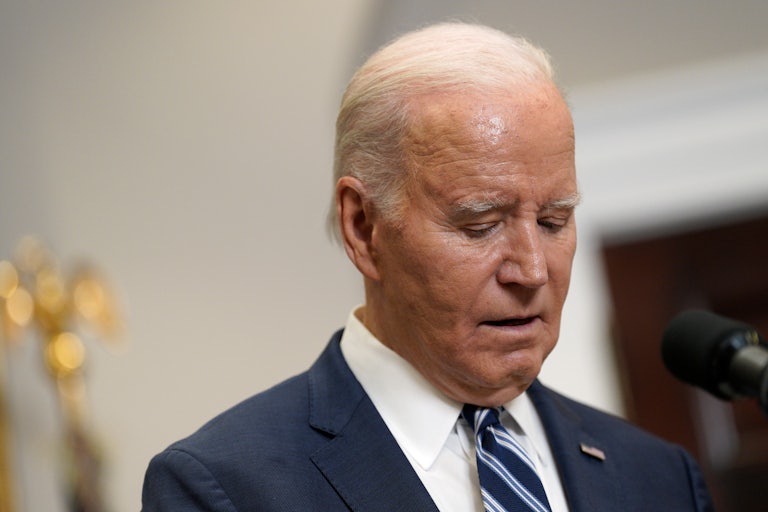
This week, Israel took hold of the Rafah border crossing in southern Gaza, a move that has stoked fears of further death and devastation in the territory. US President Joe Biden had previously warned Israeli Prime Minister Benjamin Netanyahu that an invasion of Rafah was a “red line”. The Israeli move has come as the death toll in Israel’s war on Gaza continues to mount in a war that has killed more than 34,000 Palestinians.
Meanwhile, the Biden administration faces growing internal dissent against its policies in the Middle East, most recently marked by the resignation of US Department of State Arabic language spokesperson, Hala Rharrit. Rharrit is the first career diplomat to resign publicly, protesting the government’s response to Israel’s war on Gaza.
So what effect is dissent having on US foreign policy? And is the Biden administration at a tipping point in its support of Israel’s war on Gaza?
This week on UpFront, Marc Lamont Hill speaks to Hala Rharrit about dissent within the Biden administration and the government’s foreign policy.
The Biden administration is compounding its biggest foreign policy mistake by falling into a trap that has bedeviled U.S. policymakers often in the past.
The initial mistake was embracing a dangerous, profoundly unreliable foreign leader, Benjamin Netanyahu, who heads a reckless and extremist government, as a full partner. It was a decision that any student of Netanyahu knew would end in disaster—no matter how well intentioned the impulse behind it in the wake of the October 7 terror attacks may have been.
Netanyahu is untrustworthy. He has a proven record of manipulation, deceit, and mendacity. He is a sworn enemy of peace in the region. He has treated Palestinians with disdain and disrespect ever since he entered politics. And the extremists in his coalition are even worse—rabid theocratic nationalists who believe that Israeli lives are infinitely more valuable than those of their closest neighbors.
The secondary error that the Biden team is now making is that, after the catastrophic consequences of its policy have become painfully clear, it is seeking to fix the mistake not by undoing it but by augmenting its policy with incremental measures. You can’t fine-tune a massive error into being a success. That is a lesson the United States learned in Vietnam, in Iraq, and in Afghanistan.
We say this as genuine admirers of the Biden administration’s foreign policy to date and with the greatest respect for the foreign policy judgment of Biden and his team. When Biden chose to pull out of Afghanistan, even though the exit was badly botched, we praised the decision to leave and to finally bring America’s longest war to an end. We consider the effort to engineer, finally, a real pivot in the focus and priorities of the U.S. to the Indo-Pacific region and to bolster that move with the creation of new alliances, deepened friendships, active diplomacy, and sound measures to counter Chinese competition to be one of the most important, best-executed strategic shifts in recent U.S. foreign policy history, and to be one with important benefits for the world as a whole.
Biden’s courage and leadership in the wake of Russia’s brutal, unprovoked invasion and massive escalation of its war in Ukraine is in the best tradition of American presidents. Revitalizing and expanding NATO will—unless undone by Donald Trump and the MAGA GOP—bear national security benefits for all in the Western alliance for decades to come. Biden, Vice President Kamala Harris, Secretary of State Antony Blinken, Secretary of Defense Lloyd Austin, national security adviser Jake Sullivan, Director of National Intelligence Avril Haines, CIA Director Bill Burns, and their associates are quite simply the very best, most experienced, wisest group of foreign policy and national security professionals the U.S. has seen in over three decades. They’re among the best ever.
But their Israel-Gaza policy now threatens to overshadow all of that and to become a mistake that haunts them into the pages of history.
Like many such errors, it began with a sound impulse. Israel, a close ally, had been brutally attacked. It was only natural that the U.S. would respond in their moment of need with an offer of assistance. But almost from the outset, the degree to which that assistance was offered without clear conditions opened the door for Netanyahu to take advantage of the U.S. and to do so in ways that would result in a devastating loss of innocent human life, an ever-worsening humanitarian crisis, and deep damage to America’s standing in the world and the Biden administration’s standing with millions of U.S. citizens.
While the U.S., from the outset, sought to influence Israel to take steps to reduce the loss of human life in Gaza and later actively worked to find acceptable deals for the release of hostages that might also come with some form of extended pause in the fighting, time after time its efforts were rebuffed by Netanyahu. Nevertheless, whenever he was asked, Biden asserted the U.S. would not set preconditions for aid to the Israelis. Biden administration officials regularly defended Israel’s actions even when they were clearly indefensible. And the crisis for the people of Gaza and, secondarily but nonetheless importantly, for the Biden administration grew worse with every passing day.
Within weeks, it was clear that Netanyahu would say one thing in meetings with Americans and do something else altogether. Eventually he and his supporters would make statements that flew directly and outrageously against U.S. wishes and in opposition to American interests. They spoke about ethnically cleansing Gaza of Palestinians. They said the war would continue indefinitely. They rejected the idea of a two-state solution.
Gradually, frustration within the Biden administration began to grow. Behind the scenes, divisions hardened among senior officials about the wisdom of throwing in with Netanyahu. Anger at him rose as it became clear that he not only refused to be held accountable for the security debacle that took place under his watch but that he also saw continuing the war as the only way he could maintain power. Further, of course, there were persistent questions about Netanyahu’s motives because he was so closely aligned with Biden’s political opponents in the U.S., Donald Trump and the GOP.
The frustration came out in statements calling for Israeli restraint. The vice president made a particularly clear call for this during a trip to the region in December. During her visit, Harris articulated a U.S. vision for “postwar Gaza” and the region that was ignored, then derided by Netanyahu.
Later, the U.S. would tweak the Israelis in comparatively small ways. Biden refused to speak to the Israeli prime minister for a while. Sanctions against four Israeli West Bank “settlers” were effectively a slap on the wrist, easily ignored by Netanyahu. (We think it would have been more effective and appropriate to sanction extremist Israeli Cabinet ministers who were fomenting anti-Palestinian violence and promoting ethnic cleansing—like, for example, National Security Minister Itamar Ben Gvir or Finance Minister Bezalel Smotrich.)
But of course none of these measures worked. They did not address the core problem. The U.S. could try to cajole and persuade Netanyahu, but the two nations’ interests were not aligned from the outset, and Netanyahu had absolutely zero meaningful incentive to succumb to U.S. entreaties or admonitions. Netanyahu is a liar, a user, an exploiter, and a malignant narcissist, just like his U.S. political ally Trump. Furthermore, he seems intent on actively seeking a confrontation with President Biden to serve his political survival.
By now it should be clear that the lipstick of rhetorical admonitions did not improve the appearance of this particular pig of a gross policy miscalculation. Nonetheless, as recently as a few days ago, a senior U.S. official said to one of us that we could not be tougher with Netanyahu because we would lose our leverage with him.
What leverage? He does not listen. He has ignored much if not all of our guidance. We may have achieved minor gains on humanitarian issues but at what cost? Nearly 30,000 Palestinians are dead. More will die if a ground operation in Rafah is launched, as appears to be imminent. Tens of thousands are at risk of starvation or disease. Israel’s abuses in Gaza are among the worst we have seen in recent history—far worse in terms of civilian toll than even Russia’s war crimes in Ukraine. And all of this is, undeniably, uncomfortably and, indeed, shamefully, being enabled by the United States.
When a major mistake is made, the first step is to stop making it worse. Recognize it for what it is. And change course. For the U.S., this means being direct and open in its criticism of Netanyahu. It means Biden, who is more popular than Netanyahu in Israel, taking his message directly to the Israeli people. It means making it clear that our goal is peace and stability and that we will support it—but it means that not only is Hamas gone but that Israel and the Palestinian Authority get new leadership. It means using our diplomatic leverage to get the release of the hostages and then to declare “mission accomplished” and to take a big step back away from this conflict, turning key remaining issues over to regional partners and international institutions.
It means working with the Saudis to use the carrot of a normalization agreement to set up a plausible process toward an independent demilitarized but secure Palestinian state. In this regard, it means recognizing a Palestinian state and making work toward it a centerpiece of U.S. regional policy. It means backing international institutions capable of providing aid.
Perhaps most consequentially, it means walking back Biden’s error of saying aid to Israel would be unconditional. It must be conditional. All aid is conditional. And it is vitally important that Netanyahu understand that America is not giving him a blank check and that the U.S. will no longer underwrite activities that are contrary to our interests or in violation of international law.
(It is also essential to understand that whatever our critique of the Biden administration’s Israel-Gaza policy to date, the only hope of undoing recent mistakes and achieving positive results lies with maintaining America’s current leadership. Donald Trump, as we have both written elsewhere, would be many times worse, many times more accommodating to the extremist elements in Netanyahu’s government.)
The bond between the American and the Israeli people is and should remain unbreakable. But we should not make the mistake of confusing the Israeli people with a dangerously radical government led by an accused criminal. We must recognize—the president must recognize—that the old U.S.-Israel relationship that Biden first got to know as a young senator is a thing of the past, a Cold War relic. We must accept that if America’s goal is regional stability, there is no path to get there that does not involve dignity and self-determination for the Palestinian people. We must understand that to the world and to the rising generation of American voters, not only is this the right path, but it is one that we have strayed from for far too long.
The only way to fix a broken policy is to end it. It is time to start anew with both the U.S.-Israel relationship and with the U.S.-Palestine relationship. If this administration can do that, it can add this area of Middle East policy to its long list of foreign policy triumphs. If it cannot, it is quite possible it will haunt Biden’s legacy for many years to come.
It means working with the Saudis to use the carrot of a normalization agreement to set up a plausible process toward an independent demilitarized but secure Palestinian state. In this regard, it means recognizing a Palestinian state and making work toward it a centerpiece of U.S. regional policy. It means backing international institutions capable of providing aid.
Perhaps most consequentially, it means walking back Biden’s error of saying aid to Israel would be unconditional. It must be conditional. All aid is conditional. And it is vitally important that Netanyahu understand that America is not giving him a blank check and that the U.S. will no longer underwrite activities that are contrary to our interests or in violation of international law.
(It is also essential to understand that whatever our critique of the Biden administration’s Israel-Gaza policy to date, the only hope of undoing recent mistakes and achieving positive results lies with maintaining America’s current leadership. Donald Trump, as we have both written elsewhere, would be many times worse, many times more accommodating to the extremist elements in Netanyahu’s government.)
The bond between the American and the Israeli people is and should remain unbreakable. But we should not make the mistake of confusing the Israeli people with a dangerously radical government led by an accused criminal. We must recognize—the president must recognize—that the old U.S.-Israel relationship that Biden first got to know as a young senator is a thing of the past, a Cold War relic. We must accept that if America’s goal is regional stability, there is no path to get there that does not involve dignity and self-determination for the Palestinian people. We must understand that to the world and to the rising generation of American voters, not only is this the right path, but it is one that we have strayed from for far too long.
The only way to fix a broken policy is to end it. It is time to start anew with both the U.S.-Israel relationship and with the U.S.-Palestine relationship. If this administration can do that, it can add this area of Middle East policy to its long list of foreign policy triumphs. If it cannot, it is quite possible it will haunt Biden’s legacy for many years to come.
David Rothkopf is a former senior official in the Clinton administration who is the author of 10 books on national security and political topics and the CEO and editor-in-chief of the DSR Network, a producer of podcasts and events. He is a columnist for The Daily Beast.
Ambassador Alon Pinkas is the former consul general of Israel in New York, former chief of staff to two Israeli foreign ministers, and a member of the Israeli delegation at the Israel-Syria peace talks in 2000. He is a columnist for Haaretz.
Israeli parliament backs Netanyahu’s rejection of a Palestinian state
Lawmakers vote to support PM’s rejection of any ‘unilateral’ recognition of a Palestinian state.
PHOTO: Israeli
Prime Minister Benjamin Netanyahu says the establishment of a
Palestinian state 'would endanger the state of Israel' [Ronen
Zvulun/Reuters]
21 February 2024
AlJazeera
Israeli lawmakers have voted to back Prime Minister Benjamin
Netanyahu’s rejection of any “unilateral” recognition of a Palestinian
state as international calls have grown for the revival of Palestinian
statehood negotiations.
Wednesday’s symbolic declaration, issued during Israel’s war on Gaza,
also received backing from members of the opposition with 99 of 120
lawmakers voting in support, a Knesset spokesperson said.
The Israeli position is that any permanent accord with the
Palestinians must be reached through direct negotiations between the two
sides and not by international dictates.
That is despite Netanyahu openly stating his opposition to a
Palestinian state, and presenting himself to the Israeli public as a
bulwark against any such state. No talks on Palestinian statehood talks
have been held since 2014, when Israel refused to accept a state
encompassing all of the Palestinian territory illegally occupied by
Israel.
“The Knesset came together in an overwhelming majority against the
attempt to impose on us the establishment of a Palestinian state, which
would not only fail to bring peace but would endanger the state of
Israel,” Netanyahu said.
The vote was condemned by the Palestinian Ministry of Foreign Affairs
and Expatriates, which accused Israel of holding the rights of the
Palestinian people hostage by occupation of territories where Palestinians seek to establish a state.
“The ministry reaffirms that the State of Palestine’s full membership
in the United Nations and its recognition by other nations does not
require permission from Netanyahu,” it said in a statement.
Willem Marx, reporting from occupied East Jerusalem, said that over the
past few weeks, there have been calls from senior figures worldwide for
Palestinian statehood to be recognised as part of any long-term
agreement to bring the current bloodshed to an end.
“What we saw just a few days ago from Israel’s cabinet was a vote
that was symbolic, saying that they would reject the establishment, the
recognition of a Palestinian state if it was forced upon Israel from
outside of Israel,” Marx said, referring to the international pressure
on Israel to end its illegal occupation of Palestinian territory and
agree to a two-state solution.
“In terms of the symbolism [regarding Wednesday’s parliamentary
vote], this was designed as a message from Netanyahu, as he made clear,
to send to the world that Israelis are united on this specific issue of
Palestinian statehood being imposed upon them by external powers.”
Little progress has been made towards achieving a two-state solution –
establishing a Palestinian state in the occupied West Bank and in Gaza
alongside Israel – since the signing of the interim Oslo Accords in the
early 1990s.
Among the obstacles impeding Palestinian statehood are expanding illegal Israeli settlements
in territories Israel captured in the 1967 Arab-Israeli War. The
settlements, which in many areas cut Palestinian communities off from
each other, are regarded as a violation of international law.
The two-state solution has long been a core Western policy in the
region. Since the outbreak in October of the latest Gaza war, the United
States has been trying to promote steps towards the creation of a
Palestinian state as part of a broader Middle East deal that would
include Saudi Arabia and other Arab states officially normalising relations with Israel.
However,
many critics point out that Israel’s actions towards Palestinians –
most notably the expansion of the settlements – has made any prospect of
a sovereign Palestinian state impossible and a one-state future,
whether that be a continuation of the occupation or a state with equal
rights for all, more of a reality.
“I cannot represent
an administration that does not value all human life equally. I cannot
stay silent as this administration turns a blind eye to the atrocities
committed against innocent Palestinian lives, in what leading human
rights experts have called a genocidal campaign by the Israeli
government,” wrote Habash, who is Palestinian American and served in the administration for nearly three years."
Biden appointee resigns over president’s handling of Gaza war
Tariq Habash, an official at the Department of Education, is the second Biden official to quit over the president’s support of Israel.
A political appointee at the Department of Education announced his resignation Wednesday over the president’s handling of the Israel-Gaza war, marking the second public departure over an issue that has deeply divided the Biden administration. Tariq Habash, a special assistant who focused primarily on student loan issues and had volunteered on Biden’s 2020 presidential campaign, did not work on foreign policy matters. Yet his resignation is notable given that the administration — which has seen multiple dissent memos and open letters calling for the White House to rein in the Israeli government — has faced few resignations over the war. “I cannot represent an administration that does not value all human life equally. I cannot stay silent as this administration turns a blind eye to the atrocities committed against innocent Palestinian lives, in what leading human rights experts have called a genocidal campaign by the Israeli government,” wrote Habash, who is Palestinian American and served in the administration for nearly three years. “I cannot be quietly complicit as this administration fails to leverage its influence as Israel’s strongest ally to halt the abusive and ongoing collective punishment tactics that have cut off Palestinians in Gaza from food, water, electricity, fuel, and medical supplies, leading to widespread disease and starvation,” Habash wrote. Israel and its supporters strongly deny that its military campaign is “genocidal,” saying the large number of deaths are in part a result of Hamas’s practice of embedding its fighters amid civilians. The only other Biden administration official to publicly resign over Biden’s support of Israel so far is Josh Paul, who worked on arms transfers to foreign powers as director of congressional and public affairs at the State Department’s Bureau of Political-Military Affairs. Paul, who resigned in October, was a career official who had spent more than 11 years in his role. Habash is the first political appointee to resign over the president’s Israel policy. Biden’s unwavering embrace of Israel after Hamas militants killed 1,200 Israelis and took some 230 hostage on Oct. 7 has roiled his administration unlike any other issue during his presidency. Biden has continued to support Israel and resisted calls for a cease-fire as its retaliatory campaign in Gaza has killed more than 22,000 Palestinians, displaced more than 80 percent of the population and created a humanitarian disaster in the densely populated enclave. The president and his supporters argue that Israel had little choice but to seek to destroy Hamas after the horrific attacks and that the civilian casualties have come despite Israel’s efforts to avoid them. But a growing number of officials at all levels within the administration are upset and angry at the sheer number of Palestinian deaths, including thousands of children, though few have put their name publicly to their concerns. In an interview, Habash cited the repeated U.S. vetoes of United Nations resolutions that would have called for a cease-fire, and he denounced the “collective punishment” of Palestinians as playing a major role in his decision to resign. Those policies “make it untenable for me to stay because it means my government, the administration I’ve represented, does not view me and millions of Americans who look like me as human. That dehumanization is personal for so many of us,” Habash said. “I felt like I had an obligation to do everything I possibly could to raise alarm bells about what I believed was incorrect policy that was making the world less safe, that was destroying the lives of millions of people.” In his letter, Habash said he brought “a critical and underrepresented perspective to the ongoing work on equity and justice” as a Palestinian American. He cited his family’s Palestinian Christian roots and their displacement amid the creation of Israel in 1948 during what Palestinians call the “Nakba,” or catastrophe, saying his family has never been allowed to return to its ancestral home. “Over the last three years, the White House issued numerous press releases noting that this was the most diverse administration in history, that it reflected America. I am part of that America,” Habash wrote. Habash also said Biden’s policy was putting his reelection — and therefore the future of American democracy — at risk because so many Democratic voters, including young voters, disapprove of his handling of the war. Asked whether he would support Biden in November, Habash said, “He gets to decide if he wants to fight for my vote and the vote of millions of Americans who support peace, an immediate end to the violence and equal rights for all civilians, including Palestinians.” Israel-Gaza war An estimated 100,000 Palestinians have fled to the crowded southern Gaza city of Rafah in recent days, the U.N. humanitarian agency said. The Israel Defense Forces on Friday announced an expansion of its operations in Khan Younis. More than 20,000 people have been killed in the Gaza Strip during the war between Israel and Hamas, according to the Gaza Health Ministry. Hostages: More than 100 held in the Gaza Strip have been released. Here’s what we know about those freed by Hamas so far. Oct. 7 attack: Hamas spent more than a year planning its assault on Israel. A Washington Post video analysis shows how Hamas exploited vulnerabilities created by Israel’s reliance on technology at the “Iron Wall,” the security barrier around the Gaza Strip, to carry out the deadliest attack in Israel’s history. Stock traders earned millions of dollarsanticipating the Oct. 7 Hamas attack, a study found. Israeli-Palestinian conflict: The Hamas-controlled Gaza Strip has a complicated history. Understand what’s behind the Israel-Gaza war and read about the history of the Israeli-Palestinian conflict. ABOUT THE AUTHOR: Yasmeen Abutaleb is a White House reporter for The Washington Post. She joined The Post in 2019 as a national health policy reporter. Yasmeen co-authored the New York Times No. 1 best seller, "Nightmare Scenario: Inside the Trump Administration Response to the Pandemic that Changed History." Twitter
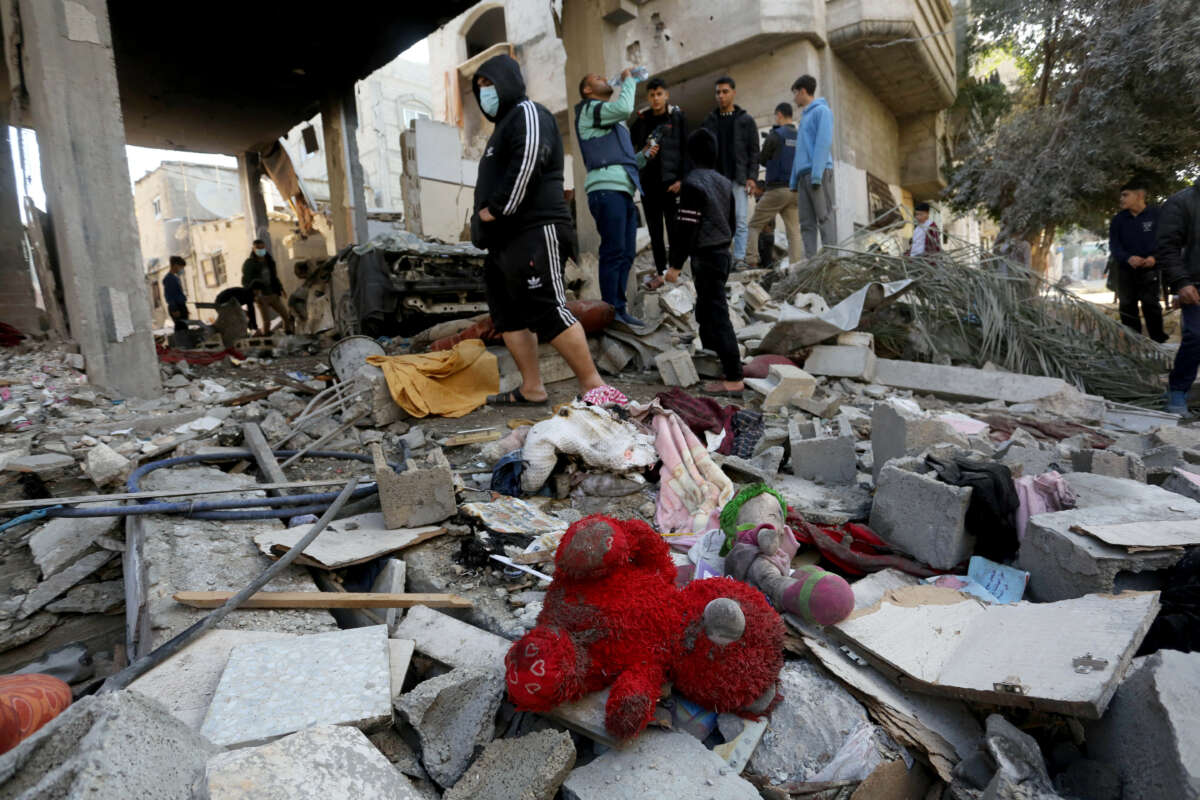
A teddy bear is seen among the rubble of an almost completely collapsed building after an Israeli attack on Nuseirat refugee camp in Deir al-Balah, Gaza, on December 30, 2023.Ashraf Amra / Anadolu via Getty Images
Citing “the urgency of Israel’s defensive needs,” the Biden administration on Friday said it would bypass Congress for the second time this month to approve an immediate arms sale to the key Middle East ally as it continues to wage a genocidal war against Gaza.
The Associated Press reported that U.S. Secretary of State Antony Blinken notified lawmakers of the new emergency determination involving the sale of $147.5 million in equipment including fuses, charges, and primers for 155mm artillery shells that Israel has already purchased from the United States.
The unguided explosive rounds — which Israel is using in heavily populated urban areas — have a “kill radius” of about 50 meters, with shrapnel able to inflict lethal wounds on people hundreds of meters away.
“The United States is committed to the security of Israel, and it is vital to U.S. national interests to ensure Israel is able to defend itself against the threats it faces,” the State Department explained.
The move follows a similar State Department determination on December 9, which expedited 13,000 rounds of tank ammunition to the Israel Defense Forces (IDF), whose troops have killed and maimed more than 80,000 Palestinians — mostly women, children, and elders — during 84 days of near-relentless attacks on Gaza.
Some of the deadliest Israeli attacks of the war have been carried out with U.S. weapons, including an October 31 airstrike with 2,000-pound bombs on the densely populated Jabalia refugee camp. More than 120 civilians were killed.
The State Department also said that “we continue to strongly emphasize to the government of Israel that they must not only comply with international humanitarian law, but also take every feasible step to prevent harm to civilians.”
Critics pushed back against that language, with Ibrahim Zabad, a professor of international relations at St. Bonaventure University in upstate New York, asserting on social media that the State Department’s move to bypass Congress “shows the U.S. administration wholeheartedly supports the mass slaughter of Palestinians, their ethnic cleansing, and the demolition of Gaza.”
British journalist Andy Worthington, known for his work chronicling the cases of Guantánamo Bay detainees, asked: “Do they think not enough Palestinian children are being orphaned or killed in Gaza?”
Eli Clifton, a senior researcher at the Quincy Institute for Responsible Statecraft, noted Blinken’s lamentation Thursday that 2023 “has been an extraordinarily dangerous year for press around the world.” Blinken’s statement did not mention the scores of journalists killed — sometimes allegedly on purpose — by Israeli troops during the war.
The U.S. already gives Israel almost $4 billion in nearly unconditional military aid each year. Since the October 7 Hamas-led attacks and Israel’s retaliatory onslaught, U.S. President Joe Biden has repeatedly affirmed his “unwavering” support for Israel. His administration has blocked multiple global cease-fire efforts at the United Nations while seeking an additional $14.3 billion in armed assistance for Israel.
While Biden recently decried Israel’s “indiscriminate bombing” of Gaza, he has refused to acknowledge what many international experts have called Israel’s genocide against the people of the besieged strip. Some activists have dubbed him “Genocide Joe.”
On Friday, South Africa filed a genocide case against Israel at the International Court of Justice.
Hundreds of rights groups and a handful of progressives in the U.S. Congress have implored the Biden administration to suspend military aid to Israel, while others including Democratic lawmakers have called for conditions to be placed on such assistance.
Earlier this month, Sen. Elizabeth Warren (D-Mass.) led a letter urging Biden to boost oversight of how American arms are used against Palestinian civilians. The letter specifically mentions 155mm artillery shells.
“The IDF has previously used these shells to hit populated areas including neighborhoods, hospitals, schools, shelters, and safe zones, causing a staggering number of civilian deaths,” the senators noted.
According to a Quinnipiac University poll published on December 20, less than half of registered U.S. voters support sending military aid to Israel — an approximately 10-point decrease from the previous month.
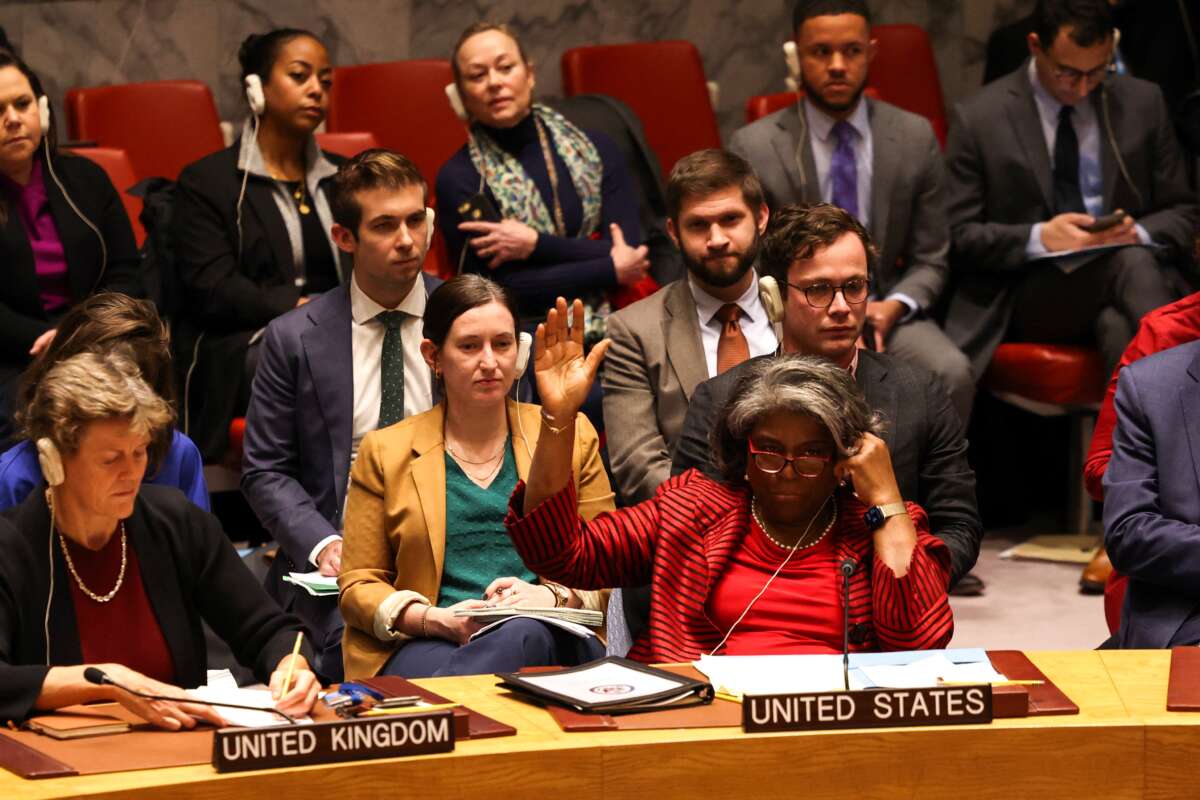
PHOTO: U.S. ambassador to the United Nations Linda Thomas-Greenfield abstains during a vote to approve a resolution calling for the "safe and unhindered delivery of humanitarian assistance at scale" in Gaza at UN headquarters in New York, on December 22, 2023. CHARLY TRIBALLEAU / AFP via Getty Images
The United States on Friday abstained from voting on a U.N. Security Council resolution that it repeatedly stonewalled and lobbied to weaken in the face of intense international opposition as Israeli forces continue to kill hundreds of Palestinians daily.
The newly passed resolution — which was introduced by the United Arab Emirates — calls for “urgent and extended humanitarian pauses and corridors throughout the Gaza Strip for a sufficient number of days to enable full, rapid, safe, and unhindered humanitarian access.”
Thirteen Security Council members voted in favor of the resolution. Russia joined the U.S. in abstaining.
The resolutioncalls for “urgent steps… for creating the conditions for a sustainable cessation of hostilities,” language that’s weaker than an earlier draft’s call for an “urgent and sustainable cessation of hostilities.”
Also removed from the final version was language condemning Israel’s indiscriminate attacks on Palestinian civilians, tens of thousands of whom have been killed, wounded, or left missing during 77 days of Israeli onslaught.
The vote came just after Russia proposed an amendment that would have restored language calling for an “immediate cessation of hostilities” to the resolution. The U.S. vetoed the amendment.
Earlier this month, the U.S. vetoed a separate Security Council resolution calling for a Gaza cease-fire. That resolution was later approved by the U.N. General Assembly in a 153-10 vote.
“It is disgraceful that the U.S. was able to stall and use the threat of its veto power to force the U.N. Security Council to weaken a much-needed call for an immediate end to attacks by all parties,” Amnesty International secretary-general Agnès Callamard said in a statement.
“This is a much-needed resolution — all efforts to address the unprecedented humanitarian catastrophe in Gaza must be welcomed — but it remains woefully insufficient in the face of the ongoing carnage and extensive destruction wrought by the government of Israel’s attacks in the occupied Gaza Strip,” Callamard continued. “Nothing short of an immediate cease-fire is enough to alleviate the mass civilian suffering we are witnessing.”
“Given the staggering death toll — with more than 20,000 killed in over two months — and the horrifying scale of destruction and devastation in Gaza, this is simply unacceptable,” she added.
In a statement giving a “qualified welcome” to the resolution, Mary Robinson — a former U.N. high commissioner for human rights and Irish president who currently chairs The Elders — said: “Agreement on this weak and overdue U.N. Security Council resolution is better than another U.S. veto. But the test of the resolution’s success will be how many lives are saved.”
“The people of Gaza are facing starvation: they need food, not words,” she added. “Neither Hamas nor Israel have complied with the previous resolution agreed last month. If the Security Council is to be credible, its members must push harder for implementation of its decisions.”
Lamenting that the resolution “became increasingly meaningless” as U.S. President Joe Biden “managed to delete the call for suspension of hostilities,” Trita Parsi, co-founder and executive vice president of the Quincy Institute for Responsible Statecraft, said on social media Friday that “Biden’s changes will help ensure that Israel’s slaughter in Gaza continues while minimizing the U.N.’s insight into what increasingly appears to be a genocide.”
“Biden is effectively running war crimes management for Israel,” he added.
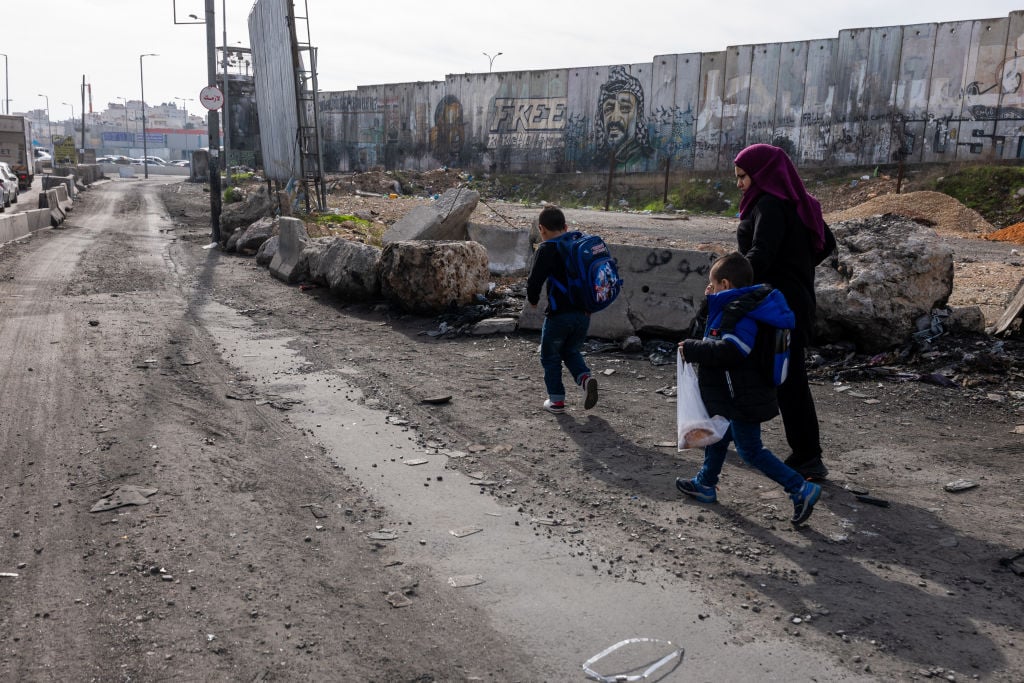
A
family walks to a checkpoint to enter Israel at the Qalandia checkpoint
outside of the city of Ramallah on December 10, 2023 in Ramallah, Palestine. Spencer Platt / Getty Images
Since the October 7 attacks by Hamas that killed 1,200 people in
Israel, the Israeli occupying forces have killed more than 17,000
Palestinians, over 7,000 of them children, and wounded more than 46,000.
Close to 1.9 million people — about 85 percent of Gaza’s population —
have been forced to flee their homes and squeeze into roughly one-third
of the Gaza Strip.
The vast majority of people in Gaza have been displaced and are on the verge of starvation.
On October 13, in anticipation of its ground invasion into Gaza,
Israel ordered 1.1 million Palestinians in northern Gaza to evacuate to
the south within 24 hours. Although that was an impossible deadline to
meet, half the population of Gaza was forcibly transferred in response
to the evacuation order. Then, Israeli forces carpet-bombed the north,
striking homes and hospitals. Much of the area was reduced to rubble.
“It is inconceivable that more than half of Gaza’s population could
traverse an active war zone, without devastating humanitarian
consequences, particularly while deprived of essential supplies and
basic services,” said Paula Gaviria Betancur, special rapporteur on the human rights of internally displaced persons, on October 13.
Israel ordered Gazans in the south to evacuate on December 3. But
there is nowhere for them to go. The Israeli border crossings are closed
and the Rafah Crossing from Egypt is heavily restricted. Many people
are sleeping in the streets and on sidewalks. “Images from Gaza on
[December 3] showed plumes of dark smoke rising above a rubble-covered
landscape and bloodied children wailing in dust-covered hospital wards,”
according to a New York Times report. “Mourners stood beside rows of bodies wrapped in white sheets.”
“Under international humanitarian law, the place where you evacuate
people to must, by law have sufficient resources for their survival —
medical facilities, food and water,” said United Nations Children’s Fund
spokesman James Elder in an interview with the Times. “That
is absolutely not the case. They are these patches of barren land, they
are streets or corners or any space in a neighborhood, half-built
buildings. The common thing they have is no water, no facilities, no
shelter from cold and rain, and particularly no sanitation.”
UN Emergency Relief CoordinatorMartin Griffiths, said
the Israeli military campaign has created “apocalyptic” conditions and
ended meaningful humanitarian operations. “This is an apocalyptic
situation now, because these are the remnants of a nation being driven
into a pocket in the south,” Griffiths noted.
Forcible Transfer Is Crime Against Humanity, War Crime and Genocide
The Rome Statute
for the International Criminal Court (ICC) lists the forcible transfer
of population as a crime against humanity “when committed as part of a
widespread or systematic attack directed against any civilian
population, with knowledge of the attack.” Israeli forces have mounted a
widespread and systematic attack against the civilians in Gaza.
Forcible transfer under the Rome Statute “means forced displacement
of the persons concerned by expulsion or other coercive acts from the
area in which they are lawfully present, without grounds permitted under
international law.” There is no legal or moral justification for Israel
to forcibly displace 85 percent of the population of Gaza.
The Rome Statute also classifies the “transfer of all or parts of the
population of the occupied territory within or outside this territory”
as a war crime.
Moreover, forcible transfer may constitute the crime of genocide under the Rome Statute. Consistent with the Genocide Convention,
the Rome Statute classifies “Deliberately inflicting on the group
conditions of life calculated to bring about its physical destruction in
whole or in part” as genocide when done with genocidal intent.
Numerous statements by Israeli officials have demonstrated their intent to commit genocide by ethnically cleansing all or part of the population of Gaza. They have vowed to “eliminate everything in Gaza” and turn it into “a city of tents.”
The Rome Statute also considers the crime of extermination to be a
crime against humanity “when committed as part of a widespread or
systematic attack directed against any civilian population, with
knowledge of the attack.” Extermination, according to the statute,
“includes the intentional infliction of conditions of life … the
deprivation of access to food and medicine, calculated to bring about
the destruction of part of a population.” On October 9, the Israeli
government escalated its 16-year siege of Gaza to a “complete siege,” slaughtering civilians and cutting off their food, water, fuel and electricity.
Nakba 2.0
In 1948, Israel carried out the Nakba (or “catastrophe”), a violent
campaign of ethnic cleansing of 750,000 Palestinians from their land in
order to create the state of Israel. Mass atrocities and dozens of
massacres killed roughly 15,000 Palestinians. The Nakba caused the
forced displacement of 85 percent of the Palestinian population.
Israel is reprising the Nakba of 75 years ago. “We are now rolling
out the Gaza Nakba,” Israeli security cabinet member and Minister of
Agriculture Avi Dichter declared on November 11. “Gaza Nakba 2023. That’s how it will end.”
Today’s Nakba has already surpassed the 1948 ethnic cleansing of
Palestine, with 85 percent of Gazans displaced and more than 17,000
Palestinians already killed. Israel shows no sign of ending its assault
on the Palestinian people and those numbers are rising every day.
ICC Chief Prosecutor Displays Blatant Israel Bias
The ICC has failed to meaningfully investigate Israeli leaders for their crimes under the Rome Statute.
In 2021, then-ICC Chief Prosecutor Fatou Bensouda, announced
the opening of a formal investigation into war crimes committed in the
West Bank, including East Jerusalem, and the Gaza Strip, during and
since “Operation Protective Edge,” Israel’s 2014 assault on Gaza which
killed 2,251 Palestinians.
After conducting a five-year preliminary examination, Bensouda had found a reasonable basis
to believe that Israeli officials had committed the war crimes of
willful killing, willfully causing serious injury, disproportionate use
of force and transfer of Israelis into Palestinian territory. Bensouda
determined there was also a reasonable basis to investigate possible war
crimes by Palestinians, including intentional attacks against
civilians, using civilians as human shields, willful killing and
torture.
Today’s Nakba has already surpassed the 1948 ethnic cleansing of Palestine.
But in spite of the seven-year probe into “the situation in
Palestine,” the ICC has made no significant progress toward holding
Israeli leaders criminally accountable.
There is also a blatant double-standard in the ICC’s treatment of the
situations in Ukraine and Palestine. In March, one year after Russia’s
invasion of Ukraine, current ICC Chief Prosecutor Karim Khan announced that the pre-trial chamber had issued an arrest warrant for Russian President Vladimir Putin for war crimes in Ukraine.
Craig Mokhiber is a longtime
international human rights lawyer who resigned his post as director of
the New York Office of the UN High Commissioner for Human Rights due to
the UN’s failure to address what he called the “text-book case of
genocide” taking place in Gaza. He characterized the difference between the ICC’s treatment of Palestine and Ukraine as “a stunning inconsistency.”
On December 3, Khan visited Israel and Ramallah in the occupied West
Bank. He issued a statement condemning Hamas for its “egregious breach
of fundamental principles of humanity through the taking and continued
holding of children.” He also decried “the significant increase in
incidents of attacks by Israeli settlers against Palestinian civilians
in the West Bank.”
But Khan did not criticize the Israeli government for its genocide,
war crimes and crimes against humanity in Gaza, including killing
thousands of Palestinians, bombing civilian infrastructure, and forcibly
transferring (now 85 percent) of the population of Gaza.
Khan made a milquetoast statement that Israel’s response to Hamas’s
attacks is “subject to clear legal parameters that govern armed
conflict. Conflict in densely populated areas where fighters are alleged
to be unlawfully embedded in the civilian population is inherently
complex, but international humanitarian law must still apply and the
Israeli military knows the law that must be applied.”
On December 6, I joined dozens of scholars and practitioners of law, international relations and politics in signing an open letter to the ICC’s Assembly of States Parties urging them to investigate Khan’s “lack of impartiality and non-discrimination.”
We wrote that Khan’s statement “demonstrated selective application of
international criminal law, and an extralegal interpretation of its
principles.” Khan, we noted, “seems to have already concluded that
international crimes have been committed by Palestinian armed groups,
thereby undermining the fundamental rules, including on the presumption of innocence and relevant standards.”
In our letter, we pointed out that Khan used the adjective “innocent”
to describe Israeli civilians but did not use the same adjective to
refer to Palestinians, and he made no reference to the “risk of genocide
in Gaza.”
We called on the Assembly of States Parties to “ensure that the
Prosecutor disburses resources on the basis of investigative needs as
opposed to politically-motivated prioritization, and urged it to
expedite its investigation into the Situation in Palestine.”
UN Secretary General Invokes “Most Powerful Tool” in UN Charter
On December 6, UN Secretary General António Guterres sent a letter
to the Security Council urging it to declare a humanitarian ceasefire
so that “the means of survival can be restored, and humanitarian
assistance can be delivered in a safe and timely manner across the Gaza
Strip.” He said, “We cannot wait” and condemned the “appalling human
suffering, physical destruction and collective trauma across Israel and
the occupied Palestinian territories.”
Guterres invoked the rarely used Article 99 of the UN Charter which says
the secretary general “may bring to attention of the Security Council
any matter which in his opinion, may threaten the maintenance of
international peace and security.”
“The situation is fast deteriorating into a catastrophe with
potentially irreversible implications for Palestinians as a whole and
for peace and security in the region,” Guterres wrote. “Such an outcome
must be avoided at all costs.”
On December 8, the Security Council convened in response to Guterres’s entreaty. Guterres informed
the council, “There is no effective protection of civilians. The people
of Gaza are being told to move like human pinballs – ricocheting
between ever-smaller slivers of the south, without any of the basics for
survival. But nowhere in Gaza is safe.”
Guterres said, “I urge the Council to spare no effort to push for an
immediate humanitarian ceasefire, for the protection of civilians, and
for the urgent delivery of life-saving aid.”
The United States vetoed a Security Council resolution that would
have demanded an immediate humanitarian ceasefire, the protection of
Palestinian and Israeli civilians, and the immediate and unconditional
release of all hostages.
Once again, the U.S. has provided Israel with political and
diplomatic cover for its war crimes, genocide, and crimes against
humanity.
ABOUT THE AUTHOR:
Marjorie Cohn is professor emerita at Thomas Jefferson School
of Law, former president of the National Lawyers Guild, and a member of
the national advisory boards of Assange Defense and Veterans For Peace,
and the bureau of the International Association of Democratic Lawyers. She
is founding dean of the People’s Academy of International Law and the
U.S. representative to the continental advisory council of the
Association of American Jurists. Her books include Drones and Targeted Killing: Legal, Moral and Geopolitical Issues. She is co-host of “Law and Disorder” Radio.
NOTE: Video
taken from the Israel-Gaza border and Gaza's Khan Younis on Dec. 10
showed smoke billowing over the enclave as explosions were heard.
(Video: Reuters)
Israel-Gaza war live updates U.S. to sell tank ammunition to Israel; aid groups warn of mass starvation in Gaza
Updated 2 hours ago
The
Biden administration invoked an emergency declaration to bypass
congressional review and expedite the sale of $106.5 million worth of tank ammunition and related equipment to Israel, despite increasing pressure from rights groups and some Democrats as Gaza’s death toll grows. Aid groups warned that people in the Gaza Strip face mass starvation after the United States vetoed a resolution backed by the majority of the U.N. Security Council that called for a cease-fire in Gaza.
Several U.S. allies distanced themselves from the Biden administration’s decision to block the U.N. Security Council cease-fire resolution, while Israeli Prime Minister Benjamin Netanyahu said Sunday that the United States was “right and just” to exercise its veto. Washington’s envoy, Robert A. Wood, said the text was “rushed” and lacked condemnation of Hamas’s Oct. 7 attack. U.N. chief António Guterres warned Sunday that the Security Council is “paralyzed by geostrategic divisions,” severely undermining its “authority and credibility.” Palestinian Authority President Mahmoud Abbas said the U.S. veto of the cease-fire resolution made it complicit in “genocide, ethnic cleansing and war crimes.”
The Israel Defense Forces pressed on with its offensive across Gaza, claiming to strike 250 targets in the past day, including underground tunnels in Khan Younis, the largest city in southern Gaza. On Sunday, the IDF said it deployed an artillery unit inside Gaza for the first time in the war, signifying a further expansion of Israel’s military presence. The World Health Organization’s executive board adopted a resolution calling for the passage of life-saving aid inside Gaza, including the access of medical personnel. It was the first time that a resolution was adopted by consensus within the United Nations system since Oct. 7, according to the WHO. During the special session of the board, the United States had earlier said that it “can’t accept” the draft of an emergency motion and that the administration was “disappointed” that the resolution text did not mention the Hamas attack on Israel.
University of Pennsylvania President Liz Magill resigned after backlash over remarks she made at a congressional hearing about antisemitism on college campuses. Magill came under intense criticism last week after her testimony, in which she declined to state plainly that a call for genocide against Jews would violate the university’s code of conduct. At least 17,997 people have been killed in Gaza and more than 49,229 wounded since the war began, according to the Gaza Health Ministry. At least 1,200 people were killed in Israel during Hamas’s Oct. 7 attack.
U.N. chief António Guterres warned
Sunday that the Security Council is “paralyzed by geostrategic
divisions,” severely undermining its “authority and credibility.”
Palestinian Authority President Mahmoud Abbas said the U.S. veto of the cease-fire resolution made it complicit in “genocide, ethnic cleansing and war crimes.”
Protests erupt as U.S. vetoes UN ceasefire resolution in Gaza:
Public outcry follows the U.S. veto of a UN resolution calling for an immediate ceasefire in Gaza, intensifying tensions over the ongoing conflict.
U.S. Receives Backlash For Vetoing U.N. Resolution Calling for Gaza Ceasefire
U.S.
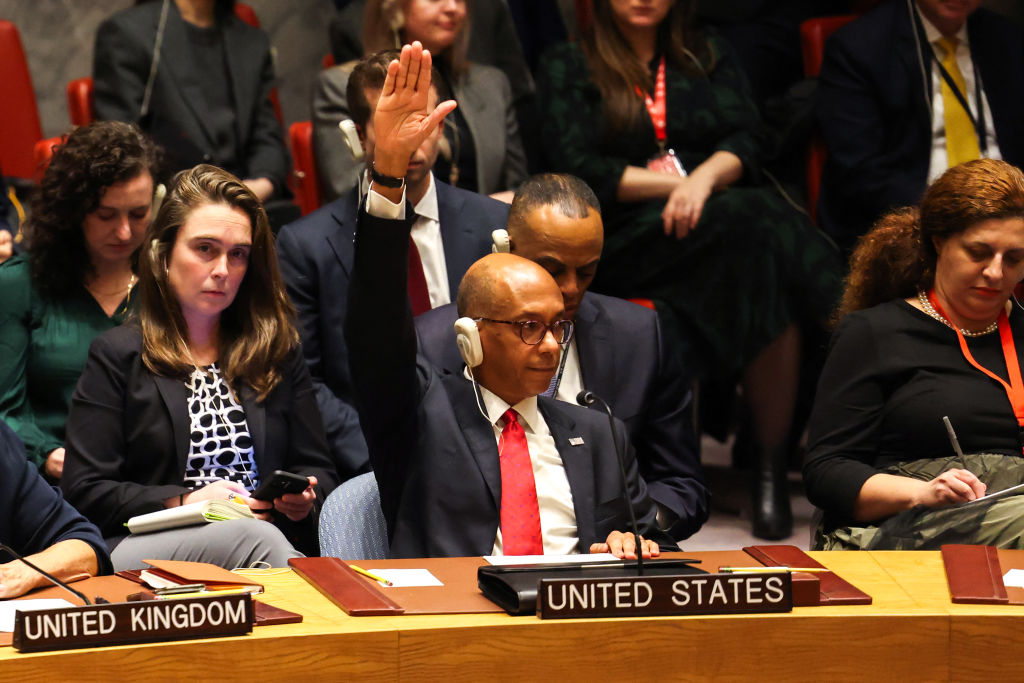
Ambassador Robert Wood raised his hand to veto a Gaza ceasefire
resolution during a U.N. Security Council meeting in New York City on
Dec. 8, 2023. Charly Triballeau—Getty Images
The U.S. is facing criticism from the Palestinian Authority that governs the West Bank, and other global leaders and organizations, after it vetoed a U.N. Security Council resolution calling for an immediate humanitarian ceasefire in the Israel-Hamas war.
The
U.S. vetoed a resolution calling for a ceasefire put forward by the
United Arab Emirates and backed by more than 90 Member States at a
meeting in New York City. Compared to 13 council members’ votes in
favor, the U.S. was the sole veto. The U.K. abstained.
The U.S. Deputy Ambassador to the United Nations Robert A. Wood told the council he
voted against an “imbalanced resolution that was divorced from reality
that would not move the needle forward on the ground in any concrete
way.”
He
said the U.S. still could not understand why the authors declined to
include language condemning “Hamas’s horrific terrorist attack” and
specifically reports of sexual violence by militants. The resolution also failed to mention Israel’s right to defend itself, Wood said.
The
U.S. proposed adding language about its role in diplomacy, increased
opportunities for humanitarian aid, encouraging the release of hostages,
the resumption of pauses in fighting and laying a foundation for peace,
but Wood said “nearly all of our recommendations were ignored.”
Earlier in the day, Wood told the council the
U.S. wants a two-state solution, but doesn’t support an immediate
ceasefire as “this would only plant the seeds for the next war—because
Hamas has no desire to see a durable peace, to see a two-state
solution.”
Israel
is not a member of the U.N. Security Council. The country’s U.N.
ambassador said in a statement after the vote that “a ceasefire will be
possible only with the return of all the hostages and the destruction of
Hamas,” the Times of Israel reported.
Hamas said in a statement on Telegram
that it strongly condemned the veto, adding “we consider the U.S.
administration to be an accomplice in the killing of our people through
its political and military support for the occupation to continue its
genocidal war on the Gaza Strip.”
“The
president has described the American position as aggressive and
immoral, a flagrant violation of all humanitarian principles and values,
and holds the United States responsible for the bloodshed of
Palestinian children, women and elderly people in the Gaza Strip,” the
statement read.
Other countries’ ambassadors also criticized the U.S. veto.
China’s representative to the U.N., Zhang Jun, called out “double
standards,” arguing it was self-contradictory to condone continued
fighting while “claiming to care about the lives and safety of people in
Gaza.”
The
Russian representative to the U.N., Dmitry Polyanskiy, claimed “our
colleagues from the U.S. have literally before our eyes issued a death
sentence to thousands if not tens of thousands more civilians in
Palestine and Israel."
Nicolas
de Rivière, the French ambassador to the U.N., said that by refusing to
unify and commit to negotiations, the council was failing its mandate
and the situation in Gaza would only worsen. France’s President Emmanuel
Macron has previously called for a ceasefire.
A
slew of global aid and human rights organizations, including Human
Rights Watch, Amnesty International, Doctors without Borders and more
similarly condemned the veto, saying it would allow death, destruction and a humanitarian disaster to continue.
Bowen: US uses veto but pressure for Gaza ceasefire is building
by Jeremy Bowen
8th December 2023
BBC International editor, Jerusalem
EPA-EFE/REX/Shutterstock
UN
secretary general António Guterres has spoken about the "serious risk
to the maintenance of international peace and security" in the Gaza
conflict, citing the spillover of hostilities in "the occupied West
Bank, Lebanon, Syria, Iraq and Yemen".
He
triggered Article 99, prompting a UN Security Council vote on Friday,
because he believes this is a very urgent matter which must be brought
to the attention of the council.
The Israeli government detests the UN and they detest the secretary general.
The
Israelis rejected his description, claiming Mr Guterres is in fact the
threat to world peace because he is pandering to Hamas by trying to end
the fighting now, before their mission to destroy the group has been
concluded.
That
ill-feeling will not have improved after the secretary general also
mentioned that one of the risks is that the situation in Gaza could get
so bad that there would be a mass displacement of Palestinians over the
border into Egypt - which is also of huge concern to the Egyptian
government.
There
was, Mr Guterres said, a high risk of the "total collapse of the
humanitarian support system in Gaza". And the Palestinians say that is
exactly what Israel wants because it wants to get all Palestinians out
of Gaza.
Journalists
are not permitted by Israel to enter Gaza so I can't report from there
myself, but what the secretary general is saying sounds pretty accurate
from the pictures and video we can see and the people we speak to.
By
all the measures you can think of, the situation there for civilians is
absolutely catastrophic, as they are subjected to a remorseless
military campaign. Israel says they are doing what they can to save
civilian lives but insists Hamas holds responsibility for using them as
human shields.
At
the UN, the Americans duly vetoed this resolution calling for a
ceasefire. For those concerned about the significant loss of life, that
does sound a bit hollow - the Americans claim the Israelis are saying
they will stick to the rules of war and avoid unnecessary civilian
deaths. But, they say, there is a gap between what Israel says and what
it does.
I
think the strategy behind the secretary general's decision to bring a
vote - which he knew would probably get vetoed - was to hurry up the
inevitable moment when the Americans will say to Israel: "Enough is
enough, you've had enough time and killed enough people and it's time
for a ceasefire."
Some
diplomats I have spoken to have said they might give the Israelis
another month - I think Mr Guterres's strategy is to try and shorten
that, partly by increasing international pressure and also partly by
shaming the Americans into thinking that they cannot continue to hold
this position as it becomes less and less tenable.
That
pressure has also increased today with the publication of footage of
prisoners in Gaza, held by the Israel Defense Forces (IDF), stripped to
their underwear and being driven away in trucks. It's a cruel image of
war seeing these men, which local reports on social media suggest could
be as many as 700.
Those
same sources, including family of some of the men, say that they were
taken from a UN school where they were sheltering, and where others
tried to get away and were killed.
A
horrendous video circulated yesterday of six people lying dead in the
street - said to be from that same area and near that same school - and
one of them was a bloody corpse lying on top of a white flag he had
apparently been carrying.
The
IDF say they are trying to work out who is a suspect and who is
responsible for those terrible attacks on 7 October - and that they are
all the while observing the international law on conflict.
But
for those who have little sympathy for what Israel is doing, or have
lost sympathy because of the level of killing that has been carried out
in Gaza, those people are saying that this is another sign of Israeli
indifference to the dignity and the health of Palestinians.
The
weather is chilly here now, so being forced to walk around in underwear
in streets, some blindfolded as we saw in the video, and some with
their hands tied behind their back, is undoubtedly unpleasant.
The Israelis say they can't avoid it - others say it's pretty savage.
Urgent need for Gaza ceasefire amid deteriorating humanitarian crisis
by
Oxfam
December 8, 2023
Residential buildings in Al Zahra City in central Gaza
were destroyed in fighting in October 2023, displacing residents of this
area.
Alef Multimedia Company/Oxfam
Civilians are confronted by continued threats from weapons, as well as starvation, thirst, and disease
Following the renewal of hostilities in Gaza
in early December, Oxfam and other humanitarian groups are expressing
concerns that the Israeli military attack in southern Gaza is causing
destruction, danger, and civilian terror and suffering at a scale that
makes any humanitarian response impossible across the entire enclave.
“Our
political leaders are failing – in abject weakness – to forge a
ceasefire, which is the only possible humanitarian action that now
really matters,” said Oxfam Humanitarian Director Marta Valdes Garcia.
Food delivery challenges
Oxfam’s
partners are confirming how dangerous conditions are in Gaza, and the
challenges they face in delivering aid to civilians. The Palestinian Agricultural Relief Committee (PARC)
working with Oxfam has procured 4,750 parcels of fresh vegetables and
fruit they are distributing to displaced families in southern Gaza.
Getting the food to people is proving challenging, says one staff person
who was able to get a message to Oxfam. “We were preparing to
distribute items in a specific street, and it was bombed. More than 130
people lost their lives, and they were just passing [in] the streets…”
The
humanitarian pause brought a short respite from airstrikes, bombs and
terror but it was never going to be enough to give trapped Palestinians
sufficient amounts of food, water, basic services, safety and hope that
they desperately needed.
As the fighting resumes, President
Biden and the US government must do all in its power to protect
civilians and bring an end to the hostilities. #Ceasefirenow
PARC is also reporting they are
working to overcome increased prices for fuel and food, and lack of
access to vegetable-producing areas in Khan Yunis, now the scene of
fighting.
“This is one of the most difficult
… wars we have experienced. If you look anywhere, you will find
displaced people, injured people, and people sleeping in the streets,
and we face many difficulties in distributing aid because there is no
safe place in Gaza. Every area can be dangerous.”
Staff from Palestinian Agricultural Relief Committee are providing packages of fresh produce for families displaced by conflict in southern Gaza. PARC/Oxfam
Gaza ceasefire necessary to deliver aid
Marta
Valdes Garcia says Oxfam is joining humanitarian groups around the
world urging “diplomatic efforts to press for a lasting ceasefire,
ensure access to humanitarian aid via Israel and Egypt to all those who
need it, and secure the release of remaining hostages.”
The
United States has an important role to play to end this conflict, says
Oxfam’s America’s Associate Director of Peace and Security Scott Paul.
“President Biden and the US government must do all in its power to
protect civilians and ultimately bring an end to the hostilities,” he
says. “US officials have specifically demanded that there be no area
bombardment, no forced displacement, the continued flow of significant
aid, no ‘safe zones’ – which, by implication, have rendered other areas
‘free fire’ zones – and, perhaps most importantly, that commercial
activity be allowed to resume. The Biden administration must make clear
that its ongoing, unlimited support for Israel is at stake.”
You can help save lives
Your contribution will help people in Gaza survive the
humanitarian crisis, and support long-term development work in more than
80 other countries.
"I'm for truth, no matter who tells it. I'm for justice, no matter who it's for or against."
W.E.B. DuBois (1868-1963)
"There is but one coward on earth, and that is the coward that dare not know."
Dr. Martin Luther King, Jr. (1929-1968)
"Change does not roll in on the wheels of inevitability, but comes through continuous struggle. And so we must straighten our backs and work for our freedom. A man can't ride you unless your back is bent. "
James Baldwin (1924-1987)
"Precisely at the point when you begin to develop a conscience you must find yourself at war with your society."
Aimé Césaire (1913-2008)
"A civilization that proves incapable of solving the problems it creates is a decadent civilization. A civilization that chooses to close its eyes to its most crucial problems is a stricken civilization. A civilization that uses its principles for trickery and deceit is a dying civilization."
Nina Simone (1933-2003)
"There's no other purpose, so far as I'm concerned, for us except to reflect the times, the situations around us and the things we're able to say through our art, the things that millions of people can't say. I think that's the function of an artist and, of course, those of us who are lucky leave a legacy so that when we're dead, we also live on. That's people like Billie Holiday and I hope that I will be that lucky, but meanwhile, the function, so far as I'm concerned, is to reflect the times, whatever that might be."
Amilcar Cabral (1924-1973)
"Always bear in mind that the people are not fighting for ideas, for the things in anyone's head. They are fighting to live better and in peace, to see their lives go forward, to guarantee the future of their children ....Hide nothing from the masses of our people. Tell no lies. Expose lies whenever they are told. Mask no difficulties, mistakes, failures. Claim no easy victories..." .
Angela Davis (b. 1944)
"The idea of freedom is inspiring. But what does it mean? If you are free in a political sense but have no food, what's that? The freedom to starve?”
Duke Ellington (1899-1974)
“Jazz is the freest musical expression we have yet seen. To me, then, jazz means simply freedom of musical speech! And it is precisely because of this freedom that so many varied forms of jazz exist. The important thing to remember, however, is that not one of these forms represents jazz by itself. Jazz simply means the freedom to have many forms.”
Amiri Baraka (1934-2014)
"Thought is more important than art. To revere art and have no understanding of the process that forces it into existence, is finally not even to understand what art is."
Frederick Douglass (1817-1895)
"Power concedes nothing without a demand. It never did and it never will. Find out just what any people will quietly submit to and you have found out the exact measure of injustice and wrong which will be imposed upon them, and these will continue till they are resisted with either words or blows, or both. The limits of tyrants are prescribed by the endurance of those whom they oppress.” --August 3, 1857
Cecil Taylor (1929-2018)
“Musical categories don’t mean anything unless we talk about the actual specific acts that people go through to make music, how one speaks, dances, dresses, moves, thinks, makes love...all these things. We begin with a sound and then say, what is the function of that sound, what is determining the procedures of that sound? Then we can talk about how it motivates or regenerates itself, and that’s where we have tradition.”
Ella Baker (1903-1986)
"Strong people don't need strong leaders"
Paul Robeson (1898-1976)
"The artist must take sides. He must elect to fight for freedom or for slavery. I have made my choice. I had no alternative."
John Coltrane (1926-1967)
"I want to be a force for real good. In other words, I know there are bad forces. I know that there are forces out here that bring suffering to others and misery to the world, but I want to be the opposite force. I want to be the force which is truly for good."
Miles Davis (1926-1991)
"Jazz is the big brother of Revolution. Revolution follows it around."
C.L.R. James (1901-1989)
"All development takes place by means of self-movement, not organization by external forces. It is within the organism itself (i.e. within the society) that there must be realized new motives, new possibilities."
Frantz Fanon (1925-1961)
"Now, political education means opening minds, awakening them, and allowing the birth of their intelligence as [Aime] Cesaire said, it is 'to invent souls.' To educate the masses politically does not mean, cannot mean, making a political speech. What it means is to try, relentlessly and passionately, to teach the masses that everything depends on them."
Edward Said (1935-2003)
“I take criticism so seriously as to believe that, even in the midst of a battle in which one is unmistakably on one side against another, there should be criticism, because there must be critical consciousness if there are to be issues, problems, values, even lives to be fought for."
Antonio Gramsci (1891-1937)
“The challenge of modernity is to live without illusions and without becoming disillusioned. There must be pessimism of the intellect and optimism of the will.”
Susan Sontag (1933-2004)
"Do stuff. Be clenched, curious. Not waiting for inspiration’s shove or society’s kiss on your forehead. Pay attention. It’s all about paying attention. Attention is vitality. It connects you with others. It makes you eager. Stay eager."
Kofi Natambu, editor of The Panopticon Review, is a writer, poet, cultural critic, and political journalist whose poetry, essays, criticism, reviews, and journalism have appeared in many literary magazines, journals, newspapers, and anthologies. He is the author of a biography MALCOLM X: His Life & Work (Alpha Books) and two books of poetry: THE MELODY NEVER STOPS (Past Tents Press) and INTERVALS (Post Aesthetic Press). He was the founder and editor of SOLID GROUND: A NEW WORLD JOURNAL, a national quarterly magazine of the arts, culture, and politics and the editor of a literary anthology NOSTALGIA FOR THE PRESENT (Post Aesthetic Press). Natambu has read his work throughout the country and given many lectures and workshops at academic and arts institutions. He has taught American literature, literary theory and criticism, cultural history and criticism, film studies, political science, creative writing, philosophy, critical theory, and music history and criticism (Jazz, Blues, R&B, Hip Hop) at many universities and colleges. He was also a curator in the Education Department of Detroit’s Museum of African American History. Born in Detroit, Michigan, Natambu currently lives in Berkeley, California with his wife Chuleenan.