Showing posts with label Public education. Show all posts

Saturday, March 16, 2024

The Fundamental Crisis and Foundational Contradiction Facing the United States During the Upcoming Presidential Election Year of 2024: Fascism guided, informed, and enabled by the Doctrines and Practices of White Supremacy and Global Capitalism--PART 22

https://www.nytimes.com/2024/03/13/magazine/nikole-hannah-jones-colorblind-racial-justice.html

Five Takeaways From Nikole Hannah-Jones’s Essay on the ‘Colorblindness’ Trap

How a 50-year campaign has undermined the progress of the civil rights movement.

PHOTO:  Credit:  Shuran Huang for The New York Times
March 13, 2024
New York Times

Last June, the Supreme Court ruled that affirmative action in college admissions was not constitutional. After the decision, much of the discussion was about its impact on the complexions of college campuses. But in an essay in The Times Magazine, I argue that we were missing the much bigger and more frightening story: that the death of affirmative action marks the culmination of a radical 50-year strategy to subvert the goal of colorblindness put forth by civil rights activists, by transforming it into a means of undermining racial justice efforts in a way that will threaten our multiracial democracy.

What do I mean by this? Here are the basic points of my essay:

Conservatives are interpreting the court’s ruling broadly, and since last summer, they have used it to attack racial-justice programs outside the field of higher education. Since the decision, conservative groups have filed and threatened lawsuits against a range of programs that consider race, from diversity fellowships at law firms to maternal-health programs. One such group has even challenged the medical school of Howard University, one of the nation’s pre-eminent historically Black universities. Founded to educate people who had been enslaved, Howard’s mission has been to serve Black Americans who had for generations been systematically excluded from American higher education. These challenges to racial-justice programs will have a lasting impact on the nation’s ability to address the vast disparities that Black people experience.

In my essay, I demonstrate that these challenges to racial-justice programs often deploy the logic of “colorblindness,” the idea that the Constitution prohibits the use of race to distinguish citizens and that the goal of a diverse, democratic nation should be a society in which race does not determine outcomes for anyone. Civil rights leaders used the idea of colorblindness to challenge racial apartheid laws and policies, but over the last 50 years, conservatives have successfully co-opted both the rhetoric and the legal legacy of the civil rights era not to advance racial progress, but to stall it. And, I’d argue, reverse it.

Though the civil rights movement is celebrated and commemorated as a proud period in American history, it faced an immediate backlash. The progressive activists who advanced civil rights for Black Americans argued that in a society that used race against Black Americans for most of our history, colorblindness is a goal. They believed that achieving colorblindness requires race-conscious policies, such as affirmative action, that worked specifically to help Black people overcome their disadvantages in order to get to a point where race no longer hindered them. Conservatives, however, invoke the idea of colorblindness to make the case that race-conscious programs, even to help those whose race had been used against them for generations, are antithetical to the Constitution. In the affirmative-action decision, Chief Justice John G. Roberts Jr., writing for the majority, embraced this idea of colorblindness, saying: “Eliminating racial discrimination means eliminating all of it.”

But mandating colorblindness in this way erases the fact that Black Americans still suffer inequality in every measurable aspect of American life — from poverty to access to quality neighborhoods and schools to health outcomes to wealth — and that this inequality stems from centuries of oppressive race-specific laws and policies. This way of thinking about colorblindness has reached its legal apotheosis on the Roberts court, where through rulings on schools and voting the Supreme Court has helped constitutionalize a colorblindness that leaves racial disparities intact while striking down efforts to ameliorate them.

These past decisions have culminated in Students for Fair Admissions v. Harvard, which can be seen as the Supreme Court clearing the way to eliminate the last legal tools to try to level the playing field for people who descend from slavery.

Part of the issue, I argue, is that the purpose of affirmative action got muddled in the 1970s. It was originally designed to reduce the suffering and improve the material conditions of people whose ancestors had been enslaved in this country. But the Supreme Court’s decision in the 1978 Bakke case changed the legally permissible goals of affirmative action, turning it into a generalized diversity program. That has opened the door for conservatives to attack the program for focusing on superficial traits like skin color, rather than addressing affirmative action's original purpose, which was to provide redress for the disadvantages descendants of slavery experienced after generations of oppression and subordination.

When this country finally abolished slavery, it was left with a fundamental question: How does a white-majority nation, which wielded race-conscious policies and laws to enslave and oppress Black people, create a society in which race no longer matters? After the short-lived period of Reconstruction, lawmakers intent on helping those who had been enslaved become full citizens passed a slate of race-conscious laws. Even then, right at the end of slavery, the idea that this nation owed something special to those who had suffered under the singular institution of slavery faced strident opposition, and efforts at redress were killed just 12 years later with Reconstruction’s end. Instead, during the nearly 100-year period known as Jim Crow, descendants of slavery were violently subjected to a dragnet of racist laws that kept them from most opportunities and also prevented America from becoming a true democracy. During the civil rights era, when Black Americans were finally assured full legal rights of citizenship, this question once again presented itself: In order to address the disadvantage Black Americans faced, do we ignore race to eliminate its power, or do we consciously use race to undo its harms? Affirmative action and other racial-justice programs were born of that era, but now, once again, we are in a period of retrenchment and backlash that threatens the stability of our nation. My essay argues that if we are to preserve our multiracial democracy, we must find a way to address our original sin.


Nikole Hannah-Jones is a domestic correspondent for The New York Times Magazine focusing on racial injustice. Her extensive reporting in both print and radio has earned a Pulitzer Prize, National Magazine Award, Peabody and a Polk Award. 

More about Nikole Hannah-Jones


Monday, February 19, 2024

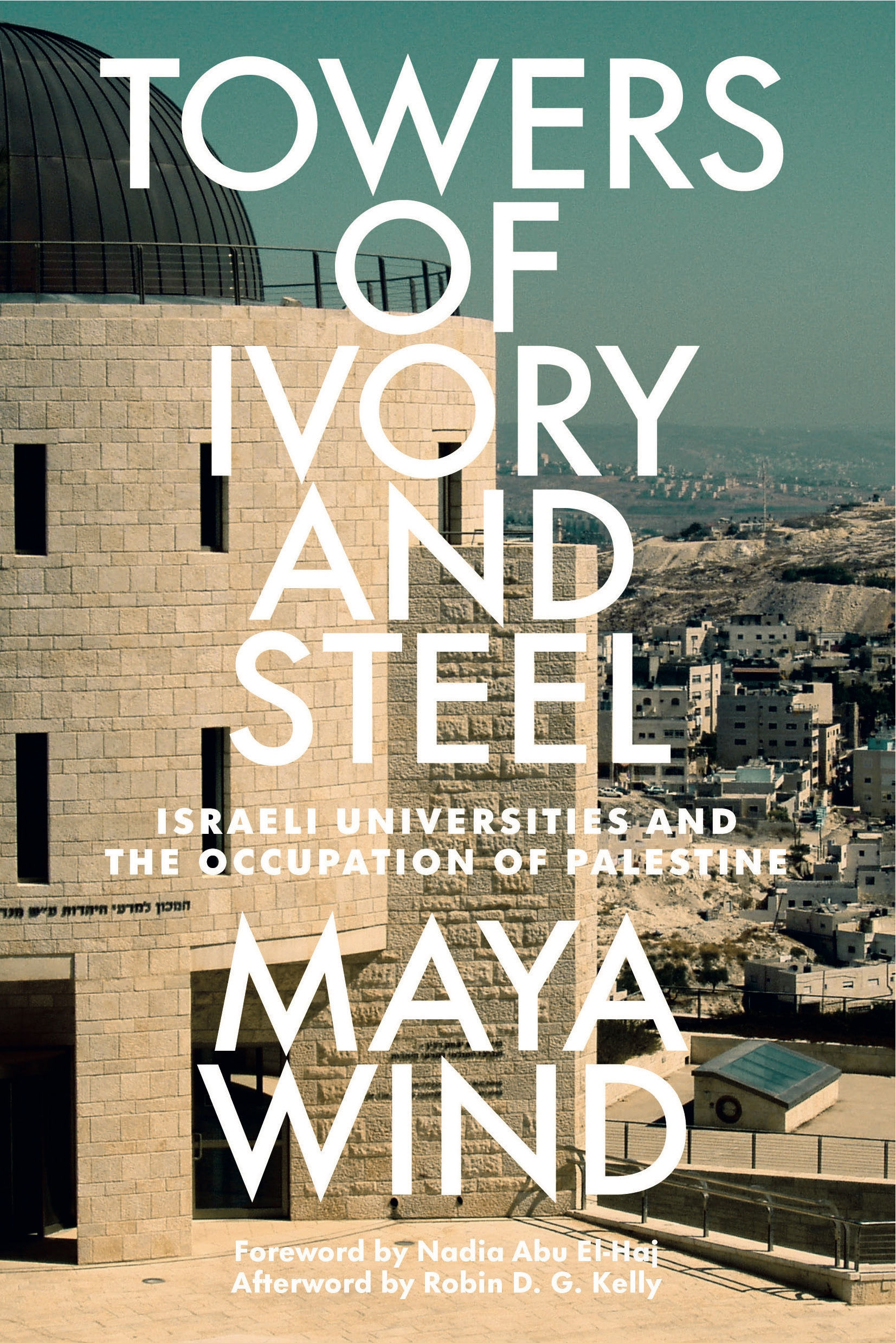
IMPORTANT NEW BOOK:

Towers of Ivory and Steel: How Israeli Universities Deny Palestinian Freedom
by Maya Wind
Verso, 2024

[Publication date:  February 13, 2024]


Foreword by Nadia Abu El-Haj
Afterword by Robin D.G. Kelley

Available now: 

https://versobooks.com/products/3009

How Israeli universities collaborate in Israeli state violence against Palestinians

Israeli universities have long enjoyed a reputation as liberal bastions of freedom and democracy. Drawing on extensive research and making Hebrew sources accessible to the international community, Maya Wind shatters this myth and documents how Israeli universities are directly complicit in the violation of Palestinian rights.

As this book shows, Israeli universities serve as pillars of Israel's system of oppression against Palestinians. Academic disciplines, degree programs, campus infrastructure, and research laboratories all service Israeli occupation and apartheid, while universities violate the rights of Palestinians to education, stifle critical scholarship, and violently repress student dissent.
Towers of Ivory and Steel is a powerful expose of Israeli academia’s ongoing and active complicity in Israel’s settler-colonial project.
 
REVIEWS:
 
"This book lands like a grenade, detonating comfortable and long held myths about the liberalism and independence of Israel’s university system. In their place, Wind’s rigorous and jaw-dropping research reveals countless ways that the nation’s most celebrated and storied education institutions are utterly entangled in the violent machinery of Palestinian dispossession, occupation, incarceration, surveillance, siege and military bombardment. From the development of deadly weapons to the crafting of state propaganda to the training of officers, there is no escaping the conclusion that these universities are part and parcel of the official infrastructure that has enabled Israel to systematically avoid the political solutions that are the only hope of enduring peace in the region. An explosive contribution from a brilliant young scholar."
—Naomi Klein, author of The Shock Doctrine and Doppelganger

"There are no ivory towers! Maya Wind brings this truth to the light with a forensic accounting of Israeli universities and their complete implication in Israel’s occupation and apartheid regime.
Towers of Ivory and Steel lays bare Israeli campuses as Jewish settlements of replacement in occupied lands, the knowledge arm for security forces and the local military industry, and as sites of Palestinian intellectual suppression, all co-signed by the “liberal silence” of Israeli academics. Fearless, emphatic, and unflinching. No other work better demonstrates why higher education remains a vital site of struggle over the future of democracy, in Israel, in Palestine, and across the world."
—Davarian L. Baldwin, author of In the Shadow of the Ivory Tower: How Universities are Plundering Our Cities

"This book is a must read — meticulously researched, lucidly written, and convincingly argued. Wind deftly illuminates the myriad ways in which the university is a site of meaningful struggle, debunking the deep-seated myths that heretofore have served to normalize Israel’s academic complex as it is part and parcel of the state’s settler colonial projects of both occupation and apartheid that violently dominate and dispossess the Palestinian people.
Towers of Ivory and Steel provides a roadmap for Israeli academics to end the institutional complicity and join the movement to remake higher education for liberation."
—J. Kehaulani Kauanui, author of Paradoxes of Hawaiian Sovereignty: Land, Sex, and the Colonial Politics of State Nationalism

"A devastating analysis of the extensive, insidious ways that the Israeli academy is central to the architecture of occupation, settler colonial violence, and repression of Palestinians. Through meticulous ethnographic and archival research, Wind not only gives lie to the claim that the Israeli academy is a bastion of academic freedom and vigorous debate. She provides a model for the decolonial work we must all do until there is freedom and liberation for all."
—Jessica Winegar, co-author with Lara Deeb of Anthropology's Politics: Disciplining the Middle East

"Drawing on Hebrew sources, Maya Wind shatters the myth of liberal expression in Israeli universities, revealing instead how they prop up apartheid."
—Rebecca Ruth Gould, New Arab

"
Towers of Ivory and Steel is a paradigm-shifting book, with incredible insider reporting that provides riveting detail of how Israeli universities serve primarily as centers of military research, propaganda, and command. A must read."
—Sarah Schulman, Bookforum
 
ABOUT THE AUTHOR:
 
Maya Wind is a scholar of Israeli expertise and militarism. She is a Killam Postdoctoral Fellow in the Department of Anthropology at the University of British Columbia.


Tuesday, January 14, 2020

Challenging American Imperialism and the Deadly Hegemonic Politics of Empire in Both Academia and the Larger Political World

https://truthout.org/…/as-tensions-with-iran-escalate-it-is…

Op-Ed
Education & Youth


As Tensions With Iran Escalate, It Is Time to Challenge Empire in the Classroom
by Shirin Vossoughi, Roozbeh Shirazi 
and Sepehr Vakil
January 13, 2020
Truthout


PHOTO: Families of children from Iran, Iraq, Syria, Palestine, Yemen, Afghanistan, Lebanon, and other parts of the region want U.S. schools to support their children by refusing narratives that normalize empire, dehumanize whole populations and pave the way for endless wars. Fat Camera / Getty Images

For educators, war is one of the most difficult topics to discuss within our classrooms. And yet, with the recent U.S. assassination of Iranian Maj. Gen. Qassim Suleimani, Iraqi senior military leader Abu Mahdi al-Muhandis and other Iraqis, the threat of imminent war is now forcefully part of the everyday thoughts of many students.

For families from Iran, Iraq, Syria, Palestine, Yemen, Afghanistan, Lebanon, and other parts of the region, the weight of these anxieties has been carried for decades.

As Iranian educators and scholars who attended U.S. public schools, and as parents of young Iranian-American children, we see an urgent need to support our young people, and to refuse narratives that normalize empire, dehumanize whole populations and thus pave the way for endless wars.

Students Carry a Heavy Burden

It is crucial for educators to acknowledge the emotional and psychological burden that Iranian, Iraqi and other Middle Eastern students are carrying, and to stand in solidarity with them. This means recognizing that when classrooms operate according to business as usual while families brace themselves for impending war, the asymmetrical violence of imperialism is normalized in the eyes of children. It means anticipating and actively working to address anti-Muslim racism and bullying — not only through supporting students targeted by such violence, but also crucially through explicit anti-racist work with those who perpetrate harm, including, at times, our fellow teachers. Every single student in our K-12 classrooms has grown up in a post-9/11 context, in which the demonization of Arab, Muslim, Iranian and South Asian communities has been taken for granted. This demonization is fueled by longstanding representations of the Middle East as inherently threatening, and of the U.S. as perpetually innocent.

Solidarity with young people also means openly discussing world events, premised on an understanding of children and youth as thinkers with agency who are actively making sense of the world. Young children in our communities are feeling the weight of stress on their parents, and learning to make sense of what these events mean for their identities and families. Our communities are also feeling enormous grief and anger in response to the tragically lethal strike by Iran of a civilian airliner carrying many Iranian students and families traveling with young children. Many students are navigating deeply complicated and emotionally laden political debates and legacies of historical trauma within their own families and communities. Educators, particularly those without roots in the region, must remember to listen and eschew simple assumptions about what “those people” think or feel about any singular political event.

Normalizing Empire

“Empire” is not part of our everyday lexicon as educators. For some, the term is at odds with the dominant image of the U.S. as a global force for good. Yet, one cannot understand the political and economic might of the U.S. without contextualizing it as a settler-colonial state, with more than 800 military bases around the world, and with a history of intervention in Latin America, Africa and Asia. To define the U.S. outside of this history is also to discount and erase the perspectives of the vast majority of the world’s population who contend with the reverberations of American power every day.

Every student in our classrooms has grown up in a post-9/11 context, in which the demonization of Arab, Muslim, Iranian and South Asian communities has been taken for granted.

Recent Iranian history provides a case in point. In 1953, the CIA worked with British intelligence to overthrow the democratically elected government of Mohammad Mossadegh, after he nationalized the Anglo-Iranian Oil Company. Nationalization upended half a century of the British taking $0.84 of every petrodollar from the sale of Iranian oil. The overthrow of Mossadegh also resulted in the U.S. reinstating Shah Mohammad Reza Pahlavi, whose rule was characterized by mass political repression, extensive corruption and widening social inequalities, culminating in the 1979 Iranian Revolution. The revolution brought about significant political changes and a break with monarchy, while enacting its own forms of social inequality and repression. For many Iranians, the U.S. support for Iraq during the subsequent Iran-Iraq War (1980-1988), its longstanding sanctions regime against Iran and recent “maximum pressure” policies constitute an enduring imperial legacy. The crisis spurred by recent U.S. assassinations also directly undermines democratic uprisings in Iran and Iraq.

For educators committed to justice, we know that our teaching cannot be ahistorical and apolitical, nor can we be silent in the face of popular struggles and vast inequities of power. Why then, do empire and militarism so often fall by the wayside in our teaching?

A formidable challenge is the myth of the U.S. as a country uniquely rooted in ideals of freedom whose military power is inherently justified. Building pedagogical space to critically engage with militarism, nationalism and empire therefore first necessitates acknowledging how deeply saturated schools are with assumptions of American goodness. We can then work with students to examine how those narratives confer or dissolve ethical obligation and humanity on different bodies.

Media representations also contribute to these challenges. On January 7, news outlets tweeted that, “Iranian missile attacks only resulted in Iraqi casualties.” Whole civics lessons and units can be constructed around the word “only.” Such hierarchies of human value are crucial teaching moments that can support students to trace the operation of white supremacy across time and place. Jim Crow laws codified a system that benefitted “only” whites, and the 1875 Page Act was “only” enforced against Chinese immigrants. Anti-immigrant narratives justify family separation at the border by arguing that they “only” affect undocumented immigrants. Analyzing such statements is a powerful way for students to understand the dehumanization words like “only” perform, and to develop a critical eye toward the workings of language.

The rise of the ethnic studies movement, as well as the development of “histories from below” offer important counternarratives to American exceptionalism by highlighting community knowledge and struggles for justice. Curricular resources can support students and teachers to critically interrogate Eurocentric understandings and essentializing representations of the Middle East and North Africa. Critical approaches to science and technology, similarly, can foreground indigenous and non-Western knowledge, and desettle hegemonic and racist representations of the world’s diverse intellectual and scientific traditions. A critical STEM education also makes visible linkages between militarism and the development of scientific and technical knowledge, including histories of resistance to the exploitation of science for war. Rather than consigning these perspectives to a standalone civics education, they ought to infuse the curriculum as a critical and ethical stance of inquiry. Indeed, the political, economic and ecological challenges of our time demand that we contend with the deeper purposes of knowledge and learning.

Educators must remember to listen and eschew simple assumptions about what “those people” think or feel about any singular political event.

There is no consensus on how to teach these issues, and the tenor of these conversations will certainly vary across settings. Some of us teach in communities where there may be vocal opposition to such approaches, and have family members or colleagues in the armed forces. Still, we must not be dissuaded from working with our students and colleagues to query their assumptions and beliefs. We may find that no one has asked them these questions before, let alone given them the space and tools to explore them. What might happen, for instance, when we contrast “MAGA” talk with the realities that the U.S. military is heavily dependent on the recruitment of low-income youth of color, and that there is a diversity of political thought among veterans? How might it impact our students to explore the lengthy history of pacifism in the United States? Muhammad Ali taught us that an anti-imperial and antiwar stance does not demonize our community members, but rather, invites the possibility of solidarities across struggles for justice.

Political Memory and Dignity

For us — the coauthors of this article — and for many children coming of age in this historical moment, the political is deeply personal.

In 1991, when the first Gulf War happened, a white male teacher pulled Roozbeh (then 13 years old) aside to ask him how he was doing. The teacher told him that if anyone said anything, to let him know, because he wanted to ensure that Roozbeh was OK. That 30-second interaction before lunch has stayed with him to this day.


The political, economic and ecological challenges of our time demand that we contend with the deeper purposes of knowledge and learning.

At the outset of the same war, Shirin’s father took her (then 11) to an antiwar march in Seattle, where protesters of different backgrounds shouted to passersby in a nearby mall, “The bombs are dropping while you’re shopping!” The current conflict may be many students’ first memory of war. Our responses shape the ethical stances they develop toward militarism, and toward the lives of those consistently treated as expendable.

During the 2003 war on Iraq, Sepehr was an undergraduate student studying engineering at UCLA. Despite the prominent presence of numerous defense companies as funders of the engineering school, their role in the profoundly immoral and deadly Iraq War was seldom mentioned. The link between scientific and technical knowledge production on the one hand, and war and militarism on other, was thus effectively obfuscated.

These memories evoke the legacies of learning environments that affirmed or diminished our personhoods, that normalized or questioned demands for war. Despite accountability pressures that increasingly narrow the profession, we understand teaching — widely defined — as a vital site of social and political possibility. Enlivening these possibilities matters most when our young people’s belonging, rights and dignity are under question, and when our politics are being reduced to binaries. Crucial to this work is a need to develop critical understandings of empire, and the ethical vision to dream beyond it.

ABOUT THE AUTHORS:

Shirin Vossoughi is an assistant professor of learning sciences in the School of Education and Social Policy at Northwestern University, where she studies the cultural, sociopolitical and ethical dimensions of human learning. Vossoughi’s research centers on formal and informal learning environments that support expansive forms of disciplinary learning and educational self-determination. Current projects include collaborative work with Iranian diaspora communities around parenting, identity and intergenerational storytelling.

Roozbeh Shirazi is an assistant professor of comparative and international education in the College of Education and Human Development at the University of Minnesota. His research examines the intersections of social inequality, formations of youth citizenship and education reform. He has conducted research and worked on educational initiatives in New York and other U.S. cities, as well as in Afghanistan and Jordan. Currently, he is working on a digital storytelling project with newcomer youth in France to explore questions and experiences of displacement, xenophobia and belonging.

Sepehr Vakil is an assistant professor of learning sciences in the School of Education and Social Policy at Northwestern University. His research examines intersections of technology, ethics, race, and identity in K-16 computer science and engineering education. In a current project, he examines the political identities of engineering students in Iran and their role in the Islamic Revolution.

PHOTO: Families of children from Iran, Iraq, Syria, Palestine, Yemen, Afghanistan, Lebanon, and other parts of the region want U.S. schools to support their children by refusing narratives that normalize empire, dehumanize whole populations and pave the way for endless wars. Fat Camera / Getty Images

Friday, January 30, 2015

Henry Giroux On Child Poverty, Massive Social and Economic Inequality, State Violence, the Relentless Attack on Public Education, and the Modern Political Economy of Capitalist Exploitation

All,

One of the most important, substantive, and prescient public intellectuals, teachers, and activists of our era is Henry Giroux who continues to not only enlighten but provide truly useful insight and clarity into what genuinely radical critical thought can and must do to fundamentally transform society, political economy, and culture on a global level in the 21st century…

Kofi   


http://www.truth-out.org/…/28721-death-dealing-politics-in-…

Death-Dealing Politics in the Age of Extreme Violence
Monday, 26 January 2015
by Henry A. Giroux, Truthout | News Analysis
Death-dealing politics in the age of extreme violence

(Image: Jared Rodriguez / Truthout)

How a society treats its children is a powerful moral and political index of its commitment to the institutions, values and principles that inform the promises of a real democracy. When measured against such criteria, it is clear that the United States has not only failed, but it is on life support. According to a report released by the Southern Education Foundation, for the first time in history, half of US public school children live in poverty, and the United States has the fourth highest child poverty rate among developed countries. Moreover, 1.3 million homeless children are enrolled in US schools, and the United States incarcerates young people at a rate and in numbers that are shameful. (1) As Jana Kasperkevic points out:

Those numbers are representative of the growing problem of child poverty in the US. Overall, one in five US children lives in poverty. It has only recently been dropping, with 14.7 million US children living in poverty in 2013, down from 16.1 million in 2012. In 2012, out of 35 economically developed countries, only Romania had a higher child poverty rate than the US. (2)

With the social contract all but dead, children no longer count for much in a society that makes virtues out of self-interest and greed, and measures success almost entirely in terms of the accumulation of capital. Under the regime of a ruthless neoliberalism, children and their working-class families have become the new casualties of a system that brazenly disdains the rule of law, compassion and a concern for others. Systemic inequality has become one of the weapons now used not only against working families and the middle class, but also in the war on youth.

When it comes to educational policy, the logic of privatization and capital accumulation is the real force at work in destroying public schools, and it's done ironically under the name of reform.

Paul Buchheit, in his piece "The Reality Tale of Two Education Systems," maps out how systemic inequality needlessly ruins the lives of millions of young people in the public school system. (3) He makes clear that public schools succeed when there are fewer children who suffer from the debilitating effects of poverty. He points to the success of schools that are adequately funded, the importance of adequate support for early childhood education and programs such as Head Start, all of which have been defunded by the new extremists and will be further defunded as long as the apostles of free-market fundamentalism are in power.

Impoverished schools are now matched by educational polices and classroom practices, such as teaching for the test, that impose on students an authoritarian regimen of repressive discipline and conformity. A pedagogy of repression that attacks unions, discredits teachers and punishes children has become the new norm in the United States, and it is backed by members of both the Democratic and Republican parties. When it comes to educational policy, the logic of privatization and capital accumulation is the real force at work in destroying public schools, and it's done ironically under the name of reform.

For instance, Ken Saltman, Diane Ravitch, Jonathan Kozol and many others have written eloquently about how both the Bush and Obama administrations have turned schools into testing and sorting factories that have little to do with learning and a great deal to do with enforcing a pedagogy of repression among students, on the one hand, and redefining schools as lucrative markets for profits, on the other. Children and the public spheres they inhabit, along with the federal programs that provide them with crucial social provisions, have become targets in the war against democracy and the public institutions that support it. Educational reform is now an extension and manifestation of a new and intensive assault being waged by the financial elite and billionaires in order to decimate all elements of the public good in order to generate new financial investments and huge profits for private investors.

One disturbing example of the sordid, ideological logic informing the crushing educational and economic policies promoted by the ethically bankrupt leaders of the US House and Senate, Rep. John Boehner (R-Ohio) and Sen. Mitch McConnell (R-Kentucky), was stated clearly when they claimed in a CBS News interview with Scott Pelley on January 22, 2015, that they were against funding President Obama's free community college program because it would increase the deficit. The appeal to austerity as a rationale to punish children, eviscerate the social state and redistribute wealth upward to rich elites has become an oft-repeated defense that serves to legitimate economic injustice and the transformation of "a world in which political economy has become a criminal economy." (4) It gets worse.

Austerity, as Guy Standing observes, also constitutes a form of "social cleansing" and "social zoning" in its passing of measures such as the closing of public libraries and schools, shutting down of affordable housing, defunding of public transportation, elimination of arts programs and elimination of sports programs for working-class kids. (5) One example of how austerity works to punish children is obvious in the recent call by Republican Gov. Sam Brownback of Kansas to make up for his crippling massive tax cuts by "cutting classroom funding for Kansas schools by $127 million and push[ing] pension fund payments off into the future." (6) Rather than acknowledge that his massive tax cuts are crippling his state's finances, he implements brutal policies that further undermine the public school system, punishing students and teachers alike. What such policies make clear is that the neoliberal support for austerity policies barely conceals a ruthless logic and a hidden structure of oppressive politics that is at the heart of the new authoritarianism.

The new extremists at various levels of political power - local, state and federal - have no trouble expanding and using the power of government to benefit the powerful and financially privileged.

Some liberals such as Paul Krugman argue that the current batch of right-wingers and Republican extremists are indifferent to reason, facts and evidence, and should rightly be viewed as reactionaries "threatened by any expansion of government." (7) This is only partly true. First, the new extremists at various levels of political power - local, state and federal - have no trouble expanding and using the power of government to benefit the powerful and financially privileged. Second, they are not simply dumb or morally vacant, though many of them appear rather thoughtless. Instead, they are pawns of corporate power and have sold themselves out to the highest bidders. Their power is dependent on doing the bidding of the billionaires such as the Koch brothers, oil companies, banks, corporations and other financial behemoths. They are not stupid; they are corrupt and this suggests less a lack of intelligence than the workings of a systemic form of predatory capitalism, which fosters iniquitous class-based relations of power that do great harm to both the US public and democracy itself. The new extremists that now control the US government are the new warriors of authoritarianism, proudly implementing the ideologies, values and policies of a failed state now in the hands of the financial ruling classes.

Painful truths about political corruption, economic injustices and the rise of the corporate state, the increasing gap between the rich and poor, and the shocking state of children in the United States are buried in the appeal to enforce savage austerity measures. Hence, it is not surprising that there is no mention among Boehner, Mitchell and their cronies about how economics and militarism now drive politics. Boehner and Mitchell are silent about how the new extremists created the deficit through tax breaks for corporations, deregulation, letting lobbyists write banking bills, the cost of two wasteful wars, pouring money into building more prisons than schools, and maintaining a nuclear arsenal and wasteful military-industrial complex at a huge cost to the American people, especially low-income youth and poor children of color. But myth making or outright lying about the politics of neoliberalism is not confined to right-wing Republicans. President Obama's self-serving claims about the economic recovery repeatedly overlook the fact that the only people who have benefited from the recovery are the Wall Street banks, the too-big-to-fail financial and corporate institutions, and the other 1% of the reigning plutocracy. As Rob Urie points out in CounterPunch, "Today, with over half of public school children now living in poverty, forty-seven million people receiving food assistance and millions of adults either unemployed or underemployed, the term 'recovery' is conspicuously unrelated to economic well-being."

Even worse, the alleged all-encompassing notion of economic recovery suggests that those Americans who have been left out of this recovery are victims of a personal failure rather than a social failure, and represent as a whole, as Urie argues, "failed 'economies of the self.'" Moreover, such policies and practices do more than blame and impose a precarious and harsh existence on young people, poor people of color, working-class people and others; they also pose a direct threat to the planet itself.

The assault on public education and low-income and poor youth of color is but one measure of the growing threat of authoritarianism in US society. Needless to say, there is more to the violence of the authoritarian state driven by financial capital than its ongoing attempts to destroy the lives and future of the majority of young people. While it is largely recognized that the United States is wedded to mass incarceration and destroying its public schools and other elements of the public good, what is often ignored is the degree to which it has become a class and racially based punishing state. Under the existing regime of market fundamentalism there has been a weakening of social values and a hardening of the culture that makes it easier to live in a world in which demonization replaces compassion, a self-righteous coldness eviscerates the radical imagination and the bonds of trust are replaced by bonds of fear.

Racism has become not simply more visible, but more violent and repulsive in its attempts to kill young black men, turn back voting rights laws and empower the police to become an occupying army in many cities.

Under such circumstances, racism has become not simply more visible, but more violent and repulsive in its attempts to kill young black men, turn back voting rights laws and empower the police to become an occupying army in many cities, willful of the fact that they can act with impunity. Militaristic violence is the new face of racism, the specter that haunts poor youth of color who are considered disposable in a society in which the flight from responsibility on the part of the financial elite is only matched by the rate in which their wealth increases yearly. As the bonds of sociality and social obligations dissolve, every human relation is measured against the yardstick of profit. Retribution and punishment now replace any vestige of restorative justice just as low-income and poor, urban youth of color are offered jail rather than a quality education and decent jobs. There is no discourse of empathy, morality and justice under the regime of neoliberal authoritarianism. Consequently, older discourses that provided a vision have not only been rendered useless, but as Hannah Arendt once argued, the very nature of the political in the modern period has been dethroned. (8)

The machinery of governance and the commanding institutions of the United States are now controlled by corporate political zombies who savor and reproduce death-dealing institutions that extend from paramilitarized local police forces to schools modeled after prisons. These are the new extremists who claim they hate big government but love big corporations, who deride the poor and slash health provisions but claim they are the new face of compassionate politics, and who turn corruption into a virtue, and honesty into a political liability. These are the extremists who support state torture, glorify militarism and are responsible for the death of millions. In a different historical period, they would have fit in well with the likes of Chile's Pinochet, apartheid South Africa, the military dictatorships in Greece and other ruthless authoritarian regimes. These people are truly the walking dead who inhabit what can only be called a world in which ethical and social responsibility has been replaced by a moral coma, a culture of fear and a politics of misery that produces a regime of violence, huge inequities in wealth and power, and a disdain for helping others, including young people. What is new about the emerging authoritarianism is that it takes ideology seriously and is marked by both a rampant and depoliticizing culture of consumerism and celebrity culture, and the rise of an expansive punishing and surveillance state. As the language of the market replaces social categories, it hides power relations while isolating people in orbits of privatization. And it is this increasing culture of atomization, privatization and reification that further erases the connected forms of social justice needed to produce a new sense of politics and collective struggle.

The consolidation of class power by the financial elite has passed into a new historical moment in US history. What most of the American public are experiencing in this new interregnum, especially those regarded as disposable, is a level of oppression, violence, poverty and loss of social provisions that seems unparalleled, especially given the grip that big money has on all the commanding institutions of American life. To claim that the United States has become an oligarchy, as a recent Princeton University study has done, is more of a subterfuge than an insight. Oligarchy sounds tame next to a savage form of free-market capitalism that operates in a field of lawlessness, extreme violence and wild justice in which a failed sociality reigns and social death and individual misery are the norm. Anything that impedes market relations is suspect and deserving of state violence. The current regime of neoliberalism acts with impunity given its ruthlessness, its moral blindness and its willingness to destroy the planet to preserve its hoarding of power and wealth. Unbridled power is indifferent to the problems of long-term unemployment, homelessness and increasing levels of poverty, and the desperate state of American youth. Moreover, the increasing manifestations of state violence mark a radical shift away from even the slightest vestige of democracy to the more prevalent use of state terrorism. The recent killings of young black people speak less to the violence of militarized local police forces then it does to the violence of a racist authoritarian state.

The war on terror has been morphed into a form of domestic terrorism aimed not only at whistleblowers, but all of those populations, from poor people of color to immigrants, who are now considered disposable.

The ongoing appeal to fear, insecurity and uncertainty by the financial elite and its corporate controlled cultural apparatuses defines the contemporary cultural zeitgeist, and its offshoot is a rise in violence and the increasing use of punitive practices in a growing number of public spheres. The war on terror has been morphed into a form of domestic terrorism aimed not only at whistleblowers, but all of those populations, from poor people of color to immigrants, who are now considered disposable. The violence of the financial state now renders entire populations disposable, that is, subject to what Richard Sennett terms the "specter of uselessness that denies gainful employment and  self-respect." Sennett calls this a "new wrinkle in neoliberal capitalism." It is also a new form of terrorism. (9)

Domestic terrorism, disposability and the criminalization of the behavior of the 99% has become the default position for all social problems. The extremists in power refuse to address social problems, regardless of how serious they are. Instead, the behaviors exhibited by people victimized and injured by such problems are criminalized. People who can't pay minor traffic fines or small debts are now put in jail; poor people of color who violate a dress code in public schools are arrested and put in police cars; the homeless are punished for sleeping in parks, and so it goes. Everyone outside of the corporate, financial and political elite is a potential enemy in the United States, and this includes not only those who are considered excess, but also those who question authority and refuse to bend to the will of the financial and politically corrupt ruling powers.

Even as more and more individuals are subject to punitive forms of punishment, financial terrorism and the suffocating tentacles of the market and surveillance state, they are led to believe that all problems come from within, and are simply a matter of character. All problems are now reduced to a matter of lifestyle and the demand that the impoverished and marginalized get up and make something of themselves. If one face of the new authoritarianism is the militarization of all aspects of society, the other side is the self-help, rabidly individualized and privatized culture that extends from Oprah Winfrey to the various screen cultures of the mainstream media. As Mark Fisher has noted, under neoliberalism's "'empire of the self' everyone is trapped in their own feelings, trapped within their own imaginations and unable to escape the tortured conditions of solipsism." (10) One distinct feature of the new authoritarianism is that it reproduces its own power and control over the US public not only through the imposition of harsh economic policies and the use of state repression, but also through powerful forms of affective management most prevalent in the wider culture.

The ideological and affective spaces produced under the new authoritarianism do not simply produce powerful myths or function as an ideological drug that legitimates the elimination of broader structural, economic and political forces; it is primarily a powerful educative force that works extremely well in depoliticizing large numbers of the US public. In part, it is central to a consumer culture marked by an endlessly repeating call to celebrate selfishness, waste and privatization. This is more than an addiction; it is a cultural and educative toxin peddled endlessly by celebrity culture, the advertising industry, mainstream media and the anti-public intellectuals who trade on other peoples' misery. Consumerism is the new religion in the United States and it promotes a swindle of fulfilment through its glitzy offering of the promise of a graveyard of rapidly disposable goods as the measure of the good life. Markets now define not only how people live but who they are. The prison house of consumption mostly succeeds at the expense of any viable notion of critical citizenship, social responsibility, and the skills and resources necessary to be an engaged individual and social agent. Of course, this is a perfect supplement to state terrorism because it replaces a therapeutic language for a political vocabulary giving rise to forms of historical and political amnesia that border on a new form of collective insanity, given the support the new extremists appear to have among the US public as they march forward with their death-dealing policies.

Politics matters when it changes the way people think, but it must do more.

While it is clear that US society is in a free fall decline as all vestiges of social and economic equality disappear, public provisions evaporate and the machinery of politics is controlled by the financial elite, what is not so clear is why these economic and political crises are rarely matched by a crisis of ideas, calls for new modes of subjectivity, a new understanding of power, and the necessity for creating new modes of resistance and a revival of a militant politics capable of fighting for a radical democracy. The interplay between the creation of authoritarian values, desires and the production of new modes of identity must be understood within the new networks that combine culture, power and what might be called neoliberal forms of public pedagogy. At stake here is the need to make the educative nature of politics central to any form of resistance that acknowledges the need to create a critical formative culture in which individuals can reimagine what a radical democracy might look like and how it might be achieved. Politics matters when it changes the way people think, but it must do more. It must not only inform, but also energize people to take collective action within deeply committed bonds of solidarity. The crisis of democracy and the slide into authoritarianism points not only to an economic crisis but also a crisis of agency, subjectivity and desire. The left needs to find ways to make education central to politics in order to take seriously any attempt to develop new historical agents and modes of collective resistance.

Democracy is dead in the United States. A new society is being constructed that no longer believes in political concessions, given its addiction to greed, power and its savage willingness to use state violence to manage its problems. The strong winds of authoritarianism are wreaking havoc all over the United States and with the new extremists now in power it is only a matter of time before "dark times" descend upon the country. And when it does, lawlessness not compassion, violence not thoughtfulness, corruption not justice will redefine US history in ways that are similar to how the reactionary revolutions of the 1930s defined that horrendous, genocidal and militarized period in history.

Let's hope that a thousand movements of resistance will flower and join together in getting rid of this neoliberal poison and modern-day prison. Jacques Derrida once referred to hope as "an unrelenting fidelity - an entrusted trace, a renewed promise and an endless responsibility before 'the ghosts of those who are not yet born or who are already dead.'" (11) It is precisely at the intersection of justice, responsibility and the civic imagination that hope inspires and energizes, serving not only as a repository of memory and moral witnessing, but as a recognition of the forces that oppress, and a realistic assessment of what it means to overcome them. In dark times, hope speaks to the need to extend the horizons of justice by both struggling against the obscene stupidity and reckless use of power that informs neoliberal capitalism, and making education central to imagining a democratic future that is worth fighting for.

Footnotes:

1. Andre Damon, "More than Half of US Public School Students Living in Poverty," Global Research (January 19, 2015). Online: http://www.globalresearch.ca/more-than-half-of-us-p…/5425563

2. Jana Kasperkevic, "More than half of US public school students live in poverty, report finds," The Guardian (January 17, 2015). Online: http://www.theguardian.com/…/public-school-students-poverty…

3. Paul Buchheit, "The Reality Tale of Two Education Systems," AlterNet (January 11, 2015). Online: http://www.alternet.org/…/reality-tale-two-education-system…

4. Cited in William Robinson, "In the Wake of Ayotzinapa, Adonde va Mexico?" Truthout (December 8, 2014). Online; http://truth-out.org/…/27862-in-the-wake-of-ayotzinapa-adon…

5. Guy Standing, The Precariat: The New Dangerous Class, (London, Bloomsbury Academic, 2011), p. 179.

6. Allan Pyke, "To Make Up For His Massive Tax Cuts, Kansas Governor Proposes Cutting Schools," Think Progress (January 22, 2015). Online: http://thinkprogress.org/…/kansas-short-term-thinking-budg…/

7. Paul Krugman, "Hating Good Government," The New York Times (January 18, 2015). Online: http://www.nytimes.com/…/paul-krugman-hating-good-governmen…

8. See: Hannah Arendt, Hannah Arendt: The Last Interview and Other Conversations, (Brooklyn, NY: Melville House Publishing, 2013), pp. 33-34.

9. See Richard Sennett's lecture on Disposable Life in the Histories of Violence Project. Online: http://historiesofviolence.com/specialseri…/disposable-life/

10. Mark Fisher, Capitalist Realism (London: Zero Books, 2009), p.74.

11. Jacques Derrida interview with Jean Birnbaum, Learning to Live Finally: The Last Interview, (New Jersey: Melville House Publishing, 2007), pp. 12-13.
Copyright, Truthout. May not be reprinted without permission of the author.
Henry A. Giroux

Henry A. Giroux currently holds the McMaster University Chair for Scholarship in the Public Interest in the English and Cultural Studies Department and a Distinguished Visiting Professorship at Ryerson University. His most recent books include: Youth in Revolt: Reclaiming a Democratic Future (Paradigm 2013), America's Educational Deficit and the War on Youth (Monthly Review Press, 2013) Neoliberalism's War on Higher Education (Haymarket Press, 2014), and The Violence of Organized Forgetting: Thinking Beyond America's Disimagination Machine (City Lights, 2014). The Toronto Star named Henry Giroux one of the 12 Canadians changing the way we think!   Giroux is also a member of Truthout's Board of Directors. His website is www.henryagiroux.com.

Related Stories:
Henry A. Giroux | Beyond the Politics of the Big Lie: The Education Deficit and the New Authoritarianism
By Henry A Giroux, Truthout | Op-Ed
Henry A. Giroux on "The Violence of Organized Forgetting"
By Victoria Harper, Truthout | Interview
Henry A. Giroux | Academic Madness and the Politics of Exile
By Henry A. Giroux, Truthout | Op-Ed
Henry A. Giroux | Barbarians at the Gates: Authoritarianism and the Assault on Public Education
By Henry A. Giroux, Truthout | News Analysis
Henry A. Giroux | Authoritarianism, Class Warfare and the Advance of Neoliberal Austerity Policies
By Henry A. Giroux, Truthout | News Analysis

Wednesday, December 31, 2014

Henry Giroux and John Logan On Public Education, Labor Unions, Neoliberalism, the Authoritarian State and the Radical Necessity of Social and Economic Democracy


Barbarians at the Gates: Authoritarianism and the Assault on Public Education

Tuesday, 30 December 2014

By Henry A. Giroux, Truthout | News Analysis
December 30, 2014
"It is impossible to understand the current assault on public education without coming to grips with the project of neoliberalism," writes Giroux. (Image via Shutterstock) 

As public schools are privatized, succumbing to corporate interests, critical thought and agency are erased, and education emphasizes market values rather than democratic ideals. The emergence of larger radical social movements depends on public education maintaining its role as a democratic sphere.

Once 2015 begins both the US Senate and House of Representatives will be controlled by the Republican Party, one of the most extremist political parties in US history. (1) Coupled with the empty centrism of the Democratic Party, their ascendency does not bode well for public education or a host of other important social issues. Nor does it bode well for democracy. If we conjured up George Orwell and his fear of state surveillance, Hannah Arendt and her claim that thoughtlessness was the foundation of totalitarianism, and Franz Kafka whose characters embodied the death of agency and the "helplessness of the living," (2) it would be difficult for these dystopian works of literary and philosophical imagination to compete with the material realization of the assault on public education and public values in the United States at the beginning of the 21st century.

These are dangerous times. Compromise and compassion are now viewed as a pathology, a blight on the very meaning of politics. Moreover, in a society controlled by financial monsters, the political order is no longer sustained by a faith in reason, critical thought and care for the other. As any vestige of critical education, thought and dissent are disparaged, the assault on reason gives way to both a crisis in agency and politics. The right-wing Republican Party and their Democratic Party counterparts, along with their corporate supporters, despise public schools as much as they disdain taxation, institutions that enable critical thinking, and any call for providing social provisions that would benefit the public good. Not only are both parties attempting to privatize much of public education in order to make schools vehicles for increasing the profits of investors, they are also destroying the critical infrastructures that sustain schools as democratic public spheres.

The educational needs of students for many Republican and Democratic Party members, pundits, lobbying groups and politicians rank low next to the financial needs of hedge fund managers.

Teachers have been deskilled. Losing much of their autonomy to be creative in the classroom, they have been relegated to technicians whose sole objective appears to be enforcing a deadening instrumental rationality in which teaching to the test becomes the primary model of teaching and learning. Moreover, they are being demonized by the claim that the major problem with public education is lack of teacher accountability. The hidden order of politics here is that larger political and economic considerations such as crushing poverty, mammoth inequality, a brutalizing racism and iniquitous modes of financing public education all disappear from the problems facing schooling in the United States. Teachers also serve as an easy target for the (un)reformers to weaken unions, bash organized labor, discredit public servants, and "argue that education can be improved if taxpayer money is funneled away from the public school system's priorities (hiring teachers, training teachers, reducing class size etc.) and into the private sector (replacing teachers with computers, replacing public schools with privately run charter schools etc.)." (3)

These policies and practices echo the principles of casino capitalism or neoliberalism and are designed to enforce a pedagogy of repression, one that kills the imagination, sanctions a deadening mode of memorization and instills in students the discipline necessary for them to accommodate willingly to existing power relations at the expense of developing their capacity to be critical and engaged agents. In this case, the aim of this pedagogy of repression mimics Hannah Arendt's claim that "The aim of totalitarian education has never been to instill convictions but to destroy the capacity to form any." (4) Public schools are also being defunded as states increasingly develop policies that drain state budgets by giving corporations substantial tax breaks. Diane Ravitch elaborates on the right-wing agenda to destroy public education, which consists of a range of groups ranging from right-wing politicians to shadowy groups such as the American Legislative Exchange Council (ALEC). She is worth quoting in full:

Since the 2010 elections, when Republicans took control of many states, there has been an explosion of legislation advancing privatization of public schools and stripping teachers of job protections and collective bargaining rights. Even some Democratic governors, seeing the strong rightward drift of our politics, have jumped on the right-wing bandwagon, seeking to remove any protection for academic freedom from public school teachers. This outburst of anti-public school, anti-teacher legislation is no accident. It is the work of a shadowy group called the American Legislative Exchange Council, or ALEC. Founded in 1973, ALEC is an organization of nearly 2,000 conservative state legislators. Its hallmark is promotion of privatization and corporate interests in every sphere, not only education, but healthcare, the environment, the economy, voting laws, public safety, etc. It drafts model legislation that conservative legislators take back to their states and introduce as their own "reform" ideas. ALEC is the guiding force behind state-level efforts to privatize public education and to turn teachers into at-will employees who may be fired for any reason. The ALEC agenda is today the "reform" agenda for education. (5)

The educational needs of students for many Republican and Democratic Party members, pundits, lobbying groups and politicians rank low next to the financial needs of hedge fund managers; the ultra-rich such as Bill Gates, the Walton family and the Koch brothers; the legislators who make up ALEC; and any number of major corporations. Individual achievement is invoked to justify education as a private right rather than as a public good. The discourses of empiricism and standardized testing become the ultimate measures of achievement just as pedagogical matters concerning civic responsibility, engaged citizenship, thoughtfulness and critical thought disappear from the vocabulary of educational reform.

Under the regime of neoliberalism, community and working together are viewed as a burden because they are at odds with the neoliberal celebration of a survival-of-the-fittest ethos. Paul Buchheit goes even further arguing that "Privatizers believe that any form of working together as a community is anti-American." (6) In this instance, the labeling of community and caring for the other as anti-American has deeper political roots. As Robert Hunsiker observes, "As for neoliberalism, its dictate of 'survival of the fittest economics' is really 'bottom-feeder economics' whereby the rich accumulate more and more and more at the expense of lower and lower and lower wages, less benefits, and crushed self-esteem. What could be worse?" (7)

Equality, justice and the search for truth no longer define the mission of public education.

Defunding for public education has gotten so out of control that, as Aaron Kase reports, one public school in Philadelphia asked parents to "chip in $613 per student just so they can open with adequate services, which if it becomes the norm, effectively defeats the purpose of equitable public education, and is entirely unreasonable to expect from the city's poorer neighborhoods." (8) Equality, justice and the search for truth no longer define the mission of public education. Economic policies that benefit the bankers, corporations and the financial elite result in massive inequities in wealth, income and power and increasingly determine how the US public views both public education and the needs of young people. As market economies are transformed into market societies, the investment in human capital such as young people has been replaced by an overdetermined emphasis on investing in economic capital. Unchecked market fundamentalism now eats its own children while destroying any viable hope they may have for being included in the social and political infrastructure of democracy and a future that benefits them. (9)

Moreover, the rights of teachers and children are more difficult to protect as unions are either dismantled or weakened by the apostles of neoliberalism and privatization. Secondary education is no longer a right but an entitlement designed mostly to benefit the children of the rich who either flee from public schools to wealthy private schools or attend public schools in wealthy communities that more often than not resemble private schools in terms of how they segregate by class and race, cater to the whims of the rich and enshrine values that are consistent with the market. Schooling for poor people and people of color defined by the school-to-prison-pipeline has come to represent an appendage of the carceral state. This is not only an attack on public education, but an attack on democracy itself. The infrastructure of education has been under assault since the 1980s with the advent of market fundamentalism in the United States and the growing disdain for the welfare state, the public good and public values. By infrastructure, I am referring to the material, financial and intellectual resources necessary for public schools to be able to function in ways that protect teacher autonomy, encourage viable unions, create a curricula that is both critical and meaningful, and produce modes of critical pedagogy that truly embrace education as the practice of freedom and young people as critical agents and engaged citizens necessary for making democracy meaningful and substantive.

The shadow of Orwell now haunts public education and democracy itself as the political defenders of torture and state surveillance take control of Congress. As lawlessness and moral depravity infect all modes of governance, the push toward treating public schools, especially in low-income neighborhoods, as prisons, and students as objects of surveillance and control has become more widespread. The presence of police, guards, cameras, and a host of surveillance and security apparatuses has turned schools into incubators for creating students willing to surrender their freedoms to the national security state. The ghost of Kafka disturbs any vision of democratic education as fear becomes the operative principle in organizing public education, especially for schools largely inhabited by poor people and people of color. For the underserved, education is designed not to inspire and energize, nor is it designed to get students to think, reflect or question. On the contrary, such schools disable the capacities of students to become knowledgeable, informed speaking agents. Instead, it relegates them to the dreary pedagogical tasks of mastering low-level skills such as memorization, a willingness to conform and a refusal to question authority. This is more than a pedagogy of repression; it is a pedagogy of helplessness that infantilizes students while dethroning any relationship between learning and social change.

Schools have become punishing factories subjecting students to zero-tolerance policies that three decades ago were only tolerated in prisons.

Schools have become punishing factories subjecting students to zero-tolerance policies that three decades ago were only tolerated in prisons. (10) Security has been turned into a police matter rather than a term that points to pedagogies, classroom policies, emotional support and modes of administration that provide spaces that dignify students, invest in their welfare, encourage them to expand their capacities for learning and embrace pedagogies that are meaningful, critical and transformative. Schools no longer are viewed as places that create dreams of greatness, extend the horizons of the imagination or point to a future that refuses to mimic the present. On the contrary, they are increasingly held hostage both to the market values embraced by the corporate and financial elite and the fundamentalist ideologies of religious conservatives. It gets worse.

Orwell's premonition about state induced surveillance and Kafka's understanding of the danger of powerlessness encouraged by regimes of fear are now matched by Arendt's warning that human subjectivity is the foundation of politics and that any threat to critical thought, especially through a culture that directs desire into the most trivial of pursuits and anti-intellectual modes of learning, is as dangerous to democracy as the heavy hand of state repression. While Arendt did not use the phrase "radical imagination" to bring home her warning about the crisis and death of critical agency, that is exactly what is being destroyed in the testing factories and penal warehouses replacing public education. As the imagination no longer becomes the subject and object of learning, thoughtlessness expands, as does the foundation for creating students more suited for a totalitarian regime than for a flourishing democracy. Totalitarian governments believe that thinking is dangerous and rightly so. As Arendt points out,

Everything which happens in thinking is subject to a critical examination of whatever there is. That is, there are no dangerous thoughts for the simple reason that thinking itself is such a dangerous enterprise. So how I can convince . . . I think, nonthinking is even more dangerous. I don't deny that thinking is dangerous, but I would say not thinking, ne pas reflechir c'est plus dangereux encore [not thinking is even more dangerous]. (11)

In the new Gilded Age with its growing economic divisions, vast punishing state, criminalization of social behaviors, and war on youth, poor people and people of color, public education is being destroyed. Against the prevailing anti-democratic reforms of the economic and religious fundamentalists, the noble belief in schools as democratic public spheres and in schooling as the center of critical thinking and learning needs to be reclaimed, struggled over and taken up as part of a larger social movement for the defense of the public good, public values and the democratic commons. It is precisely this fear of education as a building block for both critically engaged youth and a broader public and for a radical politics that inspires a great deal of fear in the billionaire, anti-public (un)reformers. (12)

Within the next decade the new extremists who now control the commanding institutions of culture, politics and economics will do everything they can to replace a weakly implemented ideal of democracy with the economic and social principles of a ruthless mode of casino capitalism, which constitutes a new form of authoritarianism. Public spheres that provide a challenge to market-driven fundamentalisms that "promote selfishness and thereby corrode both society and the moral character of individuals" will be under further assault and run the risk of disappearing altogether. (13) As selfishness and the amassing of great wealth and power are transformed by the new extremists into a civic virtue, agency itself withers, trapped within the orbits of an inward looking, privatized world.

But there is more at stake here than the collapse of public values and the destruction of a comprehensive vision of politics, largely under assault by the ongoing predatory market forces of commodification, privatization and an unchecked celebration of self-interests as the cornerstone of human agency. Racist killings, the loss of privacy, the rise of the surveillance state, growing poverty and widening inequality, the increasing corporatization of public goods, and the depleting of resources that serve the commons all point to something more than the mounting privatization and atomizing of everyday life, along with the growing militarization, spying, xenophobia, racism and other anti-democratic practices in US society.

It is impossible to understand the current assault on public education without coming to grips with the project of neoliberalism.

What unites all of these disparate issues is a growing threat of authoritarianism - or what might be otherwise called totalitarianism with elections. Neoliberal societies embrace elections because they "exclude and alienate most people from political power" and thus provide a kind of magical defense for the authoritarian project of depoliticizing the public while removing all obstacles to its goal of defending massive inequities in power, wealth and the accumulation of capital. (14) It is impossible to understand the current assault on public education without coming to grips with the project of neoliberalism and its devaluation of the social, critical agency and informed thinking as part of its attempt to consolidate class power in the hands of a largely white financial and corporate elite.

The struggle for public education as a crucial civic resource and public good must continue through the large-scale organizing of teachers and labor unions, students and groups outside of education who are also struggling against a range of injustices. The struggle over public education cannot be removed from wider struggles against student debt, funding for public goods, the elimination of massive inequalities in wealth and power, the elimination of the military-industrial-security state, the abolition of police brutality, and the eradication of the punishing-mass incarceration state, among other struggles. These struggles all share underlying interests in restoring and reclaiming a notion of radical democracy that puts power in the hands of the people rather than in the hands of the ruling elites. They also intersect around the need to elevate social needs over the narrow interests of the market and those elites who benefit from the financialization of society.

As the ruthlessness and misery produced by neoliberalism is made clear, the state resorts to increased levels of violence, often with impunity, particularly when it comes to attacking peaceful student protesters, and assaulting and often killing unarmed black men. (15) At the present moment, large-scale protests are taking place throughout the United States making clear that the public will no longer tolerate the indiscriminate killing of black men, the enforcement of racist policies across a wide social landscape, unrestrained police brutality and the continuing of widespread lawlessness that corrupts every institution - and schools in particular - that have been privatized and organized according to the narrow, if not savage and anti-democratic, interests of the market.

The ongoing protests in response to the killing of Michael Brown, in Ferguson, Missouri, Eric Garner in New York City, and 12-year-old Tamir Rice in Cleveland, Ohio, and the non-indictments of police officers who killed them, must intersect with protests over the defunding of public schools, the attack on welfare state institutions and services, the movement to save the environment, the anti-nuclear movements and a host of other isolated movements that need to join together in a new political formation capable of challenging the financial elite who have taken over the US government and all the commanding institutions of US society. The "Hands Up, Don't Shoot" and "I Can't Breathe" protests must overlap and connect with the struggle over public and higher education and the broader struggle for reclaiming a democracy that fulfills both its most radical ideals and its commitment to the common good, public values and a capacious notion of justice.

The Obama administration's educational policies have been more conservative than that of his predecessor and are based on accountability schemes that reproduce the worst of the testing craze.

The best hope for reforming public education resides in the emergence of what Stanley Aronowitz calls "disruptive social movements that operate outside of the two-party system." (16) Young people, single women, gays, students, union members, and other left groups no longer believe in either the Democratic Party or the two-party system. How else to explain their massive refusal to vote in the 2014 elections, which had the lowest voter turnout since 1943? As Aronowitz points out, for the last few decades, the Democratic Party has been particularly beholden to big money, wealthy donors and the Pentagon, and has pursued "centrist politics that allow them to follow the Republicans ever further to the right." (17) President Obama personifies the political and moral cowardice of the Democratic Party given his violation of civil liberties and civil institutions, the development of a foreign policy that amounts to a doctrine of perpetual war, and his backing of "corporate-friendly economic policies." (18) Moreover, the Obama administration's educational policies have been more conservative than that of his predecessor George W. Bush and are based on accountability schemes that reproduce the worst of the testing craze along with an aggressive approach to promoting charter schools, an attack on unions and the privatization of public education.

The current "disruptive social movements" emerging all over the country have not only opened up a national conversation about police brutality; they have also challenged the "conventional wisdom about what is possible" politically, and if these continue they could produce more far-reaching changes. (19) Both the movements against police brutality and the now largely defunct Occupy movement have provided new discursive signposts for acknowledging important social issues such as racially based police brutality and massive inequality in wealth, income and power. Central to these movements is the recognition of the educative nature of politics and the need to harness the rage of the public to points of identification that move people and indicate to them that they have the power collectively to challenge and transform the current corrupt regime of neoliberal capitalism.

These movements have created new ideological and affective spaces in which to assert the radical imagination and develop a project and politics of educated hope. Making education and the symbols of culture central to their tactics they have engaged in a war in which representations, affect, struggle and the need to produce new desires, identities, and modes of consciousness and agency matter. But they have done something more. These emerging movements are taking risks in not only confronting the raw power of state repression; they are also putting forth bold new and controversial issues such as gay marriage, the legalization of marijuana, the call for a social wage, single-payer universal health care, a shorter work week, the dismantling of the surveillance state, a new Marshall Plan for job development, free education, subsidized child care and racial justice.

Some progressives believe that one response to the extremism of the Republican Party can be found in pushing the Democratic Party to embrace more radical reforms such as gay marriage and a call for raising the minimum wage. The notion that real political, economic and social reform can be realized within the Democratic Party is more than pure fantasy; it also suffers from a form of historical amnesia that refuses to recognize that the only "reform the Democratic Party has implemented is to move more and more to the right, all in the name of a safe centrism that has marked its legacy for the last fifty years." (20)

At its best, education is dangerous because it offers young people and other actors the promise of racial and economic justice, a future in which democracy becomes inclusive and a dream in which all lives matter.

What Orwell, Arendt and Kafka have taught us is that when power is decoupled from accountability and responsibility, thoughtlessness prevails, repression increases and fear becomes the organizing principle of totalitarian societies, whatever form they may take. The legacy of fear and the lawlessness it inspires runs deep in the United States and its destructive effects are spreading into every public sphere capable of offering critical reflection on the nature of power in a society. The collapse of education into training, the loss of autonomy by teachers, the removal of the conditions that enable students to be critical and engaged citizens all speak to the character of a society in which independent thought is debased; creativity, stifled; and dissent, squelched.

We live in an age dominated by financial barbarians who are more than willing to place the vast majority of Americans in strangulating debt, low paying jobs, devastating poverty and spheres of life-threatening abjection, or, even worse, in "criminogenic ghettoes" and penal gulags. Under such circumstances, the rich commit crimes with impunity while the poor are put in jail in record numbers. Depravity and illegality feed each other as torture is defended by the political leadership as a reasonable tactic to extract crucial information from prisoners. All that stands between state terrorism and mass induced fear are informed citizens, critically educated agents and political formations willing to act with the courage necessary to think politics anew while developing innovative strategies, institutions and organizations that make it possible. Such struggles will not happen in the name of reform alone. Mass resistance to the authoritarian financial state must take place and its goal must be the dismantling of the current corrupt political system that has little to do with democracy and a great deal to do with the values, practices and policies of authoritarianism. Liberal reforms constitute a form of political regression and lack a powerful vision for challenging the corrupt and lifeless political vision produced by the regime of neoliberalism.

At the same time, the democratic institutions in which education is defined as the practice of freedom, critical learning and civic responsibility may be under siege by the lobbyists, hedge fund managers and the billionaires club, but the radical spirit of education is too powerful to be contained under state and corporate repression. The promise of educated citizens along with the enduring character of critical reflection and the search for economic, political and racial justice lives on in the demonstrations of workers, unions and young people all across the United States who are not just protesting police brutality, but also marching in order to have their voices heard as part of the promise of a radical democracy along with the arrangements that give it and them a meaningful and just life. At its best, education is dangerous because it offers young people and other actors the promise of racial and economic justice, a future in which democracy becomes inclusive and a dream in which all lives matter. Ursula K. Le Guin who was recently honored at the National Book Awards speaks about the power of books, words and artists who believe in the power of freedom, but I think her words also apply to education and other public intellectuals as well. She writes:

Books, you know, they're not just commodities. The profit motive often is in conflict with the aims of art. We live in capitalism. Its power seems inescapable. So did the divine right of kings. Any human power can be resisted and changed by human beings. Resistance and change often begin in art, and very often in our art - the art of words. I think hard times are coming when we will be wanting the voices of writers who can see alternatives to how we live now and can see through our fear-stricken society and its obsessive technologies to other ways of being, and even imagine some real grounds for hope. We will need writers who can remember freedom. Poets, visionaries - the realists of a larger reality. (21)

Le Guin's words remind us of the power of education and point indirectly to the need to resist all forms of miseducation. Miseducation breeds isolated consumerism, ignorance, militarism, a hatred of the other and indifference to the public good, and feeds a logic of disposability embraced by those who view justice and democracy as a liberal burden, if not a pathology. At its best, the critical and humane spirit of public education lives on in the future of social movements and militant labor unions willing to unify into a third party, create a new language of politics, defend those civic principles that are incompatible with casino capitalism and recognize that the most important investment a country can make is in its youth and educational institutions. The war on public education is part of the war on democracy and it is, in part, born of the legitimate fear that the emergence of larger radical social movements will depend on the development of a formative educational culture and modes of subjectivity that enable the agents for such movements. That is a concern worth nurturing and a struggle worth waging, and time is running out.

Footnotes

1. Thomas E. Mann and Norman J. Ornstein, It's Even Worse Than It Looks: How the American Constitutional System Collided With the New Politics of Extremism (New York: Basic Books, 2013).

2. Cited in Marie Luise Knott, Unlearning with Hannah Arendt, Trans by David Dollenmayer (New York: Other Press, 2013), p. 10.

3. David Sirota, "New data shows school 'reformers' are full of it," Salon, (June 3, 2013). Online: http://www.salon.com/2013/06/03/instead_of_a_war_on_teachers_how_about_one_on_poverty/

4. Hannah Arendt, "Ideology and Terror: A Novel Form of Government," The Origins of Totalitarianism, (Houghton Mifflin Harcourt, New York: 2001). pp. 468.

5. Diane Ravitch, "The People Behind the Lawmakers Out to Destroy Public Education: A Primer
What You Need To Know About ALEC," Common Dreams (May 2, 2012). Online: http://www.commondreams.org/views/2012/05/02/people-behind-lawmakers-out-destroy-public-education-primer

6. Paul Buchheit, "How Our Public Schools Became a "Communist Threat"," Common Dreams (November 18, 2013). Online: http://www.commondreams.org/views/2013/11/18/how-our-public-schools-became-communist-threat

7. Robert Hunziker, "A Neoliberal Spring?," CounterPunch (December 18, 2014.) Online: http://www.counterpunch.org/2014/12/18/a-neoliberal-spring/

8. Aaron Kase, "Public School Asks Parents to Pay $613 Per Student As Right-Wing Governor Destroys Public Education with Insane Defunding," AlterNet (August 22, 2013). Online: http://www.alternet.org/education/public-school-asks-parents-pay-613-student-right-wing-governor-destroys-public-education

9. See for instance, Roger Cohen, "'Capitalism Eating Its Children," The New York Times (May 29, 2014). Online: http://www.nytimes.com/2014/05/30/opinion/cohen-capitalism-eating-its-children.html?_r=0

10. See, for instance, the classic work on zero tolerance: William Ayers, Bernardine Dohrn and Rick Ayers, eds. Zero Tolerance: Resisting the Drive for Punishment in our Schools (New York: The New Press, 2001). See also, Annette Fuentes, Lockdown High: When the Schoolhouse Becomes a Jailhouse (New York: Verso, 2013).

11. Hannah Arendt, Hannah Arendt: The Last Interview and Other Conversations, (Brooklyn, NY: Melville House Publishing, 2013), p. 123.


12. Michael D. Yates, "Public School Teachers: New Unions, New Alliances, New Politics," Truthout, (July 24, 2013). Online:
http://truth-out.org/opinion/item/17756-public-school-teachers-new-unions-new-alliances-new-politics

13. Anita Biressi and Heather Nunn, "Selfishness in austerity times," Soundings, Issue 56, Spring 2014. p. 55.


14. Lorenzo Del Savio and Matteo Mameli, "Anti-representative democracy and oligarchic capture" Open Democracy (August 16, 2014). Online:
https://www.opendemocracy.net/lorenzo-del-savio-matteo-mameli/antirepresentative-democracy-and-oligarchic-capture

15. Robin D. G. Kelley, "Why We Won't Wait: Resisting the War Against the Black and Brown Underclass," Counterpunch (November 25, 2014). Online: http://www.counterpunch.org/2014/11/25/75039/

16. Stanley Aronowitz, "Democrats in Disarray," The Indypendent (December 16, 2014), p. 12. Online: https://www.indypendent.org/2014/12/16/democrats-disarray-donkey-can%E2%80%99t-save-our-asses

17. Ibid.

18. Ibid.

19. Ibid.

20. One recent example of this kind of pie in the sky politics can be found in Scott Galindez, "2014: The Beginning of the End for the GOP?" Reader Supported News (December 26, 2014). Online: http://readersupportednews.org/opinion2/277-75/27704-focus-2014-the-beginning-of-the-end-for-the-gop

21. Ursula K. Le Guin, "We will need writers who can remember Freedom," Speech at the 2014 National Book Awards. Online: http://parkerhiggins.net/2014/11/will-need-writers-can-remember-freedom-ursula-k-le-guin-national-book-awards/


https://www.facebook.com/pages/The-Panopticon-Review/342702882479366
 
The Five Best Labor Stories of 2014
Tuesday, 30 December 2014
By John Logan, Truthout | Op-Ed 

  
Walmart employees picket outside of the Walmart store in Pico Rivera, California on November 6, 2013. The employees accuse Walmart of continued unlawful retaliation against workers who speak out for change at the company. Some of the striking workers say that when they have come forward to call on Walmart to address issues with scheduling, wages, benefits and above all else, respect in the work place, Walmart  has reacted by retaliating against them. (Photo: UFCW International Union / Flickr)

This year has turned out to be another tough one for US workers. In particular, the results of the 2014 midterm elections, which saw the reelection of anti-union governors in Wisconsin, Michigan and Ohio, demonstrated that the attack on labor rights at the state level, which started in earnest in January 2011, has yet to run its course. Next year, more states will introduce legislation that restricts collective bargaining rights, right-to-work bills that outlaw voluntary union security agreements and "paycheck protection" bills that make it more difficult for unions to raise and spend money on politics.

But 2014 also saw several more positive developments for workers and unions that suggest that the labor movement might yet have a brighter future in the coming years. Below are five important and hopeful stories from the past 12 months.

1. The Fight for Fifteen: Nothing comes close in significance to the struggle of fast-food workers, airport workers, home-care workers and workers at federal government buildings for a minimum wage of $15 per hour. In the latest round of actions, fast-food workers and their allies held strikes and protests in at least 190 cities around the country. Prior to the first strikes in New York City two years ago, few would have taken seriously the demand for $15 per hour for McDonald's and Burger King workers. Now, not only is it taken seriously, but it has also influenced living wage battles in cities across the nation. Next year the most important labor campaign in decades will escalate its protest action.

2. OUR Walmart: Just over two years ago, Walmart workers participated in the first ever strikes in the history of the world's largest retailer. This year's Black Friday protests were the largest so far: Thousands of community allies joined workers from OUR Walmart to engage in walkouts, sit-down strikes and other protests. These actions highlighted the high cost to the public of poverty wages, poor working conditions and management retaliation. Each year, employees at Walmart, like those at McDonald's, receive billions of dollars in public assistance because their wages are so low. Workers continue to face intimidation, but the tide may be turning against billion-dollar corporations that pay poverty wages at home and abroad. Coordinated by UNI Global Union, the campaign at Walmart has a vigorous international component: Workers in Chile and South Africa have protested this month, and next year will see more protests in the United States and overseas.

3. The UAW Campaign at Volkswagen in Tennessee: In February, when the United Automobile Workers (UAW) narrowly lost a representation election at the Chattanooga plant, this campaign could easily have been remembered as one of the year's low points. After the UAW collected membership cards from a majority of workers, Tennessee's governor and senior US senator colluded with anti-union organizations to mislead and intimidate workers into voting against the union. But the UAW has rebuilt support within the plant and now at least 45 percent of the Volkswagen workers are members. The company, which has behaved in an exemplary fashion throughout, has granted it limited bargaining rights. The campaign demonstrates that if employers remain neutral and workers are free from coercion, they will choose union representation - even in the South. If McDonald's and Walmart were to behave like Volkswagen, their employees would benefit from unions, decent wages, full-time hours and respect at work.

4. The Reinvigoration of the National Labor Relations Board (NLRB): For much of the past four years, the GOP Congress, anti-union groups and big business have attempted to stop the NLRB from functioning, with considerable success. In the past few months, however, the Board has made a number of important decisions that should offer some protection to workers who want to choose a union. Earlier this month, the NLRB reissued its final rules to streamline the union certification process and get rid of the worst cases of pre-election delay. In a landmark case in December, an administrative law judge ruled that Walmart violated the law when it discriminated against protesting workers at two California stores. Most recently, the Board's general counsel ruled that McDonald's is a "joint employer" and thus responsible for the unlawful actions committed by franchise managers against workers who participated in legal strikes and protests. It's tempting to dismiss the NLRB as increasingly irrelevant, but the Board under the Obama administration has shown that it still matters and can still play a critical role in protecting workers' rights.

5. The San Francisco Retail Workers' Bill of Rights: For several years, California has bucked national trends, both in terms of maintaining union membership levels and improving labor standards. Perhaps the most significant development in the latter respect has been the enactment in December of San Francisco's "Retail Workers' Bill of Rights." The pioneering legislation provides several important benefits for tens of thousands of low-wage workers in grocery and department stores, restaurants and banks: advance notice of work schedules and estimates of how many hours they are likely to work; the posting in conspicuous places of schedules two weeks in advance; and "predictability pay" if their employer changes their schedules at short notice. Enforcement of the new law will prove challenging, but progressive lawmakers throughout the country are watching it closely, as are its opponents. The San Francisco Chamber of Commerce said that state and national chambers were extremely concerned that "what's happening in San Francisco can spread nationally." And with a bit of luck, it just well might do that.

Some commentators have suggested that the labor movement's problems have been caused by "self-sabotage," including its alleged backing for law enforcement after recent events in Ferguson, Missouri, and New York, and its support for more prisons. Such an analysis both exaggerates the influence of the labor movement - militant managers, not militant workers, have been the driving force behind the transformation of US employment relations - and misrepresents the labor movement's position on these issues, which has evolved significantly. In the wake of the killing of unarmed black men in Ferguson and New York, AFL-CIO president Rich Trumka, SEIU president Mary Kay Henry, AFT president Randi Weingarten, among others, spoke out in support of "Black Lives Matter" protests.

Trumka said: "We cannot wash our hands of these issues.... Racism is part of our inheritance as Americans. Every city, every state and every region of this country has its own deep history with racism. And so does the labor movement." Trumka, who has made confronting racism a priority, has also attacked mass incarceration, stating that we need to replace it with "mass employment," and has given it significant attention at AFL-CIO conventions. Police and prison guard unions disagree with these actions, of course, but they have seldom played well with most other unions, and should not be confused with the entire labor movement. The views of the leadership of the mainstream labor movement on race, policing and mass incarceration is now more progressive than ever before. While that is a welcome development, it will not reverse the long-term decline of unions.

"Self-sabotage," if it exists, certainly does not explain the decades-long decline in union membership. If the labor movement is to be criticized, it should be for being a little too timid for a little too long. The experience of the past few decades has demonstrated that organizing within the official NLRB system is virtually impossible, and that organizing "outside of the law" is extraordinarily difficult. Most likely, it can be done only as part of a mass movement, which is why the Fight for $15 is potentially so important. 

Next year, like 2014, will likely pose serious challenges for US workers and their organizations. But the campaigns and the policy and regulatory developments discussed above demonstrate that there's life left in the labor movement, which remains the last, best hope for reversing skyrocketing levels of economic inequality and restoring some measure of justice and decency to the US workplace.

Copyright, Truthout. May not be reprinted without permission.

John Logan is a professor and director of labor and employment studies at San Francisco State University.


Related Stories:
 
Labor Unions' Fight for the 99 Percent Goes Beyond Raising Campaign Dollars
By Sarah Jaffe, AlterNet | News Analysis
Labor Unions on the Brink
By Thom Hartmann and Sam Sacks, The Daily Take | Op-Ed
On the News With Thom Hartmann: The Importance of Labor Unions and Meaning Behind Labor Day, and More
By Thom Hartmann, The Thom Hartmann Program | Video Report
Economic Update: Labor and Unions
By Richard D. Wolff, Truthout | Radio Program
Labor Law for the 0.01%
By John Logan, Truthout | Op-Ed