[The following commentary and article was originally posted on November 9, 2016]
All,
The looming disaster of Trump's deadly new regime in all of its oppressive and totalitarian arrogance is sure to make its ominous agenda known and manifest in not only his ideological domination of the Supreme Court but in literally hundreds of federal court judicial appointments at both the federal district court and appellate court levels. The number of nominations currently awaiting Senate action is 56. There is currently one vacancy on the Supreme Court of the United States, 13 vacancies on the United States Courts of Appeals, 80 vacancies on the United States district courts, two vacancies on the United States Court of International Trade and 7 announced federal judicial vacancies before the end of Obama's second term (which officially ends on January 20, 2017).
To say this new legal and political opportunity will give Trump and his many protofascist rightwing political and judicial supporters and colleagues enormous power to immediately determine the very course and direction of American political, economic, and judicial power in the national court system for decades to come is a massive understatement. In a word as far as matters of social and economic justice at a national level are concerned we are FUCKED. In short something very vile, negligent, and cruel is coming our way and very soon.
Furthermore we as a society generally and especially as oppressed national minorities, women, and various liberal, progressive, and radically leftist tendencies alike are in for a long period of neglect, indifference, and assault by our legal and judicial institutions. This means among other things that corporate control and domination of our economy and culture will not only increase but become an even greater force for comprehensive exploitation and calculated destruction of our labor, land, and natural resources. As such massive income inequality and structural/institutional levels of discrimination and exploitation on the basis of race, class, and gender will increase exponentially across the country.
It can be safely predicted that nothing good as far as the institutional "rule of law" is concerned will come from Trump's new administration for poor, working, and middle class people and the undeniable proof will be in precisely who Trump appoints to the federal bench at both the Supreme Court and throughout the rest of the country. As usual, stay tuned...
Kofi
https://www.businessinsider.com/president-elect-donald-trum…
Home
Politics
Here's president-elect Donald Trump's list of potential Supreme Court nominees
by Jeremy Berke
November 9, 2016
Business Insider
All,
The looming disaster of Trump's deadly new regime in all of its oppressive and totalitarian arrogance is sure to make its ominous agenda known and manifest in not only his ideological domination of the Supreme Court but in literally hundreds of federal court judicial appointments at both the federal district court and appellate court levels. The number of nominations currently awaiting Senate action is 56. There is currently one vacancy on the Supreme Court of the United States, 13 vacancies on the United States Courts of Appeals, 80 vacancies on the United States district courts, two vacancies on the United States Court of International Trade and 7 announced federal judicial vacancies before the end of Obama's second term (which officially ends on January 20, 2017).
To say this new legal and political opportunity will give Trump and his many protofascist rightwing political and judicial supporters and colleagues enormous power to immediately determine the very course and direction of American political, economic, and judicial power in the national court system for decades to come is a massive understatement. In a word as far as matters of social and economic justice at a national level are concerned we are FUCKED. In short something very vile, negligent, and cruel is coming our way and very soon.
Furthermore we as a society generally and especially as oppressed national minorities, women, and various liberal, progressive, and radically leftist tendencies alike are in for a long period of neglect, indifference, and assault by our legal and judicial institutions. This means among other things that corporate control and domination of our economy and culture will not only increase but become an even greater force for comprehensive exploitation and calculated destruction of our labor, land, and natural resources. As such massive income inequality and structural/institutional levels of discrimination and exploitation on the basis of race, class, and gender will increase exponentially across the country.
It can be safely predicted that nothing good as far as the institutional "rule of law" is concerned will come from Trump's new administration for poor, working, and middle class people and the undeniable proof will be in precisely who Trump appoints to the federal bench at both the Supreme Court and throughout the rest of the country. As usual, stay tuned...
Kofi
https://www.businessinsider.com/president-elect-donald-trum…
Home
Politics
Here's president-elect Donald Trump's list of potential Supreme Court nominees
by Jeremy Berke
November 9, 2016
Business Insider
PHOTO: Donald Trump pictured at the third presidential debate at the University of Nevada Las Vegas. REUTERS/Rick Wilking
Here's president-elect Donald Trump's list of potential Supreme Court nomineesDonald Trump's list of Supreme Court nominees.
President-elect Donald Trump will likely have a huge role in shaping the composition of the Supreme Court for the next few decades.
After Senate Republicans refused to hold a hearing for Merrick Garland — President Obama's choice to replace conservative Justice Antonin Scalia — Trump will likely have the opportunity to fill at least one seat on the country's highest court.
Two liberal justices on the court, 78-year-old Stephen Breyer and 83-year-old Ruth Bader Ginsburg are also expected to retire soon.
Trump has expressed support for highly-conservative justices in the past. He's said he wants to overturn Roe v. Wade, the landmark case giving women the right to abortions, and said that the Court needs to "uphold the Second Amendment."
Trump's list of nominees contains some unusual choices, such as Utah Sen. Mike Lee. A spokesman for Lee told Politico that "Sen. Lee already has the job he wants which is why he is campaigning to represent the great people of Utah again this year."
For the most part, all of Trump's potential nominees have a history of supporting conservative issues.
Here are Donald Trump's potential Supreme Court nominees:
1. Keith Blackwell
2. Charles Canady
3. Steven Colloton
4. Allison Eid
5. Neil Gorsuch
6. Raymond Gruender
7. Thomas Hardiman
8. Raymond Kethledge
9. Joan Larsen
10. Mike Lee
11. Thomas Lee
12. Edward Mansfield
13. Federico Moreno
14. William Pryor
15. Margaret A. Ryan
16. Amul Thapar
17. Timothy Tymkovich
18. David Stras
19. Diane Sykes
20. Don Willett
21. Robert Young
ON THE HEINOUS DOCTRINE AND PRACTICE OF WHITE SUPREMACY IN THE UNITED STATES AND ITS INTEGRAL CONNECTION TO THE FERVENT RISE OF FASCIST IDEOLOGY AND BEHAVIOR IN BOTH AMERICAN SOCIETY AND THROUGHOUT THE WORLD TODAY:
White Supremacy and Sanctioned Violence in the Age of Donald Trump

“What’s Past is Prologue…”
September 14, 2017
The Panopticon Review
All,
This brilliant essay by Coates is BY FAR the best, most insightful, and most intellectually substantive as well as HONEST critical analysis of the real, actual dialectical (and dialogical) relationship between “race and class” in the United States that I’ve read in many, many years and represents the pinnacle thus far of what I’ve seen or read in print that seeks to explain what the so-called “Trump phenomenon" really is and means not only to “American politics” but U.S. society and culture writ large. The fact that Coates has a (much) more sophisticated and analytically incisive analysis of the fundamentally white supremacist roots and foundations of this current neofascist tendency than a very wide range of self identified American Marxists and other leftists (are you LISTENING Jacobin?) is an indictment of their fundamental lack of understanding of, and appreciation for, the inextricable and indissoluble links between political economy, history, philosophy, social theory, empirical reality, and strategic thought and activity in any historically materialist and/or structural analysis worth its name…Stay tuned…
Kofi
"...It is often said that Trump has no real ideology, which is not true—his ideology is white supremacy, in all its truculent and sanctimonious power. Trump inaugurated his campaign by casting himself as the defender of white maidenhood against Mexican “rapists,” only to be later alleged by multiple accusers, and by his own proud words, to be a sexual violator himself. White supremacy has always had a perverse sexual tint. Trump’s rise was shepherded by Steve Bannon, a man who mocks his white male critics as “cucks.” The word, derived from cuckold, is specifically meant to debase by fear and fantasy—the target is so weak that he would submit to the humiliation of having his white wife lie with black men. That the slur cuck casts white men as victims aligns with the dicta of whiteness, which seek to alchemize one’s profligate sins into virtue. So it was with Virginia slaveholders claiming that Britain sought to make slaves of them. So it was with marauding Klansmen organized against alleged rapes and other outrages. So it was with a candidate who called for a foreign power to hack his opponent’s email and who now, as president, is claiming to be the victim of “the single greatest witch hunt of a politician in American history.”
In Trump, white supremacists see one of their own. Only grudgingly did Trump denounce the Ku Klux Klan and David Duke, one of its former grand wizards—and after the clashes between white supremacists and counterprotesters in Charlottesville, Virginia, in August, Duke in turn praised Trump’s contentious claim that “both sides” were responsible for the violence.
Trump’s political career began in advocacy of birtherism. But long before that, he had made his worldview clear.
To Trump, whiteness is neither notional nor symbolic but is the very core of his power. In this, Trump is not singular. But whereas his forebears carried whiteness like an ancestral talisman, Trump cracked the glowing amulet open, releasing its eldritch energies. The repercussions are striking: Trump is the first president to have served in no public capacity before ascending to his perch. But more telling, Trump is also the first president to have publicly affirmed that his daughter is a “piece of ass.” The mind seizes trying to imagine a black man extolling the virtues of sexual assault on tape (“When you’re a star, they let you do it”), fending off multiple accusations of such assaults, immersed in multiple lawsuits for allegedly fraudulent business dealings, exhorting his followers to violence, and then strolling into the White House. But that is the point of white supremacy—to ensure that that which all others achieve with maximal effort, white people (particularly white men) achieve with minimal qualification. Barack Obama delivered to black people the hoary message that if they work twice as hard as white people, anything is possible. But Trump’s counter is persuasive: Work half as hard as black people, and even more is possible..."
--Ta-Nehisi Coates, "The First White President", The Atlantic, September 11, 2017
https://www.theatlantic.com/.../the-first-white.../537909/
October 2017 Issue
Politics
The First White President
The foundation of Donald Trump’s presidency is the negation of Barack Obama’s legacy.
by Ta-Nehisi Coates
The Atlantic
It is insufficient to state the obvious of Donald Trump: that he is a white man who would not be president were it not for this fact. With one immediate exception, Trump’s predecessors made their way to high office through the passive power of whiteness—that bloody heirloom which cannot ensure mastery of all events but can conjure a tailwind for most of them. Land theft and human plunder cleared the grounds for Trump’s forefathers and barred others from it. Once upon the field, these men became soldiers, statesmen, and scholars; held court in Paris; presided at Princeton; advanced into the Wilderness and then into the White House. Their individual triumphs made this exclusive party seem above America’s founding sins, and it was forgotten that the former was in fact bound to the latter, that all their victories had transpired on cleared grounds. No such elegant detachment can be attributed to Donald Trump—a president who, more than any other, has made the awful inheritance explicit.
[NOTE: Listen to the audio version of this article:Feature stories, read aloud: download the Audm app for your iPhone.]
His political career began in advocacy of birtherism, that modern recasting of the old American precept that black people are not fit to be citizens of the country they built. But long before birtherism, Trump had made his worldview clear. He fought to keep blacks out of his buildings, according to the U.S. government; called for the death penalty for the eventually exonerated Central Park Five; and railed against “lazy” black employees. “Black guys counting my money! I hate it,” Trump was once quoted as saying. “The only kind of people I want counting my money are short guys that wear yarmulkes every day.” After his cabal of conspiracy theorists forced Barack Obama to present his birth certificate, Trump demanded the president’s college grades (offering $5 million in exchange for them), insisting that Obama was not intelligent enough to have gone to an Ivy League school, and that his acclaimed memoir, Dreams From My Father, had been ghostwritten by a white man, Bill Ayers.
It is often said that Trump has no real ideology, which is not true—his ideology is white supremacy, in all its truculent and sanctimonious power. Trump inaugurated his campaign by casting himself as the defender of white maidenhood against Mexican “rapists,” only to be later alleged by multiple accusers, and by his own proud words, to be a sexual violator himself. White supremacy has always had a perverse sexual tint. Trump’s rise was shepherded by Steve Bannon, a man who mocks his white male critics as “cucks.” The word, derived from cuckold, is specifically meant to debase by fear and fantasy—the target is so weak that he would submit to the humiliation of having his white wife lie with black men. That the slur cuck casts white men as victims aligns with the dicta of whiteness, which seek to alchemize one’s profligate sins into virtue. So it was with Virginia slaveholders claiming that Britain sought to make slaves of them. So it was with marauding Klansmen organized against alleged rapes and other outrages. So it was with a candidate who called for a foreign power to hack his opponent’s email and who now, as president, is claiming to be the victim of “the single greatest witch hunt of a politician in American history.”
In Trump, white supremacists see one of their own. Only grudgingly did Trump denounce the Ku Klux Klan and David Duke, one of its former grand wizards—and after the clashes between white supremacists and counterprotesters in Charlottesville, Virginia, in August, Duke in turn praised Trump’s contentious claim that “both sides” were responsible for the violence.
Trump’s political career began in advocacy of birtherism. But long before that, he had made his worldview clear.
To Trump, whiteness is neither notional nor symbolic but is the very core of his power. In this, Trump is not singular. But whereas his forebears carried whiteness like an ancestral talisman, Trump cracked the glowing amulet open, releasing its eldritch energies. The repercussions are striking: Trump is the first president to have served in no public capacity before ascending to his perch. But more telling, Trump is also the first president to have publicly affirmed that his daughter is a “piece of ass.” The mind seizes trying to imagine a black man extolling the virtues of sexual assault on tape (“When you’re a star, they let you do it”), fending off multiple accusations of such assaults, immersed in multiple lawsuits for allegedly fraudulent business dealings, exhorting his followers to violence, and then strolling into the White House. But that is the point of white supremacy—to ensure that that which all others achieve with maximal effort, white people (particularly white men) achieve with minimal qualification. Barack Obama delivered to black people the hoary message that if they work twice as hard as white people, anything is possible. But Trump’s counter is persuasive: Work half as hard as black people, and even more is possible.
For Trump, it almost seems that the fact of Obama, the fact of a black president, insulted him personally. The insult intensified when Obama and Seth Meyers publicly humiliated him at the White House Correspondents’ Dinner in 2011. But the bloody heirloom ensures the last laugh. Replacing Obama is not enough—Trump has made the negation of Obama’s legacy the foundation of his own. And this too is whiteness. “Race is an idea, not a fact,” the historian Nell Irvin Painter has written, and essential to the construct of a “white race” is the idea of not being a nigger. Before Barack Obama, niggers could be manufactured out of Sister Souljahs, Willie Hortons, and Dusky Sallys. But Donald Trump arrived in the wake of something more potent—an entire nigger presidency with nigger health care, nigger climate accords, and nigger justice reform, all of which could be targeted for destruction or redemption, thus reifying the idea of being white. Trump truly is something new—the first president whose entire political existence hinges on the fact of a black president. And so it will not suffice to say that Trump is a white man like all the others who rose to become president. He must be called by his rightful honorific—America’s first white president.
The scope of Trump’s commitment to whiteness is matched only by the depth of popular disbelief in the power of whiteness. We are now being told that support for Trump’s “Muslim ban,” his scapegoating of immigrants, his defenses of police brutality are somehow the natural outgrowth of the cultural and economic gap between Lena Dunham’s America and Jeff Foxworthy’s. The collective verdict holds that the Democratic Party lost its way when it abandoned everyday economic issues like job creation for the softer fare of social justice. The indictment continues: To their neoliberal economics, Democrats and liberals have married a condescending elitist affect that sneers at blue-collar culture and mocks the white man as history’s greatest monster and prime-time television’s biggest doofus. In this rendition, Donald Trump is not the product of white supremacy so much as the product of a backlash against contempt for white working-class people.
“We so obviously despise them, we so obviously condescend to them,” the conservative social scientist Charles Murray, who co-wrote The Bell Curve, recently told The New Yorker, speaking of the white working class. “The only slur you can use at a dinner party and get away with is to call somebody a redneck—that won’t give you any problems in Manhattan.”
White Americans elected an orcish reality-TV star who insists on taking his intelligence briefings in picture-book form.
“The utter contempt with which privileged Eastern liberals such as myself discuss red-state, gun-country, working-class America as ridiculous and morons and rubes,” charged the celebrity chef Anthony Bourdain, “is largely responsible for the upswell of rage and contempt and desire to pull down the temple that we’re seeing now.”
That black people, who have lived for centuries under such derision and condescension, have not yet been driven into the arms of Trump does not trouble these theoreticians. After all, in this analysis, Trump’s racism and the racism of his supporters are incidental to his rise. Indeed, the alleged glee with which liberals call out Trump’s bigotry is assigned even more power than the bigotry itself. Ostensibly assaulted by campus protests, battered by arguments about intersectionality, and oppressed by new bathroom rights, a blameless white working class did the only thing any reasonable polity might: elect an orcish reality-television star who insists on taking his intelligence briefings in picture-book form.
Here's president-elect Donald Trump's list of potential Supreme Court nomineesDonald Trump's list of Supreme Court nominees.
President-elect Donald Trump will likely have a huge role in shaping the composition of the Supreme Court for the next few decades.
After Senate Republicans refused to hold a hearing for Merrick Garland — President Obama's choice to replace conservative Justice Antonin Scalia — Trump will likely have the opportunity to fill at least one seat on the country's highest court.
Two liberal justices on the court, 78-year-old Stephen Breyer and 83-year-old Ruth Bader Ginsburg are also expected to retire soon.
Trump has expressed support for highly-conservative justices in the past. He's said he wants to overturn Roe v. Wade, the landmark case giving women the right to abortions, and said that the Court needs to "uphold the Second Amendment."
Trump's list of nominees contains some unusual choices, such as Utah Sen. Mike Lee. A spokesman for Lee told Politico that "Sen. Lee already has the job he wants which is why he is campaigning to represent the great people of Utah again this year."
For the most part, all of Trump's potential nominees have a history of supporting conservative issues.
Here are Donald Trump's potential Supreme Court nominees:
1. Keith Blackwell
2. Charles Canady
3. Steven Colloton
4. Allison Eid
5. Neil Gorsuch
6. Raymond Gruender
7. Thomas Hardiman
8. Raymond Kethledge
9. Joan Larsen
10. Mike Lee
11. Thomas Lee
12. Edward Mansfield
13. Federico Moreno
14. William Pryor
15. Margaret A. Ryan
16. Amul Thapar
17. Timothy Tymkovich
18. David Stras
19. Diane Sykes
20. Don Willett
21. Robert Young
White Supremacy and Sanctioned Violence in the Age of Donald Trump
27 July 2016
by Henry A. Giroux
Truthout | Op-Ed
by Henry A. Giroux
Truthout | Op-Ed

Donald Trump accepts the Republican nomination for president on the final night of the Republican National Convention, at the Quicken Loans Arena in Cleveland, July 21, 2016. (Photo: Eric Thayer / The New York Times)
Peter Thiel, the silicon billionaire and one of the six ultra-rich financial elite to speak at the Republican National Convention once wrote that he did not "believe that freedom and democracy were compatible." This blatant anti-democratic mindset has emerged once again, without apology, as a major organizing principle of the Republican Party under Donald Trump. In addition to expressing a hatred of Muslims, Mexicans, women, journalists, dissidents, and others whom he views as outside the pale of what constitutes a true American, Trump appears to harbor a core disdain for democracy, bringing back Theodor Adorno's warning that "the true danger [of fascism] lay in the traces of the fascist mentality within the democratic political system" (a warning quoted in Prismatic Thought). What has become clear is that the current political crisis represents a return to ideologies, values and policies based upon a poisonous mix of white supremacy and ultra-nationalism, opening up a politics that "could lead back to political totalitarianism."
Throughout the 2016 Republican National Convention the hateful discourse of red-faced anger and unbridled fear-mongering added up to more than an appeal to protect America and make it safe again. Such weakly coded invocations also echoed the days of Jim Crow, the undoing of civil rights, forced expulsions and forms of state terrorism sanctioned in the strident calls for safety and law-and-order. Commenting on Trump's speech, columnist Eugene Robinson argued that his talk added up to what few journalists were willing to acknowledge -- "a notorious white supremacist account." What is shocking is the refusal in many mainstream media circles to examine the role that white supremacy has played in creating the conditions for Trump to emerge as the head of the Republican Party. This structured silence is completely at odds with Trump's longstanding legacy of discrimination, including his recent and relentless derogatory remarks concerning President Obama, his race-based attacks on US District Judge Gonzalo Curiel (who is trying a case against Trump University), his denunciation of Muslims as terrorists and his attempt to paint Mexican immigrants as criminals, drug dealers and rapists.
For more original Truthout election coverage, check out our election section, "Beyond the Sound Bites: Election 2016."
Neo-Fascism in the US
The visibility of such racist accounts and the deep investments in the ongoing mobilization of fear by political extremists in the United States surely has its roots in a number of factors, including dire economic conditions that have left millions suffering and proliferated zones of social abandonment. These economic conditions have resulted in an exponential increase in the individuals and groups condemned to live under machineries of inscription, punishment and disposability. The current mobilization of fear also has its roots, rarely mentioned by those critical of Trump, in a legacy of white supremacy that is used to divert anger over dire economic and political conditions into the diversionary cesspool of racial hatred. Racial amnesia was one consequence of the heralding of what David Theo Goldberg has called in his book Are We All Postracial Yet?, a "postracial" era in American history after the first Black president was elected to office in 2008. This collective racial amnesia (coded as postracialism) was momentarily disrupted by the execution of Troy Davis, the shootings of Jordan Davis, Trayvon Martin and others, and the rise of the Black Lives Matter movement. Yet, even today, in spite of the cell phone videos that have made visible an endless array of Black men being killed by police, much of the American public (and particularly, the white American public) seems immune to communications of the reach, depth and scope of institutional racism in America. As Nathanial Rich observes:
Today, like sixty years ago, much of the public rhetoric about race is devoted to explaining to an incurious white public, in rudimentary terms, the contours of institutional racism. It must be spelled out, as if for the first time, that police killings of unarmed black children, indifference to providing clean drinking water to a majority-black city, or efforts to curtail the voting rights of minority citizens are not freak incidents; but outbreaks of a chronic national disease. Nebulous, bureaucratic terms like "white privilege" have been substituted for "white supremacy," or "micro-aggressions" for "casual racism."
Across the globe, fascism and white supremacy in their diverse forms are on the rise. In Greece, France, Poland, Austria and Germany, among other nations, right-wing extremists have used the hateful discourse of racism, xenophobia and white nationalism to demonize immigrants and undermine democratic modes of rule and policies. As Chris Hedges observes, much of the right-wing, racist rhetoric coming out of these countries mimics what Trump and his followers are saying in the United States.
One consequence is that the public spheres that produce a critically engaged citizenry and make a democracy possible are under siege and in rapid retreat. Economic stagnation, massive inequality, the rise of religious fundamentalism and growing forms of ultra-nationalism now aim to put democratic nations to rest. Echoes of the right-wing movements in Europe have come home with a vengeance. Demagogues wrapped in xenophobia, white supremacy and the false appeal to a lost past echo a brutally familiar fascism, with slogans similar to Donald Trump's call to "Make America Great Again" and "Make America Safe Again." These are barely coded messages that call for forms of racial and social cleansing. They are on the march, spewing hatred, embracing forms of anti-semitism and white supremacy, and showing a deep-seated disdain for any form of justice on the side of democracy. As Peter Foster points out in The Telegraph, "The toxic combination of the most prolonged period of economic stagnation and the worst refugee crisis since the end of the Second World War has seen the far-Right surging across the continent, from Athens to Amsterdam and many points in between."
To read more articles by Henry A. Giroux and other authors in the Public Intellectual Project, click here.
State-manufactured lawlessness has become normalized and extends from the ongoing and often brutalizing and murderous police violence against Black people and other vulnerable groups to a criminogenic market-based system run by a financial elite that strips everyone but the upper 1% of a future, not only by stealing their possessions but also by condemning them to a life in which the only available option is to fall back on one's individual resources in order to barely survive. In addition, as Kathy Kelly points out, at the national level, lawlessness now drives a militarized foreign policy intent on assassinating alleged enemies rather than using traditional forms of interrogation, arrest and conviction. The killing of people abroad based on race is paralleled by (and connected with) the killing of Black people at home. Kelly correctly notes that the whole world has become a battlefield driven by racial profiling, where lethal violence replaces the protocols of serve and protect.
Fear is the reigning ideology and war its operative mode of action, pitting different groups against each other, shutting down the possibilities of shared responsibilities, and legitimating the growth of a paramilitary police force that kills Black people with impunity. State-manufactured fear offers up new forms of domestic terrorism embodied in the rise of a surveillance state while providing a powerful platform for militarizing many aspects of society. One consequence is that, as Charles Derber argues, America has become a warrior society whose "culture and institutions... program civilians for violence at home as well as abroad." And, as Zygmunt Bauman argues in his book Liquid Fear, in a society saturated in violence and hate, "human relations are a source of anxiety" and everyone is viewed with mistrust. Compassion gives way to suspicion and a celebration of fear and revulsion accorded to those others who allegedly have the potential to become monsters, criminals, or even worse, murderous terrorists. Under such circumstance, the bonds of trust dissolve, while hating the other becomes normalized and lawlessness is elevated to a matter of commonsense.
Politics is now a form of warfare creating and producing an expanding geography of combat zones that hold entire cities, such as Ferguson, Missouri, hostage to forms of extortion, violence lock downs and domestic terrorism -- something I have demonstrated in detail in my book America at War with Itself. These are cities where most of those targeted are Black. Within these zones of racial violence, Black people are often terrified by the presence of the police and subject to endless forms of domestic terrorism. Hannah Arendt once wrote that terror was the essence of totalitarianism. She was right and we are witnessing the dystopian visions of the new authoritarians who now trade in terror, fear, hatred, demonization, violence and racism. Trump and his neo-Nazi bulldogs are no longer on the fringe of political life and they have no interests in instilling values that will make America great. On the contrary, they are deeply concerned with creating expanding constellations of force and fear, while inculcating convictions that will destroy the ability to form critical capacities and modes of civic courage that offer a glimmer of resistance and justice.
Trump and the Culture of Cruelty
Nicholas Confessore rightly argues that Trump's "anti-other language" and denigration of Mexican immigrants as "criminal rapists, murderers and drug dealers" has "electrified the world of white nationalists," who up until the Trump campaign had been relegated to the fringe of American politics. No longer. All manner of white nationalist groups, news sites (The Daily Stormer) and individuals, such as Jared Tayler (a self-described "race realist") and David Duke (a racist and anti-Semitic Louisiana lawmaker and talk show host) have embraced Trump as a presidential candidate. And in a less-than-subtle way, Trump has embraced them. He has repeatedly tweeted messages that first appeared on racist or ultra-nationalist neo-Nazi Twitter accounts and when asked about such tweets has refused to disavow them directly.
In short, this emerging American neo-fascism in its various forms is largely about social and racial cleansing and its end point is the construction of prisons, detention centers, enclosures, walls, and all the other varieties of murderous apparatus that accompany the discourse of national greatness and racial purity. Americans have lived through 40 years of the dismantling of the welfare state, the elimination of democratic public spheres, such as schools and libraries, and the attack on public goods and social provisions. In their place, we have the rise of the punishing state with its support for a range of criminogenic institutions, extending from banks and hedge funds to state governments and militarized police departments that depend on extortion to meet their budgets.
Where are the institutions that do not support a rabid individualism, a culture of cruelty and a society based on social combat -- that refuse to militarize social problems and reject the white supremacist laws and practices spreading throughout the United States? What happens when a society is shaped by a poisonous neoliberalism that separates economic and individual economic actions form social costs, when privatization becomes the only sanctioned orbit for agency, when values are entirely reduced to exchange values?
How do we talk about the way in which language is transformed into a tool of violence, as recently happened at the Republican National Convention? Moreover, how does language act in the service of violence -- less through an overt discourse of hate and bigotry than through its complicity with all manner of symbolic and real violence? What happens to a society when moral witnessing is hollowed out by a shameless entertainment industry that is willing to produce and distribute spectacles of extreme violence on a massive scale? What happens to a society when music is used as a method of torture (as it was at Guantanamo) and when a fascist politics of torture and disappearance are endorsed by a presidential candidate and many of his supporters? Instead of addressing these questions -- as well as the state-sanctioned torture and lynching that form the backdrop for this violence -- we have been hearing a lot of talk about violence waged against police. This is not to suggest that the recent isolated acts of violence against police are justified -- of course, they are not -- but the real question is why we don't see much more of such violence, given how rampant police violence has long been in the service of white supremacy. As Ta-Nehisi Coates observes, the killing of police officers cannot be addressed outside the historical legacy of discrimination, harassment, and violence against Black people. He writes:
When the law shoots down 12-year-old children, or beats down old women on traffic islands, or chokes people to death over cigarettes; when the law shoots people over compact discs, traffic stops, drivers' licenses, loud conversation, or car trouble; when the law auctions off its monopoly on lethal violence to bemused civilians, when these civilians then kill, and when their victims are mocked in their death throes; when people stand up to defend police as officers of the state, and when these defenders are killed by these very same officers; when much of this is recorded, uploaded, live-streamed, tweeted, and broadcast; and when government seems powerless, or unwilling, to stop any of it, then it ceases, in the eyes of citizens, to be any sort of respectable law at all. It simply becomes "force."
The call for even more "law and order" feeds even more police violence rather than addressing how it can be eliminated. What is often forgotten by such calls is that, as Gayatri Chakravorty Spivak and Brad Evans point out, "When human beings are valued as less than human, violence begins to emerge as the only response." Under such circumstances, as Patrick Healy and Jonathan Martin argue, the call for law and order is in actuality a call to sanction even more state violence while telling white people that their country is spiralling out of control and that they yearn for a leader who will take aggressive, even extreme, actions to protect them. But the consequences of hate are marked or covered over with well-intentioned but misguided calls for love and empathy. These are empty calls when they do not address the root causes of violence and when they ignore a ruthless climate and culture of cruelty that calls poor people moochers; a culture that's increasingly militarized, that increasingly criminalizes and marginalizes people and social problems, and where a discourse of hate is normalized by the Republican Party and covered up by the Democratic Party.
Differences Between Hillary Clinton and Donald Trump
What cannot be ignored is that Hilary Clinton has supported a war machine that has resulted in the death of millions, while also supporting a neoliberal economy that has produced massive amounts of suffering and created a mass incarceration state. Yet, all of that is forgotten as the mainstream press focuses on stories about Clinton's emails and the details of her electoral run for the presidency. It is crucial to note that Clinton hides her crimes in the discourse of freedom and appeals to democracy while Trump overtly disdains such a discourse. In the end, state and domestic violence saturate American society and the only time this fact gets noticed is when the beatings and murders of Black men are caught on camera and spread through social media.
Where are the mainstream public outcries for the millions of Black and Brown people incarcerated in America's carceral state? When the mainstream media can write and air allegedly objective stories about a fascist candidate who delights white nationalists and neo-Nazis, without highlighting that he advocates policies that are racist and constitute war crimes, it makes visible how America has forgotten what it should be ashamed of: the fact that we've built a society in which collective morality and the ethical imagination no longer matter. Comparisons to the 1930s matter but what counts even more is that they have been forgotten or are held in disdain. Much of the American public appears to have forgotten that totalitarian and white supremacist societies are too often legitimated by a supplicant mainstream media, cowardly politicians, right-wing and liberal pundits, academics and other cultural workers who either overlook or support the hateful bigotry of demagogues, such as Trump. What is also forgotten by many is the racist legacy of policies implemented by the Democratic Party that have resulted in a punitive culture of criminalization, incarceration and shooting of untold numbers of Black people.
Rather than engage in the masochistic practice of supporting Trump's nativism, ignorance and bigotry, and his warlike fantasies of what it will take to make America great again, white workers who have been driven to despair by the ravaging policies of the financial elite and their shameless political and corporate allies should be in the streets protesting -- not only against what is called establishment politics, but also the rise of an unvarnished neo-Nazi demagogue.
Evidence of such complicity comes in many forms, some of which are wrapped in the discourse of a supine liberalism that bows down in the face of an authoritarianism largely driven by the ethos of white supremacy. One example can be found in an article by Sam Tanenhaus in The New York Times: "How Trump can save the G.O.P." This stuff is hard to make up. In the article, Tanenhaus compares Trump to former presidents Eisenhower and Lyndon Johnson and praises him for the pragmatism of some of his economic policies -- as if the spirit behind Trump's policies had any relationship to the spirit that animated Eisenhower's resistance to the military-industrial complex or to Johnson's deep concern for eliminating poverty and dismantling racism in American society. Does it matter to Tanenhous that Trump is a bigot and potential war who wants to expel 11 million Mexicans, hates Muslims and speaks glowingly about instituting torture as president of the United States? Does it matter that Trump supports violence with a wink of the eye and is unapologetic about his huge following of neo-Nazis who are enthusiastic about waging a war against Black and Brown people? How is it possible to forget that, overall, Trump is a demagogue, misogynist, racist and bigot who is unequivocally dangerous to the promises and ideals of a democracy? Apparently, it is possible. Yes, the fascists and Nazis were also efficient, particularly in the end when it came to building a war machine and committing acts of genocide. So much for pragmatism without a conscience.
Trump is a real danger to the species, the country and the world in general. His views on war and climate change -- along with the promise of violence against his enemies and his unapologetic racism, bigotry and hatred of constitutional rights -- pose some of the greatest dangers to democracy and freedom the US has ever faced.
As Adam Gopnik says in an excellent article in The New Yorker, democracies do not simply commit suicide, they are killed by murderers, by people like Trump. Most expressions of support for Trump vastly underestimate the immediate danger Trump poses to the world and minorities of class, race and ethnicity. In contrast, while Hillary Clinton is a warmonger, a cheerleader for neoliberalism and a high-ranking member of the Democratic Party establishment, she is not threatening to take an immediate set of actions that would throw people of color, immigrants and working-class people under the bus. Instead, if she wins the election, she should be viewed as part of a corrupt financial and political system that should be overthrown. While posing danger on a number of economic, political and foreign fronts, Clinton would also expose by her actions and policies the mythological nature of the idea that democracy and capitalism are the same thing. Hopefully, all those young people who followed the dead-end of a Bernie Sanders movement -- and the false suggestion that a political revolution can be achieved by reforming the Democratic Party -- would seize on this contradiction. Sanders revitalized the discourse about inequality, injustice and the need to break down the financial monopolies, but he failed in choosing a political avenue in which such real and systemic change can come about.
Fighting for a Democratic Future
We live in a time in which people are diverted into a politics that celebrates saviors, denigrates democratic relations of power and policy, and provides a mode of escape in which heartfelt trauma and pain are used to mobilize people not into democratic movements but into venting their anger by blaming others who are equally oppressed. This signals a politics that kills both empathy and the imagination, a politics that uses pain to inflict further pain on others. Atomization on a global scale is a new form of invisible violence because it shackles people to their own experiences, cutting them off from a shared awareness of the larger systemic forces that shape their lives. Anger, indignation and misery need to take a detour through the ethical, political and social models of analysis that connect individual issues to larger social problems. Only then can we resist the transformation of grievances into a Trump-like version of American fascism.
Americans need to continue to develop broad-based movements that reject the established political parties and rethink the social formations necessary to bring about a radical democracy. We see this in the Black Lives Matter movement as well as in a range of other movements that are resisting corporate money in politics, the widespread destruction of the environment, nuclear war and the mass incarceration state. With hope, these important social movements will continue to break new ground in experimenting with new ways to come together and form broad-based coalitions between fragmented subgroups.
In the end, it's vital to foster anti-fascist, pro-radical democracy movements that understand short-term and long-term strategies. Short-term strategies include participating in an electoral process to make sure a fascist or religious fundamentalist does not control a school board or gain leadership roles regarding public governance. Such practices do not represent a sellout but a strategic effort to make immediate progressive gains on the way to tearing down the entire system. Strategies built on the divide of being in or out of the system are too simplistic. Progressives must forge polices that do both as part of a larger movement for creating a radical democracy. Such actions are not the same as giving into a capitalist world view, especially when the long-term plan is to overthrow such a system. There seems to be a certain kind of theoretical infantilism that dominates some segments of the left on this issue, a form of political purity stuck in an either/or mind set. Such ideological fundamentalism (which might assert, for example, that those who vote are "giving in" or "selling out") is not helpful for successful short-term planning or for long-term strategies for developing the institutions, cultural apparatuses and social movements necessary for radical change in the US and elsewhere.
If we are to fight for a democratic future that matters, progressives and the left need to ask how we would go forward if the looming authoritarian nightmare succeeds in descending upon the United States. What can we learn about the costs of allowing our society to become lawless in its modes of governance and to lose its historical understanding of the legacy of slavery, lynching and bigotry that have given rise to mass incarceration and the punishing state? What does it mean when money rules and corrupts politics, disavows economic actions from social costs, and wages war against public trust, values and goods? These are just some of the questions that need to be addressed in order to break free from a neoliberal system that spells the death-knell for democracy. All societies contain new beginnings -- we need desperately to find one on the side of justice and democracy.
The US is in a new historical moment in which the old is dying and the new is waiting to emerge. Such periods are as hopeful as they are dangerous. At the same time, there are young people and others intent on turning despair into hope, struggling to reclaim the radical imagination, and working to build a broad-based collective struggle for real symbolic and structural change in the pursuit of political and economic justice. We need to accelerate such movements before it is too late.
Peter Thiel, the silicon billionaire and one of the six ultra-rich financial elite to speak at the Republican National Convention once wrote that he did not "believe that freedom and democracy were compatible." This blatant anti-democratic mindset has emerged once again, without apology, as a major organizing principle of the Republican Party under Donald Trump. In addition to expressing a hatred of Muslims, Mexicans, women, journalists, dissidents, and others whom he views as outside the pale of what constitutes a true American, Trump appears to harbor a core disdain for democracy, bringing back Theodor Adorno's warning that "the true danger [of fascism] lay in the traces of the fascist mentality within the democratic political system" (a warning quoted in Prismatic Thought). What has become clear is that the current political crisis represents a return to ideologies, values and policies based upon a poisonous mix of white supremacy and ultra-nationalism, opening up a politics that "could lead back to political totalitarianism."
Throughout the 2016 Republican National Convention the hateful discourse of red-faced anger and unbridled fear-mongering added up to more than an appeal to protect America and make it safe again. Such weakly coded invocations also echoed the days of Jim Crow, the undoing of civil rights, forced expulsions and forms of state terrorism sanctioned in the strident calls for safety and law-and-order. Commenting on Trump's speech, columnist Eugene Robinson argued that his talk added up to what few journalists were willing to acknowledge -- "a notorious white supremacist account." What is shocking is the refusal in many mainstream media circles to examine the role that white supremacy has played in creating the conditions for Trump to emerge as the head of the Republican Party. This structured silence is completely at odds with Trump's longstanding legacy of discrimination, including his recent and relentless derogatory remarks concerning President Obama, his race-based attacks on US District Judge Gonzalo Curiel (who is trying a case against Trump University), his denunciation of Muslims as terrorists and his attempt to paint Mexican immigrants as criminals, drug dealers and rapists.
For more original Truthout election coverage, check out our election section, "Beyond the Sound Bites: Election 2016."
Neo-Fascism in the US
The visibility of such racist accounts and the deep investments in the ongoing mobilization of fear by political extremists in the United States surely has its roots in a number of factors, including dire economic conditions that have left millions suffering and proliferated zones of social abandonment. These economic conditions have resulted in an exponential increase in the individuals and groups condemned to live under machineries of inscription, punishment and disposability. The current mobilization of fear also has its roots, rarely mentioned by those critical of Trump, in a legacy of white supremacy that is used to divert anger over dire economic and political conditions into the diversionary cesspool of racial hatred. Racial amnesia was one consequence of the heralding of what David Theo Goldberg has called in his book Are We All Postracial Yet?, a "postracial" era in American history after the first Black president was elected to office in 2008. This collective racial amnesia (coded as postracialism) was momentarily disrupted by the execution of Troy Davis, the shootings of Jordan Davis, Trayvon Martin and others, and the rise of the Black Lives Matter movement. Yet, even today, in spite of the cell phone videos that have made visible an endless array of Black men being killed by police, much of the American public (and particularly, the white American public) seems immune to communications of the reach, depth and scope of institutional racism in America. As Nathanial Rich observes:
Today, like sixty years ago, much of the public rhetoric about race is devoted to explaining to an incurious white public, in rudimentary terms, the contours of institutional racism. It must be spelled out, as if for the first time, that police killings of unarmed black children, indifference to providing clean drinking water to a majority-black city, or efforts to curtail the voting rights of minority citizens are not freak incidents; but outbreaks of a chronic national disease. Nebulous, bureaucratic terms like "white privilege" have been substituted for "white supremacy," or "micro-aggressions" for "casual racism."
Across the globe, fascism and white supremacy in their diverse forms are on the rise. In Greece, France, Poland, Austria and Germany, among other nations, right-wing extremists have used the hateful discourse of racism, xenophobia and white nationalism to demonize immigrants and undermine democratic modes of rule and policies. As Chris Hedges observes, much of the right-wing, racist rhetoric coming out of these countries mimics what Trump and his followers are saying in the United States.
One consequence is that the public spheres that produce a critically engaged citizenry and make a democracy possible are under siege and in rapid retreat. Economic stagnation, massive inequality, the rise of religious fundamentalism and growing forms of ultra-nationalism now aim to put democratic nations to rest. Echoes of the right-wing movements in Europe have come home with a vengeance. Demagogues wrapped in xenophobia, white supremacy and the false appeal to a lost past echo a brutally familiar fascism, with slogans similar to Donald Trump's call to "Make America Great Again" and "Make America Safe Again." These are barely coded messages that call for forms of racial and social cleansing. They are on the march, spewing hatred, embracing forms of anti-semitism and white supremacy, and showing a deep-seated disdain for any form of justice on the side of democracy. As Peter Foster points out in The Telegraph, "The toxic combination of the most prolonged period of economic stagnation and the worst refugee crisis since the end of the Second World War has seen the far-Right surging across the continent, from Athens to Amsterdam and many points in between."
To read more articles by Henry A. Giroux and other authors in the Public Intellectual Project, click here.
State-manufactured lawlessness has become normalized and extends from the ongoing and often brutalizing and murderous police violence against Black people and other vulnerable groups to a criminogenic market-based system run by a financial elite that strips everyone but the upper 1% of a future, not only by stealing their possessions but also by condemning them to a life in which the only available option is to fall back on one's individual resources in order to barely survive. In addition, as Kathy Kelly points out, at the national level, lawlessness now drives a militarized foreign policy intent on assassinating alleged enemies rather than using traditional forms of interrogation, arrest and conviction. The killing of people abroad based on race is paralleled by (and connected with) the killing of Black people at home. Kelly correctly notes that the whole world has become a battlefield driven by racial profiling, where lethal violence replaces the protocols of serve and protect.
Fear is the reigning ideology and war its operative mode of action, pitting different groups against each other, shutting down the possibilities of shared responsibilities, and legitimating the growth of a paramilitary police force that kills Black people with impunity. State-manufactured fear offers up new forms of domestic terrorism embodied in the rise of a surveillance state while providing a powerful platform for militarizing many aspects of society. One consequence is that, as Charles Derber argues, America has become a warrior society whose "culture and institutions... program civilians for violence at home as well as abroad." And, as Zygmunt Bauman argues in his book Liquid Fear, in a society saturated in violence and hate, "human relations are a source of anxiety" and everyone is viewed with mistrust. Compassion gives way to suspicion and a celebration of fear and revulsion accorded to those others who allegedly have the potential to become monsters, criminals, or even worse, murderous terrorists. Under such circumstance, the bonds of trust dissolve, while hating the other becomes normalized and lawlessness is elevated to a matter of commonsense.
Politics is now a form of warfare creating and producing an expanding geography of combat zones that hold entire cities, such as Ferguson, Missouri, hostage to forms of extortion, violence lock downs and domestic terrorism -- something I have demonstrated in detail in my book America at War with Itself. These are cities where most of those targeted are Black. Within these zones of racial violence, Black people are often terrified by the presence of the police and subject to endless forms of domestic terrorism. Hannah Arendt once wrote that terror was the essence of totalitarianism. She was right and we are witnessing the dystopian visions of the new authoritarians who now trade in terror, fear, hatred, demonization, violence and racism. Trump and his neo-Nazi bulldogs are no longer on the fringe of political life and they have no interests in instilling values that will make America great. On the contrary, they are deeply concerned with creating expanding constellations of force and fear, while inculcating convictions that will destroy the ability to form critical capacities and modes of civic courage that offer a glimmer of resistance and justice.
Trump and the Culture of Cruelty
Nicholas Confessore rightly argues that Trump's "anti-other language" and denigration of Mexican immigrants as "criminal rapists, murderers and drug dealers" has "electrified the world of white nationalists," who up until the Trump campaign had been relegated to the fringe of American politics. No longer. All manner of white nationalist groups, news sites (The Daily Stormer) and individuals, such as Jared Tayler (a self-described "race realist") and David Duke (a racist and anti-Semitic Louisiana lawmaker and talk show host) have embraced Trump as a presidential candidate. And in a less-than-subtle way, Trump has embraced them. He has repeatedly tweeted messages that first appeared on racist or ultra-nationalist neo-Nazi Twitter accounts and when asked about such tweets has refused to disavow them directly.
In short, this emerging American neo-fascism in its various forms is largely about social and racial cleansing and its end point is the construction of prisons, detention centers, enclosures, walls, and all the other varieties of murderous apparatus that accompany the discourse of national greatness and racial purity. Americans have lived through 40 years of the dismantling of the welfare state, the elimination of democratic public spheres, such as schools and libraries, and the attack on public goods and social provisions. In their place, we have the rise of the punishing state with its support for a range of criminogenic institutions, extending from banks and hedge funds to state governments and militarized police departments that depend on extortion to meet their budgets.
Where are the institutions that do not support a rabid individualism, a culture of cruelty and a society based on social combat -- that refuse to militarize social problems and reject the white supremacist laws and practices spreading throughout the United States? What happens when a society is shaped by a poisonous neoliberalism that separates economic and individual economic actions form social costs, when privatization becomes the only sanctioned orbit for agency, when values are entirely reduced to exchange values?
How do we talk about the way in which language is transformed into a tool of violence, as recently happened at the Republican National Convention? Moreover, how does language act in the service of violence -- less through an overt discourse of hate and bigotry than through its complicity with all manner of symbolic and real violence? What happens to a society when moral witnessing is hollowed out by a shameless entertainment industry that is willing to produce and distribute spectacles of extreme violence on a massive scale? What happens to a society when music is used as a method of torture (as it was at Guantanamo) and when a fascist politics of torture and disappearance are endorsed by a presidential candidate and many of his supporters? Instead of addressing these questions -- as well as the state-sanctioned torture and lynching that form the backdrop for this violence -- we have been hearing a lot of talk about violence waged against police. This is not to suggest that the recent isolated acts of violence against police are justified -- of course, they are not -- but the real question is why we don't see much more of such violence, given how rampant police violence has long been in the service of white supremacy. As Ta-Nehisi Coates observes, the killing of police officers cannot be addressed outside the historical legacy of discrimination, harassment, and violence against Black people. He writes:
When the law shoots down 12-year-old children, or beats down old women on traffic islands, or chokes people to death over cigarettes; when the law shoots people over compact discs, traffic stops, drivers' licenses, loud conversation, or car trouble; when the law auctions off its monopoly on lethal violence to bemused civilians, when these civilians then kill, and when their victims are mocked in their death throes; when people stand up to defend police as officers of the state, and when these defenders are killed by these very same officers; when much of this is recorded, uploaded, live-streamed, tweeted, and broadcast; and when government seems powerless, or unwilling, to stop any of it, then it ceases, in the eyes of citizens, to be any sort of respectable law at all. It simply becomes "force."
The call for even more "law and order" feeds even more police violence rather than addressing how it can be eliminated. What is often forgotten by such calls is that, as Gayatri Chakravorty Spivak and Brad Evans point out, "When human beings are valued as less than human, violence begins to emerge as the only response." Under such circumstances, as Patrick Healy and Jonathan Martin argue, the call for law and order is in actuality a call to sanction even more state violence while telling white people that their country is spiralling out of control and that they yearn for a leader who will take aggressive, even extreme, actions to protect them. But the consequences of hate are marked or covered over with well-intentioned but misguided calls for love and empathy. These are empty calls when they do not address the root causes of violence and when they ignore a ruthless climate and culture of cruelty that calls poor people moochers; a culture that's increasingly militarized, that increasingly criminalizes and marginalizes people and social problems, and where a discourse of hate is normalized by the Republican Party and covered up by the Democratic Party.
Differences Between Hillary Clinton and Donald Trump
What cannot be ignored is that Hilary Clinton has supported a war machine that has resulted in the death of millions, while also supporting a neoliberal economy that has produced massive amounts of suffering and created a mass incarceration state. Yet, all of that is forgotten as the mainstream press focuses on stories about Clinton's emails and the details of her electoral run for the presidency. It is crucial to note that Clinton hides her crimes in the discourse of freedom and appeals to democracy while Trump overtly disdains such a discourse. In the end, state and domestic violence saturate American society and the only time this fact gets noticed is when the beatings and murders of Black men are caught on camera and spread through social media.
Where are the mainstream public outcries for the millions of Black and Brown people incarcerated in America's carceral state? When the mainstream media can write and air allegedly objective stories about a fascist candidate who delights white nationalists and neo-Nazis, without highlighting that he advocates policies that are racist and constitute war crimes, it makes visible how America has forgotten what it should be ashamed of: the fact that we've built a society in which collective morality and the ethical imagination no longer matter. Comparisons to the 1930s matter but what counts even more is that they have been forgotten or are held in disdain. Much of the American public appears to have forgotten that totalitarian and white supremacist societies are too often legitimated by a supplicant mainstream media, cowardly politicians, right-wing and liberal pundits, academics and other cultural workers who either overlook or support the hateful bigotry of demagogues, such as Trump. What is also forgotten by many is the racist legacy of policies implemented by the Democratic Party that have resulted in a punitive culture of criminalization, incarceration and shooting of untold numbers of Black people.
Rather than engage in the masochistic practice of supporting Trump's nativism, ignorance and bigotry, and his warlike fantasies of what it will take to make America great again, white workers who have been driven to despair by the ravaging policies of the financial elite and their shameless political and corporate allies should be in the streets protesting -- not only against what is called establishment politics, but also the rise of an unvarnished neo-Nazi demagogue.
Evidence of such complicity comes in many forms, some of which are wrapped in the discourse of a supine liberalism that bows down in the face of an authoritarianism largely driven by the ethos of white supremacy. One example can be found in an article by Sam Tanenhaus in The New York Times: "How Trump can save the G.O.P." This stuff is hard to make up. In the article, Tanenhaus compares Trump to former presidents Eisenhower and Lyndon Johnson and praises him for the pragmatism of some of his economic policies -- as if the spirit behind Trump's policies had any relationship to the spirit that animated Eisenhower's resistance to the military-industrial complex or to Johnson's deep concern for eliminating poverty and dismantling racism in American society. Does it matter to Tanenhous that Trump is a bigot and potential war who wants to expel 11 million Mexicans, hates Muslims and speaks glowingly about instituting torture as president of the United States? Does it matter that Trump supports violence with a wink of the eye and is unapologetic about his huge following of neo-Nazis who are enthusiastic about waging a war against Black and Brown people? How is it possible to forget that, overall, Trump is a demagogue, misogynist, racist and bigot who is unequivocally dangerous to the promises and ideals of a democracy? Apparently, it is possible. Yes, the fascists and Nazis were also efficient, particularly in the end when it came to building a war machine and committing acts of genocide. So much for pragmatism without a conscience.
Trump is a real danger to the species, the country and the world in general. His views on war and climate change -- along with the promise of violence against his enemies and his unapologetic racism, bigotry and hatred of constitutional rights -- pose some of the greatest dangers to democracy and freedom the US has ever faced.
As Adam Gopnik says in an excellent article in The New Yorker, democracies do not simply commit suicide, they are killed by murderers, by people like Trump. Most expressions of support for Trump vastly underestimate the immediate danger Trump poses to the world and minorities of class, race and ethnicity. In contrast, while Hillary Clinton is a warmonger, a cheerleader for neoliberalism and a high-ranking member of the Democratic Party establishment, she is not threatening to take an immediate set of actions that would throw people of color, immigrants and working-class people under the bus. Instead, if she wins the election, she should be viewed as part of a corrupt financial and political system that should be overthrown. While posing danger on a number of economic, political and foreign fronts, Clinton would also expose by her actions and policies the mythological nature of the idea that democracy and capitalism are the same thing. Hopefully, all those young people who followed the dead-end of a Bernie Sanders movement -- and the false suggestion that a political revolution can be achieved by reforming the Democratic Party -- would seize on this contradiction. Sanders revitalized the discourse about inequality, injustice and the need to break down the financial monopolies, but he failed in choosing a political avenue in which such real and systemic change can come about.
Fighting for a Democratic Future
We live in a time in which people are diverted into a politics that celebrates saviors, denigrates democratic relations of power and policy, and provides a mode of escape in which heartfelt trauma and pain are used to mobilize people not into democratic movements but into venting their anger by blaming others who are equally oppressed. This signals a politics that kills both empathy and the imagination, a politics that uses pain to inflict further pain on others. Atomization on a global scale is a new form of invisible violence because it shackles people to their own experiences, cutting them off from a shared awareness of the larger systemic forces that shape their lives. Anger, indignation and misery need to take a detour through the ethical, political and social models of analysis that connect individual issues to larger social problems. Only then can we resist the transformation of grievances into a Trump-like version of American fascism.
Americans need to continue to develop broad-based movements that reject the established political parties and rethink the social formations necessary to bring about a radical democracy. We see this in the Black Lives Matter movement as well as in a range of other movements that are resisting corporate money in politics, the widespread destruction of the environment, nuclear war and the mass incarceration state. With hope, these important social movements will continue to break new ground in experimenting with new ways to come together and form broad-based coalitions between fragmented subgroups.
In the end, it's vital to foster anti-fascist, pro-radical democracy movements that understand short-term and long-term strategies. Short-term strategies include participating in an electoral process to make sure a fascist or religious fundamentalist does not control a school board or gain leadership roles regarding public governance. Such practices do not represent a sellout but a strategic effort to make immediate progressive gains on the way to tearing down the entire system. Strategies built on the divide of being in or out of the system are too simplistic. Progressives must forge polices that do both as part of a larger movement for creating a radical democracy. Such actions are not the same as giving into a capitalist world view, especially when the long-term plan is to overthrow such a system. There seems to be a certain kind of theoretical infantilism that dominates some segments of the left on this issue, a form of political purity stuck in an either/or mind set. Such ideological fundamentalism (which might assert, for example, that those who vote are "giving in" or "selling out") is not helpful for successful short-term planning or for long-term strategies for developing the institutions, cultural apparatuses and social movements necessary for radical change in the US and elsewhere.
If we are to fight for a democratic future that matters, progressives and the left need to ask how we would go forward if the looming authoritarian nightmare succeeds in descending upon the United States. What can we learn about the costs of allowing our society to become lawless in its modes of governance and to lose its historical understanding of the legacy of slavery, lynching and bigotry that have given rise to mass incarceration and the punishing state? What does it mean when money rules and corrupts politics, disavows economic actions from social costs, and wages war against public trust, values and goods? These are just some of the questions that need to be addressed in order to break free from a neoliberal system that spells the death-knell for democracy. All societies contain new beginnings -- we need desperately to find one on the side of justice and democracy.
The US is in a new historical moment in which the old is dying and the new is waiting to emerge. Such periods are as hopeful as they are dangerous. At the same time, there are young people and others intent on turning despair into hope, struggling to reclaim the radical imagination, and working to build a broad-based collective struggle for real symbolic and structural change in the pursuit of political and economic justice. We need to accelerate such movements before it is too late.
“What’s Past is Prologue…”
September 14, 2017
The Panopticon Review
All,
This brilliant essay by Coates is BY FAR the best, most insightful, and most intellectually substantive as well as HONEST critical analysis of the real, actual dialectical (and dialogical) relationship between “race and class” in the United States that I’ve read in many, many years and represents the pinnacle thus far of what I’ve seen or read in print that seeks to explain what the so-called “Trump phenomenon" really is and means not only to “American politics” but U.S. society and culture writ large. The fact that Coates has a (much) more sophisticated and analytically incisive analysis of the fundamentally white supremacist roots and foundations of this current neofascist tendency than a very wide range of self identified American Marxists and other leftists (are you LISTENING Jacobin?) is an indictment of their fundamental lack of understanding of, and appreciation for, the inextricable and indissoluble links between political economy, history, philosophy, social theory, empirical reality, and strategic thought and activity in any historically materialist and/or structural analysis worth its name…Stay tuned…
Kofi
"...It is often said that Trump has no real ideology, which is not true—his ideology is white supremacy, in all its truculent and sanctimonious power. Trump inaugurated his campaign by casting himself as the defender of white maidenhood against Mexican “rapists,” only to be later alleged by multiple accusers, and by his own proud words, to be a sexual violator himself. White supremacy has always had a perverse sexual tint. Trump’s rise was shepherded by Steve Bannon, a man who mocks his white male critics as “cucks.” The word, derived from cuckold, is specifically meant to debase by fear and fantasy—the target is so weak that he would submit to the humiliation of having his white wife lie with black men. That the slur cuck casts white men as victims aligns with the dicta of whiteness, which seek to alchemize one’s profligate sins into virtue. So it was with Virginia slaveholders claiming that Britain sought to make slaves of them. So it was with marauding Klansmen organized against alleged rapes and other outrages. So it was with a candidate who called for a foreign power to hack his opponent’s email and who now, as president, is claiming to be the victim of “the single greatest witch hunt of a politician in American history.”
In Trump, white supremacists see one of their own. Only grudgingly did Trump denounce the Ku Klux Klan and David Duke, one of its former grand wizards—and after the clashes between white supremacists and counterprotesters in Charlottesville, Virginia, in August, Duke in turn praised Trump’s contentious claim that “both sides” were responsible for the violence.
Trump’s political career began in advocacy of birtherism. But long before that, he had made his worldview clear.
To Trump, whiteness is neither notional nor symbolic but is the very core of his power. In this, Trump is not singular. But whereas his forebears carried whiteness like an ancestral talisman, Trump cracked the glowing amulet open, releasing its eldritch energies. The repercussions are striking: Trump is the first president to have served in no public capacity before ascending to his perch. But more telling, Trump is also the first president to have publicly affirmed that his daughter is a “piece of ass.” The mind seizes trying to imagine a black man extolling the virtues of sexual assault on tape (“When you’re a star, they let you do it”), fending off multiple accusations of such assaults, immersed in multiple lawsuits for allegedly fraudulent business dealings, exhorting his followers to violence, and then strolling into the White House. But that is the point of white supremacy—to ensure that that which all others achieve with maximal effort, white people (particularly white men) achieve with minimal qualification. Barack Obama delivered to black people the hoary message that if they work twice as hard as white people, anything is possible. But Trump’s counter is persuasive: Work half as hard as black people, and even more is possible..."
--Ta-Nehisi Coates, "The First White President", The Atlantic, September 11, 2017
https://www.theatlantic.com/.../the-first-white.../537909/
October 2017 Issue
Politics
The First White President
The foundation of Donald Trump’s presidency is the negation of Barack Obama’s legacy.
by Ta-Nehisi Coates
The Atlantic
It is insufficient to state the obvious of Donald Trump: that he is a white man who would not be president were it not for this fact. With one immediate exception, Trump’s predecessors made their way to high office through the passive power of whiteness—that bloody heirloom which cannot ensure mastery of all events but can conjure a tailwind for most of them. Land theft and human plunder cleared the grounds for Trump’s forefathers and barred others from it. Once upon the field, these men became soldiers, statesmen, and scholars; held court in Paris; presided at Princeton; advanced into the Wilderness and then into the White House. Their individual triumphs made this exclusive party seem above America’s founding sins, and it was forgotten that the former was in fact bound to the latter, that all their victories had transpired on cleared grounds. No such elegant detachment can be attributed to Donald Trump—a president who, more than any other, has made the awful inheritance explicit.
[NOTE: Listen to the audio version of this article:Feature stories, read aloud: download the Audm app for your iPhone.]
His political career began in advocacy of birtherism, that modern recasting of the old American precept that black people are not fit to be citizens of the country they built. But long before birtherism, Trump had made his worldview clear. He fought to keep blacks out of his buildings, according to the U.S. government; called for the death penalty for the eventually exonerated Central Park Five; and railed against “lazy” black employees. “Black guys counting my money! I hate it,” Trump was once quoted as saying. “The only kind of people I want counting my money are short guys that wear yarmulkes every day.” After his cabal of conspiracy theorists forced Barack Obama to present his birth certificate, Trump demanded the president’s college grades (offering $5 million in exchange for them), insisting that Obama was not intelligent enough to have gone to an Ivy League school, and that his acclaimed memoir, Dreams From My Father, had been ghostwritten by a white man, Bill Ayers.
It is often said that Trump has no real ideology, which is not true—his ideology is white supremacy, in all its truculent and sanctimonious power. Trump inaugurated his campaign by casting himself as the defender of white maidenhood against Mexican “rapists,” only to be later alleged by multiple accusers, and by his own proud words, to be a sexual violator himself. White supremacy has always had a perverse sexual tint. Trump’s rise was shepherded by Steve Bannon, a man who mocks his white male critics as “cucks.” The word, derived from cuckold, is specifically meant to debase by fear and fantasy—the target is so weak that he would submit to the humiliation of having his white wife lie with black men. That the slur cuck casts white men as victims aligns with the dicta of whiteness, which seek to alchemize one’s profligate sins into virtue. So it was with Virginia slaveholders claiming that Britain sought to make slaves of them. So it was with marauding Klansmen organized against alleged rapes and other outrages. So it was with a candidate who called for a foreign power to hack his opponent’s email and who now, as president, is claiming to be the victim of “the single greatest witch hunt of a politician in American history.”
In Trump, white supremacists see one of their own. Only grudgingly did Trump denounce the Ku Klux Klan and David Duke, one of its former grand wizards—and after the clashes between white supremacists and counterprotesters in Charlottesville, Virginia, in August, Duke in turn praised Trump’s contentious claim that “both sides” were responsible for the violence.
Trump’s political career began in advocacy of birtherism. But long before that, he had made his worldview clear.
To Trump, whiteness is neither notional nor symbolic but is the very core of his power. In this, Trump is not singular. But whereas his forebears carried whiteness like an ancestral talisman, Trump cracked the glowing amulet open, releasing its eldritch energies. The repercussions are striking: Trump is the first president to have served in no public capacity before ascending to his perch. But more telling, Trump is also the first president to have publicly affirmed that his daughter is a “piece of ass.” The mind seizes trying to imagine a black man extolling the virtues of sexual assault on tape (“When you’re a star, they let you do it”), fending off multiple accusations of such assaults, immersed in multiple lawsuits for allegedly fraudulent business dealings, exhorting his followers to violence, and then strolling into the White House. But that is the point of white supremacy—to ensure that that which all others achieve with maximal effort, white people (particularly white men) achieve with minimal qualification. Barack Obama delivered to black people the hoary message that if they work twice as hard as white people, anything is possible. But Trump’s counter is persuasive: Work half as hard as black people, and even more is possible.
For Trump, it almost seems that the fact of Obama, the fact of a black president, insulted him personally. The insult intensified when Obama and Seth Meyers publicly humiliated him at the White House Correspondents’ Dinner in 2011. But the bloody heirloom ensures the last laugh. Replacing Obama is not enough—Trump has made the negation of Obama’s legacy the foundation of his own. And this too is whiteness. “Race is an idea, not a fact,” the historian Nell Irvin Painter has written, and essential to the construct of a “white race” is the idea of not being a nigger. Before Barack Obama, niggers could be manufactured out of Sister Souljahs, Willie Hortons, and Dusky Sallys. But Donald Trump arrived in the wake of something more potent—an entire nigger presidency with nigger health care, nigger climate accords, and nigger justice reform, all of which could be targeted for destruction or redemption, thus reifying the idea of being white. Trump truly is something new—the first president whose entire political existence hinges on the fact of a black president. And so it will not suffice to say that Trump is a white man like all the others who rose to become president. He must be called by his rightful honorific—America’s first white president.
The scope of Trump’s commitment to whiteness is matched only by the depth of popular disbelief in the power of whiteness. We are now being told that support for Trump’s “Muslim ban,” his scapegoating of immigrants, his defenses of police brutality are somehow the natural outgrowth of the cultural and economic gap between Lena Dunham’s America and Jeff Foxworthy’s. The collective verdict holds that the Democratic Party lost its way when it abandoned everyday economic issues like job creation for the softer fare of social justice. The indictment continues: To their neoliberal economics, Democrats and liberals have married a condescending elitist affect that sneers at blue-collar culture and mocks the white man as history’s greatest monster and prime-time television’s biggest doofus. In this rendition, Donald Trump is not the product of white supremacy so much as the product of a backlash against contempt for white working-class people.
“We so obviously despise them, we so obviously condescend to them,” the conservative social scientist Charles Murray, who co-wrote The Bell Curve, recently told The New Yorker, speaking of the white working class. “The only slur you can use at a dinner party and get away with is to call somebody a redneck—that won’t give you any problems in Manhattan.”
White Americans elected an orcish reality-TV star who insists on taking his intelligence briefings in picture-book form.
“The utter contempt with which privileged Eastern liberals such as myself discuss red-state, gun-country, working-class America as ridiculous and morons and rubes,” charged the celebrity chef Anthony Bourdain, “is largely responsible for the upswell of rage and contempt and desire to pull down the temple that we’re seeing now.”
That black people, who have lived for centuries under such derision and condescension, have not yet been driven into the arms of Trump does not trouble these theoreticians. After all, in this analysis, Trump’s racism and the racism of his supporters are incidental to his rise. Indeed, the alleged glee with which liberals call out Trump’s bigotry is assigned even more power than the bigotry itself. Ostensibly assaulted by campus protests, battered by arguments about intersectionality, and oppressed by new bathroom rights, a blameless white working class did the only thing any reasonable polity might: elect an orcish reality-television star who insists on taking his intelligence briefings in picture-book form.
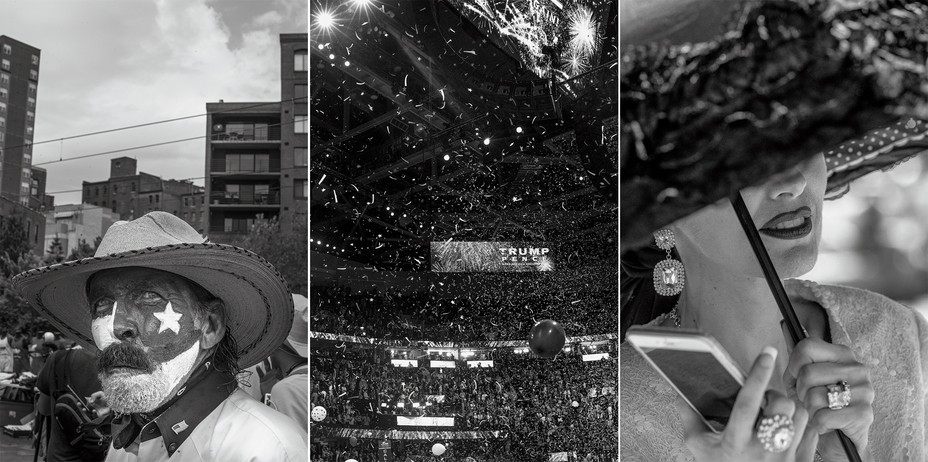
The Republican National Convention, Cleveland, July 2016. According to preelection polling, if you tallied only white voters, Trump would have defeated Clinton 389 to 81 in the Electoral College. (Gabriella Demczuk)
Asserting that Trump’s rise was primarily powered by cultural resentment and economic reversal has become de rigueur among white pundits and thought leaders. But evidence for this is, at best, mixed. In a study of preelection polling data, the Gallup researchers Jonathan Rothwell and Pablo Diego-Rosell found that “people living in areas with diminished economic opportunity” were “somewhat more likely to support Trump.” But the researchers also found that voters in their study who supported Trump generally had a higher mean household income ($81,898) than those who did not ($77,046). Those who approved of Trump were “less likely to be unemployed and less likely to be employed part-time” than those who did not. They also tended to be from areas that were very white: “The racial and ethnic isolation of whites at the zip code level is one of the strongest predictors of Trump support.”
An analysis of exit polls conducted during the presidential primaries estimated the median household income of Trump supporters to be about $72,000. But even this lower number is almost double the median household income of African Americans, and $15,000 above the American median. Trump’s white support was not determined by income. According to Edison Research, Trump won whites making less than $50,000 by 20 points, whites making $50,000 to $99,999 by 28 points, and whites making $100,000 or more by 14 points. This shows that Trump assembled a broad white coalition that ran the gamut from Joe the Dishwasher to Joe the Plumber to Joe the Banker. So when white pundits cast the elevation of Trump as the handiwork of an inscrutable white working class, they are being too modest, declining to claim credit for their own economic class. Trump’s dominance among whites across class lines is of a piece with his larger dominance across nearly every white demographic. Trump won white women (+9) and white men (+31). He won white people with college degrees (+3) and white people without them (+37). He won whites ages 18–29 (+4), 30–44 (+17), 45–64 (+28), and 65 and older (+19). Trump won whites in midwestern Illinois (+11), whites in mid-Atlantic New Jersey (+12), and whites in the Sun Belt’s New Mexico (+5). In no state that Edison polled did Trump’s white support dip below 40 percent. Hillary Clinton’s did, in states as disparate as Florida, Utah, Indiana, and Kentucky. From the beer track to the wine track, from soccer moms to nascar dads, Trump’s performance among whites was dominant. According to Mother Jones, based on preelection polling data, if you tallied the popular vote of only white America to derive 2016 electoral votes, Trump would have defeated Clinton 389 to 81, with the remaining 68 votes either a toss-up or unknown.
Asserting that Trump’s rise was primarily powered by cultural resentment and economic reversal has become de rigueur among white pundits and thought leaders. But evidence for this is, at best, mixed. In a study of preelection polling data, the Gallup researchers Jonathan Rothwell and Pablo Diego-Rosell found that “people living in areas with diminished economic opportunity” were “somewhat more likely to support Trump.” But the researchers also found that voters in their study who supported Trump generally had a higher mean household income ($81,898) than those who did not ($77,046). Those who approved of Trump were “less likely to be unemployed and less likely to be employed part-time” than those who did not. They also tended to be from areas that were very white: “The racial and ethnic isolation of whites at the zip code level is one of the strongest predictors of Trump support.”
An analysis of exit polls conducted during the presidential primaries estimated the median household income of Trump supporters to be about $72,000. But even this lower number is almost double the median household income of African Americans, and $15,000 above the American median. Trump’s white support was not determined by income. According to Edison Research, Trump won whites making less than $50,000 by 20 points, whites making $50,000 to $99,999 by 28 points, and whites making $100,000 or more by 14 points. This shows that Trump assembled a broad white coalition that ran the gamut from Joe the Dishwasher to Joe the Plumber to Joe the Banker. So when white pundits cast the elevation of Trump as the handiwork of an inscrutable white working class, they are being too modest, declining to claim credit for their own economic class. Trump’s dominance among whites across class lines is of a piece with his larger dominance across nearly every white demographic. Trump won white women (+9) and white men (+31). He won white people with college degrees (+3) and white people without them (+37). He won whites ages 18–29 (+4), 30–44 (+17), 45–64 (+28), and 65 and older (+19). Trump won whites in midwestern Illinois (+11), whites in mid-Atlantic New Jersey (+12), and whites in the Sun Belt’s New Mexico (+5). In no state that Edison polled did Trump’s white support dip below 40 percent. Hillary Clinton’s did, in states as disparate as Florida, Utah, Indiana, and Kentucky. From the beer track to the wine track, from soccer moms to nascar dads, Trump’s performance among whites was dominant. According to Mother Jones, based on preelection polling data, if you tallied the popular vote of only white America to derive 2016 electoral votes, Trump would have defeated Clinton 389 to 81, with the remaining 68 votes either a toss-up or unknown.
Part of Trump’s dominance among whites resulted from his running as a Republican, the party that has long cultivated white voters. Trump’s share of the white vote was similar to Mitt Romney’s in 2012. But unlike Romney, Trump secured this support by running against his party’s leadership, against accepted campaign orthodoxy, and against all notions of decency. By his sixth month in office, embroiled in scandal after scandal, a Pew Research Center poll found Trump’s approval rating underwater with every single demographic group. Every demographic group, that is, except one: people who identified as white.
The focus on one subsector of Trump voters—the white working class—is puzzling, given the breadth of his white coalition. Indeed, there is a kind of theater at work in which Trump’s presidency is pawned off as a product of the white working class as opposed to a product of an entire whiteness that includes the very authors doing the pawning. The motive is clear: escapism. To accept that the bloody heirloom remains potent even now, some five decades after Martin Luther King Jr. was gunned down on a Memphis balcony—even after a black president; indeed, strengthened by the fact of that black president—is to accept that racism remains, as it has since 1776, at the heart of this country’s political life. The idea of acceptance frustrates the left. The left would much rather have a discussion about class struggles, which might entice the white working masses, instead of about the racist struggles that those same masses have historically been the agents and beneficiaries of. Moreover, to accept that whiteness brought us Donald Trump is to accept whiteness as an existential danger to the country and the world. But if the broad and remarkable white support for Donald Trump can be reduced to the righteous anger of a noble class of smallville firefighters and evangelicals, mocked by Brooklyn hipsters and womanist professors into voting against their interests, then the threat of racism and whiteness, the threat of the heirloom, can be dismissed. Consciences can be eased; no deeper existential reckoning is required.
The focus on one subsector of Trump voters—the white working class—is puzzling, given the breadth of his white coalition. Indeed, there is a kind of theater at work in which Trump’s presidency is pawned off as a product of the white working class as opposed to a product of an entire whiteness that includes the very authors doing the pawning. The motive is clear: escapism. To accept that the bloody heirloom remains potent even now, some five decades after Martin Luther King Jr. was gunned down on a Memphis balcony—even after a black president; indeed, strengthened by the fact of that black president—is to accept that racism remains, as it has since 1776, at the heart of this country’s political life. The idea of acceptance frustrates the left. The left would much rather have a discussion about class struggles, which might entice the white working masses, instead of about the racist struggles that those same masses have historically been the agents and beneficiaries of. Moreover, to accept that whiteness brought us Donald Trump is to accept whiteness as an existential danger to the country and the world. But if the broad and remarkable white support for Donald Trump can be reduced to the righteous anger of a noble class of smallville firefighters and evangelicals, mocked by Brooklyn hipsters and womanist professors into voting against their interests, then the threat of racism and whiteness, the threat of the heirloom, can be dismissed. Consciences can be eased; no deeper existential reckoning is required.
An opioid epidemic is greeted with calls for compassion and treatment; a crack epidemic is greeted with scorn and mandatory minimums.
This transfiguration is not novel. It is a return to form. The tightly intertwined stories of the white working class and black Americans go back to the prehistory of the United States—and the use of one as a cudgel to silence the claims of the other goes back nearly as far. Like the black working class, the white working class originated in bondage—the former in the lifelong bondage of slavery, the latter in the temporary bondage of indenture. In the early 17th century, these two classes were remarkably, though not totally, free of racist enmity. But by the 18th century, the country’s master class had begun etching race into law while phasing out indentured servitude in favor of a more enduring labor solution. From these and other changes of law and economy, a bargain emerged: The descendants of indenture would enjoy the full benefits of whiteness, the most definitional benefit being that they would never sink to the level of the slave. But if the bargain protected white workers from slavery, it did not protect them from near-slave wages or backbreaking labor to attain them, and always there lurked a fear of having their benefits revoked. This early white working class “expressed soaring desires to be rid of the age-old inequalities of Europe and of any hint of slavery,” according to David R. Roediger, a professor of American studies at the University of Kansas. “They also expressed the rather more pedestrian goal of simply not being mistaken for slaves, or ‘negers’ or ‘negurs.’ ”
Roediger relates the experience, around 1807, of a British investor who made the mistake of asking a white maid in New England whether her “master” was home. The maid admonished the investor, not merely for implying that she had a “master” and thus was a “sarvant” but for his basic ignorance of American hierarchy. “None but negers are sarvants,” the maid is reported to have said. In law and economics and then in custom, a racist distinction not limited to the household emerged between the “help” (or the “freemen,” or the white workers) and the “servants” (the “negers,” the slaves). The former were virtuous and just, worthy of citizenship, progeny of Jefferson and, later, Jackson. The latter were servile and parasitic, dim-witted and lazy, the children of African savagery. But the dignity accorded to white labor was situational, dependent on the scorn heaped upon black labor—much as the honor accorded a “virtuous lady” was dependent on the derision directed at a “loose woman.” And like chivalrous gentlemen who claim to honor the lady while raping the “whore,” planters and their apologists could claim to honor white labor while driving the enslaved.
And so George Fitzhugh, a prominent 19th-century Southern pro-slavery intellectual, could in a single stroke deplore the exploitation of free whites’ labor while defending the exploitation of enslaved blacks’ labor. Fitzhugh attacked white capitalists as “cannibals,” feeding off the labor of their fellow whites. The white workers were “ ‘slaves without masters;’ the little fish, who were food for all the larger.” Fitzhugh inveighed against a “professional man” who’d “amassed a fortune” by exploiting his fellow whites. But whereas Fitzhugh imagined white workers as devoured by capital, he imagined black workers as elevated by enslavement. The slaveholder “provided for them, with almost parental affection”—even when the loafing slave “feigned to be unfit for labor.” Fitzhugh proved too explicit—going so far as to argue that white laborers might be better off if enslaved. (“If white slavery be morally wrong,” he wrote, “the Bible cannot be true.”) Nevertheless, the argument that America’s original sin was not deep-seated white supremacy but rather the exploitation of white labor by white capitalists—“white slavery”—proved durable. Indeed, the panic of white slavery lives on in our politics today. Black workers suffer because it was and is our lot. But when white workers suffer, something in nature has gone awry. And so an opioid epidemic among mostly white people is greeted with calls for compassion and treatment, as all epidemics should be, while a crack epidemic among mostly black people is greeted with scorn and mandatory minimums. Sympathetic op‑ed columns and articles are devoted to the plight of working-class whites when their life expectancy plummets to levels that, for blacks, society has simply accepted as normal. White slavery is sin. Nigger slavery is natural. This dynamic serves a very real purpose: the consistent awarding of grievance and moral high ground to that class of workers which, by the bonds of whiteness, stands closest to America’s aristocratic class.
This is by design. Speaking in 1848, Senator John C. Calhoun saw slavery as the explicit foundation for a democratic union among whites, working and not:
With us the two great divisions of society are not the rich and poor, but white and black; and all the former, the poor as well as the rich, belong to the upper class, and are respected and treated as equals.
On the eve of secession, Jefferson Davis, the eventual president of the Confederacy, pushed the idea further, arguing that such equality between the white working class and white oligarchs could not exist at all without black slavery:
I say that the lower race of human beings that constitute the substratum of what is termed the slave population of the South, elevates every white man in our community … It is the presence of a lower caste, those lower by their mental and physical organization, controlled by the higher intellect of the white man, that gives this superiority to the white laborer. Menial services are not there performed by the white man. We have none of our brethren sunk to the degradation of being menials. That belongs to the lower race—the descendants of Ham.
Southern intellectuals found a shade of agreement with Northern white reformers who, while not agreeing on slavery, agreed on the nature of the most tragic victim of emerging capitalism. “I was formerly like yourself, sir, a very warm advocate of the abolition of slavery,” the labor reformer George Henry Evans argued in a letter to the abolitionist Gerrit Smith. “This was before I saw that there was white slavery.” Evans was a putative ally of Smith and his fellow abolitionists. But still he asserted that “the landless white” was worse off than the enslaved black, who at least enjoyed “surety of support in sickness and old age.”
Invokers of “white slavery” held that there was nothing unique in the enslavement of blacks when measured against the enslavement of all workers. What evil there was in enslavement resulted from its status as a subsidiary of the broader exploitation better seen among the country’s noble laboring whites. Once the larger problem of white exploitation was solved, the dependent problem of black exploitation could be confronted or perhaps would fade away. Abolitionists focused on slavery were dismissed as “substitutionists” who wished to trade one form of slavery for another. “If I am less troubled concerning the Slavery prevalent in Charleston or New-Orleans,” wrote the reformer Horace Greeley, “it is because I see so much Slavery in New-York, which appears to claim my first efforts.”
Firsthand reports by white Union soldiers who witnessed actual slavery during the Civil War rendered the “white slavery” argument ridiculous. But its operating premises—white labor as noble archetype, and black labor as something else—lived on. This was a matter of rhetoric, not fact. The noble-white-labor archetype did not give white workers immunity from capitalism. It could not, in itself, break monopolies, alleviate white poverty in Appalachia or the South, or bring a decent wage to immigrant ghettos in the North. But the model for America’s original identity politics was set. Black lives literally did not matter and could be cast aside altogether as the price of even incremental gains for the white masses. It was this juxtaposition that allowed Theodore Bilbo to campaign for the Senate in the 1930s as someone who would “raise the same kind of hell as President Roosevelt” and later endorse lynching black people to keep them from voting.
The juxtaposition between the valid and even virtuous interests of the “working class” and the invalid and pathological interests of black Americans was not the province merely of blatant white supremacists like Bilbo. The acclaimed scholar, liberal hero, and future senator Daniel Patrick Moynihan, in his time working for President Richard Nixon, approvingly quoted Nixon’s formulation of the white working class: “A new voice” was beginning to make itself felt in the country. “It is a voice that has been silent too long,” Nixon claimed, alluding to working-class whites. “It is a voice of people who have not taken to the streets before, who have not indulged in violence, who have not broken the law.”
The fact of a black president seemed to insult Donald Trump personally. He has made the negation of Barack Obama’s legacy the foundation of his own. (Gabriella Demczuk)
It had been only 18 years since the Cicero riots; eight years since Daisy and Bill Myers had been run out of Levittown, Pennsylvania; three years since Martin Luther King Jr. had been stoned while walking through Chicago’s Marquette Park. But as the myth of the virtuous white working class was made central to American identity, its sins needed to be rendered invisible. The fact was, working-class whites had been agents of racist terrorism since at least the draft riots of 1863; terrorism could not be neatly separated from the racist animus found in every class of whites. Indeed, in the era of lynching, the daily newspapers often whipped up the fury of the white masses by invoking the last species of property that all white men held in common—white women. But to conceal the breadth of white racism, these racist outbursts were often disregarded or treated not as racism but as the unfortunate side effect of legitimate grievances against capital. By focusing on that sympathetic laboring class, the sins of whiteness itself were, and are still being, evaded.
When David Duke, the former grand wizard of the Ku Klux Klan, shocked the country in 1990 by almost winning one of Louisiana’s seats in the U.S. Senate, the apologists came out once again. They elided the obvious—that Duke had appealed to the racist instincts of a state whose schools are, at this very moment, still desegregating—and instead decided that something else was afoot. “There is a tremendous amount of anger and frustration among working-class whites, particularly where there is an economic downturn,” a researcher told the Los Angeles Times. “These people feel left out; they feel government is not responsive to them.” By this logic, postwar America—with its booming economy and low unemployment—should have been an egalitarian utopia and not the violently segregated country it actually was.
But this was the past made present. It was not important to the apologists that a large swath of Louisiana’s white population thought it was a good idea to send a white supremacist who once fronted a terrorist organization to the nation’s capital. Nor was it important that blacks in Louisiana had long felt left out. What was important was the fraying of an ancient bargain, and the potential degradation of white workers to the level of “negers.” “A viable left must find a way to differentiate itself strongly from such analysis,” David Roediger, the University of Kansas professor, has written.
That challenge of differentiation has largely been ignored. Instead, an imagined white working class remains central to our politics and to our cultural understanding of those politics, not simply when it comes to addressing broad economic issues but also when it comes to addressing racism. At its most sympathetic, this belief holds that most Americans—regardless of race—are exploited by an unfettered capitalist economy. The key, then, is to address those broader patterns that afflict the masses of all races; the people who suffer from those patterns more than others (blacks, for instance) will benefit disproportionately from that which benefits everyone. “These days, what ails working-class and middle-class blacks and Latinos is not fundamentally different from what ails their white counterparts,” Senator Barack Obama wrote in 2006:
Downsizing, outsourcing, automation, wage stagnation, the dismantling of employer-based health-care and pension plans, and schools that fail to teach young people the skills they need to compete in a global economy.
Obama allowed that “blacks in particular have been vulnerable to these trends”—but less because of racism than for reasons of geography and job-sector distribution. This notion—raceless antiracism—marks the modern left, from the New Democrat Bill Clinton to the socialist Bernie Sanders. Few national liberal politicians have shown any recognition that there is something systemic and particular in the relationship between black people and their country that might require specific policy solutions.
In 2016, Hillary Clinton acknowledged the existence of systemic racism more explicitly than any of her modern Democratic predecessors. She had to—black voters remembered too well the previous Clinton administration, as well as her previous campaign. While her husband’s administration had touted the rising-tide theory of economic growth, it did so while slashing welfare and getting “tough on crime,” a phrase that stood for specific policies but also served as rhetorical bait for white voters. One is tempted to excuse Hillary Clinton from having to answer for the sins of her husband. But in her 2008 campaign, she evoked the old dichotomy between white workers and loafing blacks, claiming to be the representative of “hardworking Americans, white Americans.” By the end of the 2008 primary campaign against Barack Obama, her advisers were hoping someone would uncover an apocryphal “whitey tape,” in which an angry Michelle Obama was alleged to have used the slur. During Bill Clinton’s presidential-reelection campaign in the mid-1990s, Hillary Clinton herself had endorsed the “super-predator” theory of William J. Bennett, John P. Walters, and John J. DiIulio Jr. This theory cast “inner-city” children of that era as “almost completely unmoralized” and the font of “a new generation of street criminals … the youngest, biggest and baddest generation any society has ever known.” The “baddest generation” did not become super-predators. But by 2016, they were young adults, many of whom judged Hillary Clinton’s newfound consciousness to be lacking.
It’s worth asking why the country has not been treated to a raft of sympathetic portraits of this “forgotten” young black electorate, forsaken by a Washington bought off by Davos elites and special interests. The unemployment rate for young blacks (20.6 percent) in July 2016 was double that of young whites (9.9 percent). And since the late 1970s, William Julius Wilson and other social scientists following in his wake have noted the disproportionate effect that the decline in manufacturing jobs has had on African American communities. If anyone should be angered by the devastation wreaked by the financial sector and a government that declined to prosecute the perpetrators, it is African Americans—the housing crisis was one of the primary drivers in the past 20 years of the wealth gap between black families and the rest of the country. But the cultural condescension toward and economic anxiety of black people is not news. Toiling blacks are in their proper state; toiling whites raise the specter of white slavery.
Moreover, a narrative of long-neglected working-class black voters, injured by globalization and the financial crisis, forsaken by out-of-touch politicians, and rightfully suspicious of a return of Clintonism, does not serve to cleanse the conscience of white people for having elected Donald Trump. Only the idea of a long-suffering white working class can do that. And though much has been written about the distance between elites and “Real America,” the existence of a class-transcending, mutually dependent tribe of white people is evident.
Joe Biden, then the vice president, last year:
“They’re all the people I grew up with … And they’re not racist. They’re not sexist.”
Bernie Sanders, senator and former candidate for president, last year:
“I come from the white working class, and I am deeply humiliated that the Democratic Party cannot talk to the people where I came from.”
Nicholas Kristof, the New York Times columnist, in February of this year:
My hometown, Yamhill, Ore., a farming community, is Trump country, and I have many friends who voted for Trump. I think they’re profoundly wrong, but please don’t dismiss them as hateful bigots.
These claims of origin and fidelity are not merely elite defenses of an aggrieved class but also a sweeping dismissal of the concerns of those who don’t share kinship with white men. “You can’t eat equality,” asserts Joe Biden—a statement worthy of someone unthreatened by the loss of wages brought on by an unwanted pregnancy, a background-check box at the bottom of a job application, or the deportation of a breadwinner. Within a week of Sanders lambasting Democrats for not speaking to “the people” where he “came from,” he was making an example of a woman who dreamed of representing the people where she came from. Confronted with a young woman who hoped to become the second Latina senator in American history, Sanders responded with a parody of the Clinton campaign: “It is not good enough for someone to say, ‘I’m a woman! Vote for me!’ No, that’s not good enough … One of the struggles that you’re going to be seeing in the Democratic Party is whether we go beyond identity politics.” The upshot—attacking one specimen of identity politics after having invoked another—was unfortunate.
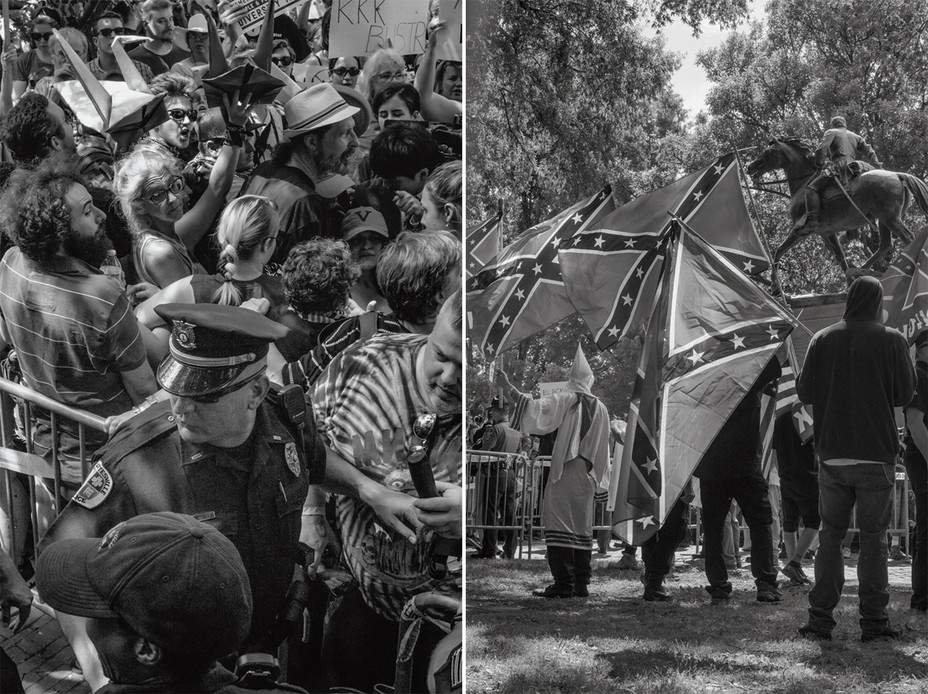
PHOTO: The KKK and counterprotesters in Charlottesville, Virginia, July 8, 2017. Not every Trump voter is a white supremacist. But every Trump voter felt it acceptable to hand the fate of the country over to one. (Gabriella Demczuk)
Other Sanders appearances proved even more alarming. On MSNBC, he attributed Trump’s success, in part, to his willingness to “not be politically correct.” Sanders admitted that Trump had “said some outrageous and painful things, but I think people are tired of the same old, same old political rhetoric.” Pressed on the definition of political correctness, Sanders gave an answer Trump surely would have approved of. “What it means is you have a set of talking points which have been poll-tested and focus-group-tested,” Sanders explained. “And that’s what you say rather than what’s really going on. And often, what you are not allowed to say are things which offend very, very powerful people.”
This definition of political correctness was shocking coming from a politician of the left. But it matched a broader defense of Trump voters. “Some people think that the people who voted for Trump are racists and sexists and homophobes and just deplorable folks,” Sanders said later. “I don’t agree.” This is not exculpatory. Certainly not every Trump voter is a white supremacist, just as not every white person in the Jim Crow South was a white supremacist. But every Trump voter felt it acceptable to hand the fate of the country over to one.
One can, to some extent, understand politicians’ embracing a self-serving identity politics. Candidates for high office, such as Sanders, have to cobble together a coalition. The white working class is seen, understandably, as a large cache of potential votes, and capturing these votes requires eliding uncomfortable truths. But journalists have no such excuse. Again and again in the past year, Nicholas Kristof could be found pleading with his fellow liberals not to dismiss his old comrades in the white working class as bigots—even when their bigotry was evidenced in his own reporting. A visit to Tulsa, Oklahoma, finds Kristof wondering why Trump voters support a president who threatens to cut the programs they depend on. But the problem, according to Kristof ’s interviewees, isn’t Trump’s attack on benefits so much as an attack on their benefits. “There’s a lot of wasteful spending, so cut other places,” one man tells Kristof. When Kristof pushes his subjects to identify that wasteful spending, a fascinating target is revealed: “Obama phones,” the products of a fevered conspiracy theory that turned a long-standing government program into a scheme through which the then-president gave away free cellphones to undeserving blacks. Kristof doesn’t shift his analysis based on this comment and, aside from a one-sentence fact-check tucked between parentheses, continues on as though it were never said.
Observing a Trump supporter in the act of deploying racism does not much perturb Kristof. That is because his defenses of the innate goodness of Trump voters and of the innate goodness of the white working class are in fact defenses of neither. On the contrary, the white working class functions rhetorically not as a real community of people so much as a tool to quiet the demands of those who want a more inclusive America.
Mark Lilla’s New York Times essay “The End of Identity Liberalism,” published not long after last year’s election, is perhaps the most profound example of this genre. Lilla denounces the perversion of liberalism into “a kind of moral panic about racial, gender and sexual identity,” which distorted liberalism’s message “and prevented it from becoming a unifying force capable of governing.” Liberals have turned away from their working-class base, he says, and must look to the “pre-identity liberalism” of Bill Clinton and Franklin D. Roosevelt. You would never know from this essay that Bill Clinton was one of the most skillful identity politicians of his era—flying home to Arkansas to see a black man, the lobotomized Ricky Ray Rector, executed; upstaging Jesse Jackson at his own conference; signing the Defense of Marriage Act. Nor would you know that the “pre-identity” liberal champion Roosevelt depended on the literally lethal identity politics of the white-supremacist “solid South.” The name Barack Obama does not appear in Lilla’s essay, and he never attempts to grapple, one way or another, with the fact that it was identity politics—the possibility of the first black president—that brought a record number of black voters to the polls, winning the election for the Democratic Party, and thus enabling the deliverance of the ancient liberal goal of national health care. “Identity politics … is largely expressive, not persuasive,” Lilla claims. “Which is why it never wins elections—but can lose them.” That Trump ran and won on identity politics is beyond Lilla’s powers of conception. What appeals to the white working class is ennobled. What appeals to black workers, and all others outside the tribe, is dastardly identitarianism. All politics are identity politics—except the politics of white people, the politics of the bloody heirloom.
White tribalism haunts even more-nuanced writers. George Packer’s New Yorker essay “The Unconnected” is a lengthy plea for liberals to focus more on the white working class, a population that “has succumbed to the ills that used to be associated with the black urban ‘underclass.’ ” Packer believes that these ills, and the Democratic Party’s failure to respond to them, explain much of Trump’s rise. Packer offers no opinion polls to weigh white workers’ views on “elites,” much less their views on racism. He offers no sense of how their views and their relationship to Trump differ from other workers’ and other whites’.
That is likely because any empirical evaluation of the relationship between Trump and the white working class would reveal that one adjective in that phrase is doing more work than the other. In 2016, Trump enjoyed majority or plurality support among every economic branch of whites. It is true that his strongest support among whites came from those making $50,000 to $99,999. This would be something more than working-class in many nonwhite neighborhoods, but even if one accepts that branch as the working class, the difference between how various groups in this income bracket voted is revealing. Sixty-one percent of whites in this “working class” supported Trump. Only 24 percent of Hispanics and 11 percent of blacks did. Indeed, the plurality of all voters making less than $100,000 and the majority making less than $50,000 voted for the Democratic candidate. So when Packer laments the fact that “Democrats can no longer really claim to be the party of working people—not white ones, anyway,” he commits a kind of category error. The real problem is that Democrats aren’t the party of white people—working or otherwise. White workers are not divided by the fact of labor from other white demographics; they are divided from all other laborers by the fact of their whiteness.
Packer’s essay was published before the election, and so the vote tally was not available. But it should not be surprising that a Republican candidate making a direct appeal to racism would drive up the numbers among white voters, given that racism has been a dividing line for the national parties since the civil-rights era. Packer finds inspiration for his thesis in West Virginia—a state that remained Democratic through the 1990s before turning decisively Republican, at least at the level of presidential politics. This relatively recent rightward movement evinces, to Packer, a shift “that couldn’t be attributed just to the politics of race.” This is likely true—the politics of race are, themselves, never attributable “just to the politics of race.” The history of slavery is also about the growth of international capitalism; the history of lynching must be seen in light of anxiety over the growing independence of women; the civil-rights movement can’t be disentangled from the Cold War. Thus, to say that the rise of Donald Trump is about more than race is to make an empty statement, one that is small comfort to the people—black, Muslim, immigrant—who live under racism’s boot.
The dent of racism is not hard to detect in West Virginia. In the 2008 Democratic primary there, 95 percent of the voters were white. Twenty percent of those—one in five—openly admitted that race was influencing their vote, and more than 80 percent voted for Hillary Clinton over Barack Obama. Four years later, the incumbent Obama lost the primary in 10 counties to Keith Judd, a white felon incarcerated in a federal prison; Judd racked up more than 40 percent of the Democratic-primary vote in the state. A simple thought experiment: Can one imagine a black felon in a federal prison running in a primary against an incumbent white president doing so well?
But racism occupies a mostly passive place in Packer’s essay. There’s no attempt to understand why black and brown workers, victimized by the same new economy and cosmopolitan elite that Packer lambastes, did not join the Trump revolution. Like Kristof, Packer is gentle with his subjects. When a woman “exploded” and told Packer, “I want to eat what I want to eat, and for them to tell me I can’t eat French fries or Coca-Cola—no way,” he sees this as a rebellion against “the moral superiority of elites.” In fact, this elite conspiracy dates back to 1894, when the government first began advising Americans on their diets. As recently as 2002, President George W. Bush launched the HealthierUS initiative, urging Americans to exercise and eat healthy food. But Packer never allows himself to wonder whether the explosion he witnessed had anything to do with the fact that similar advice now came from the country’s first black first lady. Packer concludes that Obama was leaving the country “more divided and angrier than most Americans can remember,” a statement that is likely true only because most Americans identify as white. Certainly the men and women forced to live in the wake of the beating of John Lewis, the lynching of Emmett Till, the firebombing of Percy Julian’s home, and the assassinations of Martin Luther King Jr. and Medgar Evers would disagree.
Trump’s legacy will be exposing the patina of decency for what it is and revealing just how much a demagogue can get away with.
The triumph of Trump’s campaign of bigotry presented the problematic spectacle of an American president succeeding at best in spite of his racism and possibly because of it. Trump moved racism from the euphemistic and plausibly deniable to the overt and freely claimed. This presented the country’s thinking class with a dilemma. Hillary Clinton simply could not be correct when she asserted that a large group of Americans was endorsing a candidate because of bigotry. The implications—that systemic bigotry is still central to our politics; that the country is susceptible to such bigotry; that the salt-of-the-earth Americans whom we lionize in our culture and politics are not so different from those same Americans who grin back at us in lynching photos; that Calhoun’s aim of a pan-Caucasian embrace between workers and capitalists still endures—were just too dark. Leftists would have to cope with the failure, yet again, of class unity in the face of racism. Incorporating all of this into an analysis of America and the path forward proved too much to ask. Instead, the response has largely been an argument aimed at emotion—the summoning of the white working class, emblem of America’s hardscrabble roots, inheritor of its pioneer spirit, as a shield against the horrific and empirical evidence of trenchant bigotry.
Related Stories:
Will Donald Trump Destroy the Presidency?
My President Was Black
The Case for Reparations
Packer dismisses the Democratic Party as a coalition of “rising professionals and diversity.” The dismissal is derived from, of all people, Lawrence Summers, the former Harvard president and White House economist, who last year labeled the Democratic Party “a coalition of the cosmopolitan élite and diversity.” The inference is that the party has forgotten how to speak on hard economic issues and prefers discussing presumably softer cultural issues such as “diversity.” It’s worth unpacking what, precisely, falls under this rubric of “diversity”—resistance to the monstrous incarceration of legions of black men, resistance to the destruction of health providers for poor women, resistance to the effort to deport parents, resistance to a policing whose sole legitimacy is rooted in brute force, resistance to a theory of education that preaches “no excuses” to black and brown children, even as excuses are proffered for mendacious corporate executives “too big to jail.” That this suite of concerns, taken together, can be dismissed by both an elite economist like Summers and a brilliant journalist like Packer as “diversity” simply reveals the safe space they enjoy. Because of their identity.
When Barack Obama came into office, in 2009, he believed that he could work with “sensible” conservatives by embracing aspects of their policy as his own. Instead he found that his very imprimatur made that impossible. Senate Minority Leader Mitch McConnell announced that the GOP’s primary goal was not to find common ground but to make Obama a “one-term president.” A health-care plan inspired by Romneycare was, when proposed by Obama, suddenly considered socialist and, not coincidentally, a form of reparations. The first black president found that he was personally toxic to the GOP base. An entire political party was organized around the explicit aim of negating one man. It was thought by Obama and some of his allies that this toxicity was the result of a relentless assault waged by Fox News and right-wing talk radio. Trump’s genius was to see that it was something more, that it was a hunger for revanche so strong that a political novice and accused rapist could topple the leadership of one major party and throttle the heavily favored nominee of the other.
“I could stand in the middle of Fifth Avenue and shoot somebody and I wouldn’t lose any voters,” Trump bragged in January 2016. This statement should be met with only a modicum of skepticism. Trump has mocked the disabled, withstood multiple accusations of sexual violence (all of which he has denied), fired an FBI director, sent his minions to mislead the public about his motives, personally exposed those lies by boldly stating his aim to scuttle an investigation into his possible collusion with a foreign power, then bragged about that same obstruction to representatives of that same foreign power. It is utterly impossible to conjure a black facsimile of Donald Trump—to imagine Obama, say, implicating an opponent’s father in the assassination of an American president or comparing his physical endowment with that of another candidate and then successfully capturing the presidency. Trump, more than any other politician, understood the valence of the bloody heirloom and the great power in not being a nigger.
Other Sanders appearances proved even more alarming. On MSNBC, he attributed Trump’s success, in part, to his willingness to “not be politically correct.” Sanders admitted that Trump had “said some outrageous and painful things, but I think people are tired of the same old, same old political rhetoric.” Pressed on the definition of political correctness, Sanders gave an answer Trump surely would have approved of. “What it means is you have a set of talking points which have been poll-tested and focus-group-tested,” Sanders explained. “And that’s what you say rather than what’s really going on. And often, what you are not allowed to say are things which offend very, very powerful people.”
This definition of political correctness was shocking coming from a politician of the left. But it matched a broader defense of Trump voters. “Some people think that the people who voted for Trump are racists and sexists and homophobes and just deplorable folks,” Sanders said later. “I don’t agree.” This is not exculpatory. Certainly not every Trump voter is a white supremacist, just as not every white person in the Jim Crow South was a white supremacist. But every Trump voter felt it acceptable to hand the fate of the country over to one.
One can, to some extent, understand politicians’ embracing a self-serving identity politics. Candidates for high office, such as Sanders, have to cobble together a coalition. The white working class is seen, understandably, as a large cache of potential votes, and capturing these votes requires eliding uncomfortable truths. But journalists have no such excuse. Again and again in the past year, Nicholas Kristof could be found pleading with his fellow liberals not to dismiss his old comrades in the white working class as bigots—even when their bigotry was evidenced in his own reporting. A visit to Tulsa, Oklahoma, finds Kristof wondering why Trump voters support a president who threatens to cut the programs they depend on. But the problem, according to Kristof ’s interviewees, isn’t Trump’s attack on benefits so much as an attack on their benefits. “There’s a lot of wasteful spending, so cut other places,” one man tells Kristof. When Kristof pushes his subjects to identify that wasteful spending, a fascinating target is revealed: “Obama phones,” the products of a fevered conspiracy theory that turned a long-standing government program into a scheme through which the then-president gave away free cellphones to undeserving blacks. Kristof doesn’t shift his analysis based on this comment and, aside from a one-sentence fact-check tucked between parentheses, continues on as though it were never said.
Observing a Trump supporter in the act of deploying racism does not much perturb Kristof. That is because his defenses of the innate goodness of Trump voters and of the innate goodness of the white working class are in fact defenses of neither. On the contrary, the white working class functions rhetorically not as a real community of people so much as a tool to quiet the demands of those who want a more inclusive America.
Mark Lilla’s New York Times essay “The End of Identity Liberalism,” published not long after last year’s election, is perhaps the most profound example of this genre. Lilla denounces the perversion of liberalism into “a kind of moral panic about racial, gender and sexual identity,” which distorted liberalism’s message “and prevented it from becoming a unifying force capable of governing.” Liberals have turned away from their working-class base, he says, and must look to the “pre-identity liberalism” of Bill Clinton and Franklin D. Roosevelt. You would never know from this essay that Bill Clinton was one of the most skillful identity politicians of his era—flying home to Arkansas to see a black man, the lobotomized Ricky Ray Rector, executed; upstaging Jesse Jackson at his own conference; signing the Defense of Marriage Act. Nor would you know that the “pre-identity” liberal champion Roosevelt depended on the literally lethal identity politics of the white-supremacist “solid South.” The name Barack Obama does not appear in Lilla’s essay, and he never attempts to grapple, one way or another, with the fact that it was identity politics—the possibility of the first black president—that brought a record number of black voters to the polls, winning the election for the Democratic Party, and thus enabling the deliverance of the ancient liberal goal of national health care. “Identity politics … is largely expressive, not persuasive,” Lilla claims. “Which is why it never wins elections—but can lose them.” That Trump ran and won on identity politics is beyond Lilla’s powers of conception. What appeals to the white working class is ennobled. What appeals to black workers, and all others outside the tribe, is dastardly identitarianism. All politics are identity politics—except the politics of white people, the politics of the bloody heirloom.
White tribalism haunts even more-nuanced writers. George Packer’s New Yorker essay “The Unconnected” is a lengthy plea for liberals to focus more on the white working class, a population that “has succumbed to the ills that used to be associated with the black urban ‘underclass.’ ” Packer believes that these ills, and the Democratic Party’s failure to respond to them, explain much of Trump’s rise. Packer offers no opinion polls to weigh white workers’ views on “elites,” much less their views on racism. He offers no sense of how their views and their relationship to Trump differ from other workers’ and other whites’.
That is likely because any empirical evaluation of the relationship between Trump and the white working class would reveal that one adjective in that phrase is doing more work than the other. In 2016, Trump enjoyed majority or plurality support among every economic branch of whites. It is true that his strongest support among whites came from those making $50,000 to $99,999. This would be something more than working-class in many nonwhite neighborhoods, but even if one accepts that branch as the working class, the difference between how various groups in this income bracket voted is revealing. Sixty-one percent of whites in this “working class” supported Trump. Only 24 percent of Hispanics and 11 percent of blacks did. Indeed, the plurality of all voters making less than $100,000 and the majority making less than $50,000 voted for the Democratic candidate. So when Packer laments the fact that “Democrats can no longer really claim to be the party of working people—not white ones, anyway,” he commits a kind of category error. The real problem is that Democrats aren’t the party of white people—working or otherwise. White workers are not divided by the fact of labor from other white demographics; they are divided from all other laborers by the fact of their whiteness.
Packer’s essay was published before the election, and so the vote tally was not available. But it should not be surprising that a Republican candidate making a direct appeal to racism would drive up the numbers among white voters, given that racism has been a dividing line for the national parties since the civil-rights era. Packer finds inspiration for his thesis in West Virginia—a state that remained Democratic through the 1990s before turning decisively Republican, at least at the level of presidential politics. This relatively recent rightward movement evinces, to Packer, a shift “that couldn’t be attributed just to the politics of race.” This is likely true—the politics of race are, themselves, never attributable “just to the politics of race.” The history of slavery is also about the growth of international capitalism; the history of lynching must be seen in light of anxiety over the growing independence of women; the civil-rights movement can’t be disentangled from the Cold War. Thus, to say that the rise of Donald Trump is about more than race is to make an empty statement, one that is small comfort to the people—black, Muslim, immigrant—who live under racism’s boot.
The dent of racism is not hard to detect in West Virginia. In the 2008 Democratic primary there, 95 percent of the voters were white. Twenty percent of those—one in five—openly admitted that race was influencing their vote, and more than 80 percent voted for Hillary Clinton over Barack Obama. Four years later, the incumbent Obama lost the primary in 10 counties to Keith Judd, a white felon incarcerated in a federal prison; Judd racked up more than 40 percent of the Democratic-primary vote in the state. A simple thought experiment: Can one imagine a black felon in a federal prison running in a primary against an incumbent white president doing so well?
But racism occupies a mostly passive place in Packer’s essay. There’s no attempt to understand why black and brown workers, victimized by the same new economy and cosmopolitan elite that Packer lambastes, did not join the Trump revolution. Like Kristof, Packer is gentle with his subjects. When a woman “exploded” and told Packer, “I want to eat what I want to eat, and for them to tell me I can’t eat French fries or Coca-Cola—no way,” he sees this as a rebellion against “the moral superiority of elites.” In fact, this elite conspiracy dates back to 1894, when the government first began advising Americans on their diets. As recently as 2002, President George W. Bush launched the HealthierUS initiative, urging Americans to exercise and eat healthy food. But Packer never allows himself to wonder whether the explosion he witnessed had anything to do with the fact that similar advice now came from the country’s first black first lady. Packer concludes that Obama was leaving the country “more divided and angrier than most Americans can remember,” a statement that is likely true only because most Americans identify as white. Certainly the men and women forced to live in the wake of the beating of John Lewis, the lynching of Emmett Till, the firebombing of Percy Julian’s home, and the assassinations of Martin Luther King Jr. and Medgar Evers would disagree.
Trump’s legacy will be exposing the patina of decency for what it is and revealing just how much a demagogue can get away with.
The triumph of Trump’s campaign of bigotry presented the problematic spectacle of an American president succeeding at best in spite of his racism and possibly because of it. Trump moved racism from the euphemistic and plausibly deniable to the overt and freely claimed. This presented the country’s thinking class with a dilemma. Hillary Clinton simply could not be correct when she asserted that a large group of Americans was endorsing a candidate because of bigotry. The implications—that systemic bigotry is still central to our politics; that the country is susceptible to such bigotry; that the salt-of-the-earth Americans whom we lionize in our culture and politics are not so different from those same Americans who grin back at us in lynching photos; that Calhoun’s aim of a pan-Caucasian embrace between workers and capitalists still endures—were just too dark. Leftists would have to cope with the failure, yet again, of class unity in the face of racism. Incorporating all of this into an analysis of America and the path forward proved too much to ask. Instead, the response has largely been an argument aimed at emotion—the summoning of the white working class, emblem of America’s hardscrabble roots, inheritor of its pioneer spirit, as a shield against the horrific and empirical evidence of trenchant bigotry.
Related Stories:
Will Donald Trump Destroy the Presidency?
My President Was Black
The Case for Reparations
Packer dismisses the Democratic Party as a coalition of “rising professionals and diversity.” The dismissal is derived from, of all people, Lawrence Summers, the former Harvard president and White House economist, who last year labeled the Democratic Party “a coalition of the cosmopolitan élite and diversity.” The inference is that the party has forgotten how to speak on hard economic issues and prefers discussing presumably softer cultural issues such as “diversity.” It’s worth unpacking what, precisely, falls under this rubric of “diversity”—resistance to the monstrous incarceration of legions of black men, resistance to the destruction of health providers for poor women, resistance to the effort to deport parents, resistance to a policing whose sole legitimacy is rooted in brute force, resistance to a theory of education that preaches “no excuses” to black and brown children, even as excuses are proffered for mendacious corporate executives “too big to jail.” That this suite of concerns, taken together, can be dismissed by both an elite economist like Summers and a brilliant journalist like Packer as “diversity” simply reveals the safe space they enjoy. Because of their identity.
When Barack Obama came into office, in 2009, he believed that he could work with “sensible” conservatives by embracing aspects of their policy as his own. Instead he found that his very imprimatur made that impossible. Senate Minority Leader Mitch McConnell announced that the GOP’s primary goal was not to find common ground but to make Obama a “one-term president.” A health-care plan inspired by Romneycare was, when proposed by Obama, suddenly considered socialist and, not coincidentally, a form of reparations. The first black president found that he was personally toxic to the GOP base. An entire political party was organized around the explicit aim of negating one man. It was thought by Obama and some of his allies that this toxicity was the result of a relentless assault waged by Fox News and right-wing talk radio. Trump’s genius was to see that it was something more, that it was a hunger for revanche so strong that a political novice and accused rapist could topple the leadership of one major party and throttle the heavily favored nominee of the other.
“I could stand in the middle of Fifth Avenue and shoot somebody and I wouldn’t lose any voters,” Trump bragged in January 2016. This statement should be met with only a modicum of skepticism. Trump has mocked the disabled, withstood multiple accusations of sexual violence (all of which he has denied), fired an FBI director, sent his minions to mislead the public about his motives, personally exposed those lies by boldly stating his aim to scuttle an investigation into his possible collusion with a foreign power, then bragged about that same obstruction to representatives of that same foreign power. It is utterly impossible to conjure a black facsimile of Donald Trump—to imagine Obama, say, implicating an opponent’s father in the assassination of an American president or comparing his physical endowment with that of another candidate and then successfully capturing the presidency. Trump, more than any other politician, understood the valence of the bloody heirloom and the great power in not being a nigger.
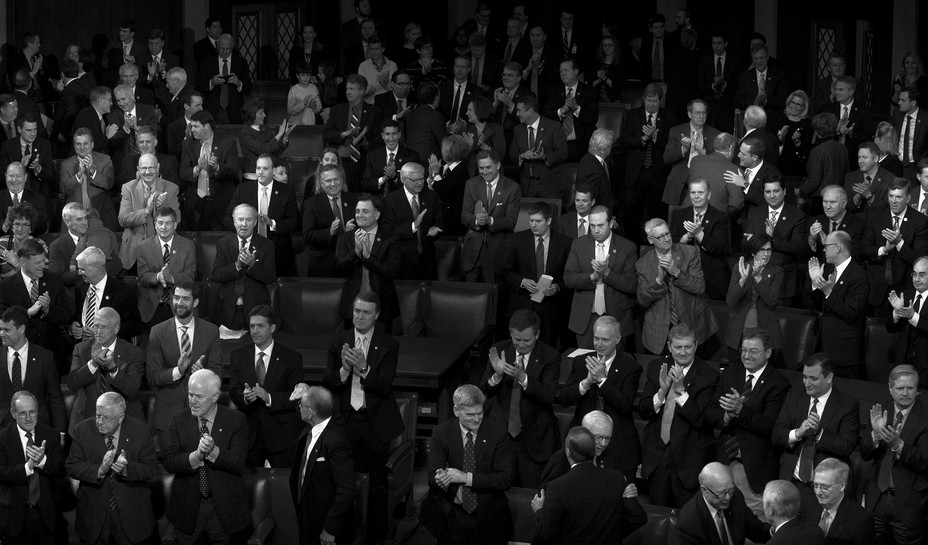
PHOTO: January 6, 2017. Republicans applaud after Congress certifies Donald Trump’s victory in the Electoral College. The American tragedy now being wrought will not end with him. (Gabriella Demczuk)
But the power is ultimately suicidal. Trump evinces this, too. In a recent New Yorker article, a former Russian military officer pointed out that interference in an election could succeed only where “necessary conditions” and an “existing background” were present. In America, that “existing background” was a persistent racism, and the “necessary condition” was a black president. The two related factors hobbled America’s ability to safeguard its electoral system. As late as July 2016, a majority of Republican voters doubted that Barack Obama had been born in the United States, which is to say they did not view him as a legitimate president. Republican politicians acted accordingly, infamously denying his final Supreme Court nominee a hearing and then, fatefully, refusing to work with the administration to defend the country against the Russian attack. Before the election, Obama found no takers among Republicans for a bipartisan response, and Obama himself, underestimating Trump and thus underestimating the power of whiteness, believed the Republican nominee too objectionable to actually win. In this Obama was, tragically, wrong. And so the most powerful country in the world has handed over all its affairs—the prosperity of its entire economy; the security of its 300 million citizens; the purity of its water, the viability of its air, the safety of its food; the future of its vast system of education; the soundness of its national highways, airways, and railways; the apocalyptic potential of its nuclear arsenal—to a carnival barker who introduced the phrase grab ’em by the pussy into the national lexicon. It is as if the white tribe united in demonstration to say, “If a black man can be president, then any white man—no matter how fallen—can be president.” And in that perverse way, the democratic dreams of Jefferson and Jackson were fulfilled.
The American tragedy now being wrought is larger than most imagine and will not end with Trump. In recent times, whiteness as an overt political tactic has been restrained by a kind of cordiality that held that its overt invocation would scare off “moderate” whites. This has proved to be only half true at best. Trump’s legacy will be exposing the patina of decency for what it is and revealing just how much a demagogue can get away with. It does not take much to imagine another politician, wiser in the ways of Washington and better schooled in the methodology of governance—and now liberated from the pretense of antiracist civility—doing a much more effective job than Trump.
But the power is ultimately suicidal. Trump evinces this, too. In a recent New Yorker article, a former Russian military officer pointed out that interference in an election could succeed only where “necessary conditions” and an “existing background” were present. In America, that “existing background” was a persistent racism, and the “necessary condition” was a black president. The two related factors hobbled America’s ability to safeguard its electoral system. As late as July 2016, a majority of Republican voters doubted that Barack Obama had been born in the United States, which is to say they did not view him as a legitimate president. Republican politicians acted accordingly, infamously denying his final Supreme Court nominee a hearing and then, fatefully, refusing to work with the administration to defend the country against the Russian attack. Before the election, Obama found no takers among Republicans for a bipartisan response, and Obama himself, underestimating Trump and thus underestimating the power of whiteness, believed the Republican nominee too objectionable to actually win. In this Obama was, tragically, wrong. And so the most powerful country in the world has handed over all its affairs—the prosperity of its entire economy; the security of its 300 million citizens; the purity of its water, the viability of its air, the safety of its food; the future of its vast system of education; the soundness of its national highways, airways, and railways; the apocalyptic potential of its nuclear arsenal—to a carnival barker who introduced the phrase grab ’em by the pussy into the national lexicon. It is as if the white tribe united in demonstration to say, “If a black man can be president, then any white man—no matter how fallen—can be president.” And in that perverse way, the democratic dreams of Jefferson and Jackson were fulfilled.
The American tragedy now being wrought is larger than most imagine and will not end with Trump. In recent times, whiteness as an overt political tactic has been restrained by a kind of cordiality that held that its overt invocation would scare off “moderate” whites. This has proved to be only half true at best. Trump’s legacy will be exposing the patina of decency for what it is and revealing just how much a demagogue can get away with. It does not take much to imagine another politician, wiser in the ways of Washington and better schooled in the methodology of governance—and now liberated from the pretense of antiracist civility—doing a much more effective job than Trump.
It has long been an axiom among certain black writers and thinkers that while whiteness endangers the bodies of black people in the immediate sense, the larger threat is to white people themselves, the shared country, and even the whole world. There is an impulse to blanch at this sort of grandiosity. When W. E. B. Du Bois claims that slavery was “singularly disastrous for modern civilization” or James Baldwin claims that whites “have brought humanity to the edge of oblivion: because they think they are white,” the instinct is to cry exaggeration. But there really is no other way to read the presidency of Donald Trump. The first white president in American history is also the most dangerous president—and he is made more dangerous still by the fact that those charged with analyzing him cannot name his essential nature, because they too are implicated in it.
This essay is drawn from Ta-Nehisi Coates’s new book, We Were Eight Years in Power.
ABOUT THE AUTHOR:
Ta-Nehisi Coates is a national correspondent for The Atlantic, where he writes about culture, politics, and social issues. He is the author of The Beautiful Struggle, Between the World and Me, and the forthcoming book We Were Eight Years in Power.
PHOTO: Jesse Draxler; Photo: David Hume Kennerly / Getty
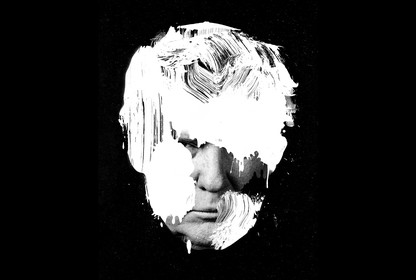
This essay is drawn from Ta-Nehisi Coates’s new book, We Were Eight Years in Power.
ABOUT THE AUTHOR:
Ta-Nehisi Coates is a national correspondent for The Atlantic, where he writes about culture, politics, and social issues. He is the author of The Beautiful Struggle, Between the World and Me, and the forthcoming book We Were Eight Years in Power.
PHOTO: Jesse Draxler; Photo: David Hume Kennerly / Getty