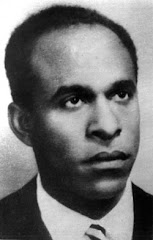
FORT-DE-FRANCE, Martinique (AP) — Aimé Césaire, an anticolonialist poet and politician who was honored throughout the French-speaking world and who was an early proponent of black pride, died here on Thursday. He was 94.
A government spokeswoman, Marie Michèle Darsières, said he died at a hospital where he was being treated for heart problems and other ailments.
Mr. Césaire was one of the Caribbean’s most celebrated cultural figures. He was especially revered in his native Martinique, which sent him to the French parliament for nearly half a century and where he was repeatedly elected mayor of Fort-de-France, the capital city.
In Paris in the 1930s he helped found the journal Black Student, which gave birth to the idea of “negritude,” a call to blacks to cultivate pride in their heritage. His 1950 book “Discourse on Colonialism” was considered a classic of French political literature.
Mr. Césaire’s ideas were honored and his death mourned in Africa and France as well as the Caribbean. The office of President Nicolas Sarkozy of France said Mr. Sarkozy would attend Mr. Césaire’s funeral, scheduled for Sunday in Fort-de-France. Students at Lycée Scoelcher, a Martinique high school where Mr. Césaire once taught, honored him in a spontaneous ceremony Thursday.
Mr. Césaire’s best-known works included the essay “Negro I Am, Negro I Will Remain” and the poem “Notes From a Return to the Native Land.”
Born on June 26, 1913, in Basse-Pointe, Martinique, Mr. Césaire attended high school and college in France. In 1937 he married another student from Martinique, Suzanne Roussi, with whom he eventually had four sons and two daughters.
He returned to Martinique during World War II and was mayor of Fort-de-France from 1945 to 2001, except for a break from 1983 to 1984.
Mr. Césaire helped Martinique shed its colonial status in 1946 to become an overseas department of France.
He was affiliated with the French Communist Party early in his career but became disillusioned in the 1950s and founded the Martinique Progressive Party in 1958. He later allied with the Socialist Party in France’s National Assembly, where he served from 1946 to 1956 and from 1958 to 1993.
As the years passed, he remained firm in his views. In 2005 he refused to meet with Mr. Sarkozy, who was then minister of the interior, because of Mr. Sarkozy’s endorsement of a bill citing the “positive role” of colonialism.
“I remain faithful to my beliefs and remain inflexibly anticolonialist,” Mr. Césaire said at the time. The offending language was struck from the bill.
Despite the snub, Mr. Sarkozy last year successfully led a campaign to rename Martinique’s airport in honor of Mr. Césaire. Mr. Césaire eventually met with Mr. Sarkozy in March 2006 but endorsed his Socialist rival, Ségolène Royal, in the 2007 French elections.
Poetry & The Political Imagination: Aime Cesaire, Negritude, and the Applications of Surrealism
by Robin D. G. Kelley
July 9, 2001
Aime Cesaire demolishes the maxim that poets make terrible politicians. Known in the world of letters as the progenitor of Negritude (the first diasporic "black pride" movement), a major voice of Surrealism, and one of the great French poets, Césaire is also revered for his role in modern anticolonial and Pan-African movements. While it might appear that the poet and politician operated in separate spheres, Césaire's life and work demonstrate that poetry can be the motor of political imagination, a potent weapon in any movement that claims freedom as its primary goal.
Born on June 25, 1913, in the small town of Basse-Pointe, Martinique, Césaire and his five siblings were raised by their mother, who was a dressmaker, and their father, who held a post as the local tax inspector. Although their father was well-educated and they shared the cultural sensibilities of the petite bourgeoisie, the Césaires nonetheless lived close to the edge of rural poverty. Aimé turned out to be a brilliant, precocious student and at age 11 was admitted to the Lycée Schoelcher in Fort-de-France. Upon graduation in 1931, he moved to Paris and enrolled in the Lycée Louis-le-Grand to prepare for the grueling entrance exams to the École Normale Supérieure (a high-level teachers' training college). There he met a number of like-minded intellectuals, most notably the Senegalese intellectual Léopold Sédar Senghor. Among other things, they began to study African history and culture, particularly the writings of German ethnologist Leo Frobenius, whose The Voice of Africa provided a powerful defense of Africa's cultural and intellectual contributions to the world.
The twosome, along with Césaire's childhood friend, poet Léon-Gontran Damas, launched a journal called L'Étudiant Noir (The Black Student). In its March 1935 issue, Césaire published a passionate tract against assimilation in which he first coined the term "Negritude." It is more than ironic that at the moment Césaire's piece appeared, he was hard at work absorbing as much knowledge about French and European humanities as possible in preparation for his entrance exams for École Normale Supérieure. The exams took their toll, for sure, though the psychic and emotional costs of having to imbibe the very culture Césaire publicly rejected must have exacerbated an already exhausting regimen.
After completing his exams during the summer of 1935, he took a short vacation to Yugoslavia with a fellow student. While visiting the Adriatic coast, Césaire was overcome with memories of home after seeing a small island from a distance. Moved, he stayed up half the night working on a long poem about the Martinique of his youth—the land, the people, the majesty of the place. The next morning when he inquired about the little island, he was told it was called Martinska. A magical chance encounter, to say the least; the words he penned that moonlit night were the beginnings of what would subsequently become his most famous poem of all: "Cahier d'un Retour au Pays Natal (Notebook of a Return to My Native Land)".
He did subsequently return to his native land in the early 1940s, shortly after "Cahier" was published, and he was joined by his wife Suzanne Roussy, a fellow Martinican student with whom he had worked on L'Étudiant Noir. They both took teaching posts in Fort-de-France and, along with other intellectuals such as René Ménil, Lucie Thésée, and Aristide Maugée, launched a journal called Tropiques in 1941. Its appearance coincided with the fall of France to the fascist Vichy regime, which consequently put the colonies of Martinique, Guadeloupe, and Guiana under Vichy rule and shattered any illusions Césaire and his comrades might have harbored about color-blind French brotherhood. The racism and authoritarianism of the regime was blatant and direct. Vichy officials censored and interdicted all literature they deemed subversive, thus forcing Tropiques's editors to camouflage their publication as a journal of West Indian folklore. Yet, despite the repressions and the ruses, Tropiques survived the war as a major voice for Surrealism and a critical forum for the evolution of a sophisticated anticolonial stance as well as a vision of a postcolonial future. The Césaires and their fellow editors promoted a vision of freedom that drew on modernism and a deep appreciation for precolonial African modes of thought and practice, and produced a kind of merging of Negritude, Marxism, and Surrealism.
By the end of the war, Césaire became more directly involved in politics, joining the Communist Party and successfully running for mayor of Fort-de-France and deputy to the French National Assembly under the Communist ticket. His main concern, however, was not proletarian revolution but rather the colonial question. In 1946, he succeeded in getting the National Assembly to pass a law changing the status of Martinique, Guadeloupe, Guiana, and Réunion from colonies to "departments" within the French Republic. He believed that the assimilation of the old colonies into the republic would guarantee equal rights, but this turned out not to be the case. In the end, French officials were sent to the colonies in greater numbers, often displacing some of the local black Martinican bureaucrats. It was a painful lesson for Césaire, one that powerfully molded his first and perhaps most important nonfiction book, Discourse on Colonialism.
First published in 1950, Discourse on Colonialism is indisputably one of the key contributions to a wave of anticolonial literature produced during the postwar period. As with much of the radical literature produced during this epoch, Discourse places the colonial question front and center. In fine Hegelian fashion, Césaire argues that colonialism works to "decivilize" the colonizer: Torture, violence, race hatred, and immorality constitute a dead weight on the so-called civilized, pulling the master class deeper and deeper into the abyss of barbarism. The instruments of colonial power rely on barbaric, brutal violence and intimidation, and the end result is the degradation of Europe itself. Discourse, then, has a double-edged meaning: It is Césaire's discourse on the material and spiritual havoc created by colonialism, and it is also a critique of colonial discourse.
Anticipating the explosion of work we now call "postcolonial studies," Césaire reveals how the circulation of colonial ideology—an ideology of racial and cultural hierarchy—is as essential to colonial rule as the police and the use of forced labor. Furthermore, as a product of the post-World War II period, Discourse goes one step further by drawing a direct link between the logic of colonialism and the rise of fascism. He provocatively points out that Europeans tolerated "Nazism before it was inflicted on them...because, until then, it had been applied only to non-European peoples; that they have cultivated that Nazism, that they are responsible for it, and that before engulfing the whole of Western, Christian civilization in its reddened waters, it oozes, seeps, and trickles from every crack."
The political implications for Césaire were that colonialism had to be overthrown and a new culture had to replace it, one that embraced non-Western traditions while also embracing the best that modernity had to offer. He outlined this argument in a paper titled "Culture and Colonization," delivered at the First International Congress of Negro Writers and Artists in September 1956. Ultimately, Césaire's insistence that colonialism and racism were the fundamental problems facing the modern world could not be reconciled with the Communist position that promoting proletarian revolution should take precedence over all other struggles. One month later, Césaire penned his famous "Letter to Maurice Thorez, Secretary General of the French Communist Party," tendering his resignation from the party. Arguing that people of color need to exercise self-determination, he warned against treating the "colonial question...as a subsidiary part of some more important global matter." Racism, in other words, cannot be subordinate to the class struggle. If following the Communist Party "pillages our most vivifying friendships, wastes the bond that weds us to other West Indian islands, the tie that makes us Africa's child, then I say communism has served us ill in having us swap a living brotherhood for what looks to have the features of the coldest of all chill abstractions."
Césaire, like his former student Frantz Fanon, was now convinced that only Third World revolt could pave the way for a new society. He had practically given up on Europe and the old humanism and its claims of universality, opting instead to redefine the "universal" in a way that did not privilege Europe. "I have a different idea of a universal," Césaire explained to his former Communist comrades. "It is of a universal rich with all that is particular, rich with all the particulars there are, the deepening of each particular, the coexistence of them all."
Césaire went on to found the Martinican Progressive Party and serve as mayor of Fort-de-France for the next two-and-a-half decades, and he continued to write. In 1960, he published Ferrements, a collection of 48 poems about black liberation and new possibilities created by independence. Using the metaphor of transforming slavery's chains into metal armor, Césaire saw the future of Africa and the diaspora as a phoenix rising. A year later he released Cadastre, which included previous poems from Soleil cou Coupé and Corps Perdu. Whereas Africa was rising (with the exception of places still under white minority rule), Europe here is depicted as a land of petrifaction and rot.
The themes of colonialism and postcolonialism dominated Césaire's work during the 1960s, so much so that he increasingly turned to history in order to explore the problems and prospects of anticolonial revolution. In 1961, he published his second major work of nonfiction: Toussaint L'Ouverture: La Révolution Française et le Problème Colonial (Toussaint L'Ouverture: The French Revolution and the Problem of Colonialism). Césaire tried to show that the French Revolution failed as much as the Haitian Revolution to achieve true liberty. Toussaint not only wanted to destroy slavery on the island of Saint Domingue but wanted to turn these ex-slaves into efficient producers for a world market, to bring his country into the modern world as citizens of the French empire. While the revolution successfully fulfilled the first goal, his dream of a modern Haiti joining a French commonwealth as equal partners was an abysmal failure. That dream died with him in a cold jail cell in Napoleon's France.
Unlike other critics, Césaire argued that Toussaint's failure lay not so much in his ambition or his ideas as in his overreliance on the military to solve social, political, and economic problems. His critique of Toussaint carried with it a veiled critique of military dictators emerging in postcolonial Africa and Latin America—a critique made explicit in his 1963 play, La Tragedie du Roi Christophe (The Tragedy of King Christophe). While grounded in Césaire's reading of Haitian history, it was also a critique of François Duvalier, Haiti's ruler from 1957 through 1971. It explores the many dimensions of postcolonial corruption, depicting Christophe as a deeply flawed but well-meaning tyrant exploiting the black masses trapped on the island. Césaire's next play, Un Saison au Congo (A Season in the Congo) (1965), about Patrice Lumumba and the struggle for independence in the Congo, went one step further, suggesting that only revolution and the violent overthrow of these dictatorships could bring about any real change.
In his final exploration of colonialism, Césaire retreated from modern history and turned to Shakespeare as his vehicle. His 1969 adaptation of The Tempest (Une Tempête) explored the relationship between Prospero the colonizer and his colonial subjects, Caliban and Ariel. Caliban rebels outright, whereas Ariel attempts to appeal to Prospero's moral conscience. Caliban is eventually crushed when he attempts to become his own master, but not before figuring out that Prospero's domination and claims to superiority are based on lies. Caliban's final speech could have come straight from Césaire's mouth, or the mouths of the radical black intelligentsia produced by colonial education:
Prospero, you are the master of illusion.
Lying is your trademark.
And you have lied so much to me
(lied about the world, lied about me)
that you have ended by imposing on me
an image of myself.
Underdeveloped, you brand me, inferior,
that's the way you have forced me to see myself.
I detest that image! What's more, it's a lie!
But now I know you, you old cancer,
and I know myself as well.
During the course of the next three decades, Césaire continued to write but moved away from the epic hero and the problems of the colonial encounter. The Surrealism that had always undergirded his work resurfaced more explicitly in his 1976 collection Noria as well as his last play, Moi, Laminaire (1982), both of which explored language and reveled in the ambiguous, dreamlike characteristics of the unconscious.
The weapon of poetry may be Césaire's greatest gift to a modern world still searching for freedom. As one of the last truly great "universalists" of the 20th century, he has had a hand in shaping or critiquing many of the major ideologies and movements of the modern world—Marxism, nationalism, Pan-Africanism, and fascism, among others. All of these ideas are rooted in notions of progress, all are products of modernity, and all fall short when it comes to envisioning a genuinely emancipatory future. Césaire must have known this, which is why more than half a century ago he wrote: "Poetic knowledge is born in the great silence of scientific knowledge."
Reproduction of material from any LiP pages without written permission is strictly prohibited | Copyright 2002 LiPmagazine.org | info@lipmagazine.org
FORT-DE-FRANCE, Martinique - Aime Cesaire, an anti-colonialist poet and politician who was honored throughout the French-speaking world and was an early proponent of black pride, has died at 94.
Cesaire died Thursday at a Fort-de-France hospital where he was being treated for heart problems and other ailments, said government spokeswoman Marie Michele Darsieres.
He was one of the Caribbean's most celebrated cultural figures and was revered in his native Martinique, where his passing brought tears and spontaneous memorial observances.
The French island sent him to the country's parliament for nearly half a century and repeatedly elected him mayor of the capital.
Cesaire helped found the "Black Student" journal in Paris in the 1930s that launched the idea of "negritude," urging blacks to cultivate pride in their heritage. His 1950 "Discourse on Colonialism" became a classic of French political literature.
French President Nicolas Sarkozy expressed "very great sadness" at Cesaire's passing, and said "the entire French nation" is in mourning.
"I prayed for him," said 45-year-old teacher Jean Luc Martin, his eyes red from crying. "I studied his works, which forged my life and allowed me to see our differences in a new light."
Students at Lycee Scoelcher, a Martinique high school where Cesaire once taught, honored him in a spontaneous ceremony Thursday. "For us, only two men count: Aime Cesaire and Nelson Mandela," student Karl Dintimile said.
Cesaire's best known works included the essay "Negro I am, Negro I Will Remain" and the poem "Notes From a Return to the Native Land."
Former Senegalese President Abdou Diouf said Cesaire led a noble fight against hate.
Born June 26, 1913, in Basse-Pointe, Martinique, Cesaire moved to France for high school and university. He returned to Martinique during World War II and served as mayor from 1945 to 2001, except in 1983-84.
Cesaire helped Martinique shed its colonial status in 1946 to become an overseas department.
In 2005, the politician-poet refused to meet with then-Interior Minister Nicolas Sarkozy, now French president, because of his endorsement of a bill citing the "positive role" of colonialism.
The offending language was struck from the bill.
Cesaire eventually met with Sarkozy in March 2006 but endorsed his Socialist rival, Segolene Royal, in the 2007 French elections.
Royal called Cesaire "an eminent symbol of a mixed-race France" and urged that he be buried in the Pantheon, where French heroes such as Victor Hugo to Marie and Pierre Curie are interred.
Cesaire was affiliated with the French Communist Party early in his career but became disillusioned in the 1950s and founded the Martinique Progressive Party in 1958. He later allied with the Socialist Party.
OBITUARY
Aimé Césaire, Martinique poet, has died
The Associated Press
Published: April 17, 2008
PARIS: The esteemed Martinique poet and politician Aimé Césaire, a leading figure in the movement for black consciousness, died Thursday, the French president's office and a hospital said. He was 94.
Césaire died in Fort-de-France on the French Caribbean island of Martinique, the hospital that was treating him said.
Césaire was involved in the fight for French West Indian rights, and he also served as a lawmaker in the lower house of France's parliament for nearly 50 years. French President Nicolas Sarkozy successfully led a campaign last year to change the name of Martinique's airport in honor of Césaire.
Sarkozy on Thursday praised Césaire as "a great poet" and a "great humanist."
"As a free and independent spirit, throughout his whole life he embodied the fight for the recognition of his identity and the richness of his African roots," Sarkozy said. "Through his universal call for the respect of human dignity, consciousness and responsibility, he will remain a symbol of hope for all oppressed peoples."
Césaire's 1950 "Discourse on Colonialism" has become a classic of French political literature and helped develop the concept of negritude, which urges blacks to cultivate pride in their heritage.
Born June 26, 1913, in Basse-Pointe, Martinique, Césaire moved to mainland France for high school and university studies, and finished one of the country's most elite institutes, the Ecole Normale Superieure.
He and Senegal's Leopold Sedar Senghor founded the journal "Black Student" in the 1930s, which gave birth to the idea of negritude.
Césaire returned to Martinique during World War II and taught at a high school in Fort-de-France.
Césaire served as mayor of Fort-de-France from 1945 to his retirement in 2001, except for a blip in 1983-84.
"I accomplished the work I had to do," Césaire said in his surprise announcement in 2000 that that he wouldn't seek another mayoral term.
Césaire's essays included "Negro I am, Negro I Will Remain." His poems, written in French, included "Notes From a Return to the Native Land." He also wrote plays.
OBITUARY
Aimé Césaire, 94, poet and human rights leader
The Associated Press
April 17, 2008
FORT-DE-FRANCE, Martinique: Aimé Césaire, a poet honored throughout the Francophone world and a crusader for West Indian rights, has died at 94.
Césaire died Thursday at a Fort-de-France hospital where he was being treated for heart problems and other ailments, a government spokeswoman, Marie-Michèle Darsières, said.
He was one of the most celebrated cultural figures in the Caribbean and was revered in his native Martinique, which sent him to the French Parliament for nearly half a century and repeatedly elected him mayor of the capital.
Césaire helped found the journal L'Étudiant Noir in Paris in the 1930s that launched the idea of "Négritude," urging blacks to cultivate pride in their heritage. His 1950 "Discourse on Colonialism" became a classic of French political literature.
His best-known works included the essay "Negro I Am, Negro I Will Remain" and the poem "Notes From a Return to the Native Land."
Cesaire died Thursday, April 17, 2008 in the French Caribbean island of Martinique. He was 94. Cesaire was a fixture in France's parliament for nearly half a century and a key figure in the fight for French Caribbean rights.
Martinique poet Aime Cesaire dies at age 94
By HERVE BRIVAL
FORT-DE-FRANCE, Martinique (AP) — Aime Cesaire, a poet honored throughout the French-speaking world and a crusader for West Indian rights, has died at 94.
Cesaire died Thursday after at a Fort-de-France hospital where he was being treated for heart problems and other ailments, said government spokeswoman Marie Michele Darsieres.
He was one of the most celebrated cultural figures in the Caribbean and was revered in his native Martinique, which sent him to France's parliament for nearly half a century and repeatedly elected him mayor of the capital.
Cesaire helped found the "Black Student" journal in Paris in the 1930s that launched the idea of "negritude," urging blacks to cultivate pride in their heritage. His 1950 "Discourse on Colonialism" became a classic of French political literature.
French Culture Minister Christine Albanel said Cesaire "imbued the French language with his liberty and his revolt."
"He made (the French language) beat to the rhythm of his spells, his cries, his appeals to overcome oppression, invoking the soul of subjugated peoples to urge the living to raise themselves up," she said.
His best known works included the essay "Negro I am, Negro I Will Remain" and the poem "Notes From a Return to the Native Land."
Cesaire was born June 26, 1913, in Basse-Pointe, Martinique and moved to France for high school and university studies. He graduated from one of the country's most elite institutes, the Ecole Normale Superieure.
Cesaire returned to Martinique during World War II and taught at a high school in Fort-de-France, where he served as mayor from 1945 to 2001, except for a blip in 1983-84.
Even political rivals paid him homage.
French President Nicolas Sarkozy successfully led a campaign last year to change the name of Martinique's airport in honor of Cesaire, despite the poet's refusal to meet him two years earlier.
Cesaire complained that Sarkozy had endorsed a 2005 French bill citing the "positive role" of colonialism. Cesaire spoke ardently against the measure's language, and it was later removed after complaints from former French colonies and France's overseas territories.
"I remain faithful to my beliefs and remain inflexibly anti-colonialist," Cesaire said in a statement at the time.
Cesaire eventually met with Sarkozy in March 2006 but endorsed his Socialist rival, Segolene Royal, in the 2007 French elections. Sarkozy on Thursday praised Cesaire as "a great poet" and a "great humanist." "As a free and independent spirit, throughout his whole life he embodied the fight for the recognition of his identity and the richness of his African roots," Sarkozy said. "Through his universal call for the respect of human dignity, consciousness and responsibility, he will remain a symbol of hope for all oppressed peoples."
Royal called him "an eminent symbol of a mixed-race France" and urged that he be buried in the Pantheon, where French heroes from Victor Hugo to Marie and Pierre Curie are interred.
"A great voice has died out, that of a man of conviction, of creation, of testimony, who awakened consciousness throughout his life, blasted apart hypocrisies, brought hope to all who were humiliated, and was a tireless fighter for human dignity," Royal said.
Cesaire was the honorary president of her support committee during the presidential campaign. Cesaire was affiliated with the French Communist Party early in his career but became disillusioned in the 1950s and founded the Martinique Progressive Party in 1958. He later allied with the Socialist Party in France's National Assembly, where he served from 1946-1956 and 1958-1993.
Associated Press writer Angela Doland in Paris, France, contributed to this report.
Copyright © 2008 The Associated Press. All rights reserved.
Aime Cesaire: 1913 - 2008
on April 17, 2008
Category: African Diaspora, African History, Obituary
The Martiniquan poet, novelist, playwright and activist, Aime Cesaire died today aged 94. I feel sad that the last of our literary and ideological [negritude] warriors is now gone.
Sad that we people of African descent remain at odds with each other. Where the people who stayed behind have forgotten those who were stolen from their villages and towns. We stand before each other staring at myths and lies constructed not by us, but by those who wish to divide us. But still we believe not what we see but what we are told.
My friend Marian who has also written a tribute in English and French sent me this from a friend of a Martiniquan friend of hers in DC.
Dear Colleagues:
The following is to announce the passing of Aime Cesaire. A poet, playwright, writer, Mayor of Fort-de-France, Congressman, pillar of the Negritude movement, thinker of the African independence movements, Cesaire leaves us with a long legacy of struggle for the dignity of people of African descent around the world, for human rights. As heads of state and dignitaries especially from Africa and the Caribbean are making their way to Martinique to attend his funeral on Sunday, we cannot help but think of the number of people he has influenced world wide through his writings. Cesaire is taught in the majority of the French language departments in universities across the United States and around the world. Among his works “Discourse on Colonialism”, “A Season in the Congo”, “The tragedy of King Christopher” or “Return to My Native Land” have resonated in the 1960s and beyond and have been seminal to liberation struggles around the globe.
Today I also mourn the personal friend and mentor that I visited on every trip to Martinique. I will miss his guidance, strength of character and dignity shrouded in simplicity.
Our thoughts and prayers are with his family.
Your colleague, Marilyn Sephocle
Aime Cesaire
Martinique
APRIL 17, 2008
R.I.P Aimé Césaire
I just heard news that the Martinican man of letters Aimé Césaire, who authored the classic Notebook of a Return to the Native Land, who inspired such different people as Frantz Fanon and Leopold Sedar Senghor, and who created the undeniably influential but now occasionally derided concept of négritude, has passed away in Fort-de-France. He was 94.
French president Nicolas Sarkozy is due to attend the funeral on Sunday. I wonder if his speech will bear any similarities to the the one he gave in Dakar last summer.
posted by Laila Lalami at 03:16 PM
Martinique poet Aime Cesaire dies at 94
By HERVE BRIVAL Associated Press Writer
Apr 17th, 2008 | FORT-DE-FRANCE, Martinique -- Aime Cesaire, an anti-colonialist poet and politician who was honored throughout the French-speaking world and was an early proponent of black pride, has died at 94.
Cesaire died Thursday at a Fort-de-France hospital where he was being treated for heart problems and other ailments, said government spokeswoman Marie Michele Darsieres.
He was one of the Caribbean's most celebrated cultural figures and was revered in his native Martinique, where his passing brought tears and spontaneous memorial observances.
The French island sent him to the country's parliament for nearly half a century and repeatedly elected him mayor of the capital.
Cesaire helped found the "Black Student" journal in Paris in the 1930s that launched the idea of "negritude," urging blacks to cultivate pride in their heritage. His 1950 "Discourse on Colonialism" became a classic of French political literature.
French President Nicolas Sarkozy expressed "very great sadness" at Cesaire's passing, and said "the entire French nation" is in mourning.
"Through his universal appeal for respect of human dignity, awareness and responsibility, he will remain a symbol of hope for all oppressed peoples," the president said a statement. Sarkozy's office said he would attend Cesaire's funeral Sunday in Fort-de-France.
Martinicans mourned Cesaire's passing.
"I prayed for him," said 45-year-old teacher Jean Luc Martin, his eyes red from crying. "I studied his works, which forged my life and allowed me to see our differences in a new light."
Students at Lycee Scoelcher, a Martinique high school where Cesaire once taught, honored him in a spontaneous ceremony Thursday. "For us, only two men count: Aime Cesaire and Nelson Mandela," student Karl Dintimile said.
Cesaire's best known works included the essay "Negro I am, Negro I Will Remain" and the poem "Notes From a Return to the Native Land."
His works also resonated in Africa. Former Senegalese President Abdou Diouf said Cesaire led a noble fight against hate.
"I salute the memory of a man who dedicated his life to multiple wars waged on all battlefields for the political and cultural destiny of his racial brothers," Diouf said.
Born June 26, 1913, in Basse-Pointe, Martinique, Cesaire moved to France for high school and university. He returned to Martinique during World War II and served as mayor from 1945 to 2001, except in 1983-84.
Cesaire helped Martinique shed its colonial status in 1946 to become an overseas department. As the years passed, he remained firm in his views.
In 2005, the politician-poet refused to meet with then-Interior Minister Sarkozy because of his endorsement of a bill citing the "positive role" of colonialism.
"I remain faithful to my beliefs and remain inflexibly anti-colonialist," Cesaire said at the time. The offending language was struck from the bill.
Despite the snub, Sarkozy successfully led a campaign last year to change the name of Martinique's airport in honor of Cesaire. Cesaire eventually met with Sarkozy in March 2006 but endorsed his Socialist rival, Segolene Royal, in the 2007 French elections.
Royal called Cesaire "an eminent symbol of a mixed-race France" and urged that he be buried in the Pantheon, where French heroes from Victor Hugo to Marie and Pierre Curie are interred.
Cesaire was affiliated with the French Communist Party early in his career but became disillusioned in the 1950s and founded the Martinique Progressive Party in 1958. He later allied with the Socialist Party in France's National Assembly, where he served from 1946-1956 and 1958-1993.
———
Associated Press writer Angela Doland in Paris contributed to this report.
Salon provides breaking news articles from the Associated Press as a service to its readers, but does not edit the AP articles it publishes.
Copyright 2008 The Associated Press. All rights reserved. This material may not be published, broadcast, rewritten or redistributed.
Monday 21st April, 2008
French poet, politician Aime Cesaire dies
IANS Thursday 17th April, 2008
Prominent French poet and anti-colonialist politician Aime Cesaire has died at the age of 94, French media reported Thursday.
Cesaire passed away in a hospital in Fort-de-France, the capital of the Antilles island of Martinique, after a brief illness.
Born in Basse-Pointe, Martinique, Cesaire travelled to Paris as a young man and there studied at the Ecole Normale Superieure.
In Paris, he created, with Leopold Sedar Senghor and Leon Damas, the literary review 'L'Etudiant Noir' (The Black Student), which marked the beginning of the so-called Negritude movement.
Negritude was a forerunner of the Black Power movement of the 1960s, emphasizing awareness of black heritage, values, and culture, and was used to rally decolonized Africans in the 1950s.
Cesaire moved back to Martinique in 1939 with his wife, fellow Martinican student Suzanne Roussi, and their young son.
He became a teacher at the Lycee Schoelcher in Fort-de-France, where one of his students was Frantz Fanon, who would become a prominent anti-colonialist polemicist and writer.
Cesaire represented Martinique in the French National Assembly from 1946, was mayor of Fort-de-France from 1945 to 1983, and became president of the Martinique Regional Council in 1983.
Originally a Communist, he opposed the Soviet Union's invasion of Hungary in 1956 and left the party to form the Martinique Progressive Party (PPM), which advocated autonomy for the island.
His works include the play 'The Tragedy of King Christophe' (1963) and the poem 'Notebook of a Return to my Native Land' (1939), as well as an adaptation for black theatre of Shakespeare's 'The Tempest'.
In 1983, the University of California Press brought out an edition of his collected poems.
Martinique's airport at Le Lamentin was renamed Martinique Aime Cesaire International Airport Jan 15, 2007.
Aimé Césaire was born in Basse-Pointe, Martinique. In 1931, he traveled to Paris to attend the Lycée Louis-le-Grand on an educational scholarship. In Paris, Césaire, who in 1935 passed an entrance exam for the École normale supérieure, created, with Léopold Sédar Senghor and Léon Damas, the literary review L'Étudiant Noir (The Black Student) which was a forerunner of the Négritude movement. In 1936, Césaire began work on his book-length poem Cahier d'un retour au pays natal - Notebook of a Return to My Native Land - (1939), a vivid and powerful depiction of the ambiguities of Caribbean life and culture in the New World and this upon returning home to Martinique.
Césaire married fellow Martinican student Suzanne Roussi in 1937. Together they moved back to Martinique in 1939 with their young son. Césaire became a teacher at the Lycée Schoelcher in Fort-de-France, where he taught Frantz Fanon and served as an inspiration for, but did not teach, Édouard Glissant. He would become a heavy influence for Fanon as both a mentor and a contemporary throughout Fanon's short life.
The years of World War II were ones of great intellectual activity for the Césaires. In 1941, Aimé Césaire and Suzanne Roussi founded the literary review Tropiques, with the help of other Martinican intellectuals like René Ménil and Aristide Maugée, in order to challenge the cultural status quo and alienation that then characterized Martinican identity. Many run-ins with censorship did not deter Césaire from being an outspoken defendant of Martinican identity. He also became close to French surrealist poet André Breton, who spent time in Martinique during the war. Breton contributed a laudatory introduction to the 1947 edition of Cahier d'un retour au pays natal, saying that "this poem is nothing less than the greatest lyrical monument of our times." ("ce poème [n'est] rien moins que le plus grand monument lyrique de ce temps").
In 1945, with the support of the French Communist Party, Césaire was elected mayor of Fort-de-France and député to the French National Assembly for Martinique. He was one of the principal drafters of the 1946 law on departmentalizing former colonies, a role for which independentist politicians have often criticized him.
Like many left intellectuals in France, Césaire looked in the 1930s and 1940s toward the Soviet Union as a source of human progress, virtue, and human rights, but Césaire later grew disillusioned with Communism. In 1956, after the invasion of Hungary by the Soviet Union, Aimé Césaire announced his resignation from the French Communist Party in a text entitled Lettre à Maurice Thorez. In 1958 he founded the Parti Progressiste Martiniquais. In 1960, he published Toussaint Louverture, based upon the life of the Haitian revolutionary. He served as President of the Regional Council of Martinique from 1983 to 1988. He retired from politics in 2001.
In 2006, he refused to meet the leader of the Union for a Popular Movement (UMP), Nicolas Sarkozy, then a probable contender for the 2007 presidential election, because the UMP had voted for the February 23, 2005 law asking teachers and textbooks to "acknowledge and recognize in particular the positive role of the French presence abroad, especially in North Africa", a law considered by many as a eulogy to colonialism and French actions during the Algerian War. President Jacques Chirac finally had the controversial law repealed[1].
His writings reflect his passion for civic and social engagement. He is the author of Discours sur le colonialisme (Discourse on Colonialism) (1953), a denunciation of European colonial racism which was published in the French review Présence Africaine. In 1968, he published the first version of Une Tempête, a radical adaptation of Shakespeare's play The Tempest for a black audience.
Martinique's airport at Le Lamentin was renamed Martinique Aimé Césaire International Airport on January 15, 2007.
From April 9, 2008, he had serious heart troubles and was admitted to Pierre Zobda Quitman hospital in Fort-de-France. He died on April 17, 2008.[1]
Works
Poetry
Cahier d'un retour au pays natal (1939), Return to my native land (bilingual edition), Paris: Présence Africaine 1968
Armes miraculeuses (1946)
Soleil cou coupé (1948)
Corps perdu (1950)
Ferrements (1960)
Cadastre (1961)
Moi, laminaire (1982)
Collected Poetry, University of California Press (1983)
Theater
Et les Chiens se taisaient, tragédie: arrangement théâtral. Paris: Présence Africaine, 1958, 1997.
La Tragédie du roi Christophe. Paris: Présence Africaine, 1963, 1993. The tragedy of King Christophe, New York: Grove 1969
Une Tempête, adapted from The Tempest by William Shakespeare: adaptation pour un théâtre nègre. Paris: Seuil, 1969, 1997. A Tempest, New York: Ubu repertory 1986
Une Saison au Congo. Paris: Seuil, 1966, 2001. A season in the Congo, New York 1968, A play about Patrice Lumumba
Other writings
Discours sur le colonialisme, Paris: Présence Africaine, 1953.
Toussaint Louverture; La Révolution française et le problème colonial. Paris: Présence Africaine, 1960.
See also
Négritude.
Créolité
Frantz Fanon
Antillanité
References
Caribbean poet Cesaire dies at 94. BBC (2008-04-17). Retrieved on 2008-04-17.
Césaire, Aimé (1957). Letter to Maurice Thorez. Paris: Présence africaine. p. 7.
Christian Filostrat, La Négritude et la "Conscience raciale et révolutionaire sociale" d'Aimé Césaire. Présence Francophone No 21, Automne 1980. pp 119 - 130.
Joubert, Jean-Louis. "Césaire, Aimé." In Dictionnaire encyclopédique de la littérature française. Paris: Robert Laffont, 1999.
External Links
Obituary from the International Herald Tribune
Aime Cesaire, biography, by Brooke Ritz, Postcolonial Studies website, English Department, Emory University. 1999.
Aimé Césaire, bibliography, biography, and links (in French), "île en île", City University of New York, 1998-2004.
Aimé Césaire, biography and bibliography, Pegasos literature related resources, 2002.
Khalid Chraibi, an interview with Aimé Césaire, (in French) on occasion of the Paris première of "La Tragédie du Roi Christophe" in 1965.
Expo Photo consacrée à Aimé Césaire, Collection of photos from a retrospective of Cesaire's literary and politcal work