Discourse that allows us to express a wide range of ideas, opinions, and analysis that can be used as an opportunity to critically examine and observe what our experience means to us beyond the given social/cultural contexts and norms that are provided us.
Latest ShowsThe unfolding crisis in Gaza, where relentless Israeli bombardment has killed more than 1,500 people since Saturday, is “a humanitarian catastrophe,” says Palestinian American human rights attorney Noura Erakat. She says Western leaders and the mainstream media have relied on racist, Islamophobic tropes to build a false consensus “that war is inevitable and that whatever consequences come out is the fault of Hamas, thereby further blaming the victims for their own killing and massacres.” Erakat also decries the Israeli order that 1.1 million residents in Gaza relocate under threat of a ground invasion. “What we are seeing is a genocidal campaign. You cannot forcibly transfer 1.1 million Palestinians in a 225-square-mile enclosed area. There is nowhere for them to go,” says Erakat, an associate professor at Rutgers University and author of Justice for Some: Law and the Question of Palestine.
Democracy Now! is an independent global news hour that airs on over 1,500 TV and radio stations Monday through Friday. Watch our livestream at democracynow.org Mondays to Fridays 8-9 a.m. ET.
AMYGOODMAN: This is Democracy Now!, democracynow.org, The War and Peace Report. I’m Amy Goodman.
Last night, the Israeli army ordered half the population of Gaza, 1.1
million residents, to evacuate their homes within 24 hours from
northern Gaza to the south, in what many Palestinians fear is the start
of a second Nakba. The U.N. said the mass transfer of half of Gaza’s
population would have devastating humanitarian consequences. This comes
as Israel has bombed Gaza for seven straight days, killing at least
1,500 people.
Joining us now, Noura Erakat, Palestinian human rights attorney, associate professor at Rutgers University, author of Justice for Some: Law and the Question of Palestine. She’s speaking to us from Philadelphia.
Noura, if you can respond to this order and what’s happening in Gaza?
NOURAERAKAT: Good morning, Amy, and thank you.
Your reporting has been an oasis in a sea of warmongering across
mainstream media, for which I have deep contempt at this moment. They
have mobilized almost every racial trope of savagery, barbarian. They
have built on Islamophobia and the infrastructure of the “war on terror”
to create a commonsense, logical conclusion that war is inevitable, and
whatever consequences come out is the fault of Hamas, thereby further
blaming the victims for their own killing and massacres.
At this point, we have to understand that there is no military
solution. There has never been a military solution to this. Hamas cannot
be eradicated. As we’ve seen, right now Palestinians are being killed,
pulled from out of the rubble. We have not given them hope. I saw a
young girl staring in trauma at the screen, her entire family decimated.
What will happen to this young girl in 20 years? What will we tell her?
That Israel had no choice? That this was your fault, and now your
future is to continue to be stuck in an open-air prison?
There must be hope. And that hope lies in a political solution and in
the responsibility of the international community to dismantle an
apartheid system, to dismantle prolonged military occupation, the
longest in the world, to lift a debilitating siege that has condemned
Palestinians to slow death. This is a human-made disaster, a
catastrophe, according to the World Health Organization. This is not a
crisis; it is a humanitarian catastrophe. If we are to create a future,
it has to begin and end with a political and diplomatic solution.
AMYGOODMAN:
We have this update: Palestine’s Ministry of Health said seven
Palestinians have been shot dead by Israeli forces in the occupied West
Bank today. Five hundred Palestinian children have been killed in Gaza,
and at least Hamas is saying that 13 of the hostages have died in the
Israeli airstrikes. These are hostages that Hamas took from the Gaza
border. Your response to all?
NOURAERAKAT:
It’s devastating, Amy. All of us are watching this. But one of the
things that we’ve been emphasizing is that although what we’re seeing is
devastating, we’ve also been laying a pathway out of it. While
international human rights organizations and Israeli human rights
organizations came to near consensus in 2020 that Israel oversees an
apartheid system, a crime against humanity, what is the greatest crime,
that is sustaining this ongoing structure of violence, there should have
been mobilization to impose weapons sanctions on Israel, to impose a
diplomatic solution, to force Israel in order to dismantle this racist,
colonial structure that has basically condemned Palestinians to
permanent subjugation. It is the failure of the international community
to mobilize that has now produced this outcome. It is all of our
responsibility. There is blood on all of our hands.
And now the way out is not a military solution. We have to
deescalate. There must be a ceasefire. There must be a recognition that
Hamas, unlike these awful comparisons to ISIS
and al-Qaeda, is actually a nascent sovereign of the Palestinian people,
who has only targeted Israel. That gives them the right to use armed
force, though that right is not qualified — that right is not — excuse
me — unqualified. They cannot use it however which way, based on ongoing
trauma and violence. But it must be recognized that as a nascent
sovereign, they are representing a Palestinians’ people struggle for
freedom.
And as we’ve seen from the broad Palestinian public institutions,
civil society organizations, other political parties, they have all
insisted that responsibility for this lies at the feet of Israel. The Haaretz editorial team has also said this lies at the responsibility of Israel.
This is not about finger-pointing, nor is it about bean counting the
dead. There is tragedy on all sides. But if we are interested, if we are
interested in not only ending this particular crisis, but of also
achieving a durable, truthful, long-lasting solution, we have to go
beyond this moment to dismantle the structures of violence that are
sustaining it and creating these tragedies that are hurting everybody
and will spill, beyond Israelis and Palestinians, throughout the region
and throughout the world.
AMYGOODMAN:
I want to ask you about the White House just saying that Gaza City’s
evacuation is a “tall order.” The Israeli army’s call for more than a
million people to evacuate North Gaza, a “tall order,” the White House
has said, adding the U.S. understands Israel is trying to give civilians
“fair warning.” Your response, Noura Erakat?
NOURAERAKAT:
That is so cynical. That is so cynical and can only be corroborated by
an irresponsible media that has failed to show decimation of Palestinian
communities, the attack on shelters, the attack on refugee camps. What
warnings? To what end? Palestinians have been under siege for 16 years.
There are no humanitarian corridors. The one corridor with Egypt was
bombed by Israel. The minister of Israeli defense literally said that
there will be no — there will be no exit, that there will be a siege,
that electricity will be cut off, that water will be cut off, that
Palestinians are “human animals.”
There has been a priming that all of these mass atrocities will be
accepted by a population who will watch it with lament but think to
themselves, “But what else was Israel supposed to do?” We are all being
primed to accept mass atrocities. This historically is the playbook of
how genocides happen. What we are seeing is a genocidal campaign.
You cannot forcibly transfer 1.1 million Palestinians in a
225-square-mile enclosed area. There is nowhere for them to go. The
largest hospital, Palestinian hospital, that is literally on life
support — no pun intended — to stay functioning, is in the north. Where
will these Palestinians be treated?
What we are seeing is an ongoing shrinking of Palestinian land, is an
ongoing campaign to take that land without the people. They want to
shrink and concentrate the Palestinians now below Wadi Gaza in what is
an untenable situation. As much as we think that this is about war and
conflict and perpetual animosities, this is about land and water.
And there is only one viable future. We either all live together, or
we all die together. And despite all of our appeals for us to survive
and live together, the international community, mainly the Western
governments, led by the United States — the European capitals, who have
already cut off aid to Israel, France, which has banned Palestinian
protests, Germany, which has banned Palestinian protests — are intent on
a military option where there is no outcome. Military solution will not
produce an outcome of a viable future for anybody.
AMYGOODMAN:
You know, I already played this, but I’m going to play a much shorter
clip of the former Israeli prime minister, because of how significant he
is, Naftali Bennett, who’s now serving in the army in Gaza, exploding
at the Sky News anchor Kamali Melbourne when asked about what’s
happening with Palestinian civilians.
KAMALIMELBOURNE:
What about those Palestinians in hospital who are on life support and
babies in incubators, whose life support and incubator will have to be
turned off because the Israelis have cut the power to Gaza?
NAFTALIBENNETT: Are you seriously keep on asking me about Palestinian civilians? What’s — what’s wrong with you?
AMYGOODMAN:
“Are you seriously asking me about what’s happening to Palestinian
civilians?” the former Israeli Prime Minister Naftali Bennett said.
You’re a human rights attorney, Noura Erakat. Your response?
NOURAERAKAT:
My response is, doesn’t have to be based on any expertise in human
rights. This is about morality. This is about decency. The fact that
Naftali Bennett can get upset about Palestinian civilians and the death
of babies in incubators should be indicative to us that Palestinians do
not have the same right to survive, that we are not exacting an equality
and a respect and a decency for all civilian life.
We have set up this situation, Amy. We have set up this situation
where Palestinians are expected to die. And what we are seeing in this
moment is now an expectation that they can die in mass numbers, that
they can die being in hospitals where they are cut off by electricity by
the Middle East’s only nuclear power, the 11th most powerful military
in the world. It’s the 12th largest military exporter, and the United
States and the European community is sending them arms. They do not need
arms. This is not a security situation. This is not a failure of
security. This is a crisis of political will.
AMYGOODMAN: Noura —
NOURAERAKAT:
This is a — rather than normalize apartheid by inviting Israeli
President Isaac Herzog to the Congress, Congress should have mobilized
for an immediate imposition of sanctions in order to create a future
where all people live, where all of us live, not just some of us.
AMYGOODMAN:
Noura Erakat, we want to thank you for being with us, Palestinian human
rights attorney, associate professor at Rutgers University.
Humanitarian Crisis in Gaza Worsens as Israel Prepares a Possible Invasion
As
Israel retaliates for the Hamas assault last weekend and plans a
potential ground attack, its airstrikes have left Gazans without power,
water and medical care.
PHOTO: Searching
for survivors and bodies in a building after it was hit by an Israeli
airstrike on Thursday in Khan Younes, in the southern Gaza Strip. Credit: Yousef Masoud for The New York Times
Six
days of Israeli airstrikes have left more than 300,000 Palestinians in
the Gaza Strip homeless, with two million residents facing critical
shortages of food, water and fuel, while Israeli troops prepared on
Thursday for a possible ground invasion after Hamas’s deadly weekend
assault.
Retaliating for the bloodiest attack on Israel in 50 years, Israel is pummeling Gaza with a ferocity not seen in past conflicts
and has cut off vital supplies to the coastal territory. Health
officials in Gaza, home to two million people, said the Israeli
bombardment had killed more than 1,500 people and injured over 6,600
others.
Israel’s military says that it
is hitting places used by Hamas, which controls Gaza, including
mosques, houses and other outwardly civilian locations. Gazans say the
airstrikes are doing indiscriminate damage to civilians and civilian
sites, and independent observers have confirmed that schools and
ambulances have been destroyed.
The
retaliatory strikes began after Hamas terrorists broke through the
border fence with Israel on Saturday morning and attacked towns,
kibbutzim and a military base, killing more than 1,200 people, most of
them civilians, wounding about 3,000 others and kidnapping about 150
hostages, the Israeli government said.
Gaza’s
only power plant stopped generating electricity on Wednesday for lack
of fuel, shutting down everything from lights to refrigerators, and much
of the region lacks running water. Hospitals are overwhelmed with
wounded patients and running out of vital supplies; fuel for generators
and vehicles is dwindling rapidly; food and water are growing scarce;
and it is not clear when humanitarian aid might be allowed in.
“We
are facing a huge disaster,” Adnan Abu Hasna, an official with the
United Nations agency that aids Palestinian refugees, said by phone from
Gaza. He described conditions as “absolutely horrible.”
PHOTO: Israeli soldiers patrolling on Thursday at the area of the music festival that was overrun by Hamas gunmen. Credit: Sergey Ponomarev for The New York Times
With the United
States stepping up its weapons shipments to Israel, Secretary of State
Antony J. Blinken joined Prime Minister Benjamin Netanyahu at a military
base in Tel Aviv to reinforce support for Israel “as long as America
exists.”
“I come before you not only
as the U.S. secretary of state, but also as a Jew,” said Mr. Blinken,
whose stepfather, Samuel Pisar, survived Nazi concentration camps. “I
understand on a personal level the harrowing echoes that Hamas’s
massacres carry for Israeli Jews and for Jews everywhere.”
He added, “This is, this must be, a moment for moral clarity.”
But
Mr. Blinken also suggested the need for caution in Israel’s
retaliation. “It’s important to take every possible precaution to
prevent harming civilians,” he said.
Mr. Netanyahu has said that Hamas shot children in the head, burned people alive, raped women and decapitated soldiers.
In
a videoconference call to NATO headquarters, Defense Minister Yoav
Gallant of Israel showed a video of the Hamas attacks that Jens
Stoltenberg, NATO’s secretary general, called “horrific.” Defense
Secretary Lloyd J. Austin III later added, “We are appalled by the
emerging scope of the atrocities committed by the terrorists of Hamas.”
The
White House said 27 U.S. citizens were killed in the Hamas attack, and
the State Department said there were 500 to 600 Americans living or
visiting in Gaza whose safety it was trying to guarantee.
PHOTO: A
stroller abandoned near an intersection in Sderot, a city in southern
Israel that was attacked on Saturday by at least two pickups carrying
armed men and a mounted machine gun.Credit: Sergey Ponomarev for The New York Times
In
a televised speech, the Hamas spokesman Abu Ubaida said the group had
achieved more than it had hoped for in its attack, which he said
involved a 3,000-person battalion and a 1,500-person backup force. He confirmed reports that Hamas had successfully duped Israeli intelligence into believing that it did not want a major conflict.
“We are telling the enemy, if you dare enter Gaza, we will destroy your army,” he said.
Israel
has called up 360,000 reservists and is building up a large force on
the border with Gaza — as well as a smaller one near the northern border
with Lebanon — amid widespread speculation that it will invade the
Hamas-held territory, which it last did in 2014.
The
military “is preparing multiple operational contingency plans” for what
it expects will be a protracted war, Lt. Col. Richard Hecht, a
spokesman for the Israel Defense Forces, told reporters. “We’re waiting
to see what our political leadership decides about a potential ground
war. This has not been decided yet.”
He
said Israeli warplanes were concentrating on striking targets belonging
to an elite Hamas unit known as the Nukhba, which is believed to have
led the attack on Israel. “We plan to get every one of those people,” he
said.
Though Israeli forces retook
all of the area overrun by the incursion within a few days, Hamas
fighters were still trying to enter Israel, including by sea, Colonel
Hecht said, adding that two were captured and five were killed on
Wednesday.
In Gaza, 338,000
people have been displaced, the United Nations said, with most of them
taking shelter in U.N. schools. Egypt, which with Israel has enforced a
blockade of Gaza for 16 years, has refused to allow people fleeing the
bombardment to enter its territory. U.S. officials said the Biden
administration was talking with Israel and Egypt about safe passage for civilians to leave and relief supplies to enter.
Israeli
warplanes have bombed 88 educational facilities in Gaza, including 18
U.N. schools, two of which were being used to shelter civilians, said
Stéphane Dujarric, a U.N. spokesman.
PHOTO: Mourners
during the funeral of multiple members of the al-Bushaiti family, who
were killed in an overnight Israeli airstrike in Khan Younes. Credit: Yousef Masoud for The New York Times
A
steady stream of broken and lifeless bodies was flowing into Gaza’s
largest medical center, Al Shifa Hospital. Ambulances, yellow cabs and
private vehicles screeched to a halt at the entrance to deliver the
wounded. Adults arrived carrying injured children or pushing people on
stretchers or wheelchairs.
Inside,
bloodied patients sat or lay on the tile floor, waiting for treatment.
Outside, bodies wrapped in white cloth lined the sidewalk waiting to be
identified or collected by loved ones.
Many
of the limestone villas and high-rise buildings surrounding the
hospital in its affluent Gaza City neighborhood of Al Rimal have been
reduced to rubble in the bombing. The Israeli military says the
neighborhood is a financial hub for Hamas
Several
medical and emergency workers have been killed in Israeli strikes in
Gaza since Saturday, including four Palestinian Red Crescent ambulance
drivers and paramedics who were killed on Wednesday, the group said.
Israel’s
siege of Gaza, cutting off water, food and medical supplies, is “not
acceptable,” Fabrizio Carboni, the Middle East director of the
International Committee of the Red Cross, said at a news briefing. He
added, “We need a safe humanitarian space.”
A
steady stream of broken and lifeless bodies was flowing into Gaza’s
largest medical center, Al Shifa Hospital. Ambulances, yellow cabs and
private vehicles screeched to a halt at the entrance to deliver the
wounded. Adults arrived carrying injured children or pushing people on
stretchers or wheelchairs.
Inside,
bloodied patients sat or lay on the tile floor, waiting for treatment.
Outside, bodies wrapped in white cloth lined the sidewalk waiting to be
identified or collected by loved ones.
Many
of the limestone villas and high-rise buildings surrounding the
hospital in its affluent Gaza City neighborhood of Al Rimal have been
reduced to rubble in the bombing. The Israeli military says the
neighborhood is a financial hub for Hamas.
PHOTO: Injured people arriving at a hospital after Israeli warplanes bombed the Al-Shati camp, west of Gaza City, on Thursday. Credit: Samar Abu Elouf for The New York Times
Hamas
is backed by Iran, which is eager to derail efforts to normalize
relations between its two regional archenemies, Saudi Arabia and Israel.
U.S. officials say that, so far, they have seen no evidence of Iranian
involvement in the Hamas attack.
But
on Thursday, the United States and Qatar agreed to refreeze $6 billion
in Iranian oil revenue, preventing Tehran from spending it. The Biden
administration agreed in August to release the money for Iran to spend on humanitarian needs in exchange for the release of Americans held prisoner in Iran.
The
Hamas attack on Saturday came as a shocking setback for Israel, with
its powerful military and renowned intelligence services. The security
apparatus failed to anticipate the incursion, failed to see that its
border defenses could be defeated easily and failed at first to grasp
the breadth of the assault and coordinate a response. People pleading
for help waited hours for police officers or troops to arrive.
While
Israelis have largely shown solidarity in the aftermath, Israeli
politicians have begun to face a backlash. On Wednesday, Idit Silman, a
member of Mr. Netanyahu’s right-wing Likud party who serves as
environmental minister, faced a heckling crowd while she visited injured
people at a hospital.
Transportation
Minister Miri Regev was chased to her car and cursed at Thursday when
she tried to visit the injured at a hospital, and security guards
restrained a young man who hurled objects at her car. She has been
widely criticized for not arranging emergency transportation for troops
called to duty on Saturday, the Jewish Sabbath, when most public
transportation shuts down.
Nir Barkat, the
economy minister, also confronted a displeased crowd at a hospital, when
he met with the wounded in Tel Aviv, according to video shared on social media.
In
an interview with Channel 14 in Israel, a man named Shirel Chogeg grew
increasingly irate as he described wounds his sister sustained when
Hamas gunmen overran the Kfar Azza kibbutz and set fire to her family’s safe room.
PHOTO: The Kfar Azza kibbutz after an attack by Hamas gunmen. Credit: Sergey Ponomarev for The New York Times
“This
terrible nightmare is registered on the names of all the Knesset
members and on the prime minister, Binyamin Netanyahu, and the minister
of national security, Itamar Ben-Gvir, these reckless people who don’t
even take responsibility,” he said.
Herzi
Halevi, the Israeli military chief of staff, acknowledged on Thursday
that the military had not lived up to its responsibilities. “We will
learn; we will investigate,” he said, “But now is the time for war.”
Edward Wong reported from Tel Aviv, and Hiba Yazbek from Jerusalem. Reporting was contributed by Samar Abu Elouf from Gaza City; Steven Erlanger, Raja Abdulrahim, Aaron Boxerman and Myra Noveck from Jerusalem; Nicholas Casey from Madrid; Victoria Kim from Seoul; Farnaz Fassihi and Nadav Gavrielov from New York; Lara Jakes from Brussels; Monika Pronczuk from London; and Ben Hubbard from Beirut, Lebanon.
ABOUT THE AUTHORS:
Edward Wong
is a diplomatic correspondent who has reported for The Times for more
than 24 years from New York, Baghdad, Beijing and Washington. He was on a
team of Pulitzer Prize finalists for Iraq War coverage.More about Edward Wong
A version of this article appears in print on Oct. 13, 2023, Section A, Page 1 of the New York edition with the headline: 300,000 Homeless In Battered Gaza As Food Runs Low. Order Reprints | Today’s Paper
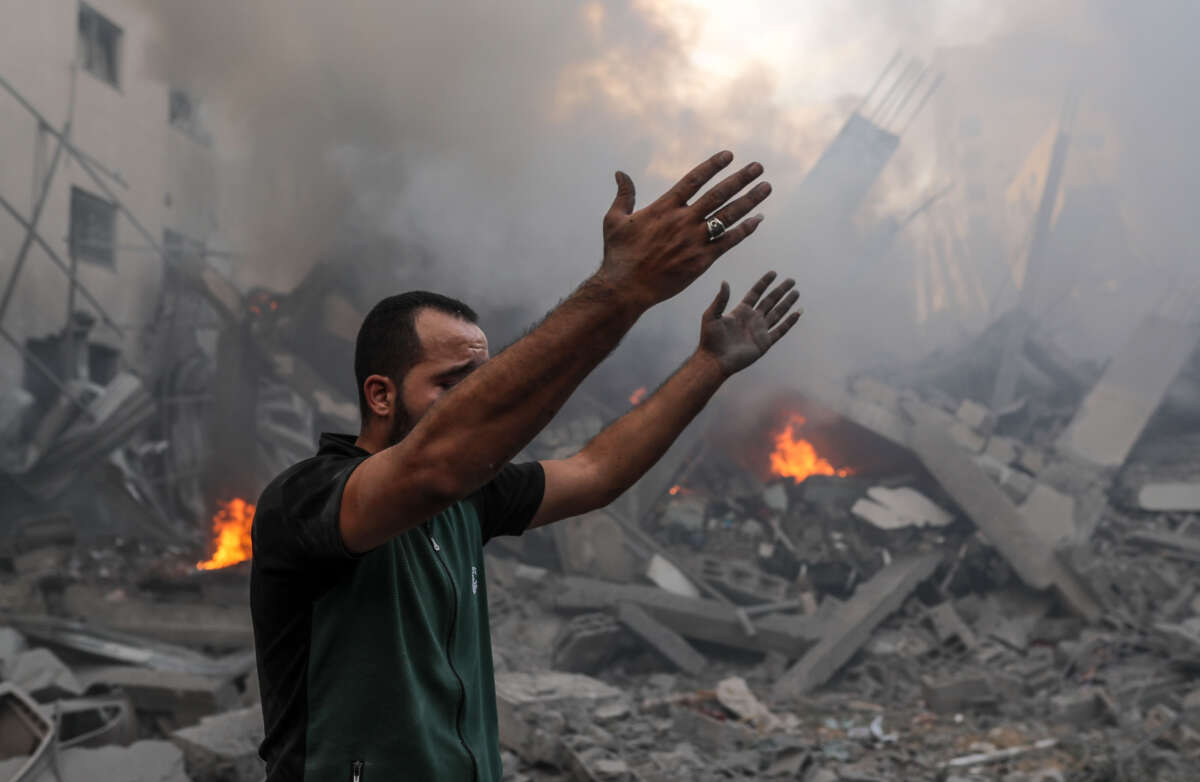
PHOTO: A man wails after Israeli airstrikes in Gaza City on October 9, 2023.
Belal Khaled / Anadolu Agency via Getty Images
Since last weekend I’ve been glued to the news and frantically
checking on my family and friends in Gaza and the West Bank. I grieve
for the loss of Palestinian and Israeli lives and I mourn with all those
who lost loved ones and those who continue to suffer the consequences
of the longest occupation in modern history.
This week’s violence did not start with Hamas’s October 7 act of
armed resistance against Israel, which surprisingly shocked Israelis and
the world. As a result of the attack — which some have argued is better
understood not as an act of war but as an “open-air prison revolt,” due
to the suffocating conditions of the never-ending siege of Gaza —
Israelis have momentarily experienced what Palestinians have endured on a
daily basis for decades. The nightmare that has unfolded is the direct
and inevitable result of a decades-long policy of ethnic cleansing and
apartheid.
It is heart-wrenching to see the images of death, massive destruction
and demolition of entire residential neighborhoods in Gaza, including
schools, hospitals, apartment buildings and mosques. As I write, Israeli
missiles and airstrikes are pounding Gaza indiscriminately in violation
of international law and human rights law.
In a press conference after forming an emergency war government with
opposition leader Benny Gantz, Israeli Prime Minister Benjamin Netanyahu
said, “Every Hamas member is a dead man … Hamas is ISIS, and we will
crush and eliminate it.” He then ordered thecarpet bombing of Gazatargeting
not only Hamas but also hammering Palestinian residential neighborhoods
indiscriminately. According to the Gaza health ministry, the death toll
after the fifth day of bombardment exceeded 1,200 Palestinians,
including over 300 children and nearly 200 women. Israel is utilizing
its military might — which includes one of the world’s most powerful and
dangerously equipped army, air force and navy, with a significant
unacknowledged nuclear arsenal — against a caged, occupied and crowded
population. Israeli politicians, including Benjamin Netanyahu and Israel
army Major General Ghasan Alyan, are calling for
“turning Gaza into rubble” and “opening the gates of hell.” Israeli
Defense Minister Yoav Gallant made a genocidal announcement and ordered
an even more complete “full blockade” of Gaza and said that Israel will
“cut all water, electricity, fuel and food…. We are fighting human
animals and we act accordingly.”
The nightmare that has unfolded is the direct and inevitable result of a decades-long policy of ethnic cleansing and apartheid.
How many times before have we heard Israel threaten the “flattening”
of Gaza? It is outrageous and shortsighted to describe Hamas’s actions
as “an unprovoked attack,” as U.S. mainstream media, the White House and
members of Congress are doing. (Notably, some voices in Israeli media
such as Haaretz are more willing to acknowledge the roots of the violence.)
Over 2 million Palestinians — most of whom are refugees from the wars
of 1948 and 1967 — have been under siege since 2007 and subjected to
relentless airstrikes every few years that have caused a tragedy of
unimaginable proportions: families displaced from their destroyed homes;
a shattered economy with 42 percent unemployment rate; no freedom of
movement; lack of life-sustaining resources such as food, water, and
fuel; and 80 percent of the population relying on international humanitarian aid
for survival. The root cause of the violence is the oppression of a
people, who for decades have been struggling to gain their freedom and
equality and are witnessing an “international community” unwilling to
address the injustice, systemic gross violations of international law,
denial of their rights and the horrific conditions they have endured.
A friend in Gaza said to me recently, “What is worse than dying in Gaza is living
[in Gaza].” The dire humanitarian conditions in Gaza — coupled with
shortages of food, electricity, fuel and medical supplies — have left
Palestinians without life-sustaining goods and services, and with
endless misery and hardship.
As I write,
Israeli missiles and airstrikes are pounding Gaza indiscriminately in
violation of international law and human rights law.
It is the continuous, nonstop aggression, settler violence and
abhorrent crimes of apartheid that provoke an armed response. Let us
also be clear that the U.S. government is complicit in these acts and is
the prime enabler of the continued oppression and dehumanization of
Palestinians. The U.S. and other European allies who are supporting the
Israeli military as it carries out collective punishment against
Palestinians — bombing apartment buildings, razing entire neighborhoods
and cutting electricity to the 2.3 million Palestinians in Gaza — bear
full responsibility for the bloodshed. In a telephone conversation with
Prime Minister Netanyahu, President Biden reiterated the U.S.’s “rock
solid and unwavering support” and ordered U.S. military ships to move
closer to the eastern Mediterranean. According to a report by CBS News,
the U.S.S. Gerald R. Ford Carrier Strike Group includes the U.S.S.
Gerald R. Ford aircraft carrier, which is the largest warship in the
world, as well as five guided missile warships.
We call on our elected officials and all those who care about justice
and human life to do everything they can in order to secure an
immediate ceasefire, to stop the annihilation of Palestinians, to end
the 17-year-old suffocating blockade on Gaza and end U.S. funding of the
Israeli apartheid regime with taxpayers’ dollars. Sending more U.S.
weapons to Israel will only add fuel to the violence and result in more
deaths and devastation.
On October 10, House Foreign Affairs Committee Chairman Michael
McCaul (R-Texas) and Ranking Member Gregory W. Meeks (D-New York),
joined by 390 of their colleagues, introduced a bipartisan resolution “standing with Israel as it defends itself against the barbaric war launched by Hamas and other terrorists and condemning Hamas’ brutal war against Israel.”
Without a change in current U.S. policy toward Israel/Palestine and
without Congress’s ability to see that a “barbaric war” against the
Palestinians has been taking place since before 1948, there will never
be a just peace in the region.
Isn’t it time to put an end to all this suffering by supporting freedom and equality for all?
International human rights organizations, including Amnesty
International and Human Rights Watch, have issued extensive reports that
concluded that Israel practices apartheid.
United Nations Special Rapporteur on Human Rights in the Occupied
Palestinian Territory Francesca Albanese has come under vicious attacks
following her report highlighting Israeli settler colonialism and
apartheid. Hagai El-Ad, director of B’Tselem, Israel’s oldest human
rights organization, recently said in its report, “Israel is not a democracy
that has a temporary occupation attached to it: It is one regime
between the Jordan River to the Mediterranean Sea, and we must look at
the full picture and see it for what it is: apartheid.” Yet, our elected
officials disregard all of this, including the International Criminal
Court’s labeling of apartheid as “a crime against humanity.”
Why hasn’t the U.S. government shown Palestinians the same empathy,
compassion, support and resolve that it has shown our brothers and
sisters in Ukraine? In a clear display of double standards, U.S.
government officials hail Ukrainians fighting the illegal Russian
occupation as heroes and supply them with arms to defend themselves, but
Palestinians — who also struggle to end an illegal occupation — are
routinely labeled as terrorists (long before Hamas even existed). Some
officials falsely accuse American supporters of Palestinian rights of
antisemitism, while others slander Jewish supporters of Palestinian
rights as self-hating Jews.
This outrage must end. There can be no hope for peace until there is
an end to the occupation; until Palestinians get justice, freedom and
equal rights; and until Israel adheres to international law. Those who
care about humanity — and those who care about the lives of Israelis and
Palestinians — will have to ask themselves a simple question: Isn’t it
time to put an end to all this suffering by supporting freedom and
equality for all?
ABOUT THE AUTHOR:
Michel Moushabeck is a Palestinian American writer, editor, translator
and musician. He is the founder and publisher of Interlink Publishing, a
36-year-old, Massachusetts-based, independent publishing house. Follow
him on Instagram: @ReadPalestine.
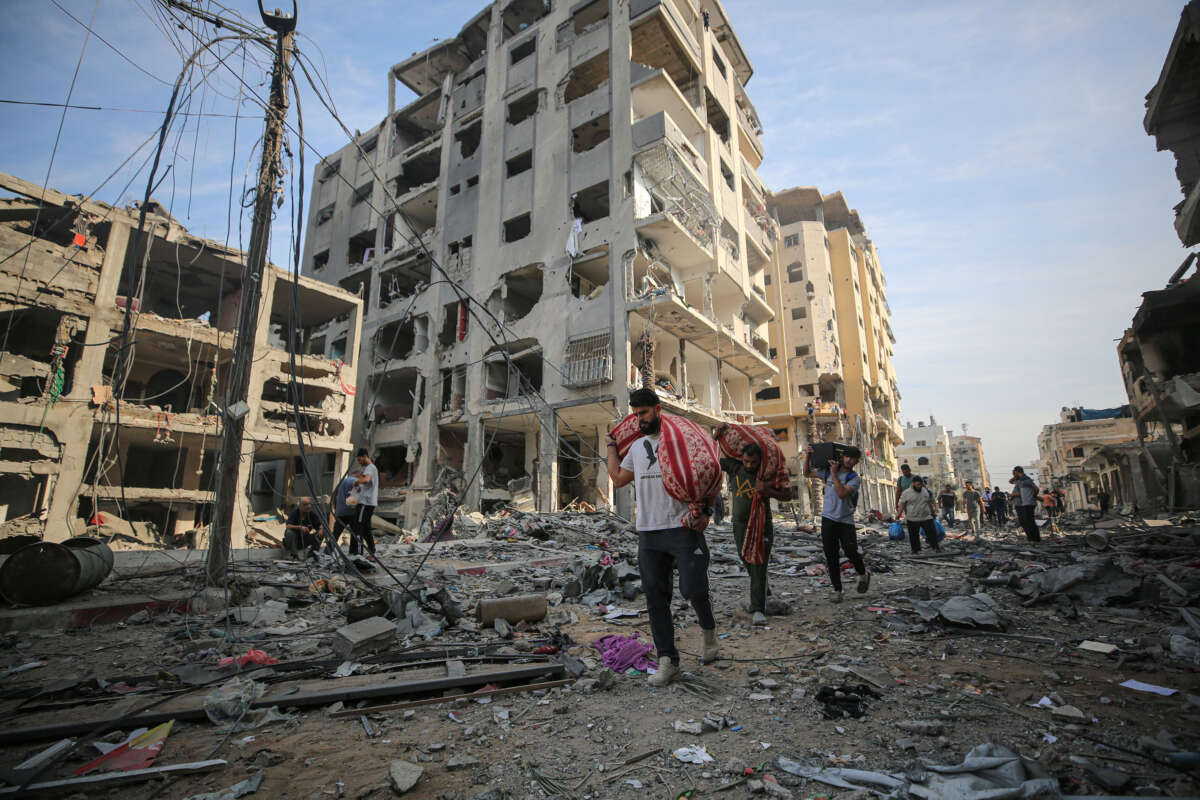
PHOTO: People
carry their belongings around destroyed buildings and debris at the
Al-Karama neighborhood after an Israeli airstrike that has been going on
for five days in Gaza City on October 11, 2023.Mustafa Hassona/Anadolu via Getty Images
Late Thursday night, Israel’s military ordered 1.1 million
Palestinians in Gaza to flee the northern half of the territory within
24 hours — an evacuation order that one U.N. spokesman said would be “impossible” to execute without “devastating human consequences.”
Since Hamas’s killing of around 1,300 Israelis last weekend, Israel has launched a relentless and indiscriminate
bombing campaign against Palestinian territories, leveling entire
residential neighborhoods, wiping families off the population registry
and killing more than 1,800 Palestinians, a figure that is likely to climb in the coming days. A third of the death toll are children.
Western media has largely focused on Hamas, framing the Israeli
military attacks on civilians as justified — but many journalists are
pushing back on that narrative, noting that Palestinians have faced
decades of dispossession, settler violence and apartheid under Israeli
occupation.
“This was not a provocation by Hamas, the provocation is that the
Israeli regime has for decades placed Palestinians under colonial
occupation,” said Yara Hawari, a senior analyst for Al-Shabaka, in a Sky News interview.
“The level of dehumanization is so phenomenal, you can’t even see us as humans,” Hawari added.
On Friday, Israel ordered Palestinians in northern Gaza to evacuate
to Egypt or the southern portion of the territory. The area is highly
populated — over 2 million Palestinians reside in Gaza overall, making the region one of the most densely populated areas of the world, with around 5,700 people per square mile. In the northern part of Gaza, that rate is closer to 9,000 people per square kilometer. Nearly half of Gaza’s population is under the age of 18.
The World Health Organization has also condemned the order, noting
that it would be “impossible” to follow, particularly for the thousands
of Palestinians who have been injured and are being treated at health
care facilities. Those awaiting treatment would be subjected to a “death
sentence” under Israel’s demand for displacement, a spokesperson for the organization said.
“I’m seeing people holding their bags like they want to run away but
where should we go? It’s a small city there’s no escape, we’re trying to
save our lives,” Gaza City resident Farah Abo Sedo said. “They bomb us every single night without any mercy, there’s nothing left.”
“No-one protects us or sends us help, there’s no safe place here,
there are a lot of children and pregnant women and no-one helps us,” Abo
Sedo added.
A video has recently gone viral of a teenager in Gaza begging for
international solidarity with the Palestinian people, showcasing the
devastating human toll of the occupation.
Chris Walker is a news writer at Truthout, and is based out of
Madison, Wisconsin. Focusing on both national and local topics since the
early 2000s, he has produced thousands of articles analyzing the issues
of the day and their impact on the American people. He can be found on
Twitter: @thatchriswalker
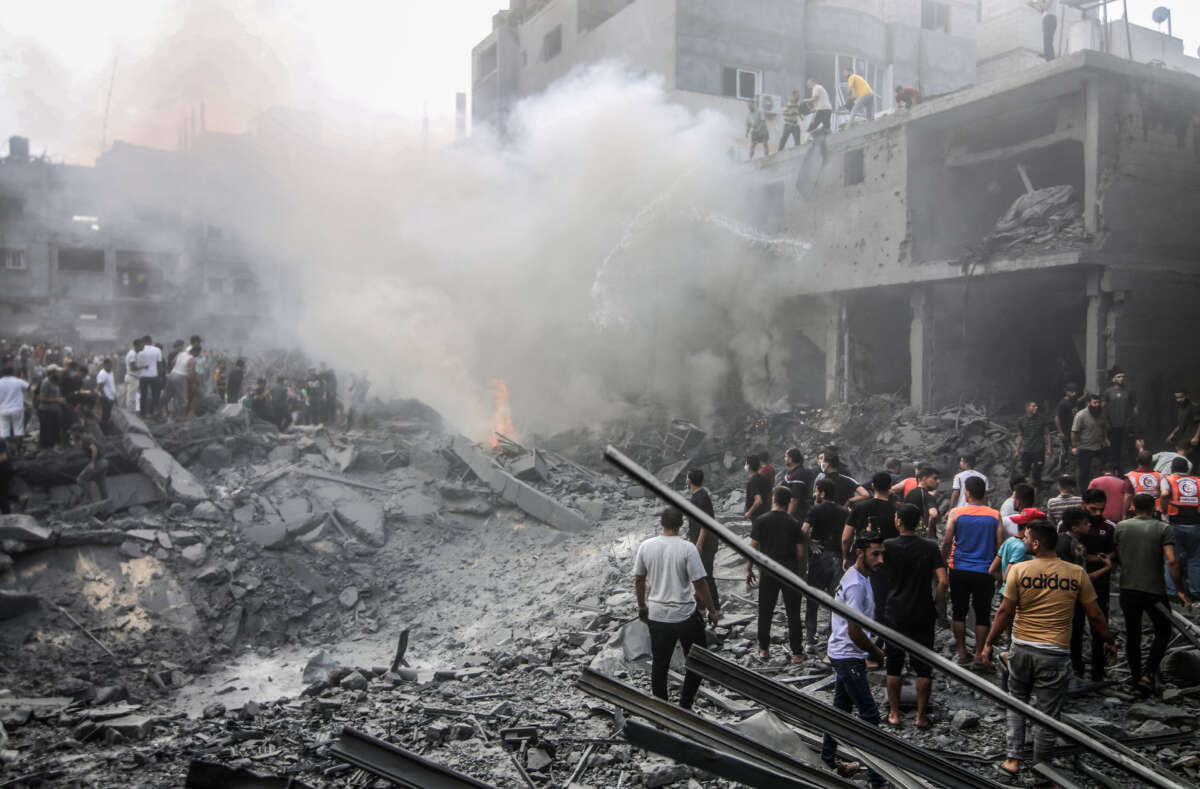
PHOTO: People extinguish a fire in the site of Israeli air strikes in Rafah on October 12, 2023. Abed Rahim Khatib / picture alliance via Getty Images
Part of being Palestinian American is having to watch Israel treated
as the U.S.’s “special ally” and essentially the 51st state. This week,
that feeling is particularly acute as the U.S. is planning to augment
its aid to Israel with an additional $2 billion, even as Israeli
officials call for genocidal acts, horrific human rights abuses and
collective punishment in the Gaza Strip.
In these moments, Palestinian Americans like me face the constant
guilt that our tax dollars are funding the oppression and apartheid
conditions faced by our families and people in Israeli-occupied
Palestine. For instance, U.S. funds help subsidize Israel’s illegal
settlements across the West Bank. Israel has now placed Palestinian
cities and villages in the West Bank under closure, and Israeli forces
have just provided already heavily armed Israeli settlers with over
1,000 additional M16 rifles, which is terrifying given the history of
settler violence.
While my family in the West Bank live in fear from soldiers and
settlers, the reports from our friends and contacts in the Gaza Strip
are nightmarish. Israeli officials are referring to Palestinians as
“human animals” and confirmed having cut off access to water,
electricity, food and medicine. Israeli bombardment has been underway
for days now in preparation for a ground invasion in Gaza.
The past few days have been grueling on so many levels, particularly as
Israeli officials — in what has been described as the most far right
government in Israel’s history — call for and carry out atrocities
against Palestinians with full backing from U.S. officials.
U.S. leaders have been inciting Israel to inflict large-scale
assaults on Hamas without regard for civilian life in a besieged and
impoverished territory where half the population are children and most
are refugees. Already there are reports of Israel’s use of white
phosphorus weapons and Israel’s bombardment killing women, children,
men, journalists and medics, while Gazan hospitals are on the brink of
losing power.
A core part of the Palestinian American experience in moments like
these is our escalated experience of systemic racism and the silencing
of our voices — not only in Palestine/Israel, but here in the U.S. as
well. The campaigns of demonization of Palestinians and targeting of
visible voices are in full force as we speak. Students and others in the
U.S. who are attempting to raise awareness about the need for
Palestinian rights and protection are being smeared, doxed and even
fired by their employers.
As I worry about my own loved ones back home and try to keep up with
the staggering statistics on the decimation of Palestinian lives and
livelihoods, I also am grieving for Israeli civilians as they process
the unprecedented scale of killing they experienced this past weekend. I
know Palestinians and Israelis who have been killed, maimed and
displaced, and who are missing, and my heart is broken in a million
pieces.
It has also been painful to endure the barrage of accusations and
suspicion. Palestinians, despite our immense heterogeneity like any
other people, are writ large associated with Hamas. While some
Palestinians support Hamas for political, religious or utilitarian
reasons, others oppose Hamas on ideological or practical grounds.
Most Palestinians merely want to lead ordinary lives with dignity and
now cannot think of anything beyond survival. I keenly experience how,
as a Palestinian American, I am deemed guilty of support for “terrorism”
until proven innocent. In the U.S., individuals overwhelmingly tend to
assume that we are sympathetic to Hamas and to the massacres and war
crimes they carried out this weekend that have resulted in over 1,300 Israeli deaths.
Of course, I am unequivocally opposed to the targeting of Israeli
civilians. But it’s demeaning for us to endure being asked to declare
this so constantly. As a pacifist, I am deeply committed to nonviolent
resistance, even as we are aware of Israel’s history of repression
against nonviolent resistance. The expectation seems to be for
Palestinians to acquiesce to our oppression and the theft of our
ancestral homes, lands and natural resources.
It’s also surreal to be pressured to muzzle ourselves about the 75
years of Israeli state-sponsored terrorism against the Palestinian
people. For my 39 years of existence on this planet, my homeland has
always been under Israeli military occupation, with massive violations
of international law. Within American academia, scholars such as myself,
who specialize in the Middle East and are people of color, often face
heightened surveillance from external organizations and internal forces
that decontextualize our words and attempt to smear us as violent and
antisemitic.
While my
family in the West Bank live in fear from soldiers and settlers, the
reports from our friends and contacts in the Gaza Strip are nightmarish.
Certainly, antisemitism must be named, condemned and combatted with
moral clarity. Yet false accusations of antisemitism should not be
leveled against individuals advancing informed criticisms of the Israeli
state and its egregious human rights violations. The Palestinian
freedom movement includes many Jewish and Israeli voices who are
furthering solidarity between our communities and who are challenging
the chilling of free speech on Palestine/Israel.
It is disheartening to witness political forces in the U.S., who are
instrumentalizing compassion regarding Israeli suffering, to help
channel further U.S. military support for Israeli violence against
innocent Palestinians in Gaza. It is an upsetting experience to realize
that many of the same folks justifiably expressing horror about the
murder and abduction of Israeli women, men, children and the elderly
have never uttered a word about the murder and disappearance of
Palestinians, even though Palestinians have disproportionately
shouldered the casualties of this conflict and settler colonialism.
I find the empathy and compassion that so many Americans have for
Israeli life to be beautiful. Yet the extreme imbalance in recognizing
the humanity of Israelis versus Palestinians has been relentlessly
stoked by the biases of mainstream U.S. media, which have yielded a U.S.
public that has largely never seen the countless images of Palestinian
children being abducted from their beds and neighborhoods and taken to
Israeli dungeons over decades now. I hope that one day we will get to
the point that the sort of empathy that the majority of people in the
U.S. so readily feel for Israelis can also be extended to the
Palestinian people as well.
Moving forward, the global movement for Palestinian freedom
continues, and the U.S. is a major part of this equation. Americans in
solidarity with Palestine play an important role in lobbying their
elected officials to push for a ceasefire between Israel and Hamas, and
to provide humanitarian protection to all civilians. We also raise
public awareness about the gross violations of human rights in the
Occupied Territories.
Achieving sustainable peace necessitates addressing the root of the
Gaza crisis: the ongoing displacement and dispossession of the
Palestinian people. As we embrace political rather than military
solutions, we also call for an end to unconditional U.S. aid to Israel,
and demand that international law be consistently applied to Israeli,
Palestinian and American parties to the conflict. There are
organizations on the ground worthy of our support, including Palestine Children’s Relief Fund and the United Nations Relief and Works Agency for Palestine Refugees, and Medical Aid for Palestinians.
I hope for an immediate end to the bloodshed, the return of
Palestinian and Israeli detainees to their homes, and building peace and
justice for all in Palestine/Israel.
ABOUT THE AUTHOR:
Sa’ed Atshan is an associate professor of peace and conflict studies and anthropology at Swarthmore College.
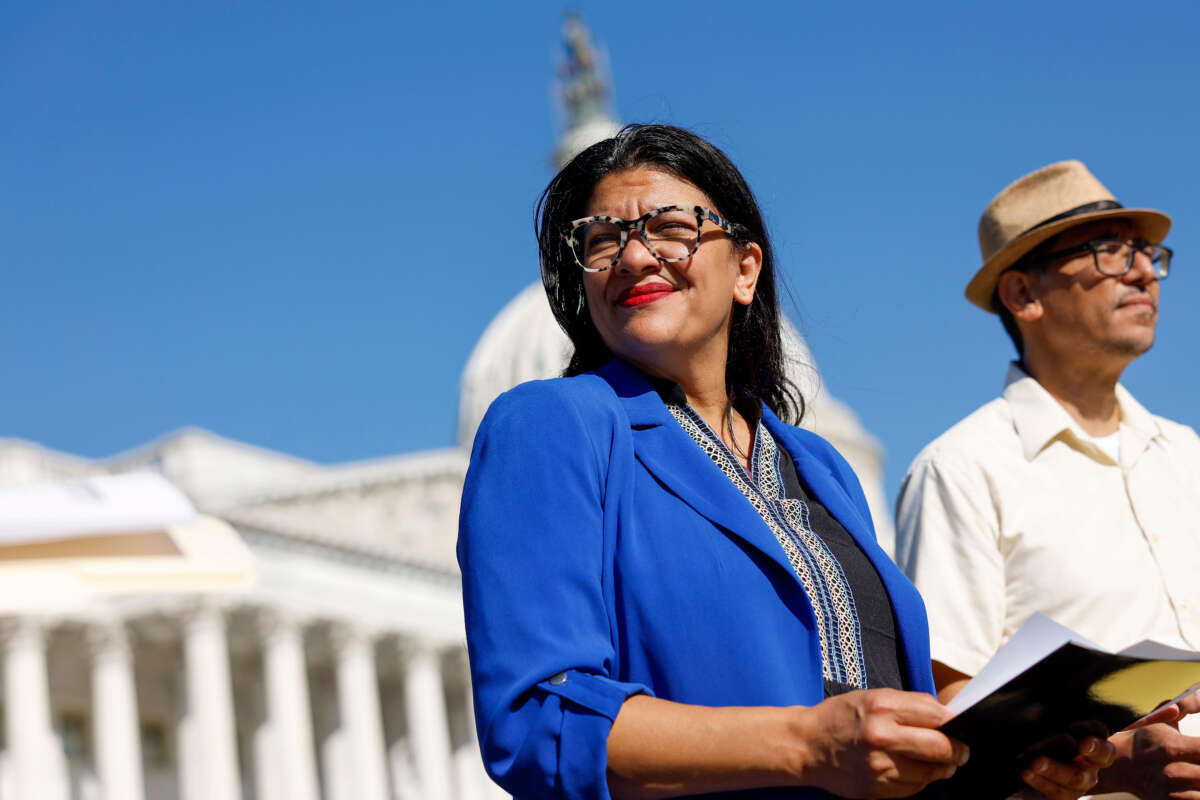
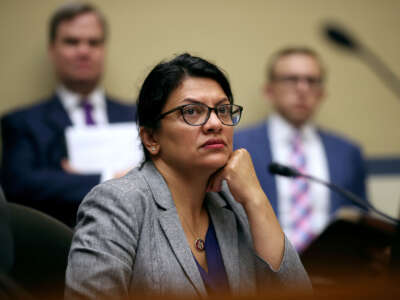
PHOTO: Rep. Rashida Tlaib arrives at a news conference outside the U.S. Capitol Building on September 19, 2023, in Washington, D.C. Anna Moneymaker / Getty Images
A Republican House member has filed a resolution to censure Rep.
Rashida Tlaib (D-Michigan), the only Palestinian in Congress, who is
facing a deluge of fierce criticism from both sides of the aisle after
she called for an end to Israel’s apartheid in a statement this weekend.
The resolution
was filed on Wednesday by Rep. Jack Bergman (R-Michigan), who parroted
unverified information from Israeli forces that Hamas had beheaded
infants in its attack last week and smeared Tlaib as antisemitic — a
longtime tactic of Zionists to discredit those who stand against Israel’s violent occupation of Palestine. Another Republican, Rep. Morgan Luttrell (Texas), joined Bergman in filing the resolution.
“There is no moral equivalence between Israel defending itself and
Hamas attacking innocent Israeli civilians,” he said, as Israel launched
thousands of bombs at Gazan citizens and cut off electricity and water
to the area, which many have noted is a war crime, after decades of committing settlerviolence
against Palestinians. The resolution condemns Tlaib for “calling Israel
an apartheid state and insinuating the United States should end its
support for the State of Israel.”
On Saturday, Tlaib released a statement
mourning the loss of Israelis in Hamas’s attack while also calling on
Israel to end their apartheid. “I grieve the Palestinian and Israeli
lives lost yesterday, today, and every day,” she said.
“The path to that future must include lifting the blockade, ending
the occupation, and dismantling the apartheid system that creates the
suffocating, dehumanizing conditions that can lead to resistance. The
failure to recognize the violent reality of living under siege,
occupation, and apartheid makes no one safer. No person, no child
anywhere should have to suffer or live in fear of violence,” she
continued. “As long as our country provides billions in unconditional
funding to support the apartheid government, this heartbreaking cycle of
violence will continue.”
It is telling that Bergman would target the only person of
Palestinian origin in the House with the resolution, even though
lawmakers like Representatives Cori Bush (D-Missouri) and Ilhan Omar (D-Minnesota) put out similar statements.
The resolution also criticizes Tlaib for hosting an event to commemorate the 75th anniversary of
the Nakba (meaning “catastrophe” in Arabic) — when Israeli militants
violently expelled three quarters of all Palestinians from their homes
between 1947 and 1949.
A censure, which requires only a simple majority vote, represents a
strong rebuke of a lawmaker and can also come with a removal from
committee assignments. It’s unclear if the censure resolution would
pass.
However, both Republicans and Democrats alike have been repeating the
same line on supporting Israel unconditionally, even as Israeli
officials began warning 1.1 million Gazans on Friday to evacuate to the
southern part of the region or face relentless bombing that has leveled
entire residential neighborhoods. Some are likening this move to a second Nakba, saying it is an escalation of the ongoing genocide that has been happening in plain sight.
Earlier this week, White House Press Secretary Karine Jean-Pierre said that
statements like Tlaib’s and Omar’s were “repugnant” — unlike, perhaps
to Jean-Pierre, decades of settler violence and apartheid. The few
pro-Palestine lawmakers in Congress have faced similar attacks from
Republicans and Democrats alike.
As some commentators have pointed out,
however, statements like Tlaib’s and Omar’s are not that far from what
even some Israelis have been saying about the current attacks; Daniel
Levy, a former Israeli negotiator and top adviser to former Israeli
Prime Minister Ehud Barak, told BBC over the weekend that both the Hamas attack and any retaliation involving killing civilians are wrong, as The Nation pointed out.
That American lawmakers would be so roundly condemned for what even
some Israeli officials are saying is a show of how strong the pro-Israel
propaganda is in the U.S.
ABOUT THE AUTHOR:
Sharon Zhang is a news writer at Truthout covering politics, climate and labor. Before coming to Truthout, Sharon had written stories for Pacific Standard, The New Republic, and more. She has a master’s degree in environmental studies. She can be found on Twitter: @zhang_sharon.
"I'm for truth, no matter who tells it. I'm for justice, no matter who it's for or against."
W.E.B. DuBois (1868-1963)
"There is but one coward on earth, and that is the coward that dare not know."
Dr. Martin Luther King, Jr. (1929-1968)
"Change does not roll in on the wheels of inevitability, but comes through continuous struggle. And so we must straighten our backs and work for our freedom. A man can't ride you unless your back is bent. "
James Baldwin (1924-1987)
"Precisely at the point when you begin to develop a conscience you must find yourself at war with your society."
Aimé Césaire (1913-2008)
"A civilization that proves incapable of solving the problems it creates is a decadent civilization. A civilization that chooses to close its eyes to its most crucial problems is a stricken civilization. A civilization that uses its principles for trickery and deceit is a dying civilization."
Nina Simone (1933-2003)
"There's no other purpose, so far as I'm concerned, for us except to reflect the times, the situations around us and the things we're able to say through our art, the things that millions of people can't say. I think that's the function of an artist and, of course, those of us who are lucky leave a legacy so that when we're dead, we also live on. That's people like Billie Holiday and I hope that I will be that lucky, but meanwhile, the function, so far as I'm concerned, is to reflect the times, whatever that might be."
Amilcar Cabral (1924-1973)
"Always bear in mind that the people are not fighting for ideas, for the things in anyone's head. They are fighting to live better and in peace, to see their lives go forward, to guarantee the future of their children ....Hide nothing from the masses of our people. Tell no lies. Expose lies whenever they are told. Mask no difficulties, mistakes, failures. Claim no easy victories..." .
Angela Davis (b. 1944)
"The idea of freedom is inspiring. But what does it mean? If you are free in a political sense but have no food, what's that? The freedom to starve?”
Duke Ellington (1899-1974)
“Jazz is the freest musical expression we have yet seen. To me, then, jazz means simply freedom of musical speech! And it is precisely because of this freedom that so many varied forms of jazz exist. The important thing to remember, however, is that not one of these forms represents jazz by itself. Jazz simply means the freedom to have many forms.”
Amiri Baraka (1934-2014)
"Thought is more important than art. To revere art and have no understanding of the process that forces it into existence, is finally not even to understand what art is."
Frederick Douglass (1817-1895)
"Power concedes nothing without a demand. It never did and it never will. Find out just what any people will quietly submit to and you have found out the exact measure of injustice and wrong which will be imposed upon them, and these will continue till they are resisted with either words or blows, or both. The limits of tyrants are prescribed by the endurance of those whom they oppress.” --August 3, 1857
Cecil Taylor (1929-2018)
“Musical categories don’t mean anything unless we talk about the actual specific acts that people go through to make music, how one speaks, dances, dresses, moves, thinks, makes love...all these things. We begin with a sound and then say, what is the function of that sound, what is determining the procedures of that sound? Then we can talk about how it motivates or regenerates itself, and that’s where we have tradition.”
Ella Baker (1903-1986)
"Strong people don't need strong leaders"
Paul Robeson (1898-1976)
"The artist must take sides. He must elect to fight for freedom or for slavery. I have made my choice. I had no alternative."
John Coltrane (1926-1967)
"I want to be a force for real good. In other words, I know there are bad forces. I know that there are forces out here that bring suffering to others and misery to the world, but I want to be the opposite force. I want to be the force which is truly for good."
Miles Davis (1926-1991)
"Jazz is the big brother of Revolution. Revolution follows it around."
C.L.R. James (1901-1989)
"All development takes place by means of self-movement, not organization by external forces. It is within the organism itself (i.e. within the society) that there must be realized new motives, new possibilities."
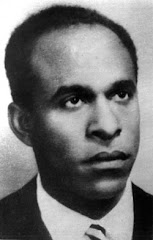
Frantz Fanon (1925-1961)
"Now, political education means opening minds, awakening them, and allowing the birth of their intelligence as [Aime] Cesaire said, it is 'to invent souls.' To educate the masses politically does not mean, cannot mean, making a political speech. What it means is to try, relentlessly and passionately, to teach the masses that everything depends on them."
Edward Said (1935-2003)
“I take criticism so seriously as to believe that, even in the midst of a battle in which one is unmistakably on one side against another, there should be criticism, because there must be critical consciousness if there are to be issues, problems, values, even lives to be fought for."
Antonio Gramsci (1891-1937)
“The challenge of modernity is to live without illusions and without becoming disillusioned. There must be pessimism of the intellect and optimism of the will.”
Susan Sontag (1933-2004)
"Do stuff. Be clenched, curious. Not waiting for inspiration’s shove or society’s kiss on your forehead. Pay attention. It’s all about paying attention. Attention is vitality. It connects you with others. It makes you eager. Stay eager."
Kofi Natambu, editor of The Panopticon Review, is a writer, poet, cultural critic, and political journalist whose poetry, essays, criticism, reviews, and journalism have appeared in many literary magazines, journals, newspapers, and anthologies. He is the author of a biography MALCOLM X: His Life & Work (Alpha Books) and two books of poetry: THE MELODY NEVER STOPS (Past Tents Press) and INTERVALS (Post Aesthetic Press). He was the founder and editor of SOLID GROUND: A NEW WORLD JOURNAL, a national quarterly magazine of the arts, culture, and politics and the editor of a literary anthology NOSTALGIA FOR THE PRESENT (Post Aesthetic Press). Natambu has read his work throughout the country and given many lectures and workshops at academic and arts institutions. He has taught American literature, literary theory and criticism, cultural history and criticism, film studies, political science, creative writing, philosophy, critical theory, and music history and criticism (Jazz, Blues, R&B, Hip Hop) at many universities and colleges. He was also a curator in the Education Department of Detroit’s Museum of African American History. Born in Detroit, Michigan, Natambu currently lives in Berkeley, California with his wife Chuleenan.