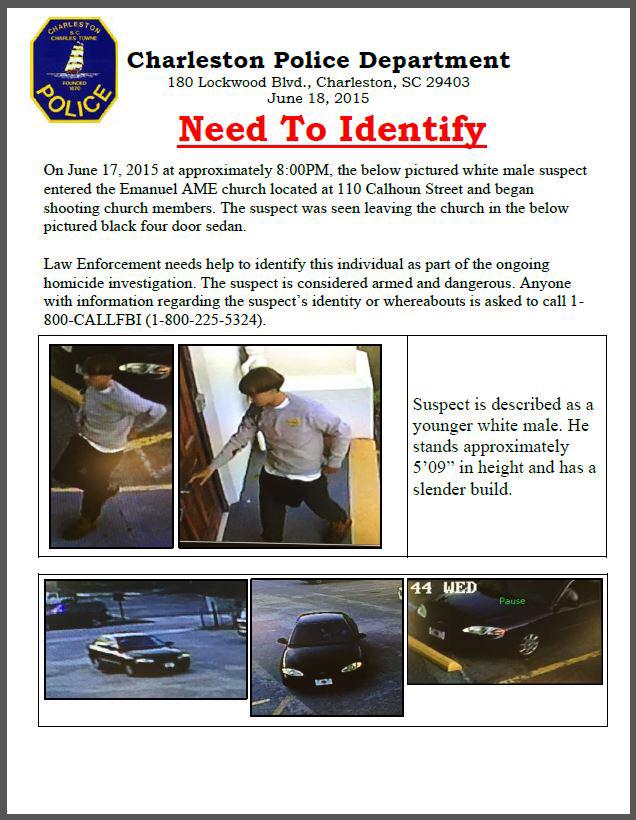
http://fair.org/home/wapo-dont-say-terrorist-about-white-people-like-ourselves/
Don’t Say ‘Terrorist’ About ‘White People Like Ourselves’
Don’t Say ‘Terrorist’ About ‘White People Like Ourselves’
by Jim Naureckas
June 22, 2015

Corporate media are demonstrably reluctant
to use the word “terrorist” with regards to Charleston shooting suspect
Dylann Roof–even though the massacre would seem to meet the legal definition of terrorism, as violent crimes that “appear to be intended…to intimidate or coerce a civilian population.”
Generally, news outlets don’t explain why they aren’t calling Roof a terrorist suspect; they just rarely use the word. But the Washington Post‘s Philip Bump gave it a shot in a piece headlined “Why We Shouldn’t Call Dylann Roof a Terrorist” (6/19/15), and his rationale is worth taking a look at.
Bump starts out by acknowledging that “a terroristic act, which this was, is treated and identified differently when the actor is a young white man.” He contrasts the treatment of the Charleston massacre with the attack on the Mohammad cartoon contest in Texas:
On some level, Bump understands that “terrorism” is a legal term with serious legal consequences, and that the fact that it’s unevenly applied based on the race and religion of the perpetrators is a real problem:
He also notes that the word has become politicized by the “War on Terror”—”which is, in essence, a war on certain groups of Middle Easterners and Muslims.” As Bump observes, “Calling more non-American people terrorists also serves to bolster the arguments of those calling for more military intervention.” Which leads him to conclude that “the problem…isn’t that we’re too slow to call Roof a terrorist. It’s that we’re often too quick to call everyone else a terrorist.”
Yet Bump doesn’t seem to have written a column about how “we’re too quick to call everyone else a terrorist”; he didn’t seem to have any problem referring to the Boston Marathon bombing as “terrorism,” for example. (“The key component to any terrorist attack is luck” was the lead sentence for a piece he wrote on the Tsarnaev brothers, for instance—The Wire, 4/22/13.) So why write this piece, urging people to do what most journalists are already doing—avoiding saying “terrorism” in connection to Charleston?

The answer seems to be in a remarkably revealing passage in the
middle of the piece, where Bump acknowledges that he identifies with
Roof because they share a skin color:
Bump closes his column by rejecting the arguments that referring to the Charleston massacre as “racial terrorism” would “help…America come to terms with the fact that the ideology he assumed is dangerous and urgent” and put Roof in line for stiffer penalties. “Fine,” he says—but
But the real debate here is not about whether terrorism is worse than mass murder with no political motive; it’s whether we’re going to call some acts of politically motivated murder “terrorism” while withholding that label from other murders that are equally politically motivated—when we know that this label has real consequences, legally and politically.
“We aren’t scared by his dumb Internet rhetoric,” says Bump. If he’s still using “we” to mean “white people like ourselves,” it is certainly true that whites generally don’t feel personally afraid of white supremacist terrorist who target African-Americans. They’re much more likely to be afraid of Muslim terrorists who target Americans in general—even though right-wing extremists (not all of whom are white supremacists, of course) killed five times as many people in this country as Muslim extremists in the decade after 9/11, according to a study from the US Military Academy (New York Times, 6/16/15).
If you really think the word “terrorism” is being used too much, you should argue against it in the cases where it’s actually frequently used—which is mostly in cases involving Muslim suspects. But that would mean going against conventional wisdom, possibly with some professional cost. To argue instead that journalists are right to avoid the label with regard to a suspect with whom “we can identify much more easily”—well, there’s never much of price to be paid for endorsing institutional prejudices.
Jim Naureckas is the editor of FAIR.org.
Messages can be sent to the Washington Post at letters@washpost.com, or via Twitter @washingtonpost. Please remember that respectful communication is the most effective.
http://www.salon.com/2015/06/21/the_racist_disease_we_never_discuss_dylann_roof_

In response to Wednesday’s murder of nine African Americans at Charleston’s Emanuel AME Church, President Obama said, “Innocent people were killed in part because someone who wanted to inflict harm had no trouble getting their hands on a gun.”
I’ll admit: When I first read that statement, I thought Obama was talking about the police. Unfair of me perhaps, but it’s not as if we haven’t now been through multiple rounds of high-profile killings of African Americans at the hands of the police.
Indeed, until Wednesday’s murders, it seemed as if the national conversation about public safety had dramatically and fruitfully shifted. From a demand for police protection of white citizens against black crime—which dominated political discussion from the 1970s to the 1990s—to a scrutiny of the very instruments of that presumed protection. And how those instruments are harming African American citizens.
It’s tempting to seize on this moment as an opportunity to broaden that discussion beyond the racism of prisons and policing to that of society itself. In a way, that’s what Obama was trying to do by focusing on the threat posed not by the state or its instruments but by private guns in the hands of private killers like Dylann Roof.
But that may not be the wisest move, at least not yet. So long as the discussion is framed as one of protection, of safety and security, we won’t get beyond the society that produced Dylann Roof. Not only has the discourse of protection contributed to the racist practices and institutions of our overly policed and incarcerated society, but it also prevents us from seeing, much less tackling, the broader, systemic inequalities that might ultimately reduce those practices and institutions.
Since the 1960s, when law and order became the rallying cry of the country’s rightward turn, particularly around issues of racial inequality, the notion that safety and security are the primary political goods has migrated across the ideological spectrum. In 1975, the influential libertarian philosopher Robert Nozick declared that a “minimal state”—“limited to the functions of protecting all its citizens against violence, theft, and fraud, and to the enforcement of contracts”—was the only legitimate form of government.
Though critical of the minimal state, liberals have also come to believe that “the ‘first’ political question,” in the words of British philosopher Bernard Williams, is “the securing of order, protection, safety, trust, and the preconditions of cooperation. It is ‘first’ because solving it is the condition of solving, indeed posing, any others.” Meeting those requirements of order, protection, safety, and so on is what distinguishes a legitimate state from an illegitimate state.
Providing for the safety and security of citizens, in this view, may not be a political question at all. It is instead the ground upon which we ask and answer all political questions. Before we can talk about justice or equality, before we can debate the kinds of schools we want or the amount of retirement or medical care we need, we have to be safe in our bodies and secure in our rights (minimally defined). Like the faith in God that once lay at the foundation of political order, the provision of safety and security is supposed to lie beneath or beyond politics. Whether we’re black or white, rich or poor, men or women, everyone needs it, all are entitled to it, no one can dispute it.
Unless we address those deep inequalities and systemic injustices that this security consensus declares to be secondary or ancillary, however, we’re not likely to provide for that security in any kind of universal way. If anything, we’ll make some men and women less safe and less secure.
Not only are blacks systematically under-protected against crime but so are they—and the poor more generally—over-policed by the state. That’s no accident, argues Georgetown Law professor David Cole, for “our criminal justice system affirmatively depends on” inequalities of class and race. It grants broad constitutional rights—against unreasonable searches and seizures, say, or to the defense of counsel—to all citizens. But it interprets those rights in such a way that they are enjoyed by wealthier, more privileged citizens. People of comfort get freedom and security; people of color and the poor get neither. Yet pay for both. “By exploiting society’s ‘background inequality,” Cole notes, the country “sidesteps the more difficult question of how much constitutional protection we could afford if we were willing to ensure that it was enjoyed equally by all people.”
To assume that the state can provide for the safety and security of the most subjugated classes in America without addressing the fact of their subjugation is to assume away the last half-century of political experience. If anything, the discourse of safety and security has made those classes less secure, less safe: not merely from freelance killers like Dylann Roof or George Zimmerman, who claim to be acting on behalf of their own safety and that of white society, but also from the police. As Cole writes, the proliferation of criminal laws and quality-of-life regulations that are supposed to make poor and black communities safer often serve as a pretext for the most intrusive and coercive modes of policing in those communities.
Corey Robin is a professor of political science at
Brooklyn College and the CUNY Graduate Center. Author of The Reactionary
Mind: Conservatism from Edmund Burke to Sarah Palin and Fear: The
History of a Political Idea, he is currently writing a book about
Clarence Thomas.
https://www.facebook.com/pages/The-Panopticon-Review/342702882479366
All,
I have been waiting fervently since last wednesday night to see/hear a black person in this country actually SAY ALOUD IN PUBLIC what the great majority of us are no doubt actually thinking and feeling about the brutal racist/white supremacist terrorist act of mass murder in Charleston, SC. and what it ACTUALLY MEANS to us. I was beginning to think/dread that no black human being would actually be given the opportunity to step forward and actually appear IN PUBLIC MEDIA to once again SAY ALOUD what we REALLY THINK AND FEEL about this truly heinous act.
FINALLY we don't have to wait any longer because MS. ROXANE GAY has come to our rescue and said aloud what desperately needs and deserves to be said so there will be no more "misunderstanding" about what this mass murder was really about and what it really means.
SO THANK YOU SISTER GAY...WE TRULY NEED AND DEEPLY APPRECIATE YOUR WORDS AND THEIR MEANING WHETHER ANYONE ELSE IN THIS DELUSIONAL COUNTRY "UNDERSTANDS" OR "GETS IT" OR NOT...
Kofi
http://www.nytimes.com/…/why-i-cant-forgive-dylann-roof.htm…
The Opinion Pages | Contributing Op-Ed Writer
Why I Can’t Forgive Dylann Roof
by Roxane Gay
JUNE 23, 2015
New York Times

I DO NOT forgive Dylann Roof, a racist terrorist whose name I hate saying or knowing. I have no immediate connection to what happened in Charleston, S.C., last week beyond my humanity and my blackness, but I do not foresee ever forgiving his crimes, and I am wholly at ease with that choice.
My unwillingness to forgive this man does not give him any kind of power. I am not filled with hate for this man because he is beneath my contempt. I do not believe in the death penalty so I don’t wish to see him dead. My lack of forgiveness serves as a reminder that there are some acts that are so terrible that we should recognize them as such. We should recognize them as beyond forgiving.
I struggle with faith but I was raised Catholic. I believe God is a God of love but cannot understand how that love is not powerful enough to save us from ourselves. As a child, I learned that forgiveness requires reconciliation by way of confession and penance. We must admit our sins. We must atone for our sins. When I went to confession each week, I told the priest my childish sins — fighting with my brothers, saying a curse word, the rather minor infractions of a sheltered Nebraska girl. When I didn’t have a sin to confess, I made something up, which was also a sin. After confession, I knelt at a pew and did my penance, and thought about the wrong I had done and then I tried to be better. I’m not sure I succeeded all that often.
Ever the daydreamer, I spent most of my time in Sunday Mass lost in my imagination. The one prayer that stayed with me was “Our Father” and the line “and forgive us our trespasses as we forgive those who trespass against us.” I always got stuck on that part. It’s a nice idea that we could forgive those who might commit the same sins we are apt to commit but surely, there must be a line. Surely there are some trespasses most of us would not commit. What then?
Forgiveness does not come easily to me. I am fine with this failing. I am particularly unwilling to forgive those who show no remorse, who don’t demonstrate any interest in reconciliation. I do not believe there has been enough time since this terrorist attack for anyone to forgive. The bodies of the dead are still being buried. We are still memorizing their names: Cynthia Hurd, Susie Jackson, Ethel Lance, DePayne Middleton Doctor, Clementa C. Pinckney, Tywanza Sanders, Daniel L. Simmons Sr., Sharonda Coleman-Singleton and Myra Thompson.
We are still memorizing these names but the families who loved the people who carried these names have forgiven Dylann Roof. They offered up testimony in court, less than 48 hours after the trauma of losing their loved ones in so brutal a manner. Alana Simmons, who lost her grandfather, said, “Although my grandfather and the other victims died at the hands of hate, everyone’s plea for your soul is proof that they lived in love, and their legacies will live in love.” Nadine Collier, who lost her mother, said: “You took something very precious away from me. I will never talk to her ever again. I will never be able to hold her again. But I forgive you and have mercy on your soul.”
I deeply respect the families of the nine slain who are able to forgive this terrorist and his murderous racism. I cannot fathom how they are capable of such eloquent mercy, such grace under such duress.
Nine people are dead. Nine black people are dead. They were murdered in a terrorist attack.
Over the weekend, newspapers across the country shared headlines of forgiveness from the families of the nine slain. The dominant media narrative vigorously embraced that notion of forgiveness, seeming to believe that if we forgive we have somehow found a way to make sense of the incomprehensible.
We are reminded of the power of whiteness. Predictably, alongside the forgiveness story, the media has tried to humanize this terrorist. They have tried to understand Dylann Roof’s hatred because surely, there must be an explanation for so heinous an act. At the gunman’s bond hearing, the judge, who was once reprimanded for using the N-word from the bench, talked about how not only were the nine slain and their families victims, but so were the relatives of the terrorist. There are no limits to the power of whiteness when it comes to calls for mercy.
The call for forgiveness is a painfully familiar refrain when black people suffer. White people embrace narratives about forgiveness so they can pretend the world is a fairer place than it actually is, and that racism is merely a vestige of a painful past instead of this indelible part of our present.
Black people forgive because we need to survive. We have to forgive time and time again while racism or white silence in the face of racism continues to thrive. We have had to forgive slavery, segregation, Jim Crow laws, lynching, inequity in every realm, mass incarceration, voter disenfranchisement, inadequate representation in popular culture, microaggressions and more. We forgive and forgive and forgive and those who trespass against us continue to trespass against us.
Mr. Roof’s racism was blunt and raggedly formed. It was bred by a culture in which we constantly have to shout “Black lives matter!” because there is so much evidence to the contrary. This terrorist was raised in this culture. He made racist jokes with his friends. He shared his plans with his roommate. It’s much easier to introduce forgiveness into the conversation than to sit with that reality and consider all who are complicit.
What white people are really asking for when they demand forgiveness from a traumatized community is absolution. They want absolution from the racism that infects us all even though forgiveness cannot reconcile America’s racist sins. They want absolution from their silence in the face of all manner of racism, great and small. They want to believe it is possible to heal from such profound and malingering trauma because to face the openness of the wounds racism has created in our society is too much. I, for one, am done forgiving.
Roxane Gay is the author of “An Untamed State” and “Bad Feminist” and a contributing opinion writer.
A version of this op-ed appears in print on June 24, 2015, on page A23 of the New York edition with the headline: Why I Can’t Forgive the Killer in Charleston.
http://www.truth-out.org/…/31517-dylann-roof-is-not-an-extr…
The Washington Post

Dylann Roof appears in court: A Washington Post writer argues against calling him a “terrorist.”
Generally, news outlets don’t explain why they aren’t calling Roof a terrorist suspect; they just rarely use the word. But the Washington Post‘s Philip Bump gave it a shot in a piece headlined “Why We Shouldn’t Call Dylann Roof a Terrorist” (6/19/15), and his rationale is worth taking a look at.
Bump starts out by acknowledging that “a terroristic act, which this was, is treated and identified differently when the actor is a young white man.” He contrasts the treatment of the Charleston massacre with the attack on the Mohammad cartoon contest in Texas:
In each case, someone hoping to prove a political point attacked a gathering because of who was in attendance. In the case where the only deaths were the attackers, we call it terrorism. In the case where the only deaths were the innocent people, we debate it.“But,” Bump then says, “we shouldn’t call Dylann Roof a terrorist.” His argument for this:
Roof wants to be a terrorist—for us to admit that he terrorized us. He likes the attention, telling the police as he admitted to his acts that he wanted to make sure they were “known.”… What if we just call him a racist, grotesque person. What if we laughed at him instead of telling him he scared us?This makes as much sense as arguing that you shouldn’t charge someone with kidnapping because the person they abducted wasn’t a kid. “Terrorism” is the name of a crime, and the relevant question isn’t whether we like the etymology of the term, but whether the murders fit the elements of the definition—which has to do with intent to intimidate or coerce, not with whether anyone actually felt “terror.”
On some level, Bump understands that “terrorism” is a legal term with serious legal consequences, and that the fact that it’s unevenly applied based on the race and religion of the perpetrators is a real problem:
When Dzhokhar Tsarnaev was arrested in Boston in 2013, the debate was over how to treat him given that he was a terror suspect—as manifested by Sen. Lindsey Graham—not over whether or not he was a terror suspect. That’s part of why Tsarnaev and the Texas cartoon attackers were so quickly identified as terrorists.This, Bump notes, “reflects the same racial chasm that Roof wanted to exacerbate.”
He also notes that the word has become politicized by the “War on Terror”—”which is, in essence, a war on certain groups of Middle Easterners and Muslims.” As Bump observes, “Calling more non-American people terrorists also serves to bolster the arguments of those calling for more military intervention.” Which leads him to conclude that “the problem…isn’t that we’re too slow to call Roof a terrorist. It’s that we’re often too quick to call everyone else a terrorist.”
Yet Bump doesn’t seem to have written a column about how “we’re too quick to call everyone else a terrorist”; he didn’t seem to have any problem referring to the Boston Marathon bombing as “terrorism,” for example. (“The key component to any terrorist attack is luck” was the lead sentence for a piece he wrote on the Tsarnaev brothers, for instance—The Wire, 4/22/13.) So why write this piece, urging people to do what most journalists are already doing—avoiding saying “terrorism” in connection to Charleston?

Washington Post‘s Philip Bump: “When I see Dylann Roof, I remember being a white male his age”
Most Americans are white, and we see white people like ourselves. When I see Dylann Roof, I remember being a white male his age, barely out of my teenage years and experiencing weird anger in a difficult time…. We can identify much more easily with who he is.Huh. You would think a self-respecting journalist, recognizing this kind of irrational bias in himself, would try to avoid letting it influence his work—would certainly not want to call for giving a criminal suspect special journalistic treatment based on this identification. Yet there’s not really any other explanation offered in the column as to why it was written about Roof and not about Dzhokhar Tsarnaev.
Bump closes his column by rejecting the arguments that referring to the Charleston massacre as “racial terrorism” would “help…America come to terms with the fact that the ideology he assumed is dangerous and urgent” and put Roof in line for stiffer penalties. “Fine,” he says—but
each of these is predicated on our insistence that terrorism is somehow a higher order of evil than simply murdering elderly people for being black even as they held their Bibles in a church. It implies that his mass murder was one thing, but that his scaring us was made things more problematic. Perhaps we should demonstrate to him—and every other angry young man like him—that we aren’t scared of his dumb Internet rhetoric. Not in the least.Let me note parenthetically that the law constantly takes intent into account—it’s the difference between murder and manslaughter, to name just one example—so suggesting that there’s something odd about taking the intent of a murder into account is specious.
And let’s reel in our use of the word “terrorism” back in.
But the real debate here is not about whether terrorism is worse than mass murder with no political motive; it’s whether we’re going to call some acts of politically motivated murder “terrorism” while withholding that label from other murders that are equally politically motivated—when we know that this label has real consequences, legally and politically.
“We aren’t scared by his dumb Internet rhetoric,” says Bump. If he’s still using “we” to mean “white people like ourselves,” it is certainly true that whites generally don’t feel personally afraid of white supremacist terrorist who target African-Americans. They’re much more likely to be afraid of Muslim terrorists who target Americans in general—even though right-wing extremists (not all of whom are white supremacists, of course) killed five times as many people in this country as Muslim extremists in the decade after 9/11, according to a study from the US Military Academy (New York Times, 6/16/15).
If you really think the word “terrorism” is being used too much, you should argue against it in the cases where it’s actually frequently used—which is mostly in cases involving Muslim suspects. But that would mean going against conventional wisdom, possibly with some professional cost. To argue instead that journalists are right to avoid the label with regard to a suspect with whom “we can identify much more easily”—well, there’s never much of price to be paid for endorsing institutional prejudices.
Jim Naureckas is the editor of FAIR.org.
Messages can be sent to the Washington Post at letters@washpost.com, or via Twitter @washingtonpost. Please remember that respectful communication is the most effective.
http://www.salon.com/2015/06/21/the_racist_disease_we_never_discuss_dylann_roof_
The racist disease we never discuss: Dylann Roof, over-policing and the real story about safety in America
People of comfort get freedom and security. People of color and the poor get neither
by Corey Robin
SALON
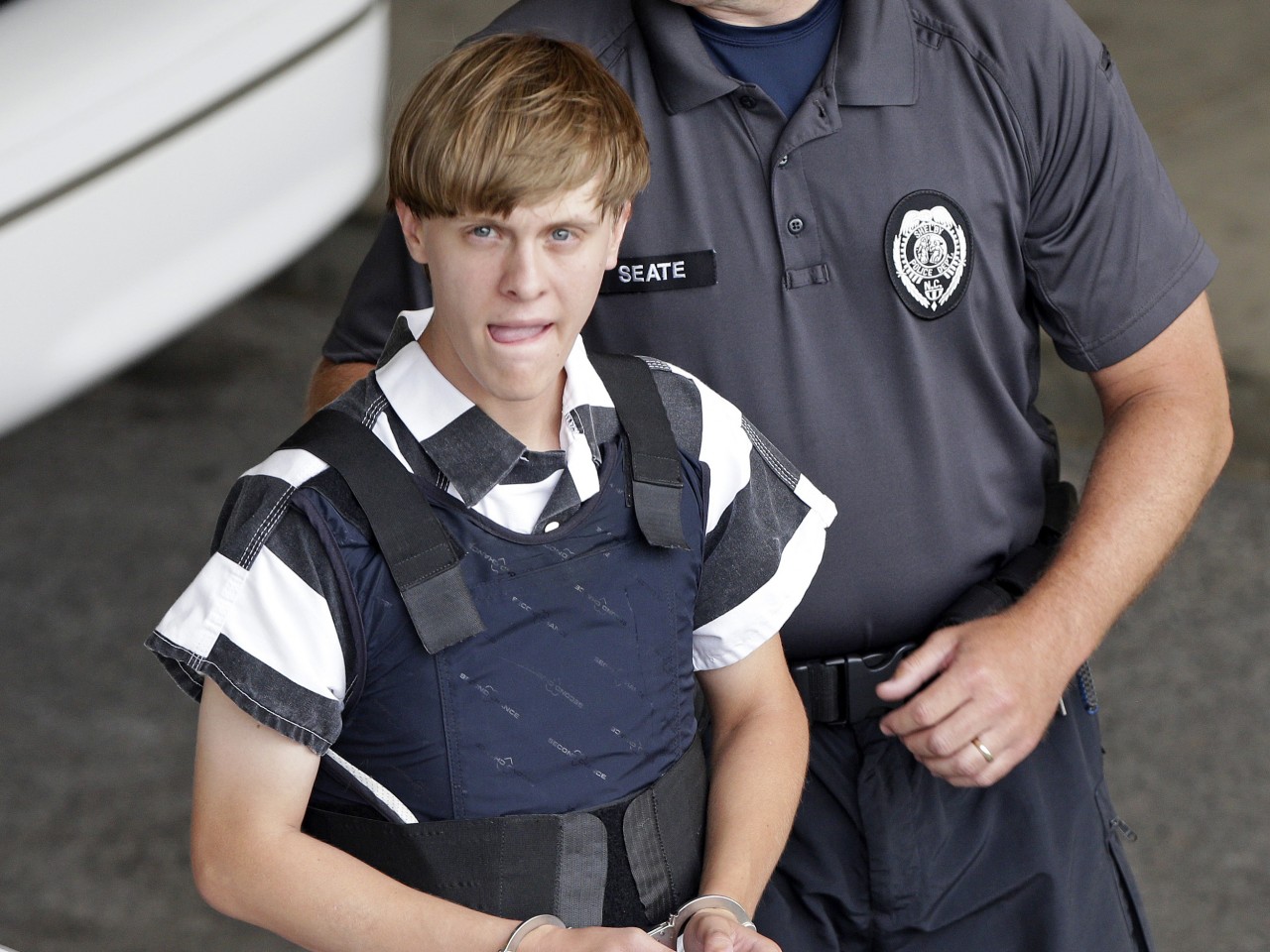
Charleston,
S.C., shooting suspect Dylann Storm Roof is escorted from the Cleveland
County Courthouse in Shelby, N.C., Thursday, June 18, 2015. Roof is a
suspect in the shooting of several people Wednesday night at the
historic The Emanuel African Methodist Episcopal Church in Charleston.
(AP Photo/Chuck Burton)(Credit: AP)
I’ll admit: When I first read that statement, I thought Obama was talking about the police. Unfair of me perhaps, but it’s not as if we haven’t now been through multiple rounds of high-profile killings of African Americans at the hands of the police.
Indeed, until Wednesday’s murders, it seemed as if the national conversation about public safety had dramatically and fruitfully shifted. From a demand for police protection of white citizens against black crime—which dominated political discussion from the 1970s to the 1990s—to a scrutiny of the very instruments of that presumed protection. And how those instruments are harming African American citizens.
It’s tempting to seize on this moment as an opportunity to broaden that discussion beyond the racism of prisons and policing to that of society itself. In a way, that’s what Obama was trying to do by focusing on the threat posed not by the state or its instruments but by private guns in the hands of private killers like Dylann Roof.
But that may not be the wisest move, at least not yet. So long as the discussion is framed as one of protection, of safety and security, we won’t get beyond the society that produced Dylann Roof. Not only has the discourse of protection contributed to the racist practices and institutions of our overly policed and incarcerated society, but it also prevents us from seeing, much less tackling, the broader, systemic inequalities that might ultimately reduce those practices and institutions.
Since the 1960s, when law and order became the rallying cry of the country’s rightward turn, particularly around issues of racial inequality, the notion that safety and security are the primary political goods has migrated across the ideological spectrum. In 1975, the influential libertarian philosopher Robert Nozick declared that a “minimal state”—“limited to the functions of protecting all its citizens against violence, theft, and fraud, and to the enforcement of contracts”—was the only legitimate form of government.
Though critical of the minimal state, liberals have also come to believe that “the ‘first’ political question,” in the words of British philosopher Bernard Williams, is “the securing of order, protection, safety, trust, and the preconditions of cooperation. It is ‘first’ because solving it is the condition of solving, indeed posing, any others.” Meeting those requirements of order, protection, safety, and so on is what distinguishes a legitimate state from an illegitimate state.
Providing for the safety and security of citizens, in this view, may not be a political question at all. It is instead the ground upon which we ask and answer all political questions. Before we can talk about justice or equality, before we can debate the kinds of schools we want or the amount of retirement or medical care we need, we have to be safe in our bodies and secure in our rights (minimally defined). Like the faith in God that once lay at the foundation of political order, the provision of safety and security is supposed to lie beneath or beyond politics. Whether we’re black or white, rich or poor, men or women, everyone needs it, all are entitled to it, no one can dispute it.
Unless we address those deep inequalities and systemic injustices that this security consensus declares to be secondary or ancillary, however, we’re not likely to provide for that security in any kind of universal way. If anything, we’ll make some men and women less safe and less secure.
Not only are blacks systematically under-protected against crime but so are they—and the poor more generally—over-policed by the state. That’s no accident, argues Georgetown Law professor David Cole, for “our criminal justice system affirmatively depends on” inequalities of class and race. It grants broad constitutional rights—against unreasonable searches and seizures, say, or to the defense of counsel—to all citizens. But it interprets those rights in such a way that they are enjoyed by wealthier, more privileged citizens. People of comfort get freedom and security; people of color and the poor get neither. Yet pay for both. “By exploiting society’s ‘background inequality,” Cole notes, the country “sidesteps the more difficult question of how much constitutional protection we could afford if we were willing to ensure that it was enjoyed equally by all people.”
To assume that the state can provide for the safety and security of the most subjugated classes in America without addressing the fact of their subjugation is to assume away the last half-century of political experience. If anything, the discourse of safety and security has made those classes less secure, less safe: not merely from freelance killers like Dylann Roof or George Zimmerman, who claim to be acting on behalf of their own safety and that of white society, but also from the police. As Cole writes, the proliferation of criminal laws and quality-of-life regulations that are supposed to make poor and black communities safer often serve as a pretext for the most intrusive and coercive modes of policing in those communities.
https://www.facebook.com/pages/The-Panopticon-Review/342702882479366
All,
I have been waiting fervently since last wednesday night to see/hear a black person in this country actually SAY ALOUD IN PUBLIC what the great majority of us are no doubt actually thinking and feeling about the brutal racist/white supremacist terrorist act of mass murder in Charleston, SC. and what it ACTUALLY MEANS to us. I was beginning to think/dread that no black human being would actually be given the opportunity to step forward and actually appear IN PUBLIC MEDIA to once again SAY ALOUD what we REALLY THINK AND FEEL about this truly heinous act.
FINALLY we don't have to wait any longer because MS. ROXANE GAY has come to our rescue and said aloud what desperately needs and deserves to be said so there will be no more "misunderstanding" about what this mass murder was really about and what it really means.
SO THANK YOU SISTER GAY...WE TRULY NEED AND DEEPLY APPRECIATE YOUR WORDS AND THEIR MEANING WHETHER ANYONE ELSE IN THIS DELUSIONAL COUNTRY "UNDERSTANDS" OR "GETS IT" OR NOT...
Kofi
http://www.nytimes.com/…/why-i-cant-forgive-dylann-roof.htm…
The Opinion Pages | Contributing Op-Ed Writer
Why I Can’t Forgive Dylann Roof
by Roxane Gay
JUNE 23, 2015
New York Times
Edel Rodriquez
I DO NOT forgive Dylann Roof, a racist terrorist whose name I hate saying or knowing. I have no immediate connection to what happened in Charleston, S.C., last week beyond my humanity and my blackness, but I do not foresee ever forgiving his crimes, and I am wholly at ease with that choice.
My unwillingness to forgive this man does not give him any kind of power. I am not filled with hate for this man because he is beneath my contempt. I do not believe in the death penalty so I don’t wish to see him dead. My lack of forgiveness serves as a reminder that there are some acts that are so terrible that we should recognize them as such. We should recognize them as beyond forgiving.
I struggle with faith but I was raised Catholic. I believe God is a God of love but cannot understand how that love is not powerful enough to save us from ourselves. As a child, I learned that forgiveness requires reconciliation by way of confession and penance. We must admit our sins. We must atone for our sins. When I went to confession each week, I told the priest my childish sins — fighting with my brothers, saying a curse word, the rather minor infractions of a sheltered Nebraska girl. When I didn’t have a sin to confess, I made something up, which was also a sin. After confession, I knelt at a pew and did my penance, and thought about the wrong I had done and then I tried to be better. I’m not sure I succeeded all that often.
Ever the daydreamer, I spent most of my time in Sunday Mass lost in my imagination. The one prayer that stayed with me was “Our Father” and the line “and forgive us our trespasses as we forgive those who trespass against us.” I always got stuck on that part. It’s a nice idea that we could forgive those who might commit the same sins we are apt to commit but surely, there must be a line. Surely there are some trespasses most of us would not commit. What then?
Forgiveness does not come easily to me. I am fine with this failing. I am particularly unwilling to forgive those who show no remorse, who don’t demonstrate any interest in reconciliation. I do not believe there has been enough time since this terrorist attack for anyone to forgive. The bodies of the dead are still being buried. We are still memorizing their names: Cynthia Hurd, Susie Jackson, Ethel Lance, DePayne Middleton Doctor, Clementa C. Pinckney, Tywanza Sanders, Daniel L. Simmons Sr., Sharonda Coleman-Singleton and Myra Thompson.
We are still memorizing these names but the families who loved the people who carried these names have forgiven Dylann Roof. They offered up testimony in court, less than 48 hours after the trauma of losing their loved ones in so brutal a manner. Alana Simmons, who lost her grandfather, said, “Although my grandfather and the other victims died at the hands of hate, everyone’s plea for your soul is proof that they lived in love, and their legacies will live in love.” Nadine Collier, who lost her mother, said: “You took something very precious away from me. I will never talk to her ever again. I will never be able to hold her again. But I forgive you and have mercy on your soul.”
I deeply respect the families of the nine slain who are able to forgive this terrorist and his murderous racism. I cannot fathom how they are capable of such eloquent mercy, such grace under such duress.
Nine people are dead. Nine black people are dead. They were murdered in a terrorist attack.
Over the weekend, newspapers across the country shared headlines of forgiveness from the families of the nine slain. The dominant media narrative vigorously embraced that notion of forgiveness, seeming to believe that if we forgive we have somehow found a way to make sense of the incomprehensible.
We are reminded of the power of whiteness. Predictably, alongside the forgiveness story, the media has tried to humanize this terrorist. They have tried to understand Dylann Roof’s hatred because surely, there must be an explanation for so heinous an act. At the gunman’s bond hearing, the judge, who was once reprimanded for using the N-word from the bench, talked about how not only were the nine slain and their families victims, but so were the relatives of the terrorist. There are no limits to the power of whiteness when it comes to calls for mercy.
The call for forgiveness is a painfully familiar refrain when black people suffer. White people embrace narratives about forgiveness so they can pretend the world is a fairer place than it actually is, and that racism is merely a vestige of a painful past instead of this indelible part of our present.
Black people forgive because we need to survive. We have to forgive time and time again while racism or white silence in the face of racism continues to thrive. We have had to forgive slavery, segregation, Jim Crow laws, lynching, inequity in every realm, mass incarceration, voter disenfranchisement, inadequate representation in popular culture, microaggressions and more. We forgive and forgive and forgive and those who trespass against us continue to trespass against us.
Mr. Roof’s racism was blunt and raggedly formed. It was bred by a culture in which we constantly have to shout “Black lives matter!” because there is so much evidence to the contrary. This terrorist was raised in this culture. He made racist jokes with his friends. He shared his plans with his roommate. It’s much easier to introduce forgiveness into the conversation than to sit with that reality and consider all who are complicit.
What white people are really asking for when they demand forgiveness from a traumatized community is absolution. They want absolution from the racism that infects us all even though forgiveness cannot reconcile America’s racist sins. They want absolution from their silence in the face of all manner of racism, great and small. They want to believe it is possible to heal from such profound and malingering trauma because to face the openness of the wounds racism has created in our society is too much. I, for one, am done forgiving.
Roxane Gay is the author of “An Untamed State” and “Bad Feminist” and a contributing opinion writer.
A version of this op-ed appears in print on June 24, 2015, on page A23 of the New York edition with the headline: Why I Can’t Forgive the Killer in Charleston.
http://www.truth-out.org/…/31517-dylann-roof-is-not-an-extr…
Dylann Roof Is Not an Extremist
Tuesday, 23 June 2015
by Zoé Samudzi,
Open Democracy | Op-Ed
Tuesday, 23 June 2015
by Zoé Samudzi,
Open Democracy | Op-Ed
 A demonstrator wears the Confederate flag outside a Democratic presidential debate in Greenville, S.C., Jan. 29, 2004. (Ruth Fremson/The New York Times)
I am the daughter of two Zimbabwean immigrants. My parents were born in what was then Rhodesia, an apartheid state ruled by a white minority government.
My parents have not told me much about life in Rhodesia outside of my mother's time spent in an internment camp and my father's brush with political activism in his youth. They are now both naturalized American citizens, and I am sure they would prefer to not resurrect memories of growing up under apartheid.
When I saw Dylann Roof wearing a jacket with a patch of the flag of the Union of South Africa (a South African apartheid flag), I was shocked and disgusted. But when someone pointed out that the other flag was that of Rhodesia, one I had never seen until Thursday (and one that my mother did not initially recognize), I was sick to my stomach - even more so when I learnt his blog was called "the last Rhodesian".
This past Wednesday evening, Roof entered Emmanuel African Methodist Episcopal Church - a church in Charleston, South Carolina with historical importance to the Black community - and opened fire, killing nine churchgoers.
American white supremacy had, in a way, come full circle.
We're missing something when we debate the nature of Roof's actions and whether they constitute a hate crime or terrorism. Why would he emblazon his jacket with apartheid South African and Rhodesian flags and have an affinity for southern Confederate iconography and beliefs if a common thread did not link all three things together?
The common thread is settler colonialism, and American white supremacy as settler colonial nostalgia. Roof wearing those apartheid patches on his jacket while simultaneously embracing the white supremacist narratives of the American Confederate South is nostalgia for this projected past.
Settler colonialism is a process in which foreign families move into a region claimed by those foreigners as their own, or on behalf of an imperial power: the United States and Rhodesia were colonized by the British, and South Africa by the Dutch. This colonization is often characterized by the displacement and/or forced assimilation, genocide of indigenous populations, and the imposition of power dynamics of settler (i.e. white) supremacy.
While settler colonial processes are unending, colonialism in its golden era was a time of global white leadership and dominance, where indigenous people were raped and enslaved and resources were plundered. The antebellum south was a slave economy in which white owners had unfettered access to Black bodies.
The legacy of the Confederate States of America was the preservation of this racist ownership and use of enslaved Blacks as a labor force. Nostalgia for this era of Black servitude represents a longing to return to a time of uncontested white male leadership and dominance, a return to the America "that used to be."
While the media may try to construct Roof as some kind of lone anomalous monster or extremist who committed an horrific hate crime in a vacuum, he is not an extremist. He is a terrorist, but he is not an extremist.
As a first generation American of Zimbabwean origin, my interactions with whiteness include both American and Rhodesian settler colonial forms, though in a new and jarring way. The similarities between these structures became more apparent when I learnt about the role that Rhodesia plays in American white supremacist militia and paramilitary culture.
Rhodesia is viewed as the land "lost" by the white savior-colonizers, spurring on "macho adventure fantasies as well as terror fantasies of black hordes wiping out virtuous white minorities."
I see little difference between the Transatlantic slave trade, state-sanctioned segregation and American apartheid, the entitled land theft of Manifest Destiny, the slaughter of indigenous people, medical experimentation on Black bodies, the state's infiltration and assassination of resistance groups and leaders of color, and Dylann Roof's slaughter of nine innocent Black people in that church.
The conversation that white America is having is incomplete. Beyond many people's failure to admit his act was one of terrorist violence (indicting the state as a perpetrator of terrorism as a result), there is a failure to recognize that his actions are consistent with the violence and racism that has characterized America since its creation.
Roof's whole-hearted embrace of Confederate ideologies, his hatred of Blacks and Latinos, his naming of the "Jewish problem," and his perception of East Asians as a "model minority" and the group in most active collusion with white supremacy may all be considered fringe and extremist views, but they are all political understandings that exist within mainstream conservatism and within mainstream whiteness more broadly.
President Obama called racism "a blight that we have to combat together." We do not need a continued insistence on moving forward in solidarity when we still do not have a proper understanding of the past.
We need white Americans to be jolted from their racialized ignorance and fragility and to begin to be honest about what America historically has been and continues to be: honesty that the shining "city upon a hill" is ideologically and functionally similar to other racist settler colonial projects around the world.
While Dylann Roof's manifesto was unspeakably racist and admittedly painful to read, white self-identified liberals or progressives should read it. The description of white supremacist racial processes is surprisingly astute (though his understanding unfortunately led him to violence rather than an active challenge of their legitimacy and function). In particular he takes to task white liberals who move to areas to attend better schools. His criticism of "white flight" to suburbia points out that many white liberals are not vastly different from him in their internalizations of white supremacy (though their expression differs drastically).
While all non-Black people of color must address anti-Blackness in their own communities, white liberals should very carefully analyze their own politics and the ways in which their white privilege ultimately maintains structures of racial oppression.
There are some very tangible things that white liberal and progressive allies can do to challenge white supremacy in the spaces they occupy. They can stop allowing casual racist jokes and comments to go unchallenged. They can share anti-racist narratives from Black people and people of color rather than simply similar comments made by white liberals. They can be mindful of the demands that they as "allies" make from Black people (e.g. demanding support and information, which takes away a person's time and energy).
But the most crucial thing white people can do is to engage mindfully with people of color in discussions of racism: to recognize the assumptions they carry as a result of socialization are likely steeped in white supremacy to some degree, and to really listen to and trust what people of color tell them about racism. Only through honest discussions about white supremacy and actively taking responsibility for identity-privileging structures can white Americans play their role in upending and ultimately dismantling still existing settler colonial structures.
This piece was reprinted by Truthout with permission or license. It may not be reproduced in any form without permission or license from the source.
Zoé Samudzi is a social psychologist working on public health issues relating to HIV prevention among transgender women of color. She passionately theorizes about race and gender hegemony, specifically about the nature of white masculinity. Twitter: @ztsamudzi.
Related Stories:
We Were Never Meant to Survive: A Response to the Attack in Charleston
By Alicia Garza, Truthout | Op-Ed
Surviving White Terrorism: Next Steps in the Struggle for Black Lives
By Dante Barry, Truthout | Op-Ed
Is the FBI Ignoring White Violence by Refusing to Call Dylann Roof a Terrorist?
By Amy Goodman, Democracy Now! | Video Interview
http://www.truth-out.org/…/31504-is-the-fbi-ignoring-white-…
Is the FBI Ignoring White Violence by Refusing to Call Dylann Roof a Terrorist?
Monday, 22 June 2015
by Amy Goodman, Democracy Now!
Video Interview
Civil rights activist Kevin Alexander Gray and Richard Cohen, president of the Southern Poverty Law Center, discuss whether the shooting in Charleston was an act of domestic terrorism. "Dylann Roof was a human drone, and every Tuesday morning the Obama administration uses drones to kill people whose names we don't even know and can't pronounce," Kevin Alexander Gray says. "So I don't know if I feel comfortable with the idea of expanding this word 'terror.'" But Richard Cohen calls the shooting "a classic case of terrorism." "It's politically motivated violence by a non-state actor and carried out with the intention of intimidating more persons than those who were the immediate victims," Cohen says. "I think in some ways it's important to talk about terrorism in that way, not so we can send out drones, not so we can deny people their due process rights, but so we can understand the true dimensions of what we're facing."
TRANSCRIPT:
AMY GOODMAN: But I wanted to go to the issue of the massacre being terrorism. Speaking at a news conference on Friday, the FBI director, James Comey, refused to label the Charleston massacre as a terrorist act.
JAMES COMEY: I wouldn't, because of the way we define terrorism under the law. Terrorism is an act of violence done or threatened to - in order to try to influence a public body or the citizenry, so it's more of a political act. And again, based on what I know so far, I don't see it as a political act.
AMY GOODMAN: So, that was the FBI director, James Comey. It's surprising many, because the Department of Justice said they were investigating whether they would call this a terrorist act, and he came out against it. Again, we're joined by Kevin Alexander Gray, activist from Columbia, the capital of South Carolina, and Richard Cohen, who is president of the Southern Poverty Law Center. Kevin Alexander Gray, your response to him saying this is not a terrorist act?
KEVIN ALEXANDER GRAY: Well, you know, most people would say a crime like this, you're trying to terrorize people. But when we start talking about the so-called expansion of the war on terrorism and expansion of the use of that word, and especially when, in a post-9/11 world, it has meant denying due process rights to a whole lot of people - Dylann Roof was a human drone. And every Tuesday morning, the Obama administration uses drones to kill people whose names we don't even know and can't pronounce. So, I don't know if I feel comfortable with the idea of expanding this word "terror."
Let's convict this young man or try this young man for murder, nine counts of murder. I am opposed to the death penalty. I would like to see him go to jail with life without parole. But, you know, the law - when you start using terms like "terrorism" in this country, for me, it's always had a racial tinge to it going into it. So that's problematic. And it's been an expansion of the denial of due process with the use of the term. So I'm a little troubled by it. I just - you know, I believe -
AMY GOODMAN: Let me - let me turn to Richard Cohen and ask your response -
KEVIN ALEXANDER GRAY: - that there ought to be a standard of law, one standard law.
AMY GOODMAN: Richard Cohen, your response to whether this is terrorism?
RICHARD COHEN: Well, I understand Mr. Gray's reservations, but I do think it is a classic case of terrorism. It's politically motivated violence by a non-state actor and carried out with the intention of intimidating more persons than those who are the immediate victims. And I think in some ways it's important to talk about it as - and terrorism in that way, not so we can send out drones, not so we can deny people their due process rights, but so we can understand the true dimensions of what we're facing. We're not facing just kind of the lone nut who walks in some place and kills a bunch of people. We're talking about someone who sees himself as part of a larger movement, intended to, you know, deny all black people their rights. So I think there is some consequence in thinking about it that way.
AMY GOODMAN: Juan Cole recently tweeted that since 2002 right-wing white terrorists have killed more Americans than Muslim extremists. Richard Cohen, the minute the Boston Marathon killings took place, "terror," the word "terror," was everywhere, unquestioned, the horrific event that took place in Boston, the horrific attack. But here, it's different. And can you talk about how it's framed over the years? You have been tracking white supremacist groups for decades at Southern Poverty Law Center. And by the way, how much have they increased in the last years?
RICHARD COHEN: Well, actually, the number of organized white supremacist groups has fallen fairly significantly over the last few years. But I don't think that means that the level of white supremacist activity has fallen. We still see a high level of violence. And what we're seeing is people drifting away from the organized groups, you know, and retreating to the anonymity of the net. You know, there's a website out there called Stormfront. Right now it has 300,000 registered users. Those are people who have signed up to post their hatred. And that's an increase of about 50 percent over the last five years.
I want to go back to the earlier question that you asked, the earlier point that you made. You know, after 9/11, we saw all of the resources at the federal level go towards jihadi terror, and, you know, kind of ignoring our homegrown terrorism. That began to change last year somewhat after the killings in [Overland] Park, Arkansas, by a well-known white supremacist. But I still think it's really important for the government, at all levels, not to put all of their eggs in the jihadi basket and to recognize that we have as much, or if not more, to fear by what we call sometimes homegrown terrorists.
AMY GOODMAN: Richard Cohen and Kevin Alexander Gray, we thank you both for being with us.
RICHARD COHEN: Thank you, Amy.
AMY GOODMAN: Richard Cohen, president of the Southern Poverty Law Center, co-author of the editorial published in today's New York Times - we'll link to it - "White Supremacists Without Borders." And Kevin Alexander Gray, community organizer in the capital of South Carolina, Columbia, edited the book Killing Trayvons: An Anthology of American Violence. And, in fact, it was Dylann Roof, if in fact he wrote this manifesto, who tracks his hatred to the Trayvon Martin case. He said that opened his eyes and changed him forever.
This is Democracy Now! When we come back, a Democracy Now! exclusive: A new candidate enters the presidential race. Stay with us.
This piece was reprinted by Truthout with permission or license. It may not be reproduced in any form without permission or license from the source.
Amy Goodman
Amy Goodman is the host and executive producer of Democracy Now!, a national, daily, independent, award-winning news program airing on over 1,100 public television and radio stations worldwide. Time Magazine named Democracy Now! its "Pick of the Podcasts," along with NBC's Meet the Press.
Related Stories:
South Carolina Massacre: Why Don't We Call Killing of Nine Black Churchgoers an Act of Terrorism?
By Amy Goodman, Democracy Now! | Video Interview
Massacre at South Carolina's Emanuel AME an Attack on Historic Landmark of African-American Freedom
By Juan González, Democracy Now! | Video Interview
As Nation Mourns Nine Black Victims of Church Massacre, Details of Suspect's White Supremacy Emerge
By Juan González, Amy Goodman, Democracy Now! | Video Interview