Showing posts with label Frantz Fanon. Show all posts

Monday, January 29, 2024

Historian and Social Critic Adam Shatz On The Life, Work, and Legacy of the Legendary Revolutionary Activist, psychiatrist, cultural critic, and political theorist Frantz Fanon (1925-1961)

The Life & Works of Frantz Fanon

January 25, 2024 

Guest: Adam Shatz is the author of the new biography The Rebel’s Clinic: The Revolutionary Lives of Frantz Fanon.
He is also the US editor of the London Review of Books and a contributor to The New York Times Magazine, The New York Review of Books, The New Yorker, and other publications. His podcast is called Myself & Others.
 
VIDEO:  


The Rebel's Clinic: The Revolutionary Lives of Frantz Fanon
by Adam Shatz
‎Farrar, Straus and Giroux,  2024
[Publication date: January 23, 2024]

Named a most anticipated book of 2024 by Foreign Policy | Lit Hub | The Millions

"Nimble and engrossing. . . [An] exemplary work of public intellectualism." ―Becca Rothfeld, The Washington Post

A revelatory biography of the writer-activist who inspired today’s movements for social and racial justice

In the era of Black Lives Matter, Frantz Fanon’s shadow looms larger than ever. He was the intellectual activist of the postcolonial era, and his writings about race, revolution, and the psychology of power continue to shape radical movements across the world. In this searching biography, Adam Shatz tells the story of Fanon’s stunning journey, which has all the twists of a Cold War-era thriller. Fanon left his modest home in Martinique to fight in the French Army during World War II; when the war was over, he fell under the influence of Existentialism while studying medicine in Lyon and trying to make sense of his experiences as a Black man in a white city. Fanon went on to practice a novel psychiatry of “dis-alienation” in rural France and Algeria, and then join the Algerian independence struggle, where he became a spokesman, diplomat, and clandestine strategist. He died in 1961, while under the care of the CIA in a Maryland hospital. Today, Fanon’s Black Skin, White Masks and The Wretched of the Earth have become canonical texts of the Black and global radical imagination, comparable to James Baldwin’s essays in their influence. And yet they are little understood. In The Rebel’s Clinic, Shatz offers a dramatic reconstruction of Fanon’s extraordinary life―and a guide to the books that underlie today’s most vital efforts to challenge white supremacy and racial capitalism.

Includes 8 pages of black-and-white photographs

 
REVIEWS:


"[A] nimble and engrossing new book . . . As Shatz shows in this exemplary work of public intellectualism, in which he does not sugarcoat or simplify, [Fanon] was every bit as much a victim of empire as the patients he worked to heal." ―Becca Rothfeld, The Washington Post

"Absorbing . . . Shatz [. . .] is a mostly steady hand in turbulent waters. His chosen title highlights a side of Fanon that often gets eclipsed by the larger-than-life image of the zealous partisan ― that of the caring doctor . . . What gives “The Rebel’s Clinic” its intellectual heft is Shatz’s willingness to write into such tensions." ―Jennifer Szalai, The New York Times Book Review

“Excellent and thought-provoking . . . All too timely . . . The Rebel’s Clinic should be read by anyone who wants a deeper understanding of the intellectual origins of today’s ‘decolonial left,’ whether they sympathize with it or not.” ―Adam Kirsch, Air Mail

"[An] insightful biography . . . Shatz is a sober and informed guide [to Fanon]. He is an erudite writer, [and] his frequent detours into the intellectual currents that surrounded Fanon―from existentialism and the francophone black consciousness movement Négritude to Algerians’ varying attitudes to FLN tactics―are useful." ―Daniel Trilling, Financial Times


"[A] perceptive biography . . . Elucidating the ideas and figures that animated Fanon’s thinking, [. . .] the nuanced narrative skillfully illuminates how the disparate threads of Fanon’s life fit together . . . Shatz also provides discerning commentary on Fanon’s two masterworks . . . A striking appraisal of a towering thinker." ―Publishers Weekly

"[A] thoroughly researched biography . . . The Rebel’s Clinic is a deep meditation on the transformative power and influence of one radical philosophical writer on the continuing fight for justice on many fronts." ―Booklist (starred review)

"The Rebel's Clinic is a diligent, scrupulous, serious book. Adam Shatz keeps Fanon alive as one of us―a human being―not simply the larger-than-life subject of an academic study. This book offers a careful reconstruction of Fanon's times, especially the war in Algeria, and resonates at a moment when we are tragically no closer to solving the problems Fanon dedicated his life and writing to understanding." ―John Edgar Wideman, author of Fanon and Look for Me and I'll Be Gone

"Frantz Fanon has found his Isaac Deutscher in Adam Shatz. Politically and psychologically suave, The Rebel’s Clinic is as illuminating on the tragic pattern of Fanon’s private life as on the tumultuous continents through which he moved. It is also continuously insightful about Fanon's tormentingly complicated intellectual bequest on the crucial subjects of race and empire." ―Pankaj Mishra, author of Run and Hide and From the Ruins of Empire

"Adam Shatz offers a richly detailed account of the life and thought of Frantz Fanon. It is at once an intimate and unsparing portrait of the complexities of Fanon’s life as psychiatrist and militant political activist, and a vivid depiction of the anti-colonial struggles in which he engaged. We get a close look at internal conflicts among revolutionaries, as Fanon makes his way from Martinique to Algeria to sub-Saharan Africa. Shatz’s masterful command of the history of that moment of promise in the early 1960s is compelling, indeed gripping reading. This is a book that gives deep insight not only into the life and times of Fanon, but also into the ways in which the history he lived was made." ―Joan W. Scott, professor emerita at the Institute for Advanced Study

"The Rebel's Clinic is a triumph, a sweeping work of intellectual history that is also an intimate biography of a remarkable thinker and historical figure. It is beautifully written, deftly constructed, rigorous and illuminating. This is a book that will last and be read for many years." ―Eyal Press, author of Dirty Work

"The Rebel’s Clinic is a fabulous book. Frantz Fanon’s life as portrayed by Adam Shatz is a breathtaking love and jealousy ridden encounter with philosophy, politics, and literature, taking place in the last days of European empires." ―Ivan Krastev, author of Is It Tomorrow Yet? and co-author of The Light that Failed

"Adam Shatz has captured Fanon's evolution as a thinker by linking this proud, fastidious man's interiority to a complex network of contexts: family, war, art, psychiatry, existentialism, black America, left-wing Catholicism and, most of all, African poetics. The result is the most subtle, comprehensive and lucid study yet to appear in English.Shatz has the gift of explanation without simplification." ―Declan Kiberd, author of Inventing Ireland

"More than a biography, Adam Shatz’s The Rebel’s Clinic is a rich and textured portrait of the intellectual and political worlds that shaped Frantz Fanon’s life, ideas, and legacies. Readers who know Fanon’s work intimately as well as those just discovering this iconic figure of Third World revolution will learn from this book." ―Adom Getachew, author of Worldmaking after Empire: The Rise and Fall of Self-Determination

"Adam Shatz sweeps us up in Frantz Fanon's life-as-road movie, with a cast of characters and an array of settings that come alive on the page, from Sartre and Beauvoir in Copacabana to Patrice Lumumba in the suburbs of Léopoldville. At the same time, with his unequaled mastery of geopolitics and world-spanning ideas, he has given us an intellectual history of a century of revolutionary aspirations. The Rebel's Clinic is a what is to be done for our times." ―Alice Kaplan, author of The Collaborator and Looking for The Stranger

"The Rebel's Clinic is a fascinating and enlightening read, one that will speak to many and that will help correct misconceptions about Fanon. This book not only provides a full picture of its subject; it also inspires the reader to apply Fanon's insights to situations that transcend his life and times. Adam Shatz has written an important book that speaks to our troubled and confusing moment." ―Raja Shehadeh, Orwell Prize–winning author of We Could Have Been Friends, My Father and I


ABOUT THE AUTHOR:


Adam Shatz is the US editor of the London Review of Books and a contributor to The New York Times Magazine, The New York Review of Books, The New Yorker, and other publications. He is the author of Writers and Missionaries: Essays on the Radical Imagination and the host of the podcast Myself with Others. He lives in Brooklyn, New York. 

Wednesday, January 24, 2024

IMPORTANT NEW BOOKS:

The Rebel's Clinic: The Revolutionary Lives of Frantz Fanon
by Adam Shatz
‎Farrar, Straus and Giroux,  2024

[Publication date: January 23, 2024]

Named a most anticipated book of 2024 by Foreign Policy | Lit Hub | The Millions

"Nimble and engrossing. . . [An] exemplary work of public intellectualism." ―Becca Rothfeld, The Washington Post

A revelatory biography of the writer-activist who inspired today’s movements for social and racial justice

In the era of Black Lives Matter, Frantz Fanon’s shadow looms larger than ever. He was the intellectual activist of the postcolonial era, and his writings about race, revolution, and the psychology of power continue to shape radical movements across the world. In this searching biography, Adam Shatz tells the story of Fanon’s stunning journey, which has all the twists of a Cold War-era thriller. Fanon left his modest home in Martinique to fight in the French Army during World War II; when the war was over, he fell under the influence of Existentialism while studying medicine in Lyon and trying to make sense of his experiences as a Black man in a white city. Fanon went on to practice a novel psychiatry of “dis-alienation” in rural France and Algeria, and then join the Algerian independence struggle, where he became a spokesman, diplomat, and clandestine strategist. He died in 1961, while under the care of the CIA in a Maryland hospital. Today, Fanon’s Black Skin, White Masks and The Wretched of the Earth have become canonical texts of the Black and global radical imagination, comparable to James Baldwin’s essays in their influence. And yet they are little understood. In The Rebel’s Clinic, Shatz offers a dramatic reconstruction of Fanon’s extraordinary life―and a guide to the books that underlie today’s most vital efforts to challenge white supremacy and racial capitalism.

Includes 8 pages of black-and-white photographs

 
REVIEWS:


"[A] nimble and engrossing new book . . . As Shatz shows in this exemplary work of public intellectualism, in which he does not sugarcoat or simplify, [Fanon] was every bit as much a victim of empire as the patients he worked to heal." ―Becca Rothfeld, The Washington Post

"Absorbing . . . Shatz [. . .] is a mostly steady hand in turbulent waters. His chosen title highlights a side of Fanon that often gets eclipsed by the larger-than-life image of the zealous partisan ― that of the caring doctor . . . What gives “The Rebel’s Clinic” its intellectual heft is Shatz’s willingness to write into such tensions." ―Jennifer Szalai, The New York Times Book Review

“Excellent and thought-provoking . . . All too timely . . . The Rebel’s Clinic should be read by anyone who wants a deeper understanding of the intellectual origins of today’s ‘decolonial left,’ whether they sympathize with it or not.” ―Adam Kirsch, Air Mail

"[An] insightful biography . . . Shatz is a sober and informed guide [to Fanon]. He is an erudite writer, [and] his frequent detours into the intellectual currents that surrounded Fanon―from existentialism and the francophone black consciousness movement Négritude to Algerians’ varying attitudes to FLN tactics―are useful." ―Daniel Trilling, Financial Times


"[A] perceptive biography . . . Elucidating the ideas and figures that animated Fanon’s thinking, [. . .] the nuanced narrative skillfully illuminates how the disparate threads of Fanon’s life fit together . . . Shatz also provides discerning commentary on Fanon’s two masterworks . . . A striking appraisal of a towering thinker." ―Publishers Weekly

"[A] thoroughly researched biography . . . The Rebel’s Clinic is a deep meditation on the transformative power and influence of one radical philosophical writer on the continuing fight for justice on many fronts." ―Booklist (starred review)

"The Rebel's Clinic is a diligent, scrupulous, serious book. Adam Shatz keeps Fanon alive as one of us―a human being―not simply the larger-than-life subject of an academic study. This book offers a careful reconstruction of Fanon's times, especially the war in Algeria, and resonates at a moment when we are tragically no closer to solving the problems Fanon dedicated his life and writing to understanding." ―John Edgar Wideman, author of Fanon and Look for Me and I'll Be Gone

"Frantz Fanon has found his Isaac Deutscher in Adam Shatz. Politically and psychologically suave, The Rebel’s Clinic is as illuminating on the tragic pattern of Fanon’s private life as on the tumultuous continents through which he moved. It is also continuously insightful about Fanon's tormentingly complicated intellectual bequest on the crucial subjects of race and empire." ―Pankaj Mishra, author of Run and Hide and From the Ruins of Empire

"Adam Shatz offers a richly detailed account of the life and thought of Frantz Fanon. It is at once an intimate and unsparing portrait of the complexities of Fanon’s life as psychiatrist and militant political activist, and a vivid depiction of the anti-colonial struggles in which he engaged. We get a close look at internal conflicts among revolutionaries, as Fanon makes his way from Martinique to Algeria to sub-Saharan Africa. Shatz’s masterful command of the history of that moment of promise in the early 1960s is compelling, indeed gripping reading. This is a book that gives deep insight not only into the life and times of Fanon, but also into the ways in which the history he lived was made." ―Joan W. Scott, professor emerita at the Institute for Advanced Study

"The Rebel's Clinic is a triumph, a sweeping work of intellectual history that is also an intimate biography of a remarkable thinker and historical figure. It is beautifully written, deftly constructed, rigorous and illuminating. This is a book that will last and be read for many years." ―Eyal Press, author of Dirty Work

"The Rebel’s Clinic is a fabulous book. Frantz Fanon’s life as portrayed by Adam Shatz is a breathtaking love and jealousy ridden encounter with philosophy, politics, and literature, taking place in the last days of European empires." ―Ivan Krastev, author of Is It Tomorrow Yet? and co-author of The Light that Failed

"Adam Shatz has captured Fanon's evolution as a thinker by linking this proud, fastidious man's interiority to a complex network of contexts: family, war, art, psychiatry, existentialism, black America, left-wing Catholicism and, most of all, African poetics. The result is the most subtle, comprehensive and lucid study yet to appear in English.Shatz has the gift of explanation without simplification." ―Declan Kiberd, author of Inventing Ireland

"More than a biography, Adam Shatz’s The Rebel’s Clinic is a rich and textured portrait of the intellectual and political worlds that shaped Frantz Fanon’s life, ideas, and legacies. Readers who know Fanon’s work intimately as well as those just discovering this iconic figure of Third World revolution will learn from this book." ―Adom Getachew, author of Worldmaking after Empire: The Rise and Fall of Self-Determination

"Adam Shatz sweeps us up in Frantz Fanon's life-as-road movie, with a cast of characters and an array of settings that come alive on the page, from Sartre and Beauvoir in Copacabana to Patrice Lumumba in the suburbs of Léopoldville. At the same time, with his unequaled mastery of geopolitics and world-spanning ideas, he has given us an intellectual history of a century of revolutionary aspirations. The Rebel's Clinic is a what is to be done for our times." ―Alice Kaplan, author of The Collaborator and Looking for The Stranger

"The Rebel's Clinic is a fascinating and enlightening read, one that will speak to many and that will help correct misconceptions about Fanon. This book not only provides a full picture of its subject; it also inspires the reader to apply Fanon's insights to situations that transcend his life and times. Adam Shatz has written an important book that speaks to our troubled and confusing moment." ―Raja Shehadeh, Orwell Prize–winning author of We Could Have Been Friends, My Father and I


ABOUT THE AUTHOR:


Adam Shatz is the US editor of the London Review of Books and a contributor to The New York Times Magazine, The New York Review of Books, The New Yorker, and other publications. He is the author of Writers and Missionaries: Essays on the Radical Imagination and the host of the podcast Myself with Others. He lives in Brooklyn, New York. 


Abolition: Politics, Practices, Promises, Vol. 1
by Angela Davis
Haymarket Books, 2024

 
[Publication date: January 30, 2024]


A major collection of essays and  speeches from pioneering freedom fighter Angela Y. Davis

For over fifty years, Angela Y. Davis has been at the forefront of collective movements for abolition and feminism and the fight against state violence and oppression. Abolition: Politics, Practices, Promises, the first of two important new volumes, brings together an essential collection of Davis’s writing over the years, showing how her thinking has sharpened and evolved even as she has remained uncompromising in her commitment to collective liberation. In pieces that address the history of abolitionist practice and thought in the United States and globally, the unique contributions of women to abolitionist struggles, and stories and lessons of organizing inside and beyond the prison walls, Davis is always curious, always incisive, and always learning.

Rich and rewarding,
Abolition: Politics, Practices, Promises will appeal to fans of Davis, to students and scholars reflecting on her life and work, and to readers new to feminism, abolition, and struggles for liberation.

REVIEWS:

“In a brilliantly observant, profoundly knowledgeable, and unfailingly original text, the author’s passion and eloquence render even the driest facts fascinating… even the staunchest Davis devotees are likely to discover new material and new ways to reimagine a more just world. A must-read essay collection for anyone invested in racial equity.”

—Kirkus (Starred Review)


“An activist. An author. A scholar. An abolitionist. A legend.”
—Ibram X. Kendi

“Before the world knew what intersectionality was, the scholar, writer and activist was living it, arguing not just for Black liberation, but for the rights of women and queer and transgender people as well.”
—
New York Times

“As an iconic educator, scholar, and leader in the civil rights movement, Angela Davis is an obligatory add to your list of must-read black authors.”
—
O Magazine

On Angela Davis: An Autobiography

“Riveting; as fresh and relevant today as it was almost 50 years ago. The words fire off the page with humour, anger and eloquence.”
—
The Guardian

“Angela Davis: An Autobiography continues to fulfill that goal as the rare book that even almost 50 years later feels timely and relevant. Maybe too relevant, considering how little has changed in the interim.”
—
Los Angeles Times

“This new edition of the autobiography is meant to bring Davis and her story to a new generation of readers, who can still identify with her experiences. Still a key work in the areas of prison abolition and feminism, this reissue of a classic autobiography deserves a place of honor in any collection.”

—Library Journal


On Freedom Is a Constant Struggle

"This is vintage Angela: insightful, curious, observant, and brilliant, asking and answering questions about events in this new century that look surprisingly similar to the last century." —Mumia Abu-Jamal

"Angela Davis once again offers us an incisive, urgent, and comprehensive understanding of systematic racism, the grounds for intersectional analysis and solidarity, and the importance of working together as equals to unmask and depose systems of injustice…. Angela Davis gathers in her lucid words our luminous history and the most promising future of freedom."
—Judith Butler

"She has eyes in the back of our head. With her we can survive and resist."
—John Berger


ABOUT THE AUTHOR:


Angela Y. Davis is Professor Emerita of History of Consciousness and Feminist Studies at UC Santa Cruz. An activist, writer, and lecturer, her work focuses on prisons, police, abolition, and the related intersections of race, gender, and class. She is the author of many books, from Angela Davis: An Autobiography to Freedom Is a Constant Struggle.


Adrienne Kennedy: Collected Plays & Other Writings
by Adrienne Kennedy
‎Library of America, 2023

[Publication date: September 12, 2023]


Edited by Marc Robinson

Library of America presents the definitive edition of an essential figure in Black and American theater, spanning from the 1960s to the 2010s and including several works published for the first time

Adrienne Kennedy has been a force on the American stage since the premiere of her groundbreaking, Obie Award–winning
Funnyhouse of a Negro in 1964. Politically engaged, formally daring, and making provocative use of material from contemporary history and popular culture, Kennedy’s haunting stage works dramatize and project interior realities that are often marked by disappointment and trauma, madness and terror. Her understanding of the inner lives of African American women expresses a powerfully insightful feminism that has come to influence generations of playwrights and writers.

Now, the Library of America presents, for the first time, a collected edition of Kennedy’s extraordinary and wide-ranging writings, spanning six decades and including ten unpublished works. Here are the early surrealistic one-acts
A Lesson in Dead Language and A Rat’s Mass; works like A Movie Star Has to Star in Black and White and Film Festival: The Day Jean Seberg Died that reveal Kennedy’s longstanding fascination with Hollywood and film culture; and Ohio State Murders, one of several plays featuring her protagonist Suzanne Alexander and the first of her plays to be staged—belatedly, in 2022—on Broadway. Sleep Deprivation Chamber is a searing indictment of racially motivated police violence based on real-life incidents involving her son, who co-wrote the play. Also included here are Kennedy’s adaptations of works by Euripides, Flaubert, and John Lennon, all brilliantly reimagined.

Outside of playwriting Kennedy has made her mark as a fiction writer and memoirist, providing a rich portrait of her life and experience especially in her book
People Who Led to My Plays but also in works from her later life such as the essay “Almost Eighty.” Taken together, the work gathered in Collected Plays & Other Writings is a celebration of Kennedy’s indispensable achievement on the stage and on the page alike.
 

ABOUT THE AUTHOR:


Adrienne Kennedy (b. 1931) is a three-time Obie-award winning playwright whose works have been widely performed and anthologized. A recipient of the American Academy of Arts and Letters award and the Guggenheim fellowship, among many other awards, she has been a visiting professor at Yale, Princeton, Brown, the University of California at Berkeley, and Harvard.
 
 
ABOUT THE EDITOR:
 

Marc Robinson is Professor of English, Theater and Performance Studies, and American Studies at Yale University. He is the author of numerous books, including The American Play: 1787–2000.


Friday, January 12, 2024

IMPORTANT NEW BOOKS:

Frantz Fanon
by James S. Williams
Reaktion Books, 2024

[Publication date: January 1, 2024]

A biography of the revolutionary philosopher and psychiatrist.
 
Doctor, militant, essayist, ambassador, teacher, journalist, pan-Africanist, Frantz Fanon sought to decolonize mid-twentieth-century culture as he embodied a new kind of intellectual. Born in colonial Martinique, he fought for France during World War II but later renounced his citizenship and fought in the Algerian War of Independence. This book emphasizes Fanon’s gift for self-invention and performance as it follows his short but extraordinary life and explores how his pioneering work in psychiatry influenced his revolutionary philosophy.

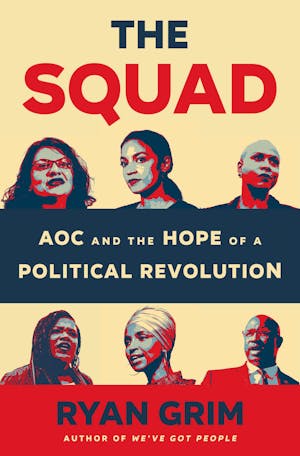
The Squad: AOC and the Hope of a Political Revolution
by Ryan Grim
‎Henry Holt and Co.


[Publication date: December 5, 2023]

The Squad

Semafor's Best Political Book of 2023

A riveting insider account of the progressive movement in Congress centering A.O.C., Rashida Tlaib, Jamaal Bowman, Cori Bush, Ayanna Pressley, and Ilhan Omar―their rise, their efforts to set an ambitious agenda for the country, and their struggle to find their footing within the Democratic party.

The Squad
is the definitive, must-read book about the most exciting figures defining our new era. The story is urgent, and the stakes are high―for the country and the world―and Grim, an experienced political reporter who covered the Squad before they were the Squad, is uniquely qualified to tell it.

When Bernie Sanders, an obscure Vermont senator, launched his quixotic 2016 presidential campaign, few could have seen just how radically the Democratic Party would transform in just a few short years―or that such a transformation could be led by a Bronx bartender volunteering for Bernie in her spare time. The world as it was when that campaign began is almost unrecognizable today, and the Squad has both shaped and been shaped by the seismic social, cultural, and political changes underway.

Referred to informally as the Squad, led by the preternaturally politically savvy Alexandria Ocasio-Cortez, the group laid down a marker for an aggressive left-wing agenda. Grim takes you behind the scenes as that new energy makes impact with Washington, and the Squad spends as much time fending off assaults from Donald Trump―who regularly singled them out and led chants of “send them back” at rallies―as they did battling their own party’s sclerotic leadership. As they’ve grown in office, they’ve had to contend with the eternal question that confronts outsiders who power their way into the inside: Are they still radical organizers willing and able to lead a political revolution? 


ABOUT THE AUTHOR:


Ryan W. Grim is an American author and journalist. Grim was Washington, D.C. bureau chief for HuffPost and is the Washington, D.C. bureau chief for The Intercept. He is also a political commentator for Breaking Points and appears frequently on The Majority Report with Sam Seder,. His writings have appeared in several publications, including Rolling Stone, The Washington Post, and Politico. He is the author of This Is Your Country on Drugs and We've Got People: From Jesse Jackson to Alexandria Ocasio-Cortez, the End of Big Money and the Rise of a Movement


The Rebels: Elizabeth Warren, Bernie Sanders, Alexandria Ocasio-Cortez, and the Struggle for a New American Politics
by Joshua Green
‎Penguin Press, 2024

[Publication date: January 9, 2024] 

From the author of the #1 New York Times bestseller Devil’s Bargain comes the revelatory inside story of the uprising within the Democratic Party, of the economic populists led by Elizabeth Warren, Bernie Sanders, and Alexandria Ocasio-Cortez.

In his classic book
Devil’s Bargain, Joshua Green chronicled how the forces of economic populism on the right, led by the likes of Steve Bannon, turned Donald Trump into their flawed but powerful vessel. In The Rebels, he gives an epic account of the long struggle that has played out in parallel on the left, told through an intimate reckoning with the careers of the three political figures who have led the charge most prominently. Based on remarkable inside sourcing and razor-sharp analysis, The Rebels uses the grand narrative of a political party undergoing tumult and transformation to tell an even larger story about the fate of America.

For many years, as Green recounts, the Democrats made their bed with Wall Street and big tech, relying on corporate money for electioneering and embracing the worldview that technological and financial innovation and globalization were a powerful net good, a rising tide lifting all boats. Yes, there were howls of pain, but they were written off by most of the elites as the moaning of sore losers mired in the past. There were always some Democratic politicians representing the old labor base who resisted the new dispensation, but these figures never made it very far on a national level. For one thing, they didn’t have the money. But as income inequality ballooned, widening the gulf between the wealthy elite and everyone else, pressures began to build.

With the 2008 crisis, those forces finally erupted into plain sight, turning this book’s protagonists into national icons. At its heart,
The Rebels tells the riveting human story of the rise and fight of Elizabeth Warren, Bernie Sanders, and Alexandria Ocasio-Cortez from the financial crisis on, as outrage over the unfairness of the American system formed a flood tide of political revolution. That same tide that would sweep Trump into office was blunted on the left, as the Democratic party found itself riven by culture war issues between its centrists and its progressives. But the winds behind economic populism still howl at gale force. Whether the Democrats can bridge their divisions and home in on a vision that unites the party, and perhaps even the country, in the face of the most violently deranged political landscape since the Civil War will be the ultimate test of the legacies of all three characters. 

A masterful account of one of the defining political stories of our age,
The Rebels cements Joshua Green’s stature at the first rank of American writers explaining how we’ve arrived at this pass and what lies ahead.
 
 
ABOUT THE AUTHOR:
 
 
Joshua Green is author of the #1 New York Times bestseller, "Devil's Bargain: Steve Bannon, Donald Trump, and the Storming of the Presidency" (Penguin), a national correspondent for Bloomberg Businessweek, and a CNN political analyst. Previously, Green was an editor at the Atlantic and the Washington Monthly, and a political columnist for the Boston Globe. He's also written for the New Yorker, Esquire, Rolling Stone, Vanity Fair and other publications. Green regularly appears on CNN's shows, HBO’s Real Time with Bill Maher, and PBS’s Washington Week and Frontline. 
 

Monday, September 3, 2012

Murder of 34 Striking Mine Workers in South Africa Exposes Deep Class Divisions in Post Apartheid Society

Siphiwe Sibeko/ReutersThe police arrested 270 miners after a deadly confrontation on Aug. 16 at an outcropping near the Marikana platinum mine. Prosecutors now say they plan to file charges against those miners.
Mourners attend the funeral of Andries Motlapula Ntsenyeho, one of 34 striking platinum mineworkers shot dead at Lonmin's Marikana mine, at his home town of Sasolburg in South Africa's Free State province yesterday. Mike Hutchings / Reuters


http://www.nytimes.com/2012/08/31/world/africa/south-africa-to-charge-marikana-miners-in-deadly-unrest.html

"After climbing a great hill one only finds that there are many more hills to climb"

--Nelson Mandela, 1994

"We thought we were different...We've been brought very firmly to the ground."
--Desmond Tutu, 2008

"‘Each generation must, out of relative obscurity, discover its mission, fulfill it, or betray it’.

--Frantz Fanon, 1961


All,

What a horrible tragedy! But it's important to note that this is what inevitably always happens when in the midst of forming and sustaining a new government following a long and difficult struggle against the brutal history of colonial domination former revolutionary organizations like the African National Congress (ANC) decide to forgo genuine self determination--and thus true national independence--to slavishly kowtow to the global forces of Capital and thereby essentially sell out themselves, their people, and their political and moral legacy to their "former" imperialist/colonial enemies headquartered in London, Berlin, Paris, Lisbon, Amsterdam, and New York--all in the name of becoming the neocolonial political and economic elite whose own massive wealth on a local scale is a much smaller share of the huge profits derived from their own complicity in the further expansion of the ruthless exploitation and organized theft of the land, labor, and material resources of their own people by this national elite in collusion with their former masters. It's a very old and all too predictable pattern no less relevant for the ongoing venality that it reveals about the lethal consequences of not fiercely opposing, challenging, and defeating the structural and institutional rule of capitalism and racism in ALL of its many guises and dimensions in one's own country from Day One of ascending to power as the new administrative and political regime. Clearly, South Africa is headed toward a new civil war on the basis of profound class conflict within the national majority black population, aided and abetted by its various interracial/multiracial coalitions created as the heinous connections between corporate forces from within both South Africa and among their imperialist "friends" and partners abroad. In the meantime their political/military "protectors" consisting of the police, army, national security apparatus and national governmental bureaucracies made up of the comprador bourgeoisie recruited from the now corrupted cadre of the old ANC masquerading as a reliable source of "national unity" and political/constitutional sovereignty. Of course in reality nothing could be further from the truth than these transparently fraudulent claims. And it's crucial to note that no matter how oppressed, demoralized, and repressed the masses of citizens are under these corrupt regimes they are fully aware of this deception and knows very well who and what are directly responsible for it--just like those striking and exploited miners certainly knew and understood and were brutally murdered precisely because of their advanced consciousness and their willingness to struggle against these forces in the name of real social and economic justice. As the prophetic revolutionary Frantz Fanon so presciently pointed out in "The Pitfalls of National Consciousness" the pivotal third chapter of his now classic text The Wretched of the Earth (1961) on the neocolonial traps, corruptions, and delusions of the new national elite in the seemingly "postrevolutionary" period following the formal demise of colonialism:

"HISTORY teaches us clearly that the battle against colonialism does not run straight away along the lines of nationalism. For a very long time the native devotes his energies to ending certain definite abuses: forced labour, corporal punishment, inequality of salaries, limitation of political rights, etc. This fight for democracy against the oppression of mankind will slowly leave the confusion of neo-liberal universalism to emerge, sometimes laboriously, as a claim to nationhood. It so happens that the unpreparedness of the educated classes, the lack of practical links between them and the mass of the people, their laziness, and, let it be said, their cowardice at the decisive moment of the struggle will give rise to tragic mishaps. National consciousness, instead of being the all-embracing crystallization of the innermost hopes of the whole people, instead of being the immediate and most obvious result of the mobilization of the people, will be in any case only an empty shell, a crude and fragile travesty of what it might have been. The faults that we find in it are quite sufficient explanation of the facility with which, when dealing with young and independent nations, the nation is passed over for the race, and the tribe is preferred to the state. These are the cracks in the edifice which show the process of retrogression that is so harmful and prejudicial to national effort and national unity. We shall see that such retrograde steps with all the weaknesses and serious dangers that they entail are the historical result of the incapacity of the national middle class to rationalize popular action, that is to say their incapacity to see into the reasons for that action.
This traditional weakness, which is almost congenital to the national consciousness of under-developed countries, is not solely the result of the mutilation of the colonized people by the colonial regime. It is also the result of the intellectual laziness of the national middle class, of its spiritual penury, and of the profoundly cosmopolitan mould that its mind is set in. The national middle class which takes over power at the end of the colonial regime is an under-developed middle class. It has practically no economic power, and in any case it is in no way commensurate with the bourgeoisie of the mother country which it hopes to replace. In its wilful narcissism, the national middle class is easily convinced that it can advantageously replace the middle class of the mother country. But that same independence which literally drives it into a comer will give rise within its ranks to catastrophic reactions, and will oblige it to send out frenzied appeals for help to the former mother country. The university and merchant classes which make up the most enlightened section of the new state are in fact characterized by the smallness of their number and their being concentrated in the capital, and the type of activities in which they are engaged: business, agriculture and the liberal professions. Neither financiers nor industrial magnates are to be found within this national middle class. The national bourgeoisie of under-developed countries is not engaged in production, nor in invention, nor building, nor labour; it is completely canalized into activities of the intermediary type. Its innermost vocation seems to be to keep in the running and to be part of the racket. The psychology of the national bourgeoisie is that of the businessman, not that of a captain of industry; and it is only too true that the greed of the settlers and the system of embargoes set up by colonialism has hardly left them any other choice. Under the colonial system, a middle class which accumulates capital is an impossible phenomenon.

Now, precisely, it would seem that the historical vocation of an authentic national middle class in an under-developed country is to repudiate its own nature in so far as it is bourgeois, that is to say in so far as it is the tool of capitalism, and to make itself the willing slave of that revolutionary capital which is the people.
In an under-developed country an authentic national middle class ought to consider as its bounden duty to betray the calling fate has marked out for it, and to put itself to school with the people: in other words to put at the people’s disposal the intellectual and technical capital that it has snatched when going through the colonial universities. But unhappily we shall see that very often the national middle class does not follow this heroic, positive, fruitful and just path; rather, it disappears with its soul set at peace into the shocking ways — shocking because anti-national — of a traditional bourgeoisie, of a bourgeoisie which is stupidly, contemptibly, cynically bourgeois. The objective of nationalist parties as from a certain given period is, we have seen, strictly national. They mobilize the people with slogans of independence, and for the rest leave it to future events. When such parties are questioned on the economic programme of the state that they are clamouring for, or on the nature of the regime which they propose to install, they are incapable of replying, because, precisely, they are completely ignorant of the economy of their own country. This economy has always developed outside the limits of their knowledge. They have nothing more than an approximate, bookish acquaintance with the actual and potential resources of their country’s soil and mineral deposits; and therefore they can only speak of these resources on a general and abstract plane. After independence this under-developed middle class, reduced in numbers and without capital, which refuses to follow the path of revolution, will fall into deplorable stagnation. It is unable to give free rein to its genius, which formerly it was wont to lament, though rather too glibly, was held in check by colonial domination. The precariousness of its resources and the paucity of its managerial class forces it back for years into an artisan economy. From its point of view, which is inevitably a very limited one, a national economy is an economy based on what may be called local products. Long speeches will be made about the artisan class.

Since the middle classes find it impossible to set up factories that would be more profit-earning both for themselves and for the country as a whole, they will surround the artisan class with a chauvinistic tenderness in keeping with the new awareness of national dignity, and which moreover will bring them in quite a lot of money. This cult of local products and this incapability to seek out new systems of management will be equally manifested by the bogging down of the national middle class in the methods of agricultural production which were characteristic of the colonial period.
The national economy of the period of independence is not set on a new footing. It is still concerned with the ground-nut harvest, with the cocoa crop and the olive yield. In the same way there is no change in the marketing of basic products, and not a single industry is set up in the country. We go on sending out raw materials; we go on being Europe’s small farmers who specialize in unfinished products. Yet the national middle class constantly demands the nationalization of the economy and of the trading sectors. This is because, from their point of view, nationalization does not mean placing the whole economy at the service of the nation and deciding to satisfy the needs of the nation. For them, nationalization does not mean governing the state with regard to the new social relations whose growth it has been decided to encourage. To them, nationalization quite simply means the transfer into native hands of those unfair advantages which are a legacy of the colonial period. Since the middle class has neither sufficient material nor intellectual resources (by intellectual resources we mean engineers and technicians) it limits its claims to the taking over of business offices and commercial houses formerly occupied by the settlers. The national bourgeoisie steps into the shoes of the former European settlement: doctors, barristers, traders, commercial travellers, general agents and transport agents. It considers that the dignity of the country and its own welfare require that it should occupy all these posts. From now on it will insist that all the big foreign companies should pass through its hands, whether these companies wish to keep on their connexions with the country, or to open it up. The national middle class discovers its historic mission: that of intermediary. Seen through its eyes, its mission has nothing to do with transforming the nation; it consists, prosaically, of being the transmission line between the nation and a capitalism, rampant though camouflaged, which today puts on the masque of neocolonialism. The national bourgeoisie will be quite content with the role of the Western bourgeoisie’s business agent, and it will play its part without any complexes in a most dignified manner. But this same lucrative role, this cheap-jack’s function, this meanness of outlook and this absence of all ambition symbolize the incapability of the national middle class to fulfil its historic role of bourgeoisie. Here, the dynamic, pioneer aspect, the characteristics of the inventor and of the discoverer of new worlds which are found in all national bourgeoisies are lamentably absent.

In the colonial countries, the spirit of indulgence is dominant at the core of the bourgeoisie; and this is because the national bourgeoisie identifies itself with the Western bourgeoisie, from whom it has learnt its lessons. It follows the Western bourgeoisie along its path of negation and decadence without ever having emulated it in its first stages of exploration and invention, stages which are an acquisition of that Western bourgeoisie whatever the circumstances. In its beginnings, the national bourgeoisie of the colonial countries identifies itself with the decadence of the bourgeoisie of the West. We need not think that it is jumping ahead; it is in fact beginning at the end. It is already senile before it has come to know the petulance, the fearlessness or the will to succeed of youth."

This is the real challenge facing South Africa today and no empty platitudes about the "glorious revolutionary past" invoked by the current heavily compromised representatives of the ANC now running the government in that endlessly beleaguered country can possibly be seen by anyone as an adequate response to the deadly crisis of class warfare enveloping South Africa at this very moment.


Kofi

http://www.thenational.ae/news/world/africa/miners-killed-by-police-in-south-africa-are-buried


In Police Shooting of Miners, South Africa Charges Miners

The police arrested 270 miners after a deadly confrontation on Aug. 16 at an outcropping near the Marikana platinum mine. Prosecutors now say they plan to file charges against those miners.

By LYDIA POLGREEN
August 30, 2012

The National


LUANDA, Angola — Two weeks after the police opened fire on a crowd of 3,000 workers engaged in a wildcat strike at a platinum mine near Johannesburg, killing 34 people in the bloodiest labor unrest since the end of apartheid, prosecutors are bringing murder charges against a surprising set of suspects: the miners themselves.

Using an obscure legal doctrine frequently relied upon by the apartheid government in its dying days, prosecutors did not accuse the police officers who shot and killed the strikers as they surged forward, machetes in hand. Instead, officials said Thursday that they were pursuing murder charges against the 270 miners who were arrested after the dust settled and the shooting stopped.

It was the latest astonishing turn in a story that has gripped South Africa, unleashing a torrent of rage over deepening inequality, poverty and unemployment.

The shootings have fed a growing sense of betrayal at the country’s governing party, the venerable African National Congress, many of whose senior members have joined a wealthy elite a world away from the downtrodden masses whose votes brought them to power at the end of apartheid in 1994. Now the prosecutors’ decision to charge the miners in the killings threatens to intensify that rift.

Frank Lesenyego, a spokesman for the National Prosecuting Authority, cited “34 counts of murder that have been laid against the 270 accused,” in connection with the killings of the 34 miners on Aug. 16. He said they were being charged under a law known as “common purpose,” in which members of a crowd when a crime is committed can be prosecuted as accomplices.

It was unclear whether the charges were simply a legal maneuver to keep the miners, who have been in jail for two weeks, under lock and key, or if prosecutors were intent on pursuing the murder charges in court. Legal experts were quick to say that the accusations were extreme.

“The charge is spurious,” said Pierre de Vos, a legal scholar at the University of Cape Town. “It will not fly. No court in South Africa on any set of facts will find the miners guilty through the common purpose doctrine.”

Patrick Craven, a spokesman for Cosatu, a federation of trade unions, criticized the murder charges. “This is pure intimidation,” Mr. Craven said. “The lawyers must really be very stupid if they think these charges will stick. The notion that these miners are responsible for the deaths of their own fellow workers is absurd.”

Several thousand workers at a platinum mine, in the town of Marikana, northwest of Johannesburg, went on strike this month, demanding a raise. The mine is owned by Lonmin, a company based in London. The men were members of a radical, breakaway union whose leaders were trying to drum up membership and had urged workers to strike to get higher pay and better working conditions. They occupied a rocky hill, armed themselves with machetes, spears and clubs, and chanted war songs and anthems from the struggle against apartheid.

For days, the authorities watched warily as the crowd grew more militant. Two police officers were hacked to death, and eight other people were killed in violent clashes. On Aug. 16, the police were given the order to move in. The police said that they tried to chase away the miners with rubber bullets and stun grenades, but that they were forced to resort to live ammunition when the miners surged at them. The police said they retrieved six guns from the scene, including one that belonged to one of the dead police officers.

The bloodshed, so reminiscent of the horror of the apartheid-era police force’s firing on protesters, stunned the nation. The government, trade unions and the opposition roundly condemned the violence, and President Jacob Zuma set up an independent commission to investigate the killings and gave it broad powers to subpoena testimony.

The police involved in the shooting could still face criminal charges as well. The inquiry set up by Mr. Zuma has the power to refer cases for prosecution, and it is expected to deliver a report in five months.

Journalists at the scene caught some of the shooting on video and in photographs. The police account, meticulously laid out in a multimedia presentation the day after the clash, has been questioned by witnesses and journalists who have examined the scene and concluded that at least some of the workers were killed in what appeared to be much more suspicious circumstances.

Some of the dead and 78 wounded were struck far from the scene of the strike or shot in the back, according to local news reports, suggesting that they were not directly involved in the confrontation or were fleeing it.

The common purpose doctrine used by prosecutors against the miners has its roots in English law, and it is not unlike laws that allow anyone associated with a crime to be charged as an accomplice, Professor de Vos said. But based on the known facts in this case, bringing the charge makes little sense, he said.

“They are conflating the possibility that the crowd might have provoked the police, which is something different from willing on the police to shoot and kill people,” Professor de Vos said. “If a court were to convict, it would be akin to a finding that they had the intention of killing themselves.”

The common purpose clause was widely abused in the last days of apartheid to jail protesters, and in a few cases people not directly involved in killing were sentenced to death under it. In the most famous case, six protesters were sentenced to be hanged for the killing of the deputy mayor of Sharpeville in 1984, though they did not directly participate in it.

The case drew international condemnation, and the accused were not executed because the death penalty was suspended in 1990 as the apartheid government began to weaken. The law was affirmed by the courts as recently as 2003, but the decision allowed it only under a very narrow set of circumstances, including when a defendant knows and intends that a killing will take place.


http://www.thenational.ae/news/world/africa/miners-killed-by-police-in-south-africa-are-buried

Miners killed by police in South Africa are buried
Agence France-Presse
September 2, 2012
MTHATHA, SOUTH AFRICA// South Africa yesterday buried most of the 34 miners killed by police last month during the worst crackdown on protests since apartheid


Twenty-six of the 34 miners were being buried this weekend.

Meanwhile, lawyers are demanding the release of 270 surviving miners who have been charged with their colleagues' murder under a law used by the former apartheid regime.

The miners were killed on August 16 when police fired into a crowd of miners on strike at Lonmin's Marikana platinum mine.

The majority of the killed miners came from the Eastern Cape province. One funeral was held in Mdumazulu village for Phumzile Sokhanyile, a 48-year-old miner, and his mother, who collapsed and died on hearing the news of his death.

Glorious Mamkhuzeni- Sokhanyile, 79, who suffered from asthma and hypertension, had fainted when she learnt of the death of her son, two days after the killings, a family member said.

But it was watching video of the police opening fire on the miners shown a day later on a television news report that led her to her death, said the miner's aunt Thokozile Sokhanyile.

"She saw the images and went 'Ah! That's how my son was killed?' and she collapsed," she added.

Thousands of relatives, workmates and friends had gathered under a white tent yesterday to mourn their deaths.

Only the mother's coffin lay in front with a wreath on top. Phumzile was buried on Friday as soon it was received by the family, according to rites in cases where a person dies of unnatural causes.

The body was not allowed anywhere near his family home and was taken straight to a cemetery, in the belief that this would ward off bad omens.
■ South Africa mine dispute a symptom of 'intense poverty and inequality'
■ South Africa prepares memorials for mine deaths


http://www.thenational.ae/news/world/africa/south-africa-mine-dispute-a-symptom-of-intense-poverty-and-inequality


South Africa mine dispute a symptom of 'intense poverty and inequality' by Richard Ferraris
August 22, 2012
The National


As head of a powerful mineworkers' union during the struggle against apartheid, Cyril Ramaphosa led a strike that erupted into clashes with police and left 11 people dead.

Mine violence shows lessons of apartheid still unheeded

Today, Mr Ramaphosa, one of the most venerable members of the ruling African National Congress (ANC), sits on the board of directors of the company that owns the Marikana mine, where 34 striking workers were killed by police last week.

The agitating outsider-turned-wealthy insider is now vilified by some South Africans in the same terms he once criticised the pillars of white minority rule.

It is this turn of the tables that illustrates the multitude of challenges South Africa still faces 18 years after the end of apartheid.

The violence that broke out at Marikana did not stem solely from grievances over wages and working conditions. It also reflected the black majority's disappointment that institutional reform has not kept pace with many people's expectations of what would come with the end of white minority rule.

Questions have also been raised about what unions are doing to protect workers' rights, as well as the black elite's comfortable relationship with big business, such as Mr Ramaphosa's relationship with Lonmin, the owner of the mine.

For the majority of black South Africans, including platinum miners at Marikana, life is a desperate struggle, and ambitions of joining the middle class are unlikely to be realised.

"The miners work hard, long hours," said Karin Labuschagne, a reporter for JacarandaFM News who covered the shooting. "Some are breadwinners with more than 10 dependents. The miners are fed up."

The police's reaction often compounds the problem. "We're heading towards a critical point both politically and economically. The public and private sector are under serious pressure to reduce inequality," said Murray Ingram, the director of the non-profit organisation Connect Community in Cape Town.

After 1994, the South African Police Force was renamed the South African Police Service, a subtle change to distance the institution from its brutal past. But Mr Ingram believes the police system is "a ticking time bomb".

As at Marikana, the police often respond to protests in a heavy-handed fashion.

"The police are seriously compromised by massive corruption and maladministration," said Mr Ingram. "Our police officers are also seriously underpaid and many encounter violence all too frequently."

The Marikana massacre underscored South Africa's compromised transition to democracy, which protected white business interests but installed some black entrepreneurs in influential private-sector positions.

The influential National Union of Mineworkers (NUM), which Mr Ramaphosa once led, has been accused of aligning itself too closely with predominantly white mine owners.

The Democratic Alliance (DA), the ANC's biggest rival, said Marikana was "a symptom of intense poverty and inequality in South Africa".

"People need to be empowered with better education and skills development, but we also need to generate economic growth that creates opportunities. This will avert the kind of economic desperation that led to the Marikana tragedy," said Mmusi Maimane, the DA's spokesman.

But the government's attempts to institute police reform and narrow the income gap between rich and poor have been complicated by internal division within the ANC.

The deaths of 34 miners came four months before the ANC's policy conference in Mangaung, where Jacob Zuma will seek re-election as the leader of the party, which is the first step towards a second term as president of South Africa.

He said last week that "the nation is hard at work addressing the persistent challenges of poverty, unemployment and inequality". He also took pains to allay global concern, noting South Africa's thriving relationship "with international investors and development partners".

For populists such as Julius Malema, the expelled former leader of the ANC's youth wing who was once touted as a future president, the ANC leadership's close relationship with big business is unacceptable. Marikana, he believes, offers further evidence that South Africa's economy needs a radical overhaul.

Mr Malema, who has been accused of benefiting financially from his ANC connections, addressed Lonmin miners at the weekend and repeated his call for the nationalisation of mines to spread the wealth.

He demanded that Mr Zuma resign over the shootings, accused the NUM of having a stake in mining companies and raged that "the miners were killed to protect the shares of Cyril Ramaphosa".

"This address, in a way, showed that he was still relevant, even though he no longer had a recognised political platform," said Ms Labuschagne. "Going to Mangaung, Malema will continue playing on his relevance in the hope of having his expulsion overturned."

The black elite, meanwhile, is accused of exploiting its links with the ANC, while the unions that ought to protect the poorest of the poor seem to operate at the behest of the wealthy classes.

And with the ANC hobbled by internecine strife, the opposition DA (although pooling a record 6 per cent of the black vote) greatly outgunned by the ruling party, it is ordinary black South Africans who remain marginalised.

"It's the poor who have been hung out to dry, there's no doubt about it," said Mr Ingram.

rferraris@thenational.ae


This article has been corrected since publication. Julius Malema, the former leader of the ANC’s youth wing, was most recently expelled, not suspended.