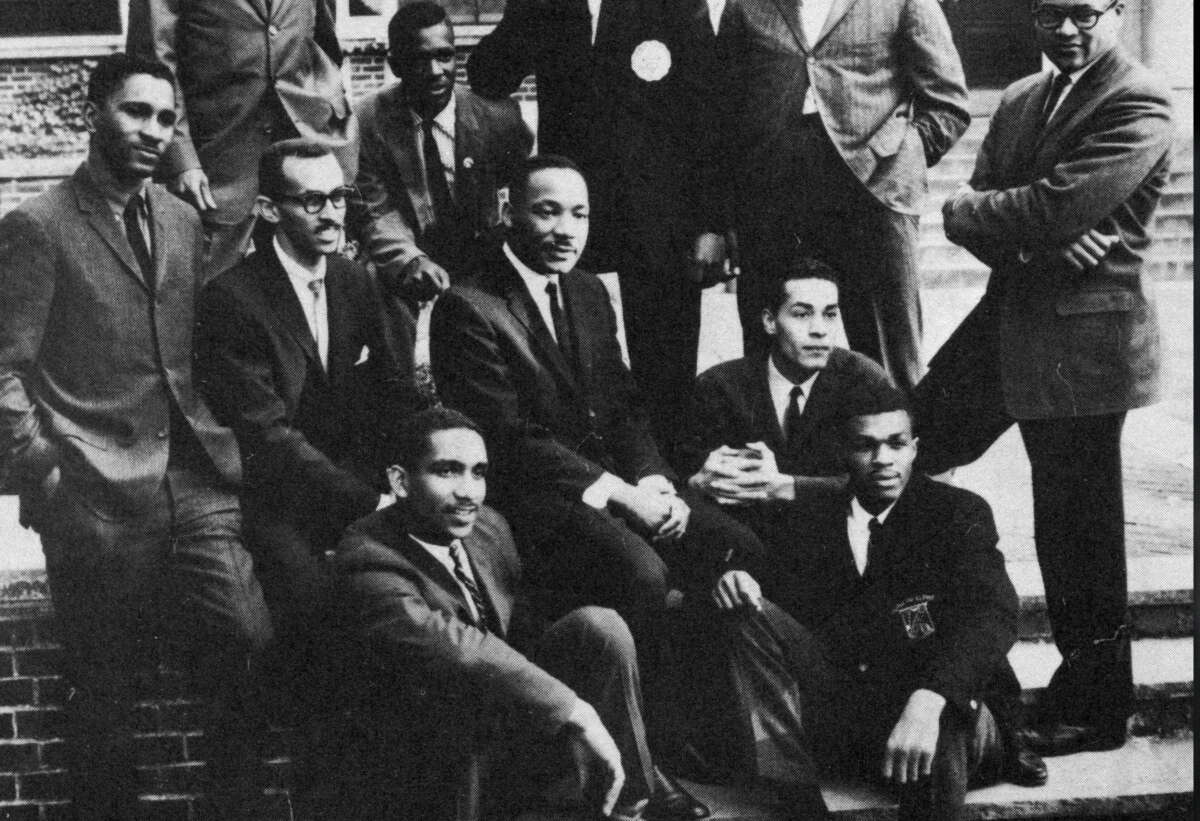
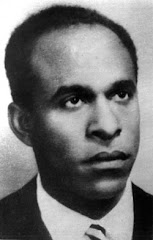
"Fascism is a new name for that kind of terror the Negro has always faced in America."
--Langston Hughes (1936)
LANGSTON HUGHES (1902-1967)
“I come from a land whose democracy from the very beginning has been tainted with race prejudice born of slavery, and whose richness has been poured through the narrow channels of greed into the hands of the few. I come to the Second International Writers Congress representing my country, America, but most especially the Negro peoples of America, and the poor peoples of America—because I am both a Negro and poor. And that combination of color and of poverty gives me the right then to speak for the most oppressed group in America, that group that has known so little of American democracy, the fifteen million Negroes who dwell within our borders.
We are the people who have long known in actual practice the meaning of the word Fascism—for the American attitude towards us has always been one of economic and social discrimination: in many states of our country Negroes are not permitted to vote or to hold political office. In some sections freedom of movement is greatly hindered, especially if we happen to be sharecroppers on the cotton farms of the South. All over America we know what it is to be refused admittance to schools and colleges, to theatres and concert halls, to hotels and restaurants. We know Jim Crow cars, race riots, lynchings, we know the sorrows of the nine Scottsboro boys, innocent young Negroes imprisoned some six years now for a crime that even the trial judge declared them not guilty of having committed, and for which some of them have not yet come to trial. Yes, we Negroes in America do not have to be told what Fascism is in action. We know. Its theories of Nordic supremacy and economic suppression have long been realities to us.”--July, 1936
― Langston Hughes,Good Morning, Revolution: Uncollected Social Protest Writings (Lawrence Hill, 1973)
https://go.gale.com/ps/i.do?id=GALE%7CA664550456&sid=googleScholar&v=2.1&it=r&linkaccess=abs&issn=14814374&p=LitRC&sw=w&userGroupName=anon%7Ea69c52aa&aty=open-web-entry Incipient Fascism: Black Radical Perspectives.
Author: Alberto Toscano
Date: March 2021
From: CLCWeb: Comparative Literature and Culture(Vol. 23, Issue 1)
Publisher: Purdue University Press
Abstract:
The sordid twilight of the Trump presidency raised the stakes of the debate on fascism. While much of the discussion has been magnetised by the legitimacy of analogies with the 1930s, this article argues that a rich and complex tradition of Black radical critique of right-wing authoritarianism provides a vital resource for thinking through the problem of US fascism beyond analogy--beginning with the DuBoisian insight that a racial fascism forged by chattel slavery and settler-colonialism anticipated the ascendancy of European fascisms. The article homes in on Black radical theories of fascism developed in the wake of the movements and uprisings of the 1960s and the US state's intensification of its repressive and carceral apparatus. Exploring the theoretical insights generated in the prison writings of George Jackson and Angela Y. Davis, it challenges the widely held belief that the 1970s stood as the nadir of theorisation of fascism, its degradation into mere political insult. Instead, with particular emphasis on Davis's articulation of an incipient or preventive fascism, it investigates the theoretical consequences of the differential experience of fascism across axes of racialisation and reflects on the pertinence of Black radical theories of fascism to our current moment of recombinant White supremacy.
"Let us be reminded that before there is a final solution, there must be a first solution, a second one, even a third." --Toni Morrison, "Racism and Fascism" (1995) (1)
BALDWIN: It's very hard to recognize that the standards which have almost killed you are really mercantile standards. They're based on cotton; they're based on oil; they're based on peanuts; they're based on profits.
GIOVANNI: To this day.
BALDWIN: To this hour.
--James Baldwin & Nikki Giovanni, A Dialogue (1971)
"Swastikas bloomed in Chicago parks like misbegotten weeds."
--Martin Luther King, "Drive to End Slums" (1967)
"Fascism is a new name for that kind of terror the Negro has always faced in America."
--Langston Hughes (1936)
In one of his prison letters on fascism, collected in Blood in My Eye, George Jackson offered the following reflection: When I am being interviewed by a member of the old guard and point
to the concrete and steel, the tiny electronic listening device
concealed in the vent, the phalanx of goons peeping in at us, his
barely functional plastic tape-recorder that cost him a week's
labor, and point out that these are all manifestations of fascism,
he will invariably attempt to refute me by defining fascism simply
as an economic geo-political affair where only one party is allowed
to exist aboveground and no opposition political activity is
allowed (121-122).
Following Jackson, we might ask: what happens to the turns and returns of the theoretical debate over fascism and (neo-)authoritarianism when it undergoes a Gestalt shift and takes racial capitalism and its carceral apparatus as its fulcrum, in something like a "tilt shot angled from below" capable of disclosing "a panorama of violence endured" (Sartre 244)? As Jacques Derrida intimated in an unsent letter to Jean Genet, dated one day prior to Jackson's assassination by a guard sniper in San Quentin: "In a prison--this one and others--where it thought it had put its outside in chains, the system of (Western-white-capitalist-racist) society has made possible, by this act, the analysis of its functioning, a practical analysis that is at once the most implacable, the most desperate, but also the most affirmative" (43). (2)
It has become commonplace in the incessant academic metacommentary on theories of fascism to castigate the 1970s as a kind of cognitive nadir, when fascism was degraded from a category of historical analysis and taxonomy into a one-size-fits-all political insult. In what follows, I want to take the imprudent wager that there is virtue and insight in the seeming exaggeration or inflation of fascism in the context of 70s radicalism, but especially to underscore how viewing fascism through the prism of the Black radical tradition can redirect our contemporary debate in fruitful and important ways. I will draw on the experience of Black political prisoners in the US as my point of departure. What happens to our conceptions of fascism and authoritarianism if we take our bearings not from putative analogies with the European interwar scene, but, for instance, from the materiality of the prison-industrial complex, from the "concrete and steel," from the devices and personnel of surveillance and repression? I want to probe the analytical nexus of fascism and racial capitalism forged in the liberation struggles of the 1970s, whilst threading it back to the analysis of fascism emerging from Black theorists in the interwar period and forward to the afterlives of fascism in the late twentieth and early twenty-first centuries.
In their writing and correspondence, which is marked by differences of interpretation interwoven with a profound comradeship, both Angela Y. Davis and George Jackson identified the US state as the site for a re-emergence or indeed a perfecting of certain features of (European) historical fascisms. Much of their theorising is suffused by contemporary debates on the nature of monopoly capitalism, imperialism and capitalist crises, as well as, in Jackson's case, by an effort to revisit the classical historiography on fascism. Of particular note and relevance for contemporary concerns is the specific light that the prism of race--of racial domination and racial capitalism--sheds on the nexus of fascism and democracy, the way it interrogates and displaces the normative conviction regarding the absolute antithesis between fascist rule and liberal democracy. Jackson and Davis are profoundly aware of the disanalogies of present forms of domination with historical fascism, but they both affirm the epistemologically privileged vantage point provided by the view from within a prison-judicial system that could accurately be described as a racial state of terror. In distinct ways, they can be seen to relay and recode that foundational gesture of anti-racist and Black radical anti-fascism crystallised in Aime Cesaire's Discourse on Colonialism. As the Martinican poet and politician recounted: "And then one fine day the bourgeoisie is awakened by a terrific boomerang effect: the gestapos are busy, the prisons fill up, the torturers standing around the racks invent, refine, discuss" (Cesaire 36).
But the new, American fascism that Jackson and Davis strive to delineate is not an unwanted return from the "other scene" of colonial violence, it originates from liberal democracy itself. The prisons are already full. And rather than a boomerang, the generalisation of racialised carceral terror into the socius at large--which is one of the foremost ingredients of the new fascism--is a much less dramatic or sudden process of seepage, the permeation of the social space of actually-existing liberal democracy with models and devices invented, refined and discussed amid "concrete and steel." As Mullen and Vials put it: for people of color at various historical moments, the experience
of racialization within a liberal democracy could have the valence
of fascism. That is to say, while a fascist state and a white
supremacist democracy have very different mechanisms of power, the
experience of racialized rightlessness within a liberal democracy
can make the distinction between it and fascism murky at the level
of lived experience. For those racially cast aside outside of
liberal democracy's system of rights, the word 'fascism' does not
always conjure up a distant and alien social order. (3)
Or, as Jean Genet had observed on 1 May 1970, at a rally in New Haven for the liberation of Black Panther Party Chairman Bobby Seale: "Another thing worries me: fascism. We often hear the Black Panther Party speak of fascism, and whites have difficulty accepting the word. That's because whites have to make a great effort of imagination to understand that blacks live under an oppressive fascist regime" (Genet 38). (4)
Like Davis, Jackson also stresses the necessity to grasp fascism not as a static form but as a process, profoundly inflected by its political and economic contexts and conjunctures. Whence the limits of models, analogies or ideal types. He comments on the "the defects of trying to analyse a movement outside of its process and its sequential relationships. You gain only a discolored glimpse of a dead past" (Jackson, Blood 124), and further notes how historically, it "developed from nation to nation out of differing levels of traditionalist capitalism's dilapidation" (125). Now, while for Jackson fascism is profoundly linked to a restructuring of the capitalist state, it is also fundamentally a counter-revolutionary form, revealed by the violence with which it represses anything that poses a consequential threat to that state. It is nevertheless instructive to note that, echoing Nicos Poulantzas's analysis in Fascism and Dictatorship, for Jackson fascism does not react immediately against an ascendant revolutionary force; it is a kind of delayed counter-revolution, parasitic on the weakness or defeat of the anti-capitalist Left. The "opposition of a weak socialist revolution" (Jackson, Blood) is a shared feature among the various fascisms (and one can of course sense the indictment of the contemporary Left in Jackson's historical allusion). In a nutshell then: "Fascism must be seen as an episodically logical stage in the socio-economic development of capitalism in a state of crisis. It is the result of a revolutionary thrust that was weak and miscarried--a consciousness that was compromised" (Jackson, Blood 126). Viewed from the US vantage point, that compromise is necessarily entangled with the persistent pattern of the racialization of class that defines American history ever since the white-supremacist counter-revolution against "Black Reconstruction," or indeed ever since Bacon's Rebellion and the concomitant "invention of the white race" (in Theodore W. Allen's formulation). As Jackson quips: "Marx's definition of history as a broken, twisted, sordid spectrum of class struggles is substantiated by Amerikan labor history" (148).
In Angela Y. Davis's concurrent analysis, the carceral, liberationist perspective on fascism is both further refined and shifted. Fascism in the US was a kind of perfected form for Jackson--all the more insidiously hegemonic because of the marriage of monopoly capital with the (racialized) trappings of liberal democracy. As he declared: "Fascism has established itself in a most disguised and efficient manner in this country. It feels so secure that the leaders allow us the luxury of faint protest. Take protest too far, however, and they will show their other face. Doors will be kicked down in the night and machine-gun fire and buckshot will become the medium of exchange" (Blood 158). (5) Notwithstanding the national and conjunctural mutability of fascism, Jackson provocatively claimed that (economic) reform could be identified as "a working definition of fascist motive forces," and one that was particularly apt for the political manifestations of US monopoly capital. For Davis, fascism in the US of the early 1970s took instead what was best defined as a preventive and incipient form. The terminology was borrowed and adapted from her teacher Herbert Marcuse. In a 1970 interview with Hans Magnus Enzensberger for the latter's journal Kursbuch, entitled "USA: Questions of Organization and the Revolutionary Subject," Marcuse had proposed to invert the customary political sequence that would see fascism as reactive not just in social content but in temporal form--whether responding immediately to a potentially triumphant revolutionary upsurge, or, in a mediated way, to an already defeated or ebbing challenge to capitalism. It is not reaction but anticipation that animates this new figure of fascism. As Marcuse tells Enzensberger: "I believe that there is something like preventative fascism. In the last ten to twenty years we've experienced a preventative counterrevolution to defend us against a feared revolution, which, however, has not taken place and doesn't stand on the agenda at the moment. In the same way preventative fascism comes about" (Marcuse, "USA" 138).
The question of the possibility of fascism in the US, much debated by liberation movements and the far Left throughout the 70s, is for Marcuse deeply entangled with the concrete forms taken by preventative counterrevolution as a core strategic imperative of the capitalist order. The specificity of this anticipatory logic is also closely linked to the distinctive disanalogies between this "incipient fascism" and its interwar European precursors: The question is whether fascism is taking over in the United
States. If by that we understand the gradual or rapid abolition of
the remnants of the constitutional state, the organization of
paramilitary troops such as the Minutemen, and granting the police
extraordinary legal powers such as the notorious no-knock law which
does away with the inviolability of the home; if one looks at the
court decisions of recent years; if one knows that special
troops--so-called counterinsurgency corps--are being trained in the
United States for possible civil war; if one looks at the almost
direct censorship of the press, television and radio: then, as far
as I'm concerned, one can speak with complete justification of an
incipient fascism.... American fascism will probably be the first
which comes to power by democratic means and with democratic
support. (137-138) (6)
Fascism here defines a set of repressive tactics, as well as an encompassing political and ideological process, which differentially targets racialised and subaltern populations whose very existence and sociality is increasingly perceived as a threat--whence the porous borders between the "criminal" and the "political prisoner." It is a process in which, to borrow from Jackson's characterization of the "oppressive contract" underlying US capitalism: "Accrual of contempt [for the oppressed] is [a] fundamental survival technique" (Jackson, Blood 162).
Davis develops the Marcusean thesis that "fascism is the preventive counter-revolution to the socialist transformation of society" (Davis & Aptheker, "Preface" xiv), (7) to specify that transformation from the vantage point of the lived experience of racialised communities in the US--where the most threatening feature of Black revolutionary politics for the state takes the form not so much of the armed struggle imagined by Jackson but of the "survival programs," the enclaves of autonomous social reproduction practiced by the Black Panthers and other groups. What can be gleaned from Davis's account more broadly is the differential visibility and experience of both fascism and democracy. In this regard, it can help to attune us to the ways in which race and gender, alongside class, can also determine the modality in which fascism is lived. (8) There is a kind of everyday fascism, so to speak, that marks the interaction of people of colour with the state, and which, while acting as the repressive infrastructure of a liberal democracy still steeped in the legacies of white supremacy, also signals the possibility or tendency to generalise this incipient or preventive fascism to the population at large. As Davis puts it, fascism today is "primarily restricted to the use of the law-enforcement-judicial-penal apparatus to arrest the overt and latent-revolutionary trends among nationally oppressed people, tomorrow it may attack the working class en masse and eventually even moderate democrats" (Davis, "Political" 41). But the latter are, alas, unlikely fully to perceive this phenomenon, both because of the invisibilisation of its site--its carceral space with its "totalitarian aspirations" (44)--and the dilated character of its unfolding, its time. The kind of fascism diagnosed by Davis is a "protracted social process" (Davis & Aptheker, "Preface" xv), whose "growth and development are cancerous in nature" (Davis, "Political" 41). We thus have the correlation in Davis's analysis between, on the one hand, the prison as a racialised enclave or laboratory and, on the other, the fascistic strategy and tactics of counter-revolution, which are in turn understood in terms of a molecular social process. Both spatially and temporally, the perception of fascist realities and potentialities is occluded by its carceral frame. As Davis will later write: "The dangerous and indeed fascistic trend toward progressively greater numbers of hidden, incarcerated human populations is itself rendered invisible. All that matters is the elimination of crime--and you get rid of crime by getting rid of people who, according to the prevailing racial common sense, are the most likely people to whom criminal acts will be attributed (Davis, "Race" 63). (9)
Dylan Rodriguez has powerfully captured the originality and challenge of the "fascism problematic" that Davis and Jackson forged out of the political violence of confinement. Notwithstanding their partially divergent evaluations, in naming a fascist present in the US (be it emergent or consummated), they share in "a theoretical and symbolic political gesture that fosters an epistemological break from the common sense of U.S. white supremacy and the regime of state violence on which it is premised" (117). This gesture is twofold. On the one hand, it anchors racial, carceral and counter-insurgent violence in political economy--not just by identifying the instrumentality of brutality and repression to the reproduction of class relations but by amplifying the Fanonian insight that we should consider violence "as a primary and productive (rather than merely repressive) articulation of particular social formations" (130). On the other hand, the reformulation of the fascist problematic from the vantage point of racialised political incarceration has the lasting virtue of troubling the facile if ideologically vital opposition between fascism and (liberal) democracy. As Rodriguez pointedly asks: "how might our political understanding of the United States be altered or dismantled if we were to conceptualize fascism as the restoration of a liberal hegemony, a way out of crisis, rather than as the symptom of crisis or the breakdown of 'democracy' and 'civil society' (137)?" As ever, rearticulating the analysis and aetiology of fascism also inflects the strategic imaginary of anti-fascism: "The dynamic, strategic relations of violence condensing within the American social formation at different times and in different places are neither accidental nor excessive, and the challenge of this reconceptualized fascism problematic is to comprehend the socially reproductive capacities of coercive technologies and (proto)genocidal practice within the current order" (140-141).
What relation might we trace between the fascism problematic differentially articulated by Jackson and Davis, on the one hand, and earlier theorisations of fascism by black radical intellectuals, on the other? In a 1990 lecture that was only recently published, Cedric J. Robinson advanced the proposition that chronic neglect of autonomous traditions of Black radical theorising has impeded engagement with a "Black construction of fascism" that is alternative, indeed antithetical, to a "euphonious recital of fascism" in mainstream theorization of the phenomenon (Robinson, "Fascism" 149). (10) Drawing on Hayden White's critical anatomy of Western historiography, Robinson surveys the platitudes and incoherencies of contemporary academic analyses of fascism to reveal a founding conceit or forgery, namely "the historical manufacture of fascism as a negation of Western Geist," the dark side of Western civilisation--in an "exemplary narrative" where the fascist nemesis confirms the essential superiority of Western liberalism, confirming "the existence of the epistemic West" and the "philosophic identity between Western civilization, Western culture, and human destiny" (152). Conversely, from the perspective of non-Western peoples and black radical movements, as Cesaire had crystallised in his Discourse, fascism, "was no more an historical aberration than colonialism, the slave trade, and slavery. Fascism was and is a modern social discipline [of domination] which much like its genetic predecessors, Christianity, imperialism, nationalism, sexism, and racism, provided the means for the ascent to and preservation of power for elitists" (Robinson, "Fascism").
But, in keeping with the argument articulated in Black Marxism regarding the autonomy of a black radical tradition from Marxist theory, Robinson is compelled to argue that most Black radical theorists of fascism (including C.L.R. James, George Padmore, and to an extent even Oliver Cromwell Cox) remained captive to the "Euro-Marxist construction of fascism" (11) ("Fascism" 155) that subordinates the civilizational and racializing continuities between Western colonialism and fascism to economic determinism and class consciousness. The signal exception to this, for Robinson, was W.E.B. Du Bois, who affirmed "the cultural identity between fascism and the putative democracies" (156), anticipating Cesaire in his assertion that "the precondition for fascism was a civilization profoundly traumatized by slavery and racism" (157). (12) Yet there is something both intriguing and symptomatic about Robinson's concluding reflection about the fact that Du Bois's most forceful and resonant account of the continuity between the history of white racism and fascism "paradoxically ... coincided with that moment when Du Bois was most influenced by Marxism" ("Fascism"). Was this really a paradox? Du Bois's own account two decades earlier of the "African roots" of World War 1 had established a nexus between capitalist imperialism and racist oppression remarkably consonant with Lenin's contemporaneous treatment of imperialism; (13) similarly, the pioneering account of autonomous black agency (the slaves' "general strike") and insight into the capitalist infrastructure of racism in Black Reconstruction in America amply demonstrate that grasping the racial and capitalist origins of the West's disciplines of domination was an abiding concern for Du Bois. To say, with the latter, that "the essence of fascism was racial" is thus only persuasive as long as this is not in opposition to the notion that the essence of fascism was "also" capitalist. (14) In other words, it is only if "racial capitalism" is not reduced to a cultural or civilizational determinant of that massive if spectral discursive entity that is "the West" that it can be articulated to the new phenomenologies of fascism that the likes of Jackson and Davis sought to explore--in ways that did not sunder insurgent black movements and Marxist theories, however "stretched."
The recovery of 1970s debates so often stigmatised for their exaggerations is not here an argument for a simple return to the fascist problematic forged by Black political prisoners and theorists. Notwithstanding the tenacious link between incarceration, racism and capitalist power, historical disanalogies remain evident, not least in the fact that contemporary authoritarianism is, alas, not best approached in terms of its prevention of or reaction to revolutionary trends (though we could certainly see it as a response to reformist ones). It also does not harm to recall Stuart Hall's warning, in presenting his analyses of Thatcherism and authoritarian statism, about the problematic pleasures of a certain antifascism: There is a sense in which the appearance of organized Fascism on
the political stage seems to solve everything for the Left. It
confirms our best-worst suspicions, awakening familiar ghosts and
spectres. Fascism and economic recession together seem to render
transparent those connections which most of the time are opaque,
hidden and displaced. Away with all those time-wasting theoretical
speculations! ... What we have to explain is a move toward
'authoritarian populism'--an exceptional form of the capitalist
state--which, unlike classical fascism, has retained most (though
not all) of the formal representative institution in place, and
which at the same time has been able to construct around itself an
active popular consent. (15)
Visible fascists can distract us from more enduring and regressive transformations, Hall suggests, while their absence can also serve to minimise profoundly violent and "fascistic" mutations in the state that may be invisible to the self-designated majority while being visited on the most vulnerable, as Davis intimates. But are we to remain stuck, when thinking our present, in an alternative between two positions, both seemingly compatible with the persistence of liberal-democratic institutions, however distorted and corrupted? On the one hand, fascists without fascism (the UK in the late 1970s according to Hall), on the other, fascism without fascists (which could be a way of defining the US in the 1970s, from the vantage point of its Black political prisoners). Perhaps to bridge this antinomy we need to reflect on the connection between the forms of "incipient fascism" identified by Davis--in the specific US case the normalisation of forms of terror and extreme repression against racialised and subaltern populations--and the emergence of explicitly fascistic movements and ideologies; to think about the mediations between the extreme levels of classed and racialised violence that accompany actually-existing liberal democracies (think, for instance, of the so-called "migration crisis") and the emergence of movements and ideologies which paradoxically argue that state and culture have been occupied by the Left, that racism is now meted out against formerly dominant ethno-national majorities, and that deracinated elites have conspired with the wretched of the earth to destroy properly "national" populations who can only be rescued by a revanchist politics of security and protectionism.
In an essay written in the wake of the 1992 L.A. uprising, Ruth Wilson Gilmore presciently bridged the black radical theories of fascism forged amid the crushed revolutions of the 60s and 1970s with the analysis of the mutations of racial capitalism in the age of so-called neoliberalism. Combining Robinson's internationalism with Jackson and Davis's insistence on the analysis of capital, Gilmore argued that reckoning with the terror waged by the US "crisis state" demands thinking its articulation with a geoeconomic order in which the United States was losing hegemony and the capacity for a pacifying redistribution of imperial dividends. Continuing in the tradition of Du Bois's historical audit of the "psychological wages of whiteness," Gilmore mediates the revanchist white supremacist ideologies crystallised around the trial of the LAPD officers who brutalised Rodney King and the impasse experienced by US imperialism and capitalist hegemony. (15) White nationalism here appears as a crisis ideology, which is also to say a revanchist victimology haunted by demotion and loss, "the idea and enactment of winning, of explicit domination set against the local reality of decreasing family wealth, fear of unemployment, threat of homelessness, and increased likelihood of early, painful death from capitalism's many toxicities" (Gilmore, "Austerity" 27). Racial ideologies do political economic work, as civilisational narratives fuelled by ressentiment find outlets in policy platforms, exploiting "the need for an enemy whose threat obliges endless budgetary consideration"--as writ large in the ensuing trajectory of mass incarceration (30). (16) At levels which are at once affective, ideological, political-economic, and international, incipient fascism returns here as the negative horizon of an anti-capitalist politics of liberation or abolition set against racial capitalism and its authoritarian investments. As Gilmore noted, in terms that continue to resonate with the present: "the very crisis which we must exploit--the raw materials of profound social change--is the tending toward fascism through the romance of identity, forged in the always already of the American national project. Our work is to rearticulate our own connections in new (and frightening) forward-looking moves in order to describe, promote, organize, bargain in the political arenas" ("Austerity" 30).
As already occurred in past conjunctures in US history (Woodrow Wilson/the Klan/Birth of a Nation in the 1910s; George Wallace/Richard Nixon/the "Southern Strategy"/"Law and Order" in the late 1960s-early 1970s; Reagan and a far right surge in the early 1980s), the contemporary moment has witnessed the sinister connubium between mainstream neo-authoritarianism, on the one hand, and white nationalist or neo-fascist street and ideological movements, on the other--with the latter often functioning as incubator or intercessor for the former. (17) In attending to the recombinant and plural character of contemporary authoritarian politics it is worth reminding ourselves of some methodological lessons from prior militant inquiries into fascism, racism and the state. Especially pertinent to our moment is Poulantzas's warning not to expect ideological cohesion or univocity from fascist ideologies. On the contrary, what the Greek Marxist theorist termed the "popular impact" of fascism stemmed from its ability to modulate its discourse in order to enlist and energise different class fractions, thereby capturing, diverting and corrupting popular aspirations (Poulantzas 265). Or, as the playwright David Edgar observed in his brief anatomy of British fascism: "the very contradictions of the doctrine, and their irrational resolution, are at the core of its functional effectiveness as a mobilizer of support" (Edgar, "Racism" 112). (18) Now, whereas Poulantzas was analysing a historical fascism deliberately playing across class registers, the contemporary ecology of the authoritarian right--including in the multiplicity of its vectors of communication--can be seen to replicate fascism's "pluralism" in a less centralised form, allowing tactical and strategic convergences between authoritarian imaginaries that might seem incompatible "on paper." Approached from such a perspective, which highlights the composite character of fascism as a crisis ideology that accrues efficacy by dint of its contradictory character (which is not the weakness a rationalist left may take it to be), the presence within contemporary authoritarianism of neoliberal rationalities together with (racialized) nostalgia for the "working class" or aversions to "globalism" is less of an enigma than it might otherwise be.
Poulantzas's insight on fascism's discursive pluralism can be critically enhanced by attending to Black radical perspectives on fascism and authoritarianism, which force us to articulate, to think together what mainstream critical theory often compartmentalises. Thus, for instance, to treat racist authoritarian populisms primarily as "effects of neoliberal reason--its expansion of the domain and claim of the private for persons and corporations alike, and its rejection of political and social (as opposed to market) justice" (Brown 21), is to sever actually-existing neoliberalism from its imbrication with the changing imperatives of racial capitalism and the reconfigurations of the racial state into an "anti-state state." (19) To say that the "energies of aggrieved power" coalescing into contemporary neo-authoritarian and white nationalist ideologies "remained on the political fringe until recent years," namely until "a liberal or social democratic order" was sapped by neoliberal reason (22), is to imply a periodisation that would be largely unrecognisable to the Black radical theorists and movements explored above. First--and without discounting the way in which dimensions of liberalism or social democracy were shaped by Black struggles, at the same time as they were also constituted by hierarchies of difference--racist ideologies and practices were never on the "fringe," witness the fact that fascism became an object of intense theorising and signification in radical Black (as well as Asian and Latino) movements in the US in what is now retrospectively imagined as the heyday of liberalism. Second, the political emergence of neoliberalism as a discourse of state managers (rather than of an insurgent intellectual elite) under Reagan and Thatcher was profoundly if insidiously racialized from the start, and deeply shaped by the "law and order" agendas that developed in explicit antagonism to the radical insurgencies of the late 1960s and early 1970s. (20)
The Black radical perspectives on authoritarian politics briefly explored in this article can contribute to overcoming the methodological conceit that leads us to project typology onto history, treating "liberalism," "social democracy," "neoliberalism" or indeed "fascism" itself as political orders that can be exhaustively defined and recognized as operative in particular spaces and times. They can also contribute to breaking the repetition compulsion that underlies the debate on whether the present can be captured critically by analogy or comparison with (European interwar) fascism. (21) What happens if we recall Langston Hughes's suggestion that the fascism of the 1930s was a "new name" for a racial terror familiar to Black, as well as indigenous and colonized, peoples? What if the defamiliarizing "tilt shot" that such perspectives enact forces us to recognize that the political order is not "one," that, for instance, the US has at various points been "experienced as something uncannily similar [to fascism] by people of color living outside of its system of rights" (Vials, Hitler 165)? Fully assuming the differential, situated experience of authoritarian political orders and ideologies is the premise of a critical, reflective antiauthoritarian politics, one that confronts head-on the material blockages to coalitional possibilities, recalling George Jackson's incisive warning that "fascism takes any latent divisible forces and develops them into divisions in fact" (Soledad 237). (22) Indeed, it was precisely a coalitional horizon that led the Black Panthers, Brown Berets, Young Lords, the Asian-American Political Alliance and others in the late 1960s and early 1970s to turn to the organizing discourse of anti-fascism (Vials, Hitler 161 192). If one of the hallmarks of fascism as an inter-classist politics of domination--what I have termed its "pluralism" --is the cynical amalgam of contradictory aspirations, a fatuous fusion of differences, then a creative appropriation of anti-fascist and anti-authoritarian traditions today will perforce require working through the realization that domination is not homogeneously experienced because it is not homogeneously exercised. It is on this background too that we may work politically to rearticulate our connections.
Works Cited:
Brown, Wendy. "Neoliberalism's Frankenstein: Authoritarian Freedom in Twenty-First Century 'Democracies.'" Authoritarianism: Three Inquiries in Critical Theory, edited by Wendy Brown, Peter E. Gordon, Max Pensky, U of Chicago P, 2018, pp. 7-43.
Burley, Shane. "The Autumn of the Alt Right." Commune, 21 February 2020, https://communemag.com/the-autumnof-the-alt-right/.
Cesaire, Aime. Discourse on Colonialism. Translated by Joan Pinkham, introduction by Robin D.G. Kelley, Monthly Review Press, 2001.
Cleaver, Kathleen. "Racism, Fascism, and Political Murder." The Black Panther, vol. II, no. 6, 14 September 1968, p. 8.
Davis, Angela Y. "Interview with Angela Y. Davis." Revolutionary Feminisms: Conversations on Collective Action and Radical Thought, edited by Brenna Bhandar and Rafeef Ziadah, Verso, 2020, pp. 203-16.
--"Oppression and Repression in the US." lecture on 17 November 1972 at California State University, Fullerton. https://calisphere.org/item/8cef4824d3eb83e821b886c4c3f9e15b/
--"Political Prisoners, Prisons and Black Liberation." If They Come in the Morning: Voices of Resistance. New edition, edited by Angela Y. Davis, Verso, 2016 [1971], pp. 27-43.
--. "Race and Criminalization: Black Americans and the Punishment Industry." The Angela Y. Davis Reader, edited by Joy James, Blackwell Publishers, 1998, pp. 61-73.
--. & Aptheker, Bettina. "Preface." If They Come in the Morning: Voices of Resistance. New edition, edited by Angela Y. Davis, Verso, 2016 [1971], pp. xiii-xviii.
Derrida, Jacques. "Letter to Jean Genet (fragments)." Negotiations. Translated and edited by Elizabeth Rottenberg, Stanford UP, 2002, p. 43.
Edgar, David. "Racism, Fascism and the Politics of the National Front." Race & Class, vol. XIX, no. 2, 1977, pp. 111-31.
--. "The International Face of Fascism." Speech at the National Anti-Klan Network Conference, Atlanta, 19 June 1982, Urgent Tasks, no. 14, 1982, p. 4.
Ferguson, Roderick. "We Cannot Be the Same After the Siege." Allies (Boston Review Forum 12), edited by Ed Pavlic et al, Boston Review, 2019.
Frost, Jackqueline. "Jean Genet's May Day Speech, 1970: 'Your Real Life Depends on the Black Panther Party.'" Social Text online, 1 May 2020, https://socialtextjournal.org/jean-genets-may-day-speech-1970-your-real-life-depends-on-the-black-panther-party/
Genet, Jean. "May Day Speech." The Declared Enemy: Texts and Interviews, translated by Jeff Fort, edited by Albert Dichy, Stanford UP, 2004, pp. 34-41.
Gilmore, Ruth Wilson. "Abolition Geography and the Problem of Innocence." The Futures of Black Radicalism, edited by Gaye Theresa Johnson and Alex Lubin, Verso, 2017, pp. 225-40.
--. "Prisons and Class Warfare." interview with Clement Petitjean/Periode, Historical Materialism, 2018, http://www.historicalmaterialism.org/index.php/interviews/prisons-and-class-warfare
--. "Globalisation and U.S. Prison Growth: From Military Keynesianism to Post-Keynesian Militarism." Race and Class, vol. 40, no. 2-3, 1998, pp. 171-187.
--. "Race, Prisons and War: Scenes from the History of US Violence." Socialist Register 2009: Violence Today, Merlin, 2009.
--. "Terror Austerity Race Gender Excess Theater." Reading Rodney King/Reading Urban Uprising, edited by Robert Gooding-Williams, Routledge, 1993, pp. 23-37.
Hayden, Michael Edison. "Stephen Miller's Affinity for White Nationalism Revealed in Leaked Emails." Southern Poverty Law Center, 12 November 2019, https://www.splcenter.org/hatewatch/2019/11/12/stephen-millers-affinity-white-nationalism-revealed-leaked-emails
Hall, Stuart. "The Great Moving Right Show." Marxism Today, January 1979, pp. 14-20.
Jackson, George. Blood in My Eye. Penguin, 1975 [1972].
--. Soledad Brother: The Prison Letters of George Jackson, Lawrence Hill Books, 1994 [1970]. Kelley, Robin D.G. "A Poetics of Anticolonialism." Cesaire, Discourse on Colonialism, pp. 20-21.
--. "Foreword." No Fascist USA! The John Brown Anti-Klan Committee and Lessons for Today's Movements, edited by Hilary Moore and James Tracey, City Lights, 2020, pp. 11-20
--. Freedom Dreams: The Black Radical Imagination, Beacon Press, 2002, pp. 55-57.
Makalani, Minkah. In the Cause of Freedom: Radical Black Internationalism from Harlem to London, 1917-1939, The U of North Carolina P, 2011, pp. 12-15.
Lawrence, Ken. "The Ku Klux Klan and Fascism (1982)." Vials and Mullen, pp. 289-299
Marcuse, Herbert. "Le Monde Diplomatique." [1976], Marxism, Revolution and Utopia: Collected Papers of Herbert Marcuse, vol. 6, edited by Douglas Kellner and Clayton Pierce, Routledge, 2014, pp. 358-61.
--. "USA: Questions of Organization and the Revolutionary Subject." The New Left and the 1960s: Collected Papers of Herbert Marcuse, vol. 3, edited by Douglas Kellner, Routledge, 2005, pp. 137-41.
Poulantzas, Nicos. "On the Popular Impact of Fascism." The Poulantzas Reader: Marxism, Law and the State, edited by James Martin, Verso, 2008, p. 265.
Rasmussen Mikkel Bolt. "Yes Of Course ... Derrida to Genet on Commitment in Favor of Jackson." New Formations, vol. 75, 2012, pp. 140-153.
Robinson, Cedric J. Black Marxism: The Making of the Black Radical Tradition. The U of North Carolina P, 2000 [1983].
--. "Fascism and the Response of Black Radical Theorists." Racial Capitalism, Black Internationalism and Cultures of Resistance, edited by H.L.T. Quan, Pluto, 2019, pp. 149-59.
Rodriguez, Dylan. Forced Passages: Imprisoned Radical Intellectuals and the U.S. Prison Regime. U of Minnesota P, 2006.
Saba, Paul. "Fighting Fascism and the Ku Klux Klan." Viewpoint Magazine, 10 October 2017, https://www.viewpointmag.com/2017/10/10/fighting-fascism-ku-klux-klan-lessons-new-communistmovement/
Sartre, Jean-Paul. "A Plea for Intellectuals." Between Existentialism and Marxism, Basic Books, 1974, pp. 228-285.
Singh, Nikhil Pal. "The Afterlife of Fascism." South Atlantic Quarterly, vol. 105, no. 1, 2006, pp. 71-93.
Slobodian, Quinn. "Anti-'68ers and the Racist-Libertarian Alliance: How a Schism among Austrian School Neoliberals Helped Spawn the Alt Right." Cultural Politics, vol.15, no. 3, 2019, pp. 372-86.
Stern, Alexandra Minna. "Normalizing Nationalism." Proud Boys and the White Ethnostate: How the Alt-Right is Warping the American Imagination, Beacon Press, 2019, pp. 111-128.
Toscano, Alberto. "'America's Belgium': W.E.B. Du Bois on Class, Race, and the Origins of World War I." Cataclysm 1914: The First World War and the Making of Modern World Politics, edited by Alexander Anievas, Brill, 2014, pp. 236-57.
Vials, Christopher. Haunted by Hitler: Liberals, the Left, and the Fight Against Fascism in the United States. U of Massachusetts P, 2014.
--. & Bill V. Mullen, editors. The US Antifascism Reader. Verso, 2020. Williams, Tyler M. "Derrida and the Censorship of Literature." The New Centennial Review, vol. 20, no. 1, 2020, pp. 1-22.
Author's profile:
Alberto Toscano is Reader in Critical Theory, Dept of Sociology, and Co-Director of the Centre for Philosophy and Critical Thought at Goldsmiths, University of London. He is currently Visiting Faculty at the Digital Democracies Institute, School of Communication, Simon Fraser University. He is the author of Fanaticism: On the Uses of an Idea (2nd edn, Verso, 2017) and, most recently, of the introduction to the new edition of Leo Lowenthal and Norbert Guterman's Prophets of Deceit (Verso, 2021). He is a member of the editorial board of Historical Materialism and editor of the Italian List for Seagull Books. Email: <alberto.toscano77@gmail.com>
(1) On Toni Morrison's reflections on fascism, see Ferguson ("Siege").
(2) This was the first publication of the letter in any language. On Derrida's reply to Genet, see Rasmussen and Williams (1-22).
(3) Vials & Mullen (271), editorial introduction to Penny Nakatsu's speech at the United Front against Fascism Conference, July 1969. See also the discussion of the "spatial metaphor" of fascism, understood as expanding out of racialized spaces of subalternity, abjection or second-class citizenship, in Vials (Hitler 159-193), Chapter 6: "United Front Against Genocide: African American Antifascism, the Black Panthers, and the Multiracial Coalitions of the Late 1960s."
(4) On this speech and Genet's relation to the Panthers, see Frost.
(5) See also Cleaver (8).
(6) The question of the new modalities of fascism is a leitmotiv in the writings from Marcuse's last decade, which sees him sometimes stressing, as in this passage, the objective possibility of a new fascism, and at others soberly noting the limited if real freedoms that residually survive in liberal capitalist democracies. A particularly striking formulation of the problem, with special reference to the US, is provided in a short piece written by Marcuse at the request of Le Monde diplomatique on the 200th anniversary of the American Declaration of Independence. There, Marcuse concludes his reflections as follows: "Today, the initiative is with the other side: totalization of controls. A new social system may well be in the making: a neo- or semi-fascist regime on a broad popular basis. There are signs pointing in this direction: the narrowing of the possibilities of capital expansion, the growth of the dependent population, the alliance of Mafia and legitimate business, the spread of violence, continued racism, the concentration of the weapons of annihilation in the hands of the powers that be, the pervasive corruption of the democratic process. Against the specter of a fascism American-style, the Left is waging an uphill fight: divided in itself, without effective organization. Its main weapon is still political education--countereducation--in theory and practice: the slow painful process of making people aware of the fact that the repressions required for maintaining the established society are no longer necessary, that they can be abolished without being replaced by another system of domination" ("Diplomatique" 360).
(7) See also Davis ("Political" 37); as well as the extensive discussion of the nexus of racism and incipient fascism in the US (with special focus on both its judicial dimensions and the racist nature of the Vietnam war) in Davis ("Oppression and Repression").
(8) Half a century on, Davis insists on the relevance of the category of fascism, and its character as a reaction to Black liberation struggles: "The outcome of the US presidential elections in 2016 would have been different if not for tendencies that are, unfortunately, best described as "fascist." ... Fascist tendencies that have become apparent today have been produced from within the liberal democracies of Europe and the Americas. As I have said, the structural racism that has characterized the United States since the very beginning of its history has been one of the primary internal contradictions to democracy. On the other hand, every moment of considerable progress, where democracy is concerned, has emanated from Black people's struggles against racism. Political forces of conservatism and reaction have always relied on racism and, as has been evident in the recent period, the ultranationalism represented by the current president is anchored in a fascist notion of the nation that calls for exclusionary strategies that are racist and Islamophobia" ("Interview" 209-10). Davis's reference in her recent discussion of fascism remains Marcuse, in particular his 1934 essay "The Struggle against Liberalism in the Totalitarian View of the State."
(9) Cited in Rodriguez (141).
(10) This essay is a pendant to Robinson's earlier excavation of the autonomy of black anti-fascist movements in the context of mobilizations around the invasion of Ethiopia by Fascist Italy, see Robinson ("Fascism" 87-109). Robinson's conclusions to his historical investigation are worth quoting: "For many if not most Blacks, the historical significance of fascism was clear: at home it foreshadowed the descent of liberalism and even the faint suggestion of racial tolerance; elsewhere it meant the destruction of even the symbols of racial liberation. Stung by the co-option of much of their leadership in the business of domination and exploitation, and effectively abandoned by the Left and the enlightened faction of American capital, they withdrew to their own council. With an immediacy which can only be understood as the result of immanent political consciousness and tradition, they mobilized to resist Fascism. The number and variety of their responses so quickly mobilized on three continents provide evidence of their historical consciousness" (106).
(11) For a judicious and sympathetic criticism of Robinson's efforts to make the Black radical tradition incongruent with Marxist theory, see Makalani (12-15).
(12) On the affinities between Cesaire's discourse and Robinson's reflections on black anti-fascism, see Kelley ("Anticolonialism" 20-21). See also Kelley (Imagination 55-57). See also the illuminating exploration of the historical nexus between the "preventive wars" waged by US imperialism and the fascist potentialities inherent to settler-colonialism and slavery in Singh. Singh writes: "Poet Langston Hughes once described the casualties of U.S. expansion, slavery, and segregation as the victims of 'our native fascisms'; as careful scholars affirmed, fascism was largely a deviation of democratic regimes. Thus, while democratic liberalism continually reimagines fascism as its monstrous Other, fascism might be better understood as its doppelganger or double--an exclusionary will to power that has regularly re-emerged, manifesting itself in: (1) those zones of internal exclusion within liberal-democratic societies (plantations, reservations, ghettos, and prisons); and (2) those sites where liberalism's expansionist impulse and universalizing force has been able to evade its own 'constitutional restraints' (the frontier, the colony, the state of emergency, the occupation, and the counterinsurgency)" (79).
(13) See my "'America's Belgium: W.E.B. Du Bois on Class, Race, and the Origins of World War I.'"
(14) Robinson's passing account of fascism in Black Marxism is more effective in mediating class rule and racial ideology than his essay on Black theorists of fascism. As he writes: "the marshaling of national social forces (peasants, farmers, workers, clerics, professional classes, the aristocracy, and the state) was accomplished by the ideological phantasmagoria of race, Herrenvolk, and nationalism. This compost of violence, in its time, became known under the name of fascism. With the creation of fascism, the bourgeoisie retained the full range of its social, political, and economic prerogatives. It had the cake of the total control of its national society, an efficient instrument for expanding its domination and expropriation to the Third World, and the ultimate means for redressing the injuries and humiliations of the past. Again, not unexpectedly, slavery as a form of labor would reappear in Europe." See Robinson (Tradition 20-21).
(15) It is worth noting that the 1970s and early 1980s saw the surge of the "Third Klan" and a confluence between traditional vehicles for white supremacy and various neo-Nazi formations, which in turn shaped Black radical and far Left anti-fascist practice and theory. See Kelley ("Foreword"). For the ways that this conjuncture shaped the theorizing of fascism in the anti-racist and new communist Left, see Lawrence (289-299) and Saba.
(16) See especially Gilmore ("Keynesianism" 171-187); Gilmore ("Violence"); Gilmore ("Prisons").
(17) As Burley observes: "A decline of the Alt Right is not a decline in the threat of fascism, in fact, it could simply be momentary projection of what is to come. Now is the time to watch for how the Alt Right will try to refashion itself, how its leadership class will adapt to new conditions. But of greater concern still is the way white nationalism informs and will inform the state, and how it responds to migration in a global crisis of climate catastrophe and economic collapse. The Alt Right gave the state extra license to resort to racist violence as a solution to its problems, and just as in fascist movements past the state found the relationship with extra-state groups synergistic." For a forensic chronicle of how white nationalism embedded itself into the executive branch under Trump, see Hayden. See also Stern.
(18) For Edgar, however, it remained vital in the late 1970s and early 1980s to distinguish, politically and analytically, between neo-fascist movements and the racist state. As he argued, after 1979 (the date of the defeat of the National Front in the UK elections that brought Thatcher to power), "practically, politically, and sociologically the fascist right was an exclusive, excluded phenomenon, that ... had to be considered and fought separately from the racist machine of the state"--though he did not exclude echoes of the former in the latter. See David Edgar ("Fascism" 4).
(19) "One of the results of contemporary racial capitalism's relentlessly restructured state-institutional capacities, and the discourses and practices that combine to enliven them, is 'the anti-state state'--governmental capacity dominated by mainstream parties and policies that achieve power on the platform that states are bad and should shrink" Gilmore ("Abolition" 235).
(20) It is also worth noting that within intellectual neoliberal collectives themselves explicitly authoritarian and racist currents were also active. Tracing these currents, it becomes possible to see how "right-populist thought as not so much a backlash against neoliberalism but the realization of possibilities latent within it" (Slobodian 374).
(21) For a recent, perspicuous example of this genre, see Samuel Moyn, "The Trouble with Comparisons." NYR Daily, 19 May 2020, available at: https://www.nvbooks.com/dailv/2020/05/19/the-trouble-with-comparisons/. What we have tried to sketch out here is precisely the non-comparative character of black radical theories of fascism.
(22) On fascism as an apparatus of division, see also Davis ("Oppression and Repression in the US.")
by Alberto Toscano
Goldsmiths, University of London
Copyright: COPYRIGHT 2021 Purdue University Press
http://docs.lib.purdue.edu/clcweb/
Source Citation
Toscano, Alberto. "Incipient Fascism: Black Radical Perspectives." CLCWeb: Comparative Literature and Culture, vol. 23, no. 1, Mar. 2021, p. NA. Gale Literature Resource Center, link.gale.com/apps/doc/A664550456/LitRC?u=sfpl_main&sid=googleScholar&xid=cff06118. Accessed 11 Mar. 2024.