All,
I hope you enjoyed the ninth week issue from March 28-April 3, 2015 of Volume 1, Number 2 of SOUND PROJECTIONS, the online quarterly music magazine which featured the outstanding trumpet player, jazz and film composer, arranger, orchestrator, ensemble leader, teacher TERENCE BLANCHARD (b. March 13, 1962). The tenth week issue of this volume of the quarterly begins TODAY on Saturday, April 4, 2015 @10AM PST which is @1PM EST.
The featured artist for this week (April 4-April 10,
2015) is the legendary, iconic and innovative singer, songwriter,
ensemble leader BILLIE HOLIDAY (1915-1959). In recognition and deep
appreciation of Ms. Holiday's extraordinary life and career we celebrate
the powerful ongoing legacy of one of the preeminent artists of the
20th century. So please enjoy this week’s featured musical artist in
SOUND PROJECTIONS, the online quarterly music magazine and please pass
the word to your friends, colleagues, comrades, and associates that the
magazine is now up and running at the following site. Please click on
the link below:
Thanks. For further important details please read below…
Kofi
Sound Projections
A sonic exploration and tonal analysis of contemporary creative music
in a myriad of improvisational/composed settings, textures, and
expressions.
Welcome to Sound Projections
I'm your host
Kofi Natambu. This online magazine features the very best in
contemporary creative music in this creative timezone NOW (the one we're
living in) as well as that of the historical past. The purpose is to
openly explore, examine, investigate, reflect on, studiously critique,
and take opulent pleasure in the sonic and aural dimensions of human
experience known and identified to us as MUSIC. I'm also interested in
critically examining the wide range of ideas and opinions that govern
our commodified notions of the production, consumption, marketing, and
commercial exchange of organized sound(s) which largely define and
thereby (over)determine our present relationships to music in the
general political economy and culture.
Thus this magazine will
strive to critically question and go beyond the conventional imposed
notions and categories of what constitutes the generic and stylistic
definitions of 'Jazz', 'classical music', 'Blues', 'Rhythm and Blues',
'Rock 'n Roll', 'Pop', 'Funk', 'Hip Hop' etc. in order to search for
what individual artists and ensembles do creatively to challenge and
transform our ingrained ideas and attitudes of what music is and could
be.
So please join me in this ongoing visceral, investigative,
and cerebral quest to explore, enjoy, and pay homage to the endlessly
creative and uniquely magisterial dimensions of MUSIC in all of its
guises and expressive identities.
April 4, 2015--April 11, 2015
Billie Holiday (1915-1959): Legendary, iconic and innovative singer, songwriter, and ensemble leader
SOUND PROJECTIONS
AN ONLINE QUARTERLY MUSIC MAGAZINE
EDITOR: KOFI NATAMBU
WINTER, 2015
VOLUME ONE NUMBER TWO

[In glorious tribute and gratitude to this great legendary artist we celebrate her centennial year]
FOR BILLIE HOLIDAY
by Kofi Natambu
Deep within her voice
there is a bird
and inside that bird is a song
and inside that song is a light
and inside that light is a Joy
and inside that Joy is a Monster
and inside that Monster is a memory
and inside that memory is a celebration
and inside that celebration is a hunger
and inside that hunger is a dance
and inside that dance is a moan
and inside that moan is a majesty
and inside that majesty is a longing
and inside that longing is a history
and inside that history is a mystery
and inside that mystery is a fear
and inside that fear is a truth
and inside that truth is a passion
and inside that passion is a whisper
and inside that whisper is a wolf
and inside that wolf is a howl
and inside that howl is a lover
and inside that lover is an escape
and inside that escape is a regret
and inside that regret is a fantasy
and inside that fantasy is a death
and inside that death is a life
and inside that life is a woman
and inside that woman is a scream
and inside that scream is a release
and inside that release is a power
and inside that power is a voice
and inside that voice is a song
and inside that song is a singer
and inside that singer is a Holiday
and inside that Holiday is Billie
Poem from the book THE MELODY NEVER STOPS by Kofi Natambu. Past Tents Press, 1991
THE DAY LADY DIED
by Frank O'Hara
It is 12:20 in New York a Friday
three days after Bastille day, yes
it is 1959 and I go get a shoeshine
because I will get off the 4:19 in Easthampton
at 7:15 and then go straight to dinner
and I don't know the people who will feed me
I walk up the muggy street beginning to sun
and have a hamburger and a malted and buy
an ugly NEW WORLD WRITING to see what the poets
in Ghana are doing these days
I go on to the bank
and Miss Stillwagon (first name Linda I once heard)
doesn't even look up my balance for once in her life
and in the GOLDEN GRIFFIN I get a little Verlaine
for Patsy with drawings by Bonnard although I do
think of Hesiod, trans. Richmond Lattimore or
Brendan Behan's new play or Le Balcon or Les Nègres
of Genet, but I don't, I stick with Verlaine
after practically going to sleep with quandariness
and for Mike I just stroll into the PARK LANE
Liquor Store and ask for a bottle of Strega and
then I go back where I came from to 6th Avenue
and the tobacconist in the Ziegfield Theatre and
casually ask for a carton of Gauloises and a carton
of Picayunes, and a NEW YORK POST with her face
on it
and I am sweating a lot by now and thinking of
leaning on the john door in the 5 SPOT
while she whispered a song along the keyboard
to Mal Waldron and everyone and I stopped breathing
This immortal poem about Billie written upon her death in 1959 is from
LUNCH POEMS by Frank O'Hara (City Lights, 1961)-- Pocket Poets Series
WKCR presents: The Billie Holiday Centennial Festival:
Tuesday, April 7th marks the 100th birthday anniversary of the one and
only Billie Holiday. We'll be celebrating the hauntingly honest, lyrical
virtuosity of Lady Day with a weeklong centennial broadcast, featuring
her entire 1933-1959 discography, as well as on-air interviews with
musicians and scholars. WKCR has a precedent of commemorating Holiday
and her incredibly important contributions to vocal jazz, jazz as a
whole, and Black music in our annual birthday broadcast schedule and in a
special 360-hour Billie Holiday Festival that aired in 2005.
Tune in to WCKR 89.9FM-NY or online at www.wkcr.org
from Sunday, April 5th at 2pm through Friday, April 9th at 9pm as we
spend a week listening to and examining the life, career, and
distinctive sound of Lady Day. We'll be posting a full broadcasting
schedule soon, but so far, look forward to a combination of continuous
and show-specific programming throughout the week.




April 3, 2015
The Art of Billie Holiday’s Life
By Richard Brody
The New Yorker
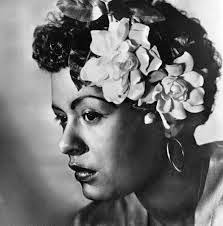
Billie Holiday, like all great artists, is as distinctive, as idiosyncratic, as original off-stage and off-mike as on. Credit Photograph by Charles Hewitt / LIFE / Getty
Some biographies of artists take in the whole life—preferably with
equal attention to the work, and integrating the two elements to the
extent that the work invites it. Others offer a bio-slice or synecdoche,
centered on one particular period, relationship, or field of activity
to provide an exemplary angle on the life and work. John Szwed’s brief
but revelatory new book, “Billie Holiday: The Musician and the Myth”
(Viking), which comes out this week—just under the wire for her
centenary (Holiday was born April 7, 1915)—is in another category. It’s a
meta-biography, about the creation of Holiday’s public image in media
of all sorts: print, television, movies, and, of course, her recordings,
but with special attention to the composition of her autobiography,
“Lady Sings the Blues,” which was published in 1956.
Szwed, whose
other books include a superb biography of Sun Ra, “Space is the Place,”
reconstructs, through ardent archival research as well as his own
interviews, the circumstances of the making of Holiday’s book. In the
process, he both evaluates the first-hand significance of “Lady Sings
the Blues” as Holiday’s factual and emotional account of her own life—as
a record of Holiday’s experiences and ideas—and also, secondarily,
treats the writing and the publication of the book as important events
in Holiday’s life. She died on July 17, 1959, at the age of forty-four,
and had been suffering from liver disease and heart disease. She was, as
she writes, addicted to heroin “on and off” since the early
nineteen-forties. Szwed says that, when she went to the hospital in
1959, “No one at the hospital knew who she was, and with needle marks on
her body, she was left in the hall for hours, since the institution was
not allowed to treat drug addicts.”
Holiday’s recording career
was precocious: she made her first records in 1933, with a small group
headed by Benny Goodman (who wasn’t yet a big-band leader). On the very
first page of the first chapter, Szwed writes wisely about the timing of
Holiday’s own book, nothing that at the time it was published, “jazz
had moved from being the popular music of 1940s America to a more
rarefied place in the public view.” This fact, for Szwed, mitigated the
response that Holiday’s book received. The critics now defending jazz
were mainly “closet high modernists who wanted no mention of drugs,
whorehouses, or lynching brought into discussions of the music.” And
those are among the subjects addressed, in unsparing detail, in
Holiday’s book. (Among the critics who attacked the book was Whitney
Balliett, this magazine’s longtime jazz critic, who wrote about it in
the Saturday Review.)
The first section of Szwed’s book is one of
the most briskly revealing pieces of jazz biography that I’ve read.
First, he establishes the bona fides of William Dufty, Holiday’s
collaborator on the book, rescuing him from charges of being a hack.
Dufty was an award-winning journalist at the New York Post at a time
when it was a leading liberal paper; he and his wife, Maely Daniele, a
longtime friend of Holiday’s, welcomed her to their apartment as “a
place of refuge from the police, her husband Louis McKay, reporters, and
the various unsavory figures who haunted her life.” Dufty did the
actual writing, based on long and detailed conversations with Holiday
augmented by archival research that sparked her recollections.
Szwed sketches a handful of the book’s divergences from the
independently established biographical record, starting with the
legendary first sentences: “Mom and Pop were just a couple of kids when
they got married. He was eighteen, she was seventeen, and I was three.”
Szwed explains, “When Billie was born, her mother was nineteen, her
father seventeen. They never married . . . She was born not in Baltimore
but in Philadelphia. Some questioned her claim of having been raped at
age ten.”
Holiday’s book is unstinting in its depiction of the
hardships she faced. As a child, she heard from her great-grandmother
about life as a slave; she grew up away from her mother, in the home of a
cousin who beat her; she scrubbed floors in a “whorehouse” in order to
hear music on the record player; and the man who raped her when she was
ten was a neighbor. She quit school at twelve and travelled to New York
alone, where she worked first as a maid and then as a prostitute. Jailed
and released, she moved in with her mother, who lived in Harlem. They
were on the verge of eviction when Holiday, who was about fifteen, got a
job singing—more or less by accident—at a local nightspot. Holiday
details the roughness of the world of music, exacerbated by relentless
racism—travelling through the South in the age of Jim Crow, being forced
to darken her skin with makeup in order to perform in Detroit. She
describes in detail her addiction to heroin, her resulting troubles with
the law, and its impact on her career.
For all its confessional
frankness and accusatory clarity, there is, as Szwed reveals, much more
to her story—and the circumstances of the composition of “Lady Sings the
Blues” are an exemplary part of it.
Delving into earlier drafts
of “Lady Sings the Blues” and other archival materials, Szwed finds
echoes of the book in other published sources to which Holiday had
referred Dufty as particularly reliable. Holiday told Dufty some stories
that were ultimately kept out of the book, including the agonizing home
abortion that her mother forced her to undergo as a teen. But Szwed
finds that the book’s most important omissions were demanded by lawyers
(including one representing Holiday and McKay) and by many of the public
figures who played major roles in Holiday’s life and autobiography.
In particular, Szwed traces the stories of two important relationships
that are missing from the book—with Charles Laughton, in the
nineteen-thirties, and with Tallulah Bankhead, in the late
nineteen-forties—and of one relationship that’s sharply diminished in
the book, her affair with Orson Welles around the time of “Citizen
Kane.”
In 1941, Welles wanted to make a film called “The Story of Jazz,” in collaboration with Duke Ellington. It would be set in the nineteen-teens and twenties, centered on the rise of Louis Armstrong, playing himself. He wanted Holiday to play Bessie Smith. Welles’s movie, Szwed writes, was “intended to be radically innovative, mixing together different styles of jazz, using the surrealist drawings of Oskar Fischinger.” It was put off, Szwed reports, due to the start of the Second World War. When Welles went to Rio to make “It’s All True,” he thought that the jazz story could be woven into it—but his filming of “the everyday interaction of races in Brazil” soured Welles’s studio, RKO, on the entire production.
The basic idea is the crucial one:
of all jazz singers, Holiday is the one who is a jazz musician, the
equal in musical invention of the epoch-making instrumentalists who
played alongside her. Szwed picks up on the negative effect on her
career that her style risked when she was starting out. He quotes one
club manager who told her, “You sing too slow . . . sounds like you’re
asleep!” Music publishers—who still made lots of money from the sale of
sheet music—didn’t like her singing, which didn’t present the melodies
clearly enough. His analysis shines all the more brightly when he goes
behind the scenes of the recordings to unfold the life of
performance—her initial experience as a cabaret singer, going table to
table for tips in the Prohibition-era cabarets on 133rd Street, where
she got her start; the peculiarities of the Fifty-Second Street clubs
where she performed in the late thirties, which fostered a casual
musical intimacy (“They were small, maybe fifteen feet by sixty feet,
and were located in the basements of brownstone residences. They
featured miniature tables for a few dozen people.”). He also explains
the painful conditions of some of her later recordings, when her health
and her voice were in bad shape (“The on-the-spot rehearsals, the false
starts, retakes, and overdubs began to pile up on the tape reels”).
Szwed looks closely at her choice of songs and the origins of ones with
which she’s closely associated, including “Strange Fruit” and “God
Bless the Child.” He details the life-threatening conflicts that she
faced on the road in the South, where she performed as a member of the
(white) Artie Shaw band. And he carefully considers the specifics of
performance later in her career, when she sang at Carnegie Hall and
recorded with far more elaborate arrangements than she had used in her
youth—and focusses on the musical implications of these circumstances.
Above all, in analyzing her art, Szwed argues for the difference
between the performer and the life—between the on-stage persona and the
person: “Her ability to communicate strong and painful emotions through
singing led many to believe that she was suffering and in real pain. But
real suffering is not necessary for great singing, only the ability to
communicate it in song . . . Like actors, singers create their
identities as artists through words and music. . . . All we can know for
certain is the performance itself.”
In general, the desire of
even the most discerning critics, such as Szwed, to separate art and
life, to analyze the formal traits of works as if they were dissociable
from the experience and the emotions that inspire them and that they
convey, is both noble and doomed—noble, because artists deserve to be
honored for their achievements, and doomed, because the formal and
systematic nature of those achievements isn’t what makes them endure.
The individuality, the immense complexity of inner life that art
conveys—including Holiday’s seemingly straightforward and instantly
appreciable art—doesn’t occur in a laboratory-like isolation.
Holiday herself, in “Lady Sings the Blues,” took care to depict the
unity of her personal life and her musicianship, starting with the
haphazard circumstances under which she began her career, as a teen-age
ex-prostitute in need of a fast way of making rent for herself and her
mother. She specifically connects the way she sings with her
experiences—and with her readiness to face them. (“Maybe I’m proud
enough to want to remember Baltimore and Welfare Island.”)
Holiday, like all great artists, is as distinctive, as idiosyncratic, as
original off-stage and off-mike as on. The life doesn’t explain the
art; rather, life is an art in itself—whether a creation of sublime
moments and fascinating gestures, or of terrifying confrontations and
mighty endurances—that is illuminated by the same inner light, inspired
by the same genius, inflected by the same touch that makes the works of
art endure on their own. The biographer of an artist is a critic in
advance, in acknowledging and appreciating the actions of an artist’s
life and recognizing what’s personal and distinctive in their being—in
discerning the artistic aspect of the life. Szwed, in his brief book,
accomplishes this goal, perhaps even better than he intended.
Richard Brody began writing for The New Yorker in 1999, and has
contributed articles about the directors François Truffaut, Jean-Luc
Godard, and Samuel Fuller. He writes about movies in his blog for newyorker.com.
Billie Holiday: The Musician and the Myth review – reclaiming Lady Day's artistry
Everyone knows about the sex and drugs – but John Szwed’s biography
makes the case for Holiday as a complex artist who inspired in many
different directions
Billie Holiday: one of the most famously
indescribable – and inimitable – voices in all of jazz and pop-music
history. Photograph: Michael Ochs Archives
by Seth Colter Walls
Thursday 2 April 2015
The Guardian (UK)
To the public, Billie Holiday might simply be an icon. But to
specialists, she’s the subject of a long and unsettled argument. In the
view of some critics, her art has often gotten short shrift compared
with discussions over the tabloid particulars of her too-short life. In
1956, she published a co-written autobiography called Lady Sings the
Blues, which tried to balance confessional storytelling with assertions
of her artistic control. It was accused of doing a disservice to jazz by
some self-appointed guardians of the genre.
In later decades,
Lady Day – as she was called by fans and fellow musicians – was even
accused of having been illiterate. A fast-and-loose 1972 biopic starring
Diana Ross, a pop singer ill-suited to capturing Holiday’s swinging
sophistication and melodic genius, hardly improved anyone’s
understanding. The feminist critic Angela Davis took sharp exception to
the film, writing that it “tends to imply that her music is no more than
an unconscious and passive product of the contingencies of her life”.
With the approach of Holiday’s centenary, more and more people are
coming over to Davis’s side. John Szwed’s swift, conversational and yet
detail-rich new biography, Billie Holiday: The Musician and the Myth,
communicates its artist-first priorities in the subtitle, and then makes
good on them throughout. That’s not to say that he ignores the singer’s
romantic flings (with Orson Welles, among others), the domestic abuse
suffered at the hands of multiple partners or the long-term heroin use
that are part of the familiar Holiday lore. Crucially, though, he spends
more than half his page-count closely considering Holiday’s music. And
his book comes just as three new recordings – one from José James, a
singer who skillfully bridges the worlds of contemporary R&B and
jazz, one by Cassandra Wilson and another by the classical pianist Lara
Downes – likewise investigate the musician’s catalogue with respectfully
daring air.
As tough as it is for those musicians to interpret
songs Holiday made iconic, it’s possible that Szwed’s challenge was more
daunting. He is writing in the wake of Holiday biographies that have,
by necessity, relied on speculation and hearsay, given the fact that
Holiday gave few interviews (and saw her autobiography redacted by a
lawsuit-averse publisher). There are also political ambiguities involved
in narrating the choices of an African American artist who, as Davis
noted, “worked primarily with the idiom of white popular song”. And then
there are the difficulties of needing to describe one of the most
famously indescribable – and inimitable – voices in all of jazz and
pop-music history.
On the latter point, Szwed clears his throat a
bit – quoting divergent critical opinions and eminent musicologists –
displaying some of the agonies that prose suffers when summing up the
Holiday sound. But he does have moments where he succeeds beautifully:
“In the upper register she had a bright but nasal sound; she sounded
clearer, perhaps even younger, in the middle; and at the bottom, there
was a rougher voice, sometimes a rasp or a growl. But even these voices
were varied or might change depending on the song she was singing.”
Elsewhere, Szwed is on point when he describes Holiday “falling behind
the beat, floating, breathing where it’s not expected, scooping up notes
and then letting them fall”.
As the author of compelling books
on complex figures such as Miles Davis and Sun Ra, it’s little surprise
that Szwed is also wise and authoritative on the sad, complex
interaction of Jim Crow racism and early pop-music practices, in the
20-page chapter The Prehistory of a Singer. And he proves as good at
reading Holiday’s political choices – such as revising the “in dialect”
lyrics of Gershwin’s I Loves You, Porgy – as he is at spelling out
Holiday’s evolving approach to improvisation, over the course of her
career.
Like Davis, Szwed hears a hint of feminist
consciousness-raising in Holiday’s 1948 rendition of My Man. And on the
tortured history of credit-taking for the composition of Strange Fruit –
the anti-lynching protest song that stunned one nightclub audience
after another, once Holiday added it to her repertoire – Szwed cuts
through the brush to show the ways in which Holiday’s melodic approach
(as well as her choice to perform it in front of white people) destined
the song for a place in history as much as anything else.
If it
sounds like the accumulated weight of history makes for solemn reading, a
lot of fun can actually be had using Szwed as a listening partner. Go
ahead and launch your streaming-music engine of choice and build a
playlist with the tracks as Szwed considers them. You probably won’t
need much help enjoying three rare Holiday recordings with Count Basie’s
1937 band – available on disc eight of Lady Day: The Complete Billie
Holiday on Columbia, 1933-1944 – since the musicians’ collective brand
of ecstasy requires little in the way of selling. But Szwed’s
description of Holiday “gliding over rhythm suspensions and finding her
way over the glassine 4/4 of a great swing rhythm section” is a treat –
as is his song-by-song investigation of Holiday’s musical partnerships
with the pianist Teddy Wilson and the saxophonist Lester Young.
In the case of pre-existing songs that Holiday made her own, Szwed cites
earlier recordings by other singers before inviting you to compare them
with what he deems to be Holiday’s best version (the better to put her
skills in relief). And when it comes to the core of Lady Day’s catalogue
– the songs she recorded, with great variance, during multiple phases
of her career – Szwed’s listening notes shed useful light on the
differences, especially for fans who think they can safely dismiss the
portion of Holiday’s discography that is less favoured by jazz
aficionados.
That very hybridity – Holiday’s ability to help
define jazz singing, and then buck the genre’s conventions – is what
makes the new spate of tributes to her feel so appropriate. A listener
might disagree with an arrangement choice made by Cassandra Wilson, on
Coming Forth By Day, or else miss elements of swing in Lara Downes’s
classical recital A Billie Holiday Songbook – but their risk-taking is
clearly in the service of honoring Holiday’s often-surprising moves.
(José James’s Yesterday I Had the Blues: The Music of Billie Holiday is
just about perfect, including as it does the playing of
MacArthur-winning pianist Jason Moran.)
Plenty of stars from
yesteryear had crazy-juicy personal lives; very few left behind
conceptual approaches that inspire in so many directions. Each of these
new albums is in league with Szwed’s book – a joint persuasion campaign
meant to encourage us to consider musicianship as the defining
characteristic of Lady Day’s legacy. That’s about as fine a
centenary-year gift as anyone had a right to expect.
Billie Holiday: The Musician and the Myth is published by Viking Press in the USA, and William Heinemann in the UK
When Billie played her yearly concerts at the Apollo and at Carnegie
Hall everyone came out in full force either to hear her sing or to see
whether she was still together. Each time a new record was issued it was
compared with her early ones, and she was often judged to be imitating
herself, to be working with the wrong musicians, the wrong arrangers,
etc. Most everyone liked to believe that Billie made her best records
when she sang with Count Basie and the other geniuses of swing. It's
hard to disagree, for she was, like all of them, an incredible horn in
those days. Billie's later records, usually in a much slower tempo, are a
different music. They are the songs of a woman alone and lonely and
without much sympathy. No one blows pretty solos behind her like Lester
did. Sometimes there are unintelligent voices in the background going
oo-oo-oo with none of the wit Billie had on "Ooo-oo-oo what a lil
moonlight can doo-oo-oo." Nevertheless, these are the songs of Lady Day
too, and if the sorrow sounds a little heavier it was because she'd been
carrying it a while. "I remember when she was happy-" Carmen McRae said
in 1955, "that was a long time ago."
Billie and Louis both were
arrested in 1956. Billie knew by this time that if the Narcotics Bureau
wanted to get her it only had to be arranged, the evidence "found" and
she could be convicted on her past record. In her book she pleaded that
the addict be treated rather than punished. She knew how little good
punishment had ever done to help her. And her stated purpose in
revealing all that she considered shameful in her life was to warn young
people away from heroin. "If you think dope is for kicks and for
thrills, you're out of your mind.... The only thing that can happen to
you is sooner or later you'll get busted, and once that happens, you'll
never live it down. Just look at me."
Billie never was able to
stop using heroin completely, though she tried very hard. Some people
thought she could have tried harder: "That girl's life... was just
snapped away from foolishness." But there were others who knew and loved
her. Lena Horne and Billie had been friends since Cafe Society days,
and she understood how life had been spoiled for Billie.
Billie
didn't lecture me - she didn't have to. Her whole life, the way she
sang, made everything very plain. It was as if she were a living picture
there for me to see something I had not seen clearly before.
Her
life was so tragic and so corrupted by other people-by white people and
by her own people. There was no place for her to go, except finally,
into that little private world of dope. She was just too sensitive to
survive.
Billie survived long enough to sing a few days at the
Five Spot, a club that opened in downtown New York in the fifties. Her
last appearance was at the Phoenix Theater in New York in May, 1959. On
May 31 she was brought to a hospital unconscious, suffering from liver
and heart ailments, the papers said. Twelve days later someone allegedly
found heroin in her room. She was arrested while in her hospital bed
and police came to guard her, to make sure this now thin, suffering
woman could not get away from the law one more time. But she escaped the
judgment of the United States of America versus Billie Holiday for a
higher judgment, on July 17, 1959.
Billie Holiday at 100: Artists reflect on jazz singer’s legacy
By Aidin Vaziri
Friday, April 3, 2015
Photo: Associated Press
Image 1 of 13
FILE - This Sept. 1958 file photo shows Billie Holiday. The Apollo
Theater is planning events to commemorate the 100th birthday of Holiday.
The legendary American jazz vocalist was born on April 17, 1915 and
died in 1959 at the age of 44. Holiday performed at least two dozen
times at the Apollo. She will be inducted into its Walk of Fame on April
16, 2015. (AP Photo/FILE)
Billie Holiday would have turned 100
this week, but who’s counting? The famed jazz singer and songwriter’s
voice is ageless, still luring fans with its effortless swagger and
unblinking candor. It carried with it all the difficulty she endured
throughout her tumultuous life — born Eleanora Fagan, an illegitimate
child, on April 7, 1915, in Baltimore; died strung out and broken 44
years later in New York — along with all the hope, fear and desperation
that came with it. “What comes out is what I feel,” she once said.
No one else can sound like Billie Holiday because no one else lived like Billie Holiday.
Yet in generation after generation, her influence is unmistakable. To
mark the centennial of her birth, which will be celebrated with
concerts, books, albums, tributes and reissue packages around the world,
we spoke with some people closer to home whose lives were deeply
touched by Holiday.
Paula West
Longtime Bay Area jazz singer, torchbearer of the American Songbook popularized by Holiday
I’m not quite sure when I first heard Billie Holiday. I believe it was
before the Diana Ross biopic (“Lady Sings the Blues”) was released. Of
course their voices were dissimilar. I was young at the time, and had
only been exposed to those “greatest hits,” such as “Fine and Mellow,”
“Them There Eyes” and “Good Morning Heartache.”
I feel the best
singers have always been able to get across the raw emotions of the
lyrics. She had no great vocal range, but that was never needed. It was
about telling the truth, the story, and not too many singers could ever
match her natural interpretations. No vocal histrionics, melisma
necessary. She was respected by musicians, as well, and her singing was
influenced by musicians such as Louis Armstrong.
There are dozens
of her interpretations I love, but “Lady in Satin” is my favorite,
particularly her version of “I’m a Fool to Want You.” The arrangement is
beautiful yet heartbreaking, of course, and no one could deliver that
better than Billie Holiday.
Lavay Smith
Blues and jazz singer with Lavay Smith & Her Red Hot Skillet Lickers, renowned for her tributes to the first ladies of jazz
I remember seeing Billie Holiday singing on TV on an oldies station
that would show the Little Rascals, Shirley Temple and old
black-and-white movies. Like everyone who hears her, I loved her right
away.
Billie remains an icon because she was true to herself. As a
singer, she made you believe that she meant every word she sang. Lyrics
were very important to her, which isn’t true of all jazz singers. And
the feeling that she creates through her use of rhythm was always
swingin’ and happy. A lot of people think of her music as being sad, but
she had a great sense of humor that comes through, and I’ve always
found her music to be uplifting.
The first album I bought was
“Lady Sings the Blues,” and I played the heck out of. It included
“Strange Fruit” and many of her hits, like “Traveling Light” and “Good
Morning Heartache.” I love all of the Columbia recordings that she did
with Lester Young and Teddy Wilson, including all of the obscure songs. I
just love the feeling and the soul of these records. The interplay
between Billie and Lester Young is the textbook definition of how an
instrumentalist should interact with a singer.
Joey Arias
New York cabaret singer and drag artist, who recently performed a tribute to Billie Holiday at Lincoln Center
I remember hearing her voice and thinking how lovely she sounded. I
wanted to have that same sound that she was emoting. It was a magic
spell that was sent to me. I feel as though we were connected at the hip
from stories I’ve heard from friends and family.
Billie was an
outspoken person. She was class all the way and never wanted to be
treated any other way. She was being followed and became public enemy
for standing up for her rights and acting strong and never letting her
guard down. She dressed beautifully and had such presence.
“Lady in
Satin” is my favorite album. It all depends on what period you want to
hear her style, but I love her in the late ’50s. She summed it all up —
her life, her singing and her thoughts, and her love of life and love.
Randall Kline
SFJazz executive director
I heard her on the home stereo as a teenager. My parents were jazz
fans. One hearing of her voice — soft, persuasive, mournful, honest,
beautiful — told you to listen more closely. “Don’t Explain” for its raw
pathos. “Strange Fruit” for its power, poignancy and, sadly, its
contemporary relevance.
Getting to know Billie Holiday
Here are some albums to help you get better acquainted with the jazz singer’s magic.
“Lady Day: The Best of Billie Holiday,” Legacy. A two-CD set containing
many of the classic sides Holiday cut for Columbia and its Brunswick,
Vocalion and Okeh labels in the 1930s and early ’40s, including “What a
Little Moonlight Can Do,” “A Fine Romance,” “You Go to My Head” and “The
Man I Love.”
“Billie Holiday: The Complete Decca Recordings,”
GRP. An excellent two-CD box featuring the torch songs, raucous
renditions of signature Bessie Smith numbers, and other material Holiday
recorded for Decca from 1944 to 1950.
“Lady in Autumn: The Best
of the Verve Years,” Verve. A good two-disc survey of Holiday’s
small-band recordings of the 1950s, featuring stellar soloists like Ben
Webster and Benny Carter.
“Lady in Satin,” Legacy. A
heartbreaking beauty. Writer Michael Brooks wrote that this 1958 album
feels “as if a group of family and friends are gathered around a loved
one and saying their last goodbyes.”
“Ken Burns Jazz — Definitive
Billie Holiday,” Verve. Compiled by the documentary filmmaker, this
single-disc collection culls material from the three major phases of the
singer’s career. — Jesse Hamlin
Kitty Margolis
San Francisco jazz singer, trustee at the Recording Academy, founder of Mad-Kat Records
I remember staring at a girlish, chubby Billie on the cover of this
brown Columbia three-LP box set released in 1962, “Billie Holiday: The
Golden Years.” It had an extensive photo book with detailed track
listings inside and liner notes by John Hammond and Ralph Gleason. I
still have it. Opening it and smelling the paper takes me right back. I
realize now that a lot of the tunes in this box became very important to
my early core repertoire.
I don’t think there is one genuine female jazz singer in the world who doesn’t have Billie inside. She defined the idiom.
One major thing that set Billie apart as a jazz singer is that she was a musician’s singer, a master improviser without ever uttering one scat syllable. She was not a classically “pretty”-sounding singer like Ella or Sarah. Billie’s sound was a bittersweet brew: raw, tart, personal, intimate, relaxed, understated, urgent.
Billie’s storytelling was always 100 percent emotionally
intelligent and believable, an ironic cocktail of longing, pride, pain,
strength with a sharp glint of humor. No one could sound happier (“Them
There Eyes”) and no one could sound darker (“I’m a Fool to Want You”).
Billie sang the truth. There was no “acting” involved. She could take
even the most banal pop lyric of the time and imbue it with subtext that
gave it a much deeper message, almost like a code.