Showing posts with label African American politics. Show all posts

Sunday, January 14, 2024

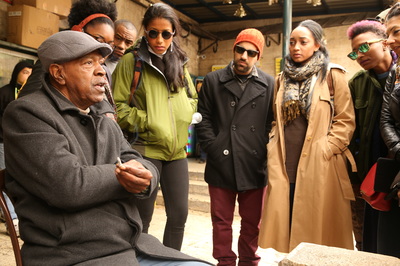
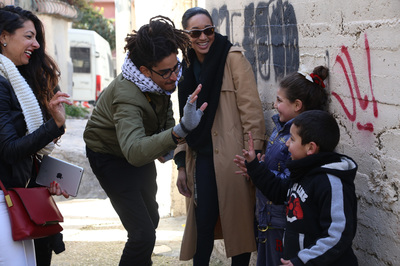
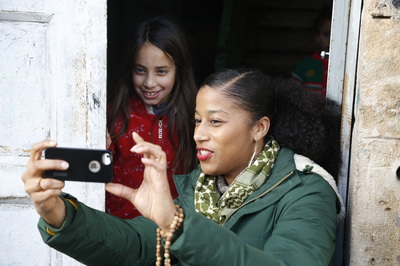
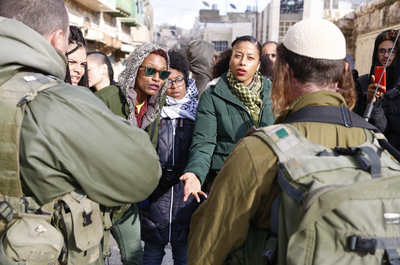
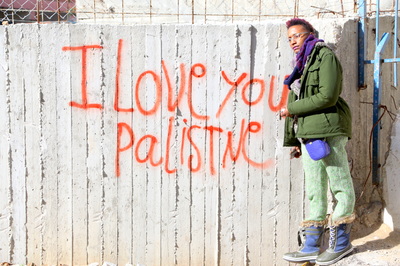
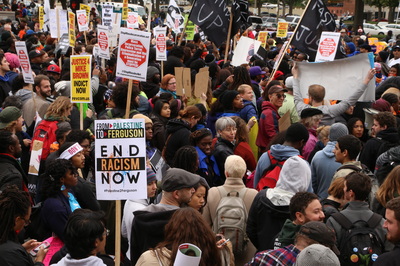
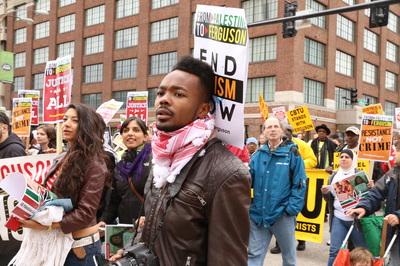
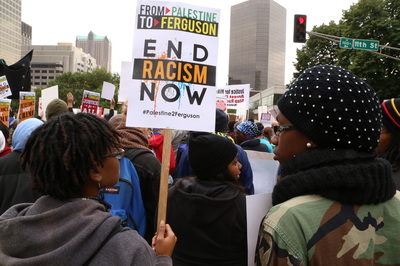
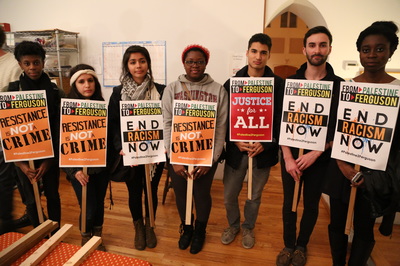
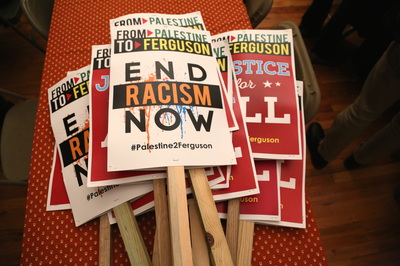
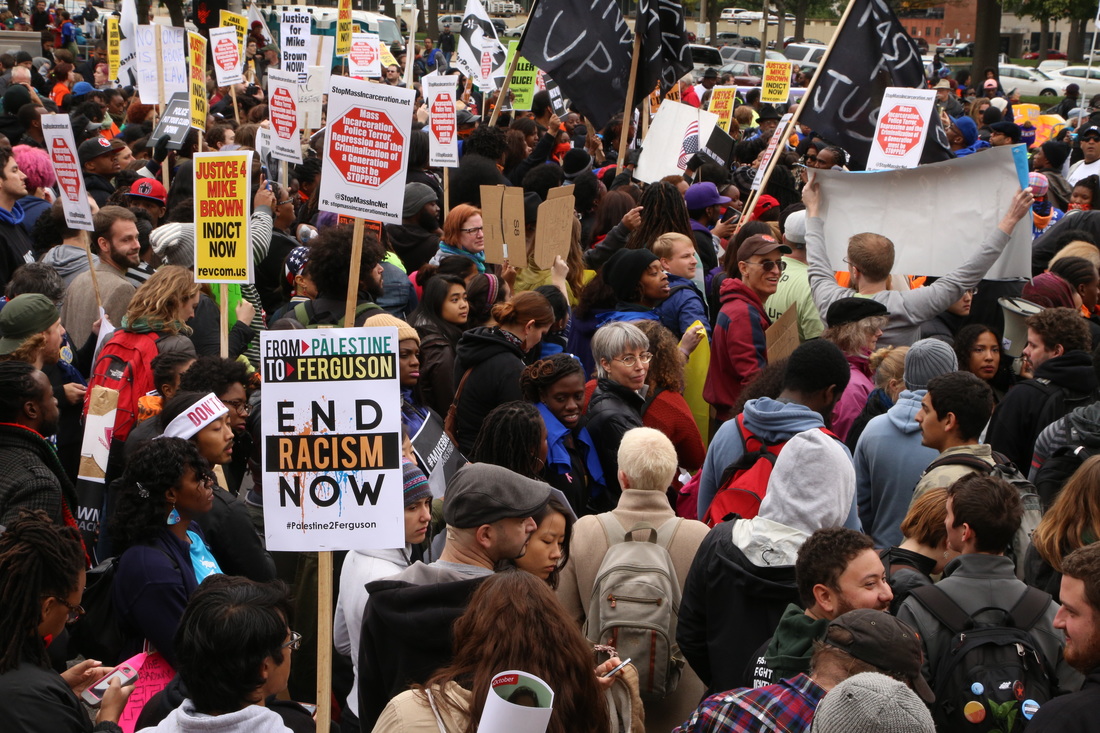
"What's Past is Prologue": A Strong and Celebratory Video Statement Of Transnational Solidarity Between Palestinians and Black Americans from October 2015

WHEN I SEE THEM I SEE US

June 26, 2020 


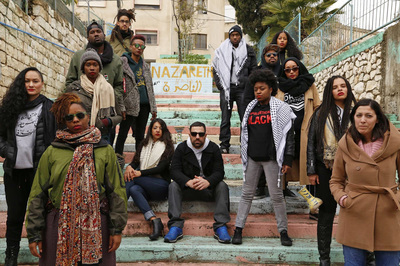
The Black-Palestinian Solidarity Campaign released this video in October 2015. Part of their statement: “We choose to join one another in resistance not because our struggles are the same but because we each struggle against the formidable forces of structural racism and the carceral and lethal technologies deployed to maintain them. This video intends to interrupt that process – to assert our humanity – and to stand together in an affirmation of life and a commitment to resistance. From Ferguson to Gaza, from Baltimore to Jerusalem, from Charleston to Bethlehem, we will be free.” See more about this video: https://www.blackpalestiniansolidarit... 
 
See the video’s script here: https://www.blackpalestiniansolidarit... 
 
The video features dozens of leading artists and activists from the US and Palestine. Among the Black Americans who appear are Danny Glover, Cornel West, Angela Davis, Alice Walker, LisaGay Hamilton, and Lauryn Hill. Palestinians in the video include Omar Barghouti, Diana Buttu, Noura Erakat, Rashid Khalidi, Sandra Tamari, and Linda Sarsour. They are speaking of their shared experiences of racism and persecution, experiences that include militarized police violence in the US and a brutal military occupation in Palestine. 
 
See this video also at The Washington Post: https://www.washingtonpost.com/video/...


2015 Black for Palestine Statement

Over 1,100 Black activists, artists, scholars, students and organizations signed the 2015 Black Solidarity Statement with Palestine. 

Excerpt:

"We offer this statement first and foremost to Palestinians, whose suffering does not go unnoticed and whose resistance and resilience under racism and colonialism inspires us. It is to Palestinians, as well as the Israeli and US governments, that we declare our commitment to working through cultural, economic, and political means to ensure Palestinian liberation at the same time as we work towards our own. We encourage activists to use this statement to advance solidarity with Palestine and we also pressure our own Black political figures to finally take action on this issue. As we continue these transnational conversations and interactions, we aim to sharpen our practice of joint struggle against capitalism, colonialism, imperialism, and the various racisms embedded in and around our societies. "
 

6,000 Black activists, artists, scholars, students and over 225 organizations
signed our Black Solidarity with Gaza #CeasefireNow statement, including:

Angela Davis | Indya Moore | kehlani | Marc Lamont Hill | Michael Bennett 
Mumia Abu-Jamal | noname | Pam Africa | Robin DG Kelley | Saul Williams


The Dream Defenders | Malcolm X Grassroots Movement |
Movement For Black Lives | 
Harriet’s Wildest Dreams


Sunday, February 17, 2013

The Crucial Coalition Of Immigrants and African Americans in the Pivotal Struggle of Labor Vs. Capital in the United States Today


All,

There is a wonderful and endlessly profound proverb from the historical depths of the inspiring and extraordinary African American collective experience in the United Hates and it has been passed down in countless intimate conversations and liberatory gatherings and blues and rhythm and blues and gospel and Jazz songs and it goes like this:  "No matter what happens always remember that GOOD NEWS IS COMING so you better be ready to receive and embrace it when it gets here."  The article below conjures up yet another shining dynamic example of this boundless and eternal truth--and like always the news comes NOT A MINUTE TOO SOON.  Can I get a witness?   YES!!

Kofi
"Politics is an activity," C.L.R. James famously said. "It is not a lecture room where the people are supposed to listen to all the government has done for them. The more active the people are, the more active the government can be."

Charging Through the Archway of History: Immigrants and African-Americans Unite to Transform the Face of Labor and the Power of Community
Saturday, 16 February 2013
By Paul Ortiz, Truthout | Op-Ed


Francisco Martinez, 17, protests policies of President Barack Obama that have deported record numbers of Latinos, during a protest outside President Obama's campaign headquarters, at One Prudential Plaza in Chicago, August 16, 2011. (Photo: Peter Hoffman / The New York Times)

A budding coalition of immigrants and African-Americans - modeled on the outstanding community- and labor-organizing example of Culinary Workers Union Local 226 - is potentially the largest progressive force in America - one capable of transforming the trajectory of US history.

"I was taught that justice wears a blindfold, so as not to be able to distinguish between the colors, and thus makes everyone equal in the eyes of the law. I propose we remove the blindfold from the eyes of Lady Justice, so that for the first time she can really see what's happening and check out where the truth lies and the lies hide. That would be a start. Viva the children of all colors! Punto!"
- Piri Thomas, Down These Mean Streets

Part I: A Tale of Two Speeches

Why did President Obama travel to Las Vegas to make a speech on immigration? Las Vegas is a union town. The city is the home of one most powerful unions in the Americas, an organization built and led largely by Latina, African-American and Asian-American women who work as maids, housekeepers and food service workers on the Las Vegas Strip and beyond.

Many of the rank-and-file members of the 60,000-member Culinary Workers Union Local 226 are single mothers, and without their support Obama would not be President of the United States. The president understands this and herein lays the symbolic power of his speech, as well as the transformations in American life that it reveals. The new president of Local 226 is the brilliant organizer Geoconda Arguello-Kline. She was a picket captain during the epic Frontier Hotel Strike (1991-1998) where not a single one of the 550 hotel workers crossed the picket line. The strike "showed us all what unity and perseverance are," she recalled. Arguello-Kline originally hails from Managua, Nicaragua and is a former hotel housekeeper.


Black and white photograph of Hattie Canty marching with other women during a union strike.

In the 1990s, Local 226 became the fastest-growing private sector union in the United States. It was led by the legendary African-American unionist Hattie Canty, who migrated to Las Vegas from rural Alabama. In contrast to the AFL-CIO's George Meany, who bragged that he had never been on a picket line, Canty was one of the greatest strike leaders in US history. Her patient leadership helped knit together a labor union made up of members from 84 nations. "Coming from Alabama," Canty observed, "this seemed like the civil rights struggle ... the labor movement and the civil rights movement, you cannot separate the two of them."

Whether they hail from Alabama, Thailand, Central America or someplace else, the members of Local 226 represent the future promise of the Americas. This is not about demographics; it is about corazón (heart), the willingness to struggle together and the courage to challenge corporate America when others have surrendered.

The place where a president chooses to deliver a major address is important. In 1980, Ronald Reagan traveled to Neshoba County, Mississippi - the least unionized state in the country - to make a speech on "states' rights." He was trying to build a base of white southern support pursuant to the 1980 Presidential Election.

He gave his speech a few miles away from the place where three civil rights activists had been murdered in 1964. James Chaney, Andrew Goodman, and Michael Schwerner were killed by people who held the doctrine of "states rights" to be a sacred part of their Confederate heritage. While Reagan may have been ignorant of the civil rights movement, he was well aware of the role that the Republican Party's "Southern Strategy" played in his electoral chances. The goal was to play upon white pride and to undermine the Democratic Party in the South. In the short term, it worked.

Analysts are saying that the re-election of Obama may signal the end of the Reagan Era.

But elections decide nothing. The zombie-like grip that policies implemented by cohorts of Reagan/Ayn Rand acolytes will only be broken by collective action. The Student Nonviolent Coordinating Committee and the United Farm Workers did not wait for John F. Kennedy or Lyndon B. Johnson to do for them what they could do for themselves. Freedom schools, strikes, boycotts and voter registration campaigns were engines of social change in the 1960s and yes, they were sometimes timed to push Washington, DC to action.

The 2006 General Strike of Latinos on International Workers' Day made the election of Barack Obama possible. The mass walkouts demonstrated the ability of Latinos to shut the economy down in defense of social justice and equality. It taught us that the real strength in our communities is in our custodians, manual laborers and service workers - not in our intellectuals, executives or experts who garner corporate endorsements for interpreting "Latin culture" for Madison Avenue. In the 1960s, we learned, much to our surprise, that the future of Latino aspirations rested on the creative energies of farm workers. In turn, the Grape Boycott awakened and trained a new generation of young community organizers who went on to play pivotal roles in rebuilding progressive politics through vehicles such as the Rainbow Coalition, the Los Angeles County Federation of Labor, and finally, the "Obama ground game."

The general strike signaled a renaissance of working-class culture in the US that we have yet to fully understand. It reminded the nation that politics is not the property of the rich; it occurs on soccer fields, in union halls, in churches and in tiendas where immigrant workers gather to share information on the latest activities of US Immigration and Customs Enforcement (ICE) in the neighborhood. In both 2008 and 2012, a significant amount of the electoral ground game hinged on the energy of local labor councils in canvassing, multi-lingual phone-banking and other outreach activities. Many of these activists had been rejuvenated by, or even earned their organizers' stripes, during International Workers' Day, 2006. In south Florida, an epicenter of the General Strike, Latinos were a decisive part of Election Day. According to Gihan Perera, "In Homestead, undocumented workers who couldn't even vote pitched in with a mariachi band and barbecue," to encourage thousands of African-Americans, Latinos, and progressive whites to stay in line and vote. Black and brown power made the difference in Florida.

"Politics is an activity," C.L.R. James famously said. "It is not a lecture room where the people are supposed to listen to all the government has done for them. The more active the people are, the more active the government can be." Nearly 300,000 Latinos, African-Americans, and Asian-American workers joined unions in the months leading up to the general election. Even the mainstream media noted that strike activity increased significantly around the time of the election campaign. "The number of union-related work stoppages involving more than 1,000 workers, which reached an all-time low of just five in 2009, rose to 13 this year as of October. And unions aren't done yet," reported the Los Angeles Times.

People are on the move.

I believe the president's Las Vegas speech is a microcosm of a larger movement that may create an expansion of democracy. Everything hinges on the next act of this drama. If a US president is pushed by grassroots pressure to create an opening for social change to occur and he engages in flowery rhetoric to facilitate the process, one doesn't pause at the archway of history to criticize the rhetoric: One charges through the damn door.

African-Americans did not wait in 1863 to see if Abraham Lincoln was serious about the Emancipation Proclamation. A quarter of a million of them enlisted in the US Army in order to drive the Confederate States of America into oblivion.

Is President Obama deeply committed to immigration reform? That's the wrong question to ask. We know that he promised Helen Chavez, the widow of United Farm Workers' co-founder César Chávez, to "do something" about the issue. A better question to ask is: What are we willing to do to welcome millions of struggling workers into our polity? Immigrants traveled to the United States from all over the world during the past two decades and contributed to one of the greatest economic booms in history. They are the solution to an aging Baby Boom generation; they are replenishing tax coffers and they are bringing much-needed changes to our archaic, monolingual culture. What will we do to make them fully empowered citizens of the republic?

Immigrant energy is contributing to a revival of progressive American political culture. It finds its echoes in the heroic DREAMista activists (who have pushed the federal government hard on immigration reform), the Florida Dream Defenders, who organized in the wake of the murder of Trayvon Martin, as well as the Occupy insurgencies. All of these initiatives are part of the rising tide of new social movements that we must nurture, support and sustain.

In a recent newspaper poll taken in the college town of Gainesville, Florida, where I live, 62 percent of the respondents voted against the premise that people "currently in the US illegally" should have a path to citizenship. This is going to be a battle.

Part II:  A New Century

Tens of millions of immigrants with lineages from Latin America, Asia, Africa and the Middle East voted in significant majorities to re-elect Barack Obama. The choices that first- and second-generation immigrant voters made in this election may signal a turning point in American history. In line with their early 20th century predecessors, these voters could have settled for the tragic bargain of whiteness that Toni Morrison has so eloquently critiqued. In her essay, "On the Backs of Blacks," Morrison observed that, "In race talk, the move into mainstream America always means buying into the notion of American blacks as the real aliens. Whatever the ethnicity or nationality of the immigrant, his nemesis is understood to be African-Americans."

The phenomenon of "whiteness," as scholars call it, meant the country's newcomers often alienated themselves from the democratic legacies of the anti-slavery movement as well as from freedom fighters such as Frederick Douglass, Ida B. Wells Barnett and Mary McCleod Bethune, in favor of assimilation to Jim Crow/Juan Crow segregation before the 1950s.

Scholars have long been predicting a massive "turn towards whiteness" among late-20th century immigrants, but it has not happened yet. In fact, we may have broken the old curse. Recent immigrants, such as those who have become members of Local 226 in Las Vegas, are increasingly aligning their politics, trade union membership and their ballots with African-Americans. In the run-up to the 2012 Presidential Election, everyone who had access to radio, television or the internet understood that 90 percent of African-Americans were going to be voting for Obama. As novelist Ishmael Reed observed in Going Too Far: Essays About America's Nervous Breakdown:

"Though progressives still cling to a fantasy to which they've been attached since at least the 1920s - that class determines one's status in American society - to millions of whites, we are all underclass. Notice how images hostile to the president show him as an underclass hoodlum, or associate him with food stamps, or fast foods like KFC, or an email circulated by a candidate for governor of New York, a pimp and his wife a whore."

It isn't as if newer generations of immigrants are completely immune to the virus of racism (and frankly, many of us brought racist attitudes from our mother countries). However, the ballots have been counted: Latinos, Asian-Americans and Americans of Middle Eastern descent rejected two solid years of race-baiting, heavy petting and courting from the Republican Party to stand in solidarity with the black electorate.

In Florida, we were given innumerable opportunities to assimilate to this country's older, miserable norms on race, to "become white" so to speak. Mitt Romney's boosters bombarded our airwaves with racial propaganda. We were warned via the notorious "Chinese Professor" video spot of an imminent Asian takeover of the US should Obama win re-election. We were encouraged to believe that African-Americans were lazy, but this is always a hard sell given slavery, and a century of the Jim Crow labor system. The fact that one cannot travel from one side of this country to the other without relying on black and brown workers to handle one's baggage, prepare one's meals or to clean up one's mess makes the "minorities need to work harder and lift themselves up by their bootstraps" argument ridiculous and insulting.

Other "softer" versions of racism or national discrimination were trotted out. A few days before Election Day, Sen. Marco Rubio bungled a play for the Latino vote by telling a Florida audience that people had fled "corrupt" countries to find freedom in the US only to discover to their dismay that Obama was plotting to import these same policies here. Rubio helpfully clarified that he was referring to Mexico and Latin America as the corrupt places in question. Rubio's gaffe illustrates a fundamental reason why the Republican Party stumbles with Latino voters: Most Mexican-Americans have a nuanced understanding of our mother country. We understand its shortcomings, but we also take pride in the accomplishments of the early 19th century Mexican War of Independence, and the fact that the abolition of slavery in Mexico preceded abolition in the United States by approximately four decades. Most of us also know that the United States invaded Mexico in order to expand slavery, steal land and rob resources from Native Americans. So, which country is more corrupt? Until the GOP drops its devotion to American Exceptionalism, the idea that the United States is as pure as the driven snow, and all other countries are lacking in the character department, the party will continue to shrink in relevance.

Hailing from Africa, Latin America, Europe, Asia and the great centers of world population, this may be the most remarkable cohort of immigrants that has ever journeyed to the United States. They believe in hard work and self-help, but because of the places they come from and the traditions they pay homage to, many of them deeply believe in tenets of equality, social democracy and mutual aid.

Of course, these are just the kind of overarching generalizations that social critics rightly distrust, but I would argue that generations of anti-colonial struggles, experiences with post-colonial letdowns and an abiding distrust of the Washington Consensus make this generation of world citizens more worldly wise than their storied Ellis Island ancestors.

For example, more than a few recent immigrants from the Korean peninsula are importing militant trade union practices to the US, and they have a direct knowledge of the mischief that IMF-style policies wreak on workers. Highland Maya bring organizing experiences with Liberation Theology from Guatemala, and Mexican migrants are steeped in the egalitarian (if unrealized) traditions of the Mexican Revolution.

These cohorts of immigrants are less likely to grasp at the straw of racism that so many of their predecessors did because they arrive with a much more critical understanding of US society and a greater capacity to change the world without exploiting others.

What all of this might mean in political terms is not yet quite clear. However, one thing is certain. If community organizers allow this incipient coalition - potentially the largest progressive force in US history - to slip away, we are missing the opportunity that only comes once in a generation to change the trajectory of American politics.
Culinary Workers Union Local 226 presents us with an outstanding model of community and labor organizing. This is a union where members stay active, and this energy drew President Obama to Las Vegas.

Many of the people who are rank-and-file activists of Local 226 are dishwashers, fry cooks and maids. They labor in what is known in Las Vegas parlance at "the back of the house," an apt metaphor for the position of the American working class since the 1980s. With women such as Canty, the union's founder, and Arguello-Kline, its new president, these workers have moved to the forefront of social change. They marched by the thousands in honor of Martin Luther King Jr.'s holiday last month with banners reading "Labor Rights Are Civil Rights," even as they organized another picket against an unfair employer in the Vegas Strip.

Arguello-Kline and Richard Trumka, the president of the AFL-CIO, appeared on local television immediately following Obama's speech on immigration. Both vowed to mobilize members of the house of labor to support immigration reform. The waiting is over. It is now possible to imagine a new social movement where labor organizing, mariachi music and MLK celebrations become integral to the rejuvenation of this nation. It's time to get busy.

Copyright, Truthout. May not be reprinted without permission.


RELATED STORIES:

Immigrant Rights Activists Are Obama's Freedom Riders
By Henry Fernandez, New America Media | Op-Ed
DREAM Act Could Add $329 Billion to US Economy
By Amanda Peterson Beadle, ThinkProgress | News Analysis
Immigrants and Unions Work To Oust Notorious Arizona Sheriff
By Jenny Brown, LaborNotes | Report
Thursday, April 19, 2012

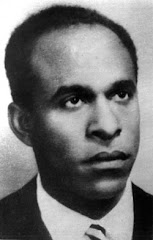
Gil Noble, 1932-2012: Pioneering Television Journalist, Documentary Filmmaker, and Legendary Black Media Figure

GIL NOBLE, 1932-2012

Gil Noble
WABC-TV, via Associated Press

http://www.huffingtonpost.com/2012/04/05/gil-noble-dead-dies-journalist_n_1406992.html?ref=black-voices&ir=Black Voices

GIL NOBLE BEING INTERVIEWED ABOUT HIS CAREER AND LIFE


GIL NOBLE INTERVIEW WITH BOB MARLEY


All,

Gil was a great journalist and a major black media pioneer on a number of different levels. Malcolm X, Dr. King, James Baldwin, Bob Marley, Kwame Ture (Stokely Carmichael), Muhammad Ali, Aretha Franklin, and Nelson Mandela among many, many other important African Americans in politics, literature, music, science, sports, and the arts routinely appeared or were interviewed on his long running award winning program "Like It Is". Mr. Noble was a man who understood the crucial importance of mass communications and excelled in making that fact known and appreciated by his audience both in New York and via PBS throughout the rest of the country. His legacy will live on wherever we make the collective effort to properly embrace and extend what his extraordinary work left us. He will be greatly missed. RIP brother...

Kofi


Gil Noble Dead: Legendary Black Journalist Dies At 80
By Jack Mirkinson
04/5/2012

The Huffington Post

Gil Noble, a legendary black journalist, has died at 80.

Noble hosted the New York public affairs show "Like It Is" for 33 years. WABC, the station he worked for, said that he created "the largest body of programs and documentaries on African Americans in the country."

"Like It Is" was born out of an effort to put more African American programs on television in the wake of the civil rights and black power movements. The show began in 1968, and it was only a stroke that forced Noble off the air in 2011.

Noble was born and bred in Harlem. In a 1998 interview, he said that he grew up "with no thought at all" of becoming a broadcaster. "[It] certainly had no place for people of color," he said. He eventually got a job at a Harlem radio station before moving to television in 1967, where he stayed for the rest of his career.

"The civil rights movement was really exploding," he continued in that interview. "I got myself an understanding of myself, my history, this country and another perspective of its story and its history and the world by all of the dynamic people who were in Harlem at the time."

Noble interviewed everyone from historians to presidents, revolutionaries to music icons. Just some of the many, many legends he spoke to include Nelson Mandela, Bob Marley, Aretha Franklin, Muhammad Ali, Kwame Ture, Jesse Jackson, Julius Nyerere and Sarah Vaughan. He also produced many documentaries about black history.

"Gil Noble's life and work had a profound effect on our society and culture," WABC president Dave Davis said in a statement.


http://www.nytimes.com/2012/04/06/business/media/gil-noble-host-of-show-on-black-issues-dies-at-80.html


Gil Noble, Host of Pioneering TV Show Focusing on Black Issues, Dies at 80
By PAUL VITELLO
April 5, 2012
New York Times

Gil Noble, a television journalist who hosted “Like It Is,” an award-winning Sunday morning public affairs program in New York, one of the longest-running in the country dedicated to showcasing black leadership and the African-American experience, died on Thursday in a hospital in Wayne, N.J. He was 80.

The cause was complications of a stroke he had last summer, said Dave Davis, president and general manager of WABC-TV, which had broadcast “Like It Is” since 1968.

Though broadcast only in the New York metropolitan area, “Like It Is” attracted guests of national and international influence. Some were controversial. His interviews with figures like Louis Farrakhan of the Nation of Islam drew complaints of one-sidedness. But for Mr. Noble, that was the point:
“My response to those who complained that I didn’t present the other side of the story was that this show was the other side of the story,” he said in 1982.
His interviews comprised a veritable archive of contemporary black history in America: hundreds of hourlong conversations with political and cultural figures like Lena Horne, Fannie Lou Hamer, Bill Cosby, Sammy Davis Jr., Muhammad Ali, Andrew Young, Dizzy Gillespie and Stokely Carmichael.

Mr. Noble viewed “Like It Is” as a platform for ideas and perspectives — especially those of blacks — that were missing from the mainstream news media. He once called his show “the antidote to the 6 and 11 o’clock news.”

His one-on-one exchanges with African and Caribbean heads of state, including Kenneth Kaunda of Zambia, Michael Manley of Jamaica and Robert Mugabe of Zimbabwe, were part of another mission: to report on events affecting people of African descent throughout the world.

“You learned a lot watching Gil,” former Mayor David N. Dinkins of New York said in an interview for this obituary. “You didn’t have to agree with everything he said, but for many of us, he was required watching.”

The deep support Mr. Noble enjoyed among his viewers helped him survive two controversies stemming from interviews with figures considered anti-Semitic, biased against Israel or both. In 1982, the Anti-Defamation League accused Mr. Noble of showing an anti-Israel bias when he broadcast a panel discussion about the Israeli invasion of Lebanon without presenting the Israeli perspective.

Just the rumor of disciplinary action prompted protests outside WABC headquarters, led by the Rev. Calvin O. Butts, pastor of the Abyssinian Baptist Church in Harlem, and the Rev. Al Sharpton. No disciplinary action was taken, but Mr. Noble was required to present a program with pro-Israeli guests.

Similar tensions arose in the summer of 1991, when Mr. Noble made plans to broadcast a speech in which a friend, Leonard Jeffries, a City College professor of black studies, was said to have made bigoted remarks. News reports had led to Mr. Jeffries’s removal as chairman of the black studies department.

Mr. Noble argued that only by hearing the speech in full could college officials (and everyone else) decide whether the remarks were cause for discipline or had been taken out of context. (In one remark, Mr. Jeffries said Hollywood movies demeaning to blacks were made by “people called Greenberg and Weisberg and Trigliani.” In another, he said, “Everyone knows rich Jews financed the slave trade.”)

WABC-TV executives shelved the segment, saying it could aggravate racial unrest in the city. As it happened, long-simmering tensions between blacks and Jews in the Crown Heights section of Brooklyn exploded into violence the next week.

Protesters again appeared outside the station’s offices. This time, they included a state senator, later to be governor of New York, David A. Paterson.

“It was a spontaneous protest as I recall,” Mr. Paterson said in an interview. “People just showed up. Because ‘Like It Is’ — it was something special in the African-American community, to be protected.” A segment on the Jeffries affair was eventually shown later.

“Some white Americans are repelled by ‘Like It Is,’ but that’s the nature of the program,” Mr. Noble told The Village Voice later that year. “We are witnessing a quarrel between the races in America, and certain opinions in the black community must be heard even if they are revolting.”

After Mr. Noble’s stroke, WABC-TV began broadcasting “Here and Now,” a public affairs show it described as “continuing the legacy of Gil Noble.”

Gilbert Edward Noble was born in Harlem on Feb. 22, 1932, the son of Rachel Noble, a teacher, and Gilbert R. Noble, who owned an auto repair shop. Both parents were born in Jamaica. He attended City College and was drafted into the Army during the Korean War.

Mr. Noble was hired as a reporter for the radio station WLIB in 1962. In 1967, after nationwide race riots that prompted television stations around the country to recruit some of their first black reporters, he was hired by WABC. He worked as reporter, weekend anchor and sometime correspondent for “Like It Is,” a show begun in 1968, before taking over as its host in 1975. He received seven Emmy Awards.

Mr. Noble’s survivors include his wife, Norma Jean; their four daughters, Lynn, Lisa, Leslie and Jennifer; a son, Chris; and eight grandchildren.

Milton Allimadi, publisher of the Harlem-based newspaper Black Star News and an occasional guest on Mr. Noble’s show, described the special regard in which Mr. Noble was held in the community he served.

After Mr. Allimadi appeared as a guest on the show, strangers stopped him on the street to shake his hand, he wrote in an online appreciation last August. “When I enter an M.T.A. bus, drivers refuse to accept my fare,” he wrote, “saying they are happy to drive someone who has been on ‘Like It Is.’ ”


GIL NOBLE ON MALCOLM X: PARTS 1 & 2

The late, great Gil Noble (1932-2012) --Always Honest, Always Direct, Always Sincere, Always Valuable--And the Kind of Genuine Black Public Intellectual and Cultural Worker That For The Most Part We Are Just Not Producing Anymore--Much To Our Detriment As a People...

PART 1: http://www.youtube.com/watch?v=C6kAeCqaAmo&feature=related


AN IMPORTANT INTERVIEW FROM MAY 25, 1998 WITH GIL NOBLE, THE LEGENDARY BLACK JOURNALIST, TV HOST AND NEWS PRODUCER AND SCHOLAR WHO DIED YESTERDAY AT THE AGE OF 80


Gilbert Edward "Gil" Noble (February 22, 1932 – April 5, 2012) was an American television reporter and interviewer. He was the producer and host of New York City television station WABC-TV's weekly, Like It Is, originally co-hosted with Melba Tolliver. The program focused primarily on issues concerning African Americans and those within the African diaspora. He was born and raised in Harlem, New York

Broadcast journalism career of Gil Noble, 1932-2012

In 1962 Noble got his professional break into broadcast media when he was hired as a part-time announcer at WLIB radio. He began reading and reporting newscasts. Noble joined WABC-TV in July 1967 as a reporter, after reporting on the 1967 Newark riots.[5] Starting in January 1968 became an anchor of its Saturday and Sunday night newscasts. He became host of Like It Is a few months prior to the rebranding of the station's newscasts as Eyewitness News in November 1968. In addition, he was an occasional interviewer on some of WABC's other public affairs shows, such as Eyewitness Exclusive. From 1986 on, Noble concentrated exclusively on Like It Is. Noble also created documentaries on such topics as W. E. B. Du Bois, Malcolm X, Fannie Lou Hamer, Ella Baker, Decade of Struggle, Martin Luther King Jr., Adam Clayton Powell, Jr., Jack Johnson, Charlie Parker and Essay on Drugs. In 1977, he wrote, directed and produced the first documentary on Paul Robeson, entitled The Tallest Tree in Our Forest.

In 1973, Noble reported (for local TV station WABC channel 7) on the first mobile cellular phone invented by Marty Cooper from the NY Hilton in New York. In 1981, he wrote an autobiography, Black is the Color of My TV Tube.[1] He was a member of the board of directors of The Jazz Foundation of America, hosting the 2001, 2002, 2003, 2004 and 2007 "A Great Night in Harlem" Concert/Benefit for The Jazz Foundation to support The Musicians Emergency Fund.[6] Noble won seven Emmy Awards and 650 community awards, and was granted five honorary doctorates.

http://www.visionaryproject.org/noblegil/

Noble, Gil
National Visionary
February 22, 1932 - April 5, 2012

Journalist, TV Producer, Host, Documentarian

BIOGRAPHY

Gil Noble, producer and host of the public affairs program “Like It Is,” has interviewed famous African Americans like Malcolm X, Martin Luther King Jr., Fannie Lou Hamer and Paul Robeson. During his career, he worked to correct negative media representations of African Americans and has promoted ethics and objectivity in journalism.

Noble was born in Harlem to Jamaican immigrants Gilbert and Iris Noble. As a teenager, Noble was inspired by pianist Erroll Garner and decided to pursue a career in music. He formed the Gil Noble Trio and played in clubs around New York City while attending City College. After graduating, he worked for Union Carbide and modeled on the side. He met his wife Jean, also a model, during this time.

Noble attempted to break into broadcast by doing voiceovers and television commercials. He became a part-time announcer for WLIB, a Harlem radio station, in 1962. While at WLIB, he also reported, read newscasts, serviced the Associated Press teletype machine and tracked interview tapes. This experience gave him working knowledge of all aspects of a newsroom operation.

In 1967, Noble auditioned for a TV reporter position at WABC. On his second audition assignment, he was called to cover violence in Newark, New Jersey’s Central Ward. Blacks had been shut off by a National Guard barricade while white city officials and journalists stood at the perimeter. Noble was able to cross the barricade and get the story from the black community’s perspective. Because of his reports, he was hired. By 1968, he was anchoring weekend newscasts. At that time, WABC created a black-oriented program in response to the assassination of Dr. Martin Luther King, Jr. Actor Robert Hooks was the host and Noble was the interviewer. When Hooks accepted an acting job, Noble replaced him as host. In the beginning, “Like It Is” focused on mostly entertainers, however, when Noble became producer in 1975, he turned its focus to the more serious issues of the black experience.

Over the years, Noble saw the documentary as the central focus and most rewarding aspect of his career. “Like It Is” has produced the largest collection of programs and documentaries on the African-American experience in the last half of the 20th century. He says documentaries “remain a powerful weapon to change false values, correct historical error and cure the poison of prejudice in the minds of black and white Americans.” In 2002, he survived an attempt by WABC to cancel his contract and show. Supporters of the show held rallies in its defense and the show remains on the air.


Saturday, February 18, 2012

The Value And Clarity of Melissa Harris-Perry On MSNBC


Fred R. Conrad/The New York Times
Melissa Harris-Perry last week on the set of her MSNBC show, which has its debut on Saturday.

http://www.nytimes.com/2012/02/13/business/media/host-of-msnbcs-melissa-harris-perry-is-a-professor.html?_r=1&pagewanted=all

All,

I've been closely following and admiring Melissa's work in a number of different formats for over a decade now. She's VERY smart, really knows her stuff politically inside and out and is a genuine and truly forward thinking progressive in every sense of that often badly misunderstood word. A brilliant academic with a strong activist consciousness and deep public commitment is always welcome anywhere but is especially very much needed and appreciated in television which, as we all know, is far too often a notoriously racist and sexist medium when it comes to political journalism, cultural critique, and social thought. Ms. Harris-Perry is a very refreshing change in the right direction for once and I seriously urge all of you to tune in to her show on MSNBC at 10am (EASTERN STANDARD TIME) AND 7AM out here on the west coast. I promise you won't be disappointed and you will definitely learn a lot. MSNBC is to be commended for this move which was long overdue on many levels. Kick ass and take names Melissa (I know you will sister!)...

Her program started today February 18 and will air for two hours every saturday and sunday morning for two hours on MSNBC. In fact I'm watching and digging her program at this very moment as I type this missive to you. Please check her out when you get a chance (if you haven't already)...ENJOY...

Kofi

At MSNBC, a Professor as TV Host
By BRIAN STELTER
February 12, 2012
New York Times

Week seven of Melissa Harris-Perry’s introductory course in African-American studies at Tulane University includes a lecture about “the hollow prize” — a theory that African-Americans tend to be elected as mayor only after a city has tipped into economic decline.

One day last summer, when Ms. Harris-Perry was filling in for Rachel Maddow on MSNBC, she recast the class lecture as a television segment, invoking Detroit; her adopted home, New Orleans; President Obama; and tax policy.

“I’ve given that lecture a million times — a million times,” Ms. Harris-Perry said in a recent interview. “But I do it once on Rachel’s show, and it was everywhere the next day. It was up on Web sites, people were e-mailing me — that, for me, was a really clear indication of how powerful television is.”

Now, MSNBC is about to introduce a progressive talk show called “Melissa Harris-Perry” on Saturday and Sunday mornings. Ms. Harris-Perry will be the only tenured professor in the United States — and one of a very small number of African-American women — who serves as a cable news host.

Is this a sign of the rise of the academic on TV? Though cable news is still stereotyped by some as a 24-7 screaming match, there are now pockets of intellectual stimulation that did not exist a decade ago.

The significance of cable news is growing. A survey released last week by the Pew Research Center found that cable news channels have, for the first time, eclipsed local television newscasts as a regular source of campaign news for the American people.

At MSNBC, “Morning Joe” with Joe Scarborough and Mika Brzezinski has become must-see television for politicians and journalists, while Ms. Maddow, a Rhodes scholar, has been lauded for her long, carefully argued essays. Recently, the channel has added several shows with similarities to those two, including “Now With Alex Wagner” at noon on weekdays and “Up w/ Chris Hayes” on the weekends. Ms. Harris-Perry’s show is set to start on Saturday morning and run from 10 to noon.

“Today, our audience thrives on being smart,” said Phil Griffin, the president of MSNBC. He said he used to worry about outsmarting the audience, but does not anymore, because MSNBC has moved from being “all things to all people” to being “a much more specific channel.” That change was propelled by the popularity of its left-leaning programs.

“TV answers to the audience,” said Rick Shenkman, author of “Just How Stupid Are We? Facing the Truth About the American Voter,” which blames television in part for dumbing down the American political process. He said MSNBC had been branding itself “as a partisan network to draw a partisan crowd, following the Fox model.”

“That’s proving to be a successful model,” he said. “It’s the Huffington Post model.”

The newest hosts at MSNBC, Mr. Hayes and Ms. Harris-Perry, like to say they are Harry Potter and Hermione. Both were groomed by Ms. Maddow and her 9 p.m. program, first as unpaid guests, then as paid contributors and finally as substitute hosts.

Mr. Hayes, an editor for the liberal newsmagazine The Nation, started hosting the unapologetically specialized “Up” in September, in MSNBC’s first expansion of point-of-view programming on the weekends. “Up” has averaged about 375,000 total viewers, 25 percent more than the newscast shown previously in the time slot, and about 130,000 viewers ages 25 to 54, on par with the previous newscast.

Mr. Hayes said last week: “The postbroadcast universe is incredibly liberating. The show I’m doing now, I can’t imagine a universe in which it would get two million viewers. But we can beat CNN. And increasingly, we are.”

And so Mr. Hayes has spent 25 minutes on the subject of mass incarceration, and 30 minutes on Internet antipiracy legislation, and two hours on the consequences of the war in Iraq — topics that are rarely tackled at length elsewhere on television.

Sometimes it has taken five minutes, he said, to get past the talking points that are familiar to any cable news viewer. “But we have the luxury of time,” he said. In one recent segment, he and his guests stopped assessing the possible electoral effects of a reignited national debate about abortion and tried to answer something more fundamental: is a fetus a person?

“When we get it right, it’s in making the subtext the text,” Mr. Hayes said.

A typical hour of “Up” features a panel of four, and at least some of the panel members are people rarely seen on other TV shows — another benefit of the postbroadcast news universe Mr. Hayes describes.

With more hours of political talk comes more on-air time for guests of diverse backgrounds. During a Feb. 3 visit to Ms. Harris-Perry’s windowless office at Rockefeller Center, a whiteboard bearing unfamiliar names gave evidence of that. In an interview that day, she recounted numerous times when she had watched political strategists on TV and wondered why political scientists had not been booked instead.

“Part of the way I end up here is, I think the ivory tower has a ton of brilliant information that doesn’t show up for ordinary people,” she said. She has studied media stereotypes in the past, including for a book about black political thought.

Ms. Harris-Perry herself has had little trouble getting booked on TV throughout the years, first on the Chicago station WGN while teaching at the University of Chicago and later on CNN, “Democracy Now” and “Bill Moyers Journal” while teaching at Princeton.

Although she had attained tenure at Princeton, the Center for African American Studies there declined to promote her to full professor — a vote of no confidence that led her to leave for Tulane in 2010. Her second husband, James Perry, who ran for mayor of New Orleans in 2010, already lived there. She plans to spend Monday to Thursday in New Orleans and fly to New York for her show on the weekends.

Ms. Harris-Perry never used a teleprompter until she was asked to fill in for Ms. Maddow for a week in July. (She practiced with an iPad teleprompter application during a trip beforehand, “which led to hilarity on the part of my then 9-year-old,” she said.)

Mr. Griffin and his MSNBC colleagues were immediately impressed, and talk began about a regular TV show for Ms. Harris-Perry. But she had ruled out a five-day-a-week show commitment until her daughter, now 10, was in college.

Then Mr. Hayes’s program began. “When Chris blew open the weekends, I thought, ‘Oh, well I’m not doing anything on Saturdays and Sundays,’ ” she said jokingly. Her husband and daughter plan to join her in New York each weekend.

Ms. Harris-Perry says she wants to be very careful not to let her television voice — one of nearly instant opinion — affect her academic writing. But she does want to bring the academic world to television, and even imagines showing portions of her classes on her show someday.

Mr. Griffin’s advice, she said, was straightforward: “You have to earn the trust of your audience.”

Rephrasing it her way, Ms. Harris-Perry said, “They’ll go with you to nerdland, but you have to earn their trust.”


Wednesday, January 25, 2012

The Critical Necessity Of Speaking Truth To Power in the Age of Obama


http://blackagendareport.com/content/black-america-paralyzed-powerless-irrelevant-year-4-obama-era

"Without criticism there will likely be no success."
--Malcolm X

All,

I realize that far too many people are simply not prepared to hear it or lack the desire to face harsh realities but that's how it always is with the truth. So this is not a matter of simply attacking individuals but of acknowledging that our struggle is not about merely "protecting" certain individuals from necessary public criticism but properly addressing the much larger and far more important needs of millions of the masses of people we call "citizens." This dire necessity is called "Speaking Truth to Power" and this timeless truism applies no matter who's in power or what they look like...

Kofi


Black America Paralyzed, Powerless, Irrelevant: Year 4 of the Obama Era
By Bruce A. Dixon
Managing Editor
January 18, 2012

Black Agenda Report


Next week will mark the third anniversary of Barack Obama's inauguration, and the unveiling of his fourth budget. Already White House spokespeople admit that it will be bad news for black and poor Americans. In three years this president has investigated and prosecuted not a single Wall Street banker or institution, not held up the wave of foreclosures a single week, not addressed the issues of black unemployment or black mass incarceration. But black America has silenced itself to protect the career of the First Black President.

Three years ago this week, more than 2 million souls, at least half of them African American, converged upon the nation's capital. They came, in what my colleague Glen Ford called the Great Black Hajj of 2009 [6], to witness and celebrate the swearing in of the nation's first African American president. They wept and danced and sang and prophesied. They marveled at how far they had come. It was, their leaders assured them, the beginning of a new day.

Three years later, it's clear that this is indeed a new day, a new era. But for most of black America, it's not the one they hoped for. Nobody expected urban poverty would begin to vanish overnight, or that millions of acres of lost black farmland would be restored. But promises were made, and expectations were justifiably high, not because Barack Obama had promised to investigate Wall Street, prosecute banksters, or stop the imperial wars and illegal foreclosures, but because humans do have the right to expect justice at home and peace abroad, whether their leaders deliver these things or not.

The highly questionable political strategy of withholding back black demands for economic or social justice and peace, so as not to embarrass, pressure or visibly tie the black presidential candidate, and later the black president to his base was so widely accepted that by mid 2007 it was a staple of black stand-up comedy routines. Three years into the Obama era, the silencing of black demands lest they embarrass the president is no longer a tactic. It's a religion, rigorously enforced by the black misleadership class and its wannabees, who fall over each other in their eagerness to mock and scorn heretics like Tavis Smiley and Cornel West for daring to highlight the fact that black poverty and joblessness are at levels not seen in seventy years.

So it is that black people, black demands, and black communities are impotent, voiceless and paralyzed. The creeping privatization of our schools, the continuing gentrification of our urban and suburban communities, and the mass incarceration of our youth all, and the diversion of resources from health care and good jobs to the war economy and corporate welfare all continue apace in the era of Obama, but without visible black protest. Black protest, and black America used to be where the left lived. Black America used to be the visible, beating heart of the American left, in permanent opposition to wars of imperial conquest, to despoiling the environment, to gutting social security and Medicaid. Those days are over.

The priority of the black political class is to damp down protests unless they can be directed exclusively against Republicans, to protect their careers, contacts and contracts, to stifle any criticism of the president, and to pretend that Republicans are to blame for whatever the Obama administration should have done and didn't. It's time to circle the wagons and invoke the false god of “black unity” for the 2012 elections. But what is it we are supposed to unify around?

We can't really say Barack Obama has stood up for poor and working people. Obama specifically promised to raise the minimum wage to $9 an hour, to walk a picket line himself and to pass the Employee Free Choice Act during his first two years in office, while he still had an enormous Democratic majority in Congress. None of that happened.

The current economic depression --- and that's what it is, a depression ---- came to a head just as Obama assumed office. In September of 2008, just before the election, George Bush was unable to get his $3 trillion bankster bailout bill through a Democratic dominated Congress. Bush summoned president-in-waiting Obama to DC, where Barack worked the phones for a week, convincing enough Democrats to change their votes and support the Bush bailoiut so banksters would indeed get paid for crashing the economy. After assuming office, Obama gave the Wall Street casinos an extra $15 trillion, quintupling down on the Bush bailout, the most massive transfer of wealth from the poor to the rich in human history. The Obama administration hasn't found a single big bankster or mortgage fraudster to prosecute in three years.

The BP Gulf disaster occurred while Obama still had a big majority in the House, but not one measure was introduced to hold oil companies to account. Obama's own “jobs council,” the Hill reports, is about to recommend the Republican energy strategy of “drill, baby drill” with minimal or no regard to the environment or attempt to wean ourselves from dirty and destructive fossil fuels. This president can't say the word “coal” without putting “clean” in front of it, or refer to “nuclear power” without declaring it “safe.”

Next week President Obama will unveil his new budget, with what his spokespeople admit will not be good news for black and poor Americans. But if our leaders have anything to say, we'll keep a lid on any protest, any sign of dissatisfaction or disaffection.

If the black misleadership class has its way, the only political role for black America is to be the solid black wall around the president [7], the wall that does not insulate him from Wall Street or the energy companies or the warmongers. They're inside the wall. Our job once again will be to protect Barack Obama from any semblance of accountability to his supposed base. To us.

Afraid of weakening him before the Republicans, we weaken ourselves instead. Rather than rish shortening his career, or dimming his halo, we shorten and impoverish black lives and livelihoods. We have a new pharaoh [8]. And we won't let him go.


Bruce A. Dixon is managing editor at Black Agenda Report. He lives and works in Marietta GA, where is is on the state committee of the Georgia Green Party. Contact him at bruce.dixon(at)blackagendareport.com.


Links:

[1] http://blackagendareport.com/category/us-politics/2012-presidential-campaign
[2] http://blackagendareport.com/category/african-america/black-misleadership-class
[3] http://blackagendareport.com/category/us-politics/democrats
[4] http://blackagendareport.com/category/us-politics/obamarama
[5] http://blackagendareport.com/sites/www.blackagendareport.com/files/talk_2_tha_hand_3.jpg
[6] http://www.blackagendareport.com/content/great-black-hajj-2009
[7] http://blackagendareport.com/content/black-wall-around-barack-obama-who-does-it-protect-him-against
[8] http://blackagendareport.com/content/new-black-politics-all-we-want-black-royal-family-not-jobs-peace-or-justice
[9] http://www.addtoany.com/share_save?linkurl=http%3A%2F%2Fblackagendareport.com%2Fcontent%2Fblack-america-paralyzed-powerless-irrelevant-year-4-obama-era&linkname=Black%20America%20Paralyzed%2C%20Powerless%2C%20Irrelevant%3A%20Year%204%20of%20the%20Obama%20Era%20