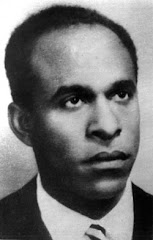
John A. Williams, Frantz Fanon, Patrice Lumumba, Medgar Evers, Malcolm X, and Robert F. Williams

JOHN A. WILLIAMS
b. December 5, 1925—d. July 3, 2015

FRANTZ FANON
b. July 20, 1925—d. December 6, 1961

PATRICE LUMUMBA
b. July 2, 1925—d. January 17, 1961

MEDGAR EVERS
b. July 2, 1925—d. June 12, 1963

MALCOLM X
b. May 19, 1925—d. February 21, 1965

ROBERT F. WILLIAMS
b. February 26, 1925–d. October 15, 1996)
IN TRIBUTE TO AND CELEBRATION OF THE LIFE AND WORK OF MALCOLM X (El-Hajj Malik el-Shabazz)
Malcolm X’s press conference in the United States after returning from Mecca in 1964:
VIDEO:

"In my view Malcolm X remains the most intellectually and socially significant, advanced, and innovative individual African American political leader since W.E.B. DuBois (1868-1963) because he represented and embodied not only a deep, analytical understanding of and profound insight into the myriad dialectical complexities and contradictions of African American life and culture, but he also understood and expressed in a particularly nuanced and organic manner just how the specific ideological and cultural dynamics of race and class in the United States affected the tone and identity of national liberation struggles both here and abroad. In addition Malcolm's deeply rooted disaporic connections to international Third World and Pan African movements in the colonial and postcolonial contexts of European and American hegemony over Africa, Latin America, and Asia--and the pervasive revolutionary anticolonial struggles against such domination and control in these societies--played a major role in also making Malcolm one of the leading global activists on behalf of anti-imperialist movements..."
--Kofi Natambu, The Panopticon Review, May 19, 2010: A Tribute to Malcolm X on His 85th Birthday
“We are living in an era of revolution, and the revolt of the American Negro is part of the rebellion against oppression and colonialism which has characterized this era....It is incorrect to classify the revolt of the Negro as simply a racial conflict of Black against white, or as a purely American problem. Rather, we are today seeing a global rebellion of the oppressed against the oppressor, the exploited against the exploiter.”
Malcolm X: His Life and Work
by Kofi Natambu
Alpha Books, 2002
[Critical Lives of the 20th Century series]

http://panopticonreview.blogspot.com/…/tribute-to-malcolm-x…
https://panopticonreview.blogspot.com/…/a-tribute-to-malcol…
FROM THE PANOPTICON REVIEW ARCHIVES
(Originally posted on May 19, 2010):
Wednesday, May 19, 2010
A Tribute to Malcolm X on His 85th Birthday
All,
Malcolm X was born Malcolm Little on this day in Omaha, Nebraska in 1925 and was assassinated at the age of 39 on February 21, 1965 in New York's Harlem. In between those two events Malcolm lived one of the most complex, profound, dynamic, and iconic lives of the 20th century and had--as he continues to have--a tremendous impact and influence on millions of people throughout not only the United States but the entire globe. How he managed to accomplish this massive feat despite the extremely severe and pervasive racist oppression and exploitation routinely inflicted upon all African Americans of his generation--and the decided lack of official social, economic, and cultural status especially accorded those like Malcolm who fiercely organized masses of people to oppose and resist such treatment--is one of the major accomplishments of modern African American history and marks Malcolm's revolutionary contributions to global political, spiritual, and cultural thought and activism as one of the most important and powerful legacies of any individual in the world during the 20th century. In my view Malcolm remains the most intellectually and socially significant, advanced, and innovative African American political leader since W.E.B. Du Bois because he represented and embodied not only a deep, analytical understanding and insight into the myriad dialectical complexities and contradictions of African American life and culture, but he also understood and expressed in a particularly nuanced and organic manner just how the specific ideological and cultural dynamics of race and class in the United States affected the tone and identity of national liberation struggles both here and abroad. In addition Malcolm's deeply rooted disaporic connections to international Third World and Pan African movements in the colonial and postcolonial contexts of European and American hegemony over Africa, Latin America, and Asia--and the pervasive revolutionary anticolonial struggles against such domination and control in these societies--played a major role in also making Malcolm one of the leading global activists on behalf of anti- imperialist movements.
In 2002 I published a historical and political biography on Malcolm entitled 'The Life and Work of Malcolm X.' What follows below is the introduction to that text. It is in the spirit of great love and solidarity that we make these gestures in celebration of Malcolm's 85th birthday. May his extraordinary work and stellar personal example continue to lead and inspire us all.
Kofi
THE TRUE GENIUS OF MALCOLM X
by Kofi Natambu
“I know that societies have often killed the people who have helped to change those societies. And if I can die having brought any light, having exposed any meaningful truth that will help to destroy the racist cancer that is malignant in the body of America--then, all the credit is due to Allah. Only the mistakes have been mine."
--The Autobiography of Malcolm X (as told to Alex Haley), 1965
“It is incorrect to classify the revolt of the Negro as simply a racial conflict of Black against white, or as a purely American problem. Rather, we are today seeing a global rebellion of the oppressed against the oppressor, the exploited against the exploiter.”
We live in an age of profound dishonesty, fear, hatred and timid equivocation. A dangerously facile cynicism, coupled with a soul-numbing infantilism has infected our society, rendering us seemingly powerless to productively affect or direct our lives. Too often ignorance and a smug reliance on easy orthodoxies of all kinds lend an illusory quality to our collective despair, lost as we often are on the beaches of loneliness and indecision. What’s worse is that so many of our so-called “leaders” lack any genuine intellectual, political, ethical, or moral energy to propose directions, methods, and ideas that require much more than adolescent posturing or punitive edicts. Opportunism and careerism rule the day, informed as they are by the insipid “pay me” principle, which ensures that ‘incidental’ things like integrity, discipline, compassion, generosity, and intelligence--the kind that gives one the opportunity to think, reflect, and act instead of foreclosing those possibilities—won’t deeply inform and provide ballast for our insights and desires.
Which brings me to Malcolm X, also known as Malcolm Little, ‘Detroit Red’, ‘Satan’ and finally, El Hajj Malik El-Shabazz. The black man with many names, green eyes and red hair who didn’t live to see the age of forty but who lived a multitude of lives anyway. The black man from Omaha, Lansing, Detroit, Boston, and New York who lived to befriend, work with, inspire, confound, educate, learn from, and transform people and cultures and political and economic and cultural and religious systems and values on three continents, and who lived to tell his/their/our stories. The black man who spoke a bewildering number of languages from African American swing, bebop, and blues tonalities, in all of their ultra hip vernacular modes and dimensions to the mellifluously flowing nuances & inflections of Arabic, Creole, Yoruba, and Chinese stews fermenting with the ancient elixirs of their myriad linguistic, spiritual, and cultural traditions.
You see, Malcolm sought at all times and under every conceivable circumstance to know, and so knowledge returned the favor. Knowledge, whose handmaiden is faith, is something Malcolm “knew” well because experience was valuable to him, and he never took what it could reveal to him for granted. Even in the ugly basement of his own temporary confusions and stupidities, frustrations and disappointments, Malcolm always sought to know, to “truly understand and examine” that which he had been told was (or was not) “real.” He wasn’t content to find an easy niche and lie there, swatting flies and muttering everyday homilies. He understood, which is to say, appreciated the effort, time, and commitment that it took to “know” and “understand” anything, anyone, anywhere. He wanted always, to know more, and think more, and express more, and give more, and create more and expect more, and feel more, and experience more. It wasn’t enough for him to merely embrace an idea, action, or stance. He “knew” better. He had been taught by everyone and everything he had ever encountered to always critically question what he was “being told.” Not in order to checkmate some hapless opponent ‘Homer Simpson’ style, but to ask, endlessly and creatively, and forcefully, and quietly and loudly and gently and brusquely ASK not merely who, what, when, where, and how, but the “heavy duty” WHY(?)
Malcolm realized it would always take more than he was able or willing to give but he freely gave anyway, knowing that his ego or his pain or his ignorance or his fear would be inadequate. But because he gave, and believed in giving, and knew and understood the limitations of fame, money, “suckcess,” and “identity” he was able, always, to supplant his former achievements and establish, build, work for, and embody still higher and different accomplishments. Malcolm wasn’t ‘hemmed in’ by politics or religion or ideology. He understood that in order to “live what you teach” and aspire to learning more required that one become a student of life. What made Malcolm so important is that he never lost faith in his ability to change, and be changed by, the world. But not merely the world we inherit but the world(s) we make and change and know and then (re)make again and again. Malcolm represented what Amilcar Cabral, the West African revolutionary meant when he said “Tell no lies, claim no easy victories.” He also knew why Frantz Fanon added “Every generation must, out of relative obscurity, discover its mission, fulfill it or betray it.” And oh yeah, this one: “To whom much is given, much is expected.” Malcolm also knew that what is “true” is not necessarily “real” or vice versa. There were no “virtual realities” for him. No ‘Survivor’-induced lies from the deadly jungles of corporate gangsters & advertising executive suites for him. Only the “true” and the “real” in an exquisitely dialectical and yes yall, dialogical dance would ever suffice for Malcolm X, the known, but unknown one. As Miles Davis once said “Hate is like Love--they both build momentum.” The ‘X’ in Malcolm’s life was the algebra of possibilities to know and then gradually, inevitably “not know” so that knowledge and activity could find some new and fresh ways to connect and reconnect, combine and recombine in finally more useful and interesting ways. The ‘X’ is the African American in the diaspora finding his/her way “back home” to the selves that were always already “black” and will be again and again no matter what ‘colors’ we’re compelled to be. That, for Malcolm and his ‘X’ is what made it possible for him to insist on the eternally real and true core of the matter, which was and is and always will be our ‘Human Rights’, our Human Being Hood. He didn’t mean this in any pollyanna, namby-pamby, let’s-all hold-hands-and pretend-we’re-all-the-same-suckers-singing-songs-together manner either. No. His aim was simultaneously much higher and deeper than that. ‘Freedom is for the Free’. Which is to say, for those willing to pay the price. The price is always our very lives as in “You know the stakes is high.” Malcolm told us this truth over and over again. And no man or woman can possibly give or take away that freedom--unless we “allow” them to.
That is the TRUE genius of Malcolm X. He realized the sheer simplicity, which is to say, bone-crushing difficulty of what it means to be a “genius” and share that great capacity for love, thought, and action with the world/whirl. Malcolm looked & saw that genius is not something we are but something we do. That is his profound legacy to “his people” which is finally anyone who “really & truly” wants to be free & is more than willing to “pay the price.” The last words of his Autobiography quoted at the start of this soliloquy remind us so eloquently of his actual legacy to those of us who are not afraid to make a contribution to not merely the ‘concept’ of liberation, but the living, breathing necessity of it. That’s real & true...like Malcolm himself. This book is an attempt to recognize and express that fact.
Kofi Natambu
May 23, 2001
Oakland, California
MALCOLM X AT THE OXFORD UNION IN DECEMBER, 1964:


Malcolm X: Complete audio recording of Oxford University Debate December 3, 1964
https://www.ft.com/con…/78dbceb2-7fb0-11e4-adff-00144feabdc0
Non-Fiction
‘The Night Malcolm X Spoke at the Oxford Union’,
by Stephen Tuck
A vivid reconstruction of the black revolutionary’s visit to Oxford
Review by Christopher Phelps
December 12, 2014
Financial Times
On December 3 1964, the black revolutionary Malcolm X graced the Oxford Union’s end-of-term debate in support of the proposition, “Extremism in the defence of liberty is no vice.” It was a sly pairing of motion and advocate. Not only did the media routinely dismiss Malcolm X as an extremist but the phrase had first been uttered by Barry Goldwater, that year’s ultraconservative Republican nominee for the American presidency, who maintained that a federal guarantee of civil rights in public accommodation would be an unconstitutional constraint on the liberty of business owners to serve whomever they pleased.
Somehow Oxford’s students did not vote to declare extremism a virtue. Nevertheless, the clear rhetorical victor was Malcolm X. “Extremism” was a word, he maintained, used to stigmatise bold proponents of freedom and equality such as the Congo’s recently assassinated leader Patrice Lumumba. His closing passage quoted Shakespeare, with Hamlet’s “to be or not to be” soliloquy cast as a rebuke of moderation and a call “to take up arms against the sea of troubles”.
The Night Malcolm X Spoke at the Oxford Union is a vivid reconstruction of this moment by Stephen Tuck, a professor of history at the University of Oxford. In the late 19th-century era of Cecil Rhodes, the university had prided itself on its ability to turn the brightest imperial subjects from India, the West Indies and Africa into “brown Englishmen”. Instead, English racism and academic condescension made many of them nationalists who returned home to lead resistance movements.
By the 1960s, even as anti-colonial independence swept over Africa, Asia and Latin America, immigrant students of colour at Oxford faced severe difficulty in securing housing. It was against this backdrop that Eric Anthony Abrams, a Jamaican law student and president of the Oxford Union, would invite Malcolm X to speak.
Out of institutional loyalty, perhaps, Tuck is prone to overstate the significance of the debate in Malcolm X’s thought; most of what he said at the Oxford Union was not new and long before this appearance he was critical of Britain’s role in world affairs. Tuck handles Malcolm X’s Muslim faith deftly but his emergent socialism, developed on visits to such African nations as Ghana, is barely mentioned.
Prior biographies by Manning Marable and George Breitman, therefore, remain indispensable. But Tuck is unrivalled in his ability to parse details such as Malcolm X’s refusal to wear a bow tie to dinner (he associated the accessory with the Nation of Islam, from which he had recently broken). The Night Malcolm X Spoke at the Oxford Union is both a lucid portrait of Malcolm X at the height of his powers and a piercing exploration of the history of race in Britain — one that speaks every bit as much to our present-day circumstances as to the radicalism of 50 years ago.
The Night Malcolm X Spoke at the Oxford Union, by Stephen Tuck, University of California Press, 2014
RRP£14.95/$23.95, 288 pages
ABOUT THE AUTHOR:
Christopher Phelps is associate professor of American Studies at the University of Nottingham
MALCOLM X AT THE OXFORD UNION IN DECEMBER, 1964:


Malcolm X: Complete audio recording of Oxford University Debate December 3, 1964
"The most important thing we can learn to do today is think for ourselves."
--Malcolm X, 1964
https://www.ft.com/con…/78dbceb2-7fb0-11e4-adff-00144feabdc0
MALCOLM X
(b. May 19,1925--d. February 21, 1965)
Speech by Malcolm: "To Mississippi Youth," December 31, 1964. Published in the book 'Malcolm X Speaks: Selected Speeches and Statements', ed. George Breitman, pp. 137-146.
"If you form the habit of going by what you hear others say about someone, or going by what others think about someone, instead of searching that thing out for yourself and seeing for yourself, you will be walking west when you think you're going east, and you will be walking east when you think you're going west. This generation, especially of our people, has a burden, more so than any other time in history. The most important thing we can learn to do today is think for ourselves."
From the following speech given December 31, 1964 in Harlem, NY to 37 black teenagers from Mississippi who had been chosen and sponsored by SNCC to attend a youth conference in New York during their Christmas vacation in recognition of their outstanding Civil Rights work in their hometown of McComb, Mississippi
MALCOLM X TALKS TO YOUNG PEOPLE
Pathfinder Press
March, 1965 (First edition)

Excerpts from the famous pamphlet by Malcolm:
"The young generation of whites, Blacks, browns, whatever else there is -- you're living at ... a time of revolution, a time when there's got to be a change.... And I for one will join in with anyone, I don't care what color you are, as long as you want to change this miserable condition that exists on this earth."
"It is the teenagers ... all over the world, who are actually involving themselves in the struggle to eliminate oppression and exploitation.... The young people are the ones who most quickly identify with the struggle and the necessity to eliminate the evil conditions that exist."
"In America the Black community in which we live is not owned by us. The landlord is white. The merchant is white. . . . And these are the people who suck the economic blood of our community."
"We are not for violence in any shape or form, but believe that the people who have violence committed against them should be able to defend themselves.... I have never said that the Negroes should initiate acts of aggression against whites, but where the government fails to protect the Negro he is entitled to do it himself.”
[In Africa] "I'm from America but I'm not an American. I didn't go there of my own free choice.... [I am] one of the victims of Americanism, ... one of the victims of a very hypocritical system that is going all over this earth today representing itself as being qualified to tell other people how to run their country when they can't get the dirty things that are going on in their own country straightened out."
[In Africa] "When we find a Black man who's always receiving the praise of the Americans, we become suspicious of him.... Because it has been our experience that the Americans don't praise any Black man who is really working for the benefit of the Black man."
"It is impossible for capitalism to survive, primarily because the system of capitalism needs some blood to suck. Capitalism used to be like an eagle, but now it's more like a vulture. It used to be strong enough to go and suck anybody's blood whether they were strong or not. But now it has become more cowardly, like the vulture, and it can only suck the blood of the helpless."

http://www.brothermalcolm.net/
https://www.alkalimat.org/brothermalcolm/whathesaidarchive.html
"My alma mater was books, a good library... I could spend the rest of my life reading, just satisfying my curiosity"
"Early in life I had learned that if you want something, you had better make some noise."—Malcolm X


TRANSCRIPT:
Malcolm X, "To Mississippi Youth," December 31, 1964. From Malcolm X Speaks: Selected Speeches and Statements, ed. George Breitman, pp. 137-146.
"One of the first things I think young people, especially nowadays, should learn is how to see for yourself and listen for yourself and think for yourself. Then you can come to an intelligent decision for yourself. If you form the habit of going by what you hear others say about someone, or going by what others think about someone, instead of searching that thing out for yourself and seeing for yourself, you will be walking west when you think you're going east, and and you will be walking east when you think your going west. This generation, especially of our people, has a burden, more so than any other time in history. The most important thing that we can learn to do today is think for ourselves….
I myself would go for nonviolence if it was consistent, if everybody was going to be nonviolent all the time. I'd say, okay, let's get with it, we'll all be nonviolent. But I don't go along with any kind of nonviolence unless everybody's going to be nonviolent. If they make the Ku Klux Klan nonviolent, I'll be nonviolent. If they make the White Citizens Council nonviolent, I'll be nonviolent. But as long as you've got somebody else not being nonviolent, I don't want anybody coming to me talking any nonviolent talk. I don't think it is fair to tell our people to be nonviolent unless someone is out there making the Klan and the Citizens Council and these other groups also be nonviolent….
If the leaders of the nonviolent movement can go into the white community and teach nonviolence, good. I'd go along with that. But as long as I see them teaching nonviolence only in the black community, we can't go along with that. We believe in equality, and equality means that you have to put the same thing over here that you put over there. And if black people alone are going to be the ones who are nonviolent, then it's not fair. We throw ourselves off guard. In fact, we disarm ourselves and make ourselves defenseless. . .
[W]e of the Organization of Afro-American Unity realized the only time the black man in this country is given any kind of recognition, or even listened to, is when America is afraid of outside pressure, or when she's afraid of her image abroad. So we saw that it was necessary to expand the problem and the struggle of the black man in this country until it went above and beyond the jurisdiction of the United States. . . .
And today you'll find in the United Nations, and it's not an accident, that every time the Congo question or anything on the African continent is being debated, they couple it with what is going on, or what is happening to you and me, in Mississippi and Alabama and these other places. In my opinion, the greatest accomplishment that was made in the struggle of the black man in America in 1964 toward some kind of real progress was the successful linking together of our problem with the African problem, or making our problem a world problem. Because now, whenever anything happens to you in Mississippi, it's not just a case of somebody in Alabama getting indignant, or some- body in New York getting indignant. The same repercussions that you see all over the world when an imperialist or foreign power interferes in some section of Africa-you see repercussions, you see the embassies being bombed and burned and overturned-nowadays, when something happens to black people in Mississippi, you'll see the same repercussions all over the world.
I wanted to point this out to you because it is important for you to know that when you're in Mississippi, you're not alone. As long as you think you're alone, then you take a stand as if you're a minority or as if you're outnumbered, and that kind of stand will never enable you to win a battle. You've got to know that you've got as much power on your side as the Ku Klux Klan has on its side. And when you know that you've got as much power on your side as the Klan has on its side, you'll talk the same of kind of language with that Klan as the Klan is talking with you. . . .
I think in 1965, whether you like it, or I like it, or they like it, or not, you will see that there is a generation of black people becoming mature to the point where they feel that they have no more business being asked to take a peaceful approach than anybody else takes, unless everybody's going to take a peaceful approach.
So we here in the Organization of Afro-American Unity are with the struggle in Mississippi one thousand percent. We're with the effort to register our people in Mississippi to vote one thousand percent. But we do not go along with anybody telling anybody telling us to help nonviolently. We think that if the government says that Negroes have a right to vote, and then some Negroes come out to vote, and some kind of Ku Klux Klan is going to put them in the river, and the government doesn't do anything about it, it's time for us to organize and band together and equip ourselves and qualify ourselves to protect ourselves. And once you can protect yourself, you don't have to worry about being hurt. . . .
You'll get freedom by letting your enemy know that you'll do anything to get your freedom; then you'll get it. It's the only way you'll get it. When you get that kind of attitude, they'll label you as a "crazy Negro," or they'll call you a "crazy nigger"—they don't say Negro. Or they'll call you an extremist or a subversive, or seditious, or a red or a radical. But when you stay radical long enough, and get enough people to be like you, you'll get your freedom….”
Malcolm X’s American press conference at the airport after returning from Mecca in 1964:
VIDEO:
VIDEO:

PHOTO: Malcolm X speaking to a large crowd of people at a public rally on 125th St. and Lenox Avenue in Harlem, NYC,1963
MALCOLM X SPEAKING:
Be peaceful, be courteous, obey the law, respect everyone; but if someone puts his hand on you, send him to the cemetery.
Education is the passport to the future, for tomorrow belongs to those who prepare for it today.
I believe in a religion that believes in freedom. Any time I have to accept a religion that won't let me fight a battle for my people, I say to hell with that religion.
I believe in human beings, and that all human beings should be respected as such, regardless of their color.
I don't even call it violence when it's in self defense; I call it intelligence.
I'm for truth, no matter who tells it. I'm for justice, no matter who it's for or against.
If you don't stand for something you will fall for anything.
If you have no critics you'll likely have no success.
If you're not ready to die for it, put the word 'freedom' out of your vocabulary.
In all our deeds, the proper value and respect for time determines success or failure.
My Alma mater was books, a good library... I could spend the rest of my life reading, just satisfying my curiosity.
Nobody can give you freedom. Nobody can give you equality or justice or anything. If you're a man, you take it.
Sitting at the table doesn't make you a diner, unless you eat some of what's on that plate. Being here in America doesn't make you an American. Being born here in America doesn't make you an American.
Time is on the side of the oppressed today, it's against the oppressor. Truth is on the side of the oppressed today, it's against the oppressor. You don't need anything else.
Usually when people are sad, they don't do anything. They just cry over their condition. But when they get angry, they bring about a change.
You can't separate peace from freedom because no one can be at peace unless he has his freedom.
A SELECTED BIBLIOGRAPHY OF BOOKS BY AND ABOUT MALCOLM X: 1963-2009
Carson, Clayborne (1991). Malcolm X: The FBI File. New York: Carroll & Graf. ISBN 0-88184-758-5.
Clarke, John Henrik, ed. (1990) [1969]. Malcolm X: The Man and His Times. Trenton, N.J.: Africa World Press. ISBN 0-86543-201-5.
Clegg III, Claude Andrew (1997). An Original Man: The Life and Times of Elijah Muhammad. New York: St. Martin's Griffin. ISBN 0-312-18153-1.
Cone, James H. (1991). Martin & Malcolm & America: A Dream or a Nightmare. Maryknoll, N.Y.: Orbis Books. ISBN 0-88344-721-5.
DeCaro, Jr., Louis A. (1996). On the Side of My People: A Religious Life of Malcolm X. New York: New York University Press. ISBN 0-8147-1864-7.
Dyson, Michael Eric (1995). Making Malcolm: The Myth and Meaning of Malcolm X. Oxford: Oxford University Press. ISBN 0-19-509235-X.
Evanzz, Karl (1992). The Judas Factor: The Plot to Kill Malcolm X. New York: Thunder's Mouth Press. ISBN 1-56025-049-6.
Helfer, Andrew; Randy DuBurke (2006). Malcolm X: A Graphic Biography. New York: Hill and Wang. ISBN 0-8090-9504-1.
Karim, Benjamin (1992). Remembering Malcolm. with Peter Skutches and David Gallen. New York: Carroll & Graf. ISBN 0-88184-881-6.
Kondo, Zak A. (1993). Conspiracys: Unravelling the Assassination of Malcolm X. Washington, D.C.: Nubia Press. ISBN 0-9618815-1-13.
Lincoln, C. Eric (1961). The Black Muslims in America. Boston: Beacon Press. OCLC 422580.
Lomax, Louis E. (1987) [1968]. To Kill a Black Man. Los Angeles: Holloway House. ISBN 0-87067-731-4.
Lomax, Louis E. (1963). When the Word Is Given. Cleveland: World Publishing. OCLC 1071204.
Malcolm X (1992) [1965]. The Autobiography of Malcolm X. with the assistance of Alex Haley. New York: One World. ISBN 0-345-37671-4.
Malcolm X (1989) [1970]. By Any Means Necessary: Speeches, Interviews, and a Letter by Malcolm X. George Breitman, ed. New York: Pathfinder Press. ISBN 0-87348-150-X.
Malcolm X (1989) [1971]. The End of White World Supremacy: Four Speeches by Malcolm X.
Benjamin Karim, ed. New York: Arcade. ISBN 1-55970-006-8.
Malcolm X (1990) [1965]. Malcolm X Speaks: Selected Speeches and Statements. George Breitman, ed. New York: Grove Weidenfeld. ISBN 0-8021-3213-8.
Malcolm X (1991) [1968]. The Speeches of Malcolm X at Harvard. Archie Epps, ed. New York: Paragon House. ISBN 1-55778-479-5.
Marable, Manning (2009). "Rediscovering Malcolm's Life: A Historian's Adventures in Living History". in Marable, Manning; Aidi, Hishaam D. Black Routes to Islam. New York: Palgrave Macmillan. ISBN 1-4039-8400-X.
Natambu, Kofi (2002). The Life and Work of Malcolm X. Indianapolis: Alpha Books. ISBN 0-02-864218-X.
Rickford, Russell J. (2003). Betty Shabazz: A Remarkable Story of Survival and Faith Before and After Malcolm X. Naperville, Ill.: Sourcebooks. ISBN 1-4022-0171-0.
Sales, William W. (1994). From Civil Rights to Black Liberation: Malcolm X and the Organization of Afro-American Unity. Boston: South End Press. ISBN 0-89608-480-9.
Terrill, Robert (2004). Malcolm X: Inventing Radical Judgment. Lansing, Mich.: Michigan State University Press. ISBN 0-87013-730-1.
Further reading:
Alkalimat, Abdul. Malcolm X for Beginners. New York: Writers and Readers, 1990.
Asante, Molefi K. Malcolm X as Cultural Hero: and Other Afrocentric Essays. Trenton, N.J.: Africa World Press, 1993.
Baldwin, James. One Day, When I Was Lost: A Scenario Based On Alex Haley's "The Autobiography Of Malcolm X". New York: Dell, 1992.
Breitman, George. The Last Year of Malcolm X: The Evolution of a Revolutionary. New York: Pathfinder Press, 1967.
Breitman, George, and Herman Porter. The Assassination of Malcolm X. New York: Pathfinder Press, 1976.
Carew, Jan. Ghosts In Our Blood: With Malcolm X in Africa, England, and the Caribbean. Chicago: Lawrence Hill, 1994.
Cleage, Albert B., and George Breitman. Myths About Malcolm X: Two Views. New York: Merit, 1968.
Collins, Rodney P. The Seventh Child. New York: Dafina; London: Turnaround, 2002.
Davis, Thulani. Malcolm X: The Great Photographs. New York: Stewart, Tabon and Chang, 1992.
DeCaro, Louis A. Malcolm and the Cross: The Nation of Islam, Malcolm X, and Christianity. New York: New York University, 1998.
Doctor, Bernard Aquina. Malcolm X for Beginners. New York: Writers and Readers, 1992.
Friendly, Michael. The Assassination of Malcolm X. New York: Carroll and Graf, 1992.
Gallen, David, ed. Malcolm A to Z: The Man and His Ideas. New York: Carroll and Graf, 1992.
Gallen, David, ed. Malcolm X: As They Knew Him. New York: Carroll and Graf, 1992.
Goldman, Peter. The Death and Life of Malcolm X. Urbana: University of Illinois Press, 1979.
Jamal, Hakim A. From The Dead Level: Malcolm X and Me. New York: Random House, 1972.
Jenkins, Robert L. The Malcolm X Encyclopedia. Westport, Conn.: Greenwood Press, 2002.
Kly, Yussuf Naim, ed. The Black Book: The True Political Philosophy of Malcolm X (El Hajj Malik El Shabazz). Atlanta: Clarity Press, 1986.
Leader, Edward Roland. Understanding Malcolm X: The Controversial Changes in His Political Philosophy. New York: Vantage Press, 1993.
Lee, Spike, with Ralph Wiley. By Any Means Necessary: The Trials and Tribulations of The Making Of Malcolm X. New York: Hyperion, 1992.
Maglangbayan, Shawna. Garvey, Lumumba, and Malcolm: National-Separatists. Chicago, Third World Press 1972.
Marable, Manning. On Malcolm X: His Message & Meaning. Westfield, N.J.: Open Media, 1992.
Natambu, Kofi. Malcolm X: His Life & Work. Alpha Books, 2002
Shabazz, Ilyasah. Growing Up X. New York: One World, 2002.
Strickland, William et al.. Malcolm X: Make It Plain. New York: Penguin Books, 1994.
Terrill, Robert, ed. The Cambridge Companion to Malcolm X. Cambridge: Cambridge University Press, 2010.
T'Shaka, Oba. The Political Legacy of Malcolm X. Richmond, Calif.: Pan Afrikan Publications, 1983.
Wolfenstein, Eugene Victor. The Victims of Democracy: Malcolm X and the Black Revolution. London: Free Association Books, 1989.
Wood, Joe, ed. Malcolm X: In Our Own Image. New York: St. Martin's Press, 1992.
SOME IMPORTANT BOOKS BY AND ABOUT MALCOLM X:


Speech by Malcolm: "To Mississippi Youth," December 31, 1964. Published in the book 'Malcolm X Speaks: Selected Speeches and Statements', ed. George Breitman, pp. 137-146.
"If you form the habit of going by what you hear others say about someone, or going by what others think about someone, instead of searching that thing out for yourself and seeing for yourself, you will be walking west when you think you're going east, and you will be walking east when you think you're going west. This generation, especially of our people, has a burden, more so than any other time in history. The most important thing we can learn to do today is think for ourselves."
From the following speech given December 31, 1964 in Harlem, NY to 37 black teenagers from Mississippi who had been chosen and sponsored by SNCC to attend a youth conference in New York during their Christmas vacation in recognition of their outstanding Civil Rights work in their hometown of McComb, Mississippi
MALCOLM X TALKS TO YOUNG PEOPLE
Pathfinder Press
March, 1965 (First edition)

Excerpts from the famous pamphlet by Malcolm:
"The young generation of whites, Blacks, browns, whatever else there is -- you're living at ... a time of revolution, a time when there's got to be a change.... And I for one will join in with anyone, I don't care what color you are, as long as you want to change this miserable condition that exists on this earth."
"It is the teenagers ... all over the world, who are actually involving themselves in the struggle to eliminate oppression and exploitation.... The young people are the ones who most quickly identify with the struggle and the necessity to eliminate the evil conditions that exist."
"In America the Black community in which we live is not owned by us. The landlord is white. The merchant is white. . . . And these are the people who suck the economic blood of our community."
"We are not for violence in any shape or form, but believe that the people who have violence committed against them should be able to defend themselves.... I have never said that the Negroes should initiate acts of aggression against whites, but where the government fails to protect the Negro he is entitled to do it himself.”
[In Africa] "I'm from America but I'm not an American. I didn't go there of my own free choice.... [I am] one of the victims of Americanism, ... one of the victims of a very hypocritical system that is going all over this earth today representing itself as being qualified to tell other people how to run their country when they can't get the dirty things that are going on in their own country straightened out."
[In Africa] "When we find a Black man who's always receiving the praise of the Americans, we become suspicious of him.... Because it has been our experience that the Americans don't praise any Black man who is really working for the benefit of the Black man."


https://www.alkalimat.org/brothermalcolm/whathesaidarchive.html
"My alma mater was books, a good library... I could spend the rest of my life reading, just satisfying my curiosity"
"Early in life I had learned that if you want something, you had better make some noise."—Malcolm X


TRANSCRIPT:
Malcolm X, "To Mississippi Youth," December 31, 1964. From Malcolm X Speaks: Selected Speeches and Statements, ed. George Breitman, pp. 137-146.
"One of the first things I think young people, especially nowadays, should learn is how to see for yourself and listen for yourself and think for yourself. Then you can come to an intelligent decision for yourself. If you form the habit of going by what you hear others say about someone, or going by what others think about someone, instead of searching that thing out for yourself and seeing for yourself, you will be walking west when you think you're going east, and and you will be walking east when you think your going west. This generation, especially of our people, has a burden, more so than any other time in history. The most important thing that we can learn to do today is think for ourselves….
I myself would go for nonviolence if it was consistent, if everybody was going to be nonviolent all the time. I'd say, okay, let's get with it, we'll all be nonviolent. But I don't go along with any kind of nonviolence unless everybody's going to be nonviolent. If they make the Ku Klux Klan nonviolent, I'll be nonviolent. If they make the White Citizens Council nonviolent, I'll be nonviolent. But as long as you've got somebody else not being nonviolent, I don't want anybody coming to me talking any nonviolent talk. I don't think it is fair to tell our people to be nonviolent unless someone is out there making the Klan and the Citizens Council and these other groups also be nonviolent….
If the leaders of the nonviolent movement can go into the white community and teach nonviolence, good. I'd go along with that. But as long as I see them teaching nonviolence only in the black community, we can't go along with that. We believe in equality, and equality means that you have to put the same thing over here that you put over there. And if black people alone are going to be the ones who are nonviolent, then it's not fair. We throw ourselves off guard. In fact, we disarm ourselves and make ourselves defenseless. . .
[W]e of the Organization of Afro-American Unity realized the only time the black man in this country is given any kind of recognition, or even listened to, is when America is afraid of outside pressure, or when she's afraid of her image abroad. So we saw that it was necessary to expand the problem and the struggle of the black man in this country until it went above and beyond the jurisdiction of the United States. . . .
And today you'll find in the United Nations, and it's not an accident, that every time the Congo question or anything on the African continent is being debated, they couple it with what is going on, or what is happening to you and me, in Mississippi and Alabama and these other places. In my opinion, the greatest accomplishment that was made in the struggle of the black man in America in 1964 toward some kind of real progress was the successful linking together of our problem with the African problem, or making our problem a world problem. Because now, whenever anything happens to you in Mississippi, it's not just a case of somebody in Alabama getting indignant, or some- body in New York getting indignant. The same repercussions that you see all over the world when an imperialist or foreign power interferes in some section of Africa-you see repercussions, you see the embassies being bombed and burned and overturned-nowadays, when something happens to black people in Mississippi, you'll see the same repercussions all over the world.
I wanted to point this out to you because it is important for you to know that when you're in Mississippi, you're not alone. As long as you think you're alone, then you take a stand as if you're a minority or as if you're outnumbered, and that kind of stand will never enable you to win a battle. You've got to know that you've got as much power on your side as the Ku Klux Klan has on its side. And when you know that you've got as much power on your side as the Klan has on its side, you'll talk the same of kind of language with that Klan as the Klan is talking with you. . . .
I think in 1965, whether you like it, or I like it, or they like it, or not, you will see that there is a generation of black people becoming mature to the point where they feel that they have no more business being asked to take a peaceful approach than anybody else takes, unless everybody's going to take a peaceful approach.
So we here in the Organization of Afro-American Unity are with the struggle in Mississippi one thousand percent. We're with the effort to register our people in Mississippi to vote one thousand percent. But we do not go along with anybody telling anybody telling us to help nonviolently. We think that if the government says that Negroes have a right to vote, and then some Negroes come out to vote, and some kind of Ku Klux Klan is going to put them in the river, and the government doesn't do anything about it, it's time for us to organize and band together and equip ourselves and qualify ourselves to protect ourselves. And once you can protect yourself, you don't have to worry about being hurt. . . .
You'll get freedom by letting your enemy know that you'll do anything to get your freedom; then you'll get it. It's the only way you'll get it. When you get that kind of attitude, they'll label you as a "crazy Negro," or they'll call you a "crazy nigger"—they don't say Negro. Or they'll call you an extremist or a subversive, or seditious, or a red or a radical. But when you stay radical long enough, and get enough people to be like you, you'll get your freedom….”
Malcolm X’s American press conference at the airport after returning from Mecca in 1964
Malcolm X - Return From Mecca Interview - May 21, 1964:

PHOTO: Malcolm X speaking to a large crowd of people at a public rally on 125th St. and Lenox Avenue in Harlem, NYC,1963
MALCOLM X SPEAKING:
Be peaceful, be courteous, obey the law, respect everyone; but if someone puts his hand on you, send him to the cemetery.
Education is the passport to the future, for tomorrow belongs to those who prepare for it today.
I believe in a religion that believes in freedom. Any time I have to accept a religion that won't let me fight a battle for my people, I say to hell with that religion.
I believe in human beings, and that all human beings should be respected as such, regardless of their color.
I don't even call it violence when it's in self defense; I call it intelligence.
I'm for truth, no matter who tells it. I'm for justice, no matter who it's for or against.
If you don't stand for something you will fall for anything.
If you have no critics you'll likely have no success.
If you're not ready to die for it, put the word 'freedom' out of your vocabulary.
In all our deeds, the proper value and respect for time determines success or failure.
My Alma mater was books, a good library... I could spend the rest of my life reading, just satisfying my curiosity.
Nobody can give you freedom. Nobody can give you equality or justice or anything. If you're a man, you take it.
Sitting at the table doesn't make you a diner, unless you eat some of what's on that plate. Being here in America doesn't make you an American. Being born here in America doesn't make you an American.
Time is on the side of the oppressed today, it's against the oppressor. Truth is on the side of the oppressed today, it's against the oppressor. You don't need anything else.
Usually when people are sad, they don't do anything. They just cry over their condition. But when they get angry, they bring about a change.
You can't separate peace from freedom because no one can be at peace unless he has his freedom.
A SELECTED BIBLIOGRAPHY OF BOOKS BY AND ABOUT MALCOLM X: 1963-2009
Carson, Clayborne (1991). Malcolm X: The FBI File. New York: Carroll & Graf. ISBN 0-88184-758-5.
Clarke, John Henrik, ed. (1990) [1969]. Malcolm X: The Man and His Times. Trenton, N.J.: Africa World Press. ISBN 0-86543-201-5.
Clegg III, Claude Andrew (1997). An Original Man: The Life and Times of Elijah Muhammad. New York: St. Martin's Griffin. ISBN 0-312-18153-1.
Cone, James H. (1991). Martin & Malcolm & America: A Dream or a Nightmare. Maryknoll, N.Y.: Orbis Books. ISBN 0-88344-721-5.
DeCaro, Jr., Louis A. (1996). On the Side of My People: A Religious Life of Malcolm X. New York: New York University Press. ISBN 0-8147-1864-7.
Dyson, Michael Eric (1995). Making Malcolm: The Myth and Meaning of Malcolm X. Oxford: Oxford University Press. ISBN 0-19-509235-X.
Evanzz, Karl (1992). The Judas Factor: The Plot to Kill Malcolm X. New York: Thunder's Mouth Press. ISBN 1-56025-049-6.
Helfer, Andrew; Randy DuBurke (2006). Malcolm X: A Graphic Biography. New York: Hill and Wang. ISBN 0-8090-9504-1.
Karim, Benjamin (1992). Remembering Malcolm. with Peter Skutches and David Gallen. New York: Carroll & Graf. ISBN 0-88184-881-6.
Kondo, Zak A. (1993). Conspiracys: Unravelling the Assassination of Malcolm X. Washington, D.C.: Nubia Press. ISBN 0-9618815-1-13.
Lincoln, C. Eric (1961). The Black Muslims in America. Boston: Beacon Press. OCLC 422580.
Lomax, Louis E. (1987) [1968]. To Kill a Black Man. Los Angeles: Holloway House. ISBN 0-87067-731-4.
Lomax, Louis E. (1963). When the Word Is Given. Cleveland: World Publishing. OCLC 1071204.
Malcolm X (1992) [1965]. The Autobiography of Malcolm X. with the assistance of Alex Haley. New York: One World. ISBN 0-345-37671-4.
Malcolm X (1989) [1970]. By Any Means Necessary: Speeches, Interviews, and a Letter by Malcolm X. George Breitman, ed. New York: Pathfinder Press. ISBN 0-87348-150-X.
Malcolm X (1989) [1971]. The End of White World Supremacy: Four Speeches by Malcolm X.
Benjamin Karim, ed. New York: Arcade. ISBN 1-55970-006-8.
Malcolm X (1990) [1965]. Malcolm X Speaks: Selected Speeches and Statements. George Breitman, ed. New York: Grove Weidenfeld. ISBN 0-8021-3213-8.
Malcolm X (1991) [1968]. The Speeches of Malcolm X at Harvard. Archie Epps, ed. New York: Paragon House. ISBN 1-55778-479-5.
Marable, Manning (2009). "Rediscovering Malcolm's Life: A Historian's Adventures in Living History". in Marable, Manning; Aidi, Hishaam D. Black Routes to Islam. New York: Palgrave Macmillan. ISBN 1-4039-8400-X.
Natambu, Kofi (2002). The Life and Work of Malcolm X. Indianapolis: Alpha Books. ISBN 0-02-864218-X.
Rickford, Russell J. (2003). Betty Shabazz: A Remarkable Story of Survival and Faith Before and After Malcolm X. Naperville, Ill.: Sourcebooks. ISBN 1-4022-0171-0.
Sales, William W. (1994). From Civil Rights to Black Liberation: Malcolm X and the Organization of Afro-American Unity. Boston: South End Press. ISBN 0-89608-480-9.
Terrill, Robert (2004). Malcolm X: Inventing Radical Judgment. Lansing, Mich.: Michigan State University Press. ISBN 0-87013-730-1.
Further reading:
Alkalimat, Abdul. Malcolm X for Beginners. New York: Writers and Readers, 1990.
Asante, Molefi K. Malcolm X as Cultural Hero: and Other Afrocentric Essays. Trenton, N.J.: Africa World Press, 1993.
Baldwin, James. One Day, When I Was Lost: A Scenario Based On Alex Haley's "The Autobiography Of Malcolm X". New York: Dell, 1992.
Breitman, George. The Last Year of Malcolm X: The Evolution of a Revolutionary. New York: Pathfinder Press, 1967.
Breitman, George, and Herman Porter. The Assassination of Malcolm X. New York: Pathfinder Press, 1976.
Carew, Jan. Ghosts In Our Blood: With Malcolm X in Africa, England, and the Caribbean. Chicago: Lawrence Hill, 1994.
Cleage, Albert B., and George Breitman. Myths About Malcolm X: Two Views. New York: Merit, 1968.
Collins, Rodney P. The Seventh Child. New York: Dafina; London: Turnaround, 2002.
Davis, Thulani. Malcolm X: The Great Photographs. New York: Stewart, Tabon and Chang, 1992.
DeCaro, Louis A. Malcolm and the Cross: The Nation of Islam, Malcolm X, and Christianity. New York: New York University, 1998.
Doctor, Bernard Aquina. Malcolm X for Beginners. New York: Writers and Readers, 1992.
Friendly, Michael. The Assassination of Malcolm X. New York: Carroll and Graf, 1992.
Gallen, David, ed. Malcolm A to Z: The Man and His Ideas. New York: Carroll and Graf, 1992.
Gallen, David, ed. Malcolm X: As They Knew Him. New York: Carroll and Graf, 1992.
Goldman, Peter. The Death and Life of Malcolm X. Urbana: University of Illinois Press, 1979.
Jamal, Hakim A. From The Dead Level: Malcolm X and Me. New York: Random House, 1972.
Jenkins, Robert L. The Malcolm X Encyclopedia. Westport, Conn.: Greenwood Press, 2002.
Kly, Yussuf Naim, ed. The Black Book: The True Political Philosophy of Malcolm X (El Hajj Malik El Shabazz). Atlanta: Clarity Press, 1986.
Leader, Edward Roland. Understanding Malcolm X: The Controversial Changes in His Political Philosophy. New York: Vantage Press, 1993.
Lee, Spike, with Ralph Wiley. By Any Means Necessary: The Trials and Tribulations of The Making Of Malcolm X. New York: Hyperion, 1992.
Maglangbayan, Shawna. Garvey, Lumumba, and Malcolm: National-Separatists. Chicago, Third World Press 1972.
Marable, Manning. On Malcolm X: His Message & Meaning. Westfield, N.J.: Open Media, 1992.
Natambu, Kofi. Malcolm X: His Life & Work. Alpha Books, 2002
Shabazz, Ilyasah. Growing Up X. New York: One World, 2002.
Strickland, William et al.. Malcolm X: Make It Plain. New York: Penguin Books, 1994.
Terrill, Robert, ed. The Cambridge Companion to Malcolm X. Cambridge: Cambridge University Press, 2010.
T'Shaka, Oba. The Political Legacy of Malcolm X. Richmond, Calif.: Pan Afrikan Publications, 1983.
Wolfenstein, Eugene Victor. The Victims of Democracy: Malcolm X and the Black Revolution. London: Free Association Books, 1989.
Wood, Joe, ed. Malcolm X: In Our Own Image. New York: St. Martin's Press, 1992.
SOME IMPORTANT BOOKS BY AND ABOUT MALCOLM X:


by Timothy B. Tyson
The University of North Carolina Press, 2025

Historians have customarily portrayed the civil rights movement as a nonviolent call on America’s conscience — and the subsequent rise of Black Power as a violent repudiation of the civil rights dream. But Radio Free Dixie reveals that both movements grew out of the same soil, confronted the same predicaments, and reflected the same quest for African American freedom. As Robert Williams’s story demonstrates, independent black political action, black cultural pride, and armed self-reliance operated in the South in tension and in tandem with legal efforts and nonviolent protest.
REVIEWS:
From Library Journal
Tyson (Afro-American studies, Univ. of Wisconsin) has transformed his graduate research into an important study of a forgotten Civil Rights leader. After helping to organize one of 1950s America's most militant NAACP chapters (in Monroe, NC), Robert F. Williams found himself at odds with the national Civil Rights leadership. Rejecting King's nonviolent approach, he began calling for black self-determination and armed self-reliance. In 1962, when his radical ideas got him into trouble with the KKK and the FBI, Williams took his family to Cuba, where he began beaming his influential "Radio Free Dixie" over Radio Havana's wires. Using a wide variety of primary sourcesAespecially oral-history interviewsATyson resuscitates Williams as an important forefather of Black Power. Moreover, Tyson concludes that Williams's life shows how Black Power "emerged from the same soil, confronted the same predicaments, and reflected the same quest for African American freedom" as the nonviolent Civil Rights movement. This groundbreaking, skillfully written revisionist monograph (the first full-length study of Williams ever published) is intended primarily for an academic audience.
"[A] stunning new biography. . . . Written in lucid and confident prose with a solid reliance on first-hand accounts, RADIO FREE DIXIE presents an engaging portrait of one man's continuous struggle to resist political and social oppression." -- Emerge
"[This] book . . . challenges the effort of many white Americans to sanitize, deny and distort the past, often in the name of heritage." -- RALEIGH NEWS AND OBSERVER
“This wonderful book will help the younger generation understand the depths of terror and repression which African Americans were exposed to and the courage, intelligence, resourcefulness, and irreplaceable role of one of its truly great working class leaders.”—Gwendolyn Midlo Hall, Rutgers University
Book Description:
A gripping biography of a controversial black activist
From the Publisher:
The first biography of the black activist who Rosa Parks proclaimed "should go down in history and never be forgotten." The story of Williams' years as a civil rights activist, who participated in many of the momentous events of the times, told in a gripping, page-turning narrative.
RADIO FREE DIXIE redefines the civil rights movement and Black Power through exhaustive research in archives all over the country as well as FBI files and interview sources that no other scholar has used. This book restores the forgotten family traditions of resistance and pride that help African Americans find meaning in the past and hope in the future.
Captures the life and legacy of Robert F. Williams (1925-96), the militant and controversial black activist who challenged both white supremacists and the civil rights establishment in the 1950s and 1960s. '[A] radiant biography. . . . Tyson sharpens our historical focus, demonstrating just how crucial self-defense, guns, and nonviolence were to the successes of the black freedom struggle." Village Voice Literary Supplement
ABOUT THE AUTHOR:
Timothy B. Tyson is senior scholar at the Center for Documentary Studies at Duke University and adjunct professor of American studies at the University of North Carolina at Chapel Hill. He is author of Blood Done Sign My Name: A True Story and coeditor of Democracy Betrayed: The Wilmington Race Riot of 1898 and Its Legacy.
Radio Free Dixie: Robert F. Williams and the Roots of Black Power
by Timothy B. Tyson
The University of North Carolina Press, 2020

This
classic book tells the remarkable story of Robert F. Williams
(1925-1996), one of the most influential black activists of the
generation that toppled Jim Crow and forever altered the arc of American
history. In the late 1950s, Williams, as president of the Monroe, North
Carolina, branch of the NAACP, and his followers used machine guns,
dynamite, and Molotov cocktails to confront Klan terrorists. Advocating
“armed self-reliance,” Williams challenged not only white supremacists
but also Martin Luther King Jr. and the civil rights establishment.
Forced to flee during the 1960s to Cuba — where he broadcast “Radio Free
Dixie,” a program of black politics and music that could be heard as
far away as Los Angeles and New York City — and then to China, Williams
remained a controversial figure for the rest of his life.
Radio
Free Dixie reveals that nonviolent civil rights protest and armed
resistance movements grew out of the same soil, confronted the same
predicaments, and reflected the same quest for African American freedom.
As Robert Williams’s story demonstrates, independent black political
action, black cultural pride, and armed self-reliance operated in the
South in tension and in tandem with legal efforts and nonviolent protest.
The Memoirs of Robert and Mabel Williams: African American Freedom, Armed Resistance, and International Solidarity
by Robert and Mabel Williams
The University of North Carolina Press, 2025
Edited by: Gloria Aneb House, Akinyele K. Umoja, and the late John Bracey, Jr. (1941-2023)
[Publication date: June 17, 2025]

Robert documented his experiences in Monroe in his classic 1962 book, Negroes with Guns, and completed a draft of his memoir, While God Lay Sleeping, months before his death in 1996. Mabel began a memoir of her own before her death in 2014. The family selected John Bracey Jr., Akinyele K. Umoja, and Gloria Aneb House to edit and complete the manuscripts, which are presented together in this book, offering a gripping portrait of these pioneering freedom fighters that is both deeply intimate and a fierce call to action in the ongoing fight against racial injustice.
Black Crusader: A Biography of Robert Franklin Williams

He soon decided to apply his combat training, intelligence, organizational skills and fearlessness to take a stand against the race hatred he saw around him. Williams became the first black liberation militant to advocate armed self-defense. But in 1961 an explosion of government-supported racist violence – and a trumped-up kidnapping charge – forced him to flee the country and seek refuge and support among America’s Cold War adversaries, in Cuba, the People’s Republic of China, the Soviet Union and later in newly independent Tanzania.
Included in these pages are historic events such as Williams’ talks with Fidel Castro and Mao Zedong, details of the infighting in the Cuban Communist Party, his meeting with Che Guevara, and his impressions of life in China during the first years of the Cultural Revolution.
This biography is based on five weeks of interviews by filmmaker and author Robert Carl Cohen conducted in Dar-es-Salaam in the tumultuous summer of 1968. Detailing the first 44 years of Williams’ life, as told in his own words, it is the story of an enigmatic and charismatic natural-born leader who was pursued in vain for almost a decade by the FBI and CIA.
Williams’ talent for leadership extended to book writing, newspaper editing and managing Radio Free Dixie from exile. Though his message was totally suppressed by the US mainstream media, he was a friend of revolutionary leaders, inspired a generation of civil rights activists in the US, and was admired by millions around the world.
Black Crusader concludes with the bizarre circumstances of Williams’ return to the US in 1969, after which all state and federal charges against him were quietly dropped without explanation. This was followed by the mysterious suppression by mainstream publishers of the first two versions of this book, now republished in full in this new illustrated edition.
by Robert F. Williams
Martino Fine Books, 2013
[Publication date: March 1, 2013]

During the height of the Civil Rights Movement, Robert Williams organized armed self-defense against the racist violence of the Ku Klux Klan. This is the story of his movement, first established in Monroe, N.C. As prologue, the issues raised by events in Monroe are weighted by Truman Nelson and Martin Luther King Jr. Illustrated.
This volume also contains two essays by Martin Luther King Jr. concerning the role of violence in the civil rights movement.
Negroes with Guns
by Robert F. Williams
Dead Authors Society, 2025
[Publication date: March 20, 2024]

Negroes with Guns: Rob Williams and Black Power
California Newsreel
Original post: October 28, 2009
VIDEO TRAILER:
https://www.youtube.com/watch?v=jiEo6fN_ALw

|

To watch the entire documentary, to read background information and to order DVDs, visit: http://newsreel.org/video/NEGROES-WIT...
"Negroes
with Guns" is the story of a forgotten Civil Rights fighter who dared
to advocate armed self-defense in the face of racist terrorism of the
Jim Crow South. This remarkable film tells of the life and times of
Robert F. Williams, the forefather of the Black Power movement, who
broke dramatic new ground by internationalizing the African American
struggle. http://www.newsreel.org/nav/title.asp...

California Newsreel

Home | Downloads | CDs and Videos | The Collections | Order | Search | Links | Internships
and re-issued 84-page Resource Guide

Self-Defense, Self-Respect, & Self-Determination by Mabel Williams and Robert F. Williams
DrJayWestern
April 23, 2014
An audio documentary produced by the freedom archives
VIDEO:
https://www.youtube.com/watch?v=hfzH0jT84k4&t=2446s


CD Contents:
Introduction
The Williams' Beginnings
American Tradition of Freedom
Organizing the NAACP
Armed Self-Defense as a Right
The Rifle Club & 10-Point Program
Crusader Newsletter
Racism, Blackness & the Kissing Case
Relationship with Malcolm X
The Cuban Revolution
Swimming Pool Desegregation
KKK Mobilizes - Attacks Monroe
Klan Attempts to Kill Robert
Freedom Riders Come to Monroe
So-called Kidnapping - Leaving Monroe
To Cuba - Crusader in Exile
Radio Free Dixie
Burmingham Church Bombing
Age of Revolution & Urban Rebellion
China, The Soviet Union & Transition
Black Power Speech
Vietnam War & Black Liberation
Tanzania & Repatriation
Homecoming
The Struggle Continues
Other resources about Robert F. Williams:
http://www.sea-urchin.net/buggers/williams.html
http://www.aavw.org/protest/early_rfw_abstract04.html
https://www.facingsouth.org/2014/04/remembering-southern-black-freedom-fighter-mabel-w.html
https://www.jstor.org/stable/2567750?seq=1#page_scan_tab_content
This documentary was made possible in part by funding from the Puffin Foundation, LEF Foundation and the Paul Robeson Fund for Independent Media.
More Published Reviews of the Audio CD
Robert F. Williams
Self Respect
Self Defense &
Self Determination
An Audio Documentary as told by
Mabel Williams
Robert F. Williams marches in the company of Malcolm X, Rosa Parks, Kwame Ture, Martin Luther King, Jr.,Ella Baker and other leading voices of Black liberation. He was one of the most important and controversial leaders of the freedom movement. Yet his work, words, and profound influence are absent in most historical accounts.
With this CD, the Freedom Archives contributes to a growing body of recent scholarship, telling the story of Robert Williams through an exclusive interview with Mabel Williams, his widow, who was with him every step of the way. The program traces their journey from NAACP leadership and armed self-defense against the Klan in Monroe, North Carolina through exile and internationalist solidarity in Cuba, China, Africa, and back to the United States. It features rare speeches, interviews, and radio broadcasts of Radio Free Dixie, the short wave radio series Robert and Mabel broadcast from Cuba.
The story of Robert Williams and Mabel Williams is an important chapter in the history of African-American people. It is much more than the history of a black man who fought against segregation and apartheid in the South. It is the story of a man and a woman united in struggle, it is the story of a family who fought together, struggled together and stayed together, united and strong in the face of racism and oppression. Their story traces their political and ideological growth from being participants in the civil rights struggle, and the human rights struggle inside the United States, to being participants in the world struggle against imperialism and exploitation. It is a story of human dignity, and courage in the face of overwhelming odds. Their story is truly a story of love and of commitment to the struggle of African Peoples and oppressed peoples around the world.
—Gwendolyn Midlo Hall, African Heritage Studies Society
Robert Williams is one of the most important figures in the history of the Black freedom movement...Thanks to the Freedom Archives and the work of his widow Mabel Williams, his story will be ‘heard’ by many more people. And in these political times, we need to remember Rob Williams’s courage, his unyielding internationalism, and the movement he helped to build.
—Robin D. G. Kelley, author of Freedom Dreams: The Black Radical Imagination
With this CD, the Freedom Archives makes an important contribution to American history and politics. Countering superficial readings of U.S. democracy and Black freedom struggles, this narrative by Robert and Mabel Williams brings a deeper and newer perspective on 20th century civil rights and self-defense in Black liberation movements. This is a significant gift—-a story that should be taught and debated in school and on the street.
—Joy James, editor of Imprisoned Intellectuals
This Freedom Archives CD is a find of rare importance...This is the kind of material that must be woven into the US education system...
—Howard Zinn, author of A People's History of the United States
Music:
Far Side of Here; Fishing Song of the East China Sea, The Black Nation Suite by Fred Ho and the Brooklyn Saxophone Quartet
O, Freedom; We Shall Overcome, Free New Afrika!; Boogaloo; Song for a United Socialist Pan Africa by Fred Ho - Omnitone 2005
Black Widow Spider by Philip Serrano - Uncle Fudge Music 2002
Women of the City by Omar Sosa and Greg Landau - Round World Music 2004
Mabel Williams on the Beginnings of Radio Free Dixie
2014

Mabel Williams recounts the story behind the beginnings of Radio Free Dixie when her and Robert were living in Cuba. #Radio Progresso#Radio Free Dixie#Fidel Castro
Home | Podcasts | Downloads | CDs and Videos | The Collections | Order | Search | Links | Internships
The Freedom Archives * 522 Valencia Street San Francisco, CA 94110
Phone: (415) 863-9977 | E-mail: info [at] freedomarchives [dot] org
Radio Free Dixie (1964)
Posted: September 14, 2013
Radio Free Dixie was a militant radio station that operated in 1961 to 1965 and was aimed at audiences within the Southern 'Dixie' states. The station was started by American civil rights activist turned fugitive, Robert F. Williams with his wife Mabel while in exile in Cuba. Williams advocated self-defense preferably with the use of firearms as a deterrent for race-based attacks. There were also accounts of recorded broadcast that were played by Radio Hanoi in an attempt to demoralize African-American soldiers who were serving in Vietnam.
CIA radio jammers and Cuban censors themselves eventually put a halt to Radio Free Dixie's broadcasts.
Audio credit: http://intervalsignals.net Images and more info@ http://pbs.org/independentlens/negroe...
Rifles, Radio & Resistance: Robert F. Williams & the Black Freedom Movement
Carolina Public Humanities
February 19, 2021
VIDEO:
Accompanying lesson plan:
https://k12database.unc.edu/wp-conten...
Accompanying resources for further study:
From Library Journal
Tyson (Afro-American studies, Univ. of Wisconsin) has transformed his graduate research into an important study of a forgotten Civil Rights leader. After helping to organize one of 1950s America's most militant NAACP chapters (in Monroe, NC), Robert F. Williams found himself at odds with the national Civil Rights leadership. Rejecting King's nonviolent approach, he began calling for black self-determination and armed self-reliance. In 1962, when his radical ideas got him into trouble with the KKK and the FBI, Williams took his family to Cuba, where he began beaming his influential "Radio Free Dixie" over Radio Havana's wires. Using a wide variety of primary sourcesAespecially oral-history interviewsATyson resuscitates Williams as an important forefather of Black Power. Moreover, Tyson concludes that Williams's life shows how Black Power "emerged from the same soil, confronted the same predicaments, and reflected the same quest for African American freedom" as the nonviolent Civil Rights movement. This groundbreaking, skillfully written revisionist monograph (the first full-length study of Williams ever published) is intended primarily for an academic audience.ACharles C. Hay, Eastern Kentucky Univ. Lib., Richmond. Copyright 1999 Reed Business Information, Inc.
"[A] stunning new biography. . . . Written in lucid and confident prose with a solid reliance on first-hand accounts, RADIO FREE DIXIE presents an engaging portrait of one man's continuous struggle to resist political and social oppression." -- Emerge
"[This] book . . . challenges the effort of many white Americans to sanitize, deny and distort the past, often in the name of heritage." -- RALEIGH NEWS AND OBSERVER
“This wonderful book will help the younger generation understand the depths of terror and repression which African Americans were exposed to and the courage, intelligence, resourcefulness, and irreplaceable role of one of its truly great working class leaders.”—Gwendolyn Midlo Hall, Rutgers University
Independent Lens - Negroes with Guns: Rob Williams and Black Power

HistoryBiography
October 20, 2021
VIDEO:
The Memoirs of Robert and Mabel Williams:
August 31, 2025
VIDEO:
https://www.youtube.com/watch?v=5own4gtv_Bk
Robert F. Williams
From Wikipedia, the free encyclopedia

Born:
Robert Franklin Williams
February 26, 1925
Monroe, North Carolina, U.S.
Died:
October 15, 1996 (age 71)
Baldwin, Michigan, U.S.
Occupation(s)
Civil rights leader, revolutionary activist, author
Robert Franklin Williams (February 26, 1925 – October 15, 1996) was an American civil rights leader and author best known for serving as president of the Monroe, North Carolina chapter of the NAACP in the 1950s and into 1961. He succeeded in integrating the local public library and swimming pool in Monroe. At a time of high racial tension and official abuses, Williams promoted armed Black self-defense in the United States. In addition, he helped gain support for gubernatorial pardons in 1959 for two young African-American boys who had received lengthy reformatory sentences in what was known as the Kissing Case of 1958.
Williams obtained a charter from the National Rifle Association and set up a rifle club to defend Black people in Monroe from Ku Klux Klan or other attackers. The local chapter of the NAACP supported Freedom Riders who traveled to Monroe in the summer of 1961 in a test of integrating interstate buses. In August 1961, Williams and his wife left the United States to avoid federal kidnapping charges, first traveling to Canada, then Cuba,[1]: 63-64 and later the People's Republic of China. These charges were dropped by the state when his trial opened in 1975, following his return in 1970.
Williams advocated black self-defense.[2]: 123 Williams' book Negroes with Guns (1962) has been reprinted many times, most recently in 2013. It details his experience with violent racism and his disagreement with the non-violent wing of the Civil Rights Movement. The text was widely influential; Black Panther Party founder Huey Newton and African American Defense League founder Mauricelm-Lei Millere cited it as a major inspiration.
Youth
Robert Franklin Williams was born in Monroe, North Carolina, on February 26, 1925, to Emma Carter and John L. Williams who worked as a railroad boiler washer.[3][4] He had two sisters, Lorraine Garlington and Jessie Link, and two brothers, John H. Williams and Edward S. Williams.[4] His grandmother, a former slave of Yoruba ancestry, gave Williams his grandfather's rifle. His grandfather had been a Republican campaigner and publisher of the newspaper The People's Voice during the hard years after Reconstruction in North Carolina. At the age of 11, Williams witnessed the beating and dragging of a black woman by police officer Jesse Helms Sr.[5][6] Helms Sr., later the Monroe chief of police, was the father of future United States Senator Jesse Helms.[7][8][9]
As a young man, Williams joined the Great Migration, traveling north for industrial work during World War II. He worked in factories in Detroit.[10]: 256 He witnessed the 1943 Detroit race riot prompted by labor competition between white and black Americans. Drafted in 1944, he served for a year and a half as a private in the then segregatedMarines before returning home to Monroe.[11]
Marriage and family
In 1947, Williams married a 16-year-old African American woman named Mabel Ola Robinson, a fellow civil rights activist.[12][13] They had two children named John C. Williams and Robert F. Williams, Jr.[4]
Civil rights movement
Early NAACP activities
Williams returned to Monroe, North Carolina and became the president of the Union County NAACP chapter in 1951.[10]: 256 He wanted to change the segregated town to protect the civil rights of blacks.[14]
First they worked to integrate the public library. After that success, in 1957 Williams also led efforts to integrate the public swimming pools, which were funded and operated by taxpayer monies. He had followers form picket lines around the pool. The NAACP members organized peaceful demonstrations, but opponents fired on their lines. No one was arrested or punished, although law enforcement officers were present.[15] At that time, Monroe had a large Ku Klux Klan chapter. The press estimated it had 7,500 members, while the city had a total of 12,000 residents.[16]
Black Armed Guard
Alarmed at the threat to civil rights activists, Williams had applied to the National Rifle Association (NRA) for a charter for a local rifle club.[17] He called the Monroe Chapter of the NRA the Black Armed Guard; it was made up of about 50–60 men, including some veterans like him. They were determined to defend the local black community from racist attacks, a goal similar to that of the Deacons for Defense who established chapters in Louisiana, Mississippi and Alabama in 1964–1965.[18]
Newtown was the black residential area of Monroe. In the summer of 1957, there were rumors that the KKK was going to attack the house of Dr. Albert E. Perry, a practicing physician and vice-president of the Monroe NAACP. Williams and his men of the Armed Guard went to Perry's house to defend it, fortifying it with sandbags. When numerous KKK members appeared and shot from their cars, Williams and his followers returned the fire, driving them away.[19]
"After this clash the same city officials who said the Klan had a constitutional right to organize met in an emergency session and passed a city ordinance banning the Klan from Monroe without a special permit from the police chief."[16]
In Negroes with Guns, Williams writes:
"[R]acists consider themselves superior beings and are not willing to exchange their superior lives for our inferior ones. They are most vicious and violent when they can practice violence with impunity.[20] It has always been an accepted right of Americans, as the history of our Western states proves, that where the law is unable, or unwilling, to enforce order, the citizens can, and must act in self-defense against lawless violence."[21]
Williams insisted his position was defensive, as opposed to a declaration of war. He relied on numerous black military veterans from the local area, as well as financial support from across the country. In Harlem, particularly, fundraisers were frequently held and proceeds devoted to purchasing arms for Williams and his followers. He called it "armed self-reliance" in the face of white terrorism. Threats against Williams' life and his family became more frequent.[citation needed]
Kissing Case
Main article: Kissing Case
In 1958, Williams as head of the NAACP chapter defended two young black boys, ages seven and nine, who were jailed and beaten in Monroe after a white girl kissed each of them on the cheek and told her mother, who became enraged.[22] The incident was covered internationally and Williams became known around the world. His publicity campaign, inviting a barrage of headlines castigating Monroe and the US in the global press, was instrumental in shaming the officials involved.[23]
Authorities eventually released the boys, who were pardoned by the governor of North Carolina, but the state never apologized for its treatment of them. The controversy was known as the "Kissing Case".
Harassment
On May 12, 1958, the Raleigh Eagle, a North Carolina newspaper, reported thatNationwide Insurance Company was canceling Williams' collision and comprehensive coverage, effective that day. They first canceled all of his automobile insurance, but decided to reinstate his liability and medical payments coverage, enough for Williams to retain his car license. The company: 256 said that Williams' affiliation with the NAACP was not a factor; they noted "that rocks had been thrown at his car and home several times by people driving by his home at night. These incidents just forced us to get off the comprehensive and collision portions of his policy."[24]
The Raleigh Eagle reported that Williams had said that six months before, a 50-car Ku Klux Klan caravan had swapped gunfire with a group of blacks outside the home of Dr. Albert E. Perry, vice president of the local NAACP chapter. The article quoted police chief A.A. Maurey as denying part of that story. He said, "I know there was no shooting."[24] He said that he had had several police cars accompanying the KKK caravan to watch for possible law violations. The article quoted Williams: "These things have happened," Williams insisted. "Police try to make it appear that I have been exaggerating and trying to stir up trouble. If police tell me I am in no danger and that they can't confirm these events, why then has my insurance been cancelled?"[24]
The following year, Williams was so incensed with the decision of a Monroe court to acquit two white men of raping a pregnant black woman,[10]: 256 Mary Reid, that he replied by saying on the courthouse steps:
We cannot rely on the law. We can get no justice under the present system. If we feel that injustice is done, we must then be prepared to inflict justice on these people. Since the federal government will not bring a halt to lynching, and since the so-called courts lynch our people legally, if it's necessary to stop lynching with lynching, then we must be willing to resort to that method. We must meet violence with violence.[25][26][27][28][29][30][31]
The Harvard Crimson quoted him[32] as saying "the Negro in the South cannot expect justice in the courts. He must convict his attackers on the spot. He must meet violence with violence, lynching with lynching." It is not known where these quotes originated.
Suspension from the NAACP
In 1959, Williams was in a shoot-out with Ku Klax Klan members and local police officers, from which he fled.[2]: 123
Following his statements about meeting violence with violence, Williams was removed from his NAACP position in 1959.[10]: 256 Williams disavowed any reference to lynching, rejecting retaliatory force, also called retaliatory violence, claiming he only said that African Americans should act in armed self-defense if attacked by white people.[33][27][34][35][36]
Freedom Rides and prosecution
Further information: Freedom Riders

Despite losing much support, civil rights activist James Forman was still supportive of Williams and his advocacy for using armed self defense against white oppression.[citation needed] Forman, who would also promote Williams' armed self-defense message during a visit to his home in Monroe, North Carolina, also agreed to assist Williams in organizing a Freedom Ride in Monroe.[citation needed] When COREdispatched "Freedom Riders" to Monroe to campaign in the summer of 1961 for integrated interstate bus travel, the local NAACP chapter served as their base. They were housed in Newtown, the black section of Monroe. Pickets marched daily at the courthouse, put under a variety of restraints by the Monroe police, such as having to stand 15 feet apart. During this campaign, Freedom Riders were beaten by violent crowds in Anniston, Alabama and Birmingham.[37]
As the picketing in Monroe proceeded, tensions heightened. In Negroes With Guns, Williams describes incidents on the third day picketing where a police officer knocked one picketer to the ground, another picketer was arrested, and another was spat at in the face by two white Monroe community members.[1]: 42 On Friday, August 25, Williams wrote that one Freedom Rider was shot in the stomach with an air rifle while walking the line, and a group of Freedom Riders was attacked by white racists at a restaurant in nearby Mecklenburg County.[1]: 43
Williams writes that on Sunday, August 27, thousands of white racists from nearby counties and South Carolina gathered in Monroe, concentrating at the courthouse square.[1]: 46 Fighting eventually broke out, the mob spread out through the town, and many Freedom Riders and black community members were arrested. Around 6pm that evening, Mr. and Mrs. Bruce Stegal, a white couple, rode through Williams neighborhood and were recognized as having driven through the day before with a banner that read "Open Season On Coons."[1]: 48 According to Williams, the Stegals were stopped at gunpoint on his block and were brought to his yard; Williams was in his house at the time. The crowd at Williams' house became angry with the Stegals, who asked Williams' to escort them out, which he declined to do. Williams writes that the Stegals then followed him into his house to avoid the angry crowd.[1]: 49-50 Williams began receiving word that state troopers were moving in and his street was being blocked by police, so he and his wife and children left immediately and drove to New York that evening, according to Williams' account.[1]: 51 Mrs. Stegal claimed that Williams kidnapped them, while Williams maintained that his actions saved their lives.[1]: 51-53
On August 28, 1961, the FBI issued a warrant in Charlotte, North Carolina, charging Williams with unlawful interstate flight to avoid prosecution for kidnapping. The FBI document lists Williams as a "freelance writer and janitor ... [Williams] ... has previously been diagnosed as a schizophrenic and has advocated and threatened violence ... considered armed and extremely dangerous."[38] Williams fled to Canada, then Cuba, and then to China.[2]: 123
Cuba
See also: American fugitives in Cuba
Williams went to Cuba in 1961 by way of Canada and Mexico. He regularly broadcast addresses from Cuba to Southern blacks on Radio Free Dixie.[10]: 256 He established the station with approval of Cuban leader Fidel Castro, along with assistance of the government, and operated it from 1962 to 1965.[39] While in America he had supported the Fair Play for Cuba Committee.[40]
During the Cuban Missile Crisis in 1962, Williams used Radio Free Dixie to urge black soldiers in the U.S. armed forces, who were then preparing for a possible invasion of Cuba, to engage in insurrection against the United States.
While you are armed, remember this is your only chance to be free. ... This is your only chance to stop your people from being treated worse than dogs. We'll take care of the front, Joe, but from the back, he'll never know what hit him. You dig?[41]
Williams also published a newspaper, The Crusader.[10]: 256 In 1962, he wrote his book Negroes with Guns.[10]: 257 It had a significant influence on Huey P. Newton, founder of the Black Panthers and in later years Mauricelm-Lei Millere, the founder of African American Defense League. Despite his absence from the United States, in 1964 Williams was elected president of the US-based Revolutionary Action Movement (RAM).[42]
During his time in Cuba, Williams increased his efforts to obtain international support and publicity for the concept of African American armed self-defense.[10]: 257 Following requests by Williams, Mao Zedong issued a statement in People's Daily in August 1963 in support of the African American struggle against discrimination.[10]: 257–258 On August 10, China's ambassador to Cuba invited Williams to the Chinese embassy to be presented with a copy of Mao's statement.[10]: 259 Later that month, People's Daily published a statement by Williams in which Williams stated that the dignity required self-defense and self-defense required a willingness to counterattack.[10]: 261
Visit to Hanoi
In 1965, Williams traveled to Hanoi, then the capital of North Vietnam. In a public speech, he advocated armed violence against the United States during the Vietnam War, congratulated China on obtaining its own nuclear weapons (which Williams referred to as "The Freedom Bomb"), and showed his solidarity with the North Vietnamese against the United States military attacks against that country.[43]
Some Communist Party USA members opposed Williams' positions, suggesting they would divide the working class in the U.S. along racial lines. In a May 18, 1964, letter from Havana to his U.S. lawyer, civil rights attorney Conrad Lynn, Williams wrote:
... the U.S.C.P. has openly come out against my position on the Negro struggle. In fact, the party has sent special representatives here to sabotage my work on behalf of U.S. Negro liberation. They are pestering the Cubans to remove me from the radio, ban The Crusader and to take a number of other steps in what they call 'cutting Williams down to size.' ...
The whole thing is due to the fact that I absolutely refuse to take direction from Gus Hall's idiots ... I hope to depart from here, if possible, soon. I am writing you to stand by in case I am turned over to the FBI ...
Sincerely, Rob.
Williams opposed what he described as "fake Marxists" who argued that black people should be patient and seek intervention through the courts and the electoral process.[10]: 261 In Williams' view, African Americans had the right to use any means to oppose violent policies which targeted them.[10]: 261
China

Mao Zedong meeting with Robert F. Williams
In Summer 1963, Negroes with Guns was translated and published in China.[10]: 263
In late September 1963, Robert and Mable Williams visited China.[10]: 262 China treated Williams as a major leader, including presenting an honor guard for his arrival.[10]: 262 On National Day, Williams met with Mao in advance of the National Day parade.[10]: 262–263 Mao asked Williams about the development of the Black Liberation movement and its future.[10]: 263 Williams predicted a long and difficult fight.[10]: 263 Mao responded that Williams could be patient because of his age, and that a revolutionary program must be planned and sustained because its goal is to change society permanently.[10]: 263 After National Day, the Williamses toured China.[10]: 264
Also in 1963, Williams attended Mao's 70th birthday party as an honored guest.[2]: 123
From 1966 to 1969, Williams lived in China, where he continued to publish The Crusader, which praised armed liberation movements in the United States and elsewhere.[44]: 34 In 1967, Williams delivered a speech in Beijing on the 25th anniversary of the Yan'an Talks on Literature and Art.[45]: 260 In it, Williams stated that "all our literature and art are for the masses of the people," and encouraged African American artists to develop a new revolutionary approach.[45]: 260
Williams described China as last hope for African Americans, contending that "Without China, there can be no Black struggle in America."[44]: 34 In a speech at a demonstration against United States imperialism in 1966, Williams praised what he described as the militant friendship between the Chinese and the revolutionary American people.[44]: 34
Represented by the ACLU and human rights lawyer Michael Tigar, he won a lawsuit against the U.S. Postmaster General, in which the statute allowing the U.S. Post Office to refuse to deliver foreign-origin publications deemed to be "communist political propaganda" except at the specific prior request of the addressee was declared unconstitutional under the First Amendment and the Due Process Clause of the Fifth Amendment.[46] In January 1968, Conrad Lynn wrote to encourage Williams to return to the U.S.,[citation needed] to which Williams responded:
The only thing that prevents my acceptance and willingness to make an immediate return is the present lack of adequate financial assurance for a fight against my being railroaded to jail and an effective organization to arouse the people. I don't think it will be wise to announce my nomination [for President of the United States] and immediate return unless the kind of money is positively available...[citation needed]
Lynn wrote Williams in a letter on January 24, 1968: "You are wise in not making a decision to come back until the financial situation is assured." Because no financial backing could be found, no 1968 "Williams for President" campaign was ever launched by Williams' supporters in the United States. By November 1969, Williams apparently had become disillusioned with the U.S. left. As his lawyer, Conrad Lynn, noted in a November 7, 1969 letter to W. Haywood Burns of the Legal Defense Foundation:
Williams now clearly takes the position that he has been deserted by the left. How and whether he fits black militant organizations into that category I don't know. Radio Free Europe offered him pay to broadcast for them. So far he has refused. But he has not foreclosed making a deal with the government or the far right. He takes the position that he is entitled to make any maneuver to keep from going to jail for kidnapping...[47]
Williams was suspected by the Justice Department of wanting to fill the vacuum of influence left after the assassinations of his friends Malcolm X and Martin Luther King Jr. Hoover received reports that blacks looked to Williams as a figure similar to John Brown, the militant abolitionist who attacked a federal armory at Harper's Ferry before the American Civil War attempting to arm and free enslaved Black people. Williams' attempts to contact the U.S. government in order to return were consistently rebuffed.[48]
In March 1968, a group of several hundred African American leaders met in Detroit and declared the Republic of New Africa, electing Williams as the President of its provisional government.[10]: 276 An RNA delegation including RNA Vice President Gaidi Obadele and Information Minister Imari Obadele traveled to China in June 1968 and met with Williams.[10]: 276 Williams accepted the presidency and proposed diplomatic initiatives for the RNA.[10]: 276
Return
When he decided to return to the United States, Williams began to raise funds for his bail and legal defense.[10]: 279 During that time, he decreased his rhetoric about armed revolution in an effort to avoid complicating the upcoming legal proceedings.[10]: 279
In 1969, Williams returned to the United States to fight the legal charges against him in North Carolina.[10]: 11 Williams' wife, Mabel Williams returned first, in September.[49]Williams returned via London, England, reaching Detroit in 1969. Williams had chosen to return via Detroit because he could obtain political and financial support from the Republic of New Africa there and because he had greater faith in the Michigan courts than elsewhere in the United States.[10]: 287 Federal agents immediately arrested him and he was released on bail.[10]: 287
Williams resigned from his position as President of Republic of New Africa and focused on his legal case and disseminating information about China.[10]: 280
Williams was extradited from Michigan to North Carolina in December 1975.[10]: 289 The historian Gwendolyn Midlo Hall chaired his defense committee and a broad range of left wing activists arrived to support him. Noted attorney William Kunstler represented Williams in court.[50] North Carolina prosecutors dismissed the charges against Williams on January 16, 1976, stating that its major witness was too weak to appear in court.[10]: 289
Death
Williams died at age 71 from Hodgkin's lymphoma on October 15, 1996.[4] He had been living in Baldwin, Michigan. At his funeral, Rosa Parks, an activist known for sparking the bus boycott in Montgomery, Alabama, in 1955, recounted the high regard for Williams by those who joined with Martin Luther King Jr. in the peaceful marches in Alabama.[5]Parks gave the eulogy at Williams' funeral in 1996, praising him for "his courage and for his commitment to freedom". She concluded, "The sacrifices he made, and what he did, should go down in history and never be forgotten."[51][52]
Works
Negroes with Guns (with input by his wife; 1962), New York, NY: Marzani & Munsell. Reprinted by Wayne State University Press, 1998.
" USA: The Potential of a Minority Revolution" [1964] 1965. In August Meier et al. (eds), Black Protest Thought in the 20th Century. Indianapolis and New York.
Listen Brother!. 1968; New York: World View Publishers. 40 pp.
" The Black Scholar Interviews: Robert F Williams," The Black Scholar, 1970.
Williams, Robert F. While God Lay Sleeping: The Autobiography of Robert F. Williams (completed 1996, unpublished).
See also
Robert Charles
Sources
"Exile Robert Williams' Wife Returns to US from Africa",
The Afro American (Baltimore, Maryland), August 30 or September 6, 1969; p. 22.
Randolph Boehm and Daniel Lewis, The Black Power Movement, Part 2: The Papers of Robert F Williams, University Publications of America, Bethesda, MD, 2002. The linked-to document is a guide to a microfilmed version of the Robert F Williams Papers, which are at the Bentley Historical Library of the University of Michigan, Ann Arbor. It contains notes on the content of the papers and an introductory essay by Timothy Tyson.
Truman Nelson, People With Strength. The Story of Monroe, N.C., 37 pp. N.Y. Committee to Aid the Monroe Defendants, n.d. (1962 or 1963?). Illustrated wraps. With hand-drawn map.
Assata Shakur's site.[1]
Greg Thomas, "Spooks, Sex & Socio-Diagnostics", Proudflesh, volume 1.1, October 2002.
Timothy B Tyson, "Robert Franklin Williams: A Warrior For Freedom, 1925–1996", Southern Exposure, Winter 1996.
Timothy B Tyson, "Introduction", to Boehm and Lewis, The Papers of Robert F Williams, 2002, cited above.
Robert F Williams, Listen Brother!, 1968, New York: World View Publishers. Opposes Vietnam War. 40 pages.
Negroes with Guns: Rob Williams and Black Power, a 2004 film[2][3]
Further reading
Hill, Lance. Deacons for Defense: Armed Resistance and the Civil Rights Movement, University of North Carolina Press, 2004. History of the Deacons' civil rights activity and organizing in Louisiana and elsewhere; they supported armed self-defense.
Forman, James. The Making of Black Revolutionaries, University of Washington Press (1997).
Rucker, Walter (2006). "Crusader In Exile: Robert F. Williams and the International Struggle for Black Freedom in America". The Black Scholar. 36 (2). Taylor & Francis: 19–34. doi:10.1080/00064246.2006.11413354. JSTOR 41069202. S2CID 141760146.
Schaich, Diane Hope. Robert F. Williams: A Rhetoric of Revolution, M.A. Thesis, SUNY Buffalo, 1970.
Tyson, Timothy B. Radio Free Dixie: Robert F. Williams and the Roots of Black Power. 416 pages. University of North Carolina Press (2001). ISBN 0-8078-4923-5.
The Robert F. Williams Papers, Bentley Historical Library, University of Michigan, Ann Arbor, Michigan. https://bentley.umich.edu/
External links
General
Robert Williams Bibliography, African American Involvement in the Vietnam War website.
Kazembe Balagun, Learning From Rosa Parks, The Indypendent, November 9, 2005.
Writings and interviews
"Speech by U.S. Negro Leader Robert Williams", at a rally in Peking on August 8, 1966, protesting the discrimination against African Americans in the U.S.
Series of six video interviews with Robert F. Williams on YouTube[dead link]
Robert F. Williams, Listen, Brother! (1968), pamphlet addressed to American soldiers in Vietnam
Sahir, Wanda. "Growing up Revolutionary: An Interview with John Williams, son of Mabel and Robert F. Williams", San Francisco Bay View: National Black Newspaper. May 18, 2005. Retrieved May 23, 2005.
"Robert Williams's letter to Ambassador Adlai Stevenson", History Is a Weapon.
Film and audio
Negroes with Guns: Rob Williams and Black Power (2004) at IMDb
Deacons for Defense (2003) at IMDb
Robert F Williams: Self Respect Self Defense and Self Determination; An Audio Documentary as told by Mabel Williams. Audio CD and 84-page booklet. Produced by Freedom Archives. Distributed by AK Press. Retrieved May 23, 2005.
BlackAcademics radio interview with Mabel Williams about Robert F. Williams' life
"Story of Old Monroe", ballad by Pete Seeger