Showing posts with label The Cold War. Show all posts

Wednesday, February 7, 2024

Dr. Peniel E. Joseph On the Ongoing Historical and Political Significance of 1963 in the United States

"What's Past is Prologue...
Opinion
Three days in 1963 that are still changing America
by Peniel E. Joseph
November 22, 2023
CNN


16 comments

[Editor’s note: Peniel E. Joseph is the Barbara Jordan chair in ethics and political values and founding director of the Center for the Study of Race and Democracy at the LBJ School of Public Affairs at the University of Texas at Austin, where he is a professor of history. He is the author of “The Third Reconstruction: America’s Struggle for Racial Justice in the Twenty-First Century.” The views expressed here are his own.]

John F. Kennedy’s abbreviated presidency, while often overshadowed by his successor’s on this front, was a crucial component of America’s second Reconstruction.


PHOTO:  Dr. Peniel E. Joseph - Kelvin Ma/Tufts University/Kelvin Ma/Tufts University

As the world acknowledges the somber occasion, 60 years ago this week, of Kennedy’s assassination in Dallas on November 22, 1963, it’s important to reflect on Kennedy’s pivotal role in the civil rights revolution. Kennedy’s death stunned the world and shook our nation’s foundation — but his life, punctuated by three days in June 1963, was instrumental to a transformation of American democracy.

Kennedy’s death was the end of one era and the beginning of another. Although we popularly remember his presidency and its end as closing the door on a purported age of American innocence, this is untrue.

Kennedy entered office as a young president with the firm belief that his most consequential role would be as a commander in chief, waging a global war for freedom and democracy on the world stage against the Soviet Union. Instead, Kennedy presided over the early years of the nation’s most crucial period of Reconstruction since the end of the Civil War. This new reality jarred Kennedy’s moral sensibilities, tested his political nerve and emboldened his personal will. He became a more passionate speaker, interested reader and public champion of freedom at home and abroad based on the changing domestic and global landscape. Kennedy never stood still or remained static in his conception of America.

Kennedy’s tragic death came near the end of the most tumultuous year of his presidency. The youngest man ever elected president in 1960 at the age of 43, Kennedy had a vision of a “New Frontier” that would see the nation conquer space, defeat the tyranny of Soviet Union communism and export America’s dreams of freedom to Africa and the developing world, but it was complicated by the most significant domestic crisis in our history: the Civil Rights Movement.

During Kennedy’s first two years in office, civil rights leaders such as the Rev. Martin Luther King Jr. criticized the young president and his younger brother and closest political adviser, Attorney General Robert Kennedy, for shortcomings in the pursuit of racial justice. The Kennedy administration’s allyship in the struggle had been cautious: at its best, exemplified by efforts in ending the mob violence against interracial Freedom Riders in 1961 and deploying federal marshals to help integrate the University of Mississippi in 1962.

The year that changed everything

When the racial crisis in Birmingham, Alabama, in the spring of 1963 galvanized America’s second Reconstruction, it prompted a decisive personal and political moment for Kennedy. The movement’s efforts to racially integrate the declining industrial steel city in Alabama met racist opposition from its commissioner of public safety, Eugene “Bull” Connor, a former sports radio announcer turned full-time segregationist terror. The state of Alabama was so hostile to civil rights that it had outlawed the NAACP.

King and local leader the Rev. Fred Shuttlesworth organized a series of demonstrations in April and May that landed them and fellow activist Ralph Abernathy in jail. There, King wrote his famous “Letter From Birmingham Jail,” which would not be published until after the crisis ended.

Meanwhile, the “Children’s Crusade,” launched by civil rights worker Jim Bevel, drew thousands of children as young as 7 to serve as shock troops of a peaceful movement to eradicate White supremacy in Birmingham. Connor’s police incarcerated thousands, unleashed dogs on nonviolent protesters and used water hoses from the fire department that were powerful enough to strip the bark from trees.

On Mother’s Day 1963, racial terrorists in Birmingham exploded bombs at the hotel of the city’s most successful Black business leader and movement supporter, AG Gaston, in an attempt to assassinate King. The blasts ignited a full-blown Black uprising that took hundreds of Alabama state troopers to quell and forced Kennedy to place the National Guard on alert. The violence also threatened to destroy a public truce between civil rights leaders and city officials that resulted in the formation of a biracial commission, the planned integration of public accommodations and the hiring of Black workers in department stores.

Kennedy faced another crisis when Alabama Gov. George Wallace, in defiance of a federal court order, vowed to prevent two Black students from entering the University of Alabama. Wallace’s infamous stand at the schoolhouse door made him a national hero to racial segregationists, far-right conservatives and believers in the Lost Cause. It propelled him to run for president in Democratic primaries the following year. It fueled an astonishingly successful campaign in 1968 that helped pave the way for more contemporary demagogues in the manipulation of White anger and resentment.

Kennedy’s pivotal words


Having tracked these violent developments from the White House, Kennedy responded to the spring crisis with a momentous set of statements and actions. Over three days in June, Kennedy embraced a vision of Black citizenship and dignity as the beating heart of American democracy.

He first did so in Hawaii on June 9 at a conference of mayors. Kennedy outlined that, for all the attention paid to the South, Northern race relations stood at a critical inflection point. Black Americans suffered double the unemployment rates as Whites, and the millions who migrated North and west to escape racial oppression found themselves living in racially segregated and economically depressed neighborhoods with poor schools, practically no social services and unaffordable, substandard housing. Kennedy challenged America’s mayors in Honolulu to offer summer jobs for Black youth and rid their local cities of racial injustice and ordinances that prevented access to equal opportunity.

The next day, Kennedy delivered the commencement address at American University. In a speech whose primary topic was world peace and finding common ground with Soviet adversaries, it’s impossible not to read into Kennedy’s words a deeper understanding of his growing consciousness about matters of race, especially lines such as his call: “Let us not be blind to our differences — but let us also direct attention to our common interests and to the means by which those differences can be resolved.”

June 11 was Kennedy’s finest hour. That evening, after Vivian Malone and James Hood successfully enrolled at the University of Alabama, Kennedy delivered an 8 p.m. televised address to the American people.
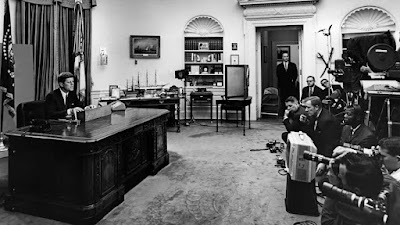

PHOTO:  On June 11, 1963, in his finest hour as president, Kennedy gives a televised address to the nation, vowing to send civil rights legislation to Congress. - Abbie Rowe/The White House/John F. Kennedy Presidential Library and Museum

For nearly 17 minutes, Kennedy discussed the Civil Rights Movement the way King had urged him to do over the past two years. “We are confronted primarily with a moral issue,” Kennedy told the nation. He juxtaposed, throughout his address, the divergent life chances between Blacks and Whites from birth to death, pointing out that both groups served in the military, irrespective of race. Kennedy characterized the hundreds of demonstrations around the country supporting civil rights as “a revolution,” which could be violent or peaceful, depending on the country’s leadership. Kennedy vowed to bring comprehensive civil rights legislation to Congress within the week.

It was a bravura speech, the best of his presidency, certainly the most politically and morally significant. It left a legacy of a president who, despite being pushed in various directions by activists, his brother Bobby and the crisis of Birmingham, seized the time and stood on the right side of history.

An unfinished legacy

Early the following day, Medgar Wiley Evers, a charismatic 37-year-old military veteran and married father of three who served as the NAACP field secretary in Mississippi, was assassinated by a White supremacist. Evers’ murder triggered national waves of protests, mourning and outrage. Kennedy greeted Medgar’s wife, Myrlie, brother Charles, son Darrell Kenyatta and daughter Reena Denise at the White House after the funeral service at Arlington Cemetery.

Over the next five months, Kennedy would, at times reluctantly, fully embrace the struggle for civil rights as part of his legacy. Kennedy met with civil rights leaders after the August 28 March on Washington, hosting them with tea, coffee and sandwiches. “I have a dream,” he said to King as he shook his hand, offering congratulations for a timeless speech against the backdrop of the Lincoln Memorial.

Progress for Kennedy would always mean something other than perfection. After the September 15, 1963, bombing of the 16th Street Baptist Church in Birmingham, Kennedy, to the disappointment of King and many others, refused to attend the funeral services for any of the six children killed that day. Carole Robertson, Addie Mae Collins, Cynthia Wesley, and Denise McNair all perished in the dynamite blast that ripped through the basement of the church. Three of the girls were 14, and one 11. Two other young people died in Birmingham that day. Two White Eagle Scouts murdered “Peanut” Ware as he rode on the handlebars of his brother’s bike, and police fired a shotgun in the back of Johnny Robinson in Birmingham during the unrest that came after the bombing.
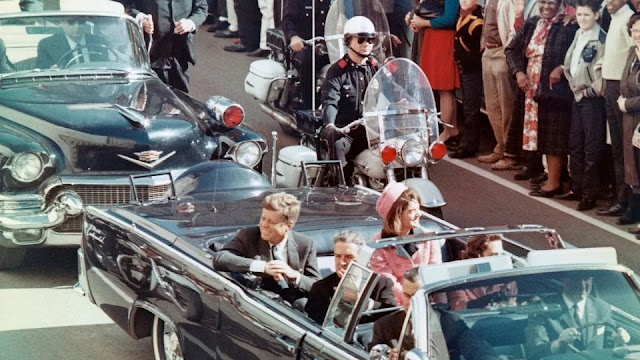

PHOTO: The president rides with first lady Jacqueline Kennedy in Dallas on November 22, 1963. Bullets put an end to his evolution on matters of racial justice. - Bettmann Archive/Getty Images

Bullets put a brutal end to Kennedy’s evolution on matters of racial justice. He was shot to death in Dallas while riding in a convertible next to first lady Jacqueline Kennedy in an act of violence that also wounded then-Texas Gov. John Connally. The shock of Kennedy’s murder brought the world up short, sparking endless conspiracy theories — especially after the accused killer, Lee Harvey Oswald, was then shot and killed by Jack Ruby, himself a figure with underworld connections. While a presidential commission later identified Oswald as a lone shooter, questions remain, even six decades later.

His killing also placed him in a pantheon with the year’s other less celebrated victims— Medgar Evers and the Birmingham Six. Malcolm X, the revolutionary leader who embodied the Black resistance and parried with King over the meaning of democracy, infamously characterized Kennedy’s death as “chickens coming home to roost,” which resulted in his suspension and eventual departure from the Nation of Islam.

Though less well-known, writer James Baldwin’s response to the assassination is particularly instructive. Baldwin found himself too angry to mourn only Kennedy. He lashed out against the country that, in his estimation, did not sufficiently express grief for Medgar Evers or the lost children of Birmingham. “Evers was put to death by the southern oligarchy to preserve the southern power structure,” Baldwin said. “That’s why he died and that’s why nobody cares.” He continued. “That’s why six children died in Birmingham and nobody cares.”

The best compliment that can be paid to Kennedy’s unfinished legacy is that he evolved. That political evolution helped lay the groundwork for his successor, Lyndon Baines Johnson, and the magnificent achievements of the Great Society, including landmark civil rights legislation Kennedy proposed that was passed under Johnson. The ultimate lesson we can learn from Kennedy, 60 years after his death, is that this nation remains a work in progress. Kennedy’s vision, at its best, continues today in the pursuit of progress, the restless and relentless effort to achieve freedom and citizenship for all Americans so that the power of our example can reverberate hopefully throughout the world.


Tuesday, December 1, 2020

IMPORTANT NEW BOOK:

Cuban Revolution in America: Havana and the Making of a United States Left, 1968–1992
by Teishan A. Latner
University of North Carolina Press, 2020

[Publication date: February 1, 2020]

Image may contain: 1 person, crowd and indoor, text that says 'Cuban Revolution in America Havana and the Making of a United States Left, 1968-1992 Teishan A. Latner'

Cuba's grassroots revolution prevailed on America's doorstep in 1959, fueling intense interest within the multiracial American Left even as it provoked a backlash from the U.S. political establishment. In this groundbreaking book, historian Teishan A. Latner contends that in the era of decolonization, the Vietnam War, and Black Power, socialist Cuba claimed center stage for a generation of Americans who looked to the insurgent Third World for inspiration and political theory. As Americans studied the island's achievements in education, health care, and economic redistribution, Cubans in turn looked to U.S. leftists as collaborators in the global battle against inequality and allies in the nation's Cold War struggle with Washington. By forging ties with organizations such as the Venceremos Brigade, the Black Panther Party, and the Cuban American students of the Antonio Maceo Brigade, and by providing political asylum to activists such as Assata Shakur, Cuba became a durable global influence on the U.S. Left.

Drawing from extensive archival and oral history research and declassified FBI and CIA documents, this is the first multidecade examination of the encounter between the Cuban Revolution and the U.S. Left after 1959. By analyzing Cuba's multifaceted impact on American radicalism, Latner contributes to a growing body of scholarship that has globalized the study of U.S. social justice movements.

REVIEWS:

An excellent new book on left- wing activists, the complex politics of solidarity, and US- Cuban relations. . . . This is a book of many strengths and stories. Latner includes an expansive and eclectic cast of characters, from predominantly white leftists and black nationalists to progressive Cuban Americans and even airplane hijackers. . . . Overall, Cuban Revolution in America provides new insights into the expected and unexpected circuits of travel.--Labor

A critical contribution to scholarship on the global Cold War and the postwar internationalist left. . . Latner's text offers crucial insights about the world in which we live as well as illuminating lessons from past attempts to change it.--Public Books

Teishan Latner's fascinating Cuban Revolution in America, with its focus on histories of travel, hijacking, and exile across Cold War barriers, is an important intellectual weapon against both the [travel] ban and the blockade.--Labour/Le Travail

Latner's book joins a growing body of work on trans-national political influences relating to the Cuban Revolution.--American Historical Review

An important contribution to our understanding of both U.S.-Cuban relations and the way in which the island nation influenced dissident movements within its larger neighbor." --E-International Relations

A vivid portrait of youth who aspired to change the United States by way of Cuba. . . . Rich with new material, well-written, and engaging, with a sometimes sly humor and consistent accessibility.--NACLA Report on the Americas

An outstanding piece of scholarship that merits a book prize.--Journal of American History

[A] groundbreaking book on a quarter century of interaction between the Cuban Revolution and US radicals.--The Sixties: A Journal of History, Politics and Culture

Scholars of the left should consider this required reading. It is these multiple lefts, white, Latinx, and African American, that Latner explores over twenty-five plus years, arguing that Cuba was the biggest global inspiration for a new generation of activists who shunned the Old Left for the new.--American Communist History

An impressive, compelling work of research and analysis . . . an unusually deep and nuanced study.--H-Net Reviews

Latner provides a unique vantage on how Cuban internationalism shaped the desires and visions of a generation of revolutionaries in the U.S. From activist brigades to hijackers and political exilees, the book offers an absorbing account of the place of Cuba in the U.S. radical imaginary.--Sujatha Fernandes, author of Cuba Represent!

ABOUT THE AUTHOR:

Teishan A. Latner is assistant professor of history at Thomas Jefferson University.

Image may contain: 1 person, crowd and indoor, text that says 'Cuban Revolution in America Havana and the Making of a United States Left, 1968-1992 Teishan A. Latner'


NOTE:  This post can also now be found here at the Panopticon Review On Facebook page.

Friday, January 10, 2020

The Current Military, Economic, and Political Crisis between Iran and the United States Began in 1953

"What's Past is Prologue..."
WHO WAS MOHAMMAD MOSADDEGH AND WHAT DID THE UNITED STATES DO TO HIM?
PHOTO: Mohammad Mossadegh (1882-1967)
Mohammad Mosaddegh[a] (Persian: محمد مصدق‎; IPA: [mohæmˈmæd(-e) mosædˈdeɢ] (About this soundlisten);[b] 16 June 1882 – 5 March 1967) was the 35th prime minister of Iran, holding office from 1951 until 1953, when his government was overthrown in the 1953 Iranian coup d'état orchestrated by the United States' Central Intelligence Agency and the United Kingdom's MI6.[4][5]
An author, administrator, lawyer and prominent parliamentarian, his administration introduced a range of social and political measures such as social security, land reforms and higher taxes including the introduction of taxation of the rent on land. His government's most significant policy, however, was the nationalization of the Iranian oil industry, which had been built by the British on Persian lands since 1913 through the Anglo-Persian Oil Company (APOC/AIOC) (later British Petroleum and BP).[6]
Many Iranians regard Mosaddegh as the leading champion of secular democracy and resistance to foreign domination in Iran's modern history. Following an initial, failed coup attempt by the CIA/MI6-backed General Fazlollah Zahedi, Mosaddegh resigned four days later on 19 August 1953, with Zahedi succeeding him as prime minister.[7]
While the coup is at times referred to in the West as Operation Ajax[8] after its CIA cryptonym, in Iran it is referred to as the 28 Mordad 1332 Coup d'état, after its date on the Iranian calendar.[9] Mosaddegh was imprisoned for three years, then put under house arrest until his death and was buried in his own home so as to prevent a political furor.[10][11][12] In 2013, the U.S. government formally acknowledged the U.S. role in the coup, as a part of its foreign policy initiatives.[13] 
This Day in History
Aug. 19, 1953: U.S. and Britain Topple Democratically Elected Government of Iran
Time Periods: Cold War: 1945 - 1960
Themes: US Foreign Policy, Wars & Related Anti-War Movements, World History/Global Studies
On Aug. 19, 1953, Iranian Premier Mohammad Mossadegh was removed from power in a coup organized and financed by the British and U.S. governments. The Shah quickly returned to take power and signed over forty percent of Iran’s oil fields to U.S. companies.
Here is a description of this historic event from “50 Years After the CIA’s First Overthrow of a Democratically Elected Foreign Government We Take a Look at the 1953 US Backed Coup in Iran” on Democracy Now!,
In 1953, the CIA and British intelligence orchestrated a coup d’etat that toppled the democratically elected government of Iran. The government of Mohammad Mossadegh. The aftershocks of the coup are still being felt.
In 1951 Prime Minister Mossadegh roused Britain’s ire when he nationalized the oil industry. Mossadegh argued that Iran should begin profiting from its vast oil reserves which had been exclusively controlled by the Anglo-Iranian Oil Company. The company later became known as British Petroleum (BP).
After considering military action, Britain opted for a coup d’état. President Harry Truman rejected the idea, but when Dwight Eisenhower took over the White House, he ordered the CIA to embark on one of its first covert operations against a foreign government.
Iran Coup | Zinn Education Project
Report to the National Security Council on Iran. Source: National Security Archive.
The coup was led by an agent named Kermit Roosevelt, the grandson of President Theodore Roosevelt. The CIA leaned on a young, insecure Shah to issue a decree dismissing Mossadegh as prime minister. Kermit Roosevelt had help from Norman Schwarzkopf’s father: 
Norman Schwarzkopf.
The CIA and the British helped to undermine Mossadegh’s government through bribery, libel, and orchestrated riots. Agents posing as communists threatened religious leaders, while the US ambassador lied to the prime minister about alleged attacks on American nationals.
Some 300 people died in firefights in the streets of Tehran.
Mossadegh was overthrown, sentenced to three years in prison followed by house arrest for life.
The crushing of Iran’s first democratic government ushered in more than two decades of dictatorship under the Shah, who relied heavily on US aid and arms. The anti-American backlash that toppled the Shah in 1979 shook the whole region and helped spread Islamic militancy.
Listen to the full broadcast which includes an interview with Stephen Kinzer, author of All the Shah’s Men: An American Coup And The Roots of Middle East Terror, and Baruch College professor Ervand Abrahamian.
In Disguising Imperialism: How Textbooks Get the Cold War Wrong and Dupe Students, high school teacher Ursula Wolfe-Rocca writes:
American Journey says the CIA “backed” a coup in Iran; in reality that “backing” involved Kermit Roosevelt, CIA agent and grandson of Theodore, arriving in Tehran with suitcases full of cash to manufacture an opposition movement by hiring people to protest, bribing newspaper editors to print misinformation (real fake news), and creating a sham communist party to act as a straw man. American Journey says the Shah “cooperated” with the United States; it leaves out that such “cooperation” was defined by Iran’s purchase of billions of dollars of weapons from the United States as well as the CIA’s training of Savak, the Shah’s secret police force infamous for its human rights violations.
There is an excellent critique of textbook coverage of this history in Chapter 8 of the first edition of Lies My Teacher Told Me by James W. Loewen. 
PHOTO: Mohammad Mossadegh (1882-1967)

Saturday, December 20, 2014

Activist and Public Intellectual Tom Hayden On Why The U.S. Renewal Of Diplomatic Relations With Cuba Is A Victory For the Cuban Revolution

http://www.thenation.com/article/193273/why-us-cuba-deal-really-victory-cuban-revolution

Why the US-Cuba Deal Really Is a Victory for the Cuban Revolution

TOM HAYDEN
(b. 1939)

No one in the mainstream media will acknowledge it, but the normalization of American relations with Havana, symbolized by release of prisoners today, is a huge success for the Cuban Revolution.

The hostile US policy, euphemistically known as “regime change,” has been thwarted. The Cuban Communist Party is confidently in power. The Castros have navigated through all the challenges of the years. In Latin America and the United Nations, Cuba is accepted, and the United States is isolated.

It is quite legitimate for American progressives to criticize various flaws and failures of the Cuban Revolution. But the media and the right are overflowing with such commentary. Only the left can recall, narrate and applaud the long resistance of tiny Cuba to the northern Goliath.

For those actually supportive of participatory democracy in Cuba, as opposed to those who support regime change by secret programs, the way to greater openness on the island lies in a relaxation of the external threat.

Despite the US embargo and relentless US subversion, Cuba remains in the upper tier of the United Nations Human Development Index because of its educational and healthcare achievements. Cuba even leads the international community in the dispatch of medical workers to fight Ebola. Cuba is celebrated globally because of its military contribution to the defeat of colonialism and apartheid in Angola and southern Africa. Now a new generation of Cuban leaders who fought in Angola is coming to power in the Havana and its diplomatic corps. For example, Rodolfo Reyes Rodríguez, Cuba’s representative to the United Nations, today walks on an artificial limb as a result of his combat in Angola.

When few thought it possible, Cuba has achieved the return of all five prisoners held for spying on right-wing Cubans who trained at Florida bases and flew harassment missions through Cuban air space. The last three to be released served hard time in American prisons, and are being welcomed as triumphant heroes on the streets of Havana. Three of the Cuban Five served in Angola as well.

Tens of thousands of Americans, from the veterans of the cane-cutting Venceremos Brigades to the steady flow of tourists insisting on their right to travel, deserve credit for steady years of educational and solidarity work and for pushing a hardy congressional bloc towards normalization.
President Obama has kept his word, despite relentless skepticism from both the left and the mainstream media. He is confounding the mainstream assumption that the Cuban right has a permanent lock on American foreign policy, especially after the Republican sweep in the November elections.

In this case, Obama’s extreme emphasis on diplomatic secrecy worked to his advantage. For over a year, leaders in both countries have conducted regular private debates and consultations, which resulted in the detailed normalization plan released in both capitals today. No one was more important on the American congressional team than Senator Patrick Leahy. Their tight discipline held until the final moment.

It is known that the private US-Cuba conversations about Alan Gross and the Cuban Five were the most difficult. The United States has never acknowledged that Gross was a de facto spy of a certain type, having traveled five times to Havana to secretly distribute advanced communications technology to persons in Havana’s small Jewish community before he was arrested in 2009. Also problematic for American officials immersed in decades of Cold War thinking was the task of wrapping their minds around the idea that the Cuban Five were political prisoners and not terrorist threats.

Finally, when both sides had achieved an internal consensus, the project was derailed by the furious Republican-led blowback against Obama’s trade of five Taliban captives for captured American soldier Bowe Bergdahl in May 2014. Then the November elections interfered with, and threatened to indefinitely delay, the beginning of normalization. Chanukah was the last date for an announcement before the installation of the new US Congress.

Because of the anti-Cuban slant of mainstream thinking, the media will make much of the anger of the Cuban right exemplified by Senator Marco Rubio. But while it’s too early to know, it’s hard to imagine his presidential ambitions being enhanced by arguing in 2016 that Obama should have tried to overthrow the Castros. Senator Bob Menendez has been a leading Democrat trying to block the Obama initiative from his chairing position on the Senate Foreign Relations Committee. Most Democrats will be delighted to see Menendez, who represents Cuban exiles in Union City, diminished in the Senate.

Going forward, the United States will remove Cuba from the “state terrorism” listing, which will ease the possibility of funding from the international financial system. For American citizens, permission to travel to Cuba will be significantly widened. Business and trade possibilities will increase. Starting with the 2015 Summit of the Americas in Panama, the American and Cuban delegations will sit at the same table. The so-called interest sections will be upgraded to formal embassies. The embargo is going to be hollowed out from within, with American tourist and investment dollars permitted to flow. With or without congressional action to lift the 1996 Helms-Burton act, the embargo is being dissolved. More than 400,000 Cuban-Americans traveled to Cuba last year alone.

And here’s a prediction: if the president has his wish, the Obama family will be seen on the streets of Havana before his term is up.


Editor’s Note: “Two Old Guys Talking” is the introduction to Tom Hayden’s forthcoming book, Listen, Yankee!, Why Cuba Matters, to be published next year by Seven Stories Press. The piece was finalized last month. The “two old guys” are the author, now 75, who first visited Cuba in 1968, and Ricardo Alarcon, now 77, former president of the Cuban National Assembly, foreign minister, and UN representative.

Saturday, July 12, 2014

New Books by Mary Helen Washington and Malcolm X On the Black Left, African American Literature, the Cold War, Social Revolution, And the Global Struggle Against U.S. Imperialism


The Other Blacklist: The African American Literary and Cultural Left of the 1950s
by Mary Helen Washington

Hardcover: 368 pages
Publisher:   Columbia University Press
April 8, 2014
ISBN-10: 0231152701
ISBN-13: 978-0231152709


Editorial Reviews:


From Booklist

*Starred Review* Considering that any effort to achieve racial equality was viewed as subversive in the Cold War era, is it any wonder that so many black artists and writers were viewed as Communists? Yet very little has been written about the black artists and writers who were surveilled, investigated, and blacklisted because of their beliefs and their work. Literary scholar Washington remedies that neglect with this engrossing look at six artists. Though some were Communist Party members and others not, they were all drawn to the Left’s appreciation of black folk culture and support for the ideal of self-determination, themes that figured prominently in their work. Washington profiles novelist and essayist Lloyd L. Brown, visual artist Charles White, playwright and novelist Alice Childress, poet and novelist Gwendolyn Brooks, novelist Frank London Brown, and novelist and activist Julian Mayfield. Tapping archival material, biographies, interviews, and FBI files, Washington examines his subjects’ aesthetic and relationships with other writers and artists and the black community as well as their frustrations with and ambivalent feelings about the Left. Photographs of the artists and their works and pages from FBI files enhance this compelling look at artists and writers who became part of the vanguard of the progressive politics and civil rights movement of the 1960s. --Vanessa Bush

Review
 
"A wonderful combination of careful research, adept historicizing, and insightful close reading. Mary Helen Washington's book brings needed critical attention to understudied figures and helps readers rethink the careers of others whom they believe they already know."

(James Smethurst, author of The African American Roots of Modernism: From Reconstruction to the Harlem Renaissance and The Black Arts Movement: Literary Nationalism in the 1960s and 1970s)

"[A] compelling look at artists and writers who became part of the vanguard of the progressive politics and civil rights movement of the 1960s."


(Booklist (starred review))


"Groundbreaking...thought-provoking."

(Publishers Weekly (starred review))

See all Editorial Reviews


Review

"A groundbreaking and eye-opening study. In Washington's sure hands, biography, politics, and cultural history combine to open new intellectual vistas."

(Alan M. Wald, University of Michigan)

About the Author
 
Mary Helen Washington is a professor in the English Department at the University of Maryland, College Park. She has been a Bunting Fellow at Harvard University and has taught at the University of Massachusetts, Boston. She is the editor of Black-Eyed Susans: Classic Stories by Black Women Writers; Midnight Birds: Stories of Contemporary Black Women Writers; Invented Lives: Narratives of Black Women; and Memory of Kin: Stories of Family by Black Writers.

NEW BOOK:
 

https://cup.columbia.edu/book/978-0-231-15270-9/the-other-blacklist
 

The Other Blacklist: The African American Literary and Cultural Left of the 1950s
by Mary Helen Washington
Columbia University Press

April, 2014
Cloth, 368 pages, B & W Photos: 28
ISBN: 978-0-231-15270-9
$35.00 / £24.00


Mary Helen Washington recovers the vital role of 1950s leftist politics in the works and lives of modern African American writers and artists. While most histories of McCarthyism focus on the devastation of the blacklist and the intersection of leftist politics and American culture, few include the activities of radical writers and artists from the Black Popular Front. Washington’s work incorporates these black intellectuals back into our understanding of mid-twentieth-century African American literature and art and expands our understanding of the creative ferment energizing all of America during this period.

Mary Helen Washington reads four representative writers—Lloyd Brown, Frank London Brown, Alice Childress, and Gwendolyn Brooks—and surveys the work of the visual artist Charles White. She traces resonances of leftist ideas and activism in their artistic achievements and follows their balanced critique of the mainstream liberal and conservative political and literary spheres. Her study recounts the targeting of African American as well as white writers during the McCarthy era, reconstructs the events of the 1959 Black Writers’ Conference in New York, and argues for the ongoing influence of the Black Popular Front decades after it folded. Defining the contours of a distinctly black modernism and its far-ranging radicalization of American politics and culture, Washington fundamentally reorients scholarship on African American and Cold War literature and life.

Related Subjects

American History
American Literature
Art History
Literary Criticism and Theory


About the Author

Mary Helen Washington is a professor in the English Department at the University of Maryland, College Park. She has been a Bunting Fellow at Harvard University and has taught at the University of Massachusetts, Boston. She is the editor of Black-Eyed Susans: Classic Stories by Black Women Writers; Midnight Birds: Stories of Contemporary Black Women Writers; Invented Lives: Narratives of Black Women; and Memory of Kin: Stories of Family by Black Writers.

New Malcolm X Diary Reveals a Revolutionary Optimist

On the 50th anniversary of the founding of his Organization of Afro-American Unity, Malcolm X’s powerful ties to Africa and African leaders are explored.


BY TODD STEVEN BURROUGHS
July 1, 2014
The Root

File:Malcolm X in 1964.jpg
Malcolm X on March 26, 1964
U.S. NEWS & WORLD REPORT MAGAZINE PHOTOGRAPH COLLECTION, LIBRARY OF CONGRESS
 
While many in the civil rights movement community this summer are celebrating the 50th anniversary of Freedom Summer, another important half-century milestone—and a significantly blacker, more radical one—was recently acknowledged in New York City: the founding of the Organization of Afro-American Unity, Malcolm X’s political organization.

If Martin Luther King Jr.’s dream of domestic social equality turned into a nightmare, Malcolm’s vision for black Americans to join the international community of Africans as an anti-Western bloc was quickly stifled with his 1965 assassination. The OAAU—patterned after the OAU, the Organization of African Unity—represented Malcolm’s domestic and international potential, a painful addition to the pile of 20th-century black historical what-ifs.

“Brother Malcolm was internationalizing the movement,” said event organizer A. Peter Bailey, who was only in his early 20s when he edited the OAAU’s newsletter, The Blacklash. “He was on a conscious effort to connect the struggle against racism in America to the struggle against colonialism internationally, especially in Africa.”

The OAAU event, which took place on June 28—the to-the-day 50th anniversary—at the Malcolm X & Dr. Betty Shabazz Memorial and Educational Center (the former Audubon Ballroom, where Malcolm was assassinated), came in the wake of a newly published diary of Malcolm X. The book, edited by journalist-historian Herb Boyd and writer Ilyasah Al-Shabazz, one of Malcolm X’s six daughters, is called The Diary of Malcolm X: El-Hajj Malik El-Shabazz, 1964. Finally freed from scholarly microfilm, the diary has been the subject of a court case between the authors and the publisher, Third World Press, and Malcolm’s other five daughters, who did not sign off on the book’s publication.

Malcolm’s diary paints the picture of a man eager to find his religious and political centers. Most of the first half of the book details his much-talked-about trip to Mecca in Saudi Arabia, while the second half—which takes place after the OAAU founding in New York—is more about his travels to Africa, where he meets more than 10 heads of state and is treated like a de facto ambassador of black America.

He had multiple goals: to educate the African leaders about the plight of African Americans; to get African leaders to denounce the United States because of Jim Crow and its accompanied violence, with the possibility of bringing the U.S. before the United Nations Commission on Human Rights; and to unite the Muslim and African worlds against Western imperialism, especially what Malcolm called “dollarism,” the funds the U.S. gave out to help, and ultimately silence, much of the Third World during the Cold War.

Malcolm was not allowed to address the 1964 OAU meeting in Cairo, but he did write and pass around a memorandum there detailing American racism. The OAU, in turn, did release a public condemnation of the United States for its treatment of African Americans.

“I find all the African delegates at all levels are strongly sympathetic to our cause,” he writes in a Wednesday, July 15, entry. “But American propaganda through the USIS [United States Information Service] has been powerful[,] influencing most of them to think we hate Africa & don’t identify with her in any way. Most of them are shocked by my strongly pro-African sentiments—shocked and elated.”

Bailey, who has written a new memoir of his time with Malcolm X, called Witnessing Brother Malcolm X, the Master Teacher: A Memoir, says of the period, “J. Edgar Hoover turned green when he heard of that [OAU] resolution.” He emphasized that Malcolm, whom he called a master of propaganda, stuck a needle in the eye of the United States with that act, making it harder for America to be seen as a bastion of democracy.

“He [Malcolm] was a black nationalist. He said it enough times,” said former OAAU member Earl Grant, now 84. “He was what people today would probably call an African nationalist.” Malcolm, said Grant, was in the tradition of black human rights activists such as back-to-Africa preacher Bishop Henry McNeal Turner, the crusading journalist and suffragist Ida B. Wells, and the proto-Garveyite intellectual Hubert Henry Harrison.

The New York City event, during which letters and documents of the OAAU’s tenure were read, had a feeling of radical, analog nostalgia. It was both quaint and important to briefly revisit the days when people wrote and mailed letters and had telephone-exchange names. The period was one of great optimism, when all parts of the movement, radical to moderate, thought they were going to win and reshape America and the world in some fashion.

The OAAU and the diary were both part of that ’60s revolutionary optimism. The OAAU was much more than a paper organization but less than a fully functional protest group. The diary, as a collection of literal notes, gives us important insights not only into Malcolm’s thinking but also into his militant, anti-Western, anti-imperialist actions.

The more that can be learned about Malcolm’s domestic and international political goals, the less it will be said that all he did was make speeches in Harlem while others in the movement did concrete work. As black America approaches the 50th anniversary of his assassination next Feb. 21, these clarifying details can allow for much-needed new discussions about Malcolm now and beyond.

Todd Steven Burroughs, co-editor, with Jared Ball, of A Lie of Reinvention: Correcting Manning Marable’s Malcolm X, is a freelance writer based in Hyattsville, Md. He has taught at Morgan State and Howard universities. He can be reached at toddpanther@gmail.com.

Like The Root on Facebook. Follow us on Twitter.

Wednesday, March 5, 2014

Renowned Historian Peniel Joseph On the Life, Work, And Legacy of Stokely Carmichael, 1941-1998


 Stokely:  A Life by Peniel Joseph.  Basic Civitas Books 2014

PENIEL JOSEPH


Tufts University professor Peniel Joseph a major historian and scholar of the Civil Rights and Black Power Movements is interviewed at length on C-Span's IN DEPTH program talks extensively about these movements and his own career as both an academic and community activist as well as his brand new and critically acclaimed biography STOKELY: A LIFE (BasicCivitas Books, 2014) about one of the most important and central figures of both the Civil Rights and Black Power eras, Stokely Carmichael. This program was televised on C-SPAN'S BookTV on Saturday, March 2, 2014

In Depth with Peniel Joseph:

Author and historian Peniel Joseph talked about his life and career.He also responded to viewers' calls, Facebook comments, electronic mails, and tweets on topics such as rewriting post-war black history, the civil rights movement and the Obama era, among others.

The Tufts University professor is the author of three books: Waiting 'Til the Midnight Hour: A Narrative History of Black Power in America; Dark Days, Bright Nights: From Black Power to Barack Obama; and Stokely: A Life. He is also the editor of: The Black Power Movement: Rethinking the Civil Rights-Black Power Era, and Neighborhood Rebels: Black Power at the Local Level.

BookTV.org
C-SPAN2
Airdate: March 2, 2014

Interview time: 3 Hours