http://www.thenation.com/article/165530/why-now-whats-next-naomi-klein-and-yotam-marom-conversation-about-occupy-wall-street?page=full
All,
This is a very important ongoing discussion about where any genuine mass movement in this country today worth its name should be going and what is necessary for its survival, growth, and expansion. Klein and Marom incisively engage the real issues and fundamental concerns facing us all in the following conversation on the crucial future direction of the Occupy Wall Street movement...
Kofi
Why Now? What's Next?
Naomi Klein and Yotam Marom in Conversation About Occupy Wall Street
by Naomi Klein and Yotam Marom | January 9, 2012
The Nation
Naomi Klein is a journalist, activist and author of The Shock Doctrine: The Rise of Disaster Capitalism and No Logo. She writes a syndicated column for The Nation and The Guardian. Yotam Marom is a political organizer, educator, and writer based in New York. He has been active in the Occupy Wall Street Movement, and is a member of the Organization for a Free Society [1]. This conversation was recorded in New York City.
Naomi Klein: One of the things that’s most mysterious about this moment is “Why now?” People have been fighting austerity measures and calling out abuses by the banks for a couple of years, with basically the same analysis: “We won’t pay for your crisis.” But it just didn’t seem to take off, at least in the US. There were marches and there were political projects and there were protests like Bloombergville, but they were largely ignored. There really was not anything on a mass scale, nothing that really struck a nerve. And now suddenly, this group of people in a park set off something extraordinary. So how do you account for that, having been involved in Occupy Wall Street since the beginning, but also in earlier anti-austerity actions?
Yotam Marom: Okay, so the first answer is, I have no idea, no one does. But I can offer some guesses. I think there are a few things you have to pay attention to when you see moments like these. One is conditions—unemployment, debt, foreclosure, the many other issues people are facing. Conditions are real, they’re bad, and you can’t fake them. Another sort of base for this kind of thing is the organizing people do to prepare for moments like these. We like to fantasize about these uprisings and big political moments—and we like to imagine that they erupt out of nowhere and that that’s all it takes—but those things come on the back of an enormous amount of organizing that happens every day, all over the world, in communities that are really marginalized and facing the worst attacks.
So those are the two kind of prerequisites for a moment like this to take place. And then you have to ask, What’s the third element that makes it all come together, what’s the trigger, the magic dust? Well, I’m not sure what the answer is, but I know what it feels like. It feels like something has been opened up, a kind of space nobody knew existed, and so all sorts of things that were impossible before are possible now. Something just got kind of unclogged. All sorts of people just started to see their struggles in this, started being able to identify with it, started feeling like winning is possible, there is an alternative, it doesn’t have to be this way. I think that’s the special thing here.
NK: Do you feel that there is an organic discussion happening about fundamentally changing the economic system? I mean we know that there is a strong, radical, angry critique of corruption, and of the corporate takeover of the political process. There’s a really powerful calling out happening. What’s less clear is the extent to which people are getting ready to actually build something else.
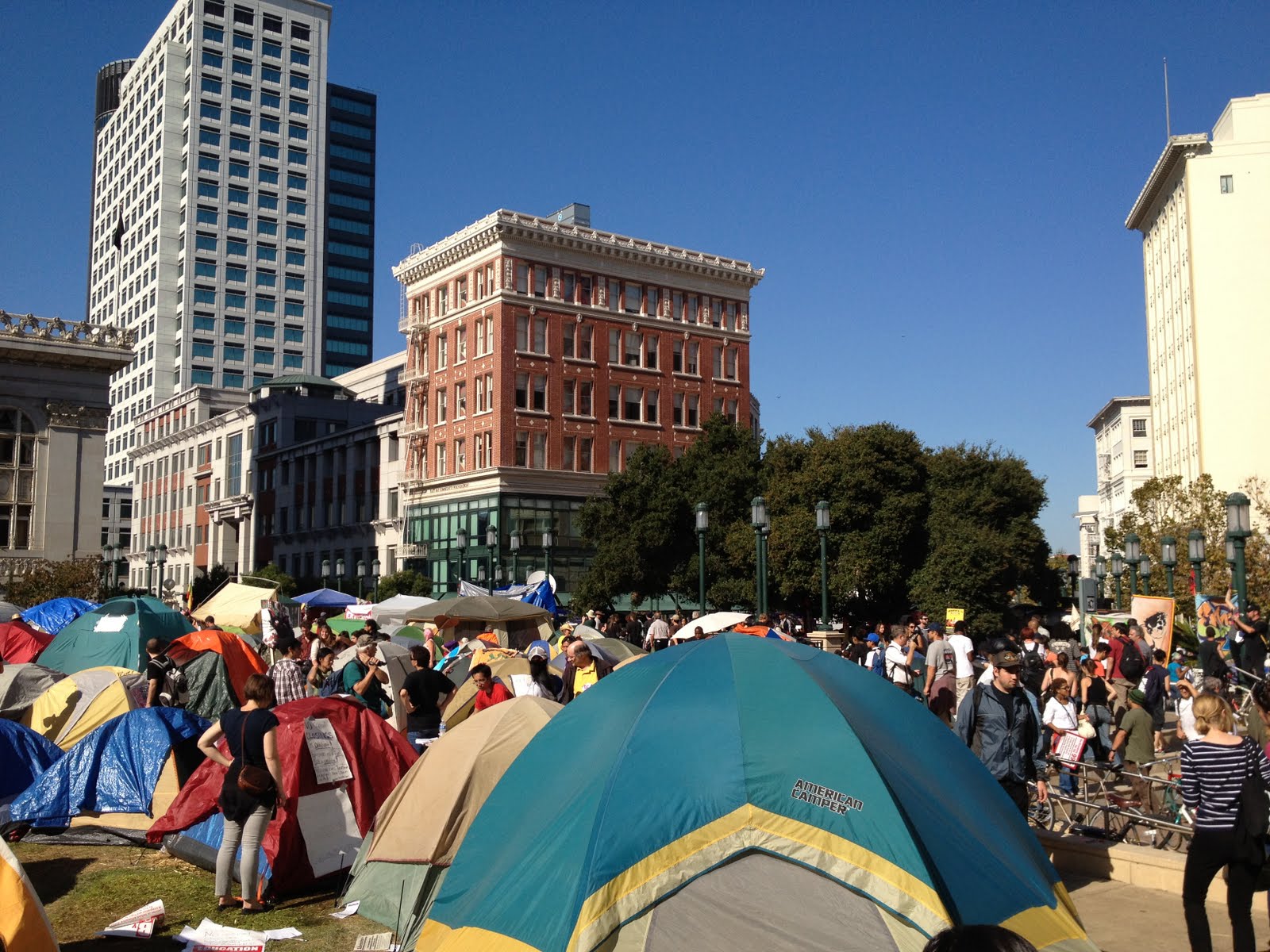
YM: Yeah, I definitely think we’re in a unique moment in the development of a movement that’s not only a protest movement against something but also an attempt to build something in its place. It is potentially a very early version of what I would call a dual-power movement, which is a movement that’s—on the one hand—trying to form the values and institutions that we want to see in a free society, while at the same time creating the space for that world by resisting and dismantling the institutions that keep us from having it. Occupation in general, as a tactic, is a really brilliant form of a dual-power struggle because the occupation is both a home where we get to practice the alternative—by practicing a participatory democracy, by having our radical libraries, by having a medical tent where anybody can get treatment, that kind of thing on a small level—and it’s also a staging ground for struggle outwards. It’s where we generate our fight against the institutions that keep us from the things that we need, against the banks as a representative of finance capitalism, against the state that protects and propels those interests.
It’s surprising and it’s really encouraging because that’s something that has been missing in a lot of struggles in the past. You usually have one or the other. You have alternative institutions, like eco-villages and food coops and so on—and then you have protest movements and other counter-institutions, like anti-war groups or labor unions. But they very rarely merge or see their struggle as shared. And we very rarely have movements that want to do both of those things, that see them as inseparable—that understand that the alternatives have to be fighting, and that fighting has to be done in a way that represents the values of the world we want to create. So I do think there’s something really radical and fundamental in that, and an enormous amount of potential.
NK: I absolutely agree that the key is in the combination of resistance and alternatives. A friend, the British eco-and arts activist John Jordan, talks about utopias and resistance being the double helix of activist DNA, and that when people drop out and just try to build their utopia and don’t engage with the systems of power, that’s when they become irrelevant and also when they are extremely vulnerable to state power and will often get smashed. And at the same time if you’re just protesting, just resisting and you don’t have those alternatives, I think that that becomes poisonous for movements.
But I’m still wondering about the question of policy—of making the leap from small-scale alternatives to the big policy changes that allow them to change the culture. A lot of people have come to the realization that the system is so busted that it really isn’t about who you get into office. But one of the ways of responding to that is to say, “Okay, we’re not going to form a political party and try to take power, but we are going to look at this system and try to identify the structural barriers to real change, and advocate for political goals that might begin to mend those structural flaws.” So that means things like the way corporations are able to fund elections and the role of corporate media and the whole issue of corporate personhood in this country. It is possible to find a few key policy fights that could conceivably create a situation where, ten years down the road, people might not feel so completely cynical about the idea of change within the political system. What do you think about that?
YM: Well, I think you’re right that we have to find ways to do that, but ways that don’t compromise what’s been so successful about this movement and this moment so far, which is that it’s so broad that so many different people can find themselves in it.
I think that within the broader movement, we do have different roles, and there is a particular role for Occupy Wall Street. I personally don’t want to have anything to do with people lobbying or running for office right now, nor do I want to focus all of my time winning small policy changes, and I don’t think that’s the role of Occupy Wall Street. But I sure as hell hope the people whose terrain that is do go and do it. I hope that they can recognize that what’s happening now is the creation of a climate where it’s possible for them to push left and win more. I’m not going to be happy with all the compromises those people have to make, and I don’t think we’re going to survive on reforms alone, but we need that too. If we want a real, meaningful social transformation, we need to win things along the way, because that’s how we provides people the foundations on top of which they can continue to struggle for the long haul, and it’s how we grow to become a critical mass that can ultimately make a fundamental break with this system.
And in the meantime, our role as Occupy Wall Street should be to dream bigger than that. I think it’s our job to look far ahead, to assert vision, to create alternatives and to intervene in the political and economic processes that govern people’s lives. We need to recognize that the institutions that govern our lives really do have power, but we don’t necessarily need to participate in them according to their rules. I think Occupy Wall Street’s role is to step in the way of those processes to prevent them from using that power, and to create openings for the alternatives we are trying to build. And then if politicians or others who consider themselves in solidarity with this movement want to go get on that, then they should use this moment to win the things that will help make us stronger in the long run, and they have a chance now to do that.
NK: You know, I’m torn about this. On one hand, OWS is so broad that a huge range of people has found a place in the tent. And there is certainly value in just having a very broad movement that is able to intervene in the political narrative at key junctures. Particularly because, looking at what is happening in Europe at the moment, I think we have to brace for the next economic shock. It’s a very big deal that when the next round of austerity measures comes down in the US, there will be a mass movement ready to say: “No way. We won’t pay—if you need money, tax the 1 percent and cut military spending, don’t cut education and food stamps.”
But we should be clear: that’s not making things better, it’s just trying to keep things from getting a whole lot worse. To make things better, there has to be a positive demand.
Look at the Chilean student protests, for instance. That’s a remarkable movement, and it’s historically hugely significant, because this is really the end of the Chilean dictatorship more than twenty years after it actually ended. Pinochet was in power for so long, and so many of his policies were locked in during the negotiated transition, that the left in Chile really did not recover until this generation of young people took to the streets. And they took to the streets sparked by austerity measures that were hitting education hard. But rather than just say, “Okay, we’re against these latest austerity cuts,” they said, “We are for free public education and we want to reverse the entire privatization agenda.” And that may seem like a narrow demand, but they were able to make it about inequality much more broadly. They did it by showing how the privatization of education in Chile, and the creation of a brutal two-tiered education system, deepened and locked in inequality, giving poor students no way out of poverty. The protests lit the country up, and now it’s not just a student movement. So that’s a completely different circumstance from OWS because it started with a demand. But it shows how, if the demand is radical enough, it can open up a much broader debate about what kind of society we want.
I think it’s more about vision than it is about demands. My worry is that there are so many groups trying to co-opt this movement, and trying to raise money off of its efforts, that the movement risks defining itself by what is not, rather by what it is or, more importantly, might become. If the movement is constantly put in a position of saying, “No, we’re not your pawn. We’re not this. We’re not that,” the danger is getting boxed into a defensive identity that was really imposed from the outside. I think some of that happened to the movement opposing corporate globalization post-Seattle, and I’d hate to see those mistakes repeated.
YM: I think you’re right about that. And you’re right about the question of demands versus vision. We don’t have demands in the way that other people want to hear them. But of course we have demands, of course we want things. When we reclaim a foreclosed home for a foreclosed-on family, or organize students to do flash mobs at the banks keeping them in debt, or environmental activists to do die-ins at banks that invest in coal, these are ways of speaking our demands in a new language of resistance. Occupy Wall Street is a really big tent that doesn’t have one voice, but that doesn’t mean all of our other groupings disappear when we enter it. There are still housing rights groups demanding an end to foreclosure, or labor unions demanding good jobs, and so on. We are trying to build a movement where individuals and groups have the autonomy to do what they need to do and pick the battles they need to pick, while being in solidarity with something much broader and far-reaching, something radical and visionary. And that’s part of the reason vision is so important, since it connects all those struggles.
But I do think we have to win things, you’re absolutely right about that. I guess the way I look at it is that we’re now about to make a transition, hopefully, from the symbolic to the real, both in the realms of creating the alternatives and fighting back. We need to reclaim homes, not just as symbols, but for people to live in them. Open the shut-down hospitals and put doctors in them. And same with the fighting: to actually disrupt business as usual, to move from protest to resistance. We’ll have an actual impact when Congress cannot pass those bills because there’s too much resistance, because there are people in the streets. We’ll have a real impact when it’s not only bank branch lobbies that we’re dancing around in but when we’ve blockaded the doors of the headquarters where they make their policies. We need to force policy-makers to re-evaluate their decisions, and we need to build power to eventually replace them altogether, not only in content but in form. If this is just about changing the narrative and it stops there, then we’re going to end up having missed an incredible opportunity to really affect people’s lives in a meaningful ways. This is not a game. A society where there are empty homes but people who don’t have homes is a fundamentally revolting thing and it’s unacceptable, can’t be allowed. You can say that for all the other things: for war, or for patriarchy, racism. We have an incredible responsibility.
NK: And nobody knows how to do what we’re trying to do. You can point to Iceland or something that happened in Argentina. But these are national struggles, somewhat on the economic periphery. No movement has ever successfully challenged hyper-mobile global capital at its source. So what we’re talking about is so new that it’s terrifying. I think people should admit that they’re terrified and that they don’t know how to do what they dream of doing, because if they don’t, then their fear—or rather our fear—will subconsciously shape our politics and you can end up in a situation where you’re saying, “No, I don’t want any structure,” or, “No, I don’t want to be making any kind of policy demands or have anything to do with politics,” when really it’s that you’re just completely scared shitless of the fact that you have no idea how to do this. So maybe if we all admit we are on unmapped territory, that fear loses some of its power.
YM: Yeah, that’s really important. We’re all just making it up. What you just said kind of reminded me of this moment that we had that was really a turning point for me. About three weeks in, sitting and talking with a bunch of people I had only just met, we were thinking about the movement and where it might be headed, and I remember this crazy moment when it hit me: “Oh, we’re winning.” It was surreal. And then that thought was immediately followed by the question: “So what do we want?” You know, we hadn’t won much, and we still haven’t, and we’re nowhere near the society we want to live in, but it was still that feeling—that the narrative was shifting, that the whole world was watching, that there was a lot of possibility before us. It was the first time that I’ve ever experienced that and I think probably the first time that a lot of people who are alive today have. And that was an incredibly empowering moment, really changed my life, but it was also an unbelievably terrifying moment, because, holy shit, that means it’s real, this is high stakes, this is no joke.
So, then, following that thread of what’s possible: all of this was impossible a few months ago. All of this was inconceivable. And I felt that very personally and I was cynical and I learned a lot from that. Turns out we know very little about what is possible. And that’s really humbling and important and it opens a lot of doors. What do you think is possible?
NK: First of all, it’s a moment of possibility like I’ve never seen because we never had as many people on our side as this moment does. I mean in the Seattle moment, we didn’t. We were marginal. We always were because we were in an economic boom. Now, the system has been breaking its own rules so defiantly that its credibility is shot. And there’s a vacuum. There’s a vacuum for other credible voices to fill that, and it’s very exciting.
Personally, I think the greatest possibility lies in bringing together the ecological crisis and the economic crisis. I see climate change as the ultimate expression of the violence of capitalism: this economic model that fetishizes greed above all else is not just making lives miserable in the short term, it is on the road to making the planet uninhabitable in the medium term. And we know, scientifically, that if we continue with business as usual, that is the future we are heading towards. I think climate change is the strongest argument we’ve ever had against corporate capitalism, as well as the strongest argument we’ve ever had for the need for alternatives to it. And the science puts us on a deadline: we need to have begun to radically reduce our emissions by the end of the decade, and that means starting now. I think that this science-based deadline has to be part of every discussion about what we’re going to do next, because we actually don’t have all the time in the world.
We should also be aware that this kind of existential urgency could be a very regressive force if the wrong people harness it. It’s easy to imagine autocrats using the climate emergency to sa, “We don’t have time for democracy or participation, we need to impose it all from the top.” Right now, the way the urgency is used within the mainstream environmental movement is to say, “This problem is so urgent that we can only ask for these compromised cap-and-trade deals, since that’s all we can hope to achieve politically.” Talking about the links between economic growth and climate change is pretty much off the table because, supposedly, we don’t have time to make those kinds of deep changes.
But that was a pre-OWS political calculation. And as you pointed out, OWS is in the business of changing what is possible. So what I’ve been saying when I speak to environmental groups is: start to imagine what would be possible if the climate movement were not out there on its own but part of a much broader political uprising fighting a greed-based economic model. Because in that context, it is practical to talk about changing this system. It’s much more practical, in fact, than pushing corrupt plans like cap-and-trade, which we know don’t stand a chance of getting us where science tells us we need to go.
I’m also excited about the fact that, over the past ten years since the peak of the so-called anti-globalization movement, a lot of work has been done that proves that economic re-localization and economic democracy are both feasible and desirable. Look at the explosion of the local food movement, of community-supported agriculture and farmers markets. Or the green co-op movement. Or community-based wind and solar energy projects. And then you have cities like Detroit, Portland or Bellingham, which are working on multiple fronts to re-localize their economies. The point is that there are living examples that we can point to now of communities that have weathered the economic crisis better than those places that are still dependent on a few large multinational corporations, and could just be leveled overnight when those corporations shut their doors. Most importantly: many of these models address both the economic and ecological crises simultaneously, creating work, rebuilding community, while lowering emissions and reducing dependence on fossil fuels.
Coming back to the idea of resistance and alternatives being the twin strands of DNA, I see a possible future where the resistance side of OWS could start to support the policies these economic alternatives need to get to the next level.
So, yeah, that’s where I see a lot of potential—both potential strength and also potential loss, lost opportunities. You?
YM: I think there is more possibility right now than I could have ever imagined. I think in the not-so-distant future, we can win a lot of things that actually improve people’s lives, we can continue to change the political landscape, and we can grow into a mass movement with the strength to propose another kind of world and also fight for it. I think we’re only in the beginning of that, and I think there is a ton of potential. And I also see that kind of possibility in the long term. I think we can win a truly free society. I think it’s totally possible to have a political and economic system that we have a genuine say in, that we democratically control, that we participate in, that is equitable and liberating, where we have autonomy for ourselves and our communities and our families, but are also in solidarity with one another. I think it’s possible, and necessary. That’s kind of the amazing thing about this moment and this movement, I guess. Right now, sitting here, I can’t even imagine the limits of possibility.
[1] http://www.afreesociety.org/
All,
This is a very important ongoing discussion about where any genuine mass movement in this country today worth its name should be going and what is necessary for its survival, growth, and expansion. Klein and Marom incisively engage the real issues and fundamental concerns facing us all in the following conversation on the crucial future direction of the Occupy Wall Street movement...
Kofi
Why Now? What's Next?
Naomi Klein and Yotam Marom in Conversation About Occupy Wall Street
by Naomi Klein and Yotam Marom | January 9, 2012
The Nation
Naomi Klein is a journalist, activist and author of The Shock Doctrine: The Rise of Disaster Capitalism and No Logo. She writes a syndicated column for The Nation and The Guardian. Yotam Marom is a political organizer, educator, and writer based in New York. He has been active in the Occupy Wall Street Movement, and is a member of the Organization for a Free Society [1]. This conversation was recorded in New York City.
Naomi Klein: One of the things that’s most mysterious about this moment is “Why now?” People have been fighting austerity measures and calling out abuses by the banks for a couple of years, with basically the same analysis: “We won’t pay for your crisis.” But it just didn’t seem to take off, at least in the US. There were marches and there were political projects and there were protests like Bloombergville, but they were largely ignored. There really was not anything on a mass scale, nothing that really struck a nerve. And now suddenly, this group of people in a park set off something extraordinary. So how do you account for that, having been involved in Occupy Wall Street since the beginning, but also in earlier anti-austerity actions?
Yotam Marom: Okay, so the first answer is, I have no idea, no one does. But I can offer some guesses. I think there are a few things you have to pay attention to when you see moments like these. One is conditions—unemployment, debt, foreclosure, the many other issues people are facing. Conditions are real, they’re bad, and you can’t fake them. Another sort of base for this kind of thing is the organizing people do to prepare for moments like these. We like to fantasize about these uprisings and big political moments—and we like to imagine that they erupt out of nowhere and that that’s all it takes—but those things come on the back of an enormous amount of organizing that happens every day, all over the world, in communities that are really marginalized and facing the worst attacks.
So those are the two kind of prerequisites for a moment like this to take place. And then you have to ask, What’s the third element that makes it all come together, what’s the trigger, the magic dust? Well, I’m not sure what the answer is, but I know what it feels like. It feels like something has been opened up, a kind of space nobody knew existed, and so all sorts of things that were impossible before are possible now. Something just got kind of unclogged. All sorts of people just started to see their struggles in this, started being able to identify with it, started feeling like winning is possible, there is an alternative, it doesn’t have to be this way. I think that’s the special thing here.
NK: Do you feel that there is an organic discussion happening about fundamentally changing the economic system? I mean we know that there is a strong, radical, angry critique of corruption, and of the corporate takeover of the political process. There’s a really powerful calling out happening. What’s less clear is the extent to which people are getting ready to actually build something else.
YM: Yeah, I definitely think we’re in a unique moment in the development of a movement that’s not only a protest movement against something but also an attempt to build something in its place. It is potentially a very early version of what I would call a dual-power movement, which is a movement that’s—on the one hand—trying to form the values and institutions that we want to see in a free society, while at the same time creating the space for that world by resisting and dismantling the institutions that keep us from having it. Occupation in general, as a tactic, is a really brilliant form of a dual-power struggle because the occupation is both a home where we get to practice the alternative—by practicing a participatory democracy, by having our radical libraries, by having a medical tent where anybody can get treatment, that kind of thing on a small level—and it’s also a staging ground for struggle outwards. It’s where we generate our fight against the institutions that keep us from the things that we need, against the banks as a representative of finance capitalism, against the state that protects and propels those interests.
It’s surprising and it’s really encouraging because that’s something that has been missing in a lot of struggles in the past. You usually have one or the other. You have alternative institutions, like eco-villages and food coops and so on—and then you have protest movements and other counter-institutions, like anti-war groups or labor unions. But they very rarely merge or see their struggle as shared. And we very rarely have movements that want to do both of those things, that see them as inseparable—that understand that the alternatives have to be fighting, and that fighting has to be done in a way that represents the values of the world we want to create. So I do think there’s something really radical and fundamental in that, and an enormous amount of potential.
NK: I absolutely agree that the key is in the combination of resistance and alternatives. A friend, the British eco-and arts activist John Jordan, talks about utopias and resistance being the double helix of activist DNA, and that when people drop out and just try to build their utopia and don’t engage with the systems of power, that’s when they become irrelevant and also when they are extremely vulnerable to state power and will often get smashed. And at the same time if you’re just protesting, just resisting and you don’t have those alternatives, I think that that becomes poisonous for movements.
But I’m still wondering about the question of policy—of making the leap from small-scale alternatives to the big policy changes that allow them to change the culture. A lot of people have come to the realization that the system is so busted that it really isn’t about who you get into office. But one of the ways of responding to that is to say, “Okay, we’re not going to form a political party and try to take power, but we are going to look at this system and try to identify the structural barriers to real change, and advocate for political goals that might begin to mend those structural flaws.” So that means things like the way corporations are able to fund elections and the role of corporate media and the whole issue of corporate personhood in this country. It is possible to find a few key policy fights that could conceivably create a situation where, ten years down the road, people might not feel so completely cynical about the idea of change within the political system. What do you think about that?
YM: Well, I think you’re right that we have to find ways to do that, but ways that don’t compromise what’s been so successful about this movement and this moment so far, which is that it’s so broad that so many different people can find themselves in it.
I think that within the broader movement, we do have different roles, and there is a particular role for Occupy Wall Street. I personally don’t want to have anything to do with people lobbying or running for office right now, nor do I want to focus all of my time winning small policy changes, and I don’t think that’s the role of Occupy Wall Street. But I sure as hell hope the people whose terrain that is do go and do it. I hope that they can recognize that what’s happening now is the creation of a climate where it’s possible for them to push left and win more. I’m not going to be happy with all the compromises those people have to make, and I don’t think we’re going to survive on reforms alone, but we need that too. If we want a real, meaningful social transformation, we need to win things along the way, because that’s how we provides people the foundations on top of which they can continue to struggle for the long haul, and it’s how we grow to become a critical mass that can ultimately make a fundamental break with this system.
And in the meantime, our role as Occupy Wall Street should be to dream bigger than that. I think it’s our job to look far ahead, to assert vision, to create alternatives and to intervene in the political and economic processes that govern people’s lives. We need to recognize that the institutions that govern our lives really do have power, but we don’t necessarily need to participate in them according to their rules. I think Occupy Wall Street’s role is to step in the way of those processes to prevent them from using that power, and to create openings for the alternatives we are trying to build. And then if politicians or others who consider themselves in solidarity with this movement want to go get on that, then they should use this moment to win the things that will help make us stronger in the long run, and they have a chance now to do that.
NK: You know, I’m torn about this. On one hand, OWS is so broad that a huge range of people has found a place in the tent. And there is certainly value in just having a very broad movement that is able to intervene in the political narrative at key junctures. Particularly because, looking at what is happening in Europe at the moment, I think we have to brace for the next economic shock. It’s a very big deal that when the next round of austerity measures comes down in the US, there will be a mass movement ready to say: “No way. We won’t pay—if you need money, tax the 1 percent and cut military spending, don’t cut education and food stamps.”
But we should be clear: that’s not making things better, it’s just trying to keep things from getting a whole lot worse. To make things better, there has to be a positive demand.
Look at the Chilean student protests, for instance. That’s a remarkable movement, and it’s historically hugely significant, because this is really the end of the Chilean dictatorship more than twenty years after it actually ended. Pinochet was in power for so long, and so many of his policies were locked in during the negotiated transition, that the left in Chile really did not recover until this generation of young people took to the streets. And they took to the streets sparked by austerity measures that were hitting education hard. But rather than just say, “Okay, we’re against these latest austerity cuts,” they said, “We are for free public education and we want to reverse the entire privatization agenda.” And that may seem like a narrow demand, but they were able to make it about inequality much more broadly. They did it by showing how the privatization of education in Chile, and the creation of a brutal two-tiered education system, deepened and locked in inequality, giving poor students no way out of poverty. The protests lit the country up, and now it’s not just a student movement. So that’s a completely different circumstance from OWS because it started with a demand. But it shows how, if the demand is radical enough, it can open up a much broader debate about what kind of society we want.
I think it’s more about vision than it is about demands. My worry is that there are so many groups trying to co-opt this movement, and trying to raise money off of its efforts, that the movement risks defining itself by what is not, rather by what it is or, more importantly, might become. If the movement is constantly put in a position of saying, “No, we’re not your pawn. We’re not this. We’re not that,” the danger is getting boxed into a defensive identity that was really imposed from the outside. I think some of that happened to the movement opposing corporate globalization post-Seattle, and I’d hate to see those mistakes repeated.
YM: I think you’re right about that. And you’re right about the question of demands versus vision. We don’t have demands in the way that other people want to hear them. But of course we have demands, of course we want things. When we reclaim a foreclosed home for a foreclosed-on family, or organize students to do flash mobs at the banks keeping them in debt, or environmental activists to do die-ins at banks that invest in coal, these are ways of speaking our demands in a new language of resistance. Occupy Wall Street is a really big tent that doesn’t have one voice, but that doesn’t mean all of our other groupings disappear when we enter it. There are still housing rights groups demanding an end to foreclosure, or labor unions demanding good jobs, and so on. We are trying to build a movement where individuals and groups have the autonomy to do what they need to do and pick the battles they need to pick, while being in solidarity with something much broader and far-reaching, something radical and visionary. And that’s part of the reason vision is so important, since it connects all those struggles.
But I do think we have to win things, you’re absolutely right about that. I guess the way I look at it is that we’re now about to make a transition, hopefully, from the symbolic to the real, both in the realms of creating the alternatives and fighting back. We need to reclaim homes, not just as symbols, but for people to live in them. Open the shut-down hospitals and put doctors in them. And same with the fighting: to actually disrupt business as usual, to move from protest to resistance. We’ll have an actual impact when Congress cannot pass those bills because there’s too much resistance, because there are people in the streets. We’ll have a real impact when it’s not only bank branch lobbies that we’re dancing around in but when we’ve blockaded the doors of the headquarters where they make their policies. We need to force policy-makers to re-evaluate their decisions, and we need to build power to eventually replace them altogether, not only in content but in form. If this is just about changing the narrative and it stops there, then we’re going to end up having missed an incredible opportunity to really affect people’s lives in a meaningful ways. This is not a game. A society where there are empty homes but people who don’t have homes is a fundamentally revolting thing and it’s unacceptable, can’t be allowed. You can say that for all the other things: for war, or for patriarchy, racism. We have an incredible responsibility.
NK: And nobody knows how to do what we’re trying to do. You can point to Iceland or something that happened in Argentina. But these are national struggles, somewhat on the economic periphery. No movement has ever successfully challenged hyper-mobile global capital at its source. So what we’re talking about is so new that it’s terrifying. I think people should admit that they’re terrified and that they don’t know how to do what they dream of doing, because if they don’t, then their fear—or rather our fear—will subconsciously shape our politics and you can end up in a situation where you’re saying, “No, I don’t want any structure,” or, “No, I don’t want to be making any kind of policy demands or have anything to do with politics,” when really it’s that you’re just completely scared shitless of the fact that you have no idea how to do this. So maybe if we all admit we are on unmapped territory, that fear loses some of its power.
YM: Yeah, that’s really important. We’re all just making it up. What you just said kind of reminded me of this moment that we had that was really a turning point for me. About three weeks in, sitting and talking with a bunch of people I had only just met, we were thinking about the movement and where it might be headed, and I remember this crazy moment when it hit me: “Oh, we’re winning.” It was surreal. And then that thought was immediately followed by the question: “So what do we want?” You know, we hadn’t won much, and we still haven’t, and we’re nowhere near the society we want to live in, but it was still that feeling—that the narrative was shifting, that the whole world was watching, that there was a lot of possibility before us. It was the first time that I’ve ever experienced that and I think probably the first time that a lot of people who are alive today have. And that was an incredibly empowering moment, really changed my life, but it was also an unbelievably terrifying moment, because, holy shit, that means it’s real, this is high stakes, this is no joke.
So, then, following that thread of what’s possible: all of this was impossible a few months ago. All of this was inconceivable. And I felt that very personally and I was cynical and I learned a lot from that. Turns out we know very little about what is possible. And that’s really humbling and important and it opens a lot of doors. What do you think is possible?
NK: First of all, it’s a moment of possibility like I’ve never seen because we never had as many people on our side as this moment does. I mean in the Seattle moment, we didn’t. We were marginal. We always were because we were in an economic boom. Now, the system has been breaking its own rules so defiantly that its credibility is shot. And there’s a vacuum. There’s a vacuum for other credible voices to fill that, and it’s very exciting.
Personally, I think the greatest possibility lies in bringing together the ecological crisis and the economic crisis. I see climate change as the ultimate expression of the violence of capitalism: this economic model that fetishizes greed above all else is not just making lives miserable in the short term, it is on the road to making the planet uninhabitable in the medium term. And we know, scientifically, that if we continue with business as usual, that is the future we are heading towards. I think climate change is the strongest argument we’ve ever had against corporate capitalism, as well as the strongest argument we’ve ever had for the need for alternatives to it. And the science puts us on a deadline: we need to have begun to radically reduce our emissions by the end of the decade, and that means starting now. I think that this science-based deadline has to be part of every discussion about what we’re going to do next, because we actually don’t have all the time in the world.
We should also be aware that this kind of existential urgency could be a very regressive force if the wrong people harness it. It’s easy to imagine autocrats using the climate emergency to sa, “We don’t have time for democracy or participation, we need to impose it all from the top.” Right now, the way the urgency is used within the mainstream environmental movement is to say, “This problem is so urgent that we can only ask for these compromised cap-and-trade deals, since that’s all we can hope to achieve politically.” Talking about the links between economic growth and climate change is pretty much off the table because, supposedly, we don’t have time to make those kinds of deep changes.
But that was a pre-OWS political calculation. And as you pointed out, OWS is in the business of changing what is possible. So what I’ve been saying when I speak to environmental groups is: start to imagine what would be possible if the climate movement were not out there on its own but part of a much broader political uprising fighting a greed-based economic model. Because in that context, it is practical to talk about changing this system. It’s much more practical, in fact, than pushing corrupt plans like cap-and-trade, which we know don’t stand a chance of getting us where science tells us we need to go.
I’m also excited about the fact that, over the past ten years since the peak of the so-called anti-globalization movement, a lot of work has been done that proves that economic re-localization and economic democracy are both feasible and desirable. Look at the explosion of the local food movement, of community-supported agriculture and farmers markets. Or the green co-op movement. Or community-based wind and solar energy projects. And then you have cities like Detroit, Portland or Bellingham, which are working on multiple fronts to re-localize their economies. The point is that there are living examples that we can point to now of communities that have weathered the economic crisis better than those places that are still dependent on a few large multinational corporations, and could just be leveled overnight when those corporations shut their doors. Most importantly: many of these models address both the economic and ecological crises simultaneously, creating work, rebuilding community, while lowering emissions and reducing dependence on fossil fuels.
Coming back to the idea of resistance and alternatives being the twin strands of DNA, I see a possible future where the resistance side of OWS could start to support the policies these economic alternatives need to get to the next level.
So, yeah, that’s where I see a lot of potential—both potential strength and also potential loss, lost opportunities. You?
YM: I think there is more possibility right now than I could have ever imagined. I think in the not-so-distant future, we can win a lot of things that actually improve people’s lives, we can continue to change the political landscape, and we can grow into a mass movement with the strength to propose another kind of world and also fight for it. I think we’re only in the beginning of that, and I think there is a ton of potential. And I also see that kind of possibility in the long term. I think we can win a truly free society. I think it’s totally possible to have a political and economic system that we have a genuine say in, that we democratically control, that we participate in, that is equitable and liberating, where we have autonomy for ourselves and our communities and our families, but are also in solidarity with one another. I think it’s possible, and necessary. That’s kind of the amazing thing about this moment and this movement, I guess. Right now, sitting here, I can’t even imagine the limits of possibility.
[1] http://www.afreesociety.org/