skip to main |
skip to sidebar
 EGYPT TV via APTN, via Associated PressEgyptian President Hosni Mubarak made a televised statement on Thursday
 Moises Saman for The New York Times
Gen. Hassan al-Roueini, an Egyptian military commander, was surrounded by antigovernment protesters as he arrived in Tahrir Square to address the crowd on Thursday.
http://www.nytimes.com/2011/02/11/world/middleeast/11egypt.html?_r=1&hp&emc=na
All,
THIS IS PURE MADNESS! This crazy muthafucking MANIAC is willing to take his entire country down with his psychotic 82 year old ass and is insanely telling not only his people but the entire world--including his servile sponsors in the U.S. government--to go fuck themselves as he defiantly refuses to act in a sane and responsible manner and step down from power. Like I said all along this MONSTER is like something straight out of a Garcia-Marquez novel; it's like being exposed to a real life caricature version of the fictional surreal dictators from "Autumn of the Patriarch" and "100 Years of Solitude" who actually looks, speaks, and acts like some fiendish robotic imitation of bloodthirsty tyrants that can only be found in some badly written graphic novel or horror comicbook. Only this is actually happening before our very eyes and ears as the entire world scrambles to make some "sense" out of what is far beyond any rational explanation or understanding...
Meanwhile the millions of now seething Egyptian people in Tahrur/Liberation Square are vowing to march on the presidential palace tomorrow in what is shaping up to be a massive national showdown between the masses and the Egyptian Army which is presently split amonfg its ranks between officers and soldiers who support and are intensely loyal to Mubarak and his handpicked puppet VP Omar Sulieman and those members of the armed forces who are intensely loyal to and supportive of the Egyptian antigovernment demonstrators who are in the streets. It looks to me that either there will be a horrific violent massacre tomorrow or sometime soon or the Army will "stand down" essentially and try to get rid of Mubarak themselves via a military coup. I can't imagine any other scenario emerging at this point given the tensions and anger that has been generated by Mubarak and his equally crazed henchmen in the government, the military, and among the goon squad vigilantes and gangsters whom Mubarak used just last week and have constantly relied on over the past 30 years to oppress and intimidate the people.
In any event the entire situation is completely out of control and neither the U.S. State Department, CIA, or the White House can possibly dictate what happens over the next 24-48 hours. Mubarak has now told Obama to fuck off just as forcibly as he has his own people so the ball is completely the court of the Egyptian masses for once--which is where it should be! Let's just fervently hope that the revolution can somehow defeat this madman once and for all and rid both their country and the world of this MURDEROUS CANCER that the United States has backed and supported with billions of $ and outright violent brutality for over 30 years.
Yeah chickens are coming home to roost alright. STAY TUNED...
Kofi
Mubarak Refuses to Step Down
By ANTHONY SHADID AND DAVID D. KIRKPATRICK
February 10, 2011
New York Times
CAIRO — President Hosni Mubarak told the Egyptian people Thursday that he would delegate more authority to his vice president, Omar Suleiman, but that he would not resign his post, contradicting earlier reports that he would step aside and surprising hundreds of thousands of demonstrators gathered to hail his departure from the political scene.
In a nationally televised address following a tumultuous day of political rumors and conflicting reports, Mr. Mubarak said he would “admit mistakes” and honor the sacrifices of young people killed in the three-week uprising, but that he would continue to “shoulder my responsibilities” until September, and did not give a firm indication that he would cede political power.
Mr. Suleiman, speaking a few minutes after President Mubarak, urged the crowds in Tahrir Square to go home. “Heroes. Go home, go back to work. The nation needs you to build, develop and create.”
Even as Mr. Mubarak spoke, huge crowds in Cairo who had anticipated his resignation shouted angry chants when they were confronted with a plea from the president to support continued rule by him and his chosen aides. The mood, celebratory throughout the day, suddenly turned grim. Protesters waved their shoes in defiance, considered a deeply insulting gesture in the Arab world, and began streaming from the square saying they would march against state TV.
Mr. Mubarak said the process of political change initiated by his administration, including a dialogue with opposition groups, would not be reversed. But he signaled no imminent transfer of power and blamed foreigners for seeking to interfere in Egypt’s affairs.
“We will not accept or listen to any foreign interventions or dictations,” Mr. Mubarak said, implying that pressure to resign came from abroad rather than from the masses of people demanding his ouster throughout his country.
His statement marked the latest twist and turn in a raucous uprising. Earlier in the day, the Egyptian military appeared poised to assert itself as the leading force in the country’s politics, declaring on state television that it would take measures “to maintain the homeland and the achievements and the aspirations of the great people of Egypt” and meet the demands of the protesters who have insisted on ending Mr. Mubarak’s 30-year rule.
Mr. Mubarak made no reference to the military in his speech, and it was unclear what the military’s earlier announcement had meant.
Several government officials said during the day that Mr. Mubarak was expected to announce his own resignation and pass authority to Mr. Suleiman, although the country’s information minister proved prescient by insisting the president was not stepping down.
Before Mr. Mubarak spoke, President Obama, in an appearance at Northern Michigan University, in Marquette, Mich., said that “We are witnessing history unfold,” and that “America will do everything we can to support an orderly and genuine transition to democracy.”
Throughout the day on Thursday, support seemed to be crumbling for Mr. Mubarak within his own party and government. Hossam Badrawy, the newly appointed secretary-general of the ruling National Democratic Party, said Mr. Mubarak appeared to accept his call to peacefully transfer power to the vice president.
He said he hoped that Mr. Mubarak would not only step down, but that the country would move toward early elections so the “people can move to another era.”
He had called Mr. Mubarak “very accommodating.”
“I know it is difficult for him,” he said. But he added, “I think I convinced him to do that as soon as possible.”
Earlier in the day, the military’s chief of staff, Sami Anan, made an appearance in Tahrir Square, where he pledged to safeguard the people’s demands and their security. Thousands of protesters roared in approval, but they also chanted “Civilian! Civilian!”
Gen. Hassan al-Roueini, military commander for the Cairo area, also appeared in Tahrir Square and told the demonstrators, “All your demands will be met today.” Some in the crowd held up their hands in V-for-victory signs, shouting, “The people want the end of the regime” and “Allahu akbar,” or “God is great,” a victory cry used by secular and religious people alike.
Yet, officials in Mr. Mubarak’s government had been warning for several days that protesters faced a choice between negotiating in earnest with the government on constitutional changes or having the military step in to guard against a descent into political chaos. Foreign Minister Ahmed Aboul Gheit seemed to add a further ominous tone to those comments on Thursday, telling Al Arabiya television, “If chaos occurs, the armed forces will intervene to control the country, a step which would lead to a very dangerous situation.”
For weeks, the protesters have hoped the military would intervene on their side, though it remained unclear whether the military would support democratic reforms that would threaten its status as the most powerful single institution in the country.
For much of its modern history, the military has played a powerful but behind-the-scenes role, reflecting its confidence that any government would protect its stature. Across the political spectrum, many wondered whether that posture had shifted after the military’s announcement.
“We’re excited and nervous,” said Ahmed Sleem, an organizer with an opposition group led by Mohamed ElBaradei, a Nobel laureate. “If Mubarak and Suleiman leave, it would be a great thing. A six-month deadline for elections would be suitable.”
Asked about the possibility of a military takeover, he said he was not afraid. “We know how to force them to step down. We know the way to Tahrir Square.”
The overlapping statements by the military and civil authorities seemed to indicate a degree of confusion — or competing claims — about what kind of shift was underway, raising the possibility that competing forces did not necessarily see the power transfer the same way.
Reporting was contributed by Kareem Fahim, Liam Stack, Mona El-Naggar and Thanassis Cambanis from Cairo, Alan Cowell from Paris, Helene Cooper from Washington and Sheryl Stolberg from Marquette, Mich.
 Soliman Oteifi/Associated Press Vice President Omar Suleiman of Egypt, center back, met with leaders of Egyptian parties and the Muslim brotherhood leadership in Cairo on Sunday.
 Vice President Omar Suleiman of Egypt, at the meeting.
 Moises Saman for The New York Times Crowds gathered near Egyptian Army tanks at the edge of Tahrir Square in Cairo on Sunday. More than 100,000 turned out again on Sunday in the square
http://www.nytimes.com/2011/02/07/world/middleeast/07egypt.html?nl=todaysheadlines&emc=tha2&pagewanted=all
All,
As I said earlier the Egyptian people know EXACTLY what time it is and who their real friends and enemies are. This is what a real revolution looks and sounds like. Let us all fervently hope that the Egyptian people can and will prevail and let us renew our collective commitment to their ultimate victory over the obviously counterrevolutionary forces both in Cairo and Washington D.C. (not to mention Paris, Berlin and London among other European centers) who insidiously seek to divide and conquer them...
Kofi
After First Talks, Egypt Opposition Vows New Protest
By DAVID D. KIRKPATRICK and DAVID E. SANGER
February 6, 2011
New York Times
CAIRO — Leaders of the Egyptian democracy movement vowed Sunday to escalate their pressure for the resignation of President Hosni Mubarak, even as his government portrayed itself as already in the midst of American-approved negotiations to end the uprising, now in its 13th day.
The government announced that the transition had begun with a meeting between Vice President Omar Suleiman and two representatives of the Muslim Brotherhood, the outlawed Islamist group the Egyptian government has sought to repress for many years as a threat to stability. They met as part of a group of about 50 prominent Egyptians and opposition figures, including officials of the small, recognized opposition parties, as well as a handful of young people who helped start the protest movement.
While both sides acknowledged the meeting as unprecedented, its significance quickly became another skirmish in the battle between the president and the protesters. Mr. Suleiman released a statement — widely reported on state television and instantly a focal point in Washington — declaring that the meeting had produced a “consensus” about a path to reform, including the promise to form a committee to recommend constitutional changes by early March. The other elements echoed pledges Mr. Mubarak had already made, including a limit on how many terms a president can serve.
Leaders of the protest movement, including both its youthful members and Brotherhood officials, denounced Mr. Suleiman’s portrayal of the meeting as a political ploy intended to suggest that some in their ranks were collaborating.
Though the movement has only a loose leadership, it has coalesced around a unified set of demands, centered on Mr. Mubarak’s resignation, but also including the dissolution of one-party rule and revamping the Constitution that protected it, and Mr. Suleiman gave no ground on any of those demands.
“We did not come out with results,” said Mohamed Morsy, a Brotherhood leader who attended, while others explained that the Brotherhood had attended only to reiterate its demands and show openness to dialogue.
The standoff over the meeting underscored the conflicting narratives about the next chapter of the revolt that has shaken Egypt and the wider Arab world.
Each side claimed that it had emerged from the last 12 days as a survivor — unarmed protesters repulsed assaults first by police officers in riot gear and then by pro-Mubarak gangs in plain clothes, but Mr. Mubarak still emerged from a week of demonstrations that brought hundreds of thousands into the streets with his position and his Western support still intact. And while the government hailed what it called a return to normalcy, the protesters vowed that there was no turning back.
To rebut Mr. Suleiman’s claims of consensus, a group of young organizers whose Facebook page fomented the revolt — a half-dozen scruffy-looking doctors, lawyers and other professionals in their early 30s — stepped forward publicly for the first time. At least three had been released just the night before from three days of extra-legal detention at the hands of Mr. Mubarak’s police, and they vowed to escalate their movement. “The government played all the dirty games that they had, and the people persisted,” said Shady el-Ghazaly Harb, a 32-year-old surgeon. “We are betting on the people.”
More than 100,000 turned out again on Sunday in the capital’s central Tahrir Square — more than expected as the work week resumed here. And some of the movement’s young organizers, who were busy meeting to organize their many small groups into a unified structure, said they were considering more large-scale demonstrations in other cities, strikes or acts of civil disobedience like surrounding the state television headquarters.
Zyad Elelaiwy, 32, a lawyer who is one of the online organizers and a member of the umbrella opposition group founded by Mohamed ElBaradei, the Nobel laureate, acknowledged a generational divide in the movement. Some older leaders — especially from the recognized parties — were tempted to negotiate with Mr. Suleiman, he said, but the young organizers determined to hold out for sweeping change.
“They are more close to negotiating, but they don’t have access to the street,” Mr. Elelaiwy said. “The people know us. They don’t know them.”
Mr. ElBaradei and the Muslim Brotherhood, the biggest opposition group, have committed to follow the lead of the young organizers, he said.
Many of the protesters who gathered in Tahrir Square, the epicenter of the protests, vented anger at reports that the United States was supporting the idea of a negotiated transition undertaken by Mr. Suleiman while Mr. Mubarak remained in power. “The extremists aren’t here in Egypt, but they will be if the United States persists!” said Noha El Sharakawy, a 52-year-old pharmacist with dual citizenship in both countries.
But the young revolt’s initiators said they were unfazed because they had never relied on Western support. “If the United States supports the revolution, it is good for the United States,” said Islam Lofty, 32, a lawyer. “If they do not, it is an Egyptian issue.”
Some in Washington said they welcomed Mr. Suleiman’s statement, arguing that it echoed points that Vice President Joseph R. Biden Jr. has pressed for: a clear road map and timetable of reforms, starting with the end of one-party rule and protections for political opponents and the media.
Though Mr. Mubarak’s government has often made similar pledges without delivering, American officials pursuing a strategy of slow and steady motion toward a few clear goals suggested they were gratified.
In an interview with National Public Radio on Sunday, Secretary of State Hillary Rodham Clinton said that she and Mr. Biden had held many conversations with Mr. Suleiman about steps toward democracy. “We hear that they are committed to this,” she said, “and when we press on concrete steps and timelines, we are given assurance that that will happen.”
To explain the apparent American shift from urgent demands for change to endorsing plans for Mr. Mubarak to remain in place during a transition, Mrs. Clinton alluded to “a debate within Egypt itself, and not just in the government, but among the people of Egypt” over how to manage the timing of the transition, since the existing Egyptian Constitution would set an unrealistic deadline of two months for an election if Mr. Mubarak stepped down. That “doesn’t give anybody enough time,” she said. She has not addressed the Egyptian opposition’s suggestion for how to solve that problem: suspension of the Constitution for up to a year until a transitional unity government can organize a free election.
In an appearance on ABC News, Mr. Suleiman said little to suggest that he was ready to move Egypt toward democracy or that he even took its youth-led democracy movement seriously.
Insisting that a transition had already begun with his meeting with members of the opposition, he reiterated that Mr. Mubarak would stay in power. If he left, Mr. Suleiman argued, “other people who have their own agenda will make instability in our country.”
Brushing aside the secular character of the youth revolt shaking Egypt and the Arab world, Mr. Suleiman suggested conspiratorially that unspecified “other people” and “an Islamic current” were in fact pushing the young people forward. “It’s not their idea,” he said. “It comes from abroad.”
And when asked about progress toward democracy, he asserted that Egypt was not ready, and would not be until “the people here will have the culture of democracy.”
Mr. ElBaradei, who has been delegated as a negotiator for the protest movement, rejected Mr. Suleiman’s arguments in his own Sunday talk show appearance.
“We need to abolish the present Constitution,” Mr. ElBaradei said in an interview on CNN. “We need to dissolve the current Parliament. These are all elements of the dictatorship regime, and we should not be — I don’t think we will go to democracy through the dictatorial Constitution.”
Rashid Mohammed Rashid, a former minister of trade and industry, said in an interview with Fareed Zakaria on CNN that he believed it would be better for Mr. Mubarak to finish his term as president to ensure a smooth transition.
But he also dismissed the threat of a radical Islamist takeover that Mr. Mubarak has often used to justify his regime, in part because of the secular impulses of the new youth movement. “I generally believe that what we have seen in the last 10 days have been initiated by the young people of Egypt, that were probably, as I said, were restricted, despite the political reforms that have been happening, of having a voice and a share,” Mr. Rashid said.
“Egypt is a great country,” he said. “It has a great young population. It has a great future and I think it is time now to let the future happen by the young people, not by history,”
Protesters in the square, meanwhile, sought to dispel the notion that their ostensibly secular, liberal movement might contain seeds of extremism. Coptic Christians held a Mass there while Muslims stood guard, repaying a favor that Christian protesters did for Muslims on Friday.
Some in the square — where many have stayed for a week without going home — acknowledged some worries about Mr. Mubarak’s perseverance, especially after the Western powers appeared to back a political transition that left him in place. “There is a lot of pressure on us,” said Omar el Shamy. “We are kind of scared.”
He added: “But after the work week started and they tried to get everyone to hate us because they couldn’t get to work, the people keep coming!”
David D. Kirkpatrick reported from Cairo, and David E. Sanger from Washington. Mona El-Naggar contributed reporting from Cairo.
http://www.nytimes.com/2011/02/06/opinion/06rich.html?src=me&ref=general
All,
As always my man Frank Rich is right on time and right on target with an intelligent and insightful analysis of what is really happening in the world and why. It's called Journalism folks (or at least it used to be)...
Kofi
February 5, 2011
Wallflowers at the Revolution
By FRANK RICH
New York Times
A month ago most Americans could not have picked Hosni Mubarak out of a police lineup. American foreign policy, even in Afghanistan, was all but invisible throughout the 2010 election season. Foreign aid is the only federal budget line that a clear-cut majority of Americans says should be cut. And so now — as the world’s most unstable neighborhood explodes before our eyes — does anyone seriously believe that most Americans are up to speed? Our government may be scrambling, but that’s nothing compared to its constituents. After a near-decade of fighting wars in the Arab world, we can still barely distinguish Sunni from Shia.
The live feed from Egypt is riveting. We can’t get enough of revolution video — even if, some nights, Middle West blizzards take precedence over Middle East battles on the networks’ evening news. But more often than not we have little or no context for what we’re watching. That’s the legacy of years of self-censored, superficial, provincial and at times Islamophobic coverage of the Arab world in a large swath of American news media. Even now we’re more likely to hear speculation about how many cents per gallon the day’s events might cost at the pump than to get an intimate look at the demonstrators’ lives.
Perhaps the most revealing window into America’s media-fed isolation from this crisis — small an example as it may seem — is the default assumption that the Egyptian uprising, like every other paroxysm in the region since the Green Revolution in Iran 18 months ago, must be powered by the twin American-born phenomena of Twitter and Facebook. Television news — at once threatened by the power of the Internet and fearful of appearing unhip — can’t get enough of this cliché.
Three days after riot police first used tear gas and water hoses to chase away crowds in Tahrir Square, CNN’s new prime-time headliner, Piers Morgan, declared that “the use of social media” was “the most fascinating aspect of this whole revolution.” On MSNBC that same night, Lawrence O’Donnell interviewed a teacher who had spent a year at the American school in Cairo. “They are all on Facebook,” she said of her former fifth-grade students. The fact that a sampling of fifth graders in the American school might be unrepresentative of, and wholly irrelevant to, the events unfolding in the streets of Cairo never entered the equation.
The social networking hype eventually had to subside for a simple reason: The Egyptian government pulled the plug on its four main Internet providers and yet the revolution only got stronger. “Let’s get a reality check here,” said Jim Clancy, a CNN International anchor, who broke through the bloviation on Jan. 29 by noting that the biggest demonstrations to date occurred on a day when the Internet was down. “There wasn’t any Twitter. There wasn’t any Facebook,” he said. No less exasperated was another knowledgeable on-the-scene journalist, Richard Engel, who set the record straight on MSNBC in a satellite hook-up with Rachel Maddow. “This didn’t have anything to do with Twitter and Facebook,” he said. “This had to do with people’s dignity, people’s pride. People are not able to feed their families.”
No one would deny that social media do play a role in organizing, publicizing and empowering participants in political movements in the Middle East and elsewhere. But as Malcolm Gladwell wrote on The New Yorker’s Web site last week, “surely the least interesting fact” about the Egyptian protesters is that some of them “may (or may not) have at one point or another employed some of the tools of the new media to communicate with one another.” What’s important is “why they were driven to do it in the first place” — starting with the issues of human dignity and crushing poverty that Engel was trying to shove back to center stage.
Among cyber-intellectuals in America, a fascinating debate has broken out about whether social media can do as much harm as good in totalitarian states like Egypt. In his fiercely argued new book, “The Net Delusion,” Evgeny Morozov, a young scholar who was born in Belarus, challenges the conventional wisdom of what he calls “cyber-utopianism.” Among other mischievous facts, he reports that there were only 19,235 registered Twitter accounts in Iran (0.027 percent of the population) on the eve of what many American pundits rebranded its “Twitter Revolution.” More damning, Morozov also demonstrates how the digital tools so useful to citizens in a free society can be co-opted by tech-savvy dictators, police states and garden-variety autocrats to spread propaganda and to track (and arrest) conveniently networked dissidents, from Iran to Venezuela. Hugo Chávez first vilified Twitter as a “conspiracy,” but now has 1.2 million followers imbibing his self-sanctifying Tweets.
This provocative debate isn’t even being acknowledged in most American coverage of the Internet’s role in the current uprisings. The talking-head invocations of Twitter and Facebook instead take the form of implicit, simplistic Western chauvinism. How fabulous that two great American digital innovations can rescue the downtrodden, unwashed masses. That is indeed impressive if no one points out that, even in the case of the young and relatively wired populace of Egypt, only some 20 percent of those masses have Internet access.
That we often don’t know as much about the people in these countries as we do about their Tweets is a testament to the cutbacks in foreign coverage at many news organizations — and perhaps also to our own desire to escape a war zone that has for so long sapped American energy, resources and patience. We see the Middle East on television only when it flares up and then generally in medium or long shot. But there actually is an English-language cable channel — Al Jazeera English — that blankets the region with bureaus and that could have been illuminating Arab life and politics for American audiences since 2006, when it was established as an editorially separate sister channel to its Qatar-based namesake.
Al Jazeera English, run by a 35-year veteran of the Canadian Broadcasting Company, is routinely available in Israel and Canada. It provided coverage of the 2009 Gaza war and this year’s Tunisian revolt when no other television networks would or could. Yet in America, it can be found only in Washington, D.C., and on small cable systems in Ohio and Vermont. None of the biggest American cable and satellite companies — Comcast, DirecTV and Time Warner — offer it.
The noxious domestic political atmosphere fostering this near-blackout is obvious to all. It was made vivid last week when Bill O’Reilly of Fox News went on a tear about how Al Jazeera English is “anti-American.” This is the same “We report, you decide” Fox News that last week broke away from Cairo just as the confrontations turned violent so that viewers could watch Rupert Murdoch promote his new tablet news product at a publicity event at the Guggenheim Museum in New York.
Unable to watch Al Jazeera English, and ravenous for comprehensive and sophisticated 24/7 television coverage of the Middle East otherwise unavailable on television, millions of Americans last week tracked down the network’s Internet stream on their computers. Such was the work-around required by the censorship practiced by America’s corporate gatekeepers. You’d almost think these news-starved Americans were Iron Curtain citizens clandestinely trying to pull in the jammed Voice of America signal in the 1950s — or Egyptians desperately seeking Al Jazeera after Mubarak disrupted its signal last week.
The consequence of a decade’s worth of indiscriminate demonization of Arabs in America — and of the low quotient of comprehensive adult news coverage that might have helped counter it — is the steady rise in Islamophobia. The “Ground Zero” mosque melee has given way to battles over mosques as far removed from Lower Manhattan as California. Soon to come is a national witch hunt — Congressional hearings called by Representative Peter King of New York — into the “radicalization of the American Muslim community.” Given the disconnect between America and the Arab world, it’s no wonder that Americans are invested in the fights for freedom in Egypt and its neighboring dictatorships only up to a point. We’ve been inculcated to assume that whoever comes out on top is ipso facto a jihadist.
This week brings the release of Donald Rumsfeld’s memoir. The eighth anniversary of the invasion of Iraq is to follow. As we took in last week’s fiery video from Cairo — mesmerizing and yet populated by mostly anonymous extras we don’t understand and don’t know — it was hard not to flash back to those glory days of “Shock and Awe.” Those bombardments too were spectacular to watch from a safe distance — no Iraqi faces, voices or bodies cluttered up the shots. We lulled ourselves into believing that democracy and other good things were soon to come. It took months, even years, for us to learn the hard way that in truth we really had no idea what was going on.
 Scott Nelson for The New York Times
Soldiers tried to persuade antigovernment protesters to allow them to dismantle barricades in Tahrir Square in Cairo on Saturday
http://www.nytimes.com/2011/02/06/world/middleeast/06egypt.html?_r=1&nl=todaysheadlines&emc=tha2
All,
Let's be crystal clear here. This is NOT rocket science. It doesn't require a middle school diploma to figure out just what the CIA's man in Egypt (i.e. current Egyptian vice president and former official government renditions torturer Omar Sulieman), the U.S. government "led" (yeah...right!) by a cowardly and clearly empire friendly President Obama, and the monstrous Egyptian president and dictator-for-life Hosni Mubarak who magically slithered straight out of a Gabriel Garcia-Marquez novel (and who in real life owns 6 different mansions in Cairo, Paris, Berlin, Madrid, New York, and London, and at last count has personally stolen over 70 billion dollars from his own country's treasury over the past 30 years) collectively have in store for the ravished and oppressed Egyptian people (whose average annual income for WORKING families is a mere $2000 a year and 40% of the population live on less than 2 dollars a day!)...
There is NO SUCH THING as a "gradual transition to power" in this situation and the Egyptian people thankfully aren't THAT stupid--not by a long shot. "The West" (much better known and far more accurately identified as Europe and the United States) ain't remotely interested in people's democracy in Egypt or anywhere else on this planet unless they essentially OWN AND CONTROL what it does, says, thinks, and produces via its limitless number of vile gangster conmen/women client state surrogates who criminally rule their various destitute nation-states and neocolonial fiefdoms via such time honored "developing state tactics and techniques" as mass murder, colossal thief, and pathological hubris and deceit. That's who Sulieman and Mubarak really are, have always been, and will always be no matter what Barack, Hillary, the State Department, the CIA, the U.S. Congress, or the cowed/cynical/braindead/indifferent American media "thinks" or "says." The very good news is that the truly heroic masses and leadership of the Egyptian Revolution KNOWS that and will no doubt in the short run ACT ON THAT KNOWLEDGE. The very bad and poisonous news of course is that the current Egyptian government, the United States, and the rest of "the West" are going to do everything in their massive collective power to completely DESTROY AND DISMEMBER this revolution both now and into the long range "future". This and ONLY THIS is what the Egyptian People's huge present struggle is really all about and as I said before--they know it. Needless to say this movement cannot afford to make any major concessions to Sulieman, Obama, or Mubarak in the coming days or weeks or they will surely pay the ultimate lethal price for "trusting" that which simply CAN'T BE TRUSTED (no,no,nono! as Public Enemy used to put it)
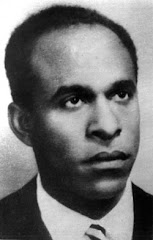
As Frantz Fanon (1925-1981) the revolutionary activist, political theorist, and psychiatrist from the Algerian Revolution so presciently said over five decades ago: "Real political education occurs when the masses understand that everything depends on them"...
Stay tuned...
Kofi
West Backs Gradual Egyptian Transition
by Kareem Fahim, Mark Landler and Anthony Shadid
February 5, 2011
New York Times
 Photographs
Protests in Egypt
CAIRO — The United States and leading European nations on Saturday threw their weight behind Egypt’s vice president, Omar Suleiman, backing his attempt to defuse a popular uprising without immediately removing President Hosni Mubarak from power.
American officials said Mr. Suleiman had promised them an “orderly transition” that would include constitutional reform and outreach to opposition groups.
“That takes some time,” Secretary of State Hilary Rodham Clinton said, speaking at a Munich security conference. “There are certain things that have to be done in order to prepare.”
But the formal endorsement came as Mr. Suleiman appeared to reject the protesters’ main demands, including the immediate resignation of Mr. Mubarak and the dismantling of a political system built around one-party rule, according to leaders of a small, officially authorized opposition party who spoke with Mr. Suleiman on Saturday.
Nor has Mr. Suleiman, a former general, former intelligence chief and Mr. Mubarak’s longtime confidant, yet reached out to the leaders designated by the protesters to negotiate with the government, opposition groups said.
Instead of loosening its grip, the existing government appeared to be consolidating its power: The prime minister said police forces were returning to the streets, and an army general urged protesters to scale back their occupation of Tahrir Square.
Protesters interpreted the simultaneous moves by the Western leaders and Mr. Suleiman as a rebuff to their demands for an end to the dictatorship led for almost three decades by Mr. Mubarak, a pivotal American ally and pillar of the existing order in the Middle East.
Just days after President Obama demanded publicly that change in Egypt must begin right away, many in the streets accused the Obama administration of sacrificing concrete steps toward genuine change in favor of a familiar stability.
“America doesn’t understand,” said Ibrahim Mustafa, 42, who was waiting to enter Tahrir Square. “The people know it is supporting an illegitimate regime.”
Leaders of the Egyptian opposition and rank-and-file protesters have steadfastly rejected any negotiations with Mr. Suleiman until after the ouster of Mr. Mubarak, arguing that moving toward democracy will require ridding the country of not only its dictator but also his rubber-stamp Parliament and a Constitution designed for one-party rule.
On Saturday, Mr. Mubarak’s party announced a shake-up that removed its old guard, including his son Gamal, from the party’s leadership while installing younger, more reform-minded figures. But such gestures were quickly dismissed as cosmetic by analysts and opposition figures.
Mr. Mubarak and Mr. Suleiman “are trying to kill what has happened and to contain and abort the revolution,” said Hassan Nafaa, a political science professor at Cairo University. “They want to continue to manage the country like they did while making some concessions.”
Mrs. Clinton’s message, echoed by Chancellor Angela Merkel of Germany and Prime Minister David Cameron of Britain, and reinforced in a flurry of calls by President Obama and Vice President Joseph R. Biden Jr. to Egyptian and regional leaders, appears to reflect an attempt at balancing calls for systemic change with some semblance of legal order and stability.
Mrs. Clinton said Mr. Mubarak, having taken himself and Gamal out of the September elections, was already effectively sidelined. She emphasized the need for Egypt to reform its Constitution to make a vote credible. “That is what the government has said it is trying to do,” she said.
She also stressed the dangers of holding elections without adequate preparation. “Revolutions have overthrown dictators in the name of democracy, only to see the process hijacked by new autocrats who use violence, deception and rigged elections to stay in power,” she said.
Her emphasis on a deliberate process was repeated by Mrs. Merkel and Mr. Cameron. Mrs. Merkel mentioned her past as a democracy activist in East Germany, recalling the impatience of protesters after the fall of the Berlin Wall in 1989, to immediately join democratic West Germany. But the process took a year, and it was time well spent, she said.
“There will be a change in Egypt,” Mrs. Merkel said, “but clearly, the change has to be shaped in a way that it is a peaceful, a sensible way forward.”
Mrs. Clinton highlighted fears about deteriorating security inside Egypt, noting the explosion at a gas pipeline in the Sinai Peninsula, and uncorroborated news reports of an earlier assassination attempt on Mr. Suleiman.
American officials did not confirm that an assassination attempt had taken place. But Mrs. Clinton referred to reports of the attempt and said it “certainly brings into sharp relief the challenges we are facing as we navigate through this period.”
In a statement, the Egyptian government said there had been no assassination attempt, but added that on Jan. 28 a car in Mr. Suleiman’s motorcade was struck by a bullet fired by “criminal elements.”
At the same Munich meeting on Saturday, Frank G. Wisner, the former ambassador President Obama sent to Cairo to negotiate with Mr. Mubarak, appeared to take an even softer line on the existing government, saying that the United States should not rush to push Mr. Mubarak out the door. He said Mr. Mubarak had a critical role to play through the end of his presidential term in September.
“You need to get a national consensus around the preconditions of the next step forward, and the president must stay in office in order to steer those changes through,” Mr. Wisner said.
The administration later said Mr. Wisner’s comments did not reflect official policy. “The views he expressed today are his own. He did not coordinate his comments with the U.S. government,” said Philip J. Crowley, the State Department spokesman.
White House officials said Friday that they were privately pushing Mr. Suleiman to sideline Mr. Mubarak and eliminate his executive role well before the September elections.
But the mixed signals fueled concerns in Egypt that the administration, which has tried to juggle endorsement of change and continued order, had effectively turned its back on the core demands of those involved in the protest movement.
Mohamed ElBaradei, the Nobel laureate who has been chosen to negotiate on behalf of the protesters and other opposition groups, said the American-backed plan for a gradual transition with Mr. Mubarak remaining in power was a nonstarter. “I do not think it’s adequate,” he said in an interview. “I’m not talking about myself. It’s not adequate for the people.
“Mubarak needs to go,” he said. “It has become an emotional issue. They need to see his back, there’s no question about it.”
Protesters also said that Western worries about security and orderly transitions sounded remarkably like Mr. Mubarak’s age-old excuses for postponing change. And they said they had waited long enough.
“We don’t want Omar Suleiman to take Mubarak’s place. We are not O.K. with this regime at all,” said Omar el-Shawy, a young online activist. “We want a president who is a civilian.”
There were few indications that Mr. Suleiman and other officials were making much progress in addressing concerns of opposition groups.
Mounir Fakhry Abdel-Nour, the secretary general of the opposition Wafd Party, said that in a meeting with Mr. Suleiman on Saturday, the vice president told him that Mr. Mubarak’s leaving early “was out of the question.” He also ruled out any transfer of Mr. Mubarak’s responsibilities.
Mr. Abdel-Nour said that he brought up the possibility of repealing Egypt’s emergency law, which allows the authorities to arrest people without charges. According to Mr. Abdel-Nour, Mr. Suleiman responded: “At a time like this?”
Negotiations between Mr. Suleiman and a group of self-appointed “wise men” who are acting as intermediaries between the vice president and the protesters, and trying to find a way around limits on succession in the Constitution, did not advance significantly.
Amr Hamzawy, one of the intermediaries, said the negotiations were “gaining traction,” but added that his group did not meet with Mr. Suleiman on Saturday. The intermediaries, whose efforts have received the tacit encouragement of Western governments, have forwarded a plan that would see Mr. Mubarak transfer his powers to Mr. Suleiman and perhaps move to his home in Sharm el-Sheik or embark on one of his annual medical leaves to Germany.
In Tahrir Square, meanwhile, the military tightened its cordon around the protesters by reinforcing security checks at all the entrances. An army officer, Brig. Gen. Hassan al-Rawaini, negotiated with protesters outside a barricade near the Egyptian Museum, urging them to bring down the fortifications, allow traffic to return and move their protest to the heart of Tahrir Square.
In contrast to the pitched clashes of just days ago, General Rawaini offered a microphone to protesters so that they could air their complaints. He tried to reason, kissing some on the head and pinching others’ cheeks. Occasionally, he winked.
Eventually, he and his soldiers moved past the makeshift barricade, knocking part of it down, though protesters quickly put back up the sheets of corrugated tin, barrels, metal rebar and parts of fences. He then toured an area strewn with rocks from the clashes and incinerated vehicles that served as barricades. Some protesters thought he was preparing for the army to enter and began forming human chains across the streets. Others chanted “Peaceful!” and formed a bodyguard around the general.
“He wants to tear down these barricades, so that the tanks can come through!” shouted Sayyid Eid, a 20-year-old protester, as he tried to block his way.
“We’re going to die here!” yelled Magdi Abdel-Rahman, another protester.
“Listen to him! Listen to him!” others shouted back.
Tempers cooled and General Rawaini made a leisurely stroll to a makeshift health clinic, then visited knots of protesters across the square with a retinue of soldiers.
“We’re trying to remove the barricades and return the streets to normal,” General Rawaini said. “If you want to protest, you can go back to the square.”
A protester shouted back, “General, we’re not going to walk away from here until Hosni Mubarak leaves!”
Kareem Fahim and Anthony Shadid reported from Cairo, and Mark Landler from Munich. Reporting was contributed by Steven Erlanger from Munich, and David D. Kirkpatrick, Mona El-Naggar and Robert F. Worth from Cairo.
 Ed Ou for The New York TimesAntigovernment protesters clashed with supporters of President Hosni Mubarak near Tahrir Square in Cairo on Thursday.
http://www.nytimes.com/2011/02/04/world/middleeast/04egypt.html?_r=1&nl=todaysheadlines&emc=tha2&pagewanted=all
Crackdown in Egypt Widens but Officials Offer Concessions
By ANTHONY SHADID
Published: February 3, 2011
CAIRO — The Egyptian government on Thursday broadened its crackdown on a 10-day uprising that has shaken its rule, arresting journalists and human rights advocates across an edgy city, while offering more concessions in a bid to win support from a population growing frustrated with a devastated economy and scenes of chaos in the streets.
The campaign was a startling blend of the oldest tactics of an authoritarian government — stoking fears of foreigners — with the air of sincerity of a repentant order. Trying to seize the initiative from a revolt that has marked one of the most decisive moments in modern Egyptian history, the government promised that neither President Hosni Mubarak nor his son Gamal, long seen as a contender for power, would run for president and offered dialogue with the banned Muslim Brotherhood, gestures almost unthinkable weeks ago.
As protesters battled crowds rallied by the government for a second day, organizers sought to rally even bigger demonstrations for Friday — dubbed the “Friday of departure” — in hopes of keeping the momentum behind a popular uprising that has demanded that Mr. Mubarak step down after three decades in power.
Voiced often in the tumultuous scenes of defiance and determination in Tahrir Square was a fear that if they lost, the protesters and their organizers would bear the brunt of a withering crackdown.
“If we can’t bring this to an end, we’re going to all be in the slammer by June,” said Murad Mohsen, a doctor treating the wounded at a makeshift clinic near barricades, where thousands fought off droves of government supporters with rocks and firebombs.
Dr. Mohsen’s comments illustrated the changing dynamic of an uprising that has captivated the Arab world, reverberating through Jordan, Sudan and Yemen, where there were peaceful protests on Thursday. New calls for protests went out in Algeria, Bahrain and Libya.
From festive scenes of just days ago, the revolt has become more martial, as exhausted men defend what they describe as the perimeter of a free Egypt around Tahrir Square. Their demands have grown more forceful and the uprising more radical. After pitched clashes of two days that left at least seven dead and hundreds wounded, banners in Tahrir Square declared Mr. Mubarak “a war criminal,” and several in the crowd said that the president should be executed. Major television networks were largely unable to broadcast from the square on Thursday.
The United States joined a chorus of criticism, with Secretary of State Hillary Rodham Clinton saying, “We condemn in the strongest terms attacks on peaceful demonstrators, human rights activists, foreigners and diplomats.”
The government’s strategy seems motivated at turning broader opinion in the country against the protests and perhaps wearing down the demonstrators themselves, some of whom seemed exhausted by the clashes. Vice President Omar Suleiman, appointed Saturday to a position that Mr. Mubarak had until then refused to fill, appealed to Egypt’s sense of decency in allowing Mr. Mubarak to serve out his term, and he chronicled the mounting losses that, he said, the uprising had inflicted on a crippled Egyptian economy.
“End your sit-in,” he said. “Your demands have been answered.”
Mr. Mubarak said in an interview with ABC that he was eager to step down but if he did, “Egypt would sink into chaos.”
In interviews and statements, the government has increasingly spread an image that foreigners were inciting the uprising, a refrain echoed in the streets. The suggestions are part of a days-long Egyptian media campaign that has portrayed the protesters as troublemakers and ignored the scope of an uprising with diffuse goals and leadership.
“Millions turn out to support Mubarak,” read the banner headline on Thursday on the front page of Al Ahram, the leading government newspaper.
The propaganda has been so pronounced that an announcer on Nile Television, Shahira Amin, quit. “I cleared my conscience and walked out,” she said.
The Committee to Protect Journalists said it had 100 reports of attacks on journalists. Al Jazeera, the influential Arabic channel, said government supporters stormed the Hilton Hotel in Cairo, searching for journalists, and two of its reporters were attacked. A Greek journalist was stabbed with a screwdriver and others were beaten and harassed.
Police also raided the Hisham Mubarak Law Center, a headquarters for many of the international human rights organizations working in Egypt. The human rights workers were told to lie on the floor and the chips were removed from the telephones, someone present in the building said, speaking on condition of anonymity for fear of retribution.
As the day wore on, tension descended across parts of the city, which is still guarded by popular committees that banded together after the police withdrew Saturday. Government supporters roamed parts of the downtown, itching for a fight, and looters set fire to a shopping mall along the Nile that was already looted and burned Friday.
The menace was a counterpoint to Tahrir Square, where the literati and well-off demonstrators mixed with the poorest of rough-and-tumble neighborhoods in scenes of camaraderie and determination that have made the square an emblem of the revolt. Protesters flashed V-for-victory signs at dawn, celebrating their success in holding the square and even pushing the barricades forward in clashes that dragged through the night.
Protesters accused government supporters of trying to block them from delivering supplies to the square, but boxes of water, bananas, yogurt and medicine still made it in. The Internet was working. Volunteers swept the streets, pushing piles of rocks to the curb that looked like bluffs of snow. Doctors staffed first-aid clinics, near graffiti that read, “We are writing the history of a free Egypt,” and men frisked people entering for weapons.
“Don’t incite them!” shouted Mahmoud Haqiqi, holding aloft a sign that read, “No to shedding of blood.” But even those who lamented the turn to violence blamed Mr. Mubarak’s supporters for provoking them and vowed not to relinquish the square. “Right now, it’s all here, protecting Tahrir Square,” said Hisham Kassem, a veteran activist and publisher, who kept a wary eye on barricades built with corrugated tin, wrecked cars and trucks, barrels, buckets filed with sand and metal railing torn from the curb. “We keep it tonight, and tomorrow the whole country is going to come out.”
He surveyed the crowd and shook his head. “I can’t face the idea of this failing.”
For days, the government seemed to stagger at the scale of an uprising that overwhelmed Egypt’s once ubiquitous security forces on Friday. The concessions on Thursday marked its most concerted attempt to address at least some of the longstanding demands in a country that many believe has stagnated under Mr. Mubarak’s rule. The newly appointed prime minister, Ahmed Shafiq, apologized for the violence and vowed to investigate who instigated it. Mr. Suleiman followed with a lengthy television interview in which he recognized what he described as “the revolution of the youth.”
Mr. Suleiman sought to project an image of good will, offering dialogue with the Muslim Brotherhood, which remains banned, even though it is the country’s most influential opposition group. In a sign of the new landscape, Mr. Suleiman referred to it by name rather than the government’s usual coded language, though he and Mr. Mubarak have both suggested it was behind the revolt. Its followers have played a forceful role in the protests, but its leaders have, so far, tried to remain in the background.
“We have contacted the Muslim Brotherhood and invited them, but they are still hesitant about the dialogue,” he said. “I think that their interest is to attend the dialogue.”
Other concessions came from Egypt’s public prosecutor, who issued a travel ban on former government ministers and an official of the ruling National Democratic Party on suspicion of theft of public money, profiteering and fraud, state television reported. Among the four was the hated former interior minister, Habib el-Adly, who commanded a police force that was widely despised for its corruption and routine use of torture.
So far, the government’s concessions have done little to diminish the protests, but the relentless message of officials that Egypt faced chaos seemed, at least anecdotally, to be finding an audience.
“This is enough,” said Ahmed Mohamed, a 22-year-old broker at the National Bank of Kuwait, hanging out at a rarity in Cairo, a coffee shop doing business. “I want life to go back to normal. We want to go back to work. And what we have done in 72 hours we couldn’t achieve in 30 years. It’s only a few months until Mubarak leaves.”
David D. Kirkpatrick, Kareem Fahim, and Mona El-Naggar contributed reporting from Cairo.
http://www.bloomberg.com/news/2011-02-04/egypt-chaos-defines-bleeding-in-despot-arab-world-commentary-by-tariq-ali.html
Egypt Chaos Defines Bleeding in Despot Arab World
By Tariq Ali
Feb 3, 2011
Bloomberg Opinion
Feb. 3 (Bloomberg) -- Haleh Esfandiari, director of the Middle East program for the Woodrow Wilson International Center for Scholars, talks about protests against Egyptian President Hosni Mubarak. She speaks with Pimm Fox on Bloomberg Television's "Taking Stock." (Source: Bloomberg)
“Freedom lies behind a door closed shut,” the great Egyptian poet Ahmed Shawqi wrote in the last century. “It can only be knocked down with a bleeding fist.” More than that is bleeding in the Arab world at the moment.
The uprisings we are witnessing in Egypt have been a rude awakening for all those who imagined that the despots of the Arab world could be kept in place provided they continued to serve the needs of the West and their harsh methods weren’t aired on CNN and BBC World. But while Western establishments lull themselves to sleep with fairy tales, ordinary citizens, who are defeated and demoralized, mull their revenge.
The French government seriously considered sending its paratroopers to save former President Zine El Abidine Ben Ali in Tunisia. Israeli Prime Minister Benjamin Netanyahu is pleading with officials in Washington to delay Hosni Mubarak’s departure from Egypt so that Israel has time to prepare for the likely outcome. Former U.K. Prime Minister Tony Blair is even describing the Egyptian dictator as a “force for good.”
The almost 200 pro-democracy citizens who have been killed don’t bother him too much. That’s small beer compared with the tens of thousands dead in Iraq. And a desperate Palestine Liberation Organization is backing Mubarak and repressing solidarity demonstrations in Ramallah on the West Bank.
Hated Figures
In Yemen, another strongman in power for 30 years is beginning to totter. President Ali Abdullah Saleh is a hated figure, again backed by the West, as I discovered when I visited the country last year.
If Tunisia was a tremor, the Egyptian uprising has become an earthquake that is spreading throughout the region. The generals in Cairo are still refusing to disperse the crowds with tanks and bullets. A full-scale Tiananmen Square option, which Mubarak and his friends would have appreciated, becomes difficult in these conditions.
So what will they do? As the crisis moves a step further, Vice President Omar Suleiman, not trusted by many people as the former director of intelligence, is hoping to divide the opposition, clear the streets and negotiate a deal, offering Amr Moussa, the toothless head of the Arab League, the interim presidency. They want someone who will retain the remnants of the old institutions and, in particular, the apparatuses of the secret state that have been so useful in helping the West’s policy of renditions in the war on terror, which has so far only succeeded in engendering more terror.
Total Overhaul
The millions of people in the streets of Egypt are demanding a total overhaul. They want, as in Tunisia, a new constitution that guarantees political and social rights. They want an independent foreign policy that is decided in Cairo, not Tel Aviv or Washington. They want to lift the blockade of Gaza so that its people can live as normally as possible.
This week, the Egyptian regime, shaken by the mass mobilizations, threatened counter-revolution. Pro-Mubarak forces, a combination of the security cops out of uniform and gangsters released from prison, attacked protesters, creating mayhem in Tahrir Square. The military, which pledged to defend public safety, failed to do so.
In Alexandria, there were clashes between Mubarak’s desperate supporters and the anti-government protesters. The coming weekend is decisive. The planned march by several hundred thousand people on the presidential palace might drive Mubarak to get a helicopter to the airport. One assumes the Saudis are preparing a palace for him as is their wont.
Plan B
A post-Mubarak Egypt is difficult to predict with exactitude. What we can say is that it won’t be a repeat of the 1979 Iranian Revolution. The iron will of the Ayatollah doesn’t exist in Cairo. Instead there is a decent, amiable technocrat, Mohamed El Baradei, more known abroad than at home, as a possible Plan B for the White House.
Lurking behind El Baradei is the Muslim Brotherhood. It, too, is divided, with a dominant wing composed of young, modernist Muslims who want to mimic Turkey. If the North Atlantic Treaty Organization’s favorite Islamists in Istanbul can do business with Washington, why not their Egyptian equivalents? They have been engaged in private discussions with informal emissaries from the U.S. for more than a decade.
Nonetheless, a regime propelled into office via an uprising from below can’t be as cavalier in disregarding public opinion, and nor is this a time for the U.S. to start preaching the virtues of liberal capitalism: The recent fate of Iceland, Ireland and Greece should be enough on that score.
Internally, what is required is to rebuild the abandoned social safety net, providing elementary health, education and housing for the poor.
Externally, Egypt’s relationship with the U.S. and Israel will have to be modified, regardless of who succeeds Mubarak. A peace treaty that benefits Israel alone was never accepted by the Egyptian people.
Only then will Egypt be able to stop the bleeding.
(Tariq Ali is a London-based writer, filmmaker and author of the 2010 book “The Obama Syndrome.” The opinions expressed are his own.)
To contact the writer of this column: Tariq Ali at tariq.ali3@btinternet.com
To contact the editor responsible for this column: James Greiff at jgreiff@bloomberg.net
 Stephen Crowley/The New York TimesPresident Barack Obama on Thursday. The White House is in discussions to find a way out of the crisis in Cairo.
http://www.nytimes.com/2011/02/04/world/middleeast/04diplomacy.html?_r=1&ref=global-home&pagewanted=all
All,
Call it kismet, call it karma, call it chickens coming home to roost, call it what goes around comes around, call it PAYBACK (is a dog!), call it having your hold card "peeped", call it "you are SO busted!", call it I can't believe I ate the WHOLE thing, call it EXPOSED, call it any goddamn thing you wanna call it--it all MEANS the same damn thing anyway ("same ole shit/different day"): The United Hates of Hysteria and its political/economic elites via its "charmingly" duplicitous neoliberal tool of the ruling class--(uh...I mean da American President) has once again showed its embarassingly transparent ASS in calling for the CIA's man in Egypt Omar Sulieman, documented torturer and renditions cop (uh...I mean da Egyptian Vice President) acting on the behalf of that Grand Ole Thug and murderer/thief/pathological liar "where's the beef" Hosni Mubarak? (uh...I mean da Egyptian President) and yes THE ARMY to "run" Egypt's "new government" (with Barack promising Hosni a guest host shot on not only Jay Leno, but Letterman, and Oprah too!) if he would simply "step down" and let "much younger professional killers handle everything" and get "the little people to calm the fuck down!--WOW--What a deal!!--ONLY IN AMERICA (and now sadly Egypt 2), huh?...
Kofi
White House, Egypt Discuss Plan for Mubarak’s Exit
By HELENE COOPER and MARK LANDLER
February 3, 2011
New York Times
WASHINGTON — The Obama administration is discussing with Egyptian officials a proposal for President Hosni Mubarak to resign immediately, turning over power to a transitional government headed by Vice President Omar Suleiman with the support of the Egyptian military, administration officials and Arab diplomats said Thursday.
Even though Mr. Mubarak has balked, so far, at leaving now, officials from both governments are continuing talks about a plan in which Mr. Suleiman, backed by Lt. Gen. Sami Enan, chief of the Egyptian armed forces, and Field Marshal Mohamed Tantawi, the defense minister, would immediately begin a process of constitutional reform.
The proposal also calls for the transitional government to invite members from a broad range of opposition groups, including the banned Muslim Brotherhood, to begin work to open up the country’s electoral system in an effort to bring about free and fair elections in September, the officials said.
Senior administration officials said that the proposal was one of several options under discussion with high-level Egyptian officials around Mr. Mubarak in an effort to persuade the president to step down now.
They cautioned that the outcome depended on several factors, not least Egypt’s own constitutional protocols and the mood of the protesters on the streets of Cairo and other Egyptian cities.
Some officials said there was not yet any indication that either Mr. Suleiman or the Egyptian military was willing to abandon Mr. Mubarak.
Even as the Obama administration is coalescing around a Mubarak-must-go-now posture in private conversations with Egyptian officials, Mr. Mubarak himself remains determined to stay until the election in September, American and Egyptian officials said. His backers forcibly pushed back on Thursday against what they viewed as American interference in Egypt’s internal affairs.
“What they’re asking cannot be done,” one senior Egyptian official said, citing clauses in the Egyptian Constitution that bar the vice president from assuming power. Under the Constitution, the speaker of Parliament would succeed the president. “That’s my technical answer,” the official added. “My political answer is they should mind their own business.”
Mr. Mubarak’s insistence on staying will again be tested by large street protests on Friday, which the demonstrators are calling his “day of departure,” when they plan to march on the presidential palace. The military’s pledge not to fire on the Egyptian people will be tested as well.
The discussions about finding a way out of the crisis in Cairo take place as new questions are being raised about whether American intelligence agencies, after the collapse of the Tunisian government, adequately warned the White House and top lawmakers about the prospects of an uprising in Egypt.
During a Senate hearing on Thursday, both Democrats and Republicans pressed a senior Central Intelligence Agency official about when the C.I.A. and other agencies notified President Obama of the looming crisis, and whether intelligence officers even monitored social networking sites and Internet forums to gauge popular sentiment in Egypt.
“At some point it had to have been obvious that there was going to be a huge demonstration,” said Senator Dianne Feinstein, the California Democrat who is chairwoman of the Senate’s Select Committee on Intelligence.
She said that intelligence agencies never sent a notice to her committee about the growing uprising in Egypt, as is customary in the case of significant global events.
Stephanie O’Sullivan, the C.I.A. official, responded that the agency had been tracking instability in Egypt for some time and had concluded that the government in Cairo was in an “untenable” situation. But, Ms. O’Sullivan said, “we didn’t know what the triggering mechanism would be.”
Because of the fervor now unleashed in Egypt, one Obama administration official said, Mr. Mubarak’s close aides expressed concern that they were not convinced that Mr. Mubarak’s resignation would satisfy the protesters.
In an interview with Christiane Amanpour of ABC News, Mr. Mubarak said that he was “fed up” with being president but that he could not step down for fear of sowing chaos in the country.
“The worry on Mubarak’s part is that if he says yes to this, there will be more demands,” said Leslie H. Gelb, president emeritus of the Council on Foreign Relations. “And since he’s not dealing with a legal entity, but a mob, how does he know there won’t be more demands tomorrow?”
A number of high-level American officials have reached out to the Egyptians in recent days. While administration officials would not offer details of the alternatives that were being discussed, they made it clear that their preferred outcome would be for Mr. Suleiman to take power as a transitional figure.
Vice President Joseph R. Biden Jr. spoke by phone to Mr. Suleiman on Thursday, the White House said in a statement, urging that “credible, inclusive negotiations begin immediately in order for Egypt to transition to a democratic government that addresses the aspirations of the Egyptian people.”
Mr. Biden’s phone call came after a mission by Mr. Obama’s private emissary, Frank G. Wisner, was abruptly ended when Mr. Mubarak, angry at Mr. Obama’s toughly worded speech on Tuesday night, declined to meet with the envoy a second time, officials said.
Defense Secretary Robert M. Gates has made three calls since the weekend to Egypt’s powerful defense minister, Field Marshal Tantawi, who served on the coalition’s side in the Persian Gulf war of 1991.
Pentagon officials declined on Thursday to describe the specifics of the calls but indicated that Mr. Gates’s messages were focused on more than urging the Egyptian military to exercise restraint.
Officials familiar with the dialogue between the Obama administration and Cairo say that American officials have told their Egyptian counterparts that if they support another strongman to replace Mr. Mubarak — but without a specific plan and timetable for moving toward democratic elections — Congress might react by freezing military aid to Egypt.
On Thursday, the Senate passed a resolution calling on Mr. Mubarak to begin the transfer of power to an “inclusive, interim caretaker government.”
Anthony H. Cordesman, an expert on the Egyptian military at the Center for Strategic and International Studies in Washington, said that a transition government led by Mr. Suleiman and the military, with pledges to move toward democratic elections, was in his mind “the most probable case.” But he said the administration had to proceed with extreme caution.
“Everybody working this issue knows that this is a military extremely sensitive to outside pressure,” Mr. Cordesman said.
Even as the Obama administration has ratcheted up the pressure on Egypt, it has reaffirmed its support for other Arab allies facing popular unrest.
The White House released a statement saying that Mr. Obama called President Ali Abdullah Saleh of Yemen on Wednesday to welcome Mr. Saleh’s recent “reform measures” — the Yemeni president promised not to run again in 2013.
And on Thursday, Secretary of State Hillary Rodham Clinton called King Abdullah II of Jordan to say that the United States looked forward to working with his new cabinet — recently announced — and to underline the importance of the relationship between Jordan and the United States.
Philip J. Crowley, the State Department spokesman, declined to say whether Mrs. Clinton had enlisted King Abdullah in an effort to ease out Mr. Mubarak. But Mr. Crowley praised the king for responding to the unrest in Jordan.
“He’s doing his best to respond to this growing aspiration,” Mr. Crowley said. “And we appreciate the leadership he’s shown.”
Elisabeth Bumiller, Mark Mazzetti and Thom Shanker contributed reporting.
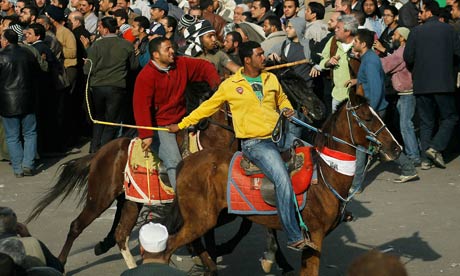
 Hosni Mubarak supporters ride horses during a clash between pro- and anti-Mubarak protesters. Photograph: Chris Hondros/Getty Images
http://www.guardian.co.uk/commentisfree/2011/feb/02/egypt-protests-mubarak
All,
The real nature of counter revolution, what it really means in Egypt today, and the ominous complicity of the United States and the Obama administration in its lethal perpetuation--both violently and non-violently.
Kofi
Egypt protests: Mubarak shows his dark side
by Simon Tisdall
guardian.co.uk,
Wednesday 2 February 2011
The counter-revolutionary message to the people from an unvanquished, still vicious regime is: it's over – go home, or else
Hosni Mubarak launched his counter-revolution today, sending waves of armed thugs to do battle with pro-democracy demonstrators in Cairo and other cities. The attacks, reportedly involving plainclothes police and vigilantes as well as pro-regime citizens, appeared to be carefully co-ordinated and timed. And the army, which only days earlier had sworn to protect "legitimate" rights of protesters, stood back and watched as the blood flowed.
This ugly turn of events should come as no surprise. What is unusual is that the regime tolerated such levels of unrest for nearly a week.
Mubarak was never quite a dictator in the Saddam Hussein or Robert Mugabe mould. His rule was more akin to the semi-enlightened despotism of an 18th-century European monarch. But at bottom, it always depended on coercion and force. Today, the pretence of reasonableness was torn away. His dark side showed for all to see.
Mubarak's speech to the nation on Tuesday night was widely misinterpreted. The president was, by turns, angry, defiant and unrepentant. He offered no apologies, proposed no new initiatives, gave no promise that his son Gamal would not succeed him, and instead lectured Egyptians on the importance of order and stability (which he alone could assure).
He appeared not to have learned anything from the past week. And his one "concession" – that he would not seek re-election – was no concession at all. After all, he had never said he would.
This was not the performance of a defeated man. Mubarak may be down but he's not out. And judging by today's events in Tahrir Square, he and the military-dominated clique around him clearly feel they have done enough, for now, to get the Americans off their backs, flex their still considerable muscle, and reclaim the streets for the regime. All the talk about reform and elections and negotiations can wait, whatever Barack Obama says.
Today's immediate message to the people from an unvanquished, still vicious regime: it's over – go home, or else.
There's a good to middling chance the counter-revolution strategy will work, given time. "Imagine yourself as Hosni Mubarak, master of Egypt for nearly 30 years. You're old, unwell, detested and addicted to power," wrote Wall Street Journal columnist Bret Stephens.
"You could have orchestrated a graceful exit by promising to preside over free and fair presidential elections later this year – elections in which the Mubarak name would not be on the ballot. Instead you gambled that you could ride out the protests and hold on. It's a pretty good gamble ..."
Reasons for believing Mubarak can not only survive the next eight months but also exert decisive, possibly fatally obstructive influence over Egypt's new direction are plentiful. As matters stand now, the regime is unreconstructed, the opposition is split, and the Americans are undecided. Despite his insistence on a swift, orderly transition, Obama has not withdrawn his personal support. In Brussels today, the EU also declined to demand Mubarak's immediate resignation. David Cameron said reforms must be implemented faster.
All of them got a dusty brush-off. In an official statement, the Egyptian foreign ministry, still led by an old Mubarak crony, Ahmed Aboul Gheit, rejected US and European calls for the transition to start now. Calls from "foreign parties" were "aimed to incite the internal situation," it said. In other words: get lost.
Mubarak and his close confidant and deputy, Omar Suleiman, have more cards to play as they foment a backlash and seek to regain control. As in the past, they can play on Israeli and American fears of an Islamist takeover. They can point out just how disastrous it might be if a new government tore up Egypt's peace treaty with Israel.
The opposition leader, Mohamed ElBaradei can easily be portrayed as untrustworthy. In fact, such a campaign is already under way. The Americans, for example, suspected him of pro-Iranian bias when he headed the UN's nuclear watchdog – and believe, too, that he is far too cosy with Turkey's neo-Islamist leaders.
As he tries to reassert his primacy, Mubarak can rely on the conservative Arab states of the Gulf, Saudi Arabia, Libya and Algeria, and on any number of African governments that have no wish to encourage popular revolution. Even old enemy Iran is privately ambivalent on this score.
He can offer negotiations to the opposition and hope to gain advantage from their refusal, so far, to participate. And if all this fails, the regime can always let loose its thugs and hooligans, just to emphasise that without state-imposed order, only chaos, not democracy, reigns.
Mubarak's counter-revolution is still a long shot. Too much has changed in Egypt for it ever to go back the way things were. But today saw the beginning of a new stage in a complex internal struggle whose ultimate outcome remains deeply uncertain.
http://www.truth-out.org/us-chickens-come-home-roost-egypt67385
All,
NATAMBU'S LAW states: "No matter how bad or fucked up any particular situation is or appears to be, or how much you know or think you know about what it all means, in reality it's always far worse than anything you could possibly imagine"
Kofi
"A former CIA agent observed, "If you want a serious interrogation, you send a prisoner to Jordan. If you want them to be tortured, you send them to Syria. If you want someone to disappear - never to see them again - you send them to Egypt."
US Chickens Come Home to Roost in Egypt
by Marjorie Cohn
Wednesday 02 February 2011
Truthout
Barack Obama, like his predecessors, has supported Egyptian President Hosni Mubarak to the tune of $1.3 billion annually, mostly in military aid. In return, Egypt minds US interests in the Middle East, notably providing a buffer between Israel and the rest of the Arab world. Egypt collaborates with Israel to isolate Gaza with a punishing blockade, to the consternation of Arabs throughout the Middle East. The United States could not have fought its wars in Iraq without Egypt's logistical support.
Now, with a revolution against Mubarak by two million Egyptians, all bets are off about who will replace him and whether the successor government will be friendly to the United States.
Mubarak's "whole system is corrupt," said Hesham Korayem, an Egyptian who taught at City University of New York and provides frequent commentary on Egyptian and Saudi television. He told me there is virtually no middle class in Egypt, only the extremely rich (about 20 to 25 percent of the population) and the extremely poor (75 percent). The parliament has no input into what Mubarak does with the money the United States gives him, $300 million of which comes to the dictator in cash each year.
Torture is commonplace in Egypt, according to Korayem. Indeed, Omar Suleiman, Egypt's intelligence chief whom Mubarak just named vice president, was the lynchpin for Egyptian torture when the Central Intelligence Agency (CIA) sent prisoners to Egypt in its extraordinary rendition program. Stephen Grey noted in his book "Ghost Plane" that "[I]n secret, men like Omar Suleiman, the country's most powerful spy and secret politician, did our work, the sort of work that Western countries have no appetite to do ourselves."
In her chapter in the newly published book, "The United States and Torture: Interrogation, Incarceration, and Abuse," Jane Mayer cites Egypt as the most common destination for suspects rendered by the United States. "The largest recipient of US foreign aid after Israel," Mayer writes, "Egypt was a key strategic ally, and its secret police force, the Mukhabarat, had a reputation for brutality." She describes the rendering of Ibn al-Sheikh al-Libi to Egypt, where he was tortured and made a false confession that Colin Powell cited as he importuned the Security Council to approve the US invasion of Iraq. Al-Libi later recanted his confession.
The State Department's 2002 report on Egypt noted that detainees were "stripped and blindfolded; suspended from a ceiling or doorframe with feet just touching the floor; beaten with fists, metal rods, or other objects; doused with hot or cold water; flogged on the back; burned with cigarettes; and subjected to electrical shocks. Some victims ... [were] forced to strip and threatened with rape."
In 2005, the United Nations Committee Against Torture found that, "Egypt resorted to consistent and widespread use of torture against detainees" and "the risk of such treatment was particularly high in the case of detainees held for political and security reasons."
About a year ago, an Italian judge convicted 22 CIA operatives and a US Air Force colonel of arranging the kidnapping of a Muslim cleric in Milan in 2003 and flying him to Egypt, where he was tortured. Hassan Mustafa Osama Nasr told Human Rights Watch he was "hung up like a slaughtered sheep and given electrical shocks" in Egypt. "I was brutally tortured and I could hear the screams of others who were tortured too," he added.
A former CIA agent observed, "If you want a serious interrogation, you send a prisoner to Jordan. If you want them to be tortured, you send them to Syria. If you want someone to disappear - never to see them again - you send them to Egypt."
So, what will happen next in Egypt?
Suleiman, who is intensely loyal to Mubarak, will not be an acceptable successor to the Egyptian people. Some fear that the Muslim Brotherhood, which supports Hamas, will take power once Mubarak is forced out, but "[t]hough it is the largest opposition group, it by no means enjoys overwhelming support, and its leaders are for the most part moderate and responsible," Scott MacLeod, Time magazine's Middle East correspondent from 1995 to 2010, wrote in The Los Angeles Times. Korayem concurs. He says the Brotherhood, which has formally renounced terrorism and violence, is more educated and peaceful now. The Brotherhood provides social and economic programs that augment public services in Egypt.
Indeed, the Brotherhood supports Mohamed ElBaradei to negotiate with the Egyptian government. ElBaradei, the former UN International Atomic Energy Agency chief and Nobel Peace Prize recipient, recently returned to Egypt to stand with the protesters. He told Fareed Zakaria on CNN that the Brotherhood favors a secular state, and "has nothing to do with the Iranian movement, has nothing to do with extremism as we have seen it in Afghanistan and other places."
The Obama administration has been slow to acknowledge that Mubarak is on his way out. Vice President Joe Biden, still in denial, said on the PBS News Hour, "I would not refer to him as a dictator." ElBaradei criticized Obama for supporting Mubarak in the face of the popular revolt in Egypt. "You are losing credibility by the day," he told CBS News. "On one hand you're talking about democracy, rule of law and human rights, and on the other hand you are lending support to a dictator that continues to oppress his people."
Korayem sees the United States' uncritical support for Israel as key to the problems in Egypt and elsewhere in the Middle East. If the United States acted as an honest broker, even "slightly fair to the Palestinians," that would go a long way to solving the difficulties, he said. But, according to journalist Gareth Porter, "The main function of the U.S. client state relationship with Egypt was to allow Israel to avoid coming to terms with Palestinian demands." Writing in Truthdig, Chris Hedges added that, "The failure of the United States to halt the slow-motion ethnic cleansing of Palestinians by Israel has consequences. The failure to acknowledge the collective humiliation and anger felt by most Arabs because of the presence of U.S. troops on Muslim soil ... has consequences."
We are seeing those consequences in the streets of Egypt and in the likelihood of similar developments in Jordan, Yemen and other Middle Eastern countries. Until the US government stops uncritically supporting tyrants, torturers and oppressors, we can expect the people to rise up and overthrow them.
Published on Truthout (http://www.truth-out.org)
http://www.truth-out.org/mubarak-supporters-violently-attack-protesters-tahrir-square-over-100-injured-video67404?utm_source=twitterfeed&utm_medium=twitter
All,
The vicious organized attacks on Egyptian anti-government demonstrators by thousands of thugs and criminals (as well as clearly undercover police and military operatives) bought and paid for by the despicable and tyrannical Mubarak regime is not only an indictment of that venal dictatorship but of President Obama's hopelessly weak, temporizing, and thereby complicit denial of the absolute necessity to publicly denounce and completely repudiate Mubarak's extremely repressive and antidemocratic government and demand his IMMEDIATE OUSTER TODAY (especially following the Egyptian dictator's ominously threatening, stubbornly incoherent, and clearly delusional "speech" on Egyptian television in the very early morning hours yesterday). As I write this four people have already officially been killed and hundreds seriously wounded in the government sponsored massacre that is described in detail below. Needless to say these criminally brutal and lethal actions by Mubarak's hired gangsters and the absurdly "diplomatic" overtures and "suggestions" by Obama's administration and the State Department about the need for the dictator to make an "orderly and peaceful transition to handing over authority now" have combined to make an already highly volatile situation far worse and is directly contributing to the rapid exponential growth of a major crisis with monumental consequences for not only Egypt but the entire Middle East region and the world...Stay tuned...
Kofi
Mubarak Supporters Riding on Horses and Camels Violently Attack Protesters in Tahrir Square, Over 100 Injured (Video)
Wednesday 02 February 2011
by: Amy Goodman | Democracy NOW! | Report
Violent clashes broke out just before our broadcast when supporters of Egyptian President Hosni Mubarak attacked anti-government protesters in Tahrir Square in Cairo. Reports are that more than 100 people have been injured. “The entire square is surrounded by thugs, and apparently there are more coming on the way,” reports Egyptian activist Nazly Hussein. "I have seen people come out injured… I saw people carried into the medical center injured." We get live reports from Hussein and Democracy Now!’s senior producer Sharif Abdel Kouddous, who are both in Cairo. [includes rush transcript]
Guests:
Sharif Abdel Kouddous, Democracy Now! senior producer
Nazly Hussein, Egyptian demonstrator
Amy Goodman: We begin the show in Cairo, where mass protests continue following President Hosni Mubarak’s refusal to immediately step down. The Egyptian army has called for the protests to end, but thousands remain in the streets. Violent clashes have broken out between pro-Mubarak and anti-government protesters in Tahrir Square in Cairo.
We’re going to go right now to Sharif Abdel Kouddous, Democracy Now! senior producer. He’s just come from Tahrir Square. In a moment, he’ll join us in studio, but this is too important to wait for that studio satellite to begin.
Sharif, tell us what’s happening now in Tahrir Square.
Sharif Abdel Kouddous: Amy, I just came back from Tahrir Square. I’m standing, talking to you on a building on top of Kornish Al Nile, which is right on—just a few hundred yards from Tahrir Square near the Nile. I don’t know if you can hear in the background, but there are hundreds, thousands of pro-Mubarak crowds who are streaming towards Tahrir.
In Tahrir, they have actually made it into the square. The army let them in. And now they are facing off. [inaudible] pushing. There’s a lot of cursing. This is mostly coming from the pro-Mubarak forces. If you walk in the street next to them, they’re very in-your-face. It’s a much more aggressive stance than we’ve seen. And we spoke to people in Tahrir who say that they’re basically coming from three different areas. There are Central Security forces who are dressed in civilian clothes, a lot of what we call baltaguia, who are also known as thugs. There’s also reports that the oil minister, Sameh Fahmi, issued orders for employees at oil companies to show up today in Heliopolis, another district in Cairo, and to demonstrate for Mubarak. And many of them are suspected to be government employees and members of the National Democratic Party.
This is an ominous development that’s happened now. They’re trying to take back Tahrir Square. They’re facing off right now. Protesters of the pro-democracy movement have linked arms. They’re holding strong. But the numbers are not what they last night in Tahrir. Many people went home. So it remains to be seen what is going to happen. I don’t know if you can hear in the background right now. The chants are getting louder. They are streaming in. This is a big coordinated effort to come back and take Tahrir. It remains to be seen what’s going to happen.
Many of the protesters in Tahrir said, "We’re going to stay here. We’re going to spend the night. If we get beaten, we get beaten. We will not hit back. But we are not leaving."
Amy Goodman: We are also joined by Nazly Hussein, along with Sharif Abdel Kouddous, in another part of the area around Tahrir Square, an Egyptian woman who’s been taking part in the protests, has been involved in opposition politics in Egypt for several years. Nazly, what do you see right now in Tahrir Square from your vantage point?
Nazly Hussein: I am currently trying to make it into Tahrir Square. I’m not on the square yet. The entire people on the square feel safe and say it’s calm and it’s OK inside the square. I’m trying to make it into the square. But the entire square is surrounded by thugs, and apparently there are more coming on the way. So we’re trying to make it into the square. People on the square are more [inaudible]. There’s a lot of efforts to bring people outside—
Amy Goodman: Have you seen any—Nazly, have you seen any injuries?
Nazly Hussein: I saw injuries. I have not seen the thugs with weapons. I can—you recognize them. After a few days on the street, you recognize them. But I have seen people come out injured. I was standing, two minutes ago, by a—when you first called me—by a medical point, and I saw people carried into the medical center injured. I have not seen anyone use violence. But you recognize them. And it’s really difficult to make it into the square. I have to go to another entry point right now and try to make it into the square.
Amy Goodman: Well, I want to thank you, Nazly Hussein, speaking to us from Tahrir Square. And Sharif will be joining us in a studio momentarily.
 EGYPT TV via APTN, via Associated Press
 Moises Saman for The New York Times