https://www.historyisaweapon.com/defcon1/misedne.html
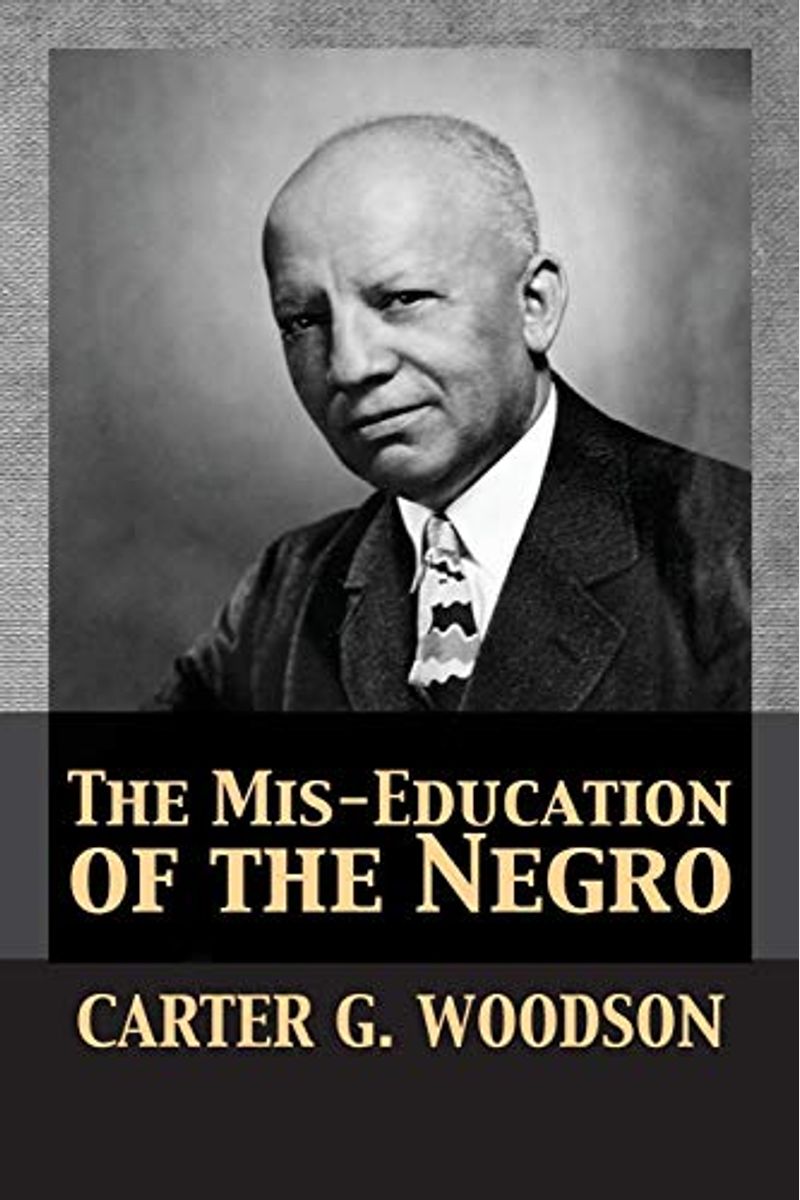
The Mis-Education of the Negro
by Dr. Carter Godwin Woodson
Edited with an Introduction by Charles H. Wesley and Thelma D. Perry
First published in 1933 this legendary text is still in print
[NOTE: The following excerpts from Dr. Woodson’s book is taken from the introduction, foreword, preface, and chapter one of the text]
Contents:
INTRODUCTION
v
FOREWORD
xxv
Preface
xxix
CHAPTER
PAGE
I.
THE SEAT OF THE TROUBLE
1
II.
HOW WE MISSED THE MARK
9
III.
HOW WE DRIFTED AWAY FROM THE TRUTH
17
IV.
EDUCATION UNDER OUTSIDE CONTROL
26
V.
THE FAILURE TO LEARN TO MAKE A LIVING
38
VI.
THE EDUCATED NEGRO LEAVES THE MASSES
52
VII.
DISSENSION AND WEAKNESS
62
VIII.
PROFESSIONAL EDUCATED DISCOURAGED
74
IX.
POLITICAL EDUCATION NEGLECTED
83
X.
THE LOSS OF VISION
96
XI.
THE NEED FOR SERVICE RATHER THAN LEADERSHIP
111
XII.
HIRELINGS IN THE PLACES OF PUBLIC SERVANTS
120
XIII.
UNDERSTAND THE NEGRO
132
XIV.
THE NEW PROGRAM
144
XV.
VOCATIONAL GUIDANCE
157
XVI.
THE NEW TYPE OF PROFESSIONAL MAN REQUIRED
173
XVII.
HIGHER STRIVINGS IN THE SERVICE OF THE COUNTRY
181
XVIII.
THE STUDY OF THE NEGRO
190
APPENDIX
199
INDEX
207
Introduction
Considerable time has passed since the first printing of this volume, but it is significant that it has meaning and direct implications for today's consideration. While it does not relate exclusively to Black History it does emphasize its instruction, research and writing. In substance Carter Woodson has produced a definitive and constructive critique of the educational system, with special reference to its blighting effects on the Negro; and the term he used, Mis-education, was the most apt and descriptive word available. It is still, in 1969, equally as relevant and expressive. Now, however, it is loudly articulated by many voices of Whites as well as Blacks, who likewise challenge the system.
The most imperative and crucial element in Woodson's concept of mis-education hinged on the education system's failure to present authentic Negro History in schools and the bitter knowledge that there was a scarcity of literature available for such a purpose, because most history books gave little or no space to the black man's presence in America. Some of them contained casual references to Negroes but these generally depicted them in menial, subordinate roles, more or less sub-human. Such books stressed their good fortune at having been exposed, through slavery, to the higher (white man's) civilization. There were included derogatory statements relating to the primitive, heathenish quality of the African background, but nothing denoting skills, abilities, contributions or potential in the image of the Blacks, in Africa or America. Woodson considered this state of affairs deplorable, an American tragedy, dooming the Negro to a brain-washed acceptance of the inferior role assigned to him by the dominant race, and absorbed by him through his schooling.
Moreover, the neglect of Afro-American History and distortion of the facts concerning Negroes in most history books, deprived the black child and his whole race of a heritage, and relegated him to nothingness and nobodyness. This was Woodson's conviction as he stated it in this book and as he lived by it. In his Annual Report of the Association for the Study of Negro Life and History for the year ending June 30, 1933, the publication period of Mis-Education, he stated:
Regarding the Negro race as a factor in world culture rather than as an element in a sequestered sphere, the Director (Woodson) has recently made two trips to Europe to extend the study of the notice taken of Negroes by European authors and artists, and to engage a larger number of Europeans and Africans in the study of the past of the Negro. 1
Thus it is evident that the stress which Dr. Woodson places on historical research, writing, and teaching in this volume was not theoretical jargon. It represented rather, a firm belief; also a judgement of the available type of education that was so strongly oriented as to warrant his complete and selfless dedication to its betterment. This devotion became a crusade which, in the above instance, carried him to Europe in an effort to open new avenues for recreating and writing of the black man's past. This was in line with his basic charges against the omission by most historians of such an important part of history.
Mis-Education criticizes the system, and explains the vicious circle that results from mis-educated individuals graduating, then proceeding to teach and mis-educate others. But the book is by no means a study in negation. The author goes to great lengths in tracing the historical foundations of the problem, its development, and its influence on interpersonal relations and historical scholarship. Numerous other scholars now follow its example.
The youths of the race were Woodson's particular concern because he recognized that it was with, the boys and girls that Mis-education began, later crystallizing into deep-seated insecurities, intra-racial cleavages, and interracial antagonisms. All of these factors have been discussed over and over in the immediate past, by historians, sociologists, psychiatrists, and laymen, but Dr. Woodson, and a pitifully small number of others, had pointed the way a full generation earlier.
More so than most of his contemporaries did Woodson contribute because he gave up a prestigious educational career, including a school principalship in Washington, D.C., the position of Dean at both Howard University and West Virginia State College. He decided instead to devote his finances and energies to an association which would help to overcome the inadequacies of the system which promoted mis-education. This was not by any means his first book but the views expressed herein form a sort of core or center, to and from which his texts and other writings protrude and revert.
All of this scholar's researches and writings were designed to provide educational sustenance, to fill the void which existed by reason of neglect of Black Studies. As has been already observed, however, he was no mere theorist, he was an activist and a pragmatist. He knew that writing alone would be inadequate for the enormity of the need. Consequently he, with four others, founded The Association for the Study of Negro Life and History, established the Journal of Negro History, and concentrated mightily on the educational aspect of his program, trying to counteract the poison of mis-education. In regard to these efforts he reported
The calls on the Research Department for assistance to teachers and students have multiplied so as to make this phase of the work a heavy burden on a small staff. Instructors now taking up the study of the Negro require help in working out courses in this new field; and their students are urged to make frequent use of the Department by correspondence or a visit to the home of the Association. 2
That statement is just as relevant in today's situation as it was when Woodson made it! As a matter of fact it might be copied and used by the present Director of the Association and it would be true except that the demand for services has increased a thousand-fold. The study of the Black man is still new in this generation, but such advances as have been made are in large part due to the vision, insight, writings, and publishing of pioneers like Carter Woodson. Indeed his analyses and conclusions regarding the entire educational system and its unrelatedness to future needs of the students stand firm, on solid ground. They were extendable to the 1960's, and student attitudes and actions make it quite clear that the reasoning and recommendations of Mis-Education constitute a convenient point of departure for the current reformation of educational institutions.
If Woodson had been content with merely writing his own articles and books his contribution would have been monumental, because his production was tremendous and his methodology was scientific. He, however, conceived of this historical vacuum in terms of such magnitude that no one historian could possibly do enough research and writing to seek the facts, organize and present them, and correct the false and distorted information which had been passed off for true history for many generations. Consequently he sought, encouraged, and published the works of other scholars who shared his convictions and his sense of urgency in the premises.
As one noteworthy example, Lawrence D. Reddick has an analytical article of forty pages in the Journal of Negro History entitled "Racial Attitudes in American History Textbooks of the South." 3 In line with Woodson's complaints this author pointed out that the average pupil received a picture of slavery which generally managed to justify it, to explain the climate and economic conditions which fastened it to the South, and to minimize the hardships for blacks by emphasizing their good nature and song-singing. The textbook authors stressed the fact that there had been no practical way to free southern slaves, and blamed the northern abolitionists for the hardening of southern attitudes.
There was virtually nothing in the textbooks he explored that referred to the role and development of the Negro in national life after Reconstruction. His activities in the wars and national defense were completely ignored, and illustrations for all periods were almost non-existent. Thus this article, accepted, edited, and published by Woodson, in all respects bore out his grievance against Mis-education, and it went to the very heart of his thesis.
In the same issue of the Journal of Negro History another article reinforced his views from a different investigative angle. Thomas L. Dabney made a survey of Negro and white colleges to determine the ones which offered courses in Negro History and/or Literature, or Race Relations; the Negro public schools which offered Negro History and/or Negro Literature; and the enrollment figures for both colleges and pre-college students. He also explained the purposes and progress of Negro History Week, as well as the home study courses offered by the Association for the Study of Negro Life and History, and its clubs in their states. 4
Another respected educator, Dr. Horace Mann Bond, was strongly aware of the substantive character of Dr. Woodson's charges of Mis-Education, particularly with regard to the curriculum under which the southern Negro child studied. In that connection he wrote, "The activities of the Association for the Study of Negro Life and History may ... be said to represent a Negro nationalism which is a reaction against the 'white' nationalism of the American people." 5
Then, referring to the curriculum builders who took "for granted that white supremacy had to be maintained," Bond declared:
The load of what appears to the present writer, and Dr. Woodson, as propaganda, was not so considered by the former writers of southern textbooks, nor is it today. 6
Thus it is apparent that Dr. Bond was either influenced by or was in agreement with the mis-education ideas which constituted so vital a part of Dr. Woodson's entire theory of the unfavorable effect of the American educational system on black children.
Many of the investigations were concentrated on the Southland and that is understandable. The hulk of the Negro population then lived below the Mason-Dixon line where no blacks were admitted to the white schools or colleges, and the dual system of education was obviously and definitely designed to perpetuate the Negro-inferiority image of the slavery period. Dr. Woodson also condemned the North for discrimination. As one who had studied at northern universities, The University of Chicago, and Harvard University, where he received the Ph.D degree, his experiences and observations enabled him to make valid judgments about that section.
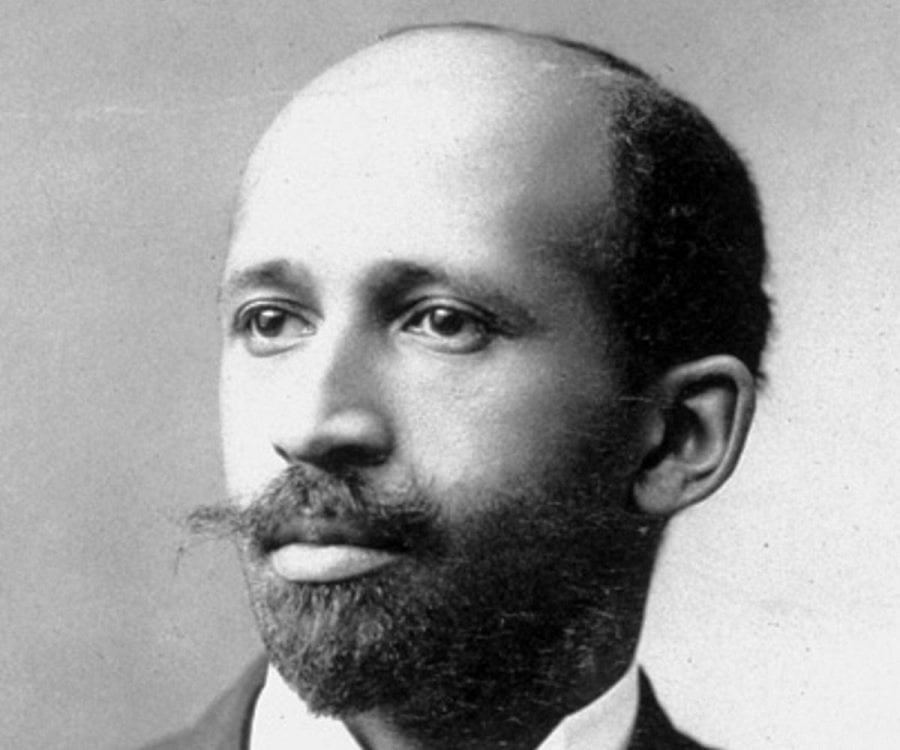
One of his intellectual contemporaries, another Harvard-trained scholar, W. E. B. DuBois, was especially outspoken on northern education for Negroes, believing with Woodson, that it propagandized and indoctrinated youth, draining them of self-confidence, self-respect, and self-knowledge.
In 1935 DuBois wrote:
... race prejudice in the United States today is such that most Negroes cannot receive proper education in white institutions ... many public school systems in the North where Negroes are admitted and tolerated but they are not educated; they are crucified ... certain Northern universities where Negro students ... cannot get fair recognition, either in classroom or on the campus, in dining hall or student activities, or in human common courtesy ... at Harvard, Yale, and Columbia, Negroes are admitted but not welcomed; while in other institutions like Princeton they cannot even enroll. 7
In further development of his thesis that Blacks needed special education, Dr. DuBois made a point-blank statement with respect to a constructive means of overcoming the mis-education to which they were subjected:
Negroes must know the history of the Negro race in America, and this they will seldom get in white institutions. Their children ought to study textbooks like Brawley's "Short History," the first edition of Woodson's "Negro in Our History," and Cromwell, Turner, and Dykes' "Readings from Negro Authors." Negroes who celebrate the birthdays of Washington and Lincoln, and relatively unimportant "founders" of various Negro colleges, ought not to forget the 5th of March,—that first national holiday of this country, which commemorates the martyrdom of Crispus Attucks. They ought to celebrate Negro Health Week and Negro History Week. They ought to study intelligently and from their own point of view, the slave trade, slavery, emancipation, Reconstruction and present economic development. 8
Dr. DuBois proceeded then to explain in careful detail that he was making no special plea for segregated schools, or mixed schools, but for education. To use his language:
... a separate Negro school where children are treated like human beings, trained by teachers of their own race, who know what it means to be black in the year of salvation 1935, is infinitely better than making our boys and girls doormats to be spit and trampled upon and lied to by ignorant social climbers, whose sole claim to superiority is ability to kick "niggers" when they are down. 9
The foregoing observations relate directly to the problems of mis-education, well understood and posed by Woodson; and the same problems are at long last being faced and attacked by the very universities identified by DuBois and many others. These institutions, formerly known only as "white" colleges, are now heeding the black demands, and are soliciting black students, even at the expense of the "quota systems," once so firmly entrenched. The "cry in the wilderness" of Woodson in Mis-Education, and his few like-minded cohorts, has become a resounding chorus, and the reverberations will in time shake the mis from Mis-education.
The scholars under discussion all shared a common goal, namely, to provide for Negro youth access to historical information and education which would be true and thus nullify or diminish the false and belittling propaganda type of history which had been handed to them by whites. This, it was felt, would build up the black child's self and race knowledge as well as his self-respect. In a larger sense they expected that their publications would at least partly fill the unjustifiable void in American History and its antecedents, reveal the existing distortions of actual facts, and constitute a service to the entire field of historical and social science writing and understanding.
Ultimately, thought Woodson and those who had similar beliefs, the program would be a responsible factor in regenerating race relations in all areas and not only in education. Without detracting from any other efforts (and there were others) it is reasonably certain that those writers who tried so zealously to right the wrongs of mis-educationexerted a positive influence in that direction. As a result the democratic practices of this society are beginning to reach for its ideology, thus narrowing the long-existing cultural lag.
It is, in fact, quite clear that Woodson regarded this book as historical only in its most inclusive sense—history as interrelated with social customs, literature, economic and political matters and all else that affects society. This is a sensible and legitimate approach, as such historians as Spengler and Toynbee have demonstrated by popularizing broad areas and issues. Woodson was familiar with the tendency to include the intangible factors that influence the course of history—psychological elements and traditional sensitivities, based of course on valid historical methodology. He fitted Mis-Education into that framework.
Necessarily he thought in terms of other aspects of society which influenced education and which were, in turn influenced by it, because all of his writings show that he was convinced of the interrelations of all types of social phenomena. Furthermore, when he published Mis-Education, the nation was in the throes of a paralyzing economic depression, and President Franklin D. Roosevelt was on the verge of his vigorous and innovative administration. The "separate but equal" myth then afforded respectable legal sanction for an unequal, caste-like society, in education and all areas of national life. Permissive resignation had settled over much of the Negro population, and a majority rationalized that the caricature of education that they received was at least "better than it used to be."
The debilitating depression had thrust the problems of the Negro, as the lowest socioeconomic class, into the forefront of those in dire need. As an educator of stature who was already engaged in his intensive writing and publishing program, the role of the disadvantageous educational system in keeping the black people on the lowest level, became abundantly clear to Woodson. Hence his attempts to analyze the problem and to define and castigate the type of education that confined Negroes in a vice-like grip of inferiority was designed not only to inform other historians and educators of their own derelictions, but to arouse the black people from their apathy. Mis-Education did not immediately have the impact that he hoped, but in the long run it merges now with the researches of the awakened historians and other educators; the demands of several minority groups, which have discovered each other; the insistence of students on racial equality and relevant curricula; and the clamor of the downtrodden masses for appropriate treatment as fellow human beings.
Dr. Woodson, in adopting a comprehensive, overall view of the problem of education in this book, was strongly prophetic, and showed a rare intellectual kinship with those who would move to the forefront in the next generation. His statement (p. 114), "The warring area, then, is in the cities," is highly pertinent to current circumstances, as are also the points in context which he connected with it. Another idea that he expressed with clarity (p. 117) in the sentences which follow, will be recognized at once for its present relevance:
The race will free itself from exploiters just as soon as it decides to do so. No one else can accomplish this task for the race. It must plan and do for itself.
Another matter connected with Mis-education should be noted. The inferior character of black education was made inevitable by virtue of the poor financing of the segregated school systems. Although most Northern states had some racially-mixed schools, education in the sixteen southern, former slave states, plus Oklahoma and the District of Columbia, forming a bloc, provided the pattern, the atmosphere, and the reflection of Negro problems and general attitudes of whites about black education in the United States.
This southern bloc maintained a completely segregated system, and though there were differences in one category or another in spending money for education among its jurisdictions they had one common denominator—there were great differentials between moneys allocated for white education and black education. In 1930 the average expenditure per school-age child was $45.00 per white pupil and $14.95 per Negro pupil. Average southern investment in public school property per school-child amounted to $120.09 for whites and $29.62 for Negroes. Figures for 1928-1929 disclose that the average southern white teacher's pupil load was 31 for a school term of 164 days, while the average black teacher instructed about 44 pupils for 144 days. The average white teacher's salary was $1020, while the average black teacher earned $524. 10
These figures were frustratingly well known to Dr. Woodson. As a participator in the field of education, an observer, a scholar and a reformer, he had long studied the disparities in the dual system. Before 1930 he had become thoroughly alarmed because the differentials between white and black education were increasing rather than diminishing, and that knowledge undoubtedly motivated some of the pessimism which creeps through in this volume.
Early in his Preface to Mis-Education the author takes a positive stand for tax money to be allocated in such manner that "every individual in the social order" should be given the opportunity to do his best. He rejected the objective notion of "progress" taken from statistical data, and injected a qualitative criteria which would judge the effectiveness of education by whether it was instrumental in making an individual "do and think for himself." With respect to Negro education in particular, it would require much study of the race and the role of its members in society. The dual system did not afford the opportunity for such study. As Woodson evaluated then, the inequity of the two societies within the nation, black and white, with its financial and propagandistic suppression of blacks through education and otherwise, was efficiently responsible for the social ills that he so deplored. He was really aiming a direct blow at the rationale which the South used to justify the dual school system; and his position was vindicated by the United States Supreme Court in the 1950's, and subsequently by public opinion. When he suggested equal educational opportunities regardless of financial status or race he was more or less anticipating the "social citizen" concept of the incoming administration, although President Roosevelt did not implement his concept to its logical conclusion.
When Woodson likewise made observations to the effect that information alone was not education, he was not stating a unique or isolated theory. Other educators agreed, but many who professed to adhere to the notion did so in a merely abstract fashion. The author of this book very carefully elaborated and illustrated the thesis. He sought for meaningful, qualitative training, yet most educational institutions held fast to their rigid, inflexible programs, under which much of the required subject-matter might prove useful as intellectual discipline, but not to the life interests of the hapless, captive students. It was Woodson's idea that this system was most devastating to the black children whose schools were inferior, and whose future life interests were farthest removed from the traditional curricula. In recent years, and frequently by reason of student pressures, colleges have been reappraising and restructuring their programs, not necessarily because of Woodson's long-ago reasoning but surely in line with it.
The Preface to Mis-Education also contains a statement that the educational systems of both Europe and the United States were antiquated and failed to hit the mark for either race. A bold and daring assertion in 1933, to be sure, but Woodson had successfully pursued education in both Europe and America. It is evident now that his judgement was projected far beyond its utterance, as witness the student movements which are presently accelerating, and assuming differing and ever more demanding forms. In further attestation note also the trend toward "vocational" education; and the frenzied effort to incorporate Black Studies at all educational levels.
Indeed long before this present climactic phase, there had been a rising racial consciousness and a new stridency to the demands by American Negroes. By the start of World War II the sacred cow of segregation was being reexamined more vigorously than ever before. Such scholars as Frazier, Myrdal, Silberman and others were writing sociologically with candor and verve on racial problems, while Woodson continued his even and uninterrupted interpretation of these problems, plus writing historical books, papers, and engaging in other journalistic endeavors. Cynicism and disillusionment among blacks had spread and become crystallized into a determination to make equality real. The indictments against discrimination were even more virile than Woodson's had been in Mis-Education some years earlier, and they covered more thoroughly the entire spectrum of race relations, but there was a direct line of descent from the educational castigation of 1933 to the more vigorous racial agitation and writings of the next decade.
Carter G. Woodson did not propose, in Mis-Education, such drastic action as the mass protest movement of A. Phillip Randolph in 1941, but then he did not have the type of support which later materialized; nor had there been in 1933 the mass militancy to which World War II gave birth. His was a modest demand, as really were the goals of Randolph's movement when judged by the scope of later demands and achievements. But if one seeks to comprehend the present culmination period in race relations, he must turn back to those earlier efforts and acknowledge the ideas and the work which "seeded the ground" as it were, and made possible a climate of opinion within which concerted action for equality could germinate and grow to fruition. This intellectual climate was possible because the research, writings, and publications of a dedicated scholar like Woodson had provided the historical information, the impetus, and the inspiration for black people to acquire a worthwhile self and race image, to make a start toward overcoming the inferiority complex which had for so long been an emotional prison. Looking back in such manner is a major purpose of history, and in that context the reissuing of this book is both appropriate and necessary.
It will be of great interest for readers to note the similarity in Woodson, the critic, as he looks at education in his day and the day in which we live. Black youth seems to be asking for what Woodson wanted as he expressed it in these pages. His philosophy was not only sound for him but it is sound for them, as they make the same demands of administrators for Black Studies, Black Curricula and Black personnel. It is for this reason that we publish this volume. It had a message for Yesterday and it has a message which Black and white should know for Today.
--Charles H. Wesley and Thelma D. Perry (Editors)
Foreword
THE thoughts brought together in this volume have been expressed in recent addresses and articles written by the author. From time to time persons deeply interested in the point of view therein presented have requested that these comments on education be made available in book form. To supply this demand this volume is given to the public.
In the preparation of the volume the author has not followed in detail the productions upon which most of the book is based. The aim is to set forth only the thought developed in passing from the one to the other. The language in some cases, then, is entirely new; and the work is not a collection of essays. In this way repetition has been avoided except to emphasize the thesis which the author sustains.
--Carter Godwin Woodson Washington, D. C.
January, 1933.
Preface
HEREIN are recorded not opinions but the reflections of one who for forty years has participated in the education of the black, brown, yellow and white races in both hemispheres and in tropical and temperate regions. Such experience, too, has been with students in all grades from the kindergarten to the university. The author, moreover, has traveled around the world to observe not only modern school systems in various countries but to study the special systems set up by private agencies and governments to educate the natives in their colonies and dependencies. Some of these observations, too, have been checked against more recent studies on a later tour.
Discussing herein the mistakes made in the education of the Negro, the writer frankly admits that he has committed some of these errors himself. In several chapters, moreover, he specifically points out wherein he himself has strayed from the path of wisdom. This book, then, is not intended as a broadside against any particular person or class, but it is given as a corrective for methods which have not produced satisfactory results.
The author does not support the once popular view that in matters of education Negroes are rightfully subjected to the will of others on the presumption that these poor people are not large taxpayers and must be content with charitable contributions to their uplift. The author takes the position that the consumer pays the tax, and as such every individual of the social order should be given unlimited opportunity make the most of himself. Such opportunity, too, should not be determined from without by forces set to direct the proscribed element in a way to redound solely to the good of others but should be determined by the make-up of the Negro himself and by what his environment requires of him.
This new program of uplift, the author contends, should not be decided upon by the trial and error method in the application of devices used in dealing with others in a different situation and at another epoch. Only by careful study of the Negro himself and the life which he is forced to lead can we arrive at the proper procedure in this crisis. The mere imparting of information is not education. Above all things, the effort must result in making a man think and do for himself just as the Jews have done in spite of universal persecution.
In thus estimating the results obtained from the so-called education of the Negro the author does not go to the census figures to show the progress of the race. It may be of no importance to the race to be able to boast today of many times as many "educated" members as it had in 1865. If they are of the wrong kind the increase in numbers will be a disadvantage rather than an advantage. The only question which concerns us here is whether these "educated" persons are actually equipped to face the ordeal before them or unconsciously contribute to their own undoing by perpetuating the regime of the oppressor.
Herein, however, lies no argument for the oft-heard contention that education for the white man should mean one thing and for the Negro a different thing. The element of race does not enter here. It is merely a matter of exercising common sense in approaching people through their environment in order to deal with conditions as they are rather than as you would like to see them or imagine that they are. There may be a difference in method of attack, but the principle remains the same.
"Highly educated" Negroes denounce persons who advocate for the Negro a sort of education different in some respects from that now given the white man. Negroes who have been so long inconvenienced and denied opportunities for development are naturally afraid of anything that sounds like discrimination. They are anxious to have everything the white man has even if it is harmful. The possibility of originality in the Negro, therefore, is discounted one hundred per cent to maintain a nominal equality. If the whites decide to take up Mormonism the Negroes must follow their lead. If the whites neglect such a study, then the Negroes must do likewise.
The author, however, does not have such an attitude. He considers the educational system as it has developed both in Europe and America an antiquated process which does not hit the mark even in the case of the needs of the white man himself. If the white man wants to hold on to it, let him do so; but the Negro, so far as he is able, should develop and carry out a program of his own.
The so-called modern education, with all its defects, however, does others so much more good than it does the Negro, because it has been worked out in conformity to the needs of those who have enslaved and oppressed weaker peoples. For example, the philosophy and ethics resulting from our educational system have justified slavery, peonage, segregation, and lynching. The oppressor has the right to exploit, to handicap, and to kill the oppressed. Negroes daily educated in the tenets of such a religion of the strong have accepted the status of the weak as divinely ordained, and during the last three generations of their nominal freedom they have done practically nothing to change it. Their pouting and resolutions indulged in by a few of the race have been of little avail.
No systematic effort toward change has been possible, for, taught the same economics, history, philosophy, literature and religion which have established the present code of morals, the Negro's mind has been brought under the control of his oppressor. The problem of holding the Negro down, therefore, is easily solved. When you control a man's thinking you do not have to worry about his actions. You do not have to tell him not to stand here or go yonder. He will find his "proper place" and will stay in it. You do not need to send him to the back door. He will go without being told. In fact, if there is no back door, he will cut one for his special benefit. His education makes it necessary.
The same educational process which inspires and stimulates the oppressor with the thought that he is everything and has accomplished everything worth while, depresses and crushes at the same time the spark of genius in the Negro by making him feel that his race does not amount to much and never will measure up to the standards of other peoples. The Negro thus educated is a hopeless liability of the race.
The difficulty is that the "educated Negro" is compelled to live and move among his own people whom he has been taught to despise. As a rule, therefore, the "educated Negro" prefers to buy his food from a white grocer because he has been taught that the Negro is not clean. It does not matter how often a Negro washes his hands, then, he cannot clean them, and it does not matter how often a white man uses his hands he cannot soil them. The educated Negro, moreover, is disinclined to take part in Negro business, because he has been taught in economics that Negroes cannot operate in this particular sphere. The "educated Negro" gets less and less pleasure out of the Negro church, not on account of its primitiveness and increasing corruption, but because of his preference for the seats of "righteousness" controlled by his oppressor. This has been his education, and nothing else can be expected of him.
If the "educated Negro" could go off and be white he might be happy, but only a mulatto now and then can do this. The large majority of this class, then, must go through life denouncing white people because they are trying to run away from the blacks and decrying the blacks because they are not white.
Chapter I: The Seat of the Trouble
THE "educated Negroes" have the attitude of contempt toward their own people because in their own as well as in their mixed schools Negroes are taught to admire the Hebrew, the Greek, the Latin and the Teuton and to despise the African. Of the hundreds of Negro high schools recently examined by an expert in the United States Bureau of Education only eighteen offer a course taking up the history of the Negro, and in most of the Negro colleges and universities where the Negro is thought of, the race is studied only as a problem or dismissed as of little consequence. For example, an officer of a Negro university, thinking that an additional course on the Negro should be given there, called upon a Negro Doctor of Philosophy of the faculty to offer such work. He promptly informed the officer that he knew nothing about the Negro. He did not go to school to waste his time that way. He went to be educated in a system which dismisses the Negro as a nonentity.
At a Negro summer school two years ago, a white instructor gave a course on the Negro, using for his text a work which teaches that whites are superior to the blacks. When asked by one of the students why he used such a textbook the instructor replied that he wanted them to get that point of view. Even schools for Negroes, then, are places where they must be convinced of their inferiority.
The thought of the inferiority of the Negro is drilled into him in almost every class he enters and in almost every book he studies. If he happens to leave school after he masters the fundamentals, before he finishes high school or reaches college, he will naturally escape some of this bias and may recover in time to be of service to his people.
Practically all of the successful Negroes in this country are of the uneducated type or of that of Negroes who have had no formal education at all. The large majority of the Negroes who have put on the finishing touches of our best colleges are all but worthless in the development of their people. If after leaving school they have the opportunity to give out to Negroes what traducers of the race would like to have it learn such persons may thereby earn a living at teaching or preaching what they have been taught but they never become a constructive force in the development of the race. The so-called school, then, becomes a questionable factor in the life of this despised people.
As another has well said, to handicap a student by teaching him that his black face is a curse and that his struggle to change his condition is hopeless is the worst sort of lynching. It kills one's aspirations and dooms him to vagabondage and crime. It is strange, then, that the friends of truth and the promoters of freedom have not risen up against the present propaganda in the schools and crushed it. This crusade is much more important than the anti-lynching movement, because there would be no lynching if it did not start in the schoolroom. Why not exploit, enslave, or exterminate a class that everybody is taught to regard as inferior?
To be more explicit we may go to the seat of the trouble. Our most widely known scholars have been trained in universities outside of the South. Northern and Western institutions, however, have had no time to deal with matters which concern the Negro especially. They must direct their attention to the problems of the majority of their constituents, and too often they have stimulated their prejudices by referring to the Negro as unworthy of consideration. Most of what these universities have offered as language, mathematics, and science may have served a good purpose, but much of what they have taught as economics, history, literature, religion and philosophy is propaganda and cant that involved a waste of time and misdirected the Negroes thus trained.
And even in the certitude of science or mathematics it has been unfortunate that the approach to the Negro has been borrowed from a "foreign" method. For example, the teaching of arithmetic in the fifth grade in a backward county in Mississippi should mean one thing in the Negro school and a decidedly different thing in the white school. The Negro children, as a rule, come from the homes of tenants and peons who have to migrate annually from plantation to plantation, looking for light which they have never seen. The children from the homes of white planters and merchants live permanently in the midst of calculations, family budgets, and the like, which enable them sometimes to learn more by contact than the Negro can acquire in school. Instead of teaching such Negro children less arithmetic, they should be taught much more of it than the white children, for the latter attend a graded school consolidated by free transportation when the Negroes go to one-room rented hovels to be taught without equipment and by incompetent teachers educated scarcely beyond the eighth grade.
In schools of theology Negroes are taught the interpretation of the Bible worked out by those who have justified segregation and winked at the economic debasement of the Negro sometimes almost to the point of starvation. Deriving their sense of right from this teaching, graduates of such schools can have no message to grip the people whom they have been ill trained to serve. Most of such mis-educated ministers, therefore, preach to benches while illiterate Negro preachers do the best they can in supplying the spiritual needs of the masses.
In the schools of business administration Negroes are trained exclusively in the psychology and economics of Wall Street and are, therefore, made to despise the opportunities to run ice wagons, push banana carts, and sell peanuts among their own people. Foreigners, who have not studied economics but have studied Negroes, take up this business and grow rich.
In schools of journalism Negroes are being taught how to edit such metropolitan dailies as the Chicago Tribune and the New York Times, which would hardly hire a Negro as a janitor; and when these graduates come to the Negro weeklies for employment they are not prepared to function in such establishments, which, to be successful, must be built upon accurate knowledge of the psychology and philosophy of the Negro.
When a Negro has finished his education in our schools, then, he has been equipped to begin the life of an Americanized or Europeanized white man, but before he steps from the threshold of his alma mater he is told by his teachers that he must go back to his own people from whom he has been estranged by a vision of ideals which in his disillusionment he will realize that he cannot attain. He goes forth to play his part in life, but he must be both social and bisocial at the same time. While he is a part of the body politic, he is in addition to this a member of a particular race to which he must restrict himself in all matters social. While serving his country he must serve within a special group. While being a good American, he must above all things be a "good Negro"; and to perform this definite function he must learn to stay in a "Negro's place."
For the arduous task of serving a race thus handicapped, however, the Negro graduate has had little or no training at all. The people whom he has been ordered to serve have been belittled by his teachers to the extent that he can hardly find delight in undertaking what his education has led him to think is impossible. Considering his race as blank in achievement, then, he sets out to stimulate their imitation of others The performance is kept up a while; but, like any other effort at meaningless imitation, it results in failure.
Facing this undesirable result, the highly educated Negro often grows sour. He becomes too pessimistic to be a constructive force and usually develops into a chronic fault-finder or a complainant at the bar of public opinion. Often when he sees that the fault lies at the door of the white oppressor whom he is afraid to attack, he turns upon the pioneering Negro who is at work doing the best he can to extricate himself from an uncomfortable predicament.
In this effort to imitate, however, these "educated people" are sincere. They hope to make the Negro conform quickly to the standard of the whites and thus remove the pretext for the barriers between the races. They do not realize, however, that even if the Negroes do successfully imitate the whites, nothing new has thereby been accomplished. You simply have a larger number of persons doing what others have been doing. The unusual gifts of the race have not thereby been developed, and an unwilling world, therefore, continues to wonder what the Negro is good for.
These "educated" people, however, decry any such thing as race consciousness; and in some respects they are right. They do not like to hear such expressions as "Negro literature," "Negro poetry," "African art," or "thinking black"; and, roughly speaking, we must concede that such things do not exist. These things did not figure in the courses which they pursued in school, and why should they? "Aren't we all Americans? Then, whatever is American is as much the heritage of the Negro as of any other group in this country."
The "highly educated" contend, moreover, that when the Negro emphasizes these things he invites racial discrimination by recognizing such differentness of the races. The thought that the Negro is one thing and the white man another is the stock-in-trade argument of the Caucasian to justify segregation. Why, then, should the Negro blame the white man for doing what he himself does?
These "highly educated" Negroes, however, fail to see that it is not the Negro who takes this position. The white man forces him to it, and to extricate himself therefrom the Negro leader must so deal with the situation as to develop in the segregated group the power with which they can elevate themselves. The differentness of races, moreover, is no evidence of superiority or of inferiority. This merely indicates that each race has certain gifts which the others do not possess. It is by the development of these gifts that every race must justify its right to exist.