Discourse that allows us to express a wide range of ideas, opinions, and analysis that can be used as an opportunity to critically examine and observe what our experience means to us beyond the given social/cultural contexts and norms that are provided us.
Biden Wants to Enable Genocide. We Must Make It Impossible for Him to Continue. Palestinian genocide comes at a devastating human cost. What will supporting it cost Biden politically?
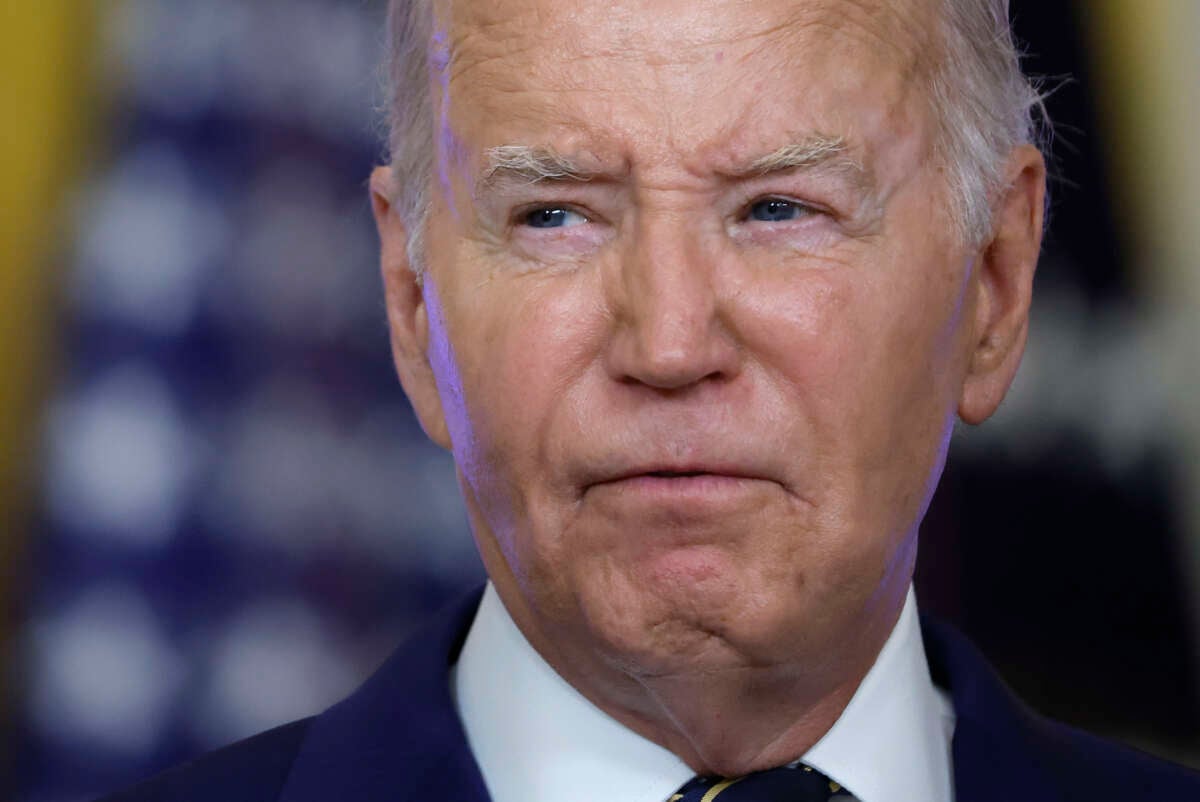
U.S. President Joe Biden delivers remarks on an executive order limiting asylum in the East Room of the White House on June 4, 2024, in Washington, D.C. Kevin Dietsch / Getty Images
Today, activists from around the country are mobilizing in Washington, D.C. to surround the White House to demand an end to Israel’s onslaught on Gaza and President Joe Biden’s support for it. Palestinians are paying an incalculable price for U.S. policy. But there is a set of costs of a different nature that the U.S. is incurring by supporting the genocide — and a strategy aimed at raising those costs can make it so great that Biden has to stop.
One cost is global. From upsetting relations between Israel and its neighbors to repeated condemnations of genocide at the UN Security Council, General Assembly, International Court of Justice and International Criminal Court, Israel and the U.S. are more isolated on the world stage than ever.
But a more immediate cost for Biden is in U.S. politics.
U.S. support for Israel has long been treated in the United States as a “domestic issue” — with AIPAC, the Anti-Defamation League, and other pro-Israel groups intervening heavily to shape federal policy, local politics and all levels in between. The conventional thinking is that insufficient support for Israel can result in a lost election — whereas the fate of Palestinians and their rights are marginalized to the realm of “foreign policy,” when discussed at all.
Since Israel invaded Gaza last October, that understanding has radically shifted: The rights of Palestinians have emerged as a “domestic issue” in their own right — with city councils across the country passing resolutions calling for a ceasefire, workers at corporations like Google demanding an end to their employers’ complicity in genocide and a student revolt against U.S. academia’s role in buttressing it.
The move of Palestinian rights from the margins of U.S. politics to its center is even raising the prospect of the incumbent president losing the November election because of his insistence on supplying the weapons to fuel Israel’s siege. Activists and voters in Michigan, Wisconsin, and elsewhere have made this likelihood dramatically visible with their “Uncommitted” and “Uninstructed” campaigns.
If Biden loses in November to an open fascist, it will likely be because he repulsed young people, progressives and people of color with his support for Israel. These are the people who he needs not only to vote for him, but to mobilize the vote for him. As the remarkable campus rebellions of this spring showed, they’re also the voters most likely to be demanding a ceasefire in Gaza.
By maintaining his support for Israel, Biden risks not just losing an election but a generation — one that does not seem willing to quietly accept the unacceptable. The question is: Is that enough to force Biden to change course? And if not, what will?
Why We Have Not Yet Won a Ceasefire
The difficult reality is that the movement demanding ceasefire is up against the hard core of U.S. imperial power, which sees support for Israel as central to its strategy in the Middle East — at apparently any cost, particularly that of Palestinian life. This is especially true for President Biden, whose personal investment in Israel appears to go beyond the requisite required for any steward of U.S. power.
In addition, there is a pillar buttressing that commitment that is unique to the U.S.-Israel relationship: a powerful pro-Israel lobby.
This includes a formal lobbying operation — led by AIPAC and other Washington-based firms — and a large, well-organized, well-funded and very dedicated constituency in communities across the country. Organizations like StandWithUs and the associated Israel on Campus Coalition target Palestinian rights activists on college campuses, accusing them of antisemitism and calling on universities to restrict free speech on campus.
While pro-Israel Jewish organizations play a key role, Christian Zionism is an increasingly dominant force in mobilizing fanatical support for Israel. Coordinated by organizations like Christians United for Israel, Christian Zionism combines right-wing Christian nationalism with an apocalyptic vision for the Middle East. Activists against U.S. support for Apartheid South Africa did not have to contend with a mass organizing force on the other side like this.
The fate of Palestinians and their rights are marginalized to the realm of “foreign policy,” when discussed at all.
Activists are also facing a White House that has greater power to pursue militarism than at other points in U.S. history. After more than two decades of the “war on terror,” the executive branch wields tremendous power to act unchecked. Even with growing opposition in Congress for Biden’s unflinching supply of weapons to Israel, the White House is able to press ahead. This is because Biden has used tricks — like invoking “emergency authority,” and making more than 100 sales that fall under the threshold amount that requires congressional approval — to feed the Israeli arsenal.
Meanwhile, the White House is going to great lengths to insulate the president and Vice President Kamala Harris from the ubiquitous protests, arranging campaign events that are closed to the public, smaller and whose attendees are highly vetted.
What should activists do then, in the face of a president who refuses to stop supplying the weapons for a genocide — even when it could cost him his reelection?
What to Do in the U.S.?
Over these eight months, activists have sought to identify any levers of power to pull that would stop Biden’s policy. This has included winning over dozens of members of Congress to demand a ceasefire. It has involved passing ceasefire resolutions in dozens of city and town councils. The movement successfully demonstrated its power to withhold votes in states that Biden needs to win in November. Recent polls show that, in these states, one in five voters say that they are less likely to vote for Biden because of his support of Israel’s assault.
The Palestine solidarity movement mobilized the largest march for Palestinian rights in U.S. history on November 4 in Washington, D.C. It has helped elevate Palestinian voices in the mainstream media conversation, and has featured vocal Jewish organizing for a ceasefire as one counter to the false notion that supporting Palestinian rights is antisemitic.
It has turned campuses — from the most public to the most elite — into sites of mobilization for Palestinian rights. It has compelled staffers in Congress and the White House itself to protest, and the resignation of State Department officials and others. Key institutions and individuals in Biden’s inner circle have urged him to push for a ceasefire, from the influential think tank the Center for American Progress to the president’s own wife.
The fact that no one of these breakthroughs has in itself forced a ceasefire does not mean that they are all useless. In many cases, the work that produced them should continue. But we also need more, because it is evident that no one of these things is the key to unlocking a halt to U.S. weapons and other support to Israel.
The challenge then is not to find the one thing that will force Biden to shift course, but to carry out a combination of things that undermine his ability to pursue his policy and make it as politically costly and as difficult as possible, until it is impossible.
Raising the Political Costs
It is clear that we need to expand actions that disrupt the ability of the U.S. to support the Israeli genocide, both politically and physically. But there is an important catch: One of the great strengths of the outpouring of protest in defense of Palestinian life has been how accessible it has been to the U.S. public. The starkness of Israel’s violence — and genocidal rhetoric of its leaders — along with the self-evident virtue of the ceasefire demand have allowed hundreds of thousands to join the movement.
Because the risk of arrest and police violence that comes with more confrontational actions tends to limit the range of participants, a challenge for organizers will be escalating disruption while continuing to invite broad numbers of people with a range of abilities and vulnerabilities to continue to participate. We therefore need to be as strategic as possible.
One area of focus should be disrupting the flow of U.S. weapons to Israel. With weapons manufacturing taking place across the country, the machinery of producing and supplying arms requires a combination of ignorance and consent to those processes by the U.S. population. But what if our communities learn about their entanglement with the flow of weapons, and replace that “consent” with resistance?
If the cost of Palestinian life is not sufficient to compel Biden to stop supporting a genocide, then it is the responsibility of the movement … to exact a greater cost by raising the political price.
How many cities and towns that have passed ceasefire resolutions host factories that make bombs — and even provide tax breaks to those companies? How many such cities and towns have roads passing through that transport weapons, or ports that ship them to Israel? What if, through a combination of nonviolent direct action, and cities being compelled by public pressure to pass ordinances against their complicity in genocide, the federal government could no longer count on our communities allowing weapons to flow from and through them?
And what if workers involved in the making or transport of these weapons supported the protests — as union longshore workers have at the Port of Oakland, refusing to unload cargo from an Israeli ship?
Activists can also undermine economic support for Israeli violence. Carrying out this genocide in Gaza comes at a great cost to the Israeli economy. Hundreds of thousands of Israeli reservists have been mobilized, taking them away from their jobs. Palestinian workers have been expelled from the agricultural sector and others. With the Israeli economy dependent on 120,000 Palestinian workers before October 7 and many of their work permits canceled since, farmers and volunteers scrambled to harvest produce and plant crops in the fall and construction projects are down 50 percent. And Moody’s has downgraded Israel’s credit rating.
The Israeli economy, in short, is vulnerable.
Unlike other countries, Israel crowdsources the financing of its economy, relying on institutions and individuals in North America to invest in Israeli companies and in the state of Israel through selling Israel bonds. Israel makes the case that such investment will offer a good financial return, and appeals to investors that such support is a political contribution to the Israeli project.
This explains why 35 U.S. state and municipal governments — most of them headed by Trump-aligned Republicans — have collectively bought more than $1.7 billion in Israel bonds since October. Additionally, American capitalists have rallied to support the Israeli economy. Bain Capital organized a trip to Israel in December for a delegation of 70 tech executives and investors, who met with Israeli leaders as well as local investors and startups.
Venture capitalists and far right state governments aren’t likely to change their positions, but there may be more vulnerable targets. We can demand that states run by liberal Democrats with investments in Israel cease, and brand-conscious banks should be made to see investing in Israel as a liability, just as they were pressured to stop propping up Apartheid South Africa years ago.
While divestment campaigns can take years, enough disruption and negative attention can lead to more immediate, further downgrades of Israel’s credit rating by institutions like Moody’s. The world of stocks and bonds markets is volatile, and Israel’s utter dependence on outside finance makes it vulnerable to big shocks, even if they come well short of full divestments.
Making Genocide Too Costly for a Government That Doesn’t Value Life
Twenty-eight years ago, the United States carried out another policy in the Middle East that brought catastrophic suffering: its economic sanctions against Iraq. In an interview with “60 Minutes” in May 1996, journalist Leslie Stahl said to then-Secretary of State Madeleine Albright: “We have heard that half a million children have died. I mean, that’s more children than died inHiroshima. And, you know, is the price worth it?”
Albright responded, “We think the price is worth it.”
The horrific history is a reminder that Biden’s support of Israel today comes in a context: Washington makes foreign policy decisions in which officials are quite aware of the suffering of those on the receiving end of their actions. The problem is that, in the dehumanizing and racist world of Washington’s geopolitics, the lives of Iraqis or Palestinians — or the Japanese victims of the atomic bombings that Stahl mentions, for that matter — do not carry much weight in their calculations.
If the cost of Palestinian life is not sufficient to compel Biden to stop supporting a genocide, then it is the responsibility of the movement against it — and for U.S. civil society — to exact a greater cost by raising the political price. We must make carrying out this genocide so difficult, and its price so politically expensive, that Washington cannot afford it
ABOUT THE AUTHOR:
Khury Petersen-Smith is the Michael Ratner Middle East Fellow at the Institute for Policy Studies.
The website of the Columbia Law Review was taken down by its board of directors on Monday after student editors refused a request from the board to halt the publication of an academic article written by Palestinian human rights lawyer Rabea Eghbariah titled "Toward Nakba as a Legal Concept.” The article argues for the Nakba to be developed as a unique legal framework, related to but distinct from other processes defined under modern international law, including apartheid and genocide. This is not the first time that Eghbariah's legal scholarship has been censored by an Ivy League institution.
The Harvard Law Review last year refused to publish a similar, shorter article it had solicited from Eghbariah even after it was initially accepted, fully edited and fact-checked. Eghbariah calls the abrupt rejection of his work "offensive," "unprofessional" and "discriminatory," and says "it is really unfortunate to see how this is playing out and the extent to which the board of directors is willing to go to shut down and silence Palestinian scholarship. "… What are they afraid of of Palestinians narrating their own reality, speaking their own truth?"
Democracy Now! is an independent global news hour that airs on over 1,500 TV and radio stations Monday through Friday. Watch our livestream at democracynow.org Mondays to Fridays 8-9 a.m. ET
Democrats Are Welcoming a Genocidal War Criminal to DC by Liza FeatherstoneJune 6, 2024Jacobin
Tens of thousands have died in Gaza and
millions face starvation. And Benjamin Netanyahu, the man responsible
for it, is being welcomed to the US by Democratic leaders as a dignitary
rather than a bloodthirsty maniac.
Israeli prime minister Benjamin Netanyahu attends a cabinet meeting in the Knesset in Jerusalem on May 24, 2020. (Abir Sultan / AFP via Getty Images)
With elections looming and the Democratic base
overwhelmingly opposed to Israel’s brutal war on Gaza, Joe Biden seems
at times to be feeling the heat and talking peace. On May 31, he claimed
that Israel had agreed to a “permanent cease-fire.” But Biden was
immediately rebuffed when Israeli prime minister Benjamin Netanyahu
disgracefully rejected that idea, caving to far-right pressure from
within his government.
The Democratic leadership should have seized the moment
and, in a unified voice, urged the president to defund Israel’s brutal
war. That would have been morally right. If successful, that action
could have, most importantly, finally halted a genocide. It also could
have helped Biden to defeat Donald Trump in the fall.
But that is not what the Democratic leadership did.
Instead, Senate Majority Leader Chuck Schumer and Democratic Leader
Hakeem Jeffries, the ranking Democrat in the House of Representatives,
joined Republican House speaker Mike Johnson in penning a letter
inviting Netanyahu, fanatic far-right architect of a war in which Israel
has been burning people alive without impunity or shame, to address Congress.
It’s hard to imagine a worse guest for the United States right now.
Netanyahu has prosecuted an utterly callous war in which more than
36,000 people have died, most of them children. His war has exposed more
than a million people to catastrophic starvation. He has also done his
best to eradicate Palestinian civilization, bombing all its
universities.
The New York Times reports that because of Israel’s ground
offensive in Rafah, more than a million Gazans forced to flee that city
have no power, water, or shelter. A construction worker who fled Rafah
last week told the paper, “The situation is as bad as you can imagine.
We are waiting for God’s mercy.”
Netanyahu has also knowingly targeted hospitals in this
war, turning hospitals, “which should be safe havens, into scenes of
death, devastation and despair,” according to
the World Health Organization. Even after the International Court of
Justice noted “catastrophic conditions” in Gaza and warned Israel that
starving civilians and obstructing humanitarian aid were war crimes,
Human Rights Watch reported that the situation had only grown worse.
Israel’s vicious disregard for Palestinian lives is almost matched by
its contempt for the international community.
Netanyahu has made clear that he intends to continue to prosecute an
eliminationist policy against the Palestinians, calling Gaza a “city of
evil” and citing the Biblical commandment to destroy the Amalekites. As
the war began last October he said, “You must remember what Amalek has
done to you.” Such rhetoric — along with the massive death toll and
efforts to block humanitarian aid — was part of the robust body of
evidence South Africa brought to the International Court of Justice when
charging Israel with genocide earlier this year.
After protests flooded the streets, as well as the offices of
Democratic politicians, Senator Schumer in March criticized Netanyahu
and said that Israel should have elections to elect a new leader.
Jeffries — who like Schumer receives millions from the American Israel
Public Affairs Committee (AIPAC), which lobbies on behalf of a foreign
power committing daily war crimes — wouldn’t go there but also refrained from comment.
But now, Schumer has recovered from his temporary bout of conscience, and the two appear to be united.
In the letter, officially issued Friday and jointly authored with Johnson, they wrote,
citing the “friendship and partnership of our democracies . . . we join
the State of Israel in your struggle against terror.” They did not
mention the terror that millions of Palestinians are suffering, nor did
they mention that Netanyahu has undermined the possibility of a deal
that would free the Israelis Hamas is holding hostage — even as those
hostages continue to die in captivity, at times as a result of Israel’s
own bombing campaign.
In addition to the moral depravity of allowing Netanyahu to enter the
United States, it’s stupid of the Democratic leadership to embrace
someone who is not only unpopular within the Democratic base but
transparently trying to undermine Biden, the elected president from
their own party. Many commentators believe that Netanyahu feels he will
be able to conduct his war with even more impunity under Trump. Does the
Democratic leadership want to kill Palestinians even more than they
want to beat Trump?
Not everyone in Congress is happy about this invitation. Socialist senator Bernie Sanders has been the loudest dissenter.
“It is a very sad day for our country that Prime Minister Netanyahu
has been invited — by leaders from both parties — to address a Joint
Meeting of Congress,” Sanders said Saturday. “Benjamin Netanyahu is a
war criminal. He should not be invited to address a Joint meeting of
Congress. I certainly will not attend.”
Congressmember Rashida Tlaib has for months been critical of
Johnson’s plans to invite the Israeli head of state, who she recently called a “genocidal maniac.”
Perhaps more surprisingly, and indicative of growing distress over
the war within the Democratic Party, Senator Dick Durbin, second-ranked
Senate leader, said this week that he would not have invited Netanyahu.
It’s not clear when Netanyahu’s address will take place —
the date was going to be June 13 but since that is a Jewish holiday, it
will likely be later this month. He will probably be greeted by massive
protests in Washington, DC. Perhaps Schumer and Jeffries should be
dogged by such protests wherever they go, too.
Liza Featherstone is a columnist for Jacobin, a freelance journalist, and the author of Selling Women Short: The Landmark Battle for Workers’ Rights at Wal-Mart.
“What have we become as a country… if a public health official in the Biden admin’s USAID cannot give a presentation on Palestinian child and maternal mortality?” On this week’s ‘Mehdi Unfiltered,’ Mehdi Hasan opens the show with a look into the spate of Biden administration officials who have resigned over the president’s handling of Gaza. Be it the dismissal of a USAID advisor presenting on Palestinian health, or a State Department official quitting over a report claiming Israel did not impede aid, a growing number of former officials are speaking out about the administration’s apathy toward the plight of Palestinians.
Watch the full episode of ‘Mehdi Unfiltered’ on Zeteo.com, and make sure to subscribe so you don’t miss new episodes.
Earlier this month, former President Donald Trump put his brazen corruption on full display for America’s top oil executives, promising to rollback the Biden administration’s environmental policies as he asked for a small campaign donation of $1 billion.
“It's
almost a caricature of big oil. It's like a scene out of Hollywood
movies,” Mehdi says, in this latest episode of ‘Unshocked.’ “You've got
the presidential candidate sitting in his wedding holiday resort in
Florida eating chopped steak with 20 big oil executives saying, ‘Give me
$1 billion and I'll make you $100 billion.’ ”
Since that first meeting was reported, Trump has only doubled down
on his quest for big oil money, visiting Houston last week to meet with
fossil-fuel execs, just days after the city suffered their own climate disaster.
“The
oil companies must have been just so stunned because they're not
hurting. They are posting record profits. All of these wars are
fantastic for their bottom lines,” Naomi Klein tells Mehdi.
In their latest conversation, Mehdi and Naomi explore what’s really
behind Trump’s “drill baby drill” obsession, and what it says not only
about our future, but also about the right’s preoccupation with brute
force, masculinity, and of course, climate denial.
“You are
here on this planet, and you do have to navigate and negotiate with the
force of nature, which is actually stronger than us,” Naomi said. “I
think that is perceived by people like Trump as an insult to their
masculinity, like the idea that nature is speaking back to them and that
their worldview really is about a hierarchy where you have white men at
the top.”
Later in the conversation, Naomi went on to explain how the genocide
in Gaza ties into America’s apathy towards climate disasters, a point
made by Colombia’s President Gustavo Petro in the wake of Israel’s war
on Gaza.
“In October, Gustavo Petro said, this is global
1933. And he said that what they were seeing in Gaza was a glimpse of
their future in the Global South,” Naomi said.“They see Gaza as part of a process of normalizing mass death, of habituating the planet to just allowing people to die.”
‘Unshocked’ is a monthly conversation between Zeteo Editor-in-Chief Mehdi Hasan and author and activist Naomi Klein, where
they pull viewers ‘out of shock’ through analysis, facts, and history.
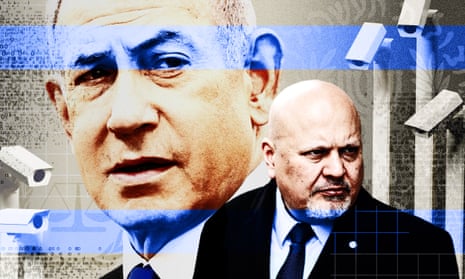
Benjamin
Netanyahu (left) has taken a close interest in the intelligence
operations against the ICC and its chief prosecutor, Karim Khan, sources
say. Composite: Guardian Design/Getty
Spying, hacking and intimidation: Israel’s nine-year ‘war’ on the ICC exposed
Exclusive:
Investigation reveals how intelligence agencies tried to derail war
crimes prosecution, with Netanyahu ‘obsessed’ with intercepts
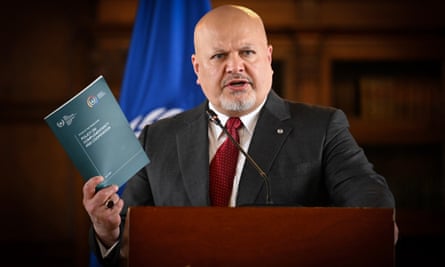
When the chief prosecutor of the international criminal court (ICC) announced he was seeking arrest warrants
against Israeli and Hamas leaders, he issued a cryptic warning: “I
insist that all attempts to impede, intimidate or improperly influence
the officials of this court must cease immediately.”
Karim
Khan did not provide specific details of attempts to interfere in the
ICC’s work, but he noted a clause in the court’s foundational treaty
that made any such interference a criminal offence. If the conduct
continued, he added, “my office will not hesitate to act”.
The prosecutor did not say who had attempted to intervene in the administration of justice, or how exactly they had done so.
Now, an investigation by the Guardian and the Israeli-based magazines +972 and Local Call can reveal how Israel
has run an almost decade-long secret “war” against the court. The
country deployed its intelligence agencies to surveil, hack, pressure,
smear and allegedly threaten senior ICC staff in an effort to derail the
court’s inquiries.
Israeli intelligence captured the communications of numerous ICC officials, including Khan and his predecessor as prosecutor, Fatou Bensouda, intercepting phone calls, messages, emails and documents.
The surveillance was ongoing in recent months, providing Israel’s prime minister, Benjamin Netanyahu,
with advance knowledge of the prosecutor’s intentions. A recent
intercepted communication suggested that Khan wanted to issue arrest
warrants against Israelis but was under “tremendous pressure from the
United States”, according to a source familiar with its contents.
Karim Khan. The surveillance was ongoing in recent months, providing Netanyahu with advance knowledge of Khan’s intentions. Photograph: Luis Acosta/AFP/Getty Images
Bensouda,
who as chief prosecutor opened the ICC’s investigation in 2021, paving
the way for last week’s announcement, was also spied on and allegedly
threatened.
Netanyahu has taken a close
interest in the intelligence operations against the ICC, and was
described by one intelligence source as being “obsessed” with intercepts
about the case. Overseen by his national security advisers, the efforts
involved the domestic spy agency, the Shin Bet, as well as the
military’s intelligence directorate, Aman, and cyber-intelligence
division, Unit 8200. Intelligence gleaned from intercepts was, sources
said, disseminated to government ministries of justice, foreign affairs
and strategic affairs.
A covert operation against Bensouda, revealed on Tuesday by the Guardian,
was run personally by Netanyahu’s close ally Yossi Cohen, who was at
the time the director of Israel’s foreign intelligence agency, the
Mossad. At one stage, the spy chief even enlisted the help of the then
president of the Democratic Republic of the Congo, Joseph Kabila.
Details
of Israel’s nine-year campaign to thwart the ICC’s inquiry have been
uncovered by the Guardian, an Israeli-Palestinian publication +972
Magazine and Local Call, a Hebrew-language outlet.
The
joint investigation draws on interviews with more than two dozen
current and former Israeli intelligence officers and government
officials, senior ICC figures, diplomats and lawyers familiar with the
ICC case and Israel’s efforts to undermine it.
Contacted
by the Guardian, a spokesperson for the ICC said it was aware of
“proactive intelligence-gathering activities being undertaken by a
number of national agencies hostile towards the court”. They said the
ICC was continually implementing countermeasures against such activity,
and that “none of the recent attacks against it by national intelligence
agencies” had penetrated the court’s core evidence holdings, which had
remained secure.
A
spokesperson for Israel’s prime minister’s office said: “The questions
forwarded to us are replete with many false and unfounded allegations
meant to hurt the state of Israel.” A military spokesperson added: “The
IDF [Israel Defense Forces] did not and does not conduct surveillance or
other intelligence operations against the ICC.”
Khan’s
decision to seek warrants against Netanyahu and his defence minister,
Yoav Gallant, along with Hamas leaders implicated in the 7 October
attack, marks the first time an ICC prosecutor has sought arrest
warrants against the leader of a close western ally.
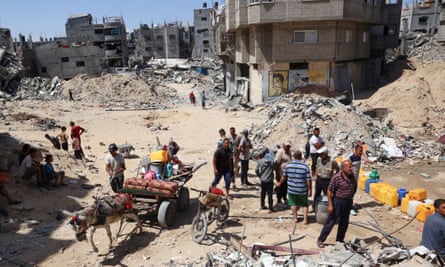
Displaced
Palestinians collecting water in a neighbourhood in Khan Younis,
southern Gaza, that has been devastated by Israeli airstrikes. Photograph: Eyad Baba/AFP/Getty Images
The
allegations of war crimes and crimes against humanity that Khan has
levelled against Netanyahu and Gallant all relate to Israel’s
eight-month war in Gaza, which according to the territory’s health authority has killed more than 35,000 people.
But
the ICC case has been a decade in the making, inching forward amid
rising alarm among Israeli officials at the possibility of arrest
warrants, which would prevent those accused from travelling to any of
the court’s 124 member states for fear of arrest.
It
is this spectre of prosecutions in The Hague that one former Israeli
intelligence official said had led the “entire military and political
establishment” to regard the counteroffensive against the ICC “as a war
that had to be waged, and one that Israel needed to be defended against.
It was described in military terms.”
That “war” commenced in January 2015, when it was confirmed that Palestine would join the court
after it was recognised as a state by the UN general assembly. Its
accession was condemned by Israeli officials as a form of “diplomatic
terrorism”.
One former defence official
familiar with Israel’s counter-ICC effort said joining the court had
been “perceived as the crossing of a red line” and “perhaps the most
aggressive” diplomatic move taken by the Palestinian Authority, which
governs the West Bank. “To be recognised as a state in the UN is nice,”
they added. “But the ICC is a mechanism with teeth.”
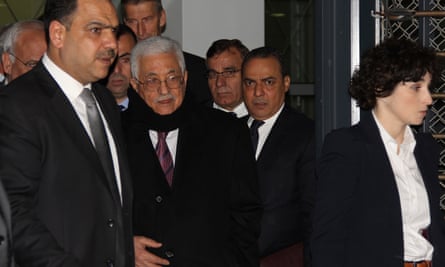
Mahmoud
Abbas (second from left), the president of the Palestinian Authority,
after a meeting with Bensouda in The Hague in October 2015. Photograph: Anadolu/Getty Images
A hand-delivered threat
For
Fatou Bensouda, a respected Gambian lawyer who was elected the ICC’s
chief prosecutor in 2012, the accession of Palestine to the court
brought with it a momentous decision. Under the Rome statute, the treaty
that established the court, the ICC can exercise its jurisdiction only
over crimes within member states or by nationals of those states.
Israel,
like the US, Russia and China, is not a member. After Palestine’s
acceptance as an ICC member, any alleged war crimes – committed by those
of any nationality – in occupied Palestinian territories now fell under Bensouda’s jurisdiction.
On 16 January 2015, within weeks of Palestine joining, Bensouda opened a preliminary examination
into what in the legalese of the court was called “the situation in
Palestine”. The following month, two men who had managed to obtain the
prosecutor’s private address turned up at her home in The Hague.
Sources
familiar with the incident said the men declined to identify themselves
when they arrived, but said they wanted to hand-deliver a letter to
Bensouda on behalf of an unknown German woman who wanted to thank her.
The envelope contained hundreds of dollars in cash and a note with an
Israeli phone number.
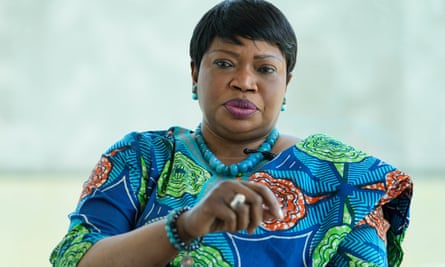
Fatou Bensouda’s caseload also included nine full investigations, including into events in the Democratic Republic of the Congo. Photograph: Peter Dejong/AP
Sources
with knowledge of an ICC review into the incident said that while it
was not possible to identify the men, or fully establish their motives,
it was concluded that Israel was likely to be signalling to the
prosecutor that it knew where she lived. The ICC reported the incident
to Dutch authorities and put in place additional security, installing
CCTV cameras at her home.
The ICC’s preliminary
inquiry in the Palestinian territories was one of several such
fact-finding exercises the court was undertaking at the time, as a
precursor to a possible full investigation. Bensouda’s caseload also
included nine full investigations, including into events in DRC, Kenya
and the Darfur region of Sudan.
Officials in
the prosecutor’s office believed the court was vulnerable to espionage
activity and introduced countersurveillance measures to protect their
confidential inquiries.
In Israel, the prime
minister’s national security council (NSC) had mobilised a response
involving its intelligence agencies. Netanyahu and some of the generals
and spy chiefs who authorised the operation had a personal stake in its
outcome.
Unlike the international court of justice
(ICJ), a UN body that deals with the legal responsibility of nation
states, the ICC is a criminal court that prosecutes individuals,
targeting those deemed most responsible for atrocities.
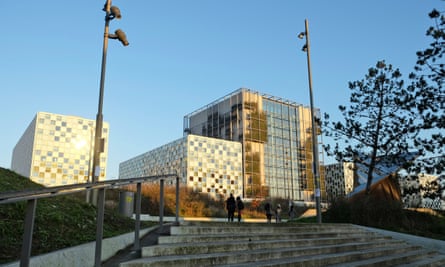
The international criminal court in The Hague, the Netherlands. Photograph: Mike Corder/AP
Multiple
Israeli sources said the leadership of the IDF wanted military
intelligence to join the effort, which was being led by other spy
agencies, to ensure senior officers could be protected from charges. “We
were told that senior officers are afraid to accept positions in the
West Bank because they are afraid of being prosecuted in The Hague,” one
source recalled.
Two intelligence officials
involved in procuring intercepts about the ICC said the prime minister’s
office took a keen interest in their work. Netanyahu’s office, one
said, would send “areas of interests” and “instructions” in relation to
the monitoring of court officials. Another described the prime minister
as “obsessed” with intercepts shedding light on the activities of the
ICC.
Hacked emails and monitored calls
Five
sources familiar with Israel’s intelligence activities said it
routinely spied on the phone calls made by Bensouda and her staff with
Palestinians. Blocked by Israel from accessing Gaza and the West Bank,
including East Jerusalem, the ICC was forced to conduct much of its
research by telephone, which made it more susceptible to surveillance.
Thanks
to their comprehensive access to Palestinian telecoms infrastructure,
the sources said, intelligence operatives could capture the calls
without installing spyware on the ICC official’s devices.
“If
Fatou Bensouda spoke to any person in the West Bank or Gaza, then that
phone call would enter [intercept] systems,” one source said. Another
said there was no hesitation internally over spying on the prosecutor,
adding: “With Bensouda, she’s black and African, so who cares?”
The
surveillance system did not capture calls between ICC officials and
anyone outside Palestine. However, multiple sources said the system
required the active selection of the overseas phone numbers of ICC
officials whose calls Israeli intelligence agencies decided to listen
to.
According
to one Israeli source, a large whiteboard in an Israeli intelligence
department contained the names of about 60 people under surveillance –
half of them Palestinians and half from other countries, including UN
officials and ICC personnel.
In The Hague,
Bensouda and her senior staff were alerted by security advisers and via
diplomatic channels that Israel was monitoring their work. A former
senior ICC official recalled: “We were made aware they were trying to
get information on where we were with the preliminary examination.”
Officials
also became aware of specific threats against a prominent Palestinian
NGO, Al-Haq, which was one of several Palestinian human rights groups
that frequently submitted information to the ICC inquiry, often in
lengthy documents detailing incidents it wanted the prosecutor to
consider. The Palestinian Authority submitted similar dossiers.
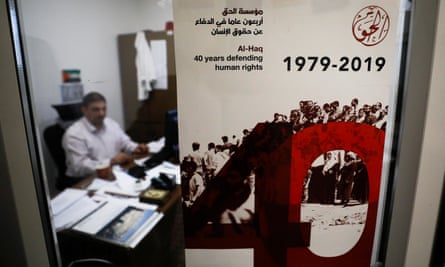
The Al-Haq office in Ramallah, in the Israeli-occupied West Bank, in 2021. Photograph: Mohamad Torokman/Reuters
Such
documents often contained sensitive information such as testimony from
potential witnesses. Al-Haq’s submissions are also understood to have
linked specific allegations of Rome statute crimes to senior officials,
including chiefs of the IDF, directors of the Shin Bet, and defence
ministers such as Benny Gantz.
Years
later, after the ICC had opened a full investigation into the Palestine
case, Gantz designated Al-Haq and five other Palestinian rights groups
as “terrorist organisations”, a label that was rejected by multiple European states and later found by the CIA to be unsupported by evidence. The organisations said the designations were a “targeted assault” against those most actively engaging with the ICC.
According
to multiple current and former intelligence officials, military
cyber-offensive teams and the Shin Bet both systematically monitored the
employees of Palestinian NGOs and the Palestinian Authority who were
engaging with the ICC. Two intelligence sources described how Israeli
operatives hacked into the emails of Al-Haq and other groups
communicating with Bensouda’s office.
One of
the sources said the Shin Bet even installed Pegasus spyware, developed
by the private-sector NSO Group, on the phones of multiple Palestinian
NGO employees, as well as two senior Palestinian Authority officials.
Keeping
tabs on the Palestinian submissions to the ICC’s inquiry was viewed as
part of the Shin Bet’s mandate, but some army officials were concerned
that spying on a foreign civilian entity crossed a line, as it had
little to do with military operations.
“It has
nothing to do with Hamas, it has nothing to do with stability in the
West Bank,” one military source said of the ICC surveillance. Another
added: “We used our resources to spy on Fatou Bensouda – this isn’t
something legitimate to do as military intelligence.”
Secret meetings with the ICC
Legitimate
or otherwise, the surveillance of the ICC and Palestinians making the
case for prosecutions against Israelis provided the Israeli government
with an advantage in a secret back channel it had opened with the
prosecutor’s office.
Israel’s
meetings with the ICC were highly sensitive: if made public, they had
the potential to undermine the government’s official position that it
did not recognise the court’s authority.
According
to six sources familiar with the meetings, they consisted of a
delegation of top government lawyers and diplomats who travelled to The
Hague. Two of the sources said the meetings were authorised by
Netanyahu.
The Israeli delegation was drawn
from the justice ministry, foreign ministry and the military advocate
general’s office. The meetings took place between 2017 and 2019, and
were led by the prominent Israeli lawyer and diplomat Tal Becker.
“In
the beginning it was tense,” recalled a former ICC official. “We would
get into details of specific incidents. We’d say: ‘We’re receiving
allegations about these attacks, these killings,’ and they would provide
us with information.”
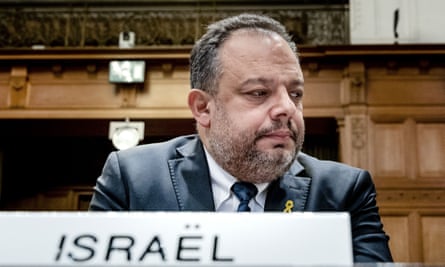
Tal Becker at the ICJ in January. Photograph: Hollandse Hoogte/REX/Shutterstock
A
person with direct knowledge of Israel’s preparation for the
back-channel meetings said officials in the justice ministry were
furnished with intelligence that had been gleaned from Israeli
surveillance intercepts before delegations arrived at The Hague. “The
lawyers who dealt with the issue at the justice ministry had a big
thirst for intelligence information,” they said.
For
the Israelis, the back-channel meetings, while sensitive, presented a
unique opportunity to directly present legal arguments challenging the
prosecutor’s jurisdiction over the Palestinian territories.
This
was a critical issue for Israel. A core ICC principle, known as
complementarity, prevents the prosecutor from investigating or trying
individuals if they are the subject of credible state-level
investigations or criminal proceedings.
Israeli
surveillance operatives were asked to find out which specific incidents
might form part of a future ICC prosecution, multiple sources said, in
order to enable Israeli investigative bodies to “open investigations
retroactively” in the same cases.
“If materials
were transferred to the ICC, we had to understand exactly what they
were, to ensure that the IDF investigated them independently and
sufficiently so that they could claim complementarity,” one source
explained.
Israel’s back-channel meetings with the ICC ended in December 2019, when Bensouda, announcing the end of her preliminary examination,
said she believed there was a “reasonable basis” to conclude that
Israel and Palestinian armed groups had both committed war crimes in the
occupied territories.
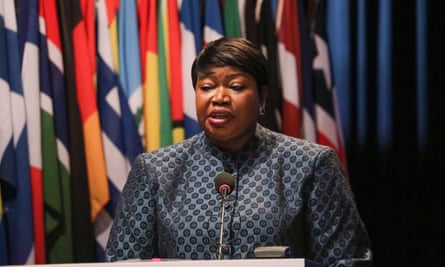
Bensouda made clear in December 2019 she was minded to open a full investigation. Photograph: Anadolu Agency/Getty Images
It
was a significant setback for Israel’s leaders, although it could have
been worse. In a move that some in the government regarded as a partial
vindication of Israel’s lobbying efforts, Bensouda stopped short of
launching a formal investigation.
Instead, she
announced she would ask a panel of ICC judges to rule on the contentious
question of the court’s jurisdiction over the Palestinian territories,
due to “unique and highly contested legal and factual issues”.
Yet
Bensouda had made clear she was minded to open a full investigation if
the judges gave her the green light. It was against this backdrop that
Israel ramped up its campaign against the ICC and turned to its top spy
chief to turn up the heat on Bensouda personally.
Personal threats and a ‘smear campaign’
Between
late 2019 and early 2021, as the pre-trial chamber considered the
jurisdictional questions, the director of the Mossad, Yossi Cohen,
intensified his efforts to persuade Bensouda not to proceed with the
investigation.
Cohen’s contacts with Bensouda –
which were described to the Guardian by four people familiar with the
prosecutor’s contemporaneous accounts of the interactions, as well as
sources briefed on the Mossad operation – had begun several years
earlier.
In one of the earliest encounters,
Cohen surprised Bensouda when he made an unexpected appearance at an
official meeting the prosecutor was holding with the then DRC president,
Joseph Kabila, in a New York hotel suite.
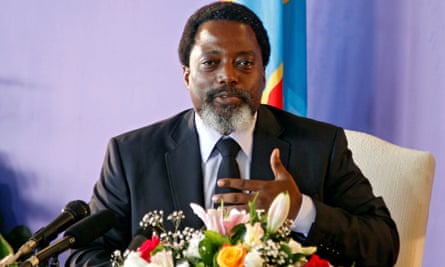
Joseph Kabila at a news conference in Kinshasa in 2018. Photograph: Kenny-Katombe Butunka/Reuters
Sources
familiar with the meeting said that after Bensouda’s staff were asked
to leave the room, the director of the Mossad suddenly appeared from
behind a door in a carefully choreographed “ambush”.
After
the incident in New York, Cohen persisted in contacting the prosecutor,
turning up unannounced and subjecting her to unwanted calls. While
initially amicable, the sources said, Cohen’s behaviour became
increasingly threatening and intimidating.
A
close ally of Netanyahu at the time, Cohen was a veteran Mossad
spymaster and had gained a reputation within the service as a skilled
recruiter of agents with experience cultivating high-level officials in
foreign governments.
Accounts of his secret
meetings with Bensouda paint a picture in which he sought to “build a
relationship” with the prosecutor as he attempted to dissuade her from
pursuing an investigation that, if it went ahead, could embroil senior
Israeli officials.
Three sources briefed on
Cohen’s activities said they understood the spy chief had tried to
recruit Bensouda into complying with Israel’s demands during the period
in which she was waiting for a ruling from the pre-trial chamber.
They
said he became more threatening after he began to realise the
prosecutor would not be persuaded to abandon the investigation. At one
stage, Cohen is said to have made comments about Bensouda’s security and
thinly veiled threats about the consequences for her career if she
proceeded. Contacted by the Guardian, Cohen and Kabila did not respond
to requests for comment. Bensouda declined to comment.
Cohen
was seen as trying to ‘build a relationship’ with the prosecutor as he
attempted to dissuade her from pursuing the investigation. Photograph: Corinna Kern/Reuters
When
she was prosecutor, Bensouda formally disclosed her encounters with
Cohen to a small group within the ICC, with the intention of putting on
record her belief that she had been “personally threatened”, sources
familiar with the disclosures said.
This was
not the only way Israel sought to place pressure on the prosecutor. At
around the same time, ICC officials discovered details of what sources
described as a diplomatic “smear campaign”, relating in part to a close
family member.
According to multiple sources,
the Mossad had obtained a cache of material including transcripts of an
apparent sting operation against Bensouda’s husband. The origins of the
material – and whether it was genuine – remain unclear.
However,
elements of the information were circulated by Israel among western
diplomatic officials, sources said, in a failed attempt to discredit the
chief prosecutor. A person briefed on the campaign said it gained
little traction among diplomats and amounted to a desperate attempt to
“besmirch” Bensouda’s reputation.
Trump’s campaign against the ICC
In
March 2020, three months after Bensouda referred the Palestine case to
the pre-trial chamber, an Israeli government delegation reportedly held
discussions in Washington with senior US officials about “a joint
Israeli-American struggle” against the ICC.
One
Israeli intelligence official said they regarded Donald Trump’s
administration as more cooperative than that of his Democratic
predecessor. The Israelis felt sufficiently comfortable to ask for
information from US intelligence about Bensouda, a request the source
said would have been “impossible” during Barack Obama’s tenure.
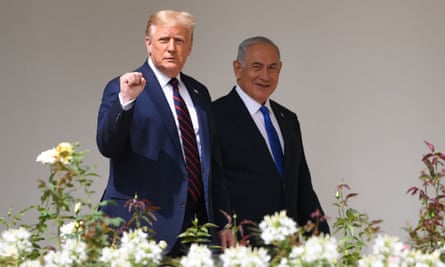
Trump and Netanyahu before the signing of the Abraham accords at the White House in 2020. Photograph: Saul Loeb/AFP/Getty Images
Days
before the meetings in Washington, Bensouda had received authorisation
from the ICC’s judges to pursue a separate investigation into war crimes
in Afghanistan committed by the Taliban and both Afghan and US military
personnel.
Fearing US armed forces would be prosecuted, the Trump administration
was engaged in its own aggressive campaign against the ICC, culminating
in the summer of 2020 with the imposition of US economic sanctions on
Bensouda and one of her top officials.
Among
ICC officials, the US-led financial and visa restrictions on court
personnel were believed to relate as much to the Palestine investigation
as to the Afghanistan case. Two former ICC officials said senior
Israeli officials had expressly indicated to them that Israel and the US
were working together.
At a press conference in June that year, senior Trump administration figures signalled their intention to impose sanctions on ICC officials,
announcing they had received unspecified information about “financial
corruption and malfeasance at the highest levels of the office of the
prosecutor”.
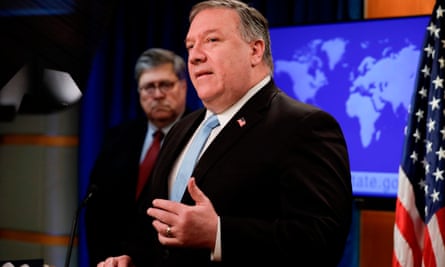
As well as referring to the
Afghanistan case, Mike Pompeo, Trump’s secretary of state, linked the US
measures to the Palestine case. “It’s clear the ICC is only putting
Israel in [its] crosshairs for nakedly political purposes,” he said.
Months later, Pompeo accused Bensouda of having “engaged in corrupt acts for her personal benefit”.
The US has never publicly provided any information to substantiate that charge, and Joe Biden lifted the sanctions months after he entered the White House.
Mike Pompeo at a joint news conference on the ICC sanctions in June 2020. Photograph: Yuri Gripas/AFP/Getty Images
But
at the time Bensouda faced increasing pressure from an apparently
concerted effort behind the scenes by the two powerful allies. As a
Gambian national, she did not enjoy the political protection that other
ICC colleagues from western countries had by virtue of their
citizenship. A former ICC source said this left her “vulnerable and
isolated”.
Cohen’s activities, sources said,
were particularly concerning for the prosecutor and led her to fear for
her personal safety. When the pre-trial chamber finally confirmed the ICC had jurisdiction in Palestine
in February 2021, some at the ICC even believed Bensouda should leave
the final decision to open a full investigation to her successor.
On 3 March, however, months before the end of her nine-year term, Bensouda announced a full investigation
in the Palestine case, setting in motion a process that could lead to
criminal charges, though she cautioned the next phase could take time.
“Any
investigation undertaken by the office will be conducted independently,
impartially and objectively, without fear or favour,” she said. “To
both Palestinian and Israeli victims and affected communities, we urge
patience.”
Khan announces arrest warrants
When
Khan took the helm at the ICC prosecutor’s office in June 2021, he
inherited an investigation he later said “lies on the San Andreas fault
of international politics and strategic interests”.
As
he took office, other investigations – including on events in the
Philippines, DRC, Afghanistan and Bangladesh – competed for his
attention, and in March 2022, days after Russia launched its invasion of
Ukraine, he opened a high-profile investigation into alleged Russian war crimes.
Initially,
the politically sensitive Palestine inquiry was not treated as a
priority by the British prosecutor’s team, sources familiar with the
case said. One said it was in effect “on the shelf” – but Khan’s office
disputes this and says it established a dedicated investigative team to
take the inquiry forward.
In Israel, the government’s top lawyers regarded Khan – who had previously defended warlords such as the former Liberian president Charles Taylor
– as a more cautious prosecutor than Bensouda. One former senior
Israeli official said there was “lots of respect” for Khan, unlike for
his predecessor. His appointment to the court was viewed as a “reason
for optimism”, they said, but they added that the 7 October attack “changed that reality”.
By
the end of the third week of Israel’s bombardment of Gaza, Khan was on
the ground at the Rafah border crossing. He subsequently made visits to
the West Bank and southern Israel, where he was invited to meet
survivors of the 7 October attack and the relatives of people who had
been killed.
In February 2024, Khan issued a
strongly worded statement that Netanyahu’s legal advisers interpreted as
an ominous sign. In the post on X, he in effect warned Israel against
launching an assault on Rafah, Gaza’s southernmost city, where more than
1 million displaced people were sheltering at the time.
“I
am deeply concerned by the reported bombardment and potential ground
incursion by Israeli forces in Rafah,” he wrote. “Those who do not
comply with the law should not complain later when my office takes
action.”
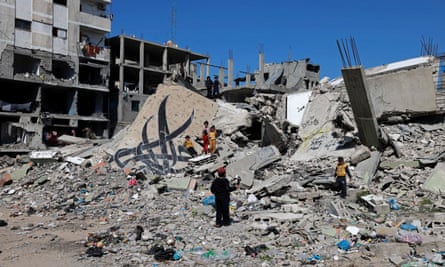
Children standing amid the rubble of a building in Rafah that was destroyed by Israeli airstrikes in February. Photograph: Mohammed Abed/AFP/Getty Images
The
comments stirred alarm within the Israeli government as they appeared
to deviate from his previous statements about the war, which officials
had viewed as reassuringly cautious. “That tweet surprised us a lot,” a
senior official said.
Concerns in Israel over
Khan’s intentions escalated last month when the government briefed the
media that it believed the prosecutor was contemplating arrest warrants against Netanyahu and other senior officials such as Yoav Gallant.
Israeli
intelligence had intercepted emails, attachments and text messages from
Khan and other officials in his office. “The subject of the ICC climbed
the ladder of priorities for Israeli intelligence,” one intelligence
source said.
It was via intercepted
communications that Israel established that Khan was at one stage
considering entering Gaza through Egypt and wanted urgent assistance
doing so “without Israel’s permission”.
Another
Israeli intelligence assessment, circulated widely in the intelligence
community, drew on surveillance of a call between two Palestinian
politicians. One of them said Khan had indicated that a request for
arrest warrants of Israeli leaders could be imminent, but warned he was
“under tremendous pressure from the United States”.
It
was against this backdrop that Netanyahu made a series of public
statements warning a request for arrest warrants could be imminent. He
called on “the leaders of the free world to stand firmly against the
ICC” and “use all the means at their disposal to stop this dangerous
move”.
He added: “Branding Israel’s leaders and
soldiers as war criminals will pour jet fuel on the fires of
antisemitism.” In Washington, a group of senior US Republican senators
had already sent a threatening letter to Khan with a clear warning:
“Target Israel and we will target you.”
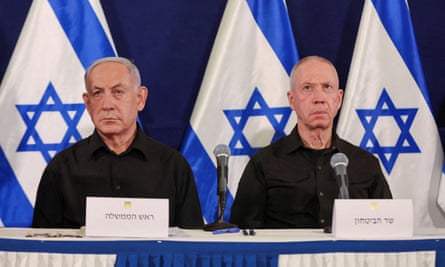
Netanyahu (left) and Yoav Gallant during a press conference in Tel Aviv in October. Photograph: Reuters
The
ICC, meanwhile, has strengthened its security with regular sweeps of
the prosecutor’s offices, security checks on devices, phone-free areas,
weekly threat assessments and the introduction of specialist equipment.
An ICC spokesperson said Khan’s office had been subjected to “several
forms of threats and communications that could be viewed as attempts to
unduly influence its activities”.
Khan recently disclosed in an interview with CNN
that some elected leaders had been “very blunt” with him as he prepared
to issue arrest warrants. “‘This court is built for Africa and for
thugs like Putin,’ is was what a senior leader told me.”
Despite
the pressure, Khan, like his predecessor in the prosecutor’s office,
chose to press ahead. Last week, Khan announced he was seeking arrest
warrants for Netanyahu and Gallant alongside three Hamas leaders for war
crimes and crimes against humanity.
He said
Israel’s prime minister and defence minister stood accused of
responsibility for extermination, starvation, the denial of humanitarian
relief supplies and deliberate targeting of civilians.
Standing
at a lectern with two of his top prosecutors – one American, the other
British – at his side, Khan said he had repeatedly told Israel to take
urgent action to comply with humanitarian law.
“I
specifically underlined that starvation as a method of war and the
denial of humanitarian relief constitute Rome statute offences. I could
not have been clearer,” he said. “As I also repeatedly underlined in my
public statements, those who do not comply with the law should not
complain later when my office takes action. That day has come.”
"I'm for truth, no matter who tells it. I'm for justice, no matter who it's for or against."
W.E.B. DuBois (1868-1963)
"There is but one coward on earth, and that is the coward that dare not know."
Dr. Martin Luther King, Jr. (1929-1968)
"Change does not roll in on the wheels of inevitability, but comes through continuous struggle. And so we must straighten our backs and work for our freedom. A man can't ride you unless your back is bent. "
James Baldwin (1924-1987)
"Precisely at the point when you begin to develop a conscience you must find yourself at war with your society."
"A civilization that proves incapable of solving the problems it creates is a decadent civilization. A civilization that chooses to close its eyes to its most crucial problems is a stricken civilization. A civilization that uses its principles for trickery and deceit is a dying civilization."
Nina Simone (1933-2003)
"There's no other purpose, so far as I'm concerned, for us except to reflect the times, the situations around us and the things we're able to say through our art, the things that millions of people can't say. I think that's the function of an artist and, of course, those of us who are lucky leave a legacy so that when we're dead, we also live on. That's people like Billie Holiday and I hope that I will be that lucky, but meanwhile, the function, so far as I'm concerned, is to reflect the times, whatever that might be."
Amilcar Cabral (1924-1973)
"Always bear in mind that the people are not fighting for ideas, for the things in anyone's head. They are fighting to live better and in peace, to see their lives go forward, to guarantee the future of their children ....Hide nothing from the masses of our people. Tell no lies. Expose lies whenever they are told. Mask no difficulties, mistakes, failures. Claim no easy victories..." .
Angela Davis (b. 1944)
"The idea of freedom is inspiring. But what does it mean? If you are free in a political sense but have no food, what's that? The freedom to starve?”
Duke Ellington (1899-1974)
“Jazz is the freest musical expression we have yet seen. To me, then, jazz means simply freedom of musical speech! And it is precisely because of this freedom that so many varied forms of jazz exist. The important thing to remember, however, is that not one of these forms represents jazz by itself. Jazz simply means the freedom to have many forms.”
Amiri Baraka (1934-2014)
"Thought is more important than art. To revere art and have no understanding of the process that forces it into existence, is finally not even to understand what art is."
Frederick Douglass (1817-1895)
"Power concedes nothing without a demand. It never did and it never will. Find out just what any people will quietly submit to and you have found out the exact measure of injustice and wrong which will be imposed upon them, and these will continue till they are resisted with either words or blows, or both. The limits of tyrants are prescribed by the endurance of those whom they oppress.” --August 3, 1857
Cecil Taylor (1929-2018)
“Musical categories don’t mean anything unless we talk about the actual specific acts that people go through to make music, how one speaks, dances, dresses, moves, thinks, makes love...all these things. We begin with a sound and then say, what is the function of that sound, what is determining the procedures of that sound? Then we can talk about how it motivates or regenerates itself, and that’s where we have tradition.”
Ella Baker (1903-1986)
"Strong people don't need strong leaders"
Paul Robeson (1898-1976)
"The artist must take sides. He must elect to fight for freedom or for slavery. I have made my choice. I had no alternative."
John Coltrane (1926-1967)
"I want to be a force for real good. In other words, I know there are bad forces. I know that there are forces out here that bring suffering to others and misery to the world, but I want to be the opposite force. I want to be the force which is truly for good."
Miles Davis (1926-1991)
"Jazz is the big brother of Revolution. Revolution follows it around."
C.L.R. James (1901-1989)
"All development takes place by means of self-movement, not organization by external forces. It is within the organism itself (i.e. within the society) that there must be realized new motives, new possibilities."
Frantz Fanon (1925-1961)
"Now, political education means opening minds, awakening them, and allowing the birth of their intelligence as [Aime] Cesaire said, it is 'to invent souls.' To educate the masses politically does not mean, cannot mean, making a political speech. What it means is to try, relentlessly and passionately, to teach the masses that everything depends on them."
Edward Said (1935-2003)
“I take criticism so seriously as to believe that, even in the midst of a battle in which one is unmistakably on one side against another, there should be criticism, because there must be critical consciousness if there are to be issues, problems, values, even lives to be fought for."
Antonio Gramsci (1891-1937)
“The challenge of modernity is to live without illusions and without becoming disillusioned. There must be pessimism of the intellect and optimism of the will.”
Susan Sontag (1933-2004)
"Do stuff. Be clenched, curious. Not waiting for inspiration’s shove or society’s kiss on your forehead. Pay attention. It’s all about paying attention. Attention is vitality. It connects you with others. It makes you eager. Stay eager."
Kofi Natambu, editor of The Panopticon Review, is a writer, poet, cultural critic, and political journalist whose poetry, essays, criticism, reviews, and journalism have appeared in many literary magazines, journals, newspapers, and anthologies. He is the author of a biography MALCOLM X: His Life & Work (Alpha Books) and two books of poetry: THE MELODY NEVER STOPS (Past Tents Press) and INTERVALS (Post Aesthetic Press). He was the founder and editor of SOLID GROUND: A NEW WORLD JOURNAL, a national quarterly magazine of the arts, culture, and politics and the editor of a literary anthology NOSTALGIA FOR THE PRESENT (Post Aesthetic Press). Natambu has read his work throughout the country and given many lectures and workshops at academic and arts institutions. He has taught American literature, literary theory and criticism, cultural history and criticism, film studies, political science, creative writing, philosophy, critical theory, and music history and criticism (Jazz, Blues, R&B, Hip Hop) at many universities and colleges. He was also a curator in the Education Department of Detroit’s Museum of African American History. Born in Detroit, Michigan, Natambu currently lives in Berkeley, California with his wife Chuleenan.