http://www.truth-out.org/richard-wolff-debt-showdown-political-theater-burdening-societys-most-vulnerable-video/1311958717
Richard Wolff: Debt Showdown Is Political Theater Burdening Society's Most Vulnerable (Video)
Friday 29 July 2011
by Juan Gonzalez and Richard D. Wolff,
Democracy Now! | Interview
Republicans have agreed to a vote today on a budget plan they say will cut the deficit $917 billion over 10 years. The move sets the stage for a showdown against unified Democratic opposition in the Senate and threats of a White House veto. To discuss the debt talks and economic austerity worldwide, we’re joined by Richard Wolff, Emeritus Professor of Economics at University of Massachusetts Amherst and author of several books, including "Capitalism Hits the Fan: The Global Economic Meltdown and What to Do About It." "This is political theater in which two parties are posturing for the election coming next year," says Wolff. "To put it in perspective, the number of times the government has raised the debt ceiling since 1940? Ninety, almost twice a year. This is a normal, automatic procedure. Every president, Republican and Democrat, has asked for it."
TRANSCRIPT:
JUAN GONZALEZ: After weeks of infighting, Republicans have agreed to vote today on a budget plan they say will cut the deficit $917 billion over 10 years. The move sets the stage for a [showdown] against unified Democratic opposition in the Senate. Independent Senators Joe Lieberman and Bernie Sanders are promising to block it. White House spokesman James Carney warned yesterday that time is running out to reach a compromise. Carney also said Treasury Department officials may soon have to decide who will get government checks and who won’t, if the Treasury loses borrowing authority.
PRESS SECRETARY JAY CARNEY: Among the many obligations we have, the 80 million checks that the Treasury Department alone issues, payments that it issues every month, of the 1.2 billion payments the federal government makes in a year, those include veterans’ payments, Social Security payments, disability payments. They include the bills to contractors, small businesses, big businesses, that do work with the government, the people who manufacture the ammunition that we send to our troops in Afghanistan. And choices then have to be made. And it’s a Sophie’s choice, right? Who do you save? Who do you pay? That’s an impossible situation that this country has never faced, and should never face, if Congress does what it was elected to do and does its job.
AMY GOODMAN: White House spokesperson Jay Carney.
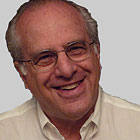
To discuss the debt talks, we’re joined by Richard Wolff, Professor Emeritus of Economics at University of Massachusetts Amherst, visiting professor here in New York at New School University, also hosts a weekly program on WBAI called Economic Update.
Welcome to Democracy Now!
RICHARD WOLFF: Thank you.
AMY GOODMAN: So we are watching this dance in Washington. The House is going to vote today around the issue of the debt ceiling. The Senate says it’s dead in the water. President Obama is vowing to veto. What does this all mean?
RICHARD WOLFF: Well, basically, your word "dance" is perfect. This is theater. This is political theater in which the two parties are posturing for the election coming next year, using this occasion—to put it in perspective, the number of times the government has raised the debt ceiling since 1940? Ninety, almost twice a year. This is a normal, automatic procedure. Every president, Republican and Democrat, has asked for it. When they ask, typically, the representatives of the other party say, "Well, you’re not managing the government real well," and then they vote for it. And that has happened over and over again. So what you’re seeing is a decision, politically, to make it theatric, out of what otherwise would have been a normal procedure.
A hundred years ago, the Congress said, in order to control the government and not to allow businesses and rich people to be able to invest in government money easily, we’re going to have the government limit how much can be borrowed. That was the idea. Now it became automatic, as we became a debt society—excuse me—and so, suddenly, the Republicans basically decided to make theater, to run their campaign a little early this year, and to slow it all down and make a big to-do.
The world expects that this will have to be undone in a few days or weeks. They’re kind of amazed to see it being stretched like this, this old, normal procedure. And the assumption is that the politics in the United States has become as dysfunctional as our economic situation. And so, that’s the danger, that this rigmarole, this theater, is really a sign that normal life in the United States has been disrupted on a scale that people haven’t seen before.
JUAN GONZALEZ: But when you say that the Republicans decided to make theater out of it, it seems to me that the Democrats also have participated in the process by making this seem like it’s—Armageddon will occur unless we get this done by August 2nd. And in essence, at times it seems almost like the Obama administration is seeking this deadline to start moving in a more centrist direction economically that it has wanted to do, but has been absent the type of crisis that it would be able to convince the American public that it needs to do.
RICHARD WOLFF: There are certainly signs of that. And they’re very troubling to many of us who are economists, right, left and center, because basically, the Democrats have said, "We will do massive cuts. They just won’t be as massive as the Republicans want." And then they will appeal to the American people in the hope that Americans will choose the lesser evil: the Democrats who won’t cut so terribly compared to the Republicans.
And the Republicans are appealing to folks that are very upset by the economic situation, don’t know who to be angry at. In the American way, they get angry at the government. It’s a little bit amazing, if you take a step back. The overwhelming majority of people who’ve lost our jobs in this crisis have been fired by private employers. The overwhelming majority of people who have been thrown out of their homes have been—have had that happen because a private bank has gone to court to get that to happen. And yet, the American people have this tendency, built into our culture, to leap right over the person who’s actually done you the damage and to blame the government. And so, the government, in general, and the particular government of Mr. Obama, is the target, and the Republicans are playing on this. And that’s their ploy.
And the Democrats are saying, "Well, we’re not so bad. We’re going to tax the rich, just a little, and the corporations a little less. And that’s something the Republicans won’t do. And we will protect your Social Security, at least more than..."
But you’re right. In the process, everything moves over to massive cutting. And besides the morals of that, it’s economically crazy. In an economic situation where recovery is very poor, very uneven, to have the government cut back, the way that spokesman for the White House just told us, is to make an economic situation that’s bad worse. So you see a kind of political game being played at the cost of worsening the underlying economic situation. And for the world, that suggests a society that’s not working.
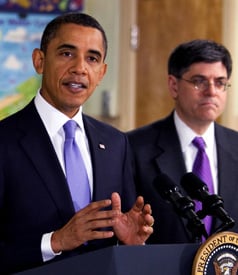
AMY GOODMAN: Let’s go to President Obama on Monday night, when he addressed the nation, reiterating his call for what he described as a "balanced approach" to deficit reduction involving spending cuts and tax increases on the wealthy.
PRESIDENT BARACK OBAMA: The first approach says, let’s live within our means by making serious historic cuts in government spending; let’s cut domestic spending to the lowest level it’s been since Dwight Eisenhower was president; let’s cut defense spending at the Pentagon by hundreds of billions of dollars; let’s cut out waste and fraud in healthcare programs like Medicare, and at the same time, let’s make modest adjustments so that Medicare is still there for future generations; finally, let’s ask the wealthiest Americans and biggest corporations to give up some of their breaks in the tax code and special deductions. This balanced approach asks everyone to give a little, without requiring anyone to sacrifice too much. It would reduce the deficit by around $4 trillion and put us on a path to pay down our debt. And the cuts wouldn’t happen so abruptly that they’d be a drag on our economy or prevent us from helping small businesses and middle-class families get back on their feet right now.
JUAN GONZALEZ: Shortly after the President addressed the nation on the budget crisis Monday night, House Speaker John Boehner responded in a televised address.
SPEAKER JOHN BOEHNER: The President is adamant that we cannot make fundamental changes to our entitlement programs. As the father of two daughters, I know these programs won’t be there for them and their kids unless significant action is taken now. And the sad truth is that the President wanted a blank check six months ago, and he wants a blank check today. This is just not going to happen.
AMY GOODMAN: Richard Wolff, economist, author, Capitalism Hits the Fan: The Global Economic Meltdown and What to Do About It, I did actually hear the reference to war by President Obama, but it’s rarely, rarely raised by Democrats or Republicans. One of your colleagues, Joe Stiglitz, said, over time, the wars in Iraq and Afghanistan will cost $5 trillion.
RICHARD WOLFF: There are a number of things that are not on the table. And frankly, I’m amazed that the President refers to what he does as a "balanced approach." First of all, the war and its enormous costs, off the table in any serious way. Going back to a serious taxation of corporations and of the rich in America, just, for example, at the scale that they were taxed in the ’50s, ’60s and ’70s, off the table.
Basically what’s being done is to suggest that now, after a "recovery," in quotations, that has only recovered the stock market and corporate profits and bank reserves, that has done nothing about unemployment and foreclosure—we haven’t had a balanced economic arrangement in this country for years. So, suddenly we’re going to be balanced in what’s coming next. That’s a strange kind of logic. Why is there not facing up to the war, the fact that you’re not taxing the rich? And perhaps the worst, we’re at a crisis because we have an economic system that hasn’t worked well, and the government bailed out banks and corporations by using public money. That was done to help them. It hasn’t helped many other folks. So now is not the time to do balance. Now is the time to correct the imbalance that has built up over all these years. And I think that would be where the President really ought to start.
JUAN GONZALEZ: But you do argue, contrary to some other liberal economists like Paul Krugman, that the deficits are a major problem and that the increasing deficit spending of the U.S. government has to be brought under control. So that would seem to indicate that your main push would be to obviously cut war spending, but also to raise taxes significantly.
RICHARD WOLFF: The most amazing thing to me is that we talk about fixing a government budget that’s in trouble, and we don’t talk about the revenue side in a serious way. That is an amazing thing. If you look at what happened to the American budget over the last 20 or 30 years, the culprit is obvious. We have dropped corporate taxes. We have dropped taxes on the rich.
Let me give you a couple of examples to drive it home. If you go back to the 1940s, here’s what you discover, that the federal government got 50 percent more money year after year from corporations than it did from individuals. For every dollar that individuals paid in income tax, corporations paid $1.50. If you compare that to today, here are the numbers. For every dollar that individuals pay to the federal government, corporations pay 25 cents. That is a dramatic change that has no parallel in the rest of our tax code.
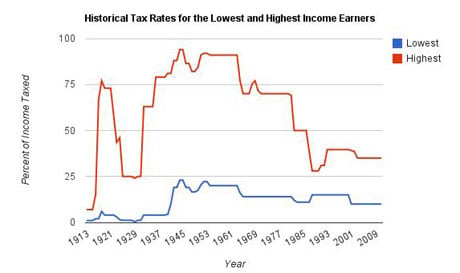
Another example. In the ’50s and ’60s, the top bracket, the income tax rate that the richest people had to pay, for example the ’50s and ’60s, it was 91 percent. Every dollar over $100,000 that a rich person earned, he or she had to give 91 cents to Washington and kept nine. And the rationale for that was, we had come out of a Great Depression, we had come out of a great war, we had to rebuild our society, we were in a crisis, and the rich had the capacity to pay, and they ought to pay. Republicans voted for that. Democrats voted for that. What do we have today? Ninety-one percent? No. The top rate for rich people today, 35 percent. Again, nobody else in this society—not the middle, not the poor—have had anything like this consequence.
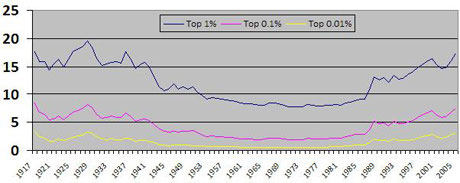
So, over the last 30, 40 years, a shift from corporate income tax to individual income tax, and among individuals, from the rich to everybody else. To deal with our budget problem without discussing that, putting that front and center, making that part of the story, that’s just a service to the rich and the corporations. There’s no polite way to say otherwise. And there’s something shameful about keeping all of that away and focusing on how we’re going to take out our budget problems by cutting back benefits to old people, to people who have medical needs. There’s something bizarre, and the world sees that, in a society that has done what it has done and now proposes to fix it on the backs of the majority.
AMY GOODMAN: And the argument that you give the money to the corporations and to the banks, and they will help people? They are the generator of jobs?
RICHARD WOLFF: The Republicans say it, and President Obama has said it repeatedly. He is going to provide incentives, he said, for years now. He is going to provide inducements and support for the private sector to put people back to work. We have a 9.2 percent unemployment rate. That’s what it’s been for the last two years. That policy has not worked. If corporations were going to do what the President gave them incentives to do, they would have done it. They’re not doing it. There’s no sign they’re going to do it. You have to face: that policy didn’t work.
What’s the alternative? Well, we don’t have to look far. Roosevelt, in the 1930s, the last time we faced this kind of situation, went on the radio in 1933 and 1934, and he gave speeches. And in those speeches, he said the following: if the private sector either cannot or will not provide work for millions of our citizens, ready, able and willing to work, then the government has to do it. And between 1934 and 1941, the federal government created and filled 11 million jobs.
The most amazing thing in the United States is not that we are not doing it. The most amazing thing is, there’s no bill to do it, there’s no discussion to do it. The president of the country never refers to it, keeps telling us—and the Republicans do the same—that the private sector is where we should focus our expectations. The private sector has answered: "We are not going to hire people here. We’re either going to hire no one, because we don’t like the way the economy looks, or we’re going to hire people in other countries, because they pay lower wages there." That’s a response of the private sector taking care of itself. It’s not a responsible way to run a society.
JUAN GONZALEZ: And one issue that you raised, in terms of how the corporations and bank profits have recovered tremendously, but—and many of these companies are sitting on huge piles of cash, that rather than invest in new machinery or bring in new workers, they’re just sitting on their money, and presumably investing it, because they’re not going to put it in at the bank rates or CD rates, so they’re obviously investing the money that they have, rather than create those jobs.
RICHARD WOLFF: Well, even more interesting, and maybe a bit of a shock to folks who don’t follow this, what the corporations are doing when they hold back the money—because it’s not profitable for them to hire—in large part, is they lend it to the United States government to fund these deficits. The United States government refuses to tax corporations and the rich. It then runs a deficit. It spends more than it takes in, because it’s not taxing them. And here comes the punchline. It then turns around to the people it didn’t tax—corporations and the rich—and borrows the money from them, paying them interest and paying them back. If the United States wanted to stimulate our economy in an effective way—
AMY GOODMAN: Pay even tax-deductible interest.
RICHARD WOLFF: Right, also. But if the government really wanted to do something, go get the money from them, stimulate, which will help them, and if you tax them to do it, you wouldn’t have a national debt. You wouldn’t run a deficit. We’re running a deficit because the people who run this society would like us to deal with our economic problems, not by taxing those who have it, the way we used to, but instead by endlessly borrowing them. And now the ultimate irony, we’ve borrowed so much as a nation from the rich and the corporations, they now are not so sure they want to continue to lend to us, because we’re so deeply in debt. And they want us instead to go stick it to poor people and sick people instead. It’s an extraordinary moment in our history as a nation.
AMY GOODMAN: We have to break, but we’re going to come back. Lots of people are sending us questions. They’re tweeting them in. They’re sending it to us on Facebook. You can go to facebook.com/democracynow or twitter.com/democracynow. We want to hear from you. We’re talking to Richard Wolff, who’s at New School University here in New York. His new book is _Capitalism Hits the Fan: The Global Economic Meltdown and What to Do About It." Stay with us.
[break]
AMY GOODMAN: Our guest, Richard Wolff. His book, Capitalism Hits the Fan: The Global Economic Meltdown and What to Do About It. And people are sending us in questions. There is, as Richard Wolff says, an enormous hunger to understand all this. Eli Rivers on Facebook asks, "Given how the masses are getting continually and increasingly financially punished for events they had little or nothing to have caused, is it reasonable to assume that there will be major political upheavals in the near future? It seems we are almost at a breaking point." Professor Wolff?
RICHARD WOLFF: Yes, I think the—in a sense, that’s coming here in the United States, your previous guest explaining the gaps in wealth among the people, becoming more and more extreme. The signs are everywhere of a society like ours polarizing in a way that is going to undercut assumptions about what it means to be an American, expectations about realizing an American Dream. Those things are falling away, and people have to face that, and they’re upset. I think part of what we call the Tea Party is simply an expression, not so much of this or that ideological persuasion, but of a level of upset about economics and the future for their own children, that makes people look somewhere for something.
Europe also, I think, shows us the future. In Europe, where people are more organized, in trade unions, in socialist, communist and other political parties, there are vehicles that these institutions provide for public anger and public disagreement to be voiced in a reasonable and consistent way. In all the major countries of Europe, not just Greece, Portugal, Ireland and those that are in trouble, but in France and Germany and so on, there have been massive public actions in the streets showing that people do not want, to use one of the slogans in France, do not want the costs of an economic crisis to be borne by the mass of people who didn’t cause it and who have already suffered from it, and that has to stop. And that is shifting European politics. And while we don’t have the level of organization of people in this country that they do, I do think we will build them again, we will rebuild them from what they were before, because there has to be a change from the very direction that the questioner asks. And I’m sure that’s coming.
JUAN GONZALEZ: But in Europe, you have the remarkable situation that the more conservative parties are being pressured by the street to adopt more conciliatory policies in terms of dealing with the crisis, whereas in the United States—
RICHARD WOLFF: Going the other way.
JUAN GONZALEZ: —the more liberal parties are being—are seeing no pressure from the street, are increasingly moving to the right, in terms of how they see the need to deal with the crisis.
RICHARD WOLFF: It’s a wonderful case study. The German example is probably the best one—the biggest economy in Europe, the most important, run by a woman now named Angela Merkel, who runs that society. She did a remarkable thing over the last two months. She said there will be no bailout of Greece, unless banks are made to pay a part of the cost. Other governments in Europe didn’t have the courage. Why is this woman, a conservative, wanting to make sure the banks pay? Because she lost the last three bi-elections, and the critics of her are saying, "Your political career is over if you don’t stop making everyone in the society pay, except those who, A, caused this crisis, and, B, have been bailed out by the government to this point." So she actually changes. And I think that’s a sign that the pushback from masses of people, which will take many different forms, is already underway there and will come here.
AMY GOODMAN: Why are the people in the United States so different?
RICHARD WOLFF: I think it’s the question of organization. Over the last 50 years, we, the collective American people, have let the organizations that express mass concerns about economics atrophy. We’re at the end of a 50-year decline of our trade union movement. We don’t have the kinds of political parties we used to have in this country and that were very powerful in this country. And so, we don’t have the vehicles to articulate, express and bring political force to the way people feel. And so they go wherever there’s a little bit of organization—Tea Party—even if it’s a little strange and a little outside their frame, because it’s something. I think the message of other people will be, if we can form the kinds of organizations that articulate these positions, there are a lot of people out there ready, willing and able to become part of that.
AMY GOODMAN: This is another question from Facebook. Steve Cipolla asks, "Does it continue to make sense to refer to U.S. economic policy in isolation? Isn’t the real long-term threat to economic (and political) stability the persistence of increasing global income inequality?"
RICHARD WOLFF: Yes, but we are still dealing with corporations that have their bases, most of them, here in the United States. Are they more global than ever? Yes. Is that a serious problem? Absolutely. You know, 30, 40 years ago, we spoke about corporations moving production jobs out of the United States. Ten or 15 years ago, we began to talk about outsourcing, moving white-collar jobs out. The most recent addition to that is the decision of corporations, as they look around the world, to say, you know, the growth of our market, the growth of demand, it’s in Asia, it’s in Latin America, it’s in parts of—it’s not here. The American people are exhausted. Their wages are going nowhere. We have high unemployment. And the fact is, no one is going to lend them much more money because they’re tapped out. So they’re not a growing market.
So you see American corporations literally focused, for production and for consumption, elsewhere. That means they’re going to take care of themselves in the world. And if we don’t want to be left behind, if we don’t want the United States to become a backwater, then the freedom of corporations to do what they want has to be reined in. And that’s a difficult issue for Americans to confront and deal with. And we live in an ideology in which we’re supposed to believe that what corporations choose to do will magically be the best for all of us. It hasn’t worked that way. That’s why we are where we are. Basic change is the order of the day.
JUAN GONZALEZ: And in other regions of the world, that change is occurring. We’ve covered quite extensively here on Democracy Now! the changes in Latin America, where actually the income and the wealth gap is shrinking in the past decade for the first time in the memory of the political establishment of Latin America as a result of all of the socially oriented governments that have come to power.
RICHARD WOLFF: Right.
JUAN GONZALEZ: It’s a completely different path from what’s going on here in the United States.
RICHARD WOLFF: And I think it also speaks to our situation, because before that happened, before you had Evo Morales, before you had Chávez, before you had—and whatever you think of their particular policies, you had an upswelling of people saying the status quo that has got us into this dead end is not tolerable. And they developed new organizations. They rebuilt old organizations. And suddenly, basic changes in policy, which reined in the power of private enterprise, which said that capitalist enterprises are not the be-all and end-all of how to run a society, those kinds of movements attracted millions of people, gained political power. And there really is no reason to believe that our society is immune or unable to do, in its own way and its own traditions, something similar.
JUAN GONZALEZ: Well, I want to ask you about another question Brian Clifford asks on our Facebook page. "In the current moment, people in liberal democratic states seem to have internalized capitalism as a natural and unquestionable order. How does the left rupture such subjectivities?"
RICHARD WOLFF: Good question. You know, again, it’s our history. For 50 years, it has been unacceptable politically in the United States to ask what is basically a straightforward question. We have a particular economic system. It’s called capitalism. We have every right as a society to ask of that system, is it working? Is it working for us? Do the benefits and the costs balance themselves out in a way that says we want to keep the system, or that says we want to change the system, or that says we ought to look for an alternative system? We’ve been afraid to ask that question. We’ve been afraid to have public debates. That’s the legacy of the Cold War. We can’t afford anymore to not do that. We have to do as the questioner says: raise the question.
As it is put in a very powerful slogan in Germany by a new party that now gets 12 percent of the national vote, here’s their slogan—it’s in Germany: Can Germany do better than capitalism? And their answer is yes. And that has forced a conversation about this system, its limits, its strengths and weaknesses. That’s long overdue in the United States. And one of the results of this crisis, and now of this governmental paralysis, is to give a strong impetus to asking those questions. And that doesn’t mean accepting the alternatives of the past. The old efforts of going beyond capitalism had strength, but they also had horrible weaknesses. We will learn from that, as human beings always have. And we can forge a country out of an opening of the debate about this economic system. And I want to be part of that, and I think the American people are ready and interested in doing it, as well.
AMY GOODMAN: I want to thank you very much for being with us. Richard Wolff, an economist, just back actually from Europe, but teaches here in New York at New School University. His book is called Capitalism Hits the Fan: The Global Economic Meltdown and What to Do About It.
Richard Wolff: Debt Showdown Is Political Theater Burdening Society's Most Vulnerable (Video)
Friday 29 July 2011
by Juan Gonzalez and Richard D. Wolff,
Democracy Now! | Interview
Republicans have agreed to a vote today on a budget plan they say will cut the deficit $917 billion over 10 years. The move sets the stage for a showdown against unified Democratic opposition in the Senate and threats of a White House veto. To discuss the debt talks and economic austerity worldwide, we’re joined by Richard Wolff, Emeritus Professor of Economics at University of Massachusetts Amherst and author of several books, including "Capitalism Hits the Fan: The Global Economic Meltdown and What to Do About It." "This is political theater in which two parties are posturing for the election coming next year," says Wolff. "To put it in perspective, the number of times the government has raised the debt ceiling since 1940? Ninety, almost twice a year. This is a normal, automatic procedure. Every president, Republican and Democrat, has asked for it."
TRANSCRIPT:
JUAN GONZALEZ: After weeks of infighting, Republicans have agreed to vote today on a budget plan they say will cut the deficit $917 billion over 10 years. The move sets the stage for a [showdown] against unified Democratic opposition in the Senate. Independent Senators Joe Lieberman and Bernie Sanders are promising to block it. White House spokesman James Carney warned yesterday that time is running out to reach a compromise. Carney also said Treasury Department officials may soon have to decide who will get government checks and who won’t, if the Treasury loses borrowing authority.
PRESS SECRETARY JAY CARNEY: Among the many obligations we have, the 80 million checks that the Treasury Department alone issues, payments that it issues every month, of the 1.2 billion payments the federal government makes in a year, those include veterans’ payments, Social Security payments, disability payments. They include the bills to contractors, small businesses, big businesses, that do work with the government, the people who manufacture the ammunition that we send to our troops in Afghanistan. And choices then have to be made. And it’s a Sophie’s choice, right? Who do you save? Who do you pay? That’s an impossible situation that this country has never faced, and should never face, if Congress does what it was elected to do and does its job.
AMY GOODMAN: White House spokesperson Jay Carney.
To discuss the debt talks, we’re joined by Richard Wolff, Professor Emeritus of Economics at University of Massachusetts Amherst, visiting professor here in New York at New School University, also hosts a weekly program on WBAI called Economic Update.
Welcome to Democracy Now!
RICHARD WOLFF: Thank you.
AMY GOODMAN: So we are watching this dance in Washington. The House is going to vote today around the issue of the debt ceiling. The Senate says it’s dead in the water. President Obama is vowing to veto. What does this all mean?
RICHARD WOLFF: Well, basically, your word "dance" is perfect. This is theater. This is political theater in which the two parties are posturing for the election coming next year, using this occasion—to put it in perspective, the number of times the government has raised the debt ceiling since 1940? Ninety, almost twice a year. This is a normal, automatic procedure. Every president, Republican and Democrat, has asked for it. When they ask, typically, the representatives of the other party say, "Well, you’re not managing the government real well," and then they vote for it. And that has happened over and over again. So what you’re seeing is a decision, politically, to make it theatric, out of what otherwise would have been a normal procedure.
A hundred years ago, the Congress said, in order to control the government and not to allow businesses and rich people to be able to invest in government money easily, we’re going to have the government limit how much can be borrowed. That was the idea. Now it became automatic, as we became a debt society—excuse me—and so, suddenly, the Republicans basically decided to make theater, to run their campaign a little early this year, and to slow it all down and make a big to-do.
The world expects that this will have to be undone in a few days or weeks. They’re kind of amazed to see it being stretched like this, this old, normal procedure. And the assumption is that the politics in the United States has become as dysfunctional as our economic situation. And so, that’s the danger, that this rigmarole, this theater, is really a sign that normal life in the United States has been disrupted on a scale that people haven’t seen before.
JUAN GONZALEZ: But when you say that the Republicans decided to make theater out of it, it seems to me that the Democrats also have participated in the process by making this seem like it’s—Armageddon will occur unless we get this done by August 2nd. And in essence, at times it seems almost like the Obama administration is seeking this deadline to start moving in a more centrist direction economically that it has wanted to do, but has been absent the type of crisis that it would be able to convince the American public that it needs to do.
RICHARD WOLFF: There are certainly signs of that. And they’re very troubling to many of us who are economists, right, left and center, because basically, the Democrats have said, "We will do massive cuts. They just won’t be as massive as the Republicans want." And then they will appeal to the American people in the hope that Americans will choose the lesser evil: the Democrats who won’t cut so terribly compared to the Republicans.
And the Republicans are appealing to folks that are very upset by the economic situation, don’t know who to be angry at. In the American way, they get angry at the government. It’s a little bit amazing, if you take a step back. The overwhelming majority of people who’ve lost our jobs in this crisis have been fired by private employers. The overwhelming majority of people who have been thrown out of their homes have been—have had that happen because a private bank has gone to court to get that to happen. And yet, the American people have this tendency, built into our culture, to leap right over the person who’s actually done you the damage and to blame the government. And so, the government, in general, and the particular government of Mr. Obama, is the target, and the Republicans are playing on this. And that’s their ploy.
And the Democrats are saying, "Well, we’re not so bad. We’re going to tax the rich, just a little, and the corporations a little less. And that’s something the Republicans won’t do. And we will protect your Social Security, at least more than..."
But you’re right. In the process, everything moves over to massive cutting. And besides the morals of that, it’s economically crazy. In an economic situation where recovery is very poor, very uneven, to have the government cut back, the way that spokesman for the White House just told us, is to make an economic situation that’s bad worse. So you see a kind of political game being played at the cost of worsening the underlying economic situation. And for the world, that suggests a society that’s not working.
AMY GOODMAN: Let’s go to President Obama on Monday night, when he addressed the nation, reiterating his call for what he described as a "balanced approach" to deficit reduction involving spending cuts and tax increases on the wealthy.
PRESIDENT BARACK OBAMA: The first approach says, let’s live within our means by making serious historic cuts in government spending; let’s cut domestic spending to the lowest level it’s been since Dwight Eisenhower was president; let’s cut defense spending at the Pentagon by hundreds of billions of dollars; let’s cut out waste and fraud in healthcare programs like Medicare, and at the same time, let’s make modest adjustments so that Medicare is still there for future generations; finally, let’s ask the wealthiest Americans and biggest corporations to give up some of their breaks in the tax code and special deductions. This balanced approach asks everyone to give a little, without requiring anyone to sacrifice too much. It would reduce the deficit by around $4 trillion and put us on a path to pay down our debt. And the cuts wouldn’t happen so abruptly that they’d be a drag on our economy or prevent us from helping small businesses and middle-class families get back on their feet right now.
JUAN GONZALEZ: Shortly after the President addressed the nation on the budget crisis Monday night, House Speaker John Boehner responded in a televised address.
SPEAKER JOHN BOEHNER: The President is adamant that we cannot make fundamental changes to our entitlement programs. As the father of two daughters, I know these programs won’t be there for them and their kids unless significant action is taken now. And the sad truth is that the President wanted a blank check six months ago, and he wants a blank check today. This is just not going to happen.
AMY GOODMAN: Richard Wolff, economist, author, Capitalism Hits the Fan: The Global Economic Meltdown and What to Do About It, I did actually hear the reference to war by President Obama, but it’s rarely, rarely raised by Democrats or Republicans. One of your colleagues, Joe Stiglitz, said, over time, the wars in Iraq and Afghanistan will cost $5 trillion.
RICHARD WOLFF: There are a number of things that are not on the table. And frankly, I’m amazed that the President refers to what he does as a "balanced approach." First of all, the war and its enormous costs, off the table in any serious way. Going back to a serious taxation of corporations and of the rich in America, just, for example, at the scale that they were taxed in the ’50s, ’60s and ’70s, off the table.
Basically what’s being done is to suggest that now, after a "recovery," in quotations, that has only recovered the stock market and corporate profits and bank reserves, that has done nothing about unemployment and foreclosure—we haven’t had a balanced economic arrangement in this country for years. So, suddenly we’re going to be balanced in what’s coming next. That’s a strange kind of logic. Why is there not facing up to the war, the fact that you’re not taxing the rich? And perhaps the worst, we’re at a crisis because we have an economic system that hasn’t worked well, and the government bailed out banks and corporations by using public money. That was done to help them. It hasn’t helped many other folks. So now is not the time to do balance. Now is the time to correct the imbalance that has built up over all these years. And I think that would be where the President really ought to start.
JUAN GONZALEZ: But you do argue, contrary to some other liberal economists like Paul Krugman, that the deficits are a major problem and that the increasing deficit spending of the U.S. government has to be brought under control. So that would seem to indicate that your main push would be to obviously cut war spending, but also to raise taxes significantly.
RICHARD WOLFF: The most amazing thing to me is that we talk about fixing a government budget that’s in trouble, and we don’t talk about the revenue side in a serious way. That is an amazing thing. If you look at what happened to the American budget over the last 20 or 30 years, the culprit is obvious. We have dropped corporate taxes. We have dropped taxes on the rich.
Let me give you a couple of examples to drive it home. If you go back to the 1940s, here’s what you discover, that the federal government got 50 percent more money year after year from corporations than it did from individuals. For every dollar that individuals paid in income tax, corporations paid $1.50. If you compare that to today, here are the numbers. For every dollar that individuals pay to the federal government, corporations pay 25 cents. That is a dramatic change that has no parallel in the rest of our tax code.
Another example. In the ’50s and ’60s, the top bracket, the income tax rate that the richest people had to pay, for example the ’50s and ’60s, it was 91 percent. Every dollar over $100,000 that a rich person earned, he or she had to give 91 cents to Washington and kept nine. And the rationale for that was, we had come out of a Great Depression, we had come out of a great war, we had to rebuild our society, we were in a crisis, and the rich had the capacity to pay, and they ought to pay. Republicans voted for that. Democrats voted for that. What do we have today? Ninety-one percent? No. The top rate for rich people today, 35 percent. Again, nobody else in this society—not the middle, not the poor—have had anything like this consequence.
So, over the last 30, 40 years, a shift from corporate income tax to individual income tax, and among individuals, from the rich to everybody else. To deal with our budget problem without discussing that, putting that front and center, making that part of the story, that’s just a service to the rich and the corporations. There’s no polite way to say otherwise. And there’s something shameful about keeping all of that away and focusing on how we’re going to take out our budget problems by cutting back benefits to old people, to people who have medical needs. There’s something bizarre, and the world sees that, in a society that has done what it has done and now proposes to fix it on the backs of the majority.
AMY GOODMAN: And the argument that you give the money to the corporations and to the banks, and they will help people? They are the generator of jobs?
RICHARD WOLFF: The Republicans say it, and President Obama has said it repeatedly. He is going to provide incentives, he said, for years now. He is going to provide inducements and support for the private sector to put people back to work. We have a 9.2 percent unemployment rate. That’s what it’s been for the last two years. That policy has not worked. If corporations were going to do what the President gave them incentives to do, they would have done it. They’re not doing it. There’s no sign they’re going to do it. You have to face: that policy didn’t work.
What’s the alternative? Well, we don’t have to look far. Roosevelt, in the 1930s, the last time we faced this kind of situation, went on the radio in 1933 and 1934, and he gave speeches. And in those speeches, he said the following: if the private sector either cannot or will not provide work for millions of our citizens, ready, able and willing to work, then the government has to do it. And between 1934 and 1941, the federal government created and filled 11 million jobs.
The most amazing thing in the United States is not that we are not doing it. The most amazing thing is, there’s no bill to do it, there’s no discussion to do it. The president of the country never refers to it, keeps telling us—and the Republicans do the same—that the private sector is where we should focus our expectations. The private sector has answered: "We are not going to hire people here. We’re either going to hire no one, because we don’t like the way the economy looks, or we’re going to hire people in other countries, because they pay lower wages there." That’s a response of the private sector taking care of itself. It’s not a responsible way to run a society.
JUAN GONZALEZ: And one issue that you raised, in terms of how the corporations and bank profits have recovered tremendously, but—and many of these companies are sitting on huge piles of cash, that rather than invest in new machinery or bring in new workers, they’re just sitting on their money, and presumably investing it, because they’re not going to put it in at the bank rates or CD rates, so they’re obviously investing the money that they have, rather than create those jobs.
RICHARD WOLFF: Well, even more interesting, and maybe a bit of a shock to folks who don’t follow this, what the corporations are doing when they hold back the money—because it’s not profitable for them to hire—in large part, is they lend it to the United States government to fund these deficits. The United States government refuses to tax corporations and the rich. It then runs a deficit. It spends more than it takes in, because it’s not taxing them. And here comes the punchline. It then turns around to the people it didn’t tax—corporations and the rich—and borrows the money from them, paying them interest and paying them back. If the United States wanted to stimulate our economy in an effective way—
AMY GOODMAN: Pay even tax-deductible interest.
RICHARD WOLFF: Right, also. But if the government really wanted to do something, go get the money from them, stimulate, which will help them, and if you tax them to do it, you wouldn’t have a national debt. You wouldn’t run a deficit. We’re running a deficit because the people who run this society would like us to deal with our economic problems, not by taxing those who have it, the way we used to, but instead by endlessly borrowing them. And now the ultimate irony, we’ve borrowed so much as a nation from the rich and the corporations, they now are not so sure they want to continue to lend to us, because we’re so deeply in debt. And they want us instead to go stick it to poor people and sick people instead. It’s an extraordinary moment in our history as a nation.
AMY GOODMAN: We have to break, but we’re going to come back. Lots of people are sending us questions. They’re tweeting them in. They’re sending it to us on Facebook. You can go to facebook.com/democracynow or twitter.com/democracynow. We want to hear from you. We’re talking to Richard Wolff, who’s at New School University here in New York. His new book is _Capitalism Hits the Fan: The Global Economic Meltdown and What to Do About It." Stay with us.
[break]
AMY GOODMAN: Our guest, Richard Wolff. His book, Capitalism Hits the Fan: The Global Economic Meltdown and What to Do About It. And people are sending us in questions. There is, as Richard Wolff says, an enormous hunger to understand all this. Eli Rivers on Facebook asks, "Given how the masses are getting continually and increasingly financially punished for events they had little or nothing to have caused, is it reasonable to assume that there will be major political upheavals in the near future? It seems we are almost at a breaking point." Professor Wolff?
RICHARD WOLFF: Yes, I think the—in a sense, that’s coming here in the United States, your previous guest explaining the gaps in wealth among the people, becoming more and more extreme. The signs are everywhere of a society like ours polarizing in a way that is going to undercut assumptions about what it means to be an American, expectations about realizing an American Dream. Those things are falling away, and people have to face that, and they’re upset. I think part of what we call the Tea Party is simply an expression, not so much of this or that ideological persuasion, but of a level of upset about economics and the future for their own children, that makes people look somewhere for something.
Europe also, I think, shows us the future. In Europe, where people are more organized, in trade unions, in socialist, communist and other political parties, there are vehicles that these institutions provide for public anger and public disagreement to be voiced in a reasonable and consistent way. In all the major countries of Europe, not just Greece, Portugal, Ireland and those that are in trouble, but in France and Germany and so on, there have been massive public actions in the streets showing that people do not want, to use one of the slogans in France, do not want the costs of an economic crisis to be borne by the mass of people who didn’t cause it and who have already suffered from it, and that has to stop. And that is shifting European politics. And while we don’t have the level of organization of people in this country that they do, I do think we will build them again, we will rebuild them from what they were before, because there has to be a change from the very direction that the questioner asks. And I’m sure that’s coming.
JUAN GONZALEZ: But in Europe, you have the remarkable situation that the more conservative parties are being pressured by the street to adopt more conciliatory policies in terms of dealing with the crisis, whereas in the United States—
RICHARD WOLFF: Going the other way.
JUAN GONZALEZ: —the more liberal parties are being—are seeing no pressure from the street, are increasingly moving to the right, in terms of how they see the need to deal with the crisis.
RICHARD WOLFF: It’s a wonderful case study. The German example is probably the best one—the biggest economy in Europe, the most important, run by a woman now named Angela Merkel, who runs that society. She did a remarkable thing over the last two months. She said there will be no bailout of Greece, unless banks are made to pay a part of the cost. Other governments in Europe didn’t have the courage. Why is this woman, a conservative, wanting to make sure the banks pay? Because she lost the last three bi-elections, and the critics of her are saying, "Your political career is over if you don’t stop making everyone in the society pay, except those who, A, caused this crisis, and, B, have been bailed out by the government to this point." So she actually changes. And I think that’s a sign that the pushback from masses of people, which will take many different forms, is already underway there and will come here.
AMY GOODMAN: Why are the people in the United States so different?
RICHARD WOLFF: I think it’s the question of organization. Over the last 50 years, we, the collective American people, have let the organizations that express mass concerns about economics atrophy. We’re at the end of a 50-year decline of our trade union movement. We don’t have the kinds of political parties we used to have in this country and that were very powerful in this country. And so, we don’t have the vehicles to articulate, express and bring political force to the way people feel. And so they go wherever there’s a little bit of organization—Tea Party—even if it’s a little strange and a little outside their frame, because it’s something. I think the message of other people will be, if we can form the kinds of organizations that articulate these positions, there are a lot of people out there ready, willing and able to become part of that.
AMY GOODMAN: This is another question from Facebook. Steve Cipolla asks, "Does it continue to make sense to refer to U.S. economic policy in isolation? Isn’t the real long-term threat to economic (and political) stability the persistence of increasing global income inequality?"
RICHARD WOLFF: Yes, but we are still dealing with corporations that have their bases, most of them, here in the United States. Are they more global than ever? Yes. Is that a serious problem? Absolutely. You know, 30, 40 years ago, we spoke about corporations moving production jobs out of the United States. Ten or 15 years ago, we began to talk about outsourcing, moving white-collar jobs out. The most recent addition to that is the decision of corporations, as they look around the world, to say, you know, the growth of our market, the growth of demand, it’s in Asia, it’s in Latin America, it’s in parts of—it’s not here. The American people are exhausted. Their wages are going nowhere. We have high unemployment. And the fact is, no one is going to lend them much more money because they’re tapped out. So they’re not a growing market.
So you see American corporations literally focused, for production and for consumption, elsewhere. That means they’re going to take care of themselves in the world. And if we don’t want to be left behind, if we don’t want the United States to become a backwater, then the freedom of corporations to do what they want has to be reined in. And that’s a difficult issue for Americans to confront and deal with. And we live in an ideology in which we’re supposed to believe that what corporations choose to do will magically be the best for all of us. It hasn’t worked that way. That’s why we are where we are. Basic change is the order of the day.
JUAN GONZALEZ: And in other regions of the world, that change is occurring. We’ve covered quite extensively here on Democracy Now! the changes in Latin America, where actually the income and the wealth gap is shrinking in the past decade for the first time in the memory of the political establishment of Latin America as a result of all of the socially oriented governments that have come to power.
RICHARD WOLFF: Right.
JUAN GONZALEZ: It’s a completely different path from what’s going on here in the United States.
RICHARD WOLFF: And I think it also speaks to our situation, because before that happened, before you had Evo Morales, before you had Chávez, before you had—and whatever you think of their particular policies, you had an upswelling of people saying the status quo that has got us into this dead end is not tolerable. And they developed new organizations. They rebuilt old organizations. And suddenly, basic changes in policy, which reined in the power of private enterprise, which said that capitalist enterprises are not the be-all and end-all of how to run a society, those kinds of movements attracted millions of people, gained political power. And there really is no reason to believe that our society is immune or unable to do, in its own way and its own traditions, something similar.
JUAN GONZALEZ: Well, I want to ask you about another question Brian Clifford asks on our Facebook page. "In the current moment, people in liberal democratic states seem to have internalized capitalism as a natural and unquestionable order. How does the left rupture such subjectivities?"
RICHARD WOLFF: Good question. You know, again, it’s our history. For 50 years, it has been unacceptable politically in the United States to ask what is basically a straightforward question. We have a particular economic system. It’s called capitalism. We have every right as a society to ask of that system, is it working? Is it working for us? Do the benefits and the costs balance themselves out in a way that says we want to keep the system, or that says we want to change the system, or that says we ought to look for an alternative system? We’ve been afraid to ask that question. We’ve been afraid to have public debates. That’s the legacy of the Cold War. We can’t afford anymore to not do that. We have to do as the questioner says: raise the question.
As it is put in a very powerful slogan in Germany by a new party that now gets 12 percent of the national vote, here’s their slogan—it’s in Germany: Can Germany do better than capitalism? And their answer is yes. And that has forced a conversation about this system, its limits, its strengths and weaknesses. That’s long overdue in the United States. And one of the results of this crisis, and now of this governmental paralysis, is to give a strong impetus to asking those questions. And that doesn’t mean accepting the alternatives of the past. The old efforts of going beyond capitalism had strength, but they also had horrible weaknesses. We will learn from that, as human beings always have. And we can forge a country out of an opening of the debate about this economic system. And I want to be part of that, and I think the American people are ready and interested in doing it, as well.
AMY GOODMAN: I want to thank you very much for being with us. Richard Wolff, an economist, just back actually from Europe, but teaches here in New York at New School University. His book is called Capitalism Hits the Fan: The Global Economic Meltdown and What to Do About It.