Showing posts with label Venus and Serena Williams. Show all posts

Thursday, September 26, 2013

HAPPY BIRTHDAY TO THE GREATEST WOMEN'S TENNIS PLAYER IN THE WORLD, SERENA WILLIAMS!


HAPPY BIRTHDAY SERENA!
(b. September 26, 1981 in Saginaw, Michigan)


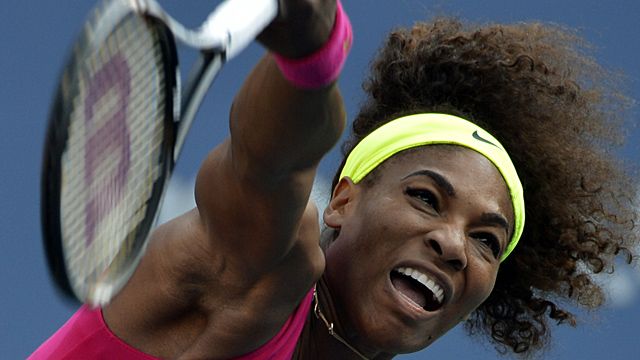
The NUMBER ONE ranked tennis player in the world and the winner of 17 Grand Slams and counting (4th all time) in her already legendary career, Serena Williams is 32 years young on this date and has won exactly 32 Grand slam titles overall so far (17 in singles, 13 in doubles, and 2 in mixed doubles)

Happy Birthday, Serena Williams | Beyond The Baseline
tennis.si.com

Serena Williams on Thursday turns 32, which happens to be the same number of Grand Slam titles she's won when combining singles and doubles. Isn't symmetry grand? Because our invitation to …

http://tennis.si.com/2013/09/26/serena-williams-birthday/


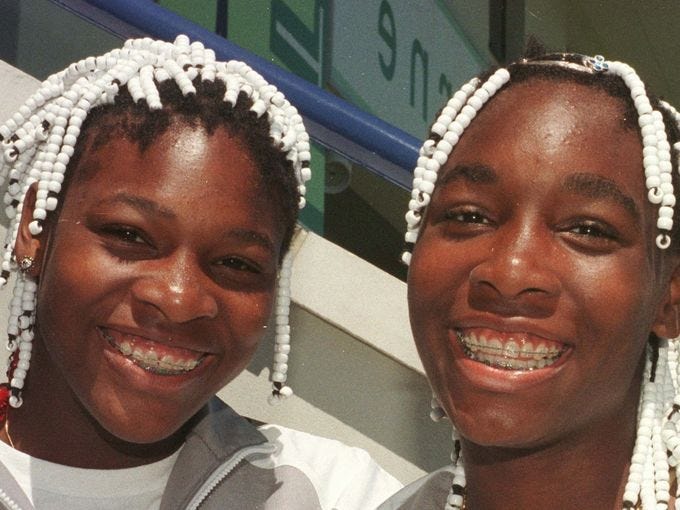
ABOVE:  Serena Williams well on her way to greatness. Here she is at age 8 in 1989 practicing on the public tennis courts of Compton, California. She and her equally famous sister Venus (then age 9) began at the ages of 4 and 5 where they were both taught to play and subsequently coached by their father Richard who was later joined by their mother who also helped in coaching them (after Mr. Williams taught her and the Williams sisters' other three girl siblings how to play as well).


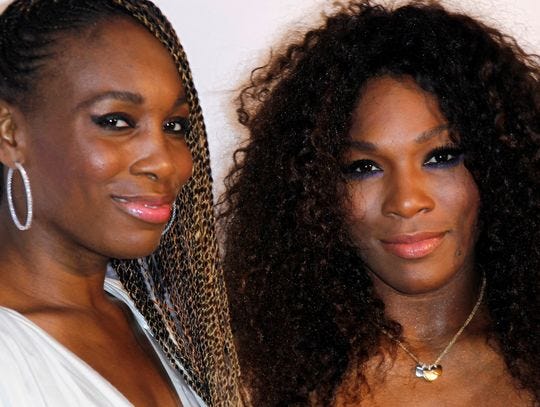
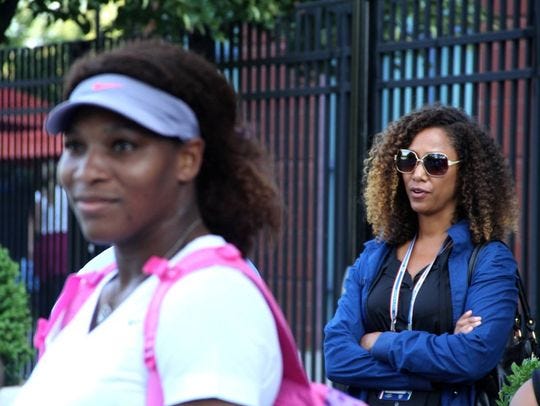
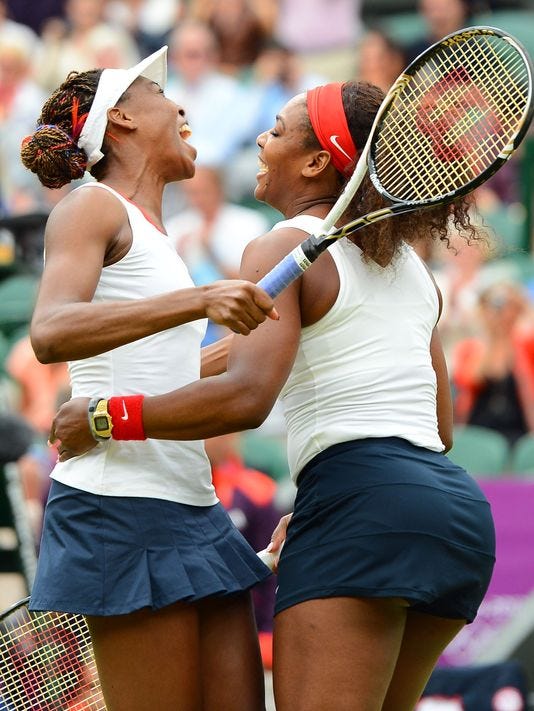
A SERIES OF PHOTOS OF SERENA AND VENUS OVER THE YEARS. ENJOY...


The Williams sisters have refused to play the mandatory BNP Paribas Open in Indian Wells, Calif., since the family was booed in what it believes to be a racially charged incident in 2001. Despite calls for the Williamses to put the incident behind them and play the event, Venus and Serena have stood firm in their boycott, giving up prize money and rankings points out of principle. How can you not respect that? For more on this issue read the following remarks by a black woman journalist at Sports Illustrated from earlier this year on March 15, 2013:

http://sportsillustrated.cnn.com/tennis/news/20130315/williams-sisters-indian-wells-serena-venus/#all

by Elizabeth Newman
March 15, 2013
SI.com


Calls for Williams sisters to return to Indian Wells are wrong

Few things anger me more than being told to just get over it. That I should rise above it all and forgive and forget even when I feel I've been slighted or wronged. The phrase "Get Over It" is particularly irksome because it essentially means, "Whatever it is that has caused you to be upset is not important." It places all of the responsibility on the person who is distressed to shake off whatever it is that is ailing her and pretend to be OK, while liberating everyone else from any obligation to listen or try to understand what's going on.

I imagine this is how Venus and Serena Williams feel each year in March, when tennis enthusiasts around the world debate whether the sisters should "Get Over It" and end their boycott against Indian Wells. It's been 12 years since the sisters were relentlessly booed and shouted down in their home state at a top tour event. Twelve years since Venus unwittingly started a firestorm by daring to pull out of a much-anticipated semifinal match against Serena, citing tendinitis in her knee. Twelve years since the sisters hastily exited the Indian Wells Tennis Garden in a cloud of shame, vowing never to return.

I have read several editorials (including one by Bruce Jenkins at SI.com) suggesting that Venus and Serena should suck it up and move on, that they should set aside all of the pain and embarrassment from that fateful day and be the bigger people for the good of the sport. Sure, each plea for the sisters to come back to Indian Wells is written with a convenient eloquence and soft undertone so as not to overtly offend. They are often written by white male critics who have never experienced the complexities of race and discrimination and who use patronizing language like, "I know I can't begin to understand what it felt like for the sisters in that moment, but I am disappointed that after all this time they can't just get past it." If the sisters were to read such commentary, they would likely roll their eyes and respond, "It's been 12 years people, why can't you get past it?" I know I would.

Each year as Indian Wells, now the BNP Paribas Open, rolls around, Venus and Serena are incessantly poked and prodded about whether they will return. Every year the answer is the same: a resounding NO.

"Even now, all these years later, we continue to boycott the event," Serena wrote in her 2009 autobiography, On the Line. "It's become a mandatory tournament on the tour, meaning that the WTA can fine a player if she doesn't attend. But I don't care if they fine me a million dollars, I will not play there again."

I can't say that I blame her. If it were me, I would never go back. I would never subject myself to the possibility of such shame and ridicule ever happening again. The words "Indian Wells" would never form on my lips again. I wouldn't waste my time acknowledging the city and the fans who reduced me to tears or the tournament that failed to stand up for me in my time of despair.

As a black woman, it has always been difficult for me to find the right words to describe to others the effects of racism on the psyche. To describe what it feels like to be stripped of your dignity and made to feel as if you're nothing, simply because your skin is of a darker hue. To describe why certain words immediately set you off because there is no way to mask the hateful intent behind them. No, I was not in the stands in 2001 to witness the chaos at Indian Wells, so I cannot verify any claims by the Williamses that the crowd's anger was racially motivated. However, one can only imagine how easy it was for Serena and Venus to feel as if the contempt and hostility emanating from the crowd had everything to do with race.

For two hours, the packed stadium of 15,000 mostly white fans viciously booed and shouted obscenities, first at Venus and her father, Richard, as they entered and then at Serena as she began her final against Kim Clijsters. The crowd booed and heckled Serena after every point she won and cheered her double faults and unforced errors. When she finally won the match, the boos drowned out any applause. When she held up the trophy, the boos became even more intense as the shouts of condemnation grew louder.
Remember, this is all happening at a tennis event. Not a football game where boorish behavior runs rampant and drunken fans fill up the stadium. Not a basketball game where unruly fans have gone so far as to throw sodas and water bottles at players on the court.

We're talking about tennis, a sport steeped in etiquette, decorum and protocol; a sport where errant catcalls and whistling are considered low brow and where even standing up during a point will get you a stern admonishment from the chair umpire. This was an event where Venus and Serena would normally feel safe and loved, not only because it was tennis but also because the tournament was in their backyard, in the very state in which they grew up. Yet on this day, all propriety and respectability was left at the gates. The negative reaction to the Williamses was blazing with anger and outrage, to the point where some black fans in attendance have said that they, too, feared for their safety.


Twelve years later, the details that led to the ruckus at the women's final still remain in dispute. According to tournament organizers, Venus pulled out of her semifinal against Serena four minutes before the match was to be played. Venus, however, maintains that she injured her knee in the quarterfinals against Elena Dementieva and that she alerted the trainers of her injury soon after the match was over.

In the post-match press conference, Dementieva seemed to back up Venus' claims, alluding to something being off about Venus' physical condition by saying, "I think we both played very bad today. I didn't expect such a bad play for Venus. It looks like she has some injury or something. ... I didn't expect this play from Venus. I thought she's going to hit the ball like she did hard, and she didn't."
Serena wrote in her memoir that Venus had been telling the trainer for hours that day that her knee didn't feel right and that she didn't think she could play, saying, "I really don't know why they're not making some kind of announcement. I told them [tournament officials] I couldn't play two hours ago."

Yet regardless of who said what to whom and when, the perfect firestorm was already set in motion. After tournament officials announced Venus' withdrawal, the fans were incensed and wanted blood. And blood is what they got when Serena took the court against Clijsters.

For everyone who has the gall to say that Venus and Serena should move past the ugliness of that day, I implore you to close your eyes and imagine yourself in that moment. Stop hiding behind the "I can't begin to imagine what it must feel like ..." one-liners and put yourself in their shoes.
Imagine being a 19-year-old black female mercilessly booed by a mostly white crowd for reasons that she cannot explain. Imagine looking up at the chair umpire expecting some type of support and relief from the vitriol but receiving none. Imagine looking up in the stands and seeing the despair on your sister's face while also seeing the festering fury in your father's eyes as everyone around you is screaming, yelling and pointing the finger. Imagine all of this happening while no one dares to do a damn thing about it. Would you really be so quick to dust off your shoulders and go back? Would you not feel betrayed by the very sport and fans to whom you had given so much?
Maybe the Williamses would have been more inclined to return to the tournament if someone, anyone, from Indian Wells or the USTA had offered some type of apology, publicly and privately. Some type of acknowledgment of what happened was a disgrace and assurances that nothing like it would ever be allowed to happen again. Instead, all the Williamses got were a bunch of passive-aggressive denials and senseless babbling from then-tournament director Charlie Pasarell, who was trying to save face and defuse the situation.

"If Richard says someone yelled something, maybe they did," he said after the tournament in 2001. "But I know that's not Indian Wells people."

What Pasarell and critics of the Williams sisters fail to understand even now is that when a 19-year-old woman is booed, reduced to tears and made to feel as if the world is raining down on her with a bevy of racial slurs and epithets, nothing short of an immediate public apology will ever suffice. It doesn't matter if a few fans and journalists who were in the crowd claim they never heard any racist language. This is what Venus and Serena say they heard; this is what they say they felt. For people to trivialize and discount these feelings in favor of moving on for the good of the sport is not only self-serving but also absurd. It speaks volumes about how, even in 2013, racism is still one of those things that people want to quickly dismiss because the reality of it is too uncomfortable.

For their part, Pasarell and the officials at Indian Wells have claimed that they have reached out to the Williams family on numerous occasions in recent years to try to make things right. But again, what's the point in all of that now? You can't come back several years later after the fact, when Venus and Serena are the biggest names in American tennis and when your tournament needs their presence to boost its sales and visibility, and say, "Oops, we're sorry. Can't we all just get along?"

The Williamses' boycott has never been about two petulant young ladies crying over spilled milk. It has always been about the tournament, its fans, its leadership and the wounds that were opened on the court that day.

"It's not about not doing our best for the sport," Venus said in 2008. "We have a legitimate issue here [at Indian Wells], and it's something we've all been dealing with over the years. But ultimately, sis and I psychologically cannot play at Indian Wells."

We often criticize athletes for not taking a stand, for not doing enough on matters of politics and social justice. In this case, however, Venus and Serena have quietly taken a stand against what they perceived to be an injustice by politely saying, "Thanks, but no thanks." To them, we're the ones who need to move past Indian Wells. We're the ones who need to simply Get Over It.


Friday, April 5, 2013

New Documentary 'Venus and Serena' Reveals Extraordinary Background Story Of Legendary Tennis Icons

https://www.facebook.com/pages/The-Panopticon-Review/342702882479366

All,

As I have stated many times in the past my two favorite athletes on this planet are Venus and Serena Williams.  This new documentary will help explain why...Check it out...

Kofi

Magnolia Pictures Will Release 'Venus And Serena' Doc In Theaters In May  (VOD In April)

Venus and Serena Official Trailer #1 - Williams Sisters Documentary Movie HD:


Ever since Venus and Serena Williams started playing in tennis tournaments, they've provoked strong reactions - from awe and admiration to suspicion and resentment. They've been winning championships for over a decade, pushing the limits of longevity in such a demanding sport. How long can they last? In Venus & Serena, we gain unprecedented access into their lives during the most intimidating year of their career. 

Today, Moviefone is happy to give you an exclusive first look at the poster for "Venus and Serena."

Check out the poster below, and catch the film on iTunes April 4 and in theaters on May 10.


Magnolia Pictures will release Venus And Serena (the feature documentary directed and produced by Maiken Baird and Michelle Major) in theatres on May 10 (VOD a month before on April 4).

The film takes an unfiltered look into the remarkable lives of the greatest sister-act professional tennis has ever seen. In a sport where they were not welcomed, the indomitable Williams sisters faced the opposition with grace and courage not only breaking new ground for female and African American athletes everywhere, but dominating the women's game for over a decade.

The film includes interviews with Bill Clinton, Billie Jean King, John McEnroe, Arnon Milchan, Gay Talese, Anna Wintour among others.

By the way, long-time Spike Lee editor Sam Pollard (and director of the 2012 PBS documentary 'Slavery By Another Name)', cut this Williams sisters doc as well.

Venus and Serena Official Trailer #1 - Williams Sisters Documentary Movie HD


(Photo: Christopher Hanewinckel, USA TODAY Sports)

'Venus and Serena': Documentary goes inside their lives
Douglas Robson

USA TODAY Sports
April 3, 2013


"Venus and Serena" will debut on iTunes on Thursday and hit theaters on May 10

It would have been a tough sell in Hollywood: An eccentric father with no tennis background somehow plotting and predicting that his two youngest daughters, African-American sisters just 15 months apart, would rise from the Southern California ghetto and sit atop the once lily-white tennis world.

Perhaps Venus and Serena Williams have been so good for so long we forget how they got here.

But what is arguably the greatest story in modern sports will soon be retold for a mass audience.

Venus and Serena, a new documentary, will debut on iTunes on Thursday and hit theaters on May 10.

The film follows the sisters during their turbulent 2011 season in which Serena returned from an 11-month absence from blood clots and surgery for a hematoma and Venus discovered she suffers from the autoimmune disease Sjogren's syndrome.

Though it was one of only three years since 1999 that neither sister won a major in singles, Serena called it "great timing."

"You get to see me when I really wasn't doing great, struggling, giving myself my medicine," she said by phone from Charleston, S.C., where she is competing this week. "You can really see the story of how far I'm able to come."

Both have rebounded. Serena, 31, is again atop the rankings at No. 1, and Venus, 32, captured a third gold medal in doubles at last year's London Olympics.

The filmmakers, ABC news veterans Michelle Major and Maiken Baird, became fascinated with the sisters when they broke onto the national stage in the 1990s.

"It's an obvious topic because they are two incredible women who changed a sport," said Major, who with Baird recorded 450 hours of footage.

"They broke just about every barrier as African-American sisters when they became number one and number two in the world in tennis," wrote Baird in an email. "It's the great American story rich with sisterhood, family, race, hard work and tenaciousness."

Serena and Venus Williams in 1997 at the Eastbourne fro the Direct Line Ladies Tennis Championships

For those familiar with the Williams story, the film doesn't break much new ground. What it does do is piece together their long, extraordinary journey from the streets of Compton, Calif., to winning a combined 22 major singles titles and becoming the first sisters to occupy the top two spots in tennis simultaneously.

"There were all these claims out there, and we really wanted to get to the bottom and tell people the details of their story," Major said in a phone interview last week.

The film shows intimate scenes with the sisters, their family and close associates at home, in hotels and at tournaments.

Serena is shown injecting herself with blood thinner and wearing the drainage bag she called "Grover" attached to her stomach following hematoma surgery.

She jokes with and chastises her hitting partner, Sascha Bajin; engages in pole dancing aerobics; and jumps onto the court in a downpour and dances around like a giddy child.

She explains her multiple personalities and says pointedly: "I was determined not to become a statistic. That's the only reason I play tennis."

The filmmakers catch Venus making the difficult behind-the-scenes decision to withdraw from the 2011 U.S. Open due to the energy-sapping illness Sjogren's.

Both sisters are shown singing karaoke, discussing marriage, and lovingly interacting at home and at tournaments.

"People can see our dynamic," Serena said. "It's kind of a real insight on our life."

Some of the most compelling shots are the early footage of the sisters doing drills with their father, driving around in a beat-up Volkswagen minibus, and being interviewed as young children.

An interviewer asks a 10- or 11-year-old Venus what her toughest match is. "Probably against my sister," she says. Asked what it was like, she pauses, takes a deep breath and responds: "Horrible."

A pre-teen Serena tells one questioner that the player she'd most like to be is the volatile John McEnroe.

Richard says he wrote a 78-page manifesto before the girls were born mapping out their route to the top of the tennis world.

A present-day Venus says: "My parents told me I'd be No. 1 in the world. I was brainwashed."
Venus and Serena Williams at a party for the 2012 Wimbledon tournament(Photo: Joel Ryan AP)
 
Major denied reports that the sisters withdrew their support after seeing a rough cut of the film and failing to show up for a scheduled appearance at the world premiere at the Toronto International Film Festival last September.

The Los Angeles Times said the family was unhappy with the depiction of Richard Williams.

"Throughout filming there were always communication issues and always us trying to get more," said Major, adding that there was "stickiness" around the timing of the festival and that Venus wanted more in-depth coverage of Sjogren's syndrome and her off-court activities.

She said that the fiercely guarded sisters might not have been ready to see themselves on screen in front of a live audience in a film that depicts "the complications of a family that's human."

"They fully support the film," Major said.

Serena confirmed that view Wednesday, saying she and Venus missed the festival due to scheduling conflicts but backed the film.

"Me and Venus were laughing over it," she said of the media reports.

Major said reaching an agreement took three years and was the "the most difficult thing I've ever done."

"I don't think anyone had the tenacity that we did to keep on going back and finding connections and finding reasons why we should film," she said.

According to Major, the sisters were paid for their time as well as for old photos and video footage. She described it as a "stipend."

Asked if they also would benefit from any commercial success, Major declined to elaborate.

The filmmakers had "full editorial control" and agreed to show the family a cut of the film and then have "meaningful discussions with them, which is exactly what we did," Major said.

The tight-knit but complex matrix of Williams family relationships is on full display.

Their mother, Oracene Price, says she knows nothing about 70-year-old Richard's current wife, Lakeisha, with whom he now has a baby boy.

"More power to her," Price says, bursting into laughter. "The only advice I can say is, 'Run. Do not pass go. Do not collect $200."

When one of Richard's five children from previous relationships shows up on court, Serena has no idea who he is.

Still, while Richard and Oracene Price are divorced, both are omnipresent forces in the sisters' lives.

Serena describes them as a kind of yin and yang. If one pushed, the other pulled.

"Neither can exist without the other," she says.

Richard, the most controversial family figure due to his sometimes outrageous and incendiary statements, is both a doting father and hard-nosed opportunist. In past and present footage, his well-known temper flares. At one point he tells the filmmakers they are around too much and suffocating him, which is "why I got rid of my first wife."

The sisters also tearily discuss the murder of their half-sister, Yetunde Price, in 2003, and the controversy surrounding their last appearance at the tournament in Indian Wells, Calif., in 2001.

According to Major, the sisters are "very, very different" but undeniably close despite the fact they have to compete against one another on such a big stage.

Serena was more off-the-cuff but less involved with orchestrating the project. Venus comes off as the more protective older sibling.

"She was the one always watching to make sure we're not filming anything untoward," Major said. "Venus is more about it being all together in a nice package. Serena's not worried about messing things up."

The film features a number of tennis talking tennis heads such as McEnroe and Peter Bodo, along with others ranging from Bill Clinton to Chris Rock to Anna Wintour.

Instructor Rick Macci, who brought the Williams sisters from Compton to Florida and worked with them for four of their formative years, also speaks about their early days.

He still sounds bitter that Richard moved the family to West Palm Beach and took over all coaching duties when Venus, then 14, signed a lucrative, multimillion dollar contract with footwear and clothing company Reebok.

"That's a left hook out of nowhere," he says.

Major said they became worried that Venus was depressed or uninterested in the project because she was sleeping a lot and wasn't forthcoming about her physical struggles. "I didn't know what was going on with her," she said.

Venus sometimes left them on eggshells.

"I was always afraid I was going to piss her off and lived with fear they might shut the thing down," Major said.

Both filmmakers wanted more from the sisters, but were happy with their output.

"I would have loved to film them going to church to see a bit more of what their religion means to them and how it has shaped them," Baird wrote of the sisters, who are Jehovah's witnesses. "They did not seem comfortable with letting us into this side of their lives which we had to respect."

Likewise, while the film discusses Richard's upbringing in the Jim Crow south, the sisters talk sparingly about race.

Serena tells the filmmakers that she prefers black men to white men and she discusses her stance on boycotting Indian Wells since 2001 after what he family believes was a racially tinged reaction from fans.

Venus says little.

"The thing that Venus wanted to talk about the absolute least is race," said Major. "Something she said that was not in the film is that race is not a winning topic."
Filmmaker Michelle Major and Serena Williams (Photo: Venus and Serena)

Saturday, September 15, 2012

The Enduring Beauty, Elegance, Power, and Genius of Venus and Serena Williams


Damon Winter/The New York Times

For last week’s cover story on Venus and Serena Williams, we sent the New York Times staff photographer Damon Winter to Key Biscayne in mid-July to shoot the sisters on the stadium court at the Crandon Tennis Center. The sweltering heat and harsh midday sun made for less than ideal picture-making conditions, but Winter found a spot with nice, diffused light under an overhang at one of the court’s entrances and managed to capture some affectionate moments between Serena and Venus there. You can see a behind-the-scenes video from his shoot here.


http://www.grantland.com/story/_/id/8343811/serena-williams-conqueror

All,

I'm shocked and simultaneously deeply appreciative of just how good, how ACCURATE, fair, just, HONEST, well written, and truly insightful this article is. Frankly, I'm even a little bit in awe. I've been diligently following and writing about the careers of Venus and Serena for 15 years now and have always felt without an iota of false modesty that what I wrote and thought about the sisters was FAR BETTER than anything 99.9% of sports journalists and the general media wrote and thought about the sisters and their truly revolutionary contributions to the game of tennis. In fact I KNEW what I wrote and thought about Venus and Serena was far more intellectually and emotionally honest, just, fair, sincere, knowledgeable, and critically insightful than what these writers (95% of whom were relentlessly arrogant, condescending, and absurdly racist and sexist white men) asserted in their incredibly dismissive and often clueless "assessment" of who and what the sisters were as both athletes and human beings. To say I never ever trusted, respected, or gave any real credence to what they said (or how they said it) is a gigantic understatement. From the very beginning of the sisters' professional careers I was (and still remain over a decade and a half later) basically contemptuous and derisive of what these reactionary morons have to say about who and what Venus and Serena are and represent--especially in the larger context of the actual tennis world of often hostile, petty, and indifferent white American fans (my wife and I both know about this from our personal experience of attending various matches of the sisters over the years) coupled with the jealousy, derision, fear, and patronizing attitudes of large parts of the tennis media, some of the other players, and some of the corporate and advertising sponsors who support the game. Despite their sustained and undiminished brilliance as well as their now well deserved legendary status in the game, the sisters remain for all their considerable fame and fortune more than a little wary of how they are perceived and treated when it comes to a genuine understanding and appreciation of their gifts and extraordinary success.

Which is all the more reason why I was so pleased to read this particular article by Brian Phillips that really gets at the heart of what makes Venus and Serena such important professional athletes and profound cultural representatives whose range of influence and inspiration extends well beyond the merely symbolic level. By focusing like a laser on what's most distinctive, and thus truly compelling about the sisters as both tennis players and young women Phillips is able in his writing to go well beyond the pathological hangups and unexamined resentment, fears, and limitations of the reductive and delusional mythologies of "whiteness" and "maleness" to enter a zone of consciousness that speaks to how the creative representation and critical analysis of sports within the larger structural contexts of modern society, political and cultural history, and "psychological identities" reveals something of lasting value and use. It thereby manages to also tell us something important and interesting about tennis itself and two of the most interesting and fascinating individuals ever to play the game...So enjoy...

Kofi


TIMOTHY A. CLARY/AFP/GETTYIMAGES

The Favorite

Learning to appreciate Serena the Conqueror


By Brian Phillips
September 6, 2012
Grantland


I liked Venus better. Not that you had to pick one, in a John vs. Paul sort of way. The real question, back when they first appeared on the semi-serious tennis fan's radar screen in the mid- to late '90s, was whether you liked them, period — whether you thought "the Williams sisters," that strange collective being, were something worth rooting for. They were going to overthrow women's tennis; that was clear from the very beginning. They were too big, too powerful, too fast, and too fierce for everyone else. The entire established order of the Hingis-Davenport era was under threat from the moment they arrived. After the 17-year-old Venus reached the final of the U.S. Open on her first try in 1997, the old guard subtly reconfigured itself, became a concerted, doomed effort to stop them from breaking through. It's hard, now that they've been so dominant for so long, to remember the kind of low-grade panic they caused, so let's put it this way: The day before Venus and Serena arrived, the game was a fully functioning system complete with plots and subplots and rivalries. The day after Venus and Serena arrived, all that seemed about as relevant as political squabbles in Constantinople right after the Turks showed up.1

And they were controversial. I mean, John Rocker was "controversial"; the Williams sisters were divisive in ways that almost defy analysis. Simply by virtue of being black, confident, from Compton, and physically on a different plane from their competitors, they raised a swarm of issues — about race, class, gender, who was inside, who was outside, what we were supposed to identify with in sports — that society, much less the WTA Tour, barely had the vocabulary to address. Tennis, in its unimportant way, had long since become one of those numb zones in which everyone more or less means well but also tacitly agrees that certain things are nicer not to discuss. Semi-serious tennis fans, as a class, were whiter, richer, and better educated than society overall.2 After the Williams sisters appeared, it was no longer possible for these fans to stay pleasantly unconscious of the fact that their chosen sport trended almost ludicrously white and upper-class, and that most of them, without being in any way self-identifyingly racist, were actually pretty OK with that. A lot of white tennis fans, in other words, suddenly felt besieged by an enemy they hadn't even known they were against.

Cf., in 2003, Tony Hoagland's massively controversial3 poem "The Change," in which an implicitly white, male, middle-class speaker, not in any way a self-identifying racist, recounts his anxiety while watching a young black female tennis player beat a white one:

some tough little European blonde
pitted against that big black girl from Alabama,
cornrowed hair and Zulu bangles on her arms,
some outrageous name like Vondella Aphrodite —
We were just walking past the lounge
and got sucked in by the screen above the bar,
and pretty soon
we started to care about who won,
putting ourselves into each whacked return
as the volleys went back and forth and back
like some contest between
the old world and the new,
and you loved her complicated hair
and her to-hell-with-everybody stare,
and I,
I couldn't help wanting
the white girl to come out on top,
because she was one of my kind, my tribe,
with her pale eyes and thin lips
and because the black girl was so big
and so black,
so unintimidated,
hitting the ball like she was driving the Emancipation Proclamation
down Abraham Lincoln's throat,
like she wasn't asking anyone's permission.

The Williams sisters, of course, had a father/coach who was mischievous and egomaniacal enough to provoke constant racial micro-controversies (my favorite: Richard Williams leaping over the NBC broadcast booth and shouting "Straight outta Compton!" when Venus won the 2000 Wimbledon title) while often having a legitimate point to make. And the sisters kept getting involved, generally through no fault of their own, in incidents that escalated the tension that seemed to follow from their mere presence at a tournament. In 1997, Irina Spirlea deliberately bumped Venus during a changeover at the U.S. Open; in 2001, the crowd booed Serena at the final at Indian Wells, and some fans allegedly yelled racial slurs.4 Everywhere they went, those first few years, the atmosphere was tacitly (and sometimes explicitly) confrontational.

A lot of people wanted them to fail. All of the worst and deepest assumptions of the sport they were in the process of conquering suggested that they shouldn't even exist. And yet there they were, conquering it,5 and not asking anyone's permission.

Anyway, back then, I liked Venus. Partly this was for reasons that could themselves be seen as problematic. She was prettier, less obviously overpowering, less baroquely muscled. She hit hard, but her game was elegant rather than punishing. She carried herself with a sense of whimsy, in contrast to Serena's sometimes surly relentlessness. She was packing that glorious sun lamp of a smile. It doesn't take a Gender Studies decoder ring to figure out that what all this builds to is that Venus was more conventionally feminine and played a game that was (slightly) more in line with the last-gen WTA tactical geometry of Hingis et al. Serena served and buildings fell over. Venus, at least in theory, seemed vulnerable.

There was another aspect to my Venus love, however: the family-psychology trap. When the sisters started playing each other in majors — they met in four straight Grand Slam finals between 2002 and 2003, the only time two women have done that in the Open Era — the Williamses gave a lot of weirdly unselfconscious interviews in which they talked openly about how Serena, as the youngest, had always been the princess of the family, and how, growing up, it had always been Venus's job to make sure Serena was OK. (Venus is 15 months older.) The now-adult Williamses all somehow seemed to broadcast that not only was this still the case, it was, moreover, totally aboveboard and natural. And you could see it, I thought, in the awkward, occasionally unnerving matches the sisters played against each other. Serena spent those matches looking like she uncomplicatedly wanted to win. Venus spent them looking trapped in some excruciating psycho-emotional cross-current between wanting to win and wanting Serena to be happy. When Serena won, she would celebrate. When Venus won, she would kind of half-celebrate and half-console Serena. This middle-child plight of Venus's, so ingrained that she wasn't even fully aware of it, struck me as wickedly unjust. I wanted her to break out of the trap, crush Serena 6-1 6-2, and smile so wide the seasons changed.

Who knows how anything happens, whether everyone saw the sisters the same way I did or whether the media just invented a narrative that stuck. But throughout Venus's and Serena's primes, from, say, 2003 to 2010, the tennis culture gradually embraced Venus — she was so gracious, and she jumped up and down so sweetly when she won Wimbledon — while Serena remained a flashpoint, criticized for her temper and her supposed lack of focus,6 as well as for a lot of other more sinisterly conceived stuff like "having no class" and "destroying sportsmanship in tennis," which, talk about not needing a decoder ring. (And I'm sorry, white dudes who tweet at me during every single tennis tournament, but you can't accuse Serena of destroying the genteel good manners of tennis while simultaneously chuckling at every dumb commercial in which John McEnroe pops up to squawk "You cannot be serious" at Mayor McCheese or whatever. White dude par excellence Jimmy Connors called a U.S. Open official "an abortion," right there on TV. This ship has sailed, and with warp speed.)

Venus took over tennis to the point that she seemed to be of tennis, to belong to its codes and traditions. Serena took over tennis while, in some sense, always remaining an outsider.

AP PHOTO/TOM PUGH

Is it strange to say that this is why I've come to love Serena more than all but maybe three or four active athletes? Love is probably the wrong word here; love implies a kind of sympathy or protectiveness that I only feel toward Serena in flashes, and never because she seems to need it. Serena took over tennis and then … just kept on taking it over. She never stopped being a conqueror. I followed her around at Wimbledon this year, and let me tell you. Have you seen her play in person? The difference between Serena live and Serena on TV is greater than the difference between Roger Federer live and Roger Federer on TV; I'm not kidding. She is just — and I mean, you can spot this with one eye closed from the top row of a stadium — playing a different sport from her opponents. This is true to the point that I kept taking that famous Bobby Jones quote about Jack Nicklaus ("[He] plays a game with which I am not familiar") and applying it to her in more and more general ways, trying to find the right level ("She occupies an order of being with which I am [explodes]").

You know, I'm guessing, what's going on with her right now. How she came back from a life-threatening pulmonary embolism to win Wimbledon at age 30, and not just win it, but run away with it (24 aces in two sets in the semis vs. Victoria Azarenka). How she did the same thing at the Olympics. How she has romped through the U.S. Open so far, beating Andrea Hlavackova 6-0, 6-0 in the fourth round. Serena turns 31 this month, and she is winning more forcefully, more ruthlessly, than she ever has. She's playing tennis the way some people salt the earth.

None of this is to say that Serena doesn't have the normal complement of human feelings and fears. But the thing I love, or admire, or am in awe of about her, though it took me years to appreciate this, is that on the court, she makes everything except tennis appear not to matter. The sport is full of subtly prejudiced upper-class white people? Well, here is an F5 tornado. Katharine Hepburn said at Humphrey Bogart's funeral that he liked to drink, so he drank; Serena likes to win tennis matches, so she wins tennis matches. It isn't to make you like her, or prove you wrong, or sell you a sandwich. It isn't to overcome the global history of race. It isn't to expand our sense of the meaning of Americanness. It's to do a thing she wants to do. And miraculously, she is herself such a force that all that other stuff scatters like paper.

And yes, here is where totally impartial fans on the Internet are going to come after me with her legendary U.S. Open meltdown, the time when she physically threatened a lineswoman who slapped her with a (probably incorrect, and pretty spectacularly non-standard in any case) foot-fault call in 2009. And yes, it was scary, and Serena showed some cosmically bad form. And OK! For fans who need their athletes to have safe personalities, or to be unswerving role models, then maybe Serena Williams is never going to click.7 Personally, I sometimes crack under stress while packing the car for a road trip, or reading a book review; I can barely understand how the Williams sisters haven't lashed out under pressure a hundred times more than they have. And unswerving role models bore me. The point is: It doesn't matter, because Serena isn't playing for your approval, doesn't need your approval, and kind of turns the whole question of your approval into wasted breath.

And I love this, or anyway I admire it and am definitely in awe of it. At some point, if you care about seeing things done well, you have to sit down and applaud the aristocracy of talent, which makes the aristocracy of tennis fans irrelevant. After all, that's what makes any change an athlete can bring about possible. Years from now, if the Williams sisters appear to have changed tennis at all, I am almost sure that Serena will seem to have been more central to that change than Venus.8 That racist, anti-racist Tony Hoagland poem from 2003 ends after "the black girl" has beaten her opponent, "then kicked her ass good / then thumped her once more for good measure," as the speaker ambiguously mourns the end of the 20th century. I love that Serena is still out there kicking the 20th century's ass — just incidentally, not even meaning to do it, not making a point of it, just kicking its ass over and over again.


NOTES:

  1. A metaphor that also unfortunately says something about how the sisters were viewed within tennis.
  2. A 2008 study found that Americans with postgraduate degrees were 68 percent more likely to be men's tennis fans, and 56 percent more likely to be women's tennis fans, than the population as a whole.
  3. Like, there is intense disagreement within the poetry community about whether the poem is (a) racist, (b) a satire of racism, (c) a bracingly honest exploration of fleeting semi-racist emotions, or (d) an attempt to explore such emotions, but one that is hopelessly compromised by the poet's position as a privileged white man. I suspect it's a little of all these things, or that it occupies a space in which they aren't entirely distinguishable.
  4. Serena won the match.
  5. Ladies' Wimbledon champions since 2000: Venus Williams, Venus Williams, Serena Williams, Serena Williams, Maria Sharapova, Venus Williams, Amelie Mauresmo, Venus Williams, Venus Williams, Serena Williams, Serena Williams, Petra Kvitova, Serena Williams.
  6. Venus also got some flak for being distracted by her fashion-label sideline. But Serena got way more. And it was Serena who showed up to play in more outrageous outfits, had a more confrontational relationship with the press, more often played her way into shape during tournaments, pulled out of more matches with weird injuries, etc.
  7. Although you had better make sure you are right with 1970s white-guy tennis freakouts, and you should ask yourself pretty seriously what you think a role model is supposed to represent.
  8. For what it's worth, I love Venus as much as I ever did, especially since the Sjögren's syndrome diagnosis last year, but there's something to be said for uncomplicatedly wanting to win.


Thursday, August 30, 2012

The Legacy of Power And Elegance: Venus And Serena Williams Continue To Triumph Both On And Off The Tennis Court

Damon Winter/The New York Times


Damon Winter/The New York Times; Stylist: Deborah Afshani. Hair: Angela Meadows. Makeup (Serena): Sheika Daley. Makeup (Venus): Kazumi Brown.


http://www.nytimes.com/2012/08/26/magazine/venus-and-serena-against-the-world.html?pagewanted=all

http://nyti.ms/NLFj3x


All,

My favorite athletes on Planet Earth and two of the most interesting and inspiring public personalities of our time are Venus and Serena and therefore I am VERY protective of and outspoken about what others have to say about them--either pro or con. Thus it was pleasantly surprising to find that the following article--while not perfect-- is actually pretty good/not bad considering all the insipid and largely biased garbage that has been written about them over the years by clueless and often racist "mainstream" journalists who don't appreciate just how culturally profound and influential African American athletes generally and the Williams sisters in particular have been--and continue to be--on a global scale. That's why I rather liked what Sullivan had to say here about the larger historical and social context of Venus and Serena's extraordinary story as both athletes and modern women because the writer actually succeeds in conveying a lot of what makes the sisters so fascinating and appealing to so many people across races, genders, and generations. So I applaud Sullivan for having the clarity of insight and sense of humanity to bring that out. My only major objection to the piece overall was how it generally depicts the father of the sisters, Richard Williams, who I and many other people not only throughout this country but the world consider to be an authentic coaching genius and tennis savant who doesn't get enough credit overall for his highly innovative teaching methods and brilliant technical guidance of the sisters' careers (thankfully Venus and Serena DO give their father the credit that he richly deserves in this piece that makes up for some of the all too typically condescending racial caricature of Richard and his ongoing legacy as coach and father). Other that that however this is a very instructive, entertaining, and interesting article that finally does justice to who and what the sisters are and represent (where would American tennis be without them!). So please check out the article and the accompanying video...and pass the word about the appearance of the sisters in both the singles and doubles competition in the 2012 U.S. Open that began ton monday and continues until September 7 in New York...Enjoy...

Kofi


Venus and Serena Against the World
By JOHN JEREMIAH SULLIVAN
August 23, 2012
New York Times


There’s video that exists of Venus and Serena Williams playing tennis when they were kids — 8 and 7, respectively — in the late ’80s, on unshaded but otherwise decent-looking public courts in California. This is not one of the clips you’ve maybe seen, taken from various news segments, but an earlier, stranger video, made by their father and longtime coach, Richard Williams, as a kind of audition tape for the tennis-instructional guru Vic Braden, ostensibly requesting an invitation to Braden’s camp, although the real reason for it, you can’t help feel in watching, simply was to let Braden know that greatness had arrived in the world. Richard’s face in the film as he presents the girls to Braden seems, as it does so often, on the brink of laughter. This was in Compton, the low-income, gang-afflicted hub city outside Los Angeles, an area made infamous by many a rap song. Although they enjoyed about as stable an upbringing as you could have in Compton back then, its problems were no mere abstraction: they supposedly knew to lie down on the court when gunshots rang out in the park. And there’s a story that Richard, when asked what he would do if his daughters ever won a Grand Slam, said he would go back and try to help the Crips who sometimes looked out for the girls during their practice sessions. “Venus Williams Is Straight Outta Compton!” read an early promotional poster their father made, to post on telephone poles. He billed the two as celebrities before they were even famous. That was how you did it. Not fake it till you make it. You decided what you were. First you had the belief, and then you had the training. “Belief and training,” Venus told me a couple of weeks ago when I met with her in Cincinnati, where she and Serena were playing in a tournament just days after returning from the Olympics. “That was unconquerable.”

She sat at a round, empty table in the meeting room at the Hyatt, first messing with her dog, a little terrierlike creature, and then placing it inside a duffel bag, where it apparently liked to hang out, because it stayed completely silent there for the better part of two hours, not even receiving any treats or anything. “He’s unemployed,” she said, forcing him with her fingers to make a face at me.

Because she’s usually frowning and scowling on court, or squinting and chewing the inside of her mouth, or looking bummed in the changeover chair — or finally at the end sometimes grinning and laughing maniacally — it’s easy to find yourself unprepared for her sheer prettiness, as witnessed when she’s more or less at ease, 6-foot-1 in pale designer jeans, quietly flashing the smile that made her at one time the richest woman in sports (before Maria Sharapova came along).

I was trying to bring the person across the table into some kind of stereoscopic harmony with the girl on the tape, the one whose short, beaded braids hang like a fringe of tassels on the side of her head. It showed her hitting big, swinging volleys from midcourt at about the skill level of a decent college player, except that she was catching them up above her head, scything the fed balls out of the air with enough topspin to send them arcing down toward the lines. After an especially good shot, Richard would say, “Good shot, Venus,” and Venus would say, in dulcet tones that retained a trace of his Louisiana syrup, “Thank you, Daddy.”

Richard addresses the camera directly. Venus and Serena stand on either side of him, taking shelter in the shadow of his legs as if the camera might not find them there. Richard reveals to Braden that they have been watching his popular tape, “Tennis Our Way,” quoting his fantastically optimistic slogan, “You’ll be famous by Friday.” Richard can’t remember the exact wording. “You kept saying we’d be good by Friday,” he tells Braden. “We was good by Tuesday. We should be great by Friday.”

The remarkable thing about the tape, from the point of view of someone interested in tennis, isn’t the almost voyeuristically candid preflight glimpse it gives of some soon-to-be superstars but simply the footage of Venus hitting. She doesn’t bounce on her feet yet between every shot, she hasn’t fully learned that readiness; she just stands there, in her jeans, waiting to be fed the next ball. Nor is it even the excellence of her technique, although her technique, it goes without saying, is ridiculous for an 8-year-old. It’s more something that she doesn’t even know she’s doing, something having to do with the transfer of force, of mass, from the back of her body to the front, and the way that this transference is passed along into the shot, the way it enters her racket head at precisely the millisecond she hits the ball, resulting in a kind of popping sound, the distinctive pop in ball-striking that signals someone who can really play, the thing you simply cannot and will never learn to do if you are a hack or even a pretty good player who has hit that cruel ceiling, the limits of your own physical ability, beyond which you cannot progress, even after decades of lessons and work, but beyond which some 8-year-old girls can go and indeed beyond which they were born. It’s the tyranny of talent. Watching this little girl do it, watching her have it, that lays it bare, undeniably evident, extracted from the game like the Higgs boson from those protons.

I asked Venus about this tape, if she remembered it at all. She did, she said (vaguely, I sensed), but in general she tries not to look back, preferring to remain “at a continuum of moving forward.”

If Braden ever watched the tape, there survives no mention of it. He must have had parents trying to sell him on their little prodigies every day, and even if he had noticed — as he could not have failed to — that the girls, especially the older one, possessed the proverbial “thing that can’t be taught,” there was plenty else in the tape to put him off. The father’s boasting (relatively subdued, for this performance) has about it the whiff of slight insanity. The way he keeps mentioning the “famous by Friday” business, the way he talks about the girls not as promising youngsters but as celebrities, as princesses, as if he worships his own creation. His Southern accent verges at times on the unintelligible. “Stay in touch with us,” spoken pathetically, hopefully, toward the end of the tape, sounds like, “Stain touch widders.”

Although he has been the subject of excellent profile writing (notably in Sports Illustrated, by S. L. Price and L. Jon Wertheim), Richard Williams remains an eternally elusive and evasive figure. I find him powerfully and movingly American somehow. His whole personality seems to have evolved as a complex reaction-structure to an insecurity so profound that it must remain secret, especially from him. Throughout his daughters’ careers, he has gone about fanning a splendor of boxing-promoter language, of lies, half-truths, boasts, misstatements, non sequiturs, buffoonery, needless exaggerations, megalomania, paranoia — as well as here and there genuinely wise, amusing lines — all of which, you begin to feel, are designed (subconsciously, yes, but no less shrewdly) to deflect attention away from a still, small center, the place where he dwells and operates. It’s there that he is who he is, whoever he is.

He came from a part of Shreveport, Lurr-zeeana, as he pronounces it, in a neighborhood whose school was called, amazingly, Little Hope. At various times he has told reporters or anyone who listened that he was a sports star there in his youth — and certainly it seems plausible, given his height (6-4-ish) and what we realize to have been present at least in a nascent way in the genes — but there are no records of these exploits, if they occurred. Perhaps he dreamed them. Perhaps he assigned them to himself the way a great novelist might give them to a character, as a necessary past for the Father of the Williams Sisters. Perhaps (most likely) he needed them in order to be the girls’ father, to carry the necessary authority in their eyes. Listen to me, now. I was like you. I was a great athlete, too. That may have been useful.

The source that brings us closest to him, precisely because of its complete lack of objectivity, is an extraordinary documentary made just over a decade ago, “Raising Tennis Aces: The Williams Story,” by a black Englishman named Terry Jervis, who himself possesses, from what can be gauged, self-promotional instincts downright Richard Williams-like in aspect. The film is about Richard Williams, mainly, but also done in collusion with him.

Most of it takes place on the grounds of a Florida compound, near where the Williams family relocated in the mid-’90s to hide from the junior playing circuit (Richard’s great stroke of genius — when the other girls were burning themselves out playing the Young Ladies Lipton Cup or what have, his girls were hiding, practicing). In the film, Venus and Serena sit for interviews, under a patio awning, saying their half-meant teenage-athlete phrases, as Richard sits beside them, grim-faced, gripping his thighs, controlling the narrative.

Mainly he is the narrative. We watch him riding around the place on a clay-court-cleaning machine. We meet others — the family lawyer, the family adviser — who speak of Richard and his integrity and foresight. We meet, curiously, another man named Richard Williams, a tennis teacher back in Compton, who gave the sisters some of their first extrafamilial lessons. Williams generously acknowledges his influence. A civil rights activist appears, testifying to how hard Richard had it growing up.

We follow him back to Shreveport, where he pays a visit to his childhood home, the place he shared with his sisters and their mother, Julia Mae Williams. His shock at its dilapidation is such that he sits down and cries. He tells the story of his closest childhood friend, killed by a car that was driven by a white woman who barely stopped to see what she’d done. “She went on her way, gracefully,” Richard says.

It’s not that the story is at all implausible for the South in the ’50s. No reason to doubt it. But there’s something about Richard’s manner. We see him weaving the physical objects of his immediate surroundings into the tale. He puts his hand on a tree in the front yard and says that he planted it after his friend died, because in the wake of that loss, he needed something “solid.” But wouldn’t the tree have been only a sapling at that time? He says the mere idea of its future growth gave him that solid feeling. But those don’t sound like a boy’s thoughts. Richard’s drive to self-mythologize is total. All must be included, even the trees; all must contribute inevitably to what came later. The trauma of the black Southern past is recast by force of will and audacity, becoming prelude to the glory of the Williams present. “Venus was born in ’80,” he says, with cryptic syntax, “but she was . . . taught like a child who was being brought up in the ’40s and the ’50s, and that’s why today if you see Venus and Serena, and we’re at a tennis tournament, and you boo us, it doesn’t hurt us, because we was taught for things like that many, many years ago, we came up in the ’40s and the ’50s.”

The mention of “you boo us” isn’t random. Richard was referring, without mentioning it explicitly, to the notorious incident at Indian Wells, Calif., in 2001, still a recent memory when “Raising Tennis Aces” was shot. People argue about exactly what went down that day, but the flash point was that Venus withdrew from a semifinal match against Serena. She didn’t feel well enough to play. Tendinitis. It’s often reported that she did this with only minutes to go before the match, but in her book (“On the Line,” a better-than-average entry in the genre of the co-written sports memoir), Serena wrote that Venus had been telling the trainer for hours she didn’t think she could do it. That was the protocol: you were supposed to tell the trainer first. But the trainer kept stalling, no doubt hoping she would recover and change her mind. At one point during the day, Venus approached Serena in the locker room and said: “I really don’t know why they’re not making some kind of announcement. I told them I couldn’t play two hours ago.” This game of chicken went on until, in the end, the stadium was full. A tournament official came on the loudspeakers and informed the crowd that the match had been canceled. Rumors of match-fixing began to swirl. A day before, the Russian player Elena Dementieva had joked-not-joked that Richard would decide which of his girls went on to the final.

(Just as an aside, I’ve never bought any of the match-fixing accusations regarding the sisters: yes, their matchups could be weird to watch, sort of hesitating, but is there any mystery to that? They’ve been playing together, more as practice partners than as opponents, practically since they were babies. Their style of play was about feeding each other, testing each other’s strokes, not winning. That dynamic couldn’t be changed overnight. Their matches grew in intensity and passion as their careers advanced, just as you would expect. Also, and perhaps most compellingly, the whole idea of Richard asking one of his daughters to lose to the other goes entirely against his style. It would have been more like him to set them against each other to strengthen them.)

Two days later, when the family returned to the court for Serena’s match against the big-hitting Belgian Kim Clijsters, the crowd began to boo. Both Richard and Serena assert that they heard the word “nigger.” The booing continued throughout the match, which Serena won in a display of all but inexplicable poise — or really something more like fearsomeness, when you witness it. But the most astonishing and little-remarked moment occurred before the match even started, when Richard and Venus walked down to their seats in the players’ box. The booing intensified — it was Venus, after all, who committed the sin, and Richard whom many despised for his frequently asinine Svengali persona (and darker tendencies too — reportedly, a couple of years before the Indian Wells fiasco, he hurt his wife, Oracene, the girls’ mother and co-trainer, badly enough to break a few of her ribs; Oracene later confirmed the reports; he denied them; either way, the marriage was crumbling just as the girls were making it). He turned and faced the crowd, as if to show them his lack of fear. He said a few things back, you can’t hear what. And then he raised his left fist in the air, like John Carlos at the ’68 Olympics. He held it there for a few seconds. The look in his face suggests that he did it almost with a kind of irony. Still, the boldness of the gesture stuns. Tennis had never seen anything like that.

In her postmatch remarks, Serena thanked her father for giving her strength, after first thanking, as she almost invariably does, Jehovah God. “I want to thank those who supported me,” she added. “And if you didn’t, I love you guys anyway.” But not so much, as it turned out. It has been more than a decade since that day, and the Williams sisters have never returned to Indian Wells, one of the tour’s bigger tournaments.

Richard Williams often receives an undue share of attention in discussions of the Williams sisters, their game and how they got started. Partly this is appropriate: he’s their coach. Partly it’s because, for many years, he demanded, or at least commanded, that attention with his bizarre pronouncements and antics. But all of this has led to a persistent distortion in the telling of the Williams story, which is, after all, a story of powerful women — not just Venus and Serena, but the household of women who surrounded and nurtured them.

In the beginning, there were three sisters, none of whose names you may have heard: Yetunde, Isha and Lyndrea. They were Oracene Price’s daughters from her first marriage. Oracene became Richard’s second wife when they married in 1980. So Richard lived in the house in Compton with four women — three girls and their mother — just as he had grown up in Shreveport with three sisters and Julia Mae. He had recreated the dynamic of his childhood home.

When he and Oracene first began to talk and dream about founding some kind of tennis dynasty — in the oft-heard tale, it happened after Richard watched a women’s match on TV and heard that the victor, Virginia Ruzici of Romania, would receive $30,000 for her efforts, just for smacking a ball, as they say — Richard first taught Oracene to play. He himself had taken up the game not long before, and he quickly became quite good. But Oracene, too, was an athlete. In her youth she played volleyball and played basketball with her brothers (“Till they got bigger than me”).

“It was like a family recreation early on,” she told me. “I myself learned to play in a year. I always wanted to learn and to learn the right way, like a professional. And Richard would show everyone my backhand.”

She explained that because she was pregnant with Venus when they first started hitting together, the traditional way of hitting a backhand — turning to the side and twisting your torso — didn’t feel comfortable for her. “I would hit the backhand open,” she said. At the time, the shot was rare and barely existed at all in the women’s game. “I made it into a comfortable stroke. I knew I’d feel better if I was low, and then I’d just whack it.”

At first they began with Oracene’s three children. Yetunde, the oldest — who was shot and killed in 2003 in Compton — wasn’t especially athletic. But Isha, many people believe, could have been the third Williams sister, if not for her back problems, and Lyndrea went on to play at the college level. But although the two girls were good, they weren’t great — perhaps they hadn’t been exposed early enough.

With Venus and Serena, Oracene said, “it’s almost like they were raised on the court.” She remembers Serena as a toddler, off to the side while they played. Oracene noticed early that something was different about their game. “They still weren’t as athletic as me,” she said — a thing you learn quickly about Oracene is that she says exactly what she means and never says anything she doesn’t mean, to a degree that can be intimidating and even seem aggressive until you realize that it isn’t negatively charged, she’s just very unto herself — “but I did notice one thing: they had a natural swing. That’s what I looked for first.” She didn’t elaborate on that, but I knew what she meant — the pop. It was the unquantifiable kinesiology of the pop. These two new daughters had it. (Richard would later claim that they were engineered for it, by an express and all but eugenical logic — he saw Oracene’s long, powerful gams and thought they would make great legs for a tennis player. Jehovah God knows if these things are true, but unlike the sturdy-tree story, it feels like something he might have thought.)

Richard and Oracene had become uncannily expert, if unavoidably eccentric, tennis coaches and analysts by the time Venus and Serena started hitting. Indeed, behind the minor miracle of there being two tennis virtuosos in this single family with no previous tennis background, there had been the previous miracle of both parents’ understanding the game well enough to teach and guide the girls. “I don’t honestly know how that happened,” Venus told me in Cincinnati. “It’s interesting. I don’t know how my parents were able to learn the game so well.”

The story has been told so many times, of these early years, when Compton got used to the sight of the little girls who would always be playing tennis at the public park — or riding around in their faded yellow VW bus with the middle seat taken out to accommodate the grocery cart full of balls — but somehow the strangeness and drama of it retain a power to fascinate. The idea of this African-American family organizing itself, as a unit, in order to lay siege to perhaps the whitest sport in the world and pulling it off somehow. “I remember even talking to my sisters and brothers,” Oracene said, recalling a time before anyone had ever heard of the Williams sisters, “and telling them: ‘The girls are going to be professional. We’re going to need a lawyer, and we’re going to need an accountant.’ ”

Isha, the middle daughter — sharply funny and practical, fiercely loyal to the family — told me: “Life was get up, 6 o’clock in the morning, go to the tennis court, before school. After school, go to tennis. But it was consistency. I hate to put it [like this], but it’s like training an animal. You can’t just be sometimey with it.” She still can’t sleep past 6.

“For the most part,” she said, “Venus would be on my dad’s court, Serena would be on my mom’s court, and we’d jump. It was like this rotating system.” All the sisters agree that Oracene’s court was the toughest. Richard liked to play games and goof, but their mother was all business and was matter-of-fact in her criticisms. “Even now,” Serena wrote in her book, Oracene is “one of the best at helping to break down my game.” In conversation, Isha points out that it’s always her mother who goes with Serena to the Australian Open, not her father. “And she’s won the Australian five times.”

Oracene did not grow up a Jehovah’s Witness. She belonged to a religious family in Michigan but lacked a church to attend in L.A. Some Witnesses came to her door one day, and she liked their message, with its emphasis on their strict interpretation of the Bible. In 1984, just as Venus and Serena were picking up rackets for the first time, Oracene was baptized and began raising her girls in the faith. Richard never did convert. He read some of the teachings, but he was not and is not a Witness. As much power as he possessed in the family, there remained a kind of inner circle — of women and faith — of which he remained outside, which may go some way toward explaining how the girls can both revere him and roll their eyes at him. He’s their father, but he’s other. Among themselves, the women in the family maintain what Oracene, quoting Colossians, calls “a perfect bond of union.” When I spoke with Lyndrea, the youngest of the three older girls (and perhaps the most unforcedly sweet of all the sisters; about Lyn, as they call her, there was nothing forbidding or closed), she was in the car on her way to the Kingdom Hall in Los Angeles to give a talk. And when I asked Isha if the girls ever went around house to house, the way Jehovah’s Witnesses do, she said yes, she had been “out in service” with Venus and Serena. “It’s a trip, too,” she said, “people be blown away.”

It’s impossible not to feel that this fierce closeness of the Williams women — strengthened by their shared faith, with its emphasis on separation from the world — has had not a little to do with the tremendous psychological stability Venus and Serena have demonstrated over the nearly 17 years of their careers. It’s amazing to think, but when this article was first in the planning stages, only a few months ago, it was conceived as a story that would mark the decline of their careers, the beginning of a conversation about their legacy. The word “retirement” had begun to appear in discussions of both sisters. This wasn’t writing them off; it just seemed like an accurate read of the situation. Venus found out she had Sjogren’s syndrome, an autoimmune disorder that often causes severe joint pain, among other symptoms. She’d fallen quite far back in the rankings, because of a lack of match play. The illness dogged her for years, until the doctors finally figured out what was wrong. It had been hard for her to accept that she was sick. “I spent my whole life playing sports and training and pushing myself to the limits,” she told me. “When you get told that you have a disease, it’s like: ‘Really? Nah, it’s all right. I don’t believe that. It must be something else, I’m just making an excuse, let me push harder.’ ” Serena, meanwhile, had cut a tendon in her foot with a piece of glass, requiring several operations, which led to a pulmonary embolism. She also suffered a giant hematoma, caused by one of the shots she took to prevent another embolism. Naturally their fitness suffered. It seemed, frankly, physically impossible that the sisters would ever regain the tip of the tennis pyramid. A good time to talk about what they had meant to the game, how they had changed it and been changed by it.

But last month, Serena won Wimbledon again. Then she won the Olympic gold medal in women’s singles. Then she and Venus (Venus actually playing slightly better than Serena, according to Serena) won gold in women’s doubles. The whole thing was a joke, a comedy. The Williams sisters were dominating tennis again. Serena, in her final match, machine-gunned her onetime rival Sharapova off the court so brusquely and efficiently, it looked as if she had an urgent appointment somewhere that she couldn’t miss. Venus, in closing out the gold-medal doubles match, hit what she felt was the best shot of her career. Her description of it in Cincinnati was beautiful (it can be hard to get tennis players to talk about their game in an analytical way). “I did a play that I normally don’t do,” she said. “Something moved my body.

“Serena was serving from the ad court, and I don’t really like to cross, to poach on the ad court, because I usually like to poach when I have a forehand. I’m thinking: I gotta help Serena out, because she always helps me on my serve. I’m not helping her enough.

“All this is going through my head. So my plan is like, I’m gonna go over, but I’m not gonna go too early; I don’t want [the other player] to see me. But this is all subconscious almost. The next thing I know, I’ve left. I don’t remember making my body move. I’m just hitting the shot. Now, I have a great one-handed backhand volley. But I hit it two-handed! I don’t know what happened. It was like watching myself from above when that happened, and like I feel like, this is the best shot of my whole life.”

I asked Oracene what she felt, watching her daughters reclaim the heights after what they’d been through. “Honestly?” she said. “I reflected on the fact that in the United States, you don’t have many players that are doing well. And then you have these two old, black girls, up in age now, and they’re still holding up America. That to me was remarkable.” I thought about it. She was right. There isn’t another American right now who’s capable of really penetrating at a major. Or maybe, in fairness to Andy Roddick and a couple of other people, it’s better to say that there isn’t another player whose penetration at a Slam would not make your eyebrows jump. It’s just these two girls, these two sisters. They’re what America has right now.

I met Serena a couple of weeks ago in Paris, where she spends several months of each year. She lives in a quiet, pretty part of the Seventh Arrondissement, in a beautiful but not ostentatious apartment that she described as “humble.” It had black floors and big airy windows that let in the sound of children playing on the sidewalk below. Most of the furniture and art pieces were things she picked up at the outdoor markets in Paris. She showed me a binder full of her plans for the interior design.

There had been some mix-up about the time. I’d stood there buzzing for about 10 minutes. Suddenly the door bolted open. The assistant, I thought, maybe coming down to explain.But it was Serena. In purple spandex workout pants, a white top and sunglasses, her hair natural and a little wild, the way she’s wearing it these days.

“You’re early,” she said.

“Really? I thought it was 7.”

“I thought 7:30.”

“I’m happy to hang out for a while.”

“No,” she said. “Walk with me.” She needed something from the pharmacy.

As we walked, she moved back and forth between French and English. Her French was good. Even very good. I had always heard this about the Williams sisters, that they were into languages. But you know how it is with some people — they take a Berlitz course and tell you they can speak Russian. She was expressing herself in the language, charming the Greek guys in the little takeout joint where we stopped, where she seemed to order one of every dish they had. They couldn’t hold sample spoons out to her fast enough. I thought what I’d been thinking for months: that I knew more or less nothing about the Williams sisters. They like it that way, you get the sense. Not many people get very close. This of course warps the perception of them by the public and the media. It feeds the idea to many people that there’s something weird and aggressively off-putting about them. They both seem conscious of the trade-off and O.K. with it.

When we returned to her apartment, she asked, “Do you want a drink drink?” She had just flown in, and there was nothing in the place but Jack Daniels, which she poured for me on the rocks, showing a nonshowy graciousness I didn’t expect. “That oughta get you going,” she said with a laugh. She didn’t have any herself. (Jehovah’s Witnesses are allowed to drink in moderation, but whiskey wasn’t part of her training regimen.)

After I moved through the congratulations and the how-are-you-feeling (she showed me the locations of her various scars, including a long and nasty one on her shin), I asked her about Indian Wells. “I’m not going to ask you if you’ll ever go back,” I said, “because I know you won’t. I just want to know if that’s your personal decision or a family decision.”

“It was my decision,” she said, sounding not so much annoyed as saddened by the subject. The rest of her answer, reproduced here in its entirety, surprised me both with its eloquence and its confidence. It was a woman’s answer, not a girl’s. And not a diva’s. She wasn’t trying to be provocative. She was letting her yes be yes and her no be no, the way Oracene had taught her.

“I don’t know if my dad said something. But I don’t need to go back there. They don’t like me. I don’t need to be there. If you can boo a teenager, and you can be white and 60 years old, you know what? I’m cool on you. I can understand maybe if they were 20, 15. But like at the French Open, the crowd boos you, but they’re young, they’re kids, they’re a younger crowd. It is what it is. You just know every time you go to Paris, you get booed, but you see so many kids in the crowd. At Indian Wells, everybody goes there when they’re retired. It’s like Palm Beach. I thought, People like Martin Luther King Jr. boycotted things. And this is nothing on that level. Look at Muhammad Ali, he didn’t even play, he went to jail because he didn’t want to go to war. The least I can do is stand up for my people and not go there. That’s the very least I can do. It’s not even that hard of a decision. I get a vacation on those two weeks. It’s like the easiest decision of my career. They can penalize me to death, I’m never going back.”

She gave me a bit of a look, as if she were peering over the rims of her glasses, though she wasn’t wearing glasses. Something along the lines of, “Does that answer your question?” She had a row of books on her shelf, the kind of beige, 19th-century books you find in the stalls along the Seine (which turned out to be where she found them). I asked if she read any of them. “No, I just bought them for show,” she said. They were beautiful; they made good décor. One faced out, on the end. It was a biography of Toussaint Louverture, the former slave who led the Haitian revolution near the end of the 18th century. The book’s cover had a great old color illustration of him on horseback, brandishing a sword. His blue-and-red coat and gray-black face.

Because she seemed to be handling uncomfortable topics surprisingly well, I moved on to maybe the second-biggest oncourt scandal of her career — her notorious outburst at a lineswoman who had made a questionable foot-fault call against her during the 2009 U. S. Open. To be fair, the call looked bogus in replay, and Serena has suffered enough bad calls at that tournament — some that were almost surreally so, including one in a 2004 match against Jennifer Capriati — to justify a little paranoia. Even so, she went over the line and said things that would have scared the living hell out of me if I’d been in that chair.

“How do you feel about that now?” I asked.

“I was definitely stressed, and I was angry,” she said. “I don’t foot-fault. Like, I have in the past, but this woman should never make a call in the semifinals of a Grand Slam on a person who doesn’t foot-fault. She was totally wrong. I’m sorry. I’m not sorry. I looked at her like — I tried to warn her. And then she did it again. And I’m thinking, This is ridiculous.”

“But you admit you went over the top?” I said.

“What bothered me most was that I was representing my religion. I just felt like anyone who knew I was a Witness was stumbled. And I really don’t want to stumble anybody.” Indeed, Oracene had told me that the Witnesses called Serena in for a dressing-down. “They had to have a talk with me,” Serena said. “And I knew it was coming. I just felt really bad, though, because it’s like, that’s not who I am.”

“How does that work?” I asked. “Were you summoned by a minister?”

“They just talk to you,” she said. “They show you Scriptures. Not ministers, they call them elders. It’s almost like a reprimand, but it’s not bad, because in the Bible it says God loves you, and if someone reprimands you, they love you.”

She went on, talking about how “every year at the Open something happens. Like last year I got a point penalty because of a grunt. Meanwhile, I can name five girls who grunt way louder than I do, and the umpire didn’t even give them a warning. And then I had the ball called out that was this far in. It’s always something. I’m thinking, already, something’s gonna happen this year at the Open. I’m just thinking, Serena, say your prayers, fall on your knees. It’s frustrating, because it’s my home country, you’re playing for the home, but it’s like, the way the umpires have been makes me not want to play there. I’d rather play in Australia, or I’d rather play at Wimbledon.”

The window behind us had an exquisite view of Paris in the twilight. Looking past me, she said: “I love how the city’s all even. I love how you can see the sky. You can’t have too many tall buildings. I mean, there are a few, but for the most part, it’s Old World. I like it.”

Something about her life there, the little I glimpsed of it — she had told me how she liked being alone in this place, how she would “come here just to be around nobody” and how she liked the way people in this neighborhood didn’t make a big deal out of her — it gave me the sense that she was hiding there. From what, though? From America, probably, a country that couldn’t decide if she was a goddess or a threat. And from her father. In the latter case, at least, she had been successful. His energy was nowhere in that apartment. This was what I was seeing, I realized, in meeting both Venus and Serena. They have quietly absconded from his shadow.

Venus had even joked about him in Cincinnati, when I asked her if he was still their coach. She rolled her eyes. “Sometimes he’ll send lengthy e-mails,” she said. “Sometimes they’re really long, and I don’t read them. I get the gist. He’s very, very into it. I think he loves it most. Out of all of us, I think he loves tennis most.”

In fact, not even Oracene accompanied the girls to Cincinnati. “They’re probably tired,” Venus said. “They say, ‘We’re over it, we’ll stay at home.’ ” Her smile had levels I wasn’t equipped to explore. It had coyness in it, it had irony in it, it even had some melancholy in it. “We’re on our own,” she said.


John Jeremiah Sullivan is a contributing writer and the author of “Pulphead.” He last wrote about the reissue of “Absalom, Absalom!”
Editor: Joel Lovell


http://www.huffingtonpost.com/2012/08/24/venus-and-serena-williams-new-york-times-magazine_n_1828500.html?utm_hp_ref=black-voices

HUFFPOST BLACK VOICES

The Internet Newspaper: News, Blogs, Video, Community


The Williams Sisters Show Off Their Fit Figures On Cover Of New York Times Magazine By Patrice Peck 8/24/2012 The Huffington Post
Given their record-breaking Olympic wins and a bevy of other championship titles, it’s safe to say that tennis titans Venus and Serena Williams are in a league of their own. Covering the latest issue of The New York Times Magazine, the glowing sisters posed defiantly aside one another, hands clenched and a formidable pair of rock-hard abs on display.

In the cover story titled “Venus and Serena Against the World,” the Williams sisters look back on their long journey to athletic stardom. Their parents and coaches Richard Williams and Oracene Price, who are also spoken about in detail, recalled the Williams’ earlier years when their daughters trained in the inner city neighborhood of Compton, California.

Even during their youth, the ladies have had “the thing that can’t be taught,” Richard told the magazine. Oracene also took a moment to reflect on the mega success of her daughters.

“I reflected on the fact that in the United States, you don’t have many players that are doing well,” she told NY Times Magazine. "And then you have these two old, black girls, up in age now, and they’re still holding up America. That to me was remarkable.”

The article touched on the more controversial moments of Serena’s career, notably her outburst at the 2009 U.S. Open.

“I was definitely stressed, and I was angry,” she said. “I don’t foot-fault. Like, I have in the past, but this woman should never make a call in the semifinals of a Grand Slam on a person who doesn’t foot-fault. She was totally wrong. I’m sorry. I’m not sorry. I looked at her like — I tried to warn her. And then she did it again. And I’m thinking, This is ridiculous.”

Serena also spoke at length about her boycotting of the Indian Wells Masters series after being ridiculed with racial slurs in 2001.

“But I don’t need to go back there,” Serena said in the interview. “They don’t like me. I don’t need to be there.”

“I thought, People like Martin Luther King Jr. boycotted things,” she continued. “And this is nothing on that level. Look at Muhammad Ali, he didn’t even play, he went to jail because he didn’t want to go to war. The least I can do is stand up for my people and not go there. That’s the very least I can do. It’s not even that hard of a decision. I get a vacation on those two weeks. It’s like the easiest decision of my career. They can penalize me to death, I’m never going back.”

Check out the NYT Magazine cover and the sisters' winning their Olympic gold medals in the slideshow below.