Showing posts with label The Republican Party. Show all posts

Monday, July 15, 2024

Chris Hedges On the Real Crisis in the United States With or Without the National Fascist Cult Led by Donald Trump

https://countercurrents.org/2024/07/my-thoughts-on-the-attempted-trump-assassination/

 
PHOTO:  Trump raises a fist after being shot at a campaign rally in Pennsylvania. Source: screenshot (Reuters)

The assassination of Trump would not remove the yearning of tens of millions of people, many conditioned by the Christian right, for a cult leader. Most of the leaders of the Christian right have built cult followings of their own. These Christian fascists embraced magical thinking, attacked their enemies as agents of Satan and denounced reality-based science and journalism long before Trump did. Cults are a product of social decay and despair, and our decay and despair are expanding, soon to explode in another financial crisis.


The efforts by the Democratic Party and much of the press, including CNN and The New York Times, to discredit Trump, as if our problems are embodied in him, are futile. The smug, self-righteousness of this crusade against Trump only contributes to the national reality television show that has replaced journalism and politics. This crusade attempts to reduce a social, economic and political crisis to the personality of Trump. It is accompanied by a refusal to confront and name the corporate forces responsible for our failed democracy. This collusion with the forces of corporate oppression, which have impoverished the working class, fostered endless war, militarized our police, created the largest prison system in the world, licensed corporations to exploit the most vulnerable and transferred wealth upwards into the hands of a billionaire class, neuters the press, Trump’s critics and the Democratic Party.

Our only hope is to organize the overthrow of the corporate state that vomited up Trump. Our democratic institutions, including the legislative bodies, the courts and the media, are hostage to corporate power. They are no longer democratic. We must, like resistance movements of the past, engage in acts of sustained mass civil disobedience, especially strikes, and non-cooperation. By turning our ire on the corporate state, rather than Trump, we name the true sources of power and abuse. We expose the absurdity of blaming our demise on demonized groups such as undocumented workers, Muslims, African-Americans, Latinos, liberals, feminists, gays and others. We give people an alternative to a bankrupt Democratic Party — whose presidential candidate is in clear cognitive decline — that is a full partner in corporate oppression and cannot be rehabilitated. We make possible the restoration of an open society. If we fail to embrace this resistance, which alone has the ability to destroy cult leaders, we will continue the march toward tyranny.


ABOUT THE AUTHOR:


Chris Hedges is a Pulitzer Prize-winning journalist who was a foreign correspondent for fifteen years for The New York Times, where he served as the Middle East Bureau Chief and Balkan Bureau Chief for the paper. He is the host of the Emmy Award-nominated RT America show On Contact. His most recent book is “America: The Farewell Tour” (2019).

Originally published on Chris Hedges Report


Tuesday, December 26, 2023

The Fundamental Crisis and Foundational Contradiction Facing the United States During the Upcoming Presidential Election Year of 2024: Fascism guided, informed, and enabled by the Doctrines and Practices of White Supremacy and Global Capitalism--PART 7

DEFEAT FASCISM BEFORE FASCISM DEFEATS YOU

"...As fate would have it, Ramaswamy’s surge coincided with a racist atrocity, which helped to clarify the source of the candidate’s popularity. On Saturday, a 21-year-old white man named Ryan Christopher Palmeter murdered three Black people in a Dollar Store in Jacksonville, Fla. The motive for the crime is no mystery. Palmeter, who took his own life after the attack, wrote racist manifestos and decorated his guns with swastikas. Prior to the attack, he had stalked a historically Black educational institution, Edward Waters university.

In television appearances on Sunday news programs, Ramaswamy made a number of incendiary and obscene statements that blamed the mass murder on anti-racism. Speaking on CNN, Ramaswamy said, “The reality is we’ve created such a racialized culture in this country in the last several years…. as the last few burning embers of racism were burning out, we have a culture in this country largely created by media and establishment and universities and politicians that throw kerosene on that racism.” He added, “And I can think of no better way to fuel racism in this country than to take something away from other people on the basis of their skin color.” Ramaswamy made similar remarks on NBC’s Meet the Press, where he claimed to be “genuinely worried that we’re seeing a new wave of anti-Black and anti-Hispanic racism as a consequence of the so-called anti-racist movements.

These remarks, along with the general tenor of his campaign, make clear that Ramaswamy belongs to a particular political niche: the person of color who gains prominence by avowing an anti-anti-racist ideology that is gratifying to right-wing voters. As such, Ramaswamy is heir to presidential candidates like Alan Keyes (who ran in 1996, 2000, and 2008), Herman Cain (2000 and 2012), and Ben Carson (2016). All these candidates were Black men who affirmed a deeply conservative racial politics that cited their own meritocratic success as proof that systematic racism was no barrier to achievement. They all enjoyed brief flourishes of popularity in the presidential primaries—until Republican voters took a closer look. Arguably and ironically, all were thwarted in part by racism, being unable to convince either the majority or a plurality of the GOP to back a Black candidate.

Such candidates have had a niche in the GOP for nearly three decades, and Ramaswamy is satisfying the same perennial GOP appetite for a person of color who will bless the racial status quo as just. But there is one important distinction. Ramaswamy is a person of color—but he’s not Black. He’s of Tamil descent. As such, his message is a harsher one. He’s not saying as the earlier candidates did, “As a Black man who succeeded, I prove that America is not racist. Racism is a thing of the past.” Ramaswamy’s message rather is, “As a person of color, I prove that America is not racist. And if Black Americans are faltering, that is due to their own faults.”

This harsher twist on the narrative of minority success explains why Ramaswamy is the GOP’s POC star in the era of Trump and the backlash to Black Lives Matter (BLM). As Sheelah Kolhatkar noted in a 2022 profile in The New Yorker, “A strain of animus toward Black Americans runs through much of Ramaswamy’s public commentary.” He’s said BLM should mean “Big Lavish Mansions.” He claims that a portly white classmate at Harvard was lower on the social order than “some athletic Black kid who came and got a place on the basketball team.” He argues, “Affirmative action is the single biggest form of institutionalized racism in America today.”


Ramaswamy has strongly praised right-wing intellectual Richard Hanania, who only a few years ago echoed neo-Nazi ideology as a virulent advocate for a white ethnostate. Although he’s disavowed his earlier Nazi views, Hanania remains committed to scientific racism, now holding (reasonably enough) that the racist hierarchy he desires can be maintained in existing liberal capitalism.

Ramaswamy occupies an exposed position as a person of color openly flirting with the white nationalist politics that have been normalized under Trump. This is a precarious stance, and while his potential right-wing followers might love what Ramaswamy says, many of them still don’t like who he is. Among evangelical Christians, there is wariness of Ramaswamy’s Hinduism, which he’s tried to deflect by repeatedly affirming his monotheism.

In July, Ramaswamy tweeted, “Being American isn’t about whether you can ‘trace your ancestry to this land.’ It’s about whether you’re committed to our nation & it core ideal.” This banal assertion of civic nationalism led to a harsh response from a right-wing poster who wrote, “Below you see the limits of high IQ candidates who don’t actually feel rooted in this place.” Ramaswamy retweeted this exchange and described his xenophobic critic as “a thoughtful guy, grateful that he’s surfacing a debate we need to have on the right.” Because of his politics, Ramaswamy has become a sycophant to people who regard him with racist disdain.

This exchange illustrates the core of Ramaswamy’s problem: While there are many white racists who are gratified to hear their ideas echoed by a person of color, there are also many white racists who can never forget that Ramaswamy has brown skin. The racist con game Ramaswamy is playing might get you a seat at the table, but it can never win. "
--Jeet Herr, "The Limits of Vivek Ramaswamy’s Racist Con Game", The Nation, August 28, 2023


https://www.thenation.com/.../vivek-ramaswamys-racist...

Politics

The Limits of Vivek Ramaswamy’s Racist Con Game

While the emerging GOP star benefits from the right’s version of affirmative action, his ugly response to the Jacksonville shootings shows the cost—and constraints—of his strategy.

by Jeet Herr
August 28, 2023
The Nation

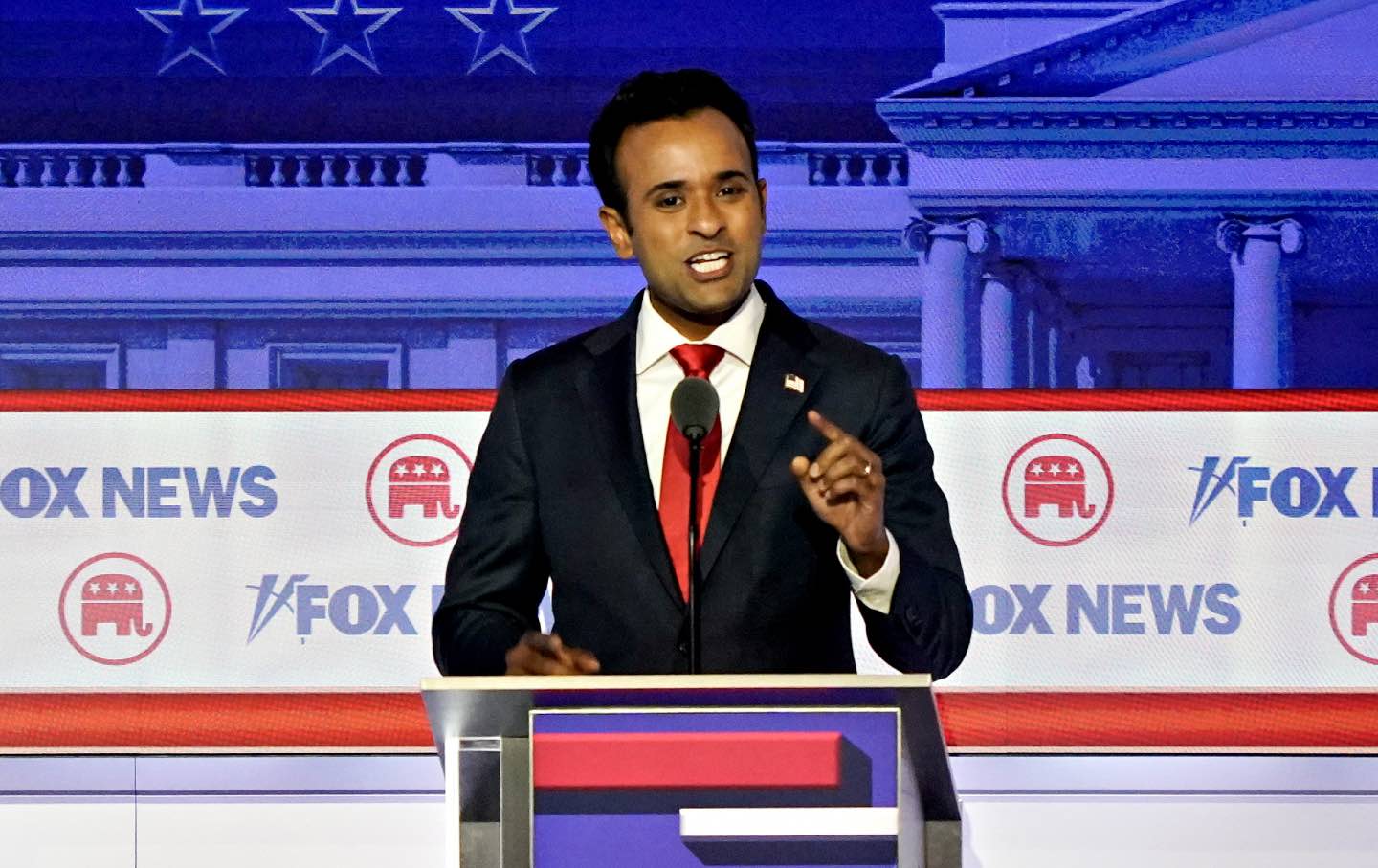
PHOTO: Vivek Ramaswamy, 2024 Republican presidential candidate, during the Republican primary presidential debate in Milwaukee, Wis., on August 23, 2023. (Al Drago / Getty)


Improbably, Vivek Ramaswamy is having his moment in the sun, emerging as the unexpected breakout star of the Republican presidential nomination race. Although Donald Trump remains the overwhelming favorite as front-runner, Ramaswamy is rapidly catching up with Florida Governor Ron DeSantis for the number-two spot. This is a remarkable turn of events given that DeSantis enjoys overwhelming financial support from the GOP donor class and, until recently, robust cheerleading from Rupert Murdoch’s media empire. But the rise of Ramaswamy along with DeSantis’s manifest failure to consolidate the anti-Trump vote has given Murdoch and other GOP plutocrats pause.

In Wednesday night’s Trumpless debate, Ramaswamy took command of the stage as the most charismatic and glib speaker—­as well as the one most likely to be attacked by fellow candidates. These attacks, focusing on Ramaswamy’s lack of experience and heterodox skepticism of military assistance to Ukraine only served to strengthen the impression that he was emerging as a major threat to the more establishment candidates. On Thursday, Morning Consult released a post-debate poll showing that Trump retained a commanding lead of 58 percent in the primaries, with DeSantis trailing at 14 percent and Ramaswamy at 11 percent. All other candidates had single digits.

Being in a tight race for distant second might seem like a trivial achievement. But Ramaswamy’s rise means DeSantis’s chances of credibly challenging Trump are rapidly diminishing. That alone changes the dynamics of the race. Further, Ramaswamy now has a plausible chance to be Trump’s running mate—as well as a major GOP power player in future races.

As fate would have it, Ramaswamy’s surge coincided with a racist atrocity, which helped to clarify the source of the candidate’s popularity. On Saturday, a 21-year-old white man named Ryan Christopher Palmeter murdered three Black people in a Dollar Store in Jacksonville, Fla. The motive for the crime is no mystery. Palmeter, who took his own life after the attack, wrote racist manifestos and decorated his guns with swastikas. Prior to the attack, he had stalked a historically Black educational institution, Edward Waters University.


In television appearances on Sunday news programs, Ramaswamy made a number of incendiary and obscene statements that blamed the mass murder on anti-racism. Speaking on CNN, Ramaswamy said, “The reality is we’ve created such a racialized culture in this country in the last several years…. as the last few burning embers of racism were burning out, we have a culture in this country largely created by media and establishment and universities and politicians that throw kerosene on that racism.” He added, “And I can think of no better way to fuel racism in this country than to take something away from other people on the basis of their skin color.” Ramaswamy made similar remarks on NBC’s Meet the Press, where he claimed to be “genuinely worried that we’re seeing a new wave of anti-Black and anti-Hispanic racism as a consequence of the so-called anti-racist movements.”

These remarks, along with the general tenor of his campaign, make clear that Ramaswamy belongs to a particular political niche: the person of color who gains prominence by avowing an anti-anti-racist ideology that is gratifying to right-wing voters. As such, Ramaswamy is heir to presidential candidates like Alan Keyes (who ran in 1996, 2000, and 2008), Herman Cain (2000 and 2012), and Ben Carson (2016). All these candidates were Black men who affirmed a deeply conservative racial politics that cited their own meritocratic success as proof that systematic racism was no barrier to achievement. They all enjoyed brief flourishes of popularity in the presidential primaries—until Republican voters took a closer look. Arguably and ironically, all were thwarted in part by racism, being unable to convince either the majority or a plurality of the GOP to back a Black candidate.

Such candidates have had a niche in the GOP for nearly three decades, and Ramaswamy is satisfying the same perennial GOP appetite for a person of color who will bless the racial status quo as just. But there is one important distinction. Ramaswamy is a person of color—but he’s not Black. He’s of Tamil descent. As such, his message is a harsher one. He’s not saying as the earlier candidates did, “As a Black man who succeeded, I prove that America is not racist. Racism is a thing of the past.” Ramaswamy’s message rather is, “As a person of color, I prove that America is not racist. And if Black Americans are faltering, that is due to their own faults.”

This harsher twist on the narrative of minority success explains why Ramaswamy is the GOP’s POC star in the era of Trump and the backlash to Black Lives Matter (BLM). As Sheelah Kolhatkar noted in a 2022 profile in The New Yorker, “A strain of animus toward Black Americans runs through much of Ramaswamy’s public commentary.” He’s said BLM should mean “Big Lavish Mansions.” He claims that a portly white classmate at Harvard was lower on the social order than “some athletic Black kid who came and got a place on the basketball team.” He argues, “Affirmative action is the single biggest form of institutionalized racism in America today.”

Ramaswamy has strongly praised right-wing intellectual Richard Hanania, who only a few years ago echoed neo-Nazi ideology as a virulent advocate for a white ethnostate. Although he’s disavowed his earlier Nazi views, Hanania remains committed to scientific racism, now holding (reasonably enough) that the racist hierarchy he desires can be maintained in existing liberal capitalism.

Ramaswamy occupies an exposed position as a person of color openly flirting with the white nationalist politics that have been normalized under Trump. This is a precarious stance, and while his potential right-wing followers might love what Ramaswamy says, many of them still don’t like who he is. Among evangelical Christians, there is wariness of Ramaswamy’s Hinduism, which he’s tried to deflect by repeatedly affirming his monotheism.

In July, Ramaswamy tweeted, “Being American isn’t about whether you can ‘trace your ancestry to this land.’ It’s about whether you’re committed to our nation & it core ideal.” This banal assertion of civic nationalism led to a harsh response from a right-wing poster who wrote, “Below you see the limits of high IQ candidates who don’t actually feel rooted in this place.” Ramaswamy retweeted this exchange and described his xenophobic critic as “a thoughtful guy, grateful that he’s surfacing a debate we need to have on the right.” Because of his politics, Ramaswamy has become a sycophant to people who regard him with racist disdain.


This exchange illustrates the core of Ramaswamy’s problem: While there are many white racists who are gratified to hear their ideas echoed by a person of color, there are also many white racists who can never forget that Ramaswamy has brown skin. The racist con game Ramaswamy is playing might get you a seat at the table, but it can never win.


ABOUT THE AUTHOR:


Jeet Heer is a national affairs correspondent for The Nation and host of the weekly Nation podcast, The Time of Monsters. He also pens the monthly column “Morbid Symptoms.” The author of In Love with Art: Francoise Mouly’s Adventures in Comics with Art Spiegelman (2013) and Sweet Lechery: Reviews, Essays and Profiles (2014), Heer has written for numerous publications, including The New Yorker, The Paris Review, Virginia Quarterly Review, The American Prospect, The Guardian, The New Republic, and The Boston Globe.

Wednesday, December 13, 2023

The Fundamental Crisis and Foundational Contradiction Facing the United States During the Upcoming Presidential Election Year of 2024: Fascism guided, informed, and enabled by the Doctrines and Practices of White Supremacy and Global Capitalism--PART 3

DEFEAT FASCISM BEFORE FASCISM DEFEATS YOU 

"What's Past is Prologue..."

http://www.truth-out.org/…/38319-white-supremacy-elected-do…

White Supremacy Elected Donald Trump
Wednesday, 9 November 2016 
by Kelly Hayes 
Truthout | News Analysis

I had no interest in watching the returns come in. Early Tuesday night, I was watching "Supernatural" reruns on my couch and only occasionally glancing at election updates on Twitter. Everything looked as predicted. The New York Times said Hillary Clinton was very likely to become the next president, as its irksome electoral meter bounced about. Like many, I had adopted the steadfast belief that Trump simply couldn't win. The polls were thoroughly damning. Wall Street didn't want him. The Republicans barely wanted him. But after a while, I felt compelled to turn off Netflix and switch to live election coverage.

I watched, drop-jawed, as it became clear the unthinkable was happening.  Donald Trump was surging toward victory.

As the electoral tide turned, wounded Clinton supporters began casting blame on social media, accusing voters who supported third-party candidates of derailing a Clinton victory. The mud-slinging directed at anyone on the left who hadn't supported Clinton was predictably swift and devoid of insight. After all, Donald Trump was the opponent Hillary Clinton wanted. He was supposed to be an easy takedown. But Clinton's team had obviously underestimated Trump's cultural momentum. The media all but celebrated his despicable antics for shock and entertainment value, as large swaths of bigoted white people endorsed his racism and xenophobia.

The Democratic establishment was sure it would have Bernie Sanders' crestfallen supporters on lock, even as it insulted them. Clinton didn't even attempt to speak the issues that might have moved such people. The Democratic establishment assumed it would get what it wanted out of fear, without making any concessions to those who didn't trust it. The struggle at Standing Rock -- which Clinton weakly acknowledged in a noncommittal statement -- is just one example of how this campaign took people for granted, and took votes for granted.

Some issues never warranted engagement for Clinton and those issues often involved marginalized people -- because the Democratic Party was betting it all on one of its most basic electoral assumptions: There's no need to be loved when your opponent is feared.

But in spite of my distaste for Clinton, I likely would have voted for her if I lived in a battleground state. I didn't because I didn't have to. And given her track record and all the harm she's done -- supporting and enacting policies that expanded mass incarceration and our violent interventions abroad -- feeling like I didn't have to vote for her was a relief. I am willing to bet that some voters in states where Clinton was projected to win had that same feeling: a sense of relief that they didn't have to cosign a neoliberal nightmare's ascension. Wall Street wanted her. The establishment wanted her. Plenty of people who hated her seemed ready to suck it up, and the polls looked good. And then....

Enter President Trump.

What came as a shock to many of us probably shouldn't have. While Clinton seemed to have made a Thatcher-like assent, overcoming misogyny by embracing her own kind of casual brutality, white supremacy would not allow her to win so easily as Obama stepped out. The flames of white violence had been stoked at a time when white people had felt the displacement of a Black presidency, and the unapologetic momentum of a movement for Black lives.

Not even Wall Street could overrule the white rage and vanity that fueled Trump. The electoral dictates of Wall Street are institutional, but white supremacy is structural. White supremacy redistributed its power Tuesday night, and in such a spectacular fashion that even those of us who expect the worst of our country were left astonished. The United States, which seemed poised to usher in another Clinton presidency, instead rallied behind a dangerous, racist buffoon.

So what does the future hold? Ugliness, to be sure. The terrifying promises of Trump's campaign are ringing in the ears of all affected by them, myself included. I am afraid for everyone who will be harmed by this man's administration. I am afraid of just how much destruction one oafish reality TV star might bring, when life as we know it nears the edge of extinction.

Yet I am, as ever, certain in my own work. I will organize and take action. I imagine a few more people will be in the streets in the coming year than otherwise would. I'll be glad to see you all out there, though sorry about the circumstances.

This is going to be rough, but it's what we've got. So let's pull it together and figure out how to tear into our common enemies in the days ahead. I know loss is bitter, but it's time to get over it and learn what you can. In this case, that might mean learning that people may not bother to show up for a candidate they don't believe cares about them, no matter how scary the alternative. And it definitely means getting ready to throw down hard, because it's going to be a long four years.


ABOUT THE AUTHOR:


Kelly Hayes is a direct action trainer and a cofounder of The Chicago Light Brigade and the direct action collective Lifted Voices. She is community relations associate and a contributing writer at Truthout and her photography is featured in the "Freedom and Resistance" exhibit of the DuSable Museum of African American History. Kelly's contribution to the anthology Who Do You Serve, Who Do You Protect? stems from her work as an organizer against state violence and her ongoing analysis of movements in the United States, as featured in Truthout and the blog Transformative Spaces.


Related Stories:

White Supremacy Is Alive and All Too Well
by Mitchell Zimmerman, OtherWords | Op-Ed

Democrats March Toward Cliff
by Robert Parry, Consortium News | Op-Ed

Standing Firm at Standing Rock: Why the Struggle Is Bigger Than One Pipeline
by Sarah Jaffe, Moyers & Company | Report


"What's Past is Prologue..."

https://newrepublic.com/…/joe-biden-destructive-politics-wh…

The Destructive Politics of White Amnesia

Joe Biden set the stage for Donald Trump's racial scapegoating. Why can't he admit that he was wrong?

by Kimberlé Williams Crenshaw
August 6, 2019
The New Republic


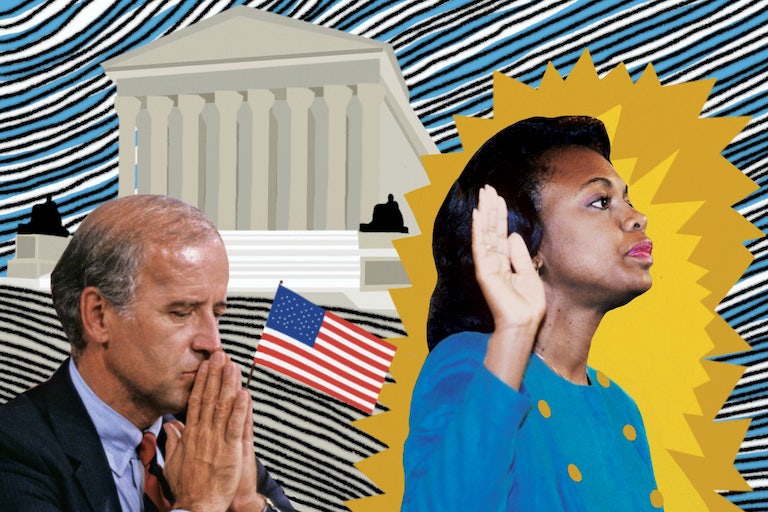
IMAGE: Arnie Sachs/Picture-Alliance/DPA/AP Photo (Biden) Jennifer Law/AFP/Getty (Hill)


For all of his bumbling verbosity and avuncular artlessness, Democratic front-runner Joe Biden serves as a remarkably elegant illustration of all that ails the Democratic Party’s bid to retake the White House in 2020.

Trump’s breathtaking weaponization of the Republican Party into the party of white nationalism should, at minimum, make the parameters of the Democratic primary campaign clear. Where conservatives in the past have employed dog whistle rhetoric to mask the manipulation of racial tensions, Trump’s itchy Twitter fingers dole out something more like smart missile rhetoric. The precision-guided invectives hurled at Representative Elijah Cummings, “the Squad,” and civil rights leader the Reverend Al Sharpton represent an escalation that Trump’s eventual general election challenger cannot meet with appeasement.

To counter such terrifying demagoguery, the party must be as unified in its repudiation of racism, xenophobia, and misogyny as the Party of Trump has been in enabling them. One would think, therefore, that candidates angling to become the standard-bearer of the loyal opposition should be capable of articulating not only the danger of this political moment, but also how their own party helped create this tragedy. Democratic candidates will never be able to steer a fresh course so long as they continue decades of denial and dissemblance. Joe Biden’s status as the 2020 field’s front-runner, in spite of his cringeworthy efforts to account for his part in that history, speaks volumes about how far today’s Democrats still have to go before they can meet the challenges of Trumpism head-on. A good deal of Biden’s inflated standing comes from an all-too characteristic Democratic posture of risk aversion, compounded by a talismanic faith in Biden’s mystic “electability.” Many party leaders and voters clearly view a Biden candidacy as the safest post-Trump course correction—and Biden as a pragmatic man of the people with the unique ability to build coalitional bridges between coastal elites and the so-called forgotten men and women of America’s heartland.

As if to underscore the inherent limitations of this posturing, Biden has trafficked enthusiastically in images of good ol’ boy politicking as evidence that he is the right man for the job. As his reminiscences of Senate business in the sepia-toned (but decidedly white) past tripped up his early campaign efforts, Biden has tried, gingerly to grudgingly, to walk his comments back. But those overtures point up a disquieting fear about his bid to defeat Trump: He may well perpetuate the fallacies of elite comity that marked his early career—and that continue to animate Democratic strategies to win back voters who are not as yet scandalized by the racist and misogynist rabble-rousing that is Trumpism. Falling back on that strategy alone may be fool’s gold. Not only is it questionable whether Trump’s heartland faithful will ever return to the Democratic column; the clouds that hang over Biden’s candidacy also suggest that when the going gets tough, the tough might find themselves going it alone. Biden’s missteps present a troubling pattern of sacrificing the interests of the very constituencies that stand to lose the most if the 2020 battle is undercut by the politics of appeasement. Voters who are activated to battle tooth-and-nail against the resurrection of our white supremacist past have every reason to press candidates for evidence that their failing marks on some of the most consequential issues affecting race and gender justice won’t be repeated. So far, the current front-runner has offered little substance in his defense, beyond Obama stardust and affability. That’s not enough in the best of times, and it is certainly not sufficient now.

For starters, Biden has yet to accept any genuine responsibility for how he helped preside over a process that depicted women—African American women—as conniving bottom-feeders. As chairman of the Senate Judiciary Committee in 1991, Biden actively enabled the humiliation and stigmatization of Anita Hill in that terrible spectacle of patriarchal impunity. He failed to call the multiple existing witnesses who could corroborate Hill’s testimony, while granting future Justice Clarence Thomas the ability to testify both before and after his accuser. From his chairman’s perch, meanwhile, Biden took a sharply inquisitorial line of questioning toward Hill, and reassured the country that Thomas’s character was beyond reproach.

Biden’s long-overdue apology for his central role in the Hill-Thomas fiasco was typical Biden—that is to say, the rough equivalent of a reckless driver’s acknowledgment that a hapless bystander may have been harmed while he was behind the wheel. But well into the #MeToo era, Biden’s entire driving record warrants explaining, in close detail. Almost three decades after the Thomas hearings, he seems unaware of how his penchant for Senate friendliness made him a prime choreographer of a cultural debacle steeped in the toxic brand of white-male privilege that Moya Bailey and Trudy have come to call misogynoir.

The harm done to Anita Hill, to Black women, and to sexual harassment victims overall is not the half of it. The mishandled hearings put Thomas on the Supreme Court, and Thomas has gone on to be the most influential justice currently sitting. Any basic review of the long train of recent high court decisions dismantling the modest protections erected to safeguard our democracy against the unlicensed rule by the wealthy and racially privileged can’t help but highlight their common thread: The majority are 5–4 opinions in which Thomas’s vote has turned the country inside out.

In the same discursive vein, Biden’s wistful recollection of working alongside segregationists James Eastland and Herman Talmadge sent up clear alarms. To be sure, from a certain realpolitik vantage, one can defend Biden’s collaboration with white power as a necessary evil. At the same time, however, Biden’s nostalgia for his pragmatic former alliances with segregationist lawmakers bespeaks a foreshortened moral compass, one prone to equate bigotry with collegial rascalry.

Rather than citing abhorrent figures like Eastland and Talmadge as exemplars of a bygone civility, Biden might just as easily have lamented the many ways in which the postwar Senate majority amplified the power and influence of segregationists—a pivotal fact that Biden only glancingly acknowledged after the public uproar greeting his comments. This glib moral embrace of unyielding racists for the sake of “getting things done” buttressed a vicious anti-Black social and political order for generations on end. When those who think of Black people as subhumans are the arbiters of policy, it’s no great surprise to see them endorse policies that are at best indifferent and at worst inimical to the interests of Black people. When it came to defining issues like busing and, subsequently, mass incarceration, Biden was an accommodating enabler in the regressive politics of race.

Biden’s selective—and at times flatly deceptive—invocation of his history of course mirrors the countless ways in which American political culture at large relies on robustly denying the truth about our own collective past. His very candidacy, pitched on a vice presidential tenure under the glorious “post-racial” interregnum of the Obama years, elides much of his public career. American leaders can indulge in such self-exculpating flights of fancy via a stolid ideological refusal to deny the true implications of a state built on racial power. However much we love to pretend otherwise, the legitimacy of segregation and chattel slavery is inscribed in many of our most hallowed rhetorical and constitutional traditions—and extend right up into the present, as the Trump White House and the rise of the alt-right remind us nearly every day.

Biden’s difficulties are not personal; rather, like many of our white leaders, he’s inherited them from institutional, societal, and cultural patterns of denial. In our near-schizophrenic consensus view of racial progress, this legacy of denial operates to celebrate the nation’s preferred self-image as a clearinghouse of equal individual opportunity, open to all, while obsessively rationalizing away slavery, colonialism, and extermination as the singular, hermetically contained responsibility of the individual bad actors long ago who perpetrated these harms. This very denial is what has set the stage for the riotous resurrection of white entitlement and scapegoat politics.

Before there is reconciliation, there must be truthful engagement with the conditions of Trumpian reaction. If Biden’s campaign fails to channel and instead diminishes the energies of constituencies mobilized to resist 45, Trumpism still wins.

The playwright Eve Ensler recently referred to the American inability to confront the country’s past injustices as a form of “diabolical amnesia.” This forgetfulness so dulls the tip of progress that we repeat the same unjust narratives over and over again. At a minimum, defeating the existential menace of the Trump movement means waking up, once and for all, from the many fatally compromised half-measures—and worse—that make up Joe Biden’s fond imaginings of bipartisan comity. The good old days of the good ol’ boys were never good. No one equipped to stem the MAGA tide would pretend otherwise.


ABOUT THE AUTHOR:
 

Kimberlé Crenshaw J.D. Harvard; L.L.M. University of Wisconsin; B.A. Cornell University) is founder and executive director of the African American Policy Forum. She is also Professor of Law at UCLA and Columbia Law School, and a leading authority in the area of Civil Rights, Black feminist legal theory, and race, racism and the law. Her articles have appeared in the Harvard Law Review, National Black Law Journal, Stanford Law Review and Southern California Law Review. She is the founding coordinator of the Critical Race Theory Workshop, and the co-editor of the volume, Critical Race Theory: Key Documents That Shaped the Movement. Crenshaw has lectured widely on race matters, addressing audiences across the country as well as in Europe, India, Africa and South America.

A specialist on race and gender equality, she has facilitated workshops for human rights activists in Brazil and in India, and for constitutional court judges in South Africa. Her groundbreaking work on “Intersectionality” has traveled globally and was influential in the drafting of the equality clause in the South African Constitution. Crenshaw authored the background paper on Race and Gender Discrimination for the United Nation’s World Conference on Racism, served as the Rapporteur for the conference’s Expert Group on Gender and Race Discrimination, and coordinated NGO efforts to ensure the inclusion of gender in the WCAR Conference Declaration.

Crenshaw has worked extensively on a variety of issues pertaining to gender and race in the domestic arena including violence against women, structural racial inequality, and affirmative action. She has served as a member of the National Science Foundation’s committee to research violence against women and has consulted with leading foundations, social justice organizations and corporations to advance their race and gender equity initiatives.

In 1996, she co-founded the African American Policy Forum to house a variety of projects designed to deliver research-based strategies to better advance social inclusion. Among the Forum’s projects are the Affirmative Action Research and Policy Consortium and the Multiracial Literacy and Leadership Initiative. In partnership with the Aspen Roundtable for Community Change, Crenshaw facilitated workshops on racial equity for hundreds of community leaders and organizations throughout the country. With the support of the Rockefeller Foundation, Crenshaw facilitates the Bellagio Project, an international network of scholars working in the field of social inclusion from five continents. Currently, she serves as Committee Chair for the U.S.-Brazil Joint Action Plan to Promote Racial and Ethnic Equality, an initiative of the U.S. State Department. A founding member of the Women’s Media Initiative, Crenshaw writes for Ms. Magazine, the Nation and other print media, and has appeared as a regular commentator on “The Tavis Smiley Show,” NPR, and MSNBC.

Twice awarded Professor of the Year at UCLA Law School, Crenshaw received the Lucy Terry Prince Unsung Heroine Award presented by the Lawyers’ Committee on Civil Rights Under Law, and the ACLU Ira Glasser Racial Justice Fellowship from 2005-07. Crenshaw has received the Fulbright Distinguished Chair for Latin America, the Alphonse Fletcher Fellowship, and was a Fellow at the Center for Advanced Study in the Behavioral Sciences at Stanford University in 2009 and a Visiting Fellow at the European University Institute in Florence, Italy in 2010. Currently, Crenshaw is the Faculty Director of the Critical Race Studies program at UCLA Law School.


IMAGE: Arnie Sachs/Picture-Alliance/DPA/AP Photo (Biden) Jennifer Law/AFP/Getty (Hill)


#CNN #News

Ilhan Omar responds to Trump's racist attack: "He spreads the disease of hate"

September 23, 2020

Rep. Ilhan Omar (D-MN) responds to President Donald Trump making a racially divisive attack against her at a campaign rally in Moon Township, Pennsylvania. 

He also denigrated the Minnesota congresswoman in her home state last month as "a horrible woman who hates our country" and insinuated that she may not have won her recent primary election.

"Let's check the mail-in vote," Trump told the crowd, adding. "Where are the people that would vote for her?"
Last summer, in a series of racist tweets, Trump told Omar and the other members of the "Squad" who have been outspoken against his policies -- Reps. Alexandria Ocasio-Cortez, Ayanna Pressley and Rashida Tlaib -- to "go back" to their supposed home countries, though they were born in the United States and Omar is a naturalized citizen.

Following his tweets, Trump's supporters at a campaign rally in North Carolina chanted "send her back," which was directed at Omar, as the President stood silently. He later claimed to disavow the chants.

Trump has also promoted false smears against Omar and questioned her patriotism, highlighting some of her controversial comments on issues including Israel, law enforcement and the September 11th terrorist attacks.


VIDEO: 


 https://www.youtube.com/watch?v=s_WQcqnQSpg

Sunday, December 10, 2023

The Fundamental Crisis and Foundational Contradiction Facing the United States During the Upcoming Presidential Election Year of 2024: Fascism guided, informed, and enabled by the Doctrines and Practices of White Supremacy and Global Capitalism--PART ONE

DEFEAT FASCISM BEFORE FASCISM DEFEATS YOU

THE PROBLEM ISN'T that Donald Trump is an UNETHICAL, CORRUPT, CRIMINAL DIRTBAG .-everyone knows that. The problem is that his supporters don't care.

FROM TIMOTHY MCVEIGH TO DONALD TRUMP: The Modern Ideological, Cultural, and Economic Turn of White Supremacy Towards Fascism in American Politics,  1995-Present:

"The most deadly, dangerous, and powerful enemy of African Americans, Latino Americans, Asian Americans, and Native Americans in general, Women in general, the poor in general, the working class in general, children in general, Freedom in general and Democracy in general in American society today is the truly heinous Republican Party and their endless number of severely bigoted and demagogic minions, mentors, sponsors, and supporters. Anyone who doesn't know or believes this blatantly obvious fact is not only a hopeless FOOL but ultimately deserves their "fate.”
—Kofi Natambu, July 15, 2009

"The Republican Party is the most dangerous organisation in human history. 'Has there ever been an organisation in human history that is dedicated, with such commitment, to the destruction of organised human life on Earth?' Not that I'm aware of."
--Noam Chomsky, April 24, 2017

"Trump is not just an ethically dead aberration. Rather, he is the successor of a long line of fascists who shut down public debate, attempt to humiliate their opponents, endorse violence as a response to dissent and criticize any public display of democratic principles. The United States has reached its endpoint with Trump, and his presence should be viewed as a stern warning of the nightmare to come. Trump is not an isolated figure in US politics; he is simply the most visible and popular expression of a number of extremists in the Republican Party who now view democracy as a liability."
--Henry A. Giroux, "Fascism in Donald Trump's United States", December 8, 2015

"Like all fundamentally authoritarian and fascist expressions the political, social, economic, and cultural triumph of sheer hatred, greed, stupidity, cruelty, resentment, corruption, ignorance, paranoia, indifferance, psychosis, sadism, cowardice, hypocrisy, cultism, idolatry, and various forms of racial, gender, and class based violence promoted AS PUBLIC POLICY AND IDEOLOGICAL PLATFORM is what the Scumbag-in-Chief fully embodies and represents, and most importantly is what the great overwhelming majority of his over 63 million voters from 2016 most love, respect, encourage, endorse, and support about their very own national zombie cult "leader”. This is the clear and present danger on both an empirical and existential level that we are all up against and absolutely must defeat and remove from power in 2020 and beyond at all cost.”
—Kofi Natambu, December 22, 2019

"Alarm bells are ringing about the dangerous implications of the behavior of the Republican Party. By doubling down on defense of the Big Lie that the 2020 election was stolen, punishing any members who reject that lie, refusing to support an investigation into the January 6 insurrection at the Capitol, and unleashing a fusillade of voter suppression legislation across the country, many see these actions as an ominous new trend in American politics that threatens the foundations of our democracy itself.

Viewed through the lens of history, however, none of this is new. The hard truth is that whichever United States political party has been most rooted in the fears, anxieties, and resentments of white people has never cared much about democracy or the Constitution designed to preserve it. Those who do want to make America a multi-racial democracy must face this fact with clear eyes and stiff spines to repel the ever-escalating threats to the nation’s most cherished institutions and values.

Contemporary analysis of domestic politics is obscured by the historical fact that white Americans fearful of the ramifications of equality for people of color have moved their political home from the Democratic Party, which was their preferred vehicle at the time of the Civil War, to the Republican Party, where they reside today. In the 19th century, Democrats dominated the South, led 11 states to secede from the Union, and waged a murderous multiyear war against their fellow Americans. Today, it is the Republicans who are the standard-bearers of the modern-day Confederate cause. “ 
—Steve Phillips, May 26, 2021

"What's Past is Prologue..."

"...It is often said that Trump has no real ideology, which is not true—his ideology is white supremacy, in all its truculent and sanctimonious power...In Trump, white supremacists see one of their own. Only grudgingly did Trump denounce the Ku Klux Klan and David Duke, one of its former grand wizards—and after the clashes between white supremacists and counterprotesters in Charlottesville, Virginia, in August, Duke in turn praised Trump’s contentious claim that “both sides” were responsible for the violence...

Trump’s political career began in advocacy of birtherism. But long before that, he had made his worldview clear...
 
To Trump, whiteness is neither notional nor symbolic but is the very core of his power. In this, Trump is not singular. But whereas his forebears carried whiteness like an ancestral talisman, Trump cracked the glowing amulet open, releasing its eldritch energies. The repercussions are striking: Trump is the first president to have served in no public capacity before ascending to his perch. But more telling, Trump is also the first president to have publicly affirmed that his daughter is a “piece of ass.” The mind seizes trying to imagine a black man extolling the virtues of sexual assault on tape (“When you’re a star, they let you do it”), fending off multiple accusations of such assaults, immersed in multiple lawsuits for allegedly fraudulent business dealings, exhorting his followers to violence, and then strolling into the White House. But that is the point of white supremacy—to ensure that that which all others achieve with maximal effort, white people (particularly white men) achieve with minimal qualification. Barack Obama delivered to black people the hoary message that if they work twice as hard as white people, anything is possible. But Trump’s counter is persuasive: Work half as hard as black people, and even more is possible..."
--Ta-Nehisi Coates, "The First White President",
The Atlantic, September 11, 2017


His Ideology Is White Supremacy': Ta-Nehisi Coates On Donald Trump
Heard on Morning Edition
by Jeffrey Pierre
September 7, 2017
NPR


PHOTO: Author Ta-Nehisi Coates says of Trump voters: "I think if you say, 'Well yeah, Donald Trump ran a racist campaign, but I voted for him despite that,' that is to say that having somebody who runs that type of campaign is not a disqualifier to you." Paul Marotta/Getty Images

"[Trump's] ideology is white supremacy, in all its truculent and sanctimonious power," Coates writes in an essay for The Atlantic, adapted from his upcoming book, We Were Eight Years in Power: An American Tragedy.

Coates spoke to Rachel Martin of Morning Edition on National Public Radio (NPR) about that essay, which will be featured in the Atlantic's October issue. The conversation focuses on why Coates thinks that Trump's election was a direct response to having a black man occupy an office that was, up until Barack Obama, "reserved for white men."

The interview has been edited and condensed.

NPR: You don't buy the argument that Donald Trump's election was about the white working class in America feeling marginalized from a globalized workforce, from a globalized economy that had left them behind — and that that's what was animating that demographic.

TA-NEHISI COATES: Well, you know, it's certainly true that the white working class feels that way. But anybody who wants to make a class-based argument must explain why the black working class, the Latino working class, didn't break the same way. They are just as afflicted by forces of globalization and economic change, deindustrialization, et cetera. And yet they didn't break to Trump. The other thing that has to be explained is why Trump was dominant across nearly every socio-economic sector of white America. It was not simply that he rose on the strength of the white working class. He rose on the strength of all of white America.

NPR: Some people look at those sectors that you just talked about and say, "Well, they weren't motivated by race in this" or "They were OK electing and supporting a presidential candidate, whom many believe was propagating racist policies." Weren't they just voting on their interests, which do not include race relations in this country?

COATES: Yeah. I would definitely agree with that. And I would argue, I think there's something behind even saying that "race relations" aren't their interest. I think that's a statement itself. Race relations are interested in them, whether they're interested in it or not.

NPR: Well, I guess that's what I'm pointing out, is that race would be something that would be more at the forefront of the people who are being marginalized by what are called "racist policies," and so maybe that's a problem. But it is the world we live in that whites don't recognize racism in this country as something that would be an animating force in their electoral decisions.

I would agree with that. I would just add that I don't think that's exonerating. For instance, I think if you say, "Well yeah, Donald Trump ran a racist campaign, but I voted for him despite that," that is to say that having somebody who runs that type of campaign is not a disqualifier to you.

NPR: You don't let anyone off the hook in this piece. You and I have talked before about how you think even President Obama, to a degree, downplayed racial divides and talked instead about economic injustices that face all Americans regardless of race. But you also in this piece call out Bernie Sanders, and to a lesser degree Hillary Clinton, for doing the same thing. You believe the political left in this country is also complicit.

COATES: I do. I think there is a long tradition in this country of evasion. I mean, David Duke, a former Klansman who was running for office in Louisiana, was very, very successful. And folks say they say the exact same thing about that, that they say today: "Oh, it's economic distress."

Clearly a lot of people here felt left behind economically. That's why folks were so moved to be represented by a Klansman.

And there's a broad agreement, I would say, across the Democratic Party from folks who are more centrist like Obama and Clinton, and folks who are further left like Bernie Sanders, that the real issue is actually economics — that there isn't some bastion of racism to be found in the white working class. And I don't think there's a particular one to be found in a white working class. I think there's a particular one to be found in white America in general.

NPR: So you've outlined a situation in which there don't seem to be any saviors. No existing party or movement that gets us out of this situation to rescue us, essentially, from the racial divides that seem to be deepening. That is a sad indictment. How do you — because it is human nature to try to look toward some kind of light — where do you see the light? Where do you see a moment, or a way out?

COATES: I don't think I do.

We have some you know some 400 years of history weighing down on us, going all the way back to colonial times when black folks first arrived here in 1619. We have not figured out a way to really pay down that debt to get that history up off of us. And so I think the expectation at some moment will happen now is, forgive me, a bit naive.

NPR: How do you raise kids in that? I mean you've written an entire book dedicated to your son addressing this very issue; but how do you — I mean when the future is that bleak when the present and the future are that bleak?

COATES: I think quite easily. Life is always a problem. The fact that I'm on the radio saying that I don't necessarily see hope does not relieve people, does not relieve my son, does not relieve children, of the responsibility to struggle. Folks struggled in much bleaker times than this. So to me, the answer to that is the same answer to how we got here in the first place. It's history. If you look at how human beings have been throughout history, during bleak times, they've struggled. Why would it be any different this time?”
—Rachel Martin, "'His Ideology Is White Supremacy': Ta-Nehisi Coates On Donald Trump”, National Public Radio (NPR), September 7, 2017

Tuesday, January 5, 2021

The Venal and Thoroughly Corrupt Trumpian Republican Party Continues To Support and Spread Vicious Lies About the 2020 Election Results

"The most deadly, dangerous, and powerful enemy of African Americans, Latino Americans, Asian Americans, and Native Americans in general, Women in general, the poor in general, the working class in general, children in general, Freedom in general and Democracy in general in American society today is the truly heinous Republican Party and their endless number of severely bigoted and demagogic minions, mentors, sponsors, and supporters. Anyone who doesn't know or believes this blatantly obvious fact is not only a hopeless FOOL but ultimately deserves their "fate.”
—Kofi Natambu, July 15, 2009
 
"The Republican Party is the most dangerous organisation in human history. 'Has there ever been an organisation in human history that is dedicated, with such commitment, to the destruction of organised human life on Earth?' Not that I'm aware of."
--Noam Chomsky, April 24, 2017
 
"Trump is not just an ethically dead aberration. Rather, he is the successor of a long line of fascists who shut down public debate, attempt to humiliate their opponents, endorse violence as a response to dissent and criticize any public display of democratic principles. The United States has reached its endpoint with Trump, and his presence should be viewed as a stern warning of the nightmare to come. Trump is not an isolated figure in US politics; he is simply the most visible and popular expression of a number of extremists in the Republican Party who now view democracy as a liability."
--Henry A. Giroux, "Fascism in Donald Trump's United States", December 8, 2015


Election 2020

At Least 140 House Republicans Expected To Challenge Electoral College Result
by Andrew Solender
December 31, 2020
Forbes


[I write about politics and the Biden transition.]

As many as 140 Republican House members are expected to object to certification of President-elect Joe Biden’s Electoral College victory as part of President Donald Trump’s continued efforts to overturn his reelection loss.
 
PHOTO: House Minority Leader Kevin McCarthy (R-CA), surrounded fellow House Republicans, speaks during a news conference outside the U.S. Capitol December 10, 2020 in Washington, DC. McCarthy and House Republicans discussed their desire to extend the Paycheck Protection Program and provide relief for small business owners and their employees who have been hurt by the coronavirus pandemic. (Photo by Drew Angerer/Getty Images) Getty Images
House Republicans Call On Speaker Pelosi To Extend Paycheck Protection Program
“2 House Republicans tell me they expect as of now that at least 140 Republican Members of the House will on Jan. 6 object to and vote against the Electoral College results,” tweeted CNN host Jake Tapper on Thursday.

Rep. Denver Riggleman (R-Va.) told Forbes a “staggering number” of his Republican House colleagues will likely object, adding, "140 certainly seems possible… I wouldn't be surprised if it were a little higher."

Riggleman said he initially expected around a hundred objections but that “pressure [is] being exerted” on House Republicans – as evidenced by state delegations putting out joint statements vowing to object to the vote.

“I would be getting pressure right now,” said Riggleman – who lost renomination to a right-wing challenger in June – adding that the vote to object “keeps their base happy, they know it’ll keep the conference happy and they know it’s not gonna win anyway.”

Riggleman said there is “not a whole lot of excitement for that vote” because most of his colleagues don’t believe in the systemic fraud Trump has alleged, echoing Sen. Ben Sasse, who said, “When we talk in private, I haven’t heard a single Congressional Republican allege that the election results were fraudulent – not one."

Just one senator has confirmed they will join the effort: Sen. Josh Hawley (R-Mo.) said Wednesday he plans to object because “some states, particularly Pennsylvania, failed to follow their own state election laws” – an argument repeatedly rejected by the court.
 
Chief Critic

Hawley’s plan to object is in defiance of Senate Majority Leader Mitch McConnell, who has instructed members of his caucus not to object to the electoral college because the eventual vote on whether to sustain objections would put Republican senators in a difficult position. Hawley was absent from a call with Republican senators Thursday morning in which McConnell hoped to challenge him on his position, according to Politico and Axios. Sen. Pat Toomey (R-Pa.) also opposes Hawley’s move.

Just 49 Republican members of Congress have publicly acknowledged Biden as president-elect – 25 House members and 24 senators, including McConnell and Toomey. Biden said during an interview with Stephen Colbert earlier this month that several Republicans called him to ask for time to recognize his victory because they are in a “tough spot” politically.
 
Big Number

9. That’s how many objections Biden himself – as President of the Senate – shut down during certification of Trump’s victory at a joint session of Congress in 2017. All the objections came from House Democrats alleging Russian meddling, voter suppression and civil rights violations, but because none had a senator backing them, Biden repeatedly said the objections “cannot be entertained” and that there was “no debate.”
Key Background

The last time a senator and a House member teamed up to challenge an electoral college vote was 2005, when Sen. Barbara Boxer and Rep. Stephanie Tubbs Jones challenged President George W. Bush’s 2004 victory in Ohio on the basis of civil rights violations. The objections precipitated two hours of debate in the House and one hour in the Senate before being rejected by wide margins in both chambers.

What To Watch For

The number of House members who object is non-salient in terms of the strength of objections. With Hawley’s Senate vote, the objections will result in debate but will undoubtedly be rejected by the Democrat-controlled House – and, likely, the Republican-controlled Senate. Thus, certification of the result will be delayed but not thwarted.

ABOUT THE AUTHOR:

Andrew Solender is a news reporter covering politics and the Biden transition. I have previously worked for MSNBC and Chronogram Magazine. I attended Vassar College and the London School of Economics.


PHOTO: House Minority Leader Kevin McCarthy (R-CA), surrounded fellow House Republicans, speaks during a news conference outside the U.S. Capitol December 10, 2020 in Washington, DC. McCarthy and House Republicans discussed their desire to extend the Paycheck Protection Program and provide relief for small business owners and their employees who have been hurt by the coronavirus pandemic. (Photo by Drew Angerer/Getty Images) Getty Images
House Republicans Call On Speaker Pelosi To Extend Paycheck Protection Program

NOTE:  This post can also be found here at the Panopticon Review On Facebook page.

Sunday, January 3, 2021

The Insidious Political Legacy of the Fascist Regime Led by Donald Trump and The Republican Party: The Rise of A New Jim Crow Caucus

The Sunday Show with Jonathan Capehart
MSNBC
January 3, 2021
 
Republicans discrediting majorities secured by black voters slammed by politics expert'
 
As 12 GOP U.S. senators plan to object to President-Elect Joe Biden’s election certification, many accuse prominent Republicans of attempting to discredit the votes of African-Americans. Stuart Stevens, author of ‘It Was All a Lie: How the Republican Party Became Donald Trump,’ tells Jonathan Capehart that these Republicans represent, ‘a new Jim Crow caucus.’ Former chair of the South Carolina Democratic Party Jaime Harrison also joins The Sunday Show to discuss.
 
VIDEO: <iframe width="560" height="315" src="https://www.msnbc.com/msnbc/embedded-video/mmvo98725957575" scrolling="no" frameborder="0" allowfullscreen>
Expert calls GOP leaders contesting elections secured by black voters a ‘Jim Crow caucus’ 

Saturday, January 18, 2020

The Doctrine and Practice Of White Supremacy Remains the Fundamental and Foundational Template Of U.S. Politics and Culture In the Neofascist Age of Trumpian/Republican MisRule


All,

Never and I mean absolutely never underestimate the bottomless pit of cruelty, envy, resentment, hatred, paranoia, stupidity, jealousy, idiocy, and misantrophy informing the raging sociopathic levels of bawling crybaby grievance fueled victimhood imposed by a dyed in the wool white supremacist society, culture, government, nation etc. This sort of braindead moronic behavior is all too typical of a deeply demagogic and deadly massive national rightwing zombie cult led by the most backward and reactionary political and cultural force in all of North America (i.e. the Republican Party) and the utterly criminal and corrupt neofascist regime led by a borderline psychopath who calls itself "The President" of these United Hates. Remember: 63 million American zombies actually voted for this gangster cult leader a mere 3 years ago and 91% of them were (and are) white Americans whether people “really wanna believe it or not." Stay tuned because the clear and present empirical and existential danger that we all justly despise and fear is gonna continue its vile and destructive ways from the present impeachment trial to the 2020 elections in November. Trust me: It's only going to get far uglier and more deadly from here on out...

Kofi


Trump Targets Michelle Obama’s School Nutrition Guidelines on Her Birthday

The Agriculture Department proposed a rule that would further unravel nutrition standards set by Mrs. Obama when she was first lady.

by Lola Fadulu
January 17, 2020
New York Times

PHOTO: The proposal weakens requirements that providers offer a variety of vegetables.Credit...Ilana Panich-Linsman for The New York Times
WASHINGTON — The Trump administration moved on Friday to roll back school nutrition standards championed by Michelle Obama, an effort long sought by food manufacturers and some school districts that have chafed at the cost of Mrs. Obama’s prescriptions for fresh fruit and vegetables.

The proposed rule by the Agriculture Department, coming on the former first lady’s birthday, would give schools more latitude to decide how much fruit to offer during breakfast and what types of vegetables to include in meals. It would also broaden what counts as a snack.

A spokeswoman for the department said that it had not intended to roll out the proposed rule on Mrs. Obama’s birthday, although some Democratic aides on Capitol Hill had their doubts. Food companies applauded the proposal, while nutritionists condemned it, predicting that starchy foods like potatoes would replace green vegetables and that fattening foods like hamburgers would be served daily as “snacks.”

“Schools and school districts continue to tell us that there is still too much food waste and that more common-sense flexibility is needed to provide students nutritious and appetizing meals,” Sonny Perdue, the agriculture secretary, said in a statement. “We listened and now we’re getting to work.”

Combating childhood obesity was Mrs. Obama’s signature issue, a rallying cry for her supporters and a lightning rod for conservative critics who saw it as epitomizing the liberal “nanny state” of the Obama era.

Mrs. Obama pressed to update federal nutrition standards and to bring healthier foods to schools. She planted the White House kitchen garden on the South Lawn — the first real garden since Eleanor Roosevelt’s World War II “Victory Garden” — and invited students to sow and harvest it each year. And she created the first Task Force on Childhood Obesity and developed the “Let’s Move!” campaign that aimed to get children to engage in 60 minutes of physical activity each day.

Mrs. Obama’s work “improved the diets of millions of children, especially vulnerable children in food insecure households,” said Juliana Cohen, a nutrition professor at Harvard University’s School of Public Health. More students are eating vegetables and whole grain-rich foods because of the former first lady.

“Food waste was a problem before the healthier standards were enacted, so rolling them back won’t solve that problem,” Ms. Cohen said. “It’s just that more people are paying attention to the issue now.”

With nearly 14 million American children, or about 19 percent, considered obese, few doubted Mrs. Obama’s intentions. And with more than 30 million children participating in the National School Lunch Program, school meals were a powerful way to target poor diets. Of that total, 22 million children are from low-income families.

But the cost and prescriptions of her policies had detractors from the beginning: beef-and-potato state lawmakers, libertarians and camera-ready conservatives like Sarah Palin, who showed up to events carrying cookies and accused Mrs. Obama of robbing children of dessert.

“The school breakfast and lunch programs have been riddled with waste for a long time, plate waste being one, and that turns into financial waste,” said Jonathan Butcher, a senior policy analyst at the conservative Heritage Foundation.

“Clearly, no one wants kids to be served unhealthy foods,” he added, but if nutrition requirements lead to children throwing away the food offered, the standards are pointless.

The Agriculture Department said the changes reflected requests made over the past two years by those at schools who serve meals to children and teenagers. The department plans to release a regulatory analysis and to open the public comment period on Jan. 21.

The proposal is the department’s second attempt to roll back nutrition standards promoted by Mrs. Obama through the 2010 Healthy, Hunger-Free Kids Act, which required schools to serve children fruits and vegetables every day and to offer more whole grain-rich foods and fat-free or low-fat milk. It also required school meal providers to limit calories and reduce saturated fat, trans fat and sodium.

The department finalized a rule in December 2018 that gave school meal providers permission to serve flavored low-fat milk in the National School Lunch Program and school breakfast program. That rule stipulated that only half of the weekly grains must be whole grain-rich, not the 100 percent target of the Healthy, Hunger-Free Kids Act, and it gave providers more time to reduce sodium in meals.

Attorneys general from six states and the District of Columbia and the Center for Science in the Public Interest have sued the department over the December 2018 rule, arguing that the rule puts millions of children at greater risk of health issues.

Friday’s proposal goes further. It allows schools to adjust fruit servings during breakfast, to reduce waste, it said, and to make room for “meats and meat alternates.” Under current regulation, providers must offer one cup of fruit during breakfast for students in kindergarten through 12th grade.

The new rule would also relax current vegetable requirements, which say providers must offer a variety of vegetables, like leafy greens and starchy foods. A department official said the goal was to give more flexibility, not change the amount of vegetables offered.

The proposal would also allow schools to offer lunch entrees for Ă  la carte purchase, to reduce waste.

Child nutritionists said the proposed rule could lead to school meal providers turning away from healthy foods, instead of coming up with ways to make that food more appealing. More flexibility on the types of vegetables offered could lead to meals dominated by starchy foods, like potatoes, which are cheaper than green vegetables.

The National Alliance for Nutrition and Activity said allowing Ă  la carte purchases could create a “giant junk food loophole.” It could also lead to children frequently turning to meals that are meant to be eaten once a week, like hamburgers.

“With one in three of our kids on track to have diabetes, it’s unconscionable that the Trump administration would do the bidding of the potato and junk food industries,” said Sam Kass, who served as the executive director of the Let’s Move! campaign.

Democrats reacted furiously. Representative Ayanna S. Pressley, Democrat of Massachusetts, said on Twitter that “The Occupant is trying to play petty with the food our babies eat. Add it to the list affirming that the cruelty is the point with this White House.”

Representative Robert C. Scott of Virginia, the chairman of the House Education and Labor Committee, said, “For many children, the food they eat at school is their only access to healthy, nutritious meals.”

The Trump administration, he added, was putting “special interests above the long-term health and development of America’s students.”

Those interests applauded, including the School Nutrition Association, which represents cafeteria workers and the food companies that provide schools with food.

“Updated nutrition standards for school meals have been a tremendous success over all, but a few of the requirements contributed to reduced lunch participation, higher costs and food waste,” Gay Anderson, the president of the association, said in a statement.

This rule is one of two that the Agriculture Department plans to propose next week. The other rule would give meal providers more flexibility under the summer meal programs.

ABOUT THE AUTHOR:

Lola Fadulu is a reporter in the Washington bureau. @lfadulu

A version of this article appears in print on Jan. 18, 2020, Section A, Page 1 of the New York edition with the headline: U.S.D.A. Tries To Relax Rules On School Food. Order Reprints | Today’s Paper

PHOTO: The proposal weakens requirements that providers offer a variety of vegetables. Credit: Ilana Panich-Linsman for The New York Times