Showing posts with label political violence. Show all posts

Wednesday, December 9, 2020

Michelle Goldberg On the Rightwing Demagoguery of the Republican Party, Political Violence, and the Enduring NeoFascist Influence of Donald Trump On the Ideological Identity and Practice Of American Democracy

"What's Past is Prologue..."

"The most deadly, dangerous, and powerful enemy of African Americans, Latino Americans, Asian Americans, and Native Americans in general, Women in general, the poor in general, the working class in general, children in general, Freedom in general and Democracy in general in American society today is the truly heinous Republican Party and their endless number of severely bigoted and demagogic minions, mentors, sponsors, and supporters. Anyone who doesn't know or believes this blatantly obvious fact is not only a hopeless FOOL but ultimately deserves their "fate.”
—Kofi Natambu, July 15, 2009

"The Republican Party is the most dangerous organisation in human history. 'Has there ever been an organisation in human history that is dedicated, with such commitment, to the destruction of organised human life on Earth?' Not that I'm aware of."
--Noam Chomsky, April 24, 2017

"Trump is not just an ethically dead aberration. Rather, he is the successor of a long line of fascists who shut down public debate, attempt to humiliate their opponents, endorse violence as a response to dissent and criticize any public display of democratic principles. The United States has reached its endpoint with Trump, and his presence should be viewed as a stern warning of the nightmare to come. Trump is not an isolated figure in US politics; he is simply the most visible and popular expression of a number of extremists in the Republican Party who now view democracy as a liability."
--Henry A. Giroux, "Fascism in Donald Trump's United States", December 8, 2015
 
Opinion
 
No One Expects Civility From Republicans
 
What’s worse: making Sarah Sanders leave a restaurant, or terrorizing election officials?
 
by Michelle Goldberg
December 7, 2020
New York Times 
 
PHOTO: Credit...Damon Winter/The New York Times

nytimes.com
Opinion | No One Expects Civility From Republicans

 
Perhaps you remember the terrible ordeal suffered by the White House press secretary Sarah Huckabee Sanders at the Red Hen in 2018. She was awaiting her entree at the Virginia farm-to-table restaurant when the co-owner, appalled by Sanders’s defense of Donald Trump’s administration, asked her to leave. This happened three days after the homeland security secretary at the time, Kirstjen Nielsen, was yelled at for the administration’s family separation policy as she tried to dine at a Mexican restaurant in Washington.
These two insults launched a thousand thumb-suckers about civility. More than one conservative writer warned liberals that the refusal to let Trump officials eat in peace could lead to Trump’s re-election. “The political question of the moment,” opined Daniel Henninger in The Wall Street Journal, is this: ‘Can the Democratic Party control its left?’”
 
Somehow, though, few are asking the same question of Republicans as Trump devotees terrorize election workers and state officials over the president’s relentless lies about voter fraud. Michigan’s secretary of state, Jocelyn Benson, described her family’s experience this past weekend: “As my 4-year-old son and I were finishing up decorating the house for Christmas on Saturday night, and he was about to sit down and to watch ‘How the Grinch Stole Christmas,’ dozens of armed individuals stood outside my home shouting obscenities and chanting into bullhorns in the dark of night.”
 
PHOTO: The house of Jocelyn Benson, Michigan’s secretary of state, was besieged by Trump supporters, some armed, over the weekend. Credit...Nicole Hester/Ann Arbor News, via Associated Press
So far, what happened to Benson doesn’t appear to be turning into a big cultural moment. There’s no frisson of the new about it; it’s pretty routine for Trumpists to threaten and intimidate people who work in both public health and election administration.
 
The radically different way the media treats boundary-pushing on the left and on the right is about more than hypocrisy or double standards. It is, rather, an outgrowth of the crisis of democracy that shields the Republican Party from popular rebuke. There’s no point asking if the G.O.P. can control its right. It has no reason to.
 
Democrats have just won the popular vote in the seventh out of the last eight presidential elections. In the aftermath, analysts have overwhelmingly focused on what Democrats, not Republicans, must do to broaden their appeal. Partly, this stems from knee-jerk assumptions about the authenticity of the so-called heartland. But it’s also just math — only one of our political parties needs to win an overwhelming national majority in order to govern.
Republican extremism tends to become a major story only when there are clear electoral consequences for it. Pat Buchanan’s demagogic culture war speech at the 1992 Republican National Convention was seen, at the time, as shocking, and elite Republicans later believed it helped George H.W. Bush lose the election. Twenty years later, after Mitt Romney’s defeat in 2012, Republicans undertook an “autopsy” and went public with the results of focus groups calling the party “scary,” “narrow-minded” and “out of touch.” There were always zealots in the modern Republican Party, but there were also forces interested in quarantining them.
After that autopsy, Reince Priebus, then the Republican Party chairman, called for a more “inclusive” G.O.P., saying, “Finding common ground with voters will be a top priority.”
 
Trump would prove that wasn’t necessary. In 2016, he got a smaller percentage of the popular vote than Romney did four years earlier, but still won the Electoral College. And while widespread revulsion toward Trump was a problem for him this November, down-ticket Republicans performed far better than almost anyone expected.
As a result, the effect of right-wing fanaticism on mainstream public opinion has become a non-issue. It doesn’t matter if Biden voters don’t like paranoid militants, many of them armed, menacing civil servants. The structure of our politics — gerrymandering in the House and the rural bias in the Senate — buffers Republicans from centrist backlash.

One thing would change this dynamic overnight: a Democratic victory in the Georgia Senate runoffs on Jan. 5. Republicans might learn that there’s a price for aligning themselves with a president trying to thwart the will of the electorate. They might regret the arrogance of Senator David Perdue, who didn’t deign to show up for a Sunday night debate with his Democratic opponent, Jon Ossoff. Trumpism might come to be seen as an electoral albatross, and Republicans would have an incentive to rejoin the reality everyone else operates in.
But unless and until that happens, few will be able to muster much surprise when Republicans condone the most outrageous right-wing thuggery, because few will expect anything else.
 
The uproar over shunning Sanders was an outgrowth of an old liberal quandary — how a tolerant society should treat those who conspire against tolerance. The people screaming outside Benson’s house raise an entirely different question, about how long our society can endure absent any overlapping values or common truths. You can condemn an anti-democratic party for behaving anti-democratically, but you can’t really argue with it.
 
More from Michelle Goldberg:
Opinion | Michelle Goldberg
The Post-Presidency of a Con Man
Nov. 13, 2020
 
Opinion | Michelle Goldberg
The MAGA Revolution Devours Its Own
Dec. 4, 2020
 
Opinion | Michelle Goldberg
De Blasio Has Actually Got Something Right
Nov. 30, 2020
 
ABOUT THE AUTHOR:

Michelle Goldberg has been an Opinion columnist since 2017. She is the author of several books about politics, religion and women’s rights, and was part of a team that won a Pulitzer Prize for public service in 2018 for reporting on workplace sexual harassment issues.
@michelleinbklyn
 
A version of this article appears in print on Dec. 8, 2020, Section A, Page 27 of the New York edition with the headline: No One Expects G.O.P. Civility.
 

NOTE:  This post can also now be found here at the Panopticon Review On Facebook page.

Friday, January 10, 2020

The Current Military, Economic, and Political Crisis between Iran and the United States Began in 1953

"What's Past is Prologue..."
WHO WAS MOHAMMAD MOSADDEGH AND WHAT DID THE UNITED STATES DO TO HIM?
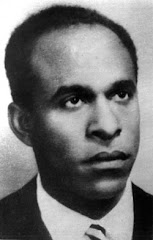
PHOTO: Mohammad Mossadegh (1882-1967)
Mohammad Mosaddegh[a] (Persian: محمد مصدق‎; IPA: [mohæmˈmæd(-e) mosædˈdeɢ] (About this soundlisten);[b] 16 June 1882 – 5 March 1967) was the 35th prime minister of Iran, holding office from 1951 until 1953, when his government was overthrown in the 1953 Iranian coup d'état orchestrated by the United States' Central Intelligence Agency and the United Kingdom's MI6.[4][5]
An author, administrator, lawyer and prominent parliamentarian, his administration introduced a range of social and political measures such as social security, land reforms and higher taxes including the introduction of taxation of the rent on land. His government's most significant policy, however, was the nationalization of the Iranian oil industry, which had been built by the British on Persian lands since 1913 through the Anglo-Persian Oil Company (APOC/AIOC) (later British Petroleum and BP).[6]
Many Iranians regard Mosaddegh as the leading champion of secular democracy and resistance to foreign domination in Iran's modern history. Following an initial, failed coup attempt by the CIA/MI6-backed General Fazlollah Zahedi, Mosaddegh resigned four days later on 19 August 1953, with Zahedi succeeding him as prime minister.[7]
While the coup is at times referred to in the West as Operation Ajax[8] after its CIA cryptonym, in Iran it is referred to as the 28 Mordad 1332 Coup d'état, after its date on the Iranian calendar.[9] Mosaddegh was imprisoned for three years, then put under house arrest until his death and was buried in his own home so as to prevent a political furor.[10][11][12] In 2013, the U.S. government formally acknowledged the U.S. role in the coup, as a part of its foreign policy initiatives.[13] 
This Day in History
Aug. 19, 1953: U.S. and Britain Topple Democratically Elected Government of Iran
Time Periods: Cold War: 1945 - 1960
Themes: US Foreign Policy, Wars & Related Anti-War Movements, World History/Global Studies
On Aug. 19, 1953, Iranian Premier Mohammad Mossadegh was removed from power in a coup organized and financed by the British and U.S. governments. The Shah quickly returned to take power and signed over forty percent of Iran’s oil fields to U.S. companies.
Here is a description of this historic event from “50 Years After the CIA’s First Overthrow of a Democratically Elected Foreign Government We Take a Look at the 1953 US Backed Coup in Iran” on Democracy Now!,
In 1953, the CIA and British intelligence orchestrated a coup d’etat that toppled the democratically elected government of Iran. The government of Mohammad Mossadegh. The aftershocks of the coup are still being felt.
In 1951 Prime Minister Mossadegh roused Britain’s ire when he nationalized the oil industry. Mossadegh argued that Iran should begin profiting from its vast oil reserves which had been exclusively controlled by the Anglo-Iranian Oil Company. The company later became known as British Petroleum (BP).
After considering military action, Britain opted for a coup d’état. President Harry Truman rejected the idea, but when Dwight Eisenhower took over the White House, he ordered the CIA to embark on one of its first covert operations against a foreign government.
Iran Coup | Zinn Education Project
Report to the National Security Council on Iran. Source: National Security Archive.
The coup was led by an agent named Kermit Roosevelt, the grandson of President Theodore Roosevelt. The CIA leaned on a young, insecure Shah to issue a decree dismissing Mossadegh as prime minister. Kermit Roosevelt had help from Norman Schwarzkopf’s father: 
Norman Schwarzkopf.
The CIA and the British helped to undermine Mossadegh’s government through bribery, libel, and orchestrated riots. Agents posing as communists threatened religious leaders, while the US ambassador lied to the prime minister about alleged attacks on American nationals.
Some 300 people died in firefights in the streets of Tehran.
Mossadegh was overthrown, sentenced to three years in prison followed by house arrest for life.
The crushing of Iran’s first democratic government ushered in more than two decades of dictatorship under the Shah, who relied heavily on US aid and arms. The anti-American backlash that toppled the Shah in 1979 shook the whole region and helped spread Islamic militancy.
Listen to the full broadcast which includes an interview with Stephen Kinzer, author of All the Shah’s Men: An American Coup And The Roots of Middle East Terror, and Baruch College professor Ervand Abrahamian.
In Disguising Imperialism: How Textbooks Get the Cold War Wrong and Dupe Students, high school teacher Ursula Wolfe-Rocca writes:
American Journey says the CIA “backed” a coup in Iran; in reality that “backing” involved Kermit Roosevelt, CIA agent and grandson of Theodore, arriving in Tehran with suitcases full of cash to manufacture an opposition movement by hiring people to protest, bribing newspaper editors to print misinformation (real fake news), and creating a sham communist party to act as a straw man. American Journey says the Shah “cooperated” with the United States; it leaves out that such “cooperation” was defined by Iran’s purchase of billions of dollars of weapons from the United States as well as the CIA’s training of Savak, the Shah’s secret police force infamous for its human rights violations.
There is an excellent critique of textbook coverage of this history in Chapter 8 of the first edition of Lies My Teacher Told Me by James W. Loewen. 
PHOTO: Mohammad Mossadegh (1882-1967)

Thursday, January 29, 2015

Noam Chomsky On the film 'American Sniper' and the History Of the Civil Rights Movement in the U.S.

Noam Chomsky (2015) --"The Civil Rights Movement”-- [FULL INTERVIEW]

The Chomsky Lectures:  January 9, 2015
A videoconference with petroc students in England


http://www.alternet.org/watch-chomsky-blasts-american-sniper-and-media-glorifies-it#.VMapAWV--go.email

During a public conversation prompted by the beginning of the Tsarnaev trial in Boston, Noam Chomsky discussed the larger issue of society's growing tolerance for violence and willingness to overlook questionable acts carried out by government agencies. He refers to a review of the 2014 film, American Sniper as a way into the conversation about what we define as terror, when we feel justified in protecting ourselves and what the fallout is for taking violent action.

Hosted at The Lilypad in Cambridge, MA by The Baffler Magazine, featuring the ACLU's Kade Crockford and linguist Noam Chomsky.

WATCH:  Chomsky Blasts 'American Sniper' and the Media that Glorifies It:


The famed professor draws a disturbing parallel between "Sniper" and our "global assassination program."

 
By Janet Allon 
AlterNet
January 26, 2015


Noam Chomsky had some choice words about the popularity of "American Sniper," its glowing New York Times review, and what the worship of a movie about a cold-blooded killer says about the American people.

It's not good.

During a Cambridge, Massachusetts event hosted by The Baffler, Chomsky first read the glowing recent review the New York Times gave the movie. That review begins inauspiciously by insulting, “America’s coastal intelligentsia, which has busied itself with chatter over little-seen art dramas while everyday Americans showed up en masse for a patriotic, pro-family picture which broke all attendance records in its opening days.”

So, Chomsky wonders aloud: “What was the patriotic, pro-family film that so entranced everyday Americans? It’s about the most deadly sniper in American history, a guy named Chris Kyle, who claims to have used his skills to have killed several hundred people in Iraq.”

Kyle's first kill was a woman who apparently walked into the street with a grenade in her hand as the Marines attacked her village. Here's how Kyle describes killing her with a single shot:

“‘I hated the damn savages I’d been fighting,’” Chomsky said, quoting Kyle. “‘Savage, despicable, evil — that’s what we were fighting in Iraq. That’s why a lot of people, myself included, called the enemy savages. There was really no other way to describe what we encountered there.’”

Chomsky also pointed out that The New Yorker loved the film, saying, "it was great, kept to the cinematic values, said it was well done." On the other hand, Newsweek's Jeff Stein, a former US intelligence officer, deferred, calling it appalling. In that review, Chomsky says, Stein remembered a visit he had made to a “clubhouse for snipers, where to quote him, ‘the barroom walls featured white-on-black Nazi SS insignia, and other Wehrmacht regalia. The Marine shooters clearly identified with the marksmen of the world’s most infamous killing machine, rather than regular troops.”

“Getting back to Chris Kyle,” Chomsky said, arriving at his larger point. “He regarded his first kill as a terrorist — this woman who walked in the street — but we can’t really attribute that to the mentality of a psychopathic killer, because we’re all tarred by the same brush insofar as we tolerate or keep silent about official policy.”

“Now, that [sniper] mentality helps explain why it’s so easy to ignore what is most clearly the most extreme terrorist campaign of modern history, if not ever — Obama’s global assassination campaign, the drone campaign, which officially is aimed at murdering people who are suspected of maybe someday planning to harm us.”

Chomsky recommends reading some of the transcripts with drone operators, calling them "harrowing" in their dehumanizing treatment of people who are targeted.

The implication is clear and chilling. Are we all, at least tacitly, American snipers?

Here's Chomsky via WGBH below.:


Saturday, February 5, 2011

Mubarak Regime Targets And Violently Attacks Western and Arab Journalists Covering the Demonstrations

Sebastian Scheiner/Associated Press
Khalil Hamra, left, of The Associated Press and other photographers took cover on Thursday as they worked to cover the protests.


http://www.nytimes.com/2011/02/04/world/middleeast/04journalists.html?nl=todaysheadlines&emc=tha22


Gangs Hunt Journalists and Rights Workers
By JEREMY W. PETERS and J. DAVID GOODMAN

February 3, 2011

New York Times


Journalists covering the revolt against President Hosni Mubarak of Egypt have found themselves the targets of widespread anger and suspicion in an apparently coordinated campaign that is intended to stifle the flow of news that could further undermine the government.

No news organization seemed exempt from the rage, which escalated as the week wore on. Whether from Western or Arab media, television networks or wire services, newspapers or photo syndicates, journalists were chased through the streets and had their equipment stolen or smashed. Some were beaten so badly that they required hospital treatment.

ABC News reported that one of its crews was carjacked on Thursday and threatened with beheading. A Reuters journalist said a “gang of thugs” had stormed the news service’s office and started smashing windows. And four journalists from The Washington Post were detained by forces that they suspected were from the Interior Ministry. All four were released by early Friday. But two of them, the paper’s Cairo bureau chief and a photographer, had been ordered not to leave a local hotel.

“It appears that journalists are being targeted by the Egyptian authorities in a deliberate campaign of intimidation aimed at quashing honest, independent reporting of a transformational event,” said The Post’s foreign editor, Douglas Jehl.

If the aim was to suppress coverage, the actions were somewhat effective. Major television networks from around the world were largely unable to broadcast from Tahrir Square, the center of antigovernment protests, on Thursday. The Egyptian state news agency had earlier asked foreign reporters and crews to move out of the hotels near the square.

Live television images were so difficult to transmit that by the afternoon, the Fox News Channel anchor Shepard Smith was showing viewers exactly what his control room in New York was seeing — blank screens from The Associated Press and Reuters television feeds.

Jon Williams of the BBC said via Twitter that Egyptian security forces had seized the news agency’s equipment at the Cairo Hilton “in an attempt to stop us broadcasting.” Both CNN and the BBC relied on taped footage of the square.

Al Jazeera and Al Arabiya, which have provided some of the most extensive network coverage of the revolt, said their journalists had been hounded from the street and from vantage points above the square where their cameras had been placed. In the absence of live pictures, the networks relied on grainy amateur video taken on the streets.

Another Arab network, Al Hurra, had what it described as one of the only live feeds from the square.

The Committee to Protect Journalists said it had received nearly 100 reports of damage to news organization property or of individuals being detained or attacked.

The intimidation tactics were condemned at the highest levels of the United States government. The White House spokesman, Robert Gibbs, rebuked the Mubarak government and its supporters, calling the harassment “completely and totally unacceptable.” Speaking to reporters traveling with President Obama, he said that “any journalist that has been detained should be released immediately.”

Secretary of State Hillary Rodham Clinton said the attacks on journalists were an affront to the most basic principles of international law. “It is especially in times of crisis that governments must demonstrate their adherence to these universal values,” she said.

A reporter for Al Arabiya was beaten by a group of pro-Mubarak demonstrators on Wednesday. His injuries were significant enough that he remained in the hospital, though his condition was not critical, said Nakhle el-Hage, the network’s director of news.

The attacks were aimed at other independent observers, too, including representatives of groups like Human Rights Watch. The Egyptian security police also raided the Hisham Mubarak Law Center, detaining as many as 16 people, including some of the country’s most prominent human rights advocates and several foreign researchers.

Al Arabiya broadcast a plea to the Egyptian Army to intervene after the network’s headquarters in Cairo came under sustained attack from pro-Mubarak demonstrators who were wielding sticks and knives. “They destroyed some equipment outside the building, and they said they would come in and destroy everything,” Mr. Hage said in a telephone interview from Dubai.

He said the army initially responded by deploying more soldiers to secure the building, but the troops soon left. “The message we got from the army is that ‘you’re left on your own,’ ” he said.

Al Arabiya’s staff was forced to flee a nearby hotel as the pro-Mubarak mob broke into the network’s office. Four of its journalists stayed at the hotel to report, while others continued to work from their homes or from friends’ homes.

Two employees of Al Jazeera were dragged out of their car on the road from the airport to central Cairo and were detained; in the early evening, the network said that, over all, three of its journalists were still in custody. A spokesman for the network also said that its Web site had faced “security issues.” The site was not available in Egypt or the United States early Thursday, though it appeared to return online later.

Two reporters working for The New York Times were released on Thursday after being detained overnight in Cairo.

The attacks started almost as soon as the violent clashes began near Tahrir Square on Wednesday. “It’s clearly a bad situation these last two days — a stark contrast to the days before that,” said David Remnick, the editor of The New Yorker, which has several journalists in Egypt, including a local translator who was assaulted, detained and later released.

The government has sought to control the information coming out of Egypt since large-scale protests against Mr. Mubarak and his subordinates began in late January. But before Wednesday, the harassment of reporters had been scattered, and attempts to control the gripping images and narratives from Cairo had mostly failed.

“We’ve never witnessed something like this in the Middle East,” said Mohamed Abdel Dayem, program coordinator for the Middle East and North Africa at the Committee to Protect Journalists. “That is not to say that Saddam Hussein’s Iraq or Muammar Qaddafi’s Libya were friendly places for journalists. There were massive amounts of harassment, intimidation and reporters put on trial. But you don’t see this level of physical violence against journalists in this kind of sustained fashion and coordination.”


David D. Kirkpatrick contributed reporting from Cairo, and Brian Stelter from Doha, Qatar.

Despite Lethal Violence By the Mubarak Regime the Egyptian People Remain United in Support of Revolution

Ed Ou for The New York Times
Antigovernment protesters clashed with supporters of President Hosni Mubarak near Tahrir Square in Cairo on Thursday.

http://www.nytimes.com/2011/02/04/world/middleeast/04egypt.html?_r=1&nl=todaysheadlines&emc=tha2&pagewanted=all


Crackdown in Egypt Widens but Officials Offer Concessions
By ANTHONY SHADID
Published: February 3, 2011

CAIRO — The Egyptian government on Thursday broadened its crackdown on a 10-day uprising that has shaken its rule, arresting journalists and human rights advocates across an edgy city, while offering more concessions in a bid to win support from a population growing frustrated with a devastated economy and scenes of chaos in the streets.

The campaign was a startling blend of the oldest tactics of an authoritarian government — stoking fears of foreigners — with the air of sincerity of a repentant order. Trying to seize the initiative from a revolt that has marked one of the most decisive moments in modern Egyptian history, the government promised that neither President Hosni Mubarak nor his son Gamal, long seen as a contender for power, would run for president and offered dialogue with the banned Muslim Brotherhood, gestures almost unthinkable weeks ago.

As protesters battled crowds rallied by the government for a second day, organizers sought to rally even bigger demonstrations for Friday — dubbed the “Friday of departure” — in hopes of keeping the momentum behind a popular uprising that has demanded that Mr. Mubarak step down after three decades in power.

Voiced often in the tumultuous scenes of defiance and determination in Tahrir Square was a fear that if they lost, the protesters and their organizers would bear the brunt of a withering crackdown.

“If we can’t bring this to an end, we’re going to all be in the slammer by June,” said Murad Mohsen, a doctor treating the wounded at a makeshift clinic near barricades, where thousands fought off droves of government supporters with rocks and firebombs.

Dr. Mohsen’s comments illustrated the changing dynamic of an uprising that has captivated the Arab world, reverberating through Jordan, Sudan and Yemen, where there were peaceful protests on Thursday. New calls for protests went out in Algeria, Bahrain and Libya.

From festive scenes of just days ago, the revolt has become more martial, as exhausted men defend what they describe as the perimeter of a free Egypt around Tahrir Square. Their demands have grown more forceful and the uprising more radical. After pitched clashes of two days that left at least seven dead and hundreds wounded, banners in Tahrir Square declared Mr. Mubarak “a war criminal,” and several in the crowd said that the president should be executed. Major television networks were largely unable to broadcast from the square on Thursday.

The United States joined a chorus of criticism, with Secretary of State Hillary Rodham Clinton saying, “We condemn in the strongest terms attacks on peaceful demonstrators, human rights activists, foreigners and diplomats.”

The government’s strategy seems motivated at turning broader opinion in the country against the protests and perhaps wearing down the demonstrators themselves, some of whom seemed exhausted by the clashes. Vice President Omar Suleiman, appointed Saturday to a position that Mr. Mubarak had until then refused to fill, appealed to Egypt’s sense of decency in allowing Mr. Mubarak to serve out his term, and he chronicled the mounting losses that, he said, the uprising had inflicted on a crippled Egyptian economy.

“End your sit-in,” he said. “Your demands have been answered.”

Mr. Mubarak said in an interview with ABC that he was eager to step down but if he did, “Egypt would sink into chaos.”

In interviews and statements, the government has increasingly spread an image that foreigners were inciting the uprising, a refrain echoed in the streets. The suggestions are part of a days-long Egyptian media campaign that has portrayed the protesters as troublemakers and ignored the scope of an uprising with diffuse goals and leadership.

“Millions turn out to support Mubarak,” read the banner headline on Thursday on the front page of Al Ahram, the leading government newspaper.

The propaganda has been so pronounced that an announcer on Nile Television, Shahira Amin, quit. “I cleared my conscience and walked out,” she said.

The Committee to Protect Journalists said it had 100 reports of attacks on journalists. Al Jazeera, the influential Arabic channel, said government supporters stormed the Hilton Hotel in Cairo, searching for journalists, and two of its reporters were attacked. A Greek journalist was stabbed with a screwdriver and others were beaten and harassed.

Police also raided the Hisham Mubarak Law Center, a headquarters for many of the international human rights organizations working in Egypt. The human rights workers were told to lie on the floor and the chips were removed from the telephones, someone present in the building said, speaking on condition of anonymity for fear of retribution.

As the day wore on, tension descended across parts of the city, which is still guarded by popular committees that banded together after the police withdrew Saturday. Government supporters roamed parts of the downtown, itching for a fight, and looters set fire to a shopping mall along the Nile that was already looted and burned Friday.

The menace was a counterpoint to Tahrir Square, where the literati and well-off demonstrators mixed with the poorest of rough-and-tumble neighborhoods in scenes of camaraderie and determination that have made the square an emblem of the revolt. Protesters flashed V-for-victory signs at dawn, celebrating their success in holding the square and even pushing the barricades forward in clashes that dragged through the night.

Protesters accused government supporters of trying to block them from delivering supplies to the square, but boxes of water, bananas, yogurt and medicine still made it in. The Internet was working. Volunteers swept the streets, pushing piles of rocks to the curb that looked like bluffs of snow. Doctors staffed first-aid clinics, near graffiti that read, “We are writing the history of a free Egypt,” and men frisked people entering for weapons.

“Don’t incite them!” shouted Mahmoud Haqiqi, holding aloft a sign that read, “No to shedding of blood.” But even those who lamented the turn to violence blamed Mr. Mubarak’s supporters for provoking them and vowed not to relinquish the square. “Right now, it’s all here, protecting Tahrir Square,” said Hisham Kassem, a veteran activist and publisher, who kept a wary eye on barricades built with corrugated tin, wrecked cars and trucks, barrels, buckets filed with sand and metal railing torn from the curb. “We keep it tonight, and tomorrow the whole country is going to come out.”

He surveyed the crowd and shook his head. “I can’t face the idea of this failing.”

For days, the government seemed to stagger at the scale of an uprising that overwhelmed Egypt’s once ubiquitous security forces on Friday. The concessions on Thursday marked its most concerted attempt to address at least some of the longstanding demands in a country that many believe has stagnated under Mr. Mubarak’s rule. The newly appointed prime minister, Ahmed Shafiq, apologized for the violence and vowed to investigate who instigated it. Mr. Suleiman followed with a lengthy television interview in which he recognized what he described as “the revolution of the youth.”

Mr. Suleiman sought to project an image of good will, offering dialogue with the Muslim Brotherhood, which remains banned, even though it is the country’s most influential opposition group. In a sign of the new landscape, Mr. Suleiman referred to it by name rather than the government’s usual coded language, though he and Mr. Mubarak have both suggested it was behind the revolt. Its followers have played a forceful role in the protests, but its leaders have, so far, tried to remain in the background.

“We have contacted the Muslim Brotherhood and invited them, but they are still hesitant about the dialogue,” he said. “I think that their interest is to attend the dialogue.”

Other concessions came from Egypt’s public prosecutor, who issued a travel ban on former government ministers and an official of the ruling National Democratic Party on suspicion of theft of public money, profiteering and fraud, state television reported. Among the four was the hated former interior minister, Habib el-Adly, who commanded a police force that was widely despised for its corruption and routine use of torture.

So far, the government’s concessions have done little to diminish the protests, but the relentless message of officials that Egypt faced chaos seemed, at least anecdotally, to be finding an audience.

“This is enough,” said Ahmed Mohamed, a 22-year-old broker at the National Bank of Kuwait, hanging out at a rarity in Cairo, a coffee shop doing business. “I want life to go back to normal. We want to go back to work. And what we have done in 72 hours we couldn’t achieve in 30 years. It’s only a few months until Mubarak leaves.”


David D. Kirkpatrick, Kareem Fahim, and Mona El-Naggar contributed reporting from Cairo.

The Barbarity of Counterrevolution in Egypt led by the Mubarak Regime and U.S. Imperialism

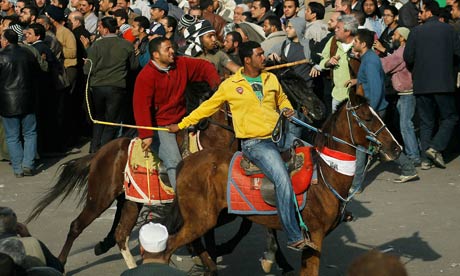
Hosni Mubarak supporters ride horses during a clash between pro- and anti-Mubarak protesters. Photograph: Chris Hondros/Getty Images

http://www.guardian.co.uk/commentisfree/2011/feb/02/egypt-protests-mubarak

All,

The real nature of counter revolution, what it really means in Egypt today, and the ominous complicity of the United States and the Obama administration in its lethal perpetuation--both violently and non-violently.

Kofi


Egypt protests: Mubarak shows his dark side
by Simon Tisdall
guardian.co.uk,
Wednesday 2 February 2011


The counter-revolutionary message to the people from an unvanquished, still vicious regime is: it's over – go home, or else

Hosni Mubarak launched his counter-revolution today, sending waves of armed thugs to do battle with pro-democracy demonstrators in Cairo and other cities. The attacks, reportedly involving plainclothes police and vigilantes as well as pro-regime citizens, appeared to be carefully co-ordinated and timed. And the army, which only days earlier had sworn to protect "legitimate" rights of protesters, stood back and watched as the blood flowed.

This ugly turn of events should come as no surprise. What is unusual is that the regime tolerated such levels of unrest for nearly a week.

Mubarak was never quite a dictator in the Saddam Hussein or Robert Mugabe mould. His rule was more akin to the semi-enlightened despotism of an 18th-century European monarch. But at bottom, it always depended on coercion and force. Today, the pretence of reasonableness was torn away. His dark side showed for all to see.

Mubarak's speech to the nation on Tuesday night was widely misinterpreted. The president was, by turns, angry, defiant and unrepentant. He offered no apologies, proposed no new initiatives, gave no promise that his son Gamal would not succeed him, and instead lectured Egyptians on the importance of order and stability (which he alone could assure).

He appeared not to have learned anything from the past week. And his one "concession" – that he would not seek re-election – was no concession at all. After all, he had never said he would.

This was not the performance of a defeated man. Mubarak may be down but he's not out. And judging by today's events in Tahrir Square, he and the military-dominated clique around him clearly feel they have done enough, for now, to get the Americans off their backs, flex their still considerable muscle, and reclaim the streets for the regime. All the talk about reform and elections and negotiations can wait, whatever Barack Obama says.

Today's immediate message to the people from an unvanquished, still vicious regime: it's over – go home, or else.

There's a good to middling chance the counter-revolution strategy will work, given time. "Imagine yourself as Hosni Mubarak, master of Egypt for nearly 30 years. You're old, unwell, detested and addicted to power," wrote Wall Street Journal columnist Bret Stephens.

"You could have orchestrated a graceful exit by promising to preside over free and fair presidential elections later this year – elections in which the Mubarak name would not be on the ballot. Instead you gambled that you could ride out the protests and hold on. It's a pretty good gamble ..."

Reasons for believing Mubarak can not only survive the next eight months but also exert decisive, possibly fatally obstructive influence over Egypt's new direction are plentiful. As matters stand now, the regime is unreconstructed, the opposition is split, and the Americans are undecided. Despite his insistence on a swift, orderly transition, Obama has not withdrawn his personal support. In Brussels today, the EU also declined to demand Mubarak's immediate resignation. David Cameron said reforms must be implemented faster.

All of them got a dusty brush-off. In an official statement, the Egyptian foreign ministry, still led by an old Mubarak crony, Ahmed Aboul Gheit, rejected US and European calls for the transition to start now. Calls from "foreign parties" were "aimed to incite the internal situation," it said. In other words: get lost.

Mubarak and his close confidant and deputy, Omar Suleiman, have more cards to play as they foment a backlash and seek to regain control. As in the past, they can play on Israeli and American fears of an Islamist takeover. They can point out just how disastrous it might be if a new government tore up Egypt's peace treaty with Israel.

The opposition leader, Mohamed ElBaradei can easily be portrayed as untrustworthy. In fact, such a campaign is already under way. The Americans, for example, suspected him of pro-Iranian bias when he headed the UN's nuclear watchdog – and believe, too, that he is far too cosy with Turkey's neo-Islamist leaders.

As he tries to reassert his primacy, Mubarak can rely on the conservative Arab states of the Gulf, Saudi Arabia, Libya and Algeria, and on any number of African governments that have no wish to encourage popular revolution. Even old enemy Iran is privately ambivalent on this score.

He can offer negotiations to the opposition and hope to gain advantage from their refusal, so far, to participate. And if all this fails, the regime can always let loose its thugs and hooligans, just to emphasise that without state-imposed order, only chaos, not democracy, reigns.

Mubarak's counter-revolution is still a long shot. Too much has changed in Egypt for it ever to go back the way things were. But today saw the beginning of a new stage in a complex internal struggle whose ultimate outcome remains deeply uncertain.

Thursday, February 3, 2011

What Goes Around Comes Around: Egypt, American Imperialism, and the Confirmation of Natambu's Law

http://www.truth-out.org/us-chickens-come-home-roost-egypt67385

All,

NATAMBU'S LAW states: "No matter how bad or fucked up any particular situation is or appears to be, or how much you know or think you know about what it all means, in reality it's always far worse than anything you could possibly imagine"

Kofi


"A former CIA agent observed, "If you want a serious interrogation, you send a prisoner to Jordan. If you want them to be tortured, you send them to Syria. If you want someone to disappear - never to see them again - you send them to Egypt."


US Chickens Come Home to Roost in Egypt
by Marjorie Cohn
Wednesday 02 February 2011
Truthout

Barack Obama, like his predecessors, has supported Egyptian President Hosni Mubarak to the tune of $1.3 billion annually, mostly in military aid. In return, Egypt minds US interests in the Middle East, notably providing a buffer between Israel and the rest of the Arab world. Egypt collaborates with Israel to isolate Gaza with a punishing blockade, to the consternation of Arabs throughout the Middle East. The United States could not have fought its wars in Iraq without Egypt's logistical support.

Now, with a revolution against Mubarak by two million Egyptians, all bets are off about who will replace him and whether the successor government will be friendly to the United States.

Mubarak's "whole system is corrupt," said Hesham Korayem, an Egyptian who taught at City University of New York and provides frequent commentary on Egyptian and Saudi television. He told me there is virtually no middle class in Egypt, only the extremely rich (about 20 to 25 percent of the population) and the extremely poor (75 percent). The parliament has no input into what Mubarak does with the money the United States gives him, $300 million of which comes to the dictator in cash each year.

Torture is commonplace in Egypt, according to Korayem. Indeed, Omar Suleiman, Egypt's intelligence chief whom Mubarak just named vice president, was the lynchpin for Egyptian torture when the Central Intelligence Agency (CIA) sent prisoners to Egypt in its extraordinary rendition program. Stephen Grey noted in his book "Ghost Plane" that "[I]n secret, men like Omar Suleiman, the country's most powerful spy and secret politician, did our work, the sort of work that Western countries have no appetite to do ourselves."

In her chapter in the newly published book, "The United States and Torture: Interrogation, Incarceration, and Abuse," Jane Mayer cites Egypt as the most common destination for suspects rendered by the United States. "The largest recipient of US foreign aid after Israel," Mayer writes, "Egypt was a key strategic ally, and its secret police force, the Mukhabarat, had a reputation for brutality." She describes the rendering of Ibn al-Sheikh al-Libi to Egypt, where he was tortured and made a false confession that Colin Powell cited as he importuned the Security Council to approve the US invasion of Iraq. Al-Libi later recanted his confession.

The State Department's 2002 report on Egypt noted that detainees were "stripped and blindfolded; suspended from a ceiling or doorframe with feet just touching the floor; beaten with fists, metal rods, or other objects; doused with hot or cold water; flogged on the back; burned with cigarettes; and subjected to electrical shocks. Some victims ... [were] forced to strip and threatened with rape."

In 2005, the United Nations Committee Against Torture found that, "Egypt resorted to consistent and widespread use of torture against detainees" and "the risk of such treatment was particularly high in the case of detainees held for political and security reasons."

About a year ago, an Italian judge convicted 22 CIA operatives and a US Air Force colonel of arranging the kidnapping of a Muslim cleric in Milan in 2003 and flying him to Egypt, where he was tortured. Hassan Mustafa Osama Nasr told Human Rights Watch he was "hung up like a slaughtered sheep and given electrical shocks" in Egypt. "I was brutally tortured and I could hear the screams of others who were tortured too," he added.

A former CIA agent observed, "If you want a serious interrogation, you send a prisoner to Jordan. If you want them to be tortured, you send them to Syria. If you want someone to disappear - never to see them again - you send them to Egypt."

So, what will happen next in Egypt?

Suleiman, who is intensely loyal to Mubarak, will not be an acceptable successor to the Egyptian people. Some fear that the Muslim Brotherhood, which supports Hamas, will take power once Mubarak is forced out, but "[t]hough it is the largest opposition group, it by no means enjoys overwhelming support, and its leaders are for the most part moderate and responsible," Scott MacLeod, Time magazine's Middle East correspondent from 1995 to 2010, wrote in The Los Angeles Times. Korayem concurs. He says the Brotherhood, which has formally renounced terrorism and violence, is more educated and peaceful now. The Brotherhood provides social and economic programs that augment public services in Egypt.

Indeed, the Brotherhood supports Mohamed ElBaradei to negotiate with the Egyptian government. ElBaradei, the former UN International Atomic Energy Agency chief and Nobel Peace Prize recipient, recently returned to Egypt to stand with the protesters. He told Fareed Zakaria on CNN that the Brotherhood favors a secular state, and "has nothing to do with the Iranian movement, has nothing to do with extremism as we have seen it in Afghanistan and other places."

The Obama administration has been slow to acknowledge that Mubarak is on his way out. Vice President Joe Biden, still in denial, said on the PBS News Hour, "I would not refer to him as a dictator." ElBaradei criticized Obama for supporting Mubarak in the face of the popular revolt in Egypt. "You are losing credibility by the day," he told CBS News. "On one hand you're talking about democracy, rule of law and human rights, and on the other hand you are lending support to a dictator that continues to oppress his people."

Korayem sees the United States' uncritical support for Israel as key to the problems in Egypt and elsewhere in the Middle East. If the United States acted as an honest broker, even "slightly fair to the Palestinians," that would go a long way to solving the difficulties, he said. But, according to journalist Gareth Porter, "The main function of the U.S. client state relationship with Egypt was to allow Israel to avoid coming to terms with Palestinian demands." Writing in Truthdig, Chris Hedges added that, "The failure of the United States to halt the slow-motion ethnic cleansing of Palestinians by Israel has consequences. The failure to acknowledge the collective humiliation and anger felt by most Arabs because of the presence of U.S. troops on Muslim soil ... has consequences."

We are seeing those consequences in the streets of Egypt and in the likelihood of similar developments in Jordan, Yemen and other Middle Eastern countries. Until the US government stops uncritically supporting tyrants, torturers and oppressors, we can expect the people to rise up and overthrow them.


Published on Truthout (http://www.truth-out.org)

Mubarak's Thugs Use Organized Violence Against Anti-Government Demonstrators As the Egyptian People Fight Back in the Streets of Cairo

http://www.truth-out.org/mubarak-supporters-violently-attack-protesters-tahrir-square-over-100-injured-video67404?utm_source=twitterfeed&utm_medium=twitter

All,

The vicious organized attacks on Egyptian anti-government demonstrators by thousands of thugs and criminals (as well as clearly undercover police and military operatives) bought and paid for by the despicable and tyrannical Mubarak regime is not only an indictment of that venal dictatorship but of President Obama's hopelessly weak, temporizing, and thereby complicit denial of the absolute necessity to publicly denounce and completely repudiate Mubarak's extremely repressive and antidemocratic government and demand his IMMEDIATE OUSTER TODAY (especially following the Egyptian dictator's ominously threatening, stubbornly incoherent, and clearly delusional "speech" on Egyptian television in the very early morning hours yesterday). As I write this four people have already officially been killed and hundreds seriously wounded in the government sponsored massacre that is described in detail below. Needless to say these criminally brutal and lethal actions by Mubarak's hired gangsters and the absurdly "diplomatic" overtures and "suggestions" by Obama's administration and the State Department about the need for the dictator to make an "orderly and peaceful transition to handing over authority now" have combined to make an already highly volatile situation far worse and is directly contributing to the rapid exponential growth of a major crisis with monumental consequences for not only Egypt but the entire Middle East region and the world...Stay tuned...

Kofi


Mubarak Supporters Riding on Horses and Camels Violently Attack Protesters in Tahrir Square, Over 100 Injured (Video)
Wednesday 02 February 2011
by: Amy Goodman | Democracy NOW! | Report

Violent clashes broke out just before our broadcast when supporters of Egyptian President Hosni Mubarak attacked anti-government protesters in Tahrir Square in Cairo. Reports are that more than 100 people have been injured. “The entire square is surrounded by thugs, and apparently there are more coming on the way,” reports Egyptian activist Nazly Hussein. "I have seen people come out injured… I saw people carried into the medical center injured." We get live reports from Hussein and Democracy Now!’s senior producer Sharif Abdel Kouddous, who are both in Cairo. [includes rush transcript]


Guests:

Sharif Abdel Kouddous, Democracy Now! senior producer
Nazly Hussein, Egyptian demonstrator


Amy Goodman: We begin the show in Cairo, where mass protests continue following President Hosni Mubarak’s refusal to immediately step down. The Egyptian army has called for the protests to end, but thousands remain in the streets. Violent clashes have broken out between pro-Mubarak and anti-government protesters in Tahrir Square in Cairo.

We’re going to go right now to Sharif Abdel Kouddous, Democracy Now! senior producer. He’s just come from Tahrir Square. In a moment, he’ll join us in studio, but this is too important to wait for that studio satellite to begin.

Sharif, tell us what’s happening now in Tahrir Square.

Sharif Abdel Kouddous: Amy, I just came back from Tahrir Square. I’m standing, talking to you on a building on top of Kornish Al Nile, which is right on—just a few hundred yards from Tahrir Square near the Nile. I don’t know if you can hear in the background, but there are hundreds, thousands of pro-Mubarak crowds who are streaming towards Tahrir.

In Tahrir, they have actually made it into the square. The army let them in. And now they are facing off. [inaudible] pushing. There’s a lot of cursing. This is mostly coming from the pro-Mubarak forces. If you walk in the street next to them, they’re very in-your-face. It’s a much more aggressive stance than we’ve seen. And we spoke to people in Tahrir who say that they’re basically coming from three different areas. There are Central Security forces who are dressed in civilian clothes, a lot of what we call baltaguia, who are also known as thugs. There’s also reports that the oil minister, Sameh Fahmi, issued orders for employees at oil companies to show up today in Heliopolis, another district in Cairo, and to demonstrate for Mubarak. And many of them are suspected to be government employees and members of the National Democratic Party.

This is an ominous development that’s happened now. They’re trying to take back Tahrir Square. They’re facing off right now. Protesters of the pro-democracy movement have linked arms. They’re holding strong. But the numbers are not what they last night in Tahrir. Many people went home. So it remains to be seen what is going to happen. I don’t know if you can hear in the background right now. The chants are getting louder. They are streaming in. This is a big coordinated effort to come back and take Tahrir. It remains to be seen what’s going to happen.

Many of the protesters in Tahrir said, "We’re going to stay here. We’re going to spend the night. If we get beaten, we get beaten. We will not hit back. But we are not leaving."

Amy Goodman: We are also joined by Nazly Hussein, along with Sharif Abdel Kouddous, in another part of the area around Tahrir Square, an Egyptian woman who’s been taking part in the protests, has been involved in opposition politics in Egypt for several years. Nazly, what do you see right now in Tahrir Square from your vantage point?

Nazly Hussein: I am currently trying to make it into Tahrir Square. I’m not on the square yet. The entire people on the square feel safe and say it’s calm and it’s OK inside the square. I’m trying to make it into the square. But the entire square is surrounded by thugs, and apparently there are more coming on the way. So we’re trying to make it into the square. People on the square are more [inaudible]. There’s a lot of efforts to bring people outside—

Amy Goodman: Have you seen any—Nazly, have you seen any injuries?

Nazly Hussein: I saw injuries. I have not seen the thugs with weapons. I can—you recognize them. After a few days on the street, you recognize them. But I have seen people come out injured. I was standing, two minutes ago, by a—when you first called me—by a medical point, and I saw people carried into the medical center injured. I have not seen anyone use violence. But you recognize them. And it’s really difficult to make it into the square. I have to go to another entry point right now and try to make it into the square.

Amy Goodman: Well, I want to thank you, Nazly Hussein, speaking to us from Tahrir Square. And Sharif will be joining us in a studio momentarily.

Friday, January 14, 2011

The Link Between Political Morality, Ideology, and Social Responsibility

http://www.nytimes.com/2011/01/14/opinion/14krugman.html?_r=1&nl=todaysheadlines&emc=tha212

All,

Once again Paul Krugman absolutely nails it and says clearly and honestly what most needs to be said about exactly where this country is in its political history and where it's going...Thanks again for eloquently speaking the necessary truth instead of lazily relying on empty platitudes Paul...

Kofi


OP-ED COLUMNIST

A Tale of Two Moralities
By PAUL KRUGMAN
January 13, 2011
New York Times

On Wednesday, President Obama called on Americans to “expand our moral imaginations, to listen to each other more carefully, to sharpen our instincts for empathy, and remind ourselves of all the ways our hopes and dreams are bound together.” Those were beautiful words; they spoke to our desire for reconciliation.

But the truth is that we are a deeply divided nation and are likely to remain one for a long time. By all means, let’s listen to each other more carefully; but what we’ll discover, I fear, is how far apart we are. For the great divide in our politics isn’t really about pragmatic issues, about which policies work best; it’s about differences in those very moral imaginations Mr. Obama urges us to expand, about divergent beliefs over what constitutes justice.

And the real challenge we face is not how to resolve our differences — something that won’t happen any time soon — but how to keep the expression of those differences within bounds.

What are the differences I’m talking about?

One side of American politics considers the modern welfare state — a private-enterprise economy, but one in which society’s winners are taxed to pay for a social safety net — morally superior to the capitalism red in tooth and claw we had before the New Deal. It’s only right, this side believes, for the affluent to help the less fortunate.

The other side believes that people have a right to keep what they earn, and that taxing them to support others, no matter how needy, amounts to theft. That’s what lies behind the modern right’s fondness for violent rhetoric: many activists on the right really do see taxes and regulation as tyrannical impositions on their liberty.

There’s no middle ground between these views. One side saw health reform, with its subsidized extension of coverage to the uninsured, as fulfilling a moral imperative: wealthy nations, it believed, have an obligation to provide all their citizens with essential care. The other side saw the same reform as a moral outrage, an assault on the right of Americans to spend their money as they choose.

This deep divide in American political morality — for that’s what it amounts to — is a relatively recent development. Commentators who pine for the days of civility and bipartisanship are, whether they realize it or not, pining for the days when the Republican Party accepted the legitimacy of the welfare state, and was even willing to contemplate expanding it. As many analysts have noted, the Obama health reform — whose passage was met with vandalism and death threats against members of Congress — was modeled on Republican plans from the 1990s.

But that was then. Today’s G.O.P. sees much of what the modern federal government does as illegitimate; today’s Democratic Party does not. When people talk about partisan differences, they often seem to be implying that these differences are petty, matters that could be resolved with a bit of good will. But what we’re talking about here is a fundamental disagreement about the proper role of government.

Regular readers know which side of that divide I’m on. In future columns I will no doubt spend a lot of time pointing out the hypocrisy and logical fallacies of the “I earned it and I have the right to keep it” crowd. And I’ll also have a lot to say about how far we really are from being a society of equal opportunity, in which success depends solely on one’s own efforts.

But the question for now is what we can agree on given this deep national divide.

In a way, politics as a whole now resembles the longstanding politics of abortion — a subject that puts fundamental values at odds, in which each side believes that the other side is morally in the wrong. Almost 38 years have passed since Roe v. Wade, and this dispute is no closer to resolution.

Yet we have, for the most part, managed to agree on certain ground rules in the abortion controversy: it’s acceptable to express your opinion and to criticize the other side, but it’s not acceptable either to engage in violence or to encourage others to do so.

What we need now is an extension of those ground rules to the wider national debate.

Right now, each side in that debate passionately believes that the other side is wrong. And it’s all right for them to say that. What’s not acceptable is the kind of violence and eliminationist rhetoric encouraging violence that has become all too common these past two years.

It’s not enough to appeal to the better angels of our nature. We need to have leaders of both parties — or Mr. Obama alone if necessary — declare that both violence and any language hinting at the acceptability of violence are out of bounds. We all want reconciliation, but the road to that goal begins with an agreement that our differences will be settled by the rule of law.