Showing posts with label Self Determination. Show all posts

Tuesday, May 28, 2024

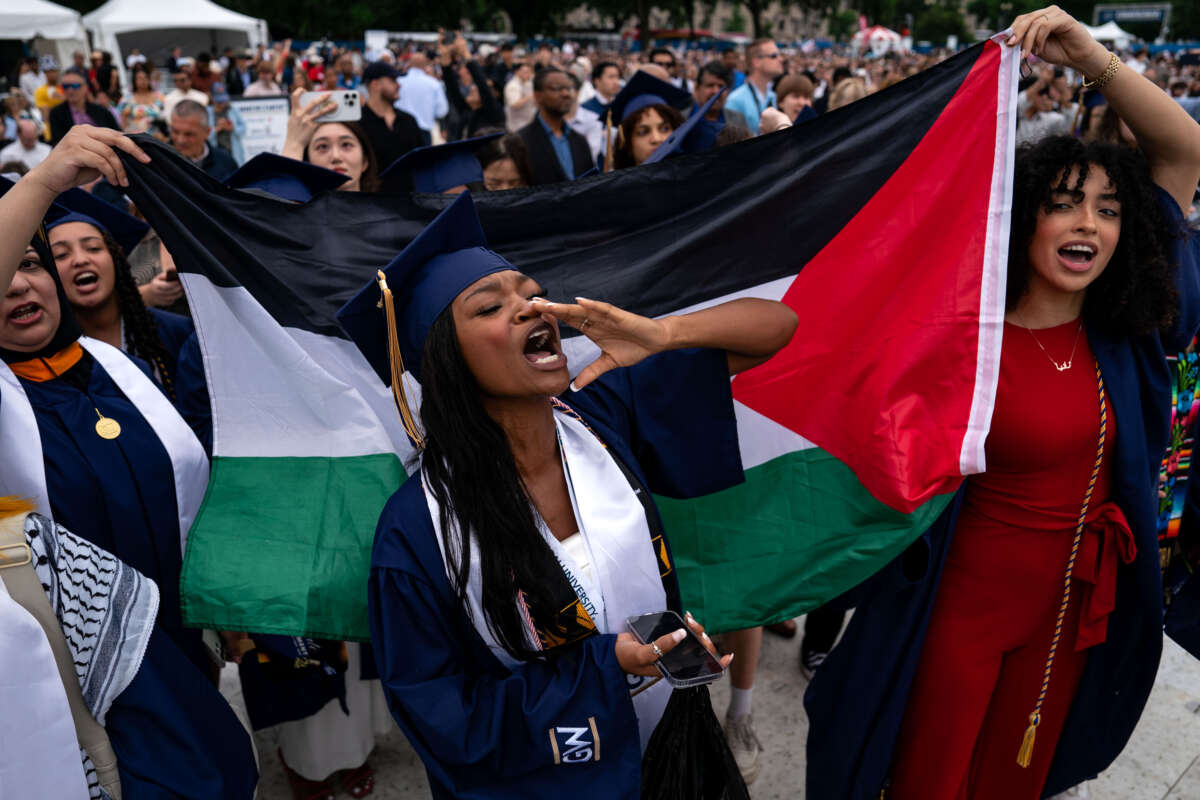
A New Generation of Activists and Students in Solidarity with the People of Gaza Will Not Be Deterred, Censored, Marginalized, or Intimidated Either on college campuses or in the streets on behalf of the liberation and self determination of Palestine in their and our collective struggle against the scourges of Genocide and Apartheid

https://truthout.org/articles/our-gaza-encampments-may-fall-but-theyve-already-radicalized-a-generation/

Friday, May 17, 2024

Palestinian-American Historian Abdel Razzaq Takriti On the Meaning of the Nakba in 1948 and its Genocidal Legacy in Gaza Today

"A Racist, Criminal Project": Palestinian Historian on 1948 Nakba, Israel's War on Gaza & U.S. Role:

Video: 

https://www.youtube.com/watch?v=MofifnIZxSI

Palestinians across the globe are marking the 76th anniversary of the Nakba — which means "catastrophe" in Arabic — when those establishing the state of Israel violently expelled over 700,000 Palestinians. Palestinian historian Abdel Razzaq Takriti says closer to 900,000 Palestinians were forced out or massacred during Israel's founding, which is being celebrated inside Israel with calls to ethnically cleanse and settle the Gaza Strip and the occupied West Bank. "The Nakba is continuing. This is a colonial continuum," says Takriti. "It's not enough to commemorate. It's not enough to talk about it. We have to stop it right now. … The first step to doing that is to stop the genocide in Gaza." 

Takriti lays out four principles for Nakba education: refuting Nakba denialism, recognizing the Nakba is part of an ongoing process of settler colonialism, stopping that process, and then reversing it by restoring Palestinian national rights. 

Democracy Now! is an independent global news hour that airs on over 1,500 TV and radio stations Monday through Friday. Watch our livestream at democracynow.org Mondays to Fridays 8-9 a.m. ET.

Latest Shows

Friday, May 3, 2024

Writer, Public Intellectual, Scholar, Historian, Philosopher, and Activist Eddie Glaude, Jr. On the Major Questions, Challenges, Responsibilities, and Contradictions, In Struggle With the Murderous Obstacles Of Our Time As We Fight on a Political, Ideological, Moral, and Ethical Level For Freedom, Justice, Equality, and Self Determination in the 21st Century

Eddie Glaude, Jr. — We Are the Leaders We Have Been Looking For 

With Clint Smith

May 2, 2024 

VIDEO:  

Watch author Eddie Glaude's book talk and reading at Politics and Prose bookstore in Washington, D.C.  We are more than the circumstances of our lives, and what we do matters. In We Are the Leaders We Have Been Looking For, one of the nation’s preeminent scholars and a New York Times bestselling author, Eddie S. Glaude Jr., makes the case that the hard work of becoming a better person should be a critical feature of Black politics. Through virtuoso interpretations of Martin Luther King, Jr., Malcolm X, and Ella Baker, Glaude shows how ordinary people have the capacity to be the heroes that our democracy so desperately requires, rather than outsourcing their needs to leaders who purportedly represent them. Based on the Du Bois Lectures delivered at Harvard University, the book begins with Glaude’s unease with the Obama years. He felt then, and does even more urgently now, that the excitement around the Obama presidency had become a disciplining tool to narrow legitimate forms of Black political dissent. This narrowing continues to undermine the well-being of Black communities. In response, Glaude guides us away from the Scylla of enthusiastic reliance on elected leaders and the Charybdis of full surrender to a belief in unchanging political structures. Glaude weaves anecdotes about his own evolving views on Black politics together with the writings of Ralph Waldo Emerson, John Dewey, Sheldon Wolin, Toni Morrison, James Baldwin, and Ralph Ellison. Narrated with passion and philosophical intensity, this book is a powerful reminder that if American democracy is to survive, we must build a better society that derives its strength from the pew, not the pulpit. Eddie S. Glaude Jr. is the author of several books, including Democracy in Black and the New York Times bestseller Begin Again: James Baldwin’s America and Its Urgent Lessons for Our Own, winner of the Harriet Beecher Stowe Book Prize. He frequently appears in the media as an MSNBC contributor on programs like Morning Joe and Deadline: White House. A native of Moss Point, Mississippi, Glaude is the James S. McDonnell Distinguished University Professor at Princeton University. Glaude is in conversation with Clint Smith, a staff writer at The Atlantic. He is the author of the narrative nonfiction book, How the Word Is Passed: A Reckoning With the History of Slavery Across America, which was a #1 New York Times Bestseller, and the poetry collections Counting Descent, which won the 2017 Literary Award for Best Poetry Book from the Black Caucus of the American Library Association and was a finalist for an NAACP Image Award and most recently Above Ground. His poetry collection, Above Ground, was recently published on March 28th. Smith is also the host of the YouTube series "Crash Course Black American History." Born and raised in New Orleans, he currently lives in Maryland with his wife and their two children.
 
PURCHASE BOOK HERE:


Wednesday, March 20, 2024

Scholar, Political Theorist, Activist, Critic, and Public Intellectual Angela Davis On Her Six Decade Long Solidarity With Palestine and Why It Remains An Essential Part of Her Commitment to Freedom, Justice, Self-Determination, and Peace Throughout the World

Angela Davis: Standing With Palestinians

Reflecting on the past 60 years.

by Angela Davis
Hammer and Hope
No. 3
Spring 2024

PHOTO: Angela Davis in Paris, France, March 2013. Photograph by Richard Dumas/Agence VU/Redux.

Solidarity with Palestinians and their decades-long struggle in defense of their land, culture, and freedom has long been a central theme of my political life. I am gratified to see so many young people — especially young Black people — supporting the struggle in Palestine today. The emotional turbulence so many of us have experienced for the past five months as we’ve witnessed the unprecedented damage the Israeli military has inflicted reminds me just how central the Palestinian quest for justice is to liberation struggles here in the U.S. and in other parts of the world, as well as to my own sense of self in our extremely complicated political world.

The state of Israel is the purveyor not only of a settler-colonial project but also of one that actively continues its violent expansion in the 21st century. Over the past months we have witnessed widespread, unnecessary death and extraordinary devastation that has led to the uprooting of practically the entire population of Gaza. Massive demonstrations all over the planet and deep collective grief about the conditions in Gaza have turned my attention back to the emotion-laden political mobilizations during the summer of 2020. People everywhere, including in Palestine, felt both rage and profound sadness at the racist police lynching of George Floyd. Some might say that the issues driving the George Floyd mobilizations and the current protests against the war on Gaza are different. But are they?

The collective mourning elicited by the racist violence that claimed the lives of George Floyd, Breonna Taylor, and so many others galvanized demonstrations aimed at the systems, structures, and histories that enabled such racist state violence. And those demonstrations were implicitly directed at the global imperialism that furthers the proliferation of racial capitalist strategies. Some of the protests also highlighted the lessons the U.S. has learned as a direct result of its close alliance with Israel, which has included trainings offered by the Israel Defense Forces to U.S. police departments all over the country. Whether or not the Minnesota police ever directly learned combat moves from the IDF, the increased militarization of policing here is directly related to global capitalism, including the economic and military ties between Israel and the U.S.

Israel’s genocidal war against the Palestinian people in Gaza — who, along with those in the West Bank, East Jerusalem, and inside Israel itself, have been conscripted to serve as involuntary embodiments of the foundational enemy of Israel — has produced unimaginable grief and sorrow. Gazan families will never fully recover from the deaths of their loved ones, from the destruction of their homes (as many as 70 percent of homes and more than half of all buildings have been damaged or destroyed), from their monthslong attempts to survive without food and water, or from sleeping in the open as human counterparts of the scarred landscape, which may not recover in the foreseeable future. The vicious and dehumanizing verbal assaults by representatives of the government and armed forces have compounded this trauma. In announcing a “complete siege” of Gaza, the Israeli defense minister, Yoav Gallant, announced: “There will be no electricity, no food, no fuel. Everything is closed.” He justified this action by adding, “We are fighting human animals and we are acting accordingly.” The international press widely quoted these remarks in the aftermath of the Oct. 7 assault by Hamas.

These atrocities, according to the charges South Africa brought before the International Court of Justice, have acquired genocidal proportions. But amid all of this, we have witnessed the rise of an unprecedented degree of global resistance and solidarity with Gazans and Palestinians. Like many others during these heartbreaking times, I have been encouraged by the leadership proffered by Jewish Voice for Peace, IfNotNow, and other progressive Jewish organizations. Their dramatic presence in the movement is a reminder that binary constructions obscure more accurate and nuanced understandings of what it means to engage in freedom quests.

I was fortunate to witness Jewish solidarity with Palestine, however minoritized, during the early history of the state of Israel, which coincided with my undergraduate years at Brandeis University. My own lifelong sense of solidarity with Palestine is rooted in those experiences of my young political life. I learned the moral value of political solidarity and what it means to express that solidarity not only as a minority position within a larger progressive community but also through a deep identification with those who have been designated as enemies. Solidarity is never entirely straightforward, but in this situation, it requires us to reach beyond simplistic explanations that attribute positions of moral rectitude to one side and utter depravity to the other. Solidarity commands us to recognize the fallacious either/or construction that effectively forbids the proximity of positions of solidarity for Palestine and of deep and heartfelt condemnations of antisemitism.

In the process of reflecting on the meaning of solidarity, I have also learned over the years how dangerous it is to objectify one’s perceived enemies such that nothing they do or say can ever change or even challenge the qualities they are assumed to embody. It is always easy to defer to prevailing discourses that rely on these objectifications, and I think that most of us (myself included) have given in to such pressures at times. Colonialism, racism, and patriarchy all thrive on such capitulations.

But some of us have had the good fortune to have been presented with alternative ways of understanding, critical engagements that question the ideological underpinnings of what we are confronting. I am thankful to many people in the various collective movements and organizations to which I have belonged — the Communist Party USA, L.A. SNCC, Black Panther Political Party, Black Panther Party, Socialist German Students’ Union, Black Women’s Health Project, and others too numerous to name — for having pointed me and others in more productive directions, regardless of the consequences for their own lives. I have always gravitated toward those who are prepared to challenge the status quo. And I am grateful to those who have offered support when I have come under attack personally.

In 2018, the Birmingham Civil Rights Institute offered me a human rights award named after Fred Shuttlesworth, a co-founder of the Southern Christian Leadership Conference, and then rescinded the honor because of my activism in support of Palestine. Before I even had the opportunity to decide what my response would be, Jewish Voice for Peace and other progressive Jewish organizations began to organize.

Their support was especially important, because it was clear that I was not being targeted as an individual. Several months after the rescission of the award, Representative Ilhan Omar was singled out by Donald Trump, who misrepresented her as he argued that she was insufficiently critical of the perpetrators of 9/11 and accused her of antisemitism because of her principled support of Palestine. Scholar and activist Barbara Ransby and others organized an outdoor convergence and protest in Washington, D.C., to support Omar, alongside her fellow representatives Rashida Tlaib, Ayanna Pressley, and Alexandria Ocasio-Cortez. In November 2018, CNN fired academic and activist Marc Lamont Hill because he had used the phrase “from the river to the sea” at a UN meeting on the International Day of Solidarity with the Palestinian People. His firing prefigured Zionists’ widespread contemporary effort to ban a rallying call that for many, in the words of Tlaib, is “an aspirational call for freedom, human rights, and peaceful coexistence, not death, destruction, or hate.”

PHOTO: Palestinian solidarity protesters in the Bay Ridge neighborhood of Brooklyn, N.Y., Oct. 21, 2023. Photograph by Christopher Lee for Hammer & Hope.

It was clear then that the Zionist lobby was stepping up its offensive because it had been losing ground. During and after the 2014 Ferguson protests, young Black activists and their supporters had begun to fiercely challenge the ideological representation of Israel as the central outpost of democracy in the Middle East, which had to be defended at all costs. The longstanding work of Palestinian activists Linda Sarsour, Ahmad Abuzaid and others to develop productive alliances that could amplify Black solidarity with Palestine and further cultivate internationalism within the Black Lives Matter movement began to resonate broadly. The Dream Defenders, founded in Florida by Phillip Agnew, Ahmad Abuznaid, and Gabriel Pendas in the aftermath of Trayvon Martin’s murder, not only brought Palestinian Americans and African Americans together in an organization that identifies as abolitionist, feminist, and socialist but also has organized a number of delegations to Palestine. I see a direct line connecting this recent history — and, of course, all the history linking Black and Palestinian movements since the Nakba in 1948 — with the rising numbers of Black people who now refuse to toe the Democratic Party line on support for Israel.

As radical advocates and activists, we don’t often have the opportunity to experience the changes for which we struggle; instead we expect that our work will affirm new starting points for generations to come. But sometimes, if we manage to live long enough, we may also have the good fortune of experiencing the transformative impact of struggles in which we have participated. When I first heard the news that the Fred Shuttlesworth Human Rights Award was being rescinded as a response to my Palestine activism, I felt unable to breathe — as if this blow had literally knocked the wind out of my body — which was why my statement at the time indicated that I was “stunned.” That feeling soon dissipated, however, as many expressions of solidarity from all over the world, including from organizations of rabbis and other Jewish formations, began to circulate. Overwhelmingly supportive responses from Black and other politically progressive organizations reminded me that freedom work, even when it may not appear to be making an appreciable difference, can lead to profound and transformative results.

Though the Birmingham Civil Rights Institute’s gala had been canceled, community activists, together with the mayor and other city officials, came together to organize a public event at the Boutwell Auditorium that probably attracted 10 times more people than the fund-raiser would have. For me personally and politically, this event occasioned a rare and deep-seated sense of collective triumph. In this historical bastion of racist segregation where I had been born and grew up — the Johannesburg of the South — a vast collection of people of different racial, religious, and cultural backgrounds attested to the weakening influence of Zionist ideology. When I looked out into the audience from the stage, I saw so many of my childhood friends, a number of whom had helped organize this gathering, protesting the BCRI decision, and all of whom were putting their bodies on the line by showing up en masse.

Before visiting Birmingham, I had traveled to Waltham, Mass., to participate in the 50th anniversary celebration of the Department of African and African American Studies at Brandeis. Students at Brandeis during the early 1960s were constantly reminded that Israel was founded in 1948, the same year Brandeis was established. While none of us could avoid the pervasive Zionism, I was grateful to have a Jewish roommate during my first year who constantly steered me to think critically about the representation of Israel as the only possible defense for the global Jewish community. She turned my attention to the condition of Palestinians, who were being systematically divested of their land, their rights, and their future. She also helped me to understand that standing with the Palestinian resistance was the best way to fight for a world where we could all be safe.

I invoke my own experience at Brandeis because despite its perpetuation of the claim that Palestinians embody a continuing existential threat to Israel (it was the first private university to ban a Students for Justice in Palestine campus chapter), I do not remember any major conflicts around this issue during my time there. But I do recall many subterranean conversations about the impact of this militaristic nation-building process on the Palestinian people. What I now deeply appreciate is that I retained crucial insights regarding the kinship between racism and antisemitism (violent white supremacists dynamited Black churches and homes in my natal city of Birmingham and targeted a synagogue), and these insights continued to lead me to the people I organized with and the people with whom I socialized. They were not displaced by my evolving consciousness of the dangers of Zionism.

After I graduated from Brandeis in 1965, I traveled to Frankfurt, Germany, to study with Max Horkheimer, Theodor Adorno, and others associated with the Institute for Social Research at the University of Frankfurt. Shortly after arriving, I became involved with the Socialist German Students’ Union (SDS). This was precisely when SDS began to turn away from Israel and toward solidarity with the Arab states challenging Israel. A few days before the outbreak of the 1967 war, the police killed a student named Benno Ohnesorg while he attended an SDS protest against the shah of Iran’s visit to Berlin. Fascist police violence happened at the same time as the Israeli army’s aggression. This led the SDS to create an interesting connection between supporting Third World Liberation efforts (including solidarity with Palestine) and challenging police violence and other forms of state repression within what was then West Germany. That a student could be killed for participating in peaceful protests provided clear evidence that West Germany had not overcome the dangers of fascism.


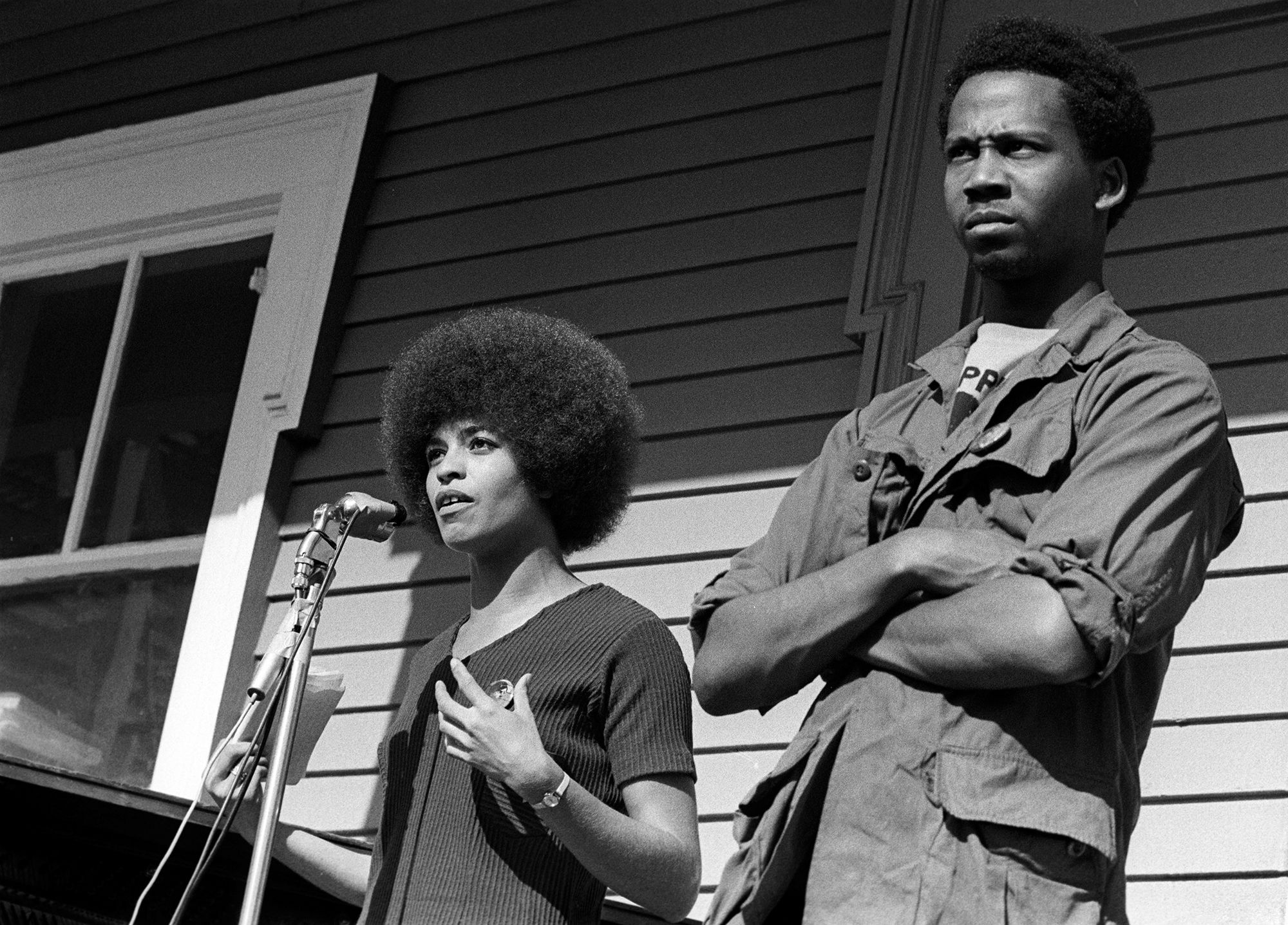
PHOTO: Angela Davis speaks at a Free Huey rally in DeFremery Park in Oakland, Calif., Nov. 12, 1969. Standing next to Davis is James Burford. Photograph by Stephen Shames.

After I returned to the U.S. in the fall of 1967, I was determined to find my way into the revolutionary Black Liberation Movement, and I reconnected with Herbert Marcuse, my Brandeis mentor, who was now teaching at UC San Diego. My experiences in Germany — especially among students from Africa and other parts of what was then known as the Third World — had consolidated my embrace of revolutionary internationalism, and I gravitated toward organizations and individuals who shared that identification. At a time of growing global solidarity with Third World struggles, all of the groups I worked with — the Communist Party, the Black Panther Party, and the Los Angeles chapter of the Student Nonviolent Coordinating Committee (SNCC) — were absolutely clear about their solidarity with Palestine. During that period, I participated in a series of exciting and enlightening political conversations with James Forman, who was then the international affairs director of SNCC. At that time, SNCC encouraged its members to study the situation in the Middle East; the organization insisted that making significant progress in our domestic struggles required us to embrace internationalism. In a letter Forman wrote to the executive secretary of SNCC during the 1967 war, he explained:
 
"The class struggle in the black community will become sharper if the war continues. Obviously the “gut” reaction in many people is against Israel and for the Arabs, reflecting the black-white tension, the hardening of racism, and the particular circumstances in which we find ourselves in this country. However, it becomes very necessary for those of us in the organization, especially those of us in leadership positions, to study the historical development and the contemporary economic policies of Israel. Actually Israel represents an extension of United State foreign policy as well as an attempt by the Zionists to create a homeland for the Jews. The latter merges with the former in many countries, especially the United States, Great Britain, and France in some respects."

When the FBI arrested me in October 1970, I could not have predicted that my own political proximity to Palestine would increase exponentially. Of the many expressions of solidarity forwarded to me during my imprisonment, I was most deeply moved by the messages emanating from prisons. I can still remember how humbled I felt upon receiving a beautiful letter of solidarity signed by Palestinian political prisoners. The letter had been smuggled out of an Israeli jail and transmitted to my lawyers, who brought it into the California jail where I was being held. Some 40 years later, when I joined a solidarity delegation to Palestine of women of color and indigenous scholar-activists, I met a Palestinian activist who told me that he was one of the imprisoned people who had signed that solidarity message so many years ago. When we embraced, I experienced a profound sense of satisfaction with the trajectory of my life and how it has intersected with so many others around the world who again and again collectively generate the hope that radical transformation is being inscribed on the agendas of our futures.

Today the unceasing military assaults on Gaza are reason for deep despair, especially as we learn every day about a loss of life and community destruction that is unprecedented in comparison to all recent wars. Despite the obvious need for a cease-fire — a permanent cease-fire — the U.S. government continues to lend aid and support to Israel. Young activists today are trying to unravel this conundrum, even as the government and both major political parties remain in thrall to Zionism. Despite efforts to persuade the public that any critique or even questioning of the state of Israel is equivalent to antisemitism, astute young people, including radical Jewish activists, are pointing out that the most effective struggles against antisemitism are necessarily linked to opposition to racism, Islamophobia, and other modes of repression and discrimination. This is the first time in my own political memory that the Palestine solidarity movement is experiencing such broad support both throughout the U.S. and all over the world. Here in the United States, despite the McCarthyist strategies employed against those who call for freedom and justice for Palestine on campuses, in the entertainment industry, and elsewhere, we are in a new political moment, and we cannot — we must not — capitulate to those who represent the interests of racial capitalism and the legacies of colonialism. As June Jordan wrote in “Poem for South African Women”:

     And who will join this standing up
    and the ones who stood without sweet company
    will sing and sing
    back into the mountains and
    if necessary
    even under the sea

    we are the ones we have been waiting for
 

ABOUT THE AUTHOR:
 

Angela Y. Davis is Professor Emerita of History of Consciousness and Feminist Studies at UC Santa Cruz. An activist, writer, and lecturer, her work focuses on prisons, police, abolition, and the related intersections of race, gender, and class. She is the author of many books, from Angela Davis: An Autobiography to Freedom Is a Constant Struggle.

Hammer & Hope is free to read. Sign up for our newsletter, donate to our magazine, and follow us on Instagram, Threads, TikTok, Facebook, and Twitter.

Monday, February 19, 2024

Historian, Scholar, and Activist Dr. Robin D. G. Kelley and the Makdisi Brothers On The Highly Contenious and Complex History of Palestine Vis-a-Vis Israel and the Imperialist/Colonial Western Elites in Europe and the United States

"The ground zero of a liberated world is Palestine" w/ Robin DG Kelley
 

January 30, 2024 

The brothers invite the American historian Robin DG Kelley to the show to discuss the status and visibility of Palestine in Black American political culture from the 1940s through MLK and Malcolm X to Black Lives Matter and the present--and the ways in which Palestine remains one of the keys to a liberated world. 
 
Date of recording: January 29, 2024. 
 
Follow us on X: @ MakdisiStreet 
Follow us on Insta: @Makdisist
 
VIDEO:  
 
ABOUT THE SPEAKER:
 
Robin D. G. Kelley is Professor and Gary B. Nash Endowed Chair in U.S. History at UCLA. He is the author of Hammer and Hoe, Race Rebels, Freedom Dreams: The Black Radical Imagination, and Thelonious Monk: The Life and Times of an American Original, among other titles. His writing has been featured in the Journal of American History, American Historical Review, Black Music Research Journal, African Studies Review, New York Times, The Crisis, The Nation, and Voice Literary Supplement.
 
UCLA History Department 
 
Robin D. G. Kelley

Dr. Robin D. G. Kelley
Distinguished Professor and Gary B. Nash Endowed Chair in U.S. History at University of California, Los Angeles (UCLA)

 
Biography

My research has explored the history of social movements in the U.S., the African Diaspora, and Africa; black intellectuals; music and visual culture; Surrealism, Marxism, among other things. My essays have appeared in a wide variety of professional journals as well as general publications, including the Journal of American History, American Historical Review, The Nation, Monthly Review, New York Times, Color Lines, Counterpunch, Souls,Black Renaissance/Renaissance Noir, Social Text ,The Black Scholar, Journal of Palestine Studies, and Boston Review, for which I also serve as Contributing Editor.

My books include, Africa Speaks, America Answers: Modern Jazz in Revolutionary Times (Cambridge: Harvard University Press, 2012); The lonious Monk: The Life and Times of an American Original (The Free Press, 2009); Freedom Dreams: The Black Radical Imagination (Beacon Press, 2002); with Howard Zinn and Dana Frank, Three Strikes: The Fighting Spirit of Labor’s Last Century (Beacon Press, 2001); Yo’ Mama’s Disfunktional!: Fighting the Culture Wars in Urban America (Boston: Beacon Press, 1997); Race Rebels: Culture, Politics, and the Black Working Class (New York: The Free Press, 1994); Into the Fire: African Americans Since 1970 (New York: Oxford University Press, 1996) [Vol. 10 of the Young Oxford History of African Americans series]; Hammer and Hoe: Alabama Communists During the Great Depression(Chapel Hill, NC: University of North Carolina Press, 1990).

I am also co-editor of the following books: Walter Rodney, The Russian Revolution: A View From the Third World (with Jesse Benjamin (New York: Verso, 2018); The Other Special Relationship: Race, Rights and Riots in Britain and the United States (with Stephen Tuck) (New York: Palgrave, 2015); Black, Brown and Beige: Surrealist Writings from Africa and the African Diaspora (with Franklin Rosemont) (Austin: University of Texas Press, 2009); To Make Our World Anew: A History of African Americans (with Earl Lewis) (Oxford University Press, 2000), volumes 1 and 2; Imagining Home: Class, Culture, and Nationalism in the African Diaspora (with Sidney J. Lemelle) (London: Verso Books, 1995); and the eleven volume Young Oxford History of African Americans (with Earl Lewis) (1995-1998).

I am currently completing three book projects:

Black Bodies Swinging: An American Postmortem (Metropolitan Books) is a genealogy of the Black Spring protests of 2020 by way of a deep examination of state-sanctioned racialized violence and a history of resistance. To understand how we arrived at this moment requires a different kind of autopsy—an historical postmortem that can lay bare the structural conditions responsible for premature death. Borrowing a metaphor from Abel Meeropol’s iconic song “Strange Fruit,” the book traces the deaths and the lives of our most recent casualties to the “blood at the root”—the racial terror at the base of our system of exploitation and wealth accumulation. The blood at the root is “racial capitalism.” The kind of historical autopsy I am proposing is intended to make visible the history and workings of racial capitalism. It exposes not only effects of racist policing but the extraction of wealth from black people, land dispossession, displacement, predatory lending, taxation, disfranchisement, environmental catastrophe, and the long history of looting through terror and government policies that suppressed black wages, relieved us of property, excluded black people from better schools and public accommodations, suppressed black home values, and subsidized white wealth accumulation. But Black Bodies Swinging is also a history of resistance, arguing that the new abolitionists represent the “Third Reconstruction generation” whose organizational genesis begins in the 1990s but whose political lineage can be traced back to slavery and settler colonialism.

I am also completing a biography of the late Grace Halsell, tentatively titled The Education of Ms. Grace Halsell: An Intimate History of the American Century. The Texas-born journalist, granddaughter of Confederate slave owners, daughter of a once wealthy cattle rancher and Indian fighter, began her career as a correspondent for several Texas papers during the 1940s and 50s, eventually worked as a staff writer for President Lyndon B. Johnson, before setting out in 1968 to chemically darken her skin and live as a black woman for a year. She published the best-selling Soul Sister: The Journal of a White Woman Who Turned Herself Black (1969). She would go on to write twelve more books, including an expose about living as a Navajo and working as a domestic in a California suburb (Bessie Yellowhair), a book about passing as an undocumented worker from Mexico (The Illegals), and several other unrelated texts. She traveled to Israel and Palestine in 1980 and wrote a book sharply critical of the occupation. As a result, jobs, lucrative book contracts, and other opportunities began to disappear. She died in 2000 from multiple myeloma cancer caused largely by the drugs she had taken to turn herself brown.

Finally, I am collaborating with Professor Tera Hunter on a general survey of African American history.

Field of Study

United States, African-American and African Diaspora, Global Jazz Studies 


Publications

Africa Speaks, America Answers: Modern Jazz in Revolutionary Times (Cambridge: Harvard University Press, 2012)

Thelonious Monk: The Life and Times of an American Original (The Free Press, 2009).

Best Book About Jazz 2009, Jazz
Journalists Association
Music in American Culture Award, American
Musicological Association
Ambassador Award for Book of Special
Distinction, English Speaking Union;
PEN Open Book Award, PEN American Center
ASCAP Deems-Taylor Award
Best Non-Fiction Book, Hurston/Wright
Legacy Award.
Booklist – Starred Review
Selected by New York Times Book Review –
Top 100 books of 2009

**Italian translation: Thelonious Monk: Storia di un Genio Americano, trans. Marco Bertoli (Roma: Minimum Fax, 2012).

Freedom Dreams: The Black Radical Imagination (Beacon Press, 2002)

with Howard Zinn and Dana Frank, Three Strikes: The Fighting Spirit of Labor’s Last Century (Beacon Press, 2001)

Yo’ Mama’s Disfunktional!: Fighting the Culture Wars in Urban America (Boston: Beacon Press, 1997).

Selected Best book of 1997 by Village
Voice; Outstanding Book on Human Rights,
Gustavus Myers Center for the Study of
Human Rights in the United States,
1997-98.

**Translated in Japanese, as Yo Mama’s DisFunktional!: Representing America’s Urban Crisis (Hanmoto Publishers, 2007), translated by Kosuzu Abe and Katsuyuki Murata. New foreword by author

Race Rebels: Culture, Politics, and the Black Working Class (New York: The Free Press, 1994).

Outstanding Book, National Conference of
Black Political Scientists, 1995.

Hammer and Hoe: Alabama Communists During the Great Depression (Chapel Hill, NC: University of North Carolina Press, 1990).

Elliot Rudwick Prize, Organization of
American Historians, 1991;
Francis Butler Simkins Prize, Southern
Historical Association
Outstanding book on Human Rights,
Gustavus Myers Center for the Study of
Human Rights in the United States, 1991.

Edited Books and Collections

Walter Rodney, The Russian Revolution: A View From the Third World, eds. Robin D. G. Kelley and Jesse Benjamin (New York: Verso, 2018)

Co-edited with Stephen Tuck, The Other Special Relationship: Race, Rights and Riots in Britain and the United States (New York: Palgrave, 2015)

Co-edited with Franklin Rosemont, Black, Brown and Beige: Surrealist Writings from Africa and the African Diaspora (Austin: University of Texas Press, 2009).

Winner, American Book Award, the Before
Columbus Foundation.

Co-edited with Earl Lewis, To Make Our World Anew: A History of African Americans (Oxford University Press, 2000). Two Volume edition, 2004.

Selection of History Book Club and Choice
Outstanding Academic Title.
Chosen as an Outstanding book on Human
Rights, Gustavus Myers Center for the
Study of Human Rights in the United
States, 2002.

Co-edited with Sidney J. Lemelle, Imagining Home: Class, Culture, and Nationalism in the African Diaspora (London: Verso Books, 1995).

Degrees

  • Ph.D. American History, UCLA, 1987
  • M.A. African History, UCLA, 1985
  • B.A. History, Cal State University Long Beach, 1983


Friday, February 9, 2024

The Pernicious Role of Law and the Enforced Ideology of Israeli Settler Colonialism in the ongoing historical oppression, exploitation, subjugation, and dispossesion/erasure of Palestine and the Palestinian People

Colonial law and the erasure of Palestine w/Noura Erakat  The Chris Hedges Report

Fundraiser

In Palestine, the law has been used as a tool of oppression to legitimize and advance the dispossession of the Palestinian people for more than a century. From the theft of Palestinian land by legal mechanisms to the non-recognition of Palestinians as a people with the inalienable right of self-determination, the law is yet another weapon wielded against the Palestinian people by Israel and its patrons. Activist, attorney, and Rutgers University professor Noura Erakat joins The Chris Hedges Report to discuss the use of lawfare against Palestine and her new book, Justice for Some: Law and the Question of Palestine.

Watch The Chris Hedges Report live YouTube premiere on The Real News Network every Friday at 12PM ET: https://therealnews.com/chris-hedges-... 

Listen to episode podcasts and find bonus content at The Chris Hedges Report 

Substack: https://chrishedges.substack.com/ 

The Real News is an independent, viewer-supported, radical media network.


Wednesday, November 29, 2023

IMPORTANT NEW BOOK:

They Called Me a Lioness: A Palestinian Girl's Fight for Freedom
by Ahed Tamimi and Dena Takruri
‎ Random House, 2023

[Publication date: September 5, 2023] 


A Palestinian activist jailed at sixteen after a confrontation with Israeli soldiers illuminates the daily struggles of life under occupation in this moving, deeply personal memoir.

“I cannot even begin to convey the clarity, the intensity, the power, the photographic storytelling of
They Called Me a Lioness.”—Ibram X. Kendi, internationally bestselling author of How to Be an Antiracist

ONE OF THE BEST BOOKS OF THE YEAR: Kirkus Reviews

“What would you do if you grew up seeing your home repeatedly raided? Your parents arrested? Your mother shot? Your uncle killed? Try, for just a moment, to imagine that this was your life. How would you want the world to react?”

Ahed Tamimi is a world-renowned Palestinian activist, born and raised in the small West Bank village of Nabi Saleh, which became a center of the resistance to Israeli occupation when an illegal, Jewish-only settlement blocked off its community spring. Tamimi came of age participating in nonviolent demonstrations against this action and the occupation at large. Her global renown reached an apex in December 2017, when, at sixteen years old, she was filmed slapping an Israeli soldier who refused to leave her front yard. The video went viral, and Tamimi was arrested.
But this is not just a story of activism or imprisonment. It is the human-scale story of an occupation that has riveted the world and shaped global politics, from a girl who grew up in the middle of it . Tamimi’s father was born in 1967, the year that Israel began its occupation of the West Bank and he grew up immersed in the resistance movement. One of Tamimi’s earliest memories is visiting him in prison, poking her toddler fingers through the fence to touch his hand. She herself would spend her seventeenth birthday behind bars. Living through this greatest test and heightened attacks on her village, Tamimi felt her resolve only deepen, in tension with her attempts to live the normal life of a daughter, sibling, friend, and student.
An essential addition to an important conversation, They Called Me a Lioness shows us what is at stake in this struggle and offers a fresh vision for resistance. With their unflinching, riveting storytelling, Ahed Tamimi and Dena Takruri shine a light on the humanity not just in occupied Palestine but also in the unsung lives of people struggling for freedom around the world.


Friday, January 25, 2019

Michelle Alexander On the Liberation of Palestine and the Ongoing Legacy of Dr. Martin Luther King, Jr. and the Grave Necessity Of Speaking Truth to Power in Global Affairs

All,

THANK YOU MICHELLE as usual for your bedrock courage, knowledge, insight, clarity, and compassion, as well as your customary intellectual, moral, ethical, and political honesty and integrity. As always you make me proud to be an active advocate and steadfast supporter and defender of the social, cultural, political, and intellectual traditions and values that you so brilliantly represent and embody. More than ever we all deeply need and desire what you have to offer and provide us.

Love & Struggle,

Kofi


LONG LIVE DR. MARTIN LUTHER KING, JR. (1929-1968)

https://www.nytimes.com/…/martin-luther-king-palestine-isra…

Opinion

Time to Break the Silence on Palestine

Martin Luther King Jr. courageously spoke out about the Vietnam War. We must do the same when it comes to this grave injustice of our time.

by Michelle Alexander
January 19, 2019
New York Times


“We must speak with all the humility that is appropriate to our limited vision, but we must speak,” the Rev. Dr. Martin Luther King Jr. declared at Riverside Church in Manhattan in 1967.  Credit: John C. Goodwin
 
On April 4, 1967, exactly one year before his assassination, the Rev. Dr. Martin Luther King Jr. stepped up to the lectern at the Riverside Church in Manhattan. The United States had been in active combat in Vietnam for two years and tens of thousands of people had been killed, including some 10,000 American troops. The political establishment — from left to right — backed the war, and more than 400,000 American service members were in Vietnam, their lives on the line.

Many of King’s strongest allies urged him to remain silent about the war or at least to soft-pedal any criticism. They knew that if he told the whole truth about the unjust and disastrous war he would be falsely labeled a Communist, suffer retaliation and severe backlash, alienate supporters and threaten the fragile progress of the civil rights movement.

King rejected all the well-meaning advice and said, “I come to this magnificent house of worship tonight because my conscience leaves me no other choice.” Quoting a statement by the Clergy and Laymen Concerned About Vietnam, he said, “A time comes when silence is betrayal” and added, “that time has come for us in relation to Vietnam.”

It was a lonely, moral stance. And it cost him. But it set an example of what is required of us if we are to honor our deepest values in times of crisis, even when silence would better serve our personal interests or the communities and causes we hold most dear. It’s what I think about when I go over the excuses and rationalizations that have kept me largely silent on one of the great moral challenges of our time: the crisis in Israel-Palestine.

I have not been alone. Until very recently, the entire Congress has remained mostly silent on the human rights nightmare that has unfolded in the occupied territories. Our elected representatives, who operate in a political environment where Israel's political lobby holds well-documented power, have consistently minimized and deflected criticism of the State of Israel, even as it has grown more emboldened in its occupation of Palestinian territory and adopted some practices reminiscent of apartheid in South Africa and Jim Crow segregation in the United States.

Many civil rights activists and organizations have remained silent as well, not because they lack concern or sympathy for the Palestinian people, but because they fear loss of funding from foundations, and false charges of anti-Semitism. They worry, as I once did, that their important social justice work will be compromised or discredited by smear campaigns.

Similarly, many students are fearful of expressing support for Palestinian rights because of the McCarthyite tactics of secret organizations like Canary Mission, which blacklists those who publicly dare to support boycotts against Israel, jeopardizing their employment prospects and future careers.

Reading King’s speech at Riverside more than 50 years later, I am left with little doubt that his teachings and message require us to speak out passionately against the human rights crisis in Israel-Palestine, despite the risks and despite the complexity of the issues. King argued, when speaking of Vietnam, that even “when the issues at hand seem as perplexing as they often do in the case of this dreadful conflict,” we must not be mesmerized by uncertainty. “We must speak with all the humility that is appropriate to our limited vision, but we must speak.”

And so, if we are to honor King’s message and not merely the man, we must condemn Israel’s actions: unrelenting violations of international law, continued occupation of the West Bank, East Jerusalem, and Gaza, home demolitions and land confiscations. We must cry out at the treatment of Palestinians at checkpoints, the routine searches of their homes and restrictions on their movements, and the severely limited access to decent housing, schools, food, hospitals and water that many of them face.

We must not tolerate Israel’s refusal even to discuss the right of Palestinian refugees to return to their homes, as prescribed by United Nations resolutions, and we ought to question the U.S. government funds that have supported multiple hostilities and thousands of civilian casualties in Gaza, as well as the $38 billion the U.S. government has pledged in military support to Israel.

And finally, we must, with as much courage and conviction as we can muster, speak out against the system of legal discrimination that exists inside Israel, a system complete with, according to Adalah, the Legal Center for Arab Minority Rights in Israel, more than 50 laws that discriminate against Palestinians — such as the new nation-state law that says explicitly that only Jewish Israelis have the right of self-determination in Israel, ignoring the rights of the Arab minority that makes up 21 percent of the population.

Of course, there will be those who say that we can’t know for sure what King would do or think regarding Israel-Palestine today. That is true. The evidence regarding King’s views on Israel is complicated and contradictory.

Although the Student Nonviolent Coordinating Committee denounced Israel’s actions against Palestinians, King found himself conflicted. Like many black leaders of the time, he recognized European Jewry as a persecuted, oppressed and homeless people striving to build a nation of their own, and he wanted to show solidarity with the Jewish community, which had been a critically important ally in the civil rights movement.

Ultimately, King canceled a pilgrimage to Israel in 1967 after Israel captured the West Bank. During a phone call about the visit with his advisers, he said, “I just think that if I go, the Arab world, and of course Africa and Asia for that matter, would interpret this as endorsing everything that Israel has done, and I do have questions of doubt.”

He continued to support Israel’s right to exist but also said on national television that it would be necessary for Israel to return parts of its conquered territory to achieve true peace and security and to avoid exacerbating the conflict. There was no way King could publicly reconcile his commitment to nonviolence and justice for all people, everywhere, with what had transpired after the 1967 war.

Today, we can only speculate about where King would stand. Yet I find myself in agreement with the historian Robin D.G. Kelley, who concluded that, if King had the opportunity to study the current situation in the same way he had studied Vietnam, “his unequivocal opposition to violence, colonialism, racism and militarism would have made him an incisive critic of Israel’s current policies.”

Indeed, King’s views may have evolved alongside many other spiritually grounded thinkers, like Rabbi Brian Walt, who has spoken publicly about the reasons that he abandoned his faith in what he viewed as political Zionism. To him, he recently explained to me, liberal Zionism meant that he believed in the creation of a Jewish state that would be a desperately needed safe haven and cultural center for Jewish people around the world, "a state that would reflect as well as honor the highest ideals of the Jewish tradition.” He said he grew up in South Africa in a family that shared those views and identified as a liberal Zionist, until his experiences in the occupied territories forever changed him.

During more than 20 visits to the West Bank and Gaza, he saw horrific human rights abuses, including Palestinian homes being bulldozed while people cried — children's toys strewn over one demolished site — and saw Palestinian lands being confiscated to make way for new illegal settlements subsidized by the Israeli government. He was forced to reckon with the reality that these demolitions, settlements and acts of violent dispossession were not rogue moves, but fully supported and enabled by the Israeli military. For him, the turning point was witnessing legalized discrimination against Palestinians — including streets for Jews only — which, he said, was worse in some ways than what he had witnessed as a boy in South Africa.

Not so long ago, it was fairly rare to hear this perspective. That is no longer the case.

Jewish Voice for Peace, for example, aims to educate the American public about “the forced displacement of approximately 750,000 Palestinians that began with Israel’s establishment and that continues to this day.” Growing numbers of people of all faiths and backgrounds have spoken out with more boldness and courage. American organizations such as If Not Now support young American Jews as they struggle to break the deadly silence that still exists among too many people regarding the occupation, and hundreds of secular and faith-based groups have joined the U.S. Campaign for Palestinian Rights.

In view of these developments, it seems the days when critiques of Zionism and the actions of the State of Israel can be written off as anti-Semitism are coming to an end. There seems to be increased understanding that criticism of the policies and practices of the Israeli government is not, in itself, anti-Semitic.

This is not to say that anti-Semitism is not real. Neo-Nazism is resurging in Germany within a growing anti-immigrant movement. Anti-Semitic incidents in the United States rose 57 percent in 2017, and many of us are still mourning what is believed to be the deadliest attack on Jewish people in American history. We must be mindful in this climate that, while criticism of Israel is not inherently anti-Semitic, it can slide there.

Fortunately, people like the Rev. Dr. William J. Barber II are leading by example, pledging allegiance to the fight against anti-Semitism while also demonstrating unwavering solidarity with the Palestinian people struggling to survive under Israeli occupation.

He declared in a riveting speech last year that we cannot talk about justice without addressing the displacement of native peoples, the systemic racism of colonialism and the injustice of government repression. In the same breath he said: “I want to say, as clearly as I know how, that the humanity and the dignity of any person or people cannot in any way diminish the humanity and dignity of another person or another people. To hold fast to the image of God in every person is to insist that the Palestinian child is as precious as the Jewish child.”

Guided by this kind of moral clarity, faith groups are taking action. In 2016, the pension board of the United Methodist Church excluded from its multibillion-dollar pension fund Israeli banks whose loans for settlement construction violate international law. Similarly, the United Church of Christ the year before passed a resolution calling for divestments and boycotts of companies that profit from Israel’s occupation of Palestinian territories.

Even in Congress, change is on the horizon. For the first time, two sitting members, Representatives Ilhan Omar, Democrat of Minnesota, and Rashida Tlaib, Democrat of Michigan, publicly support the Boycott, Divestment and Sanctions movement. In 2017, Representative Betty McCollum, Democrat of Minnesota, introduced a resolution to ensure that no U.S. military aid went to support Israel’s juvenile military detention system. Israel regularly prosecutes Palestinian children detainees in the occupied territories in military court.
PHOTO: Relatives of a Palestinian nurse, Razan al-Najjar, 21, mourning in June after she was shot dead in Gaza by Israeli soldiers.CreditHosam Salem for The New York Times

None of this is to say that the tide has turned entirely or that retaliation has ceased against those who express strong support for Palestinian rights. To the contrary, just as King received fierce, overwhelming criticism for his speech condemning the Vietnam War — 168 major newspapers, including The Times, denounced the address the following day — those who speak publicly in support of the liberation of the Palestinian people still risk condemnation and backlash.

Bahia Amawi, an American speech pathologist of Palestinian descent, was recently terminated for refusing to sign a contract that contains an anti-boycott pledge stating that she does not, and will not, participate in boycotting the State of Israel. In November, Marc Lamont Hill was fired from CNN for giving a speech in support of Palestinian rights that was grossly misinterpreted as expressing support for violence. Canary Mission continues to pose a serious threat to student activists.

And just over a week ago, the Birmingham Civil Rights Institute in Alabama, apparently under pressure mainly from segments of the Jewish community and others, rescinded an honor it bestowed upon the civil rights icon Angela Davis, who has been a vocal critic of Israel’s treatment of Palestinians and supports B.D.S.

But that attack backfired. Within 48 hours, academics and activists had mobilized in response. The mayor of Birmingham, Randall Woodfin, as well as the Birmingham School Board and the City Council, expressed outrage at the institute’s decision. The council unanimously passed a resolution in Davis’ honor, and an alternative event is being organized to celebrate her decades-long commitment to liberation for all.

I cannot say for certain that King would applaud Birmingham for its zealous defense of Angela Davis’s solidarity with Palestinian people. But I do. In this new year, I aim to speak with greater courage and conviction about injustices beyond our borders, particularly those that are funded by our government, and stand in solidarity with struggles for democracy and freedom. My conscience leaves me no other choice.

PHOTO: The Said al-Mis'hal cultural center in Gaza was hit by an Israeli airstrike in August.CreditKhalil Hamra/Associated Press

Follow The New York Times Opinion section on Facebook, Twitter (@NYTopinion) and Instagram.

ABOUT THE AUTHOR:

Michelle Alexander became a New York Times columnist in 2018. She is a civil rights lawyer and advocate, legal scholar and author of “The New Jim Crow: Mass Incarceration in the Age of Colorblindness.” 

A version of this article appears in print on Jan. 19, 2019, on Page SR1 of the New York edition with the headline: Time to Break the Silence on Palestine. Order Reprints | Today’s Paper

PHOTO: “We must speak with all the humility that is appropriate to our limited vision, but we must speak,” the Rev. Dr. Martin Luther King Jr. declared at Riverside Church in Manhattan in 1967.CreditCreditJohn C. Goodwin