Showing posts with label American Foreign Policy. Show all posts

Friday, May 10, 2024

Journalists, Media Activists, and Public Intellectuals Mehdi Hasan and Owen Jones On The Nefarious Role of Joe Biden in Funding and Directly Enabling the Genocide in Gaza by Israel and Its Historical Implications As Represented by the Progressive Politics of Dr. Martin Luther King, Jr. in 1963 To 2024 and Beyond

Is Biden the ‘White Moderate’ that MLK Warned Us About? | Mehdi Hasan and Owen Jones
 

Zeteo


May 4, 2024

VIDEO: https://www.youtube.com/watch?v=oiEDcbvyAWk


00:00 - Intro
00:33 -MLK on the 'white moderate’
1:54 -Joe Biden denounces campus protests
12:20 -Latest on Gaza and potential Rafah invasion
23:20 -UK elections


Owen and Mehdi discuss the ongoing misrepresentation of college protests in the mainstream media, the debate over genocide in Gaza, and the London mayoral elections. They discuss how college and antiwar protests have long been demonized to undermine public support for them, and how the term "genocide" is deliberately and conveniently mis-defined by supporters of Israel. Plus, Mehdi takes us back in time to read Dr. Martin Luther King Jr. 's letter from a Birmingham jail about the “white moderate,” and reflects on its relevance to modern-day politicians, particularly in light of recent comments made by President Joe Biden. Owen criticizes Biden's approach on all this, accusing him of fetishizing past struggles while vilifying current protests. They also touch on the London mayoral elections and the challenges faced by Sadiq Khan, particularly in the context of his stance on issues like Gaza and Islamophobia. ‘Two Outspoken’ is a twice-monthly conversation between broadcaster, author, and Zeteo Editor-in-Chief Mehdi Hasan and political commentator, author, and activist Owen Jones.

Mehdi and Owen will be discussing the news of the week, offering their analysis on the state of American and British politics, and even, from time to time, taking questions from Zeteo subscribers.

Founded by Mehdi Hasan, Zeteo has a strong bias for the truth and an unwavering belief in the media’s responsibility to the public. Unfiltered news, bold opinions. For more content from Zeteo, subscribe now www.zeteo.com.


Friday, March 29, 2024

What Does The Passing Of the Security Council Resolution in the UN Calling For An Immediate Ceasefire in Gaza Really Mean Given the Ongoing Fierce Opposition To It by the Oppressive Apartheid Israeli Government, and the Blatant Gaslighting, Enabling Military Support, Shameless Opportunism, and Brazen Hypocrisy by the U.S. Government Led by Joe Biden

https://www.nytimes.com/2024/03/25/world/middleeast/un-security-council-gaza-ceasefire.html

U.N. Security Council Calls for Immediate Cease-Fire in Gaza as U.S. Abstains

The U.S. decision not to vote on the resolution drew criticism from Prime Minister Benjamin Netanyahu of Israel, who ordered a delegation to hold back from a planned trip to Washington.

by Farnaz Fassihi, Aaron Boxerman and Thomas Fuller
March 25, 2024
New York Times


The United Nations Security Council on Monday passed a resolution calling for an immediate cease-fire in the Gaza Strip during the remaining weeks of Ramadan, breaking a five-month impasse during which the United States vetoed three calls for a halt to the fighting.

The resolution passed with 14 votes in favor and the United States abstaining, which U.S. officials said they did in part because the resolution did not condemn Hamas. In addition to a cease-fire, the resolution also called for the “immediate and unconditional release of all hostages” and the lifting of “all barriers to the provision of humanitarian assistance.”

Prime Minister Benjamin Netanyahu of Israel immediately criticized the United States for allowing the resolution to pass, and ordered a delegation scheduled to go to Washington to hold high-level talks with U.S. officials to remain in Israel instead. President Biden had requested those meetings to discuss alternatives to a planned Israeli offensive into Rafah, the city in southern Gaza where more than a million people have sought refuge. American officials have said such an operation would create a humanitarian disaster.

Mr. Netanyahu’s office called the U.S. abstention from the vote a “clear departure from the consistent U.S. position in the Security Council since the beginning of the war,” and said it “harms both the war effort and the effort to release the hostages.”


Top Israeli officials indicated that they would not implement the resolution for now. “The State of Israel will not cease firing. We will destroy Hamas and continue fighting until the every last hostage has come home,” Israel Katz, the country’s foreign minister, wrote on social media.
 
Smoke rising during an Israeli bombardment on a building in Rafah on Sunday.Credit...Agence France-Presse — Getty Images


Yoav Gallant, the Israeli defense minister, who was already in Washington for meetings with top Biden administration officials, similarly gave no sign Israel would implement a cease-fire.

“We will operate against Hamas everywhere — including in places where we have not yet been,” he said. He added, “We have no moral right to stop the war while there are still hostages held in Gaza.”

The White House sought to play down the growing rift with Israel. John F. Kirby, a spokesman for the National Security Council, insisted there had been no change in U.S. policy. He said there had been no official notification that the full delegation from Israel was not coming to Washington, but added: “We were looking forward to having an opportunity to speak to a delegation later this week on exploring viable options and alternatives to a major ground offensive in Rafah.”“We felt we had valuable lessons to share,” Mr. Kirby said. He noted that Mr. Gallant was still expected to meet with Mr. Biden’s national security adviser, Jake Sullivan, as well as Secretary of State Antony J. Blinken and Defense Secretary Lloyd J. Austin III.


Inside the Security Council, the passage of the resolution was greeted with applause.

“Finally, finally, the Security Council is shouldering its responsibility,” said Amar Bendjama, the Algerian ambassador to the U.N. and the only Arab member of the Council. “It is finally responding to the calls of the international community.”

The resolution, which was put forth by the 10 nonpermanent members of the Council, was being negotiated intensely until the last minute, with the United States asking for revisions in the text.

Children injured during an Israeli bombardment at the al-Najjar hospital in Rafah on Sunday.Credit: Mohammed Abed/Agence France-Presse — Getty Images


Sheltering under a tent in Rafah, Mohammed Radi, 37, said that the notion of the war ending was a dream after so many months of fighting.

“Things have not changed and I don’t see people celebrating,” he said by telephone when asked about the resolution. “We are still at war.”

António Guterres, the U.N. secretary general, who is in the Middle East meeting with Arab leaders about the war, said in a post on social media that “this resolution must be implemented. Failure would be unforgivable.”

In recent years, the United States has rarely broken with Israel in the Security Council. In 2009, in the final days of the George W. Bush presidency, the United States abstained on a cease-fire resolution on a previous war in Gaza. Under President Barack Obama, it abstained on the 2016 resolution on Israeli settlements. And it abstained again on a resolution three months ago on humanitarian aid for Gaza.


Israel-Hamas War: Live Updates
 
Updated 
 
March 29, 2024
6:26 a.m.
 
 
The Palestinian Authority forms a new cabinet, but doubts remain about its independence.


“The crucial variable is that the Biden administration is obviously not happy with Israel’s military posture now, and allowing this resolution to pass was one relatively soft way to signal its concern,” said Richard Gowan, an expert on the United Nations at the International Crisis Group. “But the abstention is a not-too-coded hint to Netanyahu to rein in operations, above all over Rafah.”

Since the war began, the United States had vetoed three previous resolutions calling for a cease-fire, agreeing with Israel’s position that it had a right to defend itself, that a permanent cease-fire would benefit Hamas and that such a resolution could jeopardize diplomatic talks. Those vetoes infuriated many diplomats and U.N. officials as the civilian death toll in the war rose, and created rifts with staunch U.S. allies in Europe, including France.


Russia and China then vetoed two alternative resolutions put forth by the United States, the most recent one last Friday, because, they said, the proposals did not clearly demand a cease-fire.

The United States has been sharply criticized by many leaders for failing to persuade Israel, its close ally, to stop or scale back its bombing campaign and ground invasion in Gaza, which the territory’s health officials say have killed some 32,000 people, displaced most of the population and reduced much of the strip to ruins.

Israel launched the war after a Hamas-led attack on Oct. 7 that killed about 1,200 people, mostly civilians, and took over 250 hostage into Gaza, according to Israeli officials. Israeli leaders continue to insist that their aims, including the defeat of Hamas, have yet to be fully realized, meaning they cannot countenance a permanent cease-fire.

Security Council resolutions are considered to be international law. And while the Council has no means of enforcing the resolution, it could impose punitive measures, such as sanctions, on Israel, so long as member states agreed.

Families and supporters of Israeli hostages held by Hamas in Gaza, calling for their return, in Tel Aviv, on Friday. Credit:  Oded Balilty/Associated Press


Linda Thomas-Greenfield, the U.S. ambassador, said the adopted resolution fell in line with diplomatic efforts by the United States, Qatar and Egypt to broker a cease-fire in exchange for the release of hostages held in Gaza. She said the U.S. abstained because it did not agree with everything in the resolution, including the decision not to condemn Hamas’s Oct. 7 attacks.


“A cease-fire of any duration must come with the release of hostages — this is the only path,” Ms. Thomas-Greenfield said.

The United States asked for a change in the text that removed “permanent cease-fire” and replaced it with a “lasting cease-fire,” according to diplomats, and wanted to make a cease-fire conditional to the release of the hostages, which is in line with its policy and the negotiations it is leading with Qatar and Egypt.

The resolution adopted on Monday does demand for the unconditional and immediate release of all hostages, but does not make its cease-fire demand conditional on the releases. Ms. Thomas-Greenfield called the resolution “nonbinding.”

The U.S.-backed resolution that failed on Friday also condemned Hamas’s Oct. 7 attack and called for U.N. member states to restrict funding to the Palestinian armed group.


Whereas the failed resolution drafted by the United States said the Security Council “determines the imperative of an immediate and sustained cease-fire,” the resolution that passed Monday was far more concise and direct. It demanded “an immediate cease-fire for the month of Ramadan respected by all parties leading to a permanent sustainable cease-fire.”

There are two weeks remaining in the Muslim holy month of Ramadan.

 
A mass “iftar,” or fast-breaking meal, in Rafah on Sunday.Credit...Mohammed Abed/Agence France-Presse — Getty Images


The resolution also deplores “all attacks against civilians” and “all acts of terrorism,” specifically singling out the taking of hostages.

Israel’s ambassador to the U.N., Gilad Erdan, accused the Council of being biased against Israel because it had taken no action on helping secure hostages held captive in Gaza. He said all Council members should have voted “against this shameful resolution.”

As images of starving children, carnage and vast destruction of civilian infrastructure from Gaza have circulated, pressure has mounted on the Security Council to act and for the U.S. not to wield its veto.


“When such atrocities are being committed in broad daylight against defenseless civilians, including women and children, the right thing to do, the only thing to do morally, legally and politically is to put an end to it,” Riyad Mansour, the Palestinian representative to the United Nations, said to the Council.

International aid agencies, which have for months pleaded for a cease-fire in Gaza, welcomed the resolution and said in statements that it must be implemented immediately to provide civilians with a respite and allow aid workers to deliver food, medicine, water and other crucial items at the scale needed.

“A cease-fire is the only way to ensure civilians are protected and is central to enabling the scale up of humanitarian assistance to safely reach those in desperate need. This resolution must serve as a critical turning point,” the International Rescue Committee said in a statement.

Hamas, which is holding more than 100 hostages seized during the Oct. 7 attack on Israel that set off the war, welcomed the Security Council resolution in a statement on Telegram. It added that the Palestinian armed group was willing “to immediately engage on a prisoner exchange process that would lead to the release of prisoners on both sides.”

The resolution that passed on Monday also called for both sides to “comply with their obligations under international law in relation to all persons they detain.”

Iyad Abuheweila contributed reporting.
 
 
ABOUT THE AUTHORS:


Farnaz Fassihi is a reporter for The New York Times based in New York. Previously she was a senior writer and war correspondent for the Wall Street Journal for 17 years based in the Middle East.  
 
More about Farnaz Fassihi


Aaron Boxerman is a Times reporting fellow with a focus on international news. More about Aaron Boxerman


Thomas Fuller, a Page One Correspondent for The Times, writes and rewrites stories for the front page. More about Thomas Fuller
 
A version of this article appears in print on March 26, 2024, Section A, Page 1 of the New York edition with the headline: Security Council Urges Cease-Fire As U.S. Abstains. Order Reprints | Today’s Paper

 

Saturday, February 10, 2024

Biden Continues to Play Extremely Cynical Politics with the Lives of Palestinians in Gaza as He Now Expresses Tepid "Regret" For His Role in Supporting/Enabling the Current Israeli Government's Genocidal War Against Palestine

https://www.nytimes.com/2024/02/09/us/politics/biden-aide-israel-regret.html

In Private Remarks to Arab Americans, Biden Aide Expresses Regrets on Gaza

In a closed-door meeting, the aide offered some of the administration’s clearest notes of contrition for its response to the Gaza war, a sign of rising Democratic pressure on President Biden.

A crowd of people standing outside a building on a sunny day. They are holding signs that feature the Palestinian flag and say “Abandon Biden” or “End the genocide in Gaza.”
PHOTO: A protest outside the Henry Hotel in Dearborn, Mich., where Biden administration officials met on Thursday with Arab American leaders. Credit: Nick Hagen for The New York Times

by Reid J. Epstein and Erica L. Green
Reporting from Washington

February 9, 2024
New York Times

In a closed-door meeting with Arab American leaders in Michigan this week, one of President Biden’s top foreign policy aides acknowledged mistakes in the administration’s response to the war in Gaza, saying he did not have “any confidence” that Israel’s government was willing to take “meaningful steps” toward Palestinian statehood.

The remarks came after months of public and private admonitions from the Biden administration for Israel to take a more surgical approach in a conflict that has killed more than 27,000 Palestinians, according to health authorities in Gaza. On Thursday, Mr. Biden himself declared that Israel had gone “over the top” in its response to the Hamas attack on Oct. 7.

The Biden aide, Jon Finer, a deputy national security adviser, offered some of the administration’s clearest expressions of regret for what he called “missteps” it had made from the beginning of the violence, and he pledged that it would do better.

During the meeting on Thursday with Arab American political leaders in Dearborn, Mich., Mr. Finer said, “We are very well aware that we have missteps in the course of responding to this crisis since Oct. 7,” according to a recording of the gathering obtained by The New York Times. A National Security Council official confirmed the recording was authentic.

Mr. Finer added: “We have left a very damaging impression based on what has been a wholly inadequate public accounting for how much the president, the administration and the country values the lives of Palestinians. And that began, frankly, pretty early in the conflict.”

Two people face the camera holding up protest signs. One sign reads: “Abandon Biden. Cease-fire now.” The other reads: “Bombing Palestinian kids is not self-defense!”
PHOTO: Protesters in Dearborn on Thursday criticized the Biden administration’s continued funding of the Israeli military. Credit: Nick Hagen for The New York Times

The war in Gaza has become part of a cascade of political problems for Mr. Biden, who has remained publicly supportive of Israel and resisted demands within the Democratic Party to call for a cease-fire. His position since Hamas killed about 1,200 people in Israel on Oct. 7, along with his remarks casting doubt on the death toll from Israeli airstrikes and calling the loss of life “a price of waging war,” has angered young people, Black voters and progressives who are more sympathetic to the Palestinian cause.

Mr. Biden himself has acknowledged the pro-Palestinian protesters who have become a frequent presence at his public events. Last month, a campaign rally on abortion rights in Virginia was repeatedly interrupted by protesters urging Mr. Biden to call for a cease-fire.

After that rally, Mr. Biden met privately with about 40 invited attendees and urged them not to view demonstrators as political enemies, saying that they deserved sympathy and that their cause was “really important,” according to three people who attended the meeting.

A Biden campaign spokeswoman declined to comment.

But the recording of the Dearborn meeting provides an unusual behind-the-scenes glimpse at the administration’s attempts to shore up support in the critical battleground state of Michigan, which has a large Arab American population in Dearborn and other Detroit suburbs. Mr. Biden’s support in the state has eroded, polls show. His allies there have warned the White House in recent months that he runs the risk of losing the state, which he carried in 2020.

Mr. Finer and several other senior Biden administration officials, including Samantha Power, the administrator of the United States Agency for International Development, traveled to Dearborn on Thursday for a series of meetings, including the one in which Mr. Finer’s comments were recorded.

Those sessions came a week after Biden campaign aides, including Julie Chávez Rodríguez, the manager of his 2024 bid, quietly traveled to the city and met with a few officials, including Representative Rashida Tlaib, a Palestinian American progressive who is at the forefront of Democratic calls for a cease-fire.

However, Mayor Abdullah Hammoud of Dearborn and several other local officials declined to meet with Ms. Chávez Rodríguez. Mr. Hammoud later issued a statement saying he wished to speak with policymakers instead of campaign officials. White House officials then scrambled to arrange a visit.

During the Thursday meetings, Mr. Finer articulated the American government’s efforts to bring a halt to the war in Gaza. Building a formal diplomatic relationship between Israel and Saudi Arabia, he said, is a critical step toward creating a Palestinian state. Doing so, he added, requires politically difficult sacrifices from both countries and the United States.

President Biden, William Burns and Jon Finer sitting in the Oval Office surrounded by staffers.
PHOTO:  Jon Finer, at right in a purple tie, during a briefing on Ukraine in the Oval Office in October. He is the second-ranking official on the National Security Council. Credit:  Brendan Smialowski/Agence France-Presse — Getty Images

“We will have to do things for Saudi Arabia that will be very unpopular in this country and in our Congress,” Mr. Finer said. “Will Israel be willing to do the hard thing that’s going to be required of them, which is meaningful steps for the Palestinians on the question of two states? I don’t know if the answer to that is yes. I do not have any confidence in this current government of Israel.”

Mr. Finer also said the Biden administration should have been faster to publicly condemn statements made by some Israeli officials that, in his words, compared “residents of Gaza to animals.” He said officials had not done so because they were trying to work with the Israeli government.

“Out of a desire to sort of focus on solving the problem and not engaging in a rhetorical back-and-forth with people who, in many cases, I think we all find somewhat abhorrent, we did not sufficiently indicate that we totally rejected and disagreed with those sorts of sentiments,” Mr. Finer said.

He did not clarify which Israeli officials he was referring to, but in the conflict’s early days, Yoav Gallant, the Israeli defense minister, said, “We are fighting human animals, and we are acting accordingly.” Some other Israeli officials have also faced criticism for dehumanizing language.

Mr. Finer’s most explicit note of contrition was for a statement released under Mr. Biden’s name on Jan. 14, marking 100 days since the conflict began. The statement focused on the plight of American and Israeli hostages being held in Gaza and made no reference to Palestinians who had been killed.

“It did not in any way address the loss of Palestinian life during the course of the first 100 days of the conflict,” Mr. Finer said. “There is no excuse for that. It should not have happened. I believe it will not happen again. But we know that there was a lot of damage done.”

Mr. Finer, who declined to comment, is the second-ranking official on the National Security Council, under Jake Sullivan, who is Mr. Biden’s national security adviser.

Adrienne Watson, a spokeswoman for the National Security Council, said: “The president and Mr. Finer were reflecting on concerns we have had for some time, and will continue to have as the Israeli operation proceeds, about the loss of Palestinian lives in this conflict and the need to reduce civilian harm.”

The Michiganders who attended the Thursday meetings with Biden administration officials described them as intense and said they were disappointed that the delegation from Washington had not committed to policy changes.

For example, administration officials declined to say whether they had advised or would advise the president to call for a cease-fire, which attendees asked for.

“You’re not going to get that answer,” said Steve Benjamin, the director of the White House’s public engagement office.

But the officials committed to issuing a letter clarifying the administration’s support of the work of the United Nations Relief and Works Agency, which the United States temporarily cut funding for after Israel accused some of its staff members of participating in the Oct. 7 attack. The Biden officials did not engage with questions from the Michigan leaders about the president’s electoral prospects in the state.

“We emphasized that beyond communication, there needs to be a change in policies,” said Abraham Aiyash, a Democratic state representative who is the majority leader in the Michigan House of Representatives. “We were clear that there would be no follow-up meetings in any capacity if there was not a shift in policy based on the tangible steps that we outlined for them today.”

Abbas Alawieh, a former congressional aide who attended the meeting, said it was “outrageous” that it had taken more than 100 days after the war started for the administration to engage with Dearborn, and that Mr. Biden had not visited himself.

Abraham Aiyash gesturing as he speaks in a parking lot.

PHORO: Abraham Aiyash, a Democratic state representative who is the majority leader in the Michigan Statehouse, has called for the Biden administration to change its policies toward Israel. Credit: Nick Hagen for The New York Times

Mr. Biden met with Arab and Muslim American leaders in October, amid growing tensions inside and outside the White House, and apologized for questioning the Gaza death toll and for other messaging from the administration. But he largely defended his support for Israel’s war, pointing to foreign policy considerations.

In November, administration officials also met by videoconference with Palestinian American leaders who expressed concern about surveys showing the plunging support for Mr. Biden in their communities. The officials told them that polling numbers did not dictate the president’s foreign policy decisions.

“People feel not just a vague sense of betrayal, but a bone-deep sense of betrayal by President Biden,” Mr. Alawieh said.

Assad I. Turfe, the deputy Wayne County executive, who also heard from the Biden aides on Thursday, said Mr. Biden should be judged by how soon the conflict in Gaza is resolved.

“The Biden administration must act swiftly and decisively to end this violence, honoring the principles of justice and human rights,” Mr. Turfe said.

On Tuesday, a group of Arab American and Muslim leaders in Michigan, led by Ms. Tlaib’s sister, announced a campaign to persuade Democrats angry about Mr. Biden’s stance on Israel to vote “Uncommitted,” against the president, in the state’s Democratic primary election on Feb. 27. Though such a move would most likely have little practical effect, it could embarrass the president if enough voters chose to participate.

Former Representative Andy Levin of Michigan called the campaign “a constructive thing for the president” and said he was encouraging fellow Democrats to vote Uncommitted — though he declined to say how he planned to vote in the primary.

“On Gaza, we’re going to have to keep pushing him,” Mr. Levin said in an interview.

Osama A. Siblani, the influential publisher of The Arab American News, a Dearborn newspaper, had meetings with both Ms. Chávez Rodríguez and Mr. Finer’s delegation. He said Arab American voters in Michigan felt betrayed after backing Mr. Biden in large numbers in 2020, arguing that they had “received nothing” since then “but lip service.”

“I’ve been involved in this community day in and day out every single day for 40 years,” Mr. Siblani said. “I can tell you right now, I cannot convince my community to vote for Biden if I kiss their feet. They will not do it.”


ABOUT THE AUTHORS: 


Reid J. Epstein covers campaigns and elections from Washington. Before joining The Times in 2019, he worked at The Wall Street Journal, Politico, Newsday and The Milwaukee Journal Sentinel. More about Reid J. Epstein

Erica L. Green is a White House correspondent, covering President Biden and his administration. More about Erica L. Green

A version of this article appears in print on Feb. 10, 2024, Section A, Page 1 of the New York edition with the headline: U.S. Faltered With Israelis, An Aide Says. Order Reprints | Today’s Paper 
Thursday, November 30, 2023

THE DEADLY, COERCIVE AND ANTIDEMOCRATIC LEGACY OF HENRY KISSINGER AND ITS CENTRAL ROLE IN SHAPING AND DEFINING AMERICAN FOREIGN POLICY SINCE 1945 --PART 3

DEFEAT FASCISM BEFORE FASCISM DEFEATS YOU

https://www.rollingstone.com/politics/politics-news/henry-kissinger-war-criminal-dead-1234804748/


Good Riddance
 
Henry Kissinger, War Criminal Beloved by America’s Ruling Class, Finally Dies

The infamy of Nixon's foreign-policy architect sits, eternally, beside that of history's worst mass murderers. A deeper shame attaches to the country that celebrates him

by Spencer Ackerman
November 29, 2023
Rolling Stone


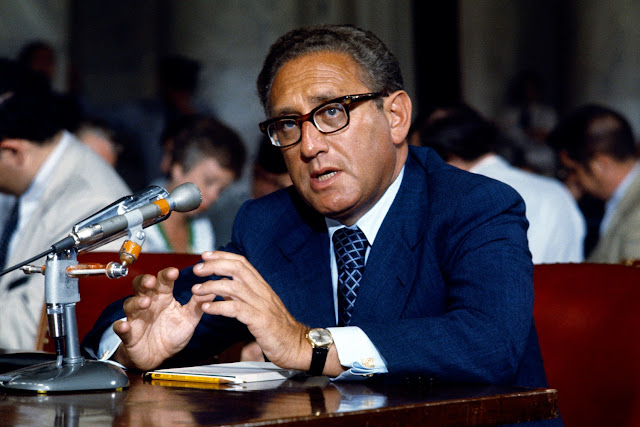
PHOTO: Appearing before the Senate Foreign Relations Committee 9/7 on his nomination to be secretary of state, Henry Kissinger pledged to cooperate closely with Congress in conducting foreign policy for a "durable peace." Bettmann Archive/Getty Images

Henry Kissinger died on Wednesday at his home in Connecticut, his consulting firm said in a statement. The notorious war criminal was 100.

Measuring purely by confirmed kills, the worst mass murderer ever executed by the United States was the white-supremacist terrorist Timothy McVeigh. On April 19, 1995, McVeigh detonated a massive bomb at the Murrah federal building in Oklahoma City, killing 168 people, including 19 children. The government killed McVeigh by lethal injection in June 2001. Whatever hesitation a state execution provokes, even over a man such as McVeigh — necessary questions about the legitimacy of killing even an unrepentant soldier of white supremacy — his death provided a measure of closure to the mother of one of his victims. “It’s a period at the end of a sentence,” said Kathleen Treanor, whose four-year-old McVeigh killed.

McVeigh, who in his own psychotic way thought he was saving America, never remotely killed on the scale of Kissinger, the most revered American grand strategist of the second half of the 20th century.

The Yale University historian Greg Grandin, author of the biography Kissinger’s Shadow, estimates that Kissinger’s actions from 1969 through 1976, a period of eight brief years when Kissinger made Richard Nixon’s and then Gerald Ford’s foreign policy as national security adviser and secretary of state, meant the end of between three and four million people. That includes “crimes of commission,” he explained, as in Cambodia and Chile, and omission, like greenlighting Indonesia’s bloodshed in East Timor; Pakistan’s bloodshed in Bangladesh; and the inauguration of an American tradition of using and then abandoning the Kurds.

“The Cubans say there is no evil that lasts a hundred years, and Kissinger is making a run to prove them wrong,” Grandin told Rolling Stone not long before Kissinger died. “There is no doubt he’ll be hailed as a geopolitical grand strategist, even though he bungled most crises, leading to escalation. He’ll get credit for opening China, but that was De Gaulle’s original idea and initiative. He’ll be praised for detente, and that was a success, but he undermined his own legacy by aligning with the neocons. And of course, he’ll get off scot free from Watergate, even though his obsession with Daniel Ellsberg really drove the crime.”

No infamy will find Kissinger on a day like today. Instead, in a demonstration of why he was able to kill so many people and get away with it, the day of his passage will be a solemn one in Congress and — shamefully, since Kissinger had reporters like CBS’ Marvin Kalb and The New York Times‘ Hendrick Smith wiretapped — newsrooms. Kissinger, a refugee from the Nazis who became a pedigreed member of the “Eastern Establishment” Nixon hated, was a practitioner of American greatness, and so the press lionized him as the cold-blooded genius who restored America’s prestige from the agony of Vietnam.

Not once in the half-century that followed Kissinger’s departure from power did the millions the United States killed matter for his reputation, except to confirm a ruthlessness that pundits occasionally find thrilling. America, like every empire, champions its state murderers. The only time I was ever in the same room as Henry Kissinger was at a 2015 national security conference at West Point. He was surrounded by fawning Army officers and ex-officials basking in the presence of a statesman.

Seymour Hersh, the investigative reporter who was the most prominent exception to the fawning coverage of Kissinger, watched journalistic deference take shape as soon as Kissinger entered the White House in 1969. “His social comings and goings could make or break a Washington party,” Hersh wrote in his biography The Price of Power. Reporters like the Times’ James Reston were eager participants in what Hersh called “an implicit shakedown scheme” — that is, access journalism — “in which reporters who got inside information in turn protected Kissinger by not divulging either the full consequences of his acts or his own connection to them.” Kissinger’s approach to the press was his approach to Nixon: sniveling obsequiousness. (Although Kissinger could vent frustration on reporters that he never could on his boss.) Hersh quotes H.R. Haldeman, Nixon’s chief of staff, remarking that Kissinger was the “hawk of hawks” inside the White House, but “touching glasses at a party with his liberal friends, the belligerent Kissinger would suddenly become a dove.”

Reviewing one of Kissinger’s litany of books, Hillary Clinton in 2014 said Kissinger, “a friend” whose counsel she relied upon as secretary of state, possessed “a conviction that we, and President Obama, share: a belief in the indispensability of continued American leadership in service of a just and liberal order.” Kissinger told USA Today within days that Clinton, presumed then to be a president-in-waiting, “ran the State Department in the most effective way that I’ve ever seen.” The same story noticed a photograph autographed by Obama thanking Kissinger for his “continued leadership.”

It’s always valuable to hear the reverent tones with which American elites speak of their monsters. When the Kissingers of the world pass, their humanity, their purpose, their sacrifices are foremost in the minds of the respectable. American elites recoiled in disgust when Iranians in great numbers took to the streets to honor one of their monsters, Qassem Soleimani, after a U.S. drone strike executed the Iranian external security chief in January 2020. Soleimani, whom the United States declared to be a terrorist and killed as such, killed far more people than Timothy McVeigh. But even if we attribute to him all the deaths in the Syrian Civil War, never in Soleimani’s wildest dreams could he kill as many people as Henry Kissinger. Nor did Soleimani get to date Jill St. John, who played Bond girl Tiffany Case in Diamonds Are Forever.

KISSINGER’S ASCENT OCCURRED THROUGH AN OBSCENITY THAT TIME CANNOT DIMINISH. In 1968, Lyndon Johnson agreed to peace negotiations with the North Vietnamese in tacit recognition of the nightmare he, building on the works of his two immediate predecessors, brought to life in Vietnam. Kissinger, an influential Cold War defense intellectual at Harvard, had access to members of the diplomatic delegation to the Paris talks. He used it to feed information from the negotiations to Richard Nixon’s presidential campaign — a campaign whose defeated GOP rival, Nelson Rockefeller, Kissinger advised — and despite Kissinger’s closer political ties to the coterie around Hubert Humphrey, Nixon’s Democratic rival.

Nixon ran for president claiming to have a secret plan to end the war. His advisers told Hersh they were deeply afraid that Johnson and Hanoi would reach an accord before the election. It would save lives in Vietnam, American and Vietnamese, but it would undermine Nixon’s hopes of exploiting the explosion in domestic antiwar sentiment. Nixon gratefully took what Kissinger gave him to make the U.S.’ proxy regime in Saigon, whose regime peace would destabilize, more intransigent. No agreement was reached until 1973, and the war ended in American humiliation with Hanoi’s 1975 victory.

“It took some balls to give us those tips,” Richard Allen, a foreign policy researcher on the Nixon campaign, later reflected to Hersh. After all, it was “a pretty dangerous thing for [Kissinger] to be screwing around with the national security.”

Every single person who died in Vietnam between autumn 1968 and the Fall of Saigon — and all who died in Laos and Cambodia, where Nixon and Kissinger secretly expanded the war within months of taking office, as well as all who died in the aftermath, like the Cambodian genocide their destabilization set into motion — died because of Henry Kissinger. We will never know what might have been, the question Kissinger’s apologists, and those in the U.S. foreign policy elite who imagine themselves standing in Kissinger’s shoes, insist upon when explaining away his crimes. We can only know what actually happened. What actually happened was that Kissinger materially sabotaged the only chance for an end to the war in 1968 as a hedged bet to ensure he would achieve power in Nixon’s administration or Humphrey’s. A true tally will probably never be known of everyone who died so Kissinger could be national security adviser.

Once in the White House, Nixon and Kissinger found themselves without leverage to produce a peace accord with Hanoi. In the hopes of manufacturing one, they came up with the “Madman Theory,” the idea that North Vietnam would negotiate peace after they came to believe Nixon was adventurous and bloodthirsty enough to risk anything. In February 1969, weeks after taking office, and lasting through April 1970, U.S. warplanes secretly dropped 110,000 tons of bombs on Cambodia. By the summer of 1969, according to a colonel on the Joint Staff, Kissinger — who had no constitutional role in the military chain of command — was personally selecting bombing targets. “Not only was Henry carefully screening the raids, he was reading the raw intelligence,” Col. Ray B. Sitton told Hersh for The Price of Power. A second phase of bombing continued until August 1973, five months after the final U.S. combat troops withdrew from Vietnam. By then, U.S. bombs had killed an estimated 100,000 people out of a population of only 7,000,000. The final phase of the bombing, which occurred after the Paris Peace Accords mandated U.S. withdrawal from Vietnam, was its most intense, an act of cruel vengeance from a thwarted superpower.

Cambodia, like Laos before it, was a formally neutral country, meaning that bombing it was an illegal aggression under the United Nations Charter. But beyond the control of Prince Sihanouk, the North Vietnamese used Cambodian territory for the Ho Chi Minh Trail, a weapons pipeline not unlike the one America is currently operating for Ukraine. In April 1970, following a coup by American client Col. Lon Nol that overthrew Sihanouk, Nixon ordered U.S. troops in Vietnam to invade Cambodia outright. In the air or on the ground, they were unable to destroy the trail, only human beings. Those who survived reacted. “Sometimes the bombs fell and hit the little children, and their fathers would be all for the Khmer Rouge,” a former Khmer Rouge cadre told historian Ben Kiernan, founder of Yale University’s Genocide Studies Program.

Nixon and Kissinger’s failure in Cambodia prompted in 1971 the U.S.-South Vietnamese invasion of Laos, another failure. Kissinger later blamed defeat on the U.S.’ clients, rather than, say, people like himself. “In retrospect, I have come to doubt whether the South Vietnamese ever really understood what we were trying to accomplish,” Kissinger wrote in his memoirs.

At the time, the secret bombing of Cambodia was a startling offense that prompted substantial political backlash when it became public. One of the articles of impeachment against Nixon prepared by the House Judiciary Committee in 1974 held that bombing Cambodia was a constitutional usurpation of Congress’ war powers. But on July 30, the committee ended up rejecting the article, 26 votes to 12, and it never became part of the coalescing impeachment effort that stopped with Nixon’s resignation.

Forty years later, and likely as a consequence, U.S. presidents routinely bomb countries the U.S. is not at war with. They provide the barest minimum of disclosure that the bombs have fallen, and often not even that. When the U.S.’ declared wars fail, as they did in Iraq and Afghanistan, their architects and stewards blame the client militaries and governments they propped up. They cover their troop withdrawals with futile bombing campaigns that kill people so American statesmen can save face. Whether he realized it or not, when President Biden in July 2021 blamed the Afghans for losing the Afghanistan war — “the Afghan military collapsed, sometimes without trying to fight” was a typical line — he was reaching for Nixon and Kissinger’s template.


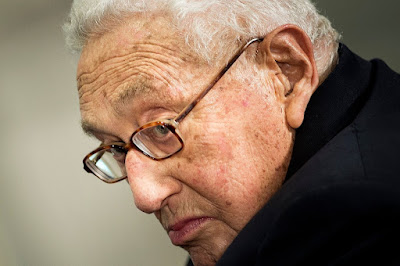
PHOTO: Former US Secretary of State Henry Kissinger in 2016. BRENDAN SMIALOWSKI/AFP/Getty Images


KISSINGER PLAYED A ROLE IN THE DEATHS OF SO MANY DIFFERENT PEOPLES that treating each with due consideration requires writing a book. Here is one example among many of the sort of carnage Kissinger inflicted indirectly rather than by edict. In 1971, the Pakistani government waged a campaign of genocide to suppress the independence movement in what would become Bangladesh. Pakistan’s Yahya Khan, an architect of the genocide, was valuable to Nixon’s ambitions of restoring diplomatic relations with China. So the U.S. let Khan’s forces rape and murder at least 300,000 people — and perhaps three million. “We can’t allow a friend of ours and China’s to get screwed in a conflict with a friend of India’s,” Nixon quoted Kissinger shrugging.


That perspective typified Kissinger. The Cold War was a geopolitical balance among two great powers. The purpose of Cold War statecraft was to maximize American freedom of action to inflict Washington’s will on the world — a zero-sum contest that meant restricting the ability of the Soviet Union to inflict Moscow’s — without the destabilization, or outright armageddon, that would result from pursuing a final defeat of the Soviets. That last part explains much right-wing hostility toward Kissinger. Kissinger represented anticommunism without ideological zeal. He was an energetic, even relentless practitioner of the Cold War, the theater of anticommunist conflict. But like George Kennan before him, Kissinger thought viewing the Cold War in ideological terms missed the point. The point was American geopolitical dominance, something measured in impunity and achieved by any means necessary. That permitted Nixon and Kissinger the creativity to reopen China, something Nixon would have demagogued anyone else for attempting.


Reopening China was by far the greatest achievement of Nixon’s foreign policy. It was the rare geopolitical initiative where Kissinger was a mere facilitator. Sy Hersh, in The Price of Power, calls Nixon “the grand theoretician” of rapprochement with Beijing, with Kissinger Nixon’s “occasional operative.” Kissinger’s dramatic, secret July 1971 trip to Beijing in advance of Nixon’s visit probably renders that description parsimonious. But, writes Hersh, “there is no evidence that Kissinger seriously considered the question of an American-Chinese rapprochement before his appointment as Nixon’s national security adviser.” Once it happened, Kissinger became an overnight celebrity, the sort of person destined to be shrouded in myth and apology.


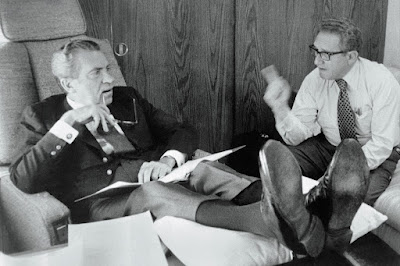
PHOTO: President Richard Nixon and Secretary of State Henry Kissinger confer aboard Air Force One. Bettmann Archive/Getty Images

Kissinger might not have been motivated by hatred of communism. But he was a reactionary who empowered and enabled the sort of reactionaries for whom anticommunism was a respectable channel for America’s racist and exploitative socio-economic traditions. His chief aide on the National Security Council was a rabid anticommunist militarist, Army Col. Alexander Haig, a future secretary of state for Ronald Reagan. When Kissinger came under attack from neoconservatives and others on the right who couldn’t tolerate detente with the Soviets and rapprochement with the Chinese, neither he nor they recognized that both of them were driven by the Cold War forces that Kissinger stoked when convenient.

Most important of all the reactionaries was Nixon, without whom Kissinger would have lacked power, and from whom Kissinger would withstand any indignity.

Nixon was one of the original Cold War demagogues, the men who never hesitated to identify communism with Black people and the “Eastern Establishment” liberals who postured as allies. His escalation in Vietnam, along with the secret bombing in Cambodia he revealed in a televised address, prompted a resurgence of the antiwar movement. Nixon exploited the mass protests by contrasting them with the “silent majority” of loyal Americans. Instead of ending the war, as he had campaigned on doing, and silencing or co-opting the antiwar movement in the process, Nixon inflamed a culture war to distract from it. It was an echo of his infamous “Southern Strategy” to harness for the Republican Party the electoral benefits of white backlash to the civil rights movement.

Nixon was not subtle about who he meant by the Eastern Establishment. When the media seized upon the U.S. massacre at My Lai, Nixon remarked, “It’s those dirty rotten Jews from New York who are behind it.” Nixon’s White House counsel, John Erlichman, recalled Nixon talking about “Jewish traitors” in front of Kissinger, including “Jews at Harvard.” Kissinger would assure the boss he was one of the good ones. “Well, Mr. President,” Erlichman quoted him responding, “there are Jews and Jews.”

Kissinger maintained his standing in part by savaging the Eastern Establishment from which he emerged. It was not entirely cynical. Kissinger shared with Nixon a contempt for the “defeatism” and “pessimism” of those who flinched at the unsavory Vietnam War they once supported. He rationalized his purges of the National Security Council bureaucracy and his marginalization of the State Department — measures that made him indispensable to foreign policy, and to Nixon — as protecting American power from those who lacked the confidence to wield it. It is revealing that among those who make U.S. foreign policy, Kissinger’s perspective is not considered ideological.

Kissinger’s consolidation of bureaucratic control was punitive and paranoid. He used the fear of internal leaks to get the FBI to wiretap his staff and the journalists he suspected of receiving their information. Yet the Eastern Establishmentarians around Kissinger, on his staff or in the press, followed him like a puppy seeking an ear scratch. His coldblooded American exceptionalism was the perfect tone for speaking to a shaken ruling class. Anthony Lake, who would go on to become national security adviser to Bill Clinton, finally quit in May 1970, alongside his colleague Roger Morris. Their breaking points were the Vietnam escalation, Nixon’s alcoholism, and the surreptitious White House wiretaps that Nixon also pursued to enforce loyalty. But Lake and Morris opted not to go public. “I consider the failure to do so to be the biggest failure of my life,” Morris told Hersh for The Price of Power. “We didn’t do so on the single calculation that it would destroy Henry.” Weeks later, Kissinger, via Haig, had the FBI wiretap Lake.

IN SOUTHEAST ASIA, KISSINGER DESTROYED. But in Chile, he helped build a template for the world in which we currently live.

On September 4, 1970, Chileans elected the democratic socialist Salvador Allende president. Allende’s program was more than redistributionist. It demanded reparation from the U.S. for exploiting it. Chile is rich in copper, and by the mid-1960s, 80 percent of its copper production was controlled by American corporations, particularly the firms Anaconda Copper and Kennecott. When Allende nationalized mining assets held by the two companies, Allende informed them he would deduct estimated “excess profit” from a compensatory package he was willing to pay the firms. It was this sort of unacceptable policy that prompted Kissinger to remark, during an intelligence meeting about two months before Allende’s election, “I don’t see why we need to stand idly by and watch a country go communist due to the irresponsibility of its own people.”


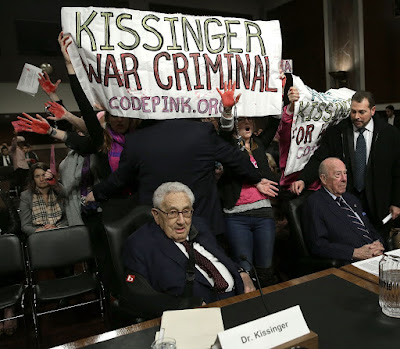
Protesters shout “Arrest Henry Kissinger for war crimes” as Former U.S. Secretary of State Henry Kissinger waits to testify in 2015. Win McNamee/Getty Images

Kissinger meant that there must never be an example of a country in America’s sphere of influence delivering socialism through the ballot. “Henry saw Allende as being a far more serious threat than Castro,” Kissinger staffer Morris told Hersh. “Allende was a living example of democratic social reform in Latin America.”

Kissinger and the CIA had decided to overthrow Allende just days after Allende’s election. Upon learning what was in motion, the U.S. ambassador in Santiago, Edward Korry, who was second to none in opposing Allende, cabled Kissinger that “to actively encourage a coup could lead us to a Bay of Pigs failure.” An “apoplectic Kissinger” told Korry to stay out of the way, according to Tim Weiner’s Legacy of Ashes: The History of The CIA. When the CIA failed at what Korry termed a Rube Goldberg gambit to get the Chilean Congress to stop Allende from taking office — that’s right, the CIA tried a January 6 in Chile — Haig urged his boss to purge “the key left-wing dominated slots” in the agency.

Korry was wrong in the end. Kissinger’s policy of overthrowing Allende — “Why not support extremists?” he spitballed in a December 1970 White House meeting with the CIA’s covert-operations chief, Tom Karamessines — paid off on September 11, 1973, when a military junta took power, prompting Allende’s suicide. He would be among the first of 3,200 Chileans to die violently under the 17-year regime of Augusto Pinochet and his Caravana de la Muerte, to say nothing of the tens of thousands tortured and imprisoned. “In the Eisenhower period, we would be heroes,” Kissinger told Nixon in a telephone conversation days after the coup. The same week he denied at his Senate confirmation hearings that the U.S. played any role in it.

The coup was only the beginning. Within two years, Pinochet’s regime invited Milton Friedman, Arnold Harberger, and other economists from the University of Chicago to advise them. Chile pioneered the implementation of their agenda: severe government budgetary austerity; relentless assaults on organized labor; privatization of state assets, including health care and public pensions; layoffs of government employees; abolition of wages and price controls; and deregulation of capital markets. “Multinationals were not only granted the right to repatriate 100 percent of their profits but given guaranteed exchange rates to help them do so,” Grandin writes in his book Empire’s Workshop. European and American bankers flocked to Chile before its 1982 economic collapse. The World Bank and Inter-American Development Bank loaned Pinochet $3.1 billion between 1976 and 1986. As Corey Robin has documented, Friedrich von Hayek’s neoliberal Mont Pelerin Society held a 1981 meeting in the very city where the junta plotted the replacement of democratic socialism with a harbinger of today’s global economic order.


Pinochet’s torture chambers were the maternity ward of neoliberalism, a baby delivered bloody and screaming by Henry Kissinger. This was the “just and liberal world order” Hillary Clinton considered Kissinger’s life work.

He was no less foundational in pushing the frontiers of where American military power could operate. It turned out the secret bombing of Cambodia and Laos, which lasted years, represented a template. When Nixon in 1970 revealed the secret bombings, it was a step too far even for Thomas Schelling, one of the Pentagon’s favorite defense academics, who called them “sickening.” As Grandin writes in Kissinger’s Shadow, the Cambridge-to-Washington set was not prepared in 1970 to accept that the U.S. had the right to destroy an enemy “safe haven” in a country it was not at war with and to do it all in secret, thereby shielding a war from basic public scrutiny. After 9/11, those assertions became accepted, foundational pillars of a War on Terror permitting four presidents to bomb, for 20 years, Pakistanis, Yemenis, Somalis, Libyans, Syrians, and others.


Kissinger met with Pinochet in Santiago in June 1976. It was a time of rising U.S. congressional anger at Pinochet’s reign of terror. Kissinger informed the general that he was obliged to make an anodyne criticism of Pinochet to forestall adverse legislation. “My evaluation is that you are a victim of all left-wing groups around the world,” Kissinger said, according to a declassified cable, “and that your greatest sin was that you overthrew a government which was going Communist.” Three months later, U.S. diplomats warned Kissinger about Operation Condor, an international campaign of right-wing assassinations pursued by the anticommunist regimes of Chile, Argentina, and Uruguay. Kissinger “has instructed that no further action be taken on this matter,” according to a September 16, 1976 cable. Five days later, a car bomb emplaced by Pinochet’s agents detonated along Washington D.C.’s Embassy Row, killing Orlando Letelier, Allende’s foreign minister, and his American co-worker, Ronni Moffitt.


In 1999, Pinochet was arrested in London through an effort by Baltazar Garzon, a Spanish judge investigating Operation Condor. Kissinger urged the British not to extradite the general. “​​I would be very happy if Pinochet was allowed home,” he told an interviewer. “This episode has gone on long enough and all my sympathies are with him.” Two years later, the administration of George W. Bush responded contemptuously to the Chilean Supreme Court’s efforts to compel Kissinger to testify. “It is unjust and ridiculous that a distinguished servant of this country should be harassed by foreign courts in this way,” an official told the Daily Telegraph. The paper noted that Kissinger was an “informal adviser” to Bush, as he was to many presidents.


Bush’s declaration of protection for Kissinger, coupled with his rejection of the Rome Treaty on the International Criminal Court, extinguished a glimmer of hope that Kissinger would someday join Pinochet under arrest. It was always a fantasy. The international architecture that the U.S. and its allies established after World War II, shorthanded today as the “rules-based international order,” somehow never gets around to applying the same pressure on a hegemonic United States as it applies to U.S.-hostile or defiant powers. It reflects the organizing principle of American exceptionalism: America acts; it is not acted upon. Henry Kissinger was a supreme architect of the rules-based international order.


In that regard, Kissinger was singular but was by no means unique. Kissinger built upon foundations constructed by Henry Morgenthau, Dean Acheson, George Kennan, Paul Nitze, the Dulles brothers, the Bundy brothers, JFK — you could go back to Albert Thayer Mahan and Teddy Roosevelt if you wanted; or James Monroe; or, depending on how fundamental you think empire is to America, 1619. He and Nixon chose to escalate in Vietnam and pursue the destruction of Cambodia. But the Pentagon Papers showed that the Vietnam War was the result of compounding decisions made in the Eisenhower, Kennedy, and Johnson administrations. The Vietnamese guerilla and justice minister Truong Nhu Tang writes in his Viet Cong Memoir that Kissinger, whose intellect he praises, “inherited a conceptual framework from his American and French predecessors … that led him to disaster.”


Kissinger and Nixon turned that into Watergate — as Grandin pointed out earlier in this story, Watergate began with a demand for vengeance on Daniel Ellsberg, the anti-Kissinger, for leaking the Pentagon Papers. Watergate was a grim demonstration, for neither the first nor the last time, that the crimes America commits abroad have a dialectical relationship with the crimes that America commits at home. Infamy has as many fathers as victory.


That, ultimately, is why Kissinger died a celebrity, with the wealth necessary to get taken in by Theranos. It is why Roger Morris and Anthony Lake opted against telling the country that the commander-in-chief was an alcoholic who was secretly surveilling his real and imagined critics. Whatever Kissinger’s origins, whatever rants about Jewboys he had to endure, Kissinger was an exemplar of the self-confident geopolitical potency that America’s elites, whatever they might personally think of Henry Kissinger, want America to make the world respect. When the Roger Morrises and Anthony Lakes and Hillary Clintons see Henry Kissinger, they see, despite what they will rotely and euphemistically acknowledge as his flaws, themselves as they wish to be.


Kissinger lived for over half a century in the world he had made. He was its hubris. He could see that the Iraq war would be a disaster, but he went along with it anyway, declaring: “the case for removing Iraq’s capacity of mass destruction is extremely strong.” Kissinger’s calculation, expressed in the noblest possible way, is that acceptance of an impending disaster is the price of influencing and hence mitigating it. His accommodation to the inevitability of political decisions he thought were folly hearkened back to his 1968 embrace of Nixon. What were the lives of Vietnamese, Cambodians, or Iraqis compared to Kissinger’s opportunity to help shape history?


But Iraq, and the broader War on Terror that Kissinger wanted expanded lest it “pete[r] out into an intelligence operation while the rest of the region gradually slides back to the pre-9/11 pattern,” presaged the world Kissinger made coming apart at the foundations. The man who repositioned U.S. foreign policy as a wedge between Russia and China lived long enough to see the February 4 Declaration uniting Moscow and Beijing. The reactionary forces he encouraged at home and abroad are showing the world that the rules-based international order is about capitalism, not democracy.


Whatever bitterness Kissinger, in his final days, experienced over the erosion of his enterprise is little comfort to his millions of victims. America denied them the closure Kathleen Treanor experienced when America, declaring justice, ended Timothy McVeigh.
In this article:

Henry Kissinger,


obit,


Obituary

Politics


Politics News