Showing posts with label mass murder. Show all posts

Thursday, January 3, 2019

PseudoScience and the Real Roots of White Supremacy as Doctrine and Practice in the World Today

All,

What is and has always been the fundamental cause of the heinous doctrine and practice of white supremacy and its savagely criminal defense and justification of slavery, genocide, colonization, and mass murder generally in the so-called "modern world" since the 15th century?

The blatantly obvious answer as always can be found in the following article below of course and the continued relentless assertion, support, and rationalization of PSEUDO SCIENCE or what is better known and clearly understood as LIES. The BIG LIE in the so-called "scientific world" is precisely what moral and intellectual cretins like Joseph Goebbels and Dr. James Watson and their many colleagues have always shared in common with their millions of acolytes and fellow LIARS who continue their murderous legacy today. Stay tuned because as fascism continues to spread exponetially across this society and the rest of the globe these white supremacist assertions and the endless articles and the ongoing flood of high profile reports and investigative journalism about them will become even more apparent than they already are...

Kofi 


James Watson Won’t Stop Talking About Race

The Nobel-winning biologist has drawn global criticism with unfounded pronouncements on genetics, race and intelligence. He still thinks he’s right, a new documentary finds.

by Amy Harmon
January 1, 2019
New York Times

 
"Decoding Watson," a new film about Dr. James D. Watson explores the gulf between his scientific brilliance and his views on race.CreditCreditMark Mannucci/Room 608 Inc.

It has been more than a decade since James D. Watson, a founder of modern genetics, landed in a kind of professional exile by suggesting that black people are intrinsically less intelligent than whites.

In 2007, Dr. Watson, who shared a 1962 Nobel Prize for describing the double-helix structure of DNA, told a British journalist that he was “inherently gloomy about the prospect of Africa” because “all our social policies are based on the fact that their intelligence is the same as ours, whereas all the testing says, not really.”
Moreover, he added, although he wished everyone were equal, “people who have to deal with black employees find this not true.”

Dr. Watson’s comments reverberated around the world, and he was forced to retire from his job as chancellor of the Cold Spring Harbor Laboratory on Long Island, although he retains an office there.

He apologized publicly and “unreservedly,’’ and in later interviews he sometimes suggested that he had been playing the provocateur — his trademark role — or had not understood that his comments would be made public.

Ever since, Dr. Watson, 90, has been largely absent from the public eye. His speaking invitations evaporated. In 2014, he became the first living Nobelist to sell his medal, citing a depleted income from having been designated a “nonperson.’’

But his remarks have lingered. They have been invoked to support white supremacist views, and scientists routinely excoriate Dr. Watson when his name surfaces on social media.

Eric Lander, the director of the Broad Institute of M.I.T. and Harvard, elicited an outcry last spring with a toast he made to Dr. Watson’s involvement in the early days of the Human Genome Project. Dr. Lander quickly apologized.
“I reject his views as despicable,” Dr. Lander wrote to Broad scientists. “They have no place in science, which must welcome everyone. I was wrong to toast, and I’m sorry.’’

And yet, offered the chance recently to recast a tarnished legacy, Dr. Watson has chosen to reaffirm it, this time on camera. In a new documentary, “American Masters: Decoding Watson,’’ to be broadcast on P.B.S. on Wednesday night, he is asked whether his views about the relationship between race and intelligence have changed.

“No,’’ Dr. Watson said. “Not at all. I would like for them to have changed, that there be new knowledge that says that your nurture is much more important than nature. But I haven’t seen any knowledge. And there’s a difference on the average between blacks and whites on I.Q. tests. I would say the difference is, it’s genetic.’’
Dr. Watson adds that he takes no pleasure in “the difference between blacks and whites’’ and wishes it didn’t exist. “It’s awful, just like it’s awful for schizophrenics,’’ he says. (His son Rufus was diagnosed in his teens with schizophrenia.) Dr. Watson continues: “If the difference exists, we have to ask ourselves, how can we try and make it better?”

Dr. Watson’s remarks may well ignite another firestorm of criticism. At the very least, they will pose a challenge for historians when they take the measure of the man: How should such fundamentally unsound views be weighed against his extraordinary scientific contributions?
In response to questions from The Times, Dr. Francis Collins, the director of the National Institutes of Health, said that most experts on intelligence “consider any black-white differences in I.Q. testing to arise primarily from environmental, not genetic, differences.”

Dr. Collins said he was unaware of any credible research on which Dr. Watson’s “profoundly unfortunate’’ statement would be based.

“It is disappointing that someone who made such groundbreaking contributions to science,’’ Dr. Collins added, “is perpetuating such scientifically unsupported and hurtful beliefs.’’

PHOTO: Dr. Watson, right, and the co-discoverer of the double-helix, Francis Crick, in 1953.CreditA. Barrington Brown, Gonville and Caius College/Science Photo Library
Image

PHOTO:  Dr. Watson, right, and the co-discoverer of the double-helix, Francis Crick, in 1953.CreditA. Barrington Brown, Gonville and Caius College/Science Photo Library

PHOTO: Dr. Watson is unable to respond, according to family members. He made his latest remarks last June, during the last of six interviews with Mark Mannucci, the film’s producer and director.

But in October Dr. Watson was hospitalized following a car accident, and he has not been able to leave medical care.

Some scientists said that Dr. Watson’s recent remarks are noteworthy less because they are his than because they signify misconceptions that may be on the rise, even among scientists, as ingrained racial biases collide with powerful advances in genetics that are enabling researchers to better explore the genetic underpinnings of behavior and cognition.

“It’s not an old story of an old guy with old views,’’ said Andrea Morris, the director of career development at Rockefeller University, who served as a scientific consultant for the film. Dr. Morris said that, as an African-American scientist, “I would like to think that he has the minority view on who can do science and what a scientist should look like. But to me, it feels very current.’’

David Reich, a geneticist at Harvard, has argued that new techniques for studying DNA show that some human populations were geographically separated for long enough that they plausibly could have evolved average genetic differences in cognition and behavior.

But in his recent book, “Who We Are and How We Got Here,’’ he explicitly repudiates Dr. Watson’s presumption that such differences would “correspond to longstanding popular stereotypes’’ as “essentially guaranteed to be wrong.’’

Even Robert Plomin, a prominent behavioral geneticist who argues that nature decisively trumps nurture when it comes to individuals, rejects speculation about average racial differences.

“There are powerful methods for studying the genetic and environmental origins of individual differences, but not for studying the causes of average differences between groups,” Dr. Plomin writes in an afterword to be published this spring in the paperback edition of his book, “Blueprint: How DNA Makes Us Who We Are.”

Whether Dr. Watson was aware of any of this science is unclear. In the film, he appears to have grown increasingly isolated. He mentions missing Francis Crick, his collaborator in the race to decipher the structure of DNA.

“We liked each other,’’ Dr. Watson says of Dr. Crick. “I couldn’t get enough of him.’’

As history now knows, the duo was able to solve the puzzle in 1953, with their hallmark models of cardboard and metal only with the help of another scientist, Rosalind Franklin, whose X-ray photograph of the DNA molecule was shown to Dr. Watson without her permission.

The tools of molecular biology unlocked by their discovery have since been used to trace humanity’s prehistory, devise lifesaving therapies, and develop Crispr, a gene-editing technology that was used recently, and unethically, to alter the DNA of twin human embryos.

And Dr. Watson became perhaps the most influential biologist of the second half of the 20th century. His textbook, “Molecular Biology of the Gene,’’ helped define the new field. First in a laboratory at Harvard and then at Cold Spring Harbor, he trained a new generation of molecular biologists and used his star power to champion such projects as the first sequencing of the human genome.
“You knew when you heard him that you were at the start of a revolution in understanding,’’ Nancy Hopkins, a biologist at the Massachusetts Institute of Technology who studied with Dr. Watson in the 1960s, says in “Decoding Watson.’’

“You felt as if you were part of this tiny group of people who had seen the light.’’

Mr. Mannucci, the director and producer, was drawn to his subject by a certain similarity to “the King Lear story’,’ he said — “that this man was at the height of his powers and, through his own character flaws, was brought down.” The film highlights Dr. Watson’s penchant for provocation, exemplified by his candid 1968 memoir, “The Double Helix,” of the race to decipher DNA’s structure.
In later years, even before his 2007 comments, Dr. Watson began making offensive statements about groups of people, suggesting, among other things, that exposure to sunlight in equatorial regions increases sexual urges and that fat people are less ambitious than others.
“He was a semiprofessional loose cannon,’’ said Nathaniel Comfort, a science historian at Johns Hopkins University. “We become prisoners of our own personas.” In the film, Dr. Comfort also suggests that Dr. Watson’s views on race are the result of the genetic filter he applies to the world: “There’s a risk to thinking about genes all the time.”

But Mary-Claire King, a leading geneticist at the University of Washington who knows Dr. Watson well and is not in the film, suggested that the racially homogeneous culture of science also played a role in shaping Dr. Watson’s misconceptions.

“If he knew African-Americans as colleagues at all levels, his present view would be impossible to sustain,’’ Dr. King said.

If that is the case, it may not bode well for combating prejudice in biomedical research, where African-Americans represent just 1.5 percent of grant applications to the N.I.H. Biases in hiring by medical school science departments are well documented.

“It’s easy to say, ‘I’m not Watson,’’’ said Kenneth Gibbs, a researcher at the N.I.H. who studies racial disparities in science. “But one should really be asking himself or herself, ‘What am I doing to ensure our campus environments are supporting scientists from backgrounds that are not there?’’’
“Decoding Watson’’ marks the first time Dr. Watson and his wife, Liz, have spoken publicly at length about finding out that Rufus, their older son, has schizophrenia. Rufus and his brother, Duncan, also appear in the film, but Mr. Mannucci said that other people close to Dr. Watson declined to participate.
In interviews with The Times, some said they believed that Dr. Watson was ill served by speaking publicly at this point in his life.
Still, Mr. Mannucci said that he had asked Dr. Watson about race and intelligence several times over the course of making the film in order to ascertain his real views. “I didn’t want to feel that it was a product of age or having caught him in a moment, trying to get a rise out of someone,’’ he said.

In the film, Dr. Watson sometimes seems to be grasping for explanations for his own views on race and intelligence. He mentions that he is a “product of the Roosevelt era,’’ and that he has always believed genes are important.

“To the extent that I’ve hurt people,’’ he said, “of course I regret it.”


ABOUT THE AUTHOR:

Amy Harmon is a national correspondent, covering the intersection of science and society. She has won two Pulitzer Prizes, for her series “The DNA Age”, and as part of a team for the series “How Race Is Lived in America.”
@amy_harmon • Facebook

A version of this article appears in print on Dec. 31, 2018, on Page D1 of the New York edition with the headline: For James Watson, the Price Was Exile. Order Reprints | Today’s Paper

Wednesday, June 17, 2015

Violent Racist Attack On Black South Carolina Church by avowed White Supremacist Leaves Nine Dead

All,

While far too many of us have been stupidly wasting time sitting around debating whether a clearly deceptive, manipulative, and mentally unstable white woman pretending to be black is fit or not to be seen as a "honorary kneegrow", the ongoing vicious white supremacist murders of black people continue relentlessly throughout the whole damn country.

The only question left now on a national scale is how are we going to defend ourselves, our families, and loved ones against these attacks?

Kofi

http://www.usatoday.com/…/charleston-south-caroli…/28902017/

Police: 9 dead in shooting at black church in Charleston, S.C.
by Melanie Eversley
June 17, 2015
USA TODAY

 
CHARLESTON, S.C. — Nine people have died in a shooting at a historic black church in Charleston, S.C., police said early Thursday morning.

"I do believe this was a hate crime," Police Chief Gregory Mullen said.

Eight people died on the scene at the Emanuel African Methodist Episcopal Church and one person was pronounced dead at a hospital, Mullen said.

Among the dead was the state senator who was pastor of the church, Democrat Clementa Pinckney, WCBD reported. Pinckney, 41, was married with two children and had served in the state Senate since 2000, according to online biographies.

People were taking part in a prayer meeting at the time of the incident, Mayor Joe Riley said during the press conference.

"This is inexplicable," Riley said. "It is the most intolerable and unbelievable act possible... The only reason someone could walk into church and shoot people praying is out of hate."

Said Police Chief Mullen: "This is a tragedy that no community should have to experience. It is senseless. It is unfathomable that someone would walk into a church when people are having a prayer meeting and take their lives."

Emanuel is the oldest AME church in the South and has one of the oldest and largest black congregations south of Baltimore, according to its website. Denmark Vesey, executed for attempting to organize a major slave rebellion, was one of the founders.

Emanuel African Methodist Episcopal Church sits at
The Emanuel African Methodist Episcopal Church sits at 110 Calhoun St. in Charleston, S.C. (Photo: Facebook)

The shooting took place at about 9 p.m. ET, Charleston police said. The gunman is still on the loose, they said.

The suspect is a clean-shaven white male about 21-years-old with sandy blond hair, and is wearing a gray sweatshirt or hoodie, blue jeans and Timberland boots, officials said.

Pinckney was a native of Beaufort, S.C., and graduated magna cum laude from Allen University in 1995. He received a master's of divinity degree from the Lutheran Theological Southern Seminary and a master's degree in public administration from the University of South Carolina. He was elected to the South Carolina House in 1996, when he was 23, and was elected to the state Senate in 2000.

U.S.

Nine Killed in Shooting at Charleston Church
By ASHLEY SOUTHALL
JUNE 17, 2015
New York Times


Police gathered outside the Emanuel A.M.E. Church after a shooting on Wednesday in Charleston, S.C. Credit Richard Ellis/European Pressphoto Agency
A white gunman opened fire Wednesday evening at a historic black church in downtown Charleston, S.C., before fleeing, the police said, and nine people were killed.

The Charleston Police Department said the shooting occurred at the Emanuel A.M.E. Church about 9 p.m.

Officials did not release information about possible victims. Chief Greg Mullen said the police believed it was a hate crime.

The police described the gunman as a clean-shaven white man about 21 years old who was wearing a gray sweatshirt, bluejeans and Timberland boots.

Around 10:45 p.m., police officers at the scene drew their weapons and later escorted a man in handcuffs, who appeared to match that description. But officials said later that they were still searching for the gunman.

Reporters said families of the possible victims were arriving at the scene.

A reporter at the scene late Wednesday said the police pushed back members of the news media after receiving a bomb threat.

Helicopters with searchlights circled overhead, and a group of pastors knelt and prayed across the street.

A man knelt across the street from where police officers gathered outside the church. Credit Wade Spees/The Post and Courier, via Associated Press
“The question is, ‘Why God?’,” a man wearing a shirt bearing the name of the Empowerment Missionary Baptist Church said during the prayer.

The church is one of the nation’s oldest black churches. The current pastor, the Rev. Clementa C. Pinckney, is also a state senator. It was not clear if he was at the church at the time of the shooting. The Gothic Revival-style church was built in 1891 and is considered a historically significant building, according to the National Park Service.


Worshipers down the street from the church on Wednesday. Credit David Goldman/Associated Press

The congregation was formed after black members of the Methodist Episcopal Church in the city broke away “over disputed burial ground,” according to the website of the National Park Service. In 1822, one of the church’s co-founders, Denmark Vesey, tried to foment a slave rebellion in Charleston, the church’s website says. The plot was foiled by authorities and 35 people were executed, including Mr. Vesey.

The church houses the oldest black congregation south of Baltimore, the Park Service said.

Gov. Nikki R. Haley said in a statement that she and her family are praying for the victims.

“While we do not yet know all of the details, we do know that we’ll never understand what motivates anyone to enter one of our places of worship and take the life of another,” the governor said. “Please join us in lifting up the victims and their families with our love and prayers.”

Late Wednesday, the campaign staff of Jeb Bush, who is seeking the Republican nomination for president, said he was canceling appearances planned for Thursday in Charleston because of the shooting.

A version of this article appears in print on June 18, 2015, on page A15 of the New York edition with the headline: South Carolina Police Search for Shooter at Black Church. Order Reprints| Today's Paper|Subscribe

"This is the product of what happens when those who spout divisive and bigoted rhetoric speak to people who do not respond to words with thought but to words with action. This is the epitome of a hate crime ... This is sadly familiar, it is a shame that in the 21st century this happens.”

http://www.pmnewsnigeria.com/2015/06/18/white-gunman-at-large-after-killing-9-black-persons-at-charleston-church/
 
White gunman at large after killing 9 black persons at Charleston church  print
Published on June 18, 2015 by pmnews  

  · 

Worshippers embrace following a group prayer across the street from the scene PHOTO: abcnews

CHARLESTON, S.C. (Reuters) – A white gunman was still at large after killing nine people during a prayer service at a historic African-American church in Charleston, South Carolina, the city’s police chief said on Thursday, describing the attack as a hate crime.

Officers with dogs searched the streets for the suspect, whom police described as a 21-year-old white man with sandy hair wearing a sweatshirt, jeans and boots.

Gunfire erupted inside Emanuel AME Church in downtown Charleston on Wednesday night, Police Chief Gregory Mullen said.

The gunman had yet to be caught hours after the attack and was considered extremely dangerous, he said.

“To have an awful person come in and shoot them is inexplicable, obviously the most intolerable and unbelievable act possible,” Charleston Mayor Joe Riley told reporters. “The only reason someone could walk into a church to shoot people praying is out of hate.”

The shooting called to mind a 1963 bombing of an African-American church in Birmingham, Alabama, that killed four girls and galvanized the civil rights movement of the 1960s.

The Charleston church is one of the largest and oldest black congregations in the South, its website says. It has its roots in the early 19th century, and the current building, completed in 1891, is considered a historically significant building, according to the U.S. National Park Service.

The attack follows the April shooting of an unarmed black man in North Charleston by a white police officer. The officer has been charged with murder in that case, one of a number of deaths of unarmed black men in encounters with police that have raised racial tensions in the United States.


A man looks on as a group of people arrive inquiring about the shooting  PHOTO: nydailynews

A man looks on as a group of people arrive inquiring about the shooting  PHOTO: nydailynews

Soon after the shooting, a clutch of men stood in a circle in front of a hotel near the church, one of many landmark buildings in the city.

“We pray for the families, they’ve got a long road ahead of them,” Reverend James Johnson, a local civil rights activist, said during the impromptu prayer service.

The FBI, the Bureau of Alcohol, Tobacco, Firearms and Explosives and other agencies have joined in the investigation, Mullen said.

Eight victims were found dead in the church, Mullen told reporters, and a ninth person died after being taken to hospital. One other person was wounded and was being treated at a local hospital, Mullen said.


charleston-shooting

None of the victims were immediately identified. But the Reverend Al Sharpton, the New York-based civil rights leader, said in a tweet that the Reverend Clementa Pinckney, the church’s pastor and a member of the state Senate, was among the dead.

After the shooting, a bomb threat was reported near the church, Charleston County Sheriff’s Office spokesman Eric Watson said, and people who were gathered in the area were told by police to move back.

Mullen said that the all-clear had been given after checks following the bomb threat.

A police chaplain was present at the scene of the shooting, and a helicopter with a searchlight hovered overhead as officers combed the area.

Following the attack on the church, Republican presidential candidate Jeb Bush, the former governor of Florida, cancelled an appearance in Charleston that had been scheduled for Thursday morning.

“Governor Bush’s thoughts and prayers are with the individuals and families affected by this tragedy,” his campaign team said in a statement.

All,

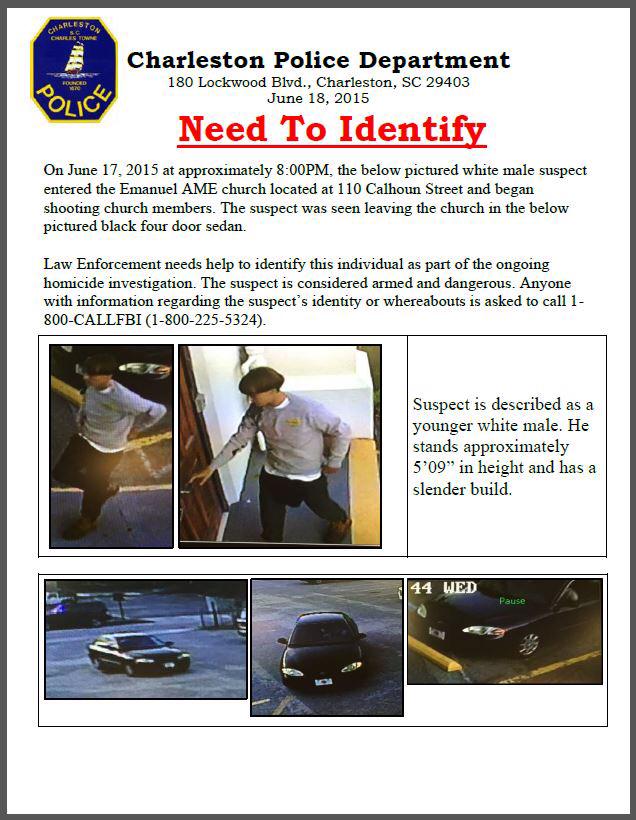
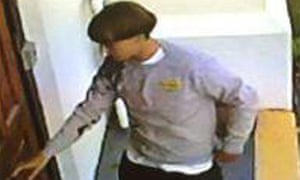
This is the white male suspect in the mass murder of nine people at a historic black Charlston, SC church last night.  He has not been caught and is still at large...

Kofi

 
City of CharlestonVerified account ‏@CityCharleston
Anyone with information about this incident call 1-800-CALL-FBI.


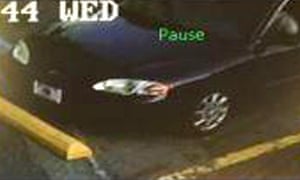
Here’s a closer view of the CCTV images released by the police of the suspect and his car.


CCTV still of shooting suspect Suspect sought in connection with the Charleston shooting.


CCTV still of shooting suspect Suspect sought in connection with the Charleston shooting.

CCTV still of shooting suspect Suspect sought in connection with the Charleston shooting. Photograph: Charleston PD/REX Shutterstock/Charleston PD/REX Shutterstock


The suspect was seen leaving the church in the pictured black four door sedan.
The suspect was seen leaving the church in the pictured black four door sedan. Photograph: Charleston PD/REX Shutterstock/Charleston PD/REX Shutterstock      

CHARLESTON SHOOTER IDENTIFIED:
Name: Dylann Storm Roof--5′ 9″120 pounds. 21 years old. White male. Driving a 2000 Hyundai ELantra GSLicense plate: LGF330

http://www.nytimes.com/…/us/charleston-church-shooting.html…

Charleston Church Shooting Leaves 9 Dead; Gunman Is Sought
By JASON HOROWITZ, NICK CORASANITI and ASHLEY SOUTHALL
JUNE 18, 2015
New York Times


Charleston police released a photograph taken from surveillance footage of the man who is believed to be the gunman. Credit Charleston Police Department, via Reuters

CHARLESTON, S.C. — The suspect in the shooting that killed nine people at a historic black church in this city’s downtown has been identified by city and federal law enforcement officials as Dylann Storm Roof, 21, of the Columbia area.

The identification comes as an intense manhunt was underway for the gunman who opened fire on Wednesday night at a historic black church in this city’s downtown.

The chief of police of Charleston, Greg Mullen, called the shooting a hate crime, and an official with the Justice Department said that a federal investigation had been started and that it could be conducted in cooperation with the state inquiry.

Chief Mullen said that law enforcement officials, including the F.B.I. and other federal agencies, were assisting in the investigation of the attack, which left six women and three men dead.

Charleston police released a photograph taken from surveillance footage of the man who is believed to be the gunman.

RELATED:
Charleston Church Shooting Leaves 9 Dead; Gunman Is Sought
JUNE 18, 2015


The gunman walked into the Emanuel African Methodist Episcopal Church, Chief Mullen said, and attended a prayer meeting for about an hour before opening fire. Initial police reports said he entered the church about 9 p.m. and began shooting. Among the dead was the Rev. Clementa Pinckney, who was also a state senator.

Sylvia Johnson, a cousin of Mr. Pinckney, told NBC News that she had spoken with a survivor of the shooting who told her the gunman reloaded five times. The survivor, she said, told her that the gunman had entered the church and asked for the pastor. Then he sat next to Mr. Pinckney during the Bible study before opening fire.

“I have to do it,” the gunman was quoted as saying. “You rape our women and you’re taking over our country. And you have to go.”

Calling the shooting the work of “a hateful and deranged mind,” Mayor Joseph P. Riley Jr. said it was hard to imagine churchgoers at “a prayer service and a Bible service, and they’re speaking about the Holy Scriptures and praying,” while someone is “sitting there contemplating the act of murder.”

Eight people died at the scene, Chief Mullen said. One person died on the way to the Medical University of South Carolina.

Photo
An image taken from surveillance video shows a car that police believe was driven by the suspect. Credit Credit Charleston Police Department, via Reuters

The police released pictures from surveillance footage of the man who is believed to be the gunman, and the police said he had been seen leaving the church in a black, four-door sedan that was also captured on video.

“We are leaving no stone unturned,” Chief Mullen said. He would not say what type of gun was used in the shooting.

City officials did not release information about the victims and did not say how many people were in the church during the shooting. Hospital officials declined to comment, but family and friends were being directed to an assistance center near the church

Mr. Pinckney’s sister was also among those killed, said J. Todd Rutherford, the minority leader of the State House of Representatives.

PHOTO: A prayer vigil near the Emanuel African Methodist Episcopal Church early Thursday. Credit David Goldman/Associated Press

Mr. Rutherford, who had served in the State Legislature with Mr. Pinckney, 41, since 1998, recalled him as a tireless leader with a booming voice and a mission to serve.

“He was called to the ministry when he was 13, ordained at 18, elected to the House at 23 and the Senate at 27,” Mr. Rutherford said. “He was a man driven by public service.”

State Senator Lawrence K. Grooms said Mr. Pinckney had had “a voice you could pick out of a crowd, a booming voice.”

“He was my friend, he was my colleague, but he was also my brother in Christ,” said Senator Grooms, who drove down from the Statehouse as soon as he heard the news last night.

In a statement, the president of the N.A.A.C.P., Cornell William Brooks, said, “There is no greater coward than a criminal who enters a house of God and slaughters innocent people engaged in the study of scripture.”

Gov. Nikki R. Haley of South Carolina asked the state’s residents to pray for the victims and their families. “We’ll never understand what motivates anyone to enter one of our places of worship and take the life of another,” she said in a statement.

Mr. Riley said the city was offering a reward for information leading to the arrest of the gunman, whom the police described as a cleanshaven white man who was about 21 with sandy blond hair and wearing a gray sweatshirt, bluejeans and Timberland boots.

Law enforcement officers from the F.B.I.; the Bureau of Alcohol, Tobacco, Firearms and Explosives; the South Carolina Law Enforcement Division; and other agencies were assisting. Chief Mullen said the police were tracking the gunman with police dogs.

Photo
A man knelt across the street outside the Emanuel A.M.E. Church after a shooting on Wednesday in Charleston, S.C. Credit Wade Spees/The Post and Courier, via Associated Press


Around 10:45 p.m., police officers escorted a man in handcuffs who appeared to match the attacker’s description. But officials said later that they were still searching for the gunman.

In the first hours after the shooting, the police blocked reporters and passers-by from approaching the church, opposite a Marriott Courtyard hotel, because of a bomb threat. Many among the news media cluster were political reporters in town to cover campaign events of Hillary Rodham Clinton and Jeb Bush.


Helicopters with searchlights circled overhead, and a group of pastors knelt and prayed across the street.

“The question is, ‘Why God?’ ” a man wearing a shirt bearing the name of the Empowerment Missionary Baptist Church said during the prayer.


Video Charleston Chief on Church Killings
Greg Mullen, the police chief of Charleston, S.C., says that a shooting on Wednesday at a historic African-American church that left nine dead was “unfathomable.” By Reuters on Publish Date June 18, 2015. Photo by David Goldman/Associated Press.

Later, a group of church leaders gathered at the corner of Calhoun and King Streets, a few blocks from where the shooting occurred, and held an impromptu news conference. Tory Fields, a member of the Charleston County Ministers Conference, said he believed the attacker had targeted the victims because of their race.

“It’s obvious that it’s race,” he said. “What else could it be? You’ve got a white guy going into an African-American church. That’s choice. He chose to go into that church and harm those people. That’s choice.”

The church is one of the nation’s oldest black congregations. The Gothic Revival building dates from 1891 and is considered a historically significant building, according to the National Park Service.

The congregation was formed by black members of Charleston’s Methodist Episcopal Church who broke away “over disputed burial ground,” according to the website of the National Park Service.

In 1822, one of the church’s co-founders, Denmark Vesey, tried to foment a slave rebellion in Charleston, the church’s website says. The plot was foiled by the authorities and 35 people were executed, including Mr. Vesey.

The church houses the oldest black congregation south of Baltimore, the National Park Service said.
Late Wednesday, the campaign staff of Mr. Bush, the former governor of Florida who is seeking the Republican nomination for president, said he was canceling appearances planned for Thursday in Charleston because of the shooting. Mrs. Clinton was in Charleston on Wednesday, but an aide said she had left the city before the shooting.

Bakari Sellers, a former member of the South Carolina House of Representatives, said he had been at a fund-raiser Mrs. Clinton attended in the early evening when he heard about the shooting only blocks away. He said the mood among the attendees, several of whom knew the church and its pastor well, quickly turned from hope to “darkness and despair.”

An earlier version of this article misstated the status of Bakari Sellers in the South Carolina House of Representatives. He is a former member, not a current one.

Jason Horowitz and Nick Corasaniti reported from Charleston, and Ashley Southall from New York. Penn Bullock contributed reporting from New York.

DYLAN STORM ROOF


The city’s chief of police called the shooting on Wednesday night at the historic Emanuel African Methodist Episcopal Church a hate crime.
nytimes.com|By NICK CORASANITI