“...The use of debt to gain control of ever more land in the United States is almost as old as the country itself. In 1803, Thomas Jefferson endorsed usurious lending to Indigenous peoples as a colonial land-grabbing scheme. “To promote this disposition to exchange lands, which they; have to spare and we want,” Jefferson wrote in a letter to future president William Henry Harrison, “we shall push our trading houses, and be glad to see the good and influential individuals among them run in debt because we observe that when these debts get beyond what the individuals can pay, they become willing to lop them off by a cession of lands.” During the Civil War, Black enslavement would be abolished in name, only to be supplanted within a decade by debt slavery in the form of sharecropping. Instead of sharing in the crop yields of the farmland they worked, landless Black laborers—many of whom were tenant farmers on the same lands where they had once been enslaved—were ensnared in a cycle of perpetual debt and poverty. Under the Black Codes, a series of oppressive laws passed throughout the South during Reconstruction, African Americans could be arrested for breaking or attempting to renegotiate labor contracts and saddled with fines they were forced to work off. Attempts to escape debt servitude were met with white terror violence. Black sharecroppers involved in unionizing efforts and other acts of dissent were massacred in 1919 in Elaine, Ark.; in 1931 in Camp Hill, Ala.; and in 1935 in Lowndes County, Ala.The government’s reversal on its promise to give millions of newly emancipated Black folks 40 acres and a mule stood in contrast to its land-giveaway policies for white citizens. The Homestead Act of 1862 took some 270 million acres of territory that had been taken from Native Americans—10 percent of all US public lands—and reallocated it in 160-acre parcels to 1.6 million Americans, almost all native or foreign-born whites, the ancestors of roughly 45 million living American adults who continue to reap generational wealth from that land grab. The Southern Homestead Act of 1866 also put free and low-cost public lands into the hands of an overwhelmingly white cohort of owners. Despite being denied these sorts of government handouts, emancipated Black farmers had acquired 3 million acres by 1875, a figure that would rise to 12 million by 1900. Land ownership by Black farmers reached its peak in 1910, when they owned between 15 million and 19 million acres.In the 20th century, mechanization and industrialization transformed farms from “labor-intensive to capital-intensive operations,” as the historian Pete Daniel writes. Debt became endemic, with farmers borrowing money during planting season and recouping the funds when crops were harvested and sold. “If you don’t get your money on time, then you’re not going to be able to be successful,” Lucious Abrams, one of the six original Pigford litigants, told me. “In order for you to have a successful crop, you need to start the first of the year putting out your lye and fertilizer, preparing your land, and seeing what type of nutrients you need to put out there. If you get your money in May or June, it’s almost time to start gathering your crop again.” For Abrams, the USDA’s loan disbursements often didn’t come in time: “They just stretch it out, and you don’t get your money till late. You don’t get enough money to operate—just enough to hang yourself.”Abrams’s experience was not unique. As the House Committee on Government Operations concluded in a 1990 report, the USDA “categorically and systematically denied minority farmers access and full participation in the multitude of Federal Government programs designed to assist them” and therefore is “directly responsible for the loss of land and resources these farmers have experienced.”A 1996 USDA-commissioned study found that “97 percent of disaster payments went to white farmers, while less than 1 percent went to black farmers,” and that white men were given thousands more in loan packages than Black men. The agency’s Civil Rights Action Team (CRAT) in 1997 determined that the USDA “took three times as long” to process Black farmers’ loans as those of white farmers, and even when a loan was approved, it often “never arrives…making it impossible for the farmer to earn any money from the farm…”—Kali Holloway, "How Thousands of Black Farmers Were Forced Off Their Land”, The Nation, November 1, 2021https://www.thenation.com/.../black-farmers-pigford-debt/Racism and Discrimination
FarmingFeature
November 15/22, 2021, Issue How Thousands of Black Farmers Were Forced Off Their Land
Black people own just 2 percent of farmland in the United States. A decades-long history of loan denials at the USDA is a major reason why.by Kali Holloway
November 1, 2021
The NationIn 1883, less than 20 years after emancipation, Curtis Gentry bought nearly 1,500 acres of undeveloped land in Shiloh, a rural community in the Alabama county where he had once been enslaved. Alongside his brother Turner, with whom he was able to reunite after emancipation—unlike the members of so many other Black families—Gentry cleared that property, uprooting trees, brush, and undergrowth. Once the land was arable, he planted and harvested an array of crops, including ribbon cane, corn, and peas.“He was a hard worker,” Bernice Atchison, Gentry’s granddaughter-in-law, told me. “Not only did he clear his own land, but he took jobs helping white people clear their land.” He taught his family how to take care of the farm while he worked on other people’s farms, bringing in extra money to the household.Gentry’s children continued to farm after their father’s death, and each subsequent generation was trained in the ways of tending to their inherited land trust. When Atchison married Gentry’s grandson Allen in 1953, the young couple were given charge of nearly 280 acres of farmland, which included amenities built by those who came before. “We had a ribbon cane mill that made syrup. We had a saw mill. There was an old still that they had used to make whiskey back in those days,” Atchison said. “I loved farming, because you have to come to understand the land.”The History of the United States as the History of CapitalismIn 1959, the Atchisons bought another 39 acres, and two years later, they built a house in which they would raise eight children. The couple sold vegetables and produce to loyal customers, most of whom worked in nearby factories and plants. In 1981, just after the Atchisons were certified as United States Department of Agriculture pig breeders, they received a letter from the USDA notifying them that they qualified for federal loans to buy “farrowing pens for the sows to have their little babies in,” Atchison said. She and Allen had spent years helping neighbors build their own farrowing pens, which had been paid for with USDA farm subsidies. “Helping Mr. Waldruf and Mr. Jones and Mr. Scott, we saw that the loan program had worked for them. So we went down to the USDA to get the money to build ours,” she said.Related Article:The Nation
Biden’s Buddy Tom Vilsack Is No Friend to Farmers
by Emily BerchBut there was a crucial difference. “They were white, and we were Black,” Atchison explained. When she and Allen went to the local Farm Service; Agency office in 1981, the FSA representative, a white man named Mr. Byrd, told them there were no loan applications available, Atchison said. On a return visit, Byrd told the couple he saw no reason they needed to expand their farm.The Atchisons made multiple follow-up trips to the FSA office, but each time, Byrd informed them they would have to wait until local white farmers received their USDA loans before the couple could even apply. From the early 1980s to the 1990s, the Atchisons were denied USDA subsidies not only for farrowing pens and pig feed but also for equipment, fertilizer, and land purchases. “We had several years of trying to go back and get loans that was supposedly available. And, of course, he would just tell us that there was no money or that it was all gone,” Atchison said. “It happened several years, year in and year out. He would tell you, ‘Oh, come back in the spring. Maybe there will be some [money] then.’” Once, when they finally succeeded in filling out an application, “Mr. Byrd tore up our application and threw it in the wastebasket. I gave him a little piece of my mind, and he told me, ‘Nigger, ain’t no money here for you.’”The couple got no response to multiple complaints they sent to the USDA’s civil rights office in Washington, D.C. Ronald Reagan had gutted the office in 1983, after which, staffers later admitted, they “simply threw discrimination complaints in the trash without ever responding to or investigating them.” Back in Alabama, Byrd kept his position as the agency’s local loan gatekeeper.Since 1965, multiple federal agencies—most notably the USDA itself—have issued reports citing, as the US Commission on Civil Rights put it that year, “unmistakable evidence that racial discrimination” within the Agriculture Department “has served to accelerate the displacement and impoverishment of the Negro farmer.” Through discriminatory loan denials and deliberate delays in financial aid, the USDA systematically blocked Black farmers from accessing critical federal funds. “If you are Black and you’re born south of the Mason-Dixon Line and you tried to farm, you’ve been discriminated against,” Lloyd Wright, the director of the USDA Office of Civil Rights under Bill Clinton and Barack Obama, and a Black Virginia farmer, told me. The debts Black farmers consequently accrued cost them millions of acres, which were then snapped up by white buyers. In 1920, the number of Black farmers peaked at nearly 1 million, constituting 14 percent of all farmers. But between 1910 and 1997, they lost 90 percent of their property. (White farmers lost only 2 percent in the same period.) As of 2017, there were just 35,470 Black-owned farms, representing 1.7 percent of all farms. The land Black farmers lost, some 16 million acres, is conservatively estimated to be worth $250 billion to $350 billion today.In 1997, facing mounting debt, Bernice Atchison signed on as a plaintiff in Pigford v. Glickman, a class-action lawsuit against the USDA brought by Black farmers alleging that the agency had discriminated against them and failed to respond adequately to discrimination complaints. In the consent decree issued two years later, and in a second settlement in 2010, the USDA agreed to provide claimants with foreclosure relief, priority consideration for future federal farm loans, access to the agency’s land inventory, and billions of dollars to cancel the wrongful debt and interest charges that resulted from the agency’s discrimination. But the promised resolution never came. Instead, the USDA continued to seize Black farmers’ land through foreclosure, and the Justice Department under George W. Bush and Obama poured millions of dollars into fighting claims and denying payouts. Many surviving Pigford farmers are deeper in debt today than they were before the lawsuit.Speaking out: Bernice Atchison in 2004, preparing for a congressional hearing. Atchison has been a public critic of the Pigford settlement. (Courtesy of Bernice Atchison’s family)Atchison was among those who never received debt cancellation. She has become one of the most visible and vocal Pigford plaintiffs and has testified about the failures of the settlement before Congress. Atchison and her family have lost more than 250 acres since the 1980s. She still farms the 60 acres that remain, raising “enough to fill up my three deep freezers” and to share with her kids. ;Allen died in 1992, amid the couple’s battles with the USDA.In March 2021, President Joe Biden signed the coronavirus relief package, which includes $4 billion in debt relief for “socially disadvantaged farmers,” a designation that includes Black, Native American, Hispanic, Asian, and Pacific Islander farmers. Despite the diversity of that coalition, the bill was ;attacked by conservatives like South Carolina Senator Lindsey Graham as slavery “reparations,” though economists at Duke University and Harvard Law School reported that the measure offers a “pittance” compared with the land’s true value. Also lost in the discussion of the bill was the fact that it offers debt cancellation only to farmers who have outstanding USDA loans. But because of the agency’s racist lending policies, few Black farmers ever received USDA money in the first place. Wright estimates that only 8 percent of Black farmers would benefit from any USDA loan cancellation program. Nonetheless, at least 13 lawsuits have been filed by white farmers arguing that the law unconstitutionally permits “reverse racism.” Injunctions issued in those cases by judges in Tennessee, Florida, and Wisconsin have effectively stalled debt relief.“Black farmers have been denied services by the Department of Agriculture for 150 years. Now that a little bit of money is supposed to go to people who have been harmed for the last century and a half, white farmers have suddenly decided it’s inappropriate for one group to get money that another group does not,” Wright told me. “I tell folks that we didn’t get 40 acres and a mule. Neither did Black farmers get debt relief under Pigford. So this [the halt in payouts] is consistent with all of the other promises that have been broken.”The USDA has vowed to fight those lawsuits, but many doubt they will ever see fairness from “the last plantation,” as the USDA is known among Black farmers. Atchison told me that she is not hopeful her acres will be returned.“The land has been resold a couple of times since it was originally sold. I don’t know whether it can ever be retrievable,” she said. “If I had gotten those loans, just think about where we would be today. Think about the assets that I would have today. That was generational wealth. Our wealth was taken away.”Working the land: A Black farmer in Tennessee in 1970. The number of Black farmers peaked at 1 million in 1920. (Robert Abbott Sengstacke / Getty)The use of debt to gain control of ever more land in the United States is almost as old as the country itself. In 1803, Thomas Jefferson endorsed usurious lending to Indigenous peoples as a colonial land-grabbing scheme. “To promote this disposition to exchange lands, which they; have to spare and we want,” Jefferson wrote in a letter to future president William Henry Harrison, “we shall push our trading houses, and be glad to see the good and influential individuals among them run in debt because we observe that when these debts get beyond what the individuals can pay, they become willing to lop them off by a cession of lands.” During the Civil War, Black enslavement would be abolished in name, only to be supplanted within a decade by debt slavery in the form of sharecropping. Instead of sharing in the crop yields of the farmland they worked, landless Black laborers—many of whom were tenant farmers on the same lands where they had once been enslaved—were ensnared in a cycle of perpetual debt and poverty. Under the Black Codes, a series of oppressive laws passed throughout the South during Reconstruction, African Americans could be arrested for breaking or attempting to renegotiate labor contracts and saddled with fines they were forced to work off. Attempts to escape debt servitude were met with white terror violence. Black sharecroppers involved in unionizing efforts and other acts of dissent were massacred in 1919 in Elaine, Ark.; in 1931 in Camp Hill, Ala.; and in 1935 in Lowndes County, Ala.The government’s reversal on its promise to give millions of newly emancipated Black folks 40 acres and a mule stood in contrast to its land-giveaway policies for white citizens. The Homestead Act of 1862 took some 270 million acres of territory that had been taken from Native Americans—10 percent of all US public lands—and reallocated it in 160-acre parcels to 1.6 million Americans, almost all native or foreign-born whites, the ancestors of roughly 45 million living American adults who continue to reap generational wealth from that land grab. The Southern Homestead Act of 1866 also put free and low-cost public lands into the hands of an overwhelmingly white cohort of owners. Despite being denied these sorts of government handouts, emancipated Black farmers had acquired 3 million acres by 1875, a figure that would rise to 12 million by 1900. Land ownership by Black farmers reached its peak in 1910, when they owned between 15 million and 19 million acres.In the 20th century, mechanization and industrialization transformed farms from “labor-intensive to capital-intensive operations,” as the historian Pete Daniel writes. Debt became endemic, with farmers borrowing money during planting season and recouping the funds when crops were harvested and sold. “If you don’t get your money on time, then you’re not going to be able to be successful,” Lucious Abrams, one of the six original Pigford litigants, told me. “In order for you to have a successful crop, you need to start the first of the year putting out your lye and fertilizer, preparing your land, and seeing what type of nutrients you need to put out there. If you get your money in May or June, it’s almost time to start gathering your crop again.” For Abrams, the USDA’s loan disbursements often didn’t come in time: “They just stretch it out, and you don’t get your money till late. You don’t get enough money to operate—just enough to hang yourself.”Abrams’s experience was not unique. As the House Committee on Government Operations concluded in a 1990 report, the USDA “categorically and systematically denied minority farmers access and full participation in the multitude of Federal Government programs designed to assist them” and therefore is “directly responsible for the loss of land and resources these farmers have experienced.”A 1996 USDA-commissioned study found that “97 percent of disaster payments went to white farmers, while less than 1 percent went to black farmers,” and that white men were given thousands more in loan packages than Black men. The agency’s Civil Rights Action Team (CRAT) in 1997 determined that the USDA “took three times as long” to process Black farmers’ loans as those of white farmers, and even when a loan was approved, it often “never arrives…making it impossible for the farmer to earn any money from the farm.”
RELATED:
More from Kali Holloway:
“Feel-Good” News Story or Poverty Propaganda?
October 1, 2021
Black Women Olympians Showed Us What It Means to Be Excellent—and Human
August 19, 2021
Our ‘Racial Reckoning’ Is Turning Out to Be a White Lie
July 19, 2021
The CRAT study also found that Black farmers who appealed “well in advance of planting season” to their local FSA office for loans were often falsely informed that no applications were available or were denied critical information required for the application to be processed. In 1998, the USDA’s National Commission on Small Farms reported that Black farmers were subjected to “indifference and blatant discrimination…in their interactions with USDA programs and staff.”
Local control over USDA loan disbursement is at the heart of the problem, Wright and others said. Three- to 11-person elected panels called county committees essentially control every aspect of FSA financial aid distribution at the local level, including hiring the staffers in agency offices. “The county committee system is set up to take care of their family, their friends, and themselves. And Blacks are not one of the above,” Wright told me. “They need to eliminate the county committees and…[hire staffers] federally like the rest of the government. Local control is great in most environments, but it has never worked for Black folks.”
The USDA’s horrific treatment of Black farmers also results from a civil rights department that has consistently failed in its responsibilities to the farmers it serves and to its own employees. Allegations of racism against employees have dogged the agency since the 1970s.
“We’ve had racial epithets. We’ve had people called ‘nigger.’ We’ve had women assaulted. We’ve had women be retaliated against for making complaints,” said Lawrence Lucas, a high-level USDA staffer for nearly two decades and a former president of the USDA Coalition of Minority Employees. “The culture at USDA is the reason why Black farmers are having the problems they’re having now.”
Bitter harvest: Bernice Atchison on her farm. She and her husband Allen were denied USDA loans throughout the 1980s and early 1990s. (Courtesy of Bernice Atchison’s family)
The problems with Pigford began even before the consent decree was approved. More than 40 civil rights organizations and plaintiffs, including Timothy Pigford, filed letters with the US District Court objecting to the proposed settlement agreement, and in March 1999, hundreds of debt-saddled farmers trekked to Washington, D.C., to register their opposition in person. USDA lawyers and the lead attorney for the class, Alexander Pires, testified that every farmer would get full debt cancellation under the consent decree they had negotiated, which set up a two-track system. Track A offered, in Pires’s words, a “virtually automatic” $50,000 payment to farmers, even if they lacked documentary evidence. This was ideal because most farmers did not keep records, Pires testified, noting he had waived the discovery process during negotiations for the same reason.
Track B offered unlimited money if farmers had documents to back up their debt claims, but the more stringent “standard of proof was not burdensome,” USDA lawyers testified. And if neither track appealed to a farmer, attorneys claimed, they could opt out of the decree and file their own lawsuit.
Plaintiffs responded with a litany of objections. The consent decree did not compel the USDA to return wrongfully seized farmland, nor did it direct the USDA to punish employees who discriminated. (The USDA explicitly refused Judge Paul Friedman’s request to add a sentence stating it would make future “best efforts” to ensure employees followed anti-discrimination laws.) Farmers argued that $50,000 “won’t even buy a medium-sized tractor,” as Pigford complainant Vernon Breckinridge put it. (Class counsel admitted to guesstimating that the $50,000 figure would suffice for Black farmers based on the $37,500 payment that Tuskegee experiment victims received, though the agricultural economist Donald McDowell had calculated fair compensation at $250,000.) Plaintiffs also questioned class counsel’s decision to negotiate away discovery, which meant that the USDA was under no obligation to provide Black farmers with information, including from the farmers’ own files. If an arbitrator ruled against a Black farmer, the farmer got no money at all and had no right to appeal.
“If I were a mass murderer [who] was found guilty of the most heinous crime in the world, I have a right to appeal,” James Morrison, of the National Black Farmers Association, said at the hearing. “Are you telling me the farmer who has spent his entire life farming, who has been denigrated, who has been castigated, who has seen nothing short of pure hell, cannot have any opportunity to control what his fate is going to be based on?”
Over those protests, Judge Friedman approved the consent decree in April 1999, writing in his opinion that it was “a good first step.” Class counsel had estimated the number of complainants would hit 2,000. Instead, more than 22,000 Black farmers applied and were deemed eligible to join the class.
Five years later, it was clear the consent decree had failed. A 2004 investigation by the Environmental Working Group (EWG) found that 9 out of 10 Black farmers had been “denied any recovery.” An estimated 64,000 farmers were rejected because they missed the court’s original filing deadline, even though they submitted claims before the court’s “late claims” period. Another 9,000 had their claims refuted and got nothing. Just 10 percent of 173 eligible Track B filers were granted compensation. Of Pigford’s 22,700 claimants, just 371 got any kind of debt relief.
Under the Bush administration, the USDA “aggressively fought claims by African American farmers, contracting with United States Department of Justice lawyers who spent at least 56,000 staff hours and $12 million contesting individual farmer claims for compensation,” the EWG study found. In many cases, local FSA employees of the USDA simply contested Black farmers’ claims of racial discrimination.
Justice undone: J.L. Chestnut, a civil rights lawyer and Pigford class-action attorney, raised concerns about the settlement after seeing the number of rejected claims.
“The government is holding up progress with technicalities; and the same USDA agents that discriminated against the farmers in the first place are now being called upon to respond to and reject applications from Black farmer class members. The adjudicators are not making fair and consistent rulings which has caused many of the rejections,” J.L. Chestnut, a Black civil rights lawyer and a Pigford class-action attorney, said in 2000 after seeing the number of rejections. His law partner added that Black farmers should go “into the streets to fight for justice in this case. Do not trust the judge, the lawyers, the adjudicators, the monitor or anyone else to resolve this case.”
A major barrier to compensation was the consent decree’s “specifically identified, similarly situated white farmer” standard, which required Black farmers to locate a white farmer “in their county who applied for the same benefit program at the same time, with the same acreage, the same type of crop, the same credit history, and received a higher payment or better treatment than the African American farmer.” The USDA had some of this information in its files, but agency lawyers denied Freedom of Information Act requests from Black farmers and their attorneys. Without those details, Pigford farmers were forced to rely on public records and guesswork. One Black farmers’ advocate described applications getting rejected for misspellings of white farmers’ names and other minor issues.
“When they gave away discovery we was already sold out, because then you put the burden of proof back on the farmers—but you already had evidence that discrimination transpired all over the country over the years,” Abrams told me. “Al Pires and them, the last thing they told me was I had to go and find a similarly situated white farmer. How can I do that other than break into their fancy USDA offices, go through all the files, and then have the police be out there to take my behind to jail?”
In October 2000, just two weeks before a major filing deadline, Pires and his team admitted to the court that they were way behind. To ensure that “counsel’s failings should not be visited on their clients,” Judge Friedman added stipulations to ensure that claims would not be excluded from review. Less than six months later, he noted that the lawyers had “failed to meet the minimum requirement” on timely filings “even once,” which he labeled a “disturbing trend.” Less than two weeks later, after class counsel made what Judge Friedman called “the remarkable admission that they never had a realistic expectation of meeting” target dates, the court began to charge them daily fines for tardiness. Instead of improving submission rates, “counsel drastically increased the rate at which they withdrew petitions,” a move that, Judge Friedman wrote, “bring[s] into question Class Counsel’s fidelity to their client” and was “bordering on legal malpractice.” The US Court of Appeals would in 2002 also issue an opinion stating that Black farmers, as a result of class counsel’s incompetency, had experienced a “double betrayal: first by the [USDA], and then by their own lawyers.” Fearing for the fate of Black farmers, in 2001 Judge Friedman asked the American Bar Association Committee on Pro Bono and Public Services to “assemble a team of pro bono lawyers to assist Class Counsel on an emergency basis.” The effort made little difference.
“I went through two or three of those type of lawyers after Pires and them left me,” Abrams told me. “You sign up, they keep you for about a month, and then next thing you know, they drop you. Then a new one comes in, does the same thing.”
Generational wealth: Bernard Bates as a child on his family’s farm in Nicodemus, Kan., with his grandfather, who homesteaded 200 acres there, and other family members. (Courtesy of Bernard Bates’s family)
Bernard Bates had lost 950 acres of land, including some 200 acres originally homesteaded by his grandfather, who settled in Nicodemus, Kan., years after his own father fled the South after the Civil War. Bates told me that after a few difficult years in the 1980s, he tried to get a USDA loan but was denied an application. He joined Pigford, but his lawyer was of little use. “When we hooked up with Pigford, I thought we would have some help,” said Ava Bates, Bernard’s wife. “But in the end it was just a runaround. The lawyer lied all the way through. When we got back home and [Bernard] would try and get in touch with her, they would never answer their phone. They promised us a lot of stuff, but it wasn’t worth a hoot.”
In 2012, the former president of Bates’s local credit association signed an affidavit affirming that the lender’s board of directors, the federal land bank, and the local USDA office had colluded “to get Bernard out of farming” and that it had been decided they would “rather foreclose, even if they lost money, rather than to take Bernard’s money.” To this day, he has not gotten debt cancellation or his land back.
Attorney Tracy McCurty, the director of the Black Belt Justice Center and the co-organizer of a campaign to cancel the Pigford farmers’ debt, said there was a “ray of hope” in 2010, when Obama authorized $1.25 billion in debt cancellation funds for Black farmers who had been left out of the original class-action suit, a settlement that became known as Pigford II. But McCurty, Wright, and multiple farmers told me that because of poor oversight, much of the funding was squandered.
“Some of the attorneys informed the farmers that the agreement stated in black and white that ‘You’re going to get debt relief, so you really don’t need to continue to pay on this. Go ahead and buy feed and fertilizer and start farming,’” Wright told me. “So some of the farmers who could’ve struggled and paid their debts didn’t, because they were advised they didn’t have to. They ended up with interest and penalties accumulating for that five years, and it was so steep now they couldn’t pay. So many of them lost land that they otherwise would not have.”
Pires and his team were paid $15 million. After the second Pigford settlement, Judge Friedman granted a second team of lawyers a requested $90 million in attorneys’ fees and expenses. “They might have lined their pockets, but they didn’t do anything for the farmers,” said Everlyn Bryant, a Pigford legacy farmer from Arkansas. She and her late husband got $50,000—far short of the debt relief her family needed. They lost 900 acres to USDA foreclosure. “Even after the consent decree was done, I was telling the attorneys that $50,000 for a real farmer is nothing. It won’t even pay the diesel bill for one month.”
“Since the Pigford debacle, because farmers have these enormous debts, their credit is ruined with USDA. Their credit is ruined with other traditional lenders,” McCurty said. “How is it that these elder farmers in their 70s and 80s, who’ve suffered for over 30 years, are still having to present themselves pro se in federal court to delay foreclosure proceedings?”
“One of the things that really hurt was that I went across the country and talked with all these Black farmers. And this was supposed to make them whole again—and everything I told them was a lie,” Abrams told me. Living under the threat of foreclosure, his wife had a nervous breakdown; he has suffered from high blood pressure, diabetes, and kidney failure. “I thought that Pigford was going to make them whole again while they was living. A lot of them have died.”
The family trust: Three generations of Bernice Atchison’s family at work on her farm in Alabama. (Courtesy of Bernice Atchison’s family)
In December 2020, President Biden nominated Tom Vilsack as agriculture secretary, infuriating many of the Pigford litigants. Lucas, the former president of the USDA Coalition of Minority Employees, said at the time that he was flooded with calls from Black farmers who worried that the appointment of Vilsack, who they believed had “shown such arrogance and indifference to civil rights,” confirmed their fear that they would never see justice. When Vilsack left the Agriculture Department at the end of Obama’s term in 2016, he presented a rosy picture of the strides the USDA had made to improve conditions for Black farmers and to end systemic racism within the agency. But according to Nathan Rosenberg and Bryce Wilson Stucki, who conducted a two-year analysis of Vilsack’s claims for The Counter, an investigative newsroom focused on food, the former agriculture secretary and his team distorted data to cover up the USDA’s continued failure to serve Black farmers. (Vilsack also made headlines in 2010 for firing Black USDA employee Shirley Sherrod based on false allegations.) ;After Vilsack asked Wright to return as head of the Civil Rights Office in 2009, his first task, Wright told me, was to tackle the 14,000 Bush-era discrimination complaints that had gone unaddressed, of which, he and his team determined, 4,000 had merit. Many of those complaints exceeded the two-year limit on receiving compensatory relief, so Wright and others attempted to find a fix. “We drafted a bill to extend the statute of limitations, and some members of the Congressional Black Caucus found the money to pay for it, and that bill passed twice in the House,” Wright said. But the bill hit roadblocks in the Senate. “My office didn’t have the same contacts in the Senate as we did in the House. I found out that not only were we not being helped by Secretary Vilsack, but that he may have been putting sand in the gears. He gave me zero help in trying to get it done.”
The Counter’s investigation found that those farmers never had their unwarranted debts settled. “USDA actually foreclosed on some of them and attempted to foreclose on others before their cases were resolved—despite a moratorium, mandated as part of the 2008 farm bill, on exactly this practice,” Rosenberg and Stucki reported. In fact, from 2006 to 2016, the USDA foreclosed on “Black-owned farms at a higher rate than on any other racial group…. The agency was more than six times as likely to foreclose on a Black farmer as it was on a white one,” they wrote.
“They just can’t assume that every time they aren’t successful it’s because of discrimination,” Vilsack would later state. “I think you can do a service to your client by not only fighting hard for them, but also explaining why they didn’t get the help that they thought they were entitled to, and it wasn’t anything to do with the color of their skin or their culture or whatever.”
“The reason why we do not trust Tom Vilsack is because during his administration, farmers continued to lose their land,” Wright told me. After all, the discrimination that spurred the Pigford lawsuit isn’t in the past. A Politico study revealed that the USDA “granted loans to only 37 percent of Black applicants last year in one program that helps farmers pay for land, equipment and repairs but accepted 71 percent of applications from white farmers.”
Wright is not hopeful Black farmers will ever get their due. “Trump was able to pay farmers these soybean payments when the product price went down because China was not buying soybeans,” he said. “If you want to do something, you get it done. If you don’t want to do it, you do process. And all the Department of Agriculture has done since this administration got in is process, as it relates to people of color.”
The USDA has said it plans to fight the lawsuits that are currently holding up debt cancellation payments to Black farmers. But in August, the agency failed to appeal one of the preliminary injunctions by the appointed deadline. McCurty, who has been aiding Black farmers with legal issues for years, believes that winning the court challenges is a long shot in any case. She has pushed for Senator Raphael Warnock, who proposed the $4 billion in debt cancellation in stand-alone legislation in February, and Senate cosponsor Cory Booker to seek more creative solutions. In September, Booker announced plans to include debt erasure for Black and other minority farmers in the budget reconciliation package that Democrats are currently drafting.
In order to sidestep the lawsuits that are preventing the funds allocated by the Covid relief act from being disbursed, the proposed bill would amend the American Rescue Plan by eliminating any mention of “socially disadvantaged farmers.” Instead, the bill’s provisions include 100 percent loan cancellation to USDA farm loan borrowers who fall under the category of “economically distressed.” It also allots $1 billion to debt restructuring for farmers. And just over another billion is divided among various services, including $350 million to those “determined to have suffered discrimination in Department of Agriculture farm lending programs.”
Wright, McCurty, and Lucas, who are advising Democrats on how to move forward with the bill, caution that history shows that if the USDA doesn’t explicitly make provisions for Black farmers, they are almost certain to be discriminated against yet again. To that end, Wright has suggested that “historically underserved farmers” should be one qualifier of eligibility for full debt cancellation, and that the $350 million allotted to victims of USDA discrimination be raised to $1 billion.
But whether any reconciliation bill will be passed at all remains to be seen. And every few months, another Pigford legacy farmer dies without seeing the federal government, or this country, do right by them. “Martin Luther King once said to tell Black folks to wait is the same as saying ‘never,’” Wright told me. “I’m not optimistic that they’ll get relief from any of these provisions, although I’m convinced that the president really intended that these programs be fairly implemented. The last plantation hasn’t caught up yet with that.”
ABOUT THE AUTHOR:
Kali Holloway is a columnist for The Nation and the director of the Make It Right Project, a new national campaign to take down Confederate monuments and tell the truth about history. Her writing has appeared in Salon, The Guardian, The Daily Beast, Time, AlterNet, Truthdig, The Huffington Post, The National Memo, Jezebel, Raw Story, and numerous other outlets.
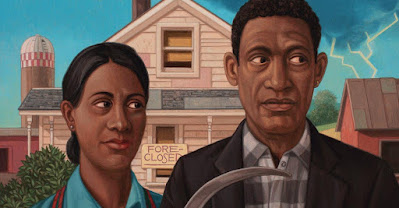
IMAGE: Illustration by Marco Ventura.
All,
THE REAL NEXUS BETWEEN 'RACE AND CLASS' IN AMERICAN POLITICS TODAY IS THAT THE DOCTRINE AND PRACTICE OF WHITE SUPREMACY AS A MAJOR IDEOLOGICAL, STRUCTURAL, INSTITUTIONAL, SYSTEMIC, AND MATERIAL FORCE AND REALITY WITHIN THE LARGER CONTEXT OF GLOBAL CAPITALISM ITSELF IN ALL OF ITS DIMENSIONS IS AS ALWAYS INEXTRICABLY CONNECTED AND MUTUALLY DEPENDENT FORCES IN THE UNITED STATES
THUS WHAT REALLY NEEDS TO BE OPENLY ACKNOWLEDGED AND SAID TODAY BECAUSE IT IS THE WHOLE DAMN TRUTH AND NOTHING BUT THE TRUTH IS THE FOLLOWING:
This country is in much deeper trouble than it actually thinks it is. The most fundamental and horrifying fact is that in the last two elections in 2016 and 2020 a whopping 58% of ALL WHITE VOTERS nationally across the board in every single individual class group from the poor to the working class to the middle and upper middle classes as well as the wealthy throughout the entire country have voted overwhelmingly for Trump TWICE and still support him for the presidency in 2024.

THE MOST IMPORTANT, TERRIFYING, BUT ALMOST NEVER PUBLICLY COMMENTED UPON FACT IS THE FOLLOWING:
Trump has won more votes over the course of two elections than ANY OTHER PRESIDENTIAL CANDIDATE FROM EITHER PARTY IN AMERICAN HISTORY. Trump received a total of 137 million votes in the last two elections (63 million in 2016 and 74 million in 2020) which is a record previously held by Barack Obama who received 134 million votes combined in 2008 and 2012. The huge difference of course is that Obama only received these many votes because 95% of black voters and 70% of Asian and Latino voters voted for him. I keep trying to remind people that Obama (like every other Democratic party candidate in the last 60 years (!) received only a paltry 41% of the white vote (43% in 2008 and an even more dismal 39% in 2012). For example Hilary Clinton only received 37% of the white vote nationally in 2016 and Biden only received 42% of the white vote in 2020. This means of course that Obama, Clinton, and Biden between them only received 40% of the national white vote in this country in the last four elections. This means that ALL of them lost the white vote by a landslide. Reminder: The largest national voting demographic in the country are white Americans who constituted 65% of all American voters in 2020 and were 70% of voters from 2008-2016. Which means as always that the white share of the voting public is larger that ALL OTHER racial/ethnic groups--male and female combined!
BTW the single largest voting bloc in the entire country is WHITE FEMALE VOTERS who make up 33% of all voters in the U.S. today—WHITE MALE VOTERS now stand at 32%.
ANOTHER ABSOLUTELY HARROWING STAT THAT SHOULD NEVER BE IGNORED: In the last 70 years of presidential elections since 1952 (a total of 18 elections overall and counting) a majority of white voters have voted for a Democratic party candidate ONLY ONCE (1964).
What all this means in a larger sense is that because the GREAT MAJORITY OF WHITE AMERICAN VOTERS IN GENERAL SINCE 2016 HAVE ACTUALLY IN FACT openly supported and most importantly have continued to vote for Trump FAR MORE THAN ANY OTHER CANDIDATE IN THE ENTIRE COUNTRY we are all in very big trouble come 2024 and that the actual political prospects for what happens not only to the presidency but even more importantly Congress (as well as civil society in general) is the worse than at any time since the horrendous 1980s…
Kofi
"What's Past is Prologue..."
"What is Racial Capitalism and Why Does It Matter?”
Important talk by Robin D. G. Kelley on "What is Racial Capitalism and Why Does It Matter?" recorded November 7, 2017 at Kane Hall, University of Washington, Seattle, WA. Sponsored by the UW Simpson Center for the Humanities:
https://www.thenation.com/…/what-is-the-left-without-ident…/
A BLAST FROM THE VERY RECENT PAST...
Race and Ethnicity
The Left
That’s Debatable
What Is the Left Without Identity Politics?
Four writers consider the question dividing the Democratic Party by Walter Benn Michaels, Charles W. Mills, Linda Hirshman and Carla Murphy
Whose Identity Politics?
by Charles W. Mills
December 16, 2016
The Nation
 Dr. CHARLES MILLS(b. January 3, 1951--d. September 20, 2021)
The causes of Donald Trump’s stunning electoral victory will be debated for years: FBI director James Comey’s October 28 letter about Clinton’s e-mails, her “basket of deplorables” comment, the Democratic campaign’s neglect of the Rust Belt states, and so on. But the pernicious and enduring role of identity politics was crucial.
I refer, of course, to the white racial identity politics that has shaped the United States from its birth.
Needless to say, this is neither the standard narrative nor the usual framing. For the orthodox white left, now claiming a cheerless we-told-you-so vindication, identity politics is THEIR politics—particularistic, pandering to special interests, balkanizing; OURS, of course, are supposedly very different—universalist, general-interest, unifying. Not “recognition,” but redistribution; not “identity” but material inequality; not “race,” but class. The proletariat, Karl Marx informs us, is the universal class, subject to no racial or gendered categorizations, whose emancipation is going to free everybody. In a somewhat diluted non-revolutionary form (social-democratic redistributivist capitalism), this vision still informs white mainstream left-liberal thought today.
But if it was wrong even in Marx’s time and Marx’s world, it is even more mistaken in the United States of the 21st century. American capitalism (white supremacist from the start) created heterogeneous structures of subordination that had different effects on white workers than on black and brown workers. White working-class identity politics—even as a junior shareholder in the overarching system of white supremacy—would pay off for its subscribers in multiple ways: not just in terms of greater political input and civic/social recognition than their non-white counterparts, but also in the form of material access to better jobs, better (segregated) neighborhoods, a better education for their children, and far greater wealth (through racially discriminatory mortgages and state transfer payments, the racialized implementation of the GI Bill, and so forth). The so-called identity politics of people of color has always been reactive, recognizing whiteness as an illicit set of entitlements to these political and economic advantages.
White working-class identity politics is a junior shareholder in the overarching system of white supremacy.
Doesn’t the white working class have legitimate grievances? Of course it does. But these must be separated from illegitimate grievances about diminished white privilege, both identitarian and economic. After all, the non-white poor and working class are hurting worse, and (for the most part) they didn’t vote for Trump. Achieving a genuine universalism responsive to the interests of both the white and the non-white disadvantaged will require an admission of whites’ differential historic positioning in the political economy, and how the prism of race has always refracted their perception of their group interests. As plutocracy and the New Gilded Age of inequality consolidate themselves, the white left needs to ask itself whose identity politics brought us to this point in the first place.
ABOUT THE AUTHOR:
Charles W. Mills (1951-2021) was Distinguished Professor of Philosophy at the City University of New York’s Graduate Center. He was the author of numerous groundbreakingbooks on race and political theory, including The Racial Contract (1997), Blackness Visible: Essays on Philosophy and Race (1998), and Black Rights/White Wrongs: The Critique of Racial Liberalism (2017).