Showing posts with label 2016 presidential election. Show all posts

Wednesday, March 13, 2024

The Fundamental Crisis and Foundational Contradiction Facing the United States During the Upcoming Presidential Election Year of 2024: Fascism guided, informed, and enabled by the Doctrines and Practices of White Supremacy and Global Capitalism--PART 20

Racial Fascism
Alberto Toscano

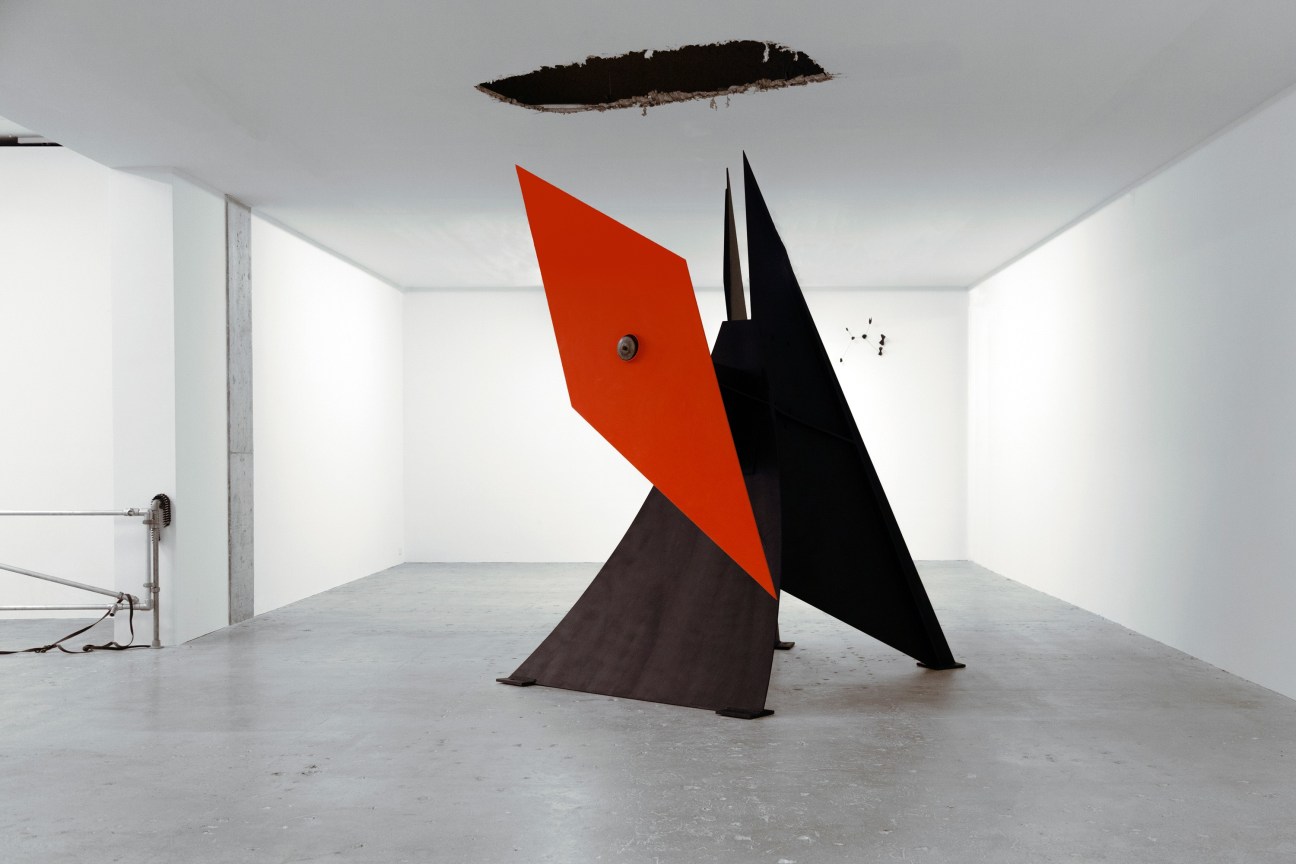
Installation view of Kinetics of Violence by Alexander Calder and Cady Noland, New York, Venus Over Manhattan, 2017.

Issue #139
October 2023
 
"Swastikas bloomed in Chicago parks like misbegotten weeds."
—Martin Luther King, “Drive to End Slums” (1967)

"Nothing is more important than stopping fascism because fascism will stop us all."
—Fred Hampton (1969)


"Fascism was a monster born of capitalist parents. Fascism came as the end-product of centuries of capitalist bestiality, exploitation, domination and racism—mainly exercised outside of Europe. It is highly significant that many settlers and colonial officials displayed a leaning towards fascism."
—Walter Rodney, How Europe Underdeveloped Africa (1972)

"Let us be reminded that before there is a final solution, there must be a first solution, a second one, even a third."
—Toni Morrison, “Racism and Fascism” (1995)


It Did Happen Here

Just as the aftermath of the 2016 US presidential election witnessed the mainstreaming of scholarly and activist discussions of fascism in the United States and beyond, the frantic quickening of the news cycle on the eve of the 2020 contest was again accompanied by multiple efforts to check America’s authoritarian pulse. Despite the deadly farce of the January 6 white riot (America’s own beer-bong putsch), the departure of the forty-fifth president has made way for a rushed remaindering in some quarters of the debate on native (or, better, nativist) fascism. The Black radical perspectives on the fascist problematic surveyed below—with their commonly neglected insistence on the structuring role of fascist potentials to the US body politic—would suggest that we instead stay with the trouble that briefly forced even some liberal partisans of American exceptionalism to consider that fascism was not some dreadful anachronism imported from the Old World; that instead, to paraphrase H. Rap Brown, it might be “as American as cherry pie,” deeply enmeshed in histories of enslavement and extermination, dispossession and domination that continue to shape the US present, materially and ideologically.

Where in 2016 attention gravitated towards the incoming administration’s organic and ideological links with the extreme right (Bannon, Miller, Spencer & Co.), the context of a mass civic insurgency against police murder and racial terror—the George Floyd Rebellion—shifted the tenor and relevance of invocations of fascism in ways that should be allowed to resonate irrespective of changed occupancy in the Oval Office. In the months leading up to the 2020 election, the systemic challenge posed by mass Black-led movements against the racial and carceral state was displaced by the US government onto the familiar figure of the (white) anarchist (or communist) agitator, as “Antifa” became a target for William Barr’s Department of Justice (still undecided whether this was a “foreign terrorist organization” or an internal “seditious” group). In the interim, the fauna of right-wing agitation grew weirder and more sinister still, thanks to QAnon, the Boogaloo movement, the Oath Keepers, and the Proud Boys—who clearly took the presidential guidance to “stand down and stand by” all too literally. The state’s exceptional powers—that dependable matrix of historical fascisms—were flexed in scenes of unidentified federal agents bundling protesters into unmarked rental vans and in the shooting of Michael Reinoehl by a US Marshals task force, even if further escalations did not eventuate.

Meanwhile, on the ideological stage, “critical race theory” (along with the New York Times’ “1619 Project”) was loudly proclaimed to be an “ideological poison” that must be “quickly extinguished”; the Executive Branch’s Office of Management and Budget dispatched a memo to all federal agencies to “cease and desist from using taxpayer dollars to fund … divisive, un-American propaganda training sessions”; and an executive order condemned anti-racist critics for advancing a “vision of America that is grounded in hierarchies based on collective social and political identities,” a ludicrous case of projection if there ever was one. This very recent history should not be treated as a freakish blip; rather, as demonstrated by the persistence of the politics and personnel that made it possible (not least at the level of state legislatures that have ramped up their projects of racial disenfranchisement, dispossession, and ecocide), it demands acknowledgment as the index of an entrenched and arguably burgeoning political potential.

Notwithstanding the changing terrain, talk of fascism has generally stuck to a familiar groove, namely asking whether present phenomena are analogous to those of interwar European fascisms.

Skeptics of comparison will underscore how the analogy of fascism either treats the present moment as exceptional, papering over US histories of authoritarianism, or, alternatively, is so broad as to fail to define what is unique about our current predicament. Analogy’s advocates will instead point to the need to detect family resemblances with past despotisms before it’s too late, often making their case by advancing some ideal-typical check list, whether in terms of the elements of or the steps towards fascism. But what if our talk of fascism were not dominated by the question of analogy?

Attending to the long history of Black radical thought about fascism and anti-fascist resistance—what Cedric Robinson called a “Black construction of fascism,” an alternative to the “the historical manufacture of fascism as a negation of Western Geist”—could serve to dislodge the debate about fascism from the deadlock of analogical thinking, providing the resources to confront our volatile interregnum.

Long before Nazi violence came to be conceived as beyond comparison, Black radical thinkers sought to expand the historical and political imagination of an anti-fascist left by detailing how what could be perceived from a European or white vantage point as a radically new form of ideology and violence was in effect continuous with the history of (settler-)colonial dispossession and racial slavery.
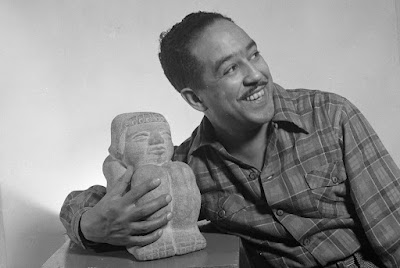

Langston Hughes in a 1943 photo taken by Gordon Parks for the US Office of War Information. Source: Library of Congress.

The pan-Africanist intellectual and activist George Padmore, breaking with the Communist International over its failure to think the nexus between “democratic” imperialism and fascism, would write in How Britain Rules Africa (1936) of settler-colonial racism as “the breeding-ground for the type of fascist mentality which is being let loose in Europe today.” He would go on to see in South Africa “the world’s classic Fascist state” grounded on the “unity of race as against class.”

Padmore’s anatomy of what he termed “colonial fascism” thus anticipated the memorable depiction of fascism as the boomerang effect of European imperialist violence in Césaire’s Discourse on Colonialism. It was also echoed by the Tunisian-Jewish writer Albert Memmi, and by the Guyanese historian and activist Walter Rodney, when he wrote of the “fascist potential of colonialism” with specific reference to settler support for the Vichy regime and pied-noir efforts to destabilize liberal rule in metropolitan France. The anti-colonial conviction whereby the standpoint of the targets of racial violence gives the lie to the exceptionality of intra-European fascism was also echoed by African-American intellectuals. Speaking in Paris at the anti-fascist International Writer’s Congress in 1937, the poet Langston Hughes would declare: “In America, Negroes do not have to be told what fascism is in action. We know. Its theories of Nordic supremacy and economic suppression have long been realities to us.” This was a lesson that could also be drawn from the monumental historical reckoning with US racial capitalism that is Du Bois’s 1935 Black Reconstruction in America. As Amiri Baraka suggested, the overthrow of Reconstruction enacted a “racial fascism” that long predated Hitlerism in its use of racial terror, co-optation of poor whites, and passionate investments in white supremacy among ample sectors of the capitalist class, financial as well as industrial. Reading the present via this lens can make palpable how and why “institutionally the historical furniture filling America’s political space has already been arranged in such a way that it would always leave open the prospect of evolving even greater authoritarian forms like fascism.”In this view, an American racial fascism could go unremarked because it operated on the other side of the color line, just as colonial fascism took place at a spatial and epistemic remove from the imperial metropole. As Jean Genet observed on May 1, 1970 at a rally in New Haven for the liberation of Black Panther Party Chairman Bobby Seale: “Another thing worries me: fascism. We often hear the Black Panther Party speak of fascism, and whites have difficulty accepting the word. That’s because whites have to make a great effort of imagination to understand that blacks live under an oppressive fascist regime.”

Fascism, Prisons, and Black Liberation

It was largely due to the Panthers, or at least in their orbit, that “fascism” returned to the forefront of radical discourse and activism in the late 1960s and early 1970s—the United Front Against Fascism conference held in Oakland in 1969 brought together a wide swath of the Old and New Lefts, as well as Asian-American, Chicano, and Puerto Rican activists who had developed their own perspectives on American fascism (for instance, by foregrounding the experience of Japanese internment during World War II).

In a striking testament to the peculiarities and continuities of US anti-fascist traditions, among the chief planks of the conference was the notionally reformist demand for community or decentralized policing—to remove racist white officers from Black neighborhoods and exert local checks on law enforcement. It is not, however, to leading members of the Black Panther Party but to political prisoners close to the Panthers that we must turn for theories about the nature of late fascism in the United States. While debates about “new fascisms” were polarizing radical debate across Europe, the writing and correspondence of Angela Y. Davis and George Jackson outlined the possibility of theorizing fascism from the direct experience of the violent nexus between the carceral state and racial capitalism.

In one of his prison letters on fascism, collected in Blood in My Eye, George Jackson offered the following reflection:

When I am being interviewed by a member of the old guard and point to the concrete and steel, the tiny electronic listening device concealed in the vent, the phalanx of goons peeping in at us, his barely functional plastic tape-recorder that cost him a week’s labor, and point out that these are all manifestations of fascism, he will invariably attempt to refute me by defining fascism simply as an economic geo-political affair where only one party is allowed to exist aboveground and no opposition political activity is allowed.

Following Jackson, we might ask: What happens to the turns and returns of the theoretical debate over fascism and (neo-)authoritarianism when it undergoes a Gestalt shift and takes the racial capitalist state and its carceral apparatus as its fulcrum, in something like a “tilt shot angled from below” that might disclose “a panorama of violence endured”?

As Jacques Derrida intimated in an unsent letter to Jean Genet, dated one day prior to Jackson’s assassination by a guard sniper at San Quentin:

"In a prison—this one and others—where it thought it had put its outside in chains, the system of (Western-white-capitalist-racist) society has made possible, by this act, the analysis of its functioning, a practical analysis that is at once the most implacable, the most desperate, but also the most affirmative."

It has become commonplace in discussions of fascism to castigate the 1970s as a kind of cognitive nadir when fascism was degraded from a category of historical analysis and taxonomy into a one-size-fits-all political insult, with dire consequences. In what follows, I want to take the imprudent wager that there is virtue and insight in the seeming exaggeration or inflation of fascism in the context of seventies radicalism and liberation politics. But I especially want to underscore how viewing fascism through the prism of Black radical intellectual traditions can redirect our contemporary debate in fruitful and important ways. What might happen to our conceptions of fascism and authoritarianism if we took our bearings not from putative analogies with the European interwar scene, but, for instance, from the materiality of the prison-industrial complex, from the “concrete and steel,” from the devices and the personnel of surveillance and repression? Probing the analytical nexus of fascism and racial capitalism forged in the liberation struggles of the 1970s, we can also connect it back to the analysis of fascism emerging from Black theorists in the interwar period and forward to the afterlives of fascism in the late twentieth and early twenty-first centuries.
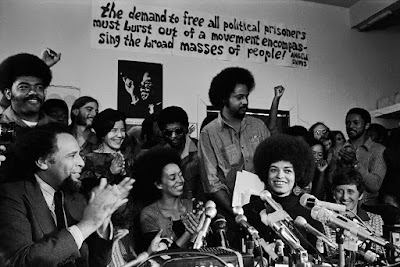

February, 1972: Angela Davis speaks to the press at a press conference following her release on bail during her trial. L-R: Howard Moore (lawyer), Fania Jordan, Angela. Franklin Alexander stands behind Angela. Photo: Stephen Shames.

In their writing and correspondence, which is marked by differences of interpretation interwoven with a profound comradeship, both Angela Y. Davis and George Jackson identified the US state apparatus as the site for a reemergence or indeed a perfecting of certain features of (European) historical fascisms. Much of their theorizing is suffused by contemporary debates on the nature of monopoly capitalism, imperialism, and capitalist crises, as well as, in Jackson’s case, by an effort to revisit the classical historiography on fascism. Of note and relevance for contemporary concerns is the specific light that the prism of race—of racial domination and racial capitalism—sheds on the nexus of fascism and democracy, and how it can help us to interrogate and displace the normative conviction regarding the absolute antithesis between fascist despotism and liberal democracy. Both Jackson and Davis are profoundly aware of the disanalogies between present forms of domination and historical fascism, but they both assert the epistemologically privileged vantage point provided by the view from within a carceral-judicial system that could fairly be described as a racial state of terror. In distinct ways, they can be seen to relay and recode that foundational gesture of anti-racist and Black radical anti-fascism crystallized in Césaire’s Discourse on Colonialism. As the Martinican poet and politician tells it: “And then one fine day the bourgeoisie is awakened by a terrific boomerang effect: the gestapos are busy, the prisons fill up, the torturers standing around the racks invent, refine, discuss.”

But the new form of American fascism that Jackson and Davis anatomize is not an unwanted return from the other space of colonial violence; it originates from the bosom of liberal democracy itself. The prisons are already full. And rather than a boomerang, the generalization of racialized carceral terror into society at large—which is one of the foremost features of the new fascism—is a much less dramatic or sudden process of seepage, the permeation of the social space of actually existing liberalism by models and devices invented, refined, and discussed amid concrete and steel. As Mullen and Vials justly observe:

For people of color at various historical moments, the experience of racialization within a liberal democracy could have the valence of fascism. That is to say, while a fascist state and a white supremacist democracy have very different mechanisms of power, the experience of racialized rightlessness within a liberal democracy can make the distinction between it and fascism murky at the level of lived experience. For those racially cast aside outside of liberal democracy’s system of rights, the word “fascism” does not always conjure up a distant and alien social order.

Like Davis, Jackson also stresses the necessity to grasp fascism not as a static form but as a process, profoundly affected by its political and economic contexts and conjunctures. Whence the limits of models, analogies, or ideal types. Jackson comments on “the defects of trying to analyse a movement outside of its process and its sequential relationships. You gain only a discolored glimpse of a dead past”; he remarks how, historically, fascism “developed from nation to nation out of differing levels of traditionalist capitalism’s dilapidation.” Now, while for the author of Soledad Brother fascism is profoundly linked to a restructuring of the capitalist state, it is also fundamentally a counterrevolutionary form, manifesting in the violence with which it meets any substantive threat to the integrity of the state of capital. It is nevertheless instructive to note that, echoing Nicos Poulantzas’s analysis in Fascism and Dictatorship, for Jackson fascism does not respond directly to an ascendant revolutionary force; it is a kind of delayed counterrevolution, parasitic on the weakness or defeat of the anti-capitalist left. The “opposition of a weak socialist revolution” is thus a shared feature among the various fascisms (one can sense the indictment of the contemporary left in Jackson’s historical allusion). In a nutshell then: “Fascism must be seen as an episodically logical stage in the socio-economic development of capitalism in a state of crisis. It is the result of a revolutionary thrust that was weak and miscarried—a consciousness that was compromised.” Viewed from the US vantage point, that compromise is necessarily entangled with the persistent pattern of the racialization of class that defines American history ever since the white-supremacist counterrevolution against Black Reconstruction, or indeed ever since Bacon’s Rebellion and the concomitant “invention of the white race.” As Jackson quips: “Marx’s definition of history as a broken, twisted, sordid spectrum of class struggles is substantiated by Amerikan labor history.”

Fascism in the United States had achieved a kind of perfected form for Jackson—all the more insidiously hegemonic because of the marriage of monopoly capital with the (racialized) trappings of liberal democracy. As he declared:

Fascism has established itself in a most disguised and efficient manner in this country. It feels so secure that the leaders allow us the luxury of faint protest. Take protest too far, however, and they will show their other face. Doors will be kicked down in the night and machine-gun fire and buckshot will become the medium of exchange.
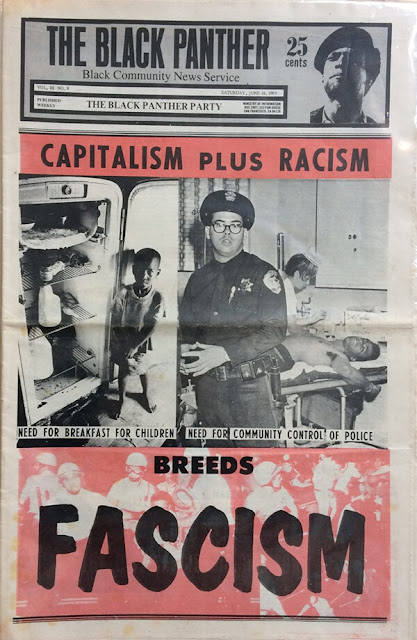

Emory Douglas’s work for The Black Panther newspaper, 1969.

Notwithstanding the national and conjunctural mutability of fascism, Jackson provocatively claimed that (economic) reform could be identified as “a working definition of fascist motive forces,” one that was particularly apt for the political expressions of US monopoly capital.

In Angela Y. Davis’s concurrent analysis, the carceral, liberationist perspective on fascism is both further refined and shifted. For Davis, American fascism in the early 1970s took what was best described as a preventive and incipient form. The terminology was borrowed and adapted from her former teacher Herbert Marcuse. In a 1970 interview with Hans Magnus Enzensberger, Marcuse had proposed inverting the customary political sequence that would see fascism as reactive not just in social content but in temporal form—whether responding immediately to a potentially triumphant revolutionary upsurge or, in a mediated way, to an already defeated or ebbing challenge to capitalism. It is not reaction but anticipation that animates this new figure of fascism. As Marcuse tells Enzensberger:

I believe that there is something like preventative fascism. In the last ten to twenty years we’ve experienced a preventative counter-revolution to defend us against a feared revolution, which, however, has not taken place and doesn’t stand on the agenda at the moment. In the same way preventative fascism comes about.

The question of the possibility of fascism in the United States, much debated by liberation movements and the far left throughout the seventies and into the eighties, is for Marcuse deeply entangled with the concrete forms taken by “preventative counterrevolution” as a core strategic imperative of the capitalist establishment, as well as its specific modalities of “preventive counter-violence.”

The specificity of this anticipatory logic is also closely linked to the distinctive disanalogies between this “incipient fascism” and its interwar European precursors. As Marcuse reflects:

The question is whether fascism is taking over in the United States. If by that we understand the gradual or rapid abolition of the remnants of the constitutional state, the organization of paramilitary troops such as the Minutemen, and granting the police extraordinary legal powers such as the notorious no-knock law which does away with the inviolability of the home; if one looks at the court decisions of recent years; if one knows that special troops—so-called counterinsurgency corps—are being trained in the United States for possible civil war; if one looks at the almost direct censorship of the press, television and radio: then, as far as I’m concerned, one can speak with complete justification of an incipient fascism … American fascism will probably be the first which comes to power by democratic means and with democratic support.

Fascism here defines a set of repressive tactics, as well as an encompassing political and ideological process, which differentially targets racialized and subaltern populations whose very existence and sociality are perceived as a threat—whence the porous borders between the “criminal” and the “political prisoner.” It is a process in which—to borrow from Jackson’s characterization of the “oppressive contract” underlying US capitalism—“accrual of contempt [for the oppressed] is [a] fundamental survival technique.”Davis develops the Marcusean thesis that “fascism is the preventive counter-revolution to the socialist transformation of society,” specifying that transformation from the vantage point of the lived experience of racialized communities in the United States. For the state, the most threatening feature of Black revolutionary politics takes the form not so much of the armed struggle invoked by Jackson but of the “survival programs,” the enclaves of autonomous social reproduction practiced by the Black Panthers and other militant and activist groups. What can be gleaned from Davis’s account more broadly are the differential visibility and experience of both fascism and democracy. In this regard, it can help to attune us to the ways in which race and gender, alongside class, can also determine the modality in which fascism is lived.There is a kind of everyday fascism that marks the interaction of people of color with the state, and which, while acting as the repressive infrastructure of a liberal democracy still steeped in the legacies of white supremacy, also signals the possibility or tendency to generalize incipient or preventive fascism to the population at large. As Davis warns, fascism in the early 1970s is “primarily restricted to the use of the law-enforcement-judicial-penal apparatus to arrest the overt and latent-revolutionary trends among nationally oppressed people, tomorrow it may attack the working class en masse and eventually even moderate democrats.” But the latter are, alas, unlikely fully to perceive this phenomenon, both because of the making invisible of its site—carceral space with its “totalitarian aspirations”—and the dilated character of its unfolding, of its time. The kind of fascism diagnosed by Davis is a “protracted social process,” whose “growth and development are cancerous in nature.”

Davis’s analyses direct us to the prison as a racialized enclave or laboratory for the fascistic strategies and tactics of counterrevolution, which are in turn understood in terms of a molecular social process. Both spatially and temporally, the perception of fascist realities and potentialities is occluded by the opacity of their social and political infrastructure. As Davis would later write, in the context of her abolitionist activism:

The dangerous and indeed fascistic trend toward progressively greater numbers of hidden, incarcerated human populations is itself rendered invisible. All that matters is the elimination of crime—and you get rid of crime by getting rid of people who, according to the prevailing racial common sense, are the most likely people to whom criminal acts will be attributed.

Dylan Rodriguez has powerfully captured the originality and challenge of the “fascism problematic” that Davis and Jackson forged out of the political violence of confinement. Notwithstanding their partially divergent evaluations, in naming a fascist present in the United States (whether incipient or accomplished) they share in “a theoretical and symbolic political gesture that fosters an epistemological break from the common sense of U.S. white supremacy and the regime of state violence on which it is premised.” This gesture is twofold. On the one hand, it anchors racial, carceral, and counterinsurgent violence in political economy—not just by identifying the instrumentality of brutal repression in the reproduction of class relations, but by amplifying the Fanonian insight that we should consider violence “as a primary and productive (rather than merely repressive) articulation of particular social formations.” On the other, the reformulation of the fascist problematic from the vantage point of racialized political incarceration has the lasting virtue of troubling the facile if ideologically inescapable opposition of fascism and (liberal) democracy. As Rodriguez pointedly asks: “How might our political understanding of the United States be altered or dismantled if we were to conceptualize fascism as the restoration of a liberal hegemony, a way out of crisis, rather than as the symptom of crisis or the breakdown of ‘democracy’ and ‘civil society’?”

As ever, rearticulating the analysis and etiology of fascism also inflects the strategic imaginary of anti-fascism:

The dynamic, strategic relations of violence condensing within the American social formation at different times and in different places are neither accidental nor excessive, and the challenge of this reconceptualized fascism problematic is to comprehend the socially reproductive capacities of coercive technologies and (proto-)genocidal practice within the current order.

From a complementary angle, Nikhil Pal Singh has illuminated the historical nexus between the “preventive wars” waged by US imperialism and the fascist potentialities inherent to settler-colonialism and chattel slavery. As he writes:

Poet Langston Hughes once described the casualties of U.S. expansion, slavery, and segregation as the victims of “our native fascisms”; as careful scholars affirmed, fascism was largely a deviation of democratic regimes. Thus, while democratic liberalism continually reimagines fascism as its monstrous Other, fascism might be better understood as its doppelganger or double—an exclusionary will to power that has regularly re-emerged, manifesting itself in: (1) those zones of internal exclusion within liberal-democratic societies (plantations, reservations, ghettos, and prisons); and (2) those sites where liberalism’s expansionist impulse and universalizing force has been able to evade its own “constitutional restraints” (the frontier, the colony, the state of emergency, the occupation, and the counter-insurgency).


Gary Simmons, Recapturing Memories of the Black Ark (2014–ongoing).

Delving into racial and colonial fascisms—and into European “historical fascism” as “the last major drive for European colonial ventures in the twentieth century”—makes intelligible the superficially paradoxical notion of a “fascist freedom” (and the subjectivities of the Herrenvolk liberals and democrats who promote it).

If fascism is also a product of the long history of “race wars,” then we cannot understand the fascist potentials of US nativism without attending, as Singh does, to the Indian Wars, and to the ways in which the settler-colonial organization of dispossessive violence vested “ordinary citizens with an expansive police power.”

Unlike classical European fascisms, US racial and settler-colonial fascism does not manifest univocally as the apotheosis of sovereignty, as a jackbooted Leviathan. Rather, as Singh observes:

The construction of racist individualism and settler freedom that distinguished the Jacksonian democracy idealized by [Steve] Bannon, for instance, encouraged a slackness of centralized government control tethered to a violence exercised at its borders and margins, something that seemed chaotic, unstable, and disordered from the controlling seat of power. Considered in these terms, the Trump administration hardly needs organized paramilitaries to do its bidding, given the normative, historical, and institutional ways in which police powers in the United States operate as delegated and sovereign prerogatives to master and control indigenous and exogenous others.


Notes:

On Toni Morrison’s reflections on fascism, see Roderick Ferguson’s illuminating essay “We Cannot Be the Same After the Siege,” Allies, ed. Ed Pavlić et al. (Boston Review, 2019). See also Ferguson’s powerful call for an anti-fascist politicization grounded in queer-of-color critique in “Authoritarianism and the Planetary Mission of Queer of Color Critique,” Safundi: The Journal of South African and American Studies 21, no. 3 (2020).

Mike Baker and Evan Hill, “Police Say an Antifa Activist Likely Shot at Officers. His Gun Suggests Otherwise,” New York Times, April 10, 2021.

The recent New York Review of Books debate featuring Peter E. Gordon, Sam Moyn, and Sarah Churchwell provides an informative panorama of positions on this question. Peter E. Gordon, “Why Historical Analogy Matters,” New York Review of Books, January 7, 2020; Samuel Moyn, “The Trouble with Comparisons,” New York Review of Books, May 19, 2020; Sarah Churchwell, “American Fascism: It Has Happened Here,” New York Review of Books, June 22, 2020.

Cedric J. Robinson, “Fascism and the Response of Black Radical Theorists,” in Racial Capitalism, Black Internationalism and Cultures of Resistance, ed. H. L. T. Quan (Pluto, 2019), 149.

Quoted in Bill Schwartz, “George Padmore,” in West Indian Intellectuals in Britain, ed. Bill Schwartz (Manchester University Press, 2003), 141–2. Though unlike Padmore he maintained his fealty to Soviet Communism, R. Palme Dutt also discerned the continuities between European fascism and Empire: “In the poems of a Kipling, in the Boer War agitation of a Daily Mail, in the war dictatorship of a Lloyd George riding roughshod over constitutional forms and driving to the aim of a ‘Knock-out Blow,’ the spirit of Fascism is already present in embryonic forms.” R. Palme Dutt, Fascism and Social Revolution (Lawrence & Wishart, 1935), 240. See also Alfie Hancox, “Fascisation as an Expression of Imperialist Decay: Rajani Palme Dutt’s Fascism and Social Revolution,” Liberated Texts, March 23, 2021.

“Every colonial nation carries the seeds of fascist temptation in its bosom. What is fascism, if not a regime of oppression for the benefit of a few?” Albert Memmi, The Colonizer and the Colonized (1957; Earthscan, 2003), 106–7; Walter Rodney, How Europe Underdeveloped Africa (1972; Verso, 2018), 243.

Langston Hughes, “Too Much of Race,” Crisis 44, no. 9 (September 1937), 272. See also the poem “Beaumont to Detroit: 1943,” whose final lines are: “How long I got to fight / BOTH HITLER—AND JIM CROW.”

I borrow the term “racial fascism” from Baraka, who crucially posits a violent dialectic between the dynamics of racial domination in the United States and imperialism, a theme that Du Bois himself had powerfully underscored as early as “The African Roots of War” (1915): “Andrew Johnson’s point position in overthrowing Reconstruction and imposing a racial fascism on Afro America and the Afro American people readied the whole of the U.S. nation for imperialist rule, which today has moved to complete control of the entire nation.” Amiri Baraka, “Black Reconstruction: Du Bois & the U.S. Struggle for Democracy & Socialism,” Conjunctions, no. 29 (1997): 78.

Harry Harootunian, “A Fascism for Our Time,” Massachusetts Review, 2021. Harootunian details the “founding oligarchical intentions” and constitutional constructions that, in conjunction with the material histories of racial capitalism, have seeded sui generis fascist potentials into the US body politic and its ruling institutions.

Jean Genet, “May Day Speech,” in The Declared Enemy: Texts and Interviews, trans. Jeff Fort, ed. Albert Dichy (Stanford University Press, 2004), 38.

On anti-imperialist anti-fascism as coalitional politics among people of color in the United States, see also the fascinating essay by Michael Staudenmaier, “‘America’s Scapegoats’: Ideas of Fascism in the Construction of the US Latina/o/x Left, 1973–83,” in “Fascism and Anti-Fascism Since 1945,” special issue, Radical History Review, no. 138 (October 2020).

See for instance the dossier on “new fascism, new democracy” organized by Maoist militants around the newspaper La Cause du peuple in Les Temps modernes, no. 310 (1972), especially André Glucksmann’s article “Fascisme: L’ancien et le nouveau.” For the French Trotskyist debate, see Jean-Marie Brohm et al., Le gaullisme, et après? État fort et fascisation (François Maspero, 1974). The best critical appraisal of theories of fascism in the US revolutionary left in the 1970s is Noel Ignatin (Ignatiev), “Fascism: Some Common Misconceptions,” Urgent Tasks, no. 4 (1978)

George Jackson, Blood in My Eye (1972; Penguin, 1975), 121–22. For a contemporary theoretical discussion of Jackson’s theses, see ARM (Association for the Realization of Marxism), “George Jackson, Monopoly Capitalism and the Fascist Type of State,” The Black Liberator 2, no. 3 (1974–75).

Jean-Paul Sartre, “A Plea for Intellectuals,” in Between Existentialism and Marxism (Basic Books, 1974), 256.

Jacques Derrida, “Letter to Jean Genet (fragments),” Negotiations, ed. and trans. Elizabeth Rottenberg (Stanford University Press, 2002), 43. See also Mikkel Bolt Rasmussen, “Yes Of Course … Derrida to Genet on Commitment in Favor of Jackson,” New Formations, no. 75 (2012); Tyler M. Williams, “Derrida and the Censorship of Literature,” New Centennial Review 20, no. 1 (2020).

Aimé Césaire, Discourse on Colonialism, trans. Joan Pinkham (Monthly Review Press, 2001), 36. Where Pinkham translates “boomerang,” the original French speaks of a “choc en retour,” a “recoil,” “return shock,” or “backlash.”

Bill V. Mullen and Christopher Vials, editorial introduction to Penny Nakatsu, “Speech at the United Front against Fascism Conference (1969),” in The US Antifascism Reader, ed. Mullen and Vials (Verso, 2020), 271. See also the discussion of the “spatial metaphor” of fascism in Christopher Vials, Haunted by Hitler: Liberals, the Left, and the Fight Against Fascism in the United States (University of Massachusetts Press, 2014).

Jackson, Blood in My Eye, 124, 125.
Jackson, Blood in My Eye, 125.
Jackson, Blood in My Eye, 126.

Theodore W. Allen, The Invention of the White Race, vol. 2, The Origin of Racial Oppression in Anglo-America (Verso, 2012).

Jackson, Blood in My Eye, 148.

Jackson, Blood in My Eye, 158. See also Kathleen Cleaver, “Racism, Fascism, and Political Murder,” The Black Panther, September 14, 1968, 8.

Herbert Marcuse, “USA: Questions of Organization and the Revolutionary Subject,” The New Left and the 1960s: Collected Papers of Herbert Marcuse, vol. 3, ed. Douglas Kellner (Routledge, 2005), 138. The notion of preventive counterrevolution had been used to define fascism in the Italian anarchist Luigi Fabbri’s La contro-rivoluzione preventiva: Riflessioni sul fascismo (L. Cappelli, 1922). See also R. Palme Dutt, Fascism and Social Revolution (Wildside Press, 2020), 123.

Étienne Balibar, “Outlines of a Topography of Cruelty: Citizenship and Civility in the Era of Global Violence,” Constellations 8, no. 1 (2001): 16.

Marcuse, “USA,” 137–38. The question of fascism’s new modalities is a leitmotif in the writings of Marcuse’s last decade. Sometimes he stresses, as in this passage, the objective possibility of a new fascism; at others, he soberly notes the limited if real freedoms that residually obtain in liberal capitalist democracies. See also Herbert Marcuse, “Le Monde Diplomatique” (1976), in Marxism, Revolution and Utopia: Collected Papers of Herbert Marcuse, vol. 6, ed. Douglas Kellner and Clayton Pierce (Routledge, 2014), 360.

Jackson, Blood in My Eye, 162.

Angela Y. Davis and Bettina Aptheker, “Preface,” in If They Come in the Morning: Voices of Resistance, ed. Angela Y. Davis (1971; Verso, 2016), xiv. See also Angela Y. Davis, “Political Prisoners, Prisons and Black Liberation,” in If They Come in the Morning, 37.

Half a century on, Davis insists on the relevance of the category of fascism, and its character as a reaction to Black liberation struggles. See “Interview with Angela Y. Davis,” in Revolutionary Feminisms: Conversations on Collective Action and Radical Thought, ed. Brenna Bhandar and Rafeef Ziadah (Verso, 2020), 209–10. Davis’s principal reference in her discussion of fascism remains Marcuse, especially his 1934 essay “The Struggle against Liberalism in the Totalitarian View of the State.”

Davis, “Political Prisoners, Prisons and Black Liberation,” 41.

Davis, “Political Prisoners, Prisons and Black Liberation,” 44.

Davis and Aptheker, “Preface,” xv; Davis, “Political Prisoners, Prisons and Black Liberation,” 41.

Angela Y. Davis, “Race and Criminalization: Black Americans and the Punishment Industry,” in The Angela Y. Davis Reader, ed. Joy James (Blackwell Publishers, 1998), 63. Cited in Dylan Rodriguez, Forced Passages: Imprisoned Radical Intellectuals and the U.S. Prison Regime (University of Minneapolis Press, 2006), 141.

Rodriguez, Forced Passages, 117.
Rodriguez, Forced Passages, 130.

Rodriguez, Forced Passages, 137. For a provocative exploration of the superimposition of fascism and liberal legality under late-capitalist crisis conditions, see Antonio Negri, “Fascismo e diritto: un esperimento di metodo,” in Macchina tempo: Rompicapi Liberazione Costituzione (Feltrinelli, 1982). See also “Interview with Toni Negri (1980),” in Revolution Retrieved: Writings on Marx, Keynes, Capitalist Crisis and New Social Subjects (1967–1983) (Red Notes, 1988), 122.

Rodriguez, Forced Passages, 140–41.

Nikhil Pal Singh, “The Afterlife of Fascism,” South Atlantic Quarterly 105, no. 1 (2006): 79.

Tiago Saraiva, Fascist Pigs: Technoscientific Organisms and the History of Fascism (MIT Press, 138). Saraiva’s book is an immensely original and methodologically rich study of fascism in its settler-colonial dimensions, drawing critically on studies of science and technology.

Nikhil Pal Singh, Race and America’s Long War (University of California Press, 2017), 26.

Singh, Race and America’s Long War, 172–73. The juridical devices for the dispossession and racialization of Indigenous people in the United States in turn played a formative role in Nazi legal thought, which extended Hitlerism’s self-identification as a white settler-colonial project (the Generalplan Ost as replica of Manifest Destiny) into racial laws forged after the US example. See James Q. Whitman’s enlightening Hitler’s American Model: The United States and the Making of Nazi Race Law (Princeton University Press, 2018).

Category

Fascism

Subject

Black Power, Black Studies, Revolution

Return to Issue #139


This text is excerpted from chapter 2 of Alberto Toscano, Late Fascism: Race, Capitalism and the Politics of Crisis, published by Verso this month


ABOUT THE AUTHOR:


Alberto Toscano teaches at the School ofCommunications, Simon Fraser University, and co-directs the Centre for Philosophy and Critical Theory at Goldsmiths, University of London. He is the author of Fanaticism: On the Uses of an Idea (Verso, 2010; 2017, 2nd ed.), Cartographies of the Absolute (with Jeff Kinkle, Zero Books, 2015), La abstracción real. Filosofia, estética y capital (Palinodia, 2021), and Terms of Disorder: Keywords for an Interregnum (Seagull, 2023). He is the co-editor of the 3-volume The SAGE Handbook of Marxism (with Sara Farris, Bev Skeggs and Svenja Bromberg, SAGE, 2022), Ruth Wilson Gilmore’s Abolition Geography: Essays in Liberation (with Brenna Bhandar, Verso, 2022), and Georges Bataille’s Critical Essays (with Benjamin Noys, Seagull, 2023). He is a member of the editorial board of the journal Historical Materialism: Research in Critical Marxist Theory and series editor of Seagull Essays and The Italian List for Seagull Books. He has also translated the work of Antonio Negri, Alain Badiou, Franco Fortini, and Furio Jesi.


© 2023 e-flux and the author

Monday, February 19, 2024

The Fundamental Crisis and Foundational Contradiction Facing the United States During the Upcoming Presidential Election Year of 2024: Fascism guided, informed, and enabled by the Doctrines and Practices of White Supremacy and Global Capitalism--PART 17

 
“What’s Past is Prologue…”

(Originally posted on December 7, 2020):

Monday, December 7, 2020


Dr. Robin D.G. Kelley On The Real Meaning of the 2020 National Presidential Election and the Profound Intellectual and Political Legacy of Dr. Cedric Robinson (1940-2016)
 
robinson
DR. CEDRIC J. ROBINSON (1940-2016)


https://bostonreview.net/.../robin-d-g-kelley-births-nation/

Politics
Race

Births of a Nation, Redux

Surveying Trumpland with Cedric Robinson

by Robin D. G. Kelley
November 5, 2020
Boston Review


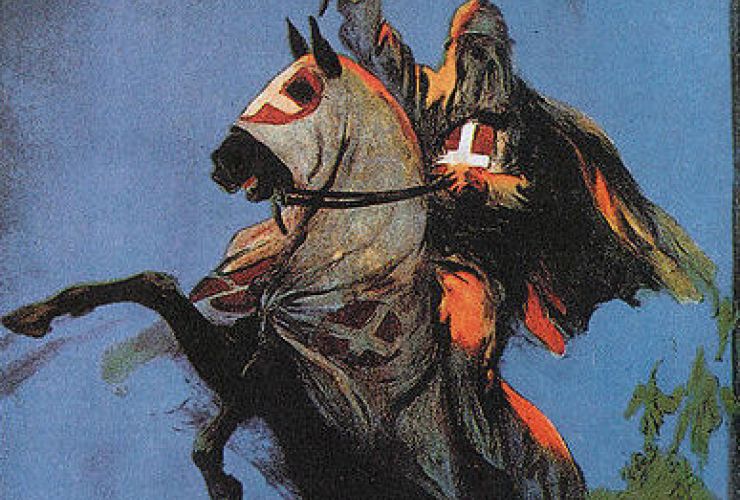
IMAGE: A promotional poster for the film 'Birth of a Nation' (1915)

I wrote the following essay, “Births of a Nation: Surveying Trumpland with Cedric Robinson,” in the wake of Trump’s 2016 victory, but it could have been written today—two days into a still unsettled presidential election; two days of witnessing frenzied, nail-biting, soul-searching Democrats wondering what happened to the blue wave and why 68 million people actually voted for Trump; two days of threats from the White House that they will fight in the courts and in the streets before giving up power. And today Cedric Robinson, pioneering scholar of what he called the “Black Radical Tradition,” would have celebrated his eightieth birthday.

Today Cedric Robinson would have celebrated his eightieth birthday. What Robinson identified as “the rewhitening of America” a century ago is what we’re seeing play out today.

The lessons I took from Cedric in the aftermath of Trump’s election still stand: our problem is not polling, or the failure of Democrats to mobilize the Black and Latinx vote (they came out, often at great risk to their health and safety), or a botched effort to reach working-class whites with a strong, colorblind class-based agenda. What Robinson identified as “the rewhitening of America” a century ago is what we’re seeing play out today.

But before reviving the tired race-versus-class debate, pay attention: Robinson was making an argument about racial regimes as expressions of class power and how racism undergirds class oppression. As I quoted Robinson before: “White patrimony deceived some of the majority of Americans, patriotism and nationalism others, but the more fugitive reality was the theft they themselves endured and the voracious expropriation of others they facilitated. The scrap which was their reward was the installation of Black inferiority into their shared national culture. It was a paltry dividend, but it still serves.” (The emphasis is mine.)

What we’ve seen is the consolidation of a racial regime based—as are all racial regimes—on “fictions” “masquerading as memory and the immutable.” Trump is saving white suburban women from Black rapists and drug dealers who want to take their Section 8 vouchers out to gated communities. He’s protecting our borders from “illegals” who have no claims whatsoever to this white man’s country. He’s shielding the nation from wicked critical race theorists and Howard Zinn with “patriotic education.” He responds to the assault on white supremacist mythologies by defending Confederate monuments. He dispatches federal military forces to crush antiracist protests and declares Kyle Rittenhouse a patriot for killing two unarmed Black Lives Matter protesters. And he dusts off the tried and true strategy of labeling all challengers to the regime “communists and socialists.” (When Biden brags “I beat the socialists!” and “I am the Democratic Party,” he plays right into the regime’s fictions—he is the neoliberal moderate taking back the country from rioters, fascists, and socialists.)

We keep telling ourselves that Trump was elected as a backlash to a Black president, but really he was elected as a backlash to a Black movement. President Obama presided during the killing of Mike Brown, Tamir Rice, Tanisha Anderson, Philando Castile, Alton Sterling, Freddie Gray, Sandra Bland—ad infinitum. It was the mass rebellion against the lawlessness of the state—in Ferguson, in Baltimore, in Chicago, in Dallas, in Baton Rouge, in New York, in Los Angeles, and elsewhere—that prompted Trumpian backlash.

We keep telling ourselves that Trump was elected as a backlash to a Black president, but really he was elected as a backlash to a Black movement. Fear and racism feed off of insecurity.

The massive vote for Trump and his fascist law-and-order rhetoric should also be seen as a backlash to a movement. Some of us believed Black Spring rebellion in the wake of the murders of George Floyd, Breonna Taylor, and Ahmad Arbery signaled a national reckoning around racial justice. But rather than reverse the rewhitening of America, our struggles catalyzed and concretized the racial regime’s explicit embrace of white power. Once again, an unstable ruling class drapes itself in white sheets, puts on its badge and brings out its guns. Fear and racism feed off of insecurity. And in the face of a global pandemic, joblessness, precarity, and an economy on the verge of collapse, this paltry dividend still serves.

If we’d paid attention, we wouldn’t have expected a Biden landslide or a blue wave ripping the Senate from Kentucky’s Mitch McConnell grip. It is not a coincidence that Louisville is on fire over the murder of Breonna Taylor and countless others who died at the hands of police in McConnell’s state. Kentucky has always been a battleground. California is too, and we’re not necessarily winning. Voters just defeated affirmative action, rent control, and the labor rights of gig workers. And despite some important victories, California delivered a lot of votes to Trump. We need to face the fact that our entire country, and the world, is a battleground. Trump and McConnell have succeeded in packing the Supreme Court with reactionaries. Trump’s backers still run the Senate. Gun-toting men and women in red hats stand outside vote-tabulating centers, threatening to do whatever is needed to secure a Trump victory. They yell “stop the count.”

Even with a Biden victory, the failure of the blue wave will be attributed in part to a certain kind of identity politics—Black and Latinx voter turnout less than what was expected—or to the militancy of antiracist protests, or to left-leaning candidates who scared off white moderates by pushing for single-payer healthcare and a Green New Deal. We should not see these as problems for legitimate Democrats. We’ve been witnessing authentic small-d democracy in action. In the streets we’ve seen a movement embrace Black, Brown, and Indigenous people, queer feminism, and a horizontal leadership model that emphasizes deliberative, participatory democracy.

We have an electoral college, battleground states, and voter suppression because the U.S. political order was built on anti-democracy.

This is the democracy Cedric Robinson insisted we embrace. He reminded us that the U.S. political order was built on anti-democracy, a theory of so-called enlightened governance that excludes the popular classes. This is why we have an electoral college, why we have battleground states, and why voter suppression was built into our country’s DNA. As I wrote three years ago, “today’s organized protests in the streets and other places of public assembly portend the rise of a police state in the United States. For the past five years, the insurgencies of the Movement for Black Lives and its dozens of allied organizations have warned the country that unless we end racist state-sanctioned violence and the mass caging of black and brown people, we are headed for a fascist state.”

We’re already here. And there is no guarantee that a Biden-Harris White House will succeed in completely reversing this trend. Nor should we expect presidents and their cabinets to do this work. That would put us back where we started—with tacit acceptance of the principles of anti-democracy.

Cedric’s words from exactly twenty years ago still haunt: “For the moment . . . an unelected government has seized illegal powers. That must be opposed with every democratic weapon in our arsenal.”

Happy Birthday, Dr. Robinson.
March 6, 2017

Cedric Robinson was fond of quoting his friend and colleague Otis Madison: “The purpose of racism is to control the behavior of white people, not Black people. For Blacks, guns and tanks are sufficient.” Robinson used the quote as an epigraph for a chapter in Forgeries of Memory and Meaning (2007), titled, “In the Year 1915: D. W. Griffith and the Rewhitening of America.” When people ask what I think Robinson would have said about the election of Donald Trump, I point to these texts as evidence that he had already given us a framework to make sense of this moment and its antecedents.

Robinson’s work—especially his lesser-known essays on democracy, identity, fascism, film, and racial regimes—has a great deal to teach us about Trumpism’s foundations, about democracy’s endemic crises, about the racial formation of the white working class, and about the significance of resistance in determining the future.

"Through the intervention of film, a new American social order was naturalized."
—Cedric J. Robinson

In 1915 William Joseph Simmons, an ex-preacher who made his income selling memberships in fraternal organizations, led a group of his friends atop Stone Mountain, just outside of Atlanta, burned a giant cross, and launched the revival of the Ku Klux Klan. His inspiration: seeing The Birth of a Nation, D. W. Griffith’s three-hour paean to the original Klan. Simmons believed the new Klan could make America great again by purging it of un-American influences: Negroes, immigrants (except for those of Anglo and Scandinavian stock), Catholics, and Jews. Under the slogan “100 percent Americanism,” the Klan pursued a program of severe immigration restriction, allegiance to the American flag, anti-communism, protecting white womanhood (and “correcting” wayward women who transgressed gender conformity, Protestant values, and the color line), better government, and law and order, while also engaging in lynching and open acts of terrorism against black people. The second Klan appears to be a ball of contradictions—antagonistic to both big business and industrial unions, contemptuous of both elites and a huge swath of the working class (the non-white and foreign-born). But as historian Sarah Haley recently argued, the Klan—whose membership rolls swelled to four million by 1924—mobilized a precarious middle class of small entrepreneurs, white-collar workers, and farmers facing the prospect of downward mobility and seeking hope in the elimination of the most marginalized segments of society.

Cedric Robinson has a great deal to teach us about Trumpism and the significance of resistance in determining the future.

In Forgeries of Memory and Meaning, Robinson explains why Griffith’s film catalyzed this movement. This was no ordinary film. Based on Thomas Dixon’s novel The Clansman (1905), it consolidated and circulated old racial fabulations and new fictions in the service of capitalist expansion and modern white supremacy—in the United States and abroad. The Birth of a Nation was historical alchemy, turning terrorists into saviors, rapists into chivalrous protectors of white women and racial purity, and courageous and visionary blacks into idle, irresponsible ignoramuses, rapists, and jezebels. Black people were not only unfit for democracy but they threatened social order. President Woodrow Wilson (who screened Griffith’s film at the White House) praised it as American history written with lightning—and like lightning, its historical reworking had an obliterating effect on truth. Robinson identified it as a “rewhitening of America,” a gallant effort to obliterate all vestiges of the black struggle for social democracy during Reconstruction.

For Robinson, 1915 marked the formation of a new “racial regime.” With the term, Robinson meant:

"Constructed social systems in which race is proposed as a justification for the relations of power. . . . [T]he covering conceit of a racial regime is a makeshift patchwork masquerading as memory and the immutable. Nevertheless, racial regimes do possess history, that is, discernible origins and mechanisms of assembly. But racial regimes are unrelentingly hostile to their exhibition. This antipathy exists because a discoverable history is incompatible with a racial regime . . . [and its] claims of naturalism.”

Racial regimes, in other words, are fictions. As such, they are unstable, fragile, and contested. The scramble to prove black inferiority and buttress white racial democracy in the era of Jim Crow was no cakewalk. The previous era had unleashed the possibility of radical change in the United States, and that struggle continued well into the twentieth century, when armed insurrection, political assassination, lynching, disfranchisement, imperialism, and federal complicity in the triumph of white supremacy destroyed the last sigh of black-led biracial democratic, populist, and radical movements.

Robinson lays out in great detail all the sites of contestation in 1915, and all the operations the new racial regime masked in the process. He reminds us that Griffith’s champion, Wilson, had opened the far Western Front of World War I when the United States invaded Haiti in 1915, long before the declaration of war on Germany. That intervention and long occupation (until 1934)—driven by U.S. finance capital—also required historical alchemy. The United States, the cause of much of Haiti’s political and economic instability, had to see itself as the country’s rescuing white knight. In the white American imagination, Haitians—like those blackface brutes in The Birth of a Nation—were seen as coons, niggers, and malevolent witchdoctors incapable of self-governance.

That May, W. E. B. Du Bois published “The African Roots of War” in Atlantic Monthly, a brilliant, prescient essay overshadowed by his folly three years later when he exhorted blacks to “close ranks” behind America’s official entry into World War I. The essay not only reveals a global racial regime in which “the white workingman has been asked to share the spoil of exploiting ‘chinks and niggers,’” but argues that we will never rid the world of war nor achieve democracy until we eradicate racism and colonialism. And who could lead the struggle to topple this rapacious system? None other than the descendants of “the European slave trade . . . the ten million black folk of the United States, now a problem, then a world salvation.”

The stage was set: D. W. Griffith’s New Nation versus the New Negroes. The latter resisted with pickets and boycotts, speeches and editorials, scholarship and art, and outright rebellion. They exposed the racial regime for what it was, the tyranny of white supremacy masquerading as enlightened democracy. The former, backed by finance capital and the academy, manufactured the Negro as Problem, a campaign accelerated through newer technologies of mass media. Film—whether newsreel footage of U.S. Marines entering Port-au-Prince or Griffith’s robed Klansmen saving the virginal Elsie Stoneman from the clutches of a rapacious mulatto—can mask and reorder social reality, turning victims into perpetrators and transforming imperialism into a rescue operation.

Robinson demonstrates that the post-Reconstruction order was not a return to the antebellum but a new racial and economic order that deployed a reinvention of the past in the service of a new regime. If new media played a key role, print was also crucial to this campaign. In 1916 The Passing of the Great Race, eugenicist Madison Grant’s chilling case for racial cleansing, became a national bestseller. Adolf Hitler praised the book as foundational to his own thinking. Grant’s book had plenty of company in the decade, including Robert W. Shufeldt’s America’s Greatest Problem: The Negro (1915) and Lothrop Stoddard’s The Rising Tide of Color Against White World Supremacy (1920). White supremacy traverses the ideological spectrum, even now. Many foundational texts of the Progressive Era’s racial regime were penned by liberal social scientists obsessed with the challenges of race and empire for American democracy. Many shared the eugenicists’ presumption that democracy’s survival depends on the suppression of difference.

Racial regimes are fictions, unstable, fragile, and contested.

Franklin H. Giddings, in his 1901 book Democracy and Empire, coined the phrase “democratic empire” to suggest that imperial expansion was itself a democratizing project. It was more than just the introduction of modern infrastructure, Western education, and civilization. It was the creation of social cohesion through the rapid assimilation of subject peoples. Giddings insisted that social cohesion or some sense of solidarity is a precondition of democracy, and racial difference renders such solidarity improbable if not impossible. Sociologist John Moffatt Mecklin, a self-proclaimed Progressive liberal, published Democracy and Race Friction: A Study in Social Ethics the year before the release of The Birth of a Nation. He argues that racism and discrimination undermine democracy, but at the same time puts much of the blame on the cultural differences and “hereditary instincts” of non-whites (e.g., weak powers of inhibition, criminality, inability to control sexual impulses). Thus, while recognizing racism as a fetter on democracy, he nonetheless apologizes for white supremacy, arguing that blacks and whites have very different value systems. White supremacy is therefore a “form of self-preservation.” (He is silent on whether lynching and rape were “moral” elements of self-preservation.) The solution? Mecklin believed “industrial competition” will allow the laws of natural selection to determine the fate of non-whites, producing the “ethnic homogeneity” necessary for “an efficient democracy.”

While these texts were influential, Griffith’s masterwork and films that followed in its wake proved indispensable for installing the modern racial regime. The consequences, however fragile, were devastating—not just for African Americans but for working-class whites. As Robinson writes, Griffith and this emergent film industry constituted the social and cultural platform for a robust economic and political agenda; an agenda in the process of seizing domestic and international labor, land, and capital. . . . White patrimony deceived some of the majority of Americans, patriotism and nationalism others, but the more fugitive reality was the theft they themselves endured and the voracious expropriation of others they facilitated. The scrap which was their reward was the installation of Black inferiority into their shared national culture. It was a paltry dividend, but it still serves.

• • •

"I love the poorly educated."
—Donald J. Trump

The dividend still serves. Many who voted for him, including those of the alt-right, flocked to Trump because he villainized immigrants, black people, and anti-patriotic business moguls who sent jobs overseas. Most pundits insist that Trump appeals not to white racism but to working-class populism driven by class anger. If this were true, why didn’t Trump win over droves of black and brown voters, since they make up the lowest rungs of the working class and suffered disproportionately more than whites during the financial crisis of 2008? Instead Trump’s victory inspired a wave of racist attacks and emboldened white nationalists to flaunt their allegiance to the president-elect.

The response on the part of high-profile liberals and leftists has been to blame “identity politics” for undermining the potential for working-class solidarity. Mark Lilla’s New York Times screed, “The End of Identity Liberalism,” is a case in point. “In recent years,” writes Lilla, “American liberalism has slipped into a kind of moral panic about racial, gender and sexual identity that has distorted liberalism’s message and prevented it from becoming a unifying force capable of governing.” The result is a “generation of liberals and progressives narcissistically unaware of conditions outside their self-defined groups, and indifferent to the task of reaching out to Americans in every walk of life.” In other words, people of color, queer folks, feminist-minded women, and liberal Democrats alienated the white working class, driving it into the arms of Trump.

Movements associated with “identity liberalism” are not exclusionary, they are serious efforts to interrogate the sources and structures of inequality.

The argument is both inept and confused. The movements associated with “identity liberalism” have not been obsessed with narrow group identities but with forms of oppression, exclusion, and marginalization. And these movements are not exclusionary—not Black Lives Matter, not prison abolitionists, not movements for LGBTQ, immigrant, Muslim, and reproductive rights. They are serious efforts to interrogate the sources of persistent inequality, the barriers to equal opportunity, and the structures and policies that do harm to some groups at the expense of others.

Of course, Lilla’s arguments are hardly new. At the height of the culture wars, conservatives such as Gertrude Himmelfarb, William Bennett, and Lynne Cheney; liberals such as Arthur Schlesinger and Allan Bloom; and self-styled leftists such as Todd Gitlin and Michael Tomasky argued that identity politics had undermined a unified America founded on Enlightenment principles of individualism, liberty, and secularism. A number of pundits have called Richard Rorty’s Achieving Our Country (1998) prophetic because it warns that continued downward mobility of the white working class and growing income inequality would lead to the rise of a strongman with authoritarian tendencies. Rorty’s thesis was not a critique of neoliberal policies, however, but a critique of the academic left and its love affair with identity politics. “Nobody is setting up a program in unemployed studies, homeless studies, or trailer-park studies,” Rorty laments, “because the unemployed, the homeless, and the residents of trailer parks are not ‘other’ in the relevant sense.” Anyone who works on these issues at the university—then and now—will find Rorty’s assertion laughable.

Rorty, a brilliant philosopher with genuine concern for working people, nevertheless mistook ideology—a categorical opposition to racism, sexism, homophobia, institutional oppression, and marginalization based on difference—for “identity politics,” while presuming that the white working class is operating purely out of race- and gender-neutral economic interests.

More conservative critics of identity politics sought to rescue Western culture from its anti-racist, feminist, and post-colonial critics. In his famous attack on multiculturalism, Arthur Schlesinger writes, “it was the West, not the non-Western cultures, that launched the crusade to abolish slavery. . . . Those many brave and humane Africans who are struggling these days for decent societies are animated by Western, not by African, ideals. White guilt can be pushed too far.” So far, in fact, that “political correctness” has been perceived as an attack on intellectual freedom and American virtues.

Robinson likened such antinomies to Christian attacks on heresy during the Middle Ages. In a short essay titled “Multiculturalism and Manichaeism,” he acknowledges what many critics of so-called “political correctness” understood: that the Schlesingers and Blooms and their compatriots across the ideological spectrum are holding on to “an imaginary transcendent universal culture—the West,” a nostalgia for a university that never was, and a mythic American identity presumably forged through an enlightened process of deracination. But Robinson knew there was more at stake. “They wish to erase the exposed seam,” he writes, “the nexus between power and regimes of knowledge so forcefully articulated by Michel Foucault. How else can one defend their specious histories of knowledge, which invoke some pristine mythical moment in the life of the American academy?”


This is not to say that Robinson’s defense of multiculturalist discourse was uncritical. He pointed to the dangers of an essentialism that reduces complex, historical experiences to fixed, discrete racial, ethnic, and gender identities. And to the left’s claim that Marxism is our way out of the Manichean world of fixed difference versus false universalism, Robinson politely demurred, citing arguments he made in Black Marxism a decade earlier. What he proposes instead is that a radical impulse in multiculturalism constitutes both a critique of the absences and an appropriation of the positive contributions of Marxism. We are not the subjects or the subject formations of the capitalist world-system. It is merely one condition of our being. . . . Multiculturalism, then, is a site of discursive resistance, and emblem of articulation of several trajectories of ‘objective’ opposition (religious, nationalist, feminist, etc.) mounted by our peoples in the everyday world.

• • •

"Democratic philosophy was subverted by plutocracy . . . whose rulers depended on the preservation of a slave economy, the exploitation of ‘white’ laborers (male and female), the severe restriction of women’s political rights, and the expropriation of Native Americans."
—Cedric J. Robinson

Opponents of Trumpism—and what it portends for the future of our democratic system—are scrambling to find both “the seed of opposition” and the roots of the crisis. Locating the elusive seed of opposition is a daunting task, but it seems that most people agree that repairing our broken democracy ought to be our priority.

Cedric Robinson had a lot to say about democracy—as a theory, an aspiration, and a fiction. As a child of World War II who came of age with the Cold War and the civil rights movement, he encountered the word “democracy” at every turn. Democracy was bandied about as an explanation for America’s frequent military excursions abroad, while at home it was an elusive dream for which black people were arrested, beaten, even killed.

Critics of so-called political correctness are holding on to an imaginary transcendent universal culture—the West.

Robinson studied democracy at the University of California, Berkeley, and fought for it as a leader of the campus naacp and as an activist in slate, a forerunner of the Berkeley Free Speech Movement. In the summer of 1962, he witnessed firsthand a struggle to create a multiethnic democracy in Southern Rhodesia crushed by the state. He was there under the auspices of Operation Crossroads—a precursor to the Peace Corps that sent student volunteers to Africa to help build libraries, schools, and community centers.

Founded by Harlem Presbyterian minister James H. Robinson and backed by the Rockefeller Brothers Fund, Operation Crossroads was also a Cold War project designed to combat communism and spread American democracy to the continent. During his month-long stay, Cedric watched the U.S.-backed regime led by the fascist Rhodesian Front violently repress and ultimately outlaw the Zimbabwe African People’s Union (zapu). Upon his return to Berkeley, Robinson enrolled in three political science courses, including one on African politics, in his quest to comprehend democracy, and he would go on to do graduate work in political science at San Francisco State University and at Stanford.

In an essay titled “African Politics: Progression or Regression?” written for a Stanford graduate seminar taught by David Abernethy (then a young scholar who wrote on popular education in Africa), Robinson argued that the newly “decolonized” territories in Africa were not yet nations. For him the “birth” of decolonialized African states required shedding Western political structures and creating their own political institutions. More provocatively, he suggests that the modern nation-state is, in fact, “a regression or step backward from the stateless societies of some earlier African history.” Here he begins to reveal the seeds of his argument in Black Marxism (1983) that the black petit bourgeoisie was disconnected from the political and cultural traditions that sustained anti-colonial movements in the past. He writes that those living in exile or European educated “have betrayed the heritage of their predecessors in the 19th and early 20th centuries,” indigenous leaders “who were committed through their own particular missions to the recovery of life with integrity for the mass of African people.” The alternative path he imagines is not based on modernization theory or industrialization but something different:

Perhaps what is needed are new political organisations without single or even multiple leaders, but with no leaders at all. . . . That is a sophisticated social organization; a primitive organization is one where the courts are filled with defendants bound and gagged or where its citizens must be shot down in the streets and terrorized in to fitful conformity.

Robinson never abandoned this radical utopian vision of democracy, although as the promise of the 1960s and ’70s faded into the revanchism of the 1980s and ’90s, he turned to the genesis of the “primitive organization” that became the U.S. political system. He traced the ideological roots of U.S. democracy back to the profoundly anti-democratic strain in Plato and Aristotle. For Robinson the “crisis” of democracy was not simply the result of the corrosive forces of neoliberalism but endemic from its very inception. His provocative essay “Slavery and the Platonic Origins of Anti-Democracy” (1995) locates the genesis of anti-democracy in The Republic, which accepts slavery and proposes a theory of enlightened governance that excludes the popular classes. Slavery in Plato’s politics was an immutable fact, the slave an inferior being bereft of reason and thus incapable of participating in democracy, let alone governing. “Plato’s political theory,” writes Robinson, “thus repressed the history of popular rebellion and with it the recognition that social agency might have its genesis from the general populace. Even in his ‘treatment’ of the degeneracy of democracy to tyranny, the demos is denied true agency through the selection of a demagogue.” Robinson wryly concludes, “In its antidemocratic plutocratic prejudice, the Republic provides an authority rich in intellectual strategems a propos to the political discourse embedded in the American political order. Plato survives because if he had not existed, he would have to be invented.”


It should come as no surprise that the founding fathers were avid readers of Plato and Aristotle, who were—along with Homer—the pillars of classical philosophy in the eighteenth and nineteenth centuries. Distrust of democracy was widespread. James Madison even positively described the new state as an “oligarchy.” Landholding, Madison insisted, had to be a requirement for participation in the body politic “as to protect the minority of the opulent against the majority.” The result, besides property requirements for voting, was the Electoral College. For some proponents, the Electoral College would be the enlightened check against the threat of an ignorant populace backing a demagogue as president. But it also guaranteed a pro-slavery White House. Basic to the college’s architecture was the Three-Fifths Compromise, the rule that congressional representation in the slave states would be apportioned by counting the white population along with 60 percent of enslaved people. The number of electors was to be equal to the number of representatives and senators from each state. This gave the slaveholding South an edge in presidential elections compared to other states, and that advantage lasted well after slavery ended, since the vast majority of black southerners were disfranchised after Reconstruction.

Ironically, critics of the Electoral College who believe Hillary Clinton should be president based on the popular vote are now invoking Alexander Hamilton’s idea of the “conscientious” elector who will buck party affiliation in order to make the enlightened choice. Hence, an anti-democratic institution is invoked as both the problem and solution, fueling the myth of American democracy’s singular genius while remaining “openly hostile to the periodic outbreaks of what it redundantly terms ‘participatory’ or ‘direct’ democracy.”


• • •


"When the performance of charismatic leadership stands in for building movements and relationships, for grassroots political education, and for a practiced commitment to disassembling social hierarchies, the promise of social justice and political empowerment is endangered by a formation of authority that limits our capacities to remake the world."
—Erica R. Edwards


In 2016, on the heels of the centennial celebration of D. W. Griffith’s The Birth of a Nation, the Sundance Film Festival screened a new film bearing the same title. Nate Parker, the young African American actor who wrote, directed, and starred in the film appropriated the title from Griffith as a deliberate provocation. His historical epic is about Nat Turner, the Virginia slave-turned-minister who led the bloodiest slave revolt in U.S. history. Like Griffith, Parker simultaneously revised history while reflecting and refracting current political realities. It is impossible to watch Parker’s The Birth of a Nation without recalling the recent wave of police killings and rage and resistance it has generated. Yet whereas Griffith’s racist epic made history, Parker’s film flopped. Revelations of Parker’s involvement in a sexual assault twenty years earlier dampened ticket sales, and cinematic representations of black rebellion tend to do poorly at the box office. But neither adequately explains the film’s epic failure.


In both Births, women are territory to be fought over, attacked, and defended. Whereas the Klan avenged the nation and their manhood by rooting out alleged black rapists, Turner and his men avenged their nation and their manhood for the rape of their women by white masters and overseers. As critic and historian Salamishah Tillett observed, Parker’s film thus silences black women, turning them into mute victims. “In denying these women their revolutionary gestures, Mr. Parker risks making them objects that he, and only he, can freely move around the screen.” Noting the film’s appearance during the height of black resistance to police violence, she adds that its emphasis on the male charismatic leader is “out of step” with the Movement for Black Lives and its largely black female leadership. I would add that the movement’s embrace of black queer feminism, its horizontal leadership model, and emphasis on deliberative, participatory democracy counter the film’s central vision.


For the past five years Black Lives Matter warned the country that unless we end racist state-sanctioned violence, we are headed for a fascist state.


Robinson understood the charismatic figure in insurgent movements as “the expression of a people focused onto one of their members . . . the responsive instrument of a people,” rather than the force or agent directing the people forward. This is certainly not how Parker portrayed Turner, which suggests that Robinson may have been sympathetic to Tillet’s reading of the film. But he would have also insisted that the female-led, horizontal formations resisting state violence today are not aberrations but consistent with the black radical tradition. H. L. T. Quan reminds us of the centrality women in Robinson’s historical archeology of black revolt. “Indeed,” Quan writes, “the women who people Robinson’s imagination are not the anorexic two-dimensional (mainstream) feminist heroines whom we often encounter in gender-related texts, but the plotters of history. They are women of substance, of imagination, of formidable social force, women who would kill and wage revolutions against the state and the world economy.”


Just as Nat Turner’s rebellion portended chattel slavery’s violent demise, today’s organized protests in the streets and other places of public assembly portend the rise of a police state in the United States. For the past five years, the insurgencies of the Movement for Black Lives and its dozens of allied organizations have warned the country that unless we end racist state-sanctioned violence and the mass caging of black and brown people, we are headed for a fascist state.


Others argue that fascism is already here. Refusing to play politics, they criticize both Democrats and Republicans. They have angered cops by insisting that no law officer is above reproach. Skeptical of courtroom justice, they have taken to the streets, social media, the press, and even the United Nations, placing the moral, ethical, and legal question about the value of black lives before the world court of opinion. The movement has also proposed a plan to divest from a society of punishment, inequality, environmental degradation, and white supremacy and invest in a future built on free education, healthcare, housing, living-wage jobs, decriminalization, restorative justice in lieu of caging, food justice, and green energy. We need to remember this before more angry liberals—forgetting the misogynist strain in white identity politics—blame the Movement for Black Lives for Clinton’s defeat and for mau-mauing white folks into the arms of Trump.


Those of us who lived through the Reagan era have seen these dynamics before, though on a smaller scale. Ronald Reagan’s election not only owed much to white working-class resentment and middle-class white homeowners seeking tax relief, but his ascent to office coincided with heightened police and vigilante violence. In 1979 in Greensboro, North Carolina, the Ku Klux Klan assassinated five members of the Communist Workers Party in broad daylight. In Mississippi in 1980, at least twelve African Americans were lynched. The same year at least forty racially motivated murders occurred in cities as diverse as Buffalo, Atlanta, and Mobile. Across the country, police killings and non-lethal acts of brutality generated protests, notably a massive urban rebellion in Liberty City, Florida. And during Reagan’s eight years in office, the number of hate crimes reported annually in the United States grew threefold. Faced with a dramatic rise in racism, unemployment, and homelessness, followed by deep cuts in social programs and increases in military spending, black resistance ramped up. The late historian and activist Manning Marable had even referred to 1980 as “The Red Year,” a revolutionary moment similar to 1919.


Robinson shared some of Marable’s optimism. It was, after all, the period in which he wrote Black Marxism, which compelled him to undertake a substantive study of fascism since the book’s three main subjects—W. E. B. Du Bois, C. L. R. James, and Richard Wright—were all radicalized during the 1930s. The dark times under Reagan resonated with his reading of the history of America’s support of fascism. For example, the American capitalist class was sympathetic to Benito Mussolini’s fascist regime. J. P. Morgan loaned Italy in excess of $100 million in 1926, and Fortune Magazine, the Saturday Evening Post, Business Weekly, and the New Republic all ran admiring spreads on Italian fascism up until the mid-1930s. Robinson’s central point was that the black masses not only anticipated the rise of fascism, they resisted before it was considered a crisis. Robinson called them “premature antifascists,” noting that they had stood in stark opposition to those elites enamored with fascism, “which gave primacy to the interests of the State as an instrument of racial ‘destiny.’”

Trump’s election does not signal the strengthening and consolidation of U.S. power but its decline. Contemporary resistance movements did not ensure Clinton’s defeat, but they did reveal the regime’s fragility. The Movement for Black Lives, Black Lives Mater, the Dream Defenders, Black Youth Project 100, We Charge Genocide, Million Hoodies, the Moral Mondays Movement, the uprisings in Baltimore and Ferguson—not to mention the immigrant rights movement, and the ongoing struggle in Standing Rock in defense of Native sovereignty and against the war on the planet—all presaged and accelerated the current crisis of the state.


Robinson teaches us that racial regimes are unstable. They can be disassembled, though that is easier said than done. In the meantime, we need to be prepared to fight for our collective lives. I can hear Cedric’s timely counsel in the aftermath of George W. Bush’s “fraudulent” defeat of Al Gore in 2000: “For the moment . . . an unelected government has seized illegal powers. That must be opposed with every democratic weapon in our arsenal.”


Robin D. G. Kelley


ABOUT THR AUTHOR:


Robin D. G. Kelley, Gary B. Nash Professor of American History at UCLA, is author many books including Africa Speaks, America Answers: Modern Jazz in Revolutionary Times and Freedom Dreams: The Black Radical Imagination.


TAGS: Politics Race Capitalism Justice Trump


IMAGE: A promotional poster for the film 'Birth of a Nation' (1915)