Showing posts with label Law and Politics. Show all posts

Tuesday, January 10, 2017

White Supremacy As Institutional Force and Public Policy in the Neofascist Regime of Donald Trump: The Insidious Nomination of Jeff Sessions for Attorney General of the United States

The notorious white supremacist, anti-immigrant, misogynist, and homophobic record of JEFF SESSIONS --Trump's new cabinet nominee for ATTORNEY GENERAL--
American Civil Liberties Union (ACLU)


Post from November 18, 2016:

ACLU National ‏@ACLU 2h2 hours ago
Here's the 23-page memo attorney general nominee Jeff Sessions created devoted to opposing immigrants 

http://www.sessions.senate.gov/…/immigration-primer-for-the… …

ACLU National ‏@ACLU 2h2 hours ago
Trump's attorney general nominee Jeff Sessions referred to the Voting Rights Act as a "piece of intrusive legislation."

ACLU National Retweeted

ACLU National ‏@ACLU 3h3 hours ago
Getting to know Jeff Sessions, Donald Trump's attorney general nominee


ACLU National ‏@ACLU 2h2 hours ago
Thomas Figures testified under oath that Sessions joked he thought KKK members were "OK, until he learned that they smoked marijuana."


ACLU National ‏@ACLU 2h2 hours ago
Trump's attorney general nominee Jeff Sessions said immigration reform will “benefit everyone but actual American citizens.”


ACLU National ‏@ACLU 2h2 hours ago
Attorney general nominee Jeff Sessions called for constitutional amendment to stop granting automatic citizenship to people born in the U.S.


http://www.huffingtonpost.com/…/trump-attorney-general-jeff…

POLITICS

Jeff Sessions Was Deemed Too Racist To Be A Federal Judge. He’ll Now Be Trump’s Attorney General.

He once joked that he only took issue with the KKK’s drug use and referred to civil rights groups as “un-American.”

November 17, 2016
by Ryan J. Reilly
Senior Justice Reporter
The Huffington Post


JEFF SESSIONS

WASHINGTON ― The man who President-elect Donald Trump will nominate as the 84th attorney general of the United States was once rejected as a federal judge over allegations he called a black attorney “boy,” suggested a white lawyer working for black clients was a race traitor, joked that the only issue he had with the Ku Klux Klan was their drug use, and referred to civil rights groups as “un-American” organizations trying to “force civil rights down the throats of people who were trying to put problems behind them.”
Sen. Jeff Sessions (R-Ala.), an early Trump supporter who has been playing a major role on the Trump transition team, met with the president-elect in New York on Thursday. In a statement, the Trump team said the president-elect was “unbelievably impressed” with Sessions.

On Friday morning, Trump and Sessions confirmed that Sessions had been offered the attorney general position.
J. Gerald Hebert remembers Sessions’ time as the top federal prosecutor in Mobile, Alabama, well. Speaking to The Huffington Post earlier this month, Hebert said he was stunned that an Attorney General Jeff Sessions is a possibility.

More than three decades ago, Hebert was in his 30s and working on voting rights cases for the Department of Justice’s Civil Rights Division. He was based in D.C. but spent time in Alabama working with Sessions, who was a U.S. attorney in Ronald Reagan’s administration.

“He was very affable, always wanting to have a conversation, a cup of coffee,” Hebert said. “Over the course of those months, I had a number of conversations with him, and in a number of those conversations he made remarks that were deeply concerning.”

After Sessions was nominated to be a federal judge in 1986, Hebert appeared before the Senate Judiciary Committee to testify about these remarks. It was unusual for a career DOJ lawyer to testify about a judicial nominee’s character, and Hebert said at the time that he did so with “very mixed feelings,” telling senators he considered Sessions “a friend.” Hebert told them Sessions had “a tendency to pop off” and that he was “not a very sensitive person when it comes to race relations.”

HuffPost reviewed a transcript of the Sessions’ 1986 confirmation hearings. In this selection, Hebert testified that he had once relayed comments about a white lawyer being described as a race traitor, and that Sessions had responded by saying “he probably is”: 

Congressional transcript

Sessions testified that he did not believe he had made such a remark, but his views changed as he reflected.


“The best I could recall was that I said, well, he is not that popular around town; I have heard him referred to as a disgrace to his race,” Sessions said. He said he did not personally believe that the white civil rights attorney was a race traitor, and that he had respect for him.

Sessions testified that he enjoyed the “free flow of ideas” and liked to stir it up with Hebert when he was in town. “I like to discuss things. I am open: I like to discuss with liberals better than I do with conservatives,” Sessions said.
In describing one conversation with Hebert on civil rights, Sessions articulated his view that things were pretty great for minorities in the 1980s and that civil rights organizations were asking for too much.

“I made the comment that the fundamental legal barriers to minorities had been knocked down, and that in many areas blacks dominate the political area, and that when the civil rights organizations or the ACLU participate in asking for things beyond what they are justified in asking, they do more harm than good,” Sessions testified.
That’s not exactly how Hebert recalled it:

Congressional transcript


Sessions also called the American Civil Liberties Union and NAACP “communist-inspired,” Hebert testified.

Thomas Figures, a former assistant U.S. attorney, backed up Hebert’s testimony about Sessions’ views. He told Congress that Sessions said the NAACP, the Southern Christian Leadership Conference, Operation Push and the National Council of Churches “were all un-American organizations teaching anti-American values.”
“I recall saying that civil rights organizations, when they demand more than is legitimate, it hurts their position,” Sessions testified. 

Figures, who died last year, also said that Sessions once warned him to “be careful what you say to white folks” after Figures told a white secretary that he found a comment she made offensive. Figures was the only black assistant U.S. attorney in the office.

“Had Mr. Sessions merely urged me to be careful what I say to ‘folks,’ that admonition would have been quite reasonable,” Figures said. “But that was not the language that he used. I realize, on the other hand, that Mr. Sessions’ remark may not have been premeditated. There was a period in our own lifetimes when blacks where regularly admonished to be particularly polite or deferential, and a remark of that sort may have just slipped out inadvertently.”

Figures also testified that Sessions and two others in the office referred to him as “boy.” Figures said he couldn’t say anything about it to Sessions because his position with him was “tentative.”

“I felt that if I had said anything or reacted in a manner in which thought appropriate, I thought I would be fired,” Figures said. “I had to guard my reaction to things, Senator, because I needed a job at the time... So I took a lot of things; I just kept it inside.”

Sessions “categorically” denied using the term “boy” to refer to Figures. “I have never used the word ‘boy’ to describe a black, nor would I tolerate it in my office,” Sessions testified.

Hebert said Figures’ testimony would be consistent with the views he believes Sessions holds.

“He demonstrated gross insensitivity to black people. So Tom Figures reporting that he had been called ‘boy’ by Jeff Sessions, that wouldn’t surprise me at all,” Hebert told HuffPost.

Figures also said that Sessions, during a “very spirited discussion” about one civil rights case, threw a file on the table and said, “I wish I could decline all of them.” Figures said it was clear the remark was made in anger, and noted that Sessions didn’t make him toss out all of the civil rights cases, even though he apparently wished that they’d disappear.
“Mr. Sessions did not make such a remark to me on any other occasion, and he did not direct me then, or at any other time, to in fact systematically decline all civil rights cases,” Figures testified.

Figures also said that Sessions would overrule him solely in criminal civil rights cases.

“In all fairness to Mr. Sessions, however, I should make clear that the problems which existed in the area of civil rights were not present in other aspects of my case assignments,” he said. “Except in criminal civil rights cases, Mr. Sessions deferred to my recommendations regarding whether to pursue cases, and never withdrew a case assignment because he disagreed with my recommendations.”

Sessions also remarked that he thought the KKK was OK until he found out they smoked marijuana, according to Figures. The statement was made in connection with the prosecution of a Klan member who had hanged a black man. From Figures’ testimony:


Congressional transcript


Questioned at the time by now-Vice President Joe Biden, Sessions admitted to the comments and said they were intended humorously.


Congressional transcript


Congressional transcript


Biden also asked Sessions about the allegation that he had used a racial slur after a court hearing when he was in private practice. (The term appears uncensored in the transcript below. The U.S. Senate didn’t approve C-SPAN cameras until later that year.)


Congressional transcript


Sessions’ nomination was ultimately defeated in June 1986, making him the first Reagan nominee the Senate Judiciary Committee rejected.


Before his rejection, Sessions told senators he denied many of the claims made against him and that he felt he had been “caricatured.” 

“All of us know that when the confidence of a private conversation is breached by a party with ulterior motives or one who simply misunderstands what the speaker says or means, he speaker can always be embarrassed,” Sessions said. “I enjoy repartee and frequently engage in devil’s advocacy. In short, when I talk to friends, I do not guard every word that I say because I think that I know they know that my commitment to equality and justice is real, and they would not twist my words or misinterpret what I am saying to them.”

“I deny as strongly as I can express it that I am insensitive to the concerns of blacks,” Sessions said.

Hebert, like many civil rights advocates, is deeply concerned about the future of the Civil Rights Division in a Trump administration. He referenced the politicization of the Civil Rights Division under former President George W. Bush, when political officials abandoned much of the division’s work.

“I fear we’ll see a repeat of that, or perhaps worse,” Hebert said. “I worry about those who are in the Civil Rights Division now, and what it will do to their careers. But more importantly, what it’s going to do to minority voters, minority citizens, across the country who need their basic fundamental human rights protected.”

“Just the thought of him overseeing the Justice Department’s Civil Rights Division is frightening,” Hebert said. “He’s a mean-spirited individual.”

Hebert said his friends in Alabama were disappointed that Sessions didn’t become a federal judge because it would have prevented him from acceding to his current position.
“He would have quietly disappeared into the history books instead of being a U.S. senator and being on the Judiciary Committee,” Hebert said. “They tongue-in-cheek say to me, ‘Thanks a lot, Gerry.’”

All,
AS I SAID BEFORE: JEFF SESSIONS IS NOTHING BUT A KLANSMAN IN A SUIT AND A CONTEMPTIBLE PATHOLOGICAL LIAR TO BOOT. DON'T BELIEVE ME? CHECK OUT WHAT THE LATE CORETTA SCOTT KING SAID ABOUT SESSIONS WHEN HE WAS REFUSED A FEDERAL JUDGESHIP IN 1986 BECAUSE OF HIS RAGING WHITE SUPREMACIST VIEWS AND BEHAVIOR...

Kofi

https://www.washingtonpost.com/…/read-the-letter-coretta-…/…

PowerPost

Congress

Read the letter Coretta Scott King wrote opposing Sessions’s 1986 federal nomination
by Wesley Lowery
January 10, 2017
The Washington Post


The widow of civil rights leader Martin Luther King Jr. urged Congress to block the 1986 nomination of Jeff Sessions for federal judge, saying that allowing him to join the federal bench would “irreparably damage the work of my husband,” according to the letter written by King that was previously publicly unavailable and obtained on Tuesday by The Post.

(Read the full letter below)

“Anyone who has used the power of his office as United States Attorney to intimate and chill the free exercise of the ballot by citizens should not be elevated to our courts,” King wrote in the cover page of her 9-page letter opposing Sessions’s nomination, which failed at the time.

“Mr. Sessions has used the awesome powers of his office in a shabby attempt to intimidate and frighten elderly black voters. For this reprehensible conduct, he should not be rewarded with a federal judgeship.”

Thirty years later, Sessions, now himself a senator, is again undergoing confirmation hearings as President-elect Donald Trump’s nominee for attorney general, and is facing fierce opposition from civil rights groups.

In the letter, King writes that Sessions’s ascension to the federal bench “simply cannot be allowed to happen,” arguing that as a U.S. attorney, the Alabama lawmaker pursued “politically-motivated voting fraud prosecutions” and that he “lacks the temperament, fairness and judgment to be a federal judge.” She said Sessions’s conduct in prosecuting civil rights leaders in a voting fraud case “raises serious questions about his commitment to the protection of the voting rights of all American citizens.”

“The irony of Mr. Sessions’ nomination is that, if confirmed, he will be given a life tenure for doing with a federal prosecution what the local sheriffs accomplished twenty years ago with clubs and cattle prods,” she wrote, later adding: “I believe his confirmation would have a devastating effect on not only the judicial system in Alabama, but also on the progress we have made toward fulfilling my husband’s dream.”

During the 1986 hearing, the letter and King’s opposition became a crucial part of the argument against Sessions’s confirmation. Current Judiciary Chair Chuck Grassley (R-Iowa) has not previously released the letter, which committee rules grant him the sole authority to reveal.
Buzzfeed News first reported the existence of the letter earlier Tuesday, noting that it was never entered into the congressional record by then-Judiciary Committee Chairman Strom Thurmond.

The full letter: SEE ORIGINAL TEXT IN THE ARTICLE

Wednesday, July 27, 2016

What Is the Major Lesson Learned in the Freddie Gray Case?

All,

This is the major lesson learned in the Freddie Gray case:

In order to successfully murder a human being and get away with it in the United Hates you must meet at least two major conditions beforehand: 

1) You must be a police officer and 2) Your victim must be black...


Kofi

http://www.nytimes.com/…/charges-dropped-against-3-remainin…

U.S.

Charges Dropped in Freddie Gray Case Against 3 Last Baltimore Officers
By SHERYL GAY STOLBERG and JESS BIDGOOD
JULY 27, 2016
New York Times


Prosecutors in Baltimore on Wednesday dropped all remaining charges against three city police officers awaiting trial in the death of Freddie Gray, ending one of the most closely watched — and unsuccessful — police prosecutions in the nation.

The decision brought a stunning end to a sweeping prosecution that began with criminal charges against six police officers last May, announced with the city still in the grips of violent protest after the death of Mr. Gray, who was found unresponsive and not breathing after he rode unsecured in a police transport wagon after his arrest on a bright morning in April 2015. Mr. Gray later died of a spinal cord injury.

But prosecutors were unable to secure a single conviction during the first four trials, the first of which, for Officer William G. Porter, began in December and ended in a mistrial that led to months of delays. Officer Edward M. Nero, who participated in the initial arrest, was acquitted in May; Officer Caesar R. Goodson Jr., the driver of the vehicle in which Mr. Gray was transported, was acquitted in June; and another officer present for the initial arrest, Lt. Brian Rice, was acquitted earlier this month.

Timeline: Three of Six Officers in Freddie Case Acquitted of All Charges So Far

Lt. Brian W. Rice, the highest-ranking officer charged in the case of Freddie Gray, was acquitted of involuntary manslaughter.

OPEN Timeline


Mr. Gray’s death, and the protests that followed, catapulted Baltimore to the center of a national reckoning over race and policing. The announcement of charges by the city’s top prosecutor, Marilyn J. Mosby, drew praise from demonstrators but also criticism from those who said it was politically motivated.

The prosecutors’ decision to drop the remaining charges was disclosed during a pretrial motion for Officer Garrett Miller, whose trial was scheduled to begin this week. Lawyers from Ms. Mosby’s office announced that the state would not prosecute that case or the two remaining ones — against Sgt. Alicia D. White and against Officer Porter, the first officer to be tried.

There had been little public hint of the decision; Judge Barry Williams of the Baltimore City Circuit Court had imposed a strict gag order on all the lawyers, defendants and witnesses, seeking to tamp down publicity surrounding a death that had sparked violent protests and riots last spring.

A court spokeswoman said Wednesday that the gag order has now been lifted.

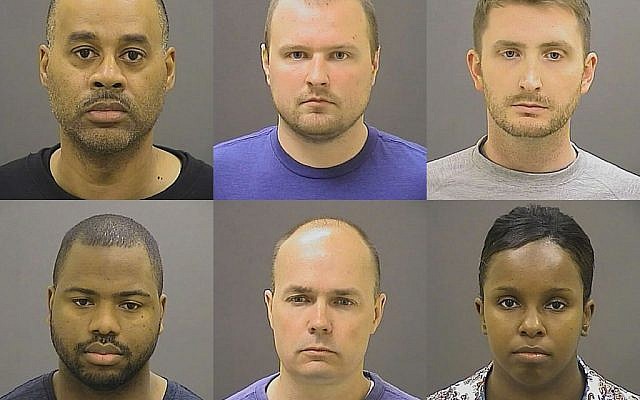
PHOTO: Six Baltimore police officers were charged with felonies ranging from assault to murder in the death of Freddie Gray in April. The officers are, top row from left, Caesar R. Goodson Jr., Garrett E. Miller and Edward M. Nero, and bottom row from left, William G. Porter, Brian W. Rice and Alicia D. White. Credit Baltimore Police Department, via Associated Press


Friday, July 19, 2013

Dr. Robin Kelley, Tim Wise, and Rayfield Waller On the Larger Political, Ideological, and Cultural Meaning and Contexts of the Trayvon Martin Verdict

http://www.counterpunch.org/2013/07/15/the-us-v-trayvon-martin/

https://www.facebook.com/pages/The-Panopticon-Review/342702882479366

All,

A typically incisive, informative, and profound piece by renowned author, scholar, historian, teacher, and activist Robin D.G. Kelley...Please read and share with others...

Kofi

How the System Worked
The US v. Trayvon Martin
JULY 15, 2013 
by ROBIN D.G. KELLEY
Counterpunch


[Editor's note: The following article by Mr. Kelley will also be appearing in the Huffington Post today]

DR. ROBIN D.G. KELLEY

In the aftermath of the Sandy Hook Elementary School massacre, Texas Congressman Louie Gohmert, Virginia Governor Bob McDonnell, Senator Rand Paul, Florida State Representative Dennis Baxley (also sponsor of his state’s Stand Your Ground law), along with a host of other Republicans, argued that had the teachers and administrators been armed, those twenty little kids whose lives Adam Lanza stole would be alive today.   Of course, they were parroting the National Rifle Association’s talking points.  The NRA and the American Legislative Exchange Council (ALEC), the conservative lobbying group responsible for drafting and pushing “Stand Your Ground” laws across the country, insist that an armed citizenry is the only effective defense against imminent threats, assailants, and predators.

But when George Zimmerman fatally shot Trayvon Martin, an unarmed, teenage pedestrian returning home one rainy February evening from a neighborhood convenience store, the NRA went mute.  Neither NRA officials nor the pro-gun wing of the Republican Party argued that had Trayvon Martin been armed, he would be alive today.  The basic facts are indisputable: Martin was on his way home when Zimmerman began to follow him—first in his SUV, and then on foot.  Zimmerman told the police he had been following this “suspicious-looking” young man.  Martin knew he was being followed and told his friend, Rachel Jeantel, that the man might be some kind of sexual predator.  At some point, Martin and Zimmerman confronted each other, a fight ensued, and in the struggle Zimmerman shot and killed Martin.

Zimmerman pursued Martin.  This is a fact.  Martin could have run, I suppose, but every black man knows that unless you’re on a field, a track, or a basketball court, running is suspicious and could get you a bullet in the back.  The other option was to ask this stranger what he was doing, but confrontations can also be dangerous—especially without witnesses and without a weapon besides a cel phone and his fists.  Florida law did not require Martin to retreat, though it is not clear if he had tried to retreat.  He did know he was in imminent danger.

Where was the NRA on Trayvon Martin’s right to stand his ground?  What happened to their principled position?  Let’s be clear: the Trayvon Martin’s of the world never had that right because the “ground” was never considered theirs to stand on.  Unless black people could magically produce some official documentation proving that they are not burglars, rapists, drug dealers, pimps or prostitutes, intruders, they are assumed to be “up to no good.”  (In the antebellum period, such documentation was called “freedom papers.”)  As Wayne LaPierre, NRA’s executive vice president, succinctly explained their position, “The only thing that stops a bad guy with a gun is a good guy with a gun.”   Trayvon Martin was a bad guy or at least looked and acted like one.  In our allegedly postracial moment, where simply talking about racism openly is considered an impolitic, if not racist, thing to do, we constantly learn and re-learn racial codes.  The world knows black men are criminal, that they populate our jails and prisons, that they kill each other over trinkets, that even the celebrities among us are up to no good.  Zimmerman’s racial profiling was therefore justified, and the defense consistently employed racial stereotypes and played on racial knowledge to turn the victim into the predator and the predator into the victim.  In short, it was Trayvon Martin, not George Zimmerman, who was put on trial.  He was tried for the crimes he may have committed and the ones he would have committed had he lived past 17.  He was tried for using lethal force against Zimmerman in the form of a sidewalk and his natural athleticism.

The successful transformation of Zimmerman into the victim of black predatory violence was evident not only in the verdict but in the stunning Orwellian language defense lawyers Mark O’Mara and Don West employed in the post-verdict interview.  West was incensed that anyone would have the audacity to even bring the case to trial—suggesting that no one needs to be held accountable for the killing of an unarmed teenager.  When O’Mara was asked if he thought the verdict might have been different if his client had been black, he replied: “Things would have been different for George Zimmerman if he was black for this reason: he would never have been charged with a crime.”  In other words, black men can go around killing indiscriminately with no fear of prosecution because there are no Civil Rights organizations pressing to hold them accountable.

And yet, it would be a mistake to place the verdict at the feet of the defense for its unscrupulous use of race, or to blame the prosecution for avoiding race, or the jury for insensitivity, or even the gun lobby for creating the conditions that have made the murder of young black men justifiable homicide.  The verdict did not surprise me, or most people I know, because we’ve been here before.  We were here with Latasha Harlins and Rodney King, with Eleanor Bumpurs and Michael Stewart.  We were here with Anthony Baez, Michael Wayne Clark, Julio Nunez, Maria Rivas, Mohammed Assassa.   We were here with Amadou Diallo, the Central Park Five, Oscar Grant, Stanley “Rock” Scott, Donnell “Bo” Lucas, Tommy Yates.  We were here with Angel Castro, Jr.  Bilal Ashraf, Anthony Starks, Johnny Gammage, Malice Green, Darlene Tiller, Alvin Barroso, Marcillus Miller, Brenda Forester.  We’ve been here before with Eliberto Saldana, Elzie Coleman, Tracy Mayberry, De Andre Harrison, Sonji Taylor, Baraka Hall, Sean Bell, Tyisha Miller, Devon Nelson, LaTanya Haggerty, Prince Jamel Galvin, Robin Taneisha Williams, Melvin Cox, Rudolph Bell, Sheron Jackson.  And Jordan Davis, killed in Jacksonville, Florida, not long after Trayvon Martin.  His murderer, Michael Dunn, emptied his gun into the parked SUV where Davis and three friends sat because they refused to turn down their music.  Dunn is invoking “stand your ground” in his defense.

The list is long and deep.  In 2012 alone, police officers, security guards or vigilantes took the lives of 136 unarmed black men and women—at least twenty-five of whom were killed by vigilantes. In ten of the incidents, the killers were not charged with a crime, and most of those who were charged either escaped conviction or accepted reduced charges in exchange for a guilty plea.  And I haven’t included the reign of terror that produced at least 5,000 legal lynchings in the United States, or the numerous assassinations—from political activists to four black girls attending Sunday school in Birmingham fifty years ago.

The point is that justice was always going to elude Trayvon Martin, not because the system failed, but because it worked.  Martin died and Zimmerman walked because our entire political and legal foundations were built on an ideology of settler colonialism—an ideology in which the protection of white property rights was always sacrosanct; predators and threats to those privileges were almost always black, brown, and red; and where the very purpose of police power was to discipline, monitor, and contain populations rendered a threat to white property and privilege.  This has been the legal standard for African Americans and other racialized groups in the U.S. long before ALEC or the NRA came into being.  We were rendered property in slavery, and a threat to property in freedom.  And during the brief moment in the 1860s and ‘70s, when former slaves participated in democracy, held political offices, and insisted on the rights of citizenship, it was a well-armed (white) citizenry that overthrew democratically-elected governments in the South, assassinated black political leaders, stripped African-Americans of virtually all citizenship rights (the franchise, the right of habeas corpus, right of free speech and assembly, etc.), and turned an entire people into predators.  (For evidence, read the crime pages of any urban newspaper during the early 20th century.  Or just watch the hot new show, “Orange is the New Black.”)

If we do not come to terms with this history, we will continue to believe that the system just needs to be tweaked, or that the fault lies with a fanatical gun culture or a wacky right-wing fringe.  We will miss the routine character of such murders: according data compiled by the Malcolm X Grassroots Movement, a black person is killed by the state or by state-sanctioned violence every 28 hours.  And we will miss how this history of routine violence has become a central component of the U.S. drone warfare and targeted killing.  What are signature strikes if not routine, justified killings of young men who might be Al-caeda members or may one day commit acts of terrorism?  It is little more than a form of high-tech racial profiling.

In the end, we should be able to prevent another Sandy Hook school tragedy—and the $7.7 million dollars that poured into Newtown on behalf of the victims suggests a real will to do all we can to protect the innocent.  But, sadly, the trial of Travyon Martin reminds us, once again, that our black and brown children must prove their innocence every day.  We cannot change the situation by simply finding the right legal strategy.  Unless we challenge the entire criminal justice system and mass incarceration, there will be many more Trayvon Martins and a constant dread that one of our children might be next.  As long as we continue to uphold and defend a system designed to protect white privilege, property and personhood, and render black and brown people predators, criminals, illegals, and terrorists, we will continue to attend funerals and rallies; watch in stunned silence as another police officer or vigilante is acquitted after taking another young life; allow our government to kill civilians in our name; and inherit a society in which our prisons and jails become the largest, most diverse institutions in the country.

Robin D. G. Kelley, who teaches at UCLA, is the author of the remarkable biography Thelonious Monk: The Life and Times of an American Original (2009) and most recently Africa Speaks, America Answers: Modern Jazz in Revolutionary Times (2012).

http://www.counterpunch.org/2013/07/15/no-innocence-left-to-kill/


JULY 15, 2013

Racism, Injustice and Explaining America to My Daughter
No Innocence Left to Kill
by TIM WISE
Counterpunch

 TIM WISE
You remember, forever and forever, that moment when you first discover the cruelties and injustices of the world, and having been ill-prepared for them, your heart breaks open.

I mean really discover them, and for yourself; not because someone else told you to see the elephant standing, gigantic and unrelenting in the middle of your room, but because you saw him, and now you know he’s there, and will never go away until you attack him, and with a vengeance.

Last night, and I am writing it down so that I will not forget — because I already know she will not — my oldest daughter, who attained the age of 12 only eleven days ago, became an American. Not in the legal sense. She was already that, born here, and — as a white child in a nation set up for people just like her — fully entitled to all the rights and privileges thereof, without much question or drama. But now she is American in the fullest and most horrible sense of that word, by which I mean she has been truly introduced to the workings of the system of which she is both a part, and, at the same time, merely an inheritor. A system that fails — with a near-unanimity almost incomprehensible to behold — to render justice to black peoples, the family of Trayvon Martin being only the latest battered by the machinations of American justice, but with all certainty not the last.

To watch her crumble, eyes swollen with tears too salty, too voluminous for her daddy to wipe away? Well now that is but the latest of my heartbreaks; to have to hold her, and tell her that everything will be OK, and to hear her respond, “No it won’t be!” Because see, even though she learned last night about injustice and even more than she knew before about the racial fault lines that divide her nation, she is still a bit too young to fully comprehend the notion of the marathon, as opposed to the sprint; to understand that this is a very long race, indeed that even 26.2 miles is but a crawl in the long distance struggle for justice. And that if she is as bothered by what she sees as it appears, well now she will have to put on some incredibly strong running shoes, because this, my dear, is the work.

This is why daddy does what he does. Now you know.

And yes, I am fully aware that there are still those who would admonish me for even suggesting this case was about race. Not just the defenders of George Zimmerman, with whom I shall deal in a moment, but even the state, whose prosecutors de-racialized this case to a point that frankly was as troubling as anything the defense tried to do. Maybe more. I mean, the defense’s job is to represent their client, and I cannot fault them for having done so successfully. But the prosecution’s job is to make it clear to the jury what the defendant did and preferably why he did it. By agreeing to a fundamentally colorblind, “this isn’t about race,” narrative, they gave away the best part of their arsenal before the war had really started.

Because anyone who still believes that this case had nothing to do with race — or worse, that it was simply a tragedy, the racial meaning of which was concocted by those whom they love to term “race hustlers” — are suffering from a delusion so profound as to call into question their capacities for rational thought. And yet still, let us try to reason with them for a second, as if they were capable of hearing it. Let’s do that for the sake of rational thought itself, as a thing we still believe in; and for our country, which some of us still believe — against all evidence — is capable of doing justice and living up to its promises. In short, let’s give this one more shot.

Those who deny the racial angle to the killing of Trayvon Martin can only do so by a willful ignorance, a carefully cultivated denial of every logical, obvious piece of evidence before them, and by erasing from their minds — if indeed they ever had anything in there to erase — the entire history of American criminal justice, the criminal suspicion regularly attached to black men, and the inevitable results whenever black men pay for these suspicions with their lives. They must choose to leave the dots unconnected between, for instance, Martin on the one hand, and then on the other, Amadou Diallo or Sean Bell or Patrick Dorismond, or any of a number of other black men whose names — were I to list them — would take up page after page, and whose names wouldn’t mean shit to most white people even if I did list them, and that is the problem.

Oh sure, I’ve heard it all before. George Zimmerman didn’t follow Trayvon Martin because Martin was black; he followed him because he thought he might be a criminal. Yes precious, I get that. But whatyou don’t get — and by not getting it while still managing to somehow hold down a job and feedyourself, scare the shit out of me — is far more important. Namely, if the presumption of criminality that Zimmerman attached to Martin was so attached because the latter was black — and would not have been similarly attached to him had he been white — then the charge of racial bias and profiling is entirely appropriate.

And surely we cannot deny that the presumption of criminality was dependent on this dead child’s race can we? Before you answer, please note that even the defense did not deny this. Indeed, Zimmerman’s attorneys acknowledged in court that their client’s concerns about Martin were connected directly to the fact that previous break-ins in the neighborhood had been committed by young black males.

This is why it matters that George Zimmerman justified his following of Martin because as he put it, “these fucking punks” always get away. In other words, Zimmerman saw Martin as just another “fucking punk” up to no good, similar to those who had committed previous break-ins in the community. But why? What behavior did Martin display that would have suggested he was criminally inclined? Zimmerman’s team could produce nothing to indicate anything particularly suspicious about Martin’s actions that night. According to Zimmerman, Martin was walking in the rain, “looking around,” or “looking around at the houses.” But not looking in windows, or jiggling doorknobs or porch screens, or anything that might have suggested a possible burglar. At no point was any evidence presented by the defense to justify their client’s suspicions. All we know is that Zimmerman saw Martin and concluded that he was just like those other criminals. And to the extent there was nothing in Martin’s actions — talking on the telephone and walking slowly home from the store — that would have indicated he was another of those “fucking punks,” the only possible explanation as to why George Zimmerman would have seen him that way is because Martin, as a young black male was presumed to be a likely criminal, and for no other reason, ultimately, but color.

Which is to say, Trayvon Martin is dead because he is black and because George Zimmerman can’t differentiate — and didn’t see the need to — between criminal and non-criminal black people. Which is to say, George Zimmerman is a racist. Because if you cannot differentiate between black criminals and just plain kids, and don’t even see the need to try, apparently, you are a racist. I don’t care what your Peruvian mother says, or her white husband who married the Peruvian mother, or your brother, or your black friends, or the black girl you took to prom, or the black kids you mentored. If you see a black child and assume “criminal,” despite no behavioral evidence at all to suggest such a conclusion, you are a racist. No exceptions. That goes for George Zimmerman and for anyone reading this.

And here’s the thing: even in the evidentiary light most favorable to George Zimmerman this would remain true. Because even if we believe, as the jury did, that Zimmerman acted in self-defense, there can be no question that were it not for George Zimmerman’s unfounded and racially-biased suspicions that evening, Trayvon Martin would be alive, and Zimmerman would be an entirely anonymous, pathetic wanna-be lawman, about whom no one would much care. It was he who initiated the drama that night. And even if you believe that Trayvon Martin attacked Zimmerman after being followed by him, that doesn’t change.

But apparently that moral and existential truth matters little to this jury or to the white reactionaries so quick to praise their decision. To them, the fact that Martin might well have had reason to fear Zimmerman that night, might have thought he was standing his ground, confronted by someone who himself was “up to no good” is irrelevant. They are saying that black people who fight back against someone they think is creepy and who is following them, and might intend to harm them, are more responsible for their deaths than those who ultimately kill them. What they have said, and make no mistake about it, is that any white person who wants to kill a black person can follow one, confront them, maybe even provoke them; and as soon as that black person perhaps takes a swing at them, or lunges at them, the white pursuer can pull their weapon, fire, and reasonably assume that they will get away with this act. I can start drama, and if you respond to the drama I created, you are to blame, not me.

But we know, if we are remotely awake, that this same logic would never be used to protect a black person accused of such an act. Let’s travel back to 1984 shall we, and hypothetically apply this logic to the Bernhard Goetz case in a little thought experiment so as to illustrate the point.

Goetz, as you’ll recall, was the white man who, afraid of young black men because he had been previously mugged, decided to shoot several such youth on a subway. They had not threatened him. They had asked him for money, and apparently teased him a bit. But at no point did they threaten him. Nonetheless, he drew his weapon and fired several rounds into them, even (according to his own initial account, later recanted), shooting a second time at one of the young men, after saying, “You don’t look so bad, here, have another.”

Goetz, predictably, was seen as a hero by the majority of the nation’s whites, if polls and anecdotal evidence are to be believed. He was a Dirty Harry-like vigilante, fighting back against crime, and more to the point, black crime. Ultimately he too would successfully plead self-defense and face conviction only on a minor weapons charge.

But let us pretend for a second that after Goetz pulled his weapon and began to fire at the young men on that subway, one of them had perhaps pulled his own firearm. Now as it turns out none of the boys had one, but let’s just pretend. And let’s say that one of them pulled a weapon precisely because, after all, he and his friends were being fired upon and so, fearing for his life, he opted to defend himself against this deranged gunman. And let’s pretend that the young man managed to hit Goetz, perhaps paralyzing him as Goetz did, in fact, to one of his victims. Does anyone seriously believe that that young black man would have been able to press a successful self-defense claim in court the way Goetz ultimately did? Or in the court of white public opinion the way Zimmerman has? If you would answer yes to this question you are either engaged in an act of self-delusion so profound as to defy imagination, or you are so deeply committed to fooling others as to make you truly dangerous.

But we are not fooled.

We don’t even have to travel back thirty years to the Goetz case to make the point, in fact. We can stay here, with this case. If everything about that night in Sanford had been the same, but Martin, fearing this stranger following him — the latter not identifying himself at any point as Neighborhood Watch — had pulled a weapon and shot George Zimmerman out of a genuine fear that he was going to be harmed (and even if Zimmerman had confronted him in a way so as to make that fear more than speculative), would the claim of self-defense have rung true for those who are so convinced by it in this case? Would this jury have likely concluded that Trayvon had had a right to defend himself against the perceived violent intentions of George Zimmerman?

Oh, and would it have taken so long for Martin to be arrested in the first place, had he been the shooter? Would he have been granted bail? Would he have been given the benefit of the doubt the way Zimmerman was by virtually every white conservative in America of note? And remember, those white folks were rushing to proclaim the shooting of Martin justified even before there had been any claim made by Zimmerman that Trayvon had attacked him. Before anyone had heard Zimmerman’s version of the story, much of white America, and virtually its entire right flank had already decided that Martin must have been up to no good because he wore a hoodie (in the rain, imagine), and was tall (actually according to the coroner he was 5’11″ not 6’2″ or 6’4″ as some have claimed), and that because of those previous break-ins, Zimmerman had every right to confront him.

No, Martin-as-shooter would never have benefitted from these public pronouncements of innocence the way Zimmerman did.

Because apparently black people don’t have a right to defend themselves. Which is why Marissa Alexander, a woman who had suffered violence at the hands of her husband (by his own admission in fact), was recently sentenced to 20 years in prison after firing a warning shot into a wall when she felt he was about to yet again harm her.

And so it continues. Year after year and case after case it continues, with black life viewed as expendable in the service of white fear, with black males in particular (but many a black female as well and plenty of Latino folk too) marked as problems to be solved, rather than as children to be nurtured. And tonight, their parents will hold them and try to assure them that everything is going to be OK, even as they will have to worry again tomorrow that their black or brown child may represent the physical embodiment of white anxiety, and pay the ultimate price for that fact, either at the hands of a random loser with a law enforcement jones, or an actual cop doing the bidding of the state. In short, they will hold their children and lie to them, at least a little — and to themselves — because who doesn’t want their child to believe that everything will be alright?

But in calmer moments these parents of color will also tell their children the truth. That in fact everything is not going to be OK, unless we make it so. That justice is not an act of wish fulfillment but the product of resistance. Because black parents know these things like they know their names, and as a matter of survival they make sure their children know them too.

And if their children have to know them, then mine must know them as well.

And now they do.

If their children are to be allowed no innocence free from these concerns, then so too must mine sacrifice some of their naiveté upon the altar of truth.

And now they have.

So to the keepers of white supremacy, I should offer this final word. You can think of it as a word of caution. My oldest daughter knows who you are and saw what you did. You have made a new enemy. One day, you might wish you hadn’t.

Tim Wise is author of many books, including his most recent, DEAR WHITE AMERICA: LETTER TO A NEW MINORITY published by City Lights (2012).  Cornel West calls Wise “A vanilla brother in the tradition of (antiracism and antislavery fighter) John Brown,”


The Dialectics of ‘Stand Your Ground’
(We’d Best Examine Some Fundamental Issues in the Zimmerman Case Other Than the Verdict)
By Rayfield A. Waller
The Panopticon Review


The link below is from an old Lawrence O'Donnell broadcast on MSNBC. It shows the MSNBC host angrily grilling Attorney Craig Sonner, one of George Zimmerman’s original defense attorneys, in absentia, on the many oddities surrounding Zimmerman. It was aired before the verdict, in fact it was aired in April, early in the breaking news cycle about Zimmerman's killing of Trayvon Martin.  

http://tv.msnbc.com/2012/12/27/msnbcs-most-watched-in-2012-lawrence-odonnell-eviscerates-zimmerman-lawyer/


O’Donnell’s intensity and passion back then speaks even now to some of the outright strangeness of this case, strangeness that has as yet not been closely examined nor thoughtfully and thoroughly analyzed in the media, and the list is lengthy:

There is the outrageous and anti-constitutional nature of the 'Concealed Carry Stand Your Ground' law with its racial overtones similar to that of the very sort of laws passed in the south during the violentpost-reconstruction era to empower White Americans to legally kill‘freedmen’--former African slaves, to kill them for being 'uppity', for speaking freely, for raising a hand to defend themselves against assault, in short for living in public while Black; there is the strange lag in the time between Martin’s death and the police department bothering toidentify his body, which lay in a morgue for three days as a “John Doe”while police reportedly declined to question neighbors about his identity and to inform his family; there is the conduct of the Sanford, Floridapolice in general who overtly provided protection, cover, and assistance to Zimmerman, and who apparently leaked personal information to the media about Trayvon Martin that was seemingly meant to tarnish his character and thus influence the jury pool; There are Juror B-37’scomments since the verdict to MSNBC that the jury instruction from the judge regarding Florida law since “Stand Your Ground”, essentially ‘locked the jurors into’ a vote to acquit; and there is the absurd nature of the law itself, which, upon close reading, could easily have legally allowed Martin to be absolved if only he had killed Zimmerman first, as a best possible (frontier justice) outcome—exposing the logical conclusioni.e. jurisprudence that the real implication of “Stand Your Ground” is that it is a law allowing—encouraging—Florida residents to engage inbattle royal gunfights with the survivor being indemnified against a charge of murder, though the mindset of the media, the courts, the defense and the prosecution attorneys in Florida is that the law protects ‘law abiding (Anglo)’ citizens against ‘potentially violent (Colored)’ citizens; meanwhile, on July 9 Illinois state legislators overrode their governor’s veto to vote a ‘concealed carry’ statute into law, becomingthe last of the 50 states to allow their citizens to carry concealed weapons in public; simultaneous to this nearly uncommented upon landmark in American public policy, Illinois state representative, Monique Davis, a Black woman and rabid Christian fundamentalist has called for the national guard to be deployed into Chicago to stem the ‘mayhem’ in her words, of young Blacks involved in a record number of incidents of gun violence; there are the Florida officials who didn't act to arrest Zimmerman or investigate his crime until hundreds of thousands of protesters across the country raised their voices; and of course there is the loss of crucial material evidence because Zimmerman (the ‘law abiding’ one) was allowed to walk free; there is as well the hefty amount of money that flowed into Zimmerman's possession that apparently paid for his first, mysterious media monkey attorneys, Craig Sonner and Hal Uhrig  (it was Sonner who lied to media that Zimmerman had suffered a broken nose in his encounter with Martin, and it was he O’Donnellcastigated after he fled the MSNBC studios to avoid the interview he hadagreed to earlier) and paid for Zimmerman’s second legal team of starattorneys (Mark O'Mara and Don West who strangely now claim that they have not been paid though they expect to be some day when the reportedly well-off Zimmerman ‘can afford to’).

All of this, and not just the verdict in the court trial, is a basis for this country's progressives to go back to the streets (as we have been) to demand that the Justice Department do a thorough investigation (so far they have reportedly merely conducted interviews), and launch a federal prosecution not just of Zimmerman but of every public and elected official involved in what current and former Florida residents like me all know to be the long-standing corruption and racism that festers in Florida's anti-brown skin, paranoid Anglo and middle class 'gated communities' and suburbs.

The Trayvon Martin Murder is systemically tied to the death of Arthur McDuffie, and to everything McDuffie's death said about Florida, none of which has changed, but has merely intensified, and with the concealed carry and ‘Stand Your Ground’ laws has now been institutionalized and legalized: namely Anglo racial hysteria, and the compulsion some White hysterics have to murder people of color rather than tolerate their public freedom and public presence as free agents and free citizens. I could write a book about the suspicion and racism I myself have encountered in Orlando's, in Hollywood's, and in Fort Lauderdale's suburbs when I used to drive up to those communities from Miami or would just pass through onthe train or the greyhound bus and having to endure the racial panic of Florida southerners freeked out by Blacks, Haitians, dark Puerto Ricans, and dark Dominicans from Miami.

Lastly: this case ought to be a breaking point for the naive ideology at large among Blacks that we should go on tolerating and excusing Barack Obama's reticence and haplessness when it comes to racial and economic justice, and the realities of systemic inequality. So far he has made no truly decisive or authoritative, declarative statement from the oval officethat he will not tolerate a return to the segregationist era's open season on Black lives. Eric Holder’s announcement that a federal probe will belaunched  was made not in a White House Press Conference or in the Rose Garden but at the Washington convention of a black sorority—an apparent attempt to sooth core constituents more than bring the weight of thefederal government to bear.

Where is President Obama’s voice? Is he at least as useful to us as Kennedy was, who in his first (and only) administration, made a loud and clear statement against segregation, violence against Blacks, and Southern racism? For, history records that two Anglo presidents, Lincoln and Kennedy, neither one particularly disposed toward a passionate concern with the well-being of Blacks, did utter profoundly decisive words in defense of Black humanity and freedom that removed doubt Among Anglo Americans about presidential commitment to justice or at least to legislative and public policy change:

Despite the inaccuracies and mawkish melodrama of Spielberg's film, "Lincoln," the 16th president actually did bark at Congressman James Alley, when Alley demurred over raising the final decisive votes to pass the 14th Amendment: "I am the president of the United States, clothed with immense power, and I expect you to procure those votes!" He backed up that bark by signing the landmark amendment.

Despite his prolonged foot dragging on racial equality and the civil rights movement marching across the sanguinated south, Kennedy, fifty years ago last Friday, finally confronted the unmitigated ferocity of a very un Hyannis Port-like racial violence in Alabama, Georgia, and Mississippi, and confronted the unwillingness of rapidly segregationist southern governors to accept his presidential authority.

Kennedy took to the oval office to clear the throat of that immense presidential power Lincoln had barked about, and made his first decisive statement against the recalcitrance of American brutality against Black lives, saying, "I hope that every American, regardless of where he lives, will stop and examine his conscience about this and other related incidents. This nation was founded by men of many nations and backgrounds. It was founded on the principle that all men are created equal, and that the rights of every man are diminished when the rights of one man are threatened...Today, we are committed to a worldwide struggle to promote and protect the rights of all who wish to be free...It ought to be possible, in short, for every American to enjoy the privileges of being American without regard to his race or his color...One hundred years of delay have passed since President Lincoln freed the slaves, yet their heirs, their grandsons, are not fully free. They are not yet freed from the bonds of injustice. ” Kennedy went on, with his attorney general, to deploy US Marshalls to force Governor Wallace to acceptschool desegregation; he nationalized the Alabama National Guard to take away Wallace's fangs--the first time the true powers of the presidency, the military, and the attorney general, were deployed expressly in the act of physically enforcing the amendment Lincoln fought to pass.

The Zimmerman verdict, coming eerily right on the heels of the fifty year anniversary of Kennedy’s historic act of declaration, is a direct challengeto the principles of life and liberty, equal justice, federal authority, civil rights, and due process—the very principles that African Americans havealways had to wait on special legislation, federal powers, and unusual enforcement, to claim.

The strange irregularities, abuses of power, and so far the federal failure to speak with a clear authority and resounding declaration, are the crucial underpinnings of the Zimmerman verdict, as is the nagging question as the days pass since the verdict: Is Obama capable of being at least as forthright as Lincoln and Kennedy, neither of whom were of African descent, but both of whom were moved, for whatever reasons, todeclare federal power and push the US toward the correct side of justice?

Wednesday, March 28, 2012

The Shoot To Kill First, Then Claim Self-Defense Later Law and American Racism

http://loyalopposition.blogs.nytimes.com/2012/03/20/shoot-first-claim-self-defense-later/


Shoot First, Claim Self-Defense Later
By ANDREW ROSENTHAL
MARCH 20, 2012
New York Times


In late February, 28-year-old George Zimmerman called 911 to report that a “real suspicious guy” was walking down the street in Sanford, Fla. He decided to follow the “suspicious guy,” and later that night Mr. Zimmerman shot and killed him with a 9 mm handgun. The “suspicious guy” was a black 17-year-old named Trayvon Martin. He was unarmed, carrying only a bag of Skittles, a can of iced tea and a cellphone.

Mr. Zimmerman claimed he was acting in self-defense, and the local police decided not to arrest him, provoking outrage from many corners. The state attorney’s office for Brevard and Seminole Counties announced Tuesday that a grand jury will examine the incident next month, and the Justice Department is conducting its own investigation, as it should.

The idea that Mr. Zimmerman feared for his life seems ridiculous. Why did he find a teenager walking down the street suspicious? OK, that was a rhetorical question. He found him suspicious because he was black. (This is a classic walking-while-black case.) If Mr. Zimmerman felt threatened, why did he follow Mr. Martin? Why didn’t he stay put, as the police dispatcher advised him to do? He was, after all, nothing but an armed vigilante – not a police officer, not even a security guard, just a man who armed himself and went out looking for trouble.

What’s more ridiculous is that prosecutors may have a difficult time with the case, because Florida is a Stand Your Ground state. Stand Your Ground laws do away with the longstanding legal concept that there’s a “duty to retreat” – that the sane and sensible thing to do when confronted with a “suspicious” situation is to get the heck out of there. In Florida and a number of other states, if running for safety is an option you don’t have to take it. You can meet perceived danger with deadly force; and if you end up making a dodgy situation worse, you can fire your gun and claim self-defense. Then it’s up to the prosecution to disprove that claim.


As Jeffrey Bellin, a law professor at Southern Methodist University, told the Christian Science Monitor, “Even if you have suspicions about what motivated this, and you think there was a racial element and no justification for this shooting, the fact is he had no obligation to retreat under the law.”

I doubt the legislators who passed Stand Your Ground had this scenario in mind, or at least I hope not. Florida state Senator Oscar Brayon, who’s demanding hearings into the law, said: “I don’t think they planned for people who would go out and become vigilantes or be like some weird Batman who would go out and kill little kids like Trayvon.” Whatever their intentions, it’s becoming increasingly clear that Stand Your Ground provides too much cover for aggression. The Tampa Bay Times reported in 2010 that “justifiable homicides tripled after the law went into effect” and that it “has been invoked in at least 93 cases with 65 deaths.”

It took Fox News a while to get onto this story, but when it did, it identified the real victim – the National Rifle Association. On America Live, Trace Gallagher said: “the alleged gunman claim[ed] it was self-defense, and now anti-gun advocates say the 911 calls from some witnesses prove otherwise, and they’re using them as ammunition in a new attack on the National Rifle Association.” Later he added, “It’s important to point out that gun sales in this country have never been higher and the crime rate, says the FBI, is very low.”

I don’t think that’s important to point out at all, actually. Far more important is what Dan Gross, president of the Brady Campaign, said in a press release: “Trayvon’s life has been lost not because of an accident.” He lost his life because a man in a state with weak gun laws left his house with a 9mm, and used it.


http://www.csmonitor.com/USA/Justice/2012/0316/Trayvon-Martin-killing-in-Florida-puts-Stand-Your-Ground-law-on-trial


The Christian Science Monitor
CSMonitor.com


Trayvon Martin killing in Florida puts 'Stand Your Ground' law on trial

The shooting of Trayvon Martin, an unarmed black teenager, in a gated Florida community has raised allegations of racial injustice and highlighted the burden that 'Stand Your Ground' laws impose on law enforcement officers.

The family of the black teenager fatally shot by a white neighborhood watch volunteer arrived at Sanford City Hall Friday evening March 16, 2012 to listen to recordings of 911 calls.


By Patrik Jonsson, Staff writer
posted March 16, 2012
ATLANTA

For many tuning in across the nation, the shooting late last month in Florida of an unarmed black teenager by a suspicious neighborhood watch captain looks like a racially motivated murder.

That's why the decision by the police not to arrest George Zimmerman for getting out of his car and shooting Trayvon Martin in the middle of a gated neighborhood in Sanford, Fla., on Feb. 26 has raised allegations of racial injustice and profiling.
The shooting has sparked a nationwide protest petition, the involvement of a black militia group, and, on Friday, a call by the parents of the slain teenager for the FBI to investigate the handling of the case, which police have handed off to state investigators.

The shooting also presents a tragic snapshot of so-called "Stand Your Ground" laws, what critics call “license-to-murder.”

Such laws eliminate the English Law concept of a “duty to retreat” from dangerous situations outside the home. Without that, an armed citizen has no obligation to stand down in the face of a threat.

The problem, as the Martin case highlights, is that making the duty to retreat "totally irrelevant," as Stetson University law professor Robert Batey has said, means the law gives prosecutors fewer factors to consider when determining self-defense, including, potentially, the extent to which a person claiming self-defense may have aggravated the situation.

Florida became the first state to pass a specific Stand Your Ground law in 2005, essentially expanding self-defense zones from the home to most public places. Seventeen states now have such laws.

“It's hard to imagine that this couldn't have been resolved by [Mr. Zimmerman] leaving, so that no one would've gotten hurt, so this is a case where the Stand Your Ground law can actually make a legal difference,” says former federal prosecutor Jeffrey Bellin, a law professor at Southern Methodist University, in Dallas.

“Even if you have suspicions about what motivated this, and you think there was a racial element and no justification for this shooting, the fact is he had no obligation to retreat under the law,” he notes. “If prosecutors don't have the evidence to disprove the claim of self-defense, they won't be able to win.”

But for the parents of the victim, and some 240,000 people who have signed a petition for a federal investigation on the Change.org website, the bare facts of the case suggest that Zimmerman was the aggressor and that the failure to arrest him points to covert racism and an abdication of authority by the local police department.

In a press conference Friday, Trayvon Martin's parents said they no longer had any faith in the Sanford Police Department and called on the FBI to take over the investigation.

"We're not getting any closure, any answers, and it's very disturbing,” Tracy Martin, Trayvon's father, said. “As a father, I'm hurt. I feel betrayed by the Sanford Police Department."

Meanwhile, tensions are roiling in the area as several large rallies and protests are being planned and a black militia group has vowed to place the shooter under citizen's arrest. The state has said it may take several weeks to complete its review of the case.

On Feb. 26, Zimmerman, 28, a self-appointed block watch captain in The Retreat at Twin Lakes, a gated community in Sanford, just outside Orlando, called 911 from his car to report a suspicious person – a black man wearing a hoodie – walking slowly through the neighborhood. The 911 operator, according to police, told Zimmerman to wait for police to arrive. The man in the hoodie was Trayvon, returning to his family's house from buying Skittles and an iced tea at a local convenience store.

Instead of waiting for police, Zimmerman exited the car and shot Trayvon after a brief altercation. Trayvon, 17, had no previous criminal record, while Zimmerman recently had a 2005 felony arrest for assault on a police officer expunged by the courts.

"Had Trayvon Martin been the triggerman, they would have arrested him day one, hour one and he would be in jail with no bail,” Ben Crump, a Tallahassee lawyer representing the family, told the Florida Courier.

"We have a murderer on the streets, walking around," Natalie Jackson, another lawyer representing the family, said on Friday.
Sanford Police Chief Bill Lee told the Orlando Sentinel that he had no grounds to arrest Zimmerman, and told reporters Thursday that that he has invited the US Department of Justice and the Florida Department of Law Enforcement to review the investigation. Florida officials confirmed they began an investigation on March 13.

"It's an open book," Mr. Lee said. "If they want to look at what we did and how we did it and what information we have, they're welcome to it."
Police have released little information, including the 911 tapes, about what happened that night and no details about how Trayvon and Zimmerman ended up grappling. What has been revealed is that before an officer arrived, Trayvon and Zimmerman got into a fight, according to police, witnesses heard one or both calling for help, and Zimmerman shot Trayvon once in the chest with a 9 mm handgun.

One witness said he came upon the scene and saw Zimmerman on his back on the ground, which jibes with statements by the police that he was covered in grass and blood. Another witness has said in a TV interview that “there was no punching, no hitting going on at the time, no wrestling,” but police say that witness gave an official account to them that jibed with Zimmerman's story.

In a letter to the Orlando Sentinel on Friday, Zimmerman's father, Robert Zimmerman, wrote that his son is part-Hispanic “with many black family members and friends.” He also pushed back at the idea that Zimmerman was the aggressor who instigated the altercation.
"At no time did George follow or confront Mr. Martin," he wrote. "When the true details of the event become public, and I hope that will be soon, everyone should be outraged by the treatment of George Zimmerman in the media."

The emotional stakes, racial backdrop, and the awkward position of the police department suggest how state laws broadening self-defense rights can backfire. But whether it's a prosecutor or a jury deciding the outcome of a case, self-defense arguments are often powerful and difficult to disprove beyond a reasonable doubt, even in jurisdictions without Stand Your Ground laws.

“This is a tragedy, and to the extent the law plays a role in encouraging this type of situation to happen, it calls into question the law,” says Professor Bellin. “At the same time, it's not clear that if this happens in a jurisdiction where there isn't a Stand Your Ground law, that you necessarily get a different result.”