Sebastian Scheiner/Associated Press
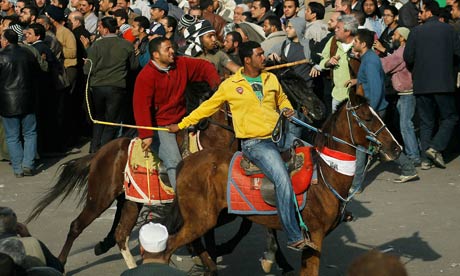
Khalil Hamra, left, of The Associated Press and other photographers took cover on Thursday as they worked to cover the protests.
http://www.nytimes.com/2011/02/04/world/middleeast/04journalists.html?nl=todaysheadlines&emc=tha22
Gangs Hunt Journalists and Rights Workers
By JEREMY W. PETERS and J. DAVID GOODMAN
February 3, 2011
New York Times
Journalists covering the revolt against President Hosni Mubarak of Egypt have found themselves the targets of widespread anger and suspicion in an apparently coordinated campaign that is intended to stifle the flow of news that could further undermine the government.
No news organization seemed exempt from the rage, which escalated as the week wore on. Whether from Western or Arab media, television networks or wire services, newspapers or photo syndicates, journalists were chased through the streets and had their equipment stolen or smashed. Some were beaten so badly that they required hospital treatment.
ABC News reported that one of its crews was carjacked on Thursday and threatened with beheading. A Reuters journalist said a “gang of thugs” had stormed the news service’s office and started smashing windows. And four journalists from The Washington Post were detained by forces that they suspected were from the Interior Ministry. All four were released by early Friday. But two of them, the paper’s Cairo bureau chief and a photographer, had been ordered not to leave a local hotel.
“It appears that journalists are being targeted by the Egyptian authorities in a deliberate campaign of intimidation aimed at quashing honest, independent reporting of a transformational event,” said The Post’s foreign editor, Douglas Jehl.
If the aim was to suppress coverage, the actions were somewhat effective. Major television networks from around the world were largely unable to broadcast from Tahrir Square, the center of antigovernment protests, on Thursday. The Egyptian state news agency had earlier asked foreign reporters and crews to move out of the hotels near the square.
Live television images were so difficult to transmit that by the afternoon, the Fox News Channel anchor Shepard Smith was showing viewers exactly what his control room in New York was seeing — blank screens from The Associated Press and Reuters television feeds.
Jon Williams of the BBC said via Twitter that Egyptian security forces had seized the news agency’s equipment at the Cairo Hilton “in an attempt to stop us broadcasting.” Both CNN and the BBC relied on taped footage of the square.
Al Jazeera and Al Arabiya, which have provided some of the most extensive network coverage of the revolt, said their journalists had been hounded from the street and from vantage points above the square where their cameras had been placed. In the absence of live pictures, the networks relied on grainy amateur video taken on the streets.
Another Arab network, Al Hurra, had what it described as one of the only live feeds from the square.
The Committee to Protect Journalists said it had received nearly 100 reports of damage to news organization property or of individuals being detained or attacked.
The intimidation tactics were condemned at the highest levels of the United States government. The White House spokesman, Robert Gibbs, rebuked the Mubarak government and its supporters, calling the harassment “completely and totally unacceptable.” Speaking to reporters traveling with President Obama, he said that “any journalist that has been detained should be released immediately.”
Secretary of State Hillary Rodham Clinton said the attacks on journalists were an affront to the most basic principles of international law. “It is especially in times of crisis that governments must demonstrate their adherence to these universal values,” she said.
A reporter for Al Arabiya was beaten by a group of pro-Mubarak demonstrators on Wednesday. His injuries were significant enough that he remained in the hospital, though his condition was not critical, said Nakhle el-Hage, the network’s director of news.
The attacks were aimed at other independent observers, too, including representatives of groups like Human Rights Watch. The Egyptian security police also raided the Hisham Mubarak Law Center, detaining as many as 16 people, including some of the country’s most prominent human rights advocates and several foreign researchers.
Al Arabiya broadcast a plea to the Egyptian Army to intervene after the network’s headquarters in Cairo came under sustained attack from pro-Mubarak demonstrators who were wielding sticks and knives. “They destroyed some equipment outside the building, and they said they would come in and destroy everything,” Mr. Hage said in a telephone interview from Dubai.
He said the army initially responded by deploying more soldiers to secure the building, but the troops soon left. “The message we got from the army is that ‘you’re left on your own,’ ” he said.
Al Arabiya’s staff was forced to flee a nearby hotel as the pro-Mubarak mob broke into the network’s office. Four of its journalists stayed at the hotel to report, while others continued to work from their homes or from friends’ homes.
Two employees of Al Jazeera were dragged out of their car on the road from the airport to central Cairo and were detained; in the early evening, the network said that, over all, three of its journalists were still in custody. A spokesman for the network also said that its Web site had faced “security issues.” The site was not available in Egypt or the United States early Thursday, though it appeared to return online later.
Two reporters working for The New York Times were released on Thursday after being detained overnight in Cairo.
The attacks started almost as soon as the violent clashes began near Tahrir Square on Wednesday. “It’s clearly a bad situation these last two days — a stark contrast to the days before that,” said David Remnick, the editor of The New Yorker, which has several journalists in Egypt, including a local translator who was assaulted, detained and later released.
The government has sought to control the information coming out of Egypt since large-scale protests against Mr. Mubarak and his subordinates began in late January. But before Wednesday, the harassment of reporters had been scattered, and attempts to control the gripping images and narratives from Cairo had mostly failed.
“We’ve never witnessed something like this in the Middle East,” said Mohamed Abdel Dayem, program coordinator for the Middle East and North Africa at the Committee to Protect Journalists. “That is not to say that Saddam Hussein’s Iraq or Muammar Qaddafi’s Libya were friendly places for journalists. There were massive amounts of harassment, intimidation and reporters put on trial. But you don’t see this level of physical violence against journalists in this kind of sustained fashion and coordination.”
David D. Kirkpatrick contributed reporting from Cairo, and Brian Stelter from Doha, Qatar.
Gangs Hunt Journalists and Rights Workers
By JEREMY W. PETERS and J. DAVID GOODMAN
February 3, 2011
New York Times
Journalists covering the revolt against President Hosni Mubarak of Egypt have found themselves the targets of widespread anger and suspicion in an apparently coordinated campaign that is intended to stifle the flow of news that could further undermine the government.
No news organization seemed exempt from the rage, which escalated as the week wore on. Whether from Western or Arab media, television networks or wire services, newspapers or photo syndicates, journalists were chased through the streets and had their equipment stolen or smashed. Some were beaten so badly that they required hospital treatment.
ABC News reported that one of its crews was carjacked on Thursday and threatened with beheading. A Reuters journalist said a “gang of thugs” had stormed the news service’s office and started smashing windows. And four journalists from The Washington Post were detained by forces that they suspected were from the Interior Ministry. All four were released by early Friday. But two of them, the paper’s Cairo bureau chief and a photographer, had been ordered not to leave a local hotel.
“It appears that journalists are being targeted by the Egyptian authorities in a deliberate campaign of intimidation aimed at quashing honest, independent reporting of a transformational event,” said The Post’s foreign editor, Douglas Jehl.
If the aim was to suppress coverage, the actions were somewhat effective. Major television networks from around the world were largely unable to broadcast from Tahrir Square, the center of antigovernment protests, on Thursday. The Egyptian state news agency had earlier asked foreign reporters and crews to move out of the hotels near the square.
Live television images were so difficult to transmit that by the afternoon, the Fox News Channel anchor Shepard Smith was showing viewers exactly what his control room in New York was seeing — blank screens from The Associated Press and Reuters television feeds.
Jon Williams of the BBC said via Twitter that Egyptian security forces had seized the news agency’s equipment at the Cairo Hilton “in an attempt to stop us broadcasting.” Both CNN and the BBC relied on taped footage of the square.
Al Jazeera and Al Arabiya, which have provided some of the most extensive network coverage of the revolt, said their journalists had been hounded from the street and from vantage points above the square where their cameras had been placed. In the absence of live pictures, the networks relied on grainy amateur video taken on the streets.
Another Arab network, Al Hurra, had what it described as one of the only live feeds from the square.
The Committee to Protect Journalists said it had received nearly 100 reports of damage to news organization property or of individuals being detained or attacked.
The intimidation tactics were condemned at the highest levels of the United States government. The White House spokesman, Robert Gibbs, rebuked the Mubarak government and its supporters, calling the harassment “completely and totally unacceptable.” Speaking to reporters traveling with President Obama, he said that “any journalist that has been detained should be released immediately.”
Secretary of State Hillary Rodham Clinton said the attacks on journalists were an affront to the most basic principles of international law. “It is especially in times of crisis that governments must demonstrate their adherence to these universal values,” she said.
A reporter for Al Arabiya was beaten by a group of pro-Mubarak demonstrators on Wednesday. His injuries were significant enough that he remained in the hospital, though his condition was not critical, said Nakhle el-Hage, the network’s director of news.
The attacks were aimed at other independent observers, too, including representatives of groups like Human Rights Watch. The Egyptian security police also raided the Hisham Mubarak Law Center, detaining as many as 16 people, including some of the country’s most prominent human rights advocates and several foreign researchers.
Al Arabiya broadcast a plea to the Egyptian Army to intervene after the network’s headquarters in Cairo came under sustained attack from pro-Mubarak demonstrators who were wielding sticks and knives. “They destroyed some equipment outside the building, and they said they would come in and destroy everything,” Mr. Hage said in a telephone interview from Dubai.
He said the army initially responded by deploying more soldiers to secure the building, but the troops soon left. “The message we got from the army is that ‘you’re left on your own,’ ” he said.
Al Arabiya’s staff was forced to flee a nearby hotel as the pro-Mubarak mob broke into the network’s office. Four of its journalists stayed at the hotel to report, while others continued to work from their homes or from friends’ homes.
Two employees of Al Jazeera were dragged out of their car on the road from the airport to central Cairo and were detained; in the early evening, the network said that, over all, three of its journalists were still in custody. A spokesman for the network also said that its Web site had faced “security issues.” The site was not available in Egypt or the United States early Thursday, though it appeared to return online later.
Two reporters working for The New York Times were released on Thursday after being detained overnight in Cairo.
The attacks started almost as soon as the violent clashes began near Tahrir Square on Wednesday. “It’s clearly a bad situation these last two days — a stark contrast to the days before that,” said David Remnick, the editor of The New Yorker, which has several journalists in Egypt, including a local translator who was assaulted, detained and later released.
The government has sought to control the information coming out of Egypt since large-scale protests against Mr. Mubarak and his subordinates began in late January. But before Wednesday, the harassment of reporters had been scattered, and attempts to control the gripping images and narratives from Cairo had mostly failed.
“We’ve never witnessed something like this in the Middle East,” said Mohamed Abdel Dayem, program coordinator for the Middle East and North Africa at the Committee to Protect Journalists. “That is not to say that Saddam Hussein’s Iraq or Muammar Qaddafi’s Libya were friendly places for journalists. There were massive amounts of harassment, intimidation and reporters put on trial. But you don’t see this level of physical violence against journalists in this kind of sustained fashion and coordination.”
David D. Kirkpatrick contributed reporting from Cairo, and Brian Stelter from Doha, Qatar.