Showing posts with label The Squad. Show all posts

Friday, January 12, 2024

IMPORTANT NEW BOOKS:

Frantz Fanon
by James S. Williams
Reaktion Books, 2024

[Publication date: January 1, 2024]

A biography of the revolutionary philosopher and psychiatrist.
 
Doctor, militant, essayist, ambassador, teacher, journalist, pan-Africanist, Frantz Fanon sought to decolonize mid-twentieth-century culture as he embodied a new kind of intellectual. Born in colonial Martinique, he fought for France during World War II but later renounced his citizenship and fought in the Algerian War of Independence. This book emphasizes Fanon’s gift for self-invention and performance as it follows his short but extraordinary life and explores how his pioneering work in psychiatry influenced his revolutionary philosophy.

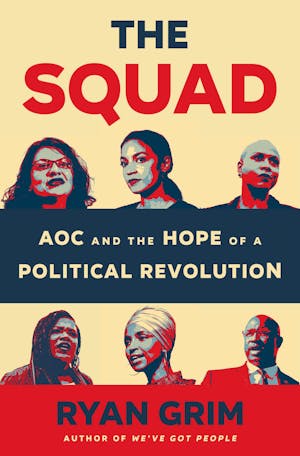
The Squad: AOC and the Hope of a Political Revolution
by Ryan Grim
‎Henry Holt and Co.


[Publication date: December 5, 2023]

The Squad

Semafor's Best Political Book of 2023

A riveting insider account of the progressive movement in Congress centering A.O.C., Rashida Tlaib, Jamaal Bowman, Cori Bush, Ayanna Pressley, and Ilhan Omar―their rise, their efforts to set an ambitious agenda for the country, and their struggle to find their footing within the Democratic party.

The Squad
is the definitive, must-read book about the most exciting figures defining our new era. The story is urgent, and the stakes are high―for the country and the world―and Grim, an experienced political reporter who covered the Squad before they were the Squad, is uniquely qualified to tell it.

When Bernie Sanders, an obscure Vermont senator, launched his quixotic 2016 presidential campaign, few could have seen just how radically the Democratic Party would transform in just a few short years―or that such a transformation could be led by a Bronx bartender volunteering for Bernie in her spare time. The world as it was when that campaign began is almost unrecognizable today, and the Squad has both shaped and been shaped by the seismic social, cultural, and political changes underway.

Referred to informally as the Squad, led by the preternaturally politically savvy Alexandria Ocasio-Cortez, the group laid down a marker for an aggressive left-wing agenda. Grim takes you behind the scenes as that new energy makes impact with Washington, and the Squad spends as much time fending off assaults from Donald Trump―who regularly singled them out and led chants of “send them back” at rallies―as they did battling their own party’s sclerotic leadership. As they’ve grown in office, they’ve had to contend with the eternal question that confronts outsiders who power their way into the inside: Are they still radical organizers willing and able to lead a political revolution? 


ABOUT THE AUTHOR:


Ryan W. Grim is an American author and journalist. Grim was Washington, D.C. bureau chief for HuffPost and is the Washington, D.C. bureau chief for The Intercept. He is also a political commentator for Breaking Points and appears frequently on The Majority Report with Sam Seder,. His writings have appeared in several publications, including Rolling Stone, The Washington Post, and Politico. He is the author of This Is Your Country on Drugs and We've Got People: From Jesse Jackson to Alexandria Ocasio-Cortez, the End of Big Money and the Rise of a Movement


The Rebels: Elizabeth Warren, Bernie Sanders, Alexandria Ocasio-Cortez, and the Struggle for a New American Politics
by Joshua Green
‎Penguin Press, 2024

[Publication date: January 9, 2024] 

From the author of the #1 New York Times bestseller Devil’s Bargain comes the revelatory inside story of the uprising within the Democratic Party, of the economic populists led by Elizabeth Warren, Bernie Sanders, and Alexandria Ocasio-Cortez.

In his classic book
Devil’s Bargain, Joshua Green chronicled how the forces of economic populism on the right, led by the likes of Steve Bannon, turned Donald Trump into their flawed but powerful vessel. In The Rebels, he gives an epic account of the long struggle that has played out in parallel on the left, told through an intimate reckoning with the careers of the three political figures who have led the charge most prominently. Based on remarkable inside sourcing and razor-sharp analysis, The Rebels uses the grand narrative of a political party undergoing tumult and transformation to tell an even larger story about the fate of America.

For many years, as Green recounts, the Democrats made their bed with Wall Street and big tech, relying on corporate money for electioneering and embracing the worldview that technological and financial innovation and globalization were a powerful net good, a rising tide lifting all boats. Yes, there were howls of pain, but they were written off by most of the elites as the moaning of sore losers mired in the past. There were always some Democratic politicians representing the old labor base who resisted the new dispensation, but these figures never made it very far on a national level. For one thing, they didn’t have the money. But as income inequality ballooned, widening the gulf between the wealthy elite and everyone else, pressures began to build.

With the 2008 crisis, those forces finally erupted into plain sight, turning this book’s protagonists into national icons. At its heart,
The Rebels tells the riveting human story of the rise and fight of Elizabeth Warren, Bernie Sanders, and Alexandria Ocasio-Cortez from the financial crisis on, as outrage over the unfairness of the American system formed a flood tide of political revolution. That same tide that would sweep Trump into office was blunted on the left, as the Democratic party found itself riven by culture war issues between its centrists and its progressives. But the winds behind economic populism still howl at gale force. Whether the Democrats can bridge their divisions and home in on a vision that unites the party, and perhaps even the country, in the face of the most violently deranged political landscape since the Civil War will be the ultimate test of the legacies of all three characters. 

A masterful account of one of the defining political stories of our age,
The Rebels cements Joshua Green’s stature at the first rank of American writers explaining how we’ve arrived at this pass and what lies ahead.
 
 
ABOUT THE AUTHOR:
 
 
Joshua Green is author of the #1 New York Times bestseller, "Devil's Bargain: Steve Bannon, Donald Trump, and the Storming of the Presidency" (Penguin), a national correspondent for Bloomberg Businessweek, and a CNN political analyst. Previously, Green was an editor at the Atlantic and the Washington Monthly, and a political columnist for the Boston Globe. He's also written for the New Yorker, Esquire, Rolling Stone, Vanity Fair and other publications. Green regularly appears on CNN's shows, HBO’s Real Time with Bill Maher, and PBS’s Washington Week and Frontline. 
 

Monday, December 18, 2023

The Reactionary Lobbying Group AIPAC Is Attempting To Destroy the Careers of Progressive Socialist Politicians in Congress Focusing On 'The Squad'

https://jacobin.com/2023/12/pro-israel-billionaires-socialists-dsa-aipac-gaza-cease-fire-israel-war?mc_cid=917d570ade&mc_eid=543806b6cc 

Pro-Israel Billionaires Are Spending Big to Oust Socialists From Office

Across the country, pro-Israel groups and billionaires are trying to stop the antiwar movement pushing for a cease-fire in Gaza by bringing down its elected leaders, including Rashida Tlaib and Ilhan Omar. These are fights the Left can win with popular support.

PHOTO:  Benjamin Netanyahu speaking at the 2019 American Israel Public Affairs Committee Policy Conference in Washington, DC. (Cheriss May / NurPhoto via Getty Images)


Socialists in elected office are standing up for Palestinian rights and demanding a cease-fire in Gaza. A handful of billionaires, rejecting this progressive and popular agenda, are trying hard to take down these antiwar lawmakers. As well, many conservative and centrist Democratic candidates are launching primary challenges against them, hoping to be the recipients of big campaign cash from the American Israeli Public Affairs Committee (AIPAC) and similar pro-Israel groups. AIPAC and its allies — like-minded organizations and big donors — told the New York Times that they are going to spend big, probably far more than in previous election cycles, to defeat anyone standing up for Palestine. Many of their targets are members of Democratic Socialists of America (DSA) or close allies of the organization.

It’s essential that we defend those elected officials who are providing principled leadership to the Left in the midst of Israel’s brutal assault on the Gaza Strip, which has so far killed more than nineteen thousand Palestinians. Israeli president Benjamin Netanyahu’s allies have plenty of money, but politically, they’re flailing as international support for Israel’s war gradually declines in the face of its indiscriminate bombing of civilians. The call for a permanent cease-fire in Gaza is broadly popular, as are the economic justice issues these officeholders champion, so these should be winnable fights if the Left can stay organized. A 61 percent majority of likely US voters believes the United States should support a cease-fire, while only 28 percent oppose such a move — even though only sixty-two members of Congress have publicly called for one so far.

Michigan representative Rashida Tlaib may be number one on AIPAC’s enemies list. The DSA-endorsed congresswoman, who is the only Palestinian American to serve in the US House of Representatives, has faced censurefrom her colleagues for her Palestinian advocacy. Two Detroit Senate candidates say that AIPAC offered them $20 million to abandon their Senate races and run against her. Both refused, in pretty indignant terms, and despite the hefty political bounty on her head, Tlaib still doesn’t have a serious primary opponent. AIPAC has for now resorted to running attack ads against her through its dark money arm, equating her advocacy for a cease-fire in Gaza — and her participation in antiwar protests — with enabling terrorists.

AIPAC has a genuine challenger for Missouri representative Cori Bush, a democratic socialist activist from St Louis who introduced the House bill calling for a cease-fire, around which so much of the antiwar movement has mobilized. In an especially depraved move, Wesley Bell, the prosecutor who investigated the Ferguson Police Department after the infamous police murder of Michael Brown, switched his attentions from unseating far-right Senator Josh Hawley — a worthy goal — to launching a primary campaign against Bush, tapping into monied ire over her cease-fire bill.

Most of the “Squad” will be targeted in 2024. AIPAC remains, as the Nation put it in 2022, “desperate to defeat Summer Lee.” The group has tried backing both primary challengers and Republicans against the Pennsylvania representative and former DSA member, and it is expected to do so again in 2024. Minnesota representative Ilhan Omar, one of the most principled anti-imperialist and pro-Palestinian voices in office and a close ally of DSA members in Congress, faces multiple primary challengers competing for AIPAC funds.

Perhaps most worrisome is the animus against Representative Jamaal Bowman of New York. Bowman, ironically, left DSA when many members felt he was not sufficiently supportive of the group’s stance on Palestine, but he has turned out to be one of the strongest voices in Washington regarding the urgency of a cease-fire and the injustice of Israel’s occupation. Bowman’s seat may now be the most imperiled of any Squad member, as AIPAC has recruited Westchester County executive George Latimer to run against him, and Latimer may tap into considerable pro-war sentiment in the district.

Bowman isn’t the only New York elected official being targeted — a coalition of billionaires will also be taking aim at several state officeholders. A recent report in Hell Gate, a local New York City news site, confirmed rumors that had been flying around for months: a group of centrist and right-wing millionaires and billionaires, including Gil Cygler, a rental car mogul, as well as bigger names like Ronald Lauder (Republican diplomat and heir to the Estée Lauder Company) and Thomas J. Tisch (investor and Brown University chancellor), want New York’s socialists out of office. While these billionaires have disliked DSA’s success in expanding renters’ rights, the organization’s advocacy for Palestinians has galvanized even more ruling-class opposition.

DSA officials under fire include state senators Jabari Brisport of Brooklyn and Kristen Gonzalez of Queens, as well as Assemblymembers Marcela Mitaynes and Emily Gallagher from Brooklyn. (For full disclosure, I’m a DSA member and live in Brisport’s district; I’ve volunteered on his campaigns in the past and plan to do so again.) While the New York State Legislature does not set foreign policy, socialist elected officials have been visible at Palestinian solidarity protests.

A particular object of ire for the pro-Israel billionaires is Assemblymember Zohran Mamdani of Queens, who wrote the “Not on Our Dime” legislation, which would bar any charity in New York State from funding Israeli settlement activity (because the tax-exempt status of nonprofits makes them effectively government-supported). Mamdani also joined a group of legislators and activists on hunger strike in front of the White House recently, demanding a cease-fire in Gaza.

New York City Council doesn’t make foreign policy any more than the state government does. But these pro-Netanyahu billionaires understand that local leaders do help shape the discourse and play a role in building political movements. They’re also targeting Brooklyn councilmember Shahana Hanif, who was not endorsed by DSA but has said that she identifies as a socialist, and who has been outspoken in her support of a cease-fire in Gaza.

New York’s pro–Benjamin Netanyahu billionaires haven’t succeeded in their previous efforts to topple DSA-endorsed candidates. They have, however, backed successful challenges to longtime black socialist city councilmember Charles Barron and helped drive newcomer city councilmember Kristin Richardson Jordan, another democratic socialist not aligned with DSA, out of office.

The lawmakers presently targeted by AIPAC and the pro-Netanyahu billionaires are indispensable leaders on the Left, and it would be a travesty to lose any of them as political representatives. In the past, so much monied opposition might have been the kiss of death to an American left movement, especially given that most people aren’t well-informed about foreign policy. But that’s not the case right now.

The Left is up to the challenge of fighting well-funded opposition today. These fights require people and commitment, and all these districts have both — that’s how left-wing candidates get into office in the first place. DSA and allied groups like the Working Families Party, especially working with the wider movement for Palestinian rights and the hundreds of thousands of Americans who have taken to the streets to demand a cease-fire, have the grassroots power to fight back and win. Every decent American should join them.


ABOUT THE AUTHOR:


Liza Featherstone is a columnist for Jacobin, a freelance journalist, and the author of Selling Women Short: The Landmark Battle for Workers’ Rights at Wal-Mart.

Filed Under:

Wednesday, December 13, 2023

The Fundamental Crisis and Foundational Contradiction Facing the United States During the Upcoming Presidential Election Year of 2024: Fascism guided, informed, and enabled by the Doctrines and Practices of White Supremacy and Global Capitalism--PART 3

DEFEAT FASCISM BEFORE FASCISM DEFEATS YOU 

"What's Past is Prologue..."

http://www.truth-out.org/…/38319-white-supremacy-elected-do…

White Supremacy Elected Donald Trump
Wednesday, 9 November 2016 
by Kelly Hayes 
Truthout | News Analysis

I had no interest in watching the returns come in. Early Tuesday night, I was watching "Supernatural" reruns on my couch and only occasionally glancing at election updates on Twitter. Everything looked as predicted. The New York Times said Hillary Clinton was very likely to become the next president, as its irksome electoral meter bounced about. Like many, I had adopted the steadfast belief that Trump simply couldn't win. The polls were thoroughly damning. Wall Street didn't want him. The Republicans barely wanted him. But after a while, I felt compelled to turn off Netflix and switch to live election coverage.

I watched, drop-jawed, as it became clear the unthinkable was happening.  Donald Trump was surging toward victory.

As the electoral tide turned, wounded Clinton supporters began casting blame on social media, accusing voters who supported third-party candidates of derailing a Clinton victory. The mud-slinging directed at anyone on the left who hadn't supported Clinton was predictably swift and devoid of insight. After all, Donald Trump was the opponent Hillary Clinton wanted. He was supposed to be an easy takedown. But Clinton's team had obviously underestimated Trump's cultural momentum. The media all but celebrated his despicable antics for shock and entertainment value, as large swaths of bigoted white people endorsed his racism and xenophobia.

The Democratic establishment was sure it would have Bernie Sanders' crestfallen supporters on lock, even as it insulted them. Clinton didn't even attempt to speak the issues that might have moved such people. The Democratic establishment assumed it would get what it wanted out of fear, without making any concessions to those who didn't trust it. The struggle at Standing Rock -- which Clinton weakly acknowledged in a noncommittal statement -- is just one example of how this campaign took people for granted, and took votes for granted.

Some issues never warranted engagement for Clinton and those issues often involved marginalized people -- because the Democratic Party was betting it all on one of its most basic electoral assumptions: There's no need to be loved when your opponent is feared.

But in spite of my distaste for Clinton, I likely would have voted for her if I lived in a battleground state. I didn't because I didn't have to. And given her track record and all the harm she's done -- supporting and enacting policies that expanded mass incarceration and our violent interventions abroad -- feeling like I didn't have to vote for her was a relief. I am willing to bet that some voters in states where Clinton was projected to win had that same feeling: a sense of relief that they didn't have to cosign a neoliberal nightmare's ascension. Wall Street wanted her. The establishment wanted her. Plenty of people who hated her seemed ready to suck it up, and the polls looked good. And then....

Enter President Trump.

What came as a shock to many of us probably shouldn't have. While Clinton seemed to have made a Thatcher-like assent, overcoming misogyny by embracing her own kind of casual brutality, white supremacy would not allow her to win so easily as Obama stepped out. The flames of white violence had been stoked at a time when white people had felt the displacement of a Black presidency, and the unapologetic momentum of a movement for Black lives.

Not even Wall Street could overrule the white rage and vanity that fueled Trump. The electoral dictates of Wall Street are institutional, but white supremacy is structural. White supremacy redistributed its power Tuesday night, and in such a spectacular fashion that even those of us who expect the worst of our country were left astonished. The United States, which seemed poised to usher in another Clinton presidency, instead rallied behind a dangerous, racist buffoon.

So what does the future hold? Ugliness, to be sure. The terrifying promises of Trump's campaign are ringing in the ears of all affected by them, myself included. I am afraid for everyone who will be harmed by this man's administration. I am afraid of just how much destruction one oafish reality TV star might bring, when life as we know it nears the edge of extinction.

Yet I am, as ever, certain in my own work. I will organize and take action. I imagine a few more people will be in the streets in the coming year than otherwise would. I'll be glad to see you all out there, though sorry about the circumstances.

This is going to be rough, but it's what we've got. So let's pull it together and figure out how to tear into our common enemies in the days ahead. I know loss is bitter, but it's time to get over it and learn what you can. In this case, that might mean learning that people may not bother to show up for a candidate they don't believe cares about them, no matter how scary the alternative. And it definitely means getting ready to throw down hard, because it's going to be a long four years.


ABOUT THE AUTHOR:


Kelly Hayes is a direct action trainer and a cofounder of The Chicago Light Brigade and the direct action collective Lifted Voices. She is community relations associate and a contributing writer at Truthout and her photography is featured in the "Freedom and Resistance" exhibit of the DuSable Museum of African American History. Kelly's contribution to the anthology Who Do You Serve, Who Do You Protect? stems from her work as an organizer against state violence and her ongoing analysis of movements in the United States, as featured in Truthout and the blog Transformative Spaces.


Related Stories:

White Supremacy Is Alive and All Too Well
by Mitchell Zimmerman, OtherWords | Op-Ed

Democrats March Toward Cliff
by Robert Parry, Consortium News | Op-Ed

Standing Firm at Standing Rock: Why the Struggle Is Bigger Than One Pipeline
by Sarah Jaffe, Moyers & Company | Report


"What's Past is Prologue..."

https://newrepublic.com/…/joe-biden-destructive-politics-wh…

The Destructive Politics of White Amnesia

Joe Biden set the stage for Donald Trump's racial scapegoating. Why can't he admit that he was wrong?

by Kimberlé Williams Crenshaw
August 6, 2019
The New Republic


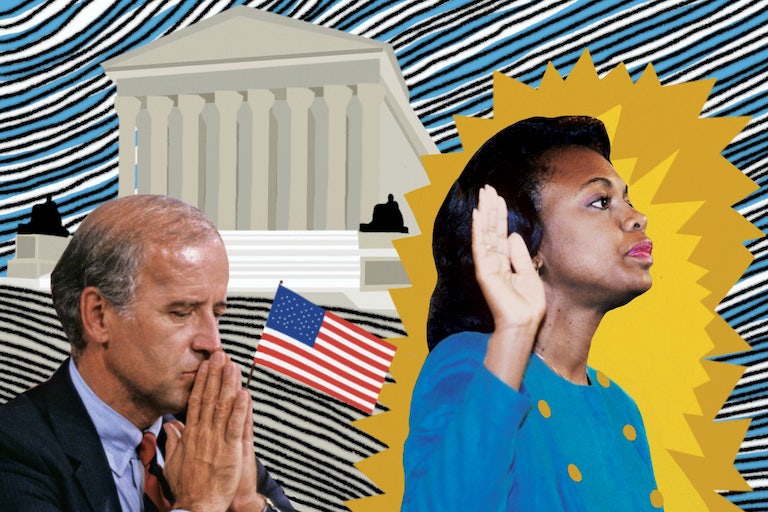
IMAGE: Arnie Sachs/Picture-Alliance/DPA/AP Photo (Biden) Jennifer Law/AFP/Getty (Hill)


For all of his bumbling verbosity and avuncular artlessness, Democratic front-runner Joe Biden serves as a remarkably elegant illustration of all that ails the Democratic Party’s bid to retake the White House in 2020.

Trump’s breathtaking weaponization of the Republican Party into the party of white nationalism should, at minimum, make the parameters of the Democratic primary campaign clear. Where conservatives in the past have employed dog whistle rhetoric to mask the manipulation of racial tensions, Trump’s itchy Twitter fingers dole out something more like smart missile rhetoric. The precision-guided invectives hurled at Representative Elijah Cummings, “the Squad,” and civil rights leader the Reverend Al Sharpton represent an escalation that Trump’s eventual general election challenger cannot meet with appeasement.

To counter such terrifying demagoguery, the party must be as unified in its repudiation of racism, xenophobia, and misogyny as the Party of Trump has been in enabling them. One would think, therefore, that candidates angling to become the standard-bearer of the loyal opposition should be capable of articulating not only the danger of this political moment, but also how their own party helped create this tragedy. Democratic candidates will never be able to steer a fresh course so long as they continue decades of denial and dissemblance. Joe Biden’s status as the 2020 field’s front-runner, in spite of his cringeworthy efforts to account for his part in that history, speaks volumes about how far today’s Democrats still have to go before they can meet the challenges of Trumpism head-on. A good deal of Biden’s inflated standing comes from an all-too characteristic Democratic posture of risk aversion, compounded by a talismanic faith in Biden’s mystic “electability.” Many party leaders and voters clearly view a Biden candidacy as the safest post-Trump course correction—and Biden as a pragmatic man of the people with the unique ability to build coalitional bridges between coastal elites and the so-called forgotten men and women of America’s heartland.

As if to underscore the inherent limitations of this posturing, Biden has trafficked enthusiastically in images of good ol’ boy politicking as evidence that he is the right man for the job. As his reminiscences of Senate business in the sepia-toned (but decidedly white) past tripped up his early campaign efforts, Biden has tried, gingerly to grudgingly, to walk his comments back. But those overtures point up a disquieting fear about his bid to defeat Trump: He may well perpetuate the fallacies of elite comity that marked his early career—and that continue to animate Democratic strategies to win back voters who are not as yet scandalized by the racist and misogynist rabble-rousing that is Trumpism. Falling back on that strategy alone may be fool’s gold. Not only is it questionable whether Trump’s heartland faithful will ever return to the Democratic column; the clouds that hang over Biden’s candidacy also suggest that when the going gets tough, the tough might find themselves going it alone. Biden’s missteps present a troubling pattern of sacrificing the interests of the very constituencies that stand to lose the most if the 2020 battle is undercut by the politics of appeasement. Voters who are activated to battle tooth-and-nail against the resurrection of our white supremacist past have every reason to press candidates for evidence that their failing marks on some of the most consequential issues affecting race and gender justice won’t be repeated. So far, the current front-runner has offered little substance in his defense, beyond Obama stardust and affability. That’s not enough in the best of times, and it is certainly not sufficient now.

For starters, Biden has yet to accept any genuine responsibility for how he helped preside over a process that depicted women—African American women—as conniving bottom-feeders. As chairman of the Senate Judiciary Committee in 1991, Biden actively enabled the humiliation and stigmatization of Anita Hill in that terrible spectacle of patriarchal impunity. He failed to call the multiple existing witnesses who could corroborate Hill’s testimony, while granting future Justice Clarence Thomas the ability to testify both before and after his accuser. From his chairman’s perch, meanwhile, Biden took a sharply inquisitorial line of questioning toward Hill, and reassured the country that Thomas’s character was beyond reproach.

Biden’s long-overdue apology for his central role in the Hill-Thomas fiasco was typical Biden—that is to say, the rough equivalent of a reckless driver’s acknowledgment that a hapless bystander may have been harmed while he was behind the wheel. But well into the #MeToo era, Biden’s entire driving record warrants explaining, in close detail. Almost three decades after the Thomas hearings, he seems unaware of how his penchant for Senate friendliness made him a prime choreographer of a cultural debacle steeped in the toxic brand of white-male privilege that Moya Bailey and Trudy have come to call misogynoir.

The harm done to Anita Hill, to Black women, and to sexual harassment victims overall is not the half of it. The mishandled hearings put Thomas on the Supreme Court, and Thomas has gone on to be the most influential justice currently sitting. Any basic review of the long train of recent high court decisions dismantling the modest protections erected to safeguard our democracy against the unlicensed rule by the wealthy and racially privileged can’t help but highlight their common thread: The majority are 5–4 opinions in which Thomas’s vote has turned the country inside out.

In the same discursive vein, Biden’s wistful recollection of working alongside segregationists James Eastland and Herman Talmadge sent up clear alarms. To be sure, from a certain realpolitik vantage, one can defend Biden’s collaboration with white power as a necessary evil. At the same time, however, Biden’s nostalgia for his pragmatic former alliances with segregationist lawmakers bespeaks a foreshortened moral compass, one prone to equate bigotry with collegial rascalry.

Rather than citing abhorrent figures like Eastland and Talmadge as exemplars of a bygone civility, Biden might just as easily have lamented the many ways in which the postwar Senate majority amplified the power and influence of segregationists—a pivotal fact that Biden only glancingly acknowledged after the public uproar greeting his comments. This glib moral embrace of unyielding racists for the sake of “getting things done” buttressed a vicious anti-Black social and political order for generations on end. When those who think of Black people as subhumans are the arbiters of policy, it’s no great surprise to see them endorse policies that are at best indifferent and at worst inimical to the interests of Black people. When it came to defining issues like busing and, subsequently, mass incarceration, Biden was an accommodating enabler in the regressive politics of race.

Biden’s selective—and at times flatly deceptive—invocation of his history of course mirrors the countless ways in which American political culture at large relies on robustly denying the truth about our own collective past. His very candidacy, pitched on a vice presidential tenure under the glorious “post-racial” interregnum of the Obama years, elides much of his public career. American leaders can indulge in such self-exculpating flights of fancy via a stolid ideological refusal to deny the true implications of a state built on racial power. However much we love to pretend otherwise, the legitimacy of segregation and chattel slavery is inscribed in many of our most hallowed rhetorical and constitutional traditions—and extend right up into the present, as the Trump White House and the rise of the alt-right remind us nearly every day.

Biden’s difficulties are not personal; rather, like many of our white leaders, he’s inherited them from institutional, societal, and cultural patterns of denial. In our near-schizophrenic consensus view of racial progress, this legacy of denial operates to celebrate the nation’s preferred self-image as a clearinghouse of equal individual opportunity, open to all, while obsessively rationalizing away slavery, colonialism, and extermination as the singular, hermetically contained responsibility of the individual bad actors long ago who perpetrated these harms. This very denial is what has set the stage for the riotous resurrection of white entitlement and scapegoat politics.

Before there is reconciliation, there must be truthful engagement with the conditions of Trumpian reaction. If Biden’s campaign fails to channel and instead diminishes the energies of constituencies mobilized to resist 45, Trumpism still wins.

The playwright Eve Ensler recently referred to the American inability to confront the country’s past injustices as a form of “diabolical amnesia.” This forgetfulness so dulls the tip of progress that we repeat the same unjust narratives over and over again. At a minimum, defeating the existential menace of the Trump movement means waking up, once and for all, from the many fatally compromised half-measures—and worse—that make up Joe Biden’s fond imaginings of bipartisan comity. The good old days of the good ol’ boys were never good. No one equipped to stem the MAGA tide would pretend otherwise.


ABOUT THE AUTHOR:
 

Kimberlé Crenshaw J.D. Harvard; L.L.M. University of Wisconsin; B.A. Cornell University) is founder and executive director of the African American Policy Forum. She is also Professor of Law at UCLA and Columbia Law School, and a leading authority in the area of Civil Rights, Black feminist legal theory, and race, racism and the law. Her articles have appeared in the Harvard Law Review, National Black Law Journal, Stanford Law Review and Southern California Law Review. She is the founding coordinator of the Critical Race Theory Workshop, and the co-editor of the volume, Critical Race Theory: Key Documents That Shaped the Movement. Crenshaw has lectured widely on race matters, addressing audiences across the country as well as in Europe, India, Africa and South America.

A specialist on race and gender equality, she has facilitated workshops for human rights activists in Brazil and in India, and for constitutional court judges in South Africa. Her groundbreaking work on “Intersectionality” has traveled globally and was influential in the drafting of the equality clause in the South African Constitution. Crenshaw authored the background paper on Race and Gender Discrimination for the United Nation’s World Conference on Racism, served as the Rapporteur for the conference’s Expert Group on Gender and Race Discrimination, and coordinated NGO efforts to ensure the inclusion of gender in the WCAR Conference Declaration.

Crenshaw has worked extensively on a variety of issues pertaining to gender and race in the domestic arena including violence against women, structural racial inequality, and affirmative action. She has served as a member of the National Science Foundation’s committee to research violence against women and has consulted with leading foundations, social justice organizations and corporations to advance their race and gender equity initiatives.

In 1996, she co-founded the African American Policy Forum to house a variety of projects designed to deliver research-based strategies to better advance social inclusion. Among the Forum’s projects are the Affirmative Action Research and Policy Consortium and the Multiracial Literacy and Leadership Initiative. In partnership with the Aspen Roundtable for Community Change, Crenshaw facilitated workshops on racial equity for hundreds of community leaders and organizations throughout the country. With the support of the Rockefeller Foundation, Crenshaw facilitates the Bellagio Project, an international network of scholars working in the field of social inclusion from five continents. Currently, she serves as Committee Chair for the U.S.-Brazil Joint Action Plan to Promote Racial and Ethnic Equality, an initiative of the U.S. State Department. A founding member of the Women’s Media Initiative, Crenshaw writes for Ms. Magazine, the Nation and other print media, and has appeared as a regular commentator on “The Tavis Smiley Show,” NPR, and MSNBC.

Twice awarded Professor of the Year at UCLA Law School, Crenshaw received the Lucy Terry Prince Unsung Heroine Award presented by the Lawyers’ Committee on Civil Rights Under Law, and the ACLU Ira Glasser Racial Justice Fellowship from 2005-07. Crenshaw has received the Fulbright Distinguished Chair for Latin America, the Alphonse Fletcher Fellowship, and was a Fellow at the Center for Advanced Study in the Behavioral Sciences at Stanford University in 2009 and a Visiting Fellow at the European University Institute in Florence, Italy in 2010. Currently, Crenshaw is the Faculty Director of the Critical Race Studies program at UCLA Law School.


IMAGE: Arnie Sachs/Picture-Alliance/DPA/AP Photo (Biden) Jennifer Law/AFP/Getty (Hill)


#CNN #News

Ilhan Omar responds to Trump's racist attack: "He spreads the disease of hate"

September 23, 2020

Rep. Ilhan Omar (D-MN) responds to President Donald Trump making a racially divisive attack against her at a campaign rally in Moon Township, Pennsylvania. 

He also denigrated the Minnesota congresswoman in her home state last month as "a horrible woman who hates our country" and insinuated that she may not have won her recent primary election.

"Let's check the mail-in vote," Trump told the crowd, adding. "Where are the people that would vote for her?"
Last summer, in a series of racist tweets, Trump told Omar and the other members of the "Squad" who have been outspoken against his policies -- Reps. Alexandria Ocasio-Cortez, Ayanna Pressley and Rashida Tlaib -- to "go back" to their supposed home countries, though they were born in the United States and Omar is a naturalized citizen.

Following his tweets, Trump's supporters at a campaign rally in North Carolina chanted "send her back," which was directed at Omar, as the President stood silently. He later claimed to disavow the chants.

Trump has also promoted false smears against Omar and questioned her patriotism, highlighting some of her controversial comments on issues including Israel, law enforcement and the September 11th terrorist attacks.


VIDEO: 


 https://www.youtube.com/watch?v=s_WQcqnQSpg

Saturday, November 18, 2023

Important Media Coverage of the Deadly Political, Moral, Physical, and Existential Consequences of The Massive War On Gaza by Israel And the United States Since November 15, 2023

https://www.nytimes.com/2023/11/15/world/middleeast/israel-gaza-war-rhetoric.html

‘Erase Gaza’: War Unleashes Incendiary Rhetoric in Israel

Experts say that inflammatory statements by prominent Israelis are normalizing ideas like the killing of civilians and mass deportations.

Plumes of dark smoke billow up from a cityscape with destroyed buildings in the foreground.
PHOTO: Strikes in northern Gaza, seen from Sderot, Israel, on Oct. 29. Credit:  Tamir Kalifa for The New York Times

Reporting from Jerusalem

November 15, 2023

New York Times

Shock, grief and pain have cascaded across Israel since Hamas gunmen poured out of Gaza to kill an estimated 1,200 Israeli civilians and soldiers on Oct. 7. So have anger and a thirst for vengeance, which the country’s leaders are verbalizing in language that critics in Israel say often crosses the line into incitement.

“We are fighting human animals, and we are acting accordingly,” said Yoav Gallant, the defense minister, two days after the attacks, as he described how the Israeli military planned to eradicate Hamas in Gaza.

“We’re fighting Nazis,” declared Naftali Bennett, a former prime minister.

“You must remember what Amalek has done to you, says our Holy Bible — we do remember,” said Prime Minister Benjamin Netanyahu, referring to the ancient enemy of the Israelites, in scripture interpreted by scholars as a call to exterminate their “men and women, children and infants.”

Inflammatory language has also been used by journalists, retired generals, celebrities, and social media influencers, according to experts who track the statements. Calls for Gaza to be “flattened,” “erased” or “destroyed” had been mentioned about 18,000 times since Oct. 7 in Hebrew posts on X, the site formerly known as Twitter, said FakeReporter, an Israeli group that monitors disinformation and hate speech. The phrases were only mentioned 16 times in the month and a half before the war.

The cumulative effect, experts say, has been to normalize public discussion of ideas that would have been considered off limits before Oct. 7: talk of “erasing” the people of Gaza, ethnic cleansing, and the nuclear annihilation of the territory.

Incendiary statements are not limited to Israel, of course. Ghazi Hamad, a senior leader of Hamas, vowed on Oct. 24 that the group would wipe out Israel as a country, and appeared to exult in the barbaric acts that his militants had carried out against Israeli civilians. “We are not ashamed to say it with full force,” he said. “We have to teach Israel a lesson, and we will do it again and again.”

But the proliferation of such language by Israelis has opened a debate in Israel, where far-right and ultranationalist politicians were testing the boundaries of acceptable speech even before Oct. 7. Itamar Ben-Gvir, a right-wing settler who went from fringe figure to minister of national security in Mr. Netanyahu’s cabinet, has a long history of making incendiary remarks about Palestinians. He said in a recent TV interview that anyone who supports Hamas should be “eliminated.”

Concerns about the spread of extremist rhetoric are an extension of a political battle within Israel that has been raging all year between Mr. Netanyahu’s ultraright government and a civic opposition, some of whom now worry that it will inure Israelis to the civilian toll in Gaza as the war goes on.

The idea of a nuclear strike on Gaza was raised last week by another right-wing minister, Amichay Eliyahu, who told a Hebrew radio station that there was no such thing as noncombatants in Gaza. Mr. Netanyahu suspended Mr. Eliyahu, saying that his comments were “disconnected from reality.”

Mr. Netanyahu says that the Israeli military is trying to prevent harm to civilians. But with the death toll rising to more than 11,000, according to the Gaza health ministry, those claims are being met with skepticism, even in the United States, which has pressed Israel to allow daily four-hour humanitarian pauses in the combat.

Such reassurances are also belied by the language Mr. Netanyahu uses with audiences in Israel. His reference to Amalek came in a speech delivered in Hebrew on Oct. 28 as Israel was launching the ground invasion. While some Jewish scholars argue that the scripture’s message is metaphoric not literal, his words resonated widely, as video of his speech was shared on social media, often by critics.

“These are not just one-off statements, made in the heat of the moment,” said Michael Sfard, an Israeli human rights lawyer and author of “The Wall and the Gate: Israel, Palestine and the Legal Battle for Human Rights.”

“When ministers make statements like that,” Mr. Sfard added, “it opens the door for everyone else.”

Yehuda Shaul, co-director of Ofek, a think tank in Jerusalem, has collected 286 statements since Oct. 7 that he classifies as having the potential to incite unlawful behavior. His list includes Eyal Golan, an Israeli pop singer; Sara Netanyahu, the wife of Mr. Netanyahu; and Yinon Magal, a host on Israel’s right-wing Channel 14.

“Erase Gaza. Don’t leave a single person there,” Mr. Golan said in an interview with Channel 14 on Oct. 15.

“I don’t call them human animals because that would be insulting to animals,” Ms. Netanyahu said during a radio interview on Oct. 10, referring to Hamas.

“It’s time for Nakba 2,” Mr. Magal wrote on X on Oct. 7, a reference to the mass displacement and flight of Palestinians before and after Israel’s creation in 1948, which Palestinians refer to as the “nakba,” or “catastrophe.”

In the West Bank last week, several academics and officials cited Mr. Eliyahu’s remark about dropping an atomic bomb on Gaza as evidence of Israel’s intention to clear the enclave of all Palestinians — a campaign they call a latter-day nakba.

On Saturday, the Israeli agriculture minister, Avi Dichter, said that the military campaign in Gaza was explicitly designed to force the mass displacement of Palestinians. “We are now rolling out the Gaza nakba,” he said in a television interview. “Gaza nakba 2023.”

The rise in incendiary statements comes against a backdrop of rising violence in the West Bank. Since Oct. 7, according to the United Nations, Israeli soldiers have killed 150 Palestinians, including 44 children, in clashes. Jewish settlers, some of whom are armed and informally allied with the military, have killed eight people, one of them a child, according to the United Nations.

Israeli officials point out that Hamas is also active in the West Bank and say that many of those clashes resulted from the military’s efforts to root out militants. Three Israelis have been killed in attacks by Palestinians since Oct. 7.

Eran Halperin, a professor of psychology at Hebrew University in Jerusalem, argued that the use of inflammatory language by Israeli leaders is not surprising, and even understandable, given the brutality of the Hamas attacks, which inflicted collective and individual trauma on Israelis.

For the first time since the Yom Kippur War of 1973, he said, Israel’s survival hangs in the balance. The country is facing the prospect of a multi-front conflict against Hezbollah and Hamas, as well as a potential uprising in the West Bank.

“People in this situation look for very, very clear answers,” Professor Halperin said. “You don’t have the mental luxury of complexity. You want to see a world of good guys and bad guys.”

“Leaders understand that,” he added, “and it leads them to use this kind of language, because this kind of language has an audience.”

Casting the threat posed by Hamas in stark terms, Professor Halperin said, also helps the government ask people to make sacrifices for the war effort: the compulsory mobilization of 360,000 reservists, the evacuation of 126,000 people from border areas in the north and south, and the shock to the economy.

But Mr. Sfard warned that Israel’s dehumanization of the people of Gaza could open the door to further discrimination and mistreatment of Palestinian citizens in Israel. It will also make Israelis more inured to the civilian death toll in Gaza, which has isolated Israel around the world, he added. A civilian death toll of 10,000 or 20,000, he said, could seem to “the average Israeli that it’s not such a big deal.”

In the long run, Mr. Sfard said, such language dooms the chance of ending the conflict with the Palestinians, erodes Israel’s democracy and breeds a younger generation that is “easily using the language in their discussion with their friends.”

“Once a certain rhetoric becomes legitimized, turning the wheel back requires a lot of education,” he said. “There is an old Jewish proverb: ‘A hundred wise men will struggle a long time to take out a stone that one stupid person dropped into the well.’”

Adam Sella contributed reporting. 


ABOUT THE AUTHOR:


Mark Landler is the London bureau chief. In three decades at The Times, he has been bureau chief in Hong Kong and Frankfurt, White House correspondent, diplomatic correspondent, European economic correspondent, and a business reporter in New York. More about Mark Landler

A version of this article appears in print on Nov. 16, 2023, Section A, Page 7 of the New York edition with the headline: ‘Erase Gaza’: Conflict Unleashes Inflammatory Rhetoric From Israeli Leaders. Order Reprints | Today’s Paper


AIPAC Set to Spend $100 Million to Unseat Lawmakers Critical of Israeli Crimes

Incumbent Squad members are among the American Israel Public Affairs Committee’s top targets.

The powerful lobby group American Israel Public Affairs Committee is expected to spend nine figures in a bid to unseat over half a dozen progressive U.S. lawmakers who have been critical of Israeli human rights crimes in Palestine, Slate reported Wednesday.

Slate politics writer Alex Sammon wrote that “close watchers now expect AIPAC to spend at least $100 million in 2024 Democratic primaries, largely trained on eliminating incumbent Squad members from their seats.”

Sammon said that Reps. Alexandria Ocasio-Cortez (D-N.Y.), Ilhan Omar (D-Minn.), Rashida Tlaib (D-Mich.), Ayanna Pressley (D-Mass.), Cori Bush (D-Mo.), Jamaal Bowman (D-N.Y.), and Summer Lee (D-Pa.) — “the most outspoken and unapologetically leftist contingent of the Democratic Party in national office” — are among AIPAC’s top targets.

 
1 PAC promising to spend 100 MILLION dollars against 5 working class, Black & brown reps in working class districts...is why we can't have a representative democracy. Idk what if we had governing that reflected our community's needs instead of AIPAC's? 
 
 
Alex Sammon
@alex_sammon
 
NEW: Sources say AIPAC is gearing up to spend over *$100 MILLION* as part of a campaign to knock the Squad out of congress in 2024. Cori Bush, Ilhan Omar, Jamaal Bowman, Summer Lee, and Rashida Tlaib are all marked for high dollar challenges.

Tlaib — the only Palestinian American member of Congress — has accused Israel of genocide for killing and maiming tens of thousands of civilians in Gaza and forcibly displacing nearly three-quarters of the besieged strip’s people. Many experts concur with her characterization.

Tlaib, Omar, Bush, and a handful of other Democratic lawmakers have also called Israel an apartheid state, an assessment shared by a growing number of rights groups, international figures, and even former Israeli government officials.

However, the furthest most progressive Democrats have gone in criticizing Israeli policies and practices is endorsing a resolution introduced last month by Bush urging U.S. President Joe Biden to press Israel’s far-right government to agree to a cease-fire in Gaza.

On Wednesday, two dozen House members led by Reps. Ocasio-Cortez, Mark Pocan (D-Wis.), and Betty McCollum (D-Minn.) sent a letter to Biden calling for a cease-fire.

As Sammon noted, a recent Data for Progress poll found that two-thirds of U.S. voters, including 80% of Democrats, also back a cease-fire.

Connor Farrell, president of the progressive fundraising group Left Rising, told Sammon that AIPAC wants “to make the statement this cycle that no one is safe from their wrath, that if you speak out, you can be targeted no matter how popular or how many cycles of incumbent you are.”

“It’s extremely audacious,” Farrell added.

Progressive Democrats are no strangers to AIPAC spending big in bids to defame, defeat, or unseat them. As Sammon noted:

In the 2022 midterms, the Israel lobby became the largest single-issue outside spender in Democratic primaries, pouring in nearly $30 million via the super PAC the United Democracy Project, and millions more via the Democratic Majority for Israel PAC. It was an astronomical amount of money, mostly directed at knocking progressives out of the primaries, largely in open and redrawn seats.

AIPAC’s heavy spending was blamed for helping Rep. Haley Stevens (D-Mich.) defeat incumbent Andy Levin — a self-described Zionist Jew — last year in Michigan’s 11th Congressional District Democratic primary.

Conversely, some of the staunchest supporters of Israel in Congress have benefited from AIPAC’s largesse. The group was the number one donor to both House Speaker Mike Johnson (R-La.) and House Minority Leader Hakeem Jeffries (D-N.Y.) during the last election cycle.

AIPAC has also been a top contributor to lawmakers like Reps. Ritchie Torres (D-N.Y.) and Josh Gottheimer (D-N.J.), who not only vocally support Israel, but also attack colleagues like Tlaib and Omar for their pro-Palestinian views. AIPAC was by far Gottheimer’s largest contributor in the 2022 electoral cycle, donating more than $216,000 to his campaign. The same goes for Torres, who received over $141,000 from the group during the same period.

 
Prem Thakker
@prem_thakker
 
Here are the 22 Democrats who voted with Republicans to censure Rep. Rashida Tlaib: Cohen Costa Craig Davis (NC) Frankel Golden Goldman Gottheimer Landsman Lee (NV) Manning Moskowitz Nickel Pappas Perez Ryan Schneider Schrier Soto Torres (NY) Wasserman Schultz Wilson (FL)

Some observers also believe it is no coincidence that Rep. Jack Bergman (R-Mich.) — whose third-biggest campaign contributor during the last election cycle was AIPAC — introduced a censure motion against Tlaib last month, baselessly calling her a terrorist sympathizer.

Progressive lawmakers haven’t taken AIPAC’s attacks laying down. Omar — who, like Tlaib has received death threats after being targeted by the group — has accused the organization of endangering her life. Pocan earlier this month called AIPAC “a cancerous presence on our democracy and politics in general.”

“I don’t give a fuck about AIPAC,” he said after the group falsely accused him and other representatives of “trying to keep Hamas in power.”

AIPAC has also come under fire from Democrats of all stripes for endorsing more than 100 Republican U.S. lawmakers who voted to subvert the 2020 presidential election in service of former President Donald Trump’s “Big Lie” that Democrats rigged the contest.

Alluding to right-wing support for the group, Bush wrote on social media Wednesday that “AIPAC is attempting to buy blue seats with GOP donor money.”

 
$100 million targeting Black and brown members of Congress for supporting a ceasefire, a position supported by 80% of our party’s voters. AIPAC is attempting to buy blue seats with GOP donor money.

Sammon wrote that AIPAC’s effort to oust popular Democrats is fraught with risks for the group:

Toppling an incumbent is not easy. Tlaib, Omar, Bush, Bowman, Pressley, and Ocasio-Cortez are all well-liked, especially in their districts. Some, like Tlaib, are masters of constituent services. Others have shown incredible fundraising chops, and boast massive grassroots networks. There have been previous attempts to take out Tlaib and Ocasio-Cortez that failed spectacularly, and expensively. Omar, who looked vulnerable in her previous race, didn’t really campaign that time around. AIPAC may find itself burning money to fight on inhospitable terrain. And if it fails, the group’s fearsome reputation in D.C. will be greatly diminished.

“That AIPAC feels the need to spend this much money at all could well be taken as a sign of weakness, not strength,” Sammon added. “Already, unlimited Israeli militarism is deeply unpopular; a full year of bombings of Palestinian hospitals and mass casualties of children in Gaza could make the AIPAC line even more unpopular still.”


ABOUT THE AUTHOR:

Brett Wilkins is a staff writer for Common Dreams.


https://truthout.org/articles/aoc-leads-coalition-of-democrats-calling-for-biden-to-demand-gaza-ceasefire/

AOC Leads Coalition of Democrats Calling for Biden to Demand Gaza Ceasefire

The group includes four Democrats who had not publicly called for a ceasefire before.

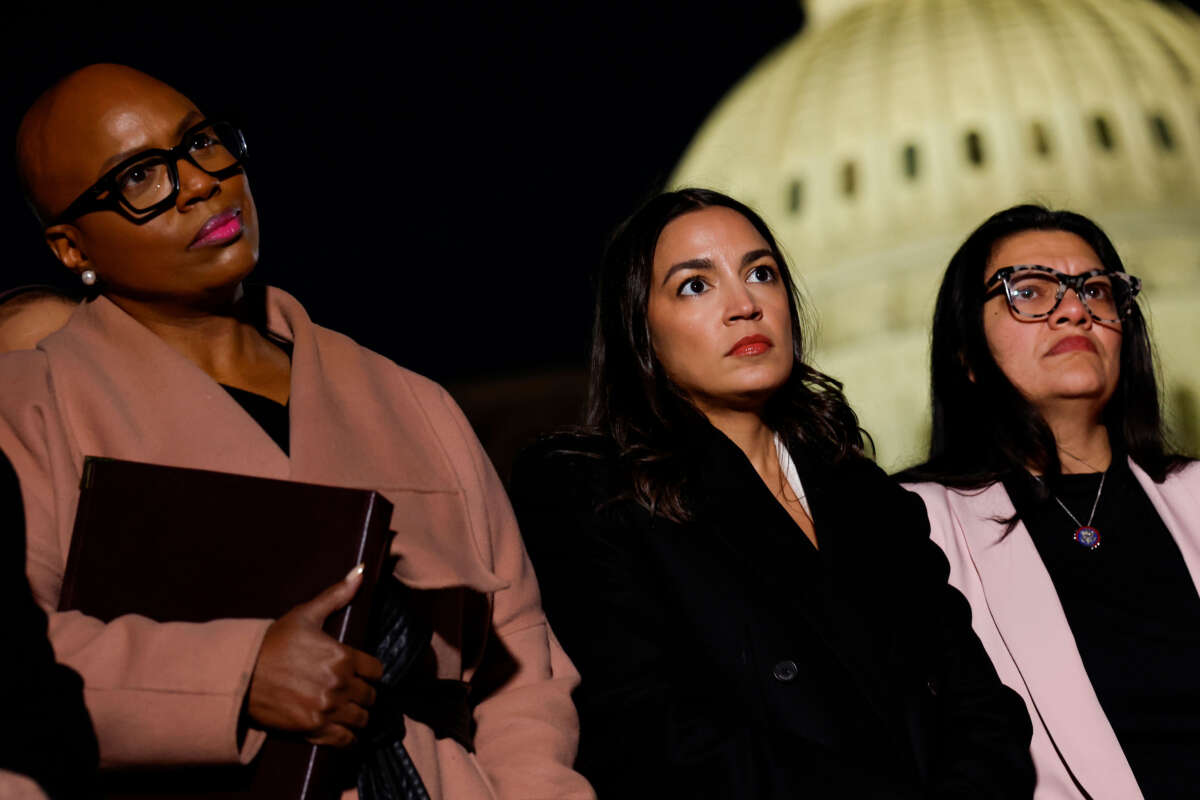
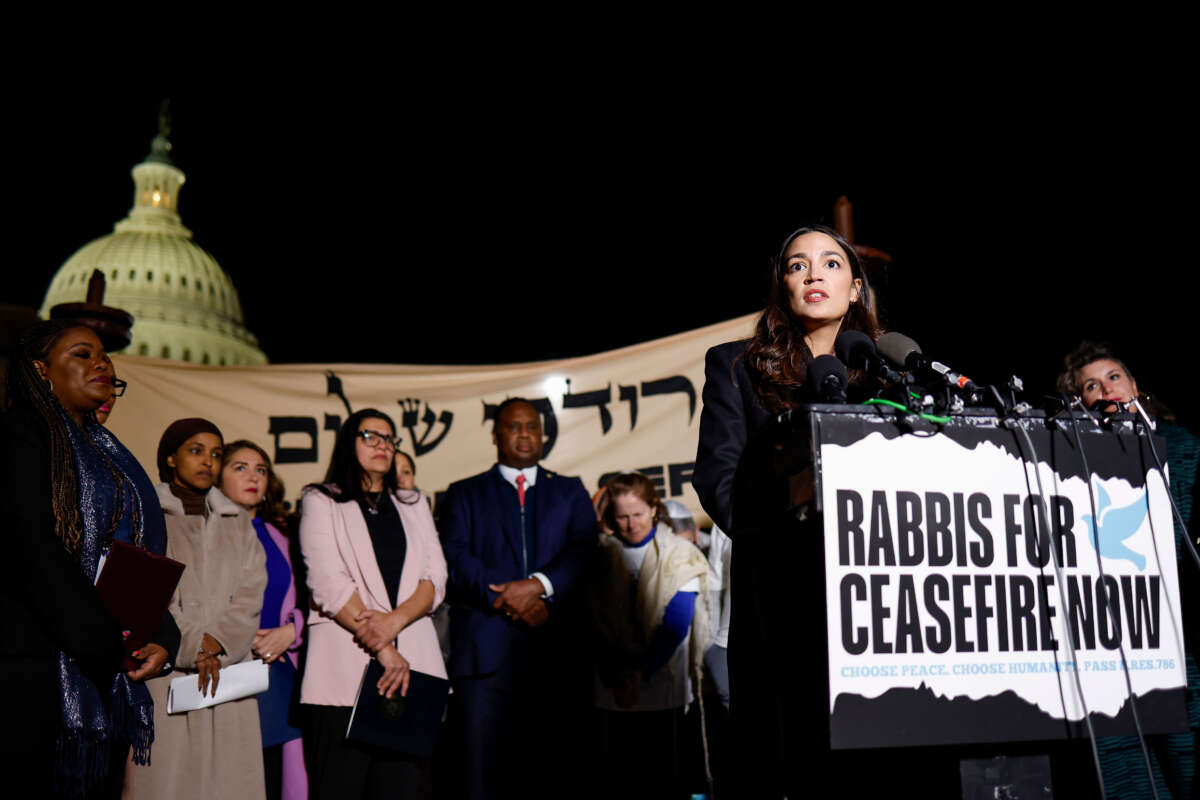
PHOTO:  Rep. Alexandria Ocasio-Cortez speaks at a news conference calling for a ceasefire in Gaza outside the U.S. Capitol building on November 13, 2023, in Washington, D.C. Anna Moneymaker / Getty Images

A group of House Democrats led by Rep. Alexandria Ocasio-Cortez (D-New York) is calling on President Joe Biden to demand a “robust bilateral ceasefire” in Gaza as reports say over 1 in 200 Palestinians in Gaza have been killed in just the last six weeks amid Israel’s siege and genocide.

The letter, signed by 24 House Democrats in total, urges Biden and Secretary of State Antony Blinken to call for a ceasefire in order to end the carnage in Gaza. The group, led also by Representatives Mark Pocan (D-Wisconsin) and Betty McCollum (D-Minnesota), says they are especially concerned with the “grave violations” against the rights of children in the region.

“We write to you to express deep concern about the intensifying war in Gaza, particularly grave violations against children, and our fear that without an immediate cessation of hostilities and the establishment of a robust bilateral ceasefire, this war will lead to a further loss of civilian life and risk dragging the United States into dangerous and unwise conflict with armed groups across the Middle East,” the lawmakers said.

“We reaffirm our unequivocal condemnation of the Hamas attacks on Israel that took place on October 7th, in which Hamas killed over 1,200 Israelis and foreign nationals, and captured over 200 hostages, who were subsequently taken to Gaza,” the group continued. “We also share dire concerns with the ongoing Israeli response, in which the Israeli Defense Forces have killed over 11,078 Palestinians, nearly half of whom have been children.”

The lawmakers detail some of the atrocities that Palestinians in Gaza have faced in the past weeks, including Israeli forces’ assault on residential neighborhoods, refugee camps and other United Nations shelters, as well as Israel’s blockade of basic needs like food, water and electricity. 

In addition to Ocasio-Cortez, Pocan and McCollum, the letter was also signed by Democratic Representatives Rashida Tlaib (Michigan), Cori Bush (Missouri), Jim McGovern (Massachusetts), Mary Gay Scanlon (Pennsylvania), Raúl Grijalva (Arizona), Pramila Jayapal (Washington), Joaquin Castro (Texas), Delia C. Ramirez (Illinois), Hank Johnson (Georgia), Greg Casar (Texas), Jesús “Chuy” García (Illinois), Bonnie Watson Coleman (New Jersey), Nydia M. Velázquez (New York), Ayanna Pressley (Massachusetts), Jonathan L. Jackson (Illinois), Barbara Lee (California), André Carson (Indiana), Jamaal Bowman (New York), Summer Lee (Pennsylvania), Veronica Escobar (Texas) and Ilhan Omar (Minnesota).

The signatories included four lawmakers who had not previously voiced support for a ceasefire in Gaza, bringing the total number of members of Congress in support of the idea to 31.

As the letter was made public on Wednesday, Israeli forces were carrying out a long raid of the largest hospital in Gaza, al-Shifa Hospital, where there were hundreds of staff and patients and thousands of residents taking shelter in the hospital grounds.

The hospital has been turned into a war zone, with Israeli forces stripping the clothes of some staff members and people taking shelter inside and blindfolding them while arresting them. The troops have closed in on the hospital in recent days, and thousands are trapped in the facility, including dozens of newborn babies. Doctors have been forced to perform manual respiration on the babies in order to keep them alive because of the fuel embargo imposed by Israel.

The assault on al-Shifa came just hours after U.S. Pentagon officials repeated Israel’s supposed justification for invading the hospital, saying that Hamas is using it as a base, even as human rights groups have said that Israel’s hospital attacks should be investigated as war crimes. In fact, analysts have drawn parallels between Israel’s claims about Hamas and the U.S.’s own false claims about weapons of mass destruction in Iraq, which were used as an excuse to launch a devastating war in the Middle East.

In their letter, the lawmakers similarly invoke the U.S.’s “mistakes in the aftermath of September 11th” and say that Biden should heed his own words about the U.S.’s wars in Afghanistan and Iraq — conflicts that in hindsight, Biden said, required “being deliberate” as he advised Israel’s leaders in an address after the October 7 attack to make “an honest assessment about whether the path you are on will achieve [your] objectives.”

The lawmakers say that Biden should acknowledge that further military activity will not bring about lasting peace in the region. Thus far, even as Biden and other top officials have been careful to use softer language about Israel’s attacks in public, the Biden administration has in private been expanding its military aid to Israel while internally suppressing lower-level administration staff who have spoken up against the genocide.

“Recognizing that there is no military solution that will end the Israeli-Palestinian conflict, we urge your Administration to obtain clarity on the specific strategic objectives of a large-scale ground invasion, their achievability, what may come after Hamas, the risks to hostages and civilians in the region, the national security implications of a multi-front war in the Middle East, and the potential threats to American citizens in the region,” they wrote.


ABOUT THE AUTHOR:


Sharon Zhang is a news writer at Truthout covering politics, climate and labor. Before coming to Truthout, Sharon had written stories for Pacific StandardThe New Republic, and more. She has a master’s degree in environmental studies. She can be found on Twitter: @zhang_sharon.


https://www.nytimes.com/2023/11/17/opinion/israel-democratic-party-jamaal-bowman.html

The War in Gaza Is Splintering the Democratic Party

Jamaal Bowman, wearing glasses, a sports coat and a white shirt, looks at the camera. In the background is a sidewalk and a street lined with cars.
PHOTO:  Jamaal Bowman. Credit:  Kholood Eid for The New York Times

Representative Jamaal Bowman, whose district encompasses several affluent Westchester County suburbs as well as a small part of the Bronx, last week planned a “healing breakfast” with Jewish constituents pained by his pro-Palestinian politics. A member of the informal alliance of a half-dozen or so young Black and brown left-wing representatives known as the Squad, Bowman won a primary against the district’s staunchly pro-Israel incumbent in 2020, fueled largely by the energy of that summer’s racial justice protests. But now, with the conflict in the Middle East inflaming American politics, he seemed likely to face his own primary challenge in June, one that will test the coalition between liberal Jews and people of color that is key to the progressive movement both in his district and in the country more broadly.

Bowman didn’t get into politics to work on Israel and Palestine. A brash, impassioned and sometimes impetuous former middle school principal, he was motivated by education and criminal justice reform. But like other members of the Squad, Bowman has developed a sympathy with the Palestinian cause that makes him an outlier in a Congress where deference to Israel is the norm.

He was one of nine Democrats to vote last month against a resolution expressing support for Israel and condemning Hamas, because, he said, it didn’t call for a two-state solution or for military de-escalation. Speaking at a rally held by Rabbis for Ceasefire this week, he said, rather presumptuously, “By me calling for a cease-fire with my colleagues and centering humanity, I am uplifting deeply what it actually means to be Jewish.”

Plenty of Jews in his district, including some who loathe Israel’s right-wing government, disagree, and have grown alienated from their congressman and the strain of progressive politics he represents. “People like me are not being given much to work with when we go to some of our beleaguered, anxious and frightened Jewish friends, and they are saying that the left is so infested with antisemitism that they can no longer be part of it,” said Lisa Genn, a local progressive activist who is part of a group called Jews for Jamaal.

With tensions in the district high, Bowman organized the breakfast so the community could talk things out in person. “Nobody’s going,” the head of the Westchester Board of Rabbis told New York Jewish Week, adding, “The relationship with the congressman has hit rock bottom, and he knows it, we know it.” Nevertheless, so many people R.S.V.P.ed that the meeting was moved from Bowman’s office in White Plains to the nearby Calvary Baptist Church.

When I arrived at the church that morning, a small group of protesters stood outside clutching signs. “Jews are not idiots. We know this is a P.R. stunt!” said one, held by a woman in a blue “Zioness” sweatshirt. “Bowman does not protect our Jewish students,” said another, held by Nancy Weinberger, a Democrat who has two children studying in Israel, and who was particularly incensed by Bowman’s recent vote against a House resolution condemning “the support of Hamas, Hezbollah and other terrorist organizations” on college campuses. “Can’t he give us one win?” she asked. “Can’t he vote in our interest at all?”

Soon the pastor of the church showed up, saw the demonstrators, and appeared to grow worried that Calvary Baptist would be seen as anti-Zionist. He abruptly canceled the event and called the police to clear everyone out. As Bowman’s staff tried to find a new location, Guy Baron, a protester wrapped in an Israeli flag, confronted the congressman in the church parking lot. “Your actions as our representative in Washington, D.C., are so painful to our community,” he said. “You have no idea. You are so out of touch with the Jewish members of your community.”

Baron inveighed against a slogan defended by Rashida Tlaib, another member of the Squad and the only Palestinian in Congress: “From the river to the sea, Palestine will be free.” The slogan was a major reason Tlaib was censured by the House last week, with 22 Democrats joining almost all but a few members of the Republican caucus.

“That is a call to genocide,” said Baron, “and you’re on their team.”

Bowman listened, his hands folded, then thanked Baron for sharing his feelings. “We are horrified by the rise of antisemitism that is happening all over the world, right here in our country, and right here in our community,” he said. “That is why we’re having this meeting and conversation today. Because we know and we acknowledge the trauma and the pain and the fear.”

Eventually, the meeting was moved back to Bowman’s office. About 40 people, including several of the protesters, gathered in a crowded semicircle in a low-ceilinged, fluorescent-lit room. Trays of bagels, scrambled eggs and pastrami sandwiches were brought in, but they went mostly untouched. Emotions were intense — there were repeated invocations of the Holocaust — but by absorbing his constituents’ outrage and grief, Bowman was able to keep the conversation civil.

“I am deeply concerned that the people that I’ve spent my life marching with are not marching with me,” Bill Giddins, a retiree from Bronxville, said to applause. “I am deeply concerned that when a Black person is damaged in America, I want to protect that person. I don’t feel the same from you and your office.” A few days before, a man had been arrested near the site of a local rally for the victims of Oct. 7 on charges of illegally carrying a semiautomatic weapon; his car was flying a Palestinian flag and had a swastika intertwined with a Jewish star scrawled on the side.

Bowman’s Jewish constituents tried to convey how an ancestral terror of annihilation had been newly awakened. “This is Westchester!” said one mother of young children. “How can we be feeling unsafe as Jews?”

“I myself can’t keep you safe,” said Bowman. “We, in this room, in this community, and me and my colleagues in elected office can do so. Not just with words, or political pandering, or virtue signaling,” but “sleeves up, in the room, figuring it out.”

Whether Bowman can figure out how to heal the rifts in his district will have implications beyond his slice of New York. Ahead of the existentially important 2024 election — which could bring Donald Trump, increasingly unabashed in his embrace of vengeful authoritarianism, back to power — some polls show Joe Biden’s support among young people and Arab Americans collapsing, likely because of the president’s backing of Israel’s war in Gaza. “People tell me they’re not voting Democrat, without me asking,” Bowman told me.

A series of ugly primary campaigns fought over Israel will only widen the progressive political divide. But with horror at conditions in Gaza and Jewish fear both ratcheting up, an intraparty clash over the future of the Squad now looks inevitable.

Cori Bush, Ayanna Pressley, Ilhan Omar and Alexandria Ocasio-Cortez stand and look off camera.
PHOTO:  From left, the Squad members Cori Bush, Ayanna Pressley, Ilhan Omar and Alexandria Ocasio-Cortez at a gathering calling for a cease-fire in Gaza. Credit:  Mandel Ngan/Agence France-Presse — Getty Images
A crowd sits in chairs. One man is wearing a skullcap.
PHOTO:  The crowd at an event called the Westchester Stands With Israel Rally, held last month at Temple Israel Center in White Plains. Credit:  Mark Vergari/The Journal News-USA Today Network

As the left-leaning journalist Ryan Grim points out in his forthcoming book, “The Squad: AOC and the Hope of a Political Revolution,” the politics of Israel and Palestine have bedeviled the group ever since its first members burst onto the political scene in 2018.

The most famous figure in the Squad, Alexandria Ocasio-Cortez, rarely spoke about the Middle East in 2018, during her first congressional campaign, which was centered on the same economic issues that powered the Bernie Sanders movement. But that May, she’d tweeted about the Israeli military’s shooting of protesters in Gaza, calling it a “massacre.” After her primary victory, she was questioned about that tweet, and her stance on Israel, on the TV show “Firing Line.” She grew visibly flustered, and afterward decided to stop doing national interviews for a while.

“At the time, she betrayed a visceral sense of just how treacherous the issue could be for her, but she could never have guessed how significantly she had underestimated it,” wrote Grim.

It was even more treacherous for Tlaib and Ilhan Omar, the first two Muslim women in Congress, who’ve both voiced support for the boycott, divestment and sanctions movement against Israel. Both spoke for many left-wing voters, especially young ones, who see in the Palestinian struggle a reflection of their own battles against various forms of oppression. Both also, occasionally, invoked what many Jews see as antisemitic tropes about Jewish power and dual loyalty. Less than a week into her first term, for example, Tlaib tweeted that Senate supporters of an anti-B.D.S. bill “forgot what country they represent.” Not long after, Omar tweeted that fealty to Israel by U.S. political leaders was “all about the Benjamins.” Some of the early weeks of the new congressional session were consumed by an attempt, eventually watered down, to officially rebuke her.

Soon after the original members of the Squad were sworn in in 2019, Mark Mellman, a Democratic pollster who once did work for the American Israel Public Affairs Committee, or AIPAC, started a group called the Democratic Majority for Israel aimed in part at stopping their influence from growing. “Most Democrats are strongly pro-Israel and we want to keep it that way,” Mellman told The Times. “There are a few discordant voices, but we want to make sure that what’s a very small problem doesn’t metastasize into a bigger problem.”

To that end, the Democratic Majority for Israel tried hard to thwart Bowman when he ran against Eliot Engel in 2020. The group spent almost $2 million in the race, much of it on ads slamming Bowman for unpaid taxes. As Grim noted, hitting “a working-class Black man for financial troubles before he’d risen to become a successful principal in the area would have been considered tone-deaf in a New York Democratic primary in any recent cycle,” but especially amid the summer’s protests over the killing of George Floyd. The attack failed; Bowman ended up winning a blowout 15-point victory.

The district, whose contours have changed with redistricting and could change again before the primary, is about 50 percent Black and Latino, and voters of color were Bowman’s base. But they were joined by some Jews, who are thought to make up about 10 percent of the district’s population. “It was the time,” said Giddins, the Bronxville retiree, who backed Bowman in the past. “We have to coalesce and give Black people power. They’re entitled to it.”

But despite Bowman’s popularity, growing disaffection among Jews — who, according to The New York Times, probably make up 20 percent to 30 percent of the Democratic primary electorate in his district — could make him vulnerable. He’s one of several Squad members facing potentially formidable primary challenges over their stances on the Israeli-Palestinian conflict.

Omar is going to have a rematch against a former Minneapolis City Council member, Don Samuels, who lost to her by about two points in the 2022 primary. Cori Bush, a Missouri Democrat who emerged from the Black Lives Matter movement, is facing a primary challenge from a former political ally, the St. Louis County prosecutor Wesley Bell. Summer Lee, a Pittsburgh Democrat whose district includes the Tree of Life synagogue, the site of an antisemitic mass murder in 2018, is being challenged by Bhavini Patel.

Bowman doesn’t have a strong opponent yet, but last month 26 rabbis in his district wrote a letter to Westchester’s popular county executive, George Latimer, imploring him to get into the race. Last week, a local TV station reported that Latimer had indeed decided to jump in, though he told me he still hadn’t made a formal decision and wouldn’t until he returned from a solidarity trip to Israel.

Should a few members of the Squad lose their primaries, the blow to Democratic unity could be severe. “Many of the young people or people of color, Muslim and Arab Democrats who support the Squad will feel like the party is not a place for them,” said Waleed Shahid, former communications director of the Justice Democrats, the group that recruited Ocasio-Cortez to run for office, and a senior adviser on Bowman’s 2020 campaign. “And they’ll either stay at home or they’ll go to a third party.”

Already, there are signs that the party is fracturing over Israel. According to a recent Reuters/Ipsos poll, about three-quarters of Democrats want a cease-fire, but few in the Democratic establishment share their views. Last week, in a rare gesture of defiance, more than 100 congressional staffers walked out to demand that their bosses back a cease-fire. More than 500 alumni of Biden’s 2020 presidential campaign and Democratic Party staff members have signed a letter imploring Biden to call for a cease-fire, saying, “If you fail to act swiftly, your legacy will be complicity in the face of genocide.”

If the conflict in Israel cools down in a few months, it might recede from the center of American politics. But the wounds it’s torn open will be hard to mend, because so many people are feeling betrayed. Many liberal Jews, mourning the mass murder in Israel and shaken by the upsurge of antisemitism at home, believe they’ve been abandoned by their allies. Advocates for the freedom and safety of Palestinians, horror-struck by more than 10,000 civilian deaths in Gaza, believe that the Democratic Party is giving its approval to atrocities. Bowman’s attempt to transcend this split in his own district, knowing how much ire would be directed at him, struck me as decent and brave. But when people discover that they see the world so radically differently, better communication alone might not be enough to bring them back together.

From the time he was elected, Bowman has had to traverse a minefield on the Middle East, facing pressure from both his pro-Israel Jewish constituents and from some of the left-wing groups that backed him. He’s mostly refused to tiptoe. Coming into office, Bowman was a member of the Democratic Socialists of America, but he angered the organization when he voted to fund Israel’s Iron Dome defense system. After he traveled to Israel and the West Bank with the left-leaning pro-Israel group J Street in 2021, some in the Democratic Socialists, which has a policy of boycotting Israel, moved to expel him. He ended up dropping his membership.

For all the blowback from the left, however, the trip solidified his abhorrence of the occupation of Palestine. “I got to see the giant wall built around the West Bank,” Bowman told me. He described being turned away from a checkpoint in the West Bank city of Hebron, where Palestinian movement is curtailed to accommodate a few hundred fanatical settlers, because he wasn’t Jewish. “And I thought that was ironic, because I’m literally a sitting member of Congress voting to support funding for the state of Israel,” he said.

He saw firsthand the way settlement expansion is making a contiguous Palestinian state nearly impossible. “I left feeling pretty overwhelmed and pretty dejected,” Bowman said, adding, “The rhetoric at home didn’t match the reality on the ground there, and specifically, the rhetoric around a two-state solution.” Bowman still believes in two states, but said, “The policies of the Israeli government haven’t gotten us there, and the U.S. hasn’t held Israel accountable towards helping us to get there.”

“At Jamaal’s core, he’s someone who believes in racial and social justice,” said Shahid, his former adviser. “And I think that a lot of the ways he thinks about the world were confirmed” by his trip to Israel. Shahid compared Bowman’s experience to that of the writer Ta-Nehisi Coates, who, speaking on the left-wing broadcast “Democracy Now,” described his own shocking encounter with the brutal segregation in Hebron. “I was in a territory where your mobility is inhibited,” said Coates. “Where your voting rights are inhibited. Where your right to the water is inhibited. Where your right to housing is inhibited, and it’s all inhibited based on ethnicity. And that sounded extremely, extremely familiar to me.”

It was familiar to Bowman, too. Given the congressman’s “experience as a racially conscious Black person,” said Shahid, “it’s hard not to see the parallels.”

Before going to Israel and Palestine, Bowman had co-sponsored legislation encouraging Arab states to normalize their relations with Israel. When he returned, he withdrew his sponsorship and announced he’d vote against the bill because, among other things, it didn’t take Palestinian interests into account. The move appalled rabbis in his district. Later, Bowman angered many Jewish constituents by co-sponsoring Tlaib’s resolution commemorating what Palestinians call the nakba, or catastrophe, referring to their expulsion from Israel during the country’s founding. He angered them further by boycotting the speech by Israel’s president, Isaac Herzog, to Congress in July.

Oct. 7 brought an already simmering discontent to a raging boil. A few days after the attacks, Bowman wanted to attend an Israeli solidarity rally held by the Westchester Jewish Council, but organizers advised him to stay away because he’d be received poorly. He has spoken out repeatedly against antisemitism, denouncing, for example, an Oct. 8 demonstration in Manhattan, promoted by the New York Democratic Socialists of America, where Hamas’s attacks were celebrated. But he hasn’t backed away from his fundamental view of the conflict, leaving the mainstream Jewish community feeling as if he’s run roughshod over their interests and sensitivities. “Actions against Israel affect the safety of the Jewish people everywhere,” said Weinberger, the woman with two children in Israel, adding, “We feel so helpless in Congress because of him. He’s taken our voice away.”

In 2022, despite mounting unhappiness with Bowman among some local Jewish leaders, national pro-Israel groups sat out his primary, determining, as Jewish Insider reported, that he “was likely unbeatable.” (He ended up winning about 57 percent of the vote in a four-way race.) But pro-Israel groups — one of which received funds from the disgraced crypto king Sam Bankman-Fried — poured an unprecedented amount of money into other primaries that year, a foretaste of the resources we could soon see mobilized against Bowman.

As Politico reported, the Democratic Majority for Israel spent $2 million to defeat the Bernie Sanders-backed Democrat Nina Turner in a 2022 Ohio primary. In Michigan, the United Democracy Project, a super PAC tied to AIPAC, spent a staggering $4.3 million to help beat Representative Andy Levin, a Jewish Democrat who had been outspoken in his criticism of Israel’s occupation. Some funding for the United Democracy Project came from Republican megadonors, including the Home Depot co-founder Bernie Marcus, a Trump supporter. These are not, needless to say, people who are averse to creating lasting ill will among Democrats.

“I’ve been in politics for 30 years, local, state and federal,” said Mark Pocan, a Wisconsin Democrat and former co-chair of the Congressional Progressive Caucus. “But last cycle was the first time I saw a really disturbing new phenomenon, which was two groups — cryptocurrency folks and AIPAC — getting involved in Democratic primaries with huge amounts of money,” often more than the candidates were spending themselves. We can expect to see even more outside money from groups supporting Israel deployed against the Squad in 2024. “The level of concern and engagement on the part of the pro-Israel community is at an extraordinarily high level,” Mellman, of Democratic Majority for Israel, told me.

These big-footed donors, who are overwhelmingly targeting representatives of color, are going to exacerbate the fissures in the Democratic Party. But they did not create them. Talking to some of the disenchanted voters at Bowman’s event, I was struck most not by their anger but by their heartbreak.

Diana Lovett, a Democratic Party district leader who held a fund-raiser for Bowman last year, said polarization over the congressman was tearing apart local Democrats. Leaving the event, she told me, with great sadness, that she didn’t feel she could back him anymore. “I love him personally,” she said. She’d spoken to him in October about their disagreement over Israel. “He was lovely, and he’s amazing, and he was the same warm and openhearted person that he was today,” she said.

But Lovett, who’d recently been hanging posters of kidnapped Israelis around town only to see them being torn down, had come to believe that their views on the Middle East are irreconcilable. “I think he sees what he believes to be an injustice, a grave injustice,” and that his votes are coming from a deep “moral consciousness,” she said. “And I think the pain and suffering he is causing to his constituents is some kind of collateral damage to that higher principle.”

If Bowman were a more transactional politician, he might have compromised on an issue so fraught in his community. But he is, for better or worse, very sincere. Lovett was dreading “an insanely divisive primary,” but didn’t see any way around it. “He’s not going to convince us, and we’re not going to convince him,” she said.


ABOUT THE AUTHOR:


Michelle Goldberg has been an Opinion columnist since 2017. She is the author of several books about politics, religion and women’s rights, and was part of a team that won a Pulitzer Prize for public service in 2018 for reporting on workplace sexual harassment. @michelleinbklyn

A version of this article appears in print on Nov. 19, 2023, Section SR, Page 6 of the New York edition with the headline: A War Abroad, A Clash at Home . Order Reprints | Today’s Paper