http://www.salon.com/2013/08/13/dont_vote_for_cory_booker/
TUESDAY, AUGUST 13, 2013
Don’t vote for Cory Booker today
He will be an awful senator
TUESDAY, AUGUST 13, 2013
Don’t vote for Cory Booker today
He will be an awful senator
BY ALEX PAREENE
SALON
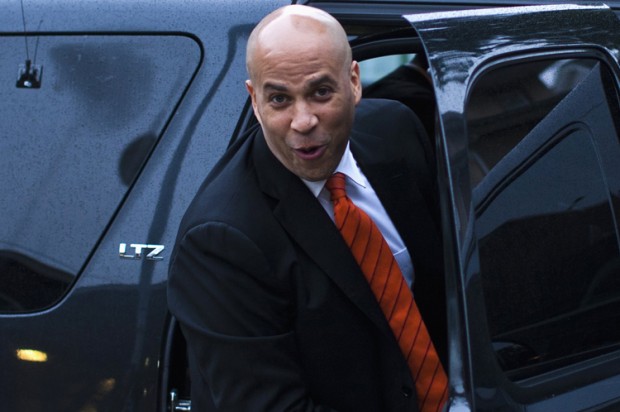
Cory Booker (Credit: Reuters/Eduardo Munoz)
Today New Jersey Democrats will decide who will be their nominee for the United States Senate. The winner of today’s primary election will be the heavy favorite in the general election. If any New Jersey voters are reading, and they have not yet voted, consider this a desperate plea: Don’t vote for Cory Booker. He’s going to be a very annoying senator.
It’s fine if you like Booker. He’s personable, charming, really good at Twitter, and he has done lots of stunts designed to make people aware of poverty, or at least to make people aware of Cory Booker’s awareness of poverty. He is a Good Liberal on many issues.
But he’s also an avatar of the wealthy elite, a camera hog, and a political cipher who has never once proposed anything to address the structural causes of the problems he claims to care so deeply about. He represents the interests of both Wall Street and Silicon Valley, two very prosperous industries full of incredibly arrogant rich men who believe that the world’s problems would be solved if arrogant rich men exactly like themselves were given free rein to make as much money as possible by any means necessary. They see, in Booker, a peer — a smart man with the right qualifications and the correct worldview. Booker and his crowd believe that the charity of the benevolent elite — people who know they are rich because of their innate skill, their brilliance, their work ethic, everything besides fundamentally inequitable distribution of resources and opportunities for economic advancement — is the only acceptable and effective means of addressing the needs of the lower orders.
Cory Booker became a millionaire because this is how the economy works for people of his class: Rich people give other rich people money to do nothing, simply because they “deserve” it. He is the worst sort of Democrat, and Democrats should be doing everything in their power to wrest control of the party away from people like him.
But that is why Cory Booker is bad as a phenomenon. What about his fitness for the specific job he is running for? It is, admittedly, probably not the job he was hoping for. Governors get to have more fun. Time’s Jay Newton-Small says Booker would miss retail politics and direct constituent interaction once he’s a senator:
Senators don’t fix potholes. Never mind flaming buildings–they rarely even kiss babies. Senators spend their days in meetings: with lobbyists, with interest groups, with other senators, with the administration, with fundraisers and with their leadership. They’re inside operators.
OK, but how do we actually think Booker spends most of his time? Fixing potholes personally, or attending meetings with rich, influential and important people? (Like Jeff Zucker’s teenage son?)
In many ways, Booker is perfectly suited for the United States Senate. He won’t be expected to accomplish anything. He will have so many more opportunities to spend time with even more rich people with elite backgrounds and worldviews similar to his. He will have much more access to television studios and Sunday shows and cable news cameras.
He will, in short, be the worst kind of senator. The kind that has no power and no real desire to exercise power on behalf of the people the senator ostensibly represents, but the kind that always expresses opinions on television about whatever national issues people on television care about that day. He will be on “Morning Joe” and “Meet the Press” constantly. He has even already said that he might consider Rand Paul and Ted Cruz as models for how a freshman senator might make “big marks.” Not “big marks” in the sense of any sort of lasting legislative legacy, because Ted Cruz does not care about legislation or policy, but “big marks” in terms of media attention and stunts designed to appeal to a core of supporters who prefer their senators brash and loud. Another one of those senators will not help anything.
It’s not like there aren’t any other options. Rush Holt would be a fine senator. He’s an actual physicist, which is neat. He cares very strongly about global warming, which is probably the single most pressing issue of our era. He will probably not use the Senate seat as a stepping stone to the White House, which means he may actually stick around long enough to gain seniority and someday actually achieve things.
So don’t vote for Cory Booker.
Alex Pareene writes about politics for Salon and is the author of "The Rude Guide to Mitt." Email him at apareene@salon.com and follow him on Twitter @pareene
http://www.theatlanticwire.com/politics/2013/08/liberals-un-endorse-cory-booker-just-he-becomes-shoo-senate/68278/
Liberals Un-Endorse Cory Booker Just as He Becomes a Shoo-in for Senate
by ELSPETH REEVE
AUGUST 13, 2013
Atlantic Wire

Newark mayor Cory Booker will almost certainly win Tuesday's primary to be the Democratic nominee for Senate in New Jersey (Update: he won), which will make him the overwhelming favorite in October's general election. But despite (or maybe because of) his near-certain imminent transit from city hall to Capitol Hill, a wave of liberals have hit Booker with their un-endorsements. The point doesn't seem to be to stop his election to the Senate — that looks impossible — but to make the case for why he shouldn't climb any higher in Democratic politics, a clear reminder that Democrats do infighting, too.

Booker is famous for sort of opposite things: an avid social media maven, he's known for helping the little guys, like the time he saved someone from a burning building; as a politician, he's supported some very big guys, like the time during the 2012 presidential campaign he defended the financial sector from Democratic attacks. And that is the core of the problem Salon's Alex Pareene (and others) have with him. Pareene writes on Tuesday that Booker is "an avatar of the wealthy elite, a camera-hog, and a political cipher who has never once proposed anything to address to the structural causes of the problems he claims to care so deeply about." He seems like a smug, self-dealing rich dude. Pareene writes:
"Booker and his crowd believe that the charity of the benevolent elite — people who know they are rich because of their innate skill, their brilliance, their work ethic, everything besides fundamentally inequitable distribution of resources and opportunities for economic advancement — is the only acceptable and effective means of addressing the needs of the lower orders."
Will this stop Booker from winning the primary? Very unlikely! Even Pareene does not think so. But his praise for another candidate gives some indication of the long-term importance of the case against Booker. Democratic rival Rush Holt, Pareene says, "will probably not use the Senate seat as a stepping stone to the White House." Booker recently announced he won't run for president — in 2016, but he didn't rule out 2020 and beyond, and that's exactly what Pareene seems worried about: "He is the worst sort of Democrat, and Democrats should be doing everything in their power to wrest control of the party away from people like him."
For the Booker un-endorsers, what's at stake in the New Jersey special election is the idea of who the Democratic standard-bearer will be after President Obama. And, while Booker talks a good game about fighting for poor people, they say, he works to protect the interests of his peers: wealthy people with allegiances to elite institutions. It's worth noting that Booker, the son of IBM executives who went to Stanford, Oxford, and Yale, is probably not all that rich himself. He's recently found himself in trouble over a web video curation company, Waywire, that he convinced people like Oprah and Google executive chairman Eric Schmidt to invest in. Booker's shares in the company, The New York Times reported, are worth $1 million to $5 million, according to his financial disclosures. But that could be very be wishful thinking: at its tiny larval startup stage, Waywire, as we discussed previously, might be worth as much as $10 million or as little as $0. The Internet is a hard game!
Still, Booker has defended the kind of elites who invest in Waywire and Booker's career. Pareen's colleague at Salon, David Sirota, is appalled that Booker's cultivation of that crowd is seen as political savvy, not corruption. Sirota writes:
"... Booker did not just raise massive amounts of campaign money from the thieves on Wall Street and then attack President Obama on behalf of those thieves. He did not just orchestrate a secret $100 million deal with Facebook CEO Mark Zuckerberg that the Washington Post notes was designed to help those donors circumvent the public and "remake (Newark) public schools in the way they want to." On top of all that, he also leveraged his municipal office to personally pocket hundreds of thousands of dollars in corporate speaking fees... Booker convinced his tech-industry backers to bequeath him an entire company – and then tried to prevent the multi-million-dollar gift from showing up in campaign disclosure reports."
The guys at Salon are not alone: "I don't trust the man," Crooks and Liars' Susie Madrak wrote on Monday. Voting for him risks selecting "a Manchurian candidate who, while running as a nominal Democrat, is and has been deeply entrenched with the vulture capitalists and their disaster capitalism education 'reform...'" Esquire's Charles Pierce is also creeped out by Booker's connections, writing on Tuesday, "Why I Wouldn't Vote for Cory Booker." He notes that Booker said on Meet the Press in 2012 that attacking Mitt Romney for Bain Capital is "nauseating to the American public. Enough is enough. Stop attacking private equity. Stop attacking Jeremiah Wright." It's a sign that Booker can't see the difference between the financial crisis and a preacher who says unpleasant things, Pierce writes:
"I've forgotten, how many houses did Jeremiah Wright steal out from under their owners? How many toxic mortgages did he foist off on unsuspecting customers while getting rich betting against the same investments? How many pensions did he loot? How close did Jeremiah Wright come to wrecking the entire world economy?
The anti-Booker sentiment has been brewing among liberals for some time. But it was less intense when Booker was less close to becoming one of 100 senators, instead of a Twitter celebrity and mayor of a city of 277,000. In June, DailyKos diarist RVKU wrote, "I Can't Vote for Cory Booker in a Primary." The blogger wasn't quite so tough on Booker, calling him intelligent and charismatic, with a "bright future in national politics" and "redeemable qualities." (RVKU lamented the same set of issues as the other un-endorsers.) Back in February, Sen. Frank Lautenberg — who died in June, and whose seat Booker is seeking to replace — compared Booker to a child who needs a spanking.
Gawker's John Cook wrote in December 2012, "Let the Booker Backlash begin." The prematurity of the declaration is evident by the update at the bottom of the post: "This post initially featured an exclamation point, rather than a period, at the end of its first sentence. Gawker regrets the error."
Correction: This post originally said the general election for Senate was in November. In fact, Gov. Chris Christie scheduled a special election for October.
(Photos by Associated Press.)
http://politix.topix.com/news/7477-cory-booker-hammered-by-liberals-after-winning-nj-primary
Gawker's John Cook wrote in December 2012, "Let the Booker Backlash begin." The prematurity of the declaration is evident by the update at the bottom of the post: "This post initially featured an exclamation point, rather than a period, at the end of its first sentence. Gawker regrets the error."
Correction: This post originally said the general election for Senate was in November. In fact, Gov. Chris Christie scheduled a special election for October.
(Photos by Associated Press.)
http://politix.topix.com/news/7477-cory-booker-hammered-by-liberals-after-winning-nj-primary
DEMS IN DISARRAY
Cory Booker Hammered by Liberals After Winning NJ Primary
Left-leaning pundits have slammed him as a false progressive
by Mary Noble
Senior Editor
Politix
Cory Booker speaks after winning the NJ Democratic primary • AP
Cory Booker, famed for rescuing women from a burning buildings and being Newark mayor as his day job, has won the Democratic nomination for NJ senate with a superman-like 40 point lead over the runner-up.
Just as Booker was poised to win the nomination, some liberal pundits turned on him. Booker is "an avatar of the wealthy elite," writes Salon's Alex Pareene. He's also "a camera hog, and a political cipher who has never once proposed anything to address the structural causes of the problems he claims to care so deeply about. He represents the interests of both Wall Street and Silicon Valley, two very prosperous industries full of incredibly arrogant rich men."
The British Guardian, another bastion of liberalism, calls Booker "the hedge fund guys' favorite politician" and a "neoliberal egomaniac" who "turns self-promotion into an art form. His corporate-friendly policies are not so pretty."
Coming to Booker's defense, Slate's Matt Yglesias praises his ideas for addressing poverty, especially a 15-page paper on child poverty penned by Booker. Yglesias also points out that Booker has a very similar voting record to the ultra-liberals preferred NJ senate candidate, Rush Holt.
In a much lower-turnout primary, NJ Republicans nominated Steve Lonegan, former mayor of Bogota, NJ.
Lonegan and Booker will face off against each other in November.
Begin forwarded message:
From: Kofi Natambu
Date: August 14, 2013
To: Amiri Baraka
Subject: Fwd: Breaking News: Cory Booker Wins N.J. Democratic Primary for U.S. Senate Seat, The A.P. Projects
Hey Amiri,
This is really depressing news. How did this openly brazen neoliberal opportunist CLOWN and PHONY ever get to this point in American politics? It's obviously a rhetorical question....
Kofi
From: NYTimes.com News Alert
Date: August 13, 2013
Subject: Breaking News: Cory Booker Wins N.J. Democratic Primary for U.S. Senate Seat, The A.P. Projects
BREAKING NEWS Tuesday, August 13, 2013
Cory Booker Wins N.J. Democratic Primary for U.S. Senate Seat, The A.P. Projects
Cory A. Booker, the mayor of Newark, captured the Democractic nomination for New Jersey’s vacant United States Senate seat, the Associated Press projected based on early returns.
Local election officials in the state’s 21 counties are still tallying the results of Tuesday’s primary election. The A.P. also projected that Steven M. Lonegan, a former mayor of Bogota, N.J., won the Republican primary.
The death of Frank R. Lautenberg, the long-time Democratic senator, in June led to an accelerated campaign, with the primary coming when many families are on summer vacation and a special election to be held just weeks later. As challengers scrambled to garner attention, much of the focus was on the Democratic side of the ballot and on Mr. Booker, who has held a commanding lead in pre-election polls and fund-raising.
READ MORE
http://www.nytimes.com/2013/08/14/nyregion/new-jersey-senateprimary.html?emc=edit_na_20130813
Cory Booker speaks after winning the NJ Democratic primary • AP
Cory Booker, famed for rescuing women from a burning buildings and being Newark mayor as his day job, has won the Democratic nomination for NJ senate with a superman-like 40 point lead over the runner-up.
Just as Booker was poised to win the nomination, some liberal pundits turned on him. Booker is "an avatar of the wealthy elite," writes Salon's Alex Pareene. He's also "a camera hog, and a political cipher who has never once proposed anything to address the structural causes of the problems he claims to care so deeply about. He represents the interests of both Wall Street and Silicon Valley, two very prosperous industries full of incredibly arrogant rich men."
The British Guardian, another bastion of liberalism, calls Booker "the hedge fund guys' favorite politician" and a "neoliberal egomaniac" who "turns self-promotion into an art form. His corporate-friendly policies are not so pretty."
Coming to Booker's defense, Slate's Matt Yglesias praises his ideas for addressing poverty, especially a 15-page paper on child poverty penned by Booker. Yglesias also points out that Booker has a very similar voting record to the ultra-liberals preferred NJ senate candidate, Rush Holt.
In a much lower-turnout primary, NJ Republicans nominated Steve Lonegan, former mayor of Bogota, NJ.
Lonegan and Booker will face off against each other in November.
Begin forwarded message:
From: Kofi Natambu
Date: August 14, 2013
To: Amiri Baraka
Subject: Fwd: Breaking News: Cory Booker Wins N.J. Democratic Primary for U.S. Senate Seat, The A.P. Projects
Hey Amiri,
This is really depressing news. How did this openly brazen neoliberal opportunist CLOWN and PHONY ever get to this point in American politics? It's obviously a rhetorical question....
Kofi
From: NYTimes.com News Alert
Date: August 13, 2013
Subject: Breaking News: Cory Booker Wins N.J. Democratic Primary for U.S. Senate Seat, The A.P. Projects
BREAKING NEWS Tuesday, August 13, 2013
Cory Booker Wins N.J. Democratic Primary for U.S. Senate Seat, The A.P. Projects
Cory A. Booker, the mayor of Newark, captured the Democractic nomination for New Jersey’s vacant United States Senate seat, the Associated Press projected based on early returns.
Local election officials in the state’s 21 counties are still tallying the results of Tuesday’s primary election. The A.P. also projected that Steven M. Lonegan, a former mayor of Bogota, N.J., won the Republican primary.
The death of Frank R. Lautenberg, the long-time Democratic senator, in June led to an accelerated campaign, with the primary coming when many families are on summer vacation and a special election to be held just weeks later. As challengers scrambled to garner attention, much of the focus was on the Democratic side of the ballot and on Mr. Booker, who has held a commanding lead in pre-election polls and fund-raising.
READ MORE
http://www.nytimes.com/2013/08/14/nyregion/new-jersey-senateprimary.html?emc=edit_na_20130813