Showing posts with label Unions. Show all posts

Tuesday, November 21, 2023

The Important Value of Union Solidarity On A Global Scale in the Support Of A Ceasefire in Gaza


Activism


This Union Is Famous for Opposing South African Apartheid. Now It’s Standing With Gaza.

In 1984, ILWU Local 10 refused to unload goods shipped from South Africa. Today, it’s demanding a cease-fire.

by Sarah Lazare
November 21, 2023
The Nation
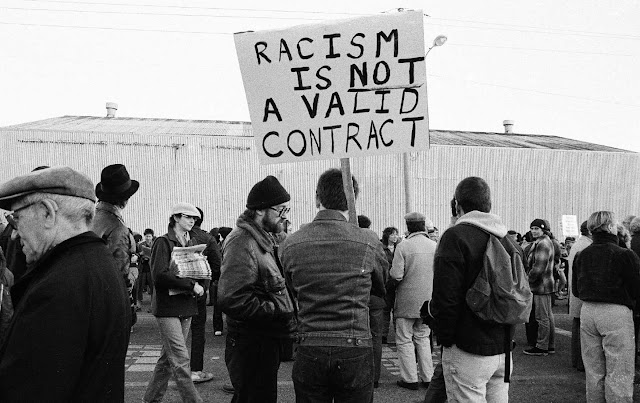


PHOTO: An ILWU supporter holds a sign in 1984 at the pier where the Nedlloyd Kimberly was anchored. (From the archive of Candice Wright)

[This article is a joint publication of The Nation and Workday Magazine, a nonprofit newsroom devoted to holding the powerful accountable through the perspective of workers.]

In 1984, Larry Wright and his coworkers in International Longshore and Warehouse Union (ILWU) Local 10 refused to unload goods shipped from South Africa in solidarity with that country’s anti-apartheid movement. This boycott at the San Francisco pier, which lasted 11 days, sent reverberations throughout the US labor movement, where major players like the AFL-CIO still were not yet willing to endorse the anti-apartheid movement’s boycott campaign.

Now, nearly 40 years later, 81-year-old Wright is involved in another effort to move the labor movement toward global solidarity: As a retiree who can speak but not vote at union meetings, he was part of a successful push within the same Local 10 to pass a resolution demanding an immediate cease-fire in Gaza. The measure passed unanimously at a November 18 general membership meeting of the union, which is based in the Bay Area and has around 1,700 members.

“It’s really important that as many people as possible are opposing what’s happening, and Local 10 is one of the unions that leads the way with supporting a struggle like this,” he said over the land line at his house in Oakland. “So I think it’s really important that the unions come out and oppose this terrible violence on the Palestinians.”

Current Issue



November 27/December 4, 2023, Issue


The resolution, which was sent to Workday Magazine and The Nation, cites the appeal from the Palestinian General Federation of Trade Unions (PGFTU) for union solidarity with Palestinians. Over the past 45 days, the Israeli military has killed at least 13,300 people in Gaza, including 5,600 children, according to the Health Ministry, which amounts to one out of every 200 people in Gaza. Local 10’s resolution sends “a message to the PGFTU expressing our solidarity and determination to take action in their defense consistent with our actions in the past and the ILWU’s principled position of defending Palestinian rights.”

The resolution calls the October 7 Hamas-led surprise attack that killed an estimated 1,200 Israelis “indefensible,” and states that “the UN calls Gaza an ‘open air prison’ of 2.2 million Palestinians. Under such repressive conditions it is no surprise that there would inevitably be a rebellion but this in no way justifies Israel’s genocidal bombing of civilians in Gaza.”
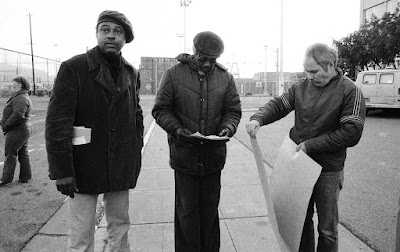

PHOTO: Three members of Local 10’s South African Liberation Support Committee (SALSC) gather in 1984. SALSC was formed in response to the 1976 Soweto uprising. (From the archive of Candice Wright)

“We additionally call on other trade unions both nationally and internationally to support PGFTU, a ceasefire and an end to Israeli apartheid oppression,” the resolution says. (Numerous human rights groups say Israel’s treatment of Palestinians amounts to apartheid.) A Local 10 official will read the resolution to the Oakland and San Francisco city councils, and the union will encourage the ILWU international and district councils to pass similar resolutions, the resolution states.

Trent Willis, a current member and former president of Local 10, voted in favor of the resolution at the general membership meeting, which was attended by roughly 200 people. “Our members are very concerned about news we’re hearing about innocent civilians being killed in the Gaza Strip right now,” he said over the phone. “And it’s not only our membership, but there are protests going on all around this country for a cease-fire.”

A growing number of local, state, regional, and even some national unions have issued similar calls for a cease-fire, a demand that is supported by a majority of people in the United States. The United States is supplying and politically backing Israel’s actions, and the Biden administration is seeking a significant increase in US military aid, even as humanitarian groups warn that Israel is indiscriminately targeting civilians. Among US labor’s supporters of a cease-fire are the United Electrical, Radio and Machine Workers of America and the leadership of the American Postal Workers Union. Yet most national unions, and the AFL-CIO, have so far declined to follow suit.

Peter Cole, a professor at Western Illinois University and the preeminent historian of Local 10, says dock workers are well-positioned to push this effort forward. “Maritime workers, dock workers, and sailors look outwards, not inwards,” he said over the phone. “They are constantly interacting with people and cargo around the world.” Local 10 members operate cranes that take containers on and off ships, drive trucks that move containers within the port, load and unload cargo from international shipping vessels, and secure containers on those vessels, among other jobs.

“Back in the ’90s, the San Francisco Labor Council called Local 10 the conscience in the labor movement,” he said. “I think that holds true.”

Local 10 is perhaps best known for taking a principled stand against South African apartheid. This organizing goes back to at least 1962, when Local 10 refused to cross a community picket of South African goods at San Francisco Pier 19, in what Cole wrote was very possibly the “first anti-apartheid action ever taken by a labor union in the United States.” In response to a 1976 uprising in the Black segregated Soweto Township, when police opened fire on Black students, killing an estimated 176 to 700 people, Local 10 members formed the Southern Africa Liberation Support Committee. Led by Leo Robinson, a Black longshoreman in Oakland, this committee was endorsed through a rank-and-file vote, which provided infrastructure for anti-apartheid organizing in Local 10, alongside other solidarity with liberation movements.

Wright, who was active on this committee, remembers “setting up literature tables in union halls, and collecting clothing, food, and books” to ship to African liberation movements in South Africa, Mozambique, Angola, Zimbabwe, and Namibia, as a show of material support. These donations were a physical presence in union life, he said, which also made them an “educational opportunity.”

Wright said that “for me, personally, I was involved in supporting the struggles in southern Africa because they were struggles against imperialism and colonialism, against the exploitation of peoples in those countries.”

Local 10 organized a series of actions in the late 1970s, but its biggest protest came in 1984. For 11 days, members boycotted South African goods carried aboard the Nedlloyd Kimberley, docked at San Francisco’s Pier 80. “We voted at a union meeting that we wouldn’t work this ship,” said Wright. “We had support from churches, from the gay community, from other unions. We had community supporters come picket. It’s easier to refuse to work if there’s a picket line. But even if there hadn’t been a picket, members wouldn’t have worked, because it was union policy not to work that ship.”

The union took this move even though its contract did not permit such a work stoppage, putting it at risk of retaliation. As word spread, crowds of community supporters flocked to Pier 80, “singing, chanting, and making witness,” Cole wrote in a historical essay. For the duration of the boycott, all of the South African cargo remained in the hold of the ship, even as workers handled goods from other countries. It was only when a federal judge threatened an injunction, which could include prison times, that the boycott ended. “The workers, having made their point, unloaded the cargo,” Cole noted.
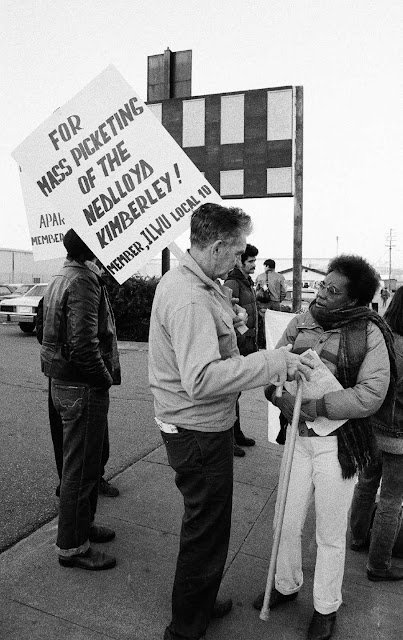
PHOTO: A Local 10 member talks with a community supporter. (From the archive of Candice Wright)

By taking this action, Local 10 was ahead of the leadership of the AFL-CIO. While the federation opposed apartheid, AFL-CIO President Lane Kirkland “was hesitant to support a full-blown boycott and divestment campaign against South Africa, worried about the African National Congress and Nelson Mandela being too far left,” explained Jeff Schuhrke, an assistant professor of labor studies at SUNY Empire State University in New York City, who has written a book about the foreign policy of the AFL-CIO, which will come out next year. “Meanwhile, the whole South African anti-apartheid movement was saying we want you to boycott and divest, this is a tactic that will help us end apartheid.”

Local 10 was not alone. Other unions in the AFL-CIO—like the United Mine Workers, United Auto Workers, and AFSCME—would soon be stepping up their boycott and divestment efforts. These efforts almost certainly played a role in pressuring the AFL-CIO to eventually endorse the boycott and divestment strategy in 1986, alongside pressure from Black South African trade unionists, Schuhrke explained. In 1990, speaking at the Oakland Coliseum, Nelson Mandela saluted Local 10 for the 1984 boycott, declaring that the workers “established themselves as the front line of the anti-apartheid movement in the Bay Area.”

This 1984 action is part of a longer history that continued through the 2000s. “The ILWU has been one of the more internationalist-oriented unions, recognizing the importance of solidarity around the world and standing up for freedom and justice and against imperialism and colonialism and apartheid,” Schuhrke explained. On May Day 2008, workers at 29 West Coast ports launched a one-day strike to protest the wars in Iraq and Afghanistan, and ILWU members refused in 2010, 2014, and 2021 to handle cargo on Israeli ships, in response to community pickets against the repression of Palestinians. As labor journalist Kim Kelly reported for In These Times, “In 2020, the ILWU also shut down ports for eight minutes and 46 seconds in solidarity with George Floyd, Breonna Taylor and all other victims of racist police violence.”

Today, opposition to Israel’s military actions in Gaza is animating protest movements throughout the world. This includes mass marches and a flurry of direct actions throughout the United States, where union members have been numbered among those taking to the streets, and demanding that members of Congress support a cease-fire. Lara Kiswani, a Palestinian American and executive director of the Arab Resource and Organizing Center, said that “we are particularly heartened by Local 10’s commitments to put its resolution to action.”

“For generations, our movement has found inspiration in Local 10’s commitments to social justice and internationalism—from its militant fights for worker power here in the US, to its unrelenting support of the South African anti-apartheid struggle, to its refusal to work Israeli ships profiting from the oppression of the Palestinian people.”

Throughout his organizing, Wright spent years working out of Local 10’s union hall, where he was dispatched to a variety of jobs, from laboring in the hull of the ship to latching containers, before switching to operating cranes and moving containers once he obtained more seniority. (He eventually switched to ILWU Local 91 after a promotion.) He saw how his union held moral power, because of their long history fighting against oppression.

“The ILWU is so respected,” he said, “that when it makes a call for people to join in opposing what’s happening to the Palestinian people, I think it carries a little extra significance, because of our history of supporting people’s struggles.”


Sarah Lazar


ABOUT THE AUTHOR:


Sarah Lazare is the editor of Workday Magazine and a contributing editor for In These Times.


Posted by Kofi Natambu at 5:10 PM


Labels:
Apartheid, Ceasefire, Gaza, International Longshoreand Warehouse Union (ILWU), Larry Wright, Sarah Lazare, Union solidarity


Wednesday, August 21, 2013

The Sustained Capitalist and Racist Assault On Detroit, Michigan And Its Lethal Consequences

 
https://www.facebook.com/pages/The-Panopticon-Review/342702882479366

Detroit Residents on Bankruptcy -We Have No Democracy!
15 August 2013
By David Bacon, 
Truthout | News
(Photo: David Bacon)

DETROIT - On July 18, 2013, Kevyn Orr, the city emergency manager appointed by Republican Gov. Rick Snyder, declared Detroit bankrupt under Chapter 9 of the bankruptcy code. According to official accounts, Detroit is $18.5 billion in the hole, making this the largest of several recent bankruptcies declared by US cities and counties.

In theory, such a declaration means that all the city's creditors will suffer and will have to accept only a fraction of what they're owed. But when a bankruptcy judge decides who will have to make sacrifices, those making the most painful ones will be Detroit's 21,000 retired city employees and its 9,000 current ones.

"Everything they've been promised, both contractually and kind of a social contract, is being pulled out from under them. It's morally indefensible," Michael Mulholland, vice president of Local 207 of the American Federation of State, County and Municipal Employees told journalist Jane Slaughter. "I was told if I worked here I'd have a steady job and in my old age not be in poverty." Mulholland's pension as a retiree is $1,600 a month, not an income that can support a family, even in a city like Detroit, where housing prices have plunged.

The Detroit bankruptcy, while huge, is the latest of several that have had their sharpest impact on city workers. The city of Stockton, California, declared bankruptcy two years ago. In a court settlement this month, it forced its 1,100 retirees to accept a lump sum of $5.1 million to compensate them for canceling their previously guaranteed medical insurance. If each retiree gets an equal share amounting to $4,636, it would buy health insurance for only a year or two at current prices. In the US, there is no national health service, and people must buy insurance to pay the cost of medical care.

Huge US corporations have a long history of trying to shed obligations for pensions and health care for retired workers. In the most recent case, the Patriot Coal Company, created by mining giants Peabody Energy and Arch Coal, declared bankruptcy while corporate creators continued to amass large profits. Patriot is responsible for the pensions and health care for 23,000 retirees and dependents who previously worked for Peabody and Arch before the spin-off. The new company says it can't sustain the payments for the benefits workers earned over years of labor in the mines.

While cities like Stockton and Vallejo in California have used bankruptcy law to accomplish this same end, legislators in Michigan have gone one large step farther. Michigan first passed Public Act 101 in 1988, when Democrats still controlled the legislature and governor's office. It allowed temporary emergency control of cities but barred canceling the contracts or benefits of employees. Then Public Act 72 in 1990 allowed the appointment of emergency managers to take control of school systems.

Finally, in 2011, Republicans took control of the Legislature and governorship. They passed Public Law 4, which was much more radical and gave virtually unlimited powers to emergency managers appointed by the governor. Those managers could completely displace elected local city councils, mayors, school boards and other public bodies. Newly elected Gov. Snyder then ended collective bargaining rights and employee status for almost 26,000 child-care workers belonging to the United Auto Workers and the American Federation of State, County and Municipal Employees.

Schools in Highland Park and Pontiac have had three emergency managers, and one manager in Highland Park has been indicted for embezzling. In Benton Harbor, the emergency manager sold off the sports arena built with $55 million of public funds to a developer for $583,000. He even barred the mayor from entering his own office. In Hamtramck, the financial manager stopped paying the mayor and City Council and told the council members to stop meeting. In Ecorse and Highland Park, financial managers made major layoffs to the fire and police departments, outsourcing many jobs to neighboring cities.
In Detroit's schools, part of the agenda has been privatization. By the end of the 2009-10 school year, 50,139 students (36 percent) in Detroit already were attending charter schools. Robert Bobb was then brought in from Oakland, California, as emergency manager and unveiled a plan to covert an additional 41 schools (30 percent of the district) serving 16,000 students into charter schools. Bobb's plan was linked to the Deficit Elimination Plan - an agreement he made with the state. It required the district to close 70 schools over two years and raise class sizes to 60 students at the high school level.
(Photo: David Bacon)

Voters rebelled and repealed Public Law 4 in 2012. The legislature grew even more radical, however, passing a law forbidding contracts that require union membership as a condition of employment (a so-called "right to work" law) then passed Public Law 4 again in a slightly modified form, as Public Act 436.

In March 2013, Snyder appointed Orr as Detroit's emergency manager. And on July 18, Orr forced the city into bankruptcy. City unions charged that he was unwilling to negotiate with them about the move and that his assistants would simply show them PowerPoint presentations during meetings in which they were supposed to bargain.

Anticipating what was to come, lawyers representing public union pension funds went to court to enforce a provision of the Michigan Constitution. It says, according to Ingham County Circuit Court Judge Rosemarie Aquilina, that the governor can't "diminish or impair pension benefits." Hearing that the judge was about to make her ruling invalidating any pending bankruptcy, Snyder and Orr declared bankruptcy a few minutes before she acted. The judge condemned the move, because it gives all authority to a bankruptcy judge and removes review by the normal court system. "It's cheating, sir, and it's cheating good people who work," the judge told Brian Devlin, assistant state attorney general. On July 23, however, the state Court of Appeals granted a motion by Attorney General Bill Schuette to stay Aquilina's order to stop bankruptcy proceedings because they violate the state constitution.
Veteran Detroit Congressman John Conyers, one of the most progressive in the House of Representatives, said the judge's ruling mandated congressional hearings to determine whether Snyder and Orr were misusing bankruptcy to slash pensions and medical insurance. The chairwoman of the Congressional Black Caucus, Marcia Fudge (D-Ohio), called for Detroit to be provided federal aid like cities recovering from natural disasters. "Some want to unfairly make city workers and their pensions the scapegoats, but they are not the problem," she said.

In another lawsuit, the National Association for the Advancement of Colored People made an even deeper challenge to the emergency manager law. In US District Court, it charged that the law discriminates against African-Americans. More than half of Michigan's 1.4 million black residents live under rule by emergency managers - which effectively nullifies their right to vote. By contrast, only 1 percent of white residents live under managers.
(Photo: David Bacon)

That disparity is a result of Detroit's history and its consequent financial crisis. The city shares a common history of the devastation of its industrial base with most of the largest US cities. To a greater or lesser degree, they all have suffered the same fate. If Detroit's is deeper than most, it is in large part the result of its past as one of the most heavily industrialized places on the planet.

In the 1930s, the Ford River Rouge plant alone, in nearby Dearborn, employed more than 100,000 workers. Counting their families, direct employment at the plant supported perhaps half a million people. And for each assembly plant job, four or five more were created in parts plants, or in the businesses serving the needs of the workers. Those workers had families as well. One plant gave work and life to well over a million people, at least.

"The Rouge" was just the largest of many auto assembly factories in the metropolitan area. Detroit was a monoculture growing one crop - cars - and its workers were among the most skilled anywhere.

Detroit grew to be one of the country's most African-American cities as well, at one time rivaling Washington, the Chocolate City, in the size and demographic weight of its black community. That also was a product of the auto industry, which together with the Midwest's steel mills, drew people from the South in one of the largest internal migrations of modern times.

From 1940 to 1943, more than 200,000 migrant workers made their way to the city. Many blacks and whites from the South took with them the South's racial attitudes and even racist organizations. Because that tension was used to set workers against each other and make the organizing of unions in the factories difficult, the union had to find ways to bring workers together. One was the celebrated "checkerboard marches" of the 1930s, where vast parades of workers were organized in such a way that black and white workers alternated in their ranks, walking beside each other in a show of racial solidarity.

Black workers, however, were given the dirtiest, lowest-status jobs. Rapid migration resulted in extreme housing shortages. That, plus rampant discrimination and segregation, led to tension between white and black residents. In June 1943, the tension exploded in the Detroit Race Riot, which lasted for three days before federal troops restored order.

(Photo: David Bacon)

By 1950, many union members believed in workplace integration but still lived and socialized in segregated neighborhoods. White residents worried that black newcomers would harm property values. Black families had to fight racial covenants, redlining and hostile neighbors. Many white residents fled to segregated suburbs in Wayne, Oakland and Macomb counties.

During the 1960s, racial tension grew. On July 23, 1967, a police raid on an after-hours bar triggered one of the biggest riots in American history. Conditions in inner-city plants were the worst in the industry. Black and white workers often felt neglected by union leadership. A new generation of militant black workers organized the Dodge Revolutionary Union Movement (DRUM) and accused Chrysler of recruiting common labor from the black ghetto while going to white suburbs to recruit supervisors and skilled workers. Its efforts collapsed in 1971, but the turmoil it created forced companies to hire more black foremen and the UAW to hire more black staff members. Many local unions elected black presidents.

Migration took place also from Mexico and the Middle East. The first wave of Mexicans went into the plants in the 1920s. They were then caught in mass deportations that shipped them back across the border in 1930, often in railroad cars. Yet thousands returned to Detroit as soon as they could. Some families, like that of Elena Herrada, came back as early as 1932. When they returned, she said, some families realized that their children actually were American citizens - babies who had been born before their parents were deported.

Then another wave came with the passage of the North American Free Trade Agreement in 1993 - part of a migration that totaled more than 8 million people over the next 15 years. "There wasn't anybody new here for a long time, until NAFTA," Herrada told journalist Julie Bally.

People came from the Middle East as well: first, a wave of Chaldeans (from what later became Iraq) and Palestinians before World War I. Then Yemenis came right afterward, with another wave from Lebanon and Syria. Today people from the Middle East number over 300,000 in Detroit and perhaps half a million in Michigan.
(Photo: David Bacon)

"Everywhere in the country and in the world, people left their beloved homelands to try their luck in this cold, faraway place where all you had to do was be willing to work," Herrada wrote in 2009. She is a member of the Detroit School Board and one of the most vocal opponents of the bankruptcy. "Whether one came from the segregated South, post-revolutionary Mexico, Europe, Kentucky or the Virginia mines, everyone who came here was ready to work. And there was plenty of work to go around."

They were the base of the United Auto Workers and helped create a union culture with deep roots. "We grew up walking every picket line in town, whether my parents worked there or not," she remembers. "We took food to strikers, talked Union at the dinner table, and to hear my family tell it, the working class would save the human race."

Active UAW membership peaked in the 1970s at 1.5 million, falling to 540,000 in 2006. After the restructuring of the automobile industry from 2008 and 2010, UAW membership fell to 390,000, with more than 600,000 retired members.

Today most of Detroit's auto plants are closed. Jobs that paid a wage that allowed parents to send their children to college disappeared as auto manufacturers moved production to countries with wages that don't allow such "luxuries."

"All that is gone now," Herrada mourned. "No longer is longevity rewarded; older workers are run out, replaced by employees who must work for less. Two-tier contracts are the rule now, not the exception. Older workers in high-wage industries under collective bargaining agreements are an endangered species. They will not reproduce. They are nearly extinct."

And today a greater percentage of African-Americans are part of the population of Mississippi (in the heart of the deep South) than any other state, as the great migration reverses itself and people leave Detroit and other cities in the north to go back to the land where their ancestors were owned as slaves 150 years ago.

By the 1950 census, Detroit's population had reached its highest point - 1,849,568 people living within the city limits, with many more in Flint, Dearborn and the other satellite auto towns around it. The Southeast Michigan Council of Governments estimates Detroit's population today at much less than half - 772,419 - and says it has lost 2,000 residents each month since downsizing began in the 1960s.


(Photo: David Bacon)

Just from 2000 to 2010, Detroit lost one-quarter of its population; 273,500 people. After New Orleans, which lost 29 percent of its population in the wake of Hurricane Katrina, Detroit's 25 percent loss is the largest percentage drop in the history of an American city with more than 100,000 people. Ten years ago, Detroit was the tenth-largest city in the country. Demographers at the Brookings Institute now believe it might be the 18th. That's the smallest it's been since 1910, just before the automotive boom brought millions of well-paid jobs and turned Detroit into the Motor City.

In 1960, Detroit had the country's highest per-capita income. Today, while Detroit makes up only 23 percent of the metropolitan region's population, it is home to nearly half of the people living in poverty. Median household income for Detroit residents ($26,098) is less than half that of residents in the suburbs ($54,688), and 52 percent of that of US residents generally ($50,221).

Another consequence of the crisis was the concentration of African-Americans, Mexican-Americans and Arab-Americans in Detroit's urban core, while more affluent white people left for the suburban areas that surround it. Half of Michigan's black population now lives in the city of Detroit. In the suburbs, only 9.6 percent of residents are black.

In October 2009, the Bureau of Labor Statistics found the city's unemployment rate was 27 percent. Detroit Mayor Dave Bing, however, argued that this number was an undercount, because it doesn't include people who have given up looking for work or those working part-time jobs because they can't find full time ones. He said that one of every two working-age Detroit residents was unemployed or couldn't find enough work to support themselves. In any city with high unemployment and precarious jobs for those working, an economic downturn wreaks much more havoc than it would in a more stable community. The Detroit News estimated that when the current recession began, Detroit's official unemployment rate jumped 7.2 percent in one year.
(Photo: David Bacon)

High rates of unemployment, in turn, produce widespread poverty. Michigan, even counting communities far from Detroit that aren't as affected by the decline of the auto industry, has one of the highest poverty rates in the country. Detroit ranks last in median family income, per capita income and the number of families and individuals living below the poverty line. During the past decade, median household income dropped by 31 percent, and the region around the city by 24 percent.

To a large degree, the public sector became the major employer in the absence of industry. More than a quarter of the city's workers are employed in health, education and social assistance, more than twice the number in any other cluster of occupations. Those jobs, however, are heavily dependent on the tax base and vulnerable to economic downturns that erode tax revenues. A lower percentage of people work in management and professional positions than any other city in the Great Lakes region.

The declining tax base eroded the ability of the city to supply basic services, and it can no longer maintain and manage its public works, its water system, its buses or its parks. Detroit Public Schools lost half its students in the past decade, a rate even faster than the loss of population generally. Only 65 percent to 70 percent of high school seniors make it to graduation, according to the Detroit Literacy Coalition.

The DLC has trained more than 200 tutors at the Detroit Public Library to help people learn to read. Dreams of better jobs, however, have to contend with the deterioration of the city in which students have grown up. Detroit occupies 138.7 square miles of land, with 375,000 homes. While there are plenty of apartments, the city was one of the places where the postwar dream of the single-family home was realized by large numbers of working-class families. Today 66,000 properties are vacant, with 78,000 in foreclosure, amounting to 30 percent of the city.

So many homes lie vacant that proposals have been made for 20 years that the city wall off "dead zones," moving out the residents and demolishing their homes, and supplying city services only in the remaining populated areas. 

Meanwhile, Orr has announced that he plans to sell major Detroit assets, including Belle Isle Park, the largest public park island in the country, and the huge Water and Sewage Department, as well as cutting almost half the city's street lighting. Rumors in the city say its world-famous art museum, with murals by Diego Rivera and paintings by Picasso, also is up for sale.

(Photo: David Bacon)

In addition to challenging these plans in court, protest demonstrations and civil disobedience are spreading. Four community leaders were arrested as hundreds of others disrupted an April City Council meeting, charging that they were turning over control of city finances to a law firm tied to the banks holding the city's loans. One of those arrested was Herrada, a former union organizer among cafeteria workers. "We should oppose the emergency manager at every turn," she said at a meeting of the Detroit library commission. "We have no one but ourselves to depend on and our own resources to fight with."

On  July 4, 2013, a long line of marchers showed up at the swank Cadillac Hotel, where Orr has been living since arriving in Detroit. The marchers demanded independence from city managers. One of them, Elder Helen Moore of the Keep the Vote No Takeover Coalition, founded in 1999 to combat the takeover of Detroit Public Schools, said, "There is no reason to celebrate the Fourth of July, because Detroit is not free. We have no democracy. Our school system has been practically destroyed by state takeovers. We are crying out today for freedom for our people, black, white and Latino. We don't do second-class citizenship very well."

"When you hear that the service is terrible in Detroit," Herrada laughed in a telephone conversation with Truthout, "imagine us raising our collective glass in cheer, because we did not come here to serve anyone."

The photos accompanying this article were taken by David Bacon in auto plants in Detroit and around the country.  They are reproduced here to acknowledge the importance of their work in building Detroit and other cities, and the physical and mental effort expended by millions of people in these factories. These workers created the enormous wealth of this industry, yet the communities where they labored are often now in ruins because the plants have closed, the jobs taken elsewhere.

Copyright, Truthout. May not be reprinted without permission.


David Bacon is a writer and photographer. His new book, "Illegal People - How Globalization Creates Migration and Criminalizes Immigrants," was just published by Beacon Press. His photographs and stories can be found at http://dbacon.igc.org.
RELATED STORIES

Detroit Loves Good Mileage At Last
By Froma Harrop, Truthout | Op-Ed
Detroit MC Speaks Truth to Problems of Ailing City
By Steve Furay, The Michigan Citizen | Report
Detroit Citizens Prepare to Fight Their Corporate Master
By Mark Vorpahl, Occupy.com | Report

Saturday, November 12, 2011

Art Handler Workers Engaged In Union Battle With Sotheby's In Solidarity With Occupy Wall Street Movement

http://www.truth-out.org/sothebys-and-beyond-occupy-movement-boosts-unions/1320958796

All,

Like I've been saying for two months now the Occupy movement in all of its many dimensions is off to a very powerful and necessary beginning and it can only grow and become even more so as it continues to rapidly evolve and mature...Holla!

Kofi


At Sotheby’s and Beyond, "Occupy" Movement Boosts Unions
10 November 2011
by Mark Brenner and Jenny Brown, Labor Notes [3] | Op-Ed

What started as mostly young people hunkering down in New York’s financial district has mushroomed into an inspiring protest movement against runaway corporate power and staggering income inequality.

One of the most visceral examples of the disconnect between the 99 percent and the 1 percent has been highlighted by a series of actions bringing together locked-out Teamsters and Occupy Wall Street activists in New York.

The two groups returned to the high-end art auction house Sotheby’s Wednesday night, bringing crowds that packed the sidewalk and spilled into the street.

About 400 blew whistles and shouted “shame” as patrons in suits filed through a police cordon to enter Sotheby’s much ballyhooed contemporary art sale.

Management has locked 43 blue-collar art handlers out of their jobs since August 1, as punishment for refusing to accept cuts to their hours, benefits, and job security. They’re members of Teamsters Local 814.

Occupy Wall Street protesters have conducted serial disruptions during Sotheby’s auctions, standing up one by one and denouncing union-busting by the company, which is making soaring profits but insists it should be able to replace full-time workers with lower-paid temps. Sotheby’s responded by requiring a $5,000 deposit to enter its auctions.

The Occupy Movement couldn’t ask for a better poster child for wealth and power run amok. “Sotheby’s: Where the .01 percent go to shop,” said one sign Wednesday. “Art for the masses, not the upper classes,” they chanted. “All day, all week, occupy Sotheby’s.”

Seven protesters were arrested inside Wednesday. One neatly dressed demonstrator was carried out of the building and down the sidewalk suspended only by his arms. “Let him go!” yelled the crowd as police loaded him into a squad car. The protesters had locked themselves to each other inside the building to make them difficult to remove.

Last week four were arrested for sitting-in at the auction house, and pickets have targeted Sotheby’s board members constantly in recent weeks. At a fancy dinner last week for the New York Women’s Foundation, where Sotheby’s board member Diana Taylor chairs the board, the wives of five art handlers called on Taylor to end the lockout.

“The art market is flush with money and booming,” noted an arts writer reviewing the auction season for the New York Times. The author expressed vague surprise that this was true despite continuing economic misery for American workers.

Inside, one painting sold for $61.7 million, more than double its estimated value, which the Times reported as the “high point,” of the auction, noting “the salesroom burst into applause.”

The article didn’t mention the noisy picket line outside. Instead, it quoted a former Sotheby’s expert: “People still really enjoy the auction process,” she said. “It’s enthralling, they get a thrill and they get to take something home besides.”

Changing the Debate

Labor has embraced Occupy Wall Street because the movement is succeeding where unions have stumbled—turning the national attention back onto those responsible for the biggest economic collapse since the Great Depression, and onto who should pay to clean up the mess.

In two-and-a-half years on the defensive about the auto bailout, health care reform, and so-called greedy public sector workers, unions have spent untold time and treasure trying to turn the tide of public opinion. From the One Nation rally last fall to the AFL-CIO’s April actions in solidarity with Wisconsin, labor has struggled to silence the drumbeat of austerity and anti-unionism.
“We endorsed Occupy Wall Street because they’re 100 percent right that banks caused this problem,” said Marvin Holland, director of community action for Transport Workers Union Local 100, which represents 38,000 bus and subway workers.

Some unions, notably the Service Employees, with their Fight for a Fair Economy campaign, and National Nurses United, with their Main Street Contract with America, have made changing the national economic debate a major thrust of their activity. But outside the Wisconsin uprising, none of labor’s efforts have pricked the national consciousness in the same way as Occupy Wall Street.

“This has really struck a nerve way up the spinal cord,” said Jason Chambers, a 10-year ironworker who’s been camping out in Dewey Square since the start of Occupy Boston. “People are just fed up that there’s no accountability for these banks that got bailed out. Meanwhile our rights are under attack across the country.”

Although participating in the occupy movement has been an adjustment for labor activists unaccustomed to the lack of formal demands or clearly identified leaders, for others it’s opened up new horizons. “This is the first time I’ve seen real democracy in my lifetime, at the general assembly at Occupy Boston,” Chambers said.

This third-generation ironworker, die-hard Bruins fan, and self-described regular guy says the “occupy” phenomenon has had a profound impact on him and his co-workers. “My vote counts and my voice is heard. To be able to contribute to it is amazing.”

One-Two Punch

With Occupy Wall Street’s meteoric rise has come pressure to clarify who’s in charge and what protesters want. But rather than pressing occupiers to move beyond the rallying cry “We are the 99%,” unions should treat the movement as a strategic ally—a megaphone and a magnifying glass for labor’s ongoing battles over everything from public sector layoffs to preserving defined-benefit pensions.

Together it’s a powerful one-two punch, with Occupy Wall Street crystallizing the big-picture problems of our upside-down economy and labor providing potent examples of corporate excess—like Sotheby’s—and clear targets for a movement ready to take to the streets.

It’s a combination that has worked well in previous challenges to the long winter of corporate rule, from local living wage fights and campus-worker struggles to flashpoints that brought labor together with new allies, such as the global justice movement that emerged from 1999’s “Battle in Seattle.”

Where's It Going?

These actions are starting to unwind the conventional wisdom that there is no alternative to budget cuts and unemployment, by taking aim directly at the 1 percent who’ve gotten filthy rich by squeezing the rest of us.

Thanks to the occupy movement, new flying squads are springing up every day ready to join the fight. Occupiers are planning creative disruptions, whether it’s a pie in the face at a bankers convention or a glitter bomb during a corporate cocktail party. More than a thousand have been arrested in New York alone since the protest began.

More arrests will surely follow if protesters and their labor allies continue to disrupt business as usual, and especially if they move from symbolic civil disobedience to shut-it-down confrontations. Those can be powerful, as shown this fall by mobile picketers at Verizon and by longshore workers in Washington state who blocked trains from delivering grain to scabs in a port.

But the most important lessons union activists should soak up from time spent shoulder to shoulder with the occupiers are their audacity and their commitment to direct democracy.

After a generation of defeats, union leaders instinctively head for what’s “politically possible.” The occupiers have turned that conventional wisdom on its head, focusing not on what we can win this minute but on what we deserve.

The ground is fertile for a new common sense, and the seeds are just hitting soil.


Links:

[1] http://www.truth-out.org/print/8915
[2] http://www.truth-out.org/printmail/8915
[3] http://labornotes.org/2011/10/sothebys-beyond-occupy-movement-boosts-unions
[4] http://www.truth-out.org/printmail
[5] http://www.truth-out.org/mark-brenner/1309020436
[6] http://www.truth-out.org/jenny-brown/%5Bfield_published_date-timestamp%5D
[7] http://org2.democracyinaction.org/o/6694/p/salsa/web/common/public/signup?signup_page_KEY=2160
[8] https://members.truth-out.org/donate
[9] http://www.truth-out.org/?q=mortgage-bankers-association-comes-chicago-receives-wrathful-welcome/1318431407
[10] http://www.truth-out.org/?q=occupy-wall-street-protest-links-locked-out-teamsters/1317314640

Friday, September 16, 2011

The Republican and Tea Party Right Continue To Wage War on Public Employees and Their Unions--Just Ask The U.S. Postal Service--Part II

(Photo: Ninja M. / Flickr)

http://www.truth-out.org/last-union/1315492298

All,

More on the insidious attacks of the Republican right on U.S. Postal Service workers and their unions specifically and public employees and their unions throughout the country generally...

Kofi

Chuck Zlatkin discusses the destruction of the Postal Service with Thom Hartmann in the video below:


Postal Workers: The Last Union
Thursday 8 September 2011
by Allison Kilkenny
Truthout | News Analysis


The recent attacks against the United States Postal Service (USPS) are more than signs of desperate times - a natural sunset moment for a service rendered archaic by FedEx and UPS. Rather, the Postal Service has been under constant, vicious assault for years from the right, who views this as an epic battle with the goal of finally taking down the strongest union in the country, the second largest employer in the United States (second only to Wal-Mart,) and a means to roll the country ever closer toward the abyss of privatization.

The Postal Service, which is older than the Constitution itself, stands at a precipice. If this great institution, which provides one of the oldest, most reliable services in the country, is permitted to fall and Congress kills its great union, then truly no collective bargaining rights, no worker contract, no union will be safe within the United States.

As the USPS spirals toward default, the historically uncontroversial mail service system has suddenly become a hot-button issue. It's an unlikely organization to inspire such hysteria. The Postal Service isn't paid for by taxpayer dollars, but rather fully funded by the sale of stamps. It's easy to forget what a marvel this is - that today, in 2011, one can still mail a letter clear across the country for less than 50 cents. And if the impressiveness of that feat still hasn't sunk in, attempt this brain exercise: consider what else you can buy for $0.44.

It was only a few years ago that the USPS was considered not only stable, but thriving. The biggest volume in pieces of mail handled by the Postal Service in its 236-year history was in 2006. The second and third busiest years were in 2005 and 2007, respectively. But it was two events: one crafted during the Bush years and another supervised by House Oversight Committee Chairman Darrell Issa, that would cripple this once great institution.

Perhaps it was its booming history that first drew Congress' attention to the Postal Service in 2006 when it passed the Postal Accountability Enhancement Act (PAEA), which mandated that the Postal Service would have to fully fund retiree health benefits for future retirees. That's right. Congress was demanding universal health care coverage.

But it even went beyond that. Congress was mandating coverage for future human beings.

"It's almost hard to comprehend what they're talking about, but basically they said that the Postal Service would have to fully fund future retirees' health benefits for the next 75 years and they would have to do it within a ten-year window," says Chuck Zlatkin, political director of the New York Metro Area Postal Union.

It was an impossible order, and strangely, a task unshared by any other government service, agency, corporation or organization within the United States. The act meant that every September 30th, the USPS had to cough up $5.5 billion to the Treasury for the pre-funding of future retirees' health benefits, meaning the Postal Service pays for employees 75 years into the future. The USPS is funding the retirement packages of people who haven't even been born yet.

The hopeless task was made even more daunting when Wall Street blew up the world's economies. It was this, and not the invention of email, that became the Postal Service's death knell. Zlatkin finds the whole "blame it on the Internet" excuse amusing. The Internet had already existed for quite a while in 2006, the USPS's busiest year, not to mention that every item purchased on Amazon and eBay - every piece of information addressed to stockholders and bank customers - still needs to be snail mailed, which is enough volume to keep the Postal Service prosperous.

"I've yet to figure out a way to mail a shirt through a computer," he chuckles.

When Wall Street's derivatives gamble blew up the country, businesses slowed their operations during the recession and, as such, the Postal Service was no longer handling historically high volumes of mail. The boom was over and the death spiral began.

At the same time, the USPS was bleeding money by overpaying into worker pension funds. An audit done by the Postal Service's Office of Inspector General came up with the figure of $75 billion in pension overpayments. Then, the Postal Regulatory Commission, an independent agency that actually received more autonomous power under PAEA, commissioned its own independent audit. The commission placed the overpayment at $50 billion.

Taking these figures into consideration, the projected $9 billion deficit the USPS now faces seems like chump change that could easily be corrected with some minor accounting tweaks.

"You could actually transfer over payment from the pension funds to the healthcare retirement funds," says Zlatkin. "And it wouldn't cost taxpayers a single penny."

H.R. 1351, the United States Postal Service Pension Obligation Recalculation and Restoration Act of 2011, is a piece of legislation sponsored by Massachusetts Congressman Stephen Lynch. The act calls for the Office of Personal Management to do the definitive audit, come up with the actual figure of overpayment and then apply that to the ridiculous system of prepayment funding expenses. The Postal Service would then have that $5.5 billion a year to use for running its services and improving mail delivery.

This would eliminate the need to terminate Saturday mail delivery service, close down mail processing centers and there would be no need to lay off 120,000 workers (the Postal Service work force has already been reduced through attrition by over 100,000 employees over the last four years).

But there are political opponents that have no desire to see the USPS survive what is, for all intents and purposes, a stupid accounting maneuver. Namely, the GOP and moderate Democrats were the players behind the PAEA, and are now the same forces peddling the narrative that the Postal Service is broke, the union too demanding and the only solution is cuts, cuts and, oh yes, more cuts.

Zlatkin says the name "Darrell Issa" like he just smelled something seriously foul. He had his first encounter with the Congressman in May soon after the American Postal Workers Union (APWU) and the Postal Service reached a collective bargaining agreement. The agreement, through givebacks that the union offered, guaranteed the Postal Service over $4 billion in cost savings on employees over the life of a contract. At the time, Postmaster Patrick Donahoe hailed this as a victory for the Postal Service, its employees and the people they serve.

However, as the union was preparing to vote on the agreement, Issa called a hearing on the contract. The move was completely unprecedented. Here was a Republican chair of the Oversight Committee grilling the postmaster general about an agreement (Issa called the contract too generous) upon which a union was currently voting. "Talk about tampering with elections," says Zlatkin.

For Zlatkin, the only other name that inspires as much contempt is Dennis Ross (R-Florida), another member of the Oversight Committee. "Issa's henchman," as Zlatkin calls him, went after the postmaster for settling on the agreement, demanding to know why he didn't negotiate the contract.

"The bigger issue is really the longer-term changes we need to make to the Postal Service in terms of its viability," Ross said to Donahoe. "I hope we can empower you to do more."

Side note: It's interesting to hear the GOP refer to the Postal Service as if it's a business rather than an entity that provides a public service. The Postal Service is not designed to churn profits.

What empower meant was to starve the Postal Service and its union. Since that day, Donahoe has abdicated his responsibility as the postmaster general, according to Zlatkin. The APWU's collective bargaining agreements in the past have included layoff protections, which Donahoe immediately offered up as sacrifice to his Republican masters when he asked to bypass worker protection so he might obliterate 220,000 career positions from the workforce by 2015.

"All he's trying to do is appease that committee. He's violated a contract he's signed. He's violated labor law. From my understanding, by going to Congress and having them change the laws to change our contracts, he's violating the Constitution of the United States."

In fact, Zlatkin says his local union chapter is so disillusioned with the postmaster's behavior that they're putting out a press release to call for his resignation or termination. "He is either a well-meaning incompetent or a duplicitous front man for the people who want to privatize the postal service," says Zlatkin.

Soon after meeting with Donahoe, Issa introduced the Postal Reform Act to Congress, a bill that Zlatkin says would "Wisconsin" the Postal Service. "[The bill would] give them the kinds of powers that the Super Committee is having to just go in there temporarily and do what has to be done: rip into the contracts, close post offices without hearings. It's basically the Postal Service Destruction Act." The bill has one co-sponsor: Dennis Ross. And both men just happen to be in charge of the House Oversight Committee. Between the "Save The Postal Service" H.R. 1351 and the Postal Service Destruction Act, Zlatkin asks rhetorically, "which is gonna come to a vote?"

It makes sense that the Postal Service has become the target of rich, overwhelmingly white politicians. As former Deputy Assistant and Deputy Press Secretary to former President George W. Bush, Tony Fratto so eloquently tweeted: "Over the past 10 yrs I might have visited a post office 10 times, total."

When you can hand off parcels to your assistant who then ships it off at FedEx's higher rates, then yeah, the post office might not be for you. But as Marcy Wheeler explains, there are still tons of people who need the USPS's services: poorer people, people using a post office box, rural people who live outside delivery areas, eBay-type entrepreneurs, immigrants sending care packages to people from their country of origin and nonprofits.

"It's part of the class war and it's against the poor and it's a class war against working people," says Zlatkin. Of the 34 post offices the USPS is considering closing in New York City, 17 are in the Bronx. The South Bronx district ranks as the poorest Congressional district in America.

"Any time a post office is rumored to be closing, it's devastating to the neighborhood that it's in," says Zlatkin, "what happens when we get involved with elected officials and community people to try and keep a post office open, it's always the same people who turn out: elderly people, disabled people, poor people and small business owners. They're the people who are the ones who that depend on the postal service that they can't really afford or have access to alternatives."

UPS and FedEx aren't required to do what the Postal Service does and that is deliver the mail to every place, even if the recipient is located in hard-to-reach rural terrain, or an inner-city neighborhood deemed too "dangerous" for other services, like taxi cabs, in which to travel. If the USPS falls, it will be another strike in the class war where poor people are yet again cut off from a service that used to belong to everyone.

So, here we have a service that caters primarily to the economically disadvantaged and employs over 574,000 union members. No wonder it became such a mouth-watering target for the GOP. It would be quite a feather in the cap of Darrell "the liberal hunter" Issa to take out one of the largest unions in the country and simultaneously give the US a nudge in the direction of total privatization by crippling one of the last great public services.

"Obama is gonna have a job talk for the country," says Zlatkin. "Is he gonna talk about the necessity for maintaining the 120,000 postal jobs, or is he going to ignore it? I would guess he would ignore it. We were the second union to endorse Obama, the APWU and since that time, he hasn't been a, what we call, good friend to the postal workers, or the people they work for."


This work by Truthout is licensed under a Creative Commons Attribution-Noncommercial 3.0 United States License.

Wednesday, March 9, 2011

The Intellectual Clarity, and Political Integrity of Naomi Klein and Rachel Maddow


DemocracyNow.org

As a wave of anti-union bills are introduced across the country in the wake of Wall Street financial crisis, many analysts are picking up on the theory that award-winning journalist and author Naomi Klein first argued in her 2007 best-selling book, "The Shock Doctrine: The Rise of Disaster Capitalism." In the book, she reveals how those in power use times of crisis to push through undemocratic and extreme free market economic policies. Democracy Now! interviews Naomi Klein to discuss how the shock doctrine is being used by politicians pushing drastic cuts and reforms as a response to the financial crisis.

"The Wisconsin protests are an incredible example of how to resist the shock doctrine," Klein says.

PART 2 of Democracy Now! discussion with Amy Goodman on Wisconsin workers struggle


All,

Naomi Klein and Rachel Maddow are two of the most profound, dynamic, informative, and EFFECTIVE public intellectuals, journalists, writers, and progressive activists in the United States today and it is an absolute joy for me to share a very important conversation these dynamos had with each other last night on Rachel's outstanding daily news and commentary program on MSNBC. and in Klein's discussion with Amy Goodman on her award winning program 'Democracy Now!' Alongside such truly visionary and stalwart champions of radical and progressive journalism, incisive ideological and political analysis, and social advocate/progressive activist-driven commentary in both "mainstream" print and electronic media contexts as Keith Olbermann, Amy Goodman, Frank Rich, Paul Krugman, Michael Moore, Bill Moyers, Glenn Greenwald, Bob Herbert, Laura Flanders, and Charles Ferguson, etc. and the contributing writers and commentators for such important leftist and liberal alternative public media sources as Democracy Now!, Truthout, Huffington Post, Counterpunch, Daily Kos, and GritTV (among others), an extraordinary new generation of journalists and 'information organizers' are making themselves heard in a manner that frankly hasn't be seen since the legendary muckraking days of Edward R. Murrow and his contemporary colleagues (and early descendants) of the 1950s, 1960s, and early 1970s The conversation above between Naomi and Rachel and the sheer quality and depth of the discourse of these women and their male and female contemporaries who are strongly committed to fundamental social, economic, and cultural change in the United States is a clear indication that they are more than prepared to seriously take on and defeat the Right in all of its guises...Enjoy...

Kofi

Michael Moore Goes To Wisconsin To Express His Solidarity With Public Employees and their Unions

All,

In spite of everything some artists/intellectuals in this country are still kicking ass and taking names. One of the most courageous and genuinely committed is the documentary filmmaker and social activist Michael Moore who unlike most people in public life ALWAYS puts his money, his time, and his body where his mouth (and ideas) are--on the frontline for truth and justice. As Da Mayor tried to explain to Mookie: IT'S ONE THING TO SIMPLY TALK ABOUT DOING THE RIGHT THING, BUT IT'S QUITE ANOTHER TO ACTUALLY DO IT. Michael understands that and acts accordingly and that makes him an invaluable force as always in our national struggle to actually CHANGE this country and not just hand it over to the wealthy CRIMINALS AND PSYCHOPATHS like the Koch Brothers and the Republican/Tea Party...Don't ever stop Mike!...We (the People) got your back...

Kofi


Begin forwarded message:

From: "Michael Moore"
Date: March 6, 2011
To: Chuleenan
Subject: How I Got to Madison, Wisconsin ...a letter from Michael Moore
Reply-To: maillist@michaelmoore.com

How I Got to Madison, Wisconsin ...a letter from Michael Moore

Sunday, March 6th, 2011

Friends,

Early yesterday morning, around 1:00 AM, I had finished work for the day on my current "project" (top secret for now -- sorry, no spoiler alerts!). Someone had sent me a link to a discussion Bill O'Reilly had had with Sarah Palin a few hours earlier about my belief that the money the 21st Century rich have absconded with really isn't theirs -- and that a vast chunk of it should be taken away from them.

They were referring to comments I had made earlier in the week on a small cable show called GRITtv (Part 1 and Part 2). I honestly didn't know this was going to air that night (I had been asked to stop by and say a few words of support for a nurses union video), but I spoke from my heart about the millions of our fellow Americans who have had their homes and jobs stolen from them by a criminal class of millionaires and billionaires. It was the morning after the Oscars, at which the winner of Best Documentary for "Inside Job" stood at the microphone and declared, "I must start by pointing out that three years after our horrific financial crisis caused by financial fraud, not a single financial executive has gone to jail. And that's wrong." And he was applauded for saying this. (When did they stop booing Oscar speeches? Damn!)

So GRITtv ran my comments -- and all week the right wingopoly has been upset over what I said: That the money that the rich have stolen (or not paid taxes on) belongs to the American people. Drudge/Limbaugh/Beck and even Donald Trump went nuts, calling me names and suggesting I move to Cuba.

So in the wee hours of yesterday morning I sat down to write an answer to them. By 3:00 AM, it had turned into more of a manifesto of class war -- or, I should say, a manifesto against the class war the rich have been conducting on the American people for the past 30 years. I read it aloud to myself to see how it sounded (trying not to wake anyone else in the apartment) and then -- and this is why no one should be up at 3:00 AM -- the crazy kicked in: I needed to get in the car and drive to Madison and give this speech.

I went online to get directions and saw that there was no official big rally planned like the one they had last Saturday and will have again next Saturday. Just the normal ongoing demonstration and occupation of the State Capitol that's been in process since February 12th (the day after Mubarak was overthrown in Egypt) to protest the Republican governor's move to kill the state's public unions.

So, it's three in the morning and I'm a thousand miles from Madison and I see that the open microphone for speakers starts at noon. Hmm. No time to drive from New York. I was off to the airport. I left a note on the kitchen table saying I'd be back at 9:00 PM. Called a friend and asked him if he wanted to meet me at the Delta counter. Called the guy who manages my website, woke him up, and asked him to track down the coordinators in Madison and tell them I'm on my way and would like to say a few words if possible -- "but tell them if they've got other plans or no room for me, I'll be happy just to stand there holding a sign and singing Solidarity Forever."

So I just showed up. The firefighters, hearing I'm there, ask me to lead their protest parade through downtown Madison. I march with them, along with John Nichols (who lives in Madison and writes for the Nation). Congresswoman Tammy Baldwin and the great singer Michelle Shocked have also decided to show up.

The scene in Madison is nothing like what they are showing you on TV or in the newspaper. First, you notice that the whole town is behind this. Yard signs and signs in store windows are everywhere supporting public workers. There are thousands of people out just randomly lining the streets for the six blocks leading to the Capitol building carrying signs, shouting and cheering and cajoling. Then there are stages and friendly competing demos on all sides of the building (yesterday's total estimate of people was 50,000-70,000, the smallest one yet)! A big semi truck has been sent by James Hoffa of the Teamsters and is parked like a don't-even-think-of-effing-with-us Sherman tank on the street in front of the Capitol. There is a long line -- separate from these other demonstrations -- of 4,000 people, waiting their turn to get through the only open door to the Capitol so they can join the occupation inside.

And inside the Rotunda is ... well, it will bring tears to your eyes if you go there. It's like a shrine to working people -- to what America is and should be about -- packed with families and kids and so many senior citizens that it made me happy for science and its impact on life expectancy over the past century. There were grandmas and great-grandpas who remember FDR and Wisconsin's La Follette and the long view of this struggle. Standing in that Rotunda was like a religious experience. There had been nothing like it, for me, in decades.

And so it was in this setting, out of doors now on the steps of the Capitol, with so many people in front of me that I couldn't see where they ended, that I just "showed up" and gave a speech that felt unlike any other I had ever given. As I had just written it and had no time to memorize it, I read from the pages I brought with me. I wanted to make sure that the words I had chosen were clear and exact. I knew they had the potential to drive the haters into a rabid state (not a pretty sight) but I also feared that the Right's wealthy patrons would see a need to retaliate should these words be met with citizen action across the land. I was, after all, putting them on notice: We are coming after you, we are stopping you and we are going to return the money/jobs/homes you stole from the people. You have gone too far. It's too bad you couldn't have been satisfied with making millions, you had to have billions -- and now you want to strip us of our ability to talk and bargain and provide. This is your tipping point, Wall Street; your come-to-Jesus moment, Corporate America. And I'm glad I'm going to be able to be a witness to it.

You can find the written version of my speech on my website. Please read it and pass it around far and wide. You can also watch a video of me giving the spoken version from the Capitol steps by clicking here. I will be sending you a second email shortly with just the speech so you can forward a clean version of it without the above story of how I abandoned my family in the middle of the night to go to Wisconsin for the day.

I can't express enough the level of admiration I have for the people of Wisconsin who, for three weeks, have braved the brutal winter cold and taken over their state Capitol. All told, literally hundreds of thousands of people have made their way to Madison to make their voices heard. It all began with high school students cutting class and marching on the building (you can read their reports on my High School Newspaper site). Then their parents joined them. Then 14 brave Democratic state senators left the state so the governor wouldn't have his quorum.

And all this while the White House was trying to stop this movement (read this)!

But it didn't matter. The People's train had left the station. And now protests were springing up in all 50 states.

The media has done a poor job covering this (imagine a takeover of the government HQ in any other country, free or totalitarian -- our media would be all over it). But this one scares them and their masters -- as it should. The organizers told me this morning that my showing up got them more coverage yesterday than they would have had, "a shot in the arm that we needed to keep momentum going." Well, I'm glad I could help. But they need a lot more than just me -- and they need you doing similar things in your own states and towns.

How 'bout it? I know you know this: This is our moment. Let's seize it. Everyone can do something.

Yours,
Michael Moore
MMFlint@aol.com
MichaelMoore.com


P.S. This local Madison paper/blog captured best what happened yesterday, and got what I'm really up to. Someone please send this to O'Reilly and Palin so there's no mistaking my true intentions.

P.P.S. Full disclosure: I am a proud union member of four unions: the Directors Guild, the Writers Guild, the Screen Actors Guild and AFTRA (the last two have passed resolutions supporting the workers in Wisconsin). My production company has signed union contracts with five unions (and soon to be a 6th). All my full-time employees have full medical and dental insurance with NO DEDUCTIBLE. So, yes, I'm biased.

Friday, February 18, 2011

The Fight For the Economic Security of American Workers and the Political Rights of Unions to Organize is The Very Foundation of Democracy

Narayan Mahon for The New York Times
Angry public workers, facing cuts, crowded into the Capitol on Wednesday in Madison, Wis.

http://www.nytimes.com/2011/02/18/us/18wisconsin.html

http://www.nytimes.com/2011/02/18/opinion/18fri1.html?ref=us

http://www.truth-out.org/wisconsin-crowds-swell-30000-key-gop-legislators-waver67882

http://celebrifi.com/gossip/Wisconsin-Unions-fight-back-against-Walker-plan-4767588.html

http://www.wisaflcio.org/

http://www.google.com/search?hl=en&source=hp&q=The+fight+against+Labor+unions+in+wisconsin&btnG=Google+Search&aq=f&aqi=&aql=&oq=


All,

I have been fervently waiting for this very moment in U.S. politics for many years now. My hope and desire was that after four brutal decades of intense conservative and reactionary domination by the right (1968-2008) the American working class and their unions would finally wake up and begin to seriously organize on a national grassroots level to DEMAND their democratic rights against the onslaught of the relentless national rightwing coalition of ruling class billionaires and multinational corporate sponsors (and whitecollar criminals) like the Koch Brothers and their endless number of viciously demagogic authoritarians, political/ideological flunkies, and venal braindead acolytes like the Republican party, the Tea Party, Rush Limbaugh, Glenn Beck, Sean Hannity, Sarah Palin, Michael Savage, Karl Rove, FOX News, Roger Ailes, Bill O'Reilly, et al ad infinitum, ad nauseum...

What's truly significant about this new wave of ORGANIZED SPONTANEITY on the part of the poor as well as the working and middle classes in this country is that they are fighting back in the midst of the worse economic crisis in the country since the Great Depression. With well over 20 million people now unemployed nationally and the severe economic and fiscal meltdown of the great majority of state and local municipalities throughout the country, workers and their active supporters, friends, and colleagues among both Democratic Party liberals and independent radical leftist groups across the country recognize that the right led by the Republican and Tea Parties is deeply committed to destroying unions and all other forms and vestiges of collective worker solidarity and unity in the United States. Make no mistake about it: If we cave in to the bullying tactics, pathological lies, and intimidation strategies of the right at this point in our history we and everything Labor has fought and died for to achieve our human, civil, and political rights over the past century will have certainly been in vain. Needless to say WE CANNOT ALLOW THAT TO HAPPEN. It's way past time to draw a clear red line in the sand and say in ONE LOUD UNITED VOICE: NO MORE!!

What's important now for us all to remember and hold close to our hearts is that this is our historical time and opportunity to do what we should have doing on the left now for many years: Wage a clear and relentless battle to protect, defend, and expand our democratic rights and freedoms in every sphere of American life, culture, political econony, and civil society. While it is our hope that our ever temporizing President will somehow find the independent will and political/ethical backbone to join and support us in this quest (exactly like we in the millions openly campaigned and voted for him in 2008!!), we cannot wait on him or his tottering administration to finally make up their minds to get off the self delusional fence they insipidly and rather cowardly call "the center." There is no such place or thing in American politics or life, and it is especially at historical moments like this that we experience most clearly the blowback from the venemous LIE of the media concocted "center-right" mythology. Like always the fight for all of us including the President can only be properly and accurately described in the form of an immortal five word question in all major political, moral, and ideological conflicts from time immemorial: WHOSE SIDE ARE YOU ON?

Kofi


Democrats Missing, Wisconsin Vote on Cuts Is Delayed
By MONICA DAVEY
February 17, 2011
New York Times

MADISON, Wis. — The fury among thousands of workers, students and union supporters rose to a boil on Thursday, as state lawmakers prepared to vote on landmark legislation that would slash collective bargaining rights for public workers. Protesters blocked a door to the Senate chambers. They sat down, body against body, filling a corridor. They chanted “Freedom, democracy, unions!” in the stately gallery as the senators convened.

Then the surprising drama in Madison this week added a new twist: the Democrats disappeared.

That left Republicans, who control the Capitol and had expected to push through the bill, in limbo. Although Republicans control the State Senate by 19 to 14, 20 senators — and thus, at least a single Democrat — must be in the room to call a vote on such fiscal matters.

“It’s disgraceful that people who are paid to be here have decided to skip town,” Senator Michael Ellis, the Senate president, said shortly after the roll was called. Said another Republican leader, Senator Scott Fitzgerald, “This is the ultimate shutdown.”

And so, as the Republicans fumed and waited, and the protesters (who were buoyed by the vanishing act) went right on protesting, a desperate search was begun for 14 missing senators — one more topsy-turvy chapter in a saga that has, in a single week, turned Wisconsin into a national battleground over public workers, unions and budget crises.

Democrats, along with the thousands of workers and protesters, oppose the bill, which would weaken unions by limiting collective bargaining for state employees and many local employees, including teachers, to base wages, and would require workers to pay more for pensions and health care. Without enough votes to stop the bill’s passage, Democratic senators apparently concluded that leaving the building would stop the vote from taking place.

“The plan is to try and slow this down because it’s an extreme piece of legislation that’s tearing this state apart,” Senator Jon Erpenbach, one of the missing Democrats, told The Associated Press by telephone. (He refused, of course, to say where he was.)

By noon, the sergeant-at-arms, Ted Blazel, was climbing past the crowds in the Capitol, searching for senators through the mazelike hallways, in offices, under desks — a task he has rarely been called to carry out.

“Nothing yet,” Mr. Blazel said at one point, his forehead glistening with sweat.

By dusk, Senate Republican leaders had decided to adjourn, at least temporarily, as supposed sightings of Democrats — and rumors of supposed sightings of Democrats — were alleged by seemingly everyone. Among the claims: They had been seen leaving on a bus altogether. They were in Iowa. Or Illinois. Or both.

“They’re in Rockford!” Mr. Fitzgerald called out excitedly at one point, as he rushed between chambers. Some of the Democrats conducted interviews from what they described as “secure locations,” and others posted messages on social networking sites.

Over three days, protesters’ backpacks, sleeping bags, water bottles and homemade signs have come to jam the marble halls of this Capitol, and on Thursday evening the rallies against the bill grew. People screamed: “Shut it down! Shut it down!” Drums pounded. Students, some barefoot, danced. Extra law enforcement workers now pepper the building, trying to guide officials through the thick, chanting crowds.

Many among the protesters said that they had no plans to leave, and that they would wait, as long as it took, to end the proposal, which was introduced only a week ago by Scott Walker, the new Republican governor here. Regarding the claims by Mr. Walker that the changes were forced by gaping budget deficits, some protesters here question his figures and his motives.

National leaders, including President Obama, have weighed in with criticism.

“That’s not the real fight,” said Dennis Van Roekel, president of the National Education Association, who flew here on Thursday morning. “It’s a politically motivated attack. It’s not about the money. What he wants to do is destroy the voice of educators and public employees.”

For his part, Mr. Walker, who appeared before reporters from his office even as chants from beyond security barriers echoed into the room, had no apologies and said he had no intention of changing the bill. And he chastised the Democratic senators for leaving.

“We’re certainly looking at all legal options out there, but I have faith that after they do their stunt for a day or two — it’s more about theatrics than anything else — that they’ll come back and realize again they’re elected to do the job,” Mr. Walker said. “Show up, debate the bill, offer amendments, have a healthy debate, but you don’t have that debate if you hang out down in Rockford or Dubuque.”

By 5 p.m., Senate Republicans said they were adjourning for the night. They had no immediate plans for sending law enforcement officers after the missing senators (it was unclear whether the Wisconsin State Patrol could pursue them across state borders anyway, one senator said). But they said they planned to be back on Friday, ready to vote. They hoped, they said, that the Democrats would choose to come, too.

And if they do not? No one here seemed to know. As the senators went home, the protesters, some of them bearing pillows, did not.


Monica Davey reported from Madison, Wis., and Steven Greenhouse from New York.


EDITORIAL

Gov. Walker’s Pretext
February 17, 2011
New York Times

In a year when governors across the country are competing to show who’s toughest, no matter what the consequences, Gov. Scott Walker of Wisconsin stands out as the first to bring his State Capitol to a halt.

Like many governors, he wants to cut the benefits of state workers. But he also decided a budget crisis was a good time to advance an ideological goal dear to his fellow Republicans: eliminating most collective bargaining rights for public employees.

Not surprisingly, thousands of workers descended on the Capitol building, pounding on windows and blocking doors, yelling “shut it down.” So many teachers called in sick that public schools in Madison and more than a dozen other districts had to be closed. On Thursday, the Democrats in the State Senate refused to show up, vowing to prevent any action until the governor drops his plan. The state police were sent to find them.

Mr. Walker has decried the chaos, but it was entirely self-inflicted. His plan to undermine the unions, which would have no direct impact on the budget, would take away nearly all of their rights to negotiate.

They would be barred from bargaining about anything except wages, and any pay increase they win would be limited by the consumer price index. Contracts would be limited to a year, and union dues could no longer be deducted from paychecks. As President Obama correctly put it on Wednesday, that “seems like an assault on unions.” (The archbishop of Milwaukee and players for the Green Bay Packers have also come out in support of the workers.)

Benefits for Wisconsin’s state workers are currently quite generous, but they weren’t stolen. They were negotiated by elected officials and can be re-negotiated at the bargaining table if necessary.

Most pay only 6 percent of their health care premium costs and Governor Walker wants to double that. The average employee contribution to premiums around the country, public and private, is 29 percent. Most state workers contribute almost nothing to their pensions; he wants them to pay 5.8 percent, which is a little less than average for government workers around the country.

Meanwhile, the governor is refusing to accept his own share of responsibility for the state’s projected $137 million shortfall. Just last month, he and the Legislature gave away $117 million in tax breaks, mostly for businesses that expand and for private health savings accounts. That was a choice lawmakers made, and had it not been for those decisions and a few others, according to the state’s Legislative Fiscal Bureau, the state would have had a surplus.

Wisconsin is certainly not as bad off as California, Illinois, and several northeastern states that are making tough budgetary decisions without trying to eliminate union rights. Nonetheless, the union-busting movement is picking up steam, with lawmakers in Ohio, Indiana, and several other states. On Thursday in Washington, John Boehner, the speaker of the House, weighed in on Mr. Walker’s side.

Keeping schools closed and blocking certain public services is not a strategy we support and could alienate public opinion and play into the governor’s hand. Short of that, the unions should make their voices heard and push back hard against this misguided plan.


Also See: Noam Chomsky | "Democracy Uprising": Wisconsin's Resistance to Assault on Public Sector, the Obama-Sanctioned Crackdown on Activists and the Distorted Legacy of Ronald Reagan. (Democracy Now! VIDEO):


Wisconsin Crowds Swell to 30,000; Key GOP Legislators Waver
by John Nichols | Thursday 17 February 2011
Truthout

Published on Truthout (http://www.truth-out.org)

"I have never been prouder of our movement than I am at this moment," shouted Wisconsin AFL-CIO President Phil Neuenfeldt, as he surveyed the crowds of union members and their supporters that surged around the state Capitol and into the streets of Madison Wednesday, literally closing the downtown as tens of thousands of Wisconsinites protested their Republican governor’s attempt to strip public employee unions of their collective bargaining rights.

Where Tuesday’s mid-day protests drew crowds estimated at 12,000 to 15,000, Wednesday's mid-day rally drew 30,000, according to estimates by organizers. Madison Police Chief Noble Wray, a veteran of 27 years on the city’s force, said he had has never see a protest of this size at the Capitol – and he noted that, while crowd estimates usually just measure those outside, this time the inside of the sprawling state Capitol was “packed.”

On Wednesday night, an estimated 20,000 teachers and their supporters rallied outside the Capitol and then marched into the building, filling the rotunda, stairways and hallways. Chants of "What's disgusting? Union busting!" shook the building as legislators met in committee rooms late into the night.

For continuing updates on Wisconsin protests, follow Truthout's blog.

The country was starting to take notice, as broadcast and cable-news satellite trucks rolled into town. The images they captured were stunning, as peaceful crowds filled vast stretches of the square that surrounds the seat of state government.

Republican legislators -- who had been poised to pass the governor’s plan Thursday, and might yet do so – were clearly paying attention. Two GOP senators broke with the governor, at least to some extent. Dale Schultz from rural southeastern Wisconsin and Van Wanggaard from the traditional manufacturing center of Racine, proposed an alternative bill that would allow limit bargaining rights for public employees on wages, pensions and health care for the next two years but allow them to continue to bargain on other issues.

While that’s hardly an attractive prospect to state workers – as it would also require them to make significantly higher pension and health-care contributions – the measure rejects the most draconian component’s of the governor’s plan. Other Republicans resisted the proposal, however, offering only minor amendments to the governor's plan.

If Schultz and Wanggaard actually vote "no" Thursday, when the measure is to be taken up, just one more Republican senator would have to join them in order to block the bill.

That the first real movement by Republicans came after Wednesday’s rally was hardly surprising, as few state capital’s have seen the sort of mobilization that occurred at mid-day, and that is likely to reoccur at nightfall as teachers from across the state are expected to pour into the city for a rally and candlelight vigil.

At a time when it's often tough to tell the difference between the corporate news and its advertisements, it's essential to keep independent journalism strong. Support Truthout today by clicking here.

In some senses, Wednesday’s remarkable rally began Tuesday evening, when Madison Teachers Inc., the local education union, announced that teachers would leave their classrooms to spend the day lobbying legislators to “Kill the Bill” that has been proposed by newly-elected Republican Governor Scott Walker.

The teachers showed up en masse in downtown Madison Wednesday morning.

And then something remarkable happened.

Instead of taking the day off, their students gathered at schools on the west and east sides of Madison and marched miles along the city’s main thoroughfares to join the largest mass demonstration the city has seen in decades – perhaps since the great protests of the Vietnam War era.

Thousands of high school students arrived at the Capital Square, coming from opposite directions, chanting: “We support our teachers! We support public education!”

Thousands of University of Wisconsin students joined them, decked out in the school’s red-and-white colors.

Buses rolled in from every corner of the state, from Racine and Kenosha in the southeast to Green Bay in the northeast, from La Crosse on the Mississippi River to Milwaukee on Lake Michigan.

Buses and cars arrived from Illinois and Minnesota and as far away as Kansas, as teachers and public employees from those states showed up at what American Federation of State, County and Municipal Employees union president Gerald McEntee says is “ground zero “in the struggle for labor rights in America.

The moms and dads of the elementary school kids came, and the kids, carrying hand-lettered signs:

“I love my teacher!”

“Scott Walker needs to go back to school!”

“Scott Walker needs a time out!”

And, “We are Wisconsin!

“I’ve been here since the 1960s, I’ve seen great demonstrations,” said former Mayor Paul Soglin, a proud former student radical who was nominated for a new term in Tuesday’s local primary election. “This is different. This is everyone – everyone turning out.”

Everyone except the governor, who high-tailed it out of town, launching a tour of outlying communities in hopes of drumming up support for his bill. Most of the support Walker was getting was coming from national conservative political groups, such as the Club for Growth, which have long hoped to break public-employee unions. But the governor held firm, saying after a day of unprecedented protests – in Madison and small towns and cities across the state – that he still wanted to pass his bill. He’s got strong support in the overwhelmingly Republican Assembly. But he cannot afford to lose one more Republican state senator. And the unions and their backers are determined to find that one Republican who is smart enough and honest enough to recognize that the governor's assault of public employees is an assault on Wisconsin itself.


We're Not Backing Down

URGENT: You are needed in Madison. In an unprecedented show of solidarity, workers, students, community members, religious groups and concerned citizens are flooding the Capitol to tell Gov. Walker to stop the attacks on Wisconsin workers and save Wisconsin’s middle class. Please join us as we rally for our rights. Click on the headline above for a Schedule of Events for Friday, February 18, and other ways you can help.

Thousands Continue Wisconsin Action for Workers’ Rights

After day-long protests yesterday drew as many as 30,000 people in Madison, hundreds of Wisconsin workers, students and allies camped out last night in the Capitol Rotunda as a hearing on Gov. Scott Walker’s (R) budget bill that eliminates collective bargaining rights for nearly all of the state’s public service workers went past midnight. The state Senate is set to vote on the bill today. It was approved last night by the Joint Finance Committee on a straight party line vote with all Republicans backing the attack on worker’s rights. Today thousands workers and their supporters from around the state enter the third day of a massive protest against Walker’s plan.

Labor Movement United in Solidarity Against Budget Repair Bill

Tuesday's rally at the capital in Madison had an estimated crowd of 15,000 people, and additional actions are taking place statewide. In order to stop Governor Walker's efforts to take away the rights of Wisconsin workers, we are going to have to keep the pressure on. In fact, our goal is to kick it up a notch. Governor Walker and his allies are trying to ram this bill through as quickly as possible; it could be passed as soon as this Thursday. We’re doing all we can to stop this.
Click the headline above to read just some of the many letters to legislators urging a "NO" vote and showing the broad support of solidarity of Wisconsin workers and their unions. Also find out what you can do to help.


Voice Your Opinion NOW! Stop the move in Madison to take away the rights of workers.

We are reaching out to the citizens of Wisconsin. We ask the people who support our nurses, our EMTs, our teachers, to call their legislators and ask them to support the right to fair bargaining.

Be connected to your Senator by dialing 1-877-753-5578 and tell him or her to stop this radical budget proposal to impose drastic cuts. It isn’t about trimming the budget. It’s the first step in what promises to be a full-on assault on the middle class and all unions. If the voice mailbox is full, click here for assistance in contacting your Senator via e-mail.

Republican Budget Proposal Attacks Middle Class, Destroys Jobs
How bad is the Republican federal budget proposal? AFL-CIO Legislative Director Bill Samuel describes it as an “all-out assault against middle-class Americans.” In a letter to House members, Samuel summarizes some of the most egregious elements of H.R. 1, the Full Year Continuing Appropriations Act of 2011. Among them, is a proposed funding level for the National Labor Relations Board (NLRB) that is so draconian, it potentially would defund the agency completely through the end of the fiscal year in September. Click the headline to read more>>

Community Services Conference - Sign Up and Make a Difference!
March 24-26, Holiday Inn - Manitowoc
ALL affiliates are encouraged to send at least one participant to the conference. The "investment" will be well worth it. Click HERE for registration information.

Unemployed Can’t Get Jobs Because They Are…Unemployed

As if finding a job isn’t hard enough, unemployed workers now face the added hurdle of being discriminated against because they don’t have a job. Speaking today before the U.S. Equal Employment Opportunity Commission (EEOC), Christine Owens, executive director of the National Employment Law Project (NELP), said that practices barring the unemployed from job availabilities have been growing around the country—and place a disproportionate burden on older workers, African Americans and other workers facing high levels of long-term unemployment.


Right to Work for Less? Not in OUR State!

Did you hear Wisconsin State AFL-CIO President Phil Neuenfeldt on the Joy Cardin Show this morning? The calls and comments from listeners were overwhelmingly in favor of the rights of workers who want to form strong, effect unions. If you missed your chance to call in, you can still make your voice heard.

Click here to read more:

http://wi.aflcio.org/statefed/?action=article&articleid=ae7532f9-e6bd-41d2-a737-22b18ea45629