Showing posts with label Voting Rights Act. Show all posts

Tuesday, November 21, 2023

The Ongoing White Supremacist Political, Ideological, Economic, and Cultural War on the Human, Constitutional, and Civil Rights Of African American Citizens in the United States --PART 2

Federal Court Guts Enforcement of Voting Rights Act in “Catastrophic” Ruling

“This ruling is a travesty for democracy,” said ACLU lawyer Sophia Lin Lakin.

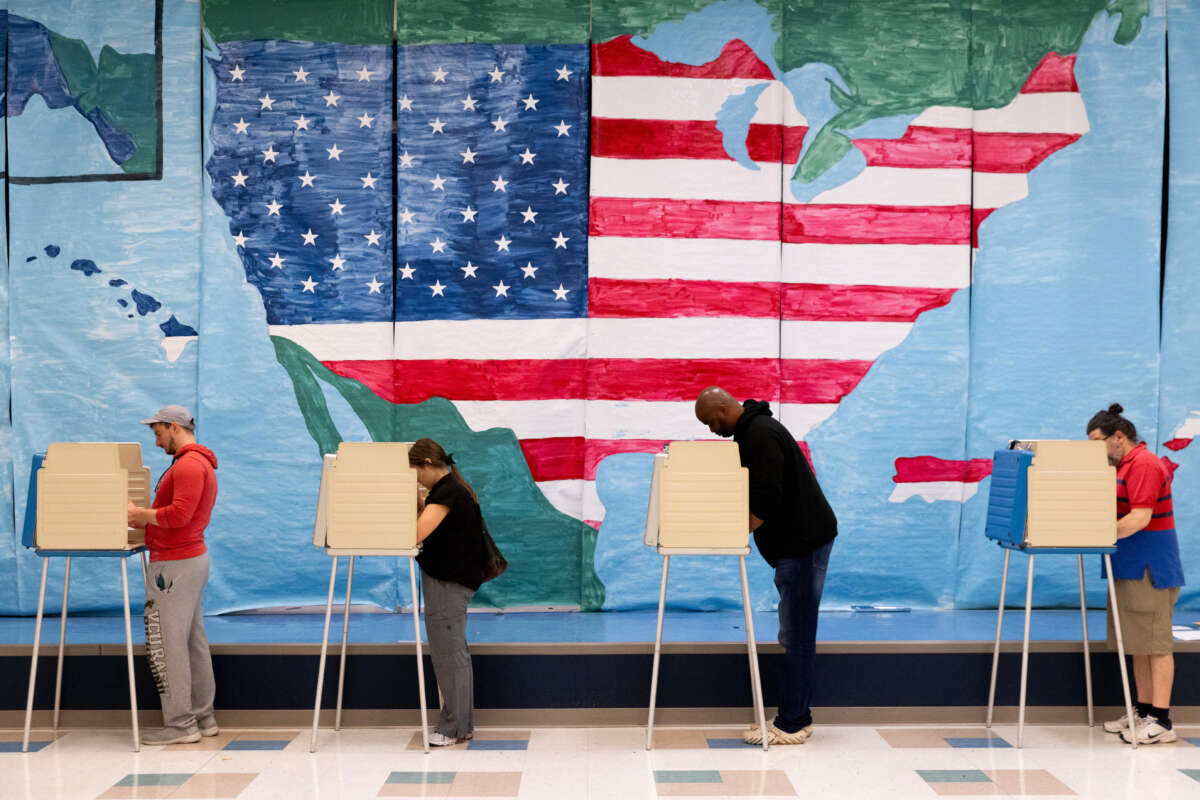
Voters fill out their ballots at a polling station on November 7, 2023. Julia Nikhinson / For The Washington Post via Getty Images

On Monday, a conservative three-judge panel on the United State’s most right-wing federal court struck down the primary enforcement mechanism of the Voting Rights Act in a ruling that experts are saying would be “catastrophic” for voting rights across the country if upheld.

In a 2-1 ruling, the 8th Circuit Court of Appeals ruled that private litigants, like voting and civil rights groups, are not allowed to bring lawsuits challenging discriminatory practices in redistricting and election administration under Section 2 of the law. “Private right of action,” as it’s known, is the main way that the Voting Rights Act is enforced; for decades, civil rights groups have filed lawsuits under the Voting Rights Act to challenge gerrymandering and racist voter suppression efforts, particularly in the South. The ruling, then, would leave only the Justice Department to bring lawsuits when electoral maps or changes to election administration rules have discriminatory effects on voters.

Experts say the ruling will gut the Voting Rights Act, the landmark 1965 law aimed at preventing racial discrimination in elections that Congress passed in a response to the civil rights movement’s widespread protests. As voting rights group Democracy Docket pointed out on Monday, only 15 of the 182 successful Section 2 lawsuits of the last 40 years were brought solely by the Department of Justice. 

“It’s hard to overstate how important and detrimental this decision would be if allowed to stand: the vast majority of claims to enforce section 2 of the Voting Rights Act are brought by private plaintiffs, not the Department of Justice with limited resources,” wrote University of California, Los Angeles law professor and director of the Safeguarding Democracy Project Rick Hasen in Election Law Blog. “If minority voters are going to continue to elect representatives of their choice, they are going to need private attorneys to bring those suits.”

The ruling was written by David Stras, a nominee of former President Donald Trump who argues based on text of the law that only the U.S. attorney general has the authority to enforce the Voting Rights Act, despite decades of precedents set by lower courts and the Supreme Court finding that Congress intended for private citizens to have the ability to sue under the law, experts say. The case, Arkansas State Conference NAACP v. Arkansas Board of Apportionment, is likely to be heard by the full 8th Circuit Court of Appeals and eventually reach the Supreme Court.

It’s unclear how the Supreme Court would rule; the Voting Rights Act, now a particular target of conservatives as Republicans continue their quest to erode voting rights across the country, very narrowly dodged being weakened in a 5-4 ruling by the Supreme Court earlier this year in a case over Alabama’s unconstitutional and racist voting maps.

Voting rights advocates have condemned the decision, saying that it puts the voting rights of millions at risk, especially those of Black Americans who have long struggled for equal access to the ballot.

Sophia Lin Lakin, who argued the case as director of the American Civil Liberties Union’s Voting Rights Project, said the ruling is a “travesty for democracy.”

“For generations, private individuals have brought cases under Section 2 of the Voting Rights Act to protect their right to vote,” Lakin said in a statement on Monday. “No court had denied them the ability to bring their claims in federal court — with the sole exception of the district court, and now the Eighth Circuit. By failing to reverse the district court’s radical decision, the Eighth Circuit has put the Voting Rights Act in jeopardy, tossing aside critical protections that voters fought and died for.”


ABOUT THE AUTHOR:


Sharon Zhang is a news writer at Truthout covering politics, climate and labor. Before coming to Truthout, Sharon had written stories for Pacific StandardThe New Republic, and more. She has a master’s degree in environmental studies. She can be found on Twitter: @zhang_sharon.


Monday, November 20, 2023

Rising 21st Century Fascism and the Ongoing White Supremacist Political, Ideological, Economic, and Cultural War on the Human, Constitutional, and Civil Rights Of African American Citizens in the United States

DEFEAT FASCISM BEFORE FASCISM DEFEATS YOU
 
https://www.nytimes.com/2023/11/20/us/politics/voting-rights-act.html 

Federal Court Moves to Drastically Weaken Voting Rights Act

The ruling, which is almost certain to be appealed to the Supreme Court, would effectively bar private citizens and civil rights groups from suing under a key provision of the landmark law.

Election officials taking down a polling site in Iowa this month. A table has several white placards with “vote” written on them next to depictions of the American flag.
PHOTO:  Voting rights leaders have viewed the current conservative makeup of the Supreme Court as hostile to the Voting Rights Act. Credit:  Jordan Gale for The New York Times
by Nick Corasaniti
November 20, 2023
New York Times

A federal appeals court moved on Monday to drastically weaken the Voting Rights Act, issuing a ruling that would effectively bar private citizens and civil rights groups from filing lawsuits under a central provision of the landmark civil rights law.

The ruling, made by the U.S. Court of Appeals for the Eighth Circuit, found that only the federal government could bring a legal challenge under Section 2 of the Voting Rights Act, a crucial part of the law that prohibits election or voting practices that discriminate against Americans based on race.

The opinion is almost certain to be appealed to the Supreme Court. The court’s current conservative majority has issued several key decisions in recent years that have weakened the Voting Rights Act. But the justices have upheld the law in other instances, including in a June ruling that found Alabama had drawn a racially discriminatory congressional map.

Passed in 1965, the Voting Rights Act was one of the most significant achievements of the civil rights movement, undoing decades of discriminatory Jim Crow laws and protecting against egregious racial gerrymanders. But the law has been under legal assault almost since its inception, and court decisions through the years have hollowed out key provisions, including a requirement that states with a history of discrimination in voting obtain approval from the federal government before changing their voting laws.

The Monday decision by the court of appeals, which centered on a case in Arkansas, found that the text of the Voting Rights Act did not explicitly contain language for “a private right of action,” or the right of private citizens to file lawsuits under the law. Therefore, the court found, the right to sue would effectively lie with the government alone.

Should the ruling stand, it would remove perhaps the most important facet of the Voting Rights Act; a majority of challenges to discriminatory laws and racial gerrymanders have come from private citizens and civil rights groups.

“It will be a devastating near-death blow to the Voting Rights Act if it remains the law,” said Wendy Weiser, the director of the Democracy Program at the Brennan Center for Justice. “Radical theories that would previously have been laughed out of court have been taken increasingly seriously by an increasingly radical judiciary.”

But Ms. Weiser said she “would be surprised if this decision stands,” based on decades of legal precedent and recent rulings by the Supreme Court.

Section 2 of the Voting Rights Act has been at the heart of many civil rights and voting rights decisions. The case in the Supreme Court’s ruling in June against Alabama’s map was brought by a number of civil rights organizations. In 2013, the section was also used to challenge a strict voter identification law passed in Texas.

Some conservative legal scholars heralded the Monday decision, saying it would prevent the Voting Rights Act from being used for political ends.

“Today’s decision is a win for Arkansas and for the rule of law,” said Jason Snead, the executive director of the Honest Elections Project, a conservative group. “The Voting Rights Act (V.R.A.) remains intact as a tool to prevent actual discrimination and disenfranchisement. But the V.R.A. is not, and was never intended to be, a partisan weapon against democratically enacted election integrity laws and redistricting practices.”

The current legal debate over who can bring Section 2 claims took a significant turn in February 2022, when Judge Lee P. Rudofsky, a district judge in eastern Arkansas appointed by former President Donald J. Trump, found that “only the attorney general of the United States may bring suit” to enforce Section 2.

The decision was appealed to the Eighth Circuit, which on Monday issued a 2-to-1 ruling largely agreeing with the previous decision and finding that the law did not explicitly provide for a “private right of action.”

“Did Congress give private plaintiffs the ability to sue under [Section] 2 of the Voting Rights Act?” Judge David R. Stras, an appointee of Mr. Trump, wrote. “Text and structure reveal that the answer is no.”

Proponents of the law and its use by private citizens point to statements made by Congress in 1982, when the Voting Rights Act was amended. In a report that accompanied the changes to the law, the House and Senate Judiciary Committees said that “it is intended that citizens have a private cause of action to enforce their rights under Section 2.”

The appeals court rejected that argument in its ruling, stating that the committees’ report “does not point to a single word or phrase in the Voting Rights Act in support of the conclusion that a private right of action has existed from the beginning.”

Section 2 of the Voting Rights Act has faced legal challenges before. In 2021, the Supreme Court found that Section 2 could be used to strike down voting restrictions only when they imposed substantial and disproportionate burdens on minority voters.

But the court left Section 2 intact, and it has remained a critical tool for civil rights groups, especially when challenging congressional and legislative district maps.

The battle over voting rights has entered a pitched new phase since the 2020 election. After Mr. Trump tried to overturn the outcome with a campaign casting doubt on the integrity of the country’s electoral infrastructure, Republican-led state legislatures across the country passed laws adding new restrictions to voting.

Sophia Lin Lakin, the director of the Voting Rights Project at the A.C.L.U., who argued the appeal on behalf of the challengers, called the Monday ruling a “travesty for democracy.”

“For generations, private individuals have brought cases under Section 2 of the Voting Rights Act to protect their right to vote,” she said in a statement. “By failing to reverse the district court’s radical decision, the Eighth Circuit has put the Voting Rights Act in jeopardy, tossing aside critical protections that voters fought and died for.”


ABOUT THE AUTHOR:


Nick Corasaniti is a Times reporter covering national politics, with a focus on voting and elections.


https://www.nytimes.com/2023/11/19/opinion/right-wing-antisemitism-populism.html

DEFEAT FASCISM BEFORE FASCISM DEFEATS YOU

 
An Old Hate Cracks Open on the New Right
by David French
November 19, 2023
New York Times
Charles Lindbergh addressing a crowd. Behind him are U.S. flags and signs reading “America First.”
Charles Lindbergh speaking in 1941 against U.S. involvement in the war in Europe.
Credit:  Bettmann/Getty Images

A dam burst last week on the right, and a wave of grotesque antisemitism poured out all over the internet.

In August, I wrote about the “lost boys” of the American right, many of them young and relatively unknown, who were outed for having secret or anonymous online profiles and using those profiles to spread raw bigotry, including antisemitism. Some of these people worked for the right wing’s biggest names, including Tucker Carlson, Ron DeSantis and Donald Trump.

What started in the shadows is now right in the open. It’s being advanced by some of the most powerful and influential people in America, and there is nothing subtle about it. The latest eruption started with a fight between the Daily Wire co-founder Ben Shapiro and his Daily Wire colleague Candace Owens. Both are immensely popular right-wing stars. Owens, for example, has more than four million followers on X, formerly known as Twitter, and more than five million on Instagram.

On Nov. 3, Owens posted on social media, “No government anywhere has a right to commit a genocide, ever. There is no justification for a genocide. I can’t believe this even needs to be said or is even considered the least bit controversial to state.” Many of her followers interpreted this as a criticism of Israel, and Shapiro, who staunchly supports Israel in its present conflict with Hamas, was later caught on tape at a private event saying Owens’s behavior during the war has been “disgraceful.”

Daily Wire drama should be of little interest to anyone outside The Daily Wire, but what happened next was truly alarming. First, Jason Whitlock, a leading personality at The Blaze, one of the largest right-wing websites, accused Shapiro of dual loyalties: “The guy has multiple loyalties. He loves America, but he loves Israel too. And maybe he loves Israel and he loves America too.” Owens, he said, “is a bit more America first. She only has one loyalty.”

Then Owens went on Carlson’s show on X, where he ranted against the “biggest donors at, say, Harvard,” asking where they were when members of the Harvard community “were calling for white genocide.”

White genocide” is a term of art on the racist right and is linked to the so-called great replacement theory, the notion that leftists (including Jewish progressives) are trying to import people of color to replace America’s white majority. This is the theory that motivated the shooter in the Tree of Life synagogue massacre in Pittsburgh. It is false, evil and very dangerous.

The same day, an obscure far-right personality posted the same conspiracy theory on X: “Jewish communities have been pushing the exact kind of dialectical hatred against whites that they claim to want people to stop using against them.”

“I’m deeply disinterested,” he continued, “in giving the tiniest shit now about western Jewish populations coming to the disturbing realization that those hordes of minorities that support flooding their country don’t exactly like them too much.”

The post wouldn’t be notable, except as yet another example of the bigoted filth that dominates discourse on X, but Elon Musk — the world’s richest man and the owner of X — responded with an endorsement. “You have said the actual truth,” he replied.

Charlie Kirk, the founder of Turning Point USA, one of the largest right-wing youth organizations in the country, jumped in the next day to defend both the original post and Musk on “The Charlie Kirk Show.” While he hedged by saying that he doesn’t like to generalize, Kirk argued that “the first part” of the original post “is absolutely true.” He then reread the post and repeated the old Jews-and-money trope: “It is true that some of the largest financiers of left-wing anti-white causes have been Jewish Americans.”

While there are more examples of right-wing antisemitism spilling into the public square, I’m going to stop there. I by no means want to minimize the antisemitism we’ve seen from the far left, including on campuses and in the streets, but I am focusing on the people I just mentioned because they are some of the most prominent figures on the right.

What is going on? For the past several decades, the Republican Party has been a strong ally of Israel, so much so that the regard evangelical voters have for Israel has been the subject of considerable criticism. In my years as a Republican and a conservative lawyer, I never witnessed a trace of antisemitism. The answer to my question, however, is clear. The “new” American right isn’t that new at all. It has rejected Reaganism, yes, but in doing so, it’s reconnecting with older and darker forces on the right.

The ghost of Charles Lindbergh is haunting us. Lindbergh, readers may recall, was the hero aviator who flew solo across the Atlantic Ocean in 1927. He later grew to admire German fascism and gave a famous speech in September 1941 in which he accused Jews of attempting to push America into World War II.

“The three most important groups who have been pressing this country toward war,” he said, “are the British, the Jewish and the Roosevelt administration.” And while Lindbergh expressed sympathy for Jews facing Nazi persecution, he went straight to the same tropes that were deployed last week, claiming that the Jewish people’s “greatest danger to this country lies in their large ownership and influence in our motion pictures, our press, our radio and our government.”

More recently, we have seen the influence of Pat Buchanan, a former Richard Nixon speechwriter and so-called paleoconservative whom William F. Buckley Jr. denounced for his antisemitism in 1991. A central part of the case against Buchanan once again related to matters of war and peace. In the run-up to the first Iraq war, Buchanan said, “There are only two groups that are beating the drums for war in the Middle East — the Israeli Defense Ministry and its amen corner in the United States.” And that was a benign comment compared with many of his later pronouncements. In 2010 he wrote that if Elena Kagan were to be confirmed as a Supreme Court justice, “Jews, who represent less than 2 percent of the U.S. population, will have 33 percent of the Supreme Court seats. Is this Democrats’ idea of diversity?”

Buchanan is no minor figure. As Nicole Hemmer wrote in 2022, his presidential campaigns in the 1990s forecast the present moment in Republican politics. The party “traded Reaganism for Buchananism,” she contended. The evidence that she was correct grows by the day.

Everything about the New Right mind-set told us that this devolution was inevitable. It scorns character, decency and civility in the public square, often turning cruelty into a virtue. This was a necessary precondition for the entire enterprise. Decent people can be misguided, certainly, but they are not consumed with hate. Decent people do not indulge bigots.

The New Right rejects the norms and values of what it calls the uniparty or the cathedral: the center-left and center-right American elite. And one of those values is a steadfast opposition to racism and prejudice. The rejection first manifests itself in the form of just asking questions, then it veers into direct challenge of conventional norms, followed by a descent into true darkness.

Hostility unmoored from character quickly turns conspiratorial, and the world of conspiracy theories is where antisemites live and thrive. And finally, the term “America First,” popular with the New Right and the older, Lindbergh right, has always been misleading. It actually means some Americans first or “real” Americans first, and “real” Americans do not include the ideological or religious enemies of the New Right.

It is no coincidence, for example, that after the Owens-Shapiro confrontation, many New Right figures began posting “Christ is king,” an obvious shot at Shapiro’s Jewish beliefs.

Evolution is a concept that applies to biology, not human nature. It turns out that humanity does not grow out of the darkness of the past. It has to be contested by every generation. We are neither imprisoned by darkness nor ever fully captured by light.

America is no exception. From before the founding, our so-called new world has been plagued by all the sins of the old. Set against that human depravity, however, are the great aspirations of the founding, including the central declaration that “all men are created equal.”

American progress was never inevitable. It took immense courage to move haltingly to the more just, more fair country we live in today. We can’t presume that progress is permanent. It never is. No one is more aware of that than America’s most marginalized and vulnerable communities. They feel the effects very keenly when we take steps backward, when our commitment to our principles falters in the face of our own sin.
More on the right and antisemitism:


X Races to Contain Damage After Elon Musk Endorses Antisemitic Post
Nov. 16, 2023


Opinion | Nicole Hemmer
The Man Who Won the Republican Party Before Trump Did
Sept. 8, 2022


Opinion | Michelle Goldberg
Antisemitism’s March Into the Mainstream
Nov. 28, 2022

The Times is committed to publishing a diversity of letters to the editor. We’d like to hear what you think about this or any of our articles. Here are some tips. And here’s our email: letters@nytimes.com.


Wednesday, April 23, 2014

The National Fight Over Affirmative Action And the Pernicious Victory of White Supremacy In Today's Supreme Court


Students at the University of Michigan in Ann Arbor on Tuesday. The Supreme Court decision revealed deep divisions among the justices over the government’s role in protecting minorities. Credit Joshua Lott for The New York Times

All,

Yesterday's heinous and utterly predictable decision by a virulently rightwing and clearly white supremacist Supreme Court to uphold the right of the state of Michigan voters to use a legislative initiative to "legally" eliminate affirmative action in its public colleges and universities, is yet another brazen example of the racist contempt and dismissive indifference of the notorious reactionary cabal of the five rightwing Justices on the Court (John Roberts, Antonin Scalia, Samuel Alito, Clarence Thomas, and Anthony Kennedy) to the human, civil, and constitutional rights of African Americans. Along with this Court's equally vicious white supremacist decision in 2012 to strike down section five of the Voting Rights Act of 1965 and the parallel class based decisions in the infamous pro-corporate Citizens United vs. FEC case in 2010 and the McCutcheon vs. FEC case this week upholding unlimited political donations by extremely wealthy donors, we are now living in a thoroughly sordid era whose massive corruption, criminal venality, fraud, and elitist domination that rivals any in the history of this increasingly totalitarian society--which means any in the history of the world. What we know for sure is that it's only going to get (far) worse and soon unless and until we collectively decide to something about it beyond  merely shaking our heads and bemoaning our fate...

Kofi

Court Backs Michigan on Affirmative Action
By ADAM LIPTAK
APRIL 22, 2014
New York Times

WASHINGTON — In a fractured decision that revealed deep divisions over what role the judiciary should play in protecting racial and ethnic minorities, the Supreme Court on Tuesday upheld a Michigan constitutional amendment that bans affirmative action in admissions to the state’s public universities.

The 6-to-2 ruling effectively endorsed similar measures in seven other states. It may also encourage more states to enact measures banning the use of race in admissions or to consider race-neutral alternatives to ensure diversity.

States that forbid affirmative action in higher education, like Florida and California, as well as Michigan, have seen a significant drop in the enrollment of black and Hispanic students in their most selective colleges and universities.

RELATED
Editorial: Racial Equality Loses at the Court


In five separate opinions spanning more than 100 pages, the justices set out starkly conflicting views. The justices in the majority, with varying degrees of vehemence, said that policies affecting minorities that do not involve intentional discrimination should be decided at the ballot box rather than in the courtroom.

How Minorities Have Fared in States With Affirmative Action Bans:

In states that have banned affirmative action in college admissions, prominent public universities have tended to enroll fewer black and Hispanic freshmen.

But Justice Sonia Sotomayor, in the longest, most passionate and most significant dissent of her career, said the Constitution required special vigilance in light of the history of slavery, Jim Crow and “recent examples of discriminatory changes to state voting laws.”

Her opinion, longer than the four other opinions combined, appeared to reflect her own experiences with affirmative action at Princeton and Yale Law School. “I had been admitted to the Ivy League through a special door,” she wrote in her best-selling memoir, “My Beloved World.” For years, she wrote, “I lived the day-to-day reality of affirmative action.”


In contrast to Justice Sotomayor’s outraged dissent, Justice Anthony M. Kennedy’s controlling opinion for three justices took pains to say that the decision was a modest one.

“This case is not about how the debate about racial preferences should be resolved,” he wrote, in an opinion joined by Chief Justice John G. Roberts Jr. and Justice Samuel A. Alito Jr. “It is about who may resolve it. There is no authority in the Constitution of the United States or in this court’s precedents for the judiciary to set aside Michigan laws that commit this policy determination to the voters.”

His announcement of the decision from the bench was businesslike. Signaling deep displeasure, Justice Sotomayor summarized her dissent from the bench, an unusual move that happens perhaps three times a term. She said the initiative put minorities to a burden not faced by other college applicants. Athletes, children of alumni and students from underrepresented parts of the state, she said, remained free to try to persuade university officials to give their applications special weight. “The one and only policy a Michigan citizen may not seek through this long-established process,” she wrote, “is a race-sensitive admissions policy.” That difference, she said, violates the Constitution’s equal protection clause.

“The Constitution does not protect racial minorities from political defeat,” she wrote. “But neither does it give the majority free rein to erect selective barriers against racial minorities.” Justice Ruth Bader Ginsburg joined the dissent.
 

Justice Sotomayor seemed to mock one of Chief Justice Roberts’s most memorable lines. In a 2007 decision that limited the use of race to achieve integration in public school systems, he wrote, “The way to stop discrimination on the basis of race is to stop discriminating on the basis of race.”

Justice Sotomayor recast the line. “The way to stop discrimination on the basis of race,” she wrote, “is to speak openly and candidly on the subject of race, and to apply the Constitution with eyes open to the unfortunate effects of centuries of racial discrimination.”


Chief Justice Roberts responded in a brief concurrence, saying that affirmative action, and the stigma that he said could accompany it, may do more harm than good. “People can disagree in good faith on this issue,” he added, “but it similarly does more harm than good to question the openness and candor of those on either side of the debate.”

In earlier cases, including one from last June challenging the admissions policies of the University of Texas, the court has said that race-conscious selection can be constitutionally permissible in states that wish to use them. In a concurrence, Justice Antonin Scalia, joined by Justice Clarence Thomas, said those decisions were wrong, and he suggested that they were in peril. He added that the question in Tuesday’s case, Schuette v. Coalition to Defend Affirmative Action, No. 12-682, was laughably easy.

“Even taking this court’s sorry line of race-based admissions cases as a given,” he wrote, “I find the question presented only slightly less strange: Does the equal protection clause forbid a state from banning a practice that the clause barely — and only provisionally — permits?”

He added that courts should resist involving judges “in the dirty business of dividing the nation into racial blocs.”

“That task is as difficult as it is unappealing,” Justice Scalia said, giving an example: “Does a half-Latin, half-American Indian have Latino interests, American-Indian interests, both, half of both?”

The most surprising opinion came from Justice Stephen G. Breyer, who abandoned his usual liberal allies to vote with the majority, although he did not adopt the majority’s reasoning. The Constitution, he said, permits but does not require states to use race-conscious admissions for educational diversity.

In general, he said, “the Constitution foresees the ballot box, not the courts, as the normal instrument for resolving differences and debates about the merits of these programs.”

Justice Elena Kagan recused herself, presumably because she had worked on the case as United States solicitor general.

The Michigan initiative, known as Proposal 2, was a response to Grutter v. Bollinger, a 2003 Supreme Court decision that upheld the use of race as one factor among many in law school admissions to ensure educational diversity.

Proposal 2, approved in 2006 by 58 percent of Michigan’s voters, amended the State Constitution to prohibit discrimination or preferential treatment in public education, government contracting and public employment. Groups favoring affirmative action sued to block the part of the law concerning higher education.

In 2012, the United States Court of Appeals for the Sixth Circuit, in Cincinnati, ruled by a vote of 8 to 7 that the initiative violated the federal Constitution’s equal protection clause. The appeals court majority said the problem with the law was that it restructured the state’s political process by making it harder for disfavored minorities to press for change.

Justice Sotomayor agreed, saying citizens seeking to have the state’s public universities adopt race-conscious admissions plans had to “undertake the daunting task of amending the State Constitution.”

Justice Kennedy said that was as it should be.

“Here Michigan voters acted in concert and statewide to seek consensus and adopt a policy on a difficult subject against a historical background of race in America that has been a source of tragedy and persisting injustice,” he wrote. “That history demands that we continue to learn, to listen and to remain open to new approaches if we are to aspire always to a constitutional order in which all persons are treated with fairness and equal dignity.” 


Complete video of President Johnson's Commencement Speech at Howard University on behalf of Affirmative Action

"To Fulfill These Rights." June 4, 1965


LBJ Library video MP 2265-66 donated by CBS.
http://www.youtube.com/watch?v=vcfAuodA2x8


LBJ 1965 Howard University Commencement Address Excerpt on YouTube


http://www.youtube.com/watch?v=5FMc1mo5y70


http://www.factmonster.com/spot/affirmativetimeline1.html

Timeline of Affirmative Action Milestones

by Borgna Brunner and Beth Rowen


Learn about the major milestones in the history of affirmative action (from the Columbia Encyclopedia: Programs to overcome the effects of past societal discrimination by allocating jobs and resources to members of specific groups, such as minorities and women). Read more about the history of affirmative action.

1960s
1970s
1980s
1990s
2000s
 

March 6, 1961

Executive Order 10925 makes the first reference to "affirmative action"

President John F. Kennedy issues Executive Order 10925, which creates the Committee on Equal Employment Opportunity and mandates that projects financed with federal funds "take affirmative action" to ensure that hiring and employment practices are free of racial bias.

July 2, 1964

Civil Rights Act signed by President Lyndon Johnson

The most sweeping civil rights legislation since Reconstruction, the Civil Rights Act prohibits discrimination of all kinds based on race, color, religion, or national origin.

June 4, 1965

Speech defining concept of affirmative action

In an eloquent speech to the graduating class at Howard University, President Johnson frames the concept underlying affirmative action, asserting that civil rights laws alone are not enough to remedy discrimination:

"You do not wipe away the scars of centuries by saying: 'now, you are free to go where you want, do as you desire, and choose the leaders you please.' You do not take a man who for years has been hobbled by chains, liberate him, bring him to the starting line of a race, saying, 'you are free to compete with all the others,' and still justly believe you have been completely fair . . . This is the next and more profound stage of the battle for civil rights. We seek not just freedom but opportunity—not just legal equity but human ability—not just equality as a right and a theory, but equality as a fact and as a result."
Sept. 24, 1965

Executive Order 11246 enforces affirmative action for the first time

Issued by President Johnson, the executive order requires government contractors to "take affirmative action" toward prospective minority employees in all aspects of hiring and employment. Contractors must take specific measures to ensure equality in hiring and must document these efforts. On Oct. 13, 1967, the order was amended to cover discrimination on the basis of gender.

1969

The Philadelphia Order

Initiated by President Richard Nixon, the "Philadelphia Order" was the most forceful plan thus far to guarantee fair hiring practices in construction jobs. Philadelphia was selected as the test case because, as assistant secretary of labor Arthur Fletcher explained, "The craft unions and the construction industry are among the most egregious offenders against equal opportunity laws . . . openly hostile toward letting blacks into their closed circle." The order included definite "goals and timetables." As President Nixon asserted, "We would not impose quotas, but would require federal contractors to show 'affirmative action' to meet the goals of increasing minority employment."

June 28, 1978

Regents of the University of California v. Bakke

This landmark Supreme Court case imposed limitations on affirmative action to ensure that providing greater opportunities for minorities did not come at the expense of the rights of the majority—affirmative action was unfair if it led to reverse discrimination. The case involved the Univ. of California, Davis, Medical School, which had two separate admissions pools, one for standard applicants, and another for minority and economically disadvantaged students. The school reserved 16 of its 100 places for this latter group.

Allan Bakke, a white applicant, was rejected twice even though there were minority applicants admitted with significantly lower scores than his. Bakke maintained that judging him on the basis of his race was a violation of the Equal Protection Clause of the Fourteenth Amendment. The Supreme Court ruled that while race was a legitimate factor in school admissions, the use of such inflexible quotas as the medical school had set aside was not. The Supreme Court, however, was split 5–4 in its decision on the Bakke case and addressed only a minimal number of the many complex issues that had sprung up about affirmative action.

July 2, 1980

Fullilove v. Klutznick

While Bakke struck down strict quotas, in Fullilove the Supreme Court ruled that some modest quotas were perfectly constitutional. The Court upheld a federal law requiring that 15% of funds for public works be set aside for qualified minority contractors. The "narrowed focus and limited extent" of the affirmative action program did not violate the equal rights of non-minority contractors, according to the Court—there was no "allocation of federal funds according to inflexible percentages solely based on race or ethnicity."

May 19, 1986

Wygant v. Jackson Board of Education

This case challenged a school board's policy of protecting minority employees by laying off non-minority teachers first, even though the non-minority employees had seniority. The Supreme Court ruled against the school board, maintaining that the injury suffered by non-minorities affected could not justify the benefits to minorities: "We have previously expressed concern over the burden that a preferential-layoffs scheme imposes on innocent parties. In cases involving valid hiring goals, the burden to be borne by innocent individuals is diffused to a considerable extent among society generally. Though hiring goals may burden some innocent individuals, they simply do not impose the same kind of injury that layoffs impose. Denial of a future employment opportunity is not as intrusive as loss of an existing job."

Feb. 25, 1987

United States v. Paradise

In July 1970, a federal court found that the State of Alabama Department of Public Safety systematically discriminated against blacks in hiring: "in the thirty-seven-year history of the patrol there has never been a black trooper." The court ordered that the state reform its hiring practices to end "pervasive, systematic, and obstinate discriminatory exclusion of blacks." A full 12 years and several lawsuits later, the department still had not promoted any blacks above entry level nor had they implemented a racially fair hiring system. In response, the court ordered specific racial quotas to correct the situation. For every white hired or promoted, one black would also be hired or promoted until at least 25% of the upper ranks of the department were composed of blacks. This use of numerical quotas was challenged. The Supreme Court, however, upheld the use of strict quotas in this case as one of the only means of combating the department's overt and defiant racism.

Jan. 23, 1989

City of Richmond v. Croson

This case involved affirmative action programs at the state and local levels—a Richmond program setting aside 30% of city construction funds for black-owned firms was challenged. For the first time, affirmative action was judged as a "highly suspect tool." The Supreme Court ruled that an "amorphous claim that there has been past discrimination in a particular industry cannot justify the use of an unyielding racial quota." It maintained that affirmative action must be subject to "strict scrutiny" and is unconstitutional unless racial discrimination can be proven to be "widespread throughout a particular industry." The Court maintained that "the purpose of strict scrutiny is to `smoke out' illegitimate uses of race by assuring that the legislative body is pursuing a goal important enough to warrant use of a highly suspect tool. The test also ensures that the means chosen `fit' this compelling goal so closely that there is little or no possibility that the motive for the classification was illegitimate racial prejudice or stereotype."

June 12, 1995

Adarand Constructors, Inc. v. Peña


What Croson was to state- and local-run affirmative action programs, Adarand was to federal programs. The Court again called for "strict scrutiny" in determining whether discrimination existed before implementing a federal affirmative action program. "Strict scrutiny" meant that affirmative action programs fulfilled a "compelling governmental interest," and were "narrowly tailored" to fit the particular situation. Although two of the judges (Scalia and Thomas) felt that there should be a complete ban on affirmative action, the majority of judges asserted that "the unhappy persistence of both the practice and the lingering effects of racial discrimination against minority groups in this country" justified the use of race-based remedial measures in certain circumstances.

July 19, 1995

White House guidelines on affirmative action

President Clinton asserted in a speech that while Adarand set "stricter standards to mandate reform of affirmative action, it actually reaffirmed the need for affirmative action and reaffirmed the continuing existence of systematic discrimination in the United States." In a White House memorandum on the same day, he called for the elimination of any program that "(a) creates a quota; (b) creates preferences for unqualified individuals; (c) creates reverse discrimination; or (d) continues even after its equal opportunity purposes have been achieved."

March 18, 1996

Hopwood v. University of Texas Law School

Cheryl Hopwood and three other white law-school applicants at the University of Texas challenged the school's affirmative action program, asserting that they were rejected because of unfair preferences toward less qualified minority applicants. As a result, the 5th U.S. Court of Appeals suspended the university's affirmative action admissions program and ruled that the 1978 Bakke decision was invalid—while Bakke rejected racial quotas it maintained that race could serve as a factor in admissions. In addition to remedying past discrimination, Bakke maintained that the inclusion of minority students would create a diverse student body, and that was beneficial to the educational environment as a whole. Hopwood, however, rejected the legitimacy of diversity as a goal, asserting that "educational diversity is not recognized as a compelling state interest." The Supreme Court allowed the ruling to stand. In 1997, the Texas Attorney General announced that all "Texas public universities [should] employ race-neutral criteria."

Note: The June 23, 2003, Supreme Court ruling in Grutter v. Bollinger invalidates Hopwood.

Nov. 3, 1997

Proposition 209 enacted in California

A state ban on all forms of affirmative action was passed in California: "The state shall not discriminate against, or grant preferential treatment to, any individual or group on the basis of race, sex, color, ethnicity, or national origin in the operation of public employment, public education, or public contracting." Proposed in 1996, the controversial ban had been delayed in the courts for almost a year before it went into effect.

Dec. 3, 1998

Initiative 200 enacted in Washington State

Washington becomes the second state to abolish state affirmative action measures when it passed "I 200," which is similar to California's Proposition 209.

Feb. 22, 2000

Florida bans race as factor in college admissions.

Florida legislature approves education component of Gov. Jeb Bush's "One Florida" initiative, aimed at ending affirmative action in the state.

Dec. 13, 2000

University of Michigan’s undergrad affirmative action policy

In Gratz v. Bollinger, a federal judge ruled that the use of race as a factor in admissions at the University of Michigan was constitutional. The gist of the university's argument was as follows: just as preference is granted to children of alumni, scholarship athletes, and others groups for reasons deemed beneficial to the university, so too does the affirmative action program serve "a compelling interest" by providing educational benefits derived from a diverse student body.

March 27, 2001

Univ. of Michigan Law School's affirmative action policy

In Grutter v. Bollinger, a case similar to the University of Michigan undergraduate lawsuit, a different judge drew an opposite conclusion, invalidating the law school's policy and ruling that "intellectual diversity bears no obvious or necessary relationship to racial diversity." But on May 14, 2002, the decision was reversed on appeal, ruling that the admissions policy was, in fact, constitutional.

June 23, 2003

Supreme Court Upholds Affirmative Action in University Admissions

In the most important affirmative action decision since the 1978 Bakke case, the Supreme Court (5–4) upholds the University of Michigan Law School's policy, ruling that race can be one of many factors considered by colleges when selecting their students because it furthers "a compelling interest in obtaining the educational benefits that flow from a diverse student body." The Supreme Court, however, ruled (6-3) that the more formulaic approach of the University of Michigan's undergraduate admissions program, which uses a point system that rates students and awards additional points to minorities, had to be modified. The undergraduate program, unlike the law school's, does not provide the "individualized consideration" of applicants deemed necessary in previous Supreme Court decisions on affirmative action.

See Grutter v. Bollinger.
June 28, 2006

Supreme Court Rules Against Considering Race to Integrate Schools

In Parents v. Seattle and Meredith v. Jefferson, affirmative action suffers a setback when a bitterly divided court rules, 5–4, that programs in Seattle and Louisville, Ky., which tried to maintain diversity in schools by considering race when assigning students to schools, are unconstitutional.

November 4, 2008

Ballot Measure to Ban Affirmative Action Goes Before Voters

Ballot measures proposing to ban affirmative action — race and gender based preferences by public entities — goes before voters in two states, Nebraska and Colorado. The ban passes with more than 50% of the vote in Nebraska. Voters in Colorado, though, reject the proposed ban.

June 29, 2009

Ricci v. DeStefano, Firefighters Go to Court

In a lawsuit brought against the city of New Haven, 18 plaintiffs—17 white and 1 Hispanic—argued that results of the 2003 lieutenant and captain exams were thrown out when it was determined that few minority firefighters qualified for advancement. The city claimed they threw out the results because they feared liability under a disparate-impact statute for issuing tests that discriminated against minority firefighters. The plaintiffs claimed that they were victims of reverse discrimination under the Title VII of the Civil Rights Act of 1964. The Supreme Court ruled (5–4) in favor of the firefighters, saying New Haven's "action in discarding the tests was a violation of Title VII."

June 24, 2013

Court Orders University to Re-examine Affirmative Action Policy

In Fisher v. University of Texas, the court allows universities to continue considering race as a factor in admissions to achieve diversity, but it does tell them that they must prove that “available, workable race-neutral alternatives do not suffice” before considering race. The court ruled 7–1 to send the case back to the U.S. Court of Appeals for the Fifth Circuit for further review to determine if the school passed the test of "strict scrutiny," the highest level of judicial review. The ruling is considered a compromise between the court's conservative and liberal factions.

Read more about the history of affirmative action:


Affirmative Action Timeline | FactMonster.com


http://www.lbjlib.utexas.edu/johnson/archives.hom/speeches.hom/650604.asp
Complete transcription and text of President Lyndon B. Johnson's Commencement Address at Howard University:

"To Fulfill These Rights"

June 4, 1965
 
PRESIDENT LYNDON JOHNSON SPEAKING AT HOWARD UNIVERSITY IN 1965

Dr. Nabrit, my fellow Americans:

I am delighted at the chance to speak at this important and this historic institution. Howard has long been an outstanding center for the education of Negro Americans. Its students are of every race and color and they come from many countries of the world. It is truly a working example of democratic excellence.

Our earth is the home of revolution. In every corner of every continent men charged with hope contend with ancient ways in the pursuit of justice. They reach for the newest of weapons to realize the oldest of dreams, that each may walk in freedom and pride, stretching his talents, enjoying the fruits of the earth.

Our enemies may occasionally seize the day of change, but it is the banner of our revolution they take. And our own future is linked to this process of swift and turbulent change in many lands in the world. But nothing in any country touches us more profoundly, and nothing is more freighted with meaning for our own destiny than the revolution of the Negro American.

In far too many ways American Negroes have been another nation: deprived of freedom, crippled by hatred, the doors of opportunity closed to hope.

In our time change has come to this Nation, too. The American Negro, acting with impressive restraint, has peacefully protested and marched, entered the courtrooms and the seats of government, demanding a justice that has long been denied. The voice of the Negro was the call to action. But it is a tribute to America that, once aroused, the courts and the Congress, the President and most of the people, have been the allies of progress.

LEGAL PROTECTION FOR HUMAN RIGHTS
 

Thus we have seen the high court of the country declare that discrimination based on race was repugnant to the Constitution, and therefore void. We have seen in 1957, and 1960, and again in 1964, the first civil rights legislation in this Nation in almost an entire century.

As majority leader of the United States Senate, I helped to guide two of these bills through the Senate. And, as your President, I was proud to sign the third. And now very soon we will have the fourth--a new law guaranteeing every American the right to vote.

No act of my entire administration will give me greater satisfaction than the day when my signature makes this bill, too, the law of this land.

The voting rights bill will be the latest, and among the most important, in a long series of victories. But this victory--as Winston Churchill said of another triumph for freedom--"is not the end. It is not even the beginning of the end. But it is, perhaps, the end of the beginning."

That beginning is freedom; and the barriers to that freedom are tumbling down. Freedom is the right to share, share fully and equally, in American society--to vote, to hold a job, to enter a public place, to go to school. It is the right to be treated in every part of our national life as a person equal in dignity and promise to all others.

FREEDOM IS NOT ENOUGH
But freedom is not enough. You do not wipe away the scars of centuries by saying: Now you are free to go where you want, and do as you desire, and choose the leaders you please.

You do not take a person who, for years, has been hobbled by chains and liberate him, bring him up to the starting line of a race and then say, "you are free to compete with all the others," and still justly believe that you have been completely fair.

Thus it is not enough just to open the gates of opportunity. All our citizens must have the ability to walk through those gates.

This is the next and the more profound stage of the battle for civil rights. We seek not just freedom but opportunity. We seek not just legal equity but human ability, not just equality as a right and a theory but equality as a fact and equality as a result.

For the task is to give 20 million Negroes the same chance as every other American to learn and grow, to work and share in society, to develop their abilities--physical, mental and spiritual, and to pursue their individual happiness.

To this end equal opportunity is essential, but not enough, not enough. Men and women of all races are born with the same range of abilities. But ability is not just the product of birth. Ability is stretched or stunted by the family that you live with, and the neighborhood you live in--by the school you go to and the poverty or the richness of your surroundings. It is the product of a hundred unseen forces playing upon the little infant, the child, and finally the man.

PROGRESS FOR SOME
This graduating class at Howard University is witness to the indomitable determination of the Negro American to win his way in American life.

The number of Negroes in schools of higher learning has almost doubled in 15 years. The number of nonwhite professional workers has more than doubled in 10 years. The median income of Negro college women tonight exceeds that of white college women. And there are also the enormous accomplishments of distinguished individual Negroes--many of them graduates of this institution, and one of them the first lady ambassador in the history of the United States.

These are proud and impressive achievements. But they tell only the story of a growing middle class minority, steadily narrowing the gap between them and their white counterparts.

A WIDENING GULF
But for the great majority of Negro Americans-the poor, the unemployed, the uprooted, and the dispossessed--there is a much grimmer story. They still, as we meet here tonight, are another nation. Despite the court orders and the laws, despite the legislative victories and the speeches, for them the walls are rising and the gulf is widening.

Here are some of the facts of this American failure.

Thirty-five years ago the rate of unemployment for Negroes and whites was about the same. Tonight the Negro rate is twice as high.

In 1948 the 8 percent unemployment rate for Negro teenage boys was actually less than that of whites. By last year that rate had grown to 23 percent, as against 13 percent for whites unemployed.

Between 1949 and 1959, the income of Negro men relative to white men declined in every section of this country. From 1952 to 1963 the median income of Negro families compared to white actually dropped from 57 percent to 53 percent.

In the years 1955 through 1957, 22 percent of experienced Negro workers were out of work at some time during the year. In 1961 through 1963 that proportion had soared to 29 percent.

Since 1947 the number of white families living in poverty has decreased 27 percent while the number of poorer nonwhite families decreased only 3 percent.

The infant mortality of nonwhites in 1940 was 70 percent greater than whites. Twenty-two years later it was 90 percent greater.

Moreover, the isolation of Negro from white communities is increasing, rather than decreasing as Negroes crowd into the central cities and become a city within a city.

Of course Negro Americans as well as white Americans have shared in our rising national abundance. But the harsh fact of the matter is that in the battle for true equality too many--far too many--are losing ground every day.

THE CAUSES OF INEQUALITY
We are not completely sure why this is. We know the causes are complex and subtle. But we do know the two broad basic reasons. And we do know that we have to act.

First, Negroes are trapped--as many whites are trapped--in inherited, gateless poverty. They lack training and skills. They are shut in, in slums, without decent medical care. Private and public poverty combine to cripple their capacities.

We are trying to attack these evils through our poverty program, through our education program, through our medical care and our other health programs, and a dozen more of the Great Society programs that are aimed at the root causes of this poverty.

We will increase, and we will accelerate, and we will broaden this attack in years to come until this most enduring of foes finally yields to our unyielding will.

But there is a second cause--much more difficult to explain, more deeply grounded, more desperate in its force. It is the devastating heritage of long years of slavery; and a century of oppression, hatred, and injustice.

SPECIAL NATURE OF NEGRO POVERTY
For Negro poverty is not white poverty. Many of its causes and many of its cures are the same. But there are differences-deep, corrosive, obstinate differences--radiating painful roots into the community, and into the family, and the nature of the individual.

These differences are not racial differences. They are solely and simply the consequence of ancient brutality, past injustice, and present prejudice. They are anguishing to observe. For the Negro they are a constant reminder of oppression. For the white they are a constant reminder of guilt. But they must be faced and they must be dealt with and they must be overcome, if we are ever to reach the time when the only difference between Negroes and whites is the color of their skin.

Nor can we find a complete answer in the experience of other American minorities. They made a valiant and a largely successful effort to emerge from poverty and prejudice.

The Negro, like these others, will have to rely mostly upon his own efforts. But he just can not do it alone. For they did not have the heritage of centuries to overcome, and they did not have a cultural tradition which had been twisted and battered by endless years of hatred and hopelessness, nor were they excluded--these others--because of race or color--a feeling whose dark intensity is matched by no other prejudice in our society.

Nor can these differences be understood as isolated infirmities. They are a seamless web. They cause each other. They result from each other. They reinforce each other.

Much of the Negro community is buried under a blanket of history and circumstance. It is not a lasting solution to lift just one corner of that blanket. We must stand on all sides and we must raise the entire cover if we are to liberate our fellow citizens.

THE ROOTS OF INJUSTICE
One of the differences is the increased concentration of Negroes in our cities. More than 73 percent of all Negroes live in urban areas compared with less than 70 percent of the whites. Most of these Negroes live in slums. Most of these Negroes live together--a separated people.

Men are shaped by their world. When it is a world of decay, ringed by an invisible wall, when escape is arduous and uncertain, and the saving pressures of a more hopeful society are unknown, it can cripple the youth and it can desolate the men.

There is also the burden that a dark skin can add to the search for a productive place in our society. Unemployment strikes most swiftly and broadly at the Negro, and this burden erodes hope. Blighted hope breeds despair. Despair brings indifferences to the learning which offers a way out. And despair, coupled with indifferences, is often the source of destructive rebellion against the fabric of society.

There is also the lacerating hurt of early collision with white hatred or prejudice, distaste or condescension. Other groups have felt similar intolerance. But success and achievement could wipe it away. They do not change the color of a man's skin. I have seen this uncomprehending pain in the eyes of the little, young Mexican-American schoolchildren that I taught many years ago. But it can be overcome. But, for many, the wounds are always open.

FAMILY BREAKDOWN
Perhaps most important--its influence radiating to every part of life--is the breakdown of the Negro family structure. For this, most of all, white America must accept responsibility. It flows from centuries of oppression and persecution of the Negro man. It flows from the long years of degradation and discrimination, which have attacked his dignity and assaulted his ability to produce for his family.

This, too, is not pleasant to look upon. But it must be faced by those whose serious intent is to improve the life of all Americans.

Only a minority--less than half--of all Negro children reach the age of 18 having lived all their lives with both of their parents. At this moment, tonight, little less than two-thirds are at home with both of their parents. Probably a majority of all Negro children receive federally-aided public assistance sometime during their childhood.

The family is the cornerstone of our society. More than any other force it shapes the attitude, the hopes, the ambitions, and the values of the child. And when the family collapses it is the children that are usually damaged. When it happens on a massive scale the community itself is crippled.

So, unless we work to strengthen the family, to create conditions under which most parents will stay together--all the rest: schools, and playgrounds, and public assistance, and private concern, will never be enough to cut completely the circle of despair and deprivation.

TO FULFILL THESE RIGHTS

There is no single easy answer to all of these problems.

Jobs are part of the answer. They bring the income which permits a man to provide for his family.

Decent homes in decent surroundings and a chance to learn--an equal chance to learn--are part of the answer.

Welfare and social programs better designed to hold families together are part of the answer.

Care for the sick is part of the answer.

An understanding heart by all Americans is another big part of the answer.

And to all of these fronts--and a dozen more--I will dedicate the expanding efforts of the Johnson administration.

But there are other answers that are still to be found. Nor do we fully understand even all of the problems. Therefore, I want to announce tonight that this fall I intend to call a White House conference of scholars, and experts, and outstanding Negro leaders--men of both races--and officials of Government at every level.

This White House conference's theme and title will be "To Fulfill These Rights."

Its object will be to help the American Negro fulfill the rights which, after the long time of injustice, he is finally about to secure.

To move beyond opportunity to achievement.

To shatter forever not only the barriers of law and public practice, but the walls which bound the condition of many by the color of his skin.

To dissolve, as best we can, the antique enmities of the heart which diminish the holder, divide the great democracy, and do wrong--great wrong--to the children of God.

And I pledge you tonight that this will be a chief goal of my administration, and of my program next year, and in the years to come. And I hope, and I pray, and I believe, it will be a part of the program of all America.

WHAT IS JUSTICE?

For what is justice?

It is to fulfill the fair expectations of man.

Thus, American justice is a very special thing. For, from the first, this has been a land of towering expectations. It was to be a nation where each man could be ruled by the common consent of all--enshrined in law, given life by institutions, guided by men themselves subject to its rule. And all--all of every station and origin--would be touched equally in obligation and in liberty.

Beyond the law lay the land. It was a rich land, glowing with more abundant promise than man had ever seen. Here, unlike any place yet known, all were to share the harvest.

And beyond this was the dignity of man. Each could become whatever his qualities of mind and spirit would permit--to strive, to seek, and, if he could, to find his happiness.

This is American justice. We have pursued it faithfully to the edge of our imperfections, and we have failed to find it for the American Negro.

So, it is the glorious opportunity of this generation to end the one huge wrong of the American Nation and, in so doing, to find America for ourselves, with the same immense thrill of discovery which gripped those who first began to realize that here, at last, was a home for freedom.

All it will take is for all of us to understand what this country is and what this country must become.

The Scripture promises: "I shall light a candle of understanding in thine heart, which shall not be put out."

Together, and with millions more, we can light that candle of understanding in the heart of all America.

And, once lit, it will never again go out.

NOTE: The President spoke at 6:35 p.m. on the Main Quadrangle in front of the library at Howard University in Washington, after being awarded an honorary degree of doctor of laws. His opening words referred to Dr. James M. Nabrit, It., President of the University. During his remarks he referred to Mrs. Patricia Harris, U.S. Ambassador to Luxembourg and former associate professor of law at Howard University.

The Voting Rights Act of 1965 was approved by the President on August 6, 1965.

Source: Public Papers of the Presidents of the United States: Lyndon B. Johnson, 1965. Volume II, entry 301, pp. 635-640. Washington, D. C.: Government Printing Office, 1966.

Last Updated June 6, 2007

Wednesday, August 28, 2013

The Real Legacy of the Civil Rights Movement: Why True Democracy Will Only Come From A Mass-Based Grass Roots Struggle For Jobs, Justice, and Fundamental Social Change

http://www.nytimes.com/2013/08/28/opinion/what-happened-to-jobs-and-justice.html?_r=0

OP-ED CONTRIBUTOR

What Happened to Jobs and Justice?

By WILLIAM P. JONES
August 27, 2013 

New York Times

MADISON, Wis. — ON Aug. 28, 1963, nearly a quarter of a million people thronged the nation’s capital for the March on Washington for Jobs and Freedom, the largest civil rights demonstration in American history. Its impact on American politics was tremendous: in addition to building support to pass the civil rights bill that President John F. Kennedy had recently proposed, marchers succeeded in strengthening and expanding the scope of the bill far beyond what the president had envisioned.

Related in Opinion:

Op-Ed Contributor: The Global March on Washington (August 28, 2013)
Op-Ed Contributor: Mahalia Jackson, and King’s Improvisation (August 28, 2013)
Opinionator | The Great Divide: How Dr. King Shaped My Work in Economics (August 27, 2013)
Editorial: The Fight for Voting Rights, 50 Years Later (August 28, 2013)


For many, the most important addition was Title VII, which prohibited employers and unions from discriminating on the basis of race, color, religion, national origin and sex. The ban on sex discrimination was itself a further amendment, introduced in January 1964 by Southern Democrats who hoped it would impede the bill’s progress through Congress. Their plan backfired: not only did they fail to scuttle the bill, but their amendment also provided a critical legal tool in the fight for women’s equality.

The message of the march still resonated in 1965, when Congress passed the Voting Rights Act, Medicare and Medicaid, key features of President Lyndon B. Johnson’s proposal to bring “an end to poverty and racial injustice.”

The march was so successful that we often forget that it occurred in a political environment not so different from our own. Kennedy’s victory over Richard M. Nixon in 1960 signaled a break from the conservatism of the 1950s. But like the election of Barack Obama in 2008, hope for a return to the liberalism of the 1930s was dampened by an administration that rejected “old slogans” like wage increases and public works in favor of tax cuts and free trade to stimulate growth.

That disillusionment gave rise to sit-ins and freedom rides against segregation in the South, but those protests proved powerless in the face of entrenched conservative power. In contrast, the grass-roots movements that gained political influence in the Kennedy years were White Citizens Councils, the John Birch Society and other forces that, much like today’s Tea Party movement, shifted the political spectrum to the right.

Given those obstacles, how did the March on Washington help drive support for such sweeping civil rights and domestic policy measures?

First, it linked the protest movements of the 1960s to institutions with longstanding roots in working-class communities. The initial call for the 1963 demonstration came from the Negro American Labor Council, an organization of black trade unionists that used local networks to plan for the march months before it was officially announced.

The Southern Christian Leadership Conference and the Student Nonviolent Coordinating Committee played similar roles in the South, mobilizing local civil rights groups, black churches and students. Support also came from the National Council of Negro Women and other elements of the black women’s movement that had battled poverty and discrimination since the 19th century.

At the same time, organizers rallied supporters around a broad and ambitious set of demands. A. Philip Randolph, the veteran trade unionist who had first called for a march on Washington to protest employment discrimination in 1941, wanted the demonstration to focus on the shortcomings of Kennedy’s economic policies. Pointing out that black workers were restricted to entry-level jobs that were most vulnerable to the automation and offshoring of manufacturing under way in the 1960s, he warned that without measures to end discrimination and create more jobs, blacks would be condemned to struggling for survival “within the grey shadows of a hopeless hope.”

Other black leaders shared that concern, but some worried that a “march for jobs” would compete with the movement that the Rev. Dr. Martin Luther King Jr. and others were leading against legalized discrimination and disfranchisement. Anna Arnold Hedgeman, a prominent leader of the black women’s movement, persuaded the men to plan a demonstration that would address “both the economic problems and civil rights.”

Finally, while Randolph, King, Hedgeman and others expanded the mobilization to include a broad and multiracial coalition, they resisted pressure to moderate their tactics or demands.

Both black and white liberals worried that an angry protest would turn moderates in Congress against Kennedy’s civil rights bill, but Randolph and King convinced the leaders of the N.A.A.C.P., the United Auto Workers and the National Urban League that the demonstration would be peaceful and effective.

It was the combination of these stalwart positions and rich institutional networks with the sheer number of peaceful black and white marchers that persuaded so many Americans of the rightness of civil rights and antipoverty legislation.

As we celebrate the 50th anniversary of the march, however, its central achievements are more imperiled than ever. This summer the Supreme Court upheld the principles behind the Civil Rights Act and the Voting Rights Act while severely weakening authority to enforce them. We have a charismatic liberal president and inspiring protest movements dedicated to racial equality and economic justice — but, as in the Kennedy years, they have proved no match for well-organized conservatives.

The solution may not be another march on Washington. But real changes in policy, and the defense of previous victories, require the combination of institutional backing, coalition building and ambitious demands that brought so many people to the National Mall in 1963.

William P. Jones is a professor of history at the University of Wisconsin and the author of “The March on Washington: Jobs, Freedom and the Forgotten History of Civil Rights.”

http://www.nytimes.com/2013/08/28/opinion/the-fight-for-voting-rights-50-years-later.html


EDITORIAL

The Fight for Voting Rights, 50 Years Later

By THE EDITORIAL BOARD
August 27, 2013
New York Times


On the 50th anniversary of the March on Washington, the country can take pride in progress made toward the guarantee of equal rights for all. Yet it is disheartening to watch the continuing battles over the right to vote, a core goal of the civil rights movement and the foundation of any functioning democracy.


The latest fights, over harsh new voting restrictions in Texas and North Carolina, have only made the need for comprehensive and lasting protection of voting rights that much clearer. In June, the Supreme Court hobbled the Voting Rights Act of 1965, one of the most effective civil rights laws in American history. A central element of that law required certain states and jurisdictions with a history of discrimination to obtain federal permission before making changes to their election laws. Finding that “things have changed dramatically,” the court struck down that part of the act.

Within hours, it became clear that things had not changed as much as the court seemed to think. Texas, one of the states covered by the act, was first out of the gate, announcing it would immediately begin enforcing a photo-identification requirement for voters that a federal court had blocked last year. Defenders of that state law — which accepts a concealed-handgun license for identification but not a student ID card — said it was necessary to prevent in-person voter fraud, even though state officials have identified only a handful of such cases. The new North Carolina voter ID law, enacted earlier this month, is similarly disconnected from reality.

These laws, supported by Republican lawmakers trying to suppress Democratic votes, may not be uniquely targeted at racial minorities — they also burden the poor, the elderly, students and others — but that does not change their racial effect. Either way, what reason is there to keep eligible citizens from voting unless you are afraid of the outcome?

Last week, the Justice Department sued Texas over the voter ID law, arguing that it discriminated against minority voters. In a separate case last month, the department joined a lawsuit seeking to place Texas back under federal oversight, because of its discriminatory state-redistricting maps. Both actions relied on surviving sections of the Voting Rights Act, and Attorney General Eric Holder Jr. promised that the administration would “take action against jurisdictions that attempt to hinder access to the ballot box, no matter where it occurs.” Given a Supreme Court that appears increasingly antagonistic to claims of voting discrimination, maintaining rights in practice will require more than just aggressive and persistent lawsuits by the Justice Department or aggrieved voters.

A more robust and lasting solution would include Congress requiring states to improve the accuracy of voter registration databases. Federal laws began this process in the 1990s and early 2000s, but many states’ voting rolls remain woefully unreliable. Making registration easier — for example, by obligating states to identify and register eligible voters or by allowing voters to update their registrations online — would also make a real difference.

As the marchers who converged on Washington 50 years ago understood, it will take a people’s movement to beat back state laws that disenfranchise the most vulnerable Americans. Congress and the courts heard the voice of the people then; it is up to this generation to make sure they hear it now.