Showing posts with label Strategy and Tactics. Show all posts

Friday, March 8, 2013

RE: Dr. Boyce Watkins, Geoffrey Jacques and Kofi Natambu Weigh in on the Ongoing National Debate On Race, Ideology, Public Policy, and the Obama Administration--SOME FINAL REMARKS

Kofi,

You're right when you say that when President Obama engages in compromise, "it doesn't mean that we can afford not to insist that the specific quality and content of his compromises with the rightwing opposition in Congress maintain a fundamental clarity, commitment, toughness, independence, and integrity with respect to his general agenda and what he and it 'stands for.'   Staying vigilant and fighting for real principle in the face of the ideological coercion and bullying tactics of the opposition is not only necessary but essential."  We started this conversation in response to an Obama critic [the reference here is to Dr. Boyce Watkins--ed.] who seems not to know, exactly, what it is Obama stands for. I was concerned about a kind of political ventriloquism I detected among some of the President's critics of the left.

What interests me right now is how different Obama's tactics in his struggle with Congress seem to be in this period, when compared with those that brought us the "Grand Bargain" of December 2010. I think he has, as of this moment, exceeded my expectations with regard to how far he's willing to go to press his point. Of course, things may change at any moment. The thing to consider, however, is how much Obama seems to be banking on the fact that whatever else the people may think politically, they returned him to office with a comfortable — even historic, in some ways, — victory margin. The speeches I've heard the President give lately, and especially his March 1 press conference, seem as clear an exposition of his agenda as I've heard. In general, though, I don't think Obama can fairly be charged with not stating clearly his fundamental agenda at any point while he's been in office. But that does not mean that he carries out that agenda in ways that will always find agreement among many of his progressive partisans, let alone his critics.

For example, like many people, I'd hoped Obama might have appointed more progressive people to his economic and (okay, I'll admit this is a stretch) his national security teams. While I get it that most economists these days seem more like people with certificates in banker management than intellectuals who understand how the capitalist system works, the apparent lack of diverse voices in the President's inner circle on economics can't but have been a contributory factor to the difficulty we're having in getting out of this depression. Likewise, I misjudged his commitment (and the commitment of the political class as a whole) to the "War on Terror" policy. (I don't join those who use criticisms of this or that tactic as a substitute for criticizing the policy as such. I have always been impressed with how some progressives enthusiastically pounce on tactics while leaving the policy alone. Meanwhile the policy enjoys a strange, and dangerously high, level of popular support.) The failure of the contemporary antiwar movement is singularly historic in this regard. It's a failure that comes, in part from not really understanding exactly what the President stands for and where he's coming from politically. But it is also, and more fundamentally, a failure to understand very well the circumstances that led to the current "War on Terror" policy. I still hear little conversation in antiwar circles about the fundamentals of that policy, not to mention related foreign policy issues, and this, in my view, leads to a striking incoherence all around.

To return to something I tried to say at the beginning of this conversation, we are better served if we listen closely to what Obama has to say for himself, and base our critique on the policies and views he actually holds. Finally, our own critique will be stronger, and our view about what needs to be done will be clearer, if we respond to this complex moment by correctly calibrating the relationship between the desires in our hearts and the intelligence in our heads.

Geoffrey

On Mar 3, 2013  Kofi Natambu wrote:

Geoffrey,

My entire point  (and I strongly submit that "in the end" it is and will be by far the most significant point about the meaning of what has transpired since the summer of 2010 between the Obama administration and the House Republican majority, and what is going to happen between now and the midterms of November 2014) can be contained quite clearly and neatly in the following pithy and on target quote: "The question is not whether Obama makes compromises. The question is what kind of compromises will he make."  My simple direct response is you can say THAT again!  Further, to say that I emphatically agree with every single word of your quote is understating it by half.   And I, like you, certainly don't need ANYONE to tell me that  "compromise is unavoidable" or that white progressives generally tend to lose their nerve, heart, and guts when it comes to "talking politics with their folks" or that "Obama has to deal with these people" in the House majority.  Or that "political developments outside the beltway of D.C." one way or the other will play a major role in what occurs at the end of the process.  All these things and more are painfully obvious and  crystal clear to anyone paying any attention at all to what has been going on since Obama took the oath in January, 2009 (for starters it's crucial to remember in this larger context that McCain won 55% of the white vote in 2008 and Romney won 60% of this vote in 2012 and tallied 18 million more white votes nationwide than Obama--it's absolutely sobering and disturbing to realize that even in New York and California, a majority of white voters pulled the lever for Romney!).    

So again, like you, I'm not unaware of what the President is up against for a second.   But that still doesn't mean that we can afford not to insist that the specific quality and content of his compromises with the rightwing opposition in Congress maintain a fundamental clarity, commitment, toughness, independence, and integrity with respect to his general agenda and what he and it "stands for."   Staying vigilant and fighting for real principle in the face of the ideological coercion and bullying tactics of the opposition is not only necessary but essential.  That's not political "confusion" brother, nor is it a "workaround". It's what is required of any political tendency worth its weight who claims that what it is indeed fighting for at any given time is actually worth the battle no matter how long it takes or what must be confronted and endured to prevail now and in the future...And that's "pretty clear" to me...

Kofi         

Thursday, August 18, 2011

The Emerging Conflict Between the Neoliberal Policies of President Obama and the Progressive Reform Agenda of His Democratic Party Base

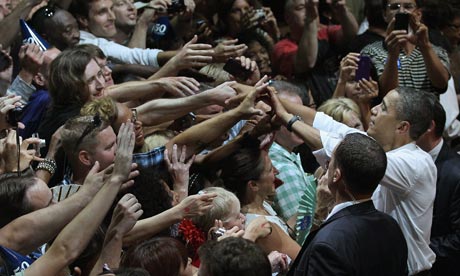
Supporters congratulate Barack Obama at his 50th birthday party: Standard and Poor's later delivered a very unwelcome present. Photograph: Scott Olson/EPA


http://www.salon.com/news/politics/war_room/2011/07/25/left_obama_leverage


Why the liberal base has so little leverage with Obama

The outcry from progressive voices over his debt ceiling posture is loud, but Obama is betting it won't last

BY ED KILGORE
Salon.com

Progressive elite disgruntlement with the administration of Barack Obama has been aired so many times during the last year that it is sometimes difficult to remember how deep and wide it has become. Like lights blinking off in house after house late at night, the number of liberal opinion-leaders willing to offer robust support for Obama’s policies and political strategy and tactics has steadily dwindled to the point where it appears as an occasional dull glimmer on the cable news shows and in the op-ed pages and the blogosphere. But up until now, signs of any rank-and-file liberal Democratic "base" revolt against Obama have been few and far between. Perhaps that’s why a poll from CNN last week publicized as showing that liberals were the main source of his latest drop in approval ratings got more attention than a random survey normally captures.

There has certainly been a persistent and growing gap between elite and non-elite progressive attitudes towards the 44th president and his administration. Liberal elite defections from the Obama camp started early and have spread steadily.

First off the grid were those angered by TARP and the coddling of miscreant CEOs and other elements of the financial community. They were quickly followed by civil libertarians upset by the failure to reverse Bush policies on surveillance and treatment of terrorist suspects; foreign policy doves alleging broken promises on Iraq and Afghanistan; and economists pining for mega-stimulus. The health reform debate produced another cohort of progressive dissenters baffled by the administration’s successive concessions to private health industry lobbies and Blue Dogs, while many environmentalists denounced a watered-down climate change bill before that entire effort was abandoned. In the months since the appalling 2010 midterm elections, progressives have largely deplored the president’s “cave” on expiration of the Bush tax cuts and, with ever-greater intensity, his advocacy of deficit reduction and “entitlement reform” as paramount national priorities.

Suffusing all these sources of discontent on the left has been a growing impatience with Obama’s steady commitment to bipartisanship in the face of Republican disrespect and obstruction; frustration over his apparent inability to articulate progressive values and goals in a way that mobilizes public opinion and gives hope to down-ballot Democrats; and contempt for suspected incompetence in such quotidian matters as executive and judicial appointments. To say that liberal elites are "disappointed" with Obama is a great understatement; terms of moral opprobrium such as "betrayal" and "sellout" are now routinely tossed at the White House.

But so far, this profound unhappiness has failed to translate into any tangible intramural challenge to the administration, in a way that defies all precedent. During his first term Bill Clinton faced regular revolts from congressional Democrats, losing a majority of House Democrats on NAFTA, GATT and welfare reform. Despite threats over the healthcare public option, Afghanistan funding, and most recently, administration offers to "reform" Medicare and Social Security, congressional Democrats have yet to bolt from Obama on any major legislation. LBJ and Carter attracted powerful left-bent primary challenges. Not so Obama, beyond vain fantasizing among the chattering classes.

A big part of the paper-tiger nature of progressive protests against Obama’s policies and politics has been the absence of any mass base for a serious revolt. Until such time as Democratic (or Democratic-leaning independent) liberal voters begin to share elite anger toward the incumbent, then all the thundering from thinkers and writers on the left (or even from staunch Progressive Caucus members in Congress) represents little more than a standing invitation to be "triangulated" by a White House seeking swing voter approbation.

And that’s why the headline accompanying the new CNN poll -- "Drop in liberal support pushes Obama approval rating down" -- is arousing fresh hopes of the left finally obtaining some political leverage over the administration at a critical moment in the budget/debt limit brouhaha.

But they are probably false hopes.

First of all, CNN’s numbers don’t quite back up the hype. The results note that Obama’s approval rating among self-described liberals is "only" 71 percent, "the lowest point of his presidency." CNN doesn’t provide a trend line for liberal approval ratings of Obama’s job performance, but Gallup’s latest weekly tracking poll has him at 75 percent among liberals, five points higher than in mid-May and six points higher than in early December of 2010. Among "liberal Democrats," probably a more reliable subcategory for capturing the sentiments of normally progressive voters, Gallup has Obama’s approval rating at 85 percent, roughly where it’s been on average throughout 2011. CNN also shows Obama’s approval rating among Democrats at "only" 80 percent, and his"renominate" number among Democrats at 77 percent, "relatively robust by historical standards but also down a bit since June." (The "historical standard" CNN supplies is a 1994 post-election poll showing Bill Clinton’s "renominate" number at 57 percent, which is indeed less robust than Obama’s). Finally, CNN’s latest survey shows that fully 13 percent of the electorate disapproves of Obama’s job performance on grounds that he is "not liberal enough," up from nine percent in a spring survey. But other survey findings (an all-time high percentage saying Obama’s not cooperating enough with congressional Republicans, and an all-time low approval rating for the direction offered by congressional Democratic leaders) call into question the idea that Obama’s in trouble because liberals are revolting against Obama for excessive cooperation with Republicans to gut Social Security and Medicare.

But the more important cautionary note to mention is that approval ratings are absolute, not comparative. Everything we know about Obama’s reelection strategy indicates that he hopes to make this a comparative rather than a "referendum" election, as he must unless economic conditions improve more than they are expected to prior to November 2012, or there is some incumbent-strengthening national security crisis. This strategy might fail, as it did for Jimmy Carter in 1980, or it might succeed, as it (arguably) did for Harry Truman in 1948 and for semi-incumbent George H.W. Bush in 1988. A Republican Party that is on a remarkable ideological bender is certainly doing everything possible to cooperate. But if a "comparative" strategy works at all, it will work most effectively with liberals, who are more acutely aware of the stakes for everything they care about -- from the survival of anything like a social safety net to the maintenance of constitutional guarantees on urgent priorities like abortion rights -- in an election that could give return Washington to united Republican control. Liberal voters are precisely the least likely Democratic-leaning segment of the electorate to sit on their hands in 2012, no matter how they feel about Obama.

And that reality, I suspect, is contributing significantly to the anger and despair expressed by progressive elites about Obama. They may now regret his nomination in 2008, or even (on strategic grounds) his election. But they know in their hearts they will be voting for him in 2012, and for the most part, speaking out for his re-election. Next time there is an open Democratic presidential nomination contest, the organized left will be almost certain to make far greater ideological demands on candidates, and make a far less speculative choice of a favorite, than it did in 2008. In the meantime, liberals will mostly have to bury a sense of cold fury that they have been "had" by a politician who in the course of less than three years has devolved from being the left’s great hope for a "transformative" presidency to a heresiarch over whom the Left has virtually no leverage.


Ed Kilgore is the managing editor of The Democratic Strategist, a senior fellow at the Progressive Policy Institute, and an online columnist for The New Republic.


http://www.guardian.co.uk/world/2011/aug/06/barack-obama-us-credit-downgrade

Barack Obama under fire as blame game follows US credit downgrade
by Paul Harris in Chicago
August 6, 2011
Guardian.co.uk

Left and right turn on president, raising questions over his chances of winning the White House again

Outside the Aragon ballroom in the north Chicago neighbourhood of Uptown, little sign remained of the president's 50th birthday party. The night before, 2,000 well-wishers had crammed inside the beautiful old building to mark Barack Obama's half-century. They had partied and danced as R&B singer Jennifer Hudson crooned "Happy Birthday".

But now, only one forlorn birthday banner still hung from a local bar. The party was truly over. As unwelcome late birthday presents go, the dramatic downgrading of America's debt rating by Standard & Poor's was hard to beat. The shock news sent reverberations through US politics, triggered an ugly blame game and plunged the economy into a fresh crisis that looks set to reverberate all the way to next year's presidential election.

On the streets of Uptown the mood was bleak. "The entire political culture has just stopped working. It feels like it is broken," said local IT worker Christian Lindemer, 30, as he strolled by the now empty Aragon.

His critics might say the same of the Obama White House. It has certainly become a place under siege. On the right it faces implacable foes in the shape of an ultra-conservative Republican party that has danced nimbly around Obama's efforts to work with it. Tea Party defenders shrug off the idea that its extremism helped to cause Standard & Poor's action and put the blame for the downgrade firmly on Obama's shoulders. "President Obama is destroying the foundations of our economy one beam at a time," said Tea Party-backed presidential candidate Michele Bachmann as the news broke.

On the left, meanwhile, Obama faces a liberal base depressed by what it sees as the president's continual concessions to Republicans. It blames the Tea Party's intransigence over the debt ceiling for the political deadlock that led to the downgrade. Republicans were "antediluvian" wrote online Slate magazine columnist Jacob Weisberg. Even vice-president Joe Biden, in private meetings with Democrat leaders, has reportedly said they "acted like terrorists" .

But now Obama's biggest enemy of all lies outside politics: it is the economy itself. The historic Standard & Poor's downgrade came after a week of terrifying market swings and amid the promise of vicious cuts to America's already shaky welfare state. It is now clear that the US economy is terribly sick. It is failing to create jobs and might double-dip back into recession. The stock market is tumbling. No wonder that Obama's birthday celebrations were so brief. He flew in and out of Chicago on the same day. Yet perhaps he got a little lift from being in a town where sympathy for its favourite political son remains relatively strong. "He's trying his best. Or at least I think he is," said Lindemer.

But in the wider landscape of American politics there is no denying the anger among some leading lights of the left at Obama, which the debt downgrade will only sharpen. After all, last week's debt deal – so hated by liberals – was meant to avoid precisely such a fiasco.

After having initially promised tax rises for the rich to go alongside deep spending cuts, Obama ended up signing a debt agreement with Republicans that contained no new revenues. Not a single cent would come from America's wealthiest people while a burden of hundreds of billions of dollars of cuts would be borne by some of the poorest.

It was billed as tough but necessary medicine in order to raise the debt ceiling and stave off disaster. But, having swallowed the pill, America got downgraded anyway and the markets still fell. It seemed Obama had given away everything for nothing. For people such as documentary-maker and activist Robert Greenwald there were only a few apt words to describe Obama's deal.

"I'm disgusted," he said "I think the day it was signed was a sad day: economically, morally and politically."

Yet the debt deal is now just one liberal complaint among many. Leftist Democrats decry the influence of the banking sector among Obama's economic staffers. They bemoan the toothlessness of his financial reforms. His promise to shut Guantánamo Bay remains unfulfilled. He preserved huge tax breaks for the wealthy. He has upped the war in Afghanistan and not delivered on climate change and immigration reform.

Obama looks like a somewhat downgraded president. He has become the butt of late-night comedians on the Daily Show and the Colbert Report, where he is portrayed as naïve and weak.

Even some of Obama's once staunchest supporters have pulled no punches. Princeton professor Cornell West, a leading black intellectual, recently described Obama as "... a black mascot of Wall Street oligarchs". He did not shy away from that incendiary opinion last week, telling a black media conference in Philadelphia: "I'm an angry brother. Barack Obama is not angry ... He's a different kind of brother."

There is huge envy among some progressives about the role of the Tea Party on the right. Even as they decry its aims they look longingly at its ability to influence politics. One progressive organisation, the Campaign for America's Future, is organising a conference in Washington in October aimed at founding such a movement on the left. "We have to be an ideological force that is as energetic as the Tea Party and pushes the Democrats to be more bold," co-director Roger Hickey told the Observer. Neither is CAF waiting until October to start action. This week , along with MoveOn.org, another liberal activist group, it will hold rallies outside scores of politicians' offices.

But in some quarters, support for Obama remains strong. Bronzeville is a small neighbourhood on Chicago's South Side. It has a rich history and in the earlier half of the last century was known as "the black metropolis". It was the epitome of black pride in Chicago, thriving with black-owned businesses, homes and a rich cultural life. Those days have gone, replaced with the tough times of the modern urban black American experience. But support for Obama is high here. "I believe he has done a magnificent job. People forget what was left after [George W] Bush. They forget the state he found the country in," said plumber Terry Jones, 49. "I wish him a happy birthday and congratulate him on a job well done."

The same is true in nearby Hyde Park, a wealthy liberal enclave where the Obamas have their family home. On these leafy streets, lined by mansions and expensively maintained lawns, many people believe Obama still epitomises what is right about American politics. They see him as the "adult in the room", standing above the fights between Democrats and Republicans. "He's trying to do a good job. I like that he wants to negotiate with people on the other side," said graduate student Anne Rebull, 29.

That sentiment chimes with Obama's own aides' ideas about how best to win the election of 2012. They believe that fight will take place in the centre ground of American politics and staking out that territory is worth the sacrifices around protecting social security and benefits for the elderly and the ill. It assumes the extremism of the Republican party will put off independents, while progressives will have no choice but Obama.

"Liberals are unhappy, but the Republicans will scare them into coming out for Obama," said Larry Haas, a political commentator and former aide in the Clinton White House. Even Hickey admits there are no plans to run a liberal primary challenge to Obama: "Nobody is talking about a challenger. We are all terrified of an ultra-conservative Republican taking over government."

But the downgrade is a rude wake-up call. When Obama took office he won much praise for staving off a second Depression by huge stimulus spending in the first months of his presidency. Standard & Poor's has single-handedly made that look a little less impressive. Though the White House and Treasury have pushed back against the agency, pointing out a major maths error in its initial sums, the downgrade made clear what millions of Americans already understood: the state of the economy seems to be worsening again. The jobless rate is still above 9% and that headline fails to account for millions unemployed for so long they have stopped looking for work and dropped out of the official count.

Obama is set to embark on a bus tour of America's heartland, where he will attempt to put jobs at the centre of his political message. But it might not be enough. Even on the streets of Bronzeville there was an understanding that economic times were now very hard, no matter how much one supported the current occupant of the White House. Jones admitted that the collapse of the housing market meant plumbing jobs were few and far between: "Nobody needs a plumber these days. It's slow. I have had to cut back, tighten my belt."

What is true for Jones is true for wider America. As the nation tightens its belt and faces more stock market falls, a second round of recession and massive spending cuts, the chances of an Obama second term also begin to narrow.

• This article was amended on 9 August 2011 to remove a quote from New York Times columnist Ross Douthat.


© 2011 Guardian News and Media Limited or its affiliated companies. All rights reserved.

Friday, October 17, 2008

Cool We Can Believe In: The Political Artistry of Barack Obama

http://www.nytimes.com/2008/10/16/us/politics/16web-healy.html?_r=1&nl=pol&emc=polb1&oref=slogin

"Float like a butterfly/sting like a bee"
--Muhammad Ali

All,

One of the things that I most admire and respect about Barack politically is his consummate ability to stay cool, focused, and disciplined no matter what the external circumstances happen to be. Like one of his major idols--Muhammad Ali--Obama has the poise, shrewdness, insight, and self confidence to realize that one's own vision and agenda (and thus behavior) is not dependent on what one's opposition says or does, but is established and carried out by one's own disciplined adherence to those ideas and values that one is independently motivated by. It's an important and fundamental political lesson that many progressives and radicals could and should learn from no matter what they may otherwise think of Obama or his politics...

Kofi


October 16, 2008
ON THE TRAIL

Staying Cool and Irritating Your Opponent
By PATRICK HEALY
New York Times


From Bill Clinton to John McCain, Senator Barack Obama has proved adept at driving very smart politicians out of their comfort zone, leading them to make comments or embrace tactics that end up backfiring.

Maybe it was one tsk-tsk too much, but at Wednesday night’s debate, something seemed to snap inside Senator McCain after listening to Senator Obama’s cool, high-minded lecture about inappropriate conduct at Republican rallies.

“What is important is making sure that we disagree without being disagreeable,” the 47-year-old freshman Democrat told the 72-year-old four-term Republican. “What we can’t do, I think, is try to characterize each other as bad people.”

Mr. McCain, who had appeared composed and confident up to that point, responded by veering into heated denouncements of Mr. Obama’s loose ties to Bill Ayers, the former Weather Underground leader, and the community organizing group Acorn, which has been accused of voter fraud. Mr. McCain did not explain what Acorn was, probably confusing many viewers, and he never regained control of the debate.

“All of these things need to be examined,” Mr. McCain said about Mr. Ayers and Acorn.

To which Mr. Obama delivered a final hit that reflected that many Americans are more concerned with the economy than with Bill Ayers.

“I think the fact that this has become such an important part of your campaign, Senator McCain, says more about your campaign than it says about me,” Mr. Obama said.

While Mr. Obama is known for giving stirring speeches before stadium-sized crowds, less recognized is his shrewd oratory against his opponents. He has been able to turn a relative weakness — his inexperience in government and politics — into a strength: Messrs. Clinton and McCain and their aides have held Mr. Obama in low regard at times, seeing him as an untested upstart, and so his easy-going manner and ongoing success have unsettled them that much more.

“Never let ‘em see you sweat: Barack Obama has mastered that concept, and it has thrown off political opponents for the past 20 months,” said William O’Reilly, a Republican political consultant in New York. “It prevented John McCain from knowing when he was scoring points last night. McCain needs to trust his instincts. Senator Obama will never look wounded, but that doesn’t mean he’s invulnerable.”

The Clintons came to believe that during the Democratic nomination fight, their advisers say, but it did not stop Mr. Clinton from lapsing into some undisciplined behavior.

Mr. Obama spent 2007 and the winter of 2008 getting under Mr. Clinton’s skin, prompting any number of missteps by a former president who is regarded as a master of politics. Mr. Obama repeated so often that he had been against the Iraq war from the start — unlike Senator Hillary Rodham Clinton, his rival for the Democratic nomination — that Mr. Clinton finally let loose in New Hampshire with a rant that the Clinton campaign had not authorized, about how Mr. Obama’s claims were a “fairy tale.”

Many Democrats were disgusted with the remark, including many black voters who supported Mr. Clinton but were offended that he would challenge the narrative of one of their own. Soon after, Mr. Clinton started attacking Mr. Obama in South Carolina — again, to the Clinton camp’s dismay. Mr. Clinton said it was “understandable” that people would vote along race and gender lines — a comment that some voters said was condescending — and he said that Mr. Obama had “put out a hit job on me” once.

After Mr. Obama won the South Carolina primary in a landslide, Mr. Clinton compared the victory to Jesse Jackson’s wins there in 1984 and 1988 — the last straw for some Democrats and black voters, who said Mr. Clinton was belittling Mr. Obama in a patently racial context. Mr. Clinton has adamantly denied doing so.

The fact is, Mr. Obama probably won points with voters by keeping his cool throughout the various Clinton episodes. And there is no question that he goaded Mr. Clinton and his wife’s campaign into making some questionable tactical moves, such as going to war with some reporters and media outlets. At times it seemed like Mrs. Clinton was the only one keeping her cool in her camp.

Had Mrs. Clinton won the nomination, she planned to run against Mr. McCain with a similar strategy that Mr. Obama has pursued: Portraying the Republican nominee as a like-minded handmaiden to President Bush. But one could easily suggest that Mr. Obama is getting under Mr. McCain’s skin with this argument more than Mrs. Clinton would have; Mr. McCain respects Mrs. Clinton quite a bit, while he could barely bring himself to look Mr. Obama in the eyes or treat him with any deference in their first two debates.

Mr. Obama’s pokes, indeed, have had the effect of drawing patronizing comments from Mr. McCain. In May, for instance, Mr. Obama taunted Mr. McCain for his lack of support on a veterans’ benefit bill in the Senate, causing Mr. McCain to invoke his and others’ military service compared to Mr. Obama’s — something the Republican candidate had indicated he would not do.

“I will not accept from Senator Obama, who did not feel it was his responsibility to serve our country in uniform, any lectures on my regard for those who did,” Mr. McCain said in a statement.

On Wednesday night, Mr. McCain also “categorically” defended the people at his rallies after Mr. Obama mentioned the nasty comments by a few. Mr. McCain said that people who have used harsh language -- one news report said one person yelled “kill him,” referring to Mr. Obama, at a Florida rally -- were among the “fringe people” who come to any huge rally. Then he turned to Mr. Ayers and Acorn and Mr. Obama’s work was done.


Copyright 2008 The New York Times Company