Showing posts with label Global politics. Show all posts

Monday, October 24, 2011

DEMOCRACY IS IN THE STREETS!: The Essential Meaning of the Occupy Wall Street Movement Both Here and Abroad

http://www.thenation.com/article/164078/occupy-wall-street-beginning-here?page=full

"Strong people don't need strong leaders"
--Ella Baker (1903-1986)--Founder of SNCC

All,

In ongoing solidarity with the 'Occupy Wall Street' movement worldwide, and in support of the article by Jonathan Schell below, I repeat with added emphasis the following statement from two weeks ago:

"What is happening at this very moment on Wall Street is by far the most important and necessary political movement in this country today. Nothing else is even close. We must now work tirelessly to establish a real viable NATIONAL NETWORK of radical ideas, strategies, tactics, and goals through a plethora of grassroots mass-based organizations throughout the country that will create both in the short and long term a concrete alternative to the criminally oppressive and exploitive political economy and culture of this country...

So this ain't about President Obama, the Democratic Party, the Republican Party, the Tea Party, the media, or for that matter any other "independent" or opportunist or self proclaimed meglomaniacal "leaders." This is thankfully way beyond all that. THIS is about US, which is to say the actual millions of citizens who are viscerally suffering from the venality and sheer madness of our current political and economic system. Thus it is absolutely imperative for all of us to remember now more than ever that Democracy cannot possibly be found among the elites because like always DEMOCRACY IS IN THE STREETS...Stay tuned..."
--Kofi Natambu
October 5, 2011

Occupy Wall Street: The Beginning Is Here
by Jonathan Schell
October 19, 2011

This article appeared in the November 7, 2011 edition of The Nation.

Nothing is more striking about the Occupy Wall Street movement, which in a political instant has swept through not only the United States but the world, than its origin. It seemed to come out of nowhere, like a virgin birth. There were, of course, organizations that played a critical initiating role, which is gradually being acknowledged and rightly honored (see, for example, Nathan Schneider, “From Occupy Wall Street to Occupy Everywhere,” October 31). But it would be wrong to assign paternity in any ordinary sense to them, and they indeed disavow such a claim. On the contrary, the core activists in Liberty Plaza founded on the spot a decentralized, nonviolent pattern of “leaderless” self-organization that made every participant, old or new to the process, a “founding father” (or mother). The movement, you could say, was father and mother to itself. To join it was, immediately, to become it.

Roars of applause for executions at the GOP debate, official approval of torture, barbaric prison conditions, obstruction of aid to storm victims and children in need—is our nation descending into barbarism?

This feature was underscored when, in response to a police ban on megaphones, the occupiers deployed their now famous human microphone, in which an individual speaker’s words are repeated by all within hearing, inventing a new animal, a speaking crowd, who thus become the voice of their joint action.

This indefinite open-endedness of origins was carried forward in another conspicuous novelty of the movement: its lack of a list of demands. According to some reports, early efforts to frame such lists went nowhere. If so, the failure became a virtue. It was not a new set of policy ideas that was being born—the world was already overloaded with these, unacted upon—but a new spirit: a spirit of action, without which all the demands in the world are a dead letter.

What we might call the demand for demands, so prominent in early media reactions, was based on a fundamental error. It confused demands and content. A movement—like a book or an article—can have content without demands. Demands are a later stage that comes once the content is developed and, above all, once the movement is strong. This movement was born rich in unmistakable content. As everyone who cares to look knows by now, its members are crying out “Enough!” to a corrupt political, economic and media establishment that is hijacking the world’s wealth for itself, immiserating ordinary people, sabotaging the rule of law, waging interminable savage and futile wars, plundering the world’s finite resources, lying about all this to the public and threatening Earth’s life forms into the bargain. As for the development of leaders and demands, Anonymous, one of the precursor groups, offered a prescription in keeping with the spirit of the movement: “If you are looking to contact one of our leaders, go to the nearest mirror and peer deeply into it. It may take some time, but, eventually, one of our leaders will appear with answers to all of your questions.”

An understanding of Occupy Wall Street’s beginnings and continuing structure perhaps offers a clue to an issue that promptly began to roil the movement: what its relationship to established groups, especially the Democratic Party, should be. Almost immediately, top Democrats, including President Obama and House minority leader Nancy Pelosi, weighed in with friendly and supportive comments. (Obama said, “The protesters are giving voice to a more broad-based frustration about how our financial system works.” Pelosi said, “The message of the protesters is a message for the establishment in every place.”) Newspapers of moderate bent eventually jumped on board. The New York Times sang the praises of the occupation in an editorial. Older leftish movements like MoveOn threw their support behind it. Even the counterattack was surprisingly feeble and off-balance. No sooner had House majority leader Eric Cantor called the occupation a “mob” than he turned around and admitted the nation knows that “folks at the top end of the income scale…make too much and too many don’t make enough.”

The usual metaphor for a movement is an explosion. But Occupy Wall Street acted more like an implosion. The established actors appeared not so much to yield in the face of pressure exerted by the movement as to fall inward into the potent new space the demonstrators had created. Only a few hundred strong at first, the movement set up a blackboard on which established powers turned out to be unexpectedly eager to write their messages. As it turned out, the powers had demands to spare, as if they had been saving them up.

Yet shortly after these friendly faces appeared, petitioning the petitioners, the worries about co-optation arose in the movement. While welcoming support, a “working group” of the occupation voiced fear of “divide and conquer attempts being made to co-opt the movement,” and warned that some “are trying to label us as the Democrats’ version of the Tea Party”—a development that would undermine “the very essence of this movement with your obsolete divide and conquer groupthink propaganda.” And certainly it is true that a party affiliation would be even more stultifying than a premature list of demands.

But it may be that such worries are unnecessary. The power of the movement does not lie in the mite that it can add to or withdraw from some existing grouping through such traditional means as alliances and endorsements. Rather, its power lies in its direct appeal to the hearts and minds of the population at large—to the 99 percent that the movement so audaciously and promisingly claims to represent. By this process, the mite becomes mighty. It was surely such a felt tremor in the hidden recesses of hearts and minds—in short, in public opinion and, even more, in public will—that alone can explain the established expressions of support as well as the wildfire spread of the protest.

When such sea changes in opinion and will are under way, entrenched institutions start to tremble and shake, and political miracles become possible. If the scale of the national and international response to Occupy Wall Street is any measure, they have begun.

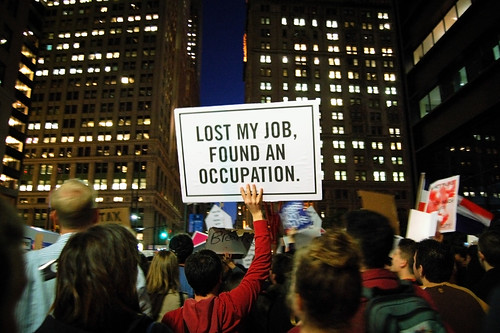
The exceptional creativity in the movement has been evident in countless handwritten signs. For example: I Lost My Job but Found an Occupation. And, Love Is the New Fear. But perhaps the loveliest, appearing in the demonstration’s early days and cited in these pages, was The Beginning Is Near. To this we can now gratefully add, The Beginning Is Here.


Jonathan Schell is the Doris Shaffer Fellow at The Nation Institute and teaches a course on the nuclear dilemma at Yale...

Also by The Author

Cruel America (Death Penalty, Economic Policy, Conservatives and the American Right, Cultural Criticism and Analysis)

The New American Jujitsu (America as Empire, Foreign Policy, Cultural Criticism and Analysis, War on Terrorism)

Wednesday, October 19, 2011

The Global Reach of the Occupy Wall Street Movement in Text and Pictures


OccupyWallStreet The resistance continues at Liberty Square and worldwide! News LiveStream Forum Chat User Map NYCGA About Donate


Right Here All Over (Occupy Wall St.) from Alex Mallis on Vimeo.


Occupy Wall Street Marks One Month
Posted Oct. 17, 2011
by OccupyWallSt


Occupations Spread to Over 100 US Cities

Movement For Economic Justice Gains Global Momentum

Liberty Square, New York, NY — One month ago today about 2,000 people rallied in Lower Manhattan and marched up Broadway. Stopping at Zuccotti Park an estimated 150 stayed the night and began an encampment. Renaming the space “Liberty Square,” we kicked off a protest against bank bailouts, corporate greed, and the unchecked power of Wall Street in Washington. In the last month, the message of “We are the 99%” has won the hearts and minds of over half of Americans (according to a recent Time survey) and is gaining ground globally, with 1500 protests in 82 countries this past Saturday (October 15).

“I am here to celebrate the 30th day of this protest against corporate power,” said Karanja Gacuca from Liberty Square, a former Wall Street analyst who now organizes with Occupy Wall Street. “Concerned about the egregious Wall Street bonuses — particularly after the industry accepted a tax-payer bailout and the middle class continues to be squeezed — I believe it's time for a fairer system that provides health care, education, and opportunity for all, and rejects corporate influence over government.”

Inspired by the uprisings across the Arab world, and fueled by the feelings of anger and helplessness of everyday Americans, in the past month Occupy Wall Street has:

Gone Global: On October 15th, protests were held from North and South America to Asia, Africa and Europe, with over 1,500 events in 82 countries, as part of a global day of action.
Flourished with Diversity: Occupiers of different ages, races, walks of life, and political beliefs have joined the movement. The mix grew quickly to include students, elderly people, families with children, construction workers on their lunch breaks, unemployed Wall Street executives, Iraq & Afghanistan veterans, moms, and many others.

Gained Support in the Heartland: Occupy actions are happening all across middle America, from Kethcum, ID to Kalamazoo, MI, from Orlando to Anchorage. Every day financial contributions arrive along with clothes, food, and notes of support from all across the country. A couple from West Virginia who have been sending supplies to Liberty Square occupiers writes: “We are so grateful for all of you involved in this defense of America. We firmly believe this is ‘it.’ If we can't grab this democracy this time, we'll sink and it will be a long time before we will have this opportunity again. Thank you for taking time from your busy life to be there.”

Changed the Conversation: The people-powered force of shared anger at a broken system that profits the top 1% at the expense of the rest of us has shifted our national dialogue. The Occupy Wall Street protest has become a cultural phenomenon, mentioned everywhere from jokes on Saturday Night Live to the solemn dedication the national memorial to Dr. Martin Luther King, Jr. by President Obama Sunday. We, the occupiers, have shown our country how to come together and respect differences while working together to build a movement for change. What a month, and we are only getting started!

Occupy Wall Street is a people-powered movement that began on September 17, 2011 in Liberty Square in Manhattan’s Financial District, and has spread to over 100 cities in the United States and actions in over 1,500 cities globally. #OWS is fighting back against the corrosive power of major banks and multinational corporations over the democratic process, and the role of Wall Street in creating an economic collapse that has caused the greatest recession in generations. The movement is inspired by popular uprisings in Egypt and Tunisia, and aims to expose how the richest 1% of people are writing the rules of an unfair global economy that is foreclosing on our future.


662 Comments

From Tahrir Square to Times Square: Protests Erupt in Over 1,500 Cities Worldwide Posted Oct. 16, 2011, 1:08 a.m. EST by OccupyWallSt

Tens of Thousands in Streets of Times Square, NY

Tens of Thousands Flood the Streets of Global Financial Centers, Capitol Cities and Small Towns to "Occupy Together" Against Wall Street Mid-Town Manhattan Jammed as Marches Converge in Times Square

New York, NY -- After triumphing in a standoff with the city over the continued protest of Wall Street at Liberty Square in Manhattan's financial district, the Occupy Wall Street movement has spread world wide today with demonstrations in over 1,500 cities globally and over 100 US cities from coast to coast. In New York, thousands marched in various protests by trade unions, students, environmentalists, and community groups. As occupiers flocked to Washington Square Park, two dozen participants were arrested at a nearby Citibank while attempting to withdraw their accounts from the global banking giant.

"I am occupying Wall Street because it is my future, my generations' future, that is at stake," said Linnea Palmer Paton, 23, a student at New York University. "Inspired by the peaceful occupation of Tahrir Square in Cairo, tonight we are are coming together in Times Square to show the world that the power of the people is an unstoppable force of global change. Today, we are fighting back against the dictators of our country - the Wall Street banks - and we are winning."

New Yorkers congregated in assemblies organized by borough, and then flooded the subway system en mass to join the movement in Manhattan. A group calling itself Todo Boricua Para Wall Street marched as a Puerto Rican contingent of several hundred playing traditional music and waving the Lares flag, a symbol of resistance to colonial Spain. "Puerto Ricans are the 99% and we will continue to join our brothers and sisters in occupying Wall Street," said David Galarza Santa, a trade unionist from Sunset Park, Brooklyn. "We are here to stand with all Latinos, who are being scapegoated by the 1%, while it is the bankers who have caused this crisis and the banks who are breaking the law."

While the spotlight is on New York, "occupy" actions are also happening all across the Midwestern and the Southern United States, from Ashland, Kentucky to Dallas, Texas to Ketchum, Idaho. Four hundred Iowans marched in Des Moines, Iowa Saturday as part of the day of action:

"People are suffering here in Iowa. Family farmers are struggling, students face mounting debt and fewer good jobs, and household incomes are plummeting," said Judy Lonning a 69-year-old retired public school teacher. "We're not willing to keep suffering for Wall Street's sins. People here are waking up and realizing that we can't just go to the ballot box. We're building a movement to make our leaders listen."

Protests filled streets of financial districts from Berlin, to Athens, Auckland to Mumbai, Tokyo to Seoul. In the UK over 3,000 people attempted to occupy the London Stock Exchange. "The financial system benefits a handful of banks at the expense of everyday people," said Spyro Van Leemnen, a 27-year old public relations agent in London and a core member of the demonstrators. "The same people who are responsible for the recession are getting away with massive bonuses. This is fundamentally unfair and undemocratic."

In South Africa, about 80 people gathered at the Johannesburg Securities Exchange, Talk Radio 702 reported. Protests continued despite police efforts to declare the gathering illegal. In Taiwan, organizers drew several hundred demonstrators, who mostly sat quietly outside the Taipei World Financial Center, known as Taipei 101.

600 people have begun an occupation of Confederation Park in Ottawa, Canada today to join the global day of action. "I am here today to stand with Indigenous Peoples around the world who are resisting this corrupt global banking system that puts profits before human rights," said Ben Powless, Mohawk citizen and indigenous youth leader. "Native Peoples are the 99%, and we've been resisting the 1% since 1492. We're marching today for self- determination and dignity against a system that has robbed our lands, poisoned our waters, and oppressed our people for generations. Today we join with those in New York and around the world to say, No More!"

In Australia, about 800 people gathered in Sydney's central business district, carrying cardboard banners and chanting "Human need, not corporate greed." Protesters will camp indefinitely "to organize, discuss and build a movement for a different world, not run by the super-rich 1%," according to a statement on the Occupy Sydney website.

The movement's success is due in part to the use of online technologies and international social networking. The rapid spread of the protests is a grassroots response to the overwhelming inequalities perpetuated by the global financial system and transnational banks. More actions are expected in the coming weeks, and the Occupation of Liberty Square in Manhattan will continue indefinitely.

Occupy Wall Street is a people powered movement that began on September 17, 2011 in Liberty Square in Manhattan’s Financial District, and has spread to over 100 cities in the United States and actions in over 1,500 cities globally. #OWS is fighting back against the corrosive power of major banks and multinational corporations over the democratic process, and the role of Wall Street in creating an economic collapse that has caused the greatest recession in generations.The movement is inspired by popular uprisings in Egypt, Tunisia, Spain, Greece, Italy and the UK, and aims to expose how the richest 1% of people who are writing the rules of the global economy are imposing an agenda of neoliberalism and economic inequality that is foreclosing our future.


620 Comments

October 15th - Global Day Of Action Posted Oct. 15, 2011, 6:12 p.m. EST by OccupyWallSt
NYC Live Updates

12:40 a.m. Police are barricading Washington Square Park from the public. Property not people.
12:12 a.m. Police are advancing on bystanders standing outside the South side of Washington Square Park.
12:09 a.m. Police have sealed the North and South side of Washington Square Park.
11:54 p.m. Police in riot gear are advancing on peaceful occupiers in Washington Square Park.
11:34 p.m. Police are massing at Washington Square Park. Police are moving on #occupychicago
9:48 p.m. 3,000 at Washington Square now, about to have a General Assembly, 70 arrests total for today.
9:02 p.m. 42 arrests on 47th.
8:50 p.m. 700 reported in Washington Square Park. Music and food there.
8:30 p.m. Scanner says riot cops in full gear, nets out, headed to the crowd, 47th and 6th.
8:11 p.m. White shirt just ordered #NYPD line AWAY from barricades. Crowd ROARS
8:08 p.m. Tension escalating, police ordering protesters to step away from barricades.
8:02 p.m. Mario: 4 paddy wagons and arrests at 46 and 6th ave.
8:00 p.m. Police are arresting occupiers at 46th and 6th.
7:30 p.m. Unconfirmed estimates ranging as high as 50,000 people in Times Square.
6:45 p.m. Police have trapped people in times square with barricades.
6:35 p.m. A horse just went down. Crowd is going wild. NYPD says anyone near barricade is going to jail. This is is inexcusable. (Source)
6:22 p.m. Police on horseback arrive. Police pulling people out of crowd and attacking them. Protesters are rushing barricades.
6:10 p.m. Police in riot gear retreat.
6:05 p.m. Police are in riot gear.
6:00 p.m. Backup has arrived. Estimated 15,000 in Times Square
5:49 p.m. Orange nets along Broadway.
5:45 p.m. Five thousand more on their way from Liberty Square and other locations.
5:30 p.m. Thousands arrive in Time Square. Now livestreaming: http://www.livestream.com/occupywallstnyc


5:13 p.m. March now 7 blocks from Times Square.
4:18 p.m. March from Washington Square Park is at 20th St and 6th Ave.


3:40 p.m. March from Washington Square Park is at 11th St and 6th Ave. At least five thousand strong.

3:36 p.m. It appears that Twitter is censoring our updates.
3:26 p.m. General Assembly of Washington Square Park marches on Times Square. 8th st and 6th ave.
3:19 p.m. Zombie group arriving in Washington Square Park. Hundreds march from Liberty Square to Citibank at 555 La Guardia Place in solidarity with arrested occupiers.
2:43 p.m. Around four thousand in Washington Square Park. Around three thousand in Liberty Square.
2:28 p.m. Police at 555 La Guardia Place are arresting occupiers in Citibank who are attempting to close their accounts.
2:23 p.m. At least 22 arrested in Citibank.
2:19 p.m. Citibank action 555 La Guardia Place. Occupiers are inside and currently being arrested.
1:57 p.m. March from Liberty Square reaches Washington Square Park. Thousands in the General Assembly meet them chanting, "Wall Street, no thanks - we don't need your greedy banks."
1:49 p.m. March from Liberty Square passes Waverly Place, nears Washington Square Park.
1:29 p.m.. Two thousand are gathered for General Assembly in Washington Square Park. Thousands more are marching to meet them.
1:23 p.m. At least twenty NYPD vehicles heading to Washington Square Park.
1:16 p.m. March from Liberty Square to Washington Square Park passes 6th and Broome.
1:05 p.m. Poetry cipher broke out during the Bronx General Assembly on the 4 train.
12:54 p.m. Bronx Police hold entrance to subway open for Bronx General Assembly - march heads downtown for free, filling two entire cars.
12:35 p.m. March from Liberty Square to Washington Square Park passes Church and Chambers - numbers more than a thousand.
Schedule

11AM - MARCH ON THE BANKS
From Liberty Square to Chase
We will then march to student meet up at Wash. Sq. Park
Facebook
moveyourmoneyproject.org

11AM - OCCUPY THE BRONX MEET-UP
Facebook

12PM - ANTI-WAR MARCH AND TEACH-IN
Wall Street And Broadway
Facebook

12PM - MASS STUDENT GENERAL ASSEMBLY
Washington Square Park -
Student meet up and student loan lender bank action
Facebook

1PM - #SankofaDay
Sponsered by the Malcolm X Grass Roots Movement
Liberty Plaza/Zuccotti Park
Facebook

3:30PM - ENVIRONMENTAL ACTION AGAINST MOUNTAIN TOP REMOVAL
New York Public Library Main Entrance
42 and 5th avenue

4PM - OCCU-PIE TIMES SQUARE RECRUITMENT CENTER
Facebook

5PM - TAKE TIME SQUARE CONVERGENCE/ OCCUPATION PARTY
The Occupation Party & Facebook

Media

Washington Square Park, NY

135 Comments

The 1% Have Addresses. The 99% Have Messages
Posted Oct. 15, 2011, 11:43 a.m. EST by OccupyWallSt

Life sure is tough for those at the top and it must get awfully lonely. Working day and night to ravage the global economy through neoliberal policy is a thankless job. The following website lists the names of many powerful financial executives and it's time we all sent them a warm thank you for the hard work they've been doing ;)

284 Comments

October 15th Call to Action
Posted Oct. 14, 2011, 11:08 p.m. EST by OccupyWallSt

Over the last 30 years, the 1% have created a global economic system - neoliberalism - that attacks our human rights and destroys our environment. Neoliberalism is worldwide - it is the reason you no longer have a job, it is the reason you cannot afford healthcare, education, food, your mortgage.
Neoliberalism is your future stolen.

Neoliberalism is everywhere, gutting labor standards, living wages, social contracts, and environmental protections. It is "a great vampire squid wrapped around the face of humanity, relentlessly jamming its blood funnel into anything that smells like money." It is a system that ravages the global south and creates global financial crisis - crisis in Spain, in Greece, in the United States. It is a system built on greed and thrives on destablizing shocks.
It allows the 1% to enrich themselves by impoverishing humanity.

This has to stop!
We must usher in an era of democratic and economic justice.
We must change, we must evolve.

On October 15th the world will rise up as one and say, "We have had enough! We are a new beginning, a global fight on on all fronts that will usher in an era of shared prosperity, respect, mutual aid, and dignity."

Actions in NYC


October 15th: Occupy Banks from Mary Matthews on Vimeo.

Actions worldwide

Take The Square

451 Comments

#OWS VICTORY: The people have prevailed, gear up for global day of action
Posted Oct. 14, 2011, 8:51 a.m. EST by OccupyWallSt

People power triumphs over Wall Street’s bid to end the protests mayor bloomberg and Brookfield Inc. back down on eviction world prepares for day of action Saturday October 15 in 950+ cities in 82 countries. We Are Winning!

NEW YORK, NY – Over 3,000 people gathered at Liberty Plaza in the pre-dawn hours this morning to defend the peaceful Occupation near Wall Street. The crowd cheered at the news that multinational real estate firm Brookfield Properties will postpone its so-called “cleanup” of the park and that Mayor Bloomberg has told the NYPD to stand down on orders to remove protesters. On the eve of the October 15 global day of action against Wall Street greed, this development has emboldened the movement and sent a clear message that the power of the people has prevailed against Wall Street.

“We are winning and Wall Street is afraid,” said Kira Moyer-Sims, a protester from Portland, Oregon. “This movement is gaining momentum and is too big to fail.”

“Brookfield Properties is the 1%. They have invested $24 billion in mortgage-backed securities, so as millions face foreclosure and eviction due to predatory lending and the burst of the housing bubble that Wall Street created, its not surprising they threatened to evict Occupy Wall Street,” said Patrick Bruner, an organizer with Occupy Wall Street from the Bed-Stuy neighborhood of Brooklyn. “But Brookfield and Bloomberg have backed down and our movement is only growing as the 99% take to the streets world wide to call for economic justice.”

The early morning announcement from the Mayor’s office in New York came after 300,000+ Americans signed petitions to stop the eviction, and flooded the 311 phone network in solidarity with those in Liberty Square. At 6 AM this morning, 3,000+ New Yorkers, unions, students, and others joined the occupiers in the square to send a clear message to the 1% who want to silence this peaceful assembly of the 99%. Donations poured into the protesters from Italy, England, Mexico and many other countries by everyday people hoping to help the movement grow.

“For too long the 99% have been ignored as our economic system has collapsed. The banks got bailouts and we’ve been sold out, ” said Harrison Schultz, business analyst from Brooklyn . “Wall Street’s greed has corrupted our country and is killing our planet. But today we celebrate victory and vow to keep fighting for justice and change on Wall Street, and in over 100 cities in the US and over 950 cities globally.”

On October 15th, Occupy Wall Street will demonstrate in concert over 951 cities in 82 countries and counting as people around the globe protest in an international day of solidarity against the greed and corruption of the 1%.

Occupy Wall Street is a people powered movement that began on September 17, 2011 in Liberty Square in Manhattan’s Financial District, and has spread to over 100 cities in the United States and actions in over 1,500 cities globally. #OWS is fighting back against the corrosive power of major banks and multinational corporations on the democratic process, and the role of Wall Street in creating an economic collapse that caused the greatest recession in generations. The movement is inspired by uprisings in Egypt, Tunisia, Spain, Greece, Italy and the UK, and aims to expose how the richest 1% of people who are writing the rules of the global economy and are imposing an agenda of neoliberalism and economic inequality.

762 Comments

Liberty Square has grown exponentially over the last three weeks. It is time to form a second General Assembly in Manhattan. We expect more to follow.

On October eighth at three in the afternoon a General Assembly will convene in Washington Square Park. At the same time Anti-Flag will play an acoustic set in Liberty Square in solidarity with our movement's expansion.

We are growing. Block by block – city by city. We will see change in this country, in this world. It will happen sooner than you can imagine.


635 Comments

AFT fully endorses Occupy Wall Street
Posted Oct. 6, 2011, 4:48 p.m. EST by OccupyWallSt

The American Federation of Teachers Local 1839 fully endorses Occupy Wall Street.

In solidarity on behalf of our Local,

Ivan S. Steinberg, President AFT Local 1839

William Calathes, Executive Vice President AFT Local 1839

884 Comments

This Site Has Nothing To Do With Us
Posted Oct. 6, 2011, 11:48 a.m. EST by OccupyWallSt

occupyparty.org

We are not a political institution.

570 Comments


#ows Takes Foley Square With Union Brothers And Sisters
Posted Oct. 6, 2011, 4:03 a.m. EST by OccupyWallSt

The American Dream has been stolen from the world. Workers are told that they aren't allowed health care, shelter, food. Students are told that they aren't allowed jobs, and that they will be in debt for the rest of their lives, unable to declare bankruptcy. The 1% has destroyed this nation and its values through their greed. The 1% has stolen this world. We will not allow this to occur.


Wednesday, April 14, 2010

Documentary Filmmaker Connie Field On Her New Film about South Africa and the Global Anti-Apartheid Movement

From new film 'Have You Heard From Johannesburg?', which opens April 14 at New York City's Film Forum. Photo: Mike Tomlinson, IFL


http://www.documentary.org/content/have-you-heard-johannesburg-epic-song-freedom

All,

The following excellent article and interview by journalist and editor Chuleenan Svetvilas is an indepth examination of an extraordinary new eight-part documentary film that was produced and directed by acclaimed political filmmaker Connie Field. The film 'Have You Heard From Johannesburg? (the title and theme music is taken from a famous 1977 song by African American singer/songwriter Gil Scott-Heron) is an exhaustive eight and a half hour epic dealing with the heroic global anti-apartheid movement that over a 50 year period played the determining role in the dismantling of one of the most oppressive and truly evil regimes on this planet. Field's riveting and highly informative documentary dramatically reminds us that it took a disciplined, dedicated, and rigorously unified international struggle to assist the valiant South African revolutionaries of the African National Congress (ANC) and a number of other smaller and equally militant organizations within South Africa itself to finally bring down a ruthless white supremacist state that ruled for decades under frankly neofascist conditions.

Kofi


Published by International Documentary Association (http://www.documentary.org)

'Have You Heard From Johannesburg?': An Epic Song of Freedom
Film Review and Interview with Connie Field
by Chuleenan Svetvilas

Photo: Impact Visuals, Archives & Special Collections at the Thomas J. Dodd Research Center


Connie Field was racing against time in 1996 when she first began working on her remarkable documentary series 'Have You Heard From Johannesburg?' Many of her interview subjects were quite old, and she knew filming needed to start as soon as possible. These people had played crucial roles in the epic story she wanted to tell: the history of the global anti-apartheid movement.

Fortunately, Field was able to capture the insight and observations of an incredible array of people before they passed away-- Govan Mbeki and Walter Sisulu, members of the African National Congress (ANC) who were imprisoned along with Nelson Mandela; Baroness Barbara Castle, a member of the British Parliament who was deeply involved in the anti-apartheid movement in England; and Ger Wagner, the CEO of Royal Dutch Shell Group, to name a few. More than 20 of Field's interviewees are no longer alive.

Field interviewed more than 130 people for the documentary, traveling to Australia, England, France, the Netherlands, New Zealand, Norway, South Africa, Sweden and all over the United States. Have You Heard From Johannesburg is told in seven parts; the first three stories are each about an hour long, followed by four feature-length (90 minutes, on average) stand-alone films, for a total running time of eight-and-a-half hours.

Parts One through Three are Road to Resistance, which focuses on the early history--the official implementation of apartheid in South Africa in 1948, the inspiring beginnings of a mass movement, and the imprisonment of ANC members, including Nelson Mandela; Hell of a Job, the extraordinary story of Oliver Tambo, the unsung hero of the ANC who lived in exile for more than 30 years, endlessly organizing and mobilizing support to end apartheid in his homeland; and The New Generation, which chronicles the struggles of young people in South Africa and the worldwide response to the apartheid regime's ruthless response to the Soweto uprising in 1976.

Parts Four through Seven are Fair Play, about the global movement to ban South Africa from competing in sports (from the 1964 Olympics to rugby matches in the 1980s); From Selma to Soweto, the story of the anti-apartheid movement in the United States, President Ronald Reagan's role in supporting the South African government through his policy of "constructive engagement," and the incredible impact of African-Americans on US foreign policy; The Bottom Line, about the successful worldwide grassroots campaigns to force corporations to stop doing business in South Africa and put intense economic pressure on the government to end apartheid; and finally, Free at Last, the culmination of decades of global grassroots movements, the South African government's increasingly oppressive response to protests, and the campaign to free Nelson Mandela.

The director and her team combed through more than 1,500 hours of archival footage and 6,000 photos to create the series. Since 2000, they have been organizing the footage and working on various edits. But as Field is quick to note, they also faced lean times on occasion and thus were in "low gear." Organizing the massive amount of material was daunting, but Field is no stranger to nonfiction film. She conducted hundreds of preliminary interviews before choosing five women to feature in her 1981 documentary The Life and Times of Rosie the Riveter, and she had directed (with Marilyn Mulford) Freedom on My Mind (1994), an Academy Award-nominated documentary about the struggle to register black voters in Mississippi in the 1960s. In 2007 she completed ¡Salud!, a documentary about Cuba's role in working toward healthcare equity worldwide.

In her latest project, Field uses familiar documentary elements--talking heads, archival footage and photos, and music--to bring to light a story that has never been told in its entirety. Oftentimes she juxtaposes her interviews with riveting film and television footage of her interview subjects when they were decades younger and on the frontlines protesting, giving speeches or interviews. Though the majority of her interviewees were part of the global anti-apartheid movement, Field also gives plenty of time to white South Africans who were members of the government or involved in business or sports during the apartheid era.

She does an admirable job pulling the stories together, sometimes with uneven results, but the entire series is well worth seeing. It is also is a cogent and timely reminder that people can indeed build a global movement and force an unjust government to change.

Have You Heard From Johannesburg? makes its world premiere at Film Forum in New York beginning April 14 and then opens in the San Francisco Bay Area at the San Rafael Film Center on June 25 and the Roxie Theater in San Francisco on June 27. The series will also be screening in London, Vancouver, Washington, DC and South Africa. Steps International is managing the international television distribution.

Field will soon be preparing a six-part, 52-minute (per episode) version for Europe (minus From Selma to Soweto because it's a US-based story). Other broadcasters are taking different packages. Active Voice is doing community outreach.

Documentary magazine caught up with Field by telephone as she was putting together the final edits to Free at Last and getting ready for her sound mix.

Connie Field with Have You Heard From Johannesburg series editor Gregory Scharpen.

Documentary: Have You Heard From Johannesburg? takes a sweeping look at the worldwide struggle against apartheid in South Africa. How did you decide to make this subject the focus of your film?

Connie Field: The subject of it really is the global movement that affected apartheid; it's really not about apartheid. It's not about how things changed in detail inside South Africa. It's basically taking a subject that most everyone in the world could be appalled by. Then the question was, What then did the world do? Who did what? What were the obstacles?

And it starts basically with the United Nations' creation of the declaration of human rights [in 1948]. That was the same year that apartheid was instituted, when the Nationalist government came to power in South Africa. So it's really about that and it's about the working together of both the internal movement and external movement because it's an incredible example of how that can work. And it's also an extraordinary story about how a liberation movement for the people living under apartheid goes about galvanizing the entire world to work with them. The ANC was probably the most successful movement ever to do that.

D: Is one of your goals to try to inspire people and remind them that mass movements can work?

CF: Well, yes. As Howard Zinn used to always remind us, often it's people's history that doesn't get told. And this story, to my chagrin, has never gotten told. There have been various books over the past ten years, but nothing that focuses on it from a global perspective.

D: Was that one of the challenges of making this film?

CF: Yes, it was a big challenge, but I don't think that I thought about that. I was interested in this incredible story, and it would also be the kind of story that I could get some funding for because I have a background in this kind of thing. There was no way to get a sense of the scope of it because it's not like I could read a book, like the history of the Civil Rights Movement and choose my focus, which is a lot easier.

I started filming early because I was very afraid that the elders in this group of interviewees would die before I had a chance to figure out the story. So I started shooting in 1997. I knew that I would be going to the National Endowment for the Humanities, which had funded my past work, so I knew I had to write very detailed scripts. In essence I thought if I could write the real scripts based on real material, as opposed to when you write a script before you've ever done anything, it would help the filmmaking process; unfortunately it didn't. So I ended up shooting first and gathering material.

D: Did you conceive of this as a series from the beginning?

CF: Yes, but a shorter one. I conceived of it as a four-part, one-hour [per episode] series. That was my first conception, then it grew to a three-part, two-hour [per episode] series and then it morphed into a 12-part one-hour [per episode] series, and now it is what it is.

Every time you're discovering a story, like the story we did on the United States, From Selma to Soweto [originally released in 2007 as Apartheid and the Club of the West]. We were just editing, and we said, Oh my goodness, this is a whole story here. I was trying to narrow down what I was going to focus on. I decided I was only going to deal with what got done outside of South Africa that really had an effect on South Africa. So that was the guiding force. I also focused on the campaigns in South Africa that had biggest impact outside of South Africa.

The US story fit that concept because once the United States sanctioned South Africa, it was a big political blow to the regime that had always depended politically on the United States at the United Nations and various places. As you see in the story, this was done over Ronald Reagan's veto. It's a very significant story in the United States because it's the first time African-Americans had really shaped US foreign policy to this degree. That's also why I put the divestment movement inside that episode.

The divestment movement was part of the strategy to economically strangle the apartheid regime. Divestment was the movement in the United States--it was stronger here than anywhere else because our economic system is privatized. Here, the pensions are in private funds and invested in the stock market. In Europe, where you have social welfare states, people's pensions are with the government. So you had all kinds of opportunities to have an effect that way that wasn't true in other parts of the world. It was the base movement inside the United States that also built the movement that then affected Congress.

D: How did each episode develop?

CF: We just laid everything out chronologically--and that structure never worked because we would have something happening over here that didn't culminate until two episodes later. It was just not the way to organize this. In essence I've done it as a hybrid, between chronological and thematic.

D: Were you thinking of doing something similar to Eyes on the Prize?

CF: Yes, I had that in mind. When Eyes on the Prize was done, people understood how important the Civil Rights Movement was. I don't think people have any notion of this [anti-apartheid movement] particularly. It's not in the global lexicon, though it should be. It was one of the most important human rights struggles of the last century.

D: How did Eyes on the Prize influence this project?

CF: It didn't, really. This [project] was a process of discovering the stories, which was not true for a lot of Eyes on the Prize; there had been numerous things written about the Civil Rights Movement. So I was constantly discovering, Oh, this happened...Oh, this is what went on here. It was not a tamable beast. It was a different process.


From Have You Heard from Johannesburg. Photo: Maribuye Centre Archives


D: Rather than interview academics or historians, you made the conscious decision to interview people who were involved in either fighting or upholding apartheid.

CF: I always do that. I learned to do that with Rosie, and it's a style I haven't quit since then. I base the films on the participants, on the people who lived that history, not the people who are commenting on it.

D: Music is a critical part of the film. The title of your film comes from Gil Scott-Heron's seminal song "Johannesburg" How did you decide on that title and theme music for the series?

CF: I like music titles. I like that song. That song was an early song from the '70s. I liked what it meant: Have you heard from them? The story is about them organizing the world and the world joining with them. It's not about the world coming in to save the South Africans. So that song expresses that.

I always collect music as a part of the story, music from the period and of the places as being a critical part of the story.

D: Did you do most of the interviews?

CF: I did all of them. I do all my own interviewing. It's stressful as a director because I had to do about three a day, and you have to prepare a lot and be so focused. When I made the film ¡Salud!, it was like taking a vacation, even though for that film we had to go to places that had no roads, and live in houses that had no electricity and no running water. But that was a vacation compared to this.

D: Was there a reason that you didn't interview Nelson Mandela?

CF: Well, two reasons: One, it wasn't super easy to interview him and the second thing, he's actually a very small part of this story because he's in prison the whole time the story takes place. So I just figured it wasn't really necessary to bother him. I didn't really need it for the story, and he has so many things pressing on him that I just didn't feel I had to be one of them, so I didn't pursue it. I hope he sees it.

D: What were some of the obstacles to making the film?

CF: We were very under-funded. This is a huge project and it's international, so we really did it on a shoestring. It meant that I made it the way I make other things: I keep the very top level very lean and save my money for spending it on cinematographers and editors. It's also why I did this all myself; I was the producer and the director. I didn't have enough money to do it otherwise, to hire other producers. Also, I’d been very lucky to work with a couple of extremely loyal young people. Without them, it would have been really depressing. Twelve years ago, I first hired Greg Scharpen to do the archiving, and he then became an Avid assistant and eventually the series editor. Sage Brucia, a terrific graphic designer, has been with me for six years. They stuck around for a really long time and for not a lot of money.


From Have You Heard From Johannesburg. Photo: Peter Magubane

D: So how were you able to support yourself?

CF: Well, I did another film that I got well paid for [¡Salud!]. It paid our rent. My staff is very generous with me. We used to have a great situation in our building before Saul Zaentz sold it in 2004. He never raised the rent for almost 20 years. I was able to get a ton of space for very little, so I didn't have much overhead. All of those factors allowed me to continue on what we had and make it stretch.

D: Will you be screening at Encounters, the doc fest in South Africa?

CF: I don't know. I'm really looking for places that will show the whole thing. I'm hoping to get set up in South Africa and hopefully the Ford Foundation will help out with that. I want to present it in Johannesburg, Durban and Cape Town in three different venues. It'll probably be a free showing. I'm hoping that will happen in July and August. I'm also hoping to go to Zanzibar in July with the whole thing.
I know that the features [Parts Four through Seven] are stand-alone, but if you see the Oliver Tambo story [Part Two: Hell of a Job], all those become more meaningful. The first three parts give you a lot of context to have a lot more meaning than just seeing the features by themselves.

I'm hoping that the people who write about film will write about the whole story so that that whole story will start to be out there in the universe. Nobody has given this stamp out there in the world that says this is an important thing that happened and people should know about it.


Chuleenan Svetvilas is a writer and editor based in Oakland, California.

Tuesday, July 28, 2009

The Iranian State Fights Back Against Mass Demonstrations

http://www.nytimes.com/2009/06/15/world/middleeast/15assess.html?_r=1&th&emc=th

All,

First: The Bad News...

Kofi


NEWS ANALYSIS

Leader Emerges With Stronger Hand
By BILL KELLER and MICHAEL SLACKMAN
Published: June 14, 2009
New York Times


TEHRAN — The jokes among Mahmoud Ahmadinejad’s detractors are legion. In one, he looks in the mirror and says, “Male lice to the right, female lice to the left.” In the West, one American tabloid rarely misses a chance to refer to him as “Evil Madman” and in the days before his re-election here he was taunted as a “monkey” and as a “midget.”

Whether his 63 percent victory is truly the will of the people or the result of fraud, it demonstrated that Mr. Ahmadinejad is the shrewd and ruthless front man for a clerical, military and political elite that is more unified and emboldened than at any time since the 1979 revolution.

As president, Mr. Ahmadinejad is subordinate to the country’s true authority, Supreme Leader Ayatollah Ali Khamenei, who commands final say over all matters of state and faith. With this election, Mr. Khamenei and his protégé appear to have neutralized for now the reform forces that they saw as a threat to their power, political analysts said.

“This will change the face of the Islamic Republic forever,” said one well-connected Iranian, who like most of those interviewed declined to be named in the current tense climate. “Ahmadinejad will claim an absolute mandate, meaning he has no need to compromise.”

When he was first elected president in 2005, Mr. Ahmadinejad showed his fealty to the leader, gently bending over and kissing his hand.

On Saturday, the leader demonstrated his own enthusiasm for the re-elected president, hailing the outcome as “a divine blessing” even before the official three-day challenge period had passed. On Sunday, Mr. Ahmadinejad flaunted his achievement by mounting a celebration rally in the heart of an opposition neighborhood of Tehran, and holding a victory news conference where he scorned the West and made a joke out of his main opponent’s quasi-house arrest.

Commenting on the Obama administration’s conciliatory overtures, he also suggested that his willingness to reconcile with foreign governments would depend on their willingness to swallow his disputed election.

Asked about speculation that in his second term he would take a more moderate line, he smirked, “It’s not true. I’m going to be more and more solid.”

He can afford to be. With the backing of the supreme leader and the military establishment, he has marginalized all of the major figures who represented a challenge to the vision of Iran as a permanently revolutionary Islamic state.

In many ways, his victory is the latest and perhaps final clash in a battle for power and influence that has lasted decades between Mr. Khamenei and Ali Akbar Hashemi Rafsanjani, the former president who, while loyal to the Islamic form of government, wanted a more pragmatic approach to the economy, international relations and social conditions at home.

Mr. Rafsanjani aligned himself and his family closely with the main reform candidate in this race, Mir Hussein Moussavi, a former prime minister who advocated greater freedom — in particular, greater freedom for women — and a more conciliatory face to the West. Another former president and pragmatist, Mohammed Khatami, had also thrown in heavily with Mr. Moussavi.

The three men, combined with widespread public support and disillusionment with Mr. Ahmadinejad, posed a challenge to the authority of the supreme leader and his allies, political analysts said.

The elite Revolutionary Guards and a good part of the intelligence services “feel very much threatened by the reformist movement,” said a political analyst who asked not to be identified for fear of retribution. “They feel that the reformists will open up to the West and be lenient on the nuclear issue,” he said. “It is a confrontation of two ways of thinking, the revolutionary and the internationalist. It is a question of power.”

Since the vote was announced Saturday, Mr. Moussavi has been the hero of seething antigovernment protests in Tehran, but so far they have been contained by legions of riot police officers and hampered by a shutdown of that critical organizing tool, text-messaging. Mr. Moussavi said he was being “closely monitored” in his home, but hoped to speak at a rally on Monday.

“He ran a red light, and he got a traffic ticket,” Mr. Ahmadinejad quipped when asked about his rival.

Unless the street protests achieve unexpected momentum, the election could cast the pro-reform classes — especially the better off and better educated — back into a state of passive disillusionment, some opposition figures said.

“I don’t think the middle class is ever going to go out and vote again,” one Moussavi supporter lamented.

When he first caught the West’s attention, Mr. Ahmadinejad had been plucked from an obscure provincial governorship and made mayor of Tehran. There he established himself as a promising populist politician. He refused to use the mayor’s big car or occupy the mayor’s grand office. He didn’t accept his salary.

Four years ago, the supreme leader anointed him as the fundamentalist presidential alternative to two candidates the leader thought less reliable, Mr. Rafsanjani and Mehdi Karroubi, a former speaker of Parliament. (Mr. Karroubi, a reformist cleric, tried again in this election, and on Friday was humiliated by the announcement that he had come in fifth in a field of four — after the invalidated ballots.)

Although his first election was marred by allegations of cheating, Mr. Ahmadinejad was credited with being genuinely street smart. He roused crowds with vague attacks on the corruption of the elite, with promises of a vast redistribution of wealth, and with appeals to Iranian pride. By playing to the Muslim world’s feelings of victimization by the West and hatred of Israel, he won adulation on the Arab street even as Arab leaders often disdained him, and that in turn earned him credibility at home.

“The old generation of the Islamic Revolution was going to die off,” said one Iranian analyst. “We thought they would inevitably give way to the reformers. But they found Ahmadinejad, and he was a wise choice. He was a new breed of populist — a new breed of demagogue.”

He is the son of an iron worker, a traffic engineer by education, but political analysts said that he might have been molded most by his experience in the Revolutionary Guards.

As president he has presided over a time of rising inflation and unemployment, but has pumped oil revenues into the budget, sustaining a semblance of growth and buying good will among civil servants, the military and the retired.

More important, he has consolidated the various arms of power that answer ultimately to the supreme leader. The Revolutionary Guards — the military elite — was given license to expand into new areas, including the oil industry and other businesses such as shipbuilding.

The Guardian Council, which oversees elections, had its budget increased 15-fold under Mr. Ahmadinejad. The council has presided over not only Friday’s outcome, but over parliamentary majorities loyal to Mr. Ahmadinejad.

For a time, it appeared that he was losing the favor of the supreme leader. Under Mr. Ahmadinejad, Iran was hit with sanctions by the United Nations Security Council, inflation and unemployment soared and unrest was rising at home as social restrictions were increased. Two of his own ministers quit, criticizing his management of the state, and Parliament discussed the prospect of impeachment.

The president seemed to stumble often. He raised tensions with the West when he told a United Nations General Assembly that he rejected the post-World War II order. He was mocked when he said at Columbia University in 2007 that there was not a single gay person in Iran. In April, nearly two dozen diplomats from the European Union walked out of a conference in Geneva after he disparaged Israel.

But political analysts said that back home, the supreme leader approved, seeing confrontation with the West as helpful in keeping alive his revolutionary ideology, and his base of power. President Obama’s conciliatory tone toward Iran, some Iranians believe, threatened to relax Iranian vigilance and the powerful forces to defend it.

Mr. Obama has made clear he still intends to explore an opening to Iran, though the questions of Mr. Ahmadinejad’s legitimacy and the consolidation of hard-line power could complicate his strategy.

“The coming period will not be an easy one,” said Gamal Abdel Gawad, director of the international relations section at the Ahram Center for Political and Strategic Studies in Cairo. “Any change will be slow and difficult because we have an elite that is very much united in its hard-line orientation.”


Bill Keller reported from Tehran, and Michael Slackman from Cairo.

Mass Demonstrations in Iran Question Government and its Clerical leadership

http://www.nytimes.com/2009/06/16/world/middleeast/16iran.html?ref=global-home

All,

The fierce struggle for real democracy in Iran continues. Meanwhile the arrogant, reactionary Iranian government and their dogmatic religious sponsors will continue to try to hold back the tides of History but even they will ultimately fail...Stay tuned...

Kofi


Top Cleric Calls for Inquiry as Protesters Defy Ban in Iran
By ROBERT F. WORTH and NAZILA FATHI
Published: June 15, 2009
New York Times


TEHRAN — Hundreds of thousands of people marched in silence through central Tehran on Monday to protest Iran’s disputed presidential election in an extraordinary show of defiance that appeared to be the largest antigovernment demonstration here since the 1979 revolution.

The march was largely peaceful, but toward the end of the day, gunfire broke out in at least one clash between protesters and militia members, and one protester was reported killed. News photographs showed several people who appeared seriously injured.

The march began hours after Iran’s supreme leader, Ayatollah Ali Khamenei, called for a inquiry into opposition claims that the election was rigged in favor of President Mahmoud Ahmadinejad.

The ayatollah’s call — announced every 15 minutes on Iranian state radio throughout the day — was the first sign that Iran’s top leadership might be rethinking its position on the election.

Mr. Khamenei announced Saturday that the election results showing a landslide victory for Mr. Ahmadinejad were fair, but on Sunday he met with Mir Hussein Moussavi, the former prime minister and moderate who was the main opposition candidate, to listen to his concerns.

The silent march was a deliberate and striking contrast with the chaos of the past few days, when riot police sprayed tear gas and wielded clubs to disperse scattered bands of angry and frightened young people. In Isfahan, south of the capital, more violence broke out on Monday, with police attacking a crowd of several thousand opposition protesters with sticks and tear gas, and rioters setting fires in parts of the city.

The broad river of people in Tehran — young and old, dressed in traditional Islamic gowns and the latest Western fashions — marched slowly from Revolution Square to Freedom Square for more than three hours, many of them wearing the signature bright green ribbons of Mr. Moussavi’s campaign, and holding up their hands in victory signs. When the occasional shout or chant went up, the crowd quickly hushed them, and some held up signs bearing the word “silence.”

“These people are not seeking a revolution,” said Ali Reza, a young actor in a brown T-shirt who stood for a moment watching on the rally’s sidelines. “We don’t want this regime to fall. We want our votes to be counted, because we want reforms, we want kindness, we want friendship with the world.”

Mr. Moussavi, who had called for the rally Sunday but never received official permission for it, joined the crowd, as did Mohammad Khatami, the reformist former president. But the crowd was so vast, and communications had been so sporadic — the authorities have cut off phone and text-messaging services repeatedly in recent days — that many marchers seemed unaware they were there.

“We don’t really have a leader,” said Mahdiye, a 20-year-old student. “Moussavi wants to do something, but they won’t let him. It is dangerous for him, and we don’t want to lose him. We don’t know how far this will go.”

The protesters said they would continue, with another major rally planned for Tuesday. But it was too soon to tell whether Mr. Khamenei’s decision to launch a probe, or the government’s decision to let the silent rally proceed, would change the election results. Many in the crowd said they believed the government was simply buying time, and hoping the protests would dissipate, as smaller protest movements have in 1999 and 2003.

“Anything is possible,” said Hamid, a 50-year-old financial adviser who, like many protesters, declined to give his last name because he feared repercussions. “If the people insist on this movement, if it continues here and in other parts of Iran, the pressure will build — and maybe Ahmedinejad will be forced to resign.”

In Washington, a State Department spokesman, Ian Kelly, said the United States is “deeply troubled” by the unrest in Iran and is concerned about allegations of ballot fraud. But he stopped short of condemning the Iran security forces for cracking down on demonstrators and said Washington does not know whether the allegations of fraud are, in fact, true.

In Moscow, meanwhile, an official at the Iranian Embassy said that Mr. Ahmadinejad had delayed a visit to Russia that was to have started Monday. The meeting, in Yekaterinburg, is of the Shanghai Cooperation Organization that includes Russia, China and four Central Asian countries. He now plans to travel on Tuesday, the official said.

As concern about the vote spread among Western governments, the European Union’s 27 member states planned to issue a joint call on Iran to clarify the election outcome, Reuters reported. The French government summoned the Iranian ambassador to register concern about the fairness of the vote, and Germany planned to follow suit.

The Spanish foreign minister, Miguel Ángel Moratinos, told reporters in Luxembourg, “There is a need to clarify the situation and to express our concern that a sector of the population are having difficulties in expressing its opinion.” In Berlin, Chancellor Angela Merkel of Germany called for a “transparent examination” of reports of irregularities.

The United Nations secretary general, Ban Ki-moon, said he had been “closely following the situation” and welcomed the announcement that there would be some manner of investigation. “The genuine will of the Iranian people should be fully respected,” he said.

Earlier, Reuters said stick-wielding supporters of Mr. Ahmadinejad clashed with marching backers of Mr. Moussavi. Other reports said some of Mr. Ahmadinejad’s followers paraded outside the British and French Embassies in Tehran following remarks by political leaders in London and Paris casting doubt on the Iranian leadership’s conduct.

There were reports of considerable violence overnight on Sunday, as opposition Web sites reported that security forces raided a dormitory at Tehran University and 15 people were injured. Between 150 and 200 students were arrested, by these accounts, but there was no immediate confirmation of the incident from the authorities. There were also reports of official action against students in the cities of Esfahan, Shiraz and Tabriz.

Iran’s Interior Ministry announced on Saturday that Mr. Ahmadinejad had won about 63 percent of the vote, after a hard-fought election campaign and the rise of a broad reform-oriented opposition that clearly had rattled Iran’s ruling elite. Opposition leaders have catalogued a list of what they call election violations and irregularities in the vote, which most observers had expected to go to a second-round runoff.

Opposition members from all the major factions were arrested late Saturday and Sunday and included the brother of a former president, Mohammad Khatami, opposition Web sites reported. Some were released after several hours.

In a press conference on Sunday, Mr. Ahmadinejad had dismissed the protesters as soccer hooligans who had lost a match, in a comment that appears to have stoked their determination.

“People feel really insulted, and nothing is worse than that,” said Azi, a 48-year-old woman in an elegant yellow headscarf who participated in the massive Monday rally. “We won’t let the regime buy time, we will hold another march tomorrow.”

At nightfall, large numbers of Tehranis took to their roofs for a second night, chanting “God is great!” and “Death to the dictator!” in neighborhoods across the city. The A.P., quoting residents, also reported that shooting was also heard in three districts of wealthy northern Tehran.


Reporting was contributed by Clifford J. Levy from Moscow, Alan Cowell from Paris, Sharon Otterman from New York, Victor Homola from Berlin, and Neil MacFarquhar from the United Nations.