(Image: HarperCollins)
http://www.truth-out.org/confidence-men-wall-street-washington-and-education-president/1316814812
All,
I've been reading this great new book for the past three days now and as usual Ron Suskind (Pulitzer Prize winning author of the masterful "The One Percent Doctrine" among many other outstanding books) does an extraordinary job of cutting through the thick fog of lies, half-truths, wobbly myths, phony posturing, and crucial but often ignored or dismissed information to tell us the larger truth(s) of what our present political and economic crisis tells us about ourselves and the world we (actually) live in. Nuanced, precise, revealing, and focused on illuminating facts and not dumb empty gossip we get a deep and meaningful portrait of exactly what is currently happening in and with our government and (yeah) "what it all means". If you care at all about any of this stuff do yourself a favor and check it out...and pass it on...
Kofi
Confidence Men: Wall Street, Washington and the Education of a President
26 September 2011
by Ronald Suskind
HarperCollins | Book Excerpt
Chapter One: SEPTEMBER 17, 2010
President Barack Obama dances lightly down the four marble steps to the Rose Garden and across the flagstones to a waiting lectern. He still glides, elegant and purposeful, in that tall man’s short-step—a ballplayer returning to the court after a time-out.
Today, September 17, 2010, he has committed to putting some “points on the board,” in the sports parlance of Rahm Emanuel, his chief of staff. The president needs to show the country that he hasn’t lost his game, the ineffable confidence, the surety of stance and delivery that propelled a man with little political experience to scale cosmic heights and to realize what felt, on Election Day, like democracy’s version of the moon landing.
Through recent history, America has considered itself something of a providential miracle, a country that kept finding reasons to believe in its Manifest Destiny. That faith, sorely tested over the past several decades, found itself restored with dizzying ebullience when Barack Obama and his beautiful family stepped onto the stage in Chicago’s Grant Park as America’s First Family. It was a sensation of such intensity as to startle many across the country and around the world into believing in the promise of America, the original and long-burning beacon of the democratic ideal.
The legacy of that moment is ever more found in the lengthening shadow it casts. In the nearly two years since, Barack Obama, like an archangel returned to earth, has been forced to walk the flat land and feel its hard contours. What, if anything, it has awakened in him remains unclear—at present, he is clearly struggling to get his bearings. And yet it is impossible to see the president and not search out signs of that man from Grant Park, who strode so boldly across history’s confetti-strewn stage.
On this warm late-summer afternoon, with Congress out of session, Obama has convened the press to announce the launch of a new agency, the Consumer Financial Protection Bureau. It has been designed to protect American consumers from the predations of the financial ser vices and banking industry, which over the past couple of decades has grown vast and insatiable by inventing, for the most part, new ways to market, sell, and invest in debt.
The woman standing awkwardly at Obama’s left hip, Harvard Law School professor Elizabeth Warren, has become the nation’s town crier on the subject of bankruptcy and debt. In the two years since the economic crisis, she has emerged from nowhere to trumpet the story of how debt was turned into a velvety weapon, how engorged financial firms deceptively packaged it, sold it as securities, and extracted usurious profits from American consumers, especially those in America’s once-vaunted middle class. The notion of a consumer financial product agency, a freestanding, independently funded entity like the Federal Communications Commission, was originally hers, unveiled in an article she published in the spring of 2007. The truth is that no one much cared for the idea, until her unheeded concerns turned up at the center of the worst financial meltdown since the Great Depression.
So today is a long-delayed victory for Warren—almost. Somehow nothing in the Rose Garden is quite as it seems. The president praises Warren, whom he says he met at Harvard Law School, as though they are old friends. They’re not, and Warren only became a professor at Harvard Law the year after Obama graduated from it. In fact, over the past two years, while Warren has seen herself lionized on magazine covers and in prime-time interviews as a leading voice for tough, restorative reforms, the president seems to have been studiously avoiding her. Part of the problem, clearly, is that she has been acting the way people expected and hoped that man from Grant Park would.
This has caused discomfort not only for the president, but also for his top lieutenants, including the boyish man in the too-long jacket at Obama’s right hip, bunched cuffs around his shoes, looking more than anything like a teenager who just grabbed a suit out of his dad’s closet. That’s Treasury secretary Tim Geithner, looking sheepish. Only those in his inner circle at Treasury, though, can precisely read what’s behind that expression: a string of private efforts across the past year to neutralize Warren. The previous fall, Geithner huddled with top aides to develop what one called an “Elizabeth Warren strategy,” a plan to engage with the firebrand reformer that would render her politically inert. He never worked out a viable strategy—a way to meet with Warren without drawing undesirable comparisons—and so, like the president, he didn’t.
What the Treasury Department did do, unbeknownst to Warren, was embrace demands from the banking industry to create a bureau under the condition that Warren would not be allowed to lead it. But as the financial- reform bill moved to a vote in early summer, industry lobbyists were so aggrieved at the idea of an agency—they felt it unsupportable under any conditions—that they didn’t bother to call in their chits on Warren.
In fact, they played it just so. The industry managed to get the proposed agency shrunk into a bureau that would live under the auspices of the Federal Reserve, the government’s greatest mixed metaphor of public purpose and private self-regard, representing as it does the dual interests of a sound monetary policy and the health of the banking industry. Beyond that, the bureau’s rules can be vetoed by a two-thirds majority of a panel of other financial regulators—an indignity of institutionalized second-guessing known to few other agencies.
But after financial regulatory reform legislation passed in July, the prospect of Warren at the bureau’s helm quickly grew into a movement: complete with Internet write-in campaigns, online petitions, flurries of editorials, and even a viral rap video—certainly a first in the history of appointing government regulators.
Warren would seem the easiest of choices. Since his earliest days on the campaign trail, Obama had spoken passionately about restoring competent government, and with it competent regulators. With the midterm elections less than two months away, he could have used a confirmation battle over Warren to draw a much-needed distinction between his administration and those, mostly Republicans, who dared to side publicly with America’s big banks and financial firms. Warren’s celebrated ferocity looked tailor-made to revive Obama’s vast grassroots campaign network. Like an encamped army with nothing to do, the foot soldiers of the campaign had fought among themselves a bit, eaten the leftover rations, and then drifted back to private life. Field commanders still in touch with the White House signaled by midsummer that a Warren confirmation battle would rally the troops and, according to one, “at least show what we stand for.” On the other side was the financial ser vices industry, which hurled nonspecific attacks at Warren, claiming she was arrogant, disrespectful, and power-hungry. It had begun castigating Obama as “antibusiness,” a charge the industry asserts would be definitively confirmed by the appointment of Warren.
In mid-August, Warren was finally called in to meet with the president. Obama began their sit-down saying, “This isn’t a job interview.” It wasn’t. The president had already decided what he was going to do, in a managerial style that had become his trademark: integrating policy options and political prognostication into a prepackaged solution— announced before the game even started.
Combatants over a Warren nomination will never take the field. Shuffling papers on the lectern in the Rose Garden, Obama says, with a few passive locutions, that Warren will be on the search committee to find someone to run the bureau:
“She was the architect behind the idea for a consumer watchdog, so it only makes sense that she’d be the, um . . .” He stumbles briefly, as though the text is pulling him off balance. “. . . She should be the architect working with Secretary of Treasury Geithner in standing up the agency.” He adds that she’ll be an adviser to both him and Geithner and “will also play a pivotal role in helping me determine who the best choice is for director of the bureau.”
That’s basically it. None of the troops are energized, and anyone who feared the financial debacle might produce a true innovation, a rock star regulator, is left unruffled.
The press conference ends with reporters shouting as the president turns to leave. One yells above the rest, “Why didn’t you put her up for confirmation?”
A moment later the president walks from the Rose Garden to the basement of the White House. Having finished with Geithner and Warren, he strolls unaccompanied, free of handlers and Secret Ser vice, through a long subterranean hall on his way to the Situation Room.
“Hey, Alan, how you doing?” he pipes up, spotting Assistant Secretary of the Treasury for Economic Affairs Alan Krueger coming the other way. Krueger carries an additional title, held over from the nineteenth century: chief economist of the United States.
“Just fine, Mr. President,” a somewhat surprised Krueger responds.
“In fact, today’s my birthday.”
The two men stop to chat for a moment at the entrance to the White House mess. The president has grown to appreciate Krueger’s input over the past eighteen months. A Prince ton professor and frequent stand-in for Geithner at Obama’s morning economic briefing, Krueger is something of an oddity in the upper reaches of government: he’s an actual researcher. Typically, high-ranking economists do their substantive, elbows-deep research in the earlier stages of their careers. Not Krueger. Not only had he been publishing groundbreaking studies up until joining the administration in January 2009, but he had also gone so far as to commission targeted research over the past year, using Prince ton funds and resources when he found the government’s research apparatus too slow.
The current economic crisis, he felt, was too thorny and too unusual not to study with fresh eyes and first questions. Characterized by both rock-bottom interest rates and a catastrophic deleveraging spiral, the crisis defied most historical precedents from which actionable policies might be drawn. And the White House needed nothing so much as a stream of creative remedies, one right after the next.
The administration undershot the crisis, convincing itself by the summer of 2009 that the economy had turned the corner and, at the same time, recognizing that it would be a jobless recovery of stunning disparities, with restored GDP growth alongside fast-rising unemployment. In fact, internal administration projections in June 2009, when unemployment was at 8 percent, noted that joblessness would average a whopping 9.8 percent in 2010. Krueger and others began to work furiously to find innovative ways that the government might stimulate job growth. Being a close friend of both National Economic Council chairman Larry Summers, who was his graduate adviser at Harvard, and Office of Management and Budget director Peter Orszag, whom he mentored at Prince ton, made Krueger one of the few people to whom both of Obama’s top economic advisers deferred. All to no avail. After the stimulus bill was passed in February 2009, little else happened on the jobs front for a year and a half. Proposals were talked to death without resolution; the few that were adopted tended to lack a coherent political strategy to make them legislative reality. The day before, the Census Bureau had announced that poverty had hit a fifteen-year high. Even the Wall Street Journal’s editorial page had bemoaned that middleclass incomes dropped a stunning 5 percent between 2001 and 2009, a lost decade laying claim to the country’s worst economic performance in half a century. Unemployment stood at precisely the 9.8 percent the administration’s prognosticators had foretold.
Obama, who was at the center of this dispiriting process, tried to keep things light and breezy in the hallway with Krueger. He seemed improbably ebullient, wanting to talk.
“So, how old?”
“A little older than you,” Krueger says. “Just turned fifty.”
Obama steps back, appraisingly.
“Fifty? You’re looking pretty good for fifty.”
He means it. Krueger notices for the first time that the president, a year his junior, has really aged in office, bits of gray hair now sprinkling his crown, wrinkles growing around his eyes. Krueger is about to say, “Well, my job’s easier than yours,” but he catches himself and instead goes with “You should see me on the basketball court.” Maybe this will win him an invitation to one of Obama’s famous five-on-fives.
None forthcoming, and Obama closes it out. “So what are you doing for your birthday?”
“Going back to Princeton,” Krueger says. He’s a breath away from adding: soon for good.
He’s through with D.C. He has decided to return home a day after the midterms, exhausted for sure, but more than that, tamping down the sense of missed opportunity. As the two men part, he can’t help but wonder if Obama feels the same way. How could he not?
Waiting in the Oval Office are Jann Wenner, the founder of Rolling Stone magazine, and his executive editor, Eric Bates. They have been there for an hour, since just before the Elizabeth Warren event, waiting and preparing for an interview with the president. Rolling Stone, failing to score an Obama interview since the campaign, has nonetheless gone through a renaissance in the past two years, dealing some of the most forceful criticisms of Wall Street and Washington and the collusion between the two, with targeted shots directed at both Goldman Sachs and Obama himself.
So, for the president, today is all about forcefully answering the charge from the progressive community—and a great many independents— that what got him elected has not been evident in his governance. The administration’s strategy is to emphasize that the distance between the hopes of Grant Park and the trimmed ambitions of legislative pragmatism is not a fissure, rupture, or acquiescence, but rather the hard reality of governing in a partisan era. All the better for those words to appear in an organ of criticism, which is why Rolling Stone was chosen.
Obama enters his famous office and compliments Wenner, the stylish, aging hipster, on his colorful socks: “If I wasn’t president, I could wear socks like that.” Then he settles himself into a wing chair between marble busts of his heroes, Abraham Lincoln and Martin Luther King, Jr.
Obama is ready to rebut criticisms head-on. But the questions today do not pose much of a challenge, beginning with standard fare about the state of the economy he inherited and Republican obstinacy that, the president notes, reared up a day before his inauguration even, when he learned that the Republican Caucus would vote as a bloc against the stimulus package, even though it included tax cuts and other features they’d asked for.
Fifteen minutes have passed before he gets the first tough question, about how his “economic team is closely identified with Wall Street and the deregulation that caused the collapse.”
The president gives a revealing response, noting that while Tim Geithner and the proud and obstreperous Larry Summers never actually worked for Goldman Sachs, “there is no doubt that I brought in a bunch of folks who understand the financial markets, the same way, by the way, that FDR brought in a lot of folks who understood the financial markets after the crash, including Joe Kennedy, because my number-one job at that point was making sure that we did not have a full-fledged financial meltdown.”
To compare Geithner and Summers to Joe Kennedy is a reach. Kennedy was so instrumental for Roosevelt in setting up the Securities and Exchange Commission because he knew Wall Street from the inside as a master operator, had made all the money he could ever need, and, crucially, was bursting with zeal to move into the public sector and never look back, even if it meant that his old colleagues from Wall Street wouldn’t invite him to dinner ever again. There has been no one remotely like this in a position of real power under Obama—especially not Summers or Geithner. The irony of Obama’s Joe Kennedy reference is that a comparable figure, in equal measures expert and unencumbered, is precisely what he has needed, and lacked. This is something Obama surely knows at this point.
There are more answers of this sort going forward: clever—respectfully acknowledging opponents’ positions, even those with thin evidence behind them, that then get stitched together into some pragmatic conclusion—but hollow. With today’s Warren announcement also part of the broader counterattack on progressives’ criticisms, the president then unabashedly champions Warren, speaking as though he has named her head of the bureau. A light bit of chat about Paul McCartney and the Obama girls closes out the lengthy (hour-and-change) interview. Obama bids the visiting journalists adieu and leaves to confer with aides outside the office.
Then suddenly he’s back, enlivened and ready to say something—as if the person the journalists had sat with for the last hour in the Oval Office was not the person he’d intended for them to meet.
“One closing remark that I want to make: It is inexcusable for any Democrat or progressive right now to stand on the sidelines in this midterm election. There may be complaints about us not having certain things done, not fast enough, making certain legislative compromises. But right now, we’ve got a choice between a Republican Party that has moved to the right of George Bush and is looking to lock in the same policies that got us into these disasters in the first place, versus an administration that, with some admitted warts, has been the most successful administration in a generation in moving progressive agendas forward. The idea that we’ve got a lack of enthusiasm in the Democratic base, that people are sitting on their hands complaining, is just irresponsible.”
He continues, passionate, punching the air, throwing some jabs at 527s and the Roberts Court, which had freed companies to spend at will, without disclosure, as political actors, leaving Democrats heavily outspent in the current midterm campaign. Then he brings it to a crescendo.
“We have to get folks off the sidelines. People need to shake off this lethargy, people need to buck up. Bringing about change is hard—that’s what I said during the campaign. It has been hard, and we’ve got some lumps to show for it. But if people now want to take their ball and go home, that tells me folks weren’t serious in the first place.”
The speech he’s referring to “during the campaign” was witnessed by only a few hundred people. It was the darkest moment of his run, in early October 2007, after an American Research Group poll put him 33 points behind Hillary Clinton, with only three months to go until the all-important Iowa Caucus. Obama gathered his National Finance Committee, the campaign’s top givers, in the auditorium of a Des Moines hotel for a do-or-die meeting. He explained to them that they were running a different kind of campaign, a genuine from-the-bottom-up, grassroots effort, that it had never been done before, not like this, and that it took time for those roots to take hold. The heavy hitters nodded: fine, they understood the concept. But it wasn’t working. The dispiriting national polls were one thing, but a recent Des Moines Register piece had Obama running third in Iowa.
Obama listened to them air their doubts for an hour or so before responding. Then his gaze, filled with the flinty resolve of tough love, swept over the crowd.
“Did you think I was kidding when I said this was the unlikely journey? I never said this was going to be simple or easy. You thought this would be simple? Change is never simple. Change is hard.” He dug deep, his voice dropping to a whisper. “Listen, I know you’re nervous. I understand. But if you’re nervous, I’ll hold your hand. We’re going to get through this together. I promise we will. And if we can win Iowa, we’ll win this country.” Many of those in the room, among them not a few Wall Street financiers, cheered, moisture creeping into their eyes. They opened their wallets, one last time, giving a campaign on life support a final transfusion. Of course, he did go on to win Iowa and “win this country.”
Now Obama is in the depths again, but there’s no one’s hand to hold. No one, outside of a few people in this iconic building, understands what the past two years have held, or what they’ve revealed to this man and those gathered tightly around him.
By being himself—an alluring and inspiring self, supremely confident yet expressing humility, speaking powerfully of grabbing history’s arc and bending it toward justice—Obama became the first black president. But more and more, walking the halls of this building, he doesn’t feel like himself—someone who could bring people together, who could map common ground and, upon it, build a future.
Disputes among his top advisers have become so acute, so fierce, that the president has had to step in and mediate many of them himself. He’s not getting what he needs to manage this daunting job, and some advisers have become convinced that his lack of experience, especially managerial experience, may be his undoing; that, at a time of peril, the president may simply not be up to the demands of this moment. But his gratitude for those who’ve ushered him to power, and have walked with him through battle, gets in the way of tough love, at least with those closest to him. There are top aides he’s wanted to remove for months or even longer, but can’t seem to. He knows he should, that no organization can run without accountability.
But today, as he runs between events and interviews—struggling to square the circle between pitiless reality and high ideals that, on Election Day, allowed him to claim kinship with FDR—President Obama is feeling oddly buoyant.
In the past few days, he’s caught a break. The mayor of Chicago decided not to run for reelection. That means his chief of staff, Rahm Emanuel, will be seeking “other opportunities” and the president won’t have to worry about firing him.
All taken care of. Emanuel will be out by month’s end to resume his political career. Many other top advisers are now planning their exits.
After that, maybe Obama can at least attempt a fresh start, a next chapter. There’s no perch, anywhere, like the presidency, with the daily burdens of office, the weight of history—and all in a fishbowl, with the world, some of it malevolent, watching every move. Which is why a president who doesn’t feel quite like himself often portends a crisis of leadership. But change presents opportunity—always—and the ground is now shifting beneath Obama’s feet. And soon enough, the president of the United States may get a chance to resume his conversation with the men whose busts stare from the cabinet behind his favorite wing chair, looking, with icy grandeur, over his narrow shoulders.
Copyright and Courtesy of HarperCollins Publishers
RONALD SUSKIND
Ron Suskind is the author of "Confidence Men: Wall Street, Washington and the Education of a President," a sweeping narrative about the fall of the U.S. economy, the rise of Barack Obama, and the President's harrowing battles to take his control of his White House and earn the confidence of the American people. From 1993 to 2000, he was the senior national affairs writer for The Wall Street Journal, where he won the Pulitzer Prize. He has written for the New York Times Magazine and Esquire, and is a distinguished visiting scholar at Dartmouth College. He lives with his wife, Cornelia Kennedy Suskind, in Washington, D.C.
Links:
[1] http://www.truth-out.org/print/6769
[2] http://www.truth-out.org/printmail/6769
[3] http://members.truth-out.org/bgift57-gift/choose-type-donation
[4] http://www.truth-out.org/printmail
[5] http://www.truth-out.org/ronald-suskin/1316814635
[6] http://org2.democracyinaction.org/o/6694/p/salsa/web/common/public/signup?signup_page_KEY=2160
[7] https://members.truth-out.org/donate
 Ron Suskind
Nancy Crampton
 U. S. Treasury Secretary Timothy Geithner
Confidence Men: Wall Street, Washington, and the Education of a President
by Ron Suskind
Harper 2011
All,
As the late David Halberstam so adroitly pointed out in his outstanding 1972 book on the deadly myopia, flaws, and failures of the Kennedy and Johnson administrations "The Best and the Brightest" far too often have an arrogant, distorted and highly exaggerated view of their intellectual and moral authority with tragic and destructive consequences for the rest of us. Hubris anyone? The brilliant political journalist Ron Suskind sustains and extends Halberstam's very prescient and prophetic legacy. Meanwhile Reality Bites (us)...again...
Kofi
From Ron Suskind's New Book 'Confidence Men': Tim Geithner Ignored Obama Order On Banks
by ANTHONY McCARTNEY
09/15/11
Huffington Post
NEW YORK — A new book offering an insider's account of the White House's response to the financial crisis says that U.S. Treasury Secretary Tim Geithner ignored an order from President Barack Obama calling for reconstruction of major banks.
According to Pulitzer Prize-winning author Ron Suskind, the incident is just one of several in which Obama struggled with a divided group of advisers, some of whom he didn't initially consider for their high-profile roles.
Suskind interviewed more than 200 people, including Obama, Geithner and other top officials for "Confidence Men: Wall Street, Washington, and The Education of A President," which will be released Sept. 20. The Associated Press purchased a copy on Thursday.
The book states Geithner and the Treasury Department ignored a March 2009 order to consider dissolving banking giant Citigroup while continuing stress tests on banks, which were burdened with toxic mortgage assets.
In the book, Obama does not deny Suskind's account, but does not reveal what he told Geithner when he found out. "Agitated may be too strong a word," Suskind quotes Obama as saying. Obama says later in the book that he was trying to be decisive but "the speed with which the bureaucracy could exercise my decision was slower than I wanted."
Geithner says in the book that he did not recall that Obama was mad at him about the Citigroup decision and rejected allegations contained in White House documents that his department had been slow to enact the president's plans.
"I don't slow walk the president on anything," Geithner told Suskind.
"The Citbank incident, and others like it, reflected a more pernicious and personal dilemma emerging from inside the administration: that the young president's authority was being systematically undermined or hedged by his seasoned advisers," Suskind writes.
Suskind states that Obama accepts the blame for mismanagement in his administration while noting that restructuring the financial system was complicated and could have resulted in deeper financial harm. One of the major complaints about Obama's administration is that it was too easy on major financial institutions, including Citi. The president had wanted Treasury officials to focus on a proposal to dissolve the bank, but no plan was ever created, the book states.
In a February 2011 interview with Suskind, Obama acknowledges another ongoing criticism – that he is too focused on policy and not on telling a larger story, one the public could relate to. Obama is quoted as saying he was elected in part because "he had connected our current predicaments with the broader arc of American history," but that such a "narrative thread" had been lost. Obama observes that he and fellow Democrats Bill Clinton and Jimmy Carter "all have sort of the disease of being policy wonks."
Suskind's book supports other accounts of disagreement among advisers over how large a stimulus was necessary to revive the economy and how aggressively to deal with financial institutions that had become "too big to fail."
Larry Summers, the former White House economic adviser, is quoted as lamenting that he and others felt "home alone" and that mistakes made under Obama would not have happened under President Clinton, for whom Summers also served. Interviewed by Suskind, Summers initially denied making such comments, then acknowledged them, saying he was frustrated at having "five issues" of major importance to deal with at once and not "five times as many" officials to handle them.
The book says one of Obama's top advisers, former chief of staff Rahm Emanuel, was not the president's first choice for the position. According to Suskind, Emanuel's name was not even on the initial short list, which included White House aide Pete Rouse.
An investigative reporter, Suskind won a Pulitzer Prize in 1995 while working for the Wall Street Journal.
His other books include "The Way of the World" (2008), which focused on national security, and "The Price of Loyalty" (2004). That best-seller was an account of the Bush administration and its first treasury secretary, Paul O'Neill, that includes what became a widely cited remark by then-Vice President Dick Cheney: "Reagan proved that deficits don't matter."
Suskind's 1998 book, "A Hope Unseen," grew out of the series of articles that won him a Pulitzer for feature writing.
Other recent books about the Obama administration include Bob Woodward's "Obama's Wars," which focused on foreign policy, and Jonathan Alter's "The Promise," which covered his first year in office.
Interesting comment by a reader of the book from Amazon.com book review section
5.0 out of 5 stars
Objective Look at Presidential Leadership, September 20, 2011
By Loyd E. Eskildson "Pragmatist" (Phoenix, AZ.) - See all my reviews
(TOP 50 REVIEWER)
This review is from: Confidence Men: Wall Street, Washington, and the Education of a President (Hardcover)
Suskind's "Confidence Men" is based on 746 hours of interviews with over 200 people, including former and current members of the Obama administration - including the president. It's negative observations will not make the president's life any easier - already dealing with an emboldened, growing opposition, a floundering economy, the appearance of having been outmaneuvered during the debt-ceiling debacle, the Solyndra mess, another Palestine-Israel mess, and even prominent strategists already saying he should 'fire much of his staff.' It begins with candidate Obama's crash course in economics and ends in early 2011, and does not include the efforts to kill Osama bin Laden, the more recent debt ceiling fight, nor his most recent efforts to create jobs.
The most attention-getting material involves comments from Obama's economic team. For example, Lawrence Summers is quoted as saying to Budget Director Peter Orzag at a dinner that 'There's no adult in charge. Clinton would never have made these mistakes.' Former Federal Reserve chairman Paul Volcker, in turn, describes the president as too reliant on Summers, smart, but not smart enough. Senior White House aide Pete Rouse wrote 'There is deep dissatisfaction within the economic team with what is perceived as Larry's imperious and heavy-handed direction of the economic policy process.' Suskind also tells us Geithner was working behind the scenes to neutralize Elizabeth Warren and prevent her being named to leadd the new Consumer Financial Protection Bureau - per bankers' demands. And then there's Christina Romer, former chair of the Council of Economic Advisers, stating that she 'felt like a piece of meat' after being kept out of a meeting by Summers; further, she once threatened to walk out of a dinner with the president and outside economists after the president skipped over her when asking his guests for their recommendations.
Additional concerns over sexism surface in the book. "This place would be in court for a hostile workplace," former White House communications director Anita Dunn is quoted as saying. "Because it actually fit all of the classic legal requirements for a genuinely hostile workplace to women." Another - "The president has a real woman problem." Some have complained to Obama about being ignored.
Per Suskind, President Obama decided in March, 2009 to create a plan to restructure many of the large, troubled banks, starting with Citigroup - only to learn a month later that Geithner/Treasury had ignored his directive. (Perhaps motivated by Geithner loyalty to former boss and Treasury Secretary Rubin (during the Clinton administration), then a Citigroup senior adviser and board member?) Insubordination, or protecting the president from himself? In any case, Obama excused it, when asked, as due to 'this is really hard stuff.' Unfortunately, Suskind does not report what Obama told Geithner when he found out.
Suskind sees Obama as a passive CEO sketching out guiding principles and allowing others to fill in the details. This ended up delegating the creation of ObamaCare to Congress, and fiscal reform to Geithner - losing control and momentum in both instances. Another Obama characteristic was seeking consensus among advisers, instead of considering whether one side or the other was just plain wrong.
Author Suskind also wonders why Obama turned away from his campaign advisers (eg. Nobel-winning Joseph Stiglitz, former Labor Secretary Robert Reich) and instead chose men associated with the disastrous prior deregulatory policies (Geithner, Summers). (Stiglitz called the enormously unpopular bank bailouts a win for banks and investors, and a loss for taxpayers. He also asserted that too much of the too-small stimulus went to tax cuts, that GDP is an inadequate measure of an economy.) Geithner is even described by one major bank CEO as 'our man in Washington,' undoubtedly at least partly due to Geithner having been selected by major bank CEOs to lead the Federal Reserve Bank of New York. Geithner also had underpaid his taxes by $34,000 in recent years, via erroneous deducations. Reportedly former chief of staff Rahm Emanuel was not Obama's first choice for the position, or even on the initial short list.
As for health care reform, Suskind contends that the debates and delays involved (partly due to Obama's delegating its initial formation to Congress) wasted his 'honeymoon' leverage to obtain concessions from both health care providers and bankers. Orzag was aware of the highly credible practice-pattern variation data compiled by Drs. Wennberg and Weinstein, how American medicine had become supply- and investor-driven, and was aching to incorporate major potential savings from these findings. It was not done, however, and the result was minimal impact on driving down the costs of health care, limiting financial-sector salaries, or preventing future financial meltdowns.
Bottom-Line: The White House is now trying to minimize the effect of Suskind's book - many of those quoted are recanting or challenging materials in the book. At least some, however, have been documented to the Washington Post via tape recordings. Suskind's reporting of a largely dysfunctional White House is not likely to be easily dismissed - major symptoms have long been evident, some reported by previous authors. Clearly there are major problems with his leadership style - probably because he's never been a leader before. And it is clear that our economic crisis is not an ordinary cyclical one that will go away with the passage of time - something has to be done about the millions of jobs lost to Asia via offshoring, and to illegal workers within the U.S.
On the other hand, President Obama must also be given credit for earlier strong leadership vs. the Pentagon during his initial review of Afghanistan options - including have the fortitude to confront that organization over leaks and eventually firing Gen. McChrystal. More obvious, his willingness to proceed with the risky attack on bin Laden within Pakistan. And as Massimo Calabresi points out, his economic team infighting pales in comparison to that between Colin Powell and Donald Rumsfeld in the Bush II administration.
The 'really good news' is that it is still not too late for Obama to start addressing underlying flaws in the free market system, and begin by replacing Geithner and others in his economic team with eg. Joseph Stiglitz (former World Bank Chief Economist) and Justin Lin (current World Bank Chief Economist). (Yes, I know Lin is Chinese - I'm suggesting him as just one member; regardless, China's economy has been the world's strongest source of growth for nearly three decades. Even more important, Chinese economists recognize both the harm 'Free Trade' has inflicted on American workers, and the fact that protectionism is sometimes essential.)
All,
I've been reading this great new book for the past three days now and as usual Ron Suskind (Pulitzer Prize winning author of the masterful "The One Percent Doctrine" among many other outstanding books) does an extraordinary job of cutting through the thick fog of lies, half-truths, wobbly myths, phony posturing, and crucial but often ignored or dismissed information to tell us the larger truth(s) of what our present political and economic crisis tells us about ourselves and the world we (actually) live in. Nuanced, precise, revealing, and focused on illuminating facts and not dumb empty gossip we get a deep and meaningful portrait of exactly what is currently happening in and with our government and (yeah) "what it all means". If you care at all about any of this stuff do yourself a favor and check it out...and pass it on...
Kofi
Confidence Men: Wall Street, Washington and the Education of a President
26 September 2011
by Ronald Suskind
HarperCollins | Book Excerpt
Chapter One: SEPTEMBER 17, 2010
President Barack Obama dances lightly down the four marble steps to the Rose Garden and across the flagstones to a waiting lectern. He still glides, elegant and purposeful, in that tall man’s short-step—a ballplayer returning to the court after a time-out.
Today, September 17, 2010, he has committed to putting some “points on the board,” in the sports parlance of Rahm Emanuel, his chief of staff. The president needs to show the country that he hasn’t lost his game, the ineffable confidence, the surety of stance and delivery that propelled a man with little political experience to scale cosmic heights and to realize what felt, on Election Day, like democracy’s version of the moon landing.
Through recent history, America has considered itself something of a providential miracle, a country that kept finding reasons to believe in its Manifest Destiny. That faith, sorely tested over the past several decades, found itself restored with dizzying ebullience when Barack Obama and his beautiful family stepped onto the stage in Chicago’s Grant Park as America’s First Family. It was a sensation of such intensity as to startle many across the country and around the world into believing in the promise of America, the original and long-burning beacon of the democratic ideal.
The legacy of that moment is ever more found in the lengthening shadow it casts. In the nearly two years since, Barack Obama, like an archangel returned to earth, has been forced to walk the flat land and feel its hard contours. What, if anything, it has awakened in him remains unclear—at present, he is clearly struggling to get his bearings. And yet it is impossible to see the president and not search out signs of that man from Grant Park, who strode so boldly across history’s confetti-strewn stage.
On this warm late-summer afternoon, with Congress out of session, Obama has convened the press to announce the launch of a new agency, the Consumer Financial Protection Bureau. It has been designed to protect American consumers from the predations of the financial ser vices and banking industry, which over the past couple of decades has grown vast and insatiable by inventing, for the most part, new ways to market, sell, and invest in debt.
The woman standing awkwardly at Obama’s left hip, Harvard Law School professor Elizabeth Warren, has become the nation’s town crier on the subject of bankruptcy and debt. In the two years since the economic crisis, she has emerged from nowhere to trumpet the story of how debt was turned into a velvety weapon, how engorged financial firms deceptively packaged it, sold it as securities, and extracted usurious profits from American consumers, especially those in America’s once-vaunted middle class. The notion of a consumer financial product agency, a freestanding, independently funded entity like the Federal Communications Commission, was originally hers, unveiled in an article she published in the spring of 2007. The truth is that no one much cared for the idea, until her unheeded concerns turned up at the center of the worst financial meltdown since the Great Depression.
So today is a long-delayed victory for Warren—almost. Somehow nothing in the Rose Garden is quite as it seems. The president praises Warren, whom he says he met at Harvard Law School, as though they are old friends. They’re not, and Warren only became a professor at Harvard Law the year after Obama graduated from it. In fact, over the past two years, while Warren has seen herself lionized on magazine covers and in prime-time interviews as a leading voice for tough, restorative reforms, the president seems to have been studiously avoiding her. Part of the problem, clearly, is that she has been acting the way people expected and hoped that man from Grant Park would.
This has caused discomfort not only for the president, but also for his top lieutenants, including the boyish man in the too-long jacket at Obama’s right hip, bunched cuffs around his shoes, looking more than anything like a teenager who just grabbed a suit out of his dad’s closet. That’s Treasury secretary Tim Geithner, looking sheepish. Only those in his inner circle at Treasury, though, can precisely read what’s behind that expression: a string of private efforts across the past year to neutralize Warren. The previous fall, Geithner huddled with top aides to develop what one called an “Elizabeth Warren strategy,” a plan to engage with the firebrand reformer that would render her politically inert. He never worked out a viable strategy—a way to meet with Warren without drawing undesirable comparisons—and so, like the president, he didn’t.
What the Treasury Department did do, unbeknownst to Warren, was embrace demands from the banking industry to create a bureau under the condition that Warren would not be allowed to lead it. But as the financial- reform bill moved to a vote in early summer, industry lobbyists were so aggrieved at the idea of an agency—they felt it unsupportable under any conditions—that they didn’t bother to call in their chits on Warren.
In fact, they played it just so. The industry managed to get the proposed agency shrunk into a bureau that would live under the auspices of the Federal Reserve, the government’s greatest mixed metaphor of public purpose and private self-regard, representing as it does the dual interests of a sound monetary policy and the health of the banking industry. Beyond that, the bureau’s rules can be vetoed by a two-thirds majority of a panel of other financial regulators—an indignity of institutionalized second-guessing known to few other agencies.
But after financial regulatory reform legislation passed in July, the prospect of Warren at the bureau’s helm quickly grew into a movement: complete with Internet write-in campaigns, online petitions, flurries of editorials, and even a viral rap video—certainly a first in the history of appointing government regulators.
Warren would seem the easiest of choices. Since his earliest days on the campaign trail, Obama had spoken passionately about restoring competent government, and with it competent regulators. With the midterm elections less than two months away, he could have used a confirmation battle over Warren to draw a much-needed distinction between his administration and those, mostly Republicans, who dared to side publicly with America’s big banks and financial firms. Warren’s celebrated ferocity looked tailor-made to revive Obama’s vast grassroots campaign network. Like an encamped army with nothing to do, the foot soldiers of the campaign had fought among themselves a bit, eaten the leftover rations, and then drifted back to private life. Field commanders still in touch with the White House signaled by midsummer that a Warren confirmation battle would rally the troops and, according to one, “at least show what we stand for.” On the other side was the financial ser vices industry, which hurled nonspecific attacks at Warren, claiming she was arrogant, disrespectful, and power-hungry. It had begun castigating Obama as “antibusiness,” a charge the industry asserts would be definitively confirmed by the appointment of Warren.
In mid-August, Warren was finally called in to meet with the president. Obama began their sit-down saying, “This isn’t a job interview.” It wasn’t. The president had already decided what he was going to do, in a managerial style that had become his trademark: integrating policy options and political prognostication into a prepackaged solution— announced before the game even started.
Combatants over a Warren nomination will never take the field. Shuffling papers on the lectern in the Rose Garden, Obama says, with a few passive locutions, that Warren will be on the search committee to find someone to run the bureau:
“She was the architect behind the idea for a consumer watchdog, so it only makes sense that she’d be the, um . . .” He stumbles briefly, as though the text is pulling him off balance. “. . . She should be the architect working with Secretary of Treasury Geithner in standing up the agency.” He adds that she’ll be an adviser to both him and Geithner and “will also play a pivotal role in helping me determine who the best choice is for director of the bureau.”
That’s basically it. None of the troops are energized, and anyone who feared the financial debacle might produce a true innovation, a rock star regulator, is left unruffled.
The press conference ends with reporters shouting as the president turns to leave. One yells above the rest, “Why didn’t you put her up for confirmation?”
A moment later the president walks from the Rose Garden to the basement of the White House. Having finished with Geithner and Warren, he strolls unaccompanied, free of handlers and Secret Ser vice, through a long subterranean hall on his way to the Situation Room.
“Hey, Alan, how you doing?” he pipes up, spotting Assistant Secretary of the Treasury for Economic Affairs Alan Krueger coming the other way. Krueger carries an additional title, held over from the nineteenth century: chief economist of the United States.
“Just fine, Mr. President,” a somewhat surprised Krueger responds.
“In fact, today’s my birthday.”
The two men stop to chat for a moment at the entrance to the White House mess. The president has grown to appreciate Krueger’s input over the past eighteen months. A Prince ton professor and frequent stand-in for Geithner at Obama’s morning economic briefing, Krueger is something of an oddity in the upper reaches of government: he’s an actual researcher. Typically, high-ranking economists do their substantive, elbows-deep research in the earlier stages of their careers. Not Krueger. Not only had he been publishing groundbreaking studies up until joining the administration in January 2009, but he had also gone so far as to commission targeted research over the past year, using Prince ton funds and resources when he found the government’s research apparatus too slow.
The current economic crisis, he felt, was too thorny and too unusual not to study with fresh eyes and first questions. Characterized by both rock-bottom interest rates and a catastrophic deleveraging spiral, the crisis defied most historical precedents from which actionable policies might be drawn. And the White House needed nothing so much as a stream of creative remedies, one right after the next.
The administration undershot the crisis, convincing itself by the summer of 2009 that the economy had turned the corner and, at the same time, recognizing that it would be a jobless recovery of stunning disparities, with restored GDP growth alongside fast-rising unemployment. In fact, internal administration projections in June 2009, when unemployment was at 8 percent, noted that joblessness would average a whopping 9.8 percent in 2010. Krueger and others began to work furiously to find innovative ways that the government might stimulate job growth. Being a close friend of both National Economic Council chairman Larry Summers, who was his graduate adviser at Harvard, and Office of Management and Budget director Peter Orszag, whom he mentored at Prince ton, made Krueger one of the few people to whom both of Obama’s top economic advisers deferred. All to no avail. After the stimulus bill was passed in February 2009, little else happened on the jobs front for a year and a half. Proposals were talked to death without resolution; the few that were adopted tended to lack a coherent political strategy to make them legislative reality. The day before, the Census Bureau had announced that poverty had hit a fifteen-year high. Even the Wall Street Journal’s editorial page had bemoaned that middleclass incomes dropped a stunning 5 percent between 2001 and 2009, a lost decade laying claim to the country’s worst economic performance in half a century. Unemployment stood at precisely the 9.8 percent the administration’s prognosticators had foretold.
Obama, who was at the center of this dispiriting process, tried to keep things light and breezy in the hallway with Krueger. He seemed improbably ebullient, wanting to talk.
“So, how old?”
“A little older than you,” Krueger says. “Just turned fifty.”
Obama steps back, appraisingly.
“Fifty? You’re looking pretty good for fifty.”
He means it. Krueger notices for the first time that the president, a year his junior, has really aged in office, bits of gray hair now sprinkling his crown, wrinkles growing around his eyes. Krueger is about to say, “Well, my job’s easier than yours,” but he catches himself and instead goes with “You should see me on the basketball court.” Maybe this will win him an invitation to one of Obama’s famous five-on-fives.
None forthcoming, and Obama closes it out. “So what are you doing for your birthday?”
“Going back to Princeton,” Krueger says. He’s a breath away from adding: soon for good.
He’s through with D.C. He has decided to return home a day after the midterms, exhausted for sure, but more than that, tamping down the sense of missed opportunity. As the two men part, he can’t help but wonder if Obama feels the same way. How could he not?
Waiting in the Oval Office are Jann Wenner, the founder of Rolling Stone magazine, and his executive editor, Eric Bates. They have been there for an hour, since just before the Elizabeth Warren event, waiting and preparing for an interview with the president. Rolling Stone, failing to score an Obama interview since the campaign, has nonetheless gone through a renaissance in the past two years, dealing some of the most forceful criticisms of Wall Street and Washington and the collusion between the two, with targeted shots directed at both Goldman Sachs and Obama himself.
So, for the president, today is all about forcefully answering the charge from the progressive community—and a great many independents— that what got him elected has not been evident in his governance. The administration’s strategy is to emphasize that the distance between the hopes of Grant Park and the trimmed ambitions of legislative pragmatism is not a fissure, rupture, or acquiescence, but rather the hard reality of governing in a partisan era. All the better for those words to appear in an organ of criticism, which is why Rolling Stone was chosen.
Obama enters his famous office and compliments Wenner, the stylish, aging hipster, on his colorful socks: “If I wasn’t president, I could wear socks like that.” Then he settles himself into a wing chair between marble busts of his heroes, Abraham Lincoln and Martin Luther King, Jr.
Obama is ready to rebut criticisms head-on. But the questions today do not pose much of a challenge, beginning with standard fare about the state of the economy he inherited and Republican obstinacy that, the president notes, reared up a day before his inauguration even, when he learned that the Republican Caucus would vote as a bloc against the stimulus package, even though it included tax cuts and other features they’d asked for.
Fifteen minutes have passed before he gets the first tough question, about how his “economic team is closely identified with Wall Street and the deregulation that caused the collapse.”
The president gives a revealing response, noting that while Tim Geithner and the proud and obstreperous Larry Summers never actually worked for Goldman Sachs, “there is no doubt that I brought in a bunch of folks who understand the financial markets, the same way, by the way, that FDR brought in a lot of folks who understood the financial markets after the crash, including Joe Kennedy, because my number-one job at that point was making sure that we did not have a full-fledged financial meltdown.”
To compare Geithner and Summers to Joe Kennedy is a reach. Kennedy was so instrumental for Roosevelt in setting up the Securities and Exchange Commission because he knew Wall Street from the inside as a master operator, had made all the money he could ever need, and, crucially, was bursting with zeal to move into the public sector and never look back, even if it meant that his old colleagues from Wall Street wouldn’t invite him to dinner ever again. There has been no one remotely like this in a position of real power under Obama—especially not Summers or Geithner. The irony of Obama’s Joe Kennedy reference is that a comparable figure, in equal measures expert and unencumbered, is precisely what he has needed, and lacked. This is something Obama surely knows at this point.
There are more answers of this sort going forward: clever—respectfully acknowledging opponents’ positions, even those with thin evidence behind them, that then get stitched together into some pragmatic conclusion—but hollow. With today’s Warren announcement also part of the broader counterattack on progressives’ criticisms, the president then unabashedly champions Warren, speaking as though he has named her head of the bureau. A light bit of chat about Paul McCartney and the Obama girls closes out the lengthy (hour-and-change) interview. Obama bids the visiting journalists adieu and leaves to confer with aides outside the office.
Then suddenly he’s back, enlivened and ready to say something—as if the person the journalists had sat with for the last hour in the Oval Office was not the person he’d intended for them to meet.
“One closing remark that I want to make: It is inexcusable for any Democrat or progressive right now to stand on the sidelines in this midterm election. There may be complaints about us not having certain things done, not fast enough, making certain legislative compromises. But right now, we’ve got a choice between a Republican Party that has moved to the right of George Bush and is looking to lock in the same policies that got us into these disasters in the first place, versus an administration that, with some admitted warts, has been the most successful administration in a generation in moving progressive agendas forward. The idea that we’ve got a lack of enthusiasm in the Democratic base, that people are sitting on their hands complaining, is just irresponsible.”
He continues, passionate, punching the air, throwing some jabs at 527s and the Roberts Court, which had freed companies to spend at will, without disclosure, as political actors, leaving Democrats heavily outspent in the current midterm campaign. Then he brings it to a crescendo.
“We have to get folks off the sidelines. People need to shake off this lethargy, people need to buck up. Bringing about change is hard—that’s what I said during the campaign. It has been hard, and we’ve got some lumps to show for it. But if people now want to take their ball and go home, that tells me folks weren’t serious in the first place.”
The speech he’s referring to “during the campaign” was witnessed by only a few hundred people. It was the darkest moment of his run, in early October 2007, after an American Research Group poll put him 33 points behind Hillary Clinton, with only three months to go until the all-important Iowa Caucus. Obama gathered his National Finance Committee, the campaign’s top givers, in the auditorium of a Des Moines hotel for a do-or-die meeting. He explained to them that they were running a different kind of campaign, a genuine from-the-bottom-up, grassroots effort, that it had never been done before, not like this, and that it took time for those roots to take hold. The heavy hitters nodded: fine, they understood the concept. But it wasn’t working. The dispiriting national polls were one thing, but a recent Des Moines Register piece had Obama running third in Iowa.
Obama listened to them air their doubts for an hour or so before responding. Then his gaze, filled with the flinty resolve of tough love, swept over the crowd.
“Did you think I was kidding when I said this was the unlikely journey? I never said this was going to be simple or easy. You thought this would be simple? Change is never simple. Change is hard.” He dug deep, his voice dropping to a whisper. “Listen, I know you’re nervous. I understand. But if you’re nervous, I’ll hold your hand. We’re going to get through this together. I promise we will. And if we can win Iowa, we’ll win this country.” Many of those in the room, among them not a few Wall Street financiers, cheered, moisture creeping into their eyes. They opened their wallets, one last time, giving a campaign on life support a final transfusion. Of course, he did go on to win Iowa and “win this country.”
Now Obama is in the depths again, but there’s no one’s hand to hold. No one, outside of a few people in this iconic building, understands what the past two years have held, or what they’ve revealed to this man and those gathered tightly around him.
By being himself—an alluring and inspiring self, supremely confident yet expressing humility, speaking powerfully of grabbing history’s arc and bending it toward justice—Obama became the first black president. But more and more, walking the halls of this building, he doesn’t feel like himself—someone who could bring people together, who could map common ground and, upon it, build a future.
Disputes among his top advisers have become so acute, so fierce, that the president has had to step in and mediate many of them himself. He’s not getting what he needs to manage this daunting job, and some advisers have become convinced that his lack of experience, especially managerial experience, may be his undoing; that, at a time of peril, the president may simply not be up to the demands of this moment. But his gratitude for those who’ve ushered him to power, and have walked with him through battle, gets in the way of tough love, at least with those closest to him. There are top aides he’s wanted to remove for months or even longer, but can’t seem to. He knows he should, that no organization can run without accountability.
But today, as he runs between events and interviews—struggling to square the circle between pitiless reality and high ideals that, on Election Day, allowed him to claim kinship with FDR—President Obama is feeling oddly buoyant.
In the past few days, he’s caught a break. The mayor of Chicago decided not to run for reelection. That means his chief of staff, Rahm Emanuel, will be seeking “other opportunities” and the president won’t have to worry about firing him.
All taken care of. Emanuel will be out by month’s end to resume his political career. Many other top advisers are now planning their exits.
After that, maybe Obama can at least attempt a fresh start, a next chapter. There’s no perch, anywhere, like the presidency, with the daily burdens of office, the weight of history—and all in a fishbowl, with the world, some of it malevolent, watching every move. Which is why a president who doesn’t feel quite like himself often portends a crisis of leadership. But change presents opportunity—always—and the ground is now shifting beneath Obama’s feet. And soon enough, the president of the United States may get a chance to resume his conversation with the men whose busts stare from the cabinet behind his favorite wing chair, looking, with icy grandeur, over his narrow shoulders.
Copyright and Courtesy of HarperCollins Publishers
RONALD SUSKIND
Ron Suskind is the author of "Confidence Men: Wall Street, Washington and the Education of a President," a sweeping narrative about the fall of the U.S. economy, the rise of Barack Obama, and the President's harrowing battles to take his control of his White House and earn the confidence of the American people. From 1993 to 2000, he was the senior national affairs writer for The Wall Street Journal, where he won the Pulitzer Prize. He has written for the New York Times Magazine and Esquire, and is a distinguished visiting scholar at Dartmouth College. He lives with his wife, Cornelia Kennedy Suskind, in Washington, D.C.
Links:
[1] http://www.truth-out.org/print/6769
[2] http://www.truth-out.org/printmail/6769
[3] http://members.truth-out.org/bgift57-gift/choose-type-donation
[4] http://www.truth-out.org/printmail
[5] http://www.truth-out.org/ronald-suskin/1316814635
[6] http://org2.democracyinaction.org/o/6694/p/salsa/web/common/public/signup?signup_page_KEY=2160
[7] https://members.truth-out.org/donate
 Ron Suskind
Nancy Crampton
http://www.nytimes.com/2011/09/16/us/politics/suskinds-confidence-men-details-recession-dissension.html?_r=1&nl=us&emc=politicsemailema3
All,
I've been saying for well over a year now that a definitive book about the actual behind-the-scenes activities of President Obama's dismal economic team was going to finally reveal to us all (or further confirm our deepest fears and misgivings!) the full extent of precisely how and why Obama's slavishly pro-Wall Street and corporate team of economic advisors led by Lawrence Summers and Timothy Geithner were largely responsible for the thoroughly inept and even incompetent economic policies and programs that have been adopted by this administration. What is especially grating in this context is the fact that nearly all of the main players in this debacle (especially Summers, Orszag, and Romer) have all now conveniently left on their own or were ushered out of the White House when it became clear that their work had resulted in a disaster. What's even more disturbing is that the woeful Secretary of Treasury Timothy Geithner is STILL in the White House after he too proposed leaving a couple months ago and Obama essentially begged him to stay. What's most important to remember of course (before certain people attempt dismiss or excuse this situation as simply one in which these men and women "betrayed" or "let the President down") is the FACT that President Obama personally chose and hired these assholes himself...What does that tell you?..Ron Suskind has done us all a great favor by writing this book if only because it provides some real clarity on why the President's economic policies and programs have been so thoroughly misdirected, half-assed and ineffectual from Day One of his administration...
Kofi
Confidence Men: Wall Street, Washington, and the Education of a President
by Ron Suskind
HarperCollins, 2011
Book Details Dissension in Obama Economic Team
By MARK LANDLER
September 15, 2011
New York Times
WASHINGTON — A new book claims that President Obama’s response to the economic crisis was hampered by a White House economic staff plagued by internal rivalries, a domineering chief adviser and a Treasury secretary who dragged his feet on enforcing decisions with which he disagreed.
The book, by Ron Suskind, a former Wall Street Journal reporter, quotes White House documents that say Mr. Obama’s decisions were routinely “re-litigated” by the chairman of the National Economic Council, Lawrence H. Summers. Some decisions, including one to overhaul the debt-ridden Citibank, were carried out sluggishly or not at all by a resistant Treasury secretary, Timothy F. Geithner, according to the book.
Mr. Suskind quotes from two memos for the president in which Pete Rouse, a senior White House aide, wrote, “There is deep dissatisfaction within the economic team with what is perceived as Larry’s imperious and heavy-handed direction of the economic policy process.”
A copy of the book, “Confidence Men: Wall Street, Washington, and the Education of a President,” published by HarperCollins, was obtained by The New York Times before it officially goes on sale on Tuesday. The White House declined to comment on Mr. Suskind’s account, which he said was based on interviews with more than 200 people, including the president.
The book offers a portrait of a White House operating under intense pressure as it dealt with a cascade of crises, from insolvent banks to collapsing carmakers. And it details the rivalries among figures around the president, including Mr. Summers; Mr. Geithner; the former chief of staff, Rahm Emanuel; and the budget director, Peter R. Orszag.
In this rough-and-tumble environment, the book reports, female staff members often felt bruised. At a dinner with Mr. Obama in November 2009, several top female aides — including Anita Dunn, who was the communications director, and Christina Romer, the chairwoman of the Council of Economic Advisers — told the president about being talked over in meetings by male colleagues or cut out altogether.
Ms. Romer, the book says, once passed a note to Mr. Summers threatening to walk out of a dinner with Mr. Obama and outside economists after the president polled his guests for their recommendations but failed to recognize her.
“It was lighthearted. It was not me threatening to walk,” Ms. Romer said in an interview from Berkeley, Calif., where she is a professor at the University of California. “My God, who would walk out on the president?”
Mr. Summers, who has returned to a teaching position at Harvard, did not comment.
In the book, Mr. Geithner denies that he obstructed any presidential directive. A senior Treasury official said a government restructuring of Citibank would have occurred only if the Treasury had been left with a significant ownership stake in the bank after it emerged from a financial stress test.
The book claims that Mr. Obama pushed out two of his closest aides, Robert Gibbs, the press secretary, and David Axelrod, his senior adviser, earlier than planned in a housecleaning after the midterm elections.
Mr. Axelrod said he had long planned to leave the administration after two years. “I had an ironclad agreement with my wife that I would do two years, and everyone knew it,” he said. Mr. Gibbs said he had contacted Robert Barnett, a Washington lawyer who helps public officials land private-sector jobs, in October to begin planning his future since he intended to leave the White House early in 2011.
http://www.huffingtonpost.com/2011/09/15/tim-geithner-ignored-obama-order_n_965404.htmlAll,
I've been saying for well over a year now that a definitive book about the actual behind-the-scenes activities of President Obama's dismal economic team was going to finally reveal to us all (or further confirm our deepest fears and misgivings!) the full extent of precisely how and why Obama's slavishly pro-Wall Street and corporate team of economic advisors led by Lawrence Summers and Timothy Geithner were largely responsible for the thoroughly inept and even incompetent economic policies and programs that have been adopted by this administration. What is especially grating in this context is the fact that nearly all of the main players in this debacle (especially Summers, Orszag, and Romer) have all now conveniently left on their own or were ushered out of the White House when it became clear that their work had resulted in a disaster. What's even more disturbing is that the woeful Secretary of Treasury Timothy Geithner is STILL in the White House after he too proposed leaving a couple months ago and Obama essentially begged him to stay. What's most important to remember of course (before certain people attempt dismiss or excuse this situation as simply one in which these men and women "betrayed" or "let the President down") is the FACT that President Obama personally chose and hired these assholes himself...What does that tell you?..Ron Suskind has done us all a great favor by writing this book if only because it provides some real clarity on why the President's economic policies and programs have been so thoroughly misdirected, half-assed and ineffectual from Day One of his administration...
Kofi
Confidence Men: Wall Street, Washington, and the Education of a President
by Ron Suskind
HarperCollins, 2011
Book Details Dissension in Obama Economic Team
By MARK LANDLER
September 15, 2011
New York Times
WASHINGTON — A new book claims that President Obama’s response to the economic crisis was hampered by a White House economic staff plagued by internal rivalries, a domineering chief adviser and a Treasury secretary who dragged his feet on enforcing decisions with which he disagreed.
The book, by Ron Suskind, a former Wall Street Journal reporter, quotes White House documents that say Mr. Obama’s decisions were routinely “re-litigated” by the chairman of the National Economic Council, Lawrence H. Summers. Some decisions, including one to overhaul the debt-ridden Citibank, were carried out sluggishly or not at all by a resistant Treasury secretary, Timothy F. Geithner, according to the book.
Mr. Suskind quotes from two memos for the president in which Pete Rouse, a senior White House aide, wrote, “There is deep dissatisfaction within the economic team with what is perceived as Larry’s imperious and heavy-handed direction of the economic policy process.”
A copy of the book, “Confidence Men: Wall Street, Washington, and the Education of a President,” published by HarperCollins, was obtained by The New York Times before it officially goes on sale on Tuesday. The White House declined to comment on Mr. Suskind’s account, which he said was based on interviews with more than 200 people, including the president.
The book offers a portrait of a White House operating under intense pressure as it dealt with a cascade of crises, from insolvent banks to collapsing carmakers. And it details the rivalries among figures around the president, including Mr. Summers; Mr. Geithner; the former chief of staff, Rahm Emanuel; and the budget director, Peter R. Orszag.
In this rough-and-tumble environment, the book reports, female staff members often felt bruised. At a dinner with Mr. Obama in November 2009, several top female aides — including Anita Dunn, who was the communications director, and Christina Romer, the chairwoman of the Council of Economic Advisers — told the president about being talked over in meetings by male colleagues or cut out altogether.
Ms. Romer, the book says, once passed a note to Mr. Summers threatening to walk out of a dinner with Mr. Obama and outside economists after the president polled his guests for their recommendations but failed to recognize her.
“It was lighthearted. It was not me threatening to walk,” Ms. Romer said in an interview from Berkeley, Calif., where she is a professor at the University of California. “My God, who would walk out on the president?”
Mr. Summers, who has returned to a teaching position at Harvard, did not comment.
In the book, Mr. Geithner denies that he obstructed any presidential directive. A senior Treasury official said a government restructuring of Citibank would have occurred only if the Treasury had been left with a significant ownership stake in the bank after it emerged from a financial stress test.
The book claims that Mr. Obama pushed out two of his closest aides, Robert Gibbs, the press secretary, and David Axelrod, his senior adviser, earlier than planned in a housecleaning after the midterm elections.
Mr. Axelrod said he had long planned to leave the administration after two years. “I had an ironclad agreement with my wife that I would do two years, and everyone knew it,” he said. Mr. Gibbs said he had contacted Robert Barnett, a Washington lawyer who helps public officials land private-sector jobs, in October to begin planning his future since he intended to leave the White House early in 2011.
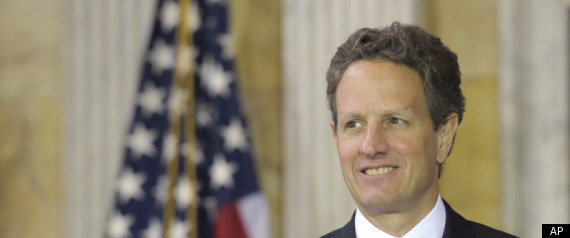 U. S. Treasury Secretary Timothy Geithner
Confidence Men: Wall Street, Washington, and the Education of a President
by Ron Suskind
Harper 2011
All,
As the late David Halberstam so adroitly pointed out in his outstanding 1972 book on the deadly myopia, flaws, and failures of the Kennedy and Johnson administrations "The Best and the Brightest" far too often have an arrogant, distorted and highly exaggerated view of their intellectual and moral authority with tragic and destructive consequences for the rest of us. Hubris anyone? The brilliant political journalist Ron Suskind sustains and extends Halberstam's very prescient and prophetic legacy. Meanwhile Reality Bites (us)...again...
Kofi
From Ron Suskind's New Book 'Confidence Men': Tim Geithner Ignored Obama Order On Banks
by ANTHONY McCARTNEY
09/15/11
Huffington Post
NEW YORK — A new book offering an insider's account of the White House's response to the financial crisis says that U.S. Treasury Secretary Tim Geithner ignored an order from President Barack Obama calling for reconstruction of major banks.
According to Pulitzer Prize-winning author Ron Suskind, the incident is just one of several in which Obama struggled with a divided group of advisers, some of whom he didn't initially consider for their high-profile roles.
Suskind interviewed more than 200 people, including Obama, Geithner and other top officials for "Confidence Men: Wall Street, Washington, and The Education of A President," which will be released Sept. 20. The Associated Press purchased a copy on Thursday.
The book states Geithner and the Treasury Department ignored a March 2009 order to consider dissolving banking giant Citigroup while continuing stress tests on banks, which were burdened with toxic mortgage assets.
In the book, Obama does not deny Suskind's account, but does not reveal what he told Geithner when he found out. "Agitated may be too strong a word," Suskind quotes Obama as saying. Obama says later in the book that he was trying to be decisive but "the speed with which the bureaucracy could exercise my decision was slower than I wanted."
Geithner says in the book that he did not recall that Obama was mad at him about the Citigroup decision and rejected allegations contained in White House documents that his department had been slow to enact the president's plans.
"I don't slow walk the president on anything," Geithner told Suskind.
"The Citbank incident, and others like it, reflected a more pernicious and personal dilemma emerging from inside the administration: that the young president's authority was being systematically undermined or hedged by his seasoned advisers," Suskind writes.
Suskind states that Obama accepts the blame for mismanagement in his administration while noting that restructuring the financial system was complicated and could have resulted in deeper financial harm. One of the major complaints about Obama's administration is that it was too easy on major financial institutions, including Citi. The president had wanted Treasury officials to focus on a proposal to dissolve the bank, but no plan was ever created, the book states.
In a February 2011 interview with Suskind, Obama acknowledges another ongoing criticism – that he is too focused on policy and not on telling a larger story, one the public could relate to. Obama is quoted as saying he was elected in part because "he had connected our current predicaments with the broader arc of American history," but that such a "narrative thread" had been lost. Obama observes that he and fellow Democrats Bill Clinton and Jimmy Carter "all have sort of the disease of being policy wonks."
Suskind's book supports other accounts of disagreement among advisers over how large a stimulus was necessary to revive the economy and how aggressively to deal with financial institutions that had become "too big to fail."
Larry Summers, the former White House economic adviser, is quoted as lamenting that he and others felt "home alone" and that mistakes made under Obama would not have happened under President Clinton, for whom Summers also served. Interviewed by Suskind, Summers initially denied making such comments, then acknowledged them, saying he was frustrated at having "five issues" of major importance to deal with at once and not "five times as many" officials to handle them.
The book says one of Obama's top advisers, former chief of staff Rahm Emanuel, was not the president's first choice for the position. According to Suskind, Emanuel's name was not even on the initial short list, which included White House aide Pete Rouse.
An investigative reporter, Suskind won a Pulitzer Prize in 1995 while working for the Wall Street Journal.
His other books include "The Way of the World" (2008), which focused on national security, and "The Price of Loyalty" (2004). That best-seller was an account of the Bush administration and its first treasury secretary, Paul O'Neill, that includes what became a widely cited remark by then-Vice President Dick Cheney: "Reagan proved that deficits don't matter."
Suskind's 1998 book, "A Hope Unseen," grew out of the series of articles that won him a Pulitzer for feature writing.
Other recent books about the Obama administration include Bob Woodward's "Obama's Wars," which focused on foreign policy, and Jonathan Alter's "The Promise," which covered his first year in office.
Interesting comment by a reader of the book from Amazon.com book review section
5.0 out of 5 stars
Objective Look at Presidential Leadership, September 20, 2011
By Loyd E. Eskildson "Pragmatist" (Phoenix, AZ.) - See all my reviews
(TOP 50 REVIEWER)
This review is from: Confidence Men: Wall Street, Washington, and the Education of a President (Hardcover)
Suskind's "Confidence Men" is based on 746 hours of interviews with over 200 people, including former and current members of the Obama administration - including the president. It's negative observations will not make the president's life any easier - already dealing with an emboldened, growing opposition, a floundering economy, the appearance of having been outmaneuvered during the debt-ceiling debacle, the Solyndra mess, another Palestine-Israel mess, and even prominent strategists already saying he should 'fire much of his staff.' It begins with candidate Obama's crash course in economics and ends in early 2011, and does not include the efforts to kill Osama bin Laden, the more recent debt ceiling fight, nor his most recent efforts to create jobs.
The most attention-getting material involves comments from Obama's economic team. For example, Lawrence Summers is quoted as saying to Budget Director Peter Orzag at a dinner that 'There's no adult in charge. Clinton would never have made these mistakes.' Former Federal Reserve chairman Paul Volcker, in turn, describes the president as too reliant on Summers, smart, but not smart enough. Senior White House aide Pete Rouse wrote 'There is deep dissatisfaction within the economic team with what is perceived as Larry's imperious and heavy-handed direction of the economic policy process.' Suskind also tells us Geithner was working behind the scenes to neutralize Elizabeth Warren and prevent her being named to leadd the new Consumer Financial Protection Bureau - per bankers' demands. And then there's Christina Romer, former chair of the Council of Economic Advisers, stating that she 'felt like a piece of meat' after being kept out of a meeting by Summers; further, she once threatened to walk out of a dinner with the president and outside economists after the president skipped over her when asking his guests for their recommendations.
Additional concerns over sexism surface in the book. "This place would be in court for a hostile workplace," former White House communications director Anita Dunn is quoted as saying. "Because it actually fit all of the classic legal requirements for a genuinely hostile workplace to women." Another - "The president has a real woman problem." Some have complained to Obama about being ignored.
Per Suskind, President Obama decided in March, 2009 to create a plan to restructure many of the large, troubled banks, starting with Citigroup - only to learn a month later that Geithner/Treasury had ignored his directive. (Perhaps motivated by Geithner loyalty to former boss and Treasury Secretary Rubin (during the Clinton administration), then a Citigroup senior adviser and board member?) Insubordination, or protecting the president from himself? In any case, Obama excused it, when asked, as due to 'this is really hard stuff.' Unfortunately, Suskind does not report what Obama told Geithner when he found out.
Suskind sees Obama as a passive CEO sketching out guiding principles and allowing others to fill in the details. This ended up delegating the creation of ObamaCare to Congress, and fiscal reform to Geithner - losing control and momentum in both instances. Another Obama characteristic was seeking consensus among advisers, instead of considering whether one side or the other was just plain wrong.
Author Suskind also wonders why Obama turned away from his campaign advisers (eg. Nobel-winning Joseph Stiglitz, former Labor Secretary Robert Reich) and instead chose men associated with the disastrous prior deregulatory policies (Geithner, Summers). (Stiglitz called the enormously unpopular bank bailouts a win for banks and investors, and a loss for taxpayers. He also asserted that too much of the too-small stimulus went to tax cuts, that GDP is an inadequate measure of an economy.) Geithner is even described by one major bank CEO as 'our man in Washington,' undoubtedly at least partly due to Geithner having been selected by major bank CEOs to lead the Federal Reserve Bank of New York. Geithner also had underpaid his taxes by $34,000 in recent years, via erroneous deducations. Reportedly former chief of staff Rahm Emanuel was not Obama's first choice for the position, or even on the initial short list.
As for health care reform, Suskind contends that the debates and delays involved (partly due to Obama's delegating its initial formation to Congress) wasted his 'honeymoon' leverage to obtain concessions from both health care providers and bankers. Orzag was aware of the highly credible practice-pattern variation data compiled by Drs. Wennberg and Weinstein, how American medicine had become supply- and investor-driven, and was aching to incorporate major potential savings from these findings. It was not done, however, and the result was minimal impact on driving down the costs of health care, limiting financial-sector salaries, or preventing future financial meltdowns.
Bottom-Line: The White House is now trying to minimize the effect of Suskind's book - many of those quoted are recanting or challenging materials in the book. At least some, however, have been documented to the Washington Post via tape recordings. Suskind's reporting of a largely dysfunctional White House is not likely to be easily dismissed - major symptoms have long been evident, some reported by previous authors. Clearly there are major problems with his leadership style - probably because he's never been a leader before. And it is clear that our economic crisis is not an ordinary cyclical one that will go away with the passage of time - something has to be done about the millions of jobs lost to Asia via offshoring, and to illegal workers within the U.S.
On the other hand, President Obama must also be given credit for earlier strong leadership vs. the Pentagon during his initial review of Afghanistan options - including have the fortitude to confront that organization over leaks and eventually firing Gen. McChrystal. More obvious, his willingness to proceed with the risky attack on bin Laden within Pakistan. And as Massimo Calabresi points out, his economic team infighting pales in comparison to that between Colin Powell and Donald Rumsfeld in the Bush II administration.
The 'really good news' is that it is still not too late for Obama to start addressing underlying flaws in the free market system, and begin by replacing Geithner and others in his economic team with eg. Joseph Stiglitz (former World Bank Chief Economist) and Justin Lin (current World Bank Chief Economist). (Yes, I know Lin is Chinese - I'm suggesting him as just one member; regardless, China's economy has been the world's strongest source of growth for nearly three decades. Even more important, Chinese economists recognize both the harm 'Free Trade' has inflicted on American workers, and the fact that protectionism is sometimes essential.)