skip to main |
skip to sidebar
 Win McNamee/Getty ImagesJustice John Paul Stevens at the White House in August 2009
http://www.nytimes.com/2010/04/10/us/politics/10stevens.html?nl=us&emc=politicsemailema1
All,
The retirement of Supreme Court Justice John Paul Stevens--by far the most consistently progressive and socially responsible figure in the Court over the past 30 years and the acknowledged leader of the minority liberal wing in the Court--is a major political loss for real progressivism on the Court and thus represents a serious challenge and absolute imperative for Obama to aggressively replace him with a genuine liberal/progressive nominee...
Most importantly Obama must be willing to go all the way and FIGHT HARD for him/her when the notorious Republican right inevitably tries to eliminate and destroy the nominee--a process which will of course begin immediately...
If the President doesn't have the vision and guts to do so we will all live to regret it bigtime...
Kofi
Retirement of Justice Stevens Is Political Test for Obama
By Sheryl Gay Stolberg and Charlie Savage
New York Times
WASHINGTON — The announcement by Justice John Paul Stevens on Friday that he would retire at the end of this term gives President Obama the rare opportunity to make back-to-back appointments to the Supreme Court during the first two years of his presidency.
But it also presents Mr. Obama with a complex political challenge: getting a nominee confirmed in the thick of a midterm election season, when Republicans, fueled by the intensity of their conservative base, are angling to knock him down, and Democrats, despite having lost their 60-vote supermajority in the Senate, are eager to flex their muscles after passing a landmark health care bill.
Justice Stevens’s announcement, delivered to the White House on Friday morning in a one-paragraph letter that began “My dear Mr. President,” set off an immediate scramble among the parties and a raft of advocacy groups that have been assembling dossiers on potential successors.
The three leading candidates — Mr. Obama is considering about 10 names all told, the White House says — present the president with a spectrum of ideological reputations, government backgrounds and life experiences. His choice will shape the battle to win Senate confirmation of his nominee.
In effect, the president must choose to be bold or play it safe.
Merrick B. Garland, 58, an appeals court judge here, is well liked by elite legal advocates and is widely considered the safest choice if Mr. Obama wants to avoid a confrontation with the minority party. A former federal prosecutor who worked on the Oklahoma City bombings, he is well-known in Washington’s legal-political community, where some view him as a kind of Democratic version of Chief Justice John G. Roberts Jr.
Elena Kagan, 49, is solicitor general but has never been a judge and does not have a lengthy trail of scholarly writings, so her views are less well documented. But as the dean of Harvard Law School, she earned respect across ideological lines by bringing in several high-profile conservative professors, and she is a favorite among some in the extended Obama circle, who see her as smart and capable. Her relative youth means she could shape the court for decades to come.
Diane P. Wood, 59, a federal appeals court judge in Mr. Obama’s home city, Chicago, is seen as the most liberal of the three. She has been a progressive voice on a court that is home to several heavyweight conservative intellectuals. As a divorced mother of three, she brings the kind of real-life experience that Mr. Obama considers important. But her strong support for abortion rights would provoke a confrontation with conservatives. On Friday, the anti-abortion group Americans United for Life warned that a Wood nomination “would return the abortion wars to the Supreme Court.”
In making his selection, Mr. Obama confronts a vastly altered political landscape from the one he faced just 11 months ago, when he nominated Sonia Sotomayor to fill the seat left vacant by the retirement of Justice David H. Souter.
With the election of Senator Scott Brown, Republican of Massachusetts, Democrats can no longer hold off a Republican filibuster. And while Democrats are emboldened by the health care vote, the passage of the legislation — which is already facing legal challenges from Republicans who say it is unconstitutional — has left the Senate more polarized than ever and created a climate in which the courts could easily become an election issue.
For the court, Justice Stevens’s departure will be the end of an era. He is the longest-serving justice by more than a decade, and he is the last remaining justice to have served in World War II. (He joined the Navy, where he served as a cryptographer, the day before Pearl Harbor was attacked.) His leaving will not, however, change the composition of the court; although he was appointed in 1975 by President Gerald R. Ford, a Republican, he has become one of its most reliably liberal members during his nearly 35-year tenure, as the court drifted ever rightward.
Still, for Mr. Obama, who taught constitutional law at the University of Chicago (where he was a colleague of Judge Wood), the vacancy is an unmistakable chance to put his stamp on the direction the court takes for the next several decades. Mr. Obama is already engaged in an unusual public confrontation with the court over its recent decision in the Citizens United case, which lifted strict limits on corporate spending in elections. On Friday, during a brief appearance in the Rose Garden, he made clear that the case was very much on his mind.
He vowed to “move quickly” in announcing a nominee. Senior advisers said they expected a decision within the next several weeks. The president said he would look for a candidate who possessed what he described as qualities similar to that of Justice Stevens: “an independent mind, a record of excellence and integrity, a fierce dedication to the rule of law and a keen understanding of how the law affects the daily lives of the American people.”
And, in what legal scholars took as a clear swipe at the Citizens United decision (for which Justice Stevens wrote the dissent), the president said he would look for a justice who “knows that in a democracy, powerful interests must not be allowed to drown out the voices of ordinary citizens.”
The White House already has a Supreme Court nomination team in place, with the selection process run by the new White House counsel, Robert F. Bauer, and overseen by Rahm Emanuel, the chief of staff. Once a nominee is picked, Mr. Bauer’s wife, Anita Dunn, who is Mr. Obama’s former communications director, will coordinate with advocacy groups. Vice President Joseph R. Biden Jr., who was chairman of the Senate Judiciary Committee during some of its most contentious confirmation fights, is also likely to play a crucial role.
On Capitol Hill, Senator Patrick J. Leahy, the Vermont Democrat and the current chairman of the Judiciary Committee, said in an interview that Justice Stevens told him privately several weeks ago of his intentions. Mr. Leahy said he had had “long conversations” with the president and wanted a vote before the August recess so that a new justice could be installed by the start of the fall term.
“When I was the most junior Democrat in the Senate, I voted for John Paul Stevens,” Mr. Leahy said. “He was a Republican nominated by a Republican president who was going to be up for election, and we voted for him, and proudly.”
That kind of bipartisanship is highly unlikely this time. While both sides agree that Republicans are unlikely to use a filibuster to block a Supreme Court nominee, conservatives will at the very least use the debate to make the case for Republican candidates. They say they will calibrate their fight to how liberal they perceive Mr. Obama’s choice to be.
“If it’s someone like Merrick Garland, I don’t think there’s going to be a big fight,” said Curt Levey of the Committee for Justice, a conservative advocacy group. But Mr. Levey said a more liberal nominee, like Judge Wood, would “be a field day for the conservative groups.”
But leaders of liberal groups, like Nan Aron of the Alliance for Justice, are suspicious of conservative assurances that a more centrist nominee would face little opposition. They note that Justice Sotomayor was perceived by many on the left as far more centrist than they would have preferred, and yet Republicans portrayed her as a “judicial activist,” and 31 voted against her.
“No matter who he sends up,” Ms. Aron said, “I think Republicans are loaded for bear and will oppose.”
Democrats were divided Friday over whether Mr. Obama would pick a fight with Republicans or shrink from one. But Walter E. Dellinger III, who was acting solicitor general under President Bill Clinton, predicted passion, as much as politics, would play a role in Mr. Obama’s decision.
“I think that in choosing a Supreme Court justice,” Mr. Dellinger said, “the president is less likely to compromise and more likely to go with his heart than on any other matter.”
Peter Baker contributed reporting.

http://rawstory.com/rs/2010/0404/scholar-justice-make-dent-wing-majority/
All,
IF Ms. Heins is correct in asserting that Obama "won't have the courage to rebuild the liberal wing of the Supreme Court" then he will deserve his self imposed fate as a spineless political coward and empty charlatan who openly sold out the nation to curry favor with a dangerously demented and oppressive national rightwing element and their superwealthy and overtly criminal corporate sponsors who are-- and will remain-- fierce political, economic, and ideological enemies of any semblance of mass democracy in the United States...In that case only we will be the losers...Stay tuned...
Kofi
Exclusive: Obama ‘won’t have the courage’ to rebuild the liberal wing of the Supreme Court
By Gavin Dahl April 4th, 2010
The Raw Story
President Barack Obama should have the courage to try to rebuild the liberal wing of the Supreme Court but he probably won't, free speech attorney Marjorie Heins told Raw Story in an exclusive interview conducted Saturday.
When Obama appoints a new Justice to replace John Paul Stevens, "that Justice wouldn't make a dent in the 5 justice right-wing majority that ruled in Citizens United," Heins said.
Heins, founder of Free Expression Policy Project, and longtime director of the ACLU arts censorship project, pointed out Anthony Kennedy's going to be the swing Justice regardless of whom Obama appoints to replace Stevens. "Obama has had a record of being very slow with judicial appointments below the Supreme Court level," said Heins. "And that's of course where most cases are decided and that's a real problem. At the Supreme Court level, he won't be slow, but he'll probably be very cautious." "In the days when we had Black and Douglas and Brennan and Marshall there really was a liberal wing on the Supreme Court," she continued. "And now what we really have is a right wing and a moderate wing, we don't really have a liberal wing anymore. Or liberalism has moved so far to the right that we can't recognize it. Obama should have the courage to try to rebuild the liberal wing, but he probably won't because he doesn't want to create any more controversy and opposition than necessary in Congress."
This weekend Justice John Paul Stevens confirmed that he plans to retire during Obama's first term as president. Sen. Arlen Specter (D-Pa) told Fox News Sunday he hopes Stevens waits a year, to avoid gridlock while Senate business is so backed up due to battles over health care legislation.
"I think we need someone who will step into Justice Stevens' shoes, who will be very tough on the issues of executive power," Specter said. "A federal court this past week declared the warrantless wiretapping unconstitutional. I think we need the kind of balance that Justice Stevens has provided to offset the majority on the court which is in favor of executive power." Justice Stevens, in his passionate Citizens United v. FEC dissent, wrote of the majority's threat to democracy, because one of the fundamentals of free speech is that all, not just the richest or most powerful, need to be heard. Vast majorities of Americans who identify as members of each of the major political parties are unhappy with the Supreme Court's decision, which fundamentally changes campaign finance laws in the United States. In a detailed article posted to the Free Expression Policy Project website immediately after the Supreme Court decision, Heins highlighted Stevens' description of the majority's argument as "aggressive judicial activism" suffering from "glittering generality."
Heins guesses he wrote the Citizens United dissent in the way he did because he wants it to be remembered. "Stevens is about to turn ninety and still plays tennis," she said, laughing. "He's incredible. One of the ironies of course is Stevens was the author of Pacifica, the case that allows the FCC to censor what it thinks is indecent on the airwaves."
Stevens is considered a first amendment champion now, but in 1978, just after he was appointed to the court, Heins says, "He didn't get it. He wrote this Pacifica decision which he ought to apologize for some day, and perhaps he even will. But certainly in Citizens United he's trying to make a very strong statement against this kind of -- beyond judicial activism -- it's very unusual what the Supreme Court did."
The key swing vote on the Supreme Court used to be Justice O'Connor, Heins points out, but now it is Kennedy. "Kennedy is usually pretty good on first amendment issues although in this case his interpretation was 'oh the first amendment doesn't allow us to make distinctions between speakers.' That's what Stevens was referring to as a 'glittering generality.' Of course government can make distinctions between speakers! Corporations are not individuals and they don't have the same rights as individuals, but Kennedy did not agree with that."
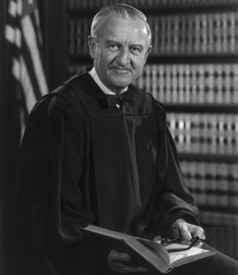
 Official portrait of Justice John Paul Stevens, taken on January 27, 1976. (Photo: Library of Congress)
http://www.truthout.org/supreme-court-justice-stevens-will-retire-june58430
Supreme Court Justice Stevens Will Retire in June
09 April 2010 by Michael Doyle and David Lightman
McClatchy Newspapers
t r u t h o u t
Washington - Supreme Court Justice John Paul Stevens announced his retirement Friday, setting up a long-anticipated confirmation battle during the most sensitive of political seasons.
Stevens, who'll turn 90 on April 20, said that after 34 years on the high court it was time to step down.
"It would be in the best interests of the court to have my successor appointed and confirmed well in advance of the commencement of the court's next term," Stevens said in a letter to President Barack Obama.
A Supreme Court representative conveyed Stevens' letter to the White House at about 10:30 a.m. Friday. White House Counsel Bob Bauer called Obama with the news, reaching the president aboard Air Force One as Obama was returning from the nuclear treaty signing in Prague.
Stevens' departure in June at the end of the 2009-10 term will remove from the court its most senior justice as well as the linchpin of what's now the liberal wing. Stevens' retirement also will ensure that the Supreme Court is front and center during the upcoming midterm congressional elections.
For conservatives and liberals alike, the pending court vacancy will become a way to mobilize the troops as well as to wage proxy fights over hot-button issues, including abortion and wartime security.
For Obama, the vacancy provides a challenge and an opportunity.
Republicans are eager to unite around an issue that will engage their conservative base. The president's Democratic Party controls 59 seats, one short of the number that's needed to stop a filibuster. In a break with tradition, some senators have signaled that they wouldn't be reluctant to filibuster a Supreme Court nominee.
Stevens' departure also provides Obama a second chance to shape the court with a relatively young justice who'll be interpreting the Constitution for the next several decades. Because of Stevens' relatively left-of-center position, the new justice may not tip the court's overall ideological balance.
"I hope that senators on both sides of the aisle will make this process a thoughtful and civil discourse," said Democratic Sen. Patrick Leahy of Vermont, the chairman of the Senate Judiciary Committee.
"Americans can expect Senate Republicans to make a sustained and vigorous case for judicial restraint and the fundamental importance of an evenhanded reading of the law," cautioned Senate Minority Leader Mitch McConnell, R-Ky.
The experience of the president's first court choice, Justice Sonia Sotomayor, may foreshadow the political conflict to come. Thirty-one Republicans opposed her, including some who'd traditionally crossed party lines to approve Democratic choices in the past.
Nine Republicans voted for Sotomayor.
Gary Jacobson, a political scientist at the University of California, San Diego, put it this way: "Given the track record of the Senate Republicans, anybody Obama supports is going to be attacked. They're geared up for battle. The question is can Republicans oppose the nominee without embarrassing themselves too much."
Having named Sotomayor as the first Hispanic justice on the Supreme Court, Obama now could make more history.
The nine-member court has never had more than two women serving at a time. Obama can change that if he reinforces Sotomayor and the 77-year-old Justice Ruth Bader Ginsburg with a female nominee. Several possibilities exist.
A very serious contender is Solicitor General Elena Kagan, the first woman to hold that prestigious post as well as the first female dean of Harvard Law School. An appellate judge who was considered seriously last year, Diane Wood of the Chicago-based 7th U.S. Circuit Court of Appeals, knows Obama from their teaching at the University of Chicago Law School.
The president might name a second Hispanic justice, Judge Kim Wardlaw of the 9th U.S. Circuit Court of Appeals.
Michigan Gov. Jennifer Granholm comes from the non-appellate world, which Obama has said he'd like to make use of.
Alternatively, the president might try to name the first Asian-American to the court. Although only seven Asian-Americans are serving on the federal bench, the president could search elsewhere; for instance, by tapping his top State Department lawyer, former Yale Law School Dean Harold Koh.
Regardless of whom the president nominates, a fight is all but guaranteed. Currently, only six of Obama's 15 appellate court nominees have been confirmed.
The last unanimously approved Supreme Court justice was Anthony Kennedy, 22 years ago. The deeply conservative top Republican on the Senate Judiciary Committee, Sen. Jeff Sessions of Alabama, was himself rejected by Democrats when he was nominated to the federal bench, and midterm election years generally only harden positions.
Stevens' retirement announcement wasn't unexpected. He'd hired only one law clerk for next year, instead of the customary four. He would've had to serve roughly another year to become either the oldest or the longest-serving Supreme Court justice.
The longest-serving justice will remain William O. Douglas, whose seat Stevens took after President Gerald Ford nominated him in 1975.
At the time, Stevens was serving on the 7th U.S. Circuit Court of Appeals. A Northwestern University Law School graduate and Navy veteran of World War II, he was deemed a conventionally moderate Midwestern Republican at the time.
Stevens "has earned the gratitude and admiration of the American people for his nearly 40 years of distinguished service to the judiciary, including more than 34 years on the Supreme Court," Chief Justice John Roberts Jr. said Friday. "He has enriched the lives of everyone at the court through his intellect, independence and warm grace."
McClatchy White House Correspondent Margaret Talev also contributed to this report.
(Image: Lance Page / t r u t h o u t; Adapted: Khaz, Hayley Austin)
http://www.truthout.org/a-supreme-court-shift-right58439
All,
We had all better hope this is not the case! If so it will be an unmitigated DISASTER for us all...
Kofi
A Supreme Court Shift to the Right?
09 April 2010
by Ruth Marcus
Op-Ed
t r u t h o u t
Washington - Here is an unsettling thought for those who waited eight years to have a Democratic president appointing judges: Barack Obama could well end his first term with a more conservative Supreme Court than the one he inherited.
This is, I hasten to admit, premature speculation -- even with the not-so-surprise announcement that Justice John Paul Stevens, the anchor of the court's liberal wing, is retiring.
First, the president's only nominee so far, Justice Sonia Sotomayor, has not even finished her first term. Where she turns out to be on the ideological spectrum in comparison to the justice she replaced, David Souter, is unknown.
Second, the accuracy of this conjecture will depend hugely on who the president selects to fill the vacancy.
Finally, as the examples of Souter (named by President George H.W. Bush) and Stevens (selected by President Gerald Ford) demonstrate, predictions about a new justice's future performance can make weather forecasting look like an exact science.
Nonetheless, it's entirely possible that a more conservative court could be Obama's paradoxical legacy -- particularly if he only serves a single term. The likelihood of the court shifting to the right is greater than that of its moving leftward.
In part, this could have been predicted even before Obama took office. It reflects less about him than it does the identity of the departing justices, one liberal followed by another. The next oldest justice is Ruth Bader Ginsburg, 77. Conservatives are reaping the benefits of Bush father and son having selected justices who were relatively young. Justice Clarence Thomas was 43 when tapped, Chief Justice John Roberts was 50, and Justice Samuel Alito was 55.
It would likely only be in the case of a departure by 74-year-old Justice Antonin Scalia -- not likely to occur voluntarily during Obama's presidency -- or Justice Anthony Kennedy, 73, that the president would have an opportunity to dramatically alter the court's ideological makeup.
But there's little in Obama's record as president to suggest that he would expend enormous capital to secure the most liberal possible justice. From the point of view of liberal groups, Obama's nominees to the lower federal courts have been, overall, disappointingly moderate.
In selecting Sotomayor, Obama acted with an eye less to ideology than to ethnicity; the selection does not offer much of a clue into what the president is looking for, as a matter of constitutional interpretation, in future justices. The conservative howling about Sotomayor's alleged radicalism had as little basis in reality as do the parallel assertions about Obama.
As Tom Goldstein of ScotusBlog put it after analyzing Sotomayor's appellate record, "Our surveys of her opinions put her in essentially the same ideological position as Justice Souter." From her conduct on the bench so far, there's no reason to change that assessment.
By contrast, it's likely, although not certain, that a Stevens replacement will be more conservative than the retiring justice. If so, this would be largely in line with history. In an interview with Jeffrey Rosen for The New York Times Magazine in 2007, Stevens noted, "including myself, every judge who's been appointed to the court since Lewis Powell (chosen by Richard Nixon in 1971) has been more conservative than his or her predecessor." Stevens excepted Ginsburg, who replaced the more conservative Byron White.
In any event, Stevens' replacement is almost certain not to be as influential a player on the left as the departing justice. As the court's senior associate justice, Stevens spoke immediately after the chief justice during the court's discussion of cases; he had the power to assign opinions and some influence with swing justices such as Kennedy and, before her departure, Sandra Day O'Connor.
I'm not arguing, by the way, that Obama would go wrong by picking a Stevens successor likely to edge the court to the right. Indeed, there is a plausible argument that a justice viewed as more centrist might have more chance of bringing along conservative colleagues on a particular issue. Two of those mentioned as possible replacements, Judge Merrick Garland of the federal appeals court in the District of Columbia, and Solicitor General Elena Kagan, are viewed as more moderate than Stevens. Either would be a superb choice.
But my prediction stands: The court that convenes on the first Monday in October is apt to be more conservative than the one we have now.
Ruth Marcus' e-mail address is marcusr@washpost.com.
(c) 2010, Washington Post Writers Group
All republished content that appears on Truthout has been obtained by permission or license.
http://www.nytimes.com/2010/01/26/us/26bar.html?nl=us&emc=politicsemailemb1
All,
Justice John Paul Stevens--age 89-- is the last of the truly great progressives on the Supreme Court. It's a great tragedy that individuals of integrity, wisdom, courage, moral clarity, compassion, and intellectual depth like Justice Stevens are becoming as rare as liberals who actually stand for something and are willing to fight for principle no matter who or what the opposition is. It's an indictment of this society and especially our backward, infantile, oppressive, and utterly corrupt political and legal systems that a man of Stevens's stature, independence, and strength of character is becoming so rare generally in our civic and public life. If only President Obama and the Democratic Party had Justice Stevens's courage and unwavering committment to real social change no matter what we would all be much further ahead on major questions of justice, equality, and freedom before the law than we are now...
Kofi
SIDEBAR
After 34 Years, a Plainspoken Justice Gets Louder
By ADAM LIPTAK
Published: January 25, 2010
WASHINGTON
New York Times
The Supreme Court announced its big campaign finance decision at 10 in the morning last Thursday. By 10:30 a.m., after Justice Anthony M. Kennedy had offered a brisk summary of the majority opinion and Justice John Paul Stevens labored through a 20-minute rebuttal, a sort of twilight had settled over the courtroom.
It seemed the Stevens era was ending.
Justice Stevens, who will turn 90 in April, joined the court in 1975 and is the longest-serving current justice by more than a decade. He has given signals that he intends to retire at the end of this term, and his dissent on Thursday was shot through with disappointment, frustration and uncharacteristic sarcasm.
He seemed weary, and more than once he stumbled over and mispronounced ordinary words in the lawyer’s lexicon — corruption, corporation, allegation. Sometimes he would take a second or third run at the word, sometimes not.
But there was no mistaking his basic message. “The rule announced today — that Congress must treat corporations exactly like human speakers in the political realm — represents a radical change in the law,” he said from the bench. “The court’s decision is at war with the views of generations of Americans.”
That was the plainspoken style of the last years of Justice Stevens’s tenure. In cases involving prisoners held without charge at Guantánamo Bay and the mentally retarded on death row, his version of American justice was propelled by common sense and moral clarity, and it commanded a majority. He was on the short end of the 2008 decision finding that the Second Amendment protected an individual right to bear arms, and he had mixed success in fighting what he saw as illegitimate justifications for discrimination against African-Americans, women and homosexuals.
Justice Stevens is the leader of the court’s liberal wing, and its three other members — Justices Ruth Bader Ginsburg, Stephen G. Breyer and Sonia Sotomayor — all joined his 90-page dissent. They must have been tempted to write separately as well, as the case was bristling with issues of particular interest to all of them. Instead, they allowed the spotlight to shine solely on Justice Stevens.
There was no such solidarity among the conservatives. Though Chief Justice John G. Roberts Jr. and Justices Antonin Scalia, Clarence Thomas and Samuel A. Alito Jr. all joined Justice Anthony M. Kennedy’s majority opinion on its main point, three of them added separate concurrences.
In his dissent, Justice Stevens said no principle required overruling two major campaign finance precedents. “The only relevant thing that has changed since” those two decisions, he wrote, “is the composition of this court.”
In Justice Stevens’s early years on the court, his views often seemed idiosyncratic, and he would often write separate opinions joined by no other justice. Over the years, though, he has emerged as a master tactician, and he came to use his seniority to great advantage. The senior justice in the majority has the power to assign the majority opinion, and Justice Stevens used that power with patience and skill.
This term, though, Justice Stevens has been more of a loner. Thursday’s decision, Citizens United v. Federal Election Commission, was only the 10th signed decision of the term. In the previous nine, Justice Stevens wrote separately and only for himself three times. On a fourth occasion, he was joined only by Justice Kennedy.
A theme ran through these recent opinions: that the Supreme Court had lost touch with fundamental notions of fair play. In two of the cases, Justice Stevens lashed out at the court’s failure to condemn what he called shoddy work by defense lawyers in death penalty cases.
On Wednesday, in Wood v. Allen, Justice Stevens dissented from a majority decision that said that a lawyer fresh out of law school had made a reasonable strategic choice in not pursuing evidence that his client was mentally retarded.
“A decision cannot be fairly characterized as ‘strategic’ unless it is a conscious choice between two legitimate and rational alternatives,” Justice Stevens wrote. “It must be borne of deliberation and not happenstance, inattention, or neglect.”
He made a similar point this month in a second capital case, Smith v. Spisak.
“It is difficult to convey how thoroughly egregious counsel’s closing argument was,” Justice Stevens wrote of a defense lawyer’s work. “Suffice it to say that the argument shares far more in common with a prosecutor’s closing than with a criminal defense attorney’s. Indeed, the argument was so outrageous that it would have rightly subjected a prosecutor to charges of misconduct.”
In the second case, Justice Stevens did vote to uphold the death sentence, saying that even a closing argument worthy of Clarence Darrow would not have spared the defendant.
That carefully calibrated distinction was of a piece with the view he announced in 2008 in Baze v. Rees, when he said he had come to the conclusion that the death penalty violates the Eighth Amendment. But he went on to say that his conclusion did not justify “a refusal to respect precedents that remain a part of our law.”
Thursday’s decision in the Citizens United case was more full-throated.
“The majority blazes through our precedents,” he wrote, “overruling or disavowing a body of case law” that included seven decisions.
Justice Stevens, who served in the Navy during World War II, reached back to those days to show the depth of his outrage at the majority’s conclusion that the government may not make legal distinctions based on whether a corporation or a person was doing the speaking.
“Such an assumption,” he wrote, “would have accorded the propaganda broadcasts to our troops by ‘Tokyo Rose’ during World War II the same protection as speech by Allied commanders.”
The reference to Tokyo Rose was probably lost on many of Justice Steven’s readers. But the concluding sentence of what may be his last major dissent could not have been clearer.
“While American democracy is imperfect,” he wrote, “few outside the majority of this court would have thought its flaws included a dearth of corporate money in politics.”
 Win McNamee/Getty Images