Showing posts with label State Department. Show all posts

Thursday, January 4, 2024

Biden Administration Bypasses Congressional Approval To Sell More Arms and Military Equipment to Israel in its War On Gaza

 
Biden Again Bypasses Congress to Sell More Arms to Israel

“Do they think not enough Palestinian children are being orphaned or killed in Gaza?” asked one journalist.
December 30, 2023 
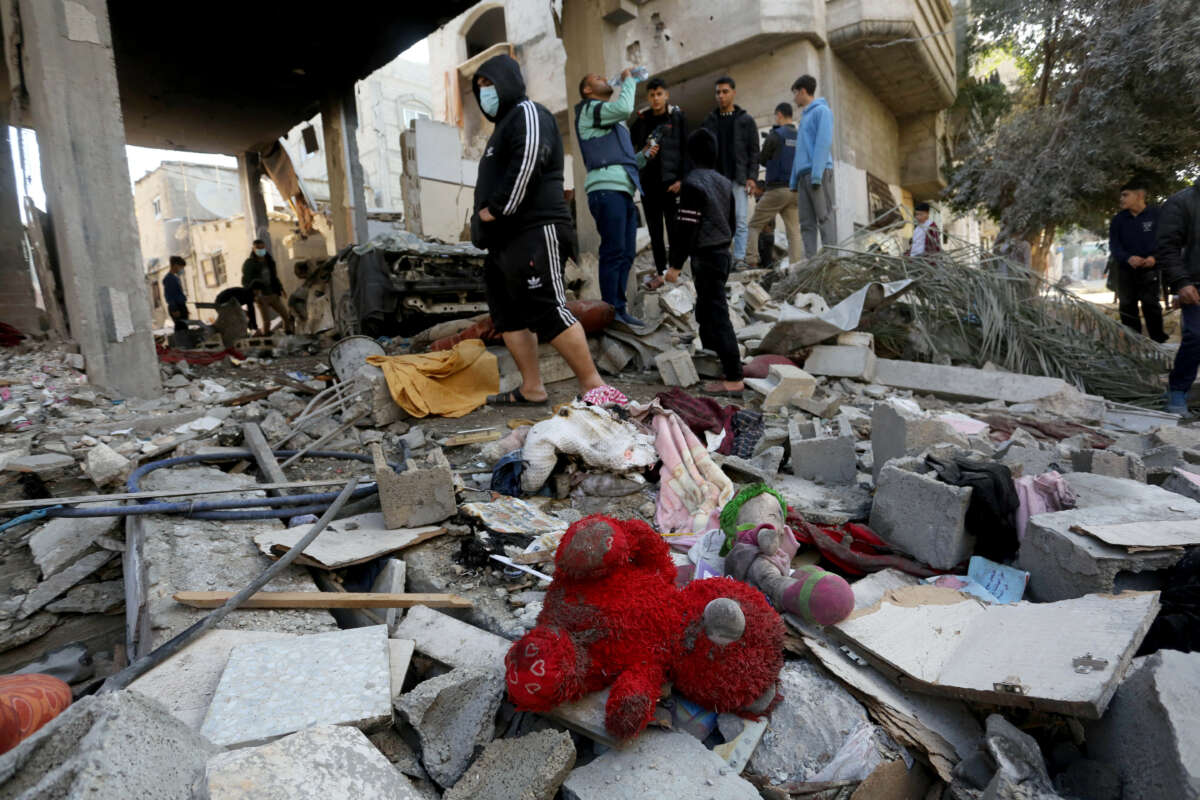
A teddy bear is seen among the rubble of an almost completely collapsed building after an Israeli attack on Nuseirat refugee camp in Deir al-Balah, Gaza, on December 30, 2023.Ashraf Amra / Anadolu via Getty Images

Citing “the urgency of Israel’s defensive needs,” the Biden administration on Friday said it would bypass Congress for the second time this month to approve an immediate arms sale to the key Middle East ally as it continues to wage a genocidal war against Gaza.

The Associated Press reported that U.S. Secretary of State Antony Blinken notified lawmakers of the new emergency determination involving the sale of $147.5 million in equipment including fuses, charges, and primers for 155mm artillery shells that Israel has already purchased from the United States.

The unguided explosive rounds — which Israel is using in heavily populated urban areas — have a “kill radius” of about 50 meters, with shrapnel able to inflict lethal wounds on people hundreds of meters away.

“The United States is committed to the security of Israel, and it is vital to U.S. national interests to ensure Israel is able to defend itself against the threats it faces,” the State Department explained.

The move follows a similar State Department determination on December 9, which expedited 13,000 rounds of tank ammunition to the Israel Defense Forces (IDF), whose troops have killed and maimed more than 80,000 Palestinians — mostly women, children, and elders — during 84 days of near-relentless attacks on Gaza.

Some of the deadliest Israeli attacks of the war have been carried out with U.S. weapons, including an October 31 airstrike with 2,000-pound bombs on the densely populated Jabalia refugee camp. More than 120 civilians were killed.

The State Department also said that “we continue to strongly emphasize to the government of Israel that they must not only comply with international humanitarian law, but also take every feasible step to prevent harm to civilians.”

Critics pushed back against that language, with Ibrahim Zabad, a professor of international relations at St. Bonaventure University in upstate New York, asserting on social media that the State Department’s move to bypass Congress “shows the U.S. administration wholeheartedly supports the mass slaughter of Palestinians, their ethnic cleansing, and the demolition of Gaza.”

British journalist Andy Worthington, known for his work chronicling the cases of Guantánamo Bay detainees, asked: “Do they think not enough Palestinian children are being orphaned or killed in Gaza?”

Eli Clifton, a senior researcher at the Quincy Institute for Responsible Statecraft, noted Blinken’s lamentation Thursday that 2023 “has been an extraordinarily dangerous year for press around the world.” Blinken’s statement did not mention the scores of journalists killed — sometimes allegedly on purpose — by Israeli troops during the war.

The U.S. already gives Israel almost $4 billion in nearly unconditional military aid each year. Since the October 7 Hamas-led attacks and Israel’s retaliatory onslaught, U.S. President Joe Biden has repeatedly affirmed his “unwavering” support for Israel. His administration has blocked multiple global cease-fire efforts at the United Nations while seeking an additional $14.3 billion in armed assistance for Israel.

The United States has given Israel more than $150 billion in inflation-adjusted aid since the nation was founded in 1948 following a yearslong campaign of terrorism and ethnic cleansing.

While Biden recently decried Israel’s “indiscriminate bombing” of Gaza, he has refused to acknowledge what many international experts have called Israel’s genocide against the people of the besieged strip. Some activists have dubbed him “Genocide Joe.”

On Friday, South Africa filed a genocide case against Israel at the International Court of Justice.

Hundreds of rights groups and a handful of progressives in the U.S. Congress have implored the Biden administration to suspend military aid to Israel, while others including Democratic lawmakers have called for conditions to be placed on such assistance.

Earlier this month, Sen. Elizabeth Warren (D-Mass.) led a letter urging Biden to boost oversight of how American arms are used against Palestinian civilians. The letter specifically mentions 155mm artillery shells.

“The IDF has previously used these shells to hit populated areas including neighborhoods, hospitals, schools, shelters, and safe zones, causing a staggering number of civilian deaths,” the senators noted.

According to a Quinnipiac University poll published on December 20, less than half of registered U.S. voters support sending military aid to Israel — an approximately 10-point decrease from the previous month.


ABOUT THE AUTHOR:


Brett Wilkins is a staff writer for Common Dreams.

Wednesday, December 5, 2012

U.S. Foreign Policy, Constitutional Law, Drone Strikes, and the American Empire in the 21st Century


http://www.thenation.com/article/171578/barack-obama-story-updated?rel=emailNation#

All,

This is what it really means to be the "Commander-in-Chief" of a deadly global empire.  In that larger political and ideological context President Obama is just the latest American managerial installment in the venal ongoing series of its historical imperialist "guardians".  But before we as the general U.S. citizenry get too morally indignant about it all one way or the other we should strongly consider and seriously ponder exactly how and why WE continue to give these political/military guardians our complicit and implicit approval, consent, and support (either consciously or via the oblivious default of conscience and social responsibility induced by our collectively agreed upon false innocence)....

Kofi


The Barack Obama Story (Updated)
by Tom Engelhardt
December 4, 2012 
The Nation


(Official White House Photo by Lawrence Jackson)


This article originally appeared at TomDispatch.com. To stay on top of important articles like these, sign up to receive the latest updates from TomDispatch.com.

President Barack Obama
The White House
1600 Pennsylvania Avenue, NW
Washington, DC 20500

Dear President Obama,


Nothing you don’t know, but let me just say it:  the world’s a weird place. In my younger years, I might have said “crazy,” but that was back when I thought being crazy was a cool thing and only regretted I wasn’t.  I mean, do you ever think about how you ended up where you are? And I’m not actually talking about the Oval Office, though that’s undoubtedly a weird enough story in its own right.

After all, you were a community organizer and a constitutional law professor and now, if you stop to think about it, here’s where you’ve ended up: you’re using robots to assassinate people you personally pick as targets. You’ve overseen and escalated off-the-books robot air wars in Pakistan, Somalia and Yemen, and are evidently considering expanding them to Mali and maybe even Libya. You’ve employed what will someday be defined as a weapon of mass destruction, launching history’s first genuine cyberwar against a country that isn’t threatening to attack us. You’ve agreed to the surveillance of more Americans every which way from Sunday than have ever been listened in on or (given e-mailing, texting and tweeting) read. You came into office proclaiming a “sunshine” policy and yet your administration has classified more documents (92,064,862 in 2011) than any other in our history. Despite signing a Whistleblower Enhancement Protection Act, you’ve used the Espionage Act on more government whistleblowers and leakers than all previous administrations combined, and yet your officials continue to leak secret material they see as advantageous to the White House without fear of prosecution. Though you deep-sixed the Bush administration name for it—“the Global War on Terror” (ridding the world of GWOT, one of the worst acronyms ever)—you’ve accepted the idea that we are “at war” with terror and on a “global battlefield” which (see above) you’re actually expanding. You’re still keeping uncharged, untried prisoners of not-quite-war in an offshore military prison camp of injustice that, on the day you came into office, you promised to close within a year. You’re overseeing planning that, according to recent reports, will continue the Afghan War in some form until at least 2017 or possibly well beyond. You preside over an administration that has encouraged the further militarization of the CIA (to which you appointed as director not a civilian but a four-star general you assumedly wanted to tuck safely away during campaign season). You’ve overseen the further militarization of the State Department; you’ve encouraged a major expansion of the special operations forces and its secret presidential army, the Joint Special Operations Command, cocooned inside the US military/ You’ve overseen the further post-9/11 expansion of an already staggering national security budget and the further growth of our labyrinthine “Intelligence Community”—and though who remembers anymore, you even won what must have been the first prospective Nobel Prize for Peace more or less before you did a damn thing, and then thanked the Nobel Committee with a full-throated defense of the right of the United States to do what it pleased, militarily, on the planet! And if that isn’t a weird legacy-in-formation, what is?

I mean, you have my sympathies. The Bush administration did you no favors. You inherited hell for a foreign policy and when it came to matters like Guantánamo, the Republicans in Congress hung you out to dry.

Still, who woulda thunk it? Don’t these “accomplishments” of yours sometimes amaze you? Don’t you ever wake up in the middle of the night wondering just who you are? Don’t you, like me, open your eyes some mornings in a state of amazement about just how you ended up on this particular fast-morphing planet? Are you as stunned as I am by the fact that a tanker carrying liquid natural gas is now making a trip from Norway to Japan across the winter waters of the Arctic? Twenty days at sea lopped off an otherwise endless voyage via the Mediterranean Sea, and the Indian and Pacific Oceans. Did you ever think you’d live to see the opening of the Northeast Passage in winter? Don’t you find it ironic that fossil fuels, which helped burn that oceanic hole in the Arctic ice, were the first commercial products shipped through those open waters? Don’t you find it just a tad odd that you can kill someone in distant Yemen without the slightest obstacle and yet you’ve been able to do next to nothing when it comes to global warming? I mean, isn’t that world-championship weird, believe-it-or-not bizarre, and increasingly our everyday reality?

Aren’t you amazed that your Pentagon has recently issued a directive meant to ensure that armed robots will never kill human beings on their own? Not so long ago, that was the stuff of sci-fi; now, it’s the subject of a bureaucratic document. Tell that to Skynet someday, right?

Who could make this stuff up? Maybe William Gibson—maybe he already did—but not me and my guess is not you either.

Putting Yourself in a Box

I know that we humans are terrible at predicting the future. Still, if I had told you back in, say, 2003 that, in the wake of a lawless administration, we would vote a constitutional lawyer into the White House as a “peace candidate” and he’d do exactly what you’ve done so far (see, again, above), you wouldn’t have believed it, would you? And if I had told you it would be you, I’ll put my money on your laughing me out of any room (not that I’ve ever been in a room with you).

Just the other day, something leaked by two “administration officials” onto the front-page of The New York Times got me started on this letter. In a piece headlined “Election Spurred a Move to Codify US Drone Policy,” reporter Scott Shane wrote that, fearing you might lose to Mitt Romney, you were rushing to develop “a formal rule book,” including “explicit rules for the targeted killing of terrorists by unmanned drones, so that a new president would inherit clear standards and procedures.” You won the election, of course, but Shane claims you’re “still pushing”—though at a far more leisurely pace—“to make the rules formal and resolve…exactly when lethal action is justified.”

To use your term, you are putting “a legal architecture” in place for a process of White House–directed robotic assassination—you call them “targeted killings”—that will assumedly be long-lasting. These are acts that in the years before 9/11, as Shane points out, Washington used to condemn when Israel committed them and that most countries consider illegal to this day.

I understand why the idea of Mitt Romney as assassin-in-chief made you nervous and why you wanted to put him in a straitjacket of drone codification. But it’s hard not to ask—and I’m not the first to do so—what about you? It’s human nature to trust ourselves over the other guy, but has it occurred to you that some of us might have the same reaction to you at the helm of a globalizing robot war as you had to Mitt?

In any case, haven’t you already managed to do to yourself what you planned to do to him—without cutting down the killing appreciably, including the deaths of civilians, children, at least four American citizens and a Yemeni deputy provincial governor who had nothing to do with Al Qaeda? If press reports are to be believed, you’ve already been fully involved in regularizing, bureaucratizing, legalizing and codifying your drone wars. In other words, you’ve put yourself deep inside a developing system in which you no longer have a hope in hell of imagining the world any other way.

Here’s a little history of the process (not that you of all people don’t already know it): You inherited an ad hoc Bush administration program of CIA drone strikes in the Pakistani tribal borderlands that started in 2004 and was originally aimed at top Al Qaeda types. But as will happen, those “targeted killings” became ever less targeted, spreading to lower level Al Qaeda types, Taliban leaders, Taliban "foot soldiers," and finally what came to be called “signature strikes” against “patterns of behavior.” (A group of military-age males with weapons, say, in an area believed to be controlled by Islamic extremists.)

We know that President Bush took you aside at the changeover moment and urged you to continue the drone wars in Pakistan (along with his cyberwar program against Iran). And though it must have been very new to you, you did so, expanding them in Pakistan and extending them in a major way to Yemen, while ever more drone bases were built in key areas of the world and ever more drones ordered up.

As this happened, those wars became ever less ad hoc, ever more organized and bureaucratic. A regular process for deciding on individual “targets” came into being. You had your “baseball cards” (PowerPoint slides on potential individuals to target) that you discussed in your regular “Terror Tuesday” meetings. Where once George W. Bush kept in his desk drawer a “personal scorecard,” a list of bad guys to cross out whenever one of them was killed, you now have an official “kill list.” Where once these strikes were just launched, you got the Office of Legal Counsel to produce a fifty-page legalistic justification for using drones to kill a US citizen. It and other legal memos on drone use have never been released to the public or even to congressional leaders. Still, your top officials feel free to use them to their advantage in public defense of US counterterror policies. (Note that the Bush administration did the same thing with its torture policies, producing Justice Department “torture memos” that “legalized” acts which, in almost any other context, or if committed by any enemy nation, would have been denounced as nightmarish acts of international illegality and that, in the past, the United States had prosecuted as crimes of war.)

Now, Shane reports, you’ve had the urge to codify it all and so institutionalize a presidential right to conduct assassination campaigns without regard to Congress, the American people, national sovereignty, the world, or previous standards of legality. And that is an accomplishment of the first order. I mean—voilà!—you’ve officially created the box that no one can think outside of.

You are—so the story goes—the most powerful man on Earth. From the Oval Office, you should have the widest of wide-angle views. But sometimes don’t you feel that you’re trapped like a rat inside a maze in part (but only in part) of your own creation?

Dreaming Before It’s Too Late

Of course, I’ve never gotten nearer to the Oval Office than Pennsylvania Avenue, so what do I know about how it’s like there? Still, I’m older than you and I do know how repetitive acts rigidify, how one possible way morphs into the only way, how one limited system of living comes to seem like the only option on Earth. It happens with age. It also happens in Washington.

The other day, I noted this little passage in a New York Times report on the discovery of huge quantities of ice on Mercury: “Sean C. Solomon, the principal investigator for [the spacecraft] Messenger, said there was enough ice there to encase Washington, D.C., in a frozen block two and a half miles deep.” I couldn’t help smiling. After all, the Washington I read about already seems enclosed in a block of ice, which is why, when it comes to the world, it so seldom thinks a new thought or acts in a new way.

If only you could reverse time and take a step back into the world of the community organizer. After all, what does such an organizer do, if not try to free people from the rigidities of their lives, the boxes they can’t think outside of, the blocks of ice they’re encased in, the acts that have come to dominate them and regularly wipe out any sense of alternative possibilities? What’s the point of community organizing if not to allow people to begin to imagine other ways of being and becoming?

Maybe you don’t even realize how you’ve been boxed into, and boxed yourself into, the codifications from hell, almost all based on our militarizing way of life. Outside that box where the bureaucratized killing takes place, where the “wars” are fought, and the battle plans are endlessly recalibrated in ways too familiar to matter, outside the airless world of the National Security Complex where one destructive set of ways has become the only way, there surely are other possibilities that could result in other kinds of worlds. After all, just because you’re trapped in a box doesn’t mean that the world is. Look at the Middle East. For better or worse, it visibly isn’t.

Back in 2009 when you first took office, I wrote a speech for you. In it, “you” told the American people that you were “ending, not expanding, two wars.” I knew that you would never give such a speech (no less read mine), but I did believe that, despite the “wisdom” of Washington, you could indeed have put both of Bush’s wars—Iraq and Afghanistan—behind you. We’ll never know, of course. You chose another path, a “surge” of 30,000 troops, CIA operatives, special forces operators, private contractors and State Department types that led to yet more disastrous years in Afghanistan.

Unfortunately, the ghostly what-ifs of history count for nothing. Still, haven’t you ever wondered whether something else wasn’t possible? Whether, for instance, sending bombs and missiles into poverty-stricken, essentially energy-less, essentially foodless Yemen was really and truly the way to world peace?

My apologies! I let sarcasm get the better of me. How about: really and truly the way to enhance US national security? Honestly, Yemen? Most Americans couldn’t find it on the map to win the lottery, and according to reports, American drone and air strikes have actually increased membership in Al Qaeda in the Arabian Peninsula. And yet you won’t stop. You probably can’t.

Similarly, don’t you ever wonder whether a “pivot” to Asia, mainly involving military power and guaranteed to exacerbate regional relations in the Pacific is the best way to deal with the rising power of China? After all, what would it mean to go to war with the country which now holds well more than $1 trillion in US debt? Wouldn’t it be like shooting ourselves in the foot, if not the head?

And don’t you ever wonder whether a labyrinth of seventeen (yes, seventeen!) major agencies and outfits in the US “intelligence community” (and even more minor ones), spending at least $75 billion annually, really makes us either safe or smart? Mightn’t we be more “intelligent” and less paranoid about the world if we spent so much less and relied instead on readily available open-source material?

I mean, there are so many things to dream about. So many ghostly possibilities to conjure up. So many experimental acts that offer at least a chance at another planet of possibility. It would be such a waste if you only reverted to your community-organizer or constitutional-law self after you left office, once “retirement syndrome” kicked in, once those drones were taking off at the command of another president and it was too late to do a thing. You could still dream then, but what good would those dreams do us or anyone else?

Thursday, February 3, 2011

Mohamed ElBaradei, The Egyptian People, and American Foreign Policy in the Middle East

Emmanuel Dunand/Agence France-Presse — Getty Images
President Obama and Mohamed ElBaradei, then the director general of the International Atomic Energy Agency, in 2009.


A Look at Mohamed ElBaradei
Former I.A.E.A Chief Steps Into Egypt Upheaval


http://www.nytimes.com/2011/02/01/world/middleeast/01elbaradei.html?nl=us&emc=politicsemailema3

All,

Although like most people in this country I don't know very much about Mr. ElBaradei as yet, my limited reading of things he has said in print and on television thus far that I'm personally aware of-- including the remarks made by him in this article-- suggests that he is basically an honest and independent man of genuine intelligence, integrity, courage, and compassion who would simply not allow himself to be pushed around or led by the nose by either the United States, extreme Islamists in the Arab world (including Iran), OR Israel. He also strikes me as a man who is truly and deeply concerned about and committed to upholding and extending genuinely secular principles of mass Democracy and freedom for the Egyptian people in general. In other words he seems to be precisely the kind of basically sincere, transitional, and thus ultimately vulnerable figure who is historically the tragic victim of various nefarious and coercive forces from within his own country and outside it (i.e. in this case the United States, Israel, and various fundamentalist Islamic groups and sects who radically oppose secular rule in general in the Arab world). During the post-revolutionary period like the one that will surely follow upon the structural, civic, and ideological demise of Mubarak's dictatorial regime (whenever that moment officially arrives) it will be imperative that whatever leading individuals and organizations emerge that they be fully cognizant of the many contradictions, opportunities, and dangers that will inevitably arise in the wake of building a new state. In that light I sincerely hope that ElBaradei--and other figures like him-- can somehow manage to remain truly independent of these fiercely contending ideological and political forces for the heart and soul of the Egypt, and that he, in coalition/collaboration with various other like minded individuals and factions in his country, effectively fight for and establish a strong mass-based unity of nationally democratic forces who will not merely succumb to essentially becoming a dependent client state surrogate for the dubious "interests" of other countries and factions who only wish to use and manipulate the sovereignty of the Egyptian nation as a mere proxy for their own various agendas that have very little to do with the real fundamental problems, concerns, needs, and desires of the masses of the Egyptian people...Stay tuned...


U.S. Scrambles to Size Up ElBaradei
By HELENE COOPER and SCOTT SHANE
January 31, 2011
New York Times

WASHINGTON — When President Obama unexpectedly won the Nobel Peace Prize in 2009, one predecessor was quick to applaud his selection for the award.

“I could not have thought of any other person that is more deserving of the Nobel Peace Prize than Barack Obama,” Mohamed ElBaradei, then the director general of the International Atomic Energy Agency, said in a videotaped statement. He went on to praise Mr. Obama’s commitment “to restore moral decency” to the lives of people around the world.

But this week, Mr. ElBaradei, now a prominent face of the opposition on the streets of Cairo, was sounding a different tune. “The American government cannot ask the Egyptian people to believe that a dictator who has been in power for 30 years will be the one to implement democracy,” Mr. ElBaradei told CBS’s “Face the Nation.” He called the United States’ refusal to openly abandon President Hosni Mubarak of Egypt “a farce.”

Mr. ElBaradei, 68, had a fractious relationship with the Bush administration, one so hostile that Bush officials tried to get him removed from his post at the atomic watchdog agency. But as Egypt’s powerful Muslim Brotherhood and the secular opposition on the streets of Cairo have increasingly coalesced around Mr. ElBaradei to negotiate on their behalf, the Obama administration is scrambling to figure out whether he is someone with whom the United States can deal.

Since the protests in Egypt erupted, Obama administration officials have been trying to reach Mr. ElBaradei, but they had not made contact as of Monday afternoon, a White House official said. “I think that outreach is ongoing,” said Robert Gibbs, the White House press secretary.

Besides both winning Nobel prizes (Mr. ElBaradei won his Peace Prize in 2005), Mr. Obama and Mr. ElBaradei both opposed the war in Iraq, a position that tainted Mr. ElBaradei’s relations with the Bush administration. Mr. Obama and Mr. ElBaradei spoke by telephone three times in the fall of 2009, as the nuclear agency director was finishing up his term, and the two men met in September 2009 at the United Nations, where Mr. Obama was hosting a nuclear security summit meeting. They talked about Iran’s nuclear ambitions, a White House official said.

Diplomatic cables obtained by WikiLeaks showed that Mr. ElBaradei was enthusiastic about Mr. Obama in the early months of his presidency. In April 2009, a cable reported, he told the American representative to the I.A.E.A., Gregory L. Schulte, that on a recent tour of Latin America “his message to each government had been to ‘help President Obama succeed.’ ” He praised Mr. Obama’s April 2009 speech in Prague on nuclear disarmament, which had echoed some of his own proposals, declaring “with a laugh that he could have written it himself.”

But now, the biggest questions for the Obama administration are Mr. ElBaradei’s views on issues related to Israel, Egypt and the United States. For instance, both the United States and Israel have counted on the Egyptians to enforce their part of the blockade of Gaza, which is controlled by the militant Islamist group Hamas.

But in an interview last June with the London-based Al Quds Al-Arabi, Mr. ElBaradei called the Gaza blockade “a brand of shame on the forehead of every Arab, every Egyptian and every human being.” He called on his government, and on Israel, to end the blockade, which Israeli and Egyptian officials argue is needed to ensure security.

During an I.A.E.A. board of governors meeting in June 2009, Mr. ElBaradei clashed sharply with Israel’s representative over a Syrian reactor destroyed in an Israeli airstrike in 2007. An American cable from Vienna said that Israel had ignored advice not to criticize Mr. ElBaradei publicly, and he responded in kind, accusing Israel of violating international law.

Joseph Cirincione, president of the Ploughshares Fund and a friend of Mr. ElBaradei, said Monday that Mr. ElBaradei wanted Israel to join the Nuclear Nonproliferation Treaty. Israel, along with India and Pakistan, is not a signatory.

One senior Obama administration official said that it was not lost on the administration that Mr. ElBaradei’s contentious relations with the Bush administration helped explain why he was now being viewed by some as a credible face of the opposition in Egypt.

“Ironically, the fact that ElBaradei crossed swords with the Bush administration on Iraq and Iran helps him in Egypt, and God forbid we should do anything to make it seem like we like him,” said Philip D. Zelikow, former counselor at the State Department during the Bush years. For all of his tangles with the Bush administration, Mr. ElBaradei, an international bureaucrat well known in diplomatic circles, is someone whom the United States can work with, Mr. Zelikow said.

However, he allowed, “Some people in the administration had a jaundiced view of his work.”

Among them was John Bolton, the former Bush administration United States ambassador to the United Nations, who routinely clashed with Mr. ElBaradei on Iran. “He is a political dilettante who is excessively pro-Iran,” he complained. Even some of Mr. ElBaradei’s staff members chafed a bit when he softened the edges of I.A.E.A. reports, especially on Iran. They believed he was doing everything he could to avoid giving the Bush administration, or Israel, a reason to launch a military attack on Iran’s nuclear facilities.

Mr. ElBaradei’s term ended early in Mr. Obama’s tenure, so any real differences over how to handle Iran never came to a head. And when he left, he said over a dinner that he was enormously admiring of Mr. Obama, chiefly because the new president had adopted much of Mr. ElBaradei’s nuclear agenda.

When Mr. ElBaradei returned to Egypt for a visit last February, American diplomats observing his reception thought he had some potential to become an anchor for the political opposition, according to diplomatic cables.

At the same time, American diplomats underscored the limits of his appeal, saying his “broader public support remains unclear” and quoting news reports and members of the ruling party as mocking him as an arrogant outsider.

“Many criticized his intention to ‘impose conditions’ on Egypt from afar and his desire to see the presidency given to him on a ‘silver platter,’ ” a cable said.


David E. Sanger contributed reporting.