Showing posts with label GOP. Show all posts

Thursday, February 22, 2024

Historian, Scholar, Critic, and Activist Nancy MacLean On What the Despicable GOP and Their Fascist MAGA Cult Leader Donald J. Trump is Planning For America if the Nation is Insane Enough To Vote Them Into Power Again in November, 2024

 
DEFEAT FASCISM BEFORE FASCISM DEFEATS YOU
 

Sound the Alarm

Warn Voters About the Radicalism Beyond Trump

The Republicans are plotting to literally rewrite the Constitution to eliminate core rights and protections.
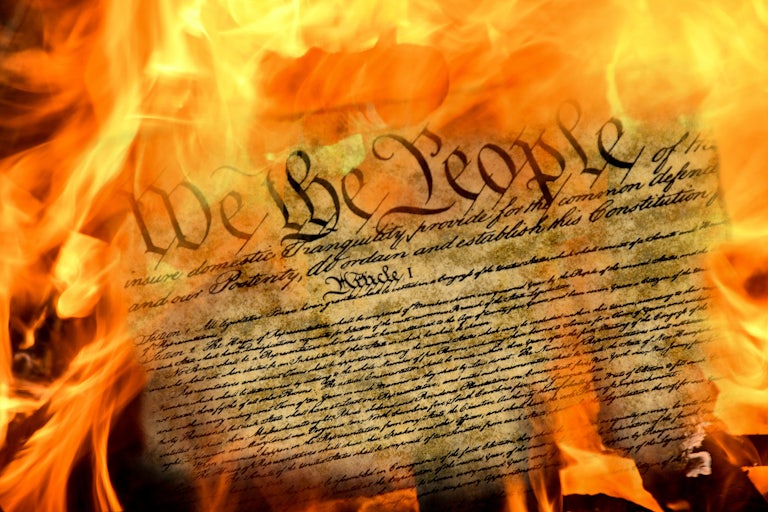
Getty

by Nancy MacLean
February 8, 2024
The New Republic


"...Lurking behind the full-frontal assault by Donald Trump and his enablers lies a more far-reaching threat. If the Republicans gain control of both Houses of Congress, expect a state-authorized Constitutional Convention to eviscerate core rights and protections most Americans hold dear.

Imagine living in a country without Social Security, Medicare, the Affordable Care Act, the right to organize a union, civil rights enforcement, and clean air and water protections, let alone action to stop climate collapse. The Constitutional Convention, in the plain language of the leading organizer for it, aims “to reverse 115 years of progressivism.”

That’s big talk, 115 years. Think it can’t be done? Although the convention push has been all but ignored by the commentariat and national Democratic leaders, it has powerhouse backing. The Koch network and other dark-money donors are generously funding it. The corporation-underwritten American Legislative Exchange Council (ALEC) has supplied “model legislation” and training to Republican state legislators. Endorsers include Mark Meadows, Ron DeSantis, Greg Abbott, Sean Hannity, and many more. Convention of States Action (COS), the 501c(4) organization leading the campaign, whose head was a co-founder of Tea Party Patriots, has recruited and deployed volunteers to lobby their legislatures. (It also offers training in “biblical citizenship.”) COS has held three practice conventions with legislators from nearly every state. The Heritage Foundation—the 800-pound gorilla on the right—recently signed on in “a game-changing report” that such a convention would be “a potent check on federal power” and is “a worthy cause.” That endorsement is likely to drive even more cash to add to the over $70 million in IRS-traceable contributions that groups solely focused on convening such a gathering have garnered from 2012 to 2022, in findings of the Center for Media and Democracy. That figure does not include contributions to ALEC, which has promoted the convention since 2013; its revenue hovers around $10 million annually.

Promoters have been methodically lining up authorizations from the states since the 2012 election showed them that most Americans reject the kind of society they seek, even Mitt Romney’s mild version. So strategists concluded that the only way to permanently entrench minority rule by plutocrats and theocrats is to encase it in a dramatically altered Constitution.

They count on most of us remaining in the dark until it is too late to stop their scheme.

So far, that’s proved a good gamble. How many of us know that there are two routes to amending the Constitution—the usual one, and the nuclear option never yet tried?

Under Article V of the Constitution, Congress “shall call a convention for proposing amendments” when it receives applications from two-thirds of the states. In reality, this is hard, because one party would need to control both houses of 34 state legislatures (or 33 plus unicameral Nebraska). But ALEC has fabricated a claim built around the idea that enough states have made past calls for a convention, some going back decades, for the idea to proceed. It plans to use these outdated state resolutions to argue to the courts that they should force Congress to convene one.

But it gets worse. If Republicans control Congress, they won’t have to bother with litigation, because it would be up to the majority in control to determine the validity of the applications—and Article V lacks the guardrails to prevent this manipulation.

Seriously? Yes, alas. House Speaker Mike Johnson, who would be in a position to call it, is a longtime ally of COS.

So how exactly would a convention nullify the Democratic agenda, past and current? The six amendments adopted by the Simulated Convention held in Williamsburg, Virginia, on August 4, 2023, would dismantle reforms We the People have won over generations. The centerpiece amendment, entitled “Fiscal Restraints,” is a one-two punch to knock out popular programs such as Social Security, unemployment insurance, Medicare, and Medicaid. By mandating that two-thirds of both houses of Congress would have to agree to any tax increase, it would force annually balanced budgets, while making it all but impossible to raise revenue from the wealth-hoarding ultrarich who back this radical agenda.

Another amendment takes dead aim at all federal regulation since 1937 and civil rights and environmental policies since then. It would obliterate the “administrative state,” the bugbear of the hard-right coalition. The measure would in short order end fair labor standards, antitrust enforcement, environmental protections, safeguards for workers who choose to unionize, civil rights on the job and in public accommodations, and the Affordable Care Act, among other hard-won reforms that ease hardship and protect us from corporate domination.

Still another amendment would allow a simple majority of state legislatures “to abrogate any action of Congress, President, or administrative agencies.” That could stop federal intervention to ensure the equal citizenship rights established in the Thirteenth, Fourteenth, and Fifteenth Amendments.

The simulated convention’s last adopted amendment would be a gargantuan gift to fossil fuel corporations. It would require Congress to turn over to state control virtually all federal lands and mineral rights, including any national park, monument, or wilderness area designated since 1975.


But this is madness, you will say. These reactionaries could never get away with rewriting the Constitution!

Except they could. First, because the instigators have already adopted a representation scheme for the convention based on one-vote-per-state, chosen by the legislatures; it gives near-empty states like Alaska and Wyoming the same power as California and New York. Second, because by crooked counting (“aggregating”) of ancient authorizations with those recently obtained, planners claim that the threshold needed to call a convention under Article V has already been met: two-thirds of the states. Third, because most of us aren’t even aware that this is happening.

For the American people to realize how much is at stake will require vast and to-the-point popular education. While the right has been tutoring its base in its version of the Constitution for years, the left has dropped this ball badly, particularly on such vital but wonky matters as how interpretation of the Commerce Clause after 1937 enabled all the federal regulations demanded by voters that had been overturned until then by reactionary justices.

But here’s the silver lining as we approach November. Democrats could jiujitsu this. Why not use the right’s menace to the Constitution to energize turnout to reclaim for Democrats state legislatures lost since 2010? The consummation of the right-wing plan depends on convention backers being able to control most statehouses. If Democratic get-out-the-vote workers train voters to fill out the entire ballot, including state legislative and judicial races, progressives could reclaim vast power to enact the popular agenda that Republican elected officials have blocked.

This urgent emphasis on winning at the state level could pay off handsomely. It might even help top-of-the-ticket candidates. Few know it, but the 2016 election was likely the first time a president was swept into office on the “reverse coattails” of Senate candidates (thanks to a flood of last-minute money from corporate donors afraid of losing the upper chamber in the predicted Hillary Clinton sweep). Wouldn’t it be a delicious inversion if President Biden won reelection and Republicans suffered a shellacking in House and Senate races because informed voters turned out in epic numbers to keep the right from rigging the Constitution?

ABOUT THE AUTHOR:


Nancy MacLean


Nancy MacLean is the William H. Chafe Distinguished Professor of History and Public Policy and author most recently of Democracy in Chains: The Deep History of the Radical Right’s Stealth Plan for America.


"What's Past is Prologue..."

http://panopticonreview.blogspot.com/…/the-panopticon-revie…

IMPORTANT NEW BOOK:

 
NOTE: This book is one of the Panopticon Review's 20 Outstanding books of 2017

Democracy in Chains: The Deep History of the Radical Right’s Stealth Plan for America
by Nancy MacLean
Viking, 2017

[Publication date: June 13, 2017]


https://kbimages1-a.akamaihd.net/…/…/democracy-in-chains.jpg

Finalist for the 2017 National Book Award

“[A] vibrant intellectual history of the radical right . . .” – The Atlantic

“This sixty-year campaign to make libertarianism mainstream and eventually take the government itself is at the heart of Democracy in Chains. . . . If you're worried about what all this means for America's future, you should be” – NPR

An explosive exposé of the right’s relentless campaign to eliminate unions, suppress voting, privatize public education, and change the Constitution.

Behind today’s headlines of billionaires taking over our government is a secretive political establishment with long, deep, and troubling roots. The capitalist radical right has been working not simply to change who rules, but to fundamentally alter the rules of democratic governance. But billionaires did not launch this movement; a white intellectual in the embattled Jim Crow South did. Democracy in Chains names its true architect—the Nobel Prize-winning political economist James McGill Buchanan—and dissects the operation he and his colleagues designed over six decades to alter every branch of government to disempower the majority.

In a brilliant and engrossing narrative, Nancy MacLean shows how Buchanan forged his ideas about government in a last gasp attempt to preserve the white elite’s power in the wake of Brown v. Board of Education. In response to the widening of American democracy, he developed a brilliant, if diabolical, plan to undermine the ability of the majority to use its numbers to level the playing field between the rich and powerful and the rest of us.

Corporate donors and their right-wing foundations were only too eager to support Buchanan’s work in teaching others how to divide America into “makers” and “takers.” And when a multibillionaire on a messianic mission to rewrite the social contract of the modern world, Charles Koch, discovered Buchanan, he created a vast, relentless, and multi-armed machine to carry out Buchanan’s strategy.

Without Buchanan's ideas and Koch's money, the libertarian right would not have succeeded in its stealth takeover of the Republican Party as a delivery mechanism. Now, with Mike Pence as Vice President, the cause has a longtime loyalist in the White House, not to mention a phalanx of Republicans in the House, the Senate, a majority of state governments, and the courts, all carrying out the plan. That plan includes harsher laws to undermine unions, privatizing everything from schools to health care and Social Security, and keeping as many of us as possible from voting. Based on ten years of unique research, Democracy in Chainstells a chilling story of right-wing academics and big money run amok. This revelatory work of scholarship is also a call to arms to protect the achievements of twentieth-century American self-government.

For decades, the capitalist radical right has been hard at work to crush unions, suppress voting, privatize public education, change the Constitution and rig the rules of American democracy. Nancy MacLean names the architects of this movement, showing how corporations, right-wing foundations and billionaires have supported a strategy designed to disempower the majority.


“[A] vibrant intellectual history of the radical right . . .” – The Atlantic

“This sixty-year campaign to make libertarianism mainstream and eventually take the government itself is at the heart of Democracy in Chains. . . . If you're worried about what all this means for America's future, you should be” – NPR

“Riveting” – O, The Oprah Magazine (Top 20 Books to Read This Summer)

An explosive exposé of the right’s relentless campaign to eliminate unions, suppress voting, privatize public education, and change the Constitution.

Behind today’s headlines of billionaires taking over our government is a secretive political establishment with long, deep, and troubling roots. The capitalist radical right has been working not simply to change who rules, but to fundamentally alter the rules of democratic governance. But billionaires did not launch this movement; a white intellectual in the embattled Jim Crow South did. Democracy in Chains names its true architect—the Nobel Prize-winning political economist James McGill Buchanan—and dissects the operation he and his colleagues designed over six decades to alter every branch of government to disempower the majority.

In a brilliant and engrossing narrative, Nancy MacLean shows how Buchanan forged his ideas about government in a last gasp attempt to preserve the white elite’s power in the wake of Brown v. Board of Education. In response to the widening of American democracy, he developed a brilliant, if diabolical, plan to undermine the ability of the majority to use its numbers to level the playing field between the rich and powerful and the rest of us.

Corporate donors and their right-wing foundations were only too eager to support Buchanan’s work in teaching others how to divide America into “makers” and “takers.” And when a multibillionaire on a messianic mission to rewrite the social contract of the modern world, Charles Koch, discovered Buchanan, he created a vast, relentless, and multi-armed machine to carry out Buchanan’s strategy.

Without Buchanan's ideas and Koch's money, the libertarian right would not have succeeded in its stealth takeover of the Republican Party as a delivery mechanism. Now, with Mike Pence as Vice President, the cause has a longtime loyalist in the White House, not to mention a phalanx of Republicans in the House, the Senate, a majority of state governments, and the courts, all carrying out the plan. That plan includes harsher laws to undermine unions, privatizing everything from schools to health care and Social Security, and keeping as many of us as possible from voting. Based on ten years of unique research, Democracy in Chains tells a chilling story of right-wing academics and big money run amok. This revelatory work of scholarship is also a call to arms to protect the achievements of twentieth-century American self-government.

Reviews:

“A remarkable new book which argues that the radical right revolution engineered by Charles and his brother David is not just about accruing political and economic power, but about restricting democracy itself.”
—The New Republic

“[A] vibrant intellectual history of the radical right . . . [MacLean] has dug deep into her material—not just Buchanan’s voluminous, unsorted papers, but other archives, too—and she has made powerful and disturbing use of it all. . . . The behind-the-scenes days and works of Buchanan show how much deliberation and persistence—in the face of formidable opposition—underlie the antigoverning politics ascendant today. What we think of as dysfunction is the result of years of strategic effort.”
—The Atlantic

“This sixty-year campaign to make libertarianism mainstream and eventually take the government itself is at the heart of Democracy in Chains. . . . [MacLean] takes the time to meticulously trace how we got here. . . . If you're worried about what all this means for America's future, you should be. . . . And if someone you know isn't convinced, you have just the book to hand them.”
—NPR

“[A] riveting, unsettling account of 'Tennessee country boy' James McGill Buchanan, key architect of today's radical right.”
—O, The Oprah Magazine

"Perhaps the best explanation to date of the roots of the political divide that threatens to irrevocably alter American government.”
—Booklist (starred review)

“It’s happening: the subversion of our democratic system from within. How did the political Right do it? Nancy MacLean tells the long-overlooked story of the political economist who developed the playbook for the Koch brothers. James McGill Buchanan merged states rights’ thinking with free market principles and helped to fashion the inherently elitist ideology of today’s Republican Party. Professor MacLean’s meticulous research and shrewd insights make this a must-read for all who believe in government ‘by the people.’”
—Nancy Isenberg, author of White Trash: The 400-Year Untold History of Class in America

“This book is mesmerizing. Rarely have I encountered a work that speaks to such significant issues, with evidence rooted in conclusive new sources. In clear prose, MacLean reveals how a public once committed to social responsibility and egalitarian values became persuaded that only an unregulated free market could protect ‘liberty’ and ‘choice.’ Because of this, our once cherished democracy is now subject to attack. Everyone who wants to understand today’s confrontational politics should read this important book, now.”
—Alice Kessler-Harris, author of In Pursuit of Equity: Women, Men and the Quest for Economic Citizenship in Twentieth Century America

“How did we get to where we are today? How did corporations come to possess ‘rights?’ How did democracy come to be defined as selfish individualism? Or money as free speech? Nancy MacLean’s Democracy in Chains provides the answers. It is essential reading in order to understand the ideas that billionaires use to justify their control of our political institutions. I can’t imagine a more timely or urgent book.”
—Greg Grandin, author of Fordlandia (finalist for the Pulitzer Prize) and The Empire of Necessity (winner of the Bancroft Prize)

"[MacLean] creates a chilling portrait of an arrogant, uncompromising, and unforgiving man . . . [she] offers a cogent yet disturbing analysis of libertarians' current efforts to rewrite the social contract and manipulate citizens' beliefs. . . . An unsettling exposé of the depth and breadth of the libertarian agenda."
—Kirkus Reviews

"MacLean constructs an erudite searing portrait of how the late political economist James McGill Buchanan (1919 - 2013) and his deep-pocketed conservative allies have reshaped --and undermined--American democracy. . . . A thoroughly researched and gripping narrative, she exposes how Buchanan’s strategies shaped trends in government in favor of “corporate dominance” and against the welfare state. . . . She has delivered another deeply important book. . . . Her work here is a feat of American intellectual and political history."
—Publisher's Weekly (starred review)

“For those who think the Tea Party, Freedom Caucus, and the alt-right are recent constructs, MacLean provides an extensive history lesson that traces the genesis of the right wing back to post-WWII doctrines. . . . A worthy companion to Jane Mayer’s Dark Money, MacLean’s intense and extensive examination of the right-wing’s rise to power is perhaps the best explanation to date of the roots of the political divide that threatens to irrevocably alter American government.”
—Booklist (starred review)


ABOUT THE AUTHOR:

Nancy MacLean is the award-winning author of Behind the Mask of Chivalry (a New York Times "noteworthy" book of the year) and Freedom is Not Enough, which was called by the Chicago Tribune “contemporary history at its best.” The William Chafe Professor of History and Public Policy at Duke University, she lives in Durham, North Carolina.

http://www.npr.org/…/democracy-in-chains-traces-the-rise-of…

Book Reviews

'Democracy In Chains' Traces The Rise Of American Libertarianism
June 18, 2017


Book Reviewed by Genevieve Valentine
National Public Radio (NPR)


Democracy in Chains: The Deep History of the Radical Right's Stealth Plan for America
by Nancy MacLean
Viking, 2017
334 pages

Obscuring census data to give "conservative districts more than their fair share of representation." Preventing access to the vote. Decrying "socialized medicine." Trying to end Social Security using dishonest vocabulary like "strengthened." Lionizing Lenin. Attempting to institute voucher programs to "get out of the business of public education." Increasing corporatization of higher education. Harboring a desire, at heart, to change the Constitution itself.

This unsettling list could be 2017 Bingo. In fact, it's from half a century earlier, when economist James Buchanan — an early herald of libertarianism — began to cultivate a group of like-minded thinkers with the goal of changing government. This ideology eventually reached the billionaire Charles Koch; the rest is, well, 2017 Bingo.

This sixty-year campaign to make libertarianism mainstream and eventually take the government itself is at the heart of Democracy in Chains. It's grim going; this isn't the first time Nancy MacLean has investigated the dark side of the American conservative movement (she also wrote Behind the Mask of Chivalry: The Making of the Second Ku Klux Klan), but it's the one that feels like it was written with a clock ticking down.

Still, it takes the time to meticulously trace how we got here from there. Charles and his brother David Koch have been pushing the libertarian agenda for more than 20 years. A generation before them, Buchanan founded a series of enclaves to study ways to make government bend. Before that, critic and historian Donald Davidson coined the term "Leviathan" in the 1930s for the federal government, and blamed northeasterners for "pushing workers' rights and federal regulations. Such ideas could never arise from American soil, Davidson insisted. They were 'alien' European imports brought by baleful characters." And going back another century, the book locates the movement's center in the fundamentalism of Vice President John C. Calhoun, for whom the ideas of capital and self-worth were inextricably intertwined. (Spoilers: It was about slavery.)

It's grim going; this isn't the first time Nancy MacLean has investigated the dark side of the American conservative movement ... but it's the one that feels like it was written with a clock ticking down.

Buchanan headed a group of radical thinkers (he told his allies "conspiratorial secrecy is at all times essential"), who worked to centralize power in states like Virginia. They eschewed empirical research. They termed taxes "slavery." They tried repeatedly to strike down progressive action — school integration, Social Security — claiming it wasn't economically sound. And they had the patience and the money to weather failures in their quest to win.

As MacLean lays out in their own words, these men developed a strategy of misinformation and lying about outcomes until they had enough power that the public couldn't retaliate against policies libertarians knew were destructive. (Look no further than Flint, MacLean says, where the Koch-funded Mackinac Center was behind policies that led to the water crisis.) And it's painstakingly laid out. This is a book written for the skeptic; MacLean's dedicated to connecting the dots.

She gives full due to the men's intellectual rigor; Buchanan won the Nobel for economics, and it's hard to deny that he and the Koch brothers have had some success. (Alongside players like Dick Armey and Tyler Cowen, there are cameos from Newt Gingrich, John Kasich, Mitt Romney, and Antonin Scalia.) But this isn't a biography. Besides occasional asides, MacLean's much more concerned with ideology and policy. By the time we reach Buchanan's role in the rise of Chilean strongman Augusto Pinochet (which backfired so badly on the people of Chile that Buchanan remained silent about it for the rest of his life), that's all you need to know about who Buchanan was.

We are, 'Democracy in Chains' is clear, at a precipice.

If you're worried about what all this means for America's future, you should be. The clear and present danger is hard to ignore. When nearly every radical belief the Buchanan school ever floated is held by a member of the current administration, it's bad news.

But it's worth noting that the primary practice outlined in this book is the leveraging of money to protect money — and the counter-practice is the vocal and sustained will of the people. We are, Democracy in Chains is clear, at a precipice. At the moment, the first practice is winning. If you don't like it, now's the time to try the second. And if someone you know isn't convinced, you have just the book to hand them.

ABOUT THE AUTHOR:

Genevieve Valentine's latest novel is Icon.

Thursday, February 1, 2024

Scholar, Activist, Critic, and Historian Henry A. Giroux On the Grave Necessity of Speaking Out Against, Standing Up To, and Defeating Fascism in the 21st Century--At Home and Abroad

 WHAT IS FASCISM?
"Fascism is a system of political authority and social order intended to reinforce the unity, energy, and purity of communities in which liberal democracy stands accused of producing division and decline...a form of political behavior marked by obsessive preoccupation with community decline, humiliation or victimhood and by compensatory cults of unity, energy and purity, in which a mass-based party of committed nationalist militants, working in uneasy but effective collaboration with traditional elites, abandons democratic liberties and pursues with redemptive violence and without ethical or legal restraints goals of internal cleansing and external expansion.”
—Robert Paxton, “The Anatomy of Fascism"


Silence Is Dangerous in the Current Age of Rising Fascism in the US

Social movements are creating powerful new languages for confronting tyranny. We must resist the plague of silence.

PHOTO: Former president Donald Trump speaks to the media outside a polling location at Londonderry High School in Londonderry, New Hampshire, on January 23, 2024. Jabin Botsford / The Washington Post via Getty Images

This week’s revelation that Donald Trump is already plotting new ways to try to put himself permanently above the law is just the latest reminder of the looming threat of lawless and emboldened right-wing forces in the United States. Trump’s new scheme to expand a Nixon-era policy memo to prohibit the Justice Department from prosecuting presidents, even after they leave office, is just a tiny hint of the greater threat. In recent months, several scholars have sounded the alarm that the United States is “sleepwalking towards authoritarianism.” The concern is not unfounded given that in his run for the presidency in 2024, Trump has boldly telegraphed his aspirations to impose an authoritarian future on the United States. He has repeatedly injected authoritarian language, extremist ideas and threats of violence into the mainstream. Moreover, he has done so to “create a climate of trepidation and powerlessness that discourages mobilization by the opposition,” in the words of scholar Ruth Ben-Ghiat. Forecasting his authoritarian intentions, Trump has openly stated that he intends to terminate portions of the U.S. Constitution, calls his political enemies “vermin” and boldly proclaims he will make himself a dictator “on day one.” On Truth Social, he claimed without irony that a president should have blanket authority and total immunity “even for events that ‘cross the line.’” He has repeatedly stated that if he regains the White House, “it will be a time for retribution” and revenge.

Taking pages from Hitler’s speeches, Trump has also said that the biggest threat to the United States “is from within.” In this instance, he reproduces a version of McCarthyite slander with his claim that the country is being overrun by “communists, Marxists, fascists and the radical left thugs that live like vermin within the confines of our country, that lie and steal and cheat on elections, and need to be rooted out.” His constant attacks on what he labels as the “enemy within” are meant to incite his MAGA followers to wage violence against people of color, critics, progressives, LGBTQ+ Americans, news networks, immigrants, feminists, and any other group that does not buy into Christian nationalist, white supremacist views.

Trump’s discourse overflows with the genocidal language used in the Third Reich. The historian Heather Cox Richardson rightly notes that Trump’s “use of language referring to enemies as bugs or rodents has a long history in genocide because it dehumanizes opponents, making it easier to kill them. In the U.S., this concept is most associated with Hitler and the Nazis, who often spoke of Jews as ‘vermin’ and vowed to exterminate them.”

Trump has claimed that immigrants “are poisoning the blood of our country” and polluting his notion of white Christian culture, and he’s indicated that, if reelected, he plans to make them undergo “ideological screening” in order to enter the country legally (assuming here that he wants to make sure they would not vote for the Democratic Party). If his vision were carried out, millions of undocumented immigrants would be barred from the country while others would be rounded up, put into what amount to Gulag camps, and subjected to unimaginably harsh policies. Given Trump’s calls to shoot shoplifters, impose death penalties on drug dealers, and his suggestion that his former chair of the Joint Chiefs of Staff, Mark Milley, “deserves to be executed,” there is no reason to doubt Trump’s authoritarian designs.

On the campaign trail, Trump repeatedly echoes the language of autocrats such as Hungarian Prime Minister Viktor Orbán, who embraces the concept of “illiberal democracy,” and claims, as The Guardian points out, that the biggest threat to Hungary and other nations is “the ‘mixing’ of European and non-European races.” Trump and the GOP, like many of the authoritarian politicians they admire, believe that equality is a weakness endemic to democracy and destroys society. Trump’s contempt for the law and desire for absolute power is not only evident in his remarks about wanting to be a dictator; it was also on full display when his legal team argued before a D.C. Circuit Court that unless Trump is impeached, he could not be held responsible for “selling pardons, military secrets, or simply having people assassinated.” As Thom Hartmann put it, “Trump’s lawyer argued before the DC Appeals Court that if Trump became president again, he could order SEAL Team Six to assassinate Joe Biden or Liz Cheney and nobody could do anything about it.” While Trump’s lawlessness is central to his grab for unchecked power, there are also displays of the delusions and aspirations of a Nazi-infested politics.

What is especially disturbing about the emerging fascism in the United States is the lack of general public outrage that accompanies it. Such silence extends from almost the entirety of the Republican Party, the mainstream media, 84 percent of white Evangelicals, and a number of the wealthiest American billionaires and corporate tycoons. While the Democratic Party, including President Joe Biden, have called out Trump as a fascist, they have been silent about their support for decades of neoliberal economic policies, the ravages of deindustrialization, a staggering rise in economic inequality and cuts to social programs. Such policies have produced the conditions that have accelerated the rise of authoritarianism in the United States. Wedded to the interests of the banks, corporate ideology and the financial elite, their silence should come as no surprise. At the same time, such policies have produced enormous economic hardships and a diminished sense of agency that creates an enforced silence among the most impoverished populations and often results in their inevitable retreat from politics, especially in relation to voting in national elections.

In the current historical moment, language has increasingly forfeited its obligation to a politics of truth, justice, equality and freedom, and in doing so has turned cannibalistic and cruel. As political horizons and public life wither under the assault of an emerging fascism and a mainstream media that refuse to confront it, language appears to fail in the presence of what Zygmunt Bauman called “the emergence of modern barbarity.” A continuing series of crises — political, cultural, economic and ecological — are translated into emotional plagues of fear, lies and violence produced by right-wing spectacles that have undermined the ability of the U.S. public to address critically the endless attacks by tyrannical forces on democratic ideas, values and institutions. Matters of historical context, interconnections, informed judgment and critical analysis that refuse to divorce themselves, in the words of Winifred Woodhull, “from social institutions and material relations of power and domination” are either ignored or disappear from public view. Language in the age of gangster capitalism and fascist politics is under siege, functioning less as a vehicle of audacious truth and moral witnessing than as a tool to purge democracy of its ideals. In the face of a politics of enforced silence, the United States is experiencing an era marked by what Brad Evans calls “a closing of the political,” grounded in the assumption that “nothing can be done.”

The poisonous shadow of authoritarianism has entered the public imagination in spectacular fashion as a normalized political discourse. A boisterous creed of “annihilating nihilism” marked by a politics of vacuousness, resentment, historical amnesia, self-interest and freedom from responsibility has become a dominating force in U.S. politics. A right-wing vocabulary of hatred, bigotry, lies and conspiracy theories has produced a brutalizing politics whose rhetoric and polices echo a dark and horrifying period of history unlike anything we have seen since the 1930s in Europe. The mobilizing passions of fascism are now being produced, circulated and legitimated though all aspects of the mass media, which are increasingly under the control of a billionaire class. How else to explain not only Trump’s public courting of white supremacists and antisemites, such as Nick Fuentes and Kanye West, but also Nikki Haley’s claim that slavery was not the cause of the Civil War? Such comments reveal the GOP’s fascist tendency not only to whitewash and seek to erase the relevance of the history of racism, but also to endorse the poisonous ideologies of white nationalism and white supremacy. As Czech dissident Václav Havel once remarked, “the disorder of real history is replaced by the orderliness of pseudo-history.… Instead of events, we are offered non-events.”

Diverse social movements … produced a language that allows us to recognize ourselves as agents, not victims.

Extremist language that was once considered unimaginable and relegated to fringe groups has been elevated to the center of power, politics and everyday life. For instance, billionaire Elon Musk’s recent racist comments echo the racial eugenicist movements in the U.S. in the 19th and 20th centuries, from which Hitler took inspiration. Yet, little is said in the mainstream press connecting Musk’s comments to a shameful past that gave us the Tuskegee experiments and provided a rationale for Jim Crow and racial segregation laws. Enforced silence is a tool for the repression of history and the wiping out of historical consciousness and memory, especially those moments in history we associate with segregation, exploitation, disposability and genocide. Fascist discourse is currently abetted and affirmed by ongoing public displays of the detritus of fascist politics, which makes visible that which the United States has forgotten and of which it should be ashamed — that is, a society in which collective morality and the ethical imagination appear to no longer matter.

Beyond bold and unapologetic public displays of fascist rhetoric, beliefs and policies, there are relentless right-wing assaults against democracy that are barely recognized in the media and in public discourse for the danger they pose to democracy. A short list includes book censorship, turning libraries into student detention centers, voter suppression laws, threatening election workers, assaulting reproductive rights, enacting cruel policies against queer and trans people and harassing critical educators. In addition, schools are turned into indoctrination centers, torrents of propaganda replace facts, history is whitewashed, dissent is suppressed and those who provide medical care to trans people and people in need of abortions are criminalized.

These authoritarian aggressions have become embedded in United States culture to the degree that they fail to garner any alarm or concern from the wider public. As fascist beliefs, values and language multiply, so do attacks by far right politicians, reactionary pundits and white supremacists against diversity, equality and inclusion, all the while promoting a white nationalist notion of who counts as a citizen. As Toni Morrison once noted, this is a language constrained by the “weary and wearying vocabulary of racial domination.” It is “a dead language” trapped in sordid silence regarding the racist ideology that drives its claims to “exclusivity and dominance.”

A dangerous silence now often accompanies a language at war with democratic ideals and the public imagination. This is an enforced silence among the larger public that purposely mutes matters of critical agency, moral responsibility, reason, justice and the demands of keeping alive a substantive democracy. It is a language where moral outrage disappears, is silenced or both, while concealing the danger that this fascist language portends. This is a depoliticizing silence that clouds lies and untruths in mindless theater, spectacles and a flood of evasions. Under such circumstances, community is emptied of any substance, reduced to notions of the social organized around the merging of lies and violence. The loneliness and social atomization produced under neoliberalism provide fodder for the dictatorial energies that offer forms of the false promise of community rooted in hate, bigotry and lies, often resulting in habitual ignorance to justice. Mainstream institutions such as schools, the media and online platforms that should trade in imaginative ideas and provide a critical culture are under siege. One consequence is the breakdown of civic culture, egalitarian values and politics itself. What many Americans fail to realize is that this reactionary mode of silence is a form of complicity that creates a political climate marked by cruelty, violence and lawlessness. How else to explain the lack of public outrage against an extremist Republican Party that rejects free summer lunch programs for food-insecure youth, weakens child labor laws and restricts voting rights?

Liberal and conservative Americans are immersed in a crisis of silence that ignores the fact that politicians such as Trump embrace totalitarian values — the language of dictators — and advocate for violence as a tool of political opportunism. This is not to suggest that all forms of silence function to erase the scourge of racism, white supremacy and the misery imposed by neoliberal capitalism.

Silence can be contemplative, offer consolation, and provide the space for close analysis, thinking critically and mobilizing modes of critical agency. However, in an era marked by a massive flight from ethical and political responsibility, a particular kind of administered silence emerges, one that subverts any sense of critical agency and abandons a more noble message regarding a warning of the dangers to come and the lessons to be addressed. Under such conditions, silence operates increasingly within oppressive relations of power. Tyrannical relations of power are now at the center of U.S. politics and radiate a contempt for dissent, integrity, compassion and liberty which, as Bauman notes in his book Babel, ejects “any sense of critical agency and [refuses] to recognize the bonds we have with others.”

In the face of injustice, silence has become ethically mute, and exhibits a dehumanizing indifference to human suffering in the midst of dangerous politics. Enforced silence, both as a subjective stance and as a political space of organized moral irresponsibility and self-deception, increasingly legitimates and helps to produce a society that has lost its moral bearings and wallows in a repudiation of civic courage and human rights. This current politics of enforced silence is happening at a time when many Americans seem oblivious to the threat posed to democracy by Trump, the GOP, far right foundations, reactionary cultural apparatuses and neoliberal educational institutions.

Silence today has become part of a politics of disappearance where critical ideas are buried along with dangerous memories, and the bodies of journalists, poets and those who lead the fight against oppression in its diverse modes. As Spanish painter Francisco Goya once warned of the degree to which truth and informed judgments are overcome by ignorance, superstition and falsehoods, “the sleep of reason produces monsters.” Martin Luther King Jr. gave a contemporary valence to Goya’s warning in his famous 1967 speech, “Beyond Vietnam: A Time to Break the Silence.” His words alerted Americans to the dangers of refusing to speak out in the face of militarism, racism and massive poverty. Stating that “a time comes when silence is betrayal,” King was clear regarding how the refusal to speak out eviscerates both the idea of democracy and the promise of resisting the mobilizing passions of fascism, especially militarism, poverty and racism. The challenge posed by King’s call to resist a complicitous silence in the face of injustice is exceptionally relevant today. At the heart of this challenge is the need to not only make detectable the current threats to democracy but also to understand how silence in the face of tyranny legitimates authoritarianism along with the risks it poses to any viable notion of justice, equality and freedom.

It is important to note that fascism not only arrives through the language of hate, bigotry, dehumanization and military dictatorships as it did in Chile and Argentina in the 1970s; it also arrives through the everyday acceptance of an ethically debilitating silence. In the current moment, such silence accompanies authoritarian threats to democracy. A politics of silence facilitates a tsunami of manufactured ignorance advanced by the repression of dissent, the cowardice of the mainstream media, the unaccountability of social media platforms steeped in the astonishing toxicity of hatred, and a disdain for equality, freedom and truth in a society, notes Jonathan Crary, governed by the corrupting force of the billionaire elite.

Given the current threat posed to U.S. democracy, enforced silence should be analyzed within the uniquely current threats to liberty, basic human rights and equality that sabotage any viable notion of democracy. Such a challenge is especially crucial at a time when the habits of democracy are being replaced by what David Graeber called the “habits of oligarchy, as though no other politics are possible.” The politics of silence increasingly works through multiple sites and seemingly contrasting impulses, often aligning itself with a reactionary disdain for the public good. In part, it does so by refusing to address the growing (yet to some, seemingly unrelated) issues of Trump’s full embrace of fascist politics, the growing attacks on freedom of expression and the struggle for social justice.

This is all the more reason to reclaim the language of the common good; to protect public and higher education from a fascist takeover; to reject the privatization of public goods; expand the power of unions and the rights of workers, people of color, women, immigrants, queer and trans people, and all those others considered excess and disposable. The plague of silence has to be broken so as to inject the struggle for human rights back into the language of politics, and to fight for a socialist democracy built on the anti-capitalist values of equality, social justice, liberty and human dignity. The words of Frederick Douglass are prescient here and worth remembering. He writes:

If there is no struggle, there is no progress. Those who profess to favor freedom and yet deprecate agitation are men who want crops without plowing the ground. They want rain without thunder and lightning. They want the ocean without the roar of its mighty waters.

If the plague of silence is to be overcome, Americans need to tap into a language that makes clear that they will not look away or refuse to stand up in the face of fascist aggression. The brilliant writer Maaza Mengiste argues for such a language with his call for a vocabulary that “will take us from shock and stunned silence toward a coherent, visceral speech, one as strong as the force that is charging at us.”

Fortunately, especially since the Occupy movement in 2011, a number of social movements have emerged to provide a language that both exposes and makes the ruthless power of the financial elite and other anti-democratic forces accountable through a discourse of critique and hope. The Occupy movement made the discourse of inequality and class differences a more central part of a national political narrative. In the last decade, workers have used the language of economic justice, solidarity and fair play to reenergize the labor movement. The resurgence of the labor movement provided a discourse that exposes how neoliberalism benefits the wealthy and privileged.

Silence has become the language through which people are either depoliticized or are willingly complicit with the economic and racial forces of totalitarianism.

Meanwhile movements such as the movement for Black lives have highlighted the language of structural racism along with making visible a history of slavery, racial abuse and police violence, and crafting a nuanced and multidimensional discourse of liberation.

The #MeToo movement created new discourses to make visible the pervasive extent of sexual assault, violence and harassment across a wide variety of sites and greatly advanced gender justice.

The abolitionist movement has provided a contextual and relational language highlighting the punitive nature of highly racialized criminal legal system and the carceral state while instituting a national movement to defund the police.

Trans and queer people have invigorated a movement and language that critiques the right-wing weaponization of marginalized and ostracized identities.

Climate activists have exposed the danger fossil fuels pose to the planet, and how the most vulnerable populations, especially Black and Brown communities, pay a heavy price for the abuses of the oil and gas industries. In doing so, they have inserted the language of climate justice into the public sphere and made clear how capitalism is creating a murderous future for human beings by destroying the environment.

Black and Brown theorists working with the idea of intersectionality have provided a new language highlighting how every social movement is “shaped by multiple intersecting inequalities and power dynamics,” which draw “attention to unmarked categories” of both oppression and resistance. All of these movements have imaginatively offered a new language of politics and continue to further expand and sharpen such discourses.

Equally promising is the increased political activism of young people, who are voicing a language and pedagogy of disruption, critique and possibility. As I stated more than a decade ago in Truthout, theirs is a language “that recognizes that there is no viable politics without will and awareness and that critical education motivates and provides a crucial foundation for understanding and intervening in the world.” Young people recognize that they have been written out of the script of democracy for too long and are now creating spaces and enacting a language in which to expand individual and social agency through collective forms of resistance as starting points to build a new democratic social order.

Fortified with the energy and language of these dynamic movements, it is incumbent upon the broader left and its various social movements to continue to develop a language that not only highlights social injustices but also includes a vocabulary that moves people, allows them to feel compassion for “the other” and gives them the courage to talk back. Beyond highlighting the wide range of social injustices, all of us on the left must continue to develop a vocabulary that speaks to people’s needs in a way that is moving, affirming, recognizable and enables them to confront the burden of conscience in the face of the unspeakable, and to do so with a sense of dignity, self-reflection and the courage to act individually and collectively in the service of a radical democracy.

One important contribution of these diverse social movements is that they all produced a language that allows us to recognize ourselves as agents, not victims. In doing so, they have expanded the discourse of radical democratic politics. Of course, there is more at stake here than a struggle over meaning; there is also the struggle over power, over the need to create a formative culture that will produce new modes of critical agency and contribute to a broad social movement that will translate meaning into a fierce struggle for economic, political and racial equality. While there is a new energy among youth and a number of powerful social movements, there is the ongoing challenge of confronting with renewed vigor a culture of silence and indifference that has become the most powerful educational force of the emerging fascism.

Writing about the civil rights struggles of the ‘60s, Martin Luther King Jr. was prescient in acknowledging that the tyranny and violence of authoritarianism feeds on silence, moral apathy and the collapse of conscience. Given the fierce urgency of the times, the struggle against an enforced silence is especially crucial when people refuse to speak up in the face of injustice. Silence has become the language through which people are either depoliticized or are willingly complicit with the economic and racial forces of totalitarianism. As King notes, it is the language of those “who accept evil without protesting against it.”

The new social movements in the face of an emerging fascism have done us a great theoretical and political favor in making clear that any viable mode of resistance must embrace a language that translates into power — a critical language that expands the power of education, agency and resistance. This is a language that imaginatively rethinks the forces of militarism, capitalism, racism and sexism in light of the dramatic changes taking place technologically, culturally and politically. There will be no justice or democracy in the United States unless a mass multiclass social movement emerges that combines political and individual rights with economic rights — that joins a movement for gender and racial equality with a movement for economic justice.

At the same time, many new social movements need to further a language that is not only theoretical and critical but also passionate. In many ways, they do this, but a politics of passion needs a greater place in their politics. Central to such a language is a politics of emotion that addresses what Ruth Ben-Ghiat refers to as communities of belonging. This is a language that invites joy while mobilizing emotions that embrace compassion, justice and hope. What might be called a politics of identification and emotion is particularly important at a time when many people living in a neoliberal society are atomized, feeling alienated, lonely, invisible, and subject to far right emotional appeals to forms of allegiance rooted in hatred, bigotry and a poisonous nationalism.

Anand Giridharads claims that today’s left is often too cerebral and too suspicious of what he calls empowering emotional appeals. He writes that much of the left today is “suspicious of the politics of passion” and “doesn’t do emotional appeals,” adding:

Can those who defend the rule of law and pluralism and economic justice and human rights not only articulate those ideas but also appeal to the more basic human needs to belong, to have anxieties soothed, to have fears answered, to feel hope, or just to feel something at the end of bleak and tedious days?… In an era [of anxiety and future dread] such as this, leaving the politics of emotion, of passion, to aspiring autocrats is a dangerous abdication.

It is worth emphasizing that the struggle against fascism and for a socialist democracy will not take place if education is not made central to politics. Any attempt to further the language of social, economic and racial justice will not be effective if it does not construct a language of critique, possibility and desire. We need a language that pedagogically moves people, makes power visible and creates communities of belonging, justice and compassion. We need to continue to fight aggressively the plague of silence with what Gayatri Chakravorty Spivak argues is “the power to think the absent.” It is only then that a critical public consciousness can be awakened, and a multiracial working-class movement can begin to bring into fruition a democratically socialist society.


ABOUT THE AUTHOR:


Henry A. Giroux currently holds the McMaster University Chair for Scholarship in the Public Interest in the English and Cultural Studies Department and is the Paulo Freire Distinguished Scholar in Critical Pedagogy. His most recent books include: American Nightmare: Facing the Challenge of Fascism (City Lights, 2018); The Terror of the Unforeseen (Los Angeles Review of books, 2019), On Critical Pedagogy, 2nd edition (Bloomsbury, 2020); Race, Politics, and Pandemic Pedagogy: Education in a Time of Crisis (Bloomsbury 2021); and Pedagogy of Resistance: Against Manufactured Ignorance (Bloomsbury 2022). Giroux is also a member of Truthout’s Board of Directors. 


Wednesday, January 24, 2024

Acclaimed Scholar and Historian Rick Perlstein On the Reality of American Fascism and precisely why it is the major question facing the United States in 2024 and Beyond

 https://www.democracynow.org/2024/1/22/ron_desantis_drops_out_2024

“American Fascism”: Historian Rick Perlstein on Trump’s Grip on the GOP & Chances of a Second January 6

January 22, 2024


Image Credit: Left: Gage Skidmore via Flickr

We look at the state of the Republican Party after Republican Florida Governor Ron DeSantis’s announcement Sunday that he has suspended his presidential campaign and endorsed Donald Trump to be the Republican Party’s 2024 nominee, making it a two-person race between Trump and former South Carolina Governor Nikki Haley. With the pivotal New Hampshire primary on Tuesday, we speak with author Rick Perlstein, a historian of the modern conservative movement, who describes Trump’s iron grip on the Republican Party as “American fascism.” He says regardless of how many votes Trump gets, the real question is how his extremist supporters will respond. “The horse race doesn’t matter if the guys in the MAGA hats blow up the track,” says Perlstein.

Transcript:

AMY GOODMAN: This is Democracy Now! I’m Amy Goodman.

We look now at the state of the Republican Party as Tuesday’s presidential primary in New Hampshire narrows down to a two-person race after Republican Florida Governor Ron DeSantis announced he’s dropping out, in a video posted Sunday on social media.

GOV. RON DESANTIS: I am today suspending my campaign. I’m proud to have delivered on 100% of my promises, and I will not stop now. It’s clear to me that a majority of Republican primary voters want to give Donald Trump another chance.

AMY GOODMAN: As DeSantis drops out of the race and endorses Trump, more questions are being raised about Trump’s mental capacity. At a campaign event Friday in New Hampshire, Trump confused his Republican rival Nikki Haley repeatedly with former House Speaker Nancy Pelosi.

DONALD TRUMP: By the way, they never report the crowd on January 6. You know, Nikki Haley — Nikki Haley — Nikki Haley — you know they — did you know they destroyed all of the information, all of the evidence, everything, deleted and destroyed all of it, all of it, because of lots of things, like Nikki Haley is in charge of security? We offered her 10,000 people, soldiers, National Guard, whatever they want. They turned it down.

AMY GOODMAN: Trump’s lapse prompted his Republican presidential opponent Nikki Haley to question his mental fitness in an interview Sunday on CBS’s Face the Nation.

NIKKI HALEY: I mean, he claimed that Joe Biden was going to get us into World War II. I’m assuming he meant World War III. He said that he ran against President Obama. He never ran against President Obama. He says that I’m the one that kept security from the Capitol on January 6th. I was nowhere near the Capitol on January 6th. But, Margaret, don’t be surprised: If you have someone that’s 80 in office, their mental stability is going to continue to decline. That’s just human nature. We know that.

AMY GOODMAN: For more, we’re joined by historian Rick Perlstein, author of a four-volume series on the rise of the modern conservative movement. His column for The American Prospect is “The Infernal Triangle.”

Rick, welcome back to Democracy Now! We don’t have much time, but a lot to cover. Talk about the significance of DeSantis pulling out, endorsing Trump, what this all means now, the two-person race, though he is winning in polls by a level — I mean, in Iowa — we haven’t seen before, trounced DeSantis by 30%. And one after another Republicans are endorsing him.

RICK PERLSTEIN: Yes. He is definitely going to be the nominee, presuming his continued ability to function as a human being, which is, you know, negligible. The important thing to understand is that, you know, the horse race stuff is fine, but the horse race doesn’t matter if the guys in the MAGA hats blow up the track. The important thing is not how many votes Donald Trump is able to get. He’s going to win the nomination. The important thing is not how many votes he gets in November, because he’s going to claim he won no matter what. The important people is — the important question is: How many people are going to be willing to take arms up for Donald Trump, you know, on the next January 6th, you know, in 2025? I don’t want to be melodramatic about it, but, you know, reality itself now seems to — for millions of Americans, a considerable part of the Republican Party, flows from the person of Donald Trump. And the word we have to begin using for this situation, as melodramatic as it seems, is “American fascism.”

AMY GOODMAN: And can you talk about people like New Hampshire Governor Sununu, who did endorse Nikki Haley, now saying if it’s Trump, he’s going to ultimately support him, to the questioning of Kristen Welker on Meet the Press? “You’re saying you would support him despite January 6, despite what you said about insurrection?” All of these Republican leaders who have questioned Trump falling into line in the end, as Trump now, today — 

RICK PERLSTEIN: Right.

AMY GOODMAN: — once again, is dealing with the rape of E. Jean Carroll, the judge called it, essentially, in common parlance, “rape.”

RICK PERLSTEIN: Right. There’s nothing new about that — right? — if we look at what people like Lindsey Graham said in 2015 and 2016 about Donald Trump, and then what they said when they saw him as a vector to keep their own power. Again, it’s really unfortunate and kind of creepy that the only sort of words that we have within the context of political philosophy that describe what’s happening come from the German language. This is Führerprinzip. You know, the truth comes from the leader.

And when they need to kind of get behind a criminal in order to be, you know, kind of a legitimate figure within a political party, that political party is — you know, you’ve got to wonder what these guys are going to look like 50 years from now in the eyes of history, right? They’ll look like, you know, the guys like Fritz von Papen, who said, “We have Hitler backed into a corner so far that he’s going to squeal.” Right? Fritz von Papen was the vice chancellor of Germany, the guy who made a coalition with Hitler that made him chancellor of Germany, right? These things are processes, you know? And we’re very far along a process, one for which the questions that are asked by conventional political journalism no longer signify anymore.

AMY GOODMAN: Florida Governor Ron DeSantis has dropped out of the presidential race two days before the New Hampshire primary, less than a week after he lost to Donald Trump by a record 30 percentage points in the Iowa caucus. In a video released Sunday, DeSantis said he’s endorsing Trump.

GOV. RON DESANTIS: He has my endorsement because we can’t go back to the old Republican guard of yesteryear, a repackaged form of warmed-over corporatism that Nikki Haley represents.

AMY GOODMAN: With DeSantis out, the Republican race has essentially become a two-person contest between Trump and Nikki Haley, the former South Carolina governor, who served as Trump’s U.N. ambassador. Over the weekend, Haley campaigned in New Hampshire. She questioned Trump’s mental fitness after he confused her with former House Speaker Nancy Pelosi. Joe Biden is now running an online ad questioning Trump’s mental capacities, featuring Nikki Haley’s comments.

NIKKI HALEY: Last night Trump is in a rally.

DONALD TRUMP: You know, Nikki Haley — Nikki Haley — Nikki Haley —

NIKKI HALEY: And he’s going on and on, mentioning me multiple times as to why I didn’t handle January 6th better.

DONALD TRUMP: Nikki Haley is in charge of security. We offered her 10,000 people. They don’t want to talk about that.

NIKKI HALEY: I wasn’t in office then. They’re saying he got confused. He got confused and said he was running against Obama. He never ran against Obama.

DONALD TRUMP: And we did with Obama. We won an election that everyone said couldn’t be won. Obama wants to — he doesn’t want to talk about it.

BRIAN KILMEADE: Well, you mean President Biden. So —

NIKKI HALEY: Don’t put our country at risk like this.

PRESIDENT JOE BIDEN: I’m Joe Biden, and I approve this message.

AMY GOODMAN: So, there Trump says he ran against President Obama. He also said you wouldn’t want Joe Biden to preside over World War II, instead of III.

What Florida Governor Ron DeSantis represented, the amount of money that he spent in this failed presidential bid, where it came from?

RICK PERLSTEIN: Yeah. I think the most important thing to understand about what Ron DeSantis represented, since, you know, he made no dent on the cult of personality of Donald Trump, you know, no appreciable contest, really, what he represents is the failure of the mainstream media to do its job in informing people about what it requires to be self-governing citizens. You know, they took this guy who celebrated torture at Guantánamo — you know, he kind of supervised it as a lawyer, laughed at the people being tortured — you know, a guy who basically is turning his own state into a kind of little fascist fiefdom, and they raised him up not only as the person who could beat Donald Trump, but as somehow better than Donald Trump, right? So we’re kind of caught in this hall of mirrors, as I’ve been repeating, where the kind of traditional ways of doing mainstream journalism, where you have the front-runner and you have the challenger and they’re in a horse race and yada yada yada, don’t even really signify what’s going on in America anymore.

AMY GOODMAN: And the amount of money that he got? He spent something like $150 million?

RICK PERLSTEIN: Right. This speaks to, I think, the way a fascist cult of personality works. It’s impervious to facts. It’s impervious to challenge, right? I mean, the fact that Nikki Haley is pointing out that Donald Trump thinks he ran against Barack Obama and that she was the speaker of the House, I mean, this resembles what we read about in 1984 by George Orwell, where, you know, your loyalty to Big Brother is signified by your willingness to say two plus two equals five. I mean, really, if you look at Donald Trump’s quote, it’s not only that he confused Nikki Haley with Nancy Pelosi, he said that he requested 10,000 troops. That never happened, right? So there’s no fact-checking that’s possible when you’re within this kind of mythic space of this kind of almost religous figure who’s going to deliver us from transcendent evil. It’s not the way people learn about thinking about American politics in journalism school.

AMY GOODMAN: I wanted to play a few of the clips of, well, then-Republican presidential contender — now he’s dropped out of the race — Florida Governor Ron DeSantis, who doubled down on the Florida Board of Education’s new rules that require educators to teach students that enslaved Black people, quote, “developed skills which, in some instances, could be applied for their personal benefit.” DeSantis defended the curriculum.

GOV. RON DESANTIS: I think that they’re probably going to show some of the folks that eventually parlayed, you know, being a blacksmith into doing things later in life. But the reality is, all of that is rooted in whatever is factual. They listed everything out. And if you have any questions about it, just ask the Department of Education. You can talk about those folks. But, I mean, these were scholars who put that together. It was not anything that was done politically.

AMY GOODMAN: The NAACP called Florida’s new curriculum a, quote, “sanitized and dishonest telling of the history of slavery in America.” Rick Perlstein, I was wondering if you could weigh in on this and also —

RICK PERLSTEIN: Right.

AMY GOODMAN: — the controversies around Nikki Haley, right? It’s now a —

RICK PERLSTEIN: Right.

AMY GOODMAN: — two-person Republican race.

RICK PERLSTEIN: Right.

AMY GOODMAN: Everything from her forgetting to say, as she said forgetting to say, but when asked what caused the Civil War, not mentioning slavery, and then —

RICK PERLSTEIN: Right.

AMY GOODMAN: — when asked on Fox about whether the United States was a racist country, she said it is not a racist country, and it never has been. Your thoughts, from DeSantis to Haley?

RICK PERLSTEIN: Right, yeah. This one goes way back in the history of the right and the conservative movement and the Republican Party. I wrote about this in my 2014 book, The Invisible Bridge, with Reagan on the cover. You know, when Roots came out and, you know, introduced Americans, many of them for the first time, to the cruelties of slavery, he said he hated this show, that, you know, treated all the white people as the bad guys and all the Black people as the good guys, right?

This script of innocence in which America is God’s ordained nation and can’t do anything bad, you know, is one of these kind of structures that Trump inherits, but, like so much of kind of Trumpism — right? — as shown by Nikki Haley, it’s kind of conventional Republicanism kind of turned up to 11. Right? But this idea that you cannot be disturbed with anything other than the pristine perfection of your own country, you know, you can’t really kind of function in the world that way, in a modern world, in which kind of complexity and contradiction and reality — right? — have to be the ground of your actions. So, we’re kind of stuck in this situation where half the country has to live in this kind of mythic dream space. And that’s why some of us are beginning to use the word “fascism” to describe, you know, basically, the hegemony of the Republican Party.

AMY GOODMAN: Talk more about fascism.

RICK PERLSTEIN: Well, fascism, you know, is not just kind of ugly right-wing politics, right? We’ve had that for a long time. Fascism is a cult of personality around the individual, who is taken to embody the will of the people. And it’s the idea of a mythic return to, you know, this past that requires the destruction of these transcendent enemies of the people who are kind of constituted in this way of thinking as normal, you know, the true Americans. And they believe things like, you know, when you hear Mike Lindell say, if you had accurate polls, 70% of the American people are red, right? This idea that they are the people, that they are the state, and the idea that any opposition to this is illegitimate.

And when you pair that with, you know, an armed opposition, that say, quite explicitly — and this is, you know, the NRA ideology — that their guns are for fighting tyranny, you know, and preserving the Republican form of government against the bad guys, the tyrants — and they say the Democrats are the tyrants — this is a very bad formulation. This is a very ugly situation. And if people are tired of politics, if people are exhausted of politics, I don’t know what to say. You know, we might not have a — as Donald Trump likes to say, we might not have a country anymore that we can recognize five, 10, 20 years from now.

AMY GOODMAN: You know, the New Hampshire primary is upon us. And when Republican New Hampshire Governor Chris Sununu was asked about what’s going on with the Republican Party on NBC Meet the Press, the host, Kristen Welker, this was his response.

GOV. CHRIS SUNUNU: I don’t care what political party you’re from, whether you’re an extreme conservative or a socialist liberal, everybody should be concerned with that type of mentality going into the White House.

KRISTEN WELKER: Despite all of these comments, despite his comments on immunity, despite what you said, about the insurrection, you would still vote for Donald Trump in a general election against Joe Biden?

GOV. CHRIS SUNUNU: Well, according to the polls, most of America would. This is how — I mean, this is what you guys aren’t reporting. This is how bad Biden has been. This is how incompetent he’s been. The guy can barely get off the stage. Nobody wants what is currently, and everyone is scared of a President Kamala Harris.

AMY GOODMAN: So, when he talked about everyone’s scared of, he didn’t talk about why he was endorsing Trump after criticizing him, you know, especially around —

RICK PERLSTEIN: Right.

AMY GOODMAN: — the insurrection. But he’s talked about Kamala Harris.

RICK PERLSTEIN: Right. Yeah, I mean, that’s the mythic dream space — right? — the idea that, you know, Joseph Biden is a total failure, right? I mean, you know, there’s a lot, lot, lot to criticize about Joseph Biden, but we also have the lowest unemployment rate in 50 years, right? So, it’s just this kind of made-up world, you know, where everyone is against Kamala Harris, right? And, you know, this is one of the ways a fascist formation functions, right? You need these legitimate conservativesm, and the Sununu family have been retainers in the Bush family, just to take one example. His father, I think, was the chief of staff — right? — of the first President Bush. You need this kind of legitimation by the so-called establishment conservatives in order to seem like a viable holder of a position of power. So, you know, he’s just as responsible for what’s going on as, you know, some Proud Boy who’s willing to beat up an election worker.

AMY GOODMAN: I wanted to ask you about the Davos meeting that took place, the Davos summit of the corporate elite of the world, corporate and governmental lead of the world, and what was being said. Last week, at the World Economic Forum, JPMorgan CEO Jamie Dimon talked about how Trump has been right on many issues. He said, quote, “I don’t think they’re voting for Trump because of his family values. Just take a step back and be honest. He was kind of right about NATO. He was kind of right about immigration. He grew the economy quite well. Tax reform worked.” And the reported consensus out of Davos is that Donald Trump isn’t just going to win the Republican primary, he’s going to win the presidency back.

RICK PERLSTEIN: Well, that, again, reminds us of the German elite in the early 1930s, who thought that, you know, basically, they could control this, they could ride this tiger, right? And, you know, that’s not why they’re voting for Donald Trump. You know, what was it? Eighty-two percent of Republican primary voters said they agreed with Donald Trump that undocumented immigrants were poisoning the blood of America, right? So he’s living in this mythic dream space, too. And that’s — wow, if you’re not joining the resistance to, you know, the end of democracy as we know it — again, this is another establishment member who is revealing himself as part of the problem.

AMY GOODMAN: I wanted to play for you Donald Trump addressing the Republican Jewish Coalition Annual Leadership Summit in October.

DONALD TRUMP: Because they want to destroy our country. They want to destroy our country. Under Biden, we have not one, but two immigration disasters. We have one on the border, and we have one in the Biden State Department, which is admitting colossal amounts of jihadists into our communities and campuses and our refugee programs. That’s why you see all of these big demonstrations in New York, in Chicago. Nobody can believe what’s taking place. They’re letting them in at levels that nobody’s ever seen before. We cannot allow that to happen. And we don’t want to be like Europe, with jihads on every corner. That’s what happens. I mean, we’re going to have — we’re going to be like Europe. You take a look at London. You take a look at Paris. You take a look at what’s going on over there. We want to be the United States of America, and we want to make our country great again. Right now we don’t have a great country. We have a laughingstock.

As president, I will end, once and for all, the mass importation of antisemitism into the United States. And just as I did before, we will keep radical Islamic terrorists the hell out of our country. We’re going to keep them out of our country. We were keeping them out. We were keeping them out. You remember the travel ban. On day one, I will restore our travel ban. We had a travel ban, because we didn’t want people coming into our country who really love the idea of blowing — blowing our country up. Let’s blow up our streets and our shopping centers and our people. So I instituted what we call the Trump travel ban. And it was an amazing success. It was suspended immediately upon his coming into the country. And I never talked about this for four years. I never mentioned it. We didn’t have one incident in four years, because we kept bad people the hell out of our country. We kept them out. We didn’t have one, not one instance. I didn’t want to say it during the four years, because I didn’t want to walk out of the speech and have something happen, right?

I’ll also be implementing strong ideological screenings for all immigrants coming in. If you hate America, if you want to abolish Israel, if you sympathize with jihadists, then we don’t want you in our country, and you’re not going to be getting into our country. I will cancel the student visas of Hamas and sympathizers on college campuses. The college campuses are being taken over. And all of the resident aliens who joined in the pro-jihadist protests this month, nobody’s ever seen anything like it. Come 2025, we will find you, and we will deport you. We will deport you.

AMY GOODMAN: So, that was President Trump after the October 7th attack, addressing the Republican Jewish Coalition, talking about the pro-Palestinian rights protests around the country on college campuses, among a number of other things, the Muslim ban, etc. Can you hold forth on this, Rick?

RICK PERLSTEIN: Yeah. First of all, I appreciate you running an extended clip, because people really need to know what Trump discourse sounds like, and not just kind of the soundbites that kind of get picked up in the media reports.

Second of all, there’s lots to say about that, but the thing that really leaped out at me was the beginning, when he said, “Oh, you know, the State Department has been infiltrated by jihadists.” And that’s, you know, an exact parallel to what Joseph McCarthy said in his famous speech in 1950, that the State Department had been infiltrated by communists. And it just shows how so much of what we’re dealing with now is kind of — these kind of scattered kind of roots of it, you know, exist throughout the history of the Republican right.

And what McCarthy was saying and what Trump is saying is that anything bad that happens in America was made to happen by elites, right? So, that is a very dangerous way of thinking. And then, everything bad that happened that elites have made happen is caused by aliens. You know, in Chicago, where I am now, an 8-year-old boy was stabbed to death by his landlord, because he thought this young Palestinian kid must be a jihadist, right? He’s scapegoating undocumented immigrants.

And the way this dreamscape works is, this promise of redemption, this promise that everything bad in the world is going to go away if these bad people go away, it can’t be satisfied. So that’s when you get to the next group. That’s why, you know, Pastor Niemöller’s, you know, “They came for the communists, and I didn’t say anything because I wasn’t a communist” is so prophetic. You know, when the redemption doesn’t come, when he, quote-unquote, “kicks out the Mexicans,” and when he, quote-unquote, “kicks out the jihadists,” people will be looking for the next scapegoat. And we need to appreciate that this is a ongoing process. It ratchets in a more and more authoritarian direction every week, every month, every year, so there’s kind of no fever that breaks here. We’re on a course that’s extremely dangerous.

AMY GOODMAN: So, I want to ask how Wall Street fits into this picture. As we were speaking, a piece came over on CNBC — right? — NBCs business channel, and it says, “As Donald Trump surges toward the Republican nomination, many Wall Street executives have made a calculated decision not to speak out against him, and in some cases they will consider supporting the Republican former president over … Joe Biden, according to [more than] a dozen people familiar with” this case. “This view reflects one shared by large portions of Wall Street, who are scrambling to come to grips with the idea that Trump is the likely [Republican] nominee for president and … could beat Biden in November. A Real Clear Politics polling average Sunday had Trump leading Biden nationwide by about 2 points in a general election.” What does this mean? And do you think that money determines who is president? Is that just a truism, or perhaps not?

RICK PERLSTEIN: Well, if money determined who was president, you know, Nikki Haley would be on a glide path, because she’s the Koch brothers’ candidate, right? There’s lots of things that determine who becomes president.

What leaps out at me at that is by the corporate elite saying, you know, “Yes, it doesn’t matter.” It doesn’t matter to them if Trump wins. You know, they can work with him — right? — is another one of those kind of Fritz von Papen situations, right? I mean, history will not absolve them. I mean, they will be looked at as part of the problem, when people look at the ruins, the smoldering ruins of America as a functioning republic, you know, if there are historians to tell us the story 50 years from now or a hundred years from now. I mean, these people, you know, have to join the fascist resistance, the anti-fascist resistance, or else, you know, it’s like Lenin said. I mean, they’re basically selling Trump the rope to kill them, because he’s going to be — you know, they’re going to be under his thumb, right? I mean, what Ron DeSantis tried to do with Disney is going to be a picnic to anyone who crosses Donald Trump, you know, even if they’re some kind of corporate master of the universe. I mean, you know, the guy is going to have the NSAsurveillance technology behind him. He has the army behind him. And the idea that they somehow believe that, you know, as Winston Churchill put it, they can kind of negotiate with the crocodile, it just means that they’re going to be eaten last.

AMY GOODMAN: So, talk about young people voting. You know, a while ago, you wrote this op-ed in The Washington Post about the Democrats forsaking young voters.

RICK PERLSTEIN: Right. Well, so, my column and a book I’m working on now about, basically, the last 25 years is called “The Infernal Triangle.” And the triangle is Republican authoritarianism, media incompetence — present company excepted — and, you know, kind of democratic fecklessness. And the fact that the Democratic Party has, you know, not seen it as an absolute priority to kind of hand the torch, to paraphrase John F. Kennedy, to a new generation of Americans is a real institutional failure and a real institutional tragedy, right? Because if people can’t feel like they can identify with the Democratic Party, well, you know, in our political system as it exists, it’s like Stephen Douglas said in the 1880s to African Americans. You know, the Republican Party might suck. You know, they might be becoming more and more plutocratic. They might not really be protecting us from, you know, lynching and terrorism in the South. But the Republican Party is the boat, and all else is the sea. And if the Democratic Party is not giving young voters, who, basically, you know, 10, 20, 30, 40, 50 years from now will be old voters, and if they become Democrats now will maintain that identity — if they’re not winning and maintaining their loyalty, they’re not doing their part to fight this fascism, either.

And, you know, I was very encouraged when Joseph Biden said that, you know, him and Kamala Harris were going to be — he said this in 2020 — kind of a bridge to the new generation of Democrats, but then kind of held on to their influence like grim death. You know, Nancy Pelosi, the fact that — you know, Ryan Grim has a wonderful — speaking of “grim” — a wonderful new book called The Squad. And the most shocking, jaw-dropping parts about it, frankly, is how instinctively she seemed to kind of patronize and condescend to the Squad and AOC, didn’t see them as an opportunity, but as a threat to her influence, you know, kind of calling the Green New Deal the “Green new dream” or whatever, right?

And, you know, to take your previous segment today on the issue of Israel-Palestine, nothing that the kind of superannuated class of 70-, 80-year-old Democrats believe about the world when it comes to what’s going on in the Middle East makes any sense to voters in their twenties, right? So, it’s just a terrible, sad situation. And we’re stuck with it. And, you know, I’ll go to the wall with the Democratic nominee, because the Democrats are the boat, and all else is the sea. But, you know, we have to think systematically about righting this tragic situation.

AMY GOODMAN: Can you say what you’re looking for, Rick, when it comes to the New Hampshire primary? And let me also say that this is not just a Republican primary. It’s also a Democratic one.

RICK PERLSTEIN: Right.

AMY GOODMAN: I mean, Biden had said that New Hampshire and Iowa shouldn’t be the first two states.

RICK PERLSTEIN: Right.

AMY GOODMAN: You know, some of the whitest states in the country —

RICK PERLSTEIN: Right.

AMY GOODMAN: — determining the agenda of the rest of the country or, you know, laying out so much of what happens next.

RICK PERLSTEIN: Yeah.

AMY GOODMAN: So, he is not on the Democratic Party — 

RICK PERLSTEIN: Right.

AMY GOODMAN: — roster in New Hampshire. But, what, Congressman Dean Phillips is. And quietly, his aides are launching a write-in campaign for Biden. But explain what that’s about, and then what you’re looking for out of the Haley-Trump competition in terms of the breakdown of who’s voting for who.

RICK PERLSTEIN: Right, right. For the first part about the Democrats — and, you know, frankly, the behavior of the people running the Democratic Party in Iowa and New Hampshire, kind of holding on to their position of power, you know, as the first in the nation, like grim death, even though the DNC, quite reasonably and responsibly, tried to kind of reform that, it just shows, you know, one more tragedy of a group of incumbent power holders who don’t have the patriotism and civic fortitude to maybe do something for the common good of the country, right? This could have been fixed in 2024. It’s not being fixed.

And as far as the Republican side goes, you know, I will repeat this again and again and again and again, because Donald Trump is going to win the most votes in the primary. I mean, it’s really not worth all that much attention and coverage at all. The real question for voters who are supporting Donald Trump is, you know, not how many of them there are, but how many among them will be willing to take up arms on January 6, 2025, you know, if he loses the vote, you know, and, as we know he will do, claims that he won it. Right? So, we really need to think these days not just in terms of Republican voters, but as Republicans as also a paramilitary formation. And if reporters aren’t talking about that, if they’re not thinking about that, they’re still living in 1996.

AMY GOODMAN: And finally, Rick, with President Trump, for example, praising Viktor Orbán of Hungary and saying what he’s going to do on the first day, dictator for a day, he says — 

RICK PERLSTEIN: Right.

AMY GOODMAN: — how seriously do you think people should take what he’s saying?

RICK PERLSTEIN: Very seriously. There’s no dictator for a day. Right? I mean, if you, you know, say that you’re going to reverse executive orders, that’s one thing. That’s constitutional. It’s within the law. But if you think of that as a dictatorship — right? — and we know from, you know, the 2025 project that Republicans have gotten together to put out as their plan, it’s a completely integrated, you know, thousand-page plan to undo the idea of expertise in civil service itself, right? It is a plan to undo the American form of government. So, this is absolutely something we should take seriously. He absolutely intends to be a dictator. And, unfortunately, people like Jamie Dimon want to help him do it.

AMY GOODMAN: And finally, why do you think Trump’s support hasn’t diminished at all, given the charges he faces for trials, 91 charges?

RICK PERLSTEIN: It’s the Führerprinzip. It’s that German word that all truth, all reality, all redemption flows from the person of Donald Trump. You know, it’s a cult of personality. There’s no breaking that spell, right? If the charge is coming from, you know, a state attorney general, well, that just means that it’s an African American, and they’re alien to real Americans, right? And the jury in a place like Washington is going to be Black, so they’re not real Americans. If it’s federal charges, it’s just somehow an extension of, you know, the deep state and Joseph Biden trying to delegitimize Donald Trump. It doesn’t matter what the facts are, right? This is a fascist dream space, a space of myth, in which there are bad guys and there are good guys, and Donald Trump is the good guy, and anyone associated with him is temporarily a good guy, and anyone against him is a bad guy and has to be terminated. That’s the situation we’re facing right now. We have to look it squarely in the eye, and we have to resist it with everything we have.

AMY GOODMAN: Rick Perlstein, author of a four-volume series on the rise of the modern conservative movement, author of Before the Storm: Barry Goldwater and the Unmaking of the American Consensus, Nixonland: The Rise of a President and the Fracturing of America, The Invisible Bridge: The Fall of Nixon and the Rise of Reagan, and Reaganland: America’s Right Turn 1976 to 1980. He also writes a column for The American Prospect titled “The Infernal Triangle.” We’ll link to it at democracynow.org