Showing posts with label W.E.B. Du Bois. Show all posts

Tuesday, June 11, 2024

Boston University Professor of Law and Government and esteemed author of The Constitutional Bind and The Two Faces of American Freedom Aziz Rana on the Fraught and Deeply Contenious History of Colonialism and Decolonization in the United States from its Founding to the Present

https://www.bostonreview.net/articles/democracy-was-a-decolonial-project/
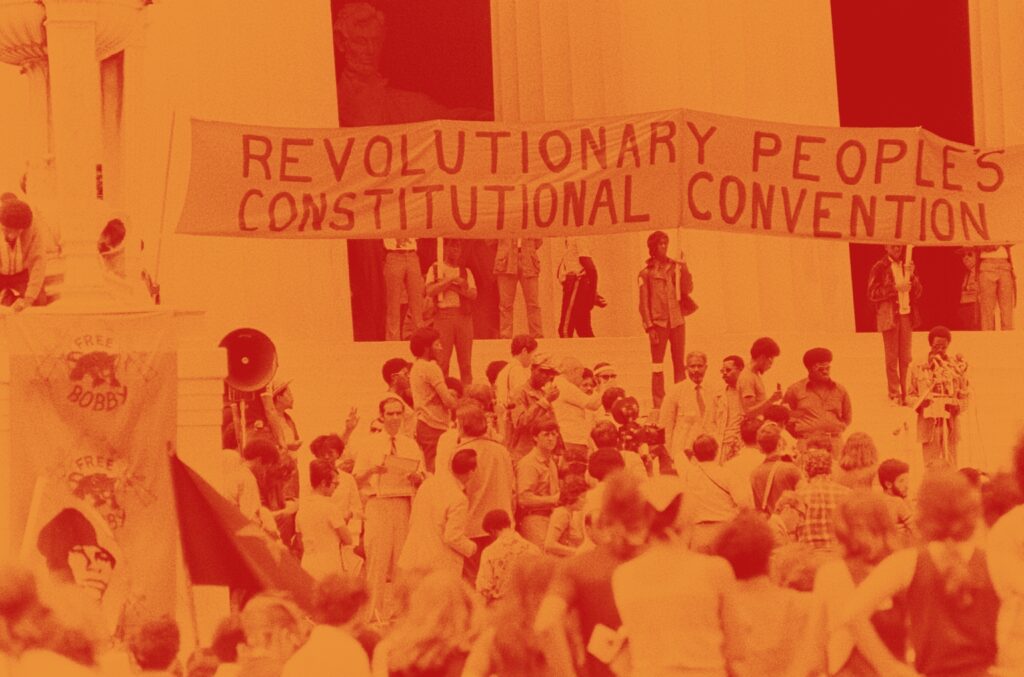
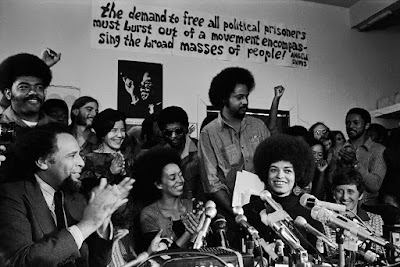
A rally for the 1970 Revolutionary People’s Constitutional Convention hosted by the Black Panthers. Image: AP

Democracy Was a Decolonial Project

For generations of American radicals, the path to liberation required a new constitution, not forced removal.

by Aziz Rana
May 30, 2024
Boston Review

The word “decolonization,” in much mainstream American commentary, is treated as an unproductive and blunt slogan: a way of reducing a nuanced history—be it in the United States or in Israel/Palestine—to a zero-sum and violent fight over who has power. “To talk of dismantling an American settler state of 330 million people is to take a rhetorical flight of fancy,” writes Michael Powell in the Atlantic. The colonial frame, he continues, generates “a morality tale stripped of subtleties” and “makes it all too easy to brush aside the practicalities of coexistence.” The implication of Powell’s argument is clear: decolonization suggests forced removal and separation. As New York Times columnist Bret Stephens writes, “real atonement” is for all non-Indigenous populations—white, Black, immigrant—to return to where they came: “If you’re an American citizen of non-Native American descent, leave.”

It goes almost without saying that these are caricatures, selective renderings of terms with long debates over their meanings. What if we looked past them, to how generations of activists and thinkers in the United States viewed their own effort to dislodge what they saw as the country’s colonial infrastructure? If we did so, we would realize that if anything, activists saw zero-sum thinking as a key marker of the colonial mindset itself. In fact, they understood the very aim of decolonization as finding a real path out of such thinking. For that reason, anticolonial American activists across various communities—Indigenous, Puerto Rican, and Black, to name a few—often turned to constitutional politics, which they embraced as a mechanism for creating a genuinely inclusive society in which equal and effective freedom was available to all communities.

Activists saw zero-sum thinking as a key marker of the colonial mindset itself.

A closer engagement with Black radical thinkers, the ideas of figures from Harry Haywood and W. E. B. Du Bois to James Boggs and Afeni Shakur in the Black Panther Party, highlights just this point. Their analysis, as well as that of Indigenous activists like Hank Adams, offers a powerful lens for reflecting on the relationship between decolonization, reform, and a nonexclusionary vision of liberation. The erasure of these constitutional visions in today’s public debates strips the depth out of anticolonial political thinking across the American twentieth century—and by doing so, restricts the tools we need today for addressing our current social crises.


For many Americans, constitutionalism is associated with a traditional civil rights frame. This is, no doubt, a large part of its history. In the 1950s, liberal Black and white voices presented the struggle for Black freedom as one of fulfilling principles embedded in the existing federal Constitution, especially those of equal protection associated with Reconstruction-era amendments. The project emphasized litigation and focused on redeeming an egalitarian national promise by unlocking the Constitution’s textual language. Brown v. Board of Education, which declared “separate but equal” doctrine inherently unequal in 1954, is the great substantive and symbolic embodiment of that project.

But the civil rights frame was never the only way of connecting constitutional politics and racial transformation. Throughout the twentieth century, Black radicals questioned whether the end of legal inequality would be enough to uproot racial subordination. As Du Bois declared in 1960, while the country was “approaching . . . a time when” Black people may be “in law equal in citizenship to other Americans,” this represented only “a beginning of even more difficult problems of race and culture.” Such figures rejected a presentation of the United States as a fundamentally liberal society, if incompletely so, in which Black freedom was primarily about providing worthy elements in nonwhite communities with an equal opportunity to achieve professional and middle-class respectability.

Instead, they argued that the intensity and violence of racial hierarchy were the product of underlying structures in American society—including deep-rooted flaws in the federal Constitution itself. The country needed more than some fine-tuning of its already egalitarian essence, because U.S. conditions embodied one variant of the colonial systems that proliferated across the globe. Such colonial circumstances, remarked Du Bois to an audience in Haiti in 1944, were not only those in which one country “belong[ed] to another country,” but also included “groups, like the Negros of the United States, who do not form a separate nation and yet who resemble in their economic and political condition a distinctly colonial status.”

Du Bois and others did not explicitly use the term “settler colonial” (it would be decades until the term was in wide circulation). Yet their analysis of colonization was adapted to the particularities of the American experience, and therefore distinct from various European imperial experiments, like those of the British in India or the Belgians in the Congo. In the U.S. context, these thinkers argued, self-government and economic prosperity for racial insiders proceeded through institutions that were designed to extract much-needed land and labor from Native and outsider groups, in the latter case particularly enslaved African workers and their descendants.

This fact generated some striking conclusions. For starters, it meant that unless Americans confronted the exploitative nature of their economic system, formal legal equality alone would never produce Black freedom. A liberal frame ignored how racial hierarchy had been woven into the fabric of American capitalism, in both small-scale production and large-scale industrialization. And if this was true, this also meant that the legal-political infrastructure of the country was organized to sustain such hierarchy. Therefore, any truly transformative response to American colonial conditions had to realize two facts. First, racial and class politics could not be separated. And second, change would require more than creative interpretations of existing text—it would necessitate basic shifts to the structure of American governance itself.

To set these shifts into motion, Black anticolonial activists would need to develop their own competing constitutional politics: a vision of alternative institutional design, values, and even governing text. Although it would be explicitly decolonial, change could not proceed in a way comparable to settings like the Congo, in which the relatively thin layer of power-holding elites were European colonial administrators without their own national movement or deeply felt connections to the land. As the great labor radical James Boggs maintained of the United States, all communities, those white and nonwhite, were permanently and mutually entangled. Decolonization, according to him, had to entail “tackling” together “all the problems of this society, because at the root of all the problems of black people is the same structure and the same system which is at the root of all the problems of all people.”

In a sense, Boggs was critiquing both a traditional civil rights frame and the idea that decolonization in the United States could merely graft onto the society a one-size fits all Third Worldism marked by a plebiscite and Black formal nationhood. The latter was a view that certainly percolated among some Black American anticolonialists, perhaps most clearly expressed in the effort in the 1960s and 1970s to establish a Republic of New Afrika. Yet the driving tendency was elsewhere. It saw the racially and economically intertwined nature of American life as requiring projects of Black freedom and of change in majority white society to be joined. As Boggs again wrote in Racism and Class Struggle (1970), “the Black Power movement must recognize that if this society is ever going to be changed to meet the needs of black people, then Black Power will have to resolve the problems of the society as a whole and not just those of black people.”


What concretely did this kind of politics entail? There were two basic orientations, emphasized at different moments and by different figures. The first concerned altering the American system of government to make it genuinely democratic. The second orientation emphasized fundamental reforms to economy and society.

Du Bois’s 1945 book, Color and Democracy, offers a systematic account of the first approach. Du Bois believed that truly overcoming both capitalism and white supremacy required confronting the structural problems of political representation in the United States. Doing so would mean targeting the existing Constitution, which, he maintained, created an infrastructure for minority rule—indeed, for a specific and quintessentially American brand of white authoritarianism. This was because the Constitution organized representation around states, privileging geography over actual people. And it fragmented and undermined popular authority through endless veto points. The result were rules that placed a massive thumb on the scale in favor of the forces of racial reaction, with ripple effects for who served as president, who sat on the Supreme Court, and what policies were contemplated. It helped ex-Confederates defeat Reconstruction and reclaim power. And once Black people were again disenfranchised, it so dramatically overrepresented Southern white constituents that Jim Crow politicians effectively determined the extent of any practical changes to the social order. “This extraordinary situation”—embodied by the “rotten-borough system” of the states, what Du Bois called a “national tabu [sic]” Americans were not allowed to critique—had “neither rhyme nor reason.” It was rather “a survival of an eighteenth-century American Tory hatred and fear of democracy, surviving as a fetish” in the form of unreflective Constitution-worship. The result was a set of institutional arrangements in which “the race problem [had] been deliberately intermixed with state particularism to thwart democracy.”

In many ways, Du Bois’s analysis mirrored the ideas of the Black communist activist and thinker Harry Haywood. Haywood was closely identified with the anticolonial idea of Black people as “an oppressed nation” in the United States and with the CPUSA’s 1920s and 1930s promotion of the “Black belt” thesis, calling for Black self-determination in counties stretching from eastern Virginia to eastern Texas. His vision of “political self-rule” in the Black belt, though, did not mean secession. Like Du Bois, Haywood, too, was focused on how to create democratic arrangements for all.

A civil rights frame was never the only way of connecting constitutional politics and racial transformation.

According to Haywood, Reconstruction’s defeat was tied to the ultimate failure to abolish “the plantation system” and therefore the persistence of deeply oppressive structures of racial capitalism. Genuine freedom for Black people across the South, he believed, could not be achieved without confronting the question of land and property. African Americans in the Black belt were a distinct and cohesive economic and political community: they had been enslaved on the land and, even in the mid-twentieth century, continued to provide the oppressed labor for its plantation economy. “There is no escape from the conclusion that freedom and prosperity for the people of the South, Negro and white, can be won only through drastic overhauling of the present system of land ownership and agrarian relations,” he argued in 1948.

But such a project was near impossible to achieve within existing institutions. Black people were not only systematically disenfranchised through explicit Jim Crow policies that denied African Americans the vote; they were also disenfranchised by the very structure of Southern state boundaries and administrative units. Haywood wrote that these “boundaries . . . arbitrarily crisscross the area of contiguous Negro majority breaking up this area into a maze of governmental administrative, judicial, and electoral subdivisions, which in no way correspond to the life needs of its people.” When white authoritarians won elections, it was because planter elites had made manipulating those elections a conscious political project. “These divisions are purposely maintained—in many cases are even gerrymandered—by the South’s rulers with the aim of continuing the political suppression of the region’s predominant” Black constituencies, Haywood wrote. All of this meant that as a programmatic agenda, “the abolition of these bureaucratic and arbitrarily established boundaries and their replacement by truly democratic ones . . . is a key task of American democracy.”

Haywood’s anticolonial vision was thus grounded in a very specific account of constitutional transformation. He called for “full equality throughout the country” alongside “self-determination in the South.” He defended the importance of ongoing struggles across the United States for Black labor and political rights. But in the South, he did not seek a new nation-state, but a new “governmental and administrative structure” to replace the old states. These institutions would facilitate Black democratic majoritarianism and serve as popular instruments for redistributing land from white “oligarchs” to the working poor, Black and white. As Haywood concluded, such Black “self-government” meant “a regrouping of country and administrative districts to guarantee full proportional representation.” It amounted to “a simple democratic demand, in full conformity with the principles of majority rule.”

It was such a sensibility that led James and Grace Lee Boggs, in the 1960s and 1970s, to update Black belt ideas as urban centers—rather than the rural South—became the heart of Black economic and political experience. As cities’ populations swelled, state-based representation, they argued, was increasingly becoming a holdover from “an agricultural era.” In a post–World War II and increasingly post-civil rights America, the system still gave disproportionate power to demographically white and geographically rural and suburban spaces. The result was national policy that deemphasized the needs of the Black poor and working classes living in cities.

The Boggses thus called for movement activists “to formulate a new Constitution that establishes a new relationship of government to people and property, as well as new relationships between the national government, the states, and the cities.” In arguing for proper federal electoral representation for cities—where large Black majorities actually lived—they imagined how aims of Black self-determination and actual American democracy could reinforce one another. Like Du Bois and Haywood before them, they saw the fundamental task of their new constitution as addressing the problems of having state-based representation as the basic unit of American government, which carried implications for the organization of federal institutions like the Senate and Supreme Court.


If one Black decolonial orientation reimagined political democracy and governance, the other focused on a social, cultural, and economic agenda. Even here, constitutional politics played a key role. This fact is best illustrated by the Black Panthers’ own experiment in constitution-writing, which culminated with the September 1970 staging in Philadelphia of a Revolutionary People’s Constitutional Convention (RPCC). That location and date embodied a large-scale counter-event in opposition to the by-then-routine anniversary celebrations on September 17 of the drafters’ signing of the 1787 U.S. Constitution.

Depending on estimates, the number of delegates and participants at the RPCC ranged from twelve to fifteen thousand people, with five to six thousand attending the plenary sessions at Temple University and Huey Newton’s opening speech; thousands more stood outside the doors but could not get seats. As one participant recalled later, delegates to the Convention came “from an array of organizations” besides the Panthers: “the American Indian Movement, the Brown Berets, the Young Lords, I wor Keun (a radical Asian-American collective), Students for a Democratic Society . . . , the newly formed Gay Liberation Front, and many feminist groups.” Those present also reported that various 1960s-era activists and celebrities mingled with the crowd and took part in plenary sessions, from Abbie Hoffman, Jerry Rubin, Tom Hayden, and William Kunstler to Muhammad Ali himself.

The event was the product of tireless organizing by Panther activists like Afeni Shakur, who were committed to using constitutional remaking as a framework for building cross-group and coalitional solidarity. Shakur, who today is remembered almost exclusively as the rapper Tupac Shakur’s mother, was a formidable activist and constitutional actor in her own right. For her and others, constitution-writing was a strategy to reach as broad an audience as possible: the language of constitutionalism maintained contact with the norms and traditions of the majority-white society while still suggesting an irruptive politics. As a shared enterprise in refounding, constitution-writing was culturally American. And yet, it also mirrored the defining acts of anticolonial rupture and independence in Asia and Africa, where there had been a proliferation of constitution-writing exercises. It thus provided space for radical activists to reconceive American values in a way that was nonviolent, revolutionary, and collaborative all at the same time.

And collaborative it had to be, since the document was meant to be written together with various non-Black political formations. The new constitution, the Panthers hoped, would be able to remake American society in ways that transcended its colonial infrastructure while respecting the intertwined nature of its white and nonwhite communities. Beyond the white and Black binary, activists also understood how the different social position of groups such as Native peoples (with their experience of expropriation and violent removal), Mexican Americans (with their related history of conquest, ongoing discrimination, and dependent labor status), or Puerto Ricans (legal subjects of an imperial state) spoke to the real complexities of overcoming the American brand of colonialism. Each of these groups, while all caught up in the same overarching structures of colonial power, were located in collective life in profoundly distinct ways, with necessarily different implications for the meaning of freedom.

The activists’ aim was to express the collective agency of a movement coalition across backgrounds and identities—meaning that they sought to incorporate proposals that had no direct relation to race and colonialism. Some of the convention’s constitutional demands, for instance, incorporated extensive LGBTQ+ rights including for transgender persons and guarantees that “all modes of human sexual self-expression deserve protection of the law and social sanction.” They also contained feminist demands, such as those for extensive reproductive rights, “socialization of housework and child care,” and “guaranteed paid maternity leave.”

The result was a series of workshop reports that spelled out a normative vision for a future constitution grounded in decolonization but not limited to that frame alone. Alongside the policies already mentioned, the reports called for constitutionally entrenching the sovereign right of all colonized peoples, including Puerto Ricans and Indigenous nations, to determine, once and for all, their future political status, as well as what legal relationship (if any) they wished to have with a reconstructed United States. They further demanded broad-ranging reparations, at home but also for communities abroad that had faced security state intervention; expanded socioeconomic rights and wealth transfers through the public and universal provision of food, housing, medical care, a nonexploitative job, and a guaranteed income; and extensive demobilization of the military, security, and police.

Taken together, the goal was a new popular compact for all Americans regardless of race or identity—a non-exploitative job for everyone, a guaranteed income for everyone. “We cannot afford not to rewrite [the Constitution]!” Shakur concluded. “We must attempt this last straw at National Salvation under this present system, for we must exhaust all legal means. We know that there can be no peace until there is land, bread, housing, education, clothing, justice and blessed liberty!”

Ultimately, these reports embodied the high-water mark for the Panthers’ efforts at articulating a decolonial alternative. Plans for participants to reconvene in Washington, D.C. in November 1970 to hold a massive ratification of the new constitution more or less collapsed, due to a combination of internal disagreements and U.S. government sabotage and repression.

Constitution-writing was nonviolent, revolutionary, and collaborative all at the same time.

But these ideas nonetheless dovetailed with separate proposals proliferating during the era. In 1972’s Trail of Broken Treaties, a caravan of Indigenous organizations traveled from the U.S. West Coast to the Washington, D.C. office of the Bureau of Indian Affairs. These organizations developed a set of demands partially drafted by the Assiniboine-Sioux activist Hank Adams, who in 1968 had also been a member of the national steering committee of the Poor People’s Campaign led by Martin Luther King, Jr. That twenty-point position paper called for Native nations, even without formal independence, to enjoy actual control over their territory, resources, and members—effectively establishing a system of concurrent sovereignty with the United States. The paper further contended that U.S. federal actions with respect to such nations would only be legitimate if based on treaty obligations. It held that all existing treaties should be enforced, with Indigenous peoples enjoying the ability to seek restitution before an appropriate arbiter for the violation of legal rights. Along with extensive material redistribution, activists additionally pressed for the “Restoration of the Native American Land Base”—meaningful land reform and return.

And at various historical moments, activists, especially tied to Mexican American and Puerto Rican politics, argued for the decriminalization of the border as a central decolonial commitment. For instance, the socialist Congressperson Vito Marcantonio, who represented a heavily Puerto Rican New York district throughout the 1940s, repeatedly joined calls for Puerto Rican independence with both economic restitution and the presumptive admission of post-independence Puerto Ricans into the United States. This idea persisted across the century, especially in immigrant politics. In order for the United States to reverse its imperial relation with its neighbors, it would have to embrace a fundamentally different politics for the border.


The great difficulty these decolonial ideas faced was not that their aims were exclusionary and zero-sum, merely reversing who now enjoyed a power to oppress. It was rather that during key moments in the twentieth century, including in the late 1960s and 1970s, there was no real pathway for creating an American majority behind both the reconstructive legal-political agenda and the transformative social, cultural, and economic one. Part of the reason had to do with the evident logistical difficulty of some of the proposals. But at a deeper level, the reform sensibility as a whole faced decisive pushback due to political currents. The growing conservatism of white working-class politics—which fed presidential victories for Richard Nixon as well as an anti–New Deal turn even within the Democratic Party—had profound effects on what ideas could get a real hearing in American life.

Unsurprisingly, the new climate proved inhospitable to radicalism. An emerging post-1960s consensus among center-left circles about how any reform discourse could proceed meant that constitutional politics had to be narrowed in scope and ambition. Now, it had to embrace the existing legal-political system and seek ameliorative changes on terms managed by Cold War judges and other state officials. The idea that anticolonial thinkers in the United States had a competing constitutional framework disappeared from popular debate. If anything, their thought became framed in terms familiar from opinion pieces today: as anti-constitutional and as having no account of inclusive democracy.

This conventional wisdom no doubt derived partly from choices made by some Black radical activists. For all their engagement with constitutional politics, the Panthers never adequately linked their social, cultural, and economic agenda to reforms to democratic governance of the kind that Du Bois and Haywood had developed earlier in such detail. And as the country shifted rightward, that lacuna left the prevailing institutions as the only model of American thinking about constitutional democracy.

In the retreat away from large-scale transformation and constitutional reform, the vast majority of activists in organizations like the Panthers turned to a local focus on basic services (from children’s breakfasts to health care clinics, ambulances, clothing, busing, prisoner support, and education centers). But smaller Black radical offshoots, including elements within the Panthers, reacted to repression and blocked reforms by embracing an armed response to the U.S. state. That response was a politically implausible pathway to change, along with raising all the ethical concerns marked by a turn to violence. Above all, it further allowed state and business officials to cast all traditions of decolonization as destructive and inherently un-democratic.

This was, of course, despite the depth and breadth of decolonial politics across the twentieth century, and the fact that thinkers and activists—again from Du Bois and Boggs to Hank Adams—had overwhelmingly avoided that dead end. They had sought consciously to link change to inclusive coalition-building and imaginative new democratic processes. But in a society marked by Nixonian law and order, simply being subject to the government’s lawlessness provided the ammunition for critics to tar all anticolonial activists (especially Black and Indigenous ones), not to mention their efforts, as dangerously out of bounds. All the while the state was engaged in extensive crackdowns, often on false pretenses—up to and including the the killing of Panther leaders like Fred Hampton. 

The idea that anticolonial thinkers in the United States had a competing constitutional framework disappeared from popular debate.

Ultimately, the two decolonial orientations, now shorn of their constitutional ambitions and insurgent potential, were reduced in political life to husks of their former selves. Often all that persisted of these ideas in mainstream American politics was the notion of Black electoral control, typically at the city level through new party machines. But such representation, something the Boggses had sought, existed without any of the wide-ranging structural changes they wanted. These changes would have ensured that city power was not hamstrung by the regressive politics and austerity commitments at the state and national levels. And it would have linked mass city mobilizations or experiments in places like Jackson, Mississippi to granting local populations the capacity to access the resources and national infrastructure required to realize those projects.

Demands like those articulated at the RPCC were largely ignored. The symbolic idea of a Black “nation” still persisted, but the conventional version of the idea deemphasized the class radicalism of the Panthers. At times, it could even devolve into a brand of ethnic politics that focused on cultural pride in ways that mirrored the very white localism Black anticolonial activists had challenged.


Today offers a striking opening to think again about the richness of that decolonial imagination. Over the last two decades, the country has faced intensifying social conditions: extreme military violence, financial crisis, striking class inequalities, the carceral state’s generational effects on poor and minority communities, white authoritarianism, and ecological disaster, to name a few. The existing legal-political institutions, marked by the same antidemocratic weaknesses Du Bois and Haywood highlighted nearly a century ago, have only strengthened a Trumpian far right and worsened these dilemmas.

At the same time, Biden and those around him seem trapped in a Cold War imagination built around increasingly hollow precepts—from the virtues of American primacy and global market liberalism to deep wariness of any significant structural changes, no matter how necessary. All of this has proven fundamentally ill-equipped for the times. The results have veered from paralysis to catastrophe—as underscored by the U.S. approach to Gaza. It is no wonder that anticolonial activism and thought have returned to the forefront: more than ever, the conventional political lens in the United States appears exhausted.  

The response must be to push back decisively against any knee-jerk rejection of a century’s worth of anticolonial American ideas and efforts. Instead, it is essential to appreciate how even if past activists did not engage in the familiar moves of court-centric constitutional politics, they nonetheless articulated a clear framework for making sense of the constitutional system as a whole. And they saw their efforts at reform as a way of building a society in which all—again, no matter the group identity—enjoyed equal and effective freedom. In this way, these activists had perhaps much in common with figures elsewhere, like Nelson Mandela and others in South Africa, who too sought to find a pathway for everyone out of the destructiveness of an embedded colonial state and economy. Their ideas may have been shaped for American conditions, but they were part of global efforts to think beyond the colonial binary.

Doing the same today requires engaging seriously with the parts of those past American anticolonial agendas that remain vibrant political resources. It also means confronting the central dilemma that long bedeviled such transformative politics: how to build a broad, multiracial majority behind both democracy and decolonization in a society like the United States, marked as it is by imperial power and ongoing colonial legacies. Holding those two ends—democracy and decolonization—together at once is the strategic and conceptual challenge for our times. Fortunately, it is also our ethical inheritance from movements past.

This essay is drawn from the newly published book, The Constitutional Bind: How Americans Came to Idolize a Document That Fails Them. Reprinted with permission from the University of Chicago Press.  

Independent and nonprofit, Boston Review relies on reader funding. To support work like this, please donate here.


ABOUT THE AUTHOR:

Aziz Rana is professor of law and government at Boston College. He is the author of The Constitutional Bind: How Americans Came to Idolize a Document That Fails Them and The Two Faces of American Freedom.


 

Wednesday, March 13, 2024

The Fundamental Crisis and Foundational Contradiction Facing the United States During the Upcoming Presidential Election Year of 2024: Fascism guided, informed, and enabled by the Doctrines and Practices of White Supremacy and Global Capitalism--PART 20

Racial Fascism
Alberto Toscano

Installation view of Kinetics of Violence by Alexander Calder and Cady Noland, New York, Venus Over Manhattan, 2017.

Issue #139
October 2023
 
"Swastikas bloomed in Chicago parks like misbegotten weeds."
—Martin Luther King, “Drive to End Slums” (1967)

"Nothing is more important than stopping fascism because fascism will stop us all."
—Fred Hampton (1969)


"Fascism was a monster born of capitalist parents. Fascism came as the end-product of centuries of capitalist bestiality, exploitation, domination and racism—mainly exercised outside of Europe. It is highly significant that many settlers and colonial officials displayed a leaning towards fascism."
—Walter Rodney, How Europe Underdeveloped Africa (1972)

"Let us be reminded that before there is a final solution, there must be a first solution, a second one, even a third."
—Toni Morrison, “Racism and Fascism” (1995)


It Did Happen Here

Just as the aftermath of the 2016 US presidential election witnessed the mainstreaming of scholarly and activist discussions of fascism in the United States and beyond, the frantic quickening of the news cycle on the eve of the 2020 contest was again accompanied by multiple efforts to check America’s authoritarian pulse. Despite the deadly farce of the January 6 white riot (America’s own beer-bong putsch), the departure of the forty-fifth president has made way for a rushed remaindering in some quarters of the debate on native (or, better, nativist) fascism. The Black radical perspectives on the fascist problematic surveyed below—with their commonly neglected insistence on the structuring role of fascist potentials to the US body politic—would suggest that we instead stay with the trouble that briefly forced even some liberal partisans of American exceptionalism to consider that fascism was not some dreadful anachronism imported from the Old World; that instead, to paraphrase H. Rap Brown, it might be “as American as cherry pie,” deeply enmeshed in histories of enslavement and extermination, dispossession and domination that continue to shape the US present, materially and ideologically.

Where in 2016 attention gravitated towards the incoming administration’s organic and ideological links with the extreme right (Bannon, Miller, Spencer & Co.), the context of a mass civic insurgency against police murder and racial terror—the George Floyd Rebellion—shifted the tenor and relevance of invocations of fascism in ways that should be allowed to resonate irrespective of changed occupancy in the Oval Office. In the months leading up to the 2020 election, the systemic challenge posed by mass Black-led movements against the racial and carceral state was displaced by the US government onto the familiar figure of the (white) anarchist (or communist) agitator, as “Antifa” became a target for William Barr’s Department of Justice (still undecided whether this was a “foreign terrorist organization” or an internal “seditious” group). In the interim, the fauna of right-wing agitation grew weirder and more sinister still, thanks to QAnon, the Boogaloo movement, the Oath Keepers, and the Proud Boys—who clearly took the presidential guidance to “stand down and stand by” all too literally. The state’s exceptional powers—that dependable matrix of historical fascisms—were flexed in scenes of unidentified federal agents bundling protesters into unmarked rental vans and in the shooting of Michael Reinoehl by a US Marshals task force, even if further escalations did not eventuate.

Meanwhile, on the ideological stage, “critical race theory” (along with the New York Times’ “1619 Project”) was loudly proclaimed to be an “ideological poison” that must be “quickly extinguished”; the Executive Branch’s Office of Management and Budget dispatched a memo to all federal agencies to “cease and desist from using taxpayer dollars to fund … divisive, un-American propaganda training sessions”; and an executive order condemned anti-racist critics for advancing a “vision of America that is grounded in hierarchies based on collective social and political identities,” a ludicrous case of projection if there ever was one. This very recent history should not be treated as a freakish blip; rather, as demonstrated by the persistence of the politics and personnel that made it possible (not least at the level of state legislatures that have ramped up their projects of racial disenfranchisement, dispossession, and ecocide), it demands acknowledgment as the index of an entrenched and arguably burgeoning political potential.

Notwithstanding the changing terrain, talk of fascism has generally stuck to a familiar groove, namely asking whether present phenomena are analogous to those of interwar European fascisms.

Skeptics of comparison will underscore how the analogy of fascism either treats the present moment as exceptional, papering over US histories of authoritarianism, or, alternatively, is so broad as to fail to define what is unique about our current predicament. Analogy’s advocates will instead point to the need to detect family resemblances with past despotisms before it’s too late, often making their case by advancing some ideal-typical check list, whether in terms of the elements of or the steps towards fascism. But what if our talk of fascism were not dominated by the question of analogy?

Attending to the long history of Black radical thought about fascism and anti-fascist resistance—what Cedric Robinson called a “Black construction of fascism,” an alternative to the “the historical manufacture of fascism as a negation of Western Geist”—could serve to dislodge the debate about fascism from the deadlock of analogical thinking, providing the resources to confront our volatile interregnum.

Long before Nazi violence came to be conceived as beyond comparison, Black radical thinkers sought to expand the historical and political imagination of an anti-fascist left by detailing how what could be perceived from a European or white vantage point as a radically new form of ideology and violence was in effect continuous with the history of (settler-)colonial dispossession and racial slavery.


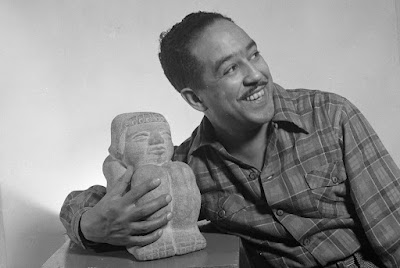
Langston Hughes in a 1943 photo taken by Gordon Parks for the US Office of War Information. Source: Library of Congress.

The pan-Africanist intellectual and activist George Padmore, breaking with the Communist International over its failure to think the nexus between “democratic” imperialism and fascism, would write in How Britain Rules Africa (1936) of settler-colonial racism as “the breeding-ground for the type of fascist mentality which is being let loose in Europe today.” He would go on to see in South Africa “the world’s classic Fascist state” grounded on the “unity of race as against class.”

Padmore’s anatomy of what he termed “colonial fascism” thus anticipated the memorable depiction of fascism as the boomerang effect of European imperialist violence in Césaire’s Discourse on Colonialism. It was also echoed by the Tunisian-Jewish writer Albert Memmi, and by the Guyanese historian and activist Walter Rodney, when he wrote of the “fascist potential of colonialism” with specific reference to settler support for the Vichy regime and pied-noir efforts to destabilize liberal rule in metropolitan France. The anti-colonial conviction whereby the standpoint of the targets of racial violence gives the lie to the exceptionality of intra-European fascism was also echoed by African-American intellectuals. Speaking in Paris at the anti-fascist International Writer’s Congress in 1937, the poet Langston Hughes would declare: “In America, Negroes do not have to be told what fascism is in action. We know. Its theories of Nordic supremacy and economic suppression have long been realities to us.” This was a lesson that could also be drawn from the monumental historical reckoning with US racial capitalism that is Du Bois’s 1935 Black Reconstruction in America. As Amiri Baraka suggested, the overthrow of Reconstruction enacted a “racial fascism” that long predated Hitlerism in its use of racial terror, co-optation of poor whites, and passionate investments in white supremacy among ample sectors of the capitalist class, financial as well as industrial. Reading the present via this lens can make palpable how and why “institutionally the historical furniture filling America’s political space has already been arranged in such a way that it would always leave open the prospect of evolving even greater authoritarian forms like fascism.”In this view, an American racial fascism could go unremarked because it operated on the other side of the color line, just as colonial fascism took place at a spatial and epistemic remove from the imperial metropole. As Jean Genet observed on May 1, 1970 at a rally in New Haven for the liberation of Black Panther Party Chairman Bobby Seale: “Another thing worries me: fascism. We often hear the Black Panther Party speak of fascism, and whites have difficulty accepting the word. That’s because whites have to make a great effort of imagination to understand that blacks live under an oppressive fascist regime.”

Fascism, Prisons, and Black Liberation

It was largely due to the Panthers, or at least in their orbit, that “fascism” returned to the forefront of radical discourse and activism in the late 1960s and early 1970s—the United Front Against Fascism conference held in Oakland in 1969 brought together a wide swath of the Old and New Lefts, as well as Asian-American, Chicano, and Puerto Rican activists who had developed their own perspectives on American fascism (for instance, by foregrounding the experience of Japanese internment during World War II).

In a striking testament to the peculiarities and continuities of US anti-fascist traditions, among the chief planks of the conference was the notionally reformist demand for community or decentralized policing—to remove racist white officers from Black neighborhoods and exert local checks on law enforcement. It is not, however, to leading members of the Black Panther Party but to political prisoners close to the Panthers that we must turn for theories about the nature of late fascism in the United States. While debates about “new fascisms” were polarizing radical debate across Europe, the writing and correspondence of Angela Y. Davis and George Jackson outlined the possibility of theorizing fascism from the direct experience of the violent nexus between the carceral state and racial capitalism.

In one of his prison letters on fascism, collected in Blood in My Eye, George Jackson offered the following reflection:

When I am being interviewed by a member of the old guard and point to the concrete and steel, the tiny electronic listening device concealed in the vent, the phalanx of goons peeping in at us, his barely functional plastic tape-recorder that cost him a week’s labor, and point out that these are all manifestations of fascism, he will invariably attempt to refute me by defining fascism simply as an economic geo-political affair where only one party is allowed to exist aboveground and no opposition political activity is allowed.

Following Jackson, we might ask: What happens to the turns and returns of the theoretical debate over fascism and (neo-)authoritarianism when it undergoes a Gestalt shift and takes the racial capitalist state and its carceral apparatus as its fulcrum, in something like a “tilt shot angled from below” that might disclose “a panorama of violence endured”?

As Jacques Derrida intimated in an unsent letter to Jean Genet, dated one day prior to Jackson’s assassination by a guard sniper at San Quentin:

"In a prison—this one and others—where it thought it had put its outside in chains, the system of (Western-white-capitalist-racist) society has made possible, by this act, the analysis of its functioning, a practical analysis that is at once the most implacable, the most desperate, but also the most affirmative."

It has become commonplace in discussions of fascism to castigate the 1970s as a kind of cognitive nadir when fascism was degraded from a category of historical analysis and taxonomy into a one-size-fits-all political insult, with dire consequences. In what follows, I want to take the imprudent wager that there is virtue and insight in the seeming exaggeration or inflation of fascism in the context of seventies radicalism and liberation politics. But I especially want to underscore how viewing fascism through the prism of Black radical intellectual traditions can redirect our contemporary debate in fruitful and important ways. What might happen to our conceptions of fascism and authoritarianism if we took our bearings not from putative analogies with the European interwar scene, but, for instance, from the materiality of the prison-industrial complex, from the “concrete and steel,” from the devices and the personnel of surveillance and repression? Probing the analytical nexus of fascism and racial capitalism forged in the liberation struggles of the 1970s, we can also connect it back to the analysis of fascism emerging from Black theorists in the interwar period and forward to the afterlives of fascism in the late twentieth and early twenty-first centuries.


February, 1972: Angela Davis speaks to the press at a press conference following her release on bail during her trial. L-R: Howard Moore (lawyer), Fania Jordan, Angela. Franklin Alexander stands behind Angela. Photo: Stephen Shames.

In their writing and correspondence, which is marked by differences of interpretation interwoven with a profound comradeship, both Angela Y. Davis and George Jackson identified the US state apparatus as the site for a reemergence or indeed a perfecting of certain features of (European) historical fascisms. Much of their theorizing is suffused by contemporary debates on the nature of monopoly capitalism, imperialism, and capitalist crises, as well as, in Jackson’s case, by an effort to revisit the classical historiography on fascism. Of note and relevance for contemporary concerns is the specific light that the prism of race—of racial domination and racial capitalism—sheds on the nexus of fascism and democracy, and how it can help us to interrogate and displace the normative conviction regarding the absolute antithesis between fascist despotism and liberal democracy. Both Jackson and Davis are profoundly aware of the disanalogies between present forms of domination and historical fascism, but they both assert the epistemologically privileged vantage point provided by the view from within a carceral-judicial system that could fairly be described as a racial state of terror. In distinct ways, they can be seen to relay and recode that foundational gesture of anti-racist and Black radical anti-fascism crystallized in Césaire’s Discourse on Colonialism. As the Martinican poet and politician tells it: “And then one fine day the bourgeoisie is awakened by a terrific boomerang effect: the gestapos are busy, the prisons fill up, the torturers standing around the racks invent, refine, discuss.”

But the new form of American fascism that Jackson and Davis anatomize is not an unwanted return from the other space of colonial violence; it originates from the bosom of liberal democracy itself. The prisons are already full. And rather than a boomerang, the generalization of racialized carceral terror into society at large—which is one of the foremost features of the new fascism—is a much less dramatic or sudden process of seepage, the permeation of the social space of actually existing liberalism by models and devices invented, refined, and discussed amid concrete and steel. As Mullen and Vials justly observe:

For people of color at various historical moments, the experience of racialization within a liberal democracy could have the valence of fascism. That is to say, while a fascist state and a white supremacist democracy have very different mechanisms of power, the experience of racialized rightlessness within a liberal democracy can make the distinction between it and fascism murky at the level of lived experience. For those racially cast aside outside of liberal democracy’s system of rights, the word “fascism” does not always conjure up a distant and alien social order.

Like Davis, Jackson also stresses the necessity to grasp fascism not as a static form but as a process, profoundly affected by its political and economic contexts and conjunctures. Whence the limits of models, analogies, or ideal types. Jackson comments on “the defects of trying to analyse a movement outside of its process and its sequential relationships. You gain only a discolored glimpse of a dead past”; he remarks how, historically, fascism “developed from nation to nation out of differing levels of traditionalist capitalism’s dilapidation.” Now, while for the author of Soledad Brother fascism is profoundly linked to a restructuring of the capitalist state, it is also fundamentally a counterrevolutionary form, manifesting in the violence with which it meets any substantive threat to the integrity of the state of capital. It is nevertheless instructive to note that, echoing Nicos Poulantzas’s analysis in Fascism and Dictatorship, for Jackson fascism does not respond directly to an ascendant revolutionary force; it is a kind of delayed counterrevolution, parasitic on the weakness or defeat of the anti-capitalist left. The “opposition of a weak socialist revolution” is thus a shared feature among the various fascisms (one can sense the indictment of the contemporary left in Jackson’s historical allusion). In a nutshell then: “Fascism must be seen as an episodically logical stage in the socio-economic development of capitalism in a state of crisis. It is the result of a revolutionary thrust that was weak and miscarried—a consciousness that was compromised.” Viewed from the US vantage point, that compromise is necessarily entangled with the persistent pattern of the racialization of class that defines American history ever since the white-supremacist counterrevolution against Black Reconstruction, or indeed ever since Bacon’s Rebellion and the concomitant “invention of the white race.” As Jackson quips: “Marx’s definition of history as a broken, twisted, sordid spectrum of class struggles is substantiated by Amerikan labor history.”

Fascism in the United States had achieved a kind of perfected form for Jackson—all the more insidiously hegemonic because of the marriage of monopoly capital with the (racialized) trappings of liberal democracy. As he declared:

Fascism has established itself in a most disguised and efficient manner in this country. It feels so secure that the leaders allow us the luxury of faint protest. Take protest too far, however, and they will show their other face. Doors will be kicked down in the night and machine-gun fire and buckshot will become the medium of exchange.


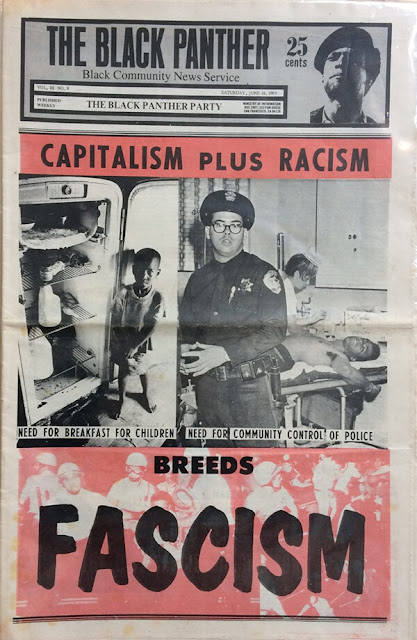
Emory Douglas’s work for The Black Panther newspaper, 1969.

Notwithstanding the national and conjunctural mutability of fascism, Jackson provocatively claimed that (economic) reform could be identified as “a working definition of fascist motive forces,” one that was particularly apt for the political expressions of US monopoly capital.

In Angela Y. Davis’s concurrent analysis, the carceral, liberationist perspective on fascism is both further refined and shifted. For Davis, American fascism in the early 1970s took what was best described as a preventive and incipient form. The terminology was borrowed and adapted from her former teacher Herbert Marcuse. In a 1970 interview with Hans Magnus Enzensberger, Marcuse had proposed inverting the customary political sequence that would see fascism as reactive not just in social content but in temporal form—whether responding immediately to a potentially triumphant revolutionary upsurge or, in a mediated way, to an already defeated or ebbing challenge to capitalism. It is not reaction but anticipation that animates this new figure of fascism. As Marcuse tells Enzensberger:

I believe that there is something like preventative fascism. In the last ten to twenty years we’ve experienced a preventative counter-revolution to defend us against a feared revolution, which, however, has not taken place and doesn’t stand on the agenda at the moment. In the same way preventative fascism comes about.

The question of the possibility of fascism in the United States, much debated by liberation movements and the far left throughout the seventies and into the eighties, is for Marcuse deeply entangled with the concrete forms taken by “preventative counterrevolution” as a core strategic imperative of the capitalist establishment, as well as its specific modalities of “preventive counter-violence.”

The specificity of this anticipatory logic is also closely linked to the distinctive disanalogies between this “incipient fascism” and its interwar European precursors. As Marcuse reflects:

The question is whether fascism is taking over in the United States. If by that we understand the gradual or rapid abolition of the remnants of the constitutional state, the organization of paramilitary troops such as the Minutemen, and granting the police extraordinary legal powers such as the notorious no-knock law which does away with the inviolability of the home; if one looks at the court decisions of recent years; if one knows that special troops—so-called counterinsurgency corps—are being trained in the United States for possible civil war; if one looks at the almost direct censorship of the press, television and radio: then, as far as I’m concerned, one can speak with complete justification of an incipient fascism … American fascism will probably be the first which comes to power by democratic means and with democratic support.

Fascism here defines a set of repressive tactics, as well as an encompassing political and ideological process, which differentially targets racialized and subaltern populations whose very existence and sociality are perceived as a threat—whence the porous borders between the “criminal” and the “political prisoner.” It is a process in which—to borrow from Jackson’s characterization of the “oppressive contract” underlying US capitalism—“accrual of contempt [for the oppressed] is [a] fundamental survival technique.”Davis develops the Marcusean thesis that “fascism is the preventive counter-revolution to the socialist transformation of society,” specifying that transformation from the vantage point of the lived experience of racialized communities in the United States. For the state, the most threatening feature of Black revolutionary politics takes the form not so much of the armed struggle invoked by Jackson but of the “survival programs,” the enclaves of autonomous social reproduction practiced by the Black Panthers and other militant and activist groups. What can be gleaned from Davis’s account more broadly are the differential visibility and experience of both fascism and democracy. In this regard, it can help to attune us to the ways in which race and gender, alongside class, can also determine the modality in which fascism is lived.There is a kind of everyday fascism that marks the interaction of people of color with the state, and which, while acting as the repressive infrastructure of a liberal democracy still steeped in the legacies of white supremacy, also signals the possibility or tendency to generalize incipient or preventive fascism to the population at large. As Davis warns, fascism in the early 1970s is “primarily restricted to the use of the law-enforcement-judicial-penal apparatus to arrest the overt and latent-revolutionary trends among nationally oppressed people, tomorrow it may attack the working class en masse and eventually even moderate democrats.” But the latter are, alas, unlikely fully to perceive this phenomenon, both because of the making invisible of its site—carceral space with its “totalitarian aspirations”—and the dilated character of its unfolding, of its time. The kind of fascism diagnosed by Davis is a “protracted social process,” whose “growth and development are cancerous in nature.”

Davis’s analyses direct us to the prison as a racialized enclave or laboratory for the fascistic strategies and tactics of counterrevolution, which are in turn understood in terms of a molecular social process. Both spatially and temporally, the perception of fascist realities and potentialities is occluded by the opacity of their social and political infrastructure. As Davis would later write, in the context of her abolitionist activism:

The dangerous and indeed fascistic trend toward progressively greater numbers of hidden, incarcerated human populations is itself rendered invisible. All that matters is the elimination of crime—and you get rid of crime by getting rid of people who, according to the prevailing racial common sense, are the most likely people to whom criminal acts will be attributed.

Dylan Rodriguez has powerfully captured the originality and challenge of the “fascism problematic” that Davis and Jackson forged out of the political violence of confinement. Notwithstanding their partially divergent evaluations, in naming a fascist present in the United States (whether incipient or accomplished) they share in “a theoretical and symbolic political gesture that fosters an epistemological break from the common sense of U.S. white supremacy and the regime of state violence on which it is premised.” This gesture is twofold. On the one hand, it anchors racial, carceral, and counterinsurgent violence in political economy—not just by identifying the instrumentality of brutal repression in the reproduction of class relations, but by amplifying the Fanonian insight that we should consider violence “as a primary and productive (rather than merely repressive) articulation of particular social formations.” On the other, the reformulation of the fascist problematic from the vantage point of racialized political incarceration has the lasting virtue of troubling the facile if ideologically inescapable opposition of fascism and (liberal) democracy. As Rodriguez pointedly asks: “How might our political understanding of the United States be altered or dismantled if we were to conceptualize fascism as the restoration of a liberal hegemony, a way out of crisis, rather than as the symptom of crisis or the breakdown of ‘democracy’ and ‘civil society’?”

As ever, rearticulating the analysis and etiology of fascism also inflects the strategic imaginary of anti-fascism:

The dynamic, strategic relations of violence condensing within the American social formation at different times and in different places are neither accidental nor excessive, and the challenge of this reconceptualized fascism problematic is to comprehend the socially reproductive capacities of coercive technologies and (proto-)genocidal practice within the current order.

From a complementary angle, Nikhil Pal Singh has illuminated the historical nexus between the “preventive wars” waged by US imperialism and the fascist potentialities inherent to settler-colonialism and chattel slavery. As he writes:

Poet Langston Hughes once described the casualties of U.S. expansion, slavery, and segregation as the victims of “our native fascisms”; as careful scholars affirmed, fascism was largely a deviation of democratic regimes. Thus, while democratic liberalism continually reimagines fascism as its monstrous Other, fascism might be better understood as its doppelganger or double—an exclusionary will to power that has regularly re-emerged, manifesting itself in: (1) those zones of internal exclusion within liberal-democratic societies (plantations, reservations, ghettos, and prisons); and (2) those sites where liberalism’s expansionist impulse and universalizing force has been able to evade its own “constitutional restraints” (the frontier, the colony, the state of emergency, the occupation, and the counter-insurgency).


Gary Simmons, Recapturing Memories of the Black Ark (2014–ongoing).

Delving into racial and colonial fascisms—and into European “historical fascism” as “the last major drive for European colonial ventures in the twentieth century”—makes intelligible the superficially paradoxical notion of a “fascist freedom” (and the subjectivities of the Herrenvolk liberals and democrats who promote it).

If fascism is also a product of the long history of “race wars,” then we cannot understand the fascist potentials of US nativism without attending, as Singh does, to the Indian Wars, and to the ways in which the settler-colonial organization of dispossessive violence vested “ordinary citizens with an expansive police power.”

Unlike classical European fascisms, US racial and settler-colonial fascism does not manifest univocally as the apotheosis of sovereignty, as a jackbooted Leviathan. Rather, as Singh observes:

The construction of racist individualism and settler freedom that distinguished the Jacksonian democracy idealized by [Steve] Bannon, for instance, encouraged a slackness of centralized government control tethered to a violence exercised at its borders and margins, something that seemed chaotic, unstable, and disordered from the controlling seat of power. Considered in these terms, the Trump administration hardly needs organized paramilitaries to do its bidding, given the normative, historical, and institutional ways in which police powers in the United States operate as delegated and sovereign prerogatives to master and control indigenous and exogenous others.


Notes:

On Toni Morrison’s reflections on fascism, see Roderick Ferguson’s illuminating essay “We Cannot Be the Same After the Siege,” Allies, ed. Ed Pavlić et al. (Boston Review, 2019). See also Ferguson’s powerful call for an anti-fascist politicization grounded in queer-of-color critique in “Authoritarianism and the Planetary Mission of Queer of Color Critique,” Safundi: The Journal of South African and American Studies 21, no. 3 (2020).

Mike Baker and Evan Hill, “Police Say an Antifa Activist Likely Shot at Officers. His Gun Suggests Otherwise,” New York Times, April 10, 2021.

The recent New York Review of Books debate featuring Peter E. Gordon, Sam Moyn, and Sarah Churchwell provides an informative panorama of positions on this question. Peter E. Gordon, “Why Historical Analogy Matters,” New York Review of Books, January 7, 2020; Samuel Moyn, “The Trouble with Comparisons,” New York Review of Books, May 19, 2020; Sarah Churchwell, “American Fascism: It Has Happened Here,” New York Review of Books, June 22, 2020.

Cedric J. Robinson, “Fascism and the Response of Black Radical Theorists,” in Racial Capitalism, Black Internationalism and Cultures of Resistance, ed. H. L. T. Quan (Pluto, 2019), 149.

Quoted in Bill Schwartz, “George Padmore,” in West Indian Intellectuals in Britain, ed. Bill Schwartz (Manchester University Press, 2003), 141–2. Though unlike Padmore he maintained his fealty to Soviet Communism, R. Palme Dutt also discerned the continuities between European fascism and Empire: “In the poems of a Kipling, in the Boer War agitation of a Daily Mail, in the war dictatorship of a Lloyd George riding roughshod over constitutional forms and driving to the aim of a ‘Knock-out Blow,’ the spirit of Fascism is already present in embryonic forms.” R. Palme Dutt, Fascism and Social Revolution (Lawrence & Wishart, 1935), 240. See also Alfie Hancox, “Fascisation as an Expression of Imperialist Decay: Rajani Palme Dutt’s Fascism and Social Revolution,” Liberated Texts, March 23, 2021.

“Every colonial nation carries the seeds of fascist temptation in its bosom. What is fascism, if not a regime of oppression for the benefit of a few?” Albert Memmi, The Colonizer and the Colonized (1957; Earthscan, 2003), 106–7; Walter Rodney, How Europe Underdeveloped Africa (1972; Verso, 2018), 243.

Langston Hughes, “Too Much of Race,” Crisis 44, no. 9 (September 1937), 272. See also the poem “Beaumont to Detroit: 1943,” whose final lines are: “How long I got to fight / BOTH HITLER—AND JIM CROW.”

I borrow the term “racial fascism” from Baraka, who crucially posits a violent dialectic between the dynamics of racial domination in the United States and imperialism, a theme that Du Bois himself had powerfully underscored as early as “The African Roots of War” (1915): “Andrew Johnson’s point position in overthrowing Reconstruction and imposing a racial fascism on Afro America and the Afro American people readied the whole of the U.S. nation for imperialist rule, which today has moved to complete control of the entire nation.” Amiri Baraka, “Black Reconstruction: Du Bois & the U.S. Struggle for Democracy & Socialism,” Conjunctions, no. 29 (1997): 78.

Harry Harootunian, “A Fascism for Our Time,” Massachusetts Review, 2021. Harootunian details the “founding oligarchical intentions” and constitutional constructions that, in conjunction with the material histories of racial capitalism, have seeded sui generis fascist potentials into the US body politic and its ruling institutions.

Jean Genet, “May Day Speech,” in The Declared Enemy: Texts and Interviews, trans. Jeff Fort, ed. Albert Dichy (Stanford University Press, 2004), 38.

On anti-imperialist anti-fascism as coalitional politics among people of color in the United States, see also the fascinating essay by Michael Staudenmaier, “‘America’s Scapegoats’: Ideas of Fascism in the Construction of the US Latina/o/x Left, 1973–83,” in “Fascism and Anti-Fascism Since 1945,” special issue, Radical History Review, no. 138 (October 2020).

See for instance the dossier on “new fascism, new democracy” organized by Maoist militants around the newspaper La Cause du peuple in Les Temps modernes, no. 310 (1972), especially André Glucksmann’s article “Fascisme: L’ancien et le nouveau.” For the French Trotskyist debate, see Jean-Marie Brohm et al., Le gaullisme, et après? État fort et fascisation (François Maspero, 1974). The best critical appraisal of theories of fascism in the US revolutionary left in the 1970s is Noel Ignatin (Ignatiev), “Fascism: Some Common Misconceptions,” Urgent Tasks, no. 4 (1978)

George Jackson, Blood in My Eye (1972; Penguin, 1975), 121–22. For a contemporary theoretical discussion of Jackson’s theses, see ARM (Association for the Realization of Marxism), “George Jackson, Monopoly Capitalism and the Fascist Type of State,” The Black Liberator 2, no. 3 (1974–75).

Jean-Paul Sartre, “A Plea for Intellectuals,” in Between Existentialism and Marxism (Basic Books, 1974), 256.

Jacques Derrida, “Letter to Jean Genet (fragments),” Negotiations, ed. and trans. Elizabeth Rottenberg (Stanford University Press, 2002), 43. See also Mikkel Bolt Rasmussen, “Yes Of Course … Derrida to Genet on Commitment in Favor of Jackson,” New Formations, no. 75 (2012); Tyler M. Williams, “Derrida and the Censorship of Literature,” New Centennial Review 20, no. 1 (2020).

Aimé Césaire, Discourse on Colonialism, trans. Joan Pinkham (Monthly Review Press, 2001), 36. Where Pinkham translates “boomerang,” the original French speaks of a “choc en retour,” a “recoil,” “return shock,” or “backlash.”

Bill V. Mullen and Christopher Vials, editorial introduction to Penny Nakatsu, “Speech at the United Front against Fascism Conference (1969),” in The US Antifascism Reader, ed. Mullen and Vials (Verso, 2020), 271. See also the discussion of the “spatial metaphor” of fascism in Christopher Vials, Haunted by Hitler: Liberals, the Left, and the Fight Against Fascism in the United States (University of Massachusetts Press, 2014).

Jackson, Blood in My Eye, 124, 125.
Jackson, Blood in My Eye, 125.
Jackson, Blood in My Eye, 126.

Theodore W. Allen, The Invention of the White Race, vol. 2, The Origin of Racial Oppression in Anglo-America (Verso, 2012).

Jackson, Blood in My Eye, 148.

Jackson, Blood in My Eye, 158. See also Kathleen Cleaver, “Racism, Fascism, and Political Murder,” The Black Panther, September 14, 1968, 8.

Herbert Marcuse, “USA: Questions of Organization and the Revolutionary Subject,” The New Left and the 1960s: Collected Papers of Herbert Marcuse, vol. 3, ed. Douglas Kellner (Routledge, 2005), 138. The notion of preventive counterrevolution had been used to define fascism in the Italian anarchist Luigi Fabbri’s La contro-rivoluzione preventiva: Riflessioni sul fascismo (L. Cappelli, 1922). See also R. Palme Dutt, Fascism and Social Revolution (Wildside Press, 2020), 123.

Étienne Balibar, “Outlines of a Topography of Cruelty: Citizenship and Civility in the Era of Global Violence,” Constellations 8, no. 1 (2001): 16.

Marcuse, “USA,” 137–38. The question of fascism’s new modalities is a leitmotif in the writings of Marcuse’s last decade. Sometimes he stresses, as in this passage, the objective possibility of a new fascism; at others, he soberly notes the limited if real freedoms that residually obtain in liberal capitalist democracies. See also Herbert Marcuse, “Le Monde Diplomatique” (1976), in Marxism, Revolution and Utopia: Collected Papers of Herbert Marcuse, vol. 6, ed. Douglas Kellner and Clayton Pierce (Routledge, 2014), 360.

Jackson, Blood in My Eye, 162.

Angela Y. Davis and Bettina Aptheker, “Preface,” in If They Come in the Morning: Voices of Resistance, ed. Angela Y. Davis (1971; Verso, 2016), xiv. See also Angela Y. Davis, “Political Prisoners, Prisons and Black Liberation,” in If They Come in the Morning, 37.

Half a century on, Davis insists on the relevance of the category of fascism, and its character as a reaction to Black liberation struggles. See “Interview with Angela Y. Davis,” in Revolutionary Feminisms: Conversations on Collective Action and Radical Thought, ed. Brenna Bhandar and Rafeef Ziadah (Verso, 2020), 209–10. Davis’s principal reference in her discussion of fascism remains Marcuse, especially his 1934 essay “The Struggle against Liberalism in the Totalitarian View of the State.”

Davis, “Political Prisoners, Prisons and Black Liberation,” 41.

Davis, “Political Prisoners, Prisons and Black Liberation,” 44.

Davis and Aptheker, “Preface,” xv; Davis, “Political Prisoners, Prisons and Black Liberation,” 41.

Angela Y. Davis, “Race and Criminalization: Black Americans and the Punishment Industry,” in The Angela Y. Davis Reader, ed. Joy James (Blackwell Publishers, 1998), 63. Cited in Dylan Rodriguez, Forced Passages: Imprisoned Radical Intellectuals and the U.S. Prison Regime (University of Minneapolis Press, 2006), 141.

Rodriguez, Forced Passages, 117.
Rodriguez, Forced Passages, 130.

Rodriguez, Forced Passages, 137. For a provocative exploration of the superimposition of fascism and liberal legality under late-capitalist crisis conditions, see Antonio Negri, “Fascismo e diritto: un esperimento di metodo,” in Macchina tempo: Rompicapi Liberazione Costituzione (Feltrinelli, 1982). See also “Interview with Toni Negri (1980),” in Revolution Retrieved: Writings on Marx, Keynes, Capitalist Crisis and New Social Subjects (1967–1983) (Red Notes, 1988), 122.

Rodriguez, Forced Passages, 140–41.

Nikhil Pal Singh, “The Afterlife of Fascism,” South Atlantic Quarterly 105, no. 1 (2006): 79.

Tiago Saraiva, Fascist Pigs: Technoscientific Organisms and the History of Fascism (MIT Press, 138). Saraiva’s book is an immensely original and methodologically rich study of fascism in its settler-colonial dimensions, drawing critically on studies of science and technology.

Nikhil Pal Singh, Race and America’s Long War (University of California Press, 2017), 26.

Singh, Race and America’s Long War, 172–73. The juridical devices for the dispossession and racialization of Indigenous people in the United States in turn played a formative role in Nazi legal thought, which extended Hitlerism’s self-identification as a white settler-colonial project (the Generalplan Ost as replica of Manifest Destiny) into racial laws forged after the US example. See James Q. Whitman’s enlightening Hitler’s American Model: The United States and the Making of Nazi Race Law (Princeton University Press, 2018).

Category

Fascism

Subject

Black Power, Black Studies, Revolution

Return to Issue #139


This text is excerpted from chapter 2 of Alberto Toscano, Late Fascism: Race, Capitalism and the Politics of Crisis, published by Verso this month


ABOUT THE AUTHOR:


Alberto Toscano teaches at the School ofCommunications, Simon Fraser University, and co-directs the Centre for Philosophy and Critical Theory at Goldsmiths, University of London. He is the author of Fanaticism: On the Uses of an Idea (Verso, 2010; 2017, 2nd ed.), Cartographies of the Absolute (with Jeff Kinkle, Zero Books, 2015), La abstracción real. Filosofia, estética y capital (Palinodia, 2021), and Terms of Disorder: Keywords for an Interregnum (Seagull, 2023). He is the co-editor of the 3-volume The SAGE Handbook of Marxism (with Sara Farris, Bev Skeggs and Svenja Bromberg, SAGE, 2022), Ruth Wilson Gilmore’s Abolition Geography: Essays in Liberation (with Brenna Bhandar, Verso, 2022), and Georges Bataille’s Critical Essays (with Benjamin Noys, Seagull, 2023). He is a member of the editorial board of the journal Historical Materialism: Research in Critical Marxist Theory and series editor of Seagull Essays and The Italian List for Seagull Books. He has also translated the work of Antonio Negri, Alain Badiou, Franco Fortini, and Furio Jesi.


© 2023 e-flux and the author

Friday, January 26, 2024

The Fundamental Crisis and Foundational Contradiction Facing the United States During the Upcoming Presidential Election Year of 2024: Fascism guided, informed, and enabled by the Doctrines and Practices of White Supremacy and Global Capitalism--PART 13

 
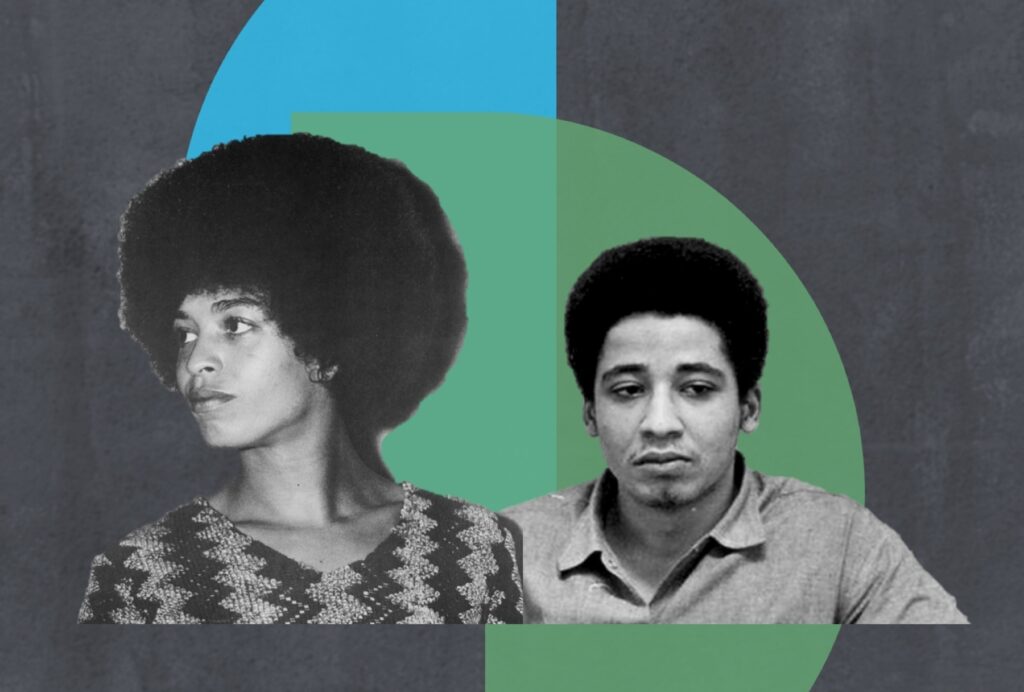
Cut out images of Angela Davis and George Jackson against a gray, blue, and green abstract background.
PHOTO/IMAGE (L-R):  Angela Davis and George Jackson
 

The Long Shadow of Racial Fascism

A debate is roiling about the aptness of comparing Trump to European fascists. But radical Black thinkers have long argued that racial slavery created its own unique form of American fascism.

In the wake of the 2016 election, public intellectuals latched onto the new administration’s organic and ideological links with the alt- and far right. But a mass civic insurgency against racial terror—and the federal government’s authoritarian response—has pushed hitherto cloistered academic debates about fascism into the mainstream, with Peter E. Gordon, Samuel Moyn, and Sarah Churchwell taking to the pages of the New York Review of Books to hash out whether it is historically apt or politically useful to call Trump a fascist. The F-word has also been making unusual forays into CNN, the New York Times, and mainstream discourse. The increasing prospect that any transfer of power will be fraught—Trump has hinted he will not accept the results if he loses—has further intensified the stakes, with even the dependable neoliberal cheerleader Thomas Friedman conjuring up specters of civil war.

What if our talk of fascism were not dominated by the question of analogy?

Notwithstanding the changing terrain, talk of fascism has generally stuck to the same groove, asking whether present phenomena are analogous to those familiar from interwar European dictatorships. Sceptics of comparison underscore the way that the analogy of fascism can either treat the present moment as exceptional, papering over the history of distinctly American forms of authoritarianism, or be so broad as to fail to define what is unique about our current predicament. Analogy’s advocates point to the need to detect family resemblances with past despotisms before it’s too late, often making their case by advancing some ideal-typical checklist, whether in terms of the elements of or the steps toward fascism. But what if our talk of fascism were not dominated by the question of analogy?

Attending to the long history of Black radical thinking about fascism and anti-fascist resistance—to what Cedric Robinson called a “Black construction of fascism” alternative to the “historical manufacture of fascism as a negation of Western Geist”—could serve to dislodge the debate about fascism from the deadlock of analogy, providing the resources to confront our volatile interregnum.


Long before Nazi violence came to be conceived of as beyond analogy, Black radical thinkers sought to expand the historical and political imagination of an anti-fascist left. They detailed how what could seem, from a European or white vantage point, to be a radically new form of ideology and violence was, in fact, continuous with the history of colonial dispossession and racial slavery.

Black radical thinkers have long sought to expand the historical and political imagination of an anti-fascist left.

Pan-Africanist George Padmore, breaking with the Communist International over its failure to see the likenesses between “democratic” imperialism and fascism, would write in How Britain Rules Africa (1936) of settler-colonial racism as “the breeding-ground for the type of fascist mentality which is being let loose in Europe today.” He would go on to see in South Africa “the world’s classic Fascist state,” grounded on the “unity of race as against class.” Padmore’s “Colonial Fascism” thus anticipated Aimé Césaire’s memorable description of fascism as the boomerang effect of European imperialist violence.

African American anti-fascists shared the anti-colonial analysis that the Atlantic world’s history of racial violence belied the novelty of intra-European fascism. Speaking in Paris at the Second International Writers Congress in 1937, Langston Hughes declared: “We Negroes in America do not have to be told what fascism is in action. We know. Its theories of Nordic supremacy and economic suppression have long been realities to us.” It was an insight that certainly would not have surprised any reader of W. E. B. Du Bois’s monumental reckoning with the history of U.S. racial capitalism, Black Reconstruction in America (1935). As Amiri Baraka would suggest much later, building on Du Bois’s passing mentions of fascism, the overthrow of Reconstruction enacted a “racial fascism” that long predated Hitlerism in its use of racial terror, conscription of poor whites, and manipulation of (to quote the famous definition of fascism by Georgi Dimitrov) “the most reactionary, most chauvinistic, and most imperialist sector of finance capital.”

In this view, a U.S. racial fascism could go unremarked because it operated on the other side of the color line, just as colonial fascism took place far from the imperial metropole. As Bill V. Mullen and Christopher Vials have suggested in their vital The US Antifascism Reader (2020):

For people of color at various historical moments, the experience of racialization within a liberal democracy could have the valence of fascism. That is to say, while a fascist state and a white supremacist democracy have very different mechanisms of power, the experience of racialized rightlessness within a liberal democracy can make the distinction between it and fascism murky at the level of lived experience. For those racially cast aside outside of liberal democracy’s system of rights, the word ‘fascism’ does not always conjure up a distant and alien social order.

Or, as French writer Jean Genet observed on May 1, 1970, at a rally in New Haven for the liberation of Black Panther Party chairman Bobby Seale: “Another thing worries me: fascism. We often hear the Black Panther Party speak of fascism, and whites have difficulty accepting the word. That’s because whites have to make a great effort of imagination to understand that blacks live under an oppressive fascist regime.”

It was largely thanks to the Panthers that the term “fascism” returned to the forefront of radical discourse and activism in the late 1960s and early 1970s. The United Front Against Fascism conference held in Oakland in 1969 brought together a wide swathe of the Old and New Lefts, as well as Asian American, Chicano, Puerto Rican (Young Lords), and white Appalachian (Young Patriots Organization) activists who had developed their own perspectives on U.S. fascism—for instance, by foregrounding the experience of Japanese internment during World War II. In a striking indication of the peculiarities and continuities of U.S. anti-fascist traditions, among the chief planks of the conference was the notionally reformist demand for community or decentralized policing—to remove racist white officers from Black neighborhoods and exert local checks on law enforcement.

Political prisoners close to the Panthers theorized specifically about what we could call “late fascism” (by analogy with “late capitalism”) in the United States. At the same time that debates about “new fascisms” were polarizing radical debate across Europe, the writing and correspondence of Angela Y. Davis and George Jackson generated a theory of fascism from the lived experience of the violent nexus between the carceral state and racial capitalism. Davis, the Black Marxist and feminist scholar, needs little introduction, her 1970 imprisonment on trumped-up conspiracy charges having rocketed her to the status of household name in the United States and an icon of solidarity worldwide. Fewer remember that the conspiracy charge against Davis arose from an armed courtroom attack by her seventeen-year-old bodyguard, Jonathan Jackson, with the goal of forcing the release of the Soledad Brothers, three African American prisoners facing the death penalty for the killing of a white prison guard. Among them was Jonathan’s older brother, the incarcerated Black revolutionary George Jackson, with whom Davis corresponded extensively. Jackson was killed by a prison sniper during an escape attempt on August, 21, 1971, a few days before the Soledad Brothers were to be tried.

In one of his prison letters on fascism, posthumously collected in Blood in My Eye (1972), Jackson offered the following reflection:

When I am being interviewed by a member of the old guard and point to the concrete and steel, the tiny electronic listening device concealed in the vent, the phalanx of goons peeping in at us, his barely functional plastic tape-recorder that cost him a week’s labor, and point out that these are all manifestations of fascism, he will invariably attempt to refute me by defining fascism simply as an economic geo-political affair where only one party is allowed to exist aboveground and no opposition political activity is allowed.

Jackson encourages us to consider what happens to our conceptions of fascism if we take our bearings not from analogies with the European interwar scene, but instead from the materiality of the prison-industrial complex, from the “concrete and steel,” from the devices and personnel of surveillance and repression.

In their writing and correspondence, marked by interpretive differences alongside profound comradeship, Davis and Jackson identify the U.S. state as the site for a recombinant or even consummate form of fascism. Much of their writing is threaded through Marxist debates on the nature of monopoly capitalism, imperialism and capitalist crises, as well as, in Jackson’s case, an effort to revisit the classical historiography on fascism. On these grounds, Jackson and Davis stress the disanalogies between present forms of domination and European exemplars, but both assert the privileged vantage point provided by the view from within a prison-judicial system that could accurately be described as a racial state of terror.

For Angela Y. Davis and George Jackson, fascism originated from liberal democracy itself.

This both echoes and departs from the Black radical theories of fascism, such as Padmore’s or Césaire’s, which emerged from the experience of the colonized. The new, U.S. fascism that Jackson and Davis strive to delineate is not an unwanted return from the “other scene” of colonial violence, but originates from liberal democracy itself. Indeed, it was a sense of the disavowed bonds between liberal and fascist forms of the state which, for Davis, was one of the great lessons passed on by Herbert Marcuse, whose grasp of this nexus in 1930s Germany allowed him to discern the fascist tendencies in the United States of his exile.

Both Davis and Jackson also stress the necessity to grasp fascism not as a static form but as a process, inflected by its political and economic contexts and conjunctures. Checklists, analogies, or ideal-types cannot do justice to the concrete history of fascism. Jackson writes of “the defects of trying to analyze a movement outside of its process and its sequential relationships. You gain only a discolored glimpse of a dead past.” He remarks that fascism “developed from nation to nation out of differing levels of traditionalist capitalism’s dilapidation.”

Where Jackson and Davis echo their European counterparts is in the idea that “new” fascisms cannot be understood without seeing them as responses to the insurgencies of the 1960s and early 1970s. For Jackson, fascism is fundamentally a counterrevolutionary form, as evidenced by the violence with which it represses any consequential threat to the state. But fascism does not react immediately against an ascendant revolutionary force; it is a kind of delayed counterrevolution, parasitic on the weakness or defeat of the anti-capitalist left, “the result of a revolutionary thrust that was weak and miscarried—a consciousness that was compromised.” Jackson argues that U.S.-style fascism is a kind of perfected form—all the more insidiously hegemonic because of the marriage of monopoly capital with the (racialized) trappings of liberal democracy. As he declared:

Fascism has established itself in a most disguised and efficient manner in this country. It feels so secure that the leaders allow us the luxury of a faint protest. Take protest too far, however, and they will show their other face. Doors will be kicked down in the night and machine-gun fire and buckshot will become the medium of exchange.

In Davis’s concurrent theorizing, the carceral, liberationist perspective on fascism has a different inflection. For Davis, fascism in the United States takes a preventive and incipient form. The terminology is adapted from Marcuse, who remarked, in an interview from 1970, “In the last ten to twenty years we’ve experienced a preventative counterrevolution to defend us against a feared revolution, which, however, has not taken place and doesn’t stand on the agenda at the moment.” Some of the elements of Marcuse’s analysis still resonate (particularly poignant, in the wake of Breonna Taylor’s murder by police, is his mention of no-knock warrants):

The question is whether fascism is taking over in the United States. If by that we understand the gradual or rapid abolition of the remnants of the constitutional state, the organization of paramilitary troops such as the Minutemen, and granting the police extraordinary legal powers such as the notorious no-knock law which does away with the inviolability of the home; if one looks at the court decisions of recent years; if one knows that special troops—so-called counterinsurgency corps—are being trained in the United States for possible civil war; if one looks at the almost direct censorship of the press, television and radio: then, as far as I’m concerned, one can speak with complete justification of an incipient fascism. . . . American fascism will probably be the first which comes to power by democratic means and with democratic support.

Davis was drawn to Marcuse’s contention that “fascism is the preventive counter-revolution to the socialist transformation of society” because of how it resonated with racialized communities and activists. In the experience of many Black radicals, the aspect of their revolutionary politics that most threatened the state was not the endorsement of armed struggle, but rather the “survival programs,” those enclaves of autonomous social reproduction facilitated by the Panthers and more broadly practiced by Black movements. While nominally mobilized against the threat of armed insurrection, the ultimate target of counterinsurgency were these experiments with social life outside and against the racial state—especially when they edged toward what Huey P. Newton named “revolutionary intercommunalism.”

Race, gender, and class determine how fascist the country might seem to any given individual.

What can be gleaned from Davis’s account is the way that fascism and democracy can be experienced very differently by different segments of the population. In this regard, Davis is attuned to the ways in which race and gender, alongside class, can determine how fascist the country seems to any given individual. As Davis puts it, fascism is “primarily restricted to the use of the law-enforcement-judicial-penal apparatus to arrest the overt and latent revolutionary trends among nationally oppressed people, tomorrow it may attack the working class en masse and eventually even moderate democrats.” But the latter are unlikely to fully perceive this phenomenon because of the manufactured invisibility of the site of the state’s maximally fascist presentation, namely, prisons with their “totalitarian aspirations.”

The kind of fascism diagnosed by Davis is a “protracted social process,” whose “growth and development are cancerous in nature.” We thus have the correlation in Davis’s analysis between, on the one hand, the prison as a racialized enclave or laboratory and, on the other, the fascist strategy of counterrevolution, which flow through society at large but are not experienced equally by everyone everywhere. As Davis has written more recently:

The dangerous and indeed fascistic trend toward progressively greater numbers of hidden, incarcerated human populations is itself rendered invisible. All that matters is the elimination of crime—and you get rid of crime by getting rid of people who, according to the prevailing racial common sense, are the most likely people to whom criminal acts will be attributed.


The lived experience of state violence by Black political prisoners such as Davis and Jackson grounded a theory of U.S. fascism and racial capitalism that interrupted what Robinson called the “euphonious recital of fascism” in mainstream political thought. It can still serve as an antidote to the lures and limits of the analogies that increasingly circulate in mainstream debate.

As the Black Lives Matter movement has made clear, the threat is not of a “return of the 1930s” but the ongoing fact of racialized state terror. This is the ever-present danger that animates present-day anti-fascist energies in the United States—and it cannot be boiled down to the necessary but insufficient task of confronting only those who self-identify as fascists.

Stuart Hall once castigated the British left for its passionate attachment to the frame of anti-fascism, for gravitating to the seemingly transparent battle against organized fascism while ignoring new modalities of authoritarianism. There were indeed fascists (the National Front), but Thatcherism was not a fascism. Conversely, Davis and Jackson glimpsed a fascist process that didn’t need fascists. Fascists without fascism, or fascism without fascists—do we have to choose?

The threat is not a return to the 1930s, but the ongoing fact of racialized terror.

To bridge this antinomy, we need to reflect on the connection between the features of “incipient fascism”—in the U.S. case, the normalization of forms of racial terror and oppression—and the emergence of explicitly fascist movements and ideologies. We need to think about the links between the often extreme levels of classed and racialized violence that accompany actually-existing liberal democracies (think, for instance, of the anti-migrant militarization of the U.S. and E.U. borders) and the emergence of movements that espouse a host of extreme positions that invert this reality: these include the belief that the state and culture have been occupied by the “radical” left (by “Cultural Marxism,” by critical race theory), that racism is now meted out against formerly dominant ethnic majorities, and that deracinated elites have conspired with the wretched of the earth to destroy properly “national” populations that can only be rescued by a revanchist politics of security and protectionism.

Our “late” fascism is an ideology of crisis and decline. It depends, in the words of abolitionist scholar Ruth Wilson Gilmore, on enlisting supporters on the basis of “the idea and enactment of winning, of explicit domination set against the local reality of decreasing family wealth, fear of unemployment, threat of homelessness, and increased likelihood of early, painful death from capitalism’s many toxicities.” Its psychological wages and racial dividends do considerable political economic work, perpetuating a brutally unequal regime of accumulation by enlisting bodies and psyches into endless culture wars.

But what is this late fascism trying to prevent? Here is where the superstructure sometimes seems to overwhelm the base, as though forces and fantasies once functional to the reproduction of a dominant class and racial order have now attained a kind of autonomy. No imminent threat to the reproduction of capitalism is on the horizon (at least no external one), so that contemporary fascist trends manifest the strange spectacle of what, in a variation on Davis and Marcuse, we could call a preventive counterreform. This politics is parasitic, among other things, on resuscitating the racialized anti-communism of a previous era, now weaponizing it against improbable targets such as Kamala Harris, while treating any mildly progressive policy as the harbinger of the imminent abolition of all things American, not least the suburbs.

But, drawing on the archive of Black radical theories of fascism, we can also start to see the present in a much longer historical arc, one marked by the periodic recurrence of racial fascism as the mode of reaction to any instance of what Du Bois once called “abolition democracy,” whether against the First Reconstruction, the Second Reconstruction, or what some have begun, hopefully, to identify as the Third.


ABOUT THE AUTHOR:

Alberto Toscano is Reader in Critical Theory and Co-Director of the Centre for Philosophy and Critical Thought at Goldsmiths, University of London. He’s the author of Fanaticism: On the Uses of an Idea and of the forthcoming Late Fascism.