Showing posts with label Dr. Martin Luther King. Show all posts

Monday, October 16, 2023

JEANNE THEOHARIS AND LERONE MARTIN ON J. EDGAR HOOVER, THE FBI, AND THE RISE OF MODERN WHITE CHRISTIAN NATIONALISM IN THE UNITED STATES


One Bureau under God

Jeanne Theoharis speaks with Lerone A. Martin on the white Christian legacy of J. Edgar Hoover’s FBI.

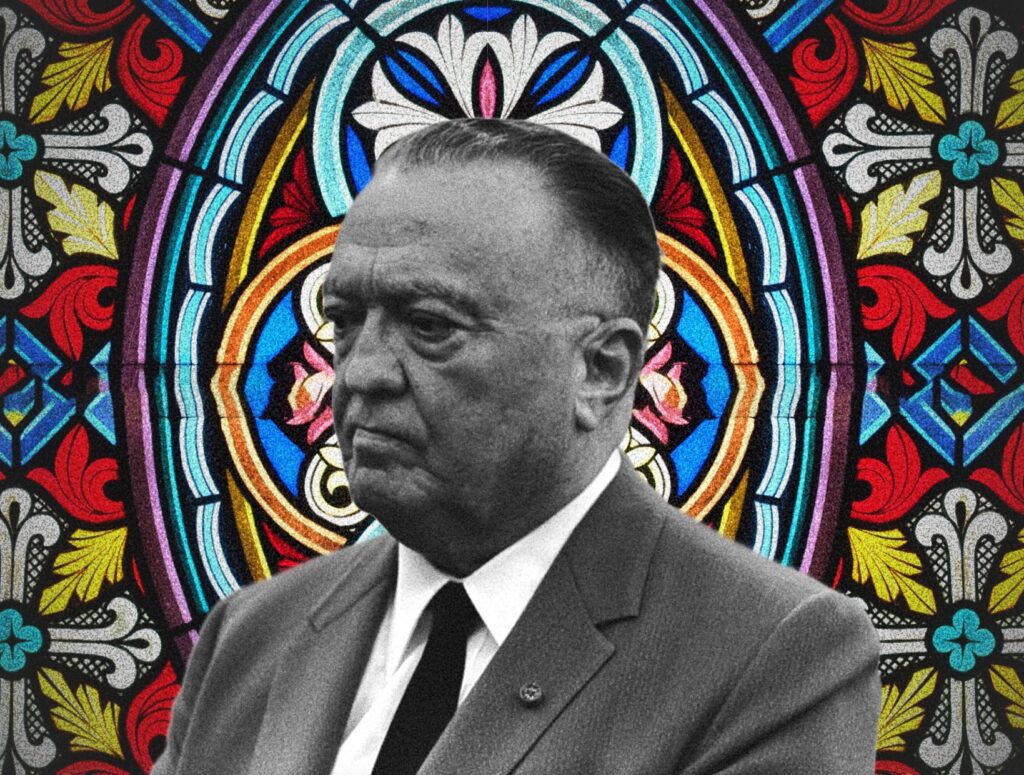
J. EDGAR HOOVER (1895-1972).  Image: Wikimedia Commons

On this day sixty years ago, October 10, 1963, the Department of Justice signed a memo granting the FBI permission to conduct technical, wall-to-wall surveillance on Martin Luther King, Jr. The eloquence and reach of King following the March on Washington had so alarmed the Kennedy administration and the bureau that six weeks later they felt drastic steps had to be taken. The bureau had already been surveilling King for some time, but this memo gave them something new: the ability to wiretap him at his home, at his office, or at “any future address to which he may move.” The FBI interpreted that language very liberally. It could be read as allowing continued surveillance if Martin Luther King, Jr. changed residences—if he picked up and moved his permanent address. But they chose instead to interpret it as saying that surveillance was permitted anywhere King moved, and used this to begin to wiretap him during his travels, installing microphones and bugs in his hotel rooms.

The FBI’s campaign against King, of course, is far from unknown. In the past few decades, even the federal government has publicly acknowledged it—if only as a way of distancing itself from its past. Indeed, Former Director of the FBI James Comey kept a record of the Kennedy memo on his desk as a supposed reminder of that “shameful” history.

Martin’s book reveals the crucial role of white Christian nationalism in Hoover’s FBI and modern practices of domestic intelligence.

But it’s one that we haven’t actually learned from, as Lerone A. Martin shows. Doing so would require the government to do some soul-searching: to commit to understanding the ideas and the influence of J. Edgar Hoover, the man who steered the bureau for thirty-seven years. Martin’s new book, The Gospel of J. Edgar Hoover: How the FBI Aided and Abetted the Rise of White Christian Nationalism (2023), is a worthy addition to this project, painstakingly documenting the religious ideology at the core of Hoover’s politics. Using thousands of newly declassified files—including records he had to sue the FBI to gain access to—the book reveals the crucial role of white Christian nationalism in Hoover’s FBI and modern practices of domestic intelligence.

Jeanne Theoharis, author of A More Beautiful and Terrible History: The Uses and Misuses of Civil Rights History (2018), interviewed Martin to discuss his book, the religious beliefs at the heart of Hoover’s FBI, and what it shows us for understanding the bureau and our country today.


 Jeanne Theoharis: Why is this date marking the Kennedy administration’s authorization of the FBI’s wiretapping of King so important? What does it reveal about the FBI’s relationship to King—and what have we not adequately understood about this history?

Lerone A. Martin: It reveals how the FBI’s perceptions of race and religion, not evidence, led them to surveil King. The memo was a long-awaited gift for Hoover. At first, some of the FBI agents were not convinced of the need to surveil King in the first place. They told Hoover, “No, there’s no communist infiltration here.” In some ways, they were patting themselves on the back, congratulating themselves on what they thought was the success of the COINTELPRO campaign in decimating the communist movement. But then, Hoover pushed back following King’s “I Have a Dream” speech, fearful of King’s influence in the “racial revolution.” Hoover’s FBI perceived Reverend King’s gospel as a direct threat to what it still saw as a Christian nation.

And the FBI allowed this fear to supersede the lack of evidence of communist infiltration. “Facts by themselves are not too meaningful, for they are somewhat like stones tossed in a heap as contrasted to the same stones put in the form of a sound edifice,” the FBI concluded in a different memo. “It is obvious to us now that we did not put the proper interpretation upon the facts.” They marked King as “the most dangerous and effective Negro leader in the country” and moved forward with their counterintelligence campaign.

Hoover exerted a powerful influence upon the politics of evangelical conservatism.

Unfortunately, the bureau is repeating this history today. Government data tells us that white supremacist violence is the top threat to the homeland. But national security policy continues to focus on communities of color, especially Muslim communities. In 2017 the Trump administration put forth a Muslim ban to secure the homeland, despite the facts. The FBI’s Countering Violent Extremism program focuses on communities of color, especially Muslim communities, despite the facts. And the now-shuttered DOJ China Initiative stoked anti-Asian hate and false charges, such as in the prosecution of Dr. Feng “Franklin” Tao, under the guise of national security. There is no doubt a direct line from Kennedy’s memo to our current moment.

JT: You’re not the first person to take on the FBI under Hoover. How does your research help us see the FBI’s mission in a new light?

LM: All of the books about Hoover—like Richard Gid Powers’s Secrecy and Power (1987) and Beverly Gage’s recent G-Man (2022)—mention Hoover’s religious upbringing, but I try to go a little further, showing how this is not something that he forgets when he becomes an adult. I argue instead that this religious upbringing shapes his entire worldview: that if we want to take him seriously as a political subject, we need to take him seriously as a man of faith. His life proves this. He had a lifelong relationship with his pastor, appointed an honorary “Chaplain of the FBI,” rented a pew at his church, served as a trustee for that church, and produced voluminous religious writings.

And I’m not just studying his faith in isolation. I wanted to know how it shaped his FBI. Bureau men, for one, were shaped accordingly. They went to worship services that were held especially for FBI agents and their families, and attended spiritual retreats, communion breakfasts, and masses at various field offices.

Hoover also engaged in a whole host of partnerships with faith communities. Undergirded by taxpayer funds, Hoover became one of the most voluminous and productive producers of religious literature, both Protestant and Catholic. The bureau—or to be more accurate, its ghostwriters—was one of the most noteworthy religious authors of the Cold War era. One of the most significant partnerships was with Christianity Today, one of the most popular conservative periodicals of the day. With homilies and essays such as “Communist Domination or Christian Rededication” and “The Communist Menace: Red Goals and Christian Ideals,” Hoover exerted a powerful influence upon the politics of evangelical conservatism.

The Cold War provided fertile ground for Hoover’s racist religious commitments

Hoover constantly told his agents the FBI had a “Christian purpose…to defend and perpetuate the dignity of the Nation’s Christian endowment.” Or as he told agents after one spiritual retreat, the fight for the soul and security of the nation was “a fight which we cannot lose, since God is on our side.” All of this becomes a part of what it means to fall in line in the bureau. Under Hoover, all of the bureau’s labor—from illegal surveillance and break-ins to lying under oath—was God’s labor.

JT: Much of the focus and recent work about Hoover focuses on his overwhelming power, his blackmailing, his personal psychology. How does your work get us to move in a different direction?

LM: It’s important to point out that Hoover’s FBI was not rogue. Nobody in this country can be considered rogue and outside of the mainstream and crazy and remain in office for almost forty-eight years. Hoover’s FBI had help and tremendous support. Robert F. Kennedy signed the memo approving the surveillance of King. President Kennedy and President Johnson both received constant briefings on the bureau’s counterintelligence. Journalists, too, illegally received bureau briefings on King’s surveillance. Ministers like Elder Lightfoot Solomon Michaux laundered FBI intel. Publications such as Christianity Today enthusiastically supported Hoover and his FBI. Public opinion polls from the Washington Post and Gallup pointed out that the overwhelming majority of Americans sided with Hoover over King. This campaign was one that was endemic to the nation. Hoover was America and America was—and in some ways still is—J. Edgar Hoover.

JT: Your book shows how this public support was bolstered especially during the Cold War. What energies and political currents was Hoover seizing upon?

LM: Hoover’s commitment to white Christian nationalism preceded the Cold War. But the Cold War provided fertile ground for his racist religious commitments. At the time, America was concerned about its ideological battle with communism and Russia coming out of World War II. And the FBI was considered America’s front guard to protect the nation in this fight—the first line of defense against an existential threat. The bureau was perfectly set up to allow Hoover to dispense all types of opinions and commentary as actual policy: this is what America needs to do to remain safe and this is what America needs to do to win the war against communism. It gave him a unique seat of authority with a direct line to the ear of the American public.

And under Hoover’s watch, anyone who disagreed with him is not seen as disagreeing based on legitimate policy differences. They are labeled enemies of the state and deemed to be going against anything that will keep America safe. So what normally would be robust debate and conversation in a functioning democracy became an us versus them: you are an existential threat to the nation if you disagree with me. And in that context, Hoover was a master of operating.

JT: You also argue that Hoover’s Christianity allows him to make a lot of partners, some of whom are Black clergy. In the book, we see the wide array of support he gets from various Black evangelicals and other Black informants. How does Hoover capture this support?

LM: Evangelicalism has often been thought of as solely as a white phenomenon. But there are African American evangelicals: there’s a National Black Evangelical Association, for example, that’s still in existence.

Hoover was able to tap into the idea that everything that ails the nation can be solved by individual conversions—that if we just get people committed to Jesus Christ, for example, all this stuff about racism, all this stuff about poverty, will cease. Because of that, Hoover earned a number of African American evangelical supporters, one of whom is Elder Lightfoot Solomon Michaux, a very popular Black religious broadcaster of the day in D.C. He broadcast over CBS Radio all around the country, and at times, the globe. He had his own television show beginning in the 1940s. He was one of the first preachers, Black or white, to have their own TV show named after them. Michaux believed in the gospel that Hoover preached. The two had a large amount of correspondence, which I was able to comb through, which showed how they coordinated to discredit Martin Luther King, Jr.

The FBI would first give Michaux “intelligence” and “counterintelligence” on King. Michaux would then launder that for them by putting it in his sermons. Over the airways, he was able to provide cover for the FBI: now, it’s not the FBI who says King is a communist, or King is faking, or King’s clerical bona fides are not real. The bureau was able to point to an African American minister who’s saying the same thing. And this became proof that King is a problem: Michaux even sent some of these sermons to the Kennedy White House. The FBI was able to work with him in a very explicit ways to use his popularity and his Blackness to authenticate their claims against King, Jr. For example, in 1965 Elder Michaux teamed up with the FBI to organize a protest against Martin Luther King, Jr. in Baltimore following the Selma to Montgomery march. He claimed that he had evidence that MLK was a communist “termite” determined to destroy America from the inside.

JT: Part of what your book also gets us to see is how Hoover sees and treats King as a distinctly Christian threat.

LM: To Hoover, King’s Christianity called into question America’s commitment to being “the land of the free.” In the ‘60s, King began to expose the country’s hypocrisy abroad to the globe for all to see. And instead of the FBI seeing the hypocrisy as a problem, King and others like him get seen as the problem for exposing it. To this end, MLK is seen as a heretic.

Hoover believed American democracy rested upon a foundation of Christian faith. American societal structures were God-ordained. Those who claimed marginalization had simply failed to live up to God’s standards. King, on the other hand, exposed America’s structural sins. Hoover perceived King’s calls for structural change as a fight against God. Therefore, the FBI concluded, King was at best a clergyman who was unwittingly being used by communists and revolutionaries, or worse, a communist in clerical garb. Either way, MLK was preaching a false gospel.

JT: To me it’s not only white Christian nationalism. It’s sort of a white Christian capitalism that the bureau is adopting: and maybe you can’t really separate the Christianity from the capitalism in terms of the threat the bureau saw in King.

LM: King did indeed challenge U.S. capitalism. And as your own work points out, Jeanne, when King was talking about gaining access to places of consumption—for Black people to have the right to spend money in more places—the United States was okay with that. It benefited them. It created a larger Black middle class. The thinking was: if they want to spend money, they should be able to spend money wherever they want. But King then starts to raise concerns about how capitalism is continually making people poor and impoverished in a very rich nation. He called for things that were seen as radical and are still seen as radical today: namely, a universal basic income and a broader social safety net.

This was a huge challenge to the idea of the bootstrapped, individualistic, capitalist way of doing things. As Sarah Hammond’s God’s Businessmen (2017) points out, corporations and evangelical conservatives pushed the idea that free market capitalism was an economic expression of Christian free will and the heart of what it meant to be an American. As MLK challenged this, many people, especially the FBI, saw it as a threat to America’s foundation because in the midst of the Cold War any challenges to unfettered capitalism were labeled communist-inspired.


JT: When James Comey was the FBI director, he proudly kept the King memo in his office allegedly to acknowledge the agency’s overreach and past mistakes. Both of us question the value of that gesture. Why is this not the way to learn from this history?

LM: I remember watching the 60 Minutes episode with Comey when he talked about having that copy of that memo placed underneath his desk to remind him of the FBI’s past sins. He talks about a training module in which new agents visit the Martin Luther King, Jr. Memorial in D.C., take down some of the quotes, and then go back and study them and discuss them. And an MLK quote— “The time is always right to do what is right”— is etched in stone at the FBI’s main training facility in Quantico, VA. These moments provide an example of—to borrow a phrase of yours—history as a way of providing comfort, but not caution. It comforted the FBI, and the American public. It said, “Hey, look, we’ve learned from our history, and we acknowledge it.” But I don’t think it was used as caution: as a warning about what could happen if the FBI does not truly reckon with its past.

And to do that you’d have to understand that King was considered radical. He was not the saint that he has been made into today. You would need to understand that at the time, King was being surveilled because he posed a threat to the political order of things. He was an enemy of the FBI. To use this history to provide caution would require the FBI to reflect on its practices of surveilling people it considers as posing a grave threat to national security. Acknowledging its true aims—to mount a coordinated campaign against an enemy—is a far more difficult task than simply apologizing for its treatment of someone we now consider a hero. Because back then, he wasn’t.

You won’t learn that from studying King’s quote at the monument that “the arc of the moral universe is long, but it bends towards justice.” These are beautiful quotes, but if you’re really going to learn from history, agents need to understand King in context. If agents were to read King’s Why We Can’t Wait (1964) and Where Do We Go from Here (1967), books where King is fundamentally challenging the American status quo, particularly on racism, poverty, and war, they would understand why the FBI chose to launch a counterintelligence campaign against him.

The lessons of history would call for a true examination of how the FBI engages current progressive movements that call for change. Without that, it’s simply a field trip to a beautiful monument in D.C.

JT: Part of your work is getting us to ask the question: who do we see as dangerous today and how are we treating them? Because at the same time that Comey has the nice framed document in his office, fifteen thousand paid FBI informants are surveilling Muslim communities; acting much like they did during COINTELPRO in the ‘60s but on an even broader scale.

LM: If we put the question this way, we can see that the bureau has not really learned from that moment. Much of the rhetoric resembles Hoover’s communism rhetoric. The bureau’s 2017 intelligence assessment of “Black Identity Extremists” is an example. The FBI, with no evidence, created the term. Black Identity Extremists were described as African Americans, motivated by “perceived” police brutality and anti-Black racism, who developed a Black religious ideology to commit terroristic acts. The reasoning is shockingly similar to the FBI’s reasoning to surveil MLK.

JT: At moments, particularly during the Trump presidency, we saw people who should have known better embracing the FBI as the good guys. We’ve seen the support of most Democrats for increasing the funding and power of the FBI.

LM: I think my book came out, for some, at an inopportune time, because all of a sudden, many folks who would consider themselves political liberals were rooting for the FBI as the good guys during the Trump moment. And my book was inconvenient because it pointed out that the FBI has been and remains complicit in the scourge that is white Christian nationalism.

Much of the rhetoric today resembles Hoover’s communism rhetoric.

To be clear, after Hoover passed away in 1972, there are some changes. Two women—one a former nun, the other a marine—joined in 1972. African Americans joined in larger numbers. And standards loosened. Certain haircuts were no longer required, facial hair was allowed, and agents were no longer restricted to white shirts. But the FBI is still operating out of the J. Edgar Hoover Building, which was finished after his death. And I think it provides a great metaphor: Hoover’s ghost is still very much so in the bureau. And one of the things about ghosts is that they’re nowhere and everywhere at the same time. We see that in the FBI.

For one, the worship services continued. After Hoover’s death, Pat Robertson became a favorite at the FBI, preaching twice for the FBI worship service. In the 2000s, the FBI invited the Westboro Baptist Church to new agent training. And in 2017 Terry Albury, an African American FBI agent, was arrested for linking intel to the press detailing the FBI’s internal racism and targeting of Muslims. Part of what he testified to was not just what was happening to Muslim Americans and how they were being treated by the bureau, but also how he was being treated within the FBI because he was an African American. And this is a long-held pattern. Since the 1980s there have been at least three racial discrimination law suits filed by Black and Latino agents of color. In 2019 women special agents and recruits sued the bureau for gender discrimination.

And the bureau still has not caught up to the white terrorist threat. In 2022 the U.S. Senate Committee on Homeland Security and Governmental Affairs issued a report on the rise of domestic terrorism. “White supremacist extremists,” it wrote, “pose the primary threat among all domestic violent extremists.” But the FBI and the Department of Homeland Security, it concluded, had not adequately aligned their resources to meet this threat. And I think that speaks perfectly to what we’re talking about. The bureau still struggles with seeing white supremacist violence as domestic terrorism or as the top domestic threat, despite the facts to the contrary. Even though the data says so, the resources within the bureau have not adjusted accordingly. It’s still focused on people of color, antiracist movements, and Muslim religious communities. Hoover’s ghost, America’s ghost, remains.

ABOUT THE INTERVIEW PARTICIPANTS:

Lerone A. Martin is Director of the Martin Luther King, Jr. Research and Education Institute at Stanford University and author of The Gospel of J. Edgar Hoover: How the FBI Aided and Abetted the Rise of White Christian Nationalism.

Jeanne Theoharis is Distinguished Professor of Political Science at Brooklyn College of CUNY and author of A More Beautiful and Terrible History: The Uses and Misuses of Civil Rights History.


IMPORTANT NEW BOOK:

The Gospel of J. Edgar Hoover: How the FBI Aided and Abetted the Rise of White Christian Nationalism
by Lerone A. Martin
‎Princeton University Press, 2023

[Publication date: February 7, 2023]

The shocking untold story of how the FBI partnered with white evangelicals to champion a vision of America as a white Christian nation

On a Sunday morning in 1966, a group of white evangelicals dedicated a stained glass window to J. Edgar Hoover. The FBI director was not an evangelical, but his Christian admirers anointed him as their political champion, believing he would lead America back to God.
The Gospel of J. Edgar Hoover reveals how Hoover and his FBI teamed up with leading white evangelicals and Catholics to bring about a white Christian America by any means necessary.

Lerone Martin draws on thousands of newly declassified FBI documents and memos to describe how, under Hoover’s leadership, FBI agents attended spiritual retreats and worship services, creating an FBI religious culture that fashioned G-men into soldiers and ministers of Christian America. Martin shows how prominent figures such as Billy Graham, Fulton Sheen, and countless other ministers from across the country partnered with the FBI and laundered bureau intel in their sermons while the faithful crowned Hoover the adjudicator of true evangelical faith and allegiance. These partnerships not only solidified the political norms of modern white evangelicalism, they also contributed to the political rise of white Christian nationalism, establishing religion and race as the bedrock of the modern national security state, and setting the terms for today’s domestic terrorism debates.

Taking readers from the pulpits and pews of small-town America to the Oval Office, and from the grassroots to denominational boardrooms,
The Gospel of J. Edgar Hoover completely transforms how we understand the FBI, white evangelicalism, and our nation’s entangled history of religion and politics.

REVIEWS:

"An elegantly written book."---David Smith, Guardian

"Marked by Martin’s impressive research and sharp character sketches, this is a fresh and invigorating look at the interplay between faith, politics, and American law enforcement." ―
Publishers Weekly

"Adds an important new aspect to Hoover’s story, based largely on newly released material, showing how he played a large role in the rise of conservative, white, male, Christian nationalism."
---Jessica Mathews, Foreign Affairs

"[Martin] focuses not just on Hoover’s notorious racism but also on his promotion of a distinct brand of conservative evangelicalism."
---Adam Hochschild, The Nation

"A fine work of scholarship that displays a diligent use of archives and a relentless pursuit of the truth."
---Daniel Rey, History Today.
 
The Gospel of J. Edgar Hoover is a work of rigorous archival research that also manages to be a page-turner. In this riveting narrative, Lerone Martin shows how Christian nationalism, ethnocentrism, and authoritarianism are deeply embedded not only in American evangelicalism, but also in the very fabric of our nation. A commanding and compelling reassessment of twentieth-century American religion.”―Kristin Kobes Du Mez, New York Timesbestselling author of Jesus and John Wayne: How White Evangelicals Corrupted a Faith and Fractured a Nation

“An immensely original account of a crucial aspect of FBI history during the Hoover era. Martin’s analysis of the remarkable depth and extent of Christian clergy support for Hoover’s unbridled reign will surprise and perhaps shock even readers well-familiar with prior scholarship.”
―David J. Garrow, Pulitzer Prize–winning author of Bearing the Cross: Martin Luther King, Jr., and the Southern Christian Leadership Conference

“A disturbingly appropriate book for our times, a book about a white Christian force forever determined to bring America back to their God. One only need read the chapter headers to start and never stop turning pages.”
―Kenneth O’Reilly, author of “Racial Matters”: The FBI’s Secret File on Black America, 1960–1972

“In this impressive work, Martin reveals how J. Edgar Hoover’s commitment to America as a white Christian nation shaped American politics and religion for much of the twentieth century. This is essential reading for anyone interested in the history of religion in the modern United States.”
―Judith Weisenfeld, author of New World A-Coming: Black Religion and Racial Identity during the Great Migration
 

ABOUT THE AUTHOR:


Lerone A. Martin is the Martin Luther King, Jr., Centennial Professor and Director of the Martin Luther King, Jr., Research and Education Institute at Stanford University. He is the award-winning author of Preaching on Wax: The Phonograph and the Shaping of Modern African American Religion.


Tuesday, June 11, 2013

THE HISTORICAL SIGNIFICANCE OF JUNE 11, 1963 AND THE ONGOING LEGACY OF THE CIVIL RIGHTS STRUGGLE IN THE UNITED STATES FIFTY YEARS LATER

All,

Fifty years ago today June 11, 1963 marks one of the strangest, most extraordinary and pivotal days in American history in a year--1963--that remains one of the most truly tragic and inspiring in the annals of both the United States and the world. In one of those weird synchronicities of major public events that seemed to characterize the 1960s era four earth shattering incidents occurred in the United States that would have profound, and ultimately even revolutionary national and global implications. These four astonishing incidents all took place within a mere eight hour span on June 11, 1963 and involved the racist assassination of a renowned Civil Rights leader and activist from Mississippi named Medgar Evers by a KKK assassin, a game changing and unprecedented speech to the nation by President John F. Kennedy who announced on television for the first time since he took office in 1961 his firm political and moral support and advocacy of strong national civil rights legislation on behalf of African American ("Negro") citizens, a major press conference announcement by Dr. Martin Luther King, Jr. and legendary black labor leader and organizer A. Philip Randolph as well as other major civil rights leaders and organizers from SNCC, CORE, the NAACP, and the Urban League along with leading figures in the the national labor movement, of plans to organize, sponsor and participate in a massive demonstration in the nation's capitol called 'The March On Washington For Jobs and Freedom ' , scheduled for August 29, 1963; and a national confrontation between the U.S. federal government via its Deputy Attorney General and the notoriously racist segregationist Governor George Wallace who literally stood in the schoolhouse door in a vain attempt to block two black students Vivian Malone and James Hood from physically entering the University of Alabama to register for classes there. In response the President and his brother Robert F. Kennedy the Attorney General of the United States federalized 4,000 Alabama National guardsmen to enforce the constitutional rights of the two black students to enter the school and register and demanded that the Governor step aside which after being granted a brief demagogic speech on his fervent support of "state's rights" (and  thus deeply hostile institutional opposition to racial equality via integration) Wallace finally complied.

Kofi
Attempting to block integration at the University of Alabama, Democratic Governor George Wallace stands defiantly at the door of the Foster Auditorium while being confronted by Deputy U.S. Attorney General Nicholas Katzenbach.
 
http://panopticonreview.blogspot.com/2013/01/the-inspiring-courage-of-james-hood.html


FROM THE PANOPTICON REVIEW ARCHIVES:

(Originally posted on January 22, 2013):

Tuesday, January 22, 2013

The Inspiring Courage of James Hood (1942-2013) and the Profound Legacy of the Civil Rights Movement

http://www.huffingtonpost.com/2013/01/18/james-hood-dead_n_2507556.html?ref=topbar

Editor's Note: This article and my response marks the beginning of what will be a year long series of articles, essays, commentary, and critical analyses by myself and others of the profound and ongoing historical impact of the pivotal years of 1963 and 1863 in the history of this nation and that of its African American citizens. 

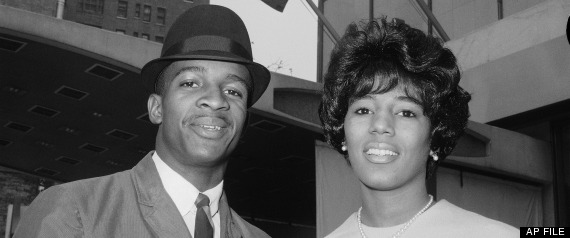
In this June 9, 1963 file photo University of Alabama students James Hood and Vivian J. Malone  pose in New York
All,

History/Time is really moving and I mean FAST. It's incredible: I remember so clearly this very day--June 11, 1963-- that James Hood and Vivian Malone-- accompanied by the U.S. Deputy Attorney General Nicolas Katzenbach and National Guard troops-- walked right past the arch segregationist Alabama Governor George Wallace who, along with Alabama state troopers, was literally standing in the front entrance door of the University of Alabama trying to physically block them from entering. I watched this entire dramatic episode on television with my parents in Detroit. I was absolutely fascinated by this event and my visceral response to it left a very sharp and absolutely indelible impression on me as a child. A huge synapse went off in my head not only because of what Hood and Malone and the Kennedy administration did--that was extraordinary enough!--but by what also happened on that very same day. Imagine: Less than 10 hours after this event Medgar Evers the legendary NAACP leader and activist from Mississippi (age 37) was assassinated as he was shot in the back by a KKK assassin just as he was taking out his keys to open the front door of his home just before midnight as his wife and three children watched in horror as they came to the door to greet him. Evers had been at a long meeting of the NAACP that evening discussing the events of that same day which also included a groundbreaking speech by President Kennedy just four hours earlier on national television in which for the very first time his administration made a clear and definitive committment to pushing for and demanding that civil rights legislation be passed--another event I witnessed with my parents on TV that evening. I remember like it was yesterday with my father saying to me in a very serious tone that I "really needed to see and hear what the President had to say" and that it was very important that I "pay close attention." My mother and father were watching the speech with such intense riveted interest that I was again mesmerized by what I saw and heard the president say. In that speech before the entire nation Kennedy said the following:

http://www.youtube.com/watch?v=QMsa5bZ89x4


Finally on this very same day(!!) Dr. Martin Luther King, Jr. and the legendary black labor union leader A. Phillip Randolph announced that they and a national coalition of civil rights organizations, labor unions, civic groups, activists, clergy, and ordinary citizens were organizing a national event known as the 'March on Washinston for Jobs and Freedom' to be held in the nation's capitol of Washington D.C. in two months on August 28, 1963. WHAT AN AMAZING DAY IN AMERICAN HISTORY.  I rest my case...

Kofi


James Hood Dead: Man Who Defied Racial Segregation At University Of Alabama Dies At Age 70
By BOB JOHNSON
01/18/13
Huffington Post


MONTGOMERY, Ala. — One of the first black students who enrolled at the University of Alabama a half century ago in defiance of racial segregation has died. James Hood of Gadsden was 70.

Officials at Adams-Buggs Funeral Home in Gadsden said they are handling arrangements for Hood, who died Thursday.

Then-Alabama Gov. George Wallace made his infamous "stand in the schoolhouse door" in a failed effort to prevent Hood and Vivian Malone from registering for classes at the university in 1963.

Hood and Malone were accompanied by Deputy U.S. Attorney General Nicholas Katzenbach when they were confronted by Wallace as they attempted to enter the university's Foster Auditorium to register for classes and pay fees.

Wallace backed down later that day and Hood and Malone registered for classes.

UA President Judy Bonner remembered Hood as a man of "courage and conviction" for being one of the first black students to enroll at the university.

"His connection to the university continued decades later when he returned to UA to earn his doctorate in 1997. He was a valued member of The University of Alabama community, and he will be missed. Our thoughts and prayers are with his family during this difficult time," Bonner said.

Hood was the last survivor among the major figures in the schoolhouse door incident. Wallace died in 1998, Vivian Malone Jones in 2005 and Katzenbach last year.

After enrolling, Hood remained at UA for a few months and moved to Michigan, where he received a bachelor's degree from Wayne State University and a master's degree from Michigan State.

He later moved to Wisconsin, where he worked at the Madison Area Technical College for 26 years. He retired in 2002 as chairman of public safety services in charge of police and fire training.

He finally returned to UA later in life to earn his doctorate.

Culpepper Clark, author of "The Schoolhouse Door: Segregation's Last Stand at the University of Alabama," called the schoolhouse door incident "an iconic moment" in the Civil Rights Movement because it provided a confrontation between Wallace and the Kennedy administration. He said the incident was "symbolically important" and helped lead to passage of the Voting Rights Act.

Clark described Hood as a man with a lot of "intellectual energy" who understood the importance of what he did at the University of Alabama in 1963.

"He didn't try to make it into more than what it was," Clark said.

The Rev. Preston Nix grew up in Etowah County and said he knew of Hood, who was several years older than he.

Nix said it took a lot of courage for Hood to challenge the segregation at the University of Alabama in 1963.

Nix said he felt Hood did what he did partly to "pave the way" for others to be able to improve themselves and get a higher education and partly because he wanted to attend the University of Alabama.

Samory Pruitt, vice president for community affairs at UA, agreed with Nix.

"Because of what he did, people like me were afforded the opportunity to go to the University of Alabama," said Pruitt, who is black. "I think it's about people having the opportunity to be the best they can be."

Posted by Kofi Natambu at 1:28 PM  on January 22, 2013

Labels: American racism, Civil Rights Movement, Dr. Martin Luther King, Governor George Wallace, Jr., Jsmes Hood, March on Washington, Medgar Evers, President Kennedy, University of Alabama, Vivian Malone
 

An epochal moment for civil rights in a single day: 11 June 1963

Fifty years ago, three seminal events – a standoff with Alabama's governor, a presidential speech and the murder of Medgar Evers – left an indelible mark on American history, writes


by Gary Younge
guardian.co.uk
Tuesday 11 June 2013
 
 GARY YOUNGE


In the early morning of 11 June 1963, Attorney General Robert Kennedy examined maps of the University of Alabama's Tuscaloosa campus as his three young children played by his feet. Within 18 hours, his brother, the president, had given an impromptu national address on civil rights, the Alabama governor had confronted the federal authorities on national television and blinked, and one of the movement's most prominent leaders had been gunned down outside his home.

In retrospect, the events that summer Tuesday – some planned, most spontaneous, and all more hostage to eventualities than planning – would become emblematic of the trajectory of the nation's racial and political dynamics for the next 50 years.

Bobby Kennedy was trying to work out the federal government's options for getting two black students, Vivian Malone and James Hood, registered for classes on campus at the university. A few hours later, in a choreographed piece of brinkmanship, Alabama's segregationist governor, George Wallace, stood at the entrance to the Foster auditorium, flanked by state troopers, to refuse them entry. The students went to their dorms while Deputy Attorney General Nicholas Katzenbach ordered Wallace to allow them in. Wallace refused and delivered a speech on states' rights.

President Kennedy then federalised the Alabama national guard and ordered Wallace's removal. "Sir, it is my sad duty to ask you to step aside under the orders of the President of the United States," said General Henry Graham. Wallace made another quick announcement, stepped aside and Malone and Hood registered.

"They knew he would step aside," Cully Clark, author of The Schoolhouse Door: Segregation's Last Stand at the University of Alabama, told NPR. "I think the fundamental question was how."

"It had been little more than a ceremony of futility," wrote journalist and Wallace biographer Marshall Frady:

"And, as a historical moment, a rather pedestrian production. But no other southern governor had managed to strike even that dramatic a pose of defiance and it has never been required of southern popular heroes that they be successful. Indeed, southerners tend to love their heroes more for their losses."

The previous day the president's inner circle was divided as to whether he should deliver a televised national address on civil rights. They decided to wait and see how things went in Alabama. After the incident had passed with more theatre than chaos, they unanimously advised the speech was now unnecessary.

Kennedy decided to ignore them, calling executives at the three television networks himself to request airtime. In The Bystander, Nick Bryant describes how, with only six hours to write the speech, Kennedy's team struggled to pull anything coherent together. Minutes before the cameras rolled, all they had was a bundle of typed pages interspersed with illegible scribbles. His secretary had no time to type up a final version and his speechwriters had not come up with a conclusion. With the cameras on, Kennedy started reading from the text and, for the last four minutes, improvised with lines he'd used before from the campaign trail and elsewhere.

"If an American, because his skin is dark, cannot eat lunch in a restaurant open to the public, if he cannot send his children to the best public school available, if he cannot vote for the public officials who will represent him, if, in short, he cannot enjoy the full and free life which all of us want, then who among us would be content to have the color of his skin changed and stand in his place? Who among us would then be content with the counsels of patience and delay?"

Kennedy went on to reflect on the issues of black unemployment and the slow pace of integration, described how the south was embarrassing the nation in front of its cold war adversaries and announced plans to introduce civil rights legislation. In Bryant's assessment:

"The speech was the most courageous of Kennedy's presidency. After two years of equivocation on the subject of civil rights, Kennedy had finally sought to mobilize that vast body of Americans who had long considered segregation immoral, and who were certainly unprepared to countenance the most extreme forms of discrimination."

A thousand miles away, in Jackson, Mississippi, Myrlie Evers – who, in 2013, would deliver the invocation at President Barack Obama's second inauguration – had watched the presidential address in bed with her three children. Her husband, Medgar, the field secretary of the state's National Association for the Advancement of Colored People (the NAACP, the oldest civil rights organisation in the country), arrived home just after midnight from a meeting with activists in a local church, carrying white T-shirts announcing "Jim Crow Must Go".

Lurking in the honeysuckle bushes across the road with a 30.06 bolt-action Winchester hunting rifle was Byron DeLa Beckwith, a fertilizer salesman and Klan member from nearby Greenwood. The sound of Evers slamming the car door was followed rapidly by a burst of gunfire. Myrlie ran downstairs while the children assumed the position they had learned to adopt if their house ever came under attack. By the time she reached the front door, Medgar's body was slumped in front of her. A bullet had gone through his back and exited through his chest. A few hours later, he was pronounced dead.

On the day of Medgar Evers' funeral, around 1,000 black youths marched through town, joined later by their elders. When police ordered them to disperse, scuffles broke out. The crowd chanted:

"We want the killer."

Meeting their demand should not have been difficult. The rifle that was fired was traced to Beckwith, whose fingerprints were on its telescopic sight. Some witnesses reported seeing a man who fit his description in the area that night, as well as a car that looked like his white Plymouth Valiant. If that wasn't enough, he'd openly bragged to fellow Klansmen about carrying out the shooting. Though it took several weeks, he was eventually arrested on the strength of this overwhelming evidence, and charged with the murder.

It was then that matters took an all-too predictable turn. Not once, but twice, in the course of 1964, all-white juries twice failed to reach a verdict. Beckwith was arrested again in 1990, and finally found guilty in 1994. He wore a confederate flag pin throughout the hearings. He died in prison in 2001.

Between them, these three events, which all took place within a day, would signal the end of a period of gruesome certainty in America's racial politics – and the beginning of an era of greater complexity. What soon became evident was threefold: the economic stratification within black America, the political realignment of southern politics and the evolution of the struggle of equality from the streets to the legislature.

Wallace's otiose performance and Beckwith's murderous assault typified the segregationists' endgame: a series of dramatic, often violent, acts perpetrated by the local state or its ideological surrogates, with no strategic value beyond symbolizing resistance and inciting a response. They were not intended to stop integration, but to protest its inevitability. And while those protests were futile, they nonetheless retained the ability to provoke, as the disturbances following Evers' funeral testified.

The years to come were sufficiently volatile that even ostensibly minor events, such as a traffic stop in Watts, Los Angeles, or the raid of a late-night drinking den in Detroit, could spark major unrest. The violence and chaos that ensued polarised communities – not on issues of ideology or strategy, but on the basis of race, in a manner that weakened the already dim prospects for solidarity across the colour line.

As Myrlie Evers, who went on to dedicate her life to nonviolent interracial activism, recalled:

"When Medgar was felled by that shot, and I rushed out and saw him lying there and people from the neighbourhood began to gather, there were also some whose colour happened to be white. I don't think I have ever hated as much in my life as I did at that particular moment anyone who had white skin."

In Malone and Hood's registration at the University of Alabama that day, we saw the doors to higher education and, through them, career advancement, reluctantly being opened for the small section of black America that was in a position, at that time, to reap the fruits of integration. There had been a middle class in black America for a long time, but as long as segregation existed, the material benefits deriving from that status were significantly circumscribed, particularly in the south.

Race dominated almost everything. A black doctor or dentist could not live outside particular neighbourhoods, nor eat in certain establishments, nor be served in certain stores. Whatever class differences existed within the black community, and there were many, they were inevitably subsumed under the broader struggle for equality.

With integration, however, came the fracturing of black communities, as those equipped to take advantage of the new opportunities forged ahead, leaving the rest to struggle with the legacy of the past 300 years. Wealthier people could move to the suburbs, their kids could integrate in white schools, and from there go on to top universities.

But this success brought its own challenges. The doors of opportunity were only opened to a few – but enough for some to ask, in the absence of legal barriers, that if some could make it, then why not others. Black Americans no longer fell foul of the law of the land, yet still remained on the wrong side of the law of probabilities: more likely to be arrested, convicted and imprisoned; less likely to be employed, promoted and educated.


For most black Americans, the end of segregation did not feel like the liberation that had been promised. After the Watts riots, Martin Luther King told Bayard Rustin, who organised the March on Washington:

"You know Bayard, I worked to get these people the right to eat hamburgers, and now I've got to do something … to help them get the money to buy them."

With Kennedy's appeal for legislation, we saw the shift in focus moving from the streets of Birmingham to Washington's corridors of power. This was progress. Changing the law had been the point of the protests. Within a year, Lyndon B Johnson, who that November assumed the presidency in the wake of Kennedy's assassination, signed the Civil Rights Act; within two years, he'd signed the Voting Rights Act.

But the shift from protesters' demands to congressional bills limited possibilities for radical transformation. Clear moral demands were replaced by horsetrading. Marchers cannot be stopped by a filibuster; legislation can. Rustin's argument ran as follows:

"We were moving from a period of protest to one of political responsibility. That is, instead of marching on the courthouse, or the restaurant or the theatre, we now had to march the ballot box. In protest, there must never be any compromise. In politics, there is always compromise."

The trouble was the nature of the deal-making was itself in flux. By aligning himself with civil rights, Kennedy would end the Democratic party's dominance of the south. The next day, southern Democrats would respond by defeating a routine funding bill. "[Civil rights] is overwhelming the whole, the whole program," House majority leader Carl Albert told him. "I couldn't do a damn thing with them."


Veteran journalist Bill Moyers wrote that when Johnson passed the Civil Rights Act a year later, "he was euphoric'":

"But late that very night, I found him in a melancholy mood as he lay in bed reading the bulldog edition of the Washington Post with headlines celebrating the day. I asked him what was troubling him. 'I think we just delivered the south to the Republican party for a long time to come,' he said."

Johnson's fears were well-founded. The Republicans, sensing an opportunity, decided to pitch a clear appeal to southern segregationists in particular, and suburban whites in general, on the grounds of race. This would create a thoroughgoing transformation in the nation's politics that is only today, in the 21st century, beginning to unravel.

"We're not generating enough angry white guys to stay in business for the long term," Republican Senator Lindsey Graham said shortly before the last presidential election.

That day, 11 June 1963, epitomised the beginning of the end for business as usual.

Gary Younge's The Speech: the Story Behind Martin Luther King's Dream will be published by Haymarket Books in August. Follow him on Twitter @garyyounge 

PRESIDENT JOHN F. KENNEDY'S TELEVISED SPEECH ON BEHALF OF CIVIL RIGHTS LEGISLATION  JUNE 11, 1963:

http://www.youtube.com/watch?v=QMsa5bZ89x4

General Henry Graham salutes and then confronts George Wallace on behalf of the federal government and the lawful enrollment of black students at the University of Alabama

Stand in the Schoolhouse Door
From Wikipedia, the free encyclopedia


Attempting to block integration at the University of Alabama, Democratic Governor George Wallace stands defiantly at the door of the Foster Auditorium while being confronted by Deputy U.S. Attorney General Nicholas Katzenbach.

The Stand in the Schoolhouse Door took place at Foster Auditorium at the University of Alabama on June 11, 1963. George Wallace, the Governor of Alabama, in a symbolic attempt to keep his inaugural promise of "segregation now, segregation tomorrow, segregation forever" and stop the desegregation of schools, stood at the door of the auditorium to try to block the entry of two black students, Vivian Malone Jones and James Hood.

The incident brought George Wallace into the national spotlight.

Background

See also: African-American Civil Rights Movement (1955–1968) and Brown v. Board of Education

On May 17, 1954, the Supreme Court of the United States handed down its decision regarding the case called Brown v. Board of Education of Topeka, Kansas, in which the plaintiffs charged that the education of black children in separate public schools from their white counterparts was unconstitutional.

Brown v. Board of Education meant that the University of Alabama had to be desegregated. In the years following, hundreds of African-Americans applied for admission, but all were denied. The University worked with police to find any disqualifying qualities, or when this failed, intimidated the applicants. But in 1963, three African-Americans with perfect qualifications—Vivian Malone Jones, Dave McGlathery and James Hood—applied, refusing to be intimidated. In early June a federal district judge ordered that they be admitted, and forbade Governor Wallace from interfering.

The incident

Vivian Malone Jones arrives to register for classes at the University of Alabama's Foster Auditorium.

On June 11, Malone and Hood arrived to register. Wallace, attempting to uphold his promise as well as for political show, blocked the entrance to Foster Auditorium with the media watching. Then, flanked by federal marshals, Deputy Attorney General Nicholas Katzenbach told Wallace to step aside.[5][1] However, Wallace cut Katzenbach off and refused, giving a speech on States' rights. Katzenbach called President John F. Kennedy, who federalized the Alabama National Guard. General Henry Graham then commanded Wallace to step aside, saying, "Sir, it is my sad duty to ask you to step aside under the orders of the President of the United States." Wallace then spoke further, but eventually moved, and Malone and Hood registered as students.

In film

The incident was detailed in Robert Drew's 1963 documentary film Crisis: Behind a Presidential Commitment. The event was depicted in the 1994 film Forrest Gump, in which the title character appeared at the event,[7][8][9] and in the 1997 television movie George Wallace.

See also

Timeline of the African-American Civil Rights Movement
Little Rock Nine


References

Wikisource has original text related to this article:
Stand in the Schoolhouse Door Speech

^ a b Elliot, Debbie. Wallace in the Schoolhouse Door. NPR. June 11, 2003. Accessed February 19, 2009.

^ Governor George C. Wallace's School House Door Speech. Accessed February 19, 2009.

^ "Address on Civil Rights". Miller Center of Public Affairs. June 11, 1963. Retrieved 2013-02-07. "This afternoon, following a series of threats and defiant statements, the presence of Alabama National Guardsmen was required on the University of Alabama to carry out the final and unequivocal order of the United States District Court of the Northern District of Alabama."

^ a b c Standing In the Schoolhouse Door (June). Veterans of the Civil Rights Movement. Accessed February 19, 2009

^ Andrew Cohen (May 9, 2012). "Nicholas Katzenbach, Unsung Hero of America's Desegregation". Theatlantic.com.

^ Lesher, Stephan (1995). George Wallace: American Populist. Da Capo Press. p. 233. ISBN 0-201-40798-1, 9780201407983 Check |isbn= value (help).

^ Byers, Thomas (1996). "History Re-Membered: Forrest Gump, Postfeminist Masculinity, and the Burial of the Counterculture". Modern Fiction Studies 42.2: 419–44. Retrieved 2009-02-28.

^ Paul Grainge (2003). Memory and Popular Film. Manchester University Press. p. 229. ISBN 978-0-7190-6375-6. Retrieved February 28, 2009.

^ Behind the Magic of Forrest Gump: "George Wallace." in Forrest Gump special collector's edition (DVD). 2001.
External links[edit]

Sarah Melton, "A Sleight of History: University of Alabama's Foster Auditorium", Southern Spaces, October 15, 2009.
JFK Address on Civil Rights (June 11, 1963)

The Crimson-white (University of Alabama student newspaper), June 9, 1963 and June 13, 1963, W. S. Hoole Special Collections Library.


Tuesday, January 22, 2013

The Inspiring Courage of James Hood (1942-2013) and the Profound Legacy of the Civil Rights Movement

Editor's Note:  This article and my response marks the beginning of what will be a year long series of articles,  essays, commentary, and  critical analyses by myself and others of the profound and ongoing historical impact of the pivotal years of 1963 and 1863 in the history of this nation and that of its African American citizens. 
 
In this June 9, 1963 file photo James Hood and Vivian J. Malone of Alabama pose in New York
All,

History/Time is really moving and I mean FAST. It's incredible:  I remember so clearly this very day--June 11, 1963-- that James Hood and Vivian Malone-- accompanied by the U.S. Deputy Attorney General Nicolas Katzenbach and National Guard troops-- walked right past the arch segregationist Alabama Governor George Wallace who, along with Alabama state troopers, was literally standing in the front entrance door of the University of Alabama trying to physically block them from entering.  I watched this entire dramatic episode on television with my parents in Detroit.  I was absolutely fascinated by this event and my visceral response to it left a very sharp and absolutely indelible impression on me as a child.  A huge synapse went off in my head not only because of what Hood and Malone and the Kennedy administration did--that was extraordinary enough!--but by what  also happened on that very same day.  Imagine:  Less than 10 hours after this event Medgar Evers the legendary NAACP leader and activist from Mississippi (age 37) was assassinated as he was shot in the back by a KKK assassin just as he was taking out his keys to open the front door of his home just before midnight as his wife and three children watched in horror as they came to the door to greet him.  Evers had been at a long meeting of the NAACP that evening discussing the events of that same day which also included a groundbreaking speech by President Kennedy just four hours earlier on national television in which for the very first time his administration made a clear and definitive committment to pushing for and demanding that civil rights legislation be passed--another event I witnessed with my parents on TV that evening.  I remember like it was yesterday with my father saying to me in a very serious tone that I "really needed to see and hear what the President had to say" and that it was very important that I "pay close attention."  My mother and father were watching the speech with such intense riveted interest that I was again mesmerized by what I saw and heard the president say.  In that speech before the entire nation Kennedy said the following:

Finally on this very same day(!!) Dr. Martin Luther King, Jr. and the legendary black labor union leader A. Phillip Randolph announced that they and a national coalition of civil rights organizations, labor unions, civic groups, activists, clergy, and ordinary citizens were organizing a national event known as the 'March on Washinston for Jobs and Freedom' to be held in the nation's capitol of Washington D.C. in two months on August 28, 1963. WHAT AN AMAZING DAY IN AMERICAN HISTORY.  I rest my case...

Kofi


James Hood Dead: Man Who Defied Racial Segregation At University Of Alabama Dies At Age 70By BOB JOHNSON 
01/18/13
Huffington Post 

MONTGOMERY, Ala. — One of the first black students who enrolled at the University of Alabama a half century ago in defiance of racial segregation has died. James Hood of Gadsden was 70.

Officials at Adams-Buggs Funeral Home in Gadsden said they are handling arrangements for Hood, who died Thursday.

Then-Alabama Gov. George Wallace made his infamous "stand in the schoolhouse door" in a failed effort to prevent Hood and Vivian Malone from registering for classes at the university in 1963.

Hood and Malone were accompanied by Deputy U.S. Attorney General Nicholas Katzenbach when they were confronted by Wallace as they attempted to enter the university's Foster Auditorium to register for classes and pay fees.

Wallace backed down later that day and Hood and Malone registered for classes.

UA President Judy Bonner remembered Hood as a man of "courage and conviction" for being one of the first black students to enroll at the university.

"His connection to the university continued decades later when he returned to UA to earn his doctorate in 1997. He was a valued member of The University of Alabama community, and he will be missed. Our thoughts and prayers are with his family during this difficult time," Bonner said.

Hood was the last survivor among the major figures in the schoolhouse door incident. Wallace died in 1998, Vivian Malone Jones in 2005 and Katzenbach last year.

After enrolling, Hood remained at UA for a few months and moved to Michigan, where he received a bachelor's degree from Wayne State University and a master's degree from Michigan State.

He later moved to Wisconsin, where he worked at the Madison Area Technical College for 26 years. He retired in 2002 as chairman of public safety services in charge of police and fire training.

He finally returned to UA later in life to earn his doctorate.

Culpepper Clark, author of "The Schoolhouse Door: Segregation's Last Stand at the University of Alabama," called the schoolhouse door incident "an iconic moment" in the Civil Rights Movement because it provided a confrontation between Wallace and the Kennedy administration. He said the incident was "symbolically important" and helped lead to passage of the Voting Rights Act.

Clark described Hood as a man with a lot of "intellectual energy" who understood the importance of what he did at the University of Alabama in 1963.

"He didn't try to make it into more than what it was," Clark said.

The Rev. Preston Nix grew up in Etowah County and said he knew of Hood, who was several years older than he.

Nix said it took a lot of courage for Hood to challenge the segregation at the University of Alabama in 1963.

Nix said he felt Hood did what he did partly to "pave the way" for others to be able to improve themselves and get a higher education and partly because he wanted to attend the University of Alabama.

Samory Pruitt, vice president for community affairs at UA, agreed with Nix.

"Because of what he did, people like me were afforded the opportunity to go to the University of Alabama," said Pruitt, who is black. "I think it's about people having the opportunity to be the best they can be."