Showing posts with label documentary film. Show all posts

Friday, April 5, 2013

New Documentary 'Venus and Serena' Reveals Extraordinary Background Story Of Legendary Tennis Icons

https://www.facebook.com/pages/The-Panopticon-Review/342702882479366

All,

As I have stated many times in the past my two favorite athletes on this planet are Venus and Serena Williams.  This new documentary will help explain why...Check it out...

Kofi

Magnolia Pictures Will Release 'Venus And Serena' Doc In Theaters In May  (VOD In April)

Venus and Serena Official Trailer #1 - Williams Sisters Documentary Movie HD:


Ever since Venus and Serena Williams started playing in tennis tournaments, they've provoked strong reactions - from awe and admiration to suspicion and resentment. They've been winning championships for over a decade, pushing the limits of longevity in such a demanding sport. How long can they last? In Venus & Serena, we gain unprecedented access into their lives during the most intimidating year of their career. 

Today, Moviefone is happy to give you an exclusive first look at the poster for "Venus and Serena."

Check out the poster below, and catch the film on iTunes April 4 and in theaters on May 10.


Magnolia Pictures will release Venus And Serena (the feature documentary directed and produced by Maiken Baird and Michelle Major) in theatres on May 10 (VOD a month before on April 4).

The film takes an unfiltered look into the remarkable lives of the greatest sister-act professional tennis has ever seen. In a sport where they were not welcomed, the indomitable Williams sisters faced the opposition with grace and courage not only breaking new ground for female and African American athletes everywhere, but dominating the women's game for over a decade.

The film includes interviews with Bill Clinton, Billie Jean King, John McEnroe, Arnon Milchan, Gay Talese, Anna Wintour among others.

By the way, long-time Spike Lee editor Sam Pollard (and director of the 2012 PBS documentary 'Slavery By Another Name)', cut this Williams sisters doc as well.

Venus and Serena Official Trailer #1 - Williams Sisters Documentary Movie HD



(Photo: Christopher Hanewinckel, USA TODAY Sports)

'Venus and Serena': Documentary goes inside their lives
Douglas Robson

USA TODAY Sports
April 3, 2013


"Venus and Serena" will debut on iTunes on Thursday and hit theaters on May 10

It would have been a tough sell in Hollywood: An eccentric father with no tennis background somehow plotting and predicting that his two youngest daughters, African-American sisters just 15 months apart, would rise from the Southern California ghetto and sit atop the once lily-white tennis world.

Perhaps Venus and Serena Williams have been so good for so long we forget how they got here.

But what is arguably the greatest story in modern sports will soon be retold for a mass audience.

Venus and Serena, a new documentary, will debut on iTunes on Thursday and hit theaters on May 10.

The film follows the sisters during their turbulent 2011 season in which Serena returned from an 11-month absence from blood clots and surgery for a hematoma and Venus discovered she suffers from the autoimmune disease Sjogren's syndrome.

Though it was one of only three years since 1999 that neither sister won a major in singles, Serena called it "great timing."

"You get to see me when I really wasn't doing great, struggling, giving myself my medicine," she said by phone from Charleston, S.C., where she is competing this week. "You can really see the story of how far I'm able to come."

Both have rebounded. Serena, 31, is again atop the rankings at No. 1, and Venus, 32, captured a third gold medal in doubles at last year's London Olympics.

The filmmakers, ABC news veterans Michelle Major and Maiken Baird, became fascinated with the sisters when they broke onto the national stage in the 1990s.

"It's an obvious topic because they are two incredible women who changed a sport," said Major, who with Baird recorded 450 hours of footage.

"They broke just about every barrier as African-American sisters when they became number one and number two in the world in tennis," wrote Baird in an email. "It's the great American story rich with sisterhood, family, race, hard work and tenaciousness."
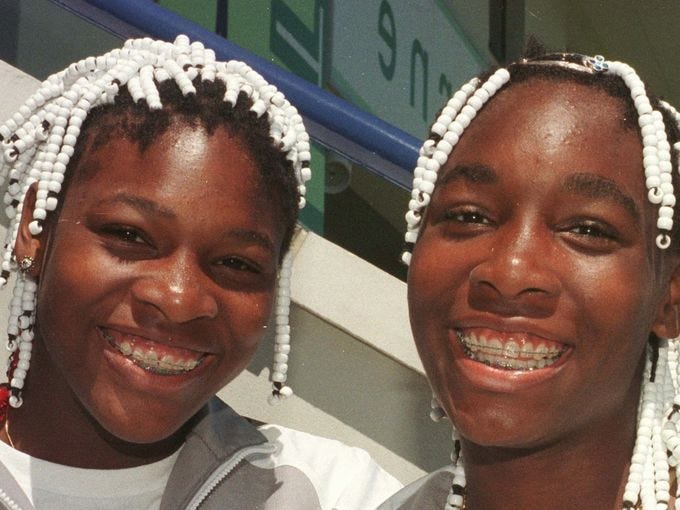
Serena and Venus Williams in 1997 at the Eastbourne fro the Direct Line Ladies Tennis Championships

For those familiar with the Williams story, the film doesn't break much new ground. What it does do is piece together their long, extraordinary journey from the streets of Compton, Calif., to winning a combined 22 major singles titles and becoming the first sisters to occupy the top two spots in tennis simultaneously.

"There were all these claims out there, and we really wanted to get to the bottom and tell people the details of their story," Major said in a phone interview last week.

The film shows intimate scenes with the sisters, their family and close associates at home, in hotels and at tournaments.

Serena is shown injecting herself with blood thinner and wearing the drainage bag she called "Grover" attached to her stomach following hematoma surgery.

She jokes with and chastises her hitting partner, Sascha Bajin; engages in pole dancing aerobics; and jumps onto the court in a downpour and dances around like a giddy child.

She explains her multiple personalities and says pointedly: "I was determined not to become a statistic. That's the only reason I play tennis."

The filmmakers catch Venus making the difficult behind-the-scenes decision to withdraw from the 2011 U.S. Open due to the energy-sapping illness Sjogren's.

Both sisters are shown singing karaoke, discussing marriage, and lovingly interacting at home and at tournaments.

"People can see our dynamic," Serena said. "It's kind of a real insight on our life."

Some of the most compelling shots are the early footage of the sisters doing drills with their father, driving around in a beat-up Volkswagen minibus, and being interviewed as young children.

An interviewer asks a 10- or 11-year-old Venus what her toughest match is. "Probably against my sister," she says. Asked what it was like, she pauses, takes a deep breath and responds: "Horrible."

A pre-teen Serena tells one questioner that the player she'd most like to be is the volatile John McEnroe.

Richard says he wrote a 78-page manifesto before the girls were born mapping out their route to the top of the tennis world.

A present-day Venus says: "My parents told me I'd be No. 1 in the world. I was brainwashed."
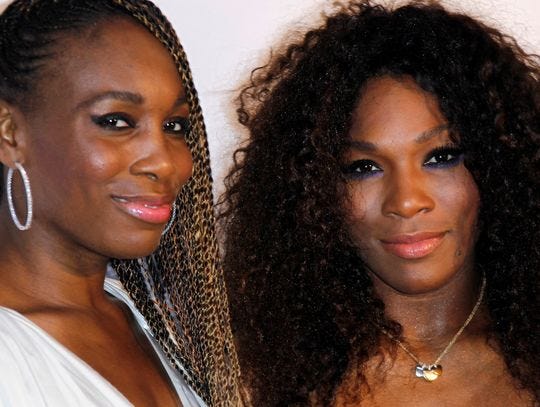
Venus and Serena Williams at a party for the 2012 Wimbledon tournament(Photo: Joel Ryan AP)
 
Major denied reports that the sisters withdrew their support after seeing a rough cut of the film and failing to show up for a scheduled appearance at the world premiere at the Toronto International Film Festival last September.

The Los Angeles Times said the family was unhappy with the depiction of Richard Williams.

"Throughout filming there were always communication issues and always us trying to get more," said Major, adding that there was "stickiness" around the timing of the festival and that Venus wanted more in-depth coverage of Sjogren's syndrome and her off-court activities.

She said that the fiercely guarded sisters might not have been ready to see themselves on screen in front of a live audience in a film that depicts "the complications of a family that's human."

"They fully support the film," Major said.

Serena confirmed that view Wednesday, saying she and Venus missed the festival due to scheduling conflicts but backed the film.

"Me and Venus were laughing over it," she said of the media reports.

Major said reaching an agreement took three years and was the "the most difficult thing I've ever done."

"I don't think anyone had the tenacity that we did to keep on going back and finding connections and finding reasons why we should film," she said.

According to Major, the sisters were paid for their time as well as for old photos and video footage. She described it as a "stipend."

Asked if they also would benefit from any commercial success, Major declined to elaborate.

The filmmakers had "full editorial control" and agreed to show the family a cut of the film and then have "meaningful discussions with them, which is exactly what we did," Major said.

The tight-knit but complex matrix of Williams family relationships is on full display.

Their mother, Oracene Price, says she knows nothing about 70-year-old Richard's current wife, Lakeisha, with whom he now has a baby boy.

"More power to her," Price says, bursting into laughter. "The only advice I can say is, 'Run. Do not pass go. Do not collect $200."

When one of Richard's five children from previous relationships shows up on court, Serena has no idea who he is.

Still, while Richard and Oracene Price are divorced, both are omnipresent forces in the sisters' lives.

Serena describes them as a kind of yin and yang. If one pushed, the other pulled.

"Neither can exist without the other," she says.

Richard, the most controversial family figure due to his sometimes outrageous and incendiary statements, is both a doting father and hard-nosed opportunist. In past and present footage, his well-known temper flares. At one point he tells the filmmakers they are around too much and suffocating him, which is "why I got rid of my first wife."

The sisters also tearily discuss the murder of their half-sister, Yetunde Price, in 2003, and the controversy surrounding their last appearance at the tournament in Indian Wells, Calif., in 2001.

According to Major, the sisters are "very, very different" but undeniably close despite the fact they have to compete against one another on such a big stage.

Serena was more off-the-cuff but less involved with orchestrating the project. Venus comes off as the more protective older sibling.

"She was the one always watching to make sure we're not filming anything untoward," Major said. "Venus is more about it being all together in a nice package. Serena's not worried about messing things up."

The film features a number of tennis talking tennis heads such as McEnroe and Peter Bodo, along with others ranging from Bill Clinton to Chris Rock to Anna Wintour.

Instructor Rick Macci, who brought the Williams sisters from Compton to Florida and worked with them for four of their formative years, also speaks about their early days.

He still sounds bitter that Richard moved the family to West Palm Beach and took over all coaching duties when Venus, then 14, signed a lucrative, multimillion dollar contract with footwear and clothing company Reebok.

"That's a left hook out of nowhere," he says.

Major said they became worried that Venus was depressed or uninterested in the project because she was sleeping a lot and wasn't forthcoming about her physical struggles. "I didn't know what was going on with her," she said.

Venus sometimes left them on eggshells.

"I was always afraid I was going to piss her off and lived with fear they might shut the thing down," Major said.

Both filmmakers wanted more from the sisters, but were happy with their output.

"I would have loved to film them going to church to see a bit more of what their religion means to them and how it has shaped them," Baird wrote of the sisters, who are Jehovah's witnesses. "They did not seem comfortable with letting us into this side of their lives which we had to respect."

Likewise, while the film discusses Richard's upbringing in the Jim Crow south, the sisters talk sparingly about race.

Serena tells the filmmakers that she prefers black men to white men and she discusses her stance on boycotting Indian Wells since 2001 after what he family believes was a racially tinged reaction from fans.

Venus says little.

"The thing that Venus wanted to talk about the absolute least is race," said Major. "Something she said that was not in the film is that race is not a winning topic."
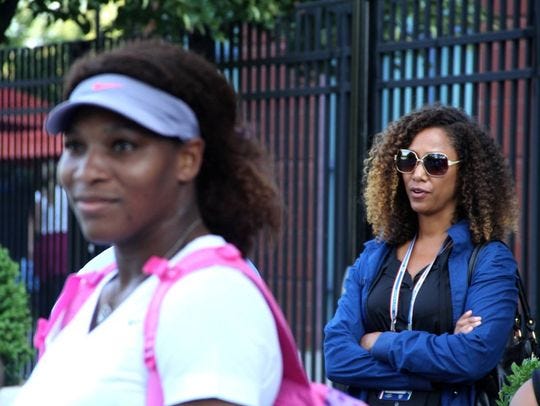
Filmmaker Michelle Major and Serena Williams (Photo: Venus and Serena)

Monday, March 21, 2011

A Documentary Film Tribute to Photographer Bill Cunningham

Bill Cunningham
(b. 1928)


Bill Cunningham New York

by Chuleenan Svetvilas


Bill Cunningham had no interest in participating in a film project. The 80-year-old photographer has been documenting fashion with his camera for nearly five decades. Though he has become famous over the years, he leads a very private life and shuns publicity. Director Richard Press says it took him ten years to make Bill Cunningham New York: eight years to convince Cunningham, who is a friend, and two years to shoot and edit the film.


Luckily, Press was able to gain Cunningham’s trust and the results are delightful. The director unobtrusively follows the photographer by day as he travels about New York City on his bicycle, shooting numerous photos of what people are wearing, darting across a busy street to take a picture, waiting for something interesting to capture. The director takes the lead from the photographer -- staying in the background, taking care not to disturb him as he works -- and through this approach, gradually reveals the essence of Cunningham’s commitment and a fascinating portrait of a man with an irrepressible joie de vivre.


Cunningham’s singular focus on his subject is riveting to watch. He’s like a photographer in the wild stalking his prey except that he’s running after a glimpse of an interesting skirt, an unusual shoe or a stylish drape of fabric. Though he has been doing this job for years, he still marvels at the clothes he sees and thrills to see an elegantly dressed woman. Some of these photos will eventually appear in his weekly “On the Street” column for the New York Times.


A charming man with a ready smile, Cunningham claims there is no short cut to capturing the “fashion show on the street.” So he’s outside everyday in all kinds of weather with his camera in hand to see what people are wearing. Remarkably, his day doesn’t end when the sun goes down; at night he’s off on his bicycle to document any number of benefits and galas to photograph the attendees and performers. These images will appear in his other weekly Times column “Evening Hours.” The film chronicles one of his nightly jaunts. Clearly, Cunningham is very fit. His stamina and dedication to his profession is obvious in each of his scenes.


The documentary also includes interviews with people who have appeared in his columns over the years as well as a few of their photo spreads. Press filmed a former diplomat wearing many different outfits cut from very colorful fabrics, discusses his clothes and why he thought Cunningham photographed them. In another interview, a young man wearing dramatic eye makeup and a striking hat that matches his suit recalls the moment a friend told him that an entire “On the Street” column had been devoted solely to his clothes and hats. Press also speaks with Iris Apfel, an octegenarian with an extravagant and outrageous sense of style; Anna Wintour, the editor of Vogue, who says “We all get dressed for Bill”; and Tom Wolfe, a writer known for his sartorial trademark, the white suit. They all have great respect and admiration for Cunningham but know little about his personal life.


Additional details about the reserved photographer gradually emerge and he comes across as a man with immense integrity and one who truly loves his work. When he’s deciding which events to attend at night, he says his only consideration is the foundation or organization that is benefiting from the event, not the guest list. The film shows him photographing such an event and refusing a repeated offer of food and drink because that would compromise the newspaper. He’s simply there to do his job, not to socialize.


Before his position at the New York Times, we discover that he was a photographer with the fashion trade magazine Women’s Wear Daily. He once shot photos showing models wearing designer outfits and juxtaposed them with everyday women wearing a combination of clothes similar to the models. His intention was to show that women on the street had creativity similar to fashion designers. However, unbeknownst to Cunningham, WWD chose to mock their clothing. So he quit, appalled that his photos would be used to disrespect the women.


The documentary also provides an eye-opening view into Cunningham’s home, a very small studio in Carnegie Hall crammed so full of file cabinets containing his negatives that there’s barely enough room for his narrow bed. He gives the director a “tour” of his place, which has no kitchen or bathroom and his few clothes are on hangers hooked on handles of his file cabinets. This startling scene illustrates just how deeply committed he is to his work. He doesn’t have room for anything but photography in his life. And the documentary makes it clear that he wouldn’t have it any other way.


Cunningham makes fun of the fact that he documents fashion for a living yet has few clothes himself. But he does have his own sense of practical style, wearing his own everyday uniform of a sort – a plain blue jacket worn by street sweepers in Paris.


Towards the end of the documentary, Press follows Cunningham to Paris as he attends Fashion Week. The veteran photographer likes to sit on the side, rather than at the end of the catwalk where all the other photographers position themselves so they can take frontal shots of the models as they strike their final pose. Cunningham would rather watch the models stride by him and shoot how the clothes look when they walk. He says Fashion Week “re-educates the eye.” But he’s also in Paris to accept the Chevalier of the Order of Arts and Letters. True to form, Cunningham brings his camera to the event and takes pictures. A woman asks him why he’s “working” and shouldn’t he just be enjoying the event? But he says it’s not work, it’s fun.


The only awkward moments arise at the end when an off-screen voice asks Cunningham about his sexuality and how important the church is to his life. Earlier in the documentary he’s asked about his family and his life before he became a photographer but the film never delves very deeply into his early life. Nearly all the interviews are with people who have some connection to his work as a photographer. The focus is on the man today and it works because Cunningham is a unique individual with an utterly engaging personality. Cunningham’s admiration for his subjects and his joy in the work is palpable in every frame.


This article was originally published in the Fall 2010 issue of DOX magazine. The film is currently playing at New York's Film Forum and will be opening at various theaters around the country in April 2011.


Chuleenan Svetvilas is a writer and editor in Berkeley, California. Her writings on film have appeared in Alternet, Documentary, DOX, Mother Jones, The Panopticon Review, and Soccer vs. the State: Tackling Football and Radical Politics, edited by Gabriel Kuhn (PM Press).

Friday, July 23, 2010

"Royalty, Heroism, and the Streets": The Ongoing Saga of Jean-Michel Basquiat (1960-1988)


Jean-Michel Basquiat in his studio, 1985. Photograph © Lizzie Himmel


 James Van Der Zee, Jean-Michel Basquiat, 1982


http://movies.nytimes.com/2010/07/21/movies/21jean.html?nl=movies&emc=mua3

Henry Geldzahler: What is the subject matter of your work?

Jean-Michel Basquiat: Royalty, Heroism, and the streets

--From 1982 interview--Age 22

All,

I see the voracious media and "art" vultures are still trying to pick at and greedily gnaw on the elusive bones of Basquiat's magic carcass (I started to say CANVAS). Venal carnivorous beasts must EAT I suppose. So it's a good thing that JMB "himselves" is long gone from this rotten vale of tears and like his mighty paintings has split to a zone where he can no longer be confiscated and consumed. In other words: See this movie and watch his laughing ghosts jump off and escape the screen no matter how much his "image" is seemingly contained/tamed by the eternal vagaries of memory, envy, and commodification. After all like Bird, Pres, LadyDay, Marvin G. and Hendrix even Jean's demons were finally defeated by his majestic WORKS in the end... Or as Marlene Dietrich put it at the end of Orson's last major Hollyweird film "Touch of Evil" (1958) before the "blacklist" took him down: "He was some kind of man. What does it matter what you say about people?" Continue to RIP anyway Brother B...

Kofi

(NOTE: See my own "review" of an earlier Basquiat graverobber (from 1999!) in the essay directly following the film review below)...

MOVIE REVIEW

Jean-Michel Basquiat: The Radiant Child (2010) NYT Critics' Pick
 

This movie has been designated a Critic's Pick by the film reviewers of The New York Times.
Lee Jaffe/Arthouse Films
The subject of “Jean-Michel Basquiat: The Radiant Child.”


A Friend, an Artist and a Personal Interview

By STEPHEN HOLDER
July 20, 2010
New York Times

“Nobody loves a genius child.” Those are words from Langston Hughes’s poem “Genius Child,” used as the hyperbolic epigraph in Tamra Davis’s worshipful documentary portrait, “Jean-Michel Basquiat: The Radiant Child.”

But after watching this homage to an artistic wunderkind, constructed around a rare question-and-answer interview with Basquiat that Ms. Davis filmed in 1985 (their mutual friend Becky Johnson asked the questions), then put in a drawer, you might revise Hughes’s declaration to read, “Nobody knows the genius child, least of all himself.” Some might even question the use of the word “genius.”

Basquiat, at the height of his fame in the 1980s, was undoubtedly loved in the way that charismatic celebrities are loved and envied. One of his admirers was Andy Warhol, who, if not in love with Basquiat, certainly desired him, and was his champion at a crucial moment in Basquiat’s ascendance. But when the two collaborated on canvases, the critic Vivien Raynor, writing in The New York Times in 1985, expressed skepticism about this superstar match:

“Last year, I wrote of Jean-Michel Basquiat that he had a chance of becoming a very good painter, providing he didn’t succumb to the forces that would make him an art world mascot. This year, it appears that those forces have prevailed.”

The film’s romantic depiction of Basquiat is an old story. An artistically driven, voraciously ambitious, devastatingly charming wild child, he was devoured by the fame he craved and died of a drug overdose in 1988 at 27. The movie does not go into the gory details of his dissipation and addiction. Although sophisticated in its blasé acceptance of art-world wheeling and dealing and the temptations that accompany sudden fame and wealth, it is also tenderly protective of its subject.

Basquiat comes across in the interview as elusive and seductive in much the same way that the early Bob Dylan did, but without the defense of language. His verbal talent found its expression in his Neo-Expressionist graffiti art, with its scrawled cryptograms and crossed-out words. Such deletions, he said, made their meanings all the more tempting to decode.

“The Radiant Child” begins by directly connecting Basquiat’s art to New York City’s blight in the 1970s, then widens its perspective to portray Basquiat as someone whose acute attunement to art history and popular culture found its way onto his savagely energetic canvases. He imprinted himself on the landscape with his graffiti, executed under the name SAMO; as an underground star, he became a regular guest on “TV Party,” a public-access show hosted by his friend Glenn O’Brien, one of the film’s more articulate talking heads.

Other commentators include the artist’s friend Julian Schnabel, who directed the 1996 biographical film “Basquiat” (starring Jeffrey Wright as Basquiat, and David Bowie as Warhol), and the rapper, hip-hop historian and graffitist Fab 5 Freddy. The closest we get to Basquiat is in the recollections of the gallery owner Annina Nosei, in whose basement he painted, and Suzanne Mallouk, a girlfriend who took him in when he was still poor.

Some of the interview’s most fascinating moments are Basquiat’s memories of his hand-to-mouth existence after running away from home as a teenager. Born to parents who were of Haitian (his father) and Puerto Rican (his mother) descent, he rebelled against a middle-class background for reasons that remain unclear. A seemingly embattled relationship with his father, an accountant, is referred to but not explored. The film takes the heady view that his flight from home was the necessary odyssey of an unstoppable Rimbaud-like visionary.

This is not to say that “The Radiant Child” isn’t a valuable film. It places Basquiat’s art in a cultural context with an enthusiasm and zest that make the many pictures shown come blazingly alive. His bitter contemplations of black history, in particular, have an epic, historical dimension, while also reflecting his own insecurity about being treated as an exotic, token black star in a predominantly white art world. One tantalizing anecdote tells of his disgust at a patron who asked him to color-coordinate a painting to her living room.

Basquiat was an ardent fan of bebop, and the frenetically edited scenes of his paintings with jazz accompaniment evoke an artist who worked quickly and needed intense music for creative stimulation. Once Basquiat became rich, his loft became party central; wads of cash were casually stuffed in the furniture.

If “The Radiant Child” embellishes the legend in a hundred small ways, its cleverest maneuver is to keep its subject at enough of a remove to enhance his mystique. It should help push the prices of his work higher.


Jean-Michel Basquiat: The Radiant Child

Opens on Wednesday in Manhattan.

Written and directed by Tamra Davis; di- rectors of photography, Ms. Davis, David Koh and Harry Geller; edited by Alexis Manya Spraic; music by J. Ralph, Adam Horovitz and Mike Diamond; produced by Ms. Davis, Mr. Koh, Lilly Bright, Stan- ley Buchthal and Ms. Spraic; released by Arthouse Films. At Film Forum, 209 West Houston Street, west of Avenue of the Americas, South Village. Running time: 1 hour 30 minutes. This film is not rated.

A version of this review appeared in print on July 21, 2010,


Book Review


Basquiat: A Quick Killing in Art
by Phoebe Hoban
Viking, 1999


How to Lynch a (Black) Painter
by Kofi Natambu

It never fails. Become a well-known or respected pioneering African American male artist and watch the deluge of racist fear, envy, spite, condescension, and hostility rain down upon you. Become everyone’s favorite or most feared pinup/mascot/strawman. Have everyone else’s unexamined and reductive banalities and stereotypes dumped on your nappy head: wild child, primitive, paranoid, naif, stud, freak. When no one can figure you out or you ‘appear’ to be much-too-complex- to-be-true watch the frustrated and envious ones accuse you of being inexplicably both “white” (as in witty, urbane, sophisticated, perceptive, intelligent and “modern/postmodern”) and “black” (as in cunning, childlike, violent, paranoid, gauche, sullen and dumb) at the same time. Then be told that these “racial” differences are the result of (gasp) CULTURE. Watch in astonishment and horror as you and your work are reduced to an unknowing and unknowable essence/cipher while your ‘intriguing’ and charismatic, yet transparent, ‘personality’ is deciphered “Rorschach style” by any silly dilettante who comes along and deigns to project onto you their own inane “dollar book Freudianisms” (as the legendary Orson Welles once deemed such behavior in another context).

No brothers and sisters you can’t win and what’s worse no one wants you to try. Persist and excel anyway and watch your legacy and great achievements patronized, ignored, neglected, and derided by nearly all the so-called experts (more judgmental white people of course). Yes, it’s true. This is the real cost of “greatness” if you happen to be an African American male innovator and it ain’t got nothing to do with whether you agree or believe it or not. It’s called history.

Now that I’ve gotten all that off my chest it should be obvious that I did not enjoy reading a new outlandish travesty of a biography about the late black painter Jean-Michel Basquiat, who died of a drug overdose in August, 1988 at the age of 27. This book entitled Basquiat: A Quick Killing in Art by a former New York Times journalist named Phoebe Hoban should actually be called Nigger Artist: A Quick Killing in Biography, crammed as it is with relentlessly racist gossip, analytical shallowness and predictably tabloid stained sensationalism. In fact, Hoban is so far out of her depth here that it almost makes one wonder why this manuscript even saw the light of day. Unfortunately part of the cost of becoming a pioneering African American male figure in the United States is to be endlessly slandered and held up to public ridicule if not violent attack. In this book we find that Basquiat is no exception.

After all what does one say about a biographer of an innovative black artist who knows next to nothing about modern painting, cultural history, aesthetic theory or the byzantine politics and endlessly cruel absurdities of being “black in America”? How does one take seriously a biography in which three times as much space is allotted to that artist’s sexual affairs and activity as it is to that individual’s aesthetic production? Or where nearly one fourth of the entire book is spent talking about the artist’s various drug deals, addictions and escapades? How about a book where whole chapters are devoted to various girlfriends of the artist? Well you get the picture...

What’s even stranger is that Hoban seems to know a great deal more about both the public and clandestine machinations of international art dealers, collectors, Wall Street and Soho-based economic investors, patrons and jetset groupies/hustlers during the 1980s. Frankly if she had pursued this angle of investigation as the major theme of her book she could have spared us the cynical, exploitive, and manipulative airing of Basquiat’s dirty laundry, and thus left the still necessary task of doing a serious and critical examination of what made Basquiat such an important painter and cultural figure to a real art critic/cultural historian/biographer. As it is, Hoban (despite her transparent attempts at being simultaneously condescending and hyperbolic in her ‘assessment’ of Basquiat’s oeuvre) winds up doing a disservice to both her general and individual areas of interest by focusing on the superfluous and melodramatic aspects of Basquiat’s public fame and subsequent demise. In so doing Hoban is able to skirt any personal or intellectual responsibility for her ‘Vanity Fair meets the National Enquirer’ prose style by pretending that ‘the life’ (however buried and distorted by the routinely tawdry and gossipy testimony of Basquiat’s “friends”, enemies, and competitors in the art world) is ‘more important’ than the art. In this way Hoban doesn’t have to explore the complex narrative of a very talented and conflicted man who was forced to deal with fierce inner and outer demons in his everyday existence, yet still found enough energy, discipline, intelligence, love, courage and dedication to leave a profound legacy of hundreds of extraordinary paintings. Needless to say a great book could have been written about the real Basquiat contending with the neurotically competitive New York artworld in all of its frenzy, decadence, greed, jealousy, racism and fear. But then Hoban would have had to deal with the fact that, despite whatever personal problems Basquiat had, he was a serious artist who worked for, and deserved, respect for his work. But that would have required Hoban to acknowledge Basquiat’s humanity. Clearly that acknowledgement is a tricky thing for many white journalists and critics when the subject is an African American male who absolutely refuses to kowtow to anyone’s either ‘liberal’ or ‘reactionary’ expectations of him.

However one day someone will be both perceptive and knowledgeable enough to do justice to who Basquiat was and wasn’t in terms of the historical and creative universe of Western art. Unfortunately that day is still not here a decade after his death. But if Basquiat can wait (something he found impossible to do while still alive) we all can. In the meantime we still have his paintings rather than this execrable book to remind us all why he was so worthy of a biography in the first place. Jean-Michel would have appreciated and celebrated the difference.


Konch

Oakland, California


May, 2000

FOR JEAN-MICHEL BASQUIAT

Like God
some people are put here
to change EVERYTHING
& disappear
leaving us with our
silly gossip & halfwritten
holybooks staring into the endless blue chasm of
our own desire wondering why
you could laugh & cry at the same damn time
all the Time
painting thousands of horizons that others never see
while you wave at us from the bright red edge of
the canvas we call life &
you deem just another stroke of yr wandering brush
with death's hohum
regime

That crown you wear is so stunning
that T Monk wrote
a song about it
A sound painting called
"Ugly Beauty" a wonderful dimension you
could always appreciate even in the midst of
all those words & images you painted
on EVERYTHING you saw touched smelled heard &
tasted.

It's true: Art is just another pretty blacknigger from Brooklyn afterall
Like Ishmael said: "Genius is Common"


by Kofi Natambu
(c) 2008


http://www.basquiatbiography.com/jean-michel-basquiat-a-biographyBASQUIAT BIOGRAPHY
Jean-Michel Basquiat: A Biography
The book Jean-Michel Basquiat: A Biography, by Eric Fretz, was published by Greenwood Press in March, 2010.
Jean-Michel Basquiat was barely out of his teens when he rocketed to the center of New York's art scene. He was 27 when he died of a heroin overdose. Always controversial, Basquiat is now established as a major contemporary painter whose unique work continues to enthrall.
Jean-Michel Basquiat: A Biography covers the artist's Brooklyn childhood, his teenage years as a homeless graffiti painter, and his rise through the art world. Along with discussion of his life and work, including his use of Afrocentric themes, the book offers background on related contemporary art movements. The text gives a vivid flavor of the various milieus that Basquiat passed through in his life. Special attention is given to Basquiat's friendship with Keith Haring and collaborations with Andy Warhol. The book also explores Basquiat's difficult relations with gallery owners and other authority figures, his problems with drug use, and his early death. A final chapter covers his continuing relevance and ongoing influence.
The book also contains a chronology of his life, a selected bibliography, list of works cited, index, and photographs showing Basquiat at various times in his career, including shots in his studio surrounded by his work.
The distinguished Greenwood Biography series was developed specifically for student use. Prepared by field experts and professionals, these engaging biographies are tailored for high school students who need challenging yet accessible biographies. Although the emphasis is on fact, not glorification, the books are meant to be fun to read.
Jean-Michel Basquiat: A Biography is supported by this website, which gives links to where the works discussed in the book can be viewed in full color, and suggested lesson plans for using the book in schools.
192 pages. Hardcover, library binding, 6 1/8 x 9 1/4, $35.00. Available from Greenwood Press, Barnes and Noble, Amazon US, and Amazon UK. Librarians: download Book Flyer.
The book will also be available on the Web as an eBook, see www.abc-clio.com for details.

Thursday, March 11, 2010

An Open Letter From Michael Moore Promoting 'Capitalism: A Love Story' And Other Related Matters


All,

I LOVE Michael Moore. Always have. I met him once personally in the early 1980s in Detroit when he wrote for and edited a very good muckraking radical weekly newspaper that he founded called The Michigan Voice (it was originally called The Flint Voice after his hometown of Flint, Michigan but he expanded the newspaper's reach to take in coverage of the entire state). He was very impressive when I met him in 1982-83 and I think he and his work still are. What I really like and deeply respect about the man and his work is that he's not another smug, cynical, and gliberal dilettante who thinks (and acts like) he's "above it all". In other words: He really gives a damn and actually puts his own ideas and principles on the line in his art and life. He's an actively engaged, critical, and caring artist and citizen in an era where far too often those things are simply dismissed, ignored, or ridiculed. That in itself doesn't make him perfect or flawless by any means of course but at least there is a fundamental core of real dedication, sincerity, and honesty in the man and his work that gives him genuine credibility and reliability in my book (unlike many of the sneering pseudointellectuals and passive-aggressive nihilistic pinheads who roam the halls of academia and hopelessly sectarian enclaves of "armchairville" where "revolutionaries" --hah!-- sit around allday talking infantile smack about whose politics and art are the "purest.") Dumbass Divas!

So let's hear it for the artists/activists/citizens who do far more than merely talk trash and vainly posture like it's all about them and their abstract "goals" for the rest of us...So continue to kick ass and take names Michael. I hear ya...

Kofi


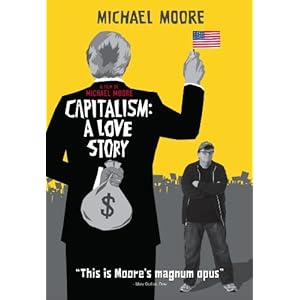
Sell! Buy! Rebel! 'Capitalism: A Love Story' Is Out Today on DVD (...and what is up with Wal-Mart?)!

Tuesday, March 9th, 2010

Friends,

DVD-Day for "Capitalism: A Love Story" has finally arrived for all you good folks who just couldn't figure out how to fit in a trip to the movie theater between your three part-time jobs -- or simply weren't able to afford the $10 for the small popcorn at your local rip-off cine-mall when my film was released last fall.

What's with you people?! I make these movies for you to see on a big screen, in the dark, with 200 strangers who want to hoot and holler along with you. Those of you who did see it -- thank you!! You helped to make it the 8th-largest grossing documentary of all time (and, as of Sunday morning, "Capitalism" had sold more tickets than Best Picture winner, "The Hurt Locker").

But for those of you who didn't get to the theater, what's your excuse? Didn't want to sit through 20 minutes of TV ads up on the screen before the movie started? Don't like sitting next to people who have 6 important cell calls to make during the film? Feet get stuck to the floor after two hours of people spilling their 164 oz. sodas, thus preventing you from getting up when the film's over? Jeez, what babies!

Well, starting today, you can now OWN your very own DVD (or Blu-ray) copy of my latest action/romance/horror film, "Capitalism: A Love Story" -- and watch it in the comfort of your soon-to-be-foreclosed home! Get it cheap at Amazon, rent or stream it fast at Netflix, or go down to the local Wal-Mart that put your locally-owned mom & pop video store outta business and pick it up for pennies on the dollar. See! Something for everyone!

The fact that Wal-Mart is carrying this movie -- a movie that specifically exposes Wal-Mart's past practice of taking out secret "dead peasant" life insurance policies on its employees and naming itself as the lone beneficiary should the employee meet an "untimely" early death -- well, my friends, need you any further proof that Corporate America is so secure in its position as the ruler of our country, so sure of its infallible power that, yes, they can even sell a movie that attacks them because it poses absolutely no threat to them?

A sane person would think that Wal-Mart would never carry "Capitalism: A Love Story" because it's simply not in their best interests to inform their customers of their shady past. After all, many Wal-Mart stores wouldn't carry "Bowling for Columbine" back in 2003. That was *Kmart* I went after (for selling the ammo to the Columbine killers)! But I guess that was too Mart-y close for Wal-Mart -- so no DVDs were allowed of that film on the shelves of some of the world's biggest retail chain's stores (the movie studio estimated that cost them $2.5 million in sales).

But seven years later, it's a new day in America. The corporate coup is complete. Corporations like Wal-Mart now call all the shots, write all the laws, pay off almost all the congressmen and essentially (along with the other Fortune 500 companies and Wall Street) rule the nation. They've helped to eliminate consumer choice and the free market while convincing you they are all for "free enterprise" and the "U.S.A."

More importantly, they've snuffed out any criticism or opposition. They've even co-opted liberals, like the people who made the wonderful documentary, "Food, Inc." The last half-hour of this movie includes -- I kid you not -- an homage to Wal-Mart as the filmmakers swoon over this kinder, gentler company that has decided to -- bless them! -- put an organic food counter in their stores! Thank you, Wal-Mart! Kumbaya! (And hey, granolaheads, don't forget to flash a smile on the way out of the store at the "greeter" who can't afford to see a doctor.)

Yes, Wal-Mart, by selling "Capitalism," is saying to me: "Go ahead Mike and expose us all you want! Hahahhaha! We're so convinced that the public has either been dumbed down or made numb enough to not give a lick about whatever it is you're saying about us and capitalism. We can sell a million of these and it won't make a damn bit of difference about our ability to rule the world. So knock yourself out, big guy! Hehehehehehe. Go ahead and put your little movie on our shelves. It will never start a revolution."

Or so they think.

But what if they're wrong?

What if they and their brethren -- the banks, the insurance companies, the hedge fund sociopaths -- are too confident we won't fight to get our country back? They think that because they, the richest 1%, now own more financial wealth than 95% of all Americans COMBINED, that they can get away with anything. Perhaps they're right. Perhaps they're not.

I did ask someone at the studio why Wal-Mart was so willing to carry this movie.

"They're no dummies," he told me. "They know who shops in their stores -- working people, blue collar, the people hit hardest by the economy. They know your movie will resonate with them and that only means one thing -- ka-ching, ka-ching at the cash register!"

Happy now? Good. I thought I'd cheer you up on my big day!

Listen, let me cut right to it: I am passionate about this movie. It is not only my most personal film, it is the most vital and necessary film I've made in my 20 years as a filmmaker. Period. I told my crew at the start of this movie, "Let's make this film so brutally honest that NO ONE with any money will ever want to write us a check to make another movie!" And so we set off to make the most dangerous documentary we could.

As gloomy as our situation in the world looks these days, I refuse to give up. If there's even the slightest chance that we can turn this around, then I want to help, I want to be part of the fight along with you.

And I want you to see this movie. Not next week (by then, the health insurance companies will have won). Not next month (by then, the banks will have scuttled any new regulations). I need you to watch it right now and I need you to get as many of your friends and family to watch it as soon as possible -- and then I want you to do something.

That "something" can be found in the 80 new minutes of material and DVD extras I've put on this home video. It's 80 minutes of bold ideas and things we can do to get our country back. No one has seen these extras -- and today will be the first time they're available on the home video of this movie.

Well, that's the pitch. I get nothing $-wise from the sale of these DVDs. I just want you to see this movie because, if you haven't, I think you will not only be "entertained" for 2 hours, you'll be ready to rock-n-roll your way down to the local Citibank and create the nonviolent ruckus they need to see. THIS IS OUR COUNTRY -- not theirs. They have plundered and pillaged long enough. Homes in this country receive foreclosure filings every eight seconds! This must be stopped.

Let my movie be the tool you use to rise up and become the citizens I know you want to be. If not now, when?

Thank you for all your support over all these years. You must know by now that I honestly couldn't make these movies without you.

My absolute gratitude and best wishes for you and yours,
Michael Moore
MMFlint@aol.com
MichaelMoore.com

P.S. To order "Capitalism: A Love Story" from Amazon, http://www.amazon.com/Capitalism-Love-Story-Michael-Moore/dp/B0030Y11XS/ You can also add "Capitalism" to your Netflix and Blockbuster queues.

P.P.S. To see just how secure Wal-Mart feels in its place as King of the World, I'll take a spin around to some Wal-Marts this weekend and see if the DVD has been pulled off the shelves. I'll let you know!


Join Mike's Mailing List | Follow Mike on Twitter | Join Mike's Facebook Group | Become Mike's MySpace Friend


Tuesday, November 3, 2009

The Triumph and Tragedy of Michael Jackson: 1958-2008

All,

This is an outstanding personal essay by Detroit-based writer and cultural critic Patricia Calloway on the heinous nexus of money, fame, drugs, exploitation, and "entertainment" in the gigantic corporate matrix that tragically became known to the rest of us as the global commodity called "Michael Jackson, Inc."--which predictably destroyed and dismembered the brilliant human being of the same name (without the quote marks and incorporated copyright sign of course). My wife and I saw the man and artist Jackson this past weekend in "This Is It", the new tribute documentary film now playing in over 18,000 theatres nationwide, and it is a wonderful and thoroughly inspiring examination/celebration of a genuine musical genius and extraordinary dedicated artist of the highest caliber. What the film proves conclusively is that Michael Jackson was an absolute master of his musical idiom who truly deserved the encomium "King of Pop." I enthusiastically recommend that everyone see the film. I guarantee you won't be disappointed. It really is that good...

Kofi


MILK AND ASHES

Losing Michael Jackson was like losing a brother in more ways than one.

By Patricia Calloway


There once was a king of pop
Who took milk going back to the top
His doctor was wit' it
But he overdid it
The milk, and the king of pop stopped.

On August 29, 2009--which would have been his 51st birthday-- Michael Jackson was finally interred at Forest Lawn Cemetery, his body committed to the ground by his family after weeks of lying in a freezer being chipped at, drained and sampled in the search for the cause of his death. Two culprits have emerged; one, Dr. Conrad Murray, who caused the death proper, and the anesthetic drug propofol, his weapon of choice. Accomplices include the tranquilizers midazolam and diazepam, with lidocaine and ephedrine acting as lookout and getaway driver, respectively.

That week in class we studied the action of the drug propofol as part of a course lecture in veterinary anesthesia; I am a second year veterinary nursing student who has recently completed an Associates degree in General Science. Our instructor talked about Michael and the drug in the most offhanded and disinterested manner. During our class break I went to a stall in the ladies' room and inexplicably burst into tears. I was quite surprised by that.

Michael's Milk of Amnesia

Propofol is a central nervous system drug used for anesthetic induction. It works very fast; it is highly lipid soluble, so it goes in and runs through the body, is metabolized then dissipates within five minutes. Its action produces unconsciousness and is painful when administered to humans.

The drug is suspended in a soybean oil and egg lecithin emulsion, hence its milky whiteness. It must be used quickly and completely because of its poor storage characteristics; any remainder must be discarded within six hours of opening because the proteinous emulsion supports bacterial growth and could become contaminated.

Dogs and cats do very well under propofol. Onset is usually less than 60 seconds and the duration of anesthesia is 5 to 10 minutes. Dogs recover quickly and smoothly from propofol with no hangovers even after multiple injections. Cats, while their recovery is a little longer, recover quickly as well. Humans are supposed to recover from propofol with a minimum of problems, except when your doctor is Conrad Murray; in that case, you've got a world of problems.


A Brother From Another Mother

My brother Rodney JoWayne Young was born in the same month as my brother Michael Joseph Jackson and they would have been the same age. My brother was a Detroit Police officer, a sergeant with over 20 years on the force. He had wanted to join the police force since high school; he graduated then worked at the Ford factory while taking classes at a local college. When the police academy called him he threw down his work gloves and apron and never looked back.

June 20, 2006 my brother was out after work riding his motorcycle with three other off-duty officers when he lost control of his bike on a freeway entry ramp. The bike went under an eighteen wheeler truck; he was crushed beneath its wheels. The driver drove another five miles before he knew he had even hit my brother.

When I visited his body in the hospital morgue the first thing I noticed was his peace vibration. I touched him; he was cold, of course, but there was no hint of last moment angst, no residual fear. I knew he hadn't been afraid in his final moments. How could that be?

For months I was tormented by the thought of the eighteen wheeler crushing the life from my brother's chest. An autopsy was scheduled to determine cause of death. He was a police officer; they had to make sure no foul play was involved (he worked in fugitive apprehension). The state police conducted the autopsy but the results weren't final for another sixty days. In the meantime he was laid to rest in a funeral fit for a head of state.

Then came the questions: How did Rodney, an experienced rider, end up under the wheels of an eighteen wheeled truck? How did Michael, a seemingly healthy man, end up in cardiac arrest under the nose of a licensed physician?

These were million dollar questions and it dawned on me as I watched Michael's memorial service, along with millions of others, that his family was on that same road toward to discovering exactly what happened to their loved one because things just weren't adding up.


Dr. Dootoomuch

When I first read the list of drugs administered to brother Michael in the early hours of June 25, 2009, I couldn't believe it. What the hell......? Who gives an entire family of drugs to a patient within hours of each dose? Who gives CPR on a soft bed instead of a hard surface? Why were there needle marks in his neck and what was injected into him? Why was he in the doctor's room and not his own? None of it made sense.

This doctor was clearly the most inept, negligent and downright stupid practitioner to ever hold a license if he gave Michael CPR on a soft bed. People Magazine reports that not only was Michael given cardiopulmonary resuscitation on a soft surface, but that the doctor used one hand to massage his heart.

In veterinary emergency CPR, we wouldn't dream of using one hand on a dog. In canine CPR, the chest is compressed between both hands, one under the chest, one over the heart, while the patient lies on its side; or, when chest up, one hand over its heart, the other under its back. The patient is always, always on a hard surface. In human CPR both hands are placed over the heart and compress the chest while the patient lies on his back.

According to his own attorney, Conrad Murray administered CPR to Michael Jackson the way I would give chest compressions to a dog in cardiac arrest. A dog. The King of Pop got substandard emergency care even by family pet standards.

The family pet would have received flumazenil, a benzodiazepine antagonist which would have reversed the effects of the Valium, Versed, and Ativan that Conrad Murray (for I refuse to call him “Doctor”) administered to him damned near every hour on the hour from one o'clock to seven thirty a.m. CNN.com reports that Murray allegedly told emergency personnel at the hospital that he had given Michael flumazenil, but I don't buy that. I don't buy it because Michael is dead; I am of the opinion that Murray threw that in to cover himself only after he finally remembered he should have used it.

The family pet also would also have been immediately ventilated, put on an ECG and given IV fluids. Not one report states Michael Jackson got any of this from Conrad Murray; that's why I'll never call him “Doctor”. When sister LaToya demanded to see Michael's doctor to “ask what the hell happened” to her brother, he didn't identify himself. Paris-Michael, Michael's daughter, had to point him out to her; after that he disappeared from the hospital. That's why I call him....well, you know, other names.

And AEG Makes Three

Who books a man for three months running in 2009 and another two months in 2010 for a total of 50 dates at an outdoor entertainment venue? Anschutz Entertainment Group, that's who.

AEG is a global sports and entertainment promotion outfit; it is the world's largest owner of sports teams and venues and the world's second largest concert promoter behind LiveNation. AEG makes its money by promoting concerts and live shows in the sports venues they own. The Staples Center is just one example of the strategy that has propelled them to the top of live entertainment.

It was AEG who held the $4 million dollar memorial service for Michael Jackson, stiffing Los Angeles taxpayers for the bill while at the same time garnering international attention for the Staples Center. Angelenos weren't the only ones left holding the bag, however.

It was AEG who pulled a fast one on its advance ticketholders when it announced that any of the 750,000 tickets sold for the “This Is It” concerts could either be refunded upon request or ticketholders could receive souvenir tickets instead. The souvenir tickets, which AEG has carefully pointed out will become collector's items, have a holographic 3D face, kind of like those Topps baseball cards of the 1970's that moved when you moved them. The tickets sold for from £50-£75; 750,000 refunds would cost AEG about $85 million dollars in tickets and booking fees.

AEG was looking to save $40 million dollars by running this “All 750,000 tickets will be valuable, just wait and see” scam. Never mind that since AEG prints the limited edition tickets they control the market for and the value of the souvenirs. Luckily, Brits aren't stupid and many of them went for the refund. Good for them.

Quick, where's the remaining piece of the historic Berlin Wall? Don't know? Me, either. AEG had it removed because it blocked the view from one of their stadiums. Ask them where it is; they had it last.

The Jackson family suspects that several of the people surrounding Michael before his death were put there by AEG and looking at this Berlin Wall and ticket thing, I can't put it past them. Their biggest concern right now is how to best “monetize their asset”; that's “make money” to me and you.

These are the people Michael agreed to work for.


“G” Is For Greed


Published reports say Michael didn't want to do fifty dates, he only wanted to do ten. AEG sold and sold and sold until he relented. Michael loved his fans and didn't want to disappoint. According to LaToya Jackson, AEG exploited his love by planting people within his camp to monitor him. She feels that Conrad Murray helped others to control him with drugs. According to AEG, a “significant amount of money” was to be advanced to Murray by them and he would be with Michael in England for the concerts. Murray had given up two cardiology practices to work with Michael. If AEG was going to advance him “substantial amounts” of money, then Murray's ship had finally come in; millions of dollars and several baby mamas in debt, he was determined to sail.

Michael passed AEG's physical like a champ and the latest coroner's report backs up their findings; he was a little thin but he was healthy for a 50 year old man. Was the reason Michael couldn't sleep because Murray had him on stimulants so he could dance and sing for hours on end in preparation for the concerts? Sedative cocktails were used to put him down at night. Sam Goldwyn used and abused Judy Garland in the same way.

There's a “g” in his name, too.

The Light Of Day

When I had you, I treated you bad and wrong, my dear

And since you've been away

Don't you know I hang around with my head hanging down

And I wonder what I'm gonna do

The Los Angeles Coroner's Office has ruled Michael's death a homicide. In his official statement, the coroner found that Michael was a healthy 50 year old man whose weight was within normal range for his height, and though he had a few tics here and there, namely a little arthritis, a little chronic lung inflammation (probably from his lupus) and no skin cancer (it had cleared up!), he was in good general health. No, he was not bald, emaciated or covered in scar tissue and puncture marks, although there were some on his arms (fresh, obviously) and one on his ankle. Now that the wait is over we all know that Conrad Murray killed our brother.

“Acute Propofol Intoxication” is another way of saying Michael was overdosed on anesthetic. In veterinary nursing what Murray did to Michael is called euthanasia; he lost consciousness then, aloft, floated away peacefully and never knew a thing.

The Michigan State Police ruled Rodney's death an accident. In their official statement, they found that my brother had suffered cardiac arrest on the freeway ramp. He lost consciousness, then control of the motorcycle which crashed into the rear side of the truck; he went under the wheels from there.

That's why he had a peace vibration; he never saw his death coming and for this I am grateful.

The driver of the truck was from the state of Wisconsin, just a family man who was on his job. He did not know he had run over my brother until the officers my brother was riding with arrested him. When he learned what happened he became hysterical. He cooperated fully with police and after the autopsy findings all charges were dropped; it wasn't his fault, it was nobody's fault.

I was never angry at him; somehow I knew he hadn't hurt my brother willfully. I prayed for his peace of mind, something so scarce during that time. It was hard for us all, the family, the officers, everybody. We held no ill feelings toward him; it was just one of those things, one of those sad, tragic events that test us and our strength in times of crisis.

I will not be praying for Conrad Murray. It's just not in me. Conrad had better pray for himself; between the Jackson family, the states of California, Nevada, and Texas plus AEG, there won't be a scrap of meat left on his bones when he goes to prison. And he will go to prison. The only thing that can save him right now is the hand of God and I don't think he will get even that.

AEG had a $40 million dollar insurance policy riding on the outcome of the autopsy; now that the death has been ruled a homicide, they can collect. A pre-existing condition would have knocked them out of the money, so I'm sure they're relieved for their bottom line that Conrad Murray poisoned Michael with propofol instead of some unseen ailment suddenly rearing its head. They sold their rights to “This Is It” to Columbia Pictures for $60 million dollars and ten percent of the film's box office. The remaining ninety percent will go to Michael's estate, as it should.

However, AEG made a side deal with worldwide merchandiser Bravada for ring tones, trading cards and apparel which the Jackson estate is seriously frowning upon. This is going to be good, so strap yourselves in. In the meantime Michael's will designates twenty percent of all income generated after his death for various charities; he will be healing the world long after you and I have gone away from this place.

My Blue Heaven

I see Rodney in dreams. He has that same peace vibration about him and I'm never sad or scared when he comes to me. He is always dressed to the nines. Gianni Versace is obviously on the other side still making clothes, fabulous, fabulous clothes.

I hope Omar, Prince, Paris and Blanket aren't afraid when their daddy comes to them. They shouldn't be; he loved them more than life itself. It's the love that brings them to us, it's called a soul tie and it lasts forever. For as long as he loves his children and they love him the King shall remain.

Long live the King.


“Michael Jackson's This Is It” opens in theaters October 28, 2009. Patricia Calloway lives and blogs in Detroit, Michigan and will be in attendance with bells (and a sequined glove) on.

Thursday, October 29, 2009

William Kunstler: Disturbing the Universe

by Chuleenan Svetvilas

"My sister and I weren't around for our father's glory days," Emily Kunstler says in William Kunstler: Disturbing the Universe, a new documentary on the controversial career of the rabble-rousing, radical lawyer of the 1960s and '70s. Emily and her sister Sarah, both born in the 1970s, have explored their father's legacy by directing a film with riveting archival footage and numerous interviews.

The film shows how Kunstler's upstate New York suburban life changed in the 1960s after he traveled to the South to participate in the civil rights movement and began defending the Freedom Riders. He had found his calling—fighting injustice. Later he represented Vietnam War protesters; met his second wife, Margaret Ratner (Emily and Sarah's mother); and defended the "Chicago Eight" against charges of conspiring to incite a riot at the 1968 Democratic National Convention. The film includes startling sketches from that 1969 trial, showing Black Panther leader Bobby Seale, of Oakland, bound and gagged in the courtroom. (Seale was later severed from the case.) The documentary also tells how Kunstler negotiated on behalf of inmates at New York's Attica State prison in 1971 after they rioted in protest of brutally inhumane conditions and treatment at the facility, and two years later helped end the 71-day standoff between the government and Native Americans at Wounded Knee, South Dakota.

The filmmakers also reveal how their father's work of the 1980s and '90s gave them nightmares. "We realized he was defending bad people," says Emily. "People accused of rape, terrorism, organized crime, and cop shooting." Their mother recounts how she didn't want her husband representing El Sayyid Nosair (accused of killing Rabbi Meir Kahane, a militant rightwing Jewish leader) because she thought it put the girls in danger.

The directors interview Kunstler's detractors and supporters alike, from Alan Dershowitz to Dennis Banks, founder of the American Indian Movement. The film, opening in theaters in November, presents the many sides of a complex man who was loved and despised for his work by the time of his death in 1995.


[The above article was first published as "Kunstler Documentary Paints Complex Portrait" in the October 2009 issue of California Lawyer]


Chuleenan Svetvilas is a writer, editor, and critic based in Oakland, California. Her writings on film has appeared in Dox, Documentary, and Release Print magazines. She is the Managing Editor of California Lawyer.

Emily and Sarah Kunstler on Their Documentary "William Kunstler: Disturbing the Universe"

by Chuleenan Svetvilas


Emily and Sarah Kunstler


William Kunstler, at mic


Chuleenan Svetvilas interviewed Emily and Sarah Kunstler on July 26, 2009 at the San Francisco Jewish Film Festival, which screened their film William Kunstler: Disturbing the Universe. The film opens in theaters in November. Go here for a list of screenings.


What is the significance of screening in the San Francisco Jewish Film Festival?

Emily Kunstler: We’ve been doing a lot of thinking about this. I think that coming here to this festival and thinking about what that meant for us and our film is an important experience for Sarah and me. The film itself doesn’t really deal specifically with Judaism but it’s a film about legacy. It’s about standing up in your lifetime, and courage, making those choices to be socially active. Getting to this festival and in terms of thinking about it being a Jewish film and our father’s being a Jewish lawyer has made us think about the choices he made in the context of the Jewish tradition, which is a completely new experience for us. But it seems quite obvious when we look at it, to see the choices that he made, sort of the history of the prophetic Jewish tradition and the Jewish tradition of social justice and working for the underdog. So that now seems quite obvious to us.

Sarah Kunstler: Our last interview was actually with a reporter who writes for Jewish magazines, a Jewish columnist, and in a very nice way he started asking us, “How Jewish are you?” And it’s an interesting question because we are largely secular Jews. We celebrated some Jewish holidays like Passover and Hannakah, the Jewish holidays that everyone kind of celebrates. But what is it that makes us Jewish and how much of that did we inherit from our father? We didn’t really get religion from our parents. Neither of them really believed in organized religion and it wasn’t a tradition that they passed down to us. And our father didn’t literally link his choices for us or explain his choices to us by tying them to a Jewish identity.

So as a result of that, we didn’t think about that tradition when we were making this film and we didn’t really work through the ideas about what it means to be a Jewish lawyer or how our film connects to Judaism. We were trying to think about why didn’t we do that. I think that because we didn’t get that from our father because he didn’t explain his activism to us in that way, because he didn’t share religion with us, that it wasn’t part of our experience. That said, I think being Jewish is a cultural and a historical and political legacy regardless of whether you embrace the religious traditions or not. We’re at a really weird place in thinking about this because it’s our first Jewish film festival. And it’s our first time really sitting down and thinking about it. The Jewish reporter was saying, “To many of us political leftist Jews, we were proud of him because he was a Jewish lawyer. He was one of us, we claimed him.” And that’s something for Emily and I to be proud of. We have to recognize that not only was he an icon that exists as a radical lawyer, as a troublemaker, as a civil rights lawyer but to the Jewish community he was a Jewish lawyer.

What prompted you to select your father as the topic for your first feature film?

Emily: it just seemed like a natural progression for our work. We had been making advocacy films for people in prison at that time for about seven years. It was around the tenth anniversary of our father’s death. What we do with our work is to combat racism in the criminal justice system. We were thinking about our father’s work, the legacy and for the first time allowing us to think about his influence on us. He died when we were teenagers so it wasn’t something we had ever really had an adult perspective. So we starting thinking about it and it seemed like the natural next step.

It was in part a personal archiving project, the voices we wanted to preserve for our children. People who he’d worked with were passing away one by one. We saw that these stories were being lost and were being co-opted. The civil rights movement was either being relegated to something in the past or was being like, George Bush was speaking at Coretta Scott King’s funeral. History is sort of funny that way and no one was really thinking about it in terms of this ongoing struggle And it was very important to our father. The most important work to do in civil rights was to maintain the rights that we have because as soon as you stop doing that work, they would slip away. So we thought it was an important time to make a movie about racism and about being an antiracist and about courage and social commitment.

We were also both approaching 30 and that’s significant. In addition to being a time when legacy was more important to us, it was also, how do we as relatively younger people connect these struggles for justice to the present day. How do we rescue this history from the past and from being this inaccessible chapter in the history book to being something that’s resonant and relevant and telling this story from our perspective -- having it be our inquiry as people who did not live through those times and are trying to live and breathe activism and social justice and responsibility was important to us.

This is a personal film, and it’s your first film in which you’ve inserted yourselves. Was that a challenge to have yourselves so directly in the film?

Sarah: I think “inserted ourselves” is an interesting choice of words because that’s definitely how it felt when we started this film. We felt in the beginning that we were inserting ourselves in a story that didn’t belong to us. And it was actually a question when we were first writing a proposal for the film we were going to make. One of the questions we got from potential funders, in a kinder way than this was: what right do you have to insert yourselves in this story?

It was really hard for us to do that because when you grow up with a parent who is kind of larger than life and in a public eye like our father was, you’re used to being on the sidelines and you’re used to not claiming that space. It felt like we were inserting ourselves. It felt like it wasn’t our story. And I think that making this film was a way of claiming that space and owning this story and figuring out how to tell it from our perspective. It’s interesting that a film can do that, that it can be a part of an evolution of your thinking and part of a rite of passage.

Emily: Initially we weren’t sure that we would be a part of this film. We figured out pretty early on that we couldn’t hide that we were his daughters and that we weren’t the right people to make a biopic about him that was completely impersonal and people would be talking to us, like you see in the film as if we were his daughters. And that opened a lot of doors for us and it closed a lot of doors for us. People would never talk to us as if we were impartial. It would always have that degree of intimacy. So we took that on. We made it a strength of the film. We thought that by telling it from our perspective it might be accessible. We didn’t want it to be a film just for baby boomers. We wanted it to be a film that people of our generation would respond to. We thought that telling a story that was in large part a universal story about a father-daughter relationship could be something that would invite a larger audience into the film.

So at what part during the process did you decide that you really did need to be a part of this film?

Emily: It was after the first couple interviews. People kept saying to us, “your dad.” We thought we could go in and we could coach people and say, “Please make sure to call him Bill or Kunstler or whatever else you could call him.” You never know how people are going to deal with you. It was really a struggle throughout the making of this film. We had some terrific producers who helped us shape this film and helped us feel comfortable putting our own voice in it. Sarah and I spent years being behind the camera and really liked being anonymous. In that sense we’re a lot more like our mother in that respect than our father. We’ve never been comfortable being the face of something. We’d much rather work from behind the scenes. So to make that choice is very hard and it’s still hard for us to see it and to feel so vulnerable and to be so exposed in that way.

Sarah: We pretty much knew that we were going to have to do it but we didn’t know how we were going to do it. It was really hard for us to do it. It was a struggle. It was a struggle when we went into the editing room. It was a struggle when we went on shoots because we didn’t know. I mean there’s a relatively new tradition of these memoirs of children making these films about their parents and kind of confronting that history, and often, that story is told with a lot more melodrama than our story is told. There’s a lot more kind of on-screen confrontation where the filmmaker is a protagonist who’s leading you through the story on screen. So we definitely confronted that tradition in making this film, like is that the movie that we want to make? We realized pretty early on that that wasn’t our story. Our differences with our father were more intellectual, like we weren’t abandoned as children. We weren’t confronting a father who left us. We weren’t going to invent this kind of psychological drama in order to make this film.

Emily: We weren’t finding this second family that we never knew about. [laughs] It’s also about dealing with people’s expectations because you want to satisfy that you’ve shared enough with an audience so that they feel like it justifies your presence. So hopefully we found a balance between the personal and the intellectual.

As you were interviewing people was it a way for you to learn more about your father or ask questions that you hadn’t been able to ask before?

Emily: Definitely, I feel like making this film gave us permission to ask the questions in the first place. When a parent dies there’s always things you wish you could have asked. There are always moments when you ask, I wonder what he would say if he were here today. But I think particularly when you lose your parent when you were a teenager. But it was hard to go to people, people that my father knew and ask for their time to sit and just talk with us so it gave us protection in that respect. We had lights and a camera. It made us feel like we were allowed to ask the questions that we always wanted to ask.

Any questions in particular?

Sarah: I think it was more about getting to jump into the storybook. It was getting to make real a history that was recounted to us and a past that didn’t belong to us. It wasn’t truth finding -- there wasn’t a Jerry Springer-esque moment in confronting one’s past.

Emily: Most of what we learned was through a series of collective interviews. But it wasn’t like there was one person who told us oh this and it really made sense to us. We interviewed over 50 people for the film. There are about 30 in the film. So we went out looking for answers but they weren’t targeted. They weren’t directed. We just wanted to talk to everybody about everything they knew and go back and put it altogether and look at it and make sense of it.

Sarah: Our father was really the principle embellisher of his own myth. He was the star of every story. And to get to go back and talk to people who realized that there were other heroes and other stories and other challenges and other risks. That it wasn’t always about him was pretty amazing for us. Earlier today Emily was talking about how this film is a story of transformation, our father’s multiple transformations in going from having a conventional law practice to civil rights to being radicalized but it’s also the transformation of Jean Fritz the [Chicago Seven] juror who is thinking about what America is, the way the world works, and is completely upended by that trial. Or Michael Smith, the prison guard at Attica realizing that he wasn’t protected from the violence and power of the state because he was a guard and there is value in the political struggle of the people he held in captivity. The judge in the Wounded Knee trial who dismissed the charges when he became aware of the misdeeds of the FBI and the government, that this is a story of those multiple transformations and we wouldn’t have known that story if we hadn’t gone looking for it. We wouldn’t have known those particular pieces of that story.

Did you feel that you were wearing two hats, director, daughter and had to try to be objective?

Emily: It’s very hard to keep perspective when you’re so close with the material you’re working with and it was a completely new experience for us so I think you know that’s where outside help came in to really help us keep our heads screwed on and keep our focus.

Sarah: Emily is also the editor and I was also the writer and we are both also producers of the film so it was many hats. Early on we thought we should hire someone to edit the film and that we were too close to it and we shouldn’t be involved at that level. But we wanted to shape the story. We didn’t trust that someone else would be able to tell the story and we’ve always edited our own stuff so we threw caution to the wind. And I’m glad we worked through it. People make films in different ways and a lot of people have clear-cut ideas, even in documentary of where they’re going to start, what is their arc, who their characters are going to be, and what’s going to happen at the end. Because our story was really a journey of discovery, we didn’t know necessarily. We had some vague ideas, we knew his life, his arc but we didn’t know what we would want. So the film was really built in large part through the writing and through the editing without being involved 100 percent in the process.

Emily: The whole process from beginning to end was really difficult. It was hard physical work and hard emotional work. It was also so rewarding. We got to give our father life again. We got to breathe life back into him. And we’re so grateful that we had that experience. There’s such a great archive of footage on him so we could go back and look at and find answers to some hard questions.

Any last thoughts?

Emily: What’s most important message about this film is a message about courage and responsibility and the power of the individual. We hope that what people take from the film is not that it’s a hero’s journey or a story about an infallible person but that it’s a story about a man who made choices in his life and who took risks, risks that we all could take in our own lives.