Showing posts with label Dr. Manning Marable. Show all posts

Monday, August 1, 2011

Interview with Amiri Baraka, Herb Boyd, and Michael Eric Dyson on Manning Marable's Book Malcolm X: A Life of Reinvention on Democracy Now! program


Hey Amiri,

This was an excellent and valuable discussion between you, Herb, and Michael and VERY NECESSARY. So I really wanna thank you for doing it. BTW: I read Abdul Akalimat's analysis of Manning's book on Malcolm just yesterday. It was excellent--even outstanding-- and made a lot a sense on a number of levels. I still don't essentially agree with either you or Akalimat on who Manning was and wasn't (smile/grimace) in the final analysis but obviously he, you, and even myself (if I may be so bold) ALL made some very important and insightful and valuable points about Manning, his book, and Malcolm himself. This is the kind of on going and fierce meaningful DEBATE AND STRUGGLE that we all should be engaged in and it's very good--and inspiring--to see it take place because we all need and will profit by it...Hope you can respond to what I've said here when you get a chance...

Unity & Struggle,

Kofi

May 19, 2011

DEMOCRACY NOW!

Host & Producer: Amy Goodman Interviews Amiri Baraka, Herb Boyd, and Michael Eric Dyson

Manning Marable’s Controversial New Biography Refuels Debate on Life and Legacy of Malcolm X

After two decades of work, Dr. Manning Marable completed a new biography, Malcolm X: A Life of Reinvention. Dr. Marable used material for his book that was recently made available, thus providing a new insight into the famed civil rights leader. His biography, however, has also refueled the debate on many controversial aspects of Malcolm X’s life and interpretation of his politics and legacy. To discuss Dr. Marable’s biography, we host a roundtable discussion with three guests. Amiri Baraka is an acclaimed poet, playwright, music historian and activist based in Newark, New Jersey. Herb Boyd is a Harlem-based activist, teacher and author who edits the online publication, The Black World Today, and writes for several publications, including Amsterdam News. Michael Eric Dyson is a professor of sociology at Georgetown University and is the author of numerous books, including Making Malcolm: The Myth and Meaning of Malcolm X.

Guests:

Amiri Baraka, is an acclaimed poet, playwright, music historian and activist. He is the author and editor of numerous books, including Black Fire: An Anthology of Afro-American Writing.

Herb Boyd, Harlem-based activist, teacher, author and journalist. He edits the online publication The Black World Today and writes for several publications, including Amsterdam News.

Michael Eric Dyson, University Professor of Sociology at Georgetown University. He is the author of numerous books, most recently, Can You Hear Me Now?: The Inspiration, Wisdom, and Insight of Michael Eric Dyson. He is also the author of Making Malcolm: The Myth and Meaning of Malcolm X.

AMY GOODMAN: We turn to an excerpt of a speech Malcolm X gave at the Audubon Ballroom about six months before he was assassinated in 1965. It’s called "By Any Means Necessary."

MALCOLM X: One of the first things that the independent African nations did was to form an organization called the Organization of African Unity. The purpose of our Organization of Afro-American Unity, which has the same aim and objective: to fight whoever gets in our way, to bring about the complete independence of people of African descent here in the Western hemisphere, and first here in the United States, and bring about the freedom of these people by any means necessary. That’s our motto.

The purpose of our organization is to start right here in Harlem, which has the largest concentration of people of African descent that exists anywhere on this earth. There are more Africans here in Harlem than exist in any city on the African continent, because that’s what you and I are: Africans.

The Charter of the United Nations, the Universal Declaration of Human Rights, the Constitution of the United States and the Bill of Rights are the principles in which we believe, and that these documents, if put into practice, represent the essence of mankind’s hopes and good intentions. Desirous that all Afro-American people and organizations should henceforth unite so that the welfare and well-being of our people will be assured, we are resolved to reinforce the common bond of purpose between our people by submerging all of our differences and establishing nonsectarian, constructive programs for human rights. We hereby present this charter:

I. The Establishment.

The Organization of Afro-American Unity shall include all people of African descent in the Western hemisphere. In essence, what it is saying, instead of you and me running around here seeking allies in our struggle for freedom in the Irish neighborhood or the Jewish neighborhood or the Italian neighborhood, we need to seek some allies among people who look something like we do. And once we get their allies. It’s time now for you and me to stop running away from the wolf right into the arms of the fox, looking for some kind of help. That’s a drag.

II. Self-Defense.

Since self-preservation is the first law of nature, we assert the Afro-American’s right to self-defense.

The Constitution of the United States of America clearly affirms the right of every American citizen to bear arms. And as Americans, we will not give up a single right guaranteed under the Constitution. The history of unpunished violence against our people clearly indicates that we must be prepared to defend ourselves or we will continue to be a defenseless people at the mercy of a ruthless and violent racist mob.

AMY GOODMAN: Malcolm X, speaking six months before he was assassinated February 21st, 1965. He was 39 years old.

To talk more about Malcolm X and the controversy, as well, around Manning Marable’s new book, A Life of Reinvention, we’re joined by three guests.

Amiri Baraka, acclaimed poet, playwright, music historian, activist, based in Newark, New Jersey. His many works include the 1969 play The Death of Malcolm X. He’s the author and editor of numerous books, including Black Fire: An Anthology of Afro-American Writing.

Herb Boyd is with us, the Harlem-based activist, teacher, author. He edits the online publication, The Black World Today, and writes for number of publications, including the Amsterdam News.

And joining us from Washington, D.C., Michael Eric Dyson, University Professor of Sociology at Georgetown University, author of numerous books, including Making Malcolm: The Myth and Meaning of Malcolm X.

We welcome you all to Democracy Now! Amiri Baraka —

AMIRI BARAKA: Yes.

AMY GOODMAN: — on this day that Malcolm X would have been 86 years old, what do you think we should understand about him?

AMIRI BARAKA: Well, we should understand the impact that Malcolm had on the whole of American society. I think that the one problem I have with Marable’s book is Marable never understands that the black liberation movement had the most impact on American society — not the CP, not the DSA, not any of these social democratic groups, but the black liberation movement had. And it wasn’t — if it wasn’t for the black liberation movement and people like Malcolm, people like Martin Luther King, people like Rosa Parks, wouldn’t be an Obama. You know, that’s the fruit of that struggle. And to downplay — I mean, calling the Nation of Islam a sect, or saying that Malcolm loved history, but he wasn’t a historian, you know, these are the kind of things that show you that it’s a class bias that Marable had. And I’m not opposed to Marable; he was a friend of mine. I was in his office waiting for him the day before he died. You know what I’m saying? But he clearly denigrates the black liberation movement.

He tries to make it seem that the Nation of Islam, we know, killed Malcolm X. That’s not true. The people who killed Malcolm X are the people that had most opportunity to kill him. And they say there’s a killer still lurking in my town, Newark. I think we should ask the police who that is. They are the ones in charge of that. You know, they should — they should be the ones put on the grill for that.

But the thing of trying to so-called humanize Malcolm, especially by adding these little unproven non-facts about him — see, because I’m not worried about the charges of, you know, homosexuality or that Betty, you know, had some kind of affair with this fool Kenyatta. There is no proof of that. That’s just speculation. Why put it in there? You understand?

When my wife and I got 3,000 pages from the FBI, which they claim they didn’t have, I had to go to Allen Ginsberg’s lawyer to get that. They charged me 10 cents apiece for the pages. What she said, Amina said this, she said, "Well, look, the stuff they crossed out — we need to worry about the stuff they let you see, because it’s the stuff they let you see that’s going to twist what you think." And then I just pushed it aside. And I think the same thing. Marable got those tidbits from where? FBI, CIA, New York Police, BOSS, and people that hated him. And then they —

AMY GOODMAN: What do you mean by "those tidbits"?

AMIRI BARAKA: Excuse me?

AMY GOODMAN: What do you mean, "those tidbits"?

AMIRI BARAKA: Well, all the rumors, the unproven rumors.

AMY GOODMAN: About?

AMIRI BARAKA: About Malcolm and Betty and those kind of things. You know, in fact, ironically, I had written Marable a month before that about his journal, where he quoted this man Thomas 15X saying that he had burned down the mosque, see? I mean, burned down Malcolm’s house in Long Island. And I wrote, "Well, how do you know that? Why would you quote this guy who was a professed enemy of Malcolm? Or to tell me about Captain Joseph, who said on television that Malcolm was Benedict Arnold?" You understand? There’s no consistency in Marable’s reporting, because his consciousness is somewhere else, you see.

JUAN GONZALEZ: Well, that’s the interesting thing to me in some of the critiques I’ve seen that you’ve written on the book, that you believe the fundamental flaw was that he did not understand the self- —- the struggle for self-determination -—

AMIRI BARAKA: Absolutely, absolutely.

JUAN GONZALEZ: — of African Americans in the country.

AMIRI BARAKA: Absolutely.

JUAN GONZALEZ: And in an effort to humanize him, basically set aside the real political issues —

AMIRI BARAKA: Absolutely, right on it.

JUAN GONZALEZ: — that both the Nation represented.

AMIRI BARAKA: That’s exactly right. You see, because to Manning, the left, as he calls it, which is anything from Trotskyites to CP, DSA, is finally more important politically. You know, Marable was the vice president or vice chairman of the DSA for several years.

JUAN GONZALEZ: The Democratic Socialists of America.

AMIRI BARAKA: Right. And so, he literally believed that left, that Democratic Socialist that Lenin denounced, you know, when he changed the name from Social Democrats to the Communist Party of the Soviet Union, is that Marable thinks that they’re more important politically, you see? So that, to him, you know, like saying the thing, you know, Malcolm loved history, but he was no historian — so, are you telling me that if you get an academic title historian, then you understand history more than a person who’s dedicated to studying it? No, that’s just a class bias.

AMY GOODMAN: Let me bring Michael Eric Dyson into this discussion, professor at Georgetown University. Your thoughts on Malcolm X today and what Amiri Baraka is saying in his criticism of Manning Marable’s book, Malcolm X: A Life of Reinvention?

MICHAEL ERIC DYSON: Well, Malcolm X was a remarkable figure. As Manning Marable himself said on your show, the most remarkable figure, he said, produced by black people in the 20th century. So I don’t think that there’s any lack of evidence to substantiate the claim that Manning Marable believed Malcolm X was the most remarkable black person produced in the 20th century. That says everything, and a heck of a lot about his own understanding and his consciousness here.

Amiri Baraka is a genius. There’s no question about that. I would respectfully disagree with him on this point, however, because I think that Manning Marable’s consciousness is not what’s at stake here. What’s at stake here are the facts. What’s at stake here is the framework. And I think Mr. Baraka is absolutely right in terms of looking at the framework that informs and constructs the facts, that brings together this symphony of data, and trying to orchestrate it into an intelligible and a coherent treatise that gives us a sense of who Malcolm is.

I don’t think we engage in any anti-intellectualism here. Yes, the professionalization and academization of history is a real problem. But the answer to that is to be as broad and humane and as literate about the multiple sources that feed into our own understandings and interpretations of history, rather than appealing to this kind of bifurcation, this Manichean distinction between us and them, between the dude who was living history and the dude who was studying history. Yeah, I would say that, absolutely, if you’re in the thick of history — Manning Marable was not trying to in any way besmirch the character of Malcolm X by saying he was not a historian. He’s saying that a historian is somebody who takes a look at the wide range of facts and phenomena and tries to organize them into a narrative that makes meaningful interpretation of those events. So he’s not trying to besmirch Malcolm X’s character.

AMIRI BARAKA: So do you think Fidel Castro wasn’t a historian?

MICHAEL ERIC DYSON: I’m sorry?

AMIRI BARAKA: No, I’m saying — I mean, it’s such a formal, academic definition, is what I’m saying. And the fact is, if you’re saying the data that Marable has — first of all, I question all of these unproven assumptions and all these things.

MICHAEL ERIC DYSON: Right, right, OK. But —

AMIRI BARAKA: They come from the same sources that finally killed him, you know.

MICHAEL ERIC DYSON: Well, I understand that. But what I’m saying to you is that — I’m going to come to that very quickly — I’m saying it’s not a formal understanding of history. It’s either we’re going to have somebody who is relatively fair-minded, not objective — we know we don’t have a point of objectivity outside of the flow of human history — but we also have to have people who were involved who are trying to understand and interpret this. And to say that Manning Marable didn’t have the right kind of consciousness is itself the kind of doctrinaire sectarianism that Malcolm X argued against.

AMIRI BARAKA: Yeah.

MICHAEL ERIC DYSON: When Malcolm X talked about the unification of black people, he said we want to do it beyond that. And I’m saying that if Mr. Baraka’s claim against Manning Marable is that he’s a certain kind of Democratic Socialist versus Leninism, I’m saying that if you’re talking about consciousness, is the ultimate black nationalist consciousness informed by a European theoretician of Marx and a person who engaged in practices that necessarily didn’t take into account the full range of black life? So when you say, furthermore, that Manning Marable —

AMIRI BARAKA: Well, Lenin was a revolutionary. Mao was a revolutionary.

MICHAEL ERIC DYSON: When you say that Manning Marable did not — what’s that?

AMIRI BARAKA: I said Lenin was a revolutionary. He made a revolution. Mao Zedong was a revolutionary. He made a revolution.

MICHAEL ERIC DYSON: I’m just saying, but —

AMIRI BARAKA: Fidel Castro was a revolutionary. He made a revolution, you see?

MICHAEL ERIC DYSON: I’m not denying any of that. But what you’re saying, you’re —

AMIRI BARAKA: Ho Chi Minh was a revolutionary.

MICHAEL ERIC DYSON: You’re impugning — you’re indicting Manning Marable for not understanding the flow of black nationalism. And I’m saying, if that’s the case —- he talked about Pan-Africanist identity, talked about Malcolm X’s engagement, his influence by Garvey, his understanding that, like King, that you want to talk about the liberation of black people. I’m saying, when you make the charge that Manning Marable doesn’t fundamentally understand that the liberation of black people is at the heart of the project of making America what it is, I think that’s contradicted by every one of Manning Marable’s books, where he makes that argument brilliantly, and he talks about the revolutionary -—

AMIRI BARAKA: Well —

MICHAEL ERIC DYSON: — power of African-American thought to change American consciousness and African-American practice to change American democracy.

AMIRI BARAKA: But it seems to me he’s always —

MICHAEL ERIC DYSON: So there’s no way — that argument is really baseless.

AMIRI BARAKA: He thinks that we are aspiring to be social democrats. He thinks that black nationalists are actually aspiring to be social democrats, aspiring to be in a Democratic Socialist sort of CP. That’s not true. The black — the revolutionary nationalist motion, like Lenin said, is more important, in revolutionary sense, because you don’t say, "This is formally involved in democracy." You say, "How much has this done to undermine imperialism?" And there’s nothing done as much to undermine imperialism in these United States as the black liberation movement. That’s what I’m saying. And he doesn’t understand that.

MICHAEL ERIC DYSON: Well, this is the irony to me. This is the irony.

AMIRI BARAKA: And he doesn’t understand that.

MICHAEL ERIC DYSON: Yes, sir. This is the irony to me. You’re quoting a dead white guy, so to speak, and you’re indicting Manning Marable for his inability to, in one sense, burrow beneath the field —

AMIRI BARAKA: Well, the Democratic Socialists come from dead white guys, too. I mean —

MICHAEL ERIC DYSON: Let me finish. Let me finish. But burrow beneath the fields of African-American consciousness and culture and practice, and you’re quoting dead white guys as opposed to African or African-American people who are black theoreticians of social revolution and change, who have talked about — or other people of color, who have talked about revolution, that don’t necessarily derive from Lenin.

AMIRI BARAKA: But you read the book, right? You already — you read the book?

JUAN GONZALEZ: If I can, for a second —- let me -—

MICHAEL ERIC DYSON: I have read the entire book. Let me just say this. All I’m saying to you, sir —

JUAN GONZALEZ: Not to stop this —

MICHAEL ERIC DYSON: Let me get to my point.

JUAN GONZALEZ: Not to stop this debate, but I’d like to bring, for a second, Herb Boyd into the —

MICHAEL ERIC DYSON: First let me get to my point.

AMIRI BARAKA: He wrote a book like that about Martin Luther King.

JUAN GONZALEZ: Well, I’d like to bring Herb Boyd into this. Herb, do you —

HERB BOYD: Don’t bring me into this. But I’m comfortable in this — in the middle of this.

JUAN GONZALEZ: Herb, you knew — you knew Malcolm. He was a big influence on you.

HERB BOYD: Indeed.

JUAN GONZALEZ: Talk about — as you read this book and this — and Manning Marable’s analysis, because it is a grippingly written book, it’s very well written — your analysis of the book?

HERB BOYD: No doubt about that, Juan, indeed. One of the things about this is it stimulated this debate, and I think that’s all constructive. We need to march toward the truth here. But I believe in going back to, like, the first principles, the kind of the base as opposed to superstructure. I don’t think that would be interpreted as some kind of Marxian analysis there. But I think one of the things about this is that the concern about the homosexuality and the infidelities are based upon, you know, fairly spurious, specious documents to begin with.

AMIRI BARAKA: Absolutely.

AMY GOODMAN: This is what Manning Marable writes in his book.

HERB BOYD: Yeah, exactly. You know —

AMIRI BARAKA: Where does it come from?

HERB BOYD: Because, first of all, when you look at it in terms of the letter that Malcolm wrote to Elijah Muhammad in March of 1959, that was then — a man named Gary Zimet said he had the authentic copy of that letter. That should have been challenged in the book. I don’t think we went far enough with that. I mean, when you find the citation in the footnotes on that, it goes back to the same guy who was trying to sell it on eBay for $100,000. The authenticity of that letter should be challenged.

AMY GOODMAN: And the letter said what?

HERB BOYD: And the letter began to talk about —

AMY GOODMAN: Supposedly.

HERB BOYD: —- the troubled relationship with Betty. That’s what Malcolm -—

AMY GOODMAN: With his wife.

HERB BOYD: — was saying to Elijah Muhammad. So we need to question that. That’s a document that needs to be questioned for its authenticity. In terms of the infidelities and the homosexuality, that comes from a man named Malcolm Jarvis, and he was called "Shorty" in the autobiography. We need to go back and see that — who was he, and why would he make this assertion? Because he was not an eyewitness to supposedly Malcolm’s sprinkling talcum powder on this here white client in order to bring him to sexual completion. So, if that constitutes homosexuality, it gives a whole new meaning for the whole concept, for me, you know?

AMIRI BARAKA: And what’s the relevance in that in a political book?

HERB BOYD: Yes.

AMIRI BARAKA: I mean, what’s the relevance to that?

HERB BOYD: Well, he figured he had to —

MICHAEL ERIC DYSON: Well, you know what? Here’s the thing here.

AMY GOODMAN: Michael Eric Dyson?

MICHAEL ERIC DYSON: You talk about [inaudible] —

AMIRI BARAKA: Are you going to talk about dead white people again? Are you going to talk about dead white people again?

MICHAEL ERIC DYSON: I’m talking about living black people who are —- I’m talking about living black -—

AMIRI BARAKA: Because I didn’t know you were a racist. I didn’t know you were a racist.

MICHAEL ERIC DYSON: Right, right. Let me —

HERB BOYD: But Michael, Michael —

MICHAEL ERIC DYSON: When I talk about dead white guys —- that the construction of dead white men is a well-known formulation that refers to the classics and the degree to which the Western canon -—

AMIRI BARAKA: But don’t you teach at a university full of dead white men?

MICHAEL ERIC DYSON: Let me — let me finish. That the canon has an impact upon the construction of consciousness. But let me get to the point here. First of all, the deep and profound homophobia and the resistance of certain sectarian interests within African-American culture that refuse to acknowledge the full humanity wants to talk about black unity, but always wants to exclude —- oh, my god. You don’t have a problem with Malcolm being a hustler, don’t have a problem. You haven’t asked no evidence of that, or the pimp. And it was exaggerated in the autobiography, with his amanuensis Alex Haley. Malcolm exaggerates his hustling itinerary to prove the redemptive power -—

AMIRI BARAKA: You got that from Marable. You got that from Marable.

MICHAEL ERIC DYSON: — of the Honorable Elijah Muhammad. None of that is being questioned. But when we talk about same-sex activity — and Manning Marable was talking about him as Malcolm Little, not as Malcolm X. He was speaking about what happened before the point of redemption from the Honorable Elijah Muhammad.

AMIRI BARAKA: How does he know that? What is facts?

MICHAEL ERIC DYSON: And he’s talking about another extension of his practice as a hustler. The fact —- Rodnell Collins, the nephew of Malcolm X, in his letter. You see the citation that Manning Marable makes there. And by the way, Manning Marable was not the first scholar to suggest that. We know Bruce Perry, in his 1991 book, which is very problematic -—

AMIRI BARAKA: You’re not going to quote that book.

MICHAEL ERIC DYSON: But Malcolm —- very problematic. But Manning Marable does the footwork and the spade work. And it’s two pages in a multi -—

AMIRI BARAKA: Perry says Malcolm was white [inaudible] —

MICHAEL ERIC DYSON: — a huge tome that engages in a serious analysis of who Malcolm X is. So if we’re going to sit up here, and with — Mr. Baraka, with all due respect —- of trying to see Manning Marable through a narrow ideological lens and to see Malcolm X through an equally problematic lens -—

AMIRI BARAKA: No, no, no. It’s quite the contrary. He sees Malcolm through a narrow ideological lens.

MICHAEL ERIC DYSON: — it distorts the entire understanding of who Manning Marable is and who Malcolm X was.

AMIRI BARAKA: Well, I know Manning.

MICHAEL ERIC DYSON: And we’re talking about ideological apparatuses, as opposed to the facts at hand and how we can best interpret them.

AMY GOODMAN: We are going to have to break for 30 seconds, and we’re coming back. And Herb Boyd, you are going to get a word in edgewise.

HERB BOYD: Oh, yes.

AMY GOODMAN: Our guests are Michael Eric Dyson — he’s in Washington, D.C., he’s a professor at Georgetown University; Amiri Baraka, poet, playwright, activist; Herb Boyd, Harlem-based activist, teacher, writer, author, journalist. This is Democracy Now! Back in a minute.

[break]

AMY GOODMAN: Our guests, Michael Eric Dyson, professor at Georgetown in Washington, D.C.; poet Amiri Baraka is with us here in New York, as is Herb Boyd, the Harlem-based activist, teacher, author, journalist.

JUAN GONZALEZ: Yeah, Herb, I’d like to begin with you.

HERB BOYD: Sure.

JUAN GONZALEZ: You’ve written that you have found as many as 25 significant errors in the book by Marable.

HERB BOYD: Sure, mm-hmm.

JUAN GONZALEZ: Could you talk about some of those?

HERB BOYD: Well, these are factual things that — this day and age, in the whole publishing industry, I mean, the fact checking is just thrown out the window. And I think many of these errors that I talk about could have been caught by a good fact checker. Some of them are absolutely egregious, in terms of the founding of the NAACP, the distance from the Apollo Theater to the Hotel Theresa. It was almost like he never walked the streets of Harlem. And I think that those kind of things should have been caught with a fact checker.

But beyond that, and I think I certainly believe that from a “dead Chinaman’s" standpoint that, as Mao Zedong said, “Let a hundred flowers blossom, let a hundred schools of thought contend.” And that kind of discussion is going on here. It’s very good. I think it’s a solid debate that we need to have about going back to the first documents, going back to the autobiography, because all of the biographies stem from the autobiography. And in other words, if the premise is flawed, then some of the conclusions may be flawed, too. So we need to go back to that.

And, of course, we have an attorney out in Detroit who has in his possession the original manuscript. And in discussions with him, he finds a number of discrepancies as he goes from the — and annotates the original manuscript and the published account. There’s a number of discrepancies there, along with the three missing chapters, which seem to — at least one of those chapters — anticipate the founding of the Organization of African-American Unity. In other words, Malcolm was moving more and more in a political vein, far in advance of the 1963 “the chickens come home to roost.”

JUAN GONZALEZ: And in terms of the most significant contributions of the book that you see, in terms of brand new information or insights —

HERB BOYD: Sure.

JUAN GONZALEZ: — that have escaped others in the past?

HERB BOYD: I think one of the things — and I think your earlier guest pointed out, Mr. Ali pointed out, that — the fact that he had access to materials that a number of the biographers before did not have, particularly the memorabilia. I was at the Schomburg when those two big crates came back. After the family had put it in an auction out in the Butterfields in San Francisco, it came back to the Schomburg, where it remains today. And in that, you found the diary. And I think one of the most interesting and probably the most critical thing about the book is that he had — Manning had access to that diary.

And 1964, as far as I’m concerned, is the most important year of Malcolm’s life. Spike Lee did not get a chance to deal with that constructively and exhaustively in his film. Manning had access to this diary. He could go day by day. I had a chance to see that same diary at the Schomburg. And I think that’s probably the most interesting and enlightening aspect of that book. You can follow Malcolm’s — these two trips that he made to Africa. 1964 was extremely important in terms of his political development and his connection, you know, to the whole geopolitical situation, the third world.

AMY GOODMAN: Amiri Baraka?

AMIRI BARAKA: Yes?

AMY GOODMAN: Did you want to weigh in on that?

AMIRI BARAKA: No. I think that, you know, it’s interesting that on the back of the book, they have — you know, what do you call that?

HERB BOYD: Blurbs.

AMIRI BARAKA: Yeah, blurbs by Skip Gates, Michael Eric Dyson and Cornel West. You know, Skip Gates, as we know, would rather look for racism in Cuba than in Cambridge, Massachusetts. Dyson wrote a book on Martin Luther King with similar kind of charges. And I was with Cornel West at the Left Forum, and I said, "Well, where are all the communists in here? Where are all the socialists?" And Cornel says, “I’m a Christian.” I’m just saying that those three people are the ideal people to push this book, because they all come from social democracy. And for somebody to say that I’m, by quoting Lenin and Mao Zedong, I’m quoting dead white guys — social democracy comes from that period where a group of people broke away from Lenin, in the Second International. He calls those people — they call themselves socialists, but they’re really chauvinists. That’s — so if he doesn’t understand that Democratic Socialists are not a party, you know, they’re people who claim to be on the left —- you understand by that? But when -—

MICHAEL ERIC DYSON: What does that have to do with Manning Marable? What does that have to do with Manning Marable’s book, Mr. Baraka? What I’m saying to you —

AMIRI BARAKA: That’s who he is. That’s who he is.

MICHAEL ERIC DYSON: You might be making a legitimate point. Let me finish.

AMIRI BARAKA: But that’s who he is.

MICHAEL ERIC DYSON: You’re making a point about — you’re talking about a political and ideological formation, which may or may not be legitimate, but that has nothing to do with the facts at hand. And I’m saying to you, you’re indicting Marable for lacking sufficient black consciousness, and you’re quoting everybody but black people.

AMIRI BARAKA: No, I’m quoting that he —

MICHAEL ERIC DYSON: And I’m saying to you that fundamentally —

AMIRI BARAKA: No, he demeans — he demeans — he demeans black revolutionaries.

MICHAEL ERIC DYSON: I’m saying to you, fundamentally, Manning Marable’s book is about a complicated picture of Malcolm X as a —

AMIRI BARAKA: But it’s a book that has few facts.

MICHAEL ERIC DYSON: — revolutionary force in American society that transformed the culture.

AMIRI BARAKA: Yeah, but it doesn’t have facts. It uses presumptions, suppositions.

MICHAEL ERIC DYSON: It is predicated upon facts, the most exhaustive —

AMIRI BARAKA: Oh, God.

MICHAEL ERIC DYSON: —- the most exhaustive factual analysis -—

AMIRI BARAKA: From where?

MICHAEL ERIC DYSON: — of Malcolm X, and taking them into account.

AMIRI BARAKA: BOSS? CIA? FBI? New York Police Department?

MICHAEL ERIC DYSON: Look, look, let me tell you this.

JUAN GONZALEZ: He does interview —

MICHAEL ERIC DYSON: Even the FBI files testify to the brilliance of Malcolm X, to his almost Spartan existence, to the way in which he forged connections among people based upon very organic ties and connections —

AMIRI BARAKA: Don’t trust FBI files, Michael.

MICHAEL ERIC DYSON: — to African and African-American people. It does bear witness to that.

JUAN GONZALEZ: But let me ask Amiri, because —

AMIRI BARAKA: Yeah.

JUAN GONZALEZ: — Amiri, you say it’s largely FBI and CIA, but he does interview quite a few of the people who were in the Nation of Islam.

MICHAEL ERIC DYSON: Exhaustively interviewed.

JUAN GONZALEZ: He interviews Herman Ferguson. He interviews practically everybody who was involved in what —

AMIRI BARAKA: Oh, but look — and that’s what I mean. Do you understand who you’re interviewing? See, I tell you, I wrote a letter to Marable a month before that, when he’s quoting Thomas 15X, the guy who accuses the Nation of Islam of setting fire to Malcolm’s house. And I said, “Do you think this is intelligent to quote these people?”

HERB BOYD: Right.

AMIRI BARAKA: So, you know what? I’ll tell you —

MICHAEL ERIC DYSON: Well, you know, if you’re going to —

AMIRI BARAKA: Whoa, whoa. If you’re going to quote a lot of people who either dislike Malcolm because he broke away from Elijah Muhammad, or you’re going to quote the very kind of a police force and secret police force that actually killed him, you know, then it makes the whole thing shaky. I’m not saying the book does not have a reason for existing that you can accept, but I’m saying if you’re going to make the book readable, because you’re going to throw in some unsupportable facts about Charles Kenyatta, who was a fool, some unsupportable facts about Betty Shabazz, which you cannot prove, you know, and which you’re going to just spice the book up — he had something about Malcolm, the day before he got murdered, went and slept with this woman — he said "might have" slept with this woman. Now, where did "might have" — where did that get in there?

MICHAEL ERIC DYSON: Well, you know what?

AMIRI BARAKA: Is that factual, Michael? "Might have"?

MICHAEL ERIC DYSON: This is what’s interesting to me. This is what’s — this is what’s interesting to me, is that what — precisely what Manning Manning was trying to do — with all, again, respect to Mr. Baraka — is to remove history from ad hominem, ad feminem attacks, to remove it from — because if we’re going to indict people for the ideological axes to grind and the narrowness of their perception, all of us are vulnerable here, including Mr. Baraka, Mr. Boyd and Michael Eric Dyson.

AMIRI BARAKA: Yeah. And Mr. Dyson, that’s true.

MICHAEL ERIC DYSON: None of us are free from the particular instances of bias or shaping our perception in a certain way.

AMIRI BARAKA: But there’s a difference. Michael, there’s a difference between —

MICHAEL ERIC DYSON: Having said that —

AMIRI BARAKA: There’s a difference between a pilot and somebody who knows about airplanes.

MICHAEL ERIC DYSON: —- what we acknowledge is the fact that Manning Marable has created a work that continues to inform us about one of the most powerful and revolutionary figures in American history, and he loves him so much. And let tell you what. Another manifestation of -—

AMIRI BARAKA: Rhetoric, rhetoric.

MICHAEL ERIC DYSON: — Manning Marable’s black consciousness is that he understood that Amiri Baraka’s genius must be protected and wanted to preserve the papers of Amiri Baraka, and brought them into shape, organized them, so that they could be sold to Columbia and whoever else, because he could understand the power of that.

AMIRI BARAKA: I was sitting in his office the day before he died. I was sitting in Marable’s office the day before he died, waiting for him. When I got home, they told me he had died. So, I’m not no enemy of Manning’s. We worked together. I’m just saying what I disagree with that work. You know.

AMY GOODMAN: We just have a minute.

HERB BOYD: Yes.

AMY GOODMAN: And I want to get from you, Herb Boyd —

HERB BOYD: Sure.

AMY GOODMAN: You met Malcolm.

HERB BOYD: Yes, indeed, yes.

AMY GOODMAN: You spent time with him, as — and Amiri also.

AMIRI BARAKA: Yeah.

AMY GOODMAN: What do you want especially young people to know about Malcolm?

HERB BOYD: I think one of the basic concerns I have about Malcolm’s life and legacy is that, first of all, nothing in that book or any other biography can diminish the importance of Malcolm. You can say all those kind of things, but he transcends all of that. And I think what — I believe that our young people should contest and challenge and read as much as they can. I think to say, “No, I’m not going to read the book,” and dismiss it like that — no. There’s some very valuable things in there. Obviously, it’s flawed. You know, all of us are flawed. Malcolm was flawed. But we have to understand the strengths and weaknesses of that; otherwise, we can’t move ahead. Go back. Let’s take a good look at it in a Sankofa way. We can face forward, but we’ve got to look back and analyze. You know, otherwise, we’re just doomed to repeat the same mistakes.

AMY GOODMAN: Ten seconds, Michael Eric Dyson.

MICHAEL ERIC DYSON: Well, look, Manning Marable’s book is not a besmirchment of the character of Malcolm X. He celebrates him as the greatest figure produced in the 20th century of African-American life. This book is a testimony to the monumental attempt to reconstruct an American life that had a revolutionary impact upon the culture and the consciousness of black people and America at large.

AMY GOODMAN: And Amiri Baraka, 10 seconds, if you can?

AMIRI BARAKA: Well, I met Malcolm the month before he was murdered, in the Waldorf Astoria, which was a hotel room by Mohamed Babu. But anyway, the thing that Malcolm impressed me with was a call for a united front.

AMY GOODMAN: We’re going to leave it there.

AMIRI BARAKA: A call for a united front.

AMY GOODMAN: Michael Eric Dyson, Amiri Baraka, Herb Boyd, thanks so much for joining us.

The original content of this program is licensed under a Creative Commons Attribution-Noncommercial-No Derivative Works 3.0 United States License. Please attribute legal copies of this work to democracynow.org. Some of the work(s) that this program incorporates, however, may be separately licensed. For further information or additional permissions, contact us.

Tuesday, May 17, 2011

On Malcolm X, Manning Marable, Marxism and the Contentious Legacy of Revolution in the United States


Amiri Baraka, b. 1934
Malcolm X, 1925-1965
Manning Marable, 1950-2011
EDITOR'S NOTE: In response to the review below I have posted my own extended critical assessment of Mr. Baraka's critique and analysis directly following the end of his review

Manning Marable’s Malcolm X book

A Book Review
by Amiri Baraka
Malcolm X: A Life of Reinvention
by Manning Marable

Viking, 2011

On March 30, 2011 I waited for a car that Manning Marable was supposed to send to pick me up at my house so that we could meet later that day in his office at Columbia University because he wanted to interview me as part of an oral history project. I had met with him two weeks before to discuss how Columbia would handle my papers, that is when we scheduled this last project. But the car never came. I called another driver I knew, a friend of mine and we drove to Columbia, but Marable was not there. It seemed no one at the Africana studies department knew where he was. Finally some word got to me that Manning had gone back into the hospital. I went back home, the next day I got the news on the internet that he had died.

The strangeness of that missed appointment was weird enough, but the fact that his last work on Malcolm X was to be released two days later made the whole ending of our living relationship a frustrating incomplete denouement.

Initially, a friend of mine gave me a copy of the book at a happy discount. Taking it on one of my frequent trips out of town, I began to read. I gave that first copy to my wife when I returned because she had also, as many other people had, been clamoring to read it. As well as asking me relentlessly had I read it. I bought another copy of the book at the Chicago airport, and I guess started to get into the book seriously.

I have known Manning for a number of years. Actually I met him while he was still teaching in Colorado. I even worked under him, when I taught briefly at Columbia University, when he was chairman of the Africana Studies Dept. at Columbia. As well, I have appreciated one of his books, the DuBois (“Black Radical Democrat”) work and at least appreciated the theme of “How Capitalism Underdeveloped Black America”, as well as the entire stance of his acknowledgement of the important aspects of American (Black American) history which had to be grasped.

But as recently as a few weeks ago, ironically I had written him a letter about his journal Souls about an essay that quoted a man* who had been accused of participating in the assassination, making some demeaning remarks about Malcolm. My letter questioned the “intelligence” of including the quote since it offered nothing significant to the piece. This was not just loose criticism; I really wanted to know just what purpose the inclusion served. ( *This man Thomas 15X is the same one quoted by Marable as saying that it was the Nation of Islam that burned Malcolm’s house down.)

But with the publication of what some have called “his magnum opus” “Malcolm X: A Life of Reinvention” It is not just Marable’s inclusion of tidbits of presumed sexual scandal that should interest readers, that I question, but more fundamentally, what was the consciousness that created this work?

First of all I don’t think we can just bull’s-eye the writer’s intentions, we must include Marable’s consciousness as the overall shaper of his intentions, as well as his method. Originally from Ohio, Marable was a freshman in college in 1969; he did not graduate until 1971. He has been attached to Academic institutions since 1974, Smith, Tuskegee, Univ. of San Francisco, Cornell, Colgate, Purdue, Ohio State, University of Colorado, Columbia. It is no denigration of his life to say that Manning was an academic, a well principled one, but an academic nevertheless.

But Marable did have a political aspect to his life, which I understood and why I think he was a very principled academic. He did understand that the “purely” academic was fabrication of the essentially unengaged. That whatever you might do, there was a conscious political stance that your political consciousness had to assume, even if you refused to take it. So his “membership” in the 1970’s National Political Assembly chaired by Richard Hatcher, Mayor of Gary, Indiana, Rep Charles Diggs, the congressman from Detroit and myself as chairman of the Congress of African Peoples, signified that he was aware and a partisan of that attempt to raise and institutionalize Black political consciousness as a way to organize Black people nationally to struggle for Black political power.

In 1974 Marable joined the Democratic Socialists of America, and for a time was even a Vice Chairman of that organization which is called “Left” but is not a Marxist and certainly not a Marxist-Leninist organization. It is one of those organizations like the group that split from Lenin’s 2nd International which he called socialists in word but chauvinists in reality. So that it is important that we recognize the specific political base upon which Manning’s “observations” may be judged. He is not simply “observing”. He is making judgments.

So that, for instance, for Marable to consistently, throughout his book, call the Nation of Islam a “sect” is a judgment not an observation. The NOI certainly has and had more influence on society than DSA, certainly on Black people. The meaning of this term to suggest a small breakaway group of a religious order that is only used now to connote a “jocular or illiterate” character (according to the OUD) is spurious. But then in relationship to revolutionary Marxism or Marxism –Leninism, DSA certainly fits the description.

My point being that Marable must be judged by what he says not by what others say he “intended”. The best thing about the book, of course, is that it raises Malcolm X to the height of our conversation again, and this is a very good thing in this Obama election period. (Post racial it ain’t!)

The very profile of Malcolm’s life, the outline of his life of struggle needs to be spread across the world again, if only to re-awaken the fiercest “blackness” in us to fight this newly packaged “same ol’ same ol”’emergence of white supremacy and racism.

Whatever Marable is saying or pointing out, in the end, is to convince us of the superiority of social democracy which he refers to as “the Left”, which is anything from DSA to the Trotskyists. The characterization of Bayard Rustin’s “superior” reasoning in a debate with Malcolm or the response of James Farmer to Malcolm’s bringing a “body guard” to Farmer’s house, “Do you think I want to kill you?” tries to render Malcolm some paranoid case when indeed there were people plotting very actively to kill him.

Ultimately, it is Marable’s own political line that renders the book weakened by his consistent attempts to “reduce” Malcolm’s known qualities and status with many largely unsubstantiated injections, many described by Marable himself as “rumors”. Is there, for instance, any real evidence of Malcolm’s or Betty’s sexual trysts. People who knew Charles Kenyatta, for example, in Harlem, will quickly recall a vainglorious fool & liar. Could much of this rumor material actually have come from Marable’s “official” sources, the FBI, CIA, BOSS, NYPD, as well as those in the NOI who hated him. About Malcolm, a sentence like Marable’s “That evening Sharon 6X may have joined him in his hotel” is inexcusable.


When I wrote the FBI asking them to release surveillance materials they had gathered on me, at first the director even denied such papers existed. It was Allen Ginsberg’s lawyer that finally got an admission that such papers existed, and that I could get them for ten cents a page. But when I got the papers, it was my wife, Amina, who said how do we know that the information they haven’t crossed out is stuff they want us to see and so confuse us about what was really going on.

I would submit that is exactly what those agencies would do in this case! To assume because you are given “access” to certain information, that that information is not “cooked”, as people around law enforcement say, is to labor in deep naiveté as to whom you are dealing with!

Marable never made any pretensions about being a “revolutionary”. His hookup with the DSA is open acknowledgment that he rejected Lenin’s prescription for a revolutionary organization, or party of the advanced, or such concepts as “The Dictatorship of the Proletariat”. In fact the DSA says they are not a party, aligning themselves very clearly with Lenin’s opponents in the 2nd International.

Such people, social democrats, are open opponents of revolution, so that at base Marable was opposed to the political logic of Malcolm’s efforts to make revolution. Marable is even more dismissive of the Nation of Islam which he brands a “cult” a “sect” dismissing the fact that even as a religious organization, the NOI had a distinct political message, and that it was this message, I think, more than the direct attraction of Islam, that drew the thousands to it.

If Marable was giving a deeper understanding of Elijah Muhammad’s call for Five States in the south, he would have mentioned the relationship of this concept to Lenin’s formulation of an Afro American Nation in the black belt south (called that because that is the largest single concentration of Afro Americans in the US). It was not simply some Negro fantasy.

If Marable actually understood the political legitimacy of Malcolm’s Black Nationalism and how Malcolm’s constant exposure to the revolutionary aspects of the Civil Rights movement and the more militant Black Liberation Movement shaped his thinking and made his whole presentation more overtly political and that this was not only negative to the core of the NOI bureaucracy but certainly to the FBI, &c. They have even written Malcolm X was much safer to them in the Nation than as a loose cannon roaming the planet outside of it. They understood that what Malcolm was saying, even in The Ballot or the Bullet was dangerous stuff. That his admission that all white people might not be the Devil was not morphing into a Dr. King replica but an understanding, as he said at Oxford University, that when Black people made their revolution there would be some white people joining them.

The meeting with the Klan was not Malcolm’s idea, certainly it was Elijah Muhammad’s as it had been Marcus Garvey’s idea before him. Malcolm’s Black Nationalism became more deliberately a Revolutionary Nationalism, such as Mao Tse Tsung (or Cabral or Nkrumah) spoke of, necessary to rally the nation’s forces together to make lst a national revolution to overthrow foreign domination and followed by a revolution to destroy capitalism.

Importantly, Marable does draw a clearer picture of Malcolm’s childhood and early days, especially indicating the Garvey influence his parents taught him and how that would make him open to what Elijah Muhammad taught. Unlike the obscure flashbacks of Spike Lee’s version of Malcolm’s early days. Though Marable ascribes some wholly political “defiance” to the conked hair and zoot suits of the 40’s rather than understanding that there was also a deep organic cultural expression that is always evident in Black life. It is not just a formal reaction to white society. African pants are similarly draped. Access to straightening combs or conkolene are a product of the period, and certainly if any straight hair is gonna be imitated, there was some here before the Latinos.

The “antibourgeois” attitude of the Black youth culture is organic and an expression of the gestalt of black life in the US and Marable seems not to wholly understand it. For instance his take on BeBop as the music of “the hepcats (sic) who broke mostly sharply from swing, developing a black oriented sound at the margins of musical taste and commercialism.” But BeBop was a revolutionary music, dismissing Tin Pan Alley commercialism and raising the blues and improvisation again as principal to black music.

The essential “disconnection “ in the book is Marable’s failure to understand the revolutionary aspects of Black Nationalism, as a struggle for “ Self Determination, Self Respect and Self Defense”. A struggle for equal democratic rights expressed on the sidewalks of an oppressor nation by an oppressed Afro- American nationality.

What the book does is try to remove Malcolm from the context and character of an Afro American revolutionary and “make him more human”, by dismantling that portrait by redrawing him with the rumors, assumptions, speculations, questionable guesses and the intentionally twisted seeing of the state and his enemies.

Was Captain Joseph (who later changed his name to Yusuf Shah) close to Malcolm? He appeared on television calling Malcolm “Benedict Arnold” and told Spike Lee that I had come up to the Mosque and stood up to question Malcolm and Malcolm told me to “sit down until you get rid of that white woman”. I met Malcolm only once, the month before he was murdered. This was in Muhammad Babu’s room at the Waldorf Astoria. Babu had just finished leading the revolution in Zanzibar, and would later become Minister of Economics for Tanzania( which was Zanzibar and Tanganyika).

At that meeting Malcolm responded to my demeaning of the NAACP by saying I should be trying, instead, to join the NAACP, to make a point about Black people needing a “United Front”. That idea was not an attempt at “trying to become respectable”, to paraphrase Marable, Malcolm had come to realize that no sectarianism could make the revolution we needed. Interestingly, Stokely Carmichael also called for the building of a Black United Front, and Martin Luther King, when he visited my house in Newark, a week before he was murdered, called for the same political strategy. It was such a front that was a major part of the national democratic coalition that elected Obama.

As for Yusuf Shah, when Spike Lee repeated Shah’s wild allegations about me in his book How I Made The Movie X, I asked a college friend mine, who had become my part time lawyer, Hudson Reed,to file a suit against Shah demanding he be questioned in court for any “exculpatory” evidence relating to the murder of Malcolm X, particularly as to the involvement of himself and organized crime. A short time later, Shah, who had moved to Massachusetts, died in his sleep. Marable reports that Captain Joseph/Yusuf Shah’s FBI file was “empty”!

It is Marable’s misunderstanding of the revolutionary aspect of Black Nationalism that challenges the portrait not only of Malcolm but of the period and it’s organizations as well. He treats the split between Malcolm X and the NOI much like he assumes the police did. (Though this is patently false.) As a struggle between “two warring black gangs”, a sect splitting from the main.

So that there is much more from Marable framing Malcolm’s murder as directed by the NOI, rather than the state. Marable’s general portrait of Malcolm is as doomed and confused individual about whom he could say that “Malcolm extensively read history but he was not a historian”. As if the academic title “HISTORIAN” conferred a more scientific understanding of history than any grassroots’ scholar might have. Simple class bias.

To say of the NOI that it was not a radical organization obscures the Black Nationalist confrontation with the white racist oppressor nation. Marable thinks that the Trots of the SWP or the members of the CP or the Committees of Correspondence are more radical. That means he has not even understood Lenin’s directive as pointed out in Stalin’s Foundations of Leninism, in The National Question,

“…The revolutionary character of a national movement under the conditions of imperialist oppression does not necessarily presuppose the existence of proletarian elements in the movement, the existence of a revolutionary or a republican programme of the movement, the existence of a democratic basis of the movement. The struggle that the Emir of Afghanistan is waging for the independence of Afghanistan is objectively a revolutionary struggle, despite the monarchist view of the Emir and his associates, for it weakens, disintegrates and undermines imperialism; whereas the struggle waged by such ‘desperate’ democrats and ‘socialists’, ‘revolutionaries’ and republicans…was a reactionary struggle. …Lenin was right in saying that the national movement of the oppressed countries should be appraised not from the point of view of formal democracy but from the point of view of the actual results , as shown by the general balance sheet of struggle against imperialism” –Foundations of Leninism, p77

Marable thinks that the Trots like the SWP or the soi disant Marxists in CPUSA or the Committees of Correspondence (a breakaway from the CPUSA) or the DSA are more radical than the NOI or Malcolm X. Perhaps on paper. But not in the real world of the Harlem streets. Malcolm came out the NOI, Dr. King from the reformist SCLC. But both men were more objectively revolutionary on those Harlem streets or in those southern marches than any of the social democratic formations and the social democrats ought to face this.

Marable spends most of his time trying to make the NOI Malcolm’s murderers. Information from FBLI, BOSS, CIA, NYPD, would tend to push this view, for obvious reasons. In this vein Marable says that Malcolm’s Africa trips “made his murder all the more necessary from an institutional standpoint.” That Malcolm’s actions “had been all too provocative” to Elijah Muhammad and the NOI. But what about the Imperialist U.S. state and its agencies of detection and murder? They would be more provoked and better able to end such provocation. If there’s a well-known murderer of Malcolm X still running loose as Marable and others have pointed out, how is it he remains free and we must presume that those agencies of the state know this as well as Marable and the others!

But even as he keeps hammering away that it was the Nation of Islam, he still says contradictorily “The fatwa, or death warrant , may or may not have been signed by Elijah Muhammad, there is no way of knowing.” Many of Marable’s claims fall under the same category.

He even quotes Malcolm after he was refused entrance into France that he had been making a “serious mistake” by focusing attention on the NOI Chicago headquarters “thinking all my problems were coming from Chicago and they’re not”. Asked then from where, Malcolm said “From Washington”.

Marable also tells us that even today the FBI refuses to release its reports on Malcolm’s assassination. Yet he will quote one of those agencies without question. Of Betty Shabazz’ death Marable says flatly, of Malcolm’s daughter Qubilah…”her disturbed twelve-year old son set fire one night to his grandmother’s apartment”. How does he know this? Is an official government “information” release that impressive? There are many doubts about that murder; shouldn’t some of them have been investigated?

Some of the characterizations in the book are simply incorrect and suffer from only knowing about the movement on paper. Marable saying about Stokely Carmichael, after splitting with “pacifist” Bob Moses and SNCC that he would subsequently join the Black Panthers” is such an example. Carmichael didn’t join the Panthers; he was “drafted” along with Rap Brown.

Marable says in effect that Malcolm misunderstood Martin Luther King’s influence on Black people. He didn’t misunderstand that influence he was trying to provide an alternative to it. Though ultimately I believe both leaders later conclusion that a United Front would be the most formidable instrument to achieve equal rights and self-determination for the Afro American people. I would have liked to see Malcolm and Martin in the same organization, and for that matter Garvey & DuBois. They could argue all day and all night and in the end some of us might not agree on the majority’s decision, but like the Congress of the United States we’d have to say “I don’t even agree with that…but that’s what we voted to do”!

Interestingly, on the back of the book are three academics who represent the same social democratic thought as Prof Marable. Gates who disparages Africa, looks for racism in Cuba not Cambridge and says the Harvard Yard is his nation.

My friend Cornel West who in response to me calling out at the Left Forum, “Where are the socialists, where are the communists” shouts “I’m a Christian!” And Michael Eric Dyson who wrote a book on Dr. King calling it the “True Dr. King’ somewhat like Marable’s approach to Malcolm. So it is necessary that we rid ourselves of the real leaders of our struggle, in favor of Academics who want to tell us we were following flawed leaders with flawed ideas. We don’t need equal rights and self-determination, an appointment to an Ivy League school will do just fine.

Amiri Baraka5/4/11
New Ark


Kofi Natambu's critical response to Amiri Baraka's review and critique of Manning Marable's new book about Malcolm X

Amiri,

I've read and reread your Marable on Malcolm essay three times now and while I find it to be a very insightful, perceptive, and useful analysis in some particular, specific respects, I also find a number of your fundamental conceptions, premises, and generalizations about Manning, his politics, and general intellectual work-- as well as your own competing and critical/subjective notions of "revolution", "social democracy", "academia", and "Marxism" (or Marxist-Leninism) in your specific critical assessments of Manning's "personal" or ideological/theoretical takes on Malcolm-- to be somewhat flawed and not quite accurate either historically, politically, or analytically. I hasten to add that my own personal perspective on what you and Manning have written about Malcolm is NOT a matter of me simply "defending" or "attacking" either you or Manning or your respective stances on who and/or what Malcolm X was or wasn't with respect to U.S. history, political/cultural ideology, and social/revolutionary activism. I find those kinds of either hagiographic and/or ad hominem approaches to important larger critical questions and analyses of thought and practice to be hopelessly irrelevant and beside the much larger and far more important point of developing and pursuing a critique that is truly worthy of further investigation, study, and "objectively" critical/self critical thought and practice.

With that said I hope and trust you will take and respond to my own comments on what you have written below in that spirit and context.

First: It is not clear at all that what you identify in your essay as "social democracy" is in fact what Manning's position was with respect to either Malcolm or the idea of "revolution" generally. Whether one considers one group or theoretical position "soi disant" or not, it is important to note that many various competing tendencies of Marxist thought and practice vary widely in form and content according to various particular sets of historical, social, cultural, and economic circumstances and realities vis-a-vis others. So while, for example, Lenin, Trotsky, or Stalin would make theoretical and practical determinations based on or rooted in the specific dynamics of their own particular historical experiences with the analytical and ideological categories of Marxist thought (e.g. class, ethnicity, gender, religion, social structure, "culture" etc.) it is crucial to note that such disparate Marxist and revolutionary activists and theoreticians as Mao, Che, Fidel, Antonio Gramsci, Rosa Luxembourg, Ho Chi Minh, Salvador Allende, Amilcar Cabral, and CLR James etc.--just to name a few-- all had their more or less generally "Leninist", "Stalinist", or "Trotskyist" takes on what they thought and insisted "revolution" and Marxism to mean in the societies and cultures that each of these individuals lived and worked in. But beyond their own personal allegiances to one or the other particular 'brand(s)' of Marxist philosophy and activism throughout history---be they via the 1st, 2nd, or 3rd internationals of the Communist parties of the Soviet Union and their global allies or to other contending formations in other parts of the world--each of these "revolutionary" individuals engaged in their own intense competition with or even opposition to what others said or thought "real" Marxism and social revolution was or wasn't given the particular concerns, dynamics, and contradictions they and their societies happened to be faced with. My point here is that while Manning's ideas about Marxism and revolution were not the same as yours-- as you've forcefully pointed out-- that doesn't mean that Manning was simply or merely a "social democrat" who was opposed to revolution--as either defined by you or previous tendencies of Marxist thought and practice. And it is simply reductionist, intellectually dishonest, and superficially ad hominem to suggest that Manning's career as an 'academic'--which is used rather disingenuously in this context by you as a dismissive perjorative category-- was the full extent of his "revolutionary" activity as either a historian, a scholar, a "Marxist", or an activist. I mean both you and he both did (and should have!) duked it out publically and privately as to what critical interpretations and conceptions were more or less correct and incorrect with respect to the complex and contentious notions of what constituted Marxist/revolutionary doctrine and practice, but to conflate Manning's extensive academic and social activism within fundamentally radical contexts with that of Henry Louis Gates (!), Michael Eric Dyson (!!), or even Cornel West (who rather bizarrely claims that "Christianity" supersedes Marxism in his work when most of his own analyses and stances are in fact drenched in and deeply indebted to Marxist exegesis and theoretical formulations) is not only wrong and inaccurate but FALSE. Manning was emphatically NOT a "social democrat" in the reductive sense that you use the term in your piece--DSA or no DSA membership. Nor was he writing about Malcolm in order to confirm or deny his own attachment to revolutionary activity--regardless of whether he was either 'right 'or 'wrong' about what he thought Malcolm did or didn't do in his life and work. Within that context I should add here that I think by far the strongest and most clearly dialectical part of your analysis of Manning's book are the following very important points:

"If Marable actually understood the political legitimacy of Malcolm’s Black Nationalism and how Malcolm’s constant exposure to the revolutionary aspects of the Civil Rights movement and the more militant Black Liberation Movement shaped his thinking and made his whole presentation more overtly political and that this was not only negative to the core of the NOI bureaucracy but certainly to the FBI, &c. They have even written Malcolm X was much safer to them in the Nation than as a loose cannon roaming the planet outside of it. They understood that what Malcolm was saying, even in The Ballot or the Bullet was dangerous stuff. That his admission that all white people might not be the Devil was not morphing into a Dr. King replica but an understanding, as he said at Oxford University, that when Black people made their revolution there would be some white people joining them... The “antibourgeois” attitude of the Black youth culture is organic and an expression of the gestalt of black life in the US and Marable seems not to wholly understand it. For instance his take on BeBop as the music of “the hepcats (sic) who broke mostly sharply from swing, developing a black oriented sound at the margins of musical taste and commercialism”. BeBop was a revolutionary music, dismissing Tin Pan Alley commercialism and raising the blues and improvisation again as principal to black music. The essential “disconnection “ in the book is Marable’s failure to understand the revolutionary aspects of Black Nationalism, as a struggle for “ Self Determination, Self Respect and Self Defense”. A struggle for equal democratic rights expressed on the sidewalks of an oppressor nation by an oppressed Afro American nationality. What the book does is try to remove Malcolm from the context and character of an Afro American revolutionary and “make him more human”, by dismantling that portrait by redrawing him with the rumors, assumptions, speculations, questionable guesses and the intentionally twisted seeing of the state and his enemies.

And this:
"Marable says in effect that Malcolm misunderstood Martin Luther King’s influence on Black people. He didn’t misunderstand that influence he was trying to provide an alternative to it. Though ultimately I believe both leaders later conclusion that a United Front would be the most formidable instrument to achieve equal rights and self-determination for the Afro American people. I would have liked to see Malcolm and Martin in the same organization, and for that matter Garvey & DuBois. They could argue all day and all night and in the end some of us might not agree on the majority’s decision, but like the Congress of the United States we’d have to say “I don’t even agree with that…but that’s what we voted to do”!"
But beyond these very cogent remarks I find it is a fundamental waste of valuable time, energy, and critical focus to write and act as though Manning's perceptions and analytical strengths (and weaknesses--which we ALL have!) were simply a case of him being a distant academic elitist however "well principled" who didn't fully comprehend or appreciate Marxist ideas and principles. Because that simply ain't the truth no matter who says it! Rather what needs to be acknowledged and said over and over again if necessary is that you and he had different, contradictory, and contending ideas and conceptions of (yes Marxist) revolutionary thought and practice that sometimes dovetailed and sometimes didn't--for either "positive" or "negative" reasons (after all that's what an aporia/blindspot means). Whether one is an "academic" an "artist" a "scholar" an "intellectual" or not (and intellectuals pretending to be superior to other intellectuals because they think one is "real and authentic" and the other is not is simply pinheaded anti-intellectual bullshit and boneheaded demagoguery that is far beneath any of us). So let's indeed FIGHT AND STRUGGLE WITH AND FIERCELY DISAGREE WITH ONE ANOTHER IF NEED BE. But let's also not pretend that we are "superior" to one another because we have and advocate different ideas of what revolution is and what it can or should mean. Manning's actual contributions were in fact far more profound, necessary, and useful than THAT--and so are yours... This was a very valuable lesson that even both Malcolm and MLK had to learn and grow from-- and not so ironically why in the end they were both ultimately assassinated by the State--regardless of what happened to either the NOI or SCLC. In that far more sober and mature context I think it is deeply crucial that like the men and women from history we admire and seek to emulate--regardless of their all too human flaws, shortcomings, or APORIAS--we keep our eyes, hearts, and souls focused on the real targets and not merely on the given limitations and inadequacies that we all face and must continue to struggle with and through. Just like Sisyphus and that eternal mountain you always brilliantly remember to remind us of...

Peace & Struggle,

Kofi
May 17, 2011


Saturday, April 9, 2011

Dr. Manning Marable, 1950-2011: Historian, Scholar, Activist, Journalist, Public Intellectual, Educator, Critic, and Revolutionary

Dr. Manning Marable, 1950-2011


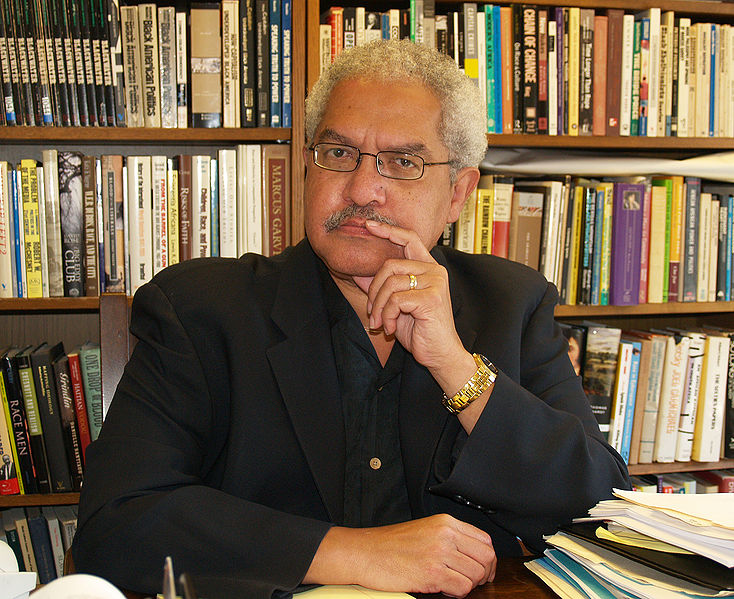
Dr. Manning Marable in his Columbia University office in 2001 beside painting of Malcolm X

Mario Tama/Getty Images


Dr. Manning Marable in his Columbia University Office in 2010
Photo by David Shankbone
Malcolm X : A Life of Reinvention by Manning Marable was published April 4, 2011 (Viking Press)


Beyond Boundaries: The Manning Marable Reader was published April 1, 2011 (Paperback edition), Paradigm Publishers

http://www.nytimes.com/2011/04/02/arts/manning-marable-60-historian-and-social-critic.html?ref=books

All,

Dr. Manning Marable was a true giant as both an extraordinary scholar and critic and his tireless work as a major African American historian, social theorist, committed radical activist, journalist, public intellectual, and gifted teacher over the past 40 years is legendary. Eloquence, power, wit, insight, and a very sharp and dynamic critical intelligence informed by an encyclopedic knowledge of history, politics, economics, philosophy, and sociology marked everything he did. I'm still in a state of shock over his untimely death. What a huge loss! Manning was one of the most important and prolific historians, theorists, and radical activists in the United States and we owe the man and his work a great debt that can only begin to be repaid by continuing to do serious work in our own lives and to generously SHARE IT WITH OTHERS as Dr. Marable did routinely throughout his astonishing life. It is in this spirit of deep and enduring revolutionary and human solidarity that we offer the following extended tribute to Manning's inspiring life and work.

Kofi


Manning Marable, Historian and Social Critic, Dies at 60
By WILLIAM GRIMES

April 1, 2011

New York Times

Manning Marable, a leading scholar of black history and a leftist critic of American social institutions and race relations, whose long-awaited biography of Malcolm X, more than a decade in the writing, is scheduled to be published on Monday, died on Friday in Manhattan. He was 60.

His wife, Leith Mullings, said that the cause was not known but that Mr. Marable, who lived in Manhattan, had entered the hospital with pneumonia in early March. In July 2010, he had undergone a double lung transplant.

Mr. Marable, a prolific writer and impassioned polemicist, addressed issues of race and economic injustice in numerous works that established him as one of the most forceful and outspoken scholars of African-American history and race relations in the United States.

He explored this territory in books like “How Capitalism Underdeveloped Black America” (1983), “Black Liberation in Conservative America” (1997) and “The Great Wells of Democracy” (2003), and in a political column, “Along the Color Line,” which was syndicated in more than 100 newspapers.

At nearly 600 pages, “Malcolm X: A Life of Reinvention,” to be published by Viking, presents a hefty counterweight to the well-known account “The Autobiography of Malcolm X.”

The autobiography, long considered a classic of the 1960s civil rights struggle, was an “as told to” book written with Alex Haley and published in 1965.

Mr. Marable, drawing on new sources, archival material and government documents unavailable to Mr. Haley, developed a fuller account of Malcolm X’s politics, religious beliefs and personal life, as well as his role in the civil rights movement and the circumstances of his assassination.

He also offers a revisionist portrait of Malcolm X at odds with Mr. Haley’s presentation of him as an evolving integrationist.

“We need to look at the organic evolution of his mind and how he struggled to find different ways to empower people of African descent by any means necessary,” Mr. Marable said in a 2007 interview with Amy Goodman on the radio program “Democracy Now.”

Mr. Marable’s political philosophy was often described as transformationist, as opposed to integrationist or separatist. That is, he urged black Americans to transform existing social structures and bring about a more egalitarian society by making common cause with other minorities and change-minded groups like environmentalists.

“By dismantling the narrow politics of racial identity and selective self-interest, by going beyond ‘black’ and ‘white,’ we may construct new values, new institutions and new visions of an America beyond traditional racial categories and racial oppression,” he wrote in the essay collection “Beyond Black and White: Transforming African-American Politics” (1995).

In a telephone interview on Friday, the scholar and author Cornel West called Mr. Marable “our grand radical democratic intellectual,” adding, “He kept alive the democratic socialist tradition in the black freedom movement, and I had great love and respect for him.”

William Manning Marable was born on May 13, 1950, in Dayton, Ohio. He earned a bachelor’s degree from Earlham College in Richmond, Ind., and a master’s degree from the University of Wisconsin before receiving his doctorate from the University of Maryland in 1976.

He directed ethnic studies programs at a number of colleges, notably the Race Relations Institute at Fisk University and the Africana and Latin American Studies program at Colgate University.

He was the chairman of the black studies department at Ohio State University in the late 1980s and also taught ethnic studies at the University of Colorado, Boulder.

At Columbia University, where he became a professor of public affairs, political science, history and African-American studies in 1993, he was the founding director of the Institute for Research in African-American Studies and the Center for the Study of Contemporary Black History.

In addition to his wife, who teaches anthropology at the Graduate Center of the City University of New York and who co-edited several of his books, Mr. Marable is survived by three children, Joshua Manning Marable of Boulder; Malaika Marable Serrano of Silver Spring, Md.; and Sojourner Marable Grimmett of Atlanta; two stepchildren, Alia Tyner of Manhattan and Michael Tyner of Brooklyn; a sister, Madonna Marable of Dayton; and three grandchildren.

His other books included Race, Reform and Rebellion: The Second Reconstruction in Black America, 1945-1982” (1984) and “The Great Wells of Democracy : The Meaning of Race in American Life” ( 2002), as well as two biographies published in 2005, W. E. B. DuBois: Black Radical Democrat” and “The Autobiography of Medgar Evers,” which he edited with Myrlie Evers-Williams, Evers’s widow.

He was the general editor of “Freedom on My Mind: The Columbia Documentary History of the African American Experience” (2003).

In 1992 he published “On Malcolm X: His Message and Meaning,” a work that prefigured the consuming project of his later years. “Beyond Boundaries: The Manning Marable Reader,” a selection of his writings, was published in January by Paradigm.


http://latimesblogs.latimes.com/jacketcopy/2011/04/malcolm-x-biographer-manning-marable-has-died.html


Jacket Copy
BOOKS, AUTHORS AND ALL THINGS BOOKISH

Malcolm X biographer Manning Marable has died
April 1, 2011
Los Angeles Times


Manning Marable, whose long-awaited biography of Malcolm X, "Malcolm X: A Life of Reinvention," will be published on Monday, died Friday. He was 60 years old.

Marable, who had led African American studies at Columbia University, was a professor there with many titles. Officially, he was the M. Moran Weston and Black Alumni Council Professor of African-American Studies and professor of history and public affairs at Columbia University. Columbia also notes that he was founding director of African American studies at Columbia from 1993 to 2003 and since 2002, he directed Columbia's Center for Contemporary Black History.

As far back as 2005, Marable was talking about "Malcolm X: A Life of Reinvention." In February of that year, on Malcolm X's birthday, he told Democracy Now about the materials that he had seen that others had not, including three "missing" chapters from Malcolm's autobiography that he said show the leader in a very different light.

Back then, Marable had already been at work on the biography for a decade -- meaning that he'd spent more than 15 years on the book and died just three days before its publication.

"A Life of Reinvention" by Manning Marable will be published by Viking on Monday.

Marable's other books include "Beyond Black and White: Race in America's Past, Present and Future" (1995), "The Crisis of Color and Democracy" (1995) and "The Great Wells of Democracy: The Meaning of Race in American Life" (2003).

The New York Times reports that Marable suffered from sarcoidosis and had undergone a double lung transplant as treatment for the disease last the summer. Last month he was hospitalized with pneumonia.

-- Carolyn Kellogg


http://www.thenation.com/print/blog/159661/great-wells-manning-marable

The Great Wells of Manning Marable
Melissa Harris-Perry
April 3, 2011
The Nation

We have suffered a great loss in the passing of Professor Manning Marable. As my Nation colleague John Nichols wrote yesterday [1], the coming weeks will be filled with tributes to Manning’s life and work. He was, as John says, “one of America’s truest public intellectuals.”

Manning was an unflinching and breathtakingly prolific scholar whose commitments to racial, economic, gender, and international justice were unparalleled. In decades of weekly columns, hundreds of academic journal articles and a dozen books, Manning has already written his own legacy. But despite the fact that we all have “Manning Marable shelves” in our personal libraries, there are two generations of African-American scholars who will remember him as much for the mentor he was to us as for the research legacy he leaves.

It is still a surprisingly lonely endeavor to be an African-American academic pursuing research on black life. Despite the outward appearance of successful careers, many black social scientists, historians and humanists wage a daily battle for relevance and respect in our departments and on our campuses. The fight begins in graduate school and does not seem to abate even after we have published articles, written books, achieved tenure or garnered professional praise.

In our loneliness and struggle many of us reach out for mentors. It is relatively easy to find senior scholars who will offer encouraging words, well-rehearsed advice and general praise. But Manning managed to do so much more than that. To be a student or a junior faculty member in Manning’s office was to wait for the smile. He would listen intently and seriously as you told him about the project you envisioned, the finding you made or a conclusion you’d drawn. As you spoke, his face was a mask of stillness covering a never-resting intellect just below the surface. It was more than a little intimidating to present an idea to Manning. But if he liked what you were up to or thought you had uncovered a promising direction then his face would crack into a broad and compelling smile that made the whole nerve-wracking experience worth it. If you got the smile then you knew you could keep going.

This was only the most surface way that Manning mentored us. As a student of politics and history, he understood that young race scholars faced steep structural barriers and entrenched academic practices that no amount of well-intentioned professional cheerleading could erase. Instead of just telling us we could do it, Manning helped make “doing it” possible.

As founding director of Columbia University’s Institute for Research in African-American Studies, Manning created a place where students could stretch their intellect in uncoventional ways. He encouraged students to study black life using methods and asking questions that typical disciplinary boundaries so often limit and discourage in our work. His institute was a gathering place for people from all over the world who insisted on critical connections between theory and practice. Through publication of his quarterly journal, Souls: A Critical Journal of Black Politics, Culture and Society [2], Manning gave many race scholars their first academic publications. Those early publications were decisive in the careers of many of the best professors in the academy today. Through his regular column "Along the Color Line" Manning gave us permission to and a model for reaching beyond the walls of the academy. He reminded us that our work was about something other than our own profession and that we owed debts to the communities who were the source material of our academic writing.

Manning did more than encourage us. He made a way for us. He cleared brush. He extended his protections. He shared his resources with uncompromising generosity. And he did all of this without needing to turn us into his personal collection. He very rarely took credit for our successes, despite his important role in all that we were able to do.

Manning Marable’s 2002 book is titled The Great Wells of American Democracy. It is a biting and critical text that challenges simplistic heroic narratives of American history, but simultaneously retains profound optimism about the inherent possibilities of the American experiment. When I think of Manning himself it is as a great well—possessing reserves of energy, intellect and commitment I have never before witnessed.

I have a recurring, Descartes-inspired, dualist fantasy. I imagine how much I could accomplish if I were not hindered by the realities of being embodied. I have so many ideas and intentions. I see so many paths and possibilities. I want to explore so many connections and paths. Think of how much I could accomplish if I were only mind and will unfettered by eyes that grow wearing of reading, hands that become exhausted from typing, a back that aches from sitting at the desk and a body that must eat and rest.

To those of us he mentored, it seemed like Manning had achieved this feat. I wondered if he had somehow bent the rules of the physical world in order to accomplish an unthinkable amount of work in such short periods. He felt like pure energy. But our dearest Manning was in a body. He was in a body that was broken and struggling. It turns out that our beloved mentor was mortal after all. I cannot believe that he is gone. I cannot even believe it is possible that he could be gone.

That we will have his long-anticipated, great and final work [3] even as he leaves us is so classically, tragically appropriate. Manning would never leave us without one more contribution, one more trail blazed, one more bar raised, one more possibility realized, one last drink from the great well of himself.

[1] http://www.thenation.com/blog/159660/manning-marable-public-intellectual-service-democracy
[2] http://www.columbia.edu/cu/ccbh/souls/
[3] http://www.amazon.com/Malcolm-X-Reinvention-Manning-Marable/dp/0670022209
[4] http://itunes.apple.com/us/app/nationnow/id399704758?mt=8


http://www.thenation.com/blog/159660/manning-marable-public-intellectual-service-democracy


Published in The Nation
http://www.thenation.com


Manning Marable: A Public Intellectual in the Service of Democracy
by John Nichols
April 2, 2011
The Nation


Many tributes will be paid in coming days to our friend and comrade from so many struggles, Manning Marable [1]. The accolades will be rich in sentiment and content, the praise high, and appropriately so.

The great historian of the African American political experience who as a Columbia University professor helped to establish the Institute for Research in African-American Studies and the Center for Contemporary Black History,” Marable was an academic heavyweight whose scholarship earned international recognition—and whose new book Malcolm X: A Life of Reinvention [2], which will be published Monday by Viking, will reconfirm his status as a groundbreaking historian. His death Friday at age 60, after a long battle with lung disease, was brutally timed, as the diligent scholar’s greatest moment of national prominence was about to arrive with the publication of a biography not just of a man, Malcolm X, but of movements and the transformation of a nation.

Had he lived, Manning would have used that moment, as he always did, to talk not just about his own work but about the many struggles to which he was devoted,

As one of America’s truest public intellectuals, Manning always engaged with the great debates of his days: debates about race, class, gender, war and elections. The record of that engagement is remarkable, and it remains in our possession, in the form of his “Along the Color Line” columns that appeared for years in African-American weekly newspapers (and eventually on the web).

Manning and I shared a passion for weekly newspaper writing. We both started contributing to our local papers as schoolchildren: he in his native Dayton, I in rural Wisconsin. When he was 17, his mother encouraged Manning to attend the funeral of the Rev. Martin Luther King Jr., after he was slain on April 4, 1968. She wanted her son “to witness a significant event in our people’s history.”

Manning made the trip as the “Youth Speaks Out” columnist for a weekly that served Dayton’s African-American community. Years later, he would write about these experiences in a fine collection of his columns and essays, Speaking Truth to Power: Essays On Race, Resistance, And Radicalism (Westview) [3].

“With Martin’s death, my childhood abruptly ended,” Manning explained. “My understanding of political change began a trajectory from reform to radicalism.”

Even as he embarked upon an educational path that aimed toward academia—gaining an undergraduate degree at Earlham College, a master’s degree from the University of Wisconsin-Madison and a PhD in American history from the University of Maryland—Manning remained a contributor and columnist for African-American weeklies and other publications. He was, as well, a prominent participant in the New America Movement, Democratic Socialists of America, the New Party, the Black Radical Congress and the Movement for a Democratic Society, which he chaired.

Manning was a radical democrat—with the emphasis on the small “d”—who believed in political participation with a purpose. “Progressives can gain positions within the state, especially at municipal and state levels, which can help fund and support grass roots interests and indirectly assist in the development of a socialist majority,” explained the professor whose columns chronicled the campaigns of Jesse Jackson for the presidency but also local contenders from across the country for school board seats and mayoralties.

Manning broke often with the Democratic Party and encouraged independent poitical endeavors. He sympathized with Ralph Nader’s run for the presidency in 2000, as with his friend and frequent intellectual and ideological ally Cornell West. But, in 2008, Manning made the case for why progressives who had doubts about Barack Obama should back the Democrat for the presidency.

When I was preparing my book on the influence of social-democratic movements in America, The “S” Word (Verso) [4], I consulted and quoted Manning’s observations on the Obama campaign. They were, as was consistently the case with his commentary, grounded in understandings of history both studied and experienced.

Manning had few illusions about Obama. At the same time, he had few doubts about the historical and political importance of the movement that elected the first African-American president.

While Manning identified Obama as a “liberal,” he also observed: [5] “What makes Obama different (from many other liberals) is that he has also been a community organizer. He has read left literature, including my works, and he understands what socialism is.”

The point was not to suggest that Obama was a socialist. Rather, it was to suggest that the senator from Illinois brought a broader range of experience—personal and ideological—to the campaign trail and the presidency than did most liberals.

Manning was hopeful about Obama, but not unrealistic [5].

“Most of us on the left have taken a position of critical support toward Obama. We have to press him to carry out his own agenda,” he wrote shortly after the 2008 election. “The analogy of FDR is appropriate. But someone has to play the role of A. Philip Randolph, the black socialist leader who attacked FDR from the left and in 1941 forced him to sign an executive order outlawing racial discrimination in factories producing for the war effort that refused to hire black people. Randolph threatened to bring 100,000 black workers to surround the White House. Roosevelt capitulated and signed an order that was the foundation of affirmative action.”

Perhaps he was being idealistic. But part of Manning’s contribution as a public intellectual in the service of democracy lay in his determination to keep the faith—to believe, and to help others to believe, that progress was possible, and that it was still realistic to speak of mobilizing masses of Americans on behalf of radical change.

In one of his finest “Along the Color Line” columns [6], a missive broadly circulated in the African-American weekly press and online, Manning Marable concluded: “If we can dare to dream politically, let us dream of the world as it should be.”


http://www.theroot.com/views/remembering-manning-marable


Published on The Root
(http://www.theroot.com)

Manning Marable: A Brother, a Mentor, a Great Mind
By Michael Eric Dyson
April 2, 2011 The Root

Michael Eric Dyson recalls the pioneering scholar as a 20th-century Frederick Douglass who nurtured and inspired talented young academics.

I discovered Manning Marable as a 21-year-old freshman at Knoxville College, a historically black college I'd left my native Detroit to attend after working in factories and fathering a son during the time most college-bound kids are in school.

I was in the library stacks, browsing the sociology section, when I came upon a book that grabbed my attention: From the Grassroots: Social and Political Essays Towards Afro-American Liberation. It was clear that Marable's left politics reflected how he had baptized classic European social theory in the black experience. "Wow," I said to myself. "If Karl Marx was a brother, this is how he'd write and think."

The author photo on this intriguing book showed a young man with a handsome face that was crowned by a shock of black hair whose woolly Afro styling conjured a 20th-century Frederick Douglass. As I was to learn later, the comparison to Douglass didn't end at the 'fro, since Marable, like his 19th-century predecessor, was an eloquent spokesman for the democratic dreams of despised black people.

As I devoured Marable's brilliant work -- including his quick 1980 follow-up, Blackwater: Historical Studies in Race, Class Consciousness, and Revolution, and his pioneering 1983 work, How Capitalism Underdeveloped Black America -- I knew I was in the presence of a world-class intellectual who lent his learning to the liberation of the vulnerable masses. I was impressed that a man so smart and accomplished could so unashamedly identify with struggling black folk -- and I was really impressed that he was so young, only eight years older than I.

Years later, when he invited me to Columbia to teach as a visiting professor in the late '90s, and I recalled again to Marable my introduction to his work, he flashed that magnetic smile of his and said that he was glad his books could help a brilliant young intellectual find his way. That, of course, was vintage Marable: deflecting attention from his Herculean efforts to parse the meaning of black political destiny by embracing the promise of a younger colleague.

And that wasn't just something he did with me; Marable nurtured and guided a veritable tribe of graduate students and junior professors as they sought sure footing in the academy. He was generous with his time and insight; he had a real talent for spotting rising stars, and a genius for tutelage and inspiration, with either a bon mot if time was short or a hearty, dynamic, luxurious, sprawling conversation when you were blessed to find his inner circle.


What was remarkable about Marable is that he possessed none of the jealousies and backbiting that render the professional academic guild a highfalutin' version of hip-hop culture's lethal fratricidal tensions. Please don't be confused: Marable loved academic gossip and tidbits of underground cultural stories as much as the rest of us, but he was never mean-spirited or vicious in his often humorous relay of the folly or hubris of a colleague or acquaintance.

Marable was kind and sweet, a teddy bear of a patriarch who watched over his young charges with wise forbearance. And he proved, in the tender and enduring companionship that he forged with his life mate, the brilliant anthropologist Leith Mullings, that you can love and learn with a black woman and drink in her beauty and brains in one sweet swig.

Marable's huge hunger to tell the truth about black suffering could never be satisfied. In a relentless stream of articles, essays, newspaper columns and books, he detailed the burdens of race and class and how these forces -- along with gender, age and sexual orientation -- ganged up on black folk and mugged us at every turn, robbing us of our dignity and our right to exist without being ambushed by inequality and injustice.

Long before the term "public intellectual" became the rage, again, Marable showed us just what engaged academics worth their salt and degrees should be up to: offering sharp analysis of the social behaviors and political practices that shape or distort our democratic heritage, while encouraging the powerless to take on the mighty with pen and protest. Marable could never get enough of such work, and he taught us all how to combine sophisticated critical scrutiny and compassionate regard for the lowly, never putting either goal in jeopardy by neglecting the work that must be done to be both smart and good.

And now, even in death, Marable teaches us still. His magnum opus, his summum bonum -- what all of his books on the urgent relevance of black politics, the pitfalls and seductions of capitalism, the ironic opportunities and vices of history, the romance and ruin of culture, and the triumphs and travails of race have built up to -- is his book on Malcolm X, due out on Monday, April 4. It is now, sadly, a posthumously published masterwork that rescues the legendary leader from the catacombs of history, separating him from the hagiography of adoring acolytes and prying him free from the hateful grip of dismissive critics.

In death, Marable gives us a life's work. He speaks to us, too, in another way: the disease from which he perished, sarcoidosis, affects black folk in America far more than it does whites or other groups. Right down to his dying breath, Marable bore witness to the possibilities and pains, the privileges and limitations, of the black identity that he so brilliantly and bravely embraced.

I will sorely miss Marable as my very dear friend whom I love -- my mentor, my colleague and big brother -- and all of us will miss one of the greatest minds and one of the most forceful spirits this land and world have ever known.


Michael Eric Dyson is University Professor of Sociology at Georgetown University and the author of 17 books, including his latest, Can You Hear Me Now? The Inspiration, Wisdom and Insight of Michael Eric Dyson.

Like The Root on Facebook. Follow us on Twitter.

Source URL: http://www.theroot.com/views/remembering-manning-marable

Links:

[1] http://www.theroot.com/users/michaelericdyson
[2] http://www.amazon.com/dp/B002UXRZD0/ref=as_li_ss_til?tag=root04c-20&camp=213381&creative=390973&linkCode=as4&creativeASIN=B002UXRZD0&adid=1JSKAZHB1W27J1NHZR69
[3] http://www.facebook.com/theroot
[4] http://www.twitter.com/theroot247
[5] http://www.theroot.com/sites/default/files/manningmarable.jpg


Links:

[1] http://www.columbia.edu/cu/polisci/fac-bios/marable/faculty.html
[2] http://www.amazon.com/Malcolm-X-Reinvention-Manning-Marable/dp/0670022209
[3] http://www.amazon.com/Speaking-Truth-Power-Resistance-Radicalism/dp/0813388287
[4] http://www.amazon.com/Word-Short-History-American-Tradition-Socialism/dp/184467679X
[5] http://www.socialistreview.org.uk/article.php?articlenumber=10628
[6] http://academic.udayton.edu/race/2008electionandracism/raceandracism/race86.htm
[7] http://commons.wikimedia.org/wiki/File:Manning_Marable_by_David_Shankbone.jpg


Manning Marable Remembered as Public Intellectual and Activist by Jamal Eric Watson
April 5, 2011
Diverse Issues in Higher Education

Categories: African/Afro/Black Studies / Social Sciences /

At the time of his death, Manning Marable held the M. Moran Weston and Black Alumni Council Professorship of African American Studies at Columbia University.

Dr. Russell Rickford hasn’t quite been the same since learning that his mentor and friend, Dr. Manning Marable, passed away at the age of 60, after suffering from complications from pneumonia.

Marable, who was diagnosed with sarcoidosis, underwent a double lung transplant last summer, but friends thought he was on the rebound toward recovery, eager to celebrate the release of his new book, Malcolm X: A Life of Reinvention, a project that took him 10 years to research and write.

A self-described Marxist, Marable had a distinguished career in the academy as a social activist and public intellectual. At the time of his death, he held the M. Moran Weston and Black Alumni Council Professorship of African American Studies at Columbia University, after serving as the founding director of the university’s Institute for Research in African-American Studies and establishing the Center for Contemporary Black History at Columbia in 2002.

After writing dozens of books and publishing more than 250 scholarly articles, friends and close associates of Marable say that he was most excited about his latest book, which was released on April 4, 2011.

“He understood this was going to be his magnum opus,” says Rickford, an assistant professor of history at Dartmouth College. “It’s a remarkable book because it transforms the way we understand Malcolm and it should imbue us with a greater respect for Malcolm’s political and intellectual legacy”

Rickford first met Marable in 2002 after arriving at Columbia as a graduate student. After serving as his dissertation advisor, Marable recently entrusted Rickford to edit and publish Beyond Boundaries: The Manning Marable Reader, a major collection of his intellectual writings over the past three decades. The reader was released earlier this month.

Rickford is one of Marable’s "intellectual sons and daughters,” as he puts it. It’s a group to whom the the celebrity scholar was never too busy to provide counsel and advice.

In recent days, many of these scholars took to their Facebook and Twitter accounts to remember Marable and pay tribute to a man who helped steer so many of them into the academy. Others are planning formal academic conferences in upcoming weeks and months aimed at promoting and celebrating Marable’s contributions to the field. His 1983 classic, How Capitalism Underdeveloped Black America influenced a generation of scholars.

“Manning did more than encourage us,” says Dr. Melissa Harris-Perry, an associate professor of political science and African-American studies at Princeton University. “He made a way for us. He cleared brush. He extended his protections. He shared his resources with uncompromising generosity. And he did all of this without needing to turn us into his personal collection. He very rarely took credit for our successes despite his important role in all that we were able to do.”

In an interview with Diverse, Georgetown University professor Dr. Michael Eric Dyson described Marable as a “brilliant scholar who believed scholars ought to have an activist background.”

Dyson says that Marable was committed to radical democratic principles and genuinely concerned with gender and class inequality. “Long before the term ‘public intellectual’ became the rage, Marable showed us just what engaged academics worth their salt and degrees should be up to: offering sharp analysis of the social behaviors and political practices that shape or distort our democratic heritage, while encouraging the powerless to take on the mighty with pen and protest.”

Those who have read Marable’s latest book on Malcolm X say it will likely stir up controversy, but seeks to contextualize the Black leader.

“Some people will not like it, but [Marable] was not about hero worship,” says Rickford. ”Marable loved Black folk. He loved us in all of our iterations and complexities and he would tell us about ourselves.”

A native of Dayton, Ohio, Marable graduated from Earlham College in 1971 and received a master’s degree in American history from the University of Wisconsin-Madison and a doctorate in American history from the University of Maryland. He taught at Cornell, Fisk, Colgate, Ohio State and the University of Colorado before arriving at Columbia.

The Marable family is planning to hold a public memorial service on May 27 at a location to be announced. Marable leaves behind a wife, Dr. Leith Mullings, three children and two stepchildren.


http://www.theroot.com/views/manning-marable-s-students-remember-him

Manning Marable's Students Remember Him

APRIL 04, 2011
The Root


They were a "veritable tribe" taught and guided by the Columbia University scholar of African-American life. Here are their tributes.

Compiled by Zaheer Ali

In his moving tribute to Manning Marable, black-studies scholar Michael Eric Dyson, a professor of sociology at Georgetown University, writes, "Marable nurtured and guided a veritable tribe of graduate students and junior professors as they sought sure footing in the academy." Here are the recollections of some members of that "veritable tribe," many of whom studied with him at Columbia University's Institute for Research in African American Studies.

Robyn C. Spencer, an assistant professor of history at Lehman College in New York City, was Marable's first graduate student.

The first time I saw Manning Marable was at his job talk at Columbia University in 1993. He delivered his audition lecture about the legacy of black radicalism embodied by Malcolm X with an unapologetic reverence that mainstream historians usually reserved for heads of state. In one fell swoop, he moved me and my coterie of graduate students --studying everything from poor black women mobilizing for welfare rights to Puerto Ricans in the Young Lords Party to black radical organizers in the Black Panther Party -- from the margin of American history to its center.

After he was hired, I couldn't wait to meet him and ask him to be my adviser. At our first meeting, he shared his vision for creating a space for research that validated the totality of the black past, including the radicals, progressives and feminists. He wanted to go beyond the ivory tower and interject into national debates about black life, shape public policy and, most of all, connect to grassroots political activism, especially in surrounding Harlem.

As I moved through the program, going from teaching assistant to doctoral candidate to assistant professor under Marable's guidance, I watched him nurture the IRAAS from the humble construction site where we held our first conversation to a leading scholarly institute -- all while employing unfunded graduate students in meaningful work and providing an institutional space for conversations about black life inside and outside the academy. I'd like to think that they were both labors of love.

Monique W. Morris is the CEO of MWM Consulting Group and the former vice president for advocacy and research at the NAACP. She is the author of Too Beautiful for Words and more than 35 research publications on social-justice issues.

Scholarship and advocacy are inextricably linked. That's what I learned most from my mentor and friend, Dr. Manning Marable. As the first staff person hired to work with him at IRAAS, I read everything he wrote and was responsible for maintaining a clipping file for his syndicated newspaper column, "Along the Color Line." That experience taught me that scholarship was an important weapon in the battle for human rights, which is a lesson that I have carried with me in my work for social justice.

Marable's mentorship was everything from quiet to challenging, but his critique was always rigorous. As a historian, he offered guidance through a spirit of sankofa. History's lessons were necessary to explore and confront if we were to move forward with a progressive black agenda.

As a democratic socialist, he challenged structural racism and the oppression of black people. Always, he was forward thinking and offered his students an opportunity to develop our own insights. A few months ago, he wrote to me that we needed a "new vision for black freedom." As we straddle life "along the color line," the time is now to advance that movement.
They were a "veritable tribe" taught and guided by the Columbia University scholar of African-American life. Here are their tributes.

In his moving tribute to Manning Marable, black-studies scholar Michael Eric Dyson, a professor of sociology at Georgetown University, writes, "Marable nurtured and guided a veritable tribe of graduate students and junior professors as they sought sure footing in the academy." Here are the recollections of some members of that "veritable tribe," many of whom studied with him at Columbia University's Institute for Research in African American Studies.

Robyn C. Spencer, an assistant professor of history at Lehman College in New York City, was Marable's first graduate student.

The first time I saw Manning Marable was at his job talk at Columbia University in 1993. He delivered his audition lecture about the legacy of black radicalism embodied by Malcolm X with an unapologetic reverence that mainstream historians usually reserved for heads of state. In one fell swoop, he moved me and my coterie of graduate students --studying everything from poor black women mobilizing for welfare rights to Puerto Ricans in the Young Lords Party to black radical organizers in the Black Panther Party -- from the margin of American history to its center.

After he was hired, I couldn't wait to meet him and ask him to be my adviser. At our first meeting, he shared his vision for creating a space for research that validated the totality of the black past, including the radicals, progressives and feminists. He wanted to go beyond the ivory tower and interject into national debates about black life, shape public policy and, most of all, connect to grassroots political activism, especially in surrounding Harlem.

As I moved through the program, going from teaching assistant to doctoral candidate to assistant professor under Marable's guidance, I watched him nurture the IRAAS from the humble construction site where we held our first conversation to a leading scholarly institute -- all while employing unfunded graduate students in meaningful work and providing an institutional space for conversations about black life inside and outside the academy. I'd like to think that they were both labors of love.

Monique W. Morris is the CEO of MWM Consulting Group and the former vice president for advocacy and research at the NAACP. She is the author of Too Beautiful for Words and more than 35 research publications on social-justice issues.

Scholarship and advocacy are inextricably linked. That's what I learned most from my mentor and friend, Dr. Manning Marable. As the first staff person hired to work with him at IRAAS, I read everything he wrote and was responsible for maintaining a clipping file for his syndicated newspaper column, "Along the Color Line." That experience taught me that scholarship was an important weapon in the battle for human rights, which is a lesson that I have carried with me in my work for social justice.

Marable's mentorship was everything from quiet to challenging, but his critique was always rigorous. As a historian, he offered guidance through a spirit of sankofa. History's lessons were necessary to explore and confront if we were to move forward with a progressive black agenda.

As a democratic socialist, he challenged structural racism and the oppression of black people. Always, he was forward thinking and offered his students an opportunity to develop our own insights. A few months ago, he wrote to me that we needed a "new vision for black freedom." As we straddle life "along the color line," the time is now to advance that movement.


Nishani Frazier is an assistant professor in the department of history at Miami University of Ohio. She is co-editor, with Manning Marable, of Freedom on My Mind: The Columbia Reader of African-American History.

I was leaving the safety of Durham, N.C., and the employment and guiding support of Dr. John Hope Franklin, another venerable historian who has passed on to the ancestors. New York was the big city, and Columbia University was the big, bad wolf. Although I entered graduate school with much trepidation, I knew that there was one place where I was welcome: It was the Institute for Research in African American Studies, a center built brick by brick by Manning Marable. It was not just the site of black studies; it was the place where many students found psychic, emotional and professional solace and security. In IRAAS, Marable created a safe haven.

Marable's greatest contribution to his students and many other students of black studies was to craft through IRAAS a powerful symbol of institutionalized mentorship. He provided for me and future students like me a shelter from the storm. This gift is among the ultimate tributes to his life, and his students reflect this legacy.

Zaheer Ali is a doctoral student in history at Columbia University, researching 20th-century African-American history and religion. He was a project manager of the Malcolm X Project.

In 2004, while working on Dr. Manning Marable's Malcolm X Project, I accompanied him to Chicago for a meeting with Minister Louis Farrakhan and his longtime aide Abdul Akbar Muhammad to discuss Marable's research on Malcolm X. It was the first time the two had ever met in person, and what was supposed to be a two-hour meeting turned into a six-hour conversation that extended into another two hours for dinner. Their political differences aside, Farrakhan expressed nothing but deep respect and appreciation for Marable's scholarship, and both men shared an interest in documenting and preserving black history.

This meeting and its follow-up would have been unlikely for me to accomplish on my own as a graduate student. But as was often the case, Marable created the circumstances wherein I could grow as a researcher and scholar: He asked me to assist in conducting the oral-history interviews of both Minister Farrakhan and Mr. Muhammad. Afterward, he granted me access to the Malcolm X Project files for my dissertation research.

Marable's generosity with his institutional and intellectual resources enriched me in ways that I have only begun to discover. His humility and faith in his students enabled him to treat us like junior colleagues, offering the chance to co-edit anthologies, submit articles to his many publications and lead major research initiatives.

He was fond of saying of the Malcolm X Project, "It's not just a job; it's a way of life." For him the history of black freedom was not just something he wrote about; it is something he lived as a radical democrat committed to equality. And he taught us to live it, too.

Zinga A. Fraser is a Ph.D. candidate in African-American studies at Northwestern University.

Although I was a train ride away from home, the IRAAS would become my second home. Professor Marable's vision of creating an intellectual and physical space at Columbia in the name of black people, but for all people, will remain his legacy. Not until I left the institute did I realize how special it is.

Observing his many projects, I saw firsthand what true theory and praxis are. While others examine the plight of incarcerated youth, he formed the Africana Criminal Justice Project. While people examine the facets of Malcolm X's life, he created the Malcolm X Project to engage students and the public on Malcolm's legacy.


Marable provided a model for my scholarship. When my project on black women in politics was questioned by some, his advice landed me at the university I now attend. At a recent talk, he said, as he did on many occasions, that it is his job to make his scholarship at Columbia relevant for those on 125th Street.

My time in the academy might suggest that I should be jaded by this concept, but I know that it is nothing abstract because I saw Marable do it daily. Although we are hurt by his loss, I am thankful to have been a part of his "living history."

Megan French is a Ph.D. candidate in history at Columbia University, researching race and urban policy in New Orleans. She was project manager of the Amistad Digital Resource.

In spring 2007, Dr. Marable asked if I would like to work on a project he was calling the Amistad Resource; it was to be an open digital resource for public school teachers on black history. He was my adviser, the person who encouraged me to do a Ph.D., but not even he knew the importance of this project for me.

I had been struggling with the way to connect the highly specific scholarship of academe with anything that would have an impact on the outside world. I was seeking ways in which scholar-activism really worked. Here, Marable opened the possible.

He wanted the site to be accessible, but also to create conversations in classrooms that had not happened when I was in high school, about racism, history and perspective. I watched someone take a risk in an academic environment where anything for public, nonprofit interests seems irrelevant and commit to the idea that this history was important for everyone.

Later that year, as we continued work on the site, Marable gave the address commemorating the 40th anniversary of the Rev. Martin Luther King Jr.'s anti-Vietnam War speech. Amid community leaders at Riverside Church -- again one of the few academics in the room -- Marable gave one of the most moving, provocative talks on civil rights I had ever heard. A woman next to me said, he really is all for the people. I said back to her, I know.

Elizabeth Kai Hinton is a Ph.D. candidate and the co-editor of Manning Marable's The New Black History: Revisiting the Second Reconstruction, which will be published by Palgrave MacMillan in November 2011.

We will remember Manning Marable's contributions to African-American studies as his foremost legacy, but he should also be recognized for the spaces he built for scholars of black history within academia. Professor Marable created the IRAAS at Columbia nearly 20 years ago to provide a safe haven for students to critically examine the nature of institutional racism, the contours of the African Diaspora and approaches to radical social change.

Like many of my peers also pursuing doctoral degrees at Columbia who had the privilege to study under Marable, the institute proved key to our survival on campus. In addition to his dedication to the work of a generation of young scholars, Marable's Souls: A Critical Journal of Black Politics, Culture and Society -- molded after W.E.B. Du Bois' Phylon -- also provides one of the few forums for black radical perspectives.

Among Marable's many legacies, both IRAAS and Souls stand as a testament to his support of young, progressive scholars, as well as his enthusiastic pursuit of history and political thought. While Marable himself is irreplaceable, he has provided a foundation for future generations and will continue to shape our understanding of social change and justice.

Zaheer Ali can be reached at mail@zaheerali.com. Follow him on Twitter. Like The Root on Facebook. Follow us on Twitter.


Links:

[1] http://www.theroot.com/user/35243
[2] http://www.theroot.com/views/remembering-manning-marable
[3] http://www.columbia.edu/cu/ccbh/mxp/
[4] http://www.columbia.edu/cu/ccbh/acjp/
[5] http://www.amistadresource.org/
[6] http://www.columbia.edu/cu/ccbh/souls/index.html
[7] mailto:mail@zaheerali.com
[8] http://www.twitter.com/zaheerali
[9] http://www.facebook.com/theroot
[10] http://www.twitter.com/theroot247


All,

Michael Eric Dyson and Bill Fletcher, Jr. reflect on the life and work and give tribute to the late Dr. Manning Marable on Democracy Now! program on April 4, 2011. They also talk about Manning's new book on Malcolm X.


Kofi


DemocracyNow.org

Two decades in the making, Manning Marable's nearly 600-page biography, "Malcolm X: A Life of Reinvention," is described as a reevaluation of Malcolm X's life, providing new insights into the circumstances of his assassination, as well as raising questions about Malcolm X's autobiography. Manning passed away on Friday, just days before his life's work was published. To discuss his legacy, Democracy Now! interviews Michael Eric Dyson, sociology professor at Georgetown University and author of "Making Malcolm: The Myth and Meaning of Malcolm X," and also by Bill Fletcher, Jr., a friend of Marable and a longtime labor and racial justice activist.

"There were three different sources that had an interest in Malcolm's death, and that's where [the book] becomes very, very important," Fletcher says. "It was the police and the FBI, it was the Nation of Islam, but there were also people in his own organization who resented the trajectory that he was moving. And so, there was this confluence of forces that led to a situation where he was permitted to be killed. And I think that when people read this, it's going to be an incredible eye opener."


For the video/audio podcast, transcript, and for Democracy Now!'s interviews with Manning Marable, visit:
http://www.democracynow.org/2011/4/4/making_malcolm_the_myth_and_meaning


http://www.youtube.com/watch?v=Ri_unYMs6wk&NR=1

iframe title="YouTube video player" width="480" height="390" src="http://www.youtube.com/embed/Ri_unYMs6wk" frameborder="0" allowfullscreen>

All,

The late historian and scholar Manning Marable eloquently discusses the profound historical significance and legacy of Malcolm X on Democracy Now! programs from 2005 and 2007.

Kofi


Democracy NOW! DN! - Part 1-2 Renowned African-American historian Manning Marable passed away on Friday at the age of 60, just days before the publication of his life's work, a monumental biography about Malcolm X. Two decades in the making, Malcolm X: A Life of Reinvention, is described as a reevaluation of Malcolm X's life. We play excerpts from when Amy Goodman interviewed Marable in 2005 and 2007 about the chapters missing from Malcolm X's autobiography and the groups implicated in his assassination. Published, with written permission, from democracynow.org. http://www.democracynow.org Provided to you under Democracy NOW creative commons license. Copyright democracynow.org, an independent non-profit user funded news media, recognized and broadcast world wide.


PLEASE CLICK ON VIDEO LINKS (PARTS 1 & 2) BELOW TO VIEW VERY IMPORTANT MARABLE INTERVIEWS ON HIS GROUNDBREAKING RESEARCH AND WRITING ON MALCOLM X:


TAVIS SMILEY SHOW ON PBS--INTERVIEW WITH MANNING MARABLE

April 4, 2011

http://www.youtube.com/watch?v=RPxc9SedgzE


http://www.huffingtonpost.com/tavis-smiley/remembering-dr-manning-ma_b_844743.html


Tavis Smiley
PBS talk show host, PRI radio host

Remembering Dr. Manning Marable
Posted: 04/ 4/11

Just days from now, Dr. Manning Marable was scheduled to appear on my PBS program to discuss his epic biography of Malcolm X. Dr. Marable passed away on Friday, April 1.

The book, in stores today, is his magnum opus -- a book over two decades in the making.

In addition to the new biography, Dr. Marable leaves a vast contribution to Black history, which is of course to say, American history.

When he joined us on the program in 2006, we discussed a wide range of topics, including what he saw as an incomplete understanding of Malcolm X.

The new book is called Malcolm X: A Life of Reinvention.

Our full 2006 conversation with Dr. Marable airs tonight on PBS. Here is a transcript of that interview:

Dr. Manning Marable
Airdate February 7, 2006
PBS

Dr. Manning Marable is Director of the Institute for Research in African American Studies at Columbia University. He also established the university's Center for Contemporary Black History. A prolific author, his work includes The Great Wells of Democracy and Living Black History. Marable was the Founding Director of Colgate University's Africana and Hispanic Studies Program. He also writes a political commentary series, Along the Color Line and is active in a variety of progressive causes.


Dr. Manning Marable

Tavis: Manning Marable is professor of history at Columbia University, and founding director of the school's Institute For Research And African-American Studies. He is the author of numerous books, including "The Autobiography of Medgar Evers.' His latest book is called 'Living Black History, How Reimagining The African-American Past Can Remake America's Racial Future.' He joins us tonight from New York. Professor Marable, nice to have you on the program, sir.

Manning Marable: Thank you, Tavis, it's great to be here.

Tavis: Nice to have you on. Let me start with the sad news of the day, and then we'll move on to how we can build up on the legacy left by one Coretta Scott King. Of course, we all know that earlier today in Atlanta, she was laid to rest. Your thoughts on the legacy and the living Black history that Coretta Scott King contributed to.

Marable: Coretta Scott King will go down in the annals of American history as a woman of remarkable courage and endurance. Without her vision and commitment to the ideals of her husband, we would not today have the Dr. Martin Luther King Jr. national holiday. We would not have the infrastructure for a King Center.

And I believe that history will show that she was truly an equal partner with Dr. King, and in many ways, when the two met several years prior to the launching of the Civil Rights movement, she was more progressive and more political than Martin was, when they were in graduate school. So her partnership and her ideas helped to shape his evolution. In many ways, more than most people are aware.

Tavis: Beyond that point, which is very significant, I'm glad you shared it with us, to remind us she did, in fact, go about carving out her own legacy, tell me how difficult you think that was that in a lot of the fact the guy she was standing next to (laugh) was a guy named Martin King. How does one go about creating one's own legacy and becoming living history oneself in that kind of shadow?

Marable: It's extremely difficult. I think that the way - what I would liken it to is the relationship, the close friendship that has cultivated, I've cultivated with Myrlie Evers-Williams, the widow of Medgar Evers. There is a parallel to it. Medgar had the toughest Civil Rights job in the United States, being the field secretary of the NAACP in Mississippi for nearly a decade.

And when he was shot in front of his family home in 1963, he instantly became a Civil Rights legend, an icon. How do you assert yourself as an active, involved, Civil Rights person, as an intellectual the way Myrlie was, in the wake of that terrible loss? Coretta Scott King faced a similar dynamic, even though for Coretta, it was more daunting, because King was a worldwide figure.

He was, perhaps, at his death, one of the three or four most influential figures on Earth. His speeches were read by millions, had been memorized by millions of people. And so, how do you assert yourself? And both in Myrlie's case and in Coretta's case, with incredible dignity, with grace, and with courage, they asserted themselves around practical tasks to ensure their husband's ideals would live on in the pursuit of their respective careers.

Myrlie through assuming presidency of the NAACP at a very difficult time in its history, a decade ago. And Coretta through the courageous battle to win a national holiday on behalf of Martin.

Tavis: Before I advance, Manning, to this notion of living Black history that I want to delve into here in just a second, let me ask what the value of Black history is. Every February, I see the grin on your face. Every February, don't ask me how we chose the coldest, shortest, darkest month of the year to do this in.

Marable: Thank you.

Tavis: Such a rich culture, heritage we have, condensed in 28 days. But that notwithstanding, what is the value of us pausing, at least for these 28 days once a year, to talk about Black history? And I wanna know your perspective on the value of it for Black folk and for folk who happen not to be Black? What's the value?

Marable: The value is very simple. We all live history every day. But Black folk and White folk in America have always talked about history in radically different ways. White Americans, for hundreds of years, have emphasized, as they reconstruct the meaning of the past, they emphasize values such as individual liberty and the ownership of private property as part of the American dream.

For African Americans, we've always understood, since 1619, that there was no such thing as an individual slave rebellion launched by a single person. That freedom was always a collective project, and that from that point on, as we construct our memories of the past, White racism has always sought to discredit or to literally destroy evidence of atrocities and racial injustice.

And Black history's logic has been to build a capacity, an argument, for the freedom, not just for African Americans, but for all people regardless of race, regardless of their socioeconomic class, or gender. And so in "Living Black History," I try to document innumerable examples of how Black history is being lost and being destroyed. And part of that has to do with the suppression of Black history.

And I give a lot of examples. Tulsa, Oklahoma. I recently visited and spoke at the University Of Tulsa, The M.L. King Day. Here's a city in the middle of America where in 1921, 2,500 African Americans were burned out of their homes, several hundred were killed, and this racial atrocity was suppressed for over 60 years. In New York City in 1991, as they expanded the federal courthouse and they were digging down into the bedrock of Manhattan Island, they discovered 19,000 corpses of African people who had been married over a century.

Today's African burial ground. This is a metaphor for the contestation that history, as a site of struggle, always is in a racialized society. After all, we were the first stock on the stock exchange. That African people built the wall on Wall Street. That if you go back in time and interrogate America's past, you find African Americans being at the heart of the American experience, building, in part, much of the wealth upon which the society has been produced. And that is why there is a deliberate effort to suppress the historical knowledge.

Tavis: Let me jump in right here, because you said a number of things I'm fascinated by, but one that I definitely want to get to before my time runs out. And that is this notion of the fact that for White folk and Black folk, we see the freedom struggle differently. And I got that point. I'm fascinated by your formulation, though, that for Black folk, freedom has always been a collective project.

I get that. I was on a plane not long ago, Manning, and talking to a White guy who recognized me and sat next to me on the plane said to me, asked me in fact, not said to me, asked me why it was that Black folk have done so well individually. And he started running the names of Black folk who've done well on an individual basis. But why we struggle so much as a collective. How would you have answered this White guy on the plane who asked me that question?

Marable: We have to introduce him to the concept of structural racism. Back 300 years ago, we had a triangle of racism; we called it the Triangle Slave Trade? That brought millions of African people to the new world, connecting Africa to the Americas to Europe. Today, there's a new triangle. And in my look "Living Black History," I talk about the colorblind racism of the twenty-first century.

A triangle that links mass unemployment, mass incarceration, and mass disenfranchisement. That the history of the future that is being made now is structuring a future for Black folk to remove us from civic conversation and democratic institutions. To limit or to reduce millions of people from having voting rights. Now have you a state like Mississippi where 30 percent of Black males in that state lost the right to vote for life.

Tavis: But Manning, that doesn't sound to me like color - I see where you're going with this. That doesn't sound like colorblind racism. It sounds to me like they know exactly who they are targeting.

Marable: Seems that way. But the White and Colored signs have been taken down. We live under a very different kind of racial domain. Fifty years ago, the history that Martin and Malcolm and Medgar had to encounter in the struggle for Black freedom was quite different than the colorblind racism of the twenty-first century.

In a way Jim Crow was always a curse and perverse blessing. Because whether you were a Ph.D. or you swept the streets, you rode in the back of the bus. And in the unity of our oppression, we felt a kinship, what the political scientist Michael Dawson refers to as linked fate. We were all part of a collective project to assert our freedom.

And in "Living Black History,' I try to talk about how important it is to document those struggles of the Black freedom movement of the 1960s. And that so many of these artifacts of the Civil Rights and Black Power period are actually being lost. I talk about, for example, from the classic book by Malcolm X and Alex Haley, 'The Autobiography Of Malcolm X," how there are three chapters that ended up being removed from the text.

And where those chapters ended up, in a law office of a lawyer in Detroit. That virtually no one has ever seen. And how Malcolm's political legacy is incomplete in part due to the gentrification of Black history. That artifacts are more valued by individual investors who can hold on to them and then market them for their own value, rather than putting them in a library or an archive and making them available to schoolchildren and for future generations.

Tavis: Well, I'm glad you didn't hold on to the good stuff found in this text. This is, of course, February, Black History Month, African American History Month, if you prefer. And spend a little time during this month familiarizing yourself with the struggle of African American people. Any number of texts you can read.

Might I recommend, though, "Living Black History, How Reimagining The African-American Past Can Remake America's Racial Future," written by Columbia Professor Manning Marable. Professor, nice to have you on the program, all the best to you.

Marable: Thank you.


http://www.npr.org/2011/04/04/135113358/mourning-a-mentor-students-pay-tribute-to-marable

April 8, 2011
NPR Shop | NPR Social Media

Mourning A Mentor: Students Pay Tribute To Marable
by JANAYA WILLIAMS
NPR

Listen to the Story
All Things Considered
[4 min 31 sec]
Add to Playlist


Manning Marable, pictured above in 2001, died Friday, just days before the publication of his life's work, a new biography of Malcolm X. "He was trying to save people with his ideas," says Marable's researcher, Zaheer Ali.


April 4, 2011 from WNYC

Columbia University professor Manning Marable did not live to see the publication of his life's work, a new biography called Malcolm X: A Life of Reinvention. The book was released Monday, just days after Marable, 60, died Friday of complications from pneumonia.

Marable was the author of 15 books and a multitude of scholarly articles. He founded Colgate University's Africana and Latin American Studies program as well as the Institute for Research in African-American Studies at Columbia, where he was a mentor to countless students. Three of them gathered in the late scholar's office over the weekend to discuss why Marable was such an important influence on them — and on African-American research in the U.S.

Zaheer Ali was the main researcher for the Malcolm X biography that Marable had been working on in one form or another for decades.

"He had this massive timeline for the Malcolm X project," Ali remembers. "It was this huge Excel chart that if you printed it out it would be over 100 pages." Marable used the chart to track discussion — from The New York Times to the FBI to the Muhammad Speaks newspaper — of events in Malcolm X's life and career.

Ali is just one of a generation of African-American scholars and public intellectuals who came of age influenced by Marable's work.

"When I got to campus the first question you were asked is, 'Have you seen Manning?' " Ali recalls. "It was almost like a rite of passage."

In addition to creating the Institute for Research in African-American Studies, Marable also founded the Center for Contemporary Black Studies. He encouraged rigorous scholarship and inquiry around radical historical figures and revolutionary movements: topics that were — until Marable's efforts — on the fringes of serious scholarship.

More On Manning Marable

Malcom X Scholar Dies As Life's Work Publishes
April 3, 2011
Malcolm X Scholar Dies Just Before Book Release
April 2, 2011
Manning Marable: 'Living Black History'
Jan. 16, 2006
Malcolm X, the Man Behind the Image
Feb. 21, 2005

Doctoral student Elizabeth Hinton, the editor of Souls, Marable's journal of black culture, remembers him as "unapologetic" about his politics. "In conversation with him, he would quote Trotsky and Lenin and Marx and Du Bois," Hinton says. "For people who were interested in a different social vision of the world and wanted to, very much in the spirit of Manning, use scholarship and political theory and historical research to envision a different kind of world, this is the space on campus that he created."

Marable's political ideas sometimes put him at odds with his peers in the field of black scholarship. But Robyn Spencer, Marable's first graduate student at Columbia almost 20 years ago, says he had a way of opening people's minds and making his work accessible.


Prof. Marable was willing to engage people with whom he had publicly disagreed — and do it civilly and with integrity.

- Zaheer Ali

"He was funny, he was always laughing," Spencer says. "He was irreverent, in some ways. He took historical actors that people think are larger than life, he brought them down to Earth. He would call Angela Davis 'Angie.' ... He made everyone accessible; he made you feel like you could access those people as well."

Marable embraced "transformationist" politics over nationalism or separatism — the idea that African-Americans could and should transform society by changing institutions in partnership with others. His interest in chronicling the black experience across ideological lines led him to exchange ideas with people of all political stripes. Ali remembers the time Marable took him along for a face-to-face meeting with Louis Farrakhan.

"I was a little nervous," Ali remembers. "They had never met before, and Professor Marable had written very critically about minister Farrakhan's nationalist politics." What began as a two-hour meeting turned into a six-hour meeting followed by dinner. "I watched two grown men have an intelligent, critical discussion about the meaning of black life in America," Ali says. "It was an important example of how Professor Marable was willing to bravely and courageously engage people with whom he had publicly disagreed — and do it civilly and with integrity."

The students whom Marable had mentored over the years call his presence on campus nothing short of a "revolution." By bringing fringe ideas into the mainstream, Marable found a way to challenge the existing canon — and create another.


http://www.bing.com/videos/search?publ=95CF74DB-61A8-4E7E-80FF-52807CB476DB&FORM=MFEVID&crea=STND_MFEVID_FY11H2_BR_CusVid_1x1&q=manning+marable&docid=877375586401&FORM=HUFPST#


http://www.youtube.com/watch?v=Y56EpwKen8M&feature=player_embedded

http://www.bing.com/videos/search?publ=95CF74DB-61A8-4E7E-80FF-52807CB476DB&FORM=MFEVID&crea=STND_MFEVID_FY11H2_BR_CusVid_1x1&q=manning+marable&docid=877375586401&FORM=HUFPST#first=41


http://www.nytimes.com/2011/04/02/books/excerpt-malcolm-x-by-manning-marable.html?ref=books&pagewanted=all


April 1, 2011

‘Malcolm X: A Life of Reinvention’
Viking Press (c) 2011
By MANNING MARABLE

From Chapter 7, “As Sure as God Made Green Apples”

Malcolm may have publicly commanded his followers to obey the law, but this did little to lessen suspicion of the Muslims by law enforcement in major cities. Nowhere did tensions run hotter than in Los Angeles, where Malcolm had established Temple No. 27 in 1957. For most whites who migrated to the city, Los Angeles was the quintessential city of dreams. For black migrants, the city of endless possibilities offered some of the same Jim Crow restrictions they had sought to escape by moving west. As early as 1915, black Los Angeles residents were protesting against racially restrictive housing covenants; such racial covenants as well as blatant discrimination by real estate firms continued to be a problem well into the 1960s. The real growth of the black community in Southern California only began to take place during the two decades after 1945. During this twenty-year period, when the black population of New York City increased by nearly 250 percent, the black population of Los Angeles jumped 800 percent. Blacks were also increasingly important in local trade unions, and in the economy generally. For example, between 1940 and 1960, the percentage of black males in LA working as factory operatives increased from 15 percent to 24 percent; the proportion of African-American men employed in crafts during the same period rose from 7 percent to 14 percent. By 1960, 468,000 blacks resided in Los Angeles County, approximately 20 percent of the county’s population.

These were some of the reasons that Malcolm had invested so much energy and effort to build the NOI’s presence in Southern California, and especially the development of Mosque No. 27. Having recruited the mosque’s leaders, he flew out to settle a local factional dispute in October 1961. Such activities were noticed and monitored by the California Senate Fact-Finding Committee on Un-American Activities, which feared that the NOI had “Communist affiliations.” The state committee concluded that there was an “interesting parallel between the Negro Muslim movement and the Communist Party, and that is the advocacy of the overthrow of a hated regime by force, violence or any other means.” On September 2, 1961, several Muslims selling Muhammad Speaks in a South Central Los Angeles grocery store parking lot were harassed by two white store detectives. The detectives later claimed that when they had attempted to stop the Muslims from selling the paper, they were “stomped and beaten.” The version of this incident described in Muhammad Speaks was strikingly different, with the paper claiming that “the two ‘detectives’ produced guns, and attempted to make a ‘citizen’s arrest.’ Grocery packers rushed out to help the detectives . . . and black residents of the area who had gathered also became involved. For 45 minutes bedlam reigned.” About forty Los Angeles Police Department officers were dispatched to the scene to restore order. Five Muslims were arrested. At their subsequent trial, the store’s owner and manager confirmed that the NOI had been given permission to peddle their newspapers in the parking lot. An all-white jury acquitted the Muslims on all charges.

Following the parking lot mêlée, the LAPD was primed for retaliation against the local NOI. The city’s police commissioner, William H. Parker, had even read Lincoln’s The Black Muslims in America, and viewed the sect as subversive and dangerous, capable of producing widespread unrest. He instructed his officers to closely monitor the mosque’s activities, which is why, just after midnight on April 27, 1962, when two officers observed what looked to them like men taking clothes out of the back of a car outside the mosque, they approached with suspicion. What happened next is a matter of dispute, yet whether the police were jumped, as they claimed, or the Muslim men were shoved and beaten without provocation, as seems likely, the commotion brought a stream of angry Muslims out of the mosque. The police threatened to respond with deadly force, but when one officer attempted to intimidate the growing crowd of bystanders, he was disarmed by the crowd. Somehow one officer’s revolver went off, shooting and wounding his partner in the elbow. Backup squad cars soon arrived ferrying more than seventy officers, and a full-scale battle ensued. Within minutes dozens of cops raided the mosque itself, randomly beating NOI members. It took fifteen minutes for the fighting to die down. In the end, seven Muslims were shot, including NOI member William X Rogers, who was shot in the back and paralyzed for life. NOI officer Ronald Stokes, a Korean War veteran, had attempted to surrender to the police by raising his hands over his head. Police responded by shooting him from the rear; a bullet pierced his heart, killing him. A coroner’s inquest determined that Stokes’s death was “justifiable.” A number of Muslims were indicted.

News of the raid shattered Malcolm; he wept for the reliable and trustworthy Stokes, whom he had known well from his many trips to the West Coast. The desecration of the mosque and the violence brought upon its members pushed Malcolm to a dark place. He was finally ready for the Nation to throw a punch. Malcolm told Mosque No. 7’s Fruit of Islam that the time had come for retribution, an eye for an eye, and he began to recruit members for an assassination team to target LAPD officers. Charles 37X, who attended one of these meetings, recalled him in a rage, shouting to the assembled Fruit, “What are you here for? What the hell are you here for?” As Louis Farrakhan related, “Brother Malcolm had a gangsterlike past. And coming into the Nation, and especially in New York, he had a tremendous sway over men that came out of the street with gangster leanings.” It was especially from these hardened men that Malcolm demanded action, and they rose to his cry. Mosque No. 7 intended to “send somebody to Los Angeles to kill [the police] as sure as God made green apples,” said James 67X. “Brothers volunteered for it.”

As he made plans to bring his killers to Los Angeles, Malcolm sought the approval of Elijah Muhammad, in what he assumed would be a formality. The time had come for action, and surely Muhammad would see the necessity in summoning the Nation’s strength for the battle. But the Messenger denied him. “Brother, you don’t go to war over a provocation,” he told Malcolm. “They could kill a few of my followers, but I’m not going to go out and do something silly.” He ordered the entire FOI to stand down. Malcolm was stunned; he acquiesced, but with bitter disappointment. Farrakhan believes Malcolm concluded that Muhammad was trying “to protect the wealth that he had acquired, rather than go out with the struggle of our people.”

A few days later Malcolm flew to Los Angeles, and on May 4 he held a press conference about the shootings at the Statler Hilton. The next day he presided over Stokes’s funeral. More than two thousand people attended the service, and an estimated one thousand joined in the automobile procession to the cemetery. Yet the matter was far from resolved. If Malcolm could not kill the officers involved, he was determined that both the police and the political establishment in Los Angeles should be forced to acknowledge their responsibility. The only way to accomplish this, he believed, was for the NOI to work with civil rights organizations, local black politicians, and religious groups. On May 20, Malcolm participated in a major rally against police brutality that attracted the support of many white liberals, as well as communists. “You’re brutalized because you’re black,” he declared at the demonstration. “And when they lay a club on the side of your head, they do not ask your religion. You’re black — that’s enough.”

He threw himself into organizing a black united front against the police in Southern California, but once more Elijah Muhammad stepped in, ordering his stubborn lieutenant to halt all efforts. “Brother, stay where I put you,” ran his edict, “because they [civil rights organizations] have no place to go. Hold your position.” Muhammad was convinced that integration could not be achieved; the civil rights groups would ultimately gravitate toward the Nation of Islam. When desegregation failed, he explained to Malcolm (and later to Farrakhan), “they will have no place to go but what you and I represent.” Consequently, he vetoed any cooperation with civil rights groups even on a matter as contentious as Stokes’s murder. Louis X saw this as an important turning point in the deteriorating relationship between Malcolm and Muhammad. By 1962, Malcolm was “speaking less and less about the teachings [of Muhammad],” recalled Farrakhan. “And he was fascinated by the civil rights movement, the action of the civil rights participants, and the lack of action of the followers of the Honorable Elijah.”

At heart, the disagreement between Malcolm X and Elijah Muhammad went deeper than the practical question of how to respond to the Los Angeles police assault. Almost from the moment Muhammad had been informed about the raid and Stokes’s death, he viewed the tragedy as stemming from a lack of courage by Mosque No. 27’s members. “Every one of the Muslims should have died,” he was reported to have said, “before they allowed an aggressor to come into their mosque.” Muhammad believed Stokes had died from weakness, because he had attempted to surrender to the police. Malcolm could hardly stomach such an idea, but having submitted to the Messenger’s authority, he repeated the arguments as his own inside Mosque No. 7. James 67X listened as Malcolm told the congregation, “We are not Christian(s). We are not to turn the other cheek, but the laborers [NOI members] have gotten so comfortable that in dealing with the devil they will submit to him. . . . If a blow is struck against you, fight back.” The brothers in the Los Angeles mosque who resisted had lived. Ronald Stokes submitted and was killed.

Some of Malcolm’s closest associates were persuaded that Elijah Muhammad had made the correct decision, at least on the issue of retaliation. Benjamin 2X Goodman, for one, would later declare, “Mr. Muhammad said, ‘All in good time’ . . . and he was right. The police were ready. It would have been a trap.” But Malcolm himself was humiliated by the NOI’s failure to defend its own members. Everything that he had experienced over the previous years — from mobilizing thousands in the streets around Hinton’s beating in 1957 to working with Philip Randolph to build a local black united front in 1961–62 — told him that the Nation could protect its members only through joint action with civil rights organizations and other religious groups. One could not simply leave everything to Allah.

The Stokes murder brought to a close the first phase of Malcolm’s career within the NOI. He had become convinced that Elijah Muhammad’s passive position could not be justified. Malcolm had spent almost a decade in the Nation, and for all his speeches, he could point to no progress on the creation of a separate black state. Meanwhile, in the state that existed, the black men and women who looked to him for leadership were suffering and dying. Political agitation and public protests, along the lines of CORE and SNCC, were essential to challenging institutional racism. Malcolm hoped that, at least within the confines of Mosque No. 7, he would be allowed to pursue a more aggressive strategy, in concert with independent black leaders like Powell and Randolph. In doing so, he speculated, perhaps the entire Nation of Islam could be reborn.


From "MALCOLM X: A Life of Reinvention" by Manning Marable. Excerpted with the permission of Viking Books, the publisher.


Manning Marable
From Wikipedia, the free encyclopedia

Born May 13, 1950
Dayton, Ohio, United States
Died April 1, 2011 (aged 60)
New York City, New York, United States
Alma mater Earlham College, University of Maryland
Spouse Leith Mullings

William Manning Marable (May 13, 1950 – April 1, 2011)[1] was an American professor of public affairs, history and African-American Studies at Columbia University.[2] Marable founded and directed the Institute for Research in African-American Studies. Marable authored several texts and was active in progressive political causes. At the time of his death, Marable had completed a biography of human rights activist Malcolm X, entitled Malcolm X: A Life of Reinvention.[3]

Marable was born in Dayton, Ohio. He received his Bachelor of Arts degree from Earlham College and his PhD from University of Maryland. Marable taught at the University of Colorado at Boulder and Ohio State University, where he was chairman of the Department of Black Studies. He later took a position at Columbia University, eventually becoming the M. Moran Weston and Black Alumni Council Professor of African-American Studies. Marable also served as the founding director of the Africana and Hispanic Studies Program at Colgate University.[2]

Marable served as Chair of Movement for a Democratic Society (MDS).[4] Marable served on the Board of Directors for the Hip-Hop Summit Action Network (HSAN), a non-profit coalition of public figures working to utilize hip-hop as an agent for social change.[5] Marable was also a member of the New York Legislature's Amistad Commission, created to review state curriculum regarding the slave trade.[6]
It was reported in June 2004 by activist group Racism Watch that Marable had called for immediate action to be taken to end the U.S. military's use of Raphael Patai's book The Arab Mind which Marable described as "a book full of racially charged stereotypes and generalizations."[7] In a 2008 column, Marable endorsed Senator Barack Obama's bid for the 2008 Democratic presidential nomination.[8]

Marable, who was diagnosed with sarcoidosis, underwent a double lung transplant as treatment in summer 2010.[9] Marable died of complications from pneumonia on April 1, 2011 in New York City at the age of 60.[10]

Writings

Malcolm X: A Life of Reinvention (2011) ISBN 978-0670022205

The Great Wells of Democracy: The Meaning of Race in American Life (2003) ISBN 978-0465043941

Freedom: A Photographic History of the African American Struggle (with Leith Mullings and Sophie Spencer-Wood, 2002) ISBN 978-0714842707

Let Nobody Turn Us Around (2000) ISBN 978-0847699308

Black Leadership (1998) ISBN 9780231107464

Black Liberation in Conservative America (1997) ISBN 9780896085596

Speaking Truth to Power: Essays on Race, Resistance, and Radicalism (1996) ISBN 978-0813388281

Beyond Black and White (1995) ISBN 9781859840498

On Malcolm X: His Message & Meaning (1992) ASIN B0006OW3HI

Race, Reform and Rebellion (1991) ISBN 9780878054930

How Capitalism Underdeveloped Black America (1983) ISBN 9780896081659


References

^ [1]
^Grimes, William. Manning Marable, Historian and Social Critic, Dies at 60. New York Times (April 1, 2011). Retrieved April 2, 2011

^ Goodman, Amy. Manning Marable on "Malcolm X: A Life of Reinvention" via Democracy Now! (May 21, 2007). Retrieved April 2, 2011

^ Good, Thomas. MDS Conference Elects Manning Marable Chair of MDS, Inc. Next Left Notes (February 20, 2007).

^ Hip-Hop Summit Action Network Board of Directors.

^ Bryant, Erica. City schools want better curriculum on Africa.‎ Democrat and Chronicle (December 29, 2008)

^ Glick, Ted. 2004 Racism Watch Calls for Action to End Use of Anti-Arab Books by the U.S. Government. via PCDC (June 2, 2004)

^ Marable, Manning. Cover Story: Barack Obama's Problem - And Ours - Along the Color Line. Black Commentator (March 6, 2008)

^ Kellogg, Carolyn. Malcolm X biographer Manning Marable has died. Los Angeles Times (April 1, 2011)

^ Rohter, Larry. Manning Marable, African-American Studies Scholar, Has Died at 60. New York Times (April 1, 2011)

External links

Manning Marable's faculty page:
http://www.sipa.columbia.edu/academics/directory/mm247-fac.html

Manning Marable via Columbia University Directory

Manning Marable interview via Tavis Smiley (PBS)
http://www.pbs.org/wnet/tavissmiley/archive/200602/20060207_marable.html