Showing posts with label The Tea Party Movement. Show all posts

Thursday, March 8, 2012

The Ominous Direction of the Republican Party and the Frenzied Attempt of the Far Right to Stop The Course of History in the United States


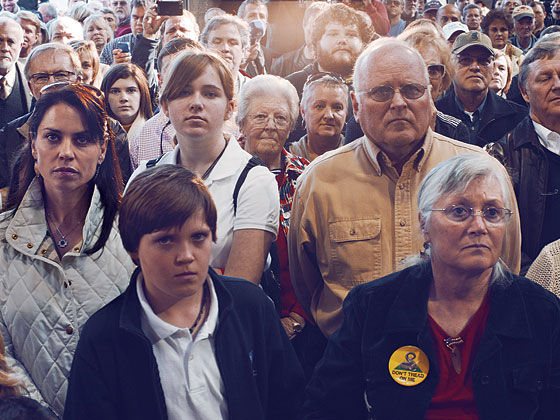
Newt Gingrich supporters listen to his stump speech at a campaign event in South Carolina.
(Photo: Christopher Anderson/Magnum Photos/New York Magazine)


All,

As I and many others have been saying for a long time now this is where the general direction of this country is going and beware anyone--especially us!--who doesn't fully recognize, perceive, or "understand" this fact. This is a brilliant and very insightful piece by Jonathan Chait that confirms what is really at stake in the American political economy and culture in 2012 and beyond (i.e. the next 25-30 years), and why the immediate future of the epic national public battles and conflicts to come over the ever present social dynamics of race, class, gender, and age in this country are about to make the highly tulmutuous, culturally contenious, and politically volatile 1960s/early '70s period of U.S. history--and the fiercely reactionary and violent response to it-- look like merely a polite dress rehearsal for what's coming...Stay tuned...

Kofi


2012 or Never

Republicans are worried this election could be their last chance to stop history. This is fear talking. But not paranoia.

By Jonathan Chait
Feb 26, 2012

New York


Of the various expressions of right-wing hysteria that have flowered over the past three years—goldbuggery, birtherism, death panels at home and imaginary apology tours by President Obama abroad—perhaps the strain that has taken deepest root within mainstream Republican circles is the terror that the achievements of the Obama administration may be irreversible, and that the time remaining to stop permanent nightfall is dwindling away.

“America is approaching a ‘tipping point’ beyond which the Nation will be unable to change course,” announces the dark, old-timey preamble to Paul Ryan’s “The Roadmap Plan,” a statement of fiscal principles that shaped the budget outline approved last spring by 98 percent of the House Republican caucus. Rick Santorum warns his audiences, “We are reaching a tipping point, folks, when those who pay are the minority and those who receive are the majority.” Even such a sober figure as Mitt Romney regularly says things like “We are only inches away from no longer being a free economy,” and that this election “could be our last chance.”

The Republican Party is in the grips of many fever dreams. But this is not one of them. To be sure, the apocalyptic ideological analysis—that “freedom” is incompatible with Clinton-era tax rates and Massachusetts-style health care—is pure crazy. But the panicked strategic analysis, and the sense of urgency it gives rise to, is actually quite sound. The modern GOP—the party of Nixon, Reagan, and both Bushes—is staring down its own demographic extinction. Right-wing warnings of impending tyranny express, in hyperbolic form, well-grounded dread: that conservative America will soon come to be dominated, in a semi-permanent fashion, by an ascendant Democratic coalition hostile to its outlook and interests. And this impending doom has colored the party’s frantic, fearful response to the Obama presidency.

The GOP has reason to be scared. Obama’s election was the vindication of a prediction made several years before by journalist John Judis and political scientist Ruy Teixeira in their 2002 book, The Emerging Democratic Majority. Despite the fact that George W. Bush then occupied the White House, Judis and Teixeira argued that demographic and political trends were converging in such a way as to form a natural-majority coalition for Democrats.

The Republican Party had increasingly found itself confined to white voters, especially those lacking a college degree and rural whites who, as Obama awkwardly put it in 2008, tend to “cling to guns or religion.” Meanwhile, the Democrats had ­increased their standing among whites with graduate degrees, particularly the growing share of secular whites, and remained dominant among racial minorities. As a whole, Judis and Teixeira noted, the electorate was growing both somewhat better educated and dramatically less white, making every successive election less favorable for the GOP. And the trends were even more striking in some key swing states. Judis and Teixeira highlighted Colorado, Nevada, and Arizona, with skyrocketing Latino populations, and Virginia and North Carolina, with their influx of college-educated whites, as the most fertile grounds for the expanding Democratic base.

Obama’s victory carried out the blueprint. Campaign reporters cast the election as a triumph of Obama’s inspirational message and cutting-edge organization, but above all his sweeping win reflected simple demography. Every year, the nonwhite proportion of the electorate grows by about half a percentage point—meaning that in every presidential election, the minority share of the vote increases by 2 percent, a huge amount in a closely divided country. One measure of how thoroughly the electorate had changed by the time of Obama’s election was that, if college- educated whites, working-class whites, and minorities had cast the same proportion of the votes in 1988 as they did in 2008, Michael Dukakis would have, just barely, won. By 2020—just eight years away—nonwhite voters should rise from a quarter of the 2008 electorate to one third. In 30 years, nonwhites will outnumber whites.

Now, there are two points to keep in mind about the emerging Democratic majority. The first is that no coalition is permanent. One party can build a majority, but eventually the minority learns to adapt to an altered landscape, and parity returns. In 1969, Kevin Phillips, then an obscure Nixon- administration staffer, wrote The Emerging Republican Majority, arguing that Republicans could undo FDR’s New Deal coalition by exploiting urban strife, the unpopularity of welfare, and the civil-rights struggle to pull blue-collar whites into a new conservative bloc. The result was the modern GOP. Bill Clinton appropriated some elements of this conservative coalition by rehabilitating his party’s image on welfare and crime (though he had a little help from Ross Perot, too). But it wasn’t until Obama was elected that a Democratic president could claim to be the leader of a true majority party.
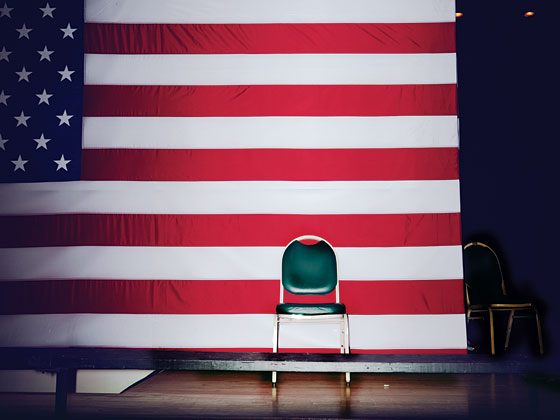


(Photo: Christopher Anderson/Magnum Photos/New York Magazine)

The second point is that short-term shocks, like war, recession, or scandal, can exert a far more powerful influence than a long-term trend: The Watergate scandal, for instance, interrupted the Republican majority at its zenith, helping elect a huge raft of Democratic congressmen in 1974, followed two years later by Jimmy Carter.

But the dominant fact of the new Democratic majority is that it has begun to overturn the racial dynamics that have governed American politics for five decades. Whatever its abstract intellectual roots, conservatism has since at least the sixties drawn its political strength by appealing to heartland identity politics. In 1985, Stanley Greenberg, then a political scientist, immersed himself in Macomb County, a blue-collar Detroit suburb where whites had abandoned the Democratic Party in droves. He found that the Reagan Democrats there understood politics almost entirely in racial terms, translating any Democratic appeal to economic justice as taking their money to subsidize the black underclass. And it didn’t end with the Reagan era. Piles of recent studies have found that voters often conflate “social” and “economic” issues. What social scientists delicately call “ethnocentrism” and “racial resentment” and “ingroup solidarity” are defining attributes of conservative voting behavior, and help organize a familiar if not necessarily rational coalition of ideological interests. Doctrines like neoconservative foreign policy, supply-side economics, and climate skepticism may bear little connection to each other at the level of abstract thought. But boiled down to political sound bites and served up to the voters, they blend into an indistinguishable stew of racial, religious, cultural, and nationalistic identity.

Obama’s election dramatized the degree to which this long-standing political dynamic had been flipped on its head. In the aftermath of George McGovern’s 1972 defeat, neoconservative intellectual Jeane Kirk­patrick disdainfully identified his voters as “intellectuals enamored with righteousness and possibility, college students, for whom perfectionism is an occupational hazard; portions of the upper classes freed from concern with economic self-interest,” and so on, curiously neglecting to include racial minorities. All of them were, in essence, people who heard a term like “real American” and understood that in some way it did not apply to them. Today, cosmopolitan liberals may still feel like an embattled sect—they certainly describe their political fights in those terms—but time has transformed their rump minority into a collective majority. As conservative strategists will tell you, there are now more of “them” than “us.” What’s more, the disparity will continue to grow indefinitely. Obama actually lost the over-45-year-old vote in 2008, gaining his entire victory margin from younger voters—more racially diverse, better educated, less religious, and more socially and economically liberal
Portents of this future were surely rendered all the more vivid by the startling reality that the man presiding over the new majority just happened to be, himself, young, urban, hip, and black. When jubilant supporters of Obama gathered in Grant Park on Election Night in 2008, Republicans saw a glimpse of their own political mortality. And a galvanizing picture of just what their new rulers would look like.

In the cold calculus of game theory, the expected response to this state of affairs would be to accommodate yourself to the growing strength of the opposing coalition—to persuade pockets of voters on the Democratic margins they might be better served by Republicans. Yet the psychology of decline does not always operate in a straightforward, rational way. A strategy of managing slow decay is unpleasant, and history is replete with instances of leaders who persuaded themselves of the opposite of the obvious conclusion. Rather than adjust themselves to their slowly weakening position, they chose instead to stage a decisive confrontation. If the terms of the fight grow more unfavorable with every passing year, well, all the more reason to have the fight sooner. This was the thought process of the antebellum southern states, sizing up the growing population and industrial might of the North. It was the thinking of the leaders of Austria-Hungary, watching their empire deteriorate and deciding they needed a decisive war with Serbia to save themselves.

At varying levels of conscious and subconscious thought, this is also the reasoning that has driven Republicans in the Obama era. Surveying the landscape, they have concluded that they must strike quickly and decisively at the opposition before all hope is lost.

Arthur Brooks, the president of the conservative American Enterprise Institute and a high-profile presence on the Republican intellectual scene, wrote a 2010 book titled The Battle, urging conservatives to treat the struggle for economic libertarianism as a “culture war” between capitalism and socialism, in which compromise was impossible. Time was running short, Brooks pleaded in apocalyptic tones. The “real core” of what he called Obama’s socialistic supporters was voters under 30. “It is the future of our country,” he wrote. “And this group has exhibited a frightening openness to statism in the age of Obama.”

The same panic courses through a new tome by James DeMint, who has made himself probably the most influential member of the Senate by relentlessly pushing his colleagues to the right and organizing primary challenges to snuff out any hint of moderation among his co-partisans. DeMint’s book, titled Now or Never, paints a haunting picture: “Republican supporters will continue to decrease every year as more Americans become dependent on the government. Dependent voters will naturally elect even big-government progressives who will continue to smother economic growth and spend America deeper into debt. The 2012 election may be the last opportunity for Republicans.”

That apocalyptic rhetoric is just as common among voters as among conservative eggheads and party elites. Theda Skocpol, a Harvard sociologist, conducted a detailed study of tea-party activists and discovered that they saw themselves beset by parasitic Democrats. “Along with illegal immigrants,” she wrote, “low-income Americans and young people loom large as illegitimate consumers of public benefits and services.”
It’s easy for liberals to dismiss these fears as simple racism—and surely racism, to some degree, sways the tea party. But it is not just conservative white people who react fearfully when they see themselves outnumbered by an influx of people unlike themselves. Minorities do it. White hipsters do it. Recall the embarrassing spectacle of liberal panic, in the aftermath of George W. Bush’s reelection, when Kerry voters believed their country had been taken over by gay-bashing Evangelical Christians.

That the struggles over the economic policies of the last few years have taken on the style of a culture war should come as no surprise, since conservatives believe Obama has pulled together an ascendant coalition of voters intent on expropriating their money. Paul Ryan, the House Republican budget chairman, has, like many Republicans, cast the fight as pitting “makers” against “takers,” with the latter in danger of irrevocably gaining the upper hand. “The tipping point represents two dangers,” he announced in a speech at the American Enterprise Institute, “first, long-term economic decline as the number of makers diminishes [and] the number of takers grows … Second, gradual moral-political decline as dependency and passivity weaken the nation’s character.”

Of course, both parties make use of end-times rhetoric, especially in election season. What’s novel about the current spate of Republican millennialism is that it’s not a mere rhetorical device to rally the faithful, nor even simply an expression of free- floating terror, but the premise of an electoral strategy.

In that light, the most surprising response to the election of 2008 is what did not happen. Following Obama’s win, all sorts of loose talk concerning the Republican predicament filled the air. How would the party recast itself? Where would it move left, how would it find common ground with Obama, what new constituencies would it court?

The most widely agreed-upon component of any such undertaking was a concerted effort to win back the Hispanic vote. It seemed like a pure political no-brainer, a vital outreach to an exploding electoral segment that could conceivably be weaned from its Democratic leanings, as had previous generations of Irish and Italian immigrants, without altering the party’s general right-wing thrust on other issues. George W. Bush had tried to cobble together a comprehensive immigration-reform policy only to see it collapse underneath a conservative grassroots revolt, and John McCain, who had initially co-sponsored a bill in the Senate, had to withdraw his support for it in his pursuit of the 2008 nomination.

In the wake of his defeat, strategists like Karl Rove and Mike Murphy urged the GOP to abandon its stubborn opposition to reform. Instead, incredibly, the party adopted a more hawkish position, with Republicans in Congress rejecting even quarter-loaf compromises like the Dream Act and state-level officials like Jan Brewer launching new restrictionist crusades. This was, as Thomas Edsall writes in The Age of Austerity, “a major gamble that the GOP can continue to win as a white party despite the growing strength of the minority vote.”

None of this is to say that Republicans ignored the rising tide of younger and browner voters that swamped them at the polls in 2008. Instead they set about keeping as many of them from the polls as possible. The bulk of the campaign has taken the form of throwing up an endless series of tedious bureaucratic impediments to voting in many states—ending same-day voter registration, imposing onerous requirements upon voter-registration drives, and upon voters themselves. “Voting liberal, that’s what kids do,” overshared William O’Brien, the New Hampshire House speaker, who had supported a bill to prohibit college students from voting from their school addresses. What can these desperate, rearguard tactics accomplish? They can make the electorate a bit older, whiter, and less poor. They can, perhaps, buy the Republicans some time.

And to what end? The Republicans’ most audacious choice is the hyperaggressive position they’ve adopted against Obama to sabotage his chances for a second term. Frustrated liberals, assessing the methods of the Republicans in Congress, see a devious brilliance at work in the GOP strategy of legislative obstruction. And indeed, Republicans very skillfully ground the legislative gears to a halt for months on end, weakening or killing large chunks of Obama’s agenda, and nurturing public discontent with Washington that they rode to a sweeping victory in 2010. At the same time, their inability to waver from desperate, all-or-nothing opposition often meant conservatives willingly suffered policy defeats for perceived political gain, and failed to minimize the scale of those defeats.

Take the fight over health-care reform. Yes, Republicans played the politics about as well as possible. But it was their hard line on compromise allowed the bill to pass: The Democrats only managed to cobble together 60 votes to pass it in the Senate because conservatives drove Arlen Specter out of the GOP, forcing him to switch to the Democratic Party. Without him, Democrats never could have broken a filibuster. When Scott Brown surprisingly won the 2010 race to fill Ted Kennedy’s Senate seat, Democrats were utterly despondent, and many proposed abandoning comprehensive health-care reform to cut a deal for some meager expansion of children’s health insurance. But Republicans refused to offer even an olive branch. Presented with a choice between passing the comprehensive bill they had spent a year cobbling together or collapsing in total ignominious defeat, the Democrats passed the bill.

Last summer, Obama was again desperate to reach compromise, this time on legislation to reduce the budget deficit, which had come to dominate the political agenda and symbolize, in the eyes of Establishment opinion, Obama’s failure to fulfill his campaign goal of winning bipartisan cooperation. In extended closed-door negotiations, Obama offered Republicans hundreds of billions of dollars in spending cuts and a permanent extension of Bush-era tax rates in return for just $800 billion in higher revenue over a decade. This was less than half the new revenue proposed by the Bowles-Simpson deficit commission. Republicans spurned this deal, too.

Instead the party has bet everything on 2012, preferring a Hail Mary strategy to the slow march of legislative progress. That is the basis of the House Republicans’ otherwise inexplicable choice to vote last spring for a sweeping budget plan that would lock in low taxes, slash spending, and transform Medicare into private vouchers—none of which was popular with voters. Majority parties are known to hold unpopular votes occasionally, but holding an unpopular vote that Republicans knew full well stood zero chance of enactment (with Obama casting a certain veto) broke new ground in the realm of foolhardiness.

The way to make sense of that foolhardiness is that the party has decided to bet everything on its one “last chance.” Not the last chance for the Republican Party to win power—there will be many of those, and over time it will surely learn to compete for nonwhite voters—but its last chance to exercise power in its current form, as a party of anti-government fundamentalism powered by sublimated white Christian identity politics. (And the last chance to stop the policy steamroller of the new Democratic majority.) And whatever rhetorical concessions to moderates and independents the eventual Republican nominee may be tempted to make in the fall, he’ll find himself fairly boxed in by everything he’s already done this winter to please that base.

Will the gamble work? Grim though the long-term demography may be, it became apparent to Republicans almost immediately after Obama took office that political fate had handed them an impossibly lucky opportunity. Democrats had come to power almost concurrently with the deepest economic crisis in 80 years, and Republicans quickly seized the tactical advantage, in an effort to leverage the crisis to rewrite their own political fortunes. The Lesser Depression could be an economic Watergate, the Republicans understood, an exogenous political shock that would, at least temporarily, overwhelm any deeper trend, and possibly afford the party a chance to permanently associate the Democrats with the painful aftermath of the crisis.

During the last midterm elections, the strategy succeeded brilliantly. Republicans moved further right and won a gigantic victory. In the 2010 electorate, the proportion of voters under 30 fell by roughly a third, while the proportion of voters over 65 years old rose by a similar amount—the white share, too. In the long run, though, the GOP has done nothing at all to rehabilitate its deep unpopularity with the public as a whole, and has only further poisoned its standing with Hispanics. But by forswearing compromise, it opened the door to a single shot. The Republicans have gained the House and stand poised to win control of the Senate. If they can claw out a presidential win and hold on to Congress, they will have a glorious two-year window to restore the America they knew and loved, to lock in transformational change, or at least to wrench the status quo so far rightward that it will take Democrats a generation to wrench it back. The cost of any foregone legislative compromises on health care or the deficit would be trivial compared to the enormous gains available to a party in control of all three federal branches.
On the other hand, if they lose their bid to unseat Obama, they will have mortgaged their future for nothing at all. And over the last several months, it has appeared increasingly likely that the party’s great all-or-nothing bet may land, ultimately, on nothing. In which case, the Republicans will have turned an unfavorable outlook into a truly bleak one in a fit of panic. The deepest effect of Obama’s election upon the Republicans’ psyche has been to make them truly fear, for the first time since before Ronald Reagan, that the future is against them.

Tuesday, March 6, 2012

The Evil and Poisonous Legacy of Andrew Breibart, 1969-2012


Andrew Breitbart, the new media entrepreneur, photographed at his Los Angeles home in 2010. (Al Seib / Los Angeles Times)

http://www.latimes.com/news/la-andrew-breitbart-m,0,4088573.story

All,

This despicable cretin and monumental asshole masquerading as a human being was one of the most savage and unrelenting racists, sexists, homophobes, pathological liars, and far rightwing demagogues in the history of American politics, and like his equally vicious predecessor and slimy mentor Lee Atwater (1951-1991) he and his loathsome agenda will NOT be missed by millions of people in this country. Like Joseph Goebbels (1897-1945)--whose fascist "Big Lie" propaganda techniques Breibart often adopted and emulated--Breibart was nothing but a walking, talking disease in every sense of the word and the most "polite" thing I could possibly say about him--and his ilk--now that he's gone is this:

WHAT GOES AROUND COMES AROUND!

Kofi


Conservative writer Andrew Breitbart dies
By Rong-Gong Lin II and Andrew Blankstein
Los Angeles Times Staff Writers
March 1, 2012

Conservative writer and website publisher Andrew Breitbart died of natural causes at Ronald Reagan UCLA Medical Center about midnight, sources told The Times.

The exact cause of death was unclear, said the sources, who spoke on the condition of anonymity because the case was ongoing.

It's also unclear if he was stricken at the hospital or another location.

"Andrew passed away unexpectedly from natural causes shortly after midnight this morning in Los Angeles," Breitbart.com said. "We have lost a husband, a father, a son, a brother, a dear friend, a patriot and a happy warrior. "

Breitbart, 43, a star of the tea party movement, was a Hollywood-hating, mainstream-media-loathing conservative, according to a Times profile. After spending 10 years as editor of the Drudge Report and helping to launch the Huffington Post, in 2005 he launched his news aggregation site Breitbart.com, which was designed to counter what Breitbart described as the "bully media cabal" that he says ignores stories at odds with prevailing liberal orthodoxy. His goal, he says often, is to "destroy the institutional left."

His big splash came in 2009, when he posted an undercover video in which a pair of conservative activists posing as a prostitute and her boyfriend asked employees of the community group ACORN for help with a brothel that would house underage Salvadorans. ACORN was embarrassed when some of its workers seemed too helpful; Congress responded by defunding the organization.

In 2010, Breitbart posted a 2 1/2-minute video of Shirley Sherrod, a black employee of the U.S. Department of Agriculture, in which she appeared to make racially charged comments. It left viewers with the inaccurate impression Sherrod had deliberately not helped a white man save his family farm in 1986 when she worked for a Georgia nonprofit organization.

The furor from the video caused Sherrod to be fired; when it was later revealed her comments had been taken out of context, Agriculture Secretary Tom Vilsack called Sherrod to apologize and ask whether she would return to the department.

Breitbart's conservative news websites broke the story about the sexually charged tweets by Rep. Anthony Weiner (D-N.Y.), a scandal that led to his resignation.

The Times' Robin Abcarian visited his office in West Los Angeles in 2010. "The command center of Andrew Breitbart's growing media empire is a suite of offices on Sawtelle Boulevard in West Los Angeles with the temporary feel of a campaign office. Only the computers seem firmly anchored."

According to that profile, Breitbart lived in Westwood with his wife, Susie, and their four young children. He was adopted by moderately conservative Jewish parents and attended two of L.A.'s most exclusive private schools -- Carlthorp and Brentwood.

His father, Gerald, owned Fox and Hounds, a landmark Tudor-style Santa Monica restaurant that later became the punk rock club Madame Wong's West. His mother, Arlene, was an executive at Bank of America in Beverly Hills and downtown L.A.


http://www.theroot.com/views/andrew-breitbarts-evil-legacy

All,

Like I said earlier Breibart was nothing but a vicious scumbag and demented sociopath who specialized in promoting criminal levels of slander, libel, hatred, and fear mongering, and whose actual "journalistic" legacy came straight out of the philosophy and techniques of the German fascist Joseph Goebbels and the "Big Lie" school of extreme rightwing demagoguery and propaganda-as-social-terrorism. The media's fawning over him is merely still more overwhelming evidence that racism, sexism, homophobia and other social and cultural forms of institutional oppression and exploitation are alive and well in the United Hates in 2012...

Kofi


Andrew Breitbart's Dirty Legacy
By Joel Dreyfuss
March 6, 2012
The Root

There's been too much praise in the media for a man who lied and cheated and was loose with the facts.

When Andrew Breitbart died suddenly on March 1 at age 43, it was not surprising that so many commentators said nice things about the man. We still have a strong taboo about speaking ill of the departed, and an early death is a shocking reminder of our own mortality. But there was no excuse for the pass so many news outlets and pundits seemed anxious to grant Breitbart despite his legacy of deceptive and dishonest deeds.

Piers Morgan presided over a Breitbart love fest on his CNN show. Arianna Huffington, the conservative-turned-liberal who had Breitbart's help in creating Huffington Post, gushed: "Andrew was full of passion, exuberance, fearlessness, and often coming up with statements that he couldn't prove, although he was also obsessed with facts and wanting to ferret out facts and the truth -- so there are all these paradoxes."

Black conservative pundit Amy Holmes walked in lockstep: "Part of his passion, too, that really drove him was being a champion and protector of the underdog, and that conservatives don't need to be in a defensive crouch, that they can stand up proudly and declare their values and, in particular, conservatives in the minority community, or the sexual-minority community."

To his credit, Morgan touched on the question of Breitbart's capacity to polarize, but only as if it were an unfortunate side effect of his principles rather than his primary intention. But then Morgan couldn't resist slathering on more butter: "And he was a great character. He was a very intelligent guy, incredible work ethic. And he will be deeply missed, not least by our panel."

A Legacy of Deception and Dishonesty

Too many commentators confused Breitbart the private person with Breitbart the public figure and tried to conflate the two. We can all feel sympathy for the loss to Breitbart's family, and we can even understand why his friends spoke of his generosity and commitment. But as Ta-Nehisi Coates noted in his blog at the Atlantic, this is not the issue. "This kind of praise is so broadly true of most controversial public figures as to be meaningless. And it is irrelevant. Breitbart may well have been an excellent father and a great friend but that is not why we are talking about him."

Avoiding speaking ill of the dead is not a reason to remain mute about an evil legacy. Breitbart was an agent provocateur who lied and cheated and distorted the facts to support his right-wing political agenda. He was largely responsible for destroying ACORN, an organization that worked for decades on behalf of the poor and disenfranchised. He nearly ruined the reputation of Shirley Sherrod, who had a distinguished civil rights record. Before he died, Breitbart was promising to expose unsavory information about President Obama's college days.

Breitbart's fame was not the result of journalistic zeal or of some innovative grasp of new media, as some of his supporters have suggested. In fact, his work had nothing at all to do with journalism, and all to do with political propaganda. His strength was a clear grasp of how he could use the unrestrained and unfiltered competitiveness for news in the age of the Internet. He understood that there was a ready, hungry market for doctored videos, faked scenarios and outright lies, especially if they confirmed the darkest suspicions of people on the right who are frightened about change in "our" America.

Take the case of ACORN. In September 2009, Breitbart posted a video of a “sting” operation against the venerable community organization. The covert video purported to show a couple dressed as pimp and prostitute (James O'Keefe and Hannah Giles) who were seeking and getting advice at an ACORN office on how to set up an illegal business. Much later, an investigation showed that the couple had never worn the outlandish clothes to the ACORN office and that, contrary to Breitbart's assertions, an ACORN worker had immediately called the police to report the incident.

In other words, none of what Breitbart presented was true or even remotely related to what actually happened. But ACORN was long gone by then, denied funds by Congress and disbanded when support dried up. The original story, fueled by Fox News, raged on the airwaves for days and triggered congressional, state and local investigations. But the reports that largely absolved ACORN, released months later, never got the level of media play that destroyed the organization.

The case of Sherrod is even more illustrative. In July 2010, Breitbart provided a video to news organizations purportedly showing Sherrod, an employee at the U.S. Department of Agriculture, admitting to a black audience that she exercised racist behavior toward a white farmer who had come to her for help.

Within hours of its airing, Sherrod was fired by Agriculture Secretary Tom Vilsack and condemned by NAACP President Benjamin Jealous. It took just a day for the undoctored video to be revealed, showing that Sherrod was making the opposite point: how she could have turned her back on the farmer but instead reached into her own humanity and took on his case.

Most likely Breitbart and his cohort knew nothing about Sherrod or the tragic mistreatment of blacks by the USDA. They didn't know or care -- and apparently neither did her bosses -- about the reverence for the Sherrod name in civil rights circles.

As Charles E. Cobb Jr., former Mississippi field secretary for the Student Nonviolent Coordinating Committee, wrote on The Root, Sherrod and her husband, Charles, were renowned for their great courage during the civil rights movement. And when young militants turned SNCC in a more confrontational black nationalist direction in response to right-wing terrorism, the Sherrods steadfastly embraced their commitment to nonviolence and interracial cooperation, as Coates also noted in his blog.

Red Meat for Racists

Breitbart wouldn't back off even when a reporter got the wife of the farmer Sherrod had been speaking about to confirm how Sherrod had taken up their cause and helped save their farm. As Coates said, "In short, when confronted with his participation in an immoral act, Breitbart doubled down on immorality. Accused of deception, he elected to deceive further. He took many with him down that path, and by the end we were left with writers parsing the term lynching so as to further malign Sherrod."

The image of a black woman admitting racism toward whites in a presentation to a black audience that seems to laugh and clap in approval is red meat for those who are anxious to prove that blacks are secretly racist. In an age where only a few diehards are still strumming the tropes of old-fashioned black inferiority, the next-best strategy for marginalizing African Americans is an assault on their morality.

For those with such an agenda, what Shirley Sherrod espouses publicly cannot be true; whatever ACORN professes, the organization (led by a black woman at the time of the attacks) hides a dastardly secret agenda. What the NAACP says it believes is just propaganda.

The quest to prove the immorality of African Americans -- and presumably absolve white racists of their own guilt -- feeds into the continued effort to unlock the deep, dark secret of President Obama: He can't really be who he appears to be; he's actually a Muslim or a radical or a Kenyan anti-colonialist. He wants to weaken America and destroy our way of life. He has come to power only by cheating us (with the help of ACORN, in some scenarios), because otherwise it couldn't happen.

Breitbart, like Glenn Beck and Rush Limbaugh and other conservative provocateurs, learned to tap the fear of white conservatives who cannot accept that liberals, black and white, have come to power legitimately or that a black man sits in the White House. In Breitbart's case, he exploited the people's trust in video: If it was on TV, it had to be true. If the facts didn't support his argument, he and his followers made them up and didn't hesitate to step on people's lives and reputations in pursuit of their goals. No one should be saying anything good about that Andrew Breitbart.

Joel Dreyfuss is senior editor-at-large at The Root.

Like The Root on Facebook. Follow us on Twitter.


Links:

[1] http://www.theroot.com/users/joeldreyfuss
[2] http://www.theroot.com/print/60828
[3] http://www.theroot.com/printmail/60828
[4] http://www.theroot.com/views/andrew-breitbarts-evil-legacy
[5] http://www.facebook.com/share.php
[6] http://www.digg.com/submit?url=http://www.theroot.com/views/andrew-breitbarts-evil-legacy&title=Andrew+Breitbart%5C%27s+Dirty+Legacy&media=news&topic=arts_culturetarget=
[7] http://twitter.com/intent/tweet?text=%7C+%40TheRoot247:+Andrew+Breitbart%27s+Dirty+Legacy+http://wapo.st/yDhUtz
[8] http://www.myspace.com/index.cfm?fuseaction=postto&t=Andrew Breitbart\'s Dirty Legacy&u=http://www.theroot.com/views/andrew-breitbarts-evil-legacy
[9] http://www.stumbleupon.com/submit?url=http://www.theroot.com/views/andrew-breitbarts-evil-legacy&title=Andrew Breitbart\'s Dirty Legacy
[10] http://www.google.com/bookmarks/mark?op=edit&bkmk=http://www.theroot.com/views/andrew-breitbarts-evil-legacy&title=Andrew Breitbart\'s Dirty Legacy
[11] http://twitter.com/share?text=| @TheRoot247: Andrew Breitbart's Dirty Legacy&url=http://wapo.st/yDhUtz&counturl=http://www.theroot.com/views/andrew-breitbarts-evil-legacy
[12] http://www.theroot.com/buzz/andrew-breitbart-dead-43
[13] http://transcripts.cnn.com/TRANSCRIPTS/1203/01/pmt.01.html
[14] http://www.theatlantic.com/national/archive/2012/03/on-making-yourself-right/253889/
[15] http://www.theroot.com/views/bertha-lewis-life-after-acorn
[16] http://www.theroot.com/buzz/blogger-wants-shirley-sherrod-suit-tossed
[17] http://www.theroot.com/buzz/watch-breitbarts-obama-tapes-coming
[18] http://www.facebook.com/theroot
[19] http://www.twitter.com/theroot247
[20] http://gawker.com/5508190/okeefe-and-breitbart-acorn-videos-severely-edited
[21] http://www.huffingtonpost.com/john-atlas/acorn-vindicated-of-wrong_b_612265.html
[22] http://www.theroot.com/views/shirley-sherrod-hypocrisy-and-political-expediency
[23] http://www.theroot.com/category/views-tags/acorn-and-andrew-breitbart
[24] http://www.theroot.com/category/views-tags/andrew-breitbart
[25] http://www.theroot.com/category/views-tags/andrew-breitbart-and-sherrod-0
[26] http://www.theroot.com/category/views-tags/andrew-breitbart-criticism
[27] http://www.theroot.com/category/views-tags/andrew-breitbart-critique
[28] http://www.theroot.com/category/views-tags/andrew-breitbart-legacy
[29] http://www.theroot.com/category/views-tags/andrew-breitbart-lies
[30] http://www.theroot.com/category/views-tags/breitbart-and-sherrod
[31] http://www.theroot.com/views/Politics
[32] http://www.theroot.com/category/views-tags/sherrod-and-breitbart
[33] http://www.theroot.com/category/views-tags/shirley-and-charles-sherrod
[34] http://www.theroot.com/category/views-tags/andrew-breitbart-dead
[35] http://www.theroot.com/category/views-tags/andrew-breitbart-death
[36] http://www.theroot.com/category/views-tags/speaking-ill-dead
[37] http://www.google.com/bookmarks/mark?op=edit&bkmk=http://www.theroot.com/root-100/2010/janelle-mon-e&title=Andrew Breitbart\'s Dirty Legacy
[38] http://www.theroot.com/views/looking-beyond-super-tuesday
[39] http://www.theroot.com/views/beyond-faith-why-black-social-conservatives-still-vote-dems
[40] http://www.theroot.com/views/romney-fails-leadership-test?wpisrc=nextbox

Thursday, August 18, 2011

New Academic Study Reveals the Real Ideological and Political Roots of the Tea Party

http://mobile.nytimes.com/article;jsessionid=5CFE13D7527B9C3DD44A699F9FB2CC3B.w6?a=829691&single=1&f=28⊂=Contributor

All,

Of course WE all knew from jumpstreet that the Tea Party was nothing but yet another historical manifestation and political 'updating' of the KKK, the White Citizens Council, and the John Birch Society--among the many other white supremacist/anti immigrant/religious fanatic groups in the United Hates. But its always good to know that other people are actually beginning to pay some real attention to who and what these virulently racist and far rightwing demagogues are and actually represent--especially now that the Klansman and "states rights" Governor of Texas Rick Perry is the leading Republican presidential candidate...

Kofi


OPINION
OP-ED CONTRIBUTORS

Crashing the Tea Party
By DAVID E. CAMPBELL and ROBERT D. PUTNAM
August 17, 2011
New York Times

GIVEN how much sway the Tea Party has among Republicans in Congress and those seeking the Republican presidential nomination, one might think the Tea Party is redefining mainstream American politics.

But in fact the Tea Party is increasingly swimming against the tide of public opinion: among most Americans, even before the furor over the debt limit, its brand was becoming toxic. To embrace the Tea Party carries great political risk for Republicans, but perhaps not for the reason you might think.

Polls show that disapproval of the Tea Party is climbing. In April 2010, a New York Times/CBS News survey found that 18 percent of Americans had an unfavorable opinion of it, 21 percent had a favorable opinion and 46 percent had not heard enough. Now, 14 months later, Tea Party supporters have slipped to 20 percent, while their opponents have more than doubled, to 40 percent.

Of course, politicians of all stripes are not faring well among the public these days. But in data we have recently collected, the Tea Party ranks lower than any of the 23 other groups we asked about - lower than both Republicans and Democrats. It is even less popular than much maligned groups like "atheists" and "Muslims." Interestingly, one group that approaches it in unpopularity is the Christian Right.

The strange thing is that over the last five years, Americans have moved in an economically conservative direction: they are more likely to favor smaller government, to oppose redistribution of income and to favor private charities over government to aid the poor. While none of these opinions are held by a majority of Americans, the trends would seem to favor the Tea Party. So why are its negatives so high? To find out, we need to examine what kinds of people actually support it.

Beginning in 2006 we interviewed a representative sample of 3,000 Americans as part of our continuing research into national political attitudes, and we returned to interview many of the same people again this summer. As a result, we can look at what people told us, long before there was a Tea Party, to predict who would become a Tea Party supporter five years later. We can also account for multiple influences simultaneously - isolating the impact of one factor while holding others constant.

Our analysis casts doubt on the Tea Party's "origin story." Early on, Tea Partiers were often described as nonpartisan political neophytes. Actually, the Tea Party's supporters today were highly partisan Republicans long before the Tea Party was born, and were more likely than others to have contacted government officials. In fact, past Republican affiliation is the single strongest predictor of Tea Party support today.

What's more, contrary to some accounts, the Tea Party is not a creature of the Great Recession. Many Americans have suffered in the last four years, but they are no more likely than anyone else to support the Tea Party. And while the public image of the Tea Party focuses on a desire to shrink government, concern over big government is hardly the only or even the most important predictor of Tea Party support among voters.

So what do Tea Partiers have in common? They are overwhelmingly white, but even compared to other white Republicans, they had a low regard for immigrants and blacks long before Barack Obama was president, and they still do.

More important, they were disproportionately social conservatives in 2006 - opposing abortion, for example - and still are today. Next to being a Republican, the strongest predictor of being a Tea Party supporter today was a desire, back in 2006, to see religion play a prominent role in politics. And Tea Partiers continue to hold these views: they seek "deeply religious" elected officials, approve of religious leaders' engaging in politics and want religion brought into political debates. The Tea Party's generals may say their overriding concern is a smaller government, but not their rank and file, who are more concerned about putting God in government.

This inclination among the Tea Party faithful to mix religion and politics explains their support for Representative Michele Bachmann of Minnesota and Gov. Rick Perry of Texas. Their appeal to Tea Partiers lies less in what they say about the budget or taxes, and more in their overt use of religious language and imagery, including Mrs. Bachmann's lengthy prayers at campaign stops and Mr. Perry's prayer rally in Houston.

Yet it is precisely this infusion of religion into politics that most Americans increasingly oppose. While over the last five years Americans have become slightly more conservative economically, they have swung even further in opposition to mingling religion and politics. It thus makes sense that the Tea Party ranks alongside the Christian Right in unpopularity.

On everything but the size of government, Tea Party supporters are increasingly out of step with most Americans, even many Republicans. Indeed, at the opposite end of the ideological spectrum, today's Tea Party parallels the anti-Vietnam War movement which rallied behind George S. McGovern in 1972. The McGovernite activists brought energy, but also stridency, to the Democratic Party - repelling moderate voters and damaging the Democratic brand for a generation. By embracing the Tea Party, Republicans risk repeating history.


David E. Campbell, an associate professor of political science at Notre Dame, and Robert D. Putnam, a professor of public policy at Harvard, are the authors of "American Grace: How Religion Divides and Unites Us."

He's Not Wearing A White Hood and Robes But He Might As Well Be: Republican Governor Rick Perry of Texas Enters the 2012 Presidential Race

Richard Ellis/Getty Images
Gov. Rick Perry of Texas announced his candidacy for president at the RedState Gathering, a meeting of conservative activists, in Charleston, S.C., on Saturday.

http://www.nytimes.com/2011/08/14/us/politics/14perry.html?ref=global-home

All,

Rick Perry is nothing but the Ku Klux Klan + the Tea Party in a suit and therefore a very dangerous and deceptive man. BEWARE! (for real). That he, like the notorious Bushwhacker 2, has been Governor of Texas for the past decade (!) is enough by itself to indicate just how stubbornly backward and violently reactionary the Republican candidate for the Presidency is going to be in 2012. Get ready for the most openly racist, brazenly cruel, and lowdown dirty dog national campaign since the post Reconstruction era of the 1880s and '90s (remember the "black codes"?--well if you don't you will certainly find out exactly what it was--and still is--quick, fast, and in a hurry...Here come the paddyrollers once again and guess who they're looking for? (as usual)...

Kofi


Promising Better Direction, Perry Enters Race
By Ashley Parker
August 13, 2011
New York Times

CHARLESTON, S.C. — Gov. Rick Perry of Texas announced Saturday that he was running for president, declaring it was “time to get America working again” as he sought to offer the Republican Party a well-rounded candidate who appeals to fiscal conservatives and can also rally the evangelical base.


As many of his fellow candidates flooded Iowa over the weekend to woo voters at the Ames Straw Poll, Mr. Perry headed here to announce that he was seeking the nomination at the RedState Gathering, an annual convention of conservative bloggers.

“I came to South Carolina because I will not sit back and accept the path that America is on, because a great country requires a better direction, because a renewed nation needs a new president,” he said.

“With the support of my family and unwavering belief in the goodness of America, I declare to you today as a candidate for president of the United States.”

And with that, Mr. Perry, 61, whose spectral presence has lingered over the Republican primary contest — he was even the topic of a question at Thursday night’s Republican debate in Iowa — officially became a candidate for the Republican nomination.

Mr. Perry’s entrance into an already crowded field is expected to reconfigure the dynamics of the race, offering Republicans a fiscal and social conservative who not only appeals to the party’s base but can also challenge Mitt Romney, who is leading in many polls, on jobs and the economy.

His announcement reverberated 1,200 miles away in Iowa, where thousands of Republicans gathered to size up the party’s candidates, who delivered speeches and asked for support in the Ames Straw Poll. Though Mr. Perry’s name was not on the ballot, a group called Americans for Rick Perry urged people to list him as a write-in candidate.

In a sea of people wearing green shirts for Tim Pawlenty, orange shirts for Michele Bachmann and red shirts for Ron Paul, dozens of maroon shirts bearing Mr. Perry’s name stood out in the crowd. He is set to travel to Iowa on Sunday, where he intends to spend three days in the state introducing himself to voters who will open the nominating contest early next year.

“He’s an attractive candidate,” Tim Gibson, 59, of Clive, Iowa, said as he stood in line at the straw poll waiting to cast his vote for Mr. Perry. “He brings leadership to the race. My top priority is winning the election, and I want to vote for someone who can win.”

Mr. Perry is the longest-serving governor of Texas, having been elected to three full terms and having held the position for more than 10 years. He is known as a fierce and skilled campaigner, as well as a prodigious fund-raiser. In past campaigns, he has eked out victories and also come from behind to win by large margins. He also seems to have uncanny luck and the ability to recognize and capitalize on it.

“He becomes immediately one of the top three candidates, and he fills a vacuum — of someone who is a conservative, who has credibility and can speak to the fiscal conservative, anti-big-government and anti-Washington crowd, but he’s also a social conservative,” said Matthew Dowd, a former strategist for President George W. Bush. “At least in the short term, he is a major disruption in the race.”

Mr. Perry was heading to New Hampshire on Saturday evening and then to Iowa, but what he does in the coming weeks will be the real test of his candidacy, said Republicans who were waiting to see if he could withstand the scrutiny that comes with a presidential campaign.

“He either gets in and gets through the gantlet of the first month or so and consistently moves forward and wins the nomination, or he’s got this terrific flameout,” Mr. Dowd said. “There’s no middle ground.”

Mr. Romney has positioned himself as the candidate with real-world experience who can turn the economy around and create jobs, and Mr. Perry will compete with him on that front, having ushered in a decade of job growth in Texas. But not everyone is convinced that Mr. Perry’s tenure has been great for Texas.

“He’s cutting services in order to maintain really low tax rates, and so many of the jobs he’s created are these minimum-wage jobs, not these living-wage jobs,” said Representative Lloyd Doggett, Democrat of Texas. “I think he has, as they would say here in Texas, plenty of ’splaining to do about his positions.”

Mr. Perry, a fifth-generation Texan, grew up in a rural community in Paint Creek, on a tenant farm nestled in the West Texas plains, an area known as the Big Empty. Mr. Perry, an Eagle Scout, told Texas Monthly last year, “There were three things to do in Paint Creek: school, church and Boy Scouts.” His mother, he said, was a good seamstress who still made his underwear when he went off to college at Texas A&M University, from which he graduated in 1972 with a major in animal science.

Mr. Perry, a Methodist who regularly attends an evangelical megachurch near his home and hosted a large “Nation in Crisis” prayer rally this month in Houston, is a natural candidate to appeal to his party’s religious right, as well as to parts of its Tea Party contingent.

In some ways, Mr. Perry embraced Tea Party ideals before the party itself was popular, winning re-election in 2010 — first by beating Senator Kay Bailey Hutchison in a primary challenge for governor, and then defeating Bill White, the former mayor of Houston — by positioning himself as an outsider, despite his two terms as governor. He pitted Texas against Washington, and prevailed.

Mr. Perry has walked a fine line on immigration, trying to balance his state’s business interests with calls for hard-line reform and border security, and that may not endear him with some Republicans, especially those aligned with the Tea Party.

In 2001, he signed his state’s version of the Dream Act, a bill that allowed children of illegal immigrants to attend state universities as long as they were working toward citizenship and had graduated from a Texas high school. Yet a decade later, he led the push for a “sanctuary city” bill that would have allowed the police to question people they picked up about their immigration status.

Mr. Perry is Mr. Bush’s direct successor as governor, and with his Texas twang and swagger, he can seem like a caricature of the former president. Voters trying to figure out what they think of Mr. Perry will invariably wrestle with their feelings about Mr. Bush, which, Republicans say, may become a potential liability if he makes it to the general election.

Though Mr. Perry is a disciplined campaigner, he has been known to get carried away when speaking and sometimes finds himself trying to rein in his own statements. In 2009, he dabbled with secession.

“There really was considerable talk down here about all the talk of secession that bubbled up around his gubernatorial campaign,” Mr. Doggett said. “So that when he started talking about running for president, the question was: of which country?”


Jeff Zeleny contributed reporting from Ames, Iowa.


http://www.thenation.com/blog/162782/rick-perrys-neocon-friends?rel=emailNation

All,

More on the Klansman Governor from Texas running for President and his neocon/protofascist posse...

Kofi


Rick Perry's Neocon Friends
by Robert Dreyfuss
August 15, 2011
The Nation

No one seriously believes that Republicans will nominate the wild-eyed, certifiable Michele Bachmann for president, and Romney the Robot isn’t setting Tea Party hearts aflutter. So it looks like Rick Perry, the Bible-thumping, secessionist hawk—who’s already assembling a team of neoconservative advisers—will get the nod to challenge President Obama in 2012.

Were Perry to win, his victory—especially if the GOP, as seems likely, conquers the Senate—will speed the United States down the merry path to oblivion at least a couple of decades before the rise of China and India do anyway. Worryingly, Perry might be exactly the know-nothing hawk who decides to use US military power to forestall America’s inevitable decline by force, even if it leads to World War III. Like Tea Party fanatics who courted financial Armageddon by insisting that reneging on US debt obligations wouldn’t be so bad, Perry’s own Tea Party Pentagon, staffed by neoconservatives, might decide the nuclear Armageddon wouldn’t be so bad, either, as long as it makes the world understand how exceptional American exceptionalism is.

Indeed, as James Lindsey points out [1] for the Council on Foreign Relations, in his screed, Fed Up: Our Fight to Save America from Washington, a book that he allegedly wrote, Perry declares that “exceptional” America has to be prepared for war with China and India:

“We are now confronted with the rise of new economic and military powerhouses in China and India, as well as a Russia that is increasingly aggressive and troublesome to its neighbors and former satellite nations that are struggling to maintain their relatively newfound independence. There is no reason to believe that armed conflict with any major power is imminent, but the world is rapidly changing, and the United States must be prepared for the ramifications of shifting balances of power.”

And Perry adds, concerning the “reset” in relations with Russia:

“It was a slap in the face to a number of our allies. As a Wall Street Journal article put it, ‘Some prominent figures in the region, such as former Polish President Lech Walesa, worried the new US administration was turning away from its traditional allies in Central Europe to placate Russia’.… Surely we can’t be serious?”

In his speech proclaiming his candidacy, in which he said elegantly that “we don’t need a president who apologizes for America,” and he added: “What I learned in my 20’s traveling the globe as an Air Force pilot, our current president has yet to acknowledge in his 50s—that we are the most exceptional nation on the face of the earth.”

No surprise, of course, that Perry is consorting with left-over neocons [2] from the Bush administration, as National Review reported in July, such as Douglas Feith, the ¨uber-hawk who oversaw the war in Iraq, and Bill Luti, Feith’s compatriot in the Bush White House, who joined with Vice President Cheney to persuade Bush that an unprovoked attack on Iraq was the right thing to do, and Dan Blumenthal, another Bush veteran who’s taken up residence at the American Enterprise Institute. Though the Tea Party types who support nut-libertarian Ron Paul oppose wars such as Iraq and Afghanistan and want to reduce the size of the Pentagon, Perry appeals to the other side of the Tea Party and to traditional Republican hawks who oppose the libertarians’ outright isolationism. Indeed, a source close to Perry told National Review [3] that Perry does not exhibit “the neo-isolationism that you might expect from certain people [close to] the Tea Party.” (According to Politico, Donald Rumseld is setting up Perry’s encounters [4] with the neocons.)

Like this blog post? Read it on The Nation’s free iPhone App, NationNow. [5]


Source URL: http://www.thenation.com/blog/162782/rick-perrys-neocon-friends

Links:

[1] http://blogs.cfr.org/lindsay/2011/08/13/campaign-2012-hello-rick-perry-gop-presidential-candidate/
[2] http://www.nationalreview.com/corner/272021/perrys-briefing-katrina-trinko
[3] http://www.nationalreview.com/corner/273717/perry-no-isolationist-foreign-policy-katrina-trinko#
[4] http://www.politico.com/blogs/bensmith/0711/Rumsfeld_had_role_in_Perry_meeting.html
[5] http://itunes.apple.com/us/app/nationnow/id399704758?mt=8

Monday, August 1, 2011

Paul Krugman Exposes the Bogus Mythology of Centrism in the Media Coverage of American Politics

http://www.nytimes.com/2011/07/29/opinion/krugman-the-centrist-cop-out.html?_r=1&ref=global-home

All,

Here's Paul telling the whole truth and nothing but...as usual...Thanks again Paul for consistently having the courage to do what so many others refuse to do...

Kofi


July 28, 2011

The Centrist Cop-Out
By PAUL KRUGMAN
The New York Times


The facts of the crisis over the debt ceiling aren’t complicated. Republicans have, in effect, taken America hostage, threatening to undermine the economy and disrupt the essential business of government unless they get policy concessions they would never have been able to enact through legislation. And Democrats — who would have been justified in rejecting this extortion altogether — have, in fact, gone a long way toward meeting those Republican demands.

As I said, it’s not complicated. Yet many people in the news media apparently can’t bring themselves to acknowledge this simple reality. News reports portray the parties as equally intransigent; pundits fantasize about some kind of “centrist” uprising, as if the problem was too much partisanship on both sides.

Some of us have long complained about the cult of “balance,” the insistence on portraying both parties as equally wrong and equally at fault on any issue, never mind the facts. I joked long ago that if one party declared that the earth was flat, the headlines would read “Views Differ on Shape of Planet.” But would that cult still rule in a situation as stark as the one we now face, in which one party is clearly engaged in blackmail and the other is dickering over the size of the ransom?

The answer, it turns out, is yes. And this is no laughing matter: The cult of balance has played an important role in bringing us to the edge of disaster. For when reporting on political disputes always implies that both sides are to blame, there is no penalty for extremism. Voters won’t punish you for outrageous behavior if all they ever hear is that both sides are at fault.

Let me give you an example of what I’m talking about. As you may know, President Obama initially tried to strike a “Grand Bargain” with Republicans over taxes and spending. To do so, he not only chose not to make an issue of G.O.P. extortion, he offered extraordinary concessions on Democratic priorities: an increase in the age of Medicare eligibility, sharp spending cuts and only small revenue increases. As The Times’s Nate Silver pointed out, Mr. Obama effectively staked out a position that was not only far to the right of the average voter’s preferences, it was if anything a bit to the right of the average Republican voter’s preferences.

But Republicans rejected the deal. So what was the headline on an Associated Press analysis of that breakdown in negotiations? “Obama, Republicans Trapped by Inflexible Rhetoric.” A Democratic president who bends over backward to accommodate the other side — or, if you prefer, who leans so far to the right that he’s in danger of falling over — is treated as being just the same as his utterly intransigent opponents. Balance!

Which brings me to those “centrist” fantasies.

Many pundits view taking a position in the middle of the political spectrum as a virtue in itself. I don’t. Wisdom doesn’t necessarily reside in the middle of the road, and I want leaders who do the right thing, not the centrist thing.

But for those who insist that the center is always the place to be, I have an important piece of information: We already have a centrist president. Indeed, Bruce Bartlett, who served as a policy analyst in the Reagan administration, argues that Mr. Obama is in practice a moderate conservative.

Mr. Bartlett has a point. The president, as we’ve seen, was willing, even eager, to strike a budget deal that strongly favored conservative priorities. His health reform was very similar to the reform Mitt Romney installed in Massachusetts. Romneycare, in turn, closely followed the outlines of a plan originally proposed by the right-wing Heritage Foundation. And returning tax rates on high-income Americans to their level during the Roaring Nineties is hardly a socialist proposal.

True, Republicans insist that Mr. Obama is a leftist seeking a government takeover of the economy, but they would, wouldn’t they? The facts, should anyone choose to report them, say otherwise.

So what’s with the buzz about a centrist uprising? As I see it, it’s coming from people who recognize the dysfunctional nature of modern American politics, but refuse, for whatever reason, to acknowledge the one-sided role of Republican extremists in making our system dysfunctional. And it’s not hard to guess at their motivation. After all, pointing out the obvious truth gets you labeled as a shrill partisan, not just from the right, but from the ranks of self-proclaimed centrists.

But making nebulous calls for centrism, like writing news reports that always place equal blame on both parties, is a big cop-out — a cop-out that only encourages more bad behavior. The problem with American politics right now is Republican extremism, and if you’re not willing to say that, you’re helping make that problem worse.


Sunday, July 3, 2011

Matt Taibbi on Michele Bachmann, the Tea Party Movement, and the True Danger of the Far Right in American Politics and Culture

Michele Bachmann Illustration by Victor Juhasz
 
 
Laura, 
 
This madwoman is the posterchild epitome of the demented religious fascists that you warned me were rampant in the deep reactionary underground of American politics years ago and who has now gone thoroughly 'mainstream' isn't it? Everything about Bachman and her cretinous associates in the Tea Party and the far right evangelical Christian movement reminds me of the ominous rise of the Nazi Party circa 1930 when virtually no one in the Weimar Republic of Germany took Hitler and his deadly gang of maniacal thugs seriously only to wind up with them running the national government just three years later... 
 
Kofi 
  
Michele Bachmann's Holy War 
by Matt Taibbi 
June 22, 2011 
Rolling Stone  
 
The Tea Party contender may seem like a goofball, but be warned: Her presidential campaign is no laughing matter Close your eyes, take a deep breath, and, as you consider the career and future presidential prospects of an incredible American phenomenon named Michele Bachmann, do one more thing. Don't laugh. It may be the hardest thing you ever do, for Michele Bachmann is almost certainly the funniest thing that has ever happened to American presidential politics. Fans of obscure 1970s television may remember a short-lived children's show called Far Out Space Nuts, in which a pair of dimwitted NASA repairmen, one of whom is played by Bob (Gilligan) Denver, accidentally send themselves into space by pressing "launch" instead of "lunch" inside a capsule they were fixing at Cape Canaveral. This plot device roughly approximates the political and cultural mechanism that is sending Michele Bachmann hurtling in the direction of the Oval Office. Bachmann is a religious zealot whose brain is a raging electrical storm of divine visions and paranoid delusions. She believes that the Chinese are plotting to replace the dollar bill, that light bulbs are killing our dogs and cats, and that God personally chose her to become both an IRS attorney who would spend years hounding taxpayers and a raging anti-tax Tea Party crusader against big government. She kicked off her unofficial presidential campaign in New Hampshire, by mistakenly declaring it the birthplace of the American Revolution. "It's your state that fired the shot that was heard around the world!" she gushed. "You are the state of Lexington and Concord, you started the battle for liberty right here in your backyard." I said lunch, not launch! But don't laugh. Don't do it. And don't look her in the eyes; don't let her smile at you. Michele Bachmann, when she turns her head toward the cameras and brandishes her pearls and her ageless, unblemished neckline and her perfect suburban orthodontics in an attempt to reassure the unbeliever of her non-threateningness, is one of the scariest sights in the entire American cultural tableau. She's trying to look like June Cleaver, but she actually looks like the T2 skeleton posing for a passport photo. You will want to laugh, but don't, because the secret of Bachmann's success is that every time you laugh at her, she gets stronger. In modern American politics, being the right kind of ignorant and entertainingly crazy is like having a big right hand in boxing; you've always got a puncher's chance. And Bachmann is exactly the right kind of completely batshit crazy. Not medically crazy, not talking-to-herself-on-the-subway crazy, but grandiose crazy, late-stage Kim Jong-Il crazy — crazy in the sense that she's living completely inside her own mind, frenetically pacing the hallways of a vast sand castle she's built in there, unable to meaningfully communicate with the human beings on the other side of the moat, who are all presumed to be enemies. Bachmann's story, to hear her tell it, is about a suburban homemaker who is chosen by God to become a politician who will restore faith and family values to public life and do battle with secular humanism. But by the time you've finished reviewing her record of lies and embellishments and contradictions, you'll have no idea if she actually believes in her own divine inspiration, or whether it's a big con job. Or maybe both are true — in which case this hard-charging challenger for the GOP nomination is a rare breed of political psychopath, equal parts crazed Divine Wind kamikaze-for-Jesus and calculating, six-faced Machiavellian prevaricator. Whatever she is, she's no joke. Bachmann was born Michele Amble in Waterloo, Iowa, to a pair of lifelong Democrats, but grew up in tiny Anoka, Minnesota. By her teen years, her parents had divorced; her mother remarried and brought step-siblings into the home, creating a Brady Bunchian group of nine kids. One of Bachmann's step-siblings, Helen LaFave, would later come out as a lesbian, a fact that Michele, who became famous opposing gay marriage, never mentions on the campaign trail. For the most part, though, Bachmann's upbringing seems like pure Americana, a typical Midwestern girl who was "in a couple of beauty pageants" and "not overtly political," according to her stepbrother Michael LaFave. Young Michele found Jesus at age 16, not long before she went away to Winona State University and met a doltish, like-minded believer named Marcus Bachmann. After finishing college, the two committed young Christians moved to Oklahoma, where Michele entered one of the most ridiculous learning institutions in the Western Hemisphere, a sort of highway rest area with legal accreditation called the O.W. Coburn School of Law; Michele was a member of its inaugural class in 1979. Originally a division of Oral Roberts University, this august academy, dedicated to the teaching of "the law from a biblical worldview," has gone through no fewer than three names — including the Christian Broadcasting Network School of Law. Those familiar with the darker chapters in George W. Bush's presidency might recognize the school's current name, the Regent University School of Law. Yes, this was the tiny educational outhouse that, despite being the 136th-ranked law school in the country, where 60 percent of graduates flunked the bar, produced a flood of entrants into the Bush Justice Department. Regent was unabashed in its desire that its graduates enter government and become "change agents" who would help bring the law more in line with "eternal principles of justice," i.e., biblical morality. To that end, Bachmann was mentored by a crackpot Christian extremist professor named John Eidsmoe, a frequent contributor to John Birch Society publications who once opined that he could imagine Jesus carrying an M16 and who spent considerable space in one of his books musing about the feasibility of criminalizing blasphemy. This background is significant considering Bachmann's leadership role in the Tea Party, a movement ostensibly founded on ideas of limited government. Bachmann says she believes in a limited state, but she was educated in an extremist Christian tradition that rejects the entire notion of a separate, secular legal authority and views earthly law as an instrument for interpreting biblical values. As a legislator, she not only worked to impose a ban on gay marriage, she also endorsed a report that proposed banning anyone who "espoused or supported Shariah law" from immigrating to the U.S. (Bachmann seems so unduly obsessed with Shariah law that, after listening to her frequent pronouncements on the subject, one begins to wonder if her crazed antipathy isn't born of professional jealousy.) This discrepancy may account for why some Tea Party leaders don't buy Bachmann as a champion of small government. "Michele Bachmann is — what's the old-school term? — a poser," says Chris Littleton, an Ohio Tea Party leader troubled by her support of the Patriot Act and other big-government interventions. "Look at her record and see how 'Tea Party' she really is." When Bachmann finished her studies in Oklahoma, Marcus instructed her to do her postgraduate work in tax law — a command Michele took as divinely ordained. She would later profess to complete surprise at God's choice for her field of study. "Tax law? I hate taxes," she said. "Why should I go and do something like that?" Still, she sucked it up and did as she was told. "The Lord says: Be submissive, wives, you are to be submissive to your husbands." Moving back to Minnesota, she and Marcus settled in Stillwater, a town of 18,000 near St. Paul, where they raised their five children and took in 23 foster kids. Stillwater is a Midwestern version of a Currier & Ives set piece, complete with cozy homes, antique stores — and no black people. In short, the perfect launching pad for a political career built on Bachmann's retro-Stepford image. Stillwater's congressional district is the whitest district in Minnesota (95 percent) and one of the wealthiest in America (with a median income $16,000 above the national average). Michele took a job as a tax attorney collecting for the IRS and spent the next four years sucking on the tit of the Internal Revenue Service, which makes her Tea Party-leader hypocrisy quotient about average. (At least she didn't collect more than $250,000 in federal farm subsidies between 1995 and 2006 — that was her father-in-law.) It was after Bachmann quit the IRS in 1993 that her political career really began; although she had volunteered for Jimmy Carter in her youth and had been an anti-abortion protester, she didn't become a major player in Stillwater until she joined a group of fellow Christian activists to form New Heights, one of the first charter schools in America. Anyone wanting to understand how President Bachmann might behave should pay close attention to what happened at New Heights. Because the school took government money, like other charter schools, it had to maintain a separation of church and state, and Bachmann was reportedly careful to keep God out of the initial outlines of the school's curriculum. But before long, parents began to complain that Bachmann and her cronies were trying to bombard the students with Christian dogma — advocating the inclusion of something called the "12 Biblical Principles" into the curriculum, pushing the teaching of creationism and banning the showing of the Disney movie Aladdin because it promoted witchcraft. "One member of Michele's entourage talked about how he had visions, and that God spoke to him directly," recalled Denise Stephens, a parent who was opposed to the religious curriculum at New Heights. "He told us that as Christians we had to lay our lives down for it. I remember getting in the car with my husband afterward and telling him, 'This is a cult.'" Under pressure from parents, Bachmann resigned from New Heights. But the experience left her with a hang-up about the role of the state in public education. She was soon mobilizing against an educational-standards program called Profile of Learning, an early precursor to No Child Left Behind. Under the program, state educators and local businesses teamed up to craft a curriculum that would help young people prepare for the work force — but Bachmann saw through their devious scheme. "She thought it was a socialist plot to turn our children into little worker-automatons," says Bill Prendergast, a Stillwater resident who wrote for the town's newspaper and has documented every step of Bachmann's career. The theme of socialists scheming to herd children into a factorylike system of predetermined occupations still comes up often in Bachmann's rhetoric. In a recent speech in Iowa, for instance, she talked wistfully of the early Midwest settled by her Norwegian ancestors, a place where "we can choose whatever profession we want, and no one tells us what profession we go in." Bachmann likewise rejected AmeriCorps as an attempt to build "re-education camps for young people, where young people have to go and get trained in a philosophy that the government puts forward," and blasted a schools program started by Bill Clinton for trying to brainwash kids into accepting "government central planning of our economy and our way of life." To combat this dark outcome, Bachmann joined up with a Junior Anti-Sex League-type outfit called the Maple River Education Coalition, which was largely composed of Christian conservatives rallying against educational standards. The group met in a church, and its sessions resembled old-time religious revivals, complete with whooping and hollering. "There were enormous amounts of 'amens,'" recalls Mary Cecconi, a Stillwater resident who attended an early meeting of Maple River. "It's like a mission from God with those people." Maple River was so out there that Minnesota's then-governor, Jesse Ventura, no slouch in the batshit-conspiracy department, dismissed the group as nothing but a bunch of people who "think UFOs are landing next month." Maple River eventually morphed into an organization called EdWatch, which railed against various dystopian indoctrination plans, including the U.N.-inspired International Baccalaureate program, offered in some American high schools. Bachmannites despise IB because its "universal" curriculum refuses to recognize the superiority of Christianity to other religions. You and I might have thought William Butler Yeats, for example, was a great poet who died half a century before the Age of Aquarius, but EdWatch calls him a "New-Age Pantheism Guru" who was aggressively "undermining Christianity." Bachmann's anti-standards crusade led her to her first political run. In 1999, she joined four other Republicans in Stillwater in an attempt to seize control of the school board. The "Slate of Five" proved unpopular: The GOP candidates finished dead last. Bachmann learned her lesson. "Since then, she has never abdicated control of her campaign or her message to anyone," says Cecconi, who defeated Bachmann in the race — which remains the only election Bachmann has ever lost. The slate of five had been put together by a local Republican kingpin named Bill Pulkrabek, who this spring was jailed for domestic assault after he allegedly pulled his mistress down a set of stairs by her hair. According to Pulkrabek, Bachmann initially came to him asking for advice on how to defeat Gary Laidig, a moderate Republican state senator, but he advised her to run for the school board first. "We talked about knocking Gary off later," Pulkrabek recalled. And indeed, right after the school-board fiasco, Bachmann decided to take on Laidig. In her later telling of the story, however, Bachmann substituted a higher authority than Bill Pulkrabek. It was God, she insisted, not a girlfriend-abusing politician, who instructed her to get involved in politics. "As if we didn't have enough to do, He called me to run for the Minnesota State Senate," she said in 2006. "I had no idea, no desire to be in politics. None." In another version of the story told by Bachmann, she ran against Laidig only because a GOP endorsing convention in April of that year spontaneously selected her, prompting yet another Home Alone extreme-surprise moment. "I came in wearing jeans, a sweatshirt and moccasins, and I had no makeup on at all," she said. "I had made not one phone call, and spent not five cents, and I did not solicit a vote." Laidig, who calls Bachmann a "cold and calculating" person, didn't buy it. "Absolute bullshit," he told reporters. "She planned this all along." Bachmann's entire political career has followed this exact same pattern of God-speaks-directly-to-me fundamentalism mixed with pathological, relentless, conscienceless lying. She's not a liar in the traditional way of politicians, who tend to lie dully, usefully and (they hope) believably, often with the aim of courting competing demographics at the same time. That's not what Bachmann's thing is. Bachmann lies because she can't help it, because it's a built-in component of both her genetics and her ideology. She is at once the most entertaining and the most dangerous kind of liar, a turbocharged cross between a born bullshit artist and a religious fanatic, for whom lying to the infidel is a kind of holy duty. It has taken just over 10 years for Bachmann to go from small-town PTA maven to serious presidential contender, a testament to both her rare and unerring talent for generating media attention, and to her truly astonishing energy level and narcissistic tenacity. Minnesota politicians who have squared off against Bachmann all speak with a kind of horrified reverence for her martial indomitability, her brilliantly fortifying lack of self-doubt, even the fact that she hasn't appeared to physically age at all in 10 years. "She will not stop," says Cecconi. Bachmann ended up unseating Laidig — and since then, getting herself elected is pretty much the only thing she has accomplished in politics. That's not an exaggeration: As both a state senator and a congresswoman, Michele Bachmann has never passed a piece of meaningful legislation. Her time in the Minnesota legislature was concentrated in two lengthy and unsuccessful protest campaigns. The first was a jeremiad against school standards, which fizzled out when Ventura's replacement, then-governor and current presidential rival Tim Pawlenty, backed his own version of school standards with the coming of No Child Left Behind. The other was a hysterical campaign against gay marriage that involved some of the strangest behavior ever attributed to an American elected official. In 2003, after the Massachusetts Supreme Court issued its famous ruling permitting gay marriage, Bachmann proposed an amendment to the Minnesota constitution banning gay marriage — despite the fact that the state legislature had already passed a law making same-sex unions illegal. Even the politicians who were sufficiently gay-phobic to have passed the original anti- marriage law were floored by the brazen pointlessness of Bachmann's bill. "It's unnecessary, it's redundant, it's duplicative," said Assistant Senate Majority Leader Ann Rest. The episode was classic Bachmann, whose political strategy throughout her career has mostly revolved around having her Little House on the Never-Existed Fundamentalist Prairie sensibilities rocked by something she has read (or misread) in the news, then immediately proposing a horseshit, total-waste-of- everybody's-time legislative action in response. In 2009, after she saw a news story about the Chinese calling on the world to abandon the dollar as its reserve currency, Bachmann somehow took this to mean that the Obama administration might force ordinary Americans to abandon their familiar green dollar bills for some international and no doubt atheist currency. To combat this possibility, Bachmann introduced a resolution to "bar the dollar from being replaced by any foreign currency." Even after the gaffe was made public, Bachmann pressed on, challenging Treasury Secretary Tim Geithner to "categorically renounce the United States moving away from the dollar." Imagine Joe McCarthy dragging Cabinet members into hearings and demanding that they publicly disavow the works of Groucho Marx, and you get a rough idea of the general style of Bachmannian politics. Bachmann's anti-gay crusade in Minnesota was born of similar stuff. Right from the start, she made sure that everyone knew the awesome importance of the task she was taking on, trying to outlaw an already outlawed practice. "This is probably the biggest issue that will impact our state and our nation in, at least, the last 30 years," she said. She called gay marriage an "earthquake issue," insisting that failure to pass her proposal would mean that "sex curriculum would essentially be taught by the gay community" and that "little K-12 children will be forced to learn that homosexuality is normal, natural, and perhaps they should try it." Much as Sarah Palin's actual speeches sometimes melt indistinguishably into Tina Fey's SNL parodies, Bachmann's anti-gay rhetoric at times features a campy, over-the-top quality that makes it hard to tell her apart from a tranny cabaret act. She described the gay lifestyle as "bondage" and "personal enslavement," even claiming that suicide among gay teens is due not to discrimination but to "the fact of what they're doing." Bachmann's obsession with gay culture led her to bizarre behavioral extremes. In April 2005, after the State Senate refused to even vote on her constitutional amendment, she hid in the bushes outside the State Capitol during a gay-rights rally. A photo shows Bachmann, only the top of her Stepford head visible, crouched alone in an extreme catcher's squat behind the Capitol shrubbery. She later insisted she wasn't hiding at all, but resting because her heels hurt. That same year tensions between Bachmann and some gay activists grew heated during a town-hall meeting she attended. Depending on whom you believe — and by that I mean which of Bachmann's own competing versions of the story you believe — Bachmann either left the meeting to avoid the activists, or excused herself to "use the restroom" only to be "held against her will" there by what may or may not have been a pair of angry lesbians. She reported the incident to the Washington County sheriff: "Sen. Bachman [sic] stated that when she was trying to leave, 2 women blocked her in and told her they wanted to continue talking. Sen. Bachman stated she was afraid and screamed for help. The 2 women let her leave the restroom when she screamed." Images of Michele Bachmann squatting behind a bush or hiding from lesbians in a bathroom would seem to be punch lines of funny stories, but they are not. The real punch line is that rather than destroying her politically, these incidents helped propel her into Congress. In her first two races, in 2006 and 2008, she defeated experienced, credible opponents who failed to realize what they were dealing with until it was too late. Her 2006 win was an especially extraordinary testament to her electoral viability. In a terrible year for conservatives, with the death-spiraling Bush administration taking Republican seats down with them all over the country, Bachmann won a fairly independent district by an eight-point margin. In her runs for Congress, Bachmann discovered — or perhaps it is more accurate to say we all discovered — that a total absence of legislative accomplishment and a complete inability to tell the truth or even to identify objective reality are no longer hindrances to higher office. Emboldened by the lack of consequences for her early freakouts, Bachmann's self-mythologizing became more and more overt. In October 2006, she stepped before a packed house at the Living Word Christian Center in Brooklyn Park, Minnesota, and told her life story. All of history's great madmen have had that one gorgeous moment where the cackling hairy hunchback that has been gestating within for years finally comes out and shows itself, strutting up and down the catwalk for the world to see. This was Michele's catwalk moment, a lengthy autobiographical speech in which she claimed "callings" from God had pushed her to every major decision in her life — from studying tax law to running for Congress. She even told the congregation that she and hubby Marcus — who by then had opened a Christian counseling center — had been united not by love but by a unique series of divine visions experienced by three people simultaneously. Bachmann claimed that back in her college days, she was up one night praying with a female friend of hers when "the Lord gave each one of us the same, exact vision... It was a picture of me, marrying this man, in the valley where his parents have a farm in western Wisconsin." Meanwhile, miles away, Marcus "was repairing a fence on the farm where he worked, and the Lord showed him in a vision that he was supposed to marry me." According to Bachmann, Marcus initially complained to God that he wanted to see the world first, and only later relented. Snickering readers in New York or Los Angeles might be tempted by all of this to conclude that Bachmann is uniquely crazy. But in fact, such tales by Bachmann work precisely because there are a great many people in America just like Bachmann, people who believe that God tells them what condiments to put on their hamburgers, who can't tell the difference between Soviet Communism and a Stafford loan, but can certainly tell the difference between being mocked and being taken seriously. When you laugh at Michele Bachmann for going on MSNBC and blurting out that the moon is made of red communist cheese, these people don't learn that she is wrong. What they learn is that you're a dick, that they hate you more than ever, and that they're even more determined now to support anyone who promises not to laugh at their own visions and fantasies. Bachmann is the champion of those tens of millions of Americans who have read and enjoyed the Left Behind books, the apocalyptic works of Christian fiction that posit an elaborate fantasy in which all the true believers are whisked off to heaven with a puff of smoke at the outset of Armageddon. Here on Earth, meanwhile, the guilty are bent to the will of a marauding Satan who appears at first in the guise of a smooth-talking, handsome, educated, pro-government, superficially pacifist, internationalist politician named Nicolae Carpathia — basically, Barack Obama. Bachmann has ties to the Left Behind crowd and has even said that Beverly LaHaye, wife of LB co-author and fundamentalist godfather Tim LaHaye, was her inspiration for entering politics. As Bachmann has told and retold her story as one of divine inspiration, she has recast her biography in ever more grandiose directions. A great example is the issue of her "28 children." Bachmann has five kids and, something even her most withering critic should acknowledge, has cared for 23 foster kids. But in 2008 — 10 years after any of her foster children had been in her home — Bachmann was talking as though she was still dashing home from Congress to cook for them. "Every weekend now when I go home, I will go to the grocery store, I'll buy food for the family," she said. "We have five kids and 23 foster kids that we raise. So I go to the grocery store and buy a lot of food." It is difficult to tell whether this sort of thing is delusion, artifice or both. "I think Michele honestly believes whatever she says in the moment," says Cecconi. It was the same in October 2008, when Bachmann went on Hardball With Chris Matthews and effectively accused both her fellow members of Congress and soon-to-be-president Barack Obama of being witches who should be thrown in a lake to see if they sank from lack of patriotism. "I wish the American media would take a great look at the views of the people in Congress and find out, are they pro-America or anti-America?" she said. "I think people would love to see an exposé like that." When the comment sparked a furious controversy, Bachmann responded by blaming Matthews, insisting that "I did not suggest the word 'anti-American.'" She wasn't mad that she was misquoted — she was furious because her views had been conveyed accurately, in a live television interview. "There's always this mechanism available to Bachmann," says Elwyn Tinklenberg, the Democrat she defeated in the congressional election that fall. "No matter what they say, there is this attitude that 'these poor Christians are being picked on.'" Cecconi agrees, saying that Bachmann has discovered her blunders only serve to underscore her martyrdom. "I've seen her parlay that into 'Look how downtrodden I am,'" she says. "It works for her." Given how Bachmann's stature rises every time she does something we laugh at, it's no wonder she's set her strangely unfocused eyes on the White House. Since arriving in Congress, she has been a human tabloid-copy machine, spouting one copy-worthy lunacy after another. She launched a fierce campaign against compact fluorescent lights, claiming that the energy-saving bulbs contain mercury and pose a "very real threat to children, disabled people, pets, senior citizens." She blasted the 2010 census as a government plot and told people not to comply because the U.S. Constitution doesn't require citizens to participate, when in fact it does. She told her constituents to be "armed and dangerous" in their resistance to cap-and-trade limits on climate-warming pollution. She insisted that Obama's trip to India cost taxpayers $200 million a day, and claimed that Nancy Pelosi had spent $100,000 on booze on state-paid flights aboard military jets. This is not to say that Bachmann hasn't played a prominent role in Congress. Most significantly, she cannily positioned herself as the congressional champion of the Tea Party; last summer she formed a Tea Party caucus, which she now leads. The public has become acquainted with some of Bachmann's other excellent qualities as a politician — her TV-ready looks, her easy confidence in public speaking, her quick command of a mountainous database of (frequently bogus) facts — but often overlooked is her greatest quality, the gigantic set of burnished titanium Terminator-testicles swinging under her skirt. While other Republicans floundered in the wreckage of the post-Bush era, Bachmann boldly presented herself as an unfazed, unbowed answer to Obama, leading the GOP charge to overturn the president's two signature legislative efforts, the health care bill and Wall Street reform. That she hasn't actually succeeded is beside the point; at a time when other Republicans seem weighed down by the party's recent failures, Bachmann has pressed on like she isn't even aware of them — which, of course, is a distinct possibility. At the republican debate at St. Anselm College in New Hampshire on June 13th, which marked the unofficial beginning of the GOP presidential race, Bachmann wiped the floor with the other candidates — admittedly not a terribly difficult thing to do, given that this may be the sorriest group of presidential hopefuls ever assembled. Mitt Romney, Ron Paul, Herman Cain, Rick Santorum, Newt Gingrich and Tim Pawlenty looked like a bunch of rumpled businessmen in a subway car watching an old lady get mugged, each waiting for the other to do something about it. Bachmann, by contrast, radiated confidence and energy — prompting Washington Post columnist Ezra Klein to wonder if he had been right when he half-jokingly suggested that "Michele Bachmann is the candidate Sarah Palin was supposed to be." Here's the difference between Bachmann and Palin: While Palin is clearly bored by the dreary, laborious aspects of campaigning and seems far more interested in gobbling up the ancillary benefits of reality-show celebrity, Bachmann is ruthlessly goal-oriented, a relentless worker who has the attention span to stay on message at all times. With a little imagination, you can even see a clear path for her to the nomination. Though she outraged Des Moines Republicans by blowing off a party dinner in late May, she had already visited the state four times this year and scored key endorsements there. Obamacare progenitor Mitt Romney has already half-conceded Iowa by dropping out of the straw poll there, leaving fellow Minnesotan Tim Pawlenty as Bachmann's main competition for the first big prize of the race. Pawlenty and Bachmann have tangled for years over a variety of issues ranging from school standards to health care to a cigarette tax. Pawlenty reportedly views Bachmann's decision to jump in and spoil his long-planned assault on the presidency as the equivalent to her having crouched over and peed in his Cheerios. Asked about Bachmann's run, Pawlenty seethed, "I'm not running for comic- or entertainer-in-chief." Even other Republicans, it seems, are making the mistake of laughing at Bachmann. But consider this possibility: She wins Iowa, then swallows the Tea Party and Christian vote whole for the next 30 or 40 primaries while Romney and Pawlenty battle fiercely over who is the more "viable" boring-white-guy candidate. Then Wall Street blows up again — and it's Barack Obama and a soaring unemployment rate versus a white, God-fearing mother of 28 from the heartland. It could happen. Michele Bachmann has found the flaw in the American Death Star. She is a television camera's dream, a threat to do or say something insane at any time, the ultimate reality-show protagonist. She has brilliantly piloted a media system that is incapable of averting its eyes from a story, riding that attention to an easy conquest of an overeducated cultural elite from both parties that is far too full of itself to understand the price of its contemptuous laughter. All of those people out there aren't voting for Michele Bachmann. They're voting against us. And to them, it turns out, we suck enough to make anyone a contender. 
 
Related: 
 
Matt Taibbi's 'The Truth About the Tea Party' Take the Bachmann-Palin Challenge: Can You Tell Them Apart?  
 
Videos: Michele Bachmann's Craziest Moments 
 
This story is from Rolling Stone issue 1134/1135, available on newsstands and through Rolling Stone All Access on June 24, 2011.