"WHAT'S PAST IS PROLOGUE..."
Iconic photo ‘The Soiling of Old Glory’ still makes an impact 50 years later

PHOTO: This April 5, 1976 photo of a white teenager, Joseph Rakes, assaulting a Black man, lawyer and civil rights activist Ted Landsmark, with a flagpole won the Pulitzer Prize for spot photography. The photo was taken during a protest against court-ordered desegregation busing. Stanley Forman (used with permission)
by Diane Adame
April 6, 2026
GBH
It has been 50 years since the Pulitzer-Prize winning photo “The Soiling of Old Glory” was taken as a busing desegregation protest erupted throughout City Hall Plaza in Boston.
The photo, which was taken on April 5, 1976, shows a young white man gripping an American flag and aiming it at a young Black man during the protest. The image drew national attention for how it vividly captured racial unrest during the busing crisis in the 1970s.
“The photograph has had significant impact over the decades because it was taken during a bicentennial year where the country was celebrating a number of democratic principles which in fact were being contradicted by what the photo depicts,” said Theodore “Ted” Landsmark, the Black man captured in the photograph.
Stanley Forman, the newspaper photographer who took the photo for the Boston Herald American, still remembers that day.
“It was a Monday… I asked the editor, Alvin Saley, what was going on. He told me there was a demonstration — we went to demonstrations every day — it was an anti-busing demonstration at City Hall,” he said. “I asked if I could go to it, and he said, ‘Sure.’”
The protest was one of many happening in Boston at the time ever since the city began busing students outside of their neighborhoods in 1974 in an effort, mandated by the courts, to desegregate schools.
Forman said he was switching his camera lens when he saw a group of white student protesters walking through the plaza.
“I saw a couple of Black men taking the turn, coming up from Court Street to come onto the plaza, and they were attacked,” he said.
“Ted got the worst of it,” he said. “They threw things at them, they kicked them, knocked them down and in the end, Joseph Rakes, who was holding the flagpole, whacked him in the nose.”
 Ted Landsmark retired from Boston’s planning board last month after 12 years.. Emily Judem GBH News
Landsmark said he was on my way to a meeting in Boston City Hall to discuss affirmative action efforts to bring more employment to people of color in the city.
“I thought that if I simply continued to walk straight, I’d be able to get into City Hall without really encountering the front edge of the demonstrators,” he told GBH in an interview remembering the incident. “But a number of the students walked by me and then several circled back, yelling racial epithets at me.”
Michael Curry, a member of the NAACP national board of directors and head of the Massachusetts League of Community Health Centers, said the photo continues to have an impact because it didn’t happen that long ago.
“It made it even more clear for a generation of us that Boston was a tale of two cities, one where people came for opportunity if you were Irish, Italian, Polish and Jewish,” Curry said, “and another city that had also resisted Black political, economic and educational progress in the city.”
Landsmark said he never anticipated that the photo would still be a topic of discussion all these years later.
“Many of the issues that were raised by that photo remain a salient issue, and — unfortunately — unresolved today,” he said. “My hope would be that looking back at it a half century later, we would reflect on the amount of work that remains to be done in order to achieve racial equality in the United States in this year.”
Forman said the photo often gets compared to more recent pictures racial tensions in the U.S.
“The picture gets resurrected every few years because of something happening in this country,” said Forman. “Thankfully, it hasn’t been outdone yet, but nothing lasts forever. Although this picture I think will last the test of time.”
ABOUT THE AUTHOR:
diane.adame@gbh.org
Diane Adame is a production assistant with GBH News’ Education desk. Feedback? Questions? Story ideas?
Reach out to Diane at diane.adame@gbh.org.
Explore Topics:
Race
History
Media
https://www.nytimes.com/2026/06/25/us/politics/supreme-court-trump-haiti-race.html
Justices Clash on Whether Race Played a Role in Trump’s Bid to Deport Haitians
The split mirrored one that has long divided Americans: how seriously to take the president’s loose, provocative and sometimes ugly remarks.
Listen · 7:24 minutes

by Adam Liptak
June 25, 2026
New York Times
The Supreme Court on Thursday confronted two questions that have also confounded many Americans for the past decade: How seriously should people take President Trump’s wild, coarse and ugly statements? And are some of them marred by racial animus?
Like the country itself, the court was deeply divided on both.
In ruling that President Trump could deport some 350,000 Haitians, the Supreme Court’s conservative majority first had to determine whether race had played a role in his decision to remove the humanitarian protections that had shielded them. If discrimination was “a motivating factor” in Mr. Trump’s determination, the leading precedent said, it would violate the Constitution’s equal protection clause.
Writing for the majority, Justice Samuel A. Alito Jr. concluded that Mr. Trump’s many statements about Haitians were not “overtly racial,” and that it was unlikely that race had been a motivating factor in the administration’s decision to end the protections. He was joined by the court’s five other Republican appointees.
What Justice Alito did not do was set out a single example of those statements.
In dissent, Justice Elena Kagan was incredulous.
“The statements fairly shout,” she wrote, “in their racial undertones and overtones alike, that race entered into the president’s resolve to remove Haitians from this country.”
The clash was a vivid example of what critics say has been the court’s tendency to give Mr. Trump the benefit of the doubt, interpreting even his most extreme remarks charitably.
The case concerned the Temporary Protected Status program, which was created by Congress in 1990 to allow people whose home countries are deemed unsafe because of war, natural disasters or other crises to live and work in the United States. Mr. Trump has long questioned the program.
Thursday’s decision concerned people from Haiti and Syria, though only the Haitian plaintiffs challenged the termination of their status on equal protection grounds. Other aspects of the decision will most likely allow the administration to withdraw protections from even more immigrants.
The most telling aspect of Justice Alito’s majority opinion, Justice Kagan said, was that he could not bring himself to quote a single example of Mr. Trump’s statements about Haiti and Haitians. Mr. Trump’s remarks were “so repellent and racially inflected that the majority declines to put them in print,” she wrote.
She filled the gap by setting down a litany of statements by Mr. Trump about Haiti and its people.
Her list included these comments from Mr. Trump: Haitians in Ohio were “eating the pets” of their neighbors. Haitians “probably have AIDS.” Haiti is a “shithole country,” which is “filthy, dirty, disgusting.” Haitian immigration is “like a death wish for our country.” Haitians are “poisoning the blood” of the nation.
Justice Kagan said those comments were more than sufficient evidence of racial animus. “The references — of filth, disease and primitiveness — are shot through with racial stereotypes and tropes,” she wrote.

Mr. Trump, she added, seemed to have no problem with some immigration. “Why can’t we have some people from Norway, Sweden?” he once asked.
“Haitians are Black,” wrote Justice Kagan, who was joined by Justices Sonia Sotomayor and Ketanji Brown Jackson. “(Norwegians and Swedes not so much.)”
The court’s conservative majority has a history of interpreting Mr. Trump’s remarks generously. In 2018, in upholding his ban on travel from several predominantly Muslim countries, Chief Justice John G. Roberts Jr. recounted Mr. Trump’s call for a “total and complete shutdown of Muslims entering the United States.”
But the chief justice said Mr. Trump’s comments had to be balanced against the powers of the president to conduct the national security affairs of the nation.
“The issue before us is not whether to denounce the statements,” Chief Justice Roberts wrote. “It is instead the significance of those statements in reviewing a presidential directive, neutral on its face, addressing a matter within the core of executive responsibility.”
In Thursday’s opinion, too, Justice Alito said there were neutral reasons for lifting the Temporary Protected Status protections for Haitians.
“One may oppose T.P.S. and favor tighter restrictions on immigration for economic or other reasons that have nothing to do with race,” he wrote. “And a person without racial bias can provide a harshly unfavorable description of living conditions in some of the countries with T.P.S. designations.”
He allowed that “political discourse by prominent public figures is increasingly couched in terms that would have scandalized the public just a short time ago.” But he concluded that the administration opposed immigration generally and had not used racial criteria in its decisions.
Justice Alito wrote that the temporary protections had been lifted in more than a dozen countries, including Nepal, Burma, Afghanistan, Yemen, Syria, Somalia, Ethiopia, South Sudan, Cameroon, Nicaragua, Honduras and Venezuela.
“Most would regard this as a racially diverse group of countries,” he wrote. The plaintiffs contended that they were all “nonwhite.”
When the case was argued in April, Justice Alito suggested that “nonwhite” was not a meaningful category.
“Do you think that if you put Syrians, Turks, Greeks and other people who live around the Mediterranean in a lineup, do you think you could say those people, that all of them, are they all nonwhite?” he asked.
After an extended back-and-forth with a lawyer for the Haitian plaintiffs, Justice Alito said, “I don’t like dividing the people of the world into these groups.”
In his opinion on Thursday, the justice wrote that “only the termination of a T.P.S. designation for a Nordic or Germanic country” would satisfy critics who said that Mr. Trump’s determinations were tainted by race discrimination.
For his part, Justice Alito depicted Haiti’s plight in sympathetic terms at odds with Mr. Trump’s rhetoric. “It is a very poor country, and living conditions there are unquestionably difficult,” he wrote, adding: “But poverty and deprivation are no reflection on character, and there is no justification for denigrating the character of Haitians who suffer from and bear no responsibility for their country’s ills.”
He went on to describe the many positive contributions Haitians had made to the United States “from the very beginning, and they continue to do so today.”
Justice Amy Coney Barrett, who adopted two children born in Haiti, signed Justice Alito’s majority opinion along with Chief Justice Roberts and Justices Clarence Thomas, Neil M. Gorsuch and Brett M. Kavanaugh.
ABOUT THE AUTHOR:
Adam Liptak is the chief legal affairs correspondent of The Times and the host of The Docket, a newsletter on legal developments. A graduate of Yale Law School, he practiced law for 14 years before joining The Times in 2002.
See more on: U.S. Politics, U.S. Supreme Court, Donald Trump, Samuel A. Alito Jr., Elena Kagan
Our Coverage of the Supreme Court:
- Weedkiller Lawsuit: The Supreme Court sided with the manufacturer of Roundup, overturning a jury award for a Missouri man who claimed the widely used herbicide caused cancer in a decision that could have sweeping impacts on thousands of other Americans who similarly claim the product sickened them.
- Hawaii Gun Law: The justices struck down a Hawaii law that required gun owners to get permission before carrying a firearm onto private property like grocery stores, coffee shops and gas stations that are otherwise open to the public.
- Religious Rights Case: The court said that a Rastafarian whose dreadlocks were forcibly shaved by prison guards could not sue state employees for money.
- Assets Seized by Cuba: The justices cleared the way for Exxon Mobil to seek compensation from Cuban-owned entities over oil and gas assets the Communist country seized in 1960.
- Securities and Exchange Commission: The court ruled that the S.E.C. can recover money that companies and individuals gained illegally, even if the agency is unable to prove that investors suffered a financial loss.
https://www.thenation.com/article/society/supreme-court-tps-ruling-elie-mystal-analysis/
Society
The Supreme Court Once Again Endorses Trump’s Racism
The court took a look at Trump’s obviously bigoted handling of the Temporary Protected Status program and said, “Nothing to see here.”
by Elie Mystal
June 25, 2026
The Nation
On Thursday, the Supreme Court ruled by a vote of 6–3 that the Trump administration can revoke Temporary Protected Status (TPS) for Haitian and Syrian immigrants. The case is called Mullin v. Doe. Justice Samuel Alito, writing for the majority, determined that the decision by former Secretary of Homeland Security Kristi Noem to revoke TPS was “unreviewable” by the court. Further, Alito argued that the affected immigrants were “unlikely to succeed” on their constitutional claim that the administration violated their rights under the Equal Protection Clause. Alito then said that the administration can begin mass deportation immediately, refusing to allow people to stay here while their litigation is pending.
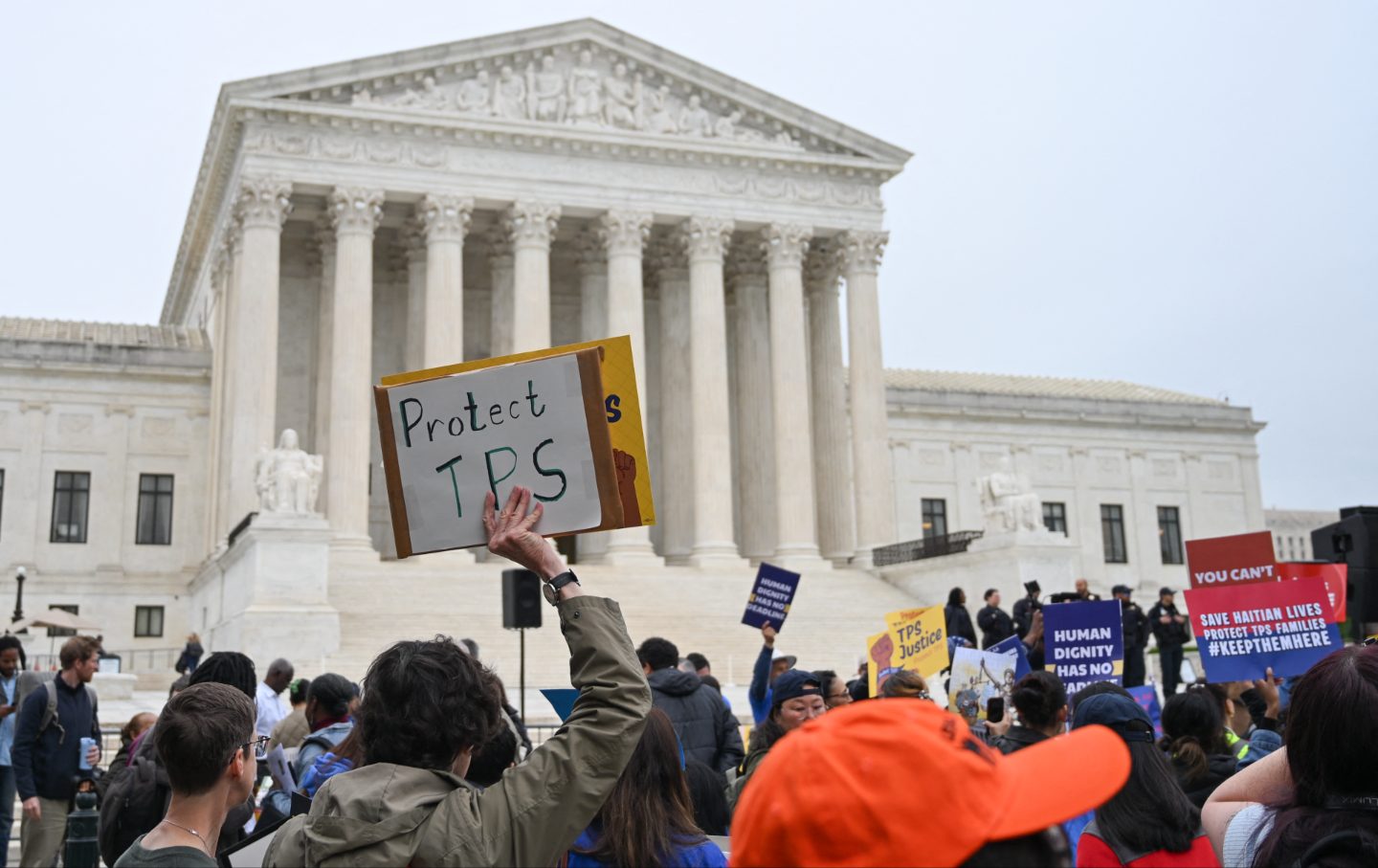
Members of the National TPS Alliance rally at the US Supreme Court in Washington, DC, on April 29, 2026. (Alex Wroblewski / AFP via Getty Images)
In so ruling, Alito and the other Republicans on the Supreme Court have given constitutional protection to the openly racist and white supremacist policies of the Trump administration. When it comes down to it, the thousands of words Alito wrote could have been tossed out in favor of just 10: “Haitians have no rights white men are bound to respect.”
Every Republican you know, whether they’re wearing a wife-beater or Elon Musk underoos, will respond to these objections with some version of “but temporary protected status is supposed to be temporary.” Which, duh, congratulations for successfully googling the definition of “temporary”; your Republican mother must be very proud. The disagreement comes because there is supposed to be a process for ending TPS, and that is a process the Trump administration refused to follow.
The Haitian TPS program was first implemented in 2010 following a massive earthquake in their country. Before revoking TPS status, the US government is supposed to assess whether the country is “safe” for people to return to.
Have you checked in on Haiti recently? The country functionally has no government. It is run by several rival gangs. Things are so unsafe that the Haitian national soccer team, which amazingly made the World Cup this year, literally cannot play soccer matches in Haiti. Somehow, the Trump administration has decided that none of this matters—that a country where you can’t even watch a sports game is nevertheless safe enough to deport people to. And now, Alito says that the Supreme Court isn’t even allowed to review that stance. But he is wrong, because the court can review the Trump administration’s process for making that wild determination. Or, more accurately, its lack of a process, given that there is no evidence that the administration conducted any investigation at all into the conditions in Haiti. (It’s not even clear that these people read a newspaper.) Instead, Trump just remembered that Haitians are Black and decided to send them back.
And that leads to the second problem with this ruling. No matter what you think about TPS, it is flatly unconstitutional for the US government to make its decisions based on racial animus. Or at least it was unconstitutional until Trump took office. There is a mountain of evidence that racism was behind Trump’s TPS decisions. But according to Alito, Trump’s obvious bigotry is not something you can prove. Instead, he writes:
None of the cited statements by either the President or the Secretary was overtly racial, and in substance all expressed policy views that could rest on race-neutral justifications.… And a person without racial bias can provide a harshly unfavorable description of living conditions in some of the countries with TPS designations. The criteria for TPS designations guarantee that many, if not most, designated countries have such characteristics.
Alito is essentially saying you can say racist things about a people and their country, without being racist. I’m reminded of a Chris Rock joke about Seinfeld actor Michael Richards. Richards infamously shouted the N-word in a crowded theater multiple times, but there were still people defending him as “not racist… in his heart.” Rock opined, “What does he have to do to be racist, shoot Medgar Evers?”
The idea that one can say racist things but not be a racist person is one for (white) philosophers to debate. The idea that the Trump administration was motivated by unconstitutional racial animus is something Haitian immigrants should be allowed to argue in court. Alito’s formulation gives the Trump administration carte blanche to be racist, however defined, without ever being held to the standard of equal protection as laid out in the Constitution.
And there’s another problem with Alito’s formulation. The astute reader will note that Alito is speaking in hypotheticals. The TPS decision “could” rest on race-neutral grounds. A person “can provide…unfavorable descriptions” without being held to account for their racism. Alito is talking around what Trump has said about Haitian immigrants, without engaging with what Trump has actually said.
In dissent, Justice Elena Kagan puts it into the record. She writes:
The evidence [Haitian plaintiffs] have offered includes statements by the President so repellent and racially inflected that the majority declines to put them in print.… So here are some of those statements. Haitians are “eating the dogs.… They’re eating the cats. They’re eating—they’re eating the pets of the people that live [in Springfield, Ohio].”…And: Haitians are also eating “other things too that they’re not supposed to be.”…And: Haitians in the United States “probably have AIDS.”…And: Haiti is a “shithole country,” which is “filthy, dirty, [and] disgusting.”…And: Haitian immigration is “like a death wish for our country.”…And: Haitians, along with some others, are “poisoning the blood” of our country.… And: “Why is it we only take people from shithole countries” like “Haiti [and] Somalia”? “Why cannot we have some people from Norway [and] Sweden?”
The majority briefly replies that those remarks are not “overtly racial,”… but it is hard to know what that means. Haitians are Black. (Norwegians and Swedes not so much.) The references—of filth, disease, and primitiveness—are shot through with racial stereotypes and tropes. It is hard to imagine the statements being made today of any White community.… The statements fairly shout, in their racial undertones and overtones alike, that race entered into the President’s resolve to remove Haitians from this country."
I’m just saying, if you don’t want to reprint the comments from the guy you’re claiming is so not-racist, that guy might be a racist.
Alito finishes up by saying that the Trump administration is not racist toward Haitians, or Syrians (another group affected by this ruling), because the Trump administration rejects TPS for all groups of people. Alito claims this shows that Trump just doesn’t agree with TPS.
First of all, rejecting all non-white immigrants here on TPS doesn’t prove you are race-neutral; it just illustrates that TPS is usually extended to people from non-white countries. This isn’t a card game of hearts. “Shooting the moon” on racism doesn’t help you get away with it.
But there’s also the very obvious point that the government is not opposed to all claims from immigrants who say their country is unsafe. Trump, famously, is solicitous to one immigrant group above all others: white South Africans.
Make of that what you will.
I’ve written about this before, but this decision fits in line with how this Supreme Court usually handles the Trump administration: It pretends Donald Trump does not exist. Trump can say any filthy, disgusting, bigoted thing he likes, and his cronies on the court will pretend he didn’t say it—and if he did say it, they’ll just pretend it doesn’t matter. This has been happening since at least Trump v. Hawaii—the Muslim ban case in Trump’s first term—where the court pretended that what the president actually said about his policies didn’t matter when it came to reviewing those policies. It is all part of the Republicans’ judicial commitment to keep their collective heads planted in a mound of white sand.
The decision to ignore Trump’s racism means that the Republicans on the Supreme Court are racist. I don’t claim to know what’s in their hearts, but more to the point, I don’t care. I can see their racist actions. And their actions affirm, time and again, Trump’s own overt racial biases. It has been clear for a long time that that affirmation must be interpreted as an endorsement.
ABOUT THE AUTHOR:
Elie Mystal
Elie Mystal is The Nation’s justice correspondent and a columnist. He is also an Alfred Knobler Fellow at the Type Media Center. He is the author of two books: the New York Times bestseller Allow Me to Retort: A Black Guy’s Guide to the Constitution and Bad Law: Ten Popular Laws That Are Ruining America, both published by The New Press. You can subscribe to his Nation newsletter “Elie v. U.S.” here
https://www.thenation.com/article/politics/russell-vought-omb-grant-rule/
Politics
Russell Vought’s Latest Plan to Gut the Government Should Terrify You
A proposed new rule changing the way the federal government hands out money could be absolutely devastating for every single person in this country.
by Gregg Gonsalves
June 25, 2026
The Nation

This is how things are supposed to work: We pay our taxes. The IRS collects them, and they are deposited into the US General Fund. These dollars from the General Fund are then disbursed to agencies according to what is authorized and appropriated to them under law by Congress. Agencies then dole this money out to state and local governments, or to community organizations and other partners, through grants or contracts. Some agency allocations decisions are formula-based (e.g., based on population or other criteria), while others depend on expert advice to make these adjudications.
But if Office of Management and Budget Director Russell Vought gets his way, this long-standing process will be put in the dustbin. Under proposed revisions to the Uniform Guidance that governs the expenditure of federal funds, decisions on all grants will now be in the hands of political commissars rather than subject-matter experts. The new proposed rule is over 400 pages long, and there are many other terrible provisions within it.
The new rule affects everything from healthcare, transportation, education, and food assistance to, of course, scientific research. This means grants to rural hospitals, for mass transit and road and bridge repair, for special education programs and Head Start, the Supplemental Nutrition Assistance Program and cancer research would now be subject to the whims of Russell Vought and his cronies.
In my world of scientific research, the proposed rules have set off alarm bells everywhere, even among institutions that have been cautious and reticent about taking on the Trump administration so directly until now, like Research!America, the American Association for the Advancement of Science, the New England Journal of Medicine, and universities like mine. They all recognize that should this rule be promulgated, it would be the end of science as we know it in America. Thus, everyone is mobilizing to get comments in on the proposed rule before the July 13 deadline ( you should write a comment too—this rule will affect you, your family, and your community), talking to their members of Congress, and prepping for legal challenges, as Vought will not be deterred from his quest by public opinion or what our duly elected federal representatives have to say.
But what is Vought’s quest anyway? I am so, so tired of the attempts to fit dear Russ into paradigms of normal political policymaking. Let’s put it this way: If you thought Elon Musk and DOGE were bad (and they were and are responsible for the deaths of many just by dismantling USAID alone), Vought is 100 times worse. This rule is codifying the work of DOGE and taking it to a whole other level.
And why does he do what he does? The man is a devout Christian and a deacon of his church, but like the administration’s other my-religion-is-what-I-say-it-is dude, JD Vance, his Christianity is nothing you’d recognize from the Sermon on the Mount. It is a gospel of cruelty. Vought once said he wanted to put civil servants in trauma—it is clear that, if this proposed rule is enacted, it is going to traumatize millions of Americans by gutting many federal programs that serve people from coast to coast.
Current Issue

The corruption and vengeance inherent in the new rule—political friends will be rewarded with bid-free contracts and foes will be cut off from support—will create chaos in the end. Think of the Reflecting Pool at the Lincoln Memorial as a symbol of more to come—incompetence rising like green scum to the top—except across all aspects of American life. Do you really want your bridge repaired by these people? Or to put the fate of rural hospitals in their hands?
And the pain and suffering Vought will inflict on Americans—willingly, with determination, and possibly glee in that cold, cold heart—is destined to create more civil unrest out of people’s sheer desperation as programs they’ve relied on wither should this rule go into effect this fall. This is where the other key opportunist in the Trump administration, Stephen Miller, and his vision of a brave new world “that is governed by strength, that governed by force, that is governed by power,” comes into play. We’ve already seen the pregame with ICE on our streets. The man is looking for reasons to escalate his war on the American people.
I don’t think I am overreacting. While this new OMB rule is only one part of Vought’s plan, the import of it, the potential effects from its enactment are easy to see—it’s why it has garnered concern from most quarters of civil society. It is a massive power play to bring all of us to heel on the road to authoritarianism. It is a punishment doled out by our own Tomás de Torquemada, obsessed with a vision of a God only the Devil knows.
ABOUT THE AUTHOR:
Gregg Gonsalves
Nation public health correspondent Gregg Gonsalves is the codirector of the Global Health Justice Partnership and an associate professor of epidemiology at the Yale School of Public Health.