Friday, June 3, 2011

Black Public Intellectuals Cornel West and Melissa Harris-Perry Debate the Policies of the Obama Administration on the 'Ed Schultz Program' on MSNBC


http://www.thenation.com/authors/melissa-harris-perry

All,

Ever heard of being able to chew gum and talk/walk/gawk at the same damn time?...Yeah, yeah I thought you had...Me too!...Which is all the more reason why these endless tirades about the personal and political behavior of (black and white) public intellectuals by other (black and white) intellectuals are so often utterly bizarre and hopelessly and hilariously DUMB--especially when the real major subtext of and reason for these rhetorical jibes and jabs have far more to do with what the Obama Administration is or is not doing and whether one generally supports or is actively critical of the actual performance of the President of the United States vis-a-vis U.S. corporate elites, The Republican and Tea parties, Wall Street, the massive imperialist war machine (ever heard of Iraq, Afghanistan, Libya, Pakistan folks?), not to mention chronic structural unemployment, the dire need for major education, Health care, and financial reform, and transparency in government (just for starters)...

In the following scathing, witty, and highly lucid piece Melissa Harris-Perry eloquently and judiciously takes her Princeton colleague Cornel West to task for stupidly conflating silly personal motives with serious political ones in his most recent critique of the President in his interview with Chris Hedges and does a fine, wicked job of exposing the fundamental hypocrisy of West's friend Tavis Smiley's own fawning public relationship with the corporate elites of Wal-Mart, Wells Fargo, and McDonald's, among others in their ongoing contradictory claims to "speak truth to power" in the current national economic crisis. Perry goes on to also point out that tenured university professors with large salaries and considerable access to material resources and institutional support that the "average citizen" could not possibly equal puts them both in a privileged position that must be honestly confronted, acknowledged, and accounted for in their own publicly critical assessments of the meaning of events and issues facing the national body politic--especially as it relates to the actual policy positions and programs of the President. Perry's clear-eyed ability to cut through the fog of personal ego and self serving grandstanding is thus important and timely and generally can't or shouldn't be dismissed...

Yet at the same time it must also be said that despite whatever obvious flaws, shortcomings, weaknesses, and contradictions of public intellectuals from academia it's very important that one not lose sight of whatever substantive critical analyses by West and Perry can be and have been made of President Obama and the national government as well as the wealthy elite economic and political institutions and interests that they far too often service and privilege above the masses of people. So that even though West has had a bitter and contentious 'personal' relationship with the former major Obama economic advisor Lawrence Summers in the past when Summers was still the President of Harvard and Cornel still taught there, it is still important to recognize that his intrepid critique of Summers goes far beyond their own personal acrimony and speaks directly to West detailing and exposing the reactionary economic policy 'advice' Summers gave to the President that he and the Democratic Party later implemented. Given these larger realities one must not lose sight of the far bigger and vastly more important responsibility of truly speaking truth to power and publicly advocating and fighting for radical grassroots change via the instruments of mass organizations and actual political involvement and participation. In other words there is ample room and a great necessity for real useful knowledge that even privileged academics and intellectuals can and must provide if their commitment is to a much broader vision that goes far beyond that of mere ego reinforcement and taking idle 'personal' potshots at professional colleagues and associates who also seek a forum that exceeds that of the corrupt and cynical soundbite obsessed media and the lucrative financial and head expanding lures, temptations, and traps of the national lecture circuit...

Kofi


Cornel West v. Barack Obama
by Melissa Harris-Perry
May 17, 2011
The Nation

Professor Cornel West is President Obama’s silenced, disregarded, disrespected moral conscience, according to Chris Hedges’s recent Truthdig column, “The Obama Deception: Why Cornel West went Ballistic.” In a self-aggrandizing, victimology sermon deceptively wrapped in the discourse of prophetic, Professor West offers thin criticism of President Obama and stunning insight into the delicate ego of the self-appointed black leadership class that has been largely supplanted in recent years.

West begins with a bit of historical revision. West suggests that the president discarded him without provocation after he offered the Obama for America campaign his loyal service and prayers. But anyone with a casual knowledge of this rift knows it began during the Democratic primary, not after the election. It began, not with a puffed-up president but when Cornel West’s “dear brother” Tavis Smiley threw a public tantrum because Senator Obama refused to attend Smiley’s annual State of Black America. Smiley repeatedly suggested that his forum was the necessary black vetting space for the Democratic nominees. He needed to ask Obama and Clinton tough questions so that black America could get the answers it needed. But black America was doing a fine job making up its own mind in the primaries and didn’t need Smiley’s blessing to determine their own electoral preferences. Indeed, when Smiley got a chance to hold candidate Clinton “accountable” he spent more time fawning over her than probing about her symbolic or substantive policy stances that impacted black communities. Fiercely loyal to his friend, Professor West chose sides and began to undermine candidate Obama in small and large ways. Candidate Obama ceased calling West back because he was in the middle of a fierce campaign and West’s loyalties were, at best, divided. I suspect candidate Obama did not trust his “dear brother” to keep the campaign secrets and strategies. I also suspect he was not inaccurate in his hesitancy.

West may have had principled, even prophetic reasons, for choosing this outsider position relative to Obama, but it is dishonest to later frame that choice as a betrayal on the part of the president. After what I had written about Senator Clinton during the campaign I wasn’t expecting an offer from the State Department.

Furthermore, West’s sense of betrayal is clearly more personal than ideological. In Hedges’s article West claims that a true progressive would always put love of the people above concern with the elite and privileged. Then he complains, “I couldn’t get a ticket [to the inauguration] with my mother and my brother. I said this is very strange. We drive into the hotel and the guy who picks up my bags from the hotel has a ticket to the inauguration…. We had to watch the thing in the hotel.” Let me get this straight—the tenured, Princeton professor who collects five figures for public lectures was relegated to a hotel television while an anonymous hotel worker got tickets to the inauguration! What kind of crazy, mixed-up class politics are these? Wait a minute…

What exactly is so irritating to West about inaugural ticket-gate? It can’t be a claim that the black, progressive intellectual community was unrepresented. Yale’s Elizabeth Alexander was the poet that cold morning. It can’t be that the “common man” was shut out because the Neighborhood Ball was reserved for the ordinary women and and men who worked to make Obama ’08 possible. It must be a simple matter of jealous indignation. While I appreciate the humanness in such a reaction, it hardly counts as a prophetic critique.

Since the inaugural snub, Professor West has made his personal animosity and political criticism of the president his main public talking point. There was that hilariously bad documentary with Tavis Smiley and the rest of the Soul Patrol in 2009. There is the tiresome repetitiveness with which West invokes the name of his erstwhile Harvard nemesis Lawrence Summers as indicative of President Obama’s failed economic vision. And just a few weeks ago there was the eminently watchable screaming match on MSNBC where love-the-people West called Rev. Al Sharpton a “mascot” for the Obama administration. Add to this three-year screed the current Hedges article and it looks more like a pissing match than prophecy.

Take for example West’s ad hominem attack on the president’s racial identity.

“I think my dear brother Barack Obama has a certain fear of free black men.… It’s understandable. As a young brother who grows up in a white context, brilliant African father, he’s always had to fear being a white man with black skin. All he has known culturally is white. He is just as human as I am, but that is his cultural formation.”

This comment is utter hilarity coming from Cornel West who has spent the bulk of his adulthood living in those deeply rooted, culturally rich, historically important black communities of Cambridge, Massachusetts, and Princeton, New Jersey. And it is hard to see his claim that Obama is “most comfortable with upper middle-class white and Jewish men who consider themselves very smart, very savvy and very effective in getting what they” as anything other than a classic projection of his own comfortably ensconced life at Harvard and Princeton Universities. Harvard and Princeton are not places that are particularly noted for their liberating history for black men.

Let me be clear, being an Ivy League professor does not mean that one has no room to offer critical engagement on issues of race. Like Professor West, I too make my living at elite, predominantly white institutions. For the past five years we were on the same payroll at Princeton. Like Professor West I supplement my income by giving lectures about race, politics and history. Like West, I hope to influence policy, inspire individuals and intervene in public conversations about race. My criticism of West is his seeming unwillingness to acknowledge how our structural positions within the academy and in public intellectual life can be just as compromising to our position vis-à-vis black communities as is President Obama’s.

As tenured professors Cornel West and I are not meaningfully accountable, no matter what our love, commitment or self-delusions tell us. President Obama, as an elected official, can, in fact, be voted out of his job. We can’t. That is a difference that matters. As West derides the president’s economic policies he remains silent on his friend Tavis Smiley’s relationship with Wal-Mart, Wells Fargo and McDonald’s—all corporations whose invasive and predatory actions in poor and black communities have been the target of progressive organizing for decades. I have never heard him take Tavis Smiley to task for helping convince black Americans to enter into predatory mortgages. I’ve never heard him ask whether Tavis’s decision to publish R. Kelley’s memoirs might be a less than progressive decision. He doesn’t hold Tavis accountable because Tavis is his friend and he is loyal. I respect that, but I also know that if he were in elected office the could not get off so easily. Opposition research would point out the hypocrisy in his public positions in a way that would make him vulnerable come election time. As a media personality and professor he is safely ensconced in a system that can never vote him off the island. I think an honest critique of Obama has to begin by acknowledging his own privileges.

Instead, West seems determined to keep black politics tethered to a patronage model of politics. He tells Hedges:

“Our last hope is to generate a democratic awakening among our fellow citizens. This means raising our voices, very loud and strong, bearing witness, individually and collectively. Tavis [Smiley] and I have talked about ways of civil disobedience, beginning with ways for both of us to get arrested…”

God help us if Cornel West and Tavis Smiley getting arrested is our last chance at a democratic awakening.

I have many criticisms of the Obama administration. I wrote angrily about his choice of Rick Warren to deliver a prayer at the inauguration. I have spoken on television about my disagreement with drone attacks in Pakistan and been critical of the administration’s initial choice to prosecute DADT cases. I worked for more progressive health care reform legislation and supported organizations that resisted the reproductive rights “compromises” in the bill. I’ve been scathing in public remarks and writings about the President’s education policy. My husband leads a nonprofit that is suing HUD for its implementation of a discriminatory formula in the post-Katrina Road Home program. The president has never called me. I got my ticket to the inauguration from Canada! (Because Canadian Broadcast Television who gave me a chance to narrate the day’s events.) But I can tell the difference between a substantive criticism and a personal attack. It is clear to me that West’s ego, not the health of American democracy, is the wounded creature in this story.


About the Author:

Melissa Harris-Perry
COLUMNIST
The Nation

Melissa Harris-Perry, an associate professor of politics and African-American studies at Princeton University, is completing her latest book, Sister Citizen: A Text for Colored Girls Who've Considered Politics When Being Strong Isn't Enough. She is a contributor to MSNBC.

Cornel West Interviewed by Chris Hedges on the American Empire, President Obama, and the Crisis in U.S. Politics

AP / Pablo Martinez Monsivais

President Obama shakes hands with Princeton University professor Cornel West after speaking at the National Urban League’s 100th Anniversary Convention in Washington in July 2010.

http://www.truthdig.com/report/item/the_obama_deception_why_cornel_west_went_ballistic_20110516/

All,

Putting aside for the moment the infantile, petty, self aggrandizing, egocentric, and finally irrelevant 'personal' conflict between Cornel and the President (like that's on them, yo!) and the clearly subjective ad hominem bullshit statements about their respective "racial identities", West makes some very important, necessary, and telling political and ideological criticisms and analysis of Obama and his administration that any and all people who care at all where this country is going and the government's undeniable impact on our everyday lives and social reality (whether we know it or fully acknowledge it or not) must pay very close attention to and ACT accordingly. The ball's clearly in our court at this point in history and EVERYTHING is at stake--for real. And like always: Talk is cheap. What are we gonna DO is the only real question facing us now...

Kofi


The Obama Deception: Why Cornel West Went Ballistic
By Chris Hedges
May 16, 2011
TruthDig

The moral philosopher Cornel West, if Barack Obama’s ascent to power was a morality play, would be the voice of conscience. Rahm Emanuel, a cynical product of the Chicago political machine, would be Satan. Emanuel in the first scene of the play would dangle power, privilege, fame and money before Obama. West would warn Obama that the quality of a life is defined by its moral commitment, that his legacy will be determined by his willingness to defy the cruel assault by the corporate state and the financial elite against the poor and working men and women, and that justice must never be sacrificed on the altar of power.

Perhaps there was never much of a struggle in Obama’s heart. Perhaps West only provided a moral veneer. Perhaps the dark heart of Emanuel was always the dark heart of Obama. Only Obama knows. But we know how the play ends. West is banished like honest Kent in “King Lear.” Emanuel and immoral mediocrities from Lawrence Summers to Timothy Geithner to Robert Gates—think of Goneril and Regan in the Shakespearean tragedy—take power. We lose. And Obama becomes an obedient servant of the corporate elite in exchange for the hollow trappings of authority.

No one grasps this tragic descent better than West, who did 65 campaign events for Obama, believed in the potential for change and was encouraged by the populist rhetoric of the Obama campaign. He now nurses, like many others who placed their faith in Obama, the anguish of the deceived, manipulated and betrayed. He bitterly describes Obama as “a black mascot of Wall Street oligarchs and a black puppet of corporate plutocrats. And now he has become head of the American killing machine and is proud of it.”

“When you look at a society you look at it through the lens of the least of these, the weak and the vulnerable; you are committed to loving them first, not exclusively, but first, and therefore giving them priority,” says West, the Class of 1943 University Professor of African American Studies and Religion at Princeton University. “And even at this moment, when the empire is in deep decline, the culture is in deep decay, the political system is broken, where nearly everyone is up for sale, you say all I have is the subversive memory of those who came before, personal integrity, trying to live a decent life, and a willingness to live and die for the love of folk who are catching hell. This means civil disobedience, going to jail, supporting progressive forums of social unrest if they in fact awaken the conscience, whatever conscience is left, of the nation. And that’s where I find myself now.

“I have to take some responsibility,” he admits of his support for Obama as we sit in his book-lined office. “I could have been reading into it more than was there.

“I was thinking maybe he has at least some progressive populist instincts that could become more manifest after the cautious policies of being a senator and working with [Sen. Joe] Lieberman as his mentor,” he says. “But it became very clear when I looked at the neoliberal economic team. The first announcement of Summers and Geithner I went ballistic. I said, ‘Oh, my God, I have really been misled at a very deep level.’ And the same is true for Dennis Ross and the other neo-imperial elites. I said, ‘I have been thoroughly misled, all this populist language is just a facade. I was under the impression that he might bring in the voices of brother Joseph Stiglitz and brother Paul Krugman. I figured, OK, given the structure of constraints of the capitalist democratic procedure that’s probably the best he could do. But at least he would have some voices concerned about working people, dealing with issues of jobs and downsizing and banks, some semblance of democratic accountability for Wall Street oligarchs and corporate plutocrats who are just running amuck. I was completely wrong.”

West says the betrayal occurred on two levels.

“There is the personal level,” he says. “I used to call my dear brother [Obama] every two weeks. I said a prayer on the phone for him, especially before a debate. And I never got a call back. And when I ran into him in the state Capitol in South Carolina when I was down there campaigning for him he was very kind. The first thing he told me was, ‘Brother West, I feel so bad. I haven’t called you back. You been calling me so much. You been giving me so much love, so much support and what have you.’ And I said, ‘I know you’re busy.’ But then a month and half later I would run into other people on the campaign and he’s calling them all the time. I said, wow, this is kind of strange. He doesn’t have time, even two seconds, to say thank you or I’m glad you’re pulling for me and praying for me, but he’s calling these other people. I said, this is very interesting. And then as it turns out with the inauguration I couldn’t get a ticket with my mother and my brother. I said this is very strange. We drive into the hotel and the guy who picks up my bags from the hotel has a ticket to the inauguration. My mom says, ‘That’s something that this dear brother can get a ticket and you can’t get one, honey, all the work you did for him from Iowa.’ Beginning in Iowa to Ohio. We had to watch the thing in the hotel.

“What it said to me on a personal level,” he goes on, “was that brother Barack Obama had no sense of gratitude, no sense of loyalty, no sense of even courtesy, [no] sense of decency, just to say thank you. Is this the kind of manipulative, Machiavellian orientation we ought to get used to? That was on a personal level.”

But there was also the betrayal on the political and ideological level.

“It became very clear to me as the announcements were being made,” he says, “that this was going to be a newcomer, in many ways like Bill Clinton, who wanted to reassure the Establishment by bringing in persons they felt comfortable with and that we were really going to get someone who was using intermittent progressive populist language in order to justify a centrist, neoliberalist policy that we see in the opportunism of Bill Clinton. It was very much going to be a kind of black face of the DLC [Democratic Leadership Council].”

Obama and West’s last personal contact took place a year ago at a gathering of the Urban League when, he says, Obama “cussed me out.” Obama, after his address, which promoted his administration’s championing of charter schools, approached West, who was seated in the front row.

“He makes a bee line to me right after the talk, in front of everybody,” West says. “He just lets me have it. He says, ‘You ought to be ashamed of yourself, saying I’m not a progressive. Is that the best you can do? Who do you think you are?’ I smiled. I shook his hand. And a sister hollered in the back, ‘You can’t talk to professor West. That’s Dr. Cornel West. Who do you think you are?’ You can go to jail talking to the president like that. You got to watch yourself. I wanted to slap him on the side of his head.

“It was so disrespectful,” he went on, “that’s what I didn’t like. I’d already been called, along with all [other] leftists, a “F’ing retard” by Rahm Emanuel because we had critiques of the president.”

Valerie Jarrett, a senior adviser to the president, has, West said, phoned him to complain about his critiques of Obama. Jarrett was especially perturbed, West says, when he said in an interview last year that he saw a lot of Malcolm X and Ella Baker in Michelle Obama. Jarrett told him his comments were not complimentary to the first lady.

“I said in the world that I live in, in that which authorizes my reality, Ella Baker is a towering figure,” he says, munching Fritos and sipping apple juice at his desk. “If I say there is a lot of Ella Baker in Michelle Obama, that’s a compliment. She can take it any way she wants. I can tell her I’m sorry it offended you, but I’m going to speak the truth. She is a Harvard Law graduate, a Princeton graduate, and she deals with child obesity and military families. Why doesn’t she visit a prison? Why not spend some time in the hood? That is where she is, but she can’t do it.

“I think my dear brother Barack Obama has a certain fear of free black men,” West says. “It’s understandable. As a young brother who grows up in a white context, brilliant African father, he’s always had to fear being a white man with black skin. All he has known culturally is white. He is just as human as I am, but that is his cultural formation. When he meets an independent black brother, it is frightening. And that’s true for a white brother. When you get a white brother who meets a free, independent black man, they got to be mature to really embrace fully what the brother is saying to them. It’s a tension, given the history. It can be overcome. Obama, coming out of Kansas influence, white, loving grandparents, coming out of Hawaii and Indonesia, when he meets these independent black folk who have a history of slavery, Jim Crow, Jane Crow and so on, he is very apprehensive. He has a certain rootlessness, a deracination. It is understandable.

“He feels most comfortable with upper middle-class white and Jewish men who consider themselves very smart, very savvy and very effective in getting what they want,” he says. “He’s got two homes. He has got his family and whatever challenges go on there, and this other home. Larry Summers blows his mind because he’s so smart. He’s got Establishment connections. He’s embracing me. It is this smartness, this truncated brilliance, that titillates and stimulates brother Barack and makes him feel at home. That is very sad for me.

“This was maybe America’s last chance to fight back against the greed of the Wall Street oligarchs and corporate plutocrats, to generate some serious discussion about public interest and common good that sustains any democratic experiment,” West laments. “We are squeezing out all of the democratic juices we have. The escalation of the class war against the poor and the working class is intense. More and more working people are beaten down. They are world-weary. They are into self-medication. They are turning on each other. They are scapegoating the most vulnerable rather than confronting the most powerful. It is a profoundly human response to panic and catastrophe. I thought Barack Obama could have provided some way out. But he lacks backbone.

“Can you imagine if Barack Obama had taken office and deliberately educated and taught the American people about the nature of the financial catastrophe and what greed was really taking place?” West asks. “If he had told us what kind of mechanisms of accountability needed to be in place, if he had focused on homeowners rather than investment banks for bailouts and engaged in massive job creation he could have nipped in the bud the right-wing populism of the tea party folk. The tea party folk are right when they say the government is corrupt. It is corrupt. Big business and banks have taken over government and corrupted it in deep ways.

“We have got to attempt to tell the truth, and that truth is painful,” he says. “It is a truth that is against the thick lies of the mainstream. In telling that truth we become so maladjusted to the prevailing injustice that the Democratic Party, more and more, is not just milquetoast and spineless, as it was before, but thoroughly complicitous with some of the worst things in the American empire. I don’t think in good conscience I could tell anybody to vote for Obama. If it turns out in the end that we have a crypto-fascist movement and the only thing standing between us and fascism is Barack Obama, then we have to put our foot on the brake. But we’ve got to think seriously of third-party candidates, third formations, third parties.

“Our last hope is to generate a democratic awakening among our fellow citizens. This means raising our voices, very loud and strong, bearing witness, individually and collectively. Tavis [Smiley] and I have talked about ways of civil disobedience, beginning with ways for both of us to get arrested, to galvanize attention to the plight of those in prisons, in the hoods, in poor white communities. We must never give up. We must never allow hope to be eliminated or suffocated.”


A Progressive Journal of News and Opinion. Editor, Robert Scheer. Publisher, Zuade Kaufman.

Copyright © 2011 Truthdig, L.L.C. All rights reserved.
Web site development by Hop Studios

Tuesday, May 31, 2011

Gary Younge and Eddie Glaude, Jr. On The Necessity of Dealing with the Stark Reality of Racism and Class Issues in the Age of Obama


Gary Younge


Dr. Eddie Glaude, Jr.


Cornel West; President Obama (Getty Images)


http://www.thenation.com/article/160782/obama-and-black-americans-paradox-hope


"Obama should do more for black people—not because he is black but because black people are the citizens suffering most. Black people have every right to make demands on Obama—not because he’s black but because they gave him a greater percentage of their votes than any other group, and he owes his presidency to them. Like any president, he should be constantly pressured to put the issue of racial injustice front and center....The day he took office, the world may have looked at black America differently, but black America has taken some time to look at Obama differently. When he went from being an aspiration to a fact of political life, the posters that bore his likeness in socialist realist style over single-word commands like Hope, Believe and Change should have been replaced with posters bearing the single-word statement: Power. As Frederick Douglass said: “Power concedes nothing without a demand. It never did and it never will.”
--Gary Younge

All,

Gary is of course 100% right...And anyone who thinks he isn't at this late date is a FOOL...We must all grow up and deal with political REALITY and not mere "hopes and dreams." An excellent piece...

Kofi


Obama and Black Americans: the Paradox of Hope
by Gary Younge
May 18, 2011


This article appeared in the June 6, 2011 edition of The Nation.

When Barack Obama was pondering a run for the presidency Michelle asked him what he thought he could accomplish. He replied,“The day I take the oath of office, the world will look at us differently. And millions of kids across this country will look at themselves differently. That alone is something.” His victory was indeed something. The world certainly looked at America differently, though this had as much to do with who he wasn’t—George W. Bush—as what he was, black, among other things.

Polls show that African-Americans indeed look at themselves differently. A January 2010 Pew survey revealed huge optimism. The percentage of black Americans who thought blacks were better off than they were five years before had almost doubled since 2007. There were also significant increases in the percentages who believed the standard-of-living gap between whites and blacks was decreasing.

But for all the ways black America has felt better about itself and looked better to others, it has not actually fared better. In fact, it has been doing worse. The economic gap between black and white has grown since Obama took power. Under his tenure black unemployment, poverty and foreclosures are at their highest levels for at least a decade.

Millions of black kids may well aspire to the presidency now that a black man is in the White House. But such a trajectory is less likely for them now than it was under Bush. Herein lies what is at best a paradox and at worst a contradiction within Obama’s core base of support. The very group most likely to support him—black Americans—is the same group that is doing worse under him.

This condition was best exemplified by Velma Hart, the black chief financial officer for a Maryland veterans organization, who backed Obama in 2008. She told Obama at a town hall meeting in September, “I’m exhausted of defending you…. My husband and I have joked for years that we thought we were well beyond the hot-dogs-and-beans era of our lives. But, quite frankly, it is starting to knock on our door and ring true that that might be where we are headed again.” In November Velma Hart was laid off.

If it were white Americans who remained this loyal to a Republican president under whom they were doing this badly, the left would be claiming false consciousness. If a Republican president were behind statistics like these, few liberals would be offering that president the benefit of the doubt.

So, how do we explain this apparent inconsistency? There would appear to be three main reasons. The first is white people. Not all of them. But enough. Half of white Americans in a Pew survey shared the birthers’ doubt that Obama was born in this country. After the president produced his long-form birth certificate, Donald Trump demanded his college transcripts (claiming he was not smart enough to get into the Ivy League), and Newt Gingrich branded him the “food stamp president.” In the face of such brazenly racist attacks, defending Obama’s right to the office becomes easily blurred with defending his record.

Second, the post–civil rights era concept of corporate diversity, which many black people have embraced, is central to his symbolism. Racial advancement is increasingly understood not as a process of social change but of individual promotion—the elevation of black faces to high places. Instead of equal opportunities, we have photo opportunities. “We have more black people in more visible and powerful positions,” Angela Davis told me before Obama’s nomination. “But then we have far more black people who have been pushed down to the bottom of the ladder….There’s a model of diversity as the difference that makes no difference, the change that brings about no change.”

Third and perhaps most important, the discrepancy reflects a mixture of realism and low expectations. That black Americans are doing worse than everyone else, and that the man they elected to turn that around has not done so, does not fundamentally change their view of how American politics works; almost every other Democratic president has failed in a similar way. Conversely the fact that a black man might be elected president, that enough white people might vote for him, that nobody has shot him, really has changed their assumptions.

In the black commentariat, opinion is divided over whether African-Americans should demand a more overt commitment to racial justice from a black president or refrain from doing so because it would weaken his appeal to others. The Rev. Al Sharpton insists that calling on Obama to be a “black exponent of black views” is “just stupid,” since it will embolden conservative attacks on projects black people need. Princeton professor Cornel West insists that Obama has “a certain fear of free black men” and “feels most comfortable with upper-middle-class white and Jewish men.”

By concentrating so heavily on race, both sides detract from his responsibilities. Obama should do more for black people—not because he is black but because black people are the citizens suffering most. Black people have every right to make demands on Obama—not because he’s black but because they gave him a greater percentage of their votes than any other group, and he owes his presidency to them. Like any president, he should be constantly pressured to put the issue of racial injustice front and center.

The day he took office, the world may have looked at black America differently, but black America has taken some time to look at Obama differently. When he went from being an aspiration to a fact of political life, the posters that bore his likeness in socialist realist style over single-word commands like Hope, Believe and Change should have been replaced with posters bearing the single-word statement: Power. As Frederick Douglass said: “Power concedes nothing without a demand. It never did and it never will.”


Gary Younge, the Alfred Knobler Journalism Fellow at The Nation Institute, is the New York correspondent for the Guardian and the author of No Place Like Home: A Black Briton's Journey Through the Deep South (Mississippi) and Stranger in a Strange Land: Travels in the Disunited States (New Press). He is also a contributor to The Nation.

http://www.theroot.com/views/black-critics-and-president-obama?page=0,0

"Three points need to be made about this issue. First, the challenge to black criticism of Obama reveals the persistence of a certain form of black identity politics. What is at work here is a startling effort to police black dissent in the name of race loyalty...Postracialism is the latest effort to get rid of blackness; it is part of a neoliberal commitment to color-blindness. And it is often used to insulate Obama from criticisms about racial policy. Here, racial distinctiveness is denied. We are all just human beings. And any appeals to race constitute a holdover from a politics of old.

So we're left with the New Deal rhetoric of "lifting all boats" -- a way of talking that is designed, in part, to evade the scorn of Southern Democrats and leaves intact an idea of whiteness that undermines genuine democratic transformation. Obama, when asked to address black suffering, is called the president of all Americans.

Well, damn, aren't we Americans, too? The challenge in such an environment is how to address issues that actually involve race, and to do so without appeals to crude notions of racial solidarity or ideas that all black people hold the same interests because they're black.

This takes me to the last point: that the combination of race loyalty and postracialism effectively banishes black suffering from public view. We see Hispanic organizations demanding the passage of the DREAM Act; we saw the LGBT (lesbian, gay, bisexual and transgender) community push for the repeal of "Don't ask, don't tell"; we witnessed the president of the AFL-CIO, Richard Trumka, threaten reprisals for those politicians who refused to support labor's agenda.

In none of these instances have we heard as a response to their demands that the president must be seen as the president of all Americans. Nor do we hear that such appeals are remnants of old forms of bad identity politics..."

--Eddie Glaude, Jr.

All,

Eddie, like Gary, is right on target. As citizens we can't simply let the President and his administration off the hook just because we all happen to be black. That's a passive abdication of one's essential human responsibility to a genuine critique and real social transformation, not pathetically clinging to a seriously misguided and distorted idea of "racial loyalty."

Kofi

Black Critics and President Obama

Are African Americans expected to shut up and suffer? That's just not democratic.

By: Eddie S. Glaude Jr.
Posted: May 23, 2011
The Root


Black America finds itself in an unusual moment. By any measure, many of our communities are suffering heavily during this economic downturn. Black unemployment is officially at 16.1 percent (some believe the real number hovers around 28 percent, making nearly one-third of black America jobless). Even those who have been fortunate to keep their jobs have seen their weekly wages decline.

The foreclosure crisis has also disproportionately affected black communities -- we are 70 to 80 percent more likely to have lost our homes. And it is well known now that there is a direct correlation between racist lending practices and the vulnerability of our communities to foreclosure.

Faced with failing schools (while we wait for Superman) and the destabilizing effects of the prison industrial complex (nearly 1 million of us are locked up; families are destroyed as the rate of black female incarceration skyrockets, leaving many of our children languishing as wards of the state), entire communities -- even entire cities -- have been engulfed in what seems to be spiraling cycles of misery and hopelessness.

And yet we find ourselves embroiled in a heated public debate over whom to hold accountable for the failure to address these conditions. Recently, Cornel West offered a strident critique of President Obama's relative silence on this matter. For him, the president has failed to address substantively the conditions of the poor and the most vulnerable in our society. Instead, West maintains, Obama has been too concerned with appeasing the robber barons on Wall Street.

Many took offense, not only with the personal nature of the criticism but also with the fact that West dared to criticize the president at all. Some African Americans hold the view that this only contributes to right-wing attacks against Obama, making him vulnerable in 2012. Others believe that such criticisms betray an unreasonable expectation that Obama owes something to the black community because he is the first black president -- a troublesome black identity politics, they might say.

Worries about Democrats closing ranks for an upcoming election seem, to me, at least, to be a perennial (and uninteresting) concern. I am more interested in the underlying anxiety about black people criticizing Obama. It is as if we are being told to keep our mouths shut.

Three points need to be made about this issue. First, the challenge to black criticism of Obama reveals the persistence of a certain form of black identity politics. What is at work here is a startling effort to police black dissent in the name of race loyalty. This may be rooted in very different sensibilities.

There are those, as Gary Younge notes in the Nation, who hold that presidents, generally, do not affect their conditions of living. And if we are going to have a president, it might as well be a black one, and we should support him no matter the concrete realities of black communities. American politics don't work, and Barack Obama can't change that fact. One could view this as race loyalty from below.

Others maintain that support of Obama reflects a commitment to racial advancement. To criticize him is, in effect, to turn one's back on the black freedom struggle of which Obama is the culmination. One might think of this as racial loyalty from above. It is the latest version of racial uplift rooted in a particular black-elite aspiration to hold on to the levers of power.

In both instances, criticisms of the president by black people are met with impatience or fierce condemnation. Race loyalty joins with a lingering commitment among the broader public to postracialism.

This takes me to the second point. Postracialism is the latest effort to get rid of blackness; it is part of a neoliberal commitment to color-blindness. And it is often used to insulate Obama from criticisms about racial policy. Here, racial distinctiveness is denied. We are all just human beings. And any appeals to race constitute a holdover from a politics of old.

So we're left with the New Deal rhetoric of "lifting all boats" -- a way of talking that is designed, in part, to evade the scorn of Southern Democrats and leaves intact an idea of whiteness that undermines genuine democratic transformation. Obama, when asked to address black suffering, is called the president of all Americans.

Well, damn, aren't we Americans, too? The challenge in such an environment is how to address issues that actually involve race, and to do so without appeals to crude notions of racial solidarity or ideas that all black people hold the same interests because they're black.

This takes me to the last point: that the combination of race loyalty and postracialism effectively banishes black suffering from public view. We see Hispanic organizations demanding the passage of the DREAM Act; we saw the LGBT (lesbian, gay, bisexual and transgender) community push for the repeal of "Don't ask, don't tell"; we witnessed the president of the AFL-CIO, Richard Trumka, threaten reprisals for those politicians who refused to support labor's agenda.

In none of these instances have we heard as a response to their demands that the president must be seen as the president of all Americans. Nor do we hear that such appeals are remnants of old forms of bad identity politics. And of course, they are identity politics.

What is going on here? One could be a bit cynical and say that this is just plain old politics. Folks are using race loyalty as way to keep black folks in line. So the Rev. Al Sharpton, Tom Joyner and others appeal to black solidarity as a way of shoring up the base. And yet Obama and the Congress don't have to deliver "the goods" because any race-specific policies are rejected out of hand as holdovers from a time long gone. But I want to resist going there ... for now.

What I do know is that folks are really scared to talk about racial inequality in this country. That fear stems from the belief that any effort to address the suffering of black communities directly would trigger deep-seated prejudices that still animate American life. America would lurch even farther to the right and all hell would break loose.

In 1903, W.E.B. Du Bois published The Souls of Black Folk. He dared to take on the power and influence of Booker T. Washington. Du Bois was concerned about Washington's style of leadership. He believed that it undermined democratic life within black communities. Too many cowered before him. Too many stood by silently for fear of reprisal.

Du Bois wrote: "[T]he hushing of the criticism of honest opponents is a dangerous thing ... Honest and earnest criticism from those whose interests are most nearly touched -- criticism of writers by readers, of government by those governed, of leaders by those led -- this is the soul of democracy and the safeguard of modern society."

He was right. What is at stake here is not some idea of race loyalty. Black people are suffering, and we need to engage that suffering publicly and directly. And that isn't an issue of whether someone is black enough. This is about genuine democracy, about holding to account anyone, including ourselves, who fails to muster the moral and political courage to respond to this crisis.

Do the fact of blackness and the fact of Obama's presidency commit us to some kind of uncritical loyalty? Are we to stand by silently in the face of this devastation? Absolutely not! In these critical times, to borrow a phrase from the late Palestinian critic Edward Said, "Never solidarity before criticism" must be our cry.

Eddie S. Glaude Jr. is chair of the Center for African American Studies at Princeton University.


Saturday, May 28, 2011

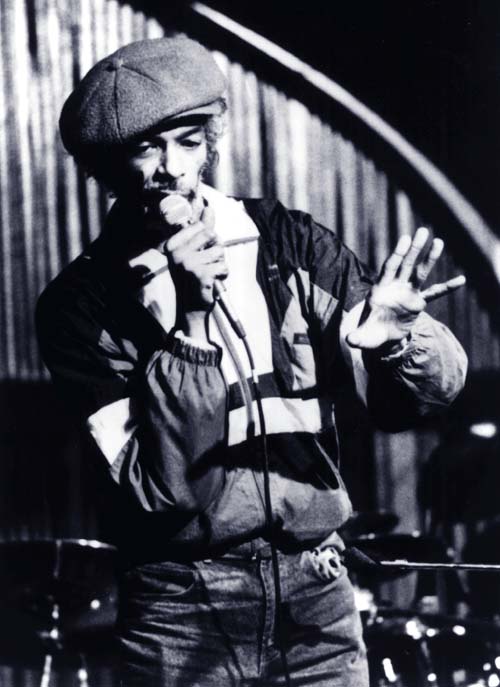
Gil Scott-Heron, 1949-2011: Revolutionary Poet, Novelist, Singer, Songwriter, Musician, Activist


Gil Scott-Heron, 1949-2011

http://www.nytimes.com/2011/05/29/arts/music/gil-scott-heron-voice-of-black-culture-dies-at-62.html

http://www.rollingstone.com/music/news/gil-scott-heron-forefather-of-hip-hop-dead-at-62-20110528

All,

Another African-American GIANT has left this vale of tears we arrogantly call "civilized society" and I sincerely wish there was another word other than the woefully overused, abused, and exploited cliche "genius" to describe just how truly original, dynamic, profound, innovative, and extraordinary Gil Scott-Heron's art was at his best. His enduring work as writer, poet, and musician was and is FAR BEYOND in form and depth of content what 99% of rappers in history could even conceive of let alone actually express (the only notable exceptions to this obvious fact worth mentioning are Chuck D of Public Enemy, Q-Tip from A Tribe Called Quest, Rakim, Mos Def, De La Soul, and KRS-One who themselves would openly admit they were nowhere near as advanced as Gil was!). Hip Hop and the so-called "spoken word" community in this country WISHES that a poet as creative and yes revolutionary as Scott-Heron could have been its actual "forefather." It's certainly the hip hop community's massive loss that Gil's work always went in openly radical directions that were inspired and deeply informed first, last, and always by the legendary cultural/artistic examples and contributions established by Langston Hughes, Bob Kaufman, Aime Cesaire, Leroi Jones/Amiri Baraka, Billie Holiday, Duke Ellington, Miles Davis, Gwendolynn Brooks, Sterling A. Brown, Melvin B. Tolson, Jean Toomer, Aretha Franklin, Curtis Mayfield, Chester Himes, John Coltrane, Malcolm X, Paul Robeson, W.E.B. DuBois, Robert Hayden, Eddie Jefferson, Zora Neale Hurston, King Pleasure, Betty Carter, Marvin Gaye, and Etheridge Knight, among other giants from the fertile African American literary/musical traditions. More than mere homage Gil always vigorously sought and found new ways to carry forward these incredible traditions in a popular art context rooted deeply in both black vernacular and modernist traditions and forms. Listen especially to Gil's dynamic signature work from the 1970-1985 period to find out just how consistently creative, deeply perceptive, politically conscious, and truly visionary his poetic and musical work was. That is and will always remain his inspiring legacy to 20th century art and culture for both his people and the world. RIP Gil--and love always...

Kofi


Gil Scott-Heron, Voice of Black Culture, Dies at 62
By BEN SISARIO
May 28, 2011
New York Times

Gil Scott-Heron, the poet and recording artist whose syncopated spoken style and mordant critiques of politics, racism and mass media in pieces like “The Revolution Will Not Be Televised” made him a notable voice of black protest culture in the 1970s and an important early influence on hip-hop, died on Friday at a hospital in Manhattan. He was 62 and had been a longtime resident of Harlem.

His death was announced in a Twitter message on Friday night by his British publisher, Jamie Byng, and confirmed early Saturday by an American representative of his record label, XL. The cause was not immediately known, although The Associated Press reported that he had become ill after returning from a trip to Europe.

Mr. Scott-Heron often bristled at the suggestion that his work had prefigured rap. “I don’t know if I can take the blame for it,” he said in an interview last year with the music Web site The Daily Swarm. He preferred to call himself a “bluesologist,” drawing on the traditions of blues, jazz and Harlem renaissance poetics.

Yet, along with the work of the Last Poets, a group of black nationalist performance poets who emerged alongside him in the late 1960s and early ’70s, Mr. Scott-Heron established much of the attitude and the stylistic vocabulary that would characterize the socially conscious work of early rap groups like Public Enemy and Boogie Down Productions. And he has remained part of the DNA of hip-hop by being sampled by stars like Kanye West.

“You can go into Ginsberg and the Beat poets and Dylan, but Gil Scott-Heron is the manifestation of the modern word,” Chuck D, the leader of Public Enemy, told The New Yorker in 2010. “He and the Last Poets set the stage for everyone else.”

Mr. Scott-Heron’s career began with a literary rather than a musical bent. He was born in Chicago on April 1, 1949, and reared in Tennessee and New York. His mother was a librarian and an English teacher; his estranged father was a Jamaican soccer player.

In his early teens, Mr. Scott-Heron wrote detective stories, and his work as a writer won him a scholarship to the Fieldston School in the Bronx, where he was one of 5 black students in a class of 100. Following in the footsteps of Langston Hughes, he went to the historically black Lincoln University in Pennsylvania, and he wrote his first novel at 19, a murder mystery called “The Vulture.” A book of verse, “Small Talk at 125th and Lenox,” and a second novel, “The Nigger Factory,” soon followed.

Working with a college friend, Brian Jackson, Mr. Scott-Heron turned to music in search of a wider audience. His first album, “Small Talk at 125th and Lenox,” was released in 1970 on Flying Dutchman, a small label, and included a live recitation of “Revolution” accompanied by conga and bongo drums. Another version of that piece, recorded with a full band including the jazz bassist Ron Carter, was released on Mr. Scott-Heron’s second album, “Pieces of a Man,” in 1971.

“Revolution” established Mr. Scott-Heron as a rising star of the black cultural left, and its cool, biting ridicule of a nation anesthetized by mass media has resonated with the socially disaffected of various stripes — campus activists, media theorists, coffeehouse poets — for four decades. With sharp, sardonic wit and a barrage of pop-culture references, he derided society’s dominating forces as well as the gullibly dominated:

The revolution will not be brought to you by the Schaefer Award Theater and will not star Natalie Wood and Steve McQueen or Bullwinkle and Julia.

The revolution will not give your mouth sex appeal.

The revolution will not get rid of the nubs.

The revolution will not make you look five pounds thinner, because the revolution will not be televised, brother.

During the 1970s, Mr. Scott-Heron was seen as a prodigy with significant potential, although he never achieved more than cult popularity. He recorded 13 albums from 1970 to 1982, and was one of the first acts that the music executive Clive Davis signed after starting Arista Records in 1974. In 1979, Mr. Scott-Heron performed at Musicians United for Safe Energy’s “No Nukes” benefit concerts at Madison Square Garden, and in 1985, he appeared on the all-star anti-apartheid album “Sun City.”

But by the mid-1980s, Mr. Scott-Heron had begun to fade, and his recording output slowed to a trickle. In later years, he struggled publicly with addiction. Since 2001, Mr. Scott-Heron had been convicted twice for cocaine possession, and he served a sentence at Rikers Island in New York for parole violation.

Commentators sometimes used Mr. Scott-Heron’s plight as an example of the harshness of New York’s drug laws. Yet his friends were also horrified by his descent. In interviews Mr. Scott-Heron often dodged questions about drugs, but the writer of the New Yorker profile reported witnessing Mr. Scott-Heron’s crack smoking and being so troubled by his own ravaged physical appearance that he avoided mirrors. “Ten to 15 minutes of this, I don’t have pain,” Mr. Scott-Heron said in the article, as he lighted a glass crack pipe.

That image seemed to contrast tragically with Mr. Scott-Heron’s legacy as someone who had once so trenchantly mocked the psychology of addiction. “You keep sayin’ kick it, quit it, kick it quit it!” he said in his 1971 song “Home Is Where the Hatred Is.” “God, did you ever try to turn your sick soul inside out so that the world could watch you die?”

Information on his survivors was not immediately available.

Despite Mr. Scott-Heron’s public problems, he remained an admired figure in music, and he made occasional concert appearances and was sought after as a collaborator. Last year, XL released “I’m New Here,” his first album of new material in 16 years, which was produced by Richard Russell, a British record producer who met Mr. Scott-Heron at Rikers Island in 2006 after writing him a letter.

Reviews for the album inevitably called Mr. Scott-Heron the “godfather of rap,” but he made it clear he had different tastes.

“It’s something that’s aimed at the kids,” he once said. “I have kids, so I listen to it. But I would not say it’s aimed at me. I listen to the jazz station.”


Gil Scott-Heron, Forefather of Hip Hop, Dead at 62

Scott-Heron was best known for 1970's 'The Revolution Will Not Be Televised'


By Andy Greene

MAY 28, 2011
Rolling Stone


Gil Scott-Heron in Harlem, New York, 2010.
Anthony Barboza/Getty Images

Revolutionary poet and musician Gil Scott-Heron, best known for his 1970 work "The Revolution Will Not Be Televised," died March 27th at a New York City hospital. The exact cause of death is currently unknown, though he had been battling a severe drug addiction and other health problems for years. He was 62.

Many hip-hop artists cite Scott-Heron as one of the forefathers of the genre, but Scott-Heron refused to take any credit. "I just think they made a mistake," he told The New Yorker last year. He also feels that people misinterpreted "The Revolution Will Not Be Televised" – a biting, spoken-work screed against the mass media and consumerist culture. "That was satire," he told The Telegraph in February of 2010. "People would try and argue that it was this militant message, but just how militant can you really be when you're saying, 'The revolution will not make you look five pounds thinner'? My songs were always about the tone of voice rather than the words. A good comic will deliver a line deadpan – they let the audience laugh."

Scott-Heron was born in Chicago, but he moved to New York City as a teenager and received a scholarship to the prestigious Fieldston School in the Bronx after his teachers took note of his writing. Before he was even 20, Scott-Heron published a murder mystery novel called The Vulture. At Lincoln University he met his future musical partner Brian Jackson. In 1970 they released Small Talk at 125th and Lenox, which included a stripped-down version of "The Revolution Will Not Be Televised."

The work failed to reach a mass audience, but was widely praised for its vivid depiction of urban decay and racism in American culture. Clive Davis signed Scott-Heron to Arista in 1974 and began releasing his records at a frantic piece, averaging more than one a year between 1970 and 1982. In 1979 he performed alongside Bruce Springsteen, Jackson Browne and many others at the MUSE benefits at Madison Square Garden, and in 1985 he sang the protest anthem "Sun City" with Bob Dylan, Steve Van Zandt, RUN DMC, Lou Reed and Miles Davis.

In the mid-1980s he was dropped by Arista as drugs started to take over his life. He continued to perform, but only released a single record between 1982 and 2010. Many hip-hop artists sampled Scott-Heron's work in recent years, though he didn't consider that an achievement. "I don't want to tell you how embarrassing that can be," he told the New Yorker last year. "Long as it don't talk about 'yo mama' and stuff, I usually let it go. It's not all bad when you get sampled—hell, you make money. They give you some money to shut you up. I guess to shut you up they should have left you alone."

In that same piece, writer Alec Wilkinson found Scott-Heron living in a cave-like Harlem apartment. He openly smoked crack in front of the writer, and occasionally fell asleep in the middle of an interview. Despite his severe addictions, Scott-Heron still performed and occasionally recorded new music. In 2010 he teamed up with producer Richard Russell for the blues and spoken-work LP I'm New Here. He had just returned from a European tour when he fell ill and checked into New York's St. Luke's-Roosevelt Hospital Center.

Tributes have been pouring onto Twitter ever since news of Scott-Heron's death hit Friday night. "RIP Gil Scott-Heron," Eminem tweeted. "He influenced all of hip-hop." Public Enemy's Chuck D, who has long pointed to Scott-Heron as one his biggest influences, wrote this: "RIP GSH..and we do what we do and how we do because of you. And to those that don't know tip your hat with a hand over your heart & recognize."

http://www.nytimes.com/aponline/2011/05/27/us/AP-US-Obit-Gil-Scott-Heron.html?_r=1&hp


Gil Scott-Heron, Spoken-Word Musician, Dies at 62

By THE ASSOCIATED PRESS
Published: May 27, 2011
Updated: May 28, 2011


NEW YORK (AP) — Long before Public Enemy urged the need to "Fight the Power" or N.W.A. offered a crude rebuke of the police, Gil-Scott Heron was articulating the rage and the disillusionment of the black masses through song and spoken word.

Scott-Heron, widely considered one of the godfathers of rap with his piercing social and political prose laid against the backdrop of minimalist percussion, flute and other instrumentation, died on Friday at age 62. His was a life full of groundbreaking, revolutionary music and personal turmoil that included a battle with crack cocaine and stints behind bars in his later years.

Musician and singer Michael Franti, who also is known for work that has examined racial and social injustices, perhaps summed up the dichotomy of Scott-Heron in a statement Saturday that described him as "a genius and a junkie."

"The first time I met him in San Francisco in 1991 while working as a doorman at the Kennel Klub, my heart was broken to see a hero of mine barely able to make it to the stage, but when he got there he was clear as crystal while singing and dropping knowledge bombs in his between song banter," said Franti, who described himself as a longtime friend. "His view of the world was so sad and yet so inspiring."

Scott-Heron was known for work that reflected the fury of black America in the post-civil rights era and spoke to the social and political disparities in the country. His songs often had incendiary titles — "Home is Where the Hatred Is" or "Whitey on the Moon" — and through spoken word and song he tapped the frustration of the masses.

He came to prominence in the 1970s as black America was grappling with the violent losses of some of its most promising leaders and what seemed to many to be the broken promises of the civil rights movement.

"It's winter in America, and all of the healers have been killed or been betrayed," lamented Scott-Heron in the song "Winter in America."

Scott-Heron recorded the song that would make him famous, "The Revolution Will Not Be Televised," which critiqued mass media, for the album "125th and Lenox" in Harlem in the 1970s. He followed up that recording with more than a dozen albums, collaborating mostly with musician Brian Jackson.

Though he was never a mainstream artist, he was an influential voice — so much so that his music was considered to be a precursor of rap and he influenced generations of hip-hop artists that would follow. When asked, however, he typically downplayed his integral role in the foundation of the genre.

"If there was any individual initiative that I was responsible for it might have been that there was music in certain poems of mine, with complete progression and repeating 'hooks,' which made them more like songs than just recitations with percussion," he wrote in the introduction to his 1990 collection of poems, "Now and Then."

In later years, he would become known more for his battle with drugs such as crack cocaine than his music. His addiction led to stints in jail and a general decline: In a 2008 interview with New York magazine, he said he had been living with HIV for years, but he still continued to perform and put out music; his last album, which came out this year, was a collaboration with artist Jamie xx, "We're Still Here," a reworking of Scott-Heron's acclaimed "I'm New Here," which was released in 2010.

He also was still smoking crack, as detailed in a New Yorker article last year.

"Ten to fifteen minutes of this, I don't have pain," he said. "I could have had an operation a few years ago, but there was an 8 percent chance of paralysis. I tried the painkillers, but after a couple of weeks I felt like a piece of furniture. It makes you feel like you don't want to do anything. This I can quit anytime I'm ready."

He referred to his signature mix of percussion, politics and performed poetry as bluesology or Third World music. But then he said it was simply "black music or black American music."

"Because black Americans are now a tremendously diverse essence of all the places we've come from and the music and rhythms we brought with us," he wrote.

Even those who may have never heard of Scott-Heron's name nevertheless knew his music. His influence on generations of rappers has been demonstrated through sampling of his recordings by artists, from Common to Mos Def to Tupac Shakur. Kanye West closes out the last track of his latest album with a long excerpt of Scott-Heron's "Who Will Survive in America."

Throughout his musical career, he took on political issues of his time, including apartheid in South Africa and nuclear arms. He had been shaped by the politics of the 1960s and black literature, especially the Harlem Renaissance.

Scott-Heron was born in Chicago on April 1, 1949. He was raised in Jackson, Tenn., and in New York before attending college at Lincoln University in Pennsylvania. Before turning to music, he was a novelist, at age 19, with the publication of "The Vulture," a murder mystery.

He also was the author of "The Nigger Factory," a social satire.

His final works continued his biting social commentary. "I'm New Here" included songs with titles such as "Me and the Devil" and "New York Is Killing Me."

In a 2010 interview with Fader magazine, Scott-Heron admitted he "could have been a better person. That's why you keep working on it."

"If we meet somebody who has never made a mistake, let's help them start a religion. Until then, we're just going to meet other humans and help to make each other better."

___

Online:

http://www.gilscottheron.net


"H2O Gate Blues" (1974) by Gil Scott-Heron:

Heh, heh, don't wanna be involved in this one, huh?
This here is gonna be a blues number.
But first I wanna do a little bit of background on the Blues
And say what it is.

Like, there are 6 cardinal colors
And colors have always come to signify more than that particular shade.
Like: "red-neck" or "got the blues."
That's where you apply something to a color, to express what you're trying to say.
So, there are 6 cardinal colors: Yellow, Red, Orange, Green, Blue, and Purple.
And there are 3,000 shades.
And if you take these 3,000 and divide them by 6, you come up with 500.
Meaning that there are at least 500 shades of The Blues.
For example, there is...

The "I ain't got me no money, blues".
There is the "I ain't got me no woman, blues".
There is the "I ain't got me no money AND I ain't got me no woman".
which is the double blues.

And for years it was thought that Black people was the only ones who could get the blues.
So the Blues hadn't come into no international type of fame. (...had a corner on the market.)

But lately we had..

The Frank Rizzo with the "Lie Detector Blues".

We had the United States government talkin bout the "Energy Crisis Blues".

And we gonna dedicate this next poem here to Spearhead X.
The Ex-Second in Command in terms of this Country. (He GOT the blues.)

And the poem is called the "H2O G-A-T-E Blues".
And if H2O is still water
And G-A-T-E is still gate
What we gettin ready to deal on is the
"Watergate Blues"... (Yeah~ YEAH~ haha~)
*scattered applause*
(Rated X!)

Lemme see if I can dial this number....


Click! Whirr ... Click!

"I'm sorry, the government you have elected is inoperative ...
Click! Inoperative!"

Just how blind will America be?
The world is on the edge of its seat
Defeat on the horizon. very surprisin'
That we all could see the plot and still could not...
-- let me do that part again.

Just how blind will America be? (Ain't no tellin')
The world is on the edge of its seat
Defeat on the horizon. very surprisin'
That we all could see the plot
And claimed that we could not.(Alright~)

Just how blind, America?
Just as Vietnam exploded in the rice
snap, crackle, and pop (Uh Oh!)
Could not stop people determined to be free.
Just how blind will America be?(Yes Sir!)

The shock of a Vietnam defeat
Sent Republican donkeys scurrying down on Wall Street
And when the roll was called it was:
Pepsi-Cola and Phillips 66
Boeing, Dow & Lockheed
Ask them what we're fighting for and they never mention the economics of war.
Ecological Warfare!
Above all else destroy the land!
If we can't break the Asian will
We'll bomb the dykes and starve the man!

America!
The international Jekyll and Hyde
The land of a thousand disguises
Sneaks up on you but rarely surprises (Yeah!)
Plundering the Asian countryside
in the name of Fu Man Thieu.

Afraid of shoeless, undernourished Cambodians
While we strike big wheat bargains with Russia
Our nuclear enemy
Just how blind, America?

But tell me, who was around where Hale Boggs died?
And what was the cause of LBJ's untimely demise?
And what really happened to J. Edgar Hoover?
The king is proud of Patrick Gray
While America's faith is drowning
beneath that cesspool-Watergate. (Yeeeah!)

How long will the citizens sit and wait?
It's looking like Europe in '38
Did they move to stop Hitler before it was too late? (no...)
How long. America before the consequences of
Keeping the school systems segregated
Allowing the press to be intimidated
Watching the price of everything soar
And hearing complaints 'cause the rich want more? (Alright!)
It seems that MacBeth, and not his lady, went mad
We've let him eliminate the whole middle class
The dollar's the only thing we can't inflate
While the poor go on without a new minimum wage
What really happened to J Edgar Hoover?
The king is proud of Patrick Gray
And there are those who say America's faith is drowning
Beneath that cesspool-Watergate.

How much more evidence do the citizens need
That the election was sabotaged by trickery and greed?
And, if this is so, and who we got didn't win
Let's do the whole goddamn election over again! (YEAH! YEAH! YEAH!)

The obvious key to the whole charade
Would be to run down all of the games they played:
Remember Dita Beard and ITT, the slaughter of Attica,
The C.I.A. in Chile knowing nothing about Allende at this time
In the past. As I recollect, Augusta Georgia
The nomination of Supreme Court Jesters to head off the tapes
William Calley's Executive Interference
in the image of John Wayne.
Kent State, Jackson State, Southern Louisiana.
Hundreds of unauthorized bombing raids.
The chaining and gagging of Bobby Seale -
Somebody tell these Maryland Governors to be for real!

We recall all of these events just to prove (Yeah!)
The Waterbuggers in the Watergate wasn't no news!
The thing that seems to justify all of our fears
Is that all of this went down in the last five years.
But tell me, what really happened to J. Edgar Hoover?
The king is proud of Patrick Gray
While America's faith is drowning
Beneath that cesspool-Watergate.

We leave America to ponder the image
Of justice from its new wave of leaders
Frank Rizzo, the high school graduate
Mayor of Philadelphia, whose ignorance
Is surpassed only by those who voted for him. (Hahahaha)
Richard Daley, imperial Napoleonic Mayor of Chicago.
who took over from Al Capone and
Continues to implement the same tactics.
George Wallace. Lester Maddox
Strom Thurmond, Ronald Reagan-
An almost endless list that won't be missed when at last
America is purged (Yeah! Alright~)

And the silent White House with the James Brothers
once in command.
But see the sauerkraut Mafia men
deserting the sinking White House ship and
Their main mindless, meglomaniac Ahab.

McCord has blown. Mitchell has blown no tap on my telephone,
McCord has blown. Mitchell has blown no tap on my telephone
Halderman, Ehrlichman, Mitchell and Dean
It follows a pattern if you dig what I mean.
Halderman, Ehrlichman, Mitchell and Dean
It follows a pattern if you dig what I mean.

And what are we left with now?
Bumper stickers that say Free the Watergate 500.
Spy movies of the same name with a cast of thousands.
And that ominous phrase: that if Nixon knew, Agnew knew!(check it out!)
But Agnew knew enough to stay out of jail
What really happened to J. Edgar Hoover?
The king is proud of Patrick Gray
And there are those who swear they've seen King Richard (who? who?)
King Richard
(who?)
King Richard
(who?)
King Richard
(who?)
King Richard
(who?)
King Richard
King Richard
King Richard
King Richard- (Yeah!)
Beneath that cesspool-Watergate.

Four more years,
Four more years,
Four more years,
Four more years of THAT?


"JOHANNESBURG" (1975) by Gil Scott-Heron

What's the word?
Tell me brother, have you heard
From Johannesburg?
What's the word?
Sister/woman have you heard
From Johannesburg?
They tell me that our brothers over there
Are defyin' the Man.
We don't know for sure because the news we get
Is unreliable, man.
Well I hate it when the blood starts flowin',
But I'm glad to see resistance growin'.
Somebody tell me what's the word?
Tell me brother, have you heard
From Johannesburg?
They tell me that our brothers over there
Refuse to work in the mines.
They may not get the news but they need to know
We're on their side.
Now sometimes distance brings misunderstanding,
But deep in my heart I'm demanding:
Somebody tell me what's the word?
Sister/woman have you heard
'Bout Johannesburg?
I know that their strugglin' over there
Ain't gonna free me,
But we all need to be strugglin'
If we're gonna be free.
Don't you wanna be free?


"RE-RON" (1984)-- by Gil Scott-Heron


"B" Movie (1981) by Gil Scott Heron:


A TRIBUTE TO GIL SCOTT-HERON, 1949-2011


May 27, 2011

Gil Scott-Heron, Spoken-Word Musician, Dies at 62

By THE ASSOCIATED PRESS

NEW YORK (AP) — Musician Gil Scott-Heron, who helped lay the groundwork for rap by fusing minimalistic percussion, political expression and spoken-word poetry on songs such as "The Revolution Will Not Be Televised," died Friday at age 62.

A friend, Doris C. Nolan, who answered the telephone listed for his Manhattan recording company, said he died in the afternoon at St. Luke's Hospital after becoming sick upon returning from a European trip.

"We're all sort of shattered," she said.

Scott-Heron's influence on rap was such that he sometimes was referred to as the Godfather of Rap, a title he rejected.

"If there was any individual initiative that I was responsible for it might have been that there was music in certain poems of mine, with complete progression and repeating 'hooks,' which made them more like songs than just recitations with percussion," he wrote in the introduction to his 1990 collection of poems, "Now and Then."

He referred to his signature mix of percussion, politics and performed poetry as bluesology or Third World music. But then he said it was simply "black music or black American music."

"Because Black Americans are now a tremendously diverse essence of all the places we've come from and the music and rhythms we brought with us," he wrote.

Nevertheless, his influence on generations of rappers has been demonstrated through sampling of his recordings by artists, including Kanye West.

Scott-Heron recorded the song that would make him famous, "The Revolution Will Not Be Televised," which critiqued mass media, for the album "125th and Lenox" in Harlem in the 1970s. He followed up that recording with more than a dozen albums, initially collaborating with musician Brian Jackson. His most recent album was "I'm New Here," which he began recording in 2007 and was released in 2010.

Throughout his musical career, he took on political issues of his time, including apartheid in South Africa and nuclear arms. He had been shaped by the politics of the 1960s and the black literature, especially of the Harlem Renaissance.

Scott-Heron was born in Chicago on April 1, 1949. He was raised in Jackson, Tenn., and in New York before attending college at Lincoln University in Pennsylvania.

Before turning to music, he was a novelist, at age 19, with the publication of "The Vulture," a murder mystery.

He also was the author of "The Nigger Factory," a social satire.


“I consider myself neither poet, composer, nor musician. These are merely tools used by sensitive men to carve out a piece of beauty or truth they hope may lead to peace and salvation.” - Gil Scott Heron

Gil Scott-Heron has been doing something his with his life and music few dare to do; look at himself and the culture around him honestly and articulate clearly his experiences and feelings about what he sees. Few artists have been as honest about their own experiences and flaws as Scott-Heron and it inspires us to look as honestly at ourselves. For Gil-Scott Heron and many contemporary artists the Civil Rights Movement didn't end thirty years ago. Through Gil's music we learn and recognize how much further we need to go and take an honest look at the continuing struggle of African-Americans and all people alike.

Scott-Heron was raised in Tennessee and the Bronx and his influences include Oscar Brown Jr., Richie Havens, John Coltrane, Langston Hughes, Malcolm X, Nina Simone and Billie Holiday. By the time Gil was twenty he had written a novel called 'The Vulture', a book of poetry titled 'Small Talk at 125th and Lenox' and released his first album 'New Black Poet:Small Talk at 125th and Lenox' which featured one of his most well known songs 'The Revolution Will Not be Televised'. Scott-Heron followed that album with 'Pieces of a Man' in 1971 with Brian Jackson, Ron Carter, Bernard Purdie and Hubert Laws. Gil and Brian Jackson would collaborate together on many more albums including 'Winter In America', 'It's Your World', 'Bridges' and 'Secrets'. Gil took part in the No Nukes concerts at Madison Square Garden in 1979, protesting the use of nuclear energy after the Three Mile Island accident and wrote a song about the incident called 'We Almost Lost Detroit' referencing the book of the title and speaking about the previous incident. Scott-Heron is known as the Godfather of Rap and continues making music and poetry to this day and trying to inspire new generations of musicians, hip-hop artists and people alike to take an honest look at themselves and the world around them.

The following video features one of my all time favorite compositions by Gil entitled "Winter in America" (1974). The lyrics are::

From the Indians who welcomed the pilgrims
And to the buffalo who once ruled the plains
Like the vultures circling beneath the dark clouds
Looking for the rain

Just like the cities staggered on the coastline
Living in a nation that just can't stand much more
Like the forest buried beneath the highway
Never had a chance to grow

And now it's winter
Winter in America
Yes and all of the healers have been killed
Or sent away, yeah
But the people know, the people know
It's winter
Winter in America
And ain't nobody fighting
'Cause nobody knows what to say
Save your soul, Lord knows
From Winter in America

The Constitution
A noble piece of paper
With free society
Struggled but it died in vain
And now Democracy is ragtime on the corner
Hoping for some rain
Looks like it's hoping
Hoping for some rain

And I see the robins
Perched in barren treetops
Watching last-ditch racists marching across the floor
But just like the peace sign that vanished in our dreams
Never had a chance to grow

And now it's winter
It's winter in America
And all of the healers have been killed
Or been betrayed
Yeah, but the people know, people know
It's winter, Lord knows
It's winter in America
And ain't nobody fighting
Cause nobody knows what to save
Save your souls
From Winter in America

And now it's winter
Winter in America
And all of the healers done been killed or sent away
Yeah, and the people know, people know
It's winter
Winter in America
And ain't nobody fighting
Cause nobody knows what to save
And ain't nobody fighting
Cause nobody knows, nobody knows
And ain't nobody fighting
Cause nobody knows what to save

http://www.youtube.com/watch?v=kcHOq8i5Pyk&feature=related http://youtu.be/kcHOq8i5Pyk

Gil Scott-Heron (born April 1, 1949 -- May 27, 2011) was an American poet, musician, and author known primarily for his late 1960s and early 1970s work as a spoken word soul performer and his collaborative work with musician Brian Jackson. His collaborative efforts with Jackson featured a musical fusion of jazz, blues and soul music, as well as lyrical content concerning social and political issues of the time, delivered in both rapping and melismatic vocal styles by Scott-Heron. The music of these albums, most notably Pieces of a Man and Winter in America in the early 1970s, influenced and helped engender later African-American music genres such as hip hop and neo soul. Scott-Heron's recording work is often associated with black militant activism and has received much critical acclaim for one of his most well-known compositions "The Revolution Will Not Be Televised". On his influence, a music writer later noted that "Scott-Heron's unique proto-rap style influenced a generation of hip-hop artists".

Winter in America is a studio album by American soul musician and poet Gil Scott-Heron and musician Brian Jackson, released in May 1974 on Strata-East Records. Recording sessions for the album took place on three recording dates in September and October of 1973 at D&B Sound Studio in Silver Springs, Maryland. The album served as the third collaboration effort by Scott-Heron and Jackson following the latter's contributions on Pieces of a Man and Free Will. As the first record produced by the two musicians, it was also the first of their work together to have Jackson receive co-billing for a release. The album features introspective and socially-conscious lyrical content by Scott-Heron and mellow instrumentation and soundscape stylistically rooted in jazz and the blues, which produced a fusion of bluesy jazz-based vocals and Jackson's free jazz arrangements. The album is also one of the earliest known studio releases to contain proto-rap elements such as a stripped-down production style and spoken word-vocalization.


"The Revolution Will Not Be Televised" (1970) by Gil Scott-Heron:

http://www.youtube.com/watch?v=qGaoXAwl9kw&feature=related


http://youtu.be/qGaoXAwl9kw


"Whitey On The Moon" (1969) by Gil Scott-Heron:

http://www.youtube.com/watch?v=PtBy_ppG4hY&feature=related

http://youtu.be/PtBy_ppG4hY


Gil Scott-Heron (born April 1, 1949 -- May 27, 2011) was an American poet, musician, and author known primarily for his late 1960s and early 1970s work as a spoken word soul performer and his collaborative work with musician Brian Jackson. His collaborative efforts with Jackson featured a musical fusion of jazz, blues and soul music, as well as lyrical content concerning social and political issues of the time, delivered in both rapping and melismatic vocal styles by Scott-Heron. The music of these albums, most notably Pieces of a Man and Winter in America in the early 1970s, influenced and helped engender later African-American music genres such as hip hop and neo soul. Scott-Heron's recording work is often associated with black militant activism and has received much critical acclaim for one of his most well-known compositions "The Revolution Will Not Be Televised". On his influence, a music writer later noted that "Scott-Heron's unique proto-rap style influenced a generation of hip-hop artists".

Winter in America is a studio album by American soul musician and poet Gil Scott-Heron and musician Brian Jackson, released in May 1974 on Strata-East Records. Recording sessions for the album took place on three recording dates in September and October of 1973 at D&B Sound Studio in Silver Springs, Maryland. The album served as the third collaboration effort by Scott-Heron and Jackson following the latter's contributions on Pieces of a Man and Free Will. As the first record produced by the two musicians, it was also the first of their work together to have Jackson receive co-billing for a release. The album features introspective and socially-conscious lyrical content by Scott-Heron and mellow instrumentation and soundscape stylistically rooted in jazz and the blues, which produced a fusion of bluesy jazz-based vocals and Jackson's free jazz arrangements. The album is also one of the earliest known studio releases to contain proto-rap elements such as a stripped-down production style and spoken word-vocalization.


http://www.google.com/imgres?imgurl=http://blogs.westword.com/backbeat/gil-scott-heron.jpg&imgrefurl=http://blogs.westword.com/backbeat/2009/05/qa_with_gil_scott-heron.php&usg=__IblPGZ0gzCSL2bWlcd0bPipQ8TM=&h=271&w=229&sz=8&hl=en&start=4&zoom=1&itbs=1&tbnid=E08YvZb7qKs0oM:&tbnh=113&tbnw=95&prev=/search?q=Gil+Scott-Heron--images&hl=en&sa=G&tbm=isch&prmd=ivnsu&ei=P3HhTd6tIoyksQOrxcXtBg


INTERVIEWS

Q&A with Gil Scott-Heron
By Tom Murphy,
May 1 2009
Denver Westword

In advance of his two shows this weekend (Saturday, May 2nd at The Oriental and Sunday, May 3rd, 2009 at The Fox Theatre), we were able to have a few words with jazz/proto-hip-hop legend Gil Scott-Heron about his influences and his work.

Westword: Your music is known for being socially conscious. When and what sparked that awareness inside you?

Gil Scott-Heron: Don't you just hate socially unconscious people? We run into them every once in a while but we try not to hang out with them. I think everybody has it, some people choke it off and don't use it. I think we all start off with it. We are a social sort of animal, as far as I'm concerned. My songs are just about people. Generally they're folks I know or have heard about.

WW: Did Langston Hughes having gone to Lincoln University influence your decision to go there after high school?

GSH: Langston Hughes, Thurgood Marshall, Kwame Nkruhmah, Melvin Tolson--quite a few people. Langston Hughes going there was definitely an influence. I thought his writing was something special and I became aware of him at a very young age. But Thurgood Marshall was one of the great men of the twentieth century.

WW: Did you ever get to meet Mr. Hughes?

GSH: I wrote my senior paper on Langston Hughes and I went down to interview him. He was working at The Amsterdam News and the New York Post. He wrote a column each week. He was very gracious and humble. We talked about his work and how he had come to master so many different art forms. That, also, was very influential because I like to write many different things myself: poetry as well as longer pieces and music. He'd done the same. He wrote songs, he wrote that weekly column and I used read his work in The Chicago Defender when I was a boy in Tennessee. It was nice to come across him still working and still just as powerful and as humorous as he was in print.

WW: Your albums always seem to have poetic titles. What lead you to title the albums "Pieces of a Man" and "Winter in America?"

GSH: Pieces of a Man was done when we were with Flying Dutchman Records, that was one of the songs that Bob Thiele was particularly fond of. Bob had produced John Coltrane. He liked the song, and he liked to name the albums that came out on his label behind something that was represented inside. Small Talk at 125th and Lennox was the name of our first book of poetry and the name of one of the poems we did on our first album. Pieces of a Man and Free Will, the other two albums we did for him, were from songs we included inside. Winter In America was what the inside of the album was about. There was no song called "Winter in America" at the time. Miss Peggy Harris, the woman who did the collage inside the album, said there ought to be a song called "Winter in America." I eventually wrote it and put it on an album called The First Minute of a New Day. In general we did not name things after a song, we tried to sum up what we were talking about on the albums.

WW: How did you get hooked up with Bob Thiele for Pieces of a Man?

GSH: I went to see him after I did my first book of poetry. I introduced myself as a songwriter. He had just started his own label and he had Leon Thomas, Oliver Nelson, Gato Barbieri and some other people that I thought might find some of the songs I wrote interesting. We got a three record deal with him eventually.

WW: Your songs often deal with heavy subjects but I also hear a playfulness and wry sense of humor there as well. I realize that may be your personality coming through but is there something else at work there?

GSH: I think that's part of life. If you're always living one way or another, you're not living a full life. You talk about all sorts of things that challenge you in your life and they have an influence on you. There are things that are, as you call it, "heavy," or complex but we deal with the simplest aspects of them so everyone can understand what we're talking about.

WW: One of your most powerful songs is "The Bottle." I have often wondered if that song was autobiographical in any way?

GSH: Actually, there was a liquor store that I could see from the back of the house when I lived in Washington. The folks used to be there every morning at 6:30 or 7:00 and be there when they opened the door. I went out there to find out who they were. There were a lot of different people. There was an ex-schoolteacher, an ex-air traffic controller, there was a doctor--there were different people with different experiences. Different things lead them to be out there in the morning like that. But none of them set out to be an alcoholic when they were born, something happened in their life that turned them that way. I like to drink a glass of cognac once in a while but that's about it for me.

WW: You've been working on an autobiography?

GSH: It covers certain pieces of my life but it's really about the campaign Stevie Wonder initiated to get Dr. Martin Luther King's birthday turned into a national holiday. That's the slice of my life that I discuss because I think that when things of historical significance happen, there need to be firsthand accounts of it. Since I was on the tour with him, I saw the various things he had in mind to bring that about and I got a good look at it. There are autobiographical pieces in there but it's not cover to cover about me.

WW: You were a published novelist before releasing an album and yet you've said you were in bands before you were a poet. Is the creative process of writing poetry and writing music different for you?

GSH: They're absolutely different. Some ideas show up by themselves and others show up with tones and melodies that you can only express with a few chords or a few pieces of harmony. Everything that shows up, shows up differently. I published a novel, I quit school to write it. I was a college sophomore. I'd always wanted to write so when I came across an idea I thought might fill the bill as a novel I took off and went to work on it.

WW: Your first novel was The Vulture?

GSH: It was and it came out at the same time as Small Talk at 125th and Lennox.

WW: Your second novel was called The Nigger Factory? I saw an interview where you talked about how it maybe had to do with the university and schooling system in America.

GSH: It was a piece of fiction. It was about a small uprising on a college campus, trying to get some basic rights. Because of the conflict between the students and the administration, things kept getting blown out of proportion. The title itself came from looking at three or four situations like that: one was Columbia University, one was Lane College in Jackson, Tennessee and one was Kent State in Ohio. Where students were trying to find themselves in one direction were getting pulled in another by folks who can't remember being young.

WW: Will you be performing new songs and poems on this tour and can we expect to see a new album in the near future?

GSH: Absolutely. If you've never heard them before, they're all new. I doubt anyone has heard all twenty-five of the albums. But we're constantly working on new things and different arrangements on old things, trying to make the show as interesting as possible for everyone involved. We're trying to finish up a new album this week that will hopefully be out at the end of the summer.


Poet/Spoken Word Artist Gil Scott-Heron talks about the meaning behind his piece "The Revolution Will Not Be Televised." Excerpt from The 90's by Skip Blumberg.


"The Bottle" by Gil Scott-Heron


http://www.youtube.com/watch?v=_b2F-XX0Ol0


Che Guevara Memorial video
Words and music by Gil Scott Heron
"The Revolution Will Not Be Televised" (1970)


INTERVIEW WITH GIL SCOTT-HERON IN PHILADELPHIA, APRIL 20, 2008