Monday, July 15, 2024

WELCOME TO FASCIST AMERICA: PART 10

https://www.nytimes.com/2024/07/12/opinion/roberts-supreme-court-immunity-taney.html

John Roberts Makes His Bid for Infamy

Chief Justice John Roberts in his judicial robe, appearing in Congress at the State of the Union address.
Credit:  Pool photo by Jacquelyn Martin

by Jamelle Bouie
July 12, 2024
New York Times

The most important takeaway from the Supreme Court’s decision in Trump v. United States is that Chief Justice John Roberts, with the approval of his Republican colleagues, rewrote the Constitution to place the president above the law.

The chief justice erased the Constitution’s clear contemplation of criminal charges for presidential misconduct. He conjured, out of thin air, a distinction between “official” and “unofficial” acts that can’t survive the slightest scrutiny. He cloaked the executive in a prosecutorial immunity so complete that it shields almost any act a president might take from legal accountability as long as that president could tie it to a “core” duty. He eliminated, in practice, any distinction between a lawful or unlawful exercise of presidential authority. And Roberts did this, he says, to preserve the separation of powers and the integrity of the executive branch.

Presidential impunity for criminal behavior isn’t the issue, Roberts suggests. The real problem, he says, is the “more likely prospect of an executive branch that cannibalizes itself, with each successive president free to prosecute his predecessors, yet unable to boldly and fearlessly carry out his duties for fear that he may be next.”

Waving away the ugly circumstances of this case — Donald Trump’s attempt to overturn his defeat in the 2020 presidential election — Roberts writes that without immunity, “prosecutions of ex-presidents could quickly become routine. The enfeebling of the presidency and our government that would result from such a cycle of factional strife is exactly what the framers intended to avoid.”

The chief justice wrote those last lines as a rebuke to his liberal colleagues who warned, in their dissents, that the majority had made the American president something like a king. But you can also read those lines as a glimpse into Roberts’s mind-set. The majority’s opinion in Trump v. United States is not so much a legal decision — it is untethered from the text, structure and history of the Constitution, making claims that are, according to the legal scholar Akhil Reed Amar, “flatly contradicted by the document’s unambiguous letter and obvious spirit” — as it is a political one.

It seems that for Roberts, the criminal prosecution of Donald Trump is so transgressive as to demand the immediate intervention of the Supreme Court. But the constitutional order does not support Roberts’s intuition that the president should have immunity for nearly every action taken in office — from Montesquieu to Madison, separation of powers never meant that each branch was immune from the touch of the other or that executive officers were beyond the reach of legal culpability.

Rather than sit with the reality of the situation, Roberts did what he has the power to do under the status quo of judicial supremacy: impose new meaning on the Constitution, according to what he wants it to say rather than what it says. He will settle the issue of the executive’s criminal culpability, so that the president can govern with the energy and confidence Roberts thinks the president needs to succeed.

We don’t know how this opinion will play out. If Trump wins a second term, there is a real chance that it will empower presidential lawlessness of a kind that no living American has experienced, at least in this country. Trump v. United States would become, in short order, one of the worst opinions ever issued by the Supreme Court. And Roberts would take his place in infamy alongside the other man whose work as chief justice helped unravel the American republic before the Civil War: Roger Taney.

For all of the influence and stature accorded the position of chief justice of the United States, we really remember only a small group. There’s John Marshall, who defined the scope of the court’s powers and used them to shepherd the American constitutional order through three decades of conflict and controversy, and Earl Warren, who constitutionalized the rights revolution of the 1950s and ’60s and helped establish the court as a place of recourse for the most vulnerable groups in our national community.

We ignore most of the others. Who — other than scholars, lawyers and the occasional journalist — thinks about John Jay or Salmon P. Chase or Fred M. Vinson? But Taney is one chief justice whose name is not only remembered but also inspires contempt.

Through most of his career on the court, Taney was praised for his moderation and integrity, even as he unambiguously worked to constitutionalize Jacksonian views of state sovereignty and federal power. With his decision in the 1857 case Dred Scott v. Sandford, however, Taney began his career as one of the most hated men in America — an ideologue who used his power to impose a stunted vision of the Constitution on the entire country, at the cost of pushing sectional tensions to the point of no return.

What stands out in Dred Scott is the breadth of Taney’s opinion. Rather than deal with the narrow question of Scott’s freedom, Taney reached out beyond the scope of the issue at hand to decide broad and unasked questions of constitutional law. He passed definitive judgment on Scott’s freedom and the status of Black citizenship and the constitutionality of the Missouri Compromise and the authority of territorial legislatures to regulate slavery. As Judge Ethan Greenberg wrote in his 2010 book, “Dred Scott and the Dangers of a Political Court,” Taney “reached out over and over again in order to rule on questions about slavery that were not necessary to the resolution of the Dred Scott case, and that had never been raised before or considered by the court below.”

Taney did this out of a sincere and deep-rooted commitment to the slave system and the Jacksonian notion of a “white man’s republic.” To protect slavery was, to Taney and the Dred Scott majority, to defend the integrity of the Union against the agitation of abolitionists and antislavery politicians. But it was not the Supreme Court’s role to settle the slavery question or quell sectional tensions or deliver a victory to its preferred side in a partisan or ideological battle. Taney and his pro-slavery colleagues ignored precedent, distorted history and misread the Constitution in service to what they wanted the constitutional order to be.

Or, as Greenberg concludes, the Dred Scott court “abandoned intellectually honest legal reasoning and the disinterested application of neutral principles of law because the court wished to pursue what it believed to be noble and important political goals.”

ABOUT THE AUTHOR:


Jamelle Bouie became a New York Times Opinion columnist in 2019. Before that he was the chief political correspondent for Slate magazine. He is based in Charlottesville, Va., and Washington. @jbouie 


WELCOME TO FASCIST AMERICA: PART 9

https://www.nytimes.com/live/2024/07/15/us/trump-documents-case-dismissed

Live5 minutes ago

Live Updates: Judge Dismisses Classified Documents Case Against Trump

Judge Aileen Cannon ruled that the entire case should be thrown out because the appointment of the special counsel who brought the case, Jack Smith, had violated the Constitution. Her decision is sure to be appealed.

6 minutes ago

Judge Cannon’s ruling will create a pathway for an appeal to the Supreme Court before the case can move forward — and, for that matter, for the special counsel, Jack Smith, to ask an appeals court to remove her. But it all may be moot since Judge Cannon’s previous delays have already all but ensured there could be no trial until after the 2024 election. If Trump wins, as polls currently indicate is likely, he could use his power over the Justice Department to have it scuttle the case anyway.

Alan Feuer
9 minutes ago

The ruling is an attempt to roll back nearly 30 years of how special counsels, like Jack Smith, have gotten their jobs. In short, special counsels are now governed by Justice Department regulations set by the discretion and through the statutory authority of the attorney general. That has been the case since the Clinton administration, when the previous law governing independent prosecutors was allowed to lapse in the wake of the Whitewater investigations.

Credit:  Doug Mills/The New York Times
Alan Feuer
9 minutes ago

There was a consensus opinion at the time of the switch that special prosecutors needed to be independent enough to handle sensitive political investigations without undue influence from powerful politicians, but no so independent that they would encourage prosecutors to run amok and abuse their power.

The courthouse in Fort Pierce, Fla., where Judge Aileen M. Cannon is hearing the classified documents case.Credit: Saul Martinez for The New York Times
Pinned
Alan Feuer
10 minutes ago

A major legal threat against Trump is dismissed. Here’s the latest.

A federal judge dismissed in its entirety the classified documents case against former President Donald J. Trump on Monday, ruling that the appointment of the special counsel, Jack Smith, had violated the Constitution.

In a stunning ruling, the judge, Aileen M. Cannon, found that because Mr. Smith had not been named to the post of special counsel by the president or confirmed by the Senate, his appointment was in violation of the appointments clause of the Constitution.

The ruling by Judge Cannon, who was put on the bench by Mr. Trump, flew in the face of previous court decisions reaching back to the Watergate era that upheld the legality of the ways in which independent prosecutors have been named. And in a single swoop, it removed a major legal threat against Mr. Trump on the first day of the Republican National Convention, where he is set to formally become the party’s nominee for president.

Mr. Smith’s team will almost certainly appeal the ruling by Judge Cannon throwing out the classified documents indictment, which charges Mr. Trump with illegally holding onto a trove of highly sensitive state secrets after he left office and then obstructing the government’s repeated efforts to retrieve them.

8 minutes ago

Judge Cannon’s ruling will create a pathway for an appeal to the Supreme Court before the case can move forward — and, for that matter, for the special counsel, Jack Smith, to ask an appeals court to remove her. But it all may be moot since Judge Cannon’s previous delays have already all but ensured there could be no trial until after the 2024 election. If Trump wins, as polls currently indicate is likely, he could use his power over the Justice Department to have it scuttle the case anyway.

Alan Feuer
11 minutes ago

The ruling is an attempt to roll back nearly 30 years of how special counsels, like Jack Smith, have gotten their jobs. In short, special counsels are now governed by Justice Department regulations set by the discretion and through the statutory authority of the attorney general. That has been the case since the Clinton administration, when the previous law governing independent prosecutors was allowed to lapse in the wake of the Whitewater investigations.

Credit:  Doug Mills/The New York Times
Alan Feuer
11 minutes ago

There was a consensus opinion at the time of the switch that special prosecutors needed to be independent enough to handle sensitive political investigations without undue influence from powerful politicians, but no so independent that they would encourage prosecutors to run amok and abuse their power.

Alan Feuer
15 minutes ago
The ruling by Judge Aileen Cannon throwing out Donald Trump’s classified documents case in its entirety this morning is stunning on several levels. One, it flies in the face of previous court decisions upholding the validity of independent prosecutors reaching back to the Watergate era. Two, its timing is remarkable, coming on the first day of the Republican National Convention where Trump will be formally named as his party’s presidential nominee.
Maggie Haberman
17 minutes ago
Judge Eileen Cannon's decision to dismiss the case against Trump came on the first day of the Republican National Convention and two days after an attempt on Trump’s life.


WELCOME TO FASCIST AMERICA: PART 8

https://www.thenation.com/article/society/supreme-court-term-consequences/


Society 

It’s Impossible to Overstate the Damage Done by the Supreme Court in This Term

The effects of the high court’s rulings will be enduring and almost impossible to overturn without a serious reckoning by Democratic lawmakers.

by Elie Mystal
July 8, 2024
The Nation
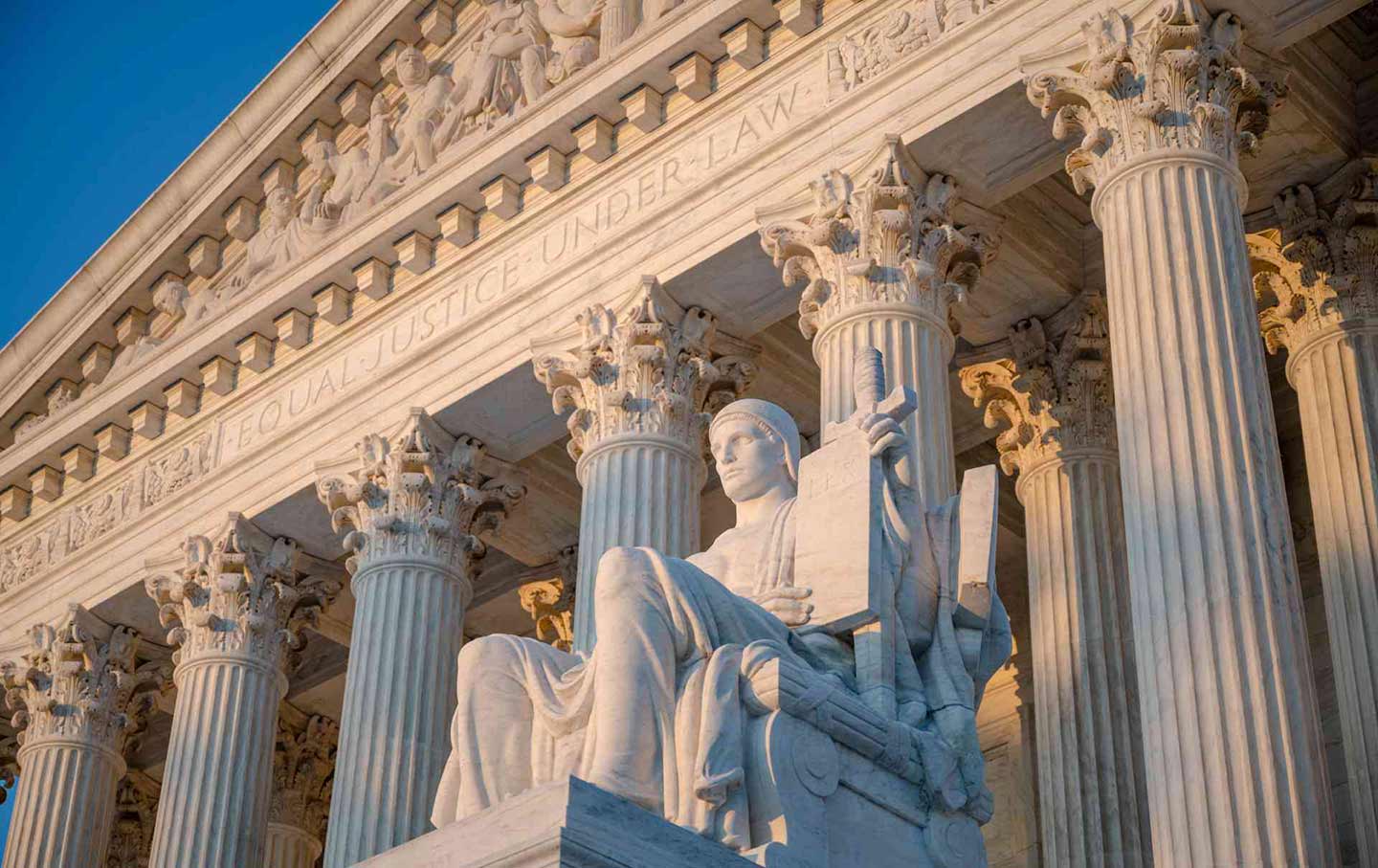
Exterior of the US Supreme Court Building the statue is titled “Authority of Law.” 
Exterior of the US Supreme Court Building the statue is titled Authority of Law. (Richard Sharrocks / Getty Images)

The just completed Supreme Court term will initiate a seismic shift in the distribution of power in the American republic. The effects of the court’s rulings in this term will have a bigger impact on the rule of law and our political future than anything the court has done since 1857’s Dred Scott decision.

I simply cannot overstate the significance of what has just happened. In one single month, the Supreme Court: legalized bribery of public officials, declared the president of the United States absolutely immune from criminal prosecution for “official” acts, and made the power to issue regulations subject to the court’s unelected approval.

When we widen the aperture to look at the whole term, we find that the court also ruled that people who fail in their violent attempts to reverse the results of an election can run for office in the very next election; would-be mass shooters can buy attachments to change their weapons into machine guns; and white state legislatures can systematically remove all Black people from their districts and call it “politics.” And as if to add a dose of unvarnished cruelty to its machinations, the court also ruled that insurrectionists who attack the capitol and obstruct the work of Congress cannot be charged with a crime, but homeless people sleeping on the streets can be sent to jail.

These rulings mean that the Supreme Court, and only the Supreme Court, gets the final word on what regulations Congress really wanted to pass, and which crimes presidents are allowed to commit. And the justices themselves can be paid, handsomely, for their opinions should interested parties and wealthy donors would like to give them a “gratuity” for ruling in ways that please those moneyed interests.

Folks, we can’t “come back” from this. There is no presidential order or legislative action that can undo all of the evils committed by the Supreme Court. This is different from what’s happened before. In 2012, when the court gutted the most important piece of legislation in American history, the Voting Rights Act, there were immediate calls for Congress to pass legislation restoring what the court took away. Obviously, Congress hasn’t done that because Republicans are against Black people voting, and Democrats, even when they have power, are against doing anything that would upset Senate traditions. But, at a minimum, the possibility existed that legislation could fix what the Supreme Court had broken (at least until the Supreme Court overruled those legislative fixes).

Similarly, in 2022, when the court took away a constitutional right for the first time in American history and overturned Roe v. Wade, there were immediate calls for Congress to pass legislation restoring what the court took away. Obviously, that hasn’t happened, because Republicans are against women having equal rights and Democrats are against doing anything that would upset Senate traditions—but, again, the possibility of a remedy existed.

This time, there’s no legislative fix for the problems the court has created. Consider the proposition that presidents are no longer subject to criminal laws. The court has ruled that, as a matter of the constitutional separation of powers, nobody has the right to prosecute presidents for crimes as long as the president claims that committing crimes is part of their job. Congress cannot reinstate criminal penalties the court says are unconstitutional in the first place.

Meanwhile, when it comes to government regulations you may have heard people—specifically, Republicans speaking in bad faith—claim that Congress just has to write better laws instead of leaving it to the executive agencies to fill in the gaps. But that is simply not a reasonable or feasible expectation. Congress doesn’t know how much lead is allowed to be in water before it damages the brains of the people who drink it. It doesn’t know how fast an industrial thresher should be allowed to operate before it becomes a death trap operated by a Bond villain. It doesn’t know if taking a submarine piloted with a PlayStation controller to visit the Titanic is a good idea or not. Experts know these things. Congress cannot write laws detailed enough for them to avoid needing to be filled out by experts in the relevant field. By placing itself over the executive agencies, the Supreme Court makes itself not judges but regulators who are allowed to assert their guesses over the judgments of scientists and professionals.

The Supreme Court is the only branch of government that claims the power to rule unchecked by the other branches of government. If Congress passes a law, the court claims authority to overrule it. If the president issues an order or regulation, the court claims the power to overrule them. If a state legislature or governor passes a rule or ordinance, the court claims the power to overrule them. And if voters attempt to elect leaders, the court claims the authority to overrule them by literally picking whose votes should be counted or recounted—to say nothing of who gets to vote in the first place.

This is not how a democracy or a republic is supposed to work. Supreme power is not supposed to reside in the hands of unelected officials who have been appointed for life. In fact, this is not how our democracy is supposed to work: The Constitution does not give the Supreme Court these powers—the court has invented them for itself.

There are only two ways to deal with this Supreme Court: ignore its rulings or flood it with new justices who will give back the power this court has stolen from the rest of us. The first option, most likely, leads directly to civil war—one where the rule of law can be imposed only by military force under the sole discretion of whoever happens to be the president, assuming that president commands the loyalty of the military. Democracy cannot long exist if laws have meaning only when the president decides to enforce them at the point of a gun.

The second option, court expansion, is the normal, peaceful, constitutional solution to a court that no longer believes it can be checked by other institutions. Adding justices who are going to act within the bounds of their constitutional authority is the only peaceful way to save ourselves from the ones who won’t. I support court expansion because it is the simple, legal, and nonviolent way to counteract the corrupt and power-hungry court.

But many Democrats do not. President Joe Biden does not. He, like so many others in his party, would rather allow the Supreme Court to be the only power that matters in this country, leaving the rest of us to squabble endlessly over the scraps of self-government the court lets fall from its table of real authority. For many Democrats, pretending to hold power is more important than actually using power to do the work of the American people over the objection of the Supreme Court.

For Republicans, the Supreme Court is a boon. Republican control of the Supreme Court allows them to pass an agenda, by a vote of 6-3, that they couldn’t get through the elected branches of government. That’s because the Republican agenda of mass shootings, forced-birth, corruption, and criminality is extremely unpopular. Voters do not like Republican policies, but the Supreme Court literally doesn’t have to care about what voters want. Republicans have set up a system where either Republicans win elections—or elections do not matter.

The conservative justices fear nothing: not the people, not the Congress, and certainly not the Democrats. They are drunk on their own power because nobody will cut off their supply. The Supreme Court rules the country in unchecked, unaccountable fashion, yet most people cannot name the justices and wouldn’t recognize them if one of the justices was holding a gun to their head.

Now, they’re going to take the summer off to let the politicians act like they’re important and the voters feel like they’re making a difference. But they’ll be back this time next year, and they will continue to do all the things Republicans want that nobody elected them to do.


ABOUT THE AUTHOR:


Elie Mystal is The Nation’s justice correspondent and the host of its legal podcast, Contempt of Court. He is also an Alfred Knobler Fellow at the Type Media Center. His first book is the New York Times bestseller Allow Me to Retort: A Black Guy’s Guide to the Constitution, published by The New Press. Elie can be followed @ElieNYC.


Chris Hedges On the Real Crisis in the United States With or Without the National Fascist Cult Led by Donald Trump

https://countercurrents.org/2024/07/my-thoughts-on-the-attempted-trump-assassination/

 
PHOTO:  Trump raises a fist after being shot at a campaign rally in Pennsylvania. Source: screenshot (Reuters)

The assassination of Trump would not remove the yearning of tens of millions of people, many conditioned by the Christian right, for a cult leader. Most of the leaders of the Christian right have built cult followings of their own. These Christian fascists embraced magical thinking, attacked their enemies as agents of Satan and denounced reality-based science and journalism long before Trump did. Cults are a product of social decay and despair, and our decay and despair are expanding, soon to explode in another financial crisis.


The efforts by the Democratic Party and much of the press, including CNN and The New York Times, to discredit Trump, as if our problems are embodied in him, are futile. The smug, self-righteousness of this crusade against Trump only contributes to the national reality television show that has replaced journalism and politics. This crusade attempts to reduce a social, economic and political crisis to the personality of Trump. It is accompanied by a refusal to confront and name the corporate forces responsible for our failed democracy. This collusion with the forces of corporate oppression, which have impoverished the working class, fostered endless war, militarized our police, created the largest prison system in the world, licensed corporations to exploit the most vulnerable and transferred wealth upwards into the hands of a billionaire class, neuters the press, Trump’s critics and the Democratic Party.

Our only hope is to organize the overthrow of the corporate state that vomited up Trump. Our democratic institutions, including the legislative bodies, the courts and the media, are hostage to corporate power. They are no longer democratic. We must, like resistance movements of the past, engage in acts of sustained mass civil disobedience, especially strikes, and non-cooperation. By turning our ire on the corporate state, rather than Trump, we name the true sources of power and abuse. We expose the absurdity of blaming our demise on demonized groups such as undocumented workers, Muslims, African-Americans, Latinos, liberals, feminists, gays and others. We give people an alternative to a bankrupt Democratic Party — whose presidential candidate is in clear cognitive decline — that is a full partner in corporate oppression and cannot be rehabilitated. We make possible the restoration of an open society. If we fail to embrace this resistance, which alone has the ability to destroy cult leaders, we will continue the march toward tyranny.


ABOUT THE AUTHOR:


Chris Hedges is a Pulitzer Prize-winning journalist who was a foreign correspondent for fifteen years for The New York Times, where he served as the Middle East Bureau Chief and Balkan Bureau Chief for the paper. He is the host of the Emmy Award-nominated RT America show On Contact. His most recent book is “America: The Farewell Tour” (2019).

Originally published on Chris Hedges Report


WELCOME TO FASCIST AMERICA: PART 7


“What’s Past is Prologue…"
 
[The following commentary initially appeared in this space on August 30, 2023]

The real nexus between 'race and class' in American politics today is that the powerful doctrine and practice of white supremacy as a major (and not incidental) ideological, structural, institutional, systemic, and material force and social reality within the larger context of Global monopoly capitalism itself in all of its dimensions is as always inextricably connected and thus mutually dependent forces in the United States.

This country is in much deeper trouble than it actually thinks it is. The most fundamental and horrifying fact is that in the last two elections in 2016 and 2020 a whopping 58% of ALL WHITE VOTERS across the board in every single individual class group from the poor to the working class to the middle and upper middle classes as well as the wealthy throughout the entire country have voted overwhelmingly for Trump TWICE and still support him for the presidency in 2024


THE MOST IMPORTANT, TERRIFYING, BUT ALMOST NEVER PUBLICLY COMMENTED UPON FACT IS THE FOLLOWING:
 
Trump has won more votes over the course of two elections than ANY OTHER PRESIDENTIAL CANDIDATE FROM EITHER PARTY IN AMERICAN HISTORY. Trump received a total of 137 million votes in the last two elections (63 million in 2016 and 74 million in 2020) which is a record previously held by Barack Obama who received 134 million votes combined in 2008 and 2012. The huge difference of course is that Obama only received these many votes because 95% of black voters and 70% of Asian and Latino voters voted from him. I keep trying to remind people that Obama (like every other democratic pary candidate in the last 60 years (!) received only a paltry 41% of the white vote (43% in 2008 and an even more dismal 39% in 2012). 
 
For example Hilary Clinton only received 37% of the white vote nationally in 2016 and Biden only received 42% of the white vote in 2020. This means of course that Obama, Clinton, and Biden between them only got 40% of the national white vote in this country in the last four elections. This means that that ALL of them lost the white vote by a landslide. Reminder: The largest national voting demographic in the country are white Americans who constituted 65% of all American voters in 2020 and were 70% of voters from 2008-2016. Which means as always that the white share of the voting public is larger that ALL OTHER racial/ethnic groups--male and female combined!


In the last 72 years of presidential elections since 1952 (a total of 18 elections overall and counting) a national majority of white voters have voted for a Democratic party candidate ONLY ONCE (1964).


What all this means in a larger sense is that because the GREAT MAJORITY OF WHITE AMERICAN VOTERS IN GENERAL SINCE 2016 HAVE ACTUALLY IN FACT openly supported and most importantly have continued to vote for Trump FAR MORE THAN ANY OTHER CANDIDATE IN THE ENTIRE COUNTRY we are all in very big trouble come November 5, 2024 and that the actual political prospects for what happens not only to the presidency but even more importantly Congress (as well as civil society in general) is the worse than at any time since the horrendous 1950s…


Friday, July 12, 2024

WELCOME TO FASCIST AMERICA: PART 6

https://www.nytimes.com/2024/07/06/opinion/biden-debate-scotus-immunity.html


Whoever the Democratic Candidate Is, Americans Have Already Lost


A black and white photograph of the Capitol dome and the Peace monument.

Photo Credit:  Damon Winter/The New York Times


“…The Supreme Court’s decision on presidential immunity is a harbinger of not just the court’s growing power but of Democrats’ inability to mount a populist defense. This conservative bloc on the court reflects years of undemocratic political maneuvering, from Mitch McConnell stealing a seat to the political activism of Chief Justice John Roberts, Justice Samuel Alito and Justice Clarence Thomas. Their decisions are not only codifying minority interests; they are a show of strength for a Republican Party that has no intention of ever ceding power to majority will again. If you take your eye off the ball of democracy for any length of time, no amount of history will save you.  Americans have taken our eyes off the ball..."


by Tressie McMillan Cottom
July 6, 2024
New York Times


I watched the debate from a pub in Ireland. A man sitting next to me pegged me for a Yank. “Sorry about all that — screwed, no matter what you do,” he said before the final minutes of the debate. I nodded, accepting his sympathies for my condition as an American during a week when it was hard to be an American.


It is only when I am not in America that I feel my Americanness. From the moment that blue passport cover places me in a different line at customs, my citizenship speaks louder than my race, gender or religion. Maybe I had to watch that debate from outside the U.S. to fully appreciate what was happening to us Americans.


A survey of the political commentariat shows a consensus forming: President Biden is fighting the final rounds of a match that the refs won’t call but probably should. Usually, after reading all of the news and polls, I turn to the everyday political discourse, which often diverges from that of the professional political watchers. What should scare Biden loyalists is that this time, the two agree. Even the most die-hard Democratic voters can see Biden’s decline for what it is: an opening for Donald Trump to win his second presidential term.


A few days after that disastrous debate, the Supreme Court finally weighed in on presidential immunity. There is no other way to read its decision than as a signal that whoever owns the Republican Party also owns the power to break the law. Whether he wins or loses, Trump owns the G.O.P., lock, stock and barrel. I’m not sure the country has fully accepted what that means.


When the Supreme Court decision was announced, I had moved on to Greece. Again, it felt like a portentous place to be as the United States moved closer to an autocracy than it had been since perhaps Reconstruction. Greece prides itself as the birthplace of deliberative democracy. As you walk through the ancient ruins, the biggest ideas to transform human society don’t look very big. The buildings where they were debated are crumbling. Modern development dwarfs what were once massive structures to Western ideology. Despite standing for more than 2,000 years, these relics of early democracy feel fragile.


Americans don’t build monuments as well made as the ancient Greeks built. The idea has always been that our democratic ideas are the real monuments. The statues and artifice of political memory should never be stronger than those ideas. Sometimes we have made our monuments cheaply, as if to say that having perfected the means of democracy — if not its platonic ideal — we don’t need to bother with strong foundations and materials.


But Greece is a testament to what happens when we think ideas are so taken for granted that they do not need defending. That small country is fighting its way out of a decades-long economic slump and years of political unrest. A nation that was so central to the ideas of democracy can today be described as politically unstable. Voters have lost faith in their country’s ability to hold fair elections. Political violence has become more common.

Americans continue to insist that Jan. 6 was an anomaly, but we are naïve about the strength of our institutions. Too many of us, academics and laypeople alike, rely too heavily on historical precedent to safeguard our electoral present. What a nation like Greece shows is that Jan. 6 is an anomaly only once before it becomes routine.


However poorly Biden performed at that debate (and he was embarrassing), debates are theater. However ill equipped the Democratic Party is to provide an heir apparent — and they are embarrassingly unprepared for this predictable eventuality — their dysfunction is not the clear and present danger. The Supreme Court’s decision on presidential immunity is a harbinger of not just the court’s growing power but of Democrats’ inability to mount a populist defense. This conservative bloc on the court reflects years of undemocratic political maneuvering, from Mitch McConnell stealing a seat to the political activism of Chief Justice John Roberts, Justice Samuel Alito and Justice Clarence Thomas. Their decisions are not only codifying minority interests; they are a show of strength for a Republican Party that has no intention of ever ceding power to majority will again.


If you take your eye off the ball of democracy for any length of time, no amount of history will save you.


Americans have taken our eyes off the ball. I have not wanted to make that call. It is an easy thing to say. Too easy. Critical thinkers too often toss about pronouncements about the demise of democracy when they lose a political battle or just want to seem erudite. It can make professional critics sound like Chicken Little, always claiming the end is near until no one cares to hear our squawking.

But it is time to squawk. It is not just that my side — the ideas I believe in like bodily autonomy, economic justice and diversity — are losing in the marketplace of ideas. It is that many of the ideas that I believe in absolutely kill in the marketplace of ideas, and it does not matter. A majority of Americans want women to have access to safe abortion care. A majority of Americans want strong social welfare programs. They want affordable housing and safe schools and sensible gun control. My ideas are winning, but our electoral politics no longer care about representing the winning ideas.

The post-debate analysis quickly devolved into a reality-show catfight. Smart people are placing bets on their favorite candidate for “Survivor: The POTUS Edition.” I hate contrived reality-show competitions, and I hate this one most of all. Should it be Kamala Harris? Some other dark-horse candidate? What about a brokered Democratic convention? How exciting!

Except, it is exciting only for people who won’t lose no matter who wins the White House.

As for the rest of America, it has already lost.


ABOUT THE AUTHOR:


Tressie McMillan Cottom (@tressiemcphd) became a New York Times Opinion columnist in 2022. She is an associate professor at the University of North Carolina at Chapel Hill School of Information and Library Science and the author of “Thick: And Other Essays” and was a 2020 MacArthur fellow.


Thursday, July 11, 2024

WELCOME TO FASCIST AMERICA: PART 5

 msnbc

Watch the ReidOut with Joy Reid Highlights: July 9, 2024

https://www.msnbc.com/msnbc/watch/watch-the-reidout-with-joy-reid-highlights-july-9-214539333940

https://www.msnbc.com/the-reidout/watch/project-2025-section-on-department-of-justice-details-using-it-to-attack-american-citizens-214618181859

Project 2025: DOJ as ‘office of vengeance’ emboldened by Trump's presidential immunity

Under Project 2025, the Department of Justice would be used to attack American citizens. The 28-page section of the project's manifesto covering the Department of Justice and the FBI is a nightmarish play-by-play on how to turn the DOJ into the office of vengeance. Joy Reid and her panel discuss.