Sunday, November 15, 2009

Where is the National Economic Discovery?

http://www.nytimes.com/2009/11/14/opinion/14herbert.html?em=&adxnnl=1&adxnnlx=1258263236-SZl4u0BgTCztbjbxAs/l6A&pagewanted=print

All,

Every single word of this chilling editorial by Herbert is absolutely true...and the ball is now clearly in both our court and Obama's...

Kofi


November 14, 2009

OP-ED COLUMNIST

A Recovery for Some
By BOB HERBERT
New York Times


President Obama’s strongest supporters during the presidential campaign were the young, the black and the poor — and they are among those who are being hammered unmercifully in this long and cruel economic downturn that the financial elites are telling us is over.

If the elites are correct, if the Great Recession really is over, then these core supporters of the president are being left far, far behind — as are blue-collar workers of every ethnic and political persuasion. Nobody wants to talk seriously about class in America, but the elites are smiling and perusing their stock portfolios while the checklist of Americans locked in depressionlike circumstances just grows and grows: construction and manufacturing workers, young men without college degrees (especially young black and Hispanic men), teenagers, and those who were already poor when the recession began.

The economic environment for all of these groups is an absolute and utter disaster.

Now we’re learning that unmarried women are among those being crushed by the epidemic of joblessness. As the Center for American Progress has noted, “The high unemployment rate of unmarried women, and particularly the 1.3 million unemployed female heads of household who are primary breadwinners for their families, is devastating to their financial circumstances and standard of living.”

Mr. Obama announced this week that he would convene a jobs summit at the White House next month to explore ways of putting Americans back to work. It remains to be seen whether the summit will yield anything substantial. But it’s fair to wonder why the president and his party have not been focused like fanatics on job creation from the first day he took office.

It was the financial elites who took the economy down, and it was ordinary working people, the longtime natural constituents of the Democratic Party, who were buried in the rubble. Mr. Obama and the Democrats have been unconscionably slow in riding to the rescue of those millions of Americans struggling with the curse of joblessness.

We’ve been hearing that there are six unemployed workers for every job opening in the U.S., but even that terrible figure is deceptive. There are 25 unemployed construction workers for every job opening in their field, and more than a dozen for every opening in the durable goods industries, according to the Center for Labor Market Studies at Northeastern University in Boston.

This was not a normal recession, and we are not on the cusp of anything like a normal recovery. The unemployment rate for black Americans is 15.7 percent. The underemployment rate for blacks in September (the latest month for which figures are available) was a gut-wrenching 23.8 percent and for Hispanics an even worse 25.1 percent. The poverty rate for black children is almost 35 percent.

Wall Street can boast about recovery all it wants, much of America remains trapped in economic hell.

It will take a monumental leadership effort by the administration and Congress to spark the kind of changes necessary to transform this wretched employment landscape. Ross Eisenbrey of the Economic Policy Institute has written: “By itself, the private sector is unable to create jobs in the numbers the United States needs to obtain a robust, full economic recovery.”

If that’s true, and I have long believed it to be the case, then we need to rethink our entire approach to employment. Conventional efforts to kick-start economic growth are dwarfed by the vast scale of the problem. Bold new efforts — creative efforts — are needed.

A recent survey for the policy institute found that one in four families had been hit by a job loss during the past year and 44 percent had suffered either the loss of a job or a reduction in wages or hours worked. Economic insecurity has spread like a debilitating virus through scores of millions of American families.

What kind of recovery are we talking about if blue-collar workers, and men and women without college degrees, and large percentages of ethnic minorities and the young and the poor are not part of it? And how can any recovery be sustained if economic insecurity is a permanent feature of even middle-class life?

The financial elites have flourished in recent decades to a great extent because they have had government on their side, with the politicians working diligently to ensure that rules, regulations and tax policies established an environment in which the elites could thrive. For ordinary Americans, it has been a different story, with jobs shipped overseas by the millions and wages remaining stagnant, with labor unions under constant assault and labor standards weakened, with the safety net shredded and the message sent out to workers everywhere: You’re on your own.

We’ll get a chance to see at President Obama’s employment summit whether anything much has changed.


Copyright 2009 The New York Times Company

American Imperialism in Action: The Ongoing Role of Big Oil in Iraq

http://www.truthout.org/1114092

All,

An important article that goes to the heart of exactly why the United States government invaded and occupied Iraq in the first place after their former longtime ally and vicious tyrant Saddam Hussein (then head of the wealthiest and most powerful nation in the Middle East outside of the other two major American allies in the region-- Israel and Saudi Arabia) tried to move out of his subordinate 'client-state' status with U.S. imperialism by invading Kuwait in 1990 and providing the first Bushwhacker Regime (George Dubya's notorious paterfamilia) with the dubious rationale for initiating the Persian Gulf War.

Kofi


Did Big Oil Win the War in Iraq?
Saturday 14 November 2009
by: Antonia Juhasz | AlterNet


As U.S. and British oil companies sign contracts with the Iraqi government, is it time to declare Big Oil the "victor" in the bloody venture?

Last week, ExxonMobil became the first U.S. oil company in 35 years to sign an oil-production contract with the government of Iraq.

As I write, several other contracts with the world’s largest oil companies are being finalized, and more are expected when a new negotiating round kicks off in Baghdad on Dec. 11.

Do these contracts represent a "victory" for Big Oil in Iraq? Yes, but not one as big as the companies had hoped for (at least, not yet).

Before the United States and Britain invaded Iraq in March 2003, their oil companies were shut out of oil-production contracts being negotiated by the government of Saddam Hussein. Today, more than six years of war later, Saddam is gone, and the U.S. and British oil companies are not only in on the oil contracts, they have managed to sweeten the terms.

However, organized resistance by Iraqis and people around the world has thus far succeeded in denying Big Oil its Big Prize: passage of the Iraq Oil Law, alternatively called Iraq Hydrocarbons Law, which would grant far greater control over Iraqi oil to foreign companies on terms much less favorable to Iraq than the current contracts provide.

If the negotiations proceed on their current path, foreign companies will produce the vast majority of Iraq’s oil. How much control they will exert, and who will reap the greatest benefits (and endure the steepest costs) is yet to be determined.

Before the Invasion

In January 2000, 10 days into President George W. Bush’s first term, representatives of the largest oil and energy companies joined the new administration to form the Cheney Energy Task Force. As part of its deliberations, the task force reviewed a series of lists titled "Foreign Suitors for Iraqi Oilfield Contracts" naming more than 60 companies from some 30 countries with contracts in various stages of negotiation.

None of contracts were with American nor major British companies, and none could take effect while the U.N. Security Council sanctions against Iraq remained in place. Three countries held the largest contracts: China, Russia and France -- all members of the Security Council and all in a position to advocate for the end of sanctions.

Were Saddam to remain in power and the sanctions to be removed, these contracts would take effect, and the U.S. and its closest ally would be shut out of Iraq’s great oil bonanza.

After the Invasion

The invasion of Iraq dealt handily with the problem of U.S. and British exclusion. ExxonMobil, Chevron, BP, ConocoPhillips and other major oil companies met with the Iraqi government on countless occasions, and the Iraqis tried to make deals.

But the oil companies, backed aggressively by the Bush administration, steadfastly insisted that contracts would only be signed after the Iraq Oil Law was passed. They nearly prevailed on several occasions, but organized resistance in and outside of Iraq has continually stymied the law’s passage.

Several forces have conspired to bring the oil companies to the negotiating table today.

Most recently and significantly, Iraq’s Parliament has refused to even consider the law until after the January 2010 elections. It is quite likely that a new government hostile to the interests of foreign (particularly U.S. and British) oil companies could come to power in those elections, making passage of the law much less likely. The deals being offered today would be the best the companies would be likely to get.

President Barack Obama and his administration have been vocal and active proponents of the law’s passage. However, this administration’s allegiance to the oil industry is not as steadfast as that of its predecessor.

The Obama administration’s push for passage of the law comes at the same time that it pursues withdrawal of all but a residual U.S. troop presence. It is hard to underestimate the added negotiating weight brought by 150,000 members of the U.S. (and until very recently British) military. Bush announced his most public declaration for passage of the Iraq Oil Law at the same time that he announced the surge of an additional 20,000 U.S. troops into Iraq. The pending loss of its most potent negotiating stick has clearly made the oil companies’ more willing to deal.

Secretary of State Hillary Rodham Clinton may have best put forward the administration’s position at the U.S.-Iraq Business and Investment Conference on Oct. 20, explaining: "A comprehensive hydrocarbon law is vital for regulating the [Iraq] oil sector. Parliament has delayed this vote until after January, but steps can be taken in the interim; for example, by holding transparent, credible auctions on oil and gas fields as we are seeing ..."

In other words, 'we know you want the law, but Parliament isn’t biting, and we’re not keeping 150,000 U.S. soldiers in Iraq indefinitely for you to get it. So, sign the d*** contracts.'

And finally, under immense pressure, the Iraqi Oil Ministry also has steadily been sweetening the deals.

The New Oil Contracts

The Iraq Oil Ministry began a bidding round in June for eight currently producing oil fields, which are among the largest in the world. Only one consortium -- BP and the Chinese National Petroleum Corp. -- agreed to the terms. The rest of the companies balked, saying the terms just simply were not generous enough. The terms have since been sweetened (and applied retroactively to BP and CNPC's deal), and the companies are now jumping on board.

Because the U.S. and British companies have, to a large degree, squeezed into pre-existing negotiations, some strange bedfellows have emerged to sign these new contracts, and more odd pairings are expected soon.

* BP and CNPC finalized the first new oil contract issued by Baghdad for the largest oil field in the country, the 17 billion barrel Rumaila field.

* ExxonMobil, with junior partner Royal Dutch Shell, won a bidding war against Russia’s Lukoil and junior partner ConocoPhillips for the 8.7 billion barrel West Qurna Phase 1 project.

* Italy's Eni SpA, with California’s Occidental Petroleum and the Korea Gas Corp., was awarded Iraq's Zubair oil field with estimated reserves of 4.4 billion barrels.

* Japan's Nippon Corp., leading a consortium of Japanese companies including Inpex Corp. and JGC Corp., is at an advanced stage in talks to win the Nassiriyah oil field.

* Shell, with partners CNPC and the Turkish Petroleum Corp., is also in discussions for the giant Kirkuk oil field, although negotiations have been delayed until after Iraq’s January elections.

The Terms

These contracts are complex and unique, representing a hybrid of existing models. They are not the best that the oil companies hoped for, which would have been production sharing agreements (PSAs). Nor are they the worst the companies might have feared; Iraq is not maintaining its nationalized system, closed to foreign oil company production participation (U.S. and other foreign oil companies sell Iraqi oil now and have done so for decades).

They are also not technical service contracts (TSCs), although this is what the Iraqi Oil Ministry has named them (likely in an attempt to thwart opposition to the contracts for offering too much to foreign oil companies). Greg Muttitt, an Iraq oil expert with Platform, told me, "TSCs generally last just a few years, they're generally for a specific job (e.g. installing pumps) rather than managing a field, and they go to service companies like Baker Hughes and Halliburton."

On the positive side for the companies, where the development production contracts (DPC) that Iraq was signing prior to the 2003 invasion offered 12-year contracts, today’s run for 20 to 25 years. And while as recently as a year ago the Iraqis offered the foreign companies a 50 percent ownership stake, today’s contracts offer them a 75 percent stake (25 percent for the Iraqi government).

On the other hand, where the PSAs sought under the Iraq Oil Law would give the companies an equity stake and the ability to book the oil in the fields as their own, these contracts provide reimbursement fees for capital and operational expenses and a fixed fee per barrel of oil produced and deny the companies the ability to book reserves.

It remains unclear whether the foreign companies or the Iraqi government ultimately has production decision-making authority. And some of the benefits included in the contracts would be annulled if the Iraq Oil Law were passed, including requirements to hire and train Iraqi workers and the transfer of needed technology.

Finally, the Iraqis apparently sweetened the deals further in the last few weeks by reducing the amount the foreign companies pay in taxes and allowing them to use private security forces to protect their facilities.

The Next Bidding Round

On Dec. 11 and 12, the second, much larger, bidding round will be launched in Baghdad. Forty-four international companies have been prequalified to bid on run for 11 groups of oil and gas fields in already producing and undiscovered fields. Negotiations will include the super giant Majnoon field, which Chevron and France’s Total have teamed up to bid for.

The contracts for these fields are expected to mirror those described above, but no "model contract" has been made publicly available.

Sunlight

The Iraq Oil Law has remained an elusive goal of the world’s most powerful industry and governments because a massive organized global resistance movement has been shining a bright spotlight on its content, its backers, and on the consequences of its passage.

We must continue to shine this spotlight on the new contract negotiations to help ensure that 1) the military occupation of Iraq will be able to conclude, and 2) that the Iraqis are not freed from a foreign military occupation only to be brought under foreign economic control.

(What these contract negotiations mean for the continued U.S. occupation of Iraq is the topic of my upcoming article for Political Research Associates.)


Antonia Juhasz is the director of the Chevron Program at Global Exchange. She is author of The Tyranny of Oil: the World's Most Powerful Industry, and What We Must Do To Stop It (HarperCollins, 2008), paperback to be released on Dec. 8 with a new foreword, and The Bush Agenda: Invading the World, One Economy at a Time (HarperCollins, 2006). She is the editor and lead author of The True Cost of Chevron: An Alternative Annual Report. She is on the National Advisory Board of Iraq Veterans Against the War, an associate fellow with the Institute for Policy Studies, a fellow with Oil Change International, and a senior analyst with Foreign Policy in Focus.

Reading Sarah Palin and Surviving the Perils of Protofascist Chic


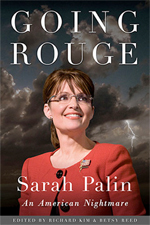
Sarah Palin's autobiography will be released the same day as a more critical perspective in "Going Rouge: Sarah Palin - An American Nightmare." (Photo: Tricia Ward; Edited: Jared Rodriguez / truthout)

http://www.truthout.org/1112097

All,

Here she comes yall...The latest rightwing pinup for protofascist chic...(or the ugly legacy of Ann Coulter strikes again)...

Kofi


"Going Rouge" Takes On the Palin Nightmare

Thursday 12 November 2009

by: Maya Schenwar, t r u t h o u t | Interview


Sarah Palin's autobiography will be released the same day as a more critical perspective in "Going Rouge: Sarah Palin - An American Nightmare." (Photo: Tricia Ward; Edited: Jared Rodriguez / t r u t h o u t)

Next Tuesday, when Sarah Palin's already-bestselling memoir, "Going Rogue: An American Life," hits shelves, another much-anticipated look at the Palin phenomenon will also debut: "Going Rouge: Sarah Palin - An American Nightmare" (available exclusively at orbooks.com). The book includes both new and classic essays by the likes of Max Blumenthal, Eve Ensler, Katrina vanden Heuvel, Jessica Valenti, Juan Cole, Jim Hightower, Robert Reich, Naomi Klein and many more.

I interviewed Richard Kim and Betsy Reed, the editors of "Going Rouge," about Palin's place in the American political landscape, her influence on the tenor of Republican politics, and why they did not choose to make Levi Johnston a focal point of their anthology.

MS: Although your book is being released the same day as "Going Rogue" and has a similar cover, it doesn't seem like you intend to trick readers into buying the book when they mean to buy "Going Rogue." What was your aim in compiling this anthology?

Betsy Reed: We want to emphasize that although the cover has an element of satire, the book is not a parody. Our goal was to present a serious appraisal of Sarah Palin's record and an assessment of her role in American politics - and her future in American politics. She is a very well-packaged celebrity at this point, so we felt it was important to show her beneath the gloss.

Richard Kim: "Going Rogue" has already printed 1.5 million copies, and it has been number one on Amazon for weeks. We can assume that it's going to be painting her in the most generous and heroic light, and it's really important to tell the other side of her story, about her record in Alaska as governor, what she did on the campaign trail and what her politics are, and not to fall prey to the Sarah Palin branding machine.

BR: We're seeing this argument take shape where anyone who's critical of Sarah Palin is portrayed as launching unfair personal attacks on her. Our book is not personal at all; it's about who she is politically. There's really nothing about Levi Johnston in the book.

MS: That's refreshing.

RK: He only enters in there once or twice. There's no full-frontal nudity in the book, either.

"Going Rouge" is available starting Nov. 17 at orbooks.com.

MS: I'd like to know how you settled on the title of "Going Rouge," besides the play on words?

BR: Well, we can readily admit the play on words was a large part of the appeal, although we suggest in a cheeky way in our introduction that any similarities are purely coincidental.

But we also argue in our introduction that Sarah Palin represents something interesting and new in Republican politics, in that she is very much presented as a woman - a mother, a hockey mom - and her pedigree as a beauty queen was a very explicit part of her marketing as a vice-presidential candidate. This is highly suspect coming from a party that's been against every major agenda item for the women's movement. The title allows us to comment on that phenomenon: the Republican Party "going rouge."

Why do you think Sarah Palin remains so widely accepted by conservatives as a viable national politician, despite her obvious shortcomings?

RK: A part of that is definitely the narrative she sells; being a mom from Alaska. Also, she also does share the views of 20 percent of the electorate: the far right. And it's clear that they are not actually thinking in this moment of winning national elections. They're not even trying to hold onto a seat in New York's 23rd district, which has been in Republican hands since the 1850s. That was the race where Sarah Palin intervened and hacked out the moderate Republican. So that's a big question that's unknown: Is the Republican Party going to follow Palin into basically suicidal territory in terms of a national election?

BR: I think she does have quite a strong following among a certain cohort of Christian, conservative, white, married women. The Republican party is a mostly male phenomenon, but I think Republicans recognized that they needed to do better with women when they picked her.

RK: Going back to what Betsy said earlier, the narrative that she sends out of being persecuted is actually deeply resonant now with that portion of the Republican Party, which is out of power in the White House, out of power in Congress, and seeing the policies of the Bush years being rolled back. She constantly says, "I'm not being recognized by the national media, so I'm going to go rogue and tell you the story directly." In that way she can bypass Washington and bypass the media world.

BR: It's nothing new - The American right has always felt itself to be aggrieved. They always present themselves as fighting against a liberal elite. During the Bush years, obviously, they controlled everything. But now with Obama, there's a receptive audience for Sarah Palin's line of being the victim of this liberal conspiracy.

MS: That sense of victimhood can make it difficult for the media to cover Sarah Palin at all. If you had to map out a strategy for the progressive media in confronting the phenomenon of Sarah Palin over the next couple of years, what would you include?

RK: The best thing progressives did during the election was stick to record record record; facts facts facts. When you line those up, you see what a disaster she was as governor and what a disaster she would be as vice president.

That should be the strategy going forward. When she posts on Facebook that Obama's going to have "death panels" that execute her Downs Syndrome baby, we have to point to where he actually talks about optional end-of-life consultations. When she talks about how "In God We Trust" has been taken off the dollar coin, implying that it was an Obama plot, progressives have to point out that in fact, this was passed by a Republican Congress and George W. Bush.

So, there's going to be a portion of the electorate that believes whatever she says, but the results of the election and the results of the summer health care debate have shown that if we stick to the facts and the record, she's usually debunked.

MS: So, what kind of impact do you hope the book will have on Palin's probable presidential campaign?

BR: In some ways, Sarah Palin represents very bad news for the Republican Party. So part of us just wants to say, "Go for it!"

RK: But then, look at what she did with Betsy McCaughey's "death panels," which were just a little thing in the New York Post and no one on the national stage was paying attention to it. Then Sarah Palin blasted it on her Facebook page, and for the entire month of August, instead of discussing the public option or single payer or any of the other health care proposals out there, we were stuck fighting that garbage.

BR: So, we're probably not going to see President Palin in 2012. The larger effect we're looking at is that Sarah Palin is warping our political debate.

MS: Criticisms of Sarah Palin always seem to contain this combination of outrage and humor. That's a hard balance to strike, and I'm interested in how you dealt with that balance in compiling the anthology.

RK: Some of the humor in the book just comes from quoting Sarah Palin. She's funny enough just on her own. There's a piece in the book that puts Sarah Palin's own words into verse, in haiku form.

So, some of the writers have a lot of fun with her. She has a sort of comic element, but then there are also terrifying elements to her, like the ignorance that she exposed in her interviews with Katie Couric or with Charlie Gibson.

That balance is represented in the book. The appeal of her youth, her wardrobe, her charm has been used to evade the hard political questions of her record and her knowledge.

MS: Is Sarah Palin a "rogue" phenomenon, or does she represent a trend in the Republican Party?

RK: What we see in Sarah Palin's continued political relevance, even though she holds no office, is that in some ways she's doing what Newt Gingrich and Dick Armey and all these other former Republican politicians are doing - using their status as media figures to push an agenda. They don't have to actually govern, or face the consequences of their actions at the polls. So, what she represents is actually the takeover of the Republican Party by these non-governmental actors - and you can throw Rush Limbaugh and Glenn Beck in there - this cabal of people who are not beholden to any electorate. Those are the people in the driver's seat.

BR: There's not anything inherently wrong with a person who's a media personality being influential in politics. We have that on the left, too. But Paul Krugman makes a good point in his [Nov. 9] column: These people don't have to worry about governing, so they can be as irresponsible as they want in their rhetoric, and could potentially make the country ungovernable for Democrats.

RK: Even Arlen Specter and Joe Lieberman and Michele Bachmann have to come home and face their constituency. Sarah Palin doesn't need to do that anymore, and that's one of the things that makes her a great danger in the next few years.

--------

"Going Rouge: Sarah Palin - An American Nightmare" can be purchased at orbooks.com.

The Necessity of Reshaping America's Judiciary

http://www.nytimes.com/2009/11/15/us/politics/15judicial.html?th&emc=th

All,

There are continuing ominous signs that a corrosive and paralyzing political inertia has begun to seep into Obama's administration as far as making assertive public policy decisions and acting decisively on key appointments in government are concerned. If the President doesn't take full--and progressive-- command of this drifting ship fairly quickly (and I mean within the next 6-8 months) his first term agenda will be burnt toast by the time the midterm congressional and senatorial elections in 2010 take place-- and that can only mean very bad news for the rest of us...Stay tuned....

Kofi


November 15, 2009

Obama Backers Fear Opportunities to Reshape Judiciary Are Slipping Away
By Charlie Savage
New York Times

WASHINGTON — President Obama has sent the Senate far fewer judicial nominations than former President George W. Bush did in his first 10 months in office, deflating the hopes of liberals that the White House would move quickly to reshape the federal judiciary after eight years of Republican appointments.

Mr. Bush, who made it an early goal to push conservatives into the judicial pipeline and left a strong stamp on the courts, had already nominated 28 appellate and 36 district candidates at a comparable point in his tenure. By contrast, Mr. Obama has offered 12 nominations to appeals courts and 14 to district courts.

Theodore Shaw, a Columbia University law professor who until recently led the NAACP Legal Defense and Educational Fund Inc., said liberals feared that the White House was not taking advantage of its chance to fill vacancies while Democrats enjoy a razor-thin advantage in the Senate enabling them to cut off the threat of filibusters against nominees. There are nearly 100 vacancies on federal courts.

“It’s not any secret that among the civil rights community and other folks there has been a growing concern about the pace of nominations and confirmations,” Mr. Shaw said. “You have to move fairly quickly because things are going to shut down before you know it, given that next year is an election year and who knows what is going to happen in the midterm elections. No one wants a blown opportunity.”

The departure of the White House counsel, Gregory B. Craig, announced on Friday, raises another concern: a leadership vacuum may be forming at the highest ranks of the administration’s judicial selection team. The administration also recently announced that Cassandra Butts, a deputy White House counsel who had played a leading role in judicial nominations, is leaving.

In addition, no one has been confirmed as head of the Justice Department’s Office of Legal Policy, which helps vet judges; Mr. Obama’s nomination of Christopher Schroeder for the position remains stalled in the Senate.

The White House contends that the number of confirmations, not nominations, is what matters. They argue that they were proceeding more methodically than Mr. Bush’s team — in ways like making a greater effort to consult with home-state senators — and so a higher percentage of Mr. Obama’s nominees would ultimately become judges.

“The administration expects to keep pace with the judicial confirmations of the two previous administrations,” said Ben LaBolt, a White House spokesman. “We have moved beyond the confirmation wars of the past, consulted with senators of both parties and nominated exceptional and highly qualified people who will bring diverse backgrounds and experiences to the bench.”

By this point in 2001, the Senate had confirmed five of Mr. Bush’s appellate judges — although one was a Clinton pick whom Mr. Bush had renominated — and 13 of his district judges. By contrast, Mr. Obama has received Senate approval of just two appellate and four district judges.

Those numbers could rise rapidly. Four appellate and four district court nominees have cleared the Senate Judiciary Committee and are waiting for floor votes. Democrats have accused Republicans of stalling them by raising obstacles to votes on uncontroversial nominees. Republicans counter that Democrats, too, used procedural tactics to slow or block some Bush nominees.

There has been some recent movement. Last Monday, the Senate confirmed Andre Davis to the United States Court of Appeals for the Fourth Circuit, shifting the balance on the Richmond-based panel — once considered the nation’s most conservative — to a majority appointed by Democrats.

And on Tuesday, Democrats moved to vote on confirming David Hamilton as an appeals court judge for the Seventh Circuit, based in Chicago. The nominations of both Mr. Davis and Mr. Hamilton had been stalled before the full Senate for five months.

Still, the pipeline behind them is emptier than under Mr. Bush. And Mr. Obama has not submitted nominees to fill two vacancies on the powerful District of Columbia appeals court, which has no home senators to consult. Administration officials said they had focused on courts with larger shortages of judges relative to caseloads.

Mr. Obama’s appeals court record compares somewhat more favorably to former President Bill Clinton’s. By Nov. 20, 1993, Mr. Clinton had sent the Senate five appellate nominees, and four of them had already been confirmed. And he had made 42 district court nominations, of whom 24 had been confirmed.

M. Edward Whelan III, president of the conservative Ethics and Public Policy Center, said it was “surprising” that Mr. Obama had made so few nominations.

“On judges as on so much else, this administration seems to be much less competent than both its supporters and critics expected,” Mr. Whelan said.

Unlike Mr. Bush, Mr. Obama had an early Supreme Court vacancy, and his team expended significant effort in the selection and confirmation of the new justice, Sonia Sotomayor. Similarly, Mr. Clinton’s first year included Justice Ruth Bader Ginsburg’s confirmation.

Still, the time Supreme Court nominations require has added to liberal anxieties. If, as anticipated, there is another Supreme Court vacancy in 2010, there could be scant time left for lower-court judgeships.

The administration’s nominations team is reviewing potential Supreme Court picks, but officials have disclosed few details. They also would not discuss plans to replace Ms. Butts. Two associate White House counsels who worked with her on judges — Susan Davies and Danielle Gray — remain in place.

Liberals also complain that the Obama team’s selections have been too moderate to counterbalance the strongly conservative appointees of Republican presidents, echoing an accusation they made during the Clinton administration.

Former Clinton officials have defended themselves against that contention, pointing out that Republicans controlled the Senate after 1994 and saying that they were also focused on finding nominees who could increase diversity on the federal bench.

Obama officials, too, point with pride to their record on diversity. Of Mr. Obama’s 12 appellate nominees, six are women, four are black, one is Asian and one is Hispanic. By contrast, about two-thirds of Mr. Bush’s nominees were white men.

But Mr. Obama raised eyebrows among liberal groups by nominating Albert Diaz to the Fourth Circuit, where he would be the first Hispanic. Mr. Diaz is a North Carolina business court judge who, at his former law firm, made his name in part by defending the tobacco giant Philip Morris, an unlikely résumé item for a Democratic appointee.

White House officials said it would be unfair to define Mr. Diaz as a tobacco lawyer, noting that he had had many other clients, had a long career as a military lawyer and did hundreds of hours of volunteer work representing indigent clients.

The officials also spoke of the administration’s approach of quietly announcing a nomination every few weeks, in contrast to Mr. Bush’s making a political event of announcing his first group of appellate nominees in May 2001.

But Nan Aron, president of the liberal Alliance for Justice, warned that picking moderate judges and low-key tactics might not work.

“It’s a mistake to think that by going slower and lessening the visibility of nominations, Republican acrimony will be reduced,” she said. “It didn’t work with Clinton and it won’t work now because Republicans will do everything in their power to hold open as many seats as they can for a future president to fill.”


Copyright 2009 The New York Times Company

Thursday, November 12, 2009

Roy DeCarava, Legendary Photographer and Iconic Artist: 1919-2009


"Sun and Shade" (1952) by Roy DeCarava


'
"Man Coming Up Subway Stairs"  (1952) by Roy DeCarava

"John Coltrane on Soprano" (1963) by Roy DeCarava

 "Dancers" (1956) by Roy DeCarava

Roy DeCarava in 1996 by Sherry DeCarava

http://www.nytimes.com/2009/10/29/arts/29decarava.html?_r=1&pagewanted=all

All,

Roy DeCarava is a legend and a GIANT in the field of 20th century photography and one of the finest, most revered, and influential artists in the United States since 1945. His astonishing photographs are thankfully on public display in many of the world's greatest museums including MOMA. But even more importantly DeCarava's extraordinary work has been and continues to be a beacon for visual artists on a global level and especially for artists of color in the United States. I personally had the distinct and lasting pleasure of viewing Mr. DeCarava's stunning photographs and hearing him talk about his work on a number of occasions in many spaces throughout the country. In 1998 my wife and I attended a ravishing international retrospective of DeCarava's photography at San Francisco MOMA where Mr. DeCarava regaled the SRO crowd in the museum auditorium with fascinating anecdotes and stirring recollections not only of his revolutionary and pioneering work photographing many anonymous and "ordinary" people in New York's incredibly diverse urban context but many indelible encounters with such iconic artists as John Coltrane, Thelonious Monk, Billie Holiday, Miles Davis, Duke Ellington, Langston Hughes, Dinah Washington, Mahalia Jackson, Erroll Garner, Coleman Hawkins, Count Basie, Sarah Vaughan, Lena Horne, Dizzy Gilespie, Horace Silver and many, many others--all of whom he immortalized in ethereally powerful photographs that have defined the very essence of the fine art of portraiture and location photography. His kinetic, meditative, and haunting style has been widely imitated but absolutely never duplicated in a prolific career that lasted over six decades. I cherish the autographs he gave me and my wife--especially of the famous large photograph of the late, great John Coltrane that adorns our living room wall to this day. Three generations of African American, Latino, Asian, and white photographers and painters have been captivated and inspired by his work and have gone on to continue his wonderful and thriving legacy of creating incredible images of everyday life and experience. His riveting and classic books of photography like The Sound I Saw: Improvisations On a Jazz Theme (Phadon, 2001), The Sweet Flypaper of Life--with text by Langston Hughes)-- (Hill & Wang, 1955; reprinted by Howard University Press, 1984), and Roy DeCarava: A Retrospective (Museum of Modern Art, 1996) stand as some of the greatest photographic art that has ever been produced in the United States.

Kofi


Roy DeCarava, Harlem Insider Who Photographed Ordinary Life, Dies at 89 
By RANDY KENNEDY 
October 28, 2009
New York Times

 
Roy DeCarava, the child of a single mother in Harlem who turned that neighborhood into his canvas, becoming one of the most important photographers of his generation by chronicling the lives of its ordinary people and its jazz giants, died on Tuesday in Manhattan. He was 89 and lived in the Bedford-Stuyvesant section of Brooklyn.

http://lens.blogs.nytimes.com/2009/10/28/parting-2/?hp

 
His death was announced by Sherry Turner DeCarava, his wife and an art historian who has written about his work.

Mr. DeCarava trained to be a painter, but while using a camera to gather images for his printmaking work he began to gravitate toward photography, partly because of its immediacy but also because of the limitations he saw all around him for a black artist in a segregated nation. “A black painter, to be an artist,” he once said, “had to join the white world or not function — had to accept the values of white culture.”

Over a career of almost 60 years, Mr. DeCarava — who fiercely guarded the manner in which his work was exhibited and whose visibility in the art world remained low for decades — came to be regarded as the founder of a school of African-American photography that broke with the social documentary traditions of his time. While an outspoken crusader for civil rights, he felt that his pictures would speak louder as a record of black life in America if they abandoned the overtly humanist aims of mentors like Edward Steichen.

“I do not want a documentary or sociological statement,” he wrote in his application for a Guggenheim Fellowship, which he won in 1952, becoming the first black photographer to do so. His goal, he explained, was “a creative expression, the kind of penetrating insight and understanding of Negroes which I believe only a Negro photographer can interpret.”

His books, like “The Sweet Flypaper of Life,” a best-selling 1955 collaboration with Langston Hughes, and his most famous photographs — a girl in a pristine graduation dress heading down a desolate, shadowed street; a man ascending wearily from the subway; a stage portrait of John Coltrane playing with closed-eyed fury — were hugely influential, paving the way for younger photographers like Beuford Smith and Carrie Mae Weems.

“One of the things that got to me,” Mr. DeCarava told The New York Times in 1982, “was that I felt that black people were not being portrayed in a serious and in an artistic way.”

Peter Galassi, the chief curator of photography at the Museum of Modern Art, who organized a retrospective of Mr. DeCarava’s work there in 1996, said of him on Wednesday: “He was looking at everyday life in Harlem from the inside, not as a sociological or political vehicle. No photographer black or white before him had really shown ordinary domestic life so perceptively and tenderly, so persuasively.”

Roy Rudolph DeCarava was born in New York on Dec. 9, 1919. He was the only child of Elfreda Ferguson, a Jamaican immigrant, who separated from Mr. DeCarava’s father not long after his birth. As a child he shined shoes and delivered newspapers and ice to make ends meet, while his mother, an amateur photographer, made sure that his artistic talents were nurtured with music lessons and drawing supplies.
  He was one of only two black students at a high school for textile studies in the Chelsea section and one of only a few at the Cooper Union School of Art, to which he had won a scholarship to study art and architecture. After two years there, discouraged by the hostile attitude of many white students toward him, he left and enrolled at the Harlem Community Art Center on 125th Street, where he pursued painting while also using his brushes to make signs for the Works Progress Administration. After a stint in the Army during World War II, he returned to New York and left painting behind for printmaking, which he juggled with a job in commercial illustration.

But soon his field work with a camera, meant to feed his printmaking, became his primary interest, and he joined the great postwar street photography world, where practitioners like Helen Levitt, William Klein and Lisette Model were at work with their 35-millimeter rangefinders.

Mr. DeCarava (pronounced dee-cuh-RAV-ah) told Charlie Rose in a televised interview in 1996 that photography was an ideal way to get at the directness he desired from art. “Going outside and meeting the challenge of taking what is and making it yours, that’s what photography does for me,” he said. “It’s not the subject that interests me as much as my perception of the subject.”

Avoiding flash whenever he could, his pictures explored the nuances of shadow perhaps more than any other photographer of his day. The critic Vicki Goldberg, writing in The New York Times, described his best work as “bafflingly dark, suffused with stillness,” adding: “DeCarava reads the city’s small secrets as it goes about its business unawares, and comes in so close that everything outside his concentration falls away.”

The $3,200 he received from his Guggenheim Fellowship allowed him to shoot in Harlem full time. Steichen used some of Mr. DeCarava’s work in the landmark “Family of Man” exhibition at the Museum of Modern Art in 1955. At the same time — after he had approached Hughes for help in finding a publisher — he published “Sweet Flypaper of Life,” which uses his work with Hughes’s prose poetry to weave a fictional narrative of Harlem life as told by a grandmother named Sister Mary Bradley.


Around the same time, he embarked on a years-long project of photographing jazz musicians like Louis Armstrong, Billie Holiday, Duke Ellington, Count Basie and Thelonious Monk at work and at rest. He was drawn to his subjects, he once said, not only because of his love of the music, but also because of the affinities he saw between jazz and photography, both of which depend on the understanding that “in between that one-fifteenth of a second, there is a thickness.”

Like many photographers who came of age in the 1940s and ’50s, he fought to win full recognition of photography by museums and galleries. For two years in the mid-’50s, he turned an apartment where he lived on the Upper West Side into a photo gallery, featuring exhibitions of work by artists like Harry Callahan and Minor White.
 
“From the broader art community recognition did come, albeit slowly, and sometimes at great cost,” wrote his wife, Sherry Turner DeCarava, whose three daughters with him, Susan, Wendy and Laura DeCarava, all of Brooklyn, also survive him. “His insistence that people recognize and treat photography properly, as a fine art, was ahead of many in his generation.”

But Mr. DeCarava struggled against barriers much more difficult to overcome. He was active in the Committee to End Discrimination Against Black Photographers and helped lead efforts like a protest against Life magazine, demanding that it address the lack of black photographers on its staff. But not everyone agreed with his approach. Gordon Parks, Life’s only black photographer in the 1960s, declined to endorse the protest and Mr. DeCarava never forgave him.

His first major solo museum exhibition did not come until 1969, at the Studio Museum in Harlem. In 2006, he was awarded the National Medal of Arts for work that, as his citation said, “seized the attention of our nation while displaying the dignity and determination of his subjects.”

To support himself and his family, Mr. DeCarava worked for many years as a freelance magazine photographer for publications like Fortune and Newsweek.

In 1975, he became an associate professor at Hunter College and later a professor of art there, one not afraid to take things into his own hands. Over one Christmas vacation, as his wife recalled, he designed and built the first full-fledged undergraduate darkroom for the college’s art department. But he described his most significant contribution as trying to impart to his students a sense of photography’s unique power.
“It doesn’t have to be pretty to be true,” Mr. DeCarava said in a 2001 interview with the contemporary artist Dread Scott. “But if it’s true it’s beautiful. Truth is beautiful. And so my whole work is about what amounts to a reverence for life itself.”

http://www.npr.org/templates/transcript/transcript.php?storyId=114287231

INTERVIEW WITH ROY DeCARAVA FROM 1996 ON NPR


Copyright © 2009 National Public Radio®.Heard on Fresh Air from WHYYOctober 30, 2009 - (Soundbite of music) 

DAVID BIANCULLI, host:  This is FRESH AIR. I'm David Bianculli, sitting in for Terry Gross.

Roy DeCarava, the man who became a famous photographer by taking pictures of every day life in Harlem, died Tuesday in Manhattan. He was 89 years old. DeCarava was born in 1919, and grew up in Harlem at a time when it was the center artistic and literary life. His photographs, covering more than half a century of Harlem, have been exhibited by many museums and collected in several books.Billie Holiday, Louis Armstrong and John Coltrane are some of the musicians he photographed - at work and at play. In 1952, Roy DeCarava became the first African-American photographer to win a Guggenheim Fellowship. It enabled him to spend a full year taking pictures of daily life in Harlem.Terry spoke with him in 1996. One of his Harlem photos from 1952 is called "Man Coming Up Subway Stairs." The man looks like he's returning from a long hard day of work. He's wearing a rumpled shirt with the sleeves rolled up and the top button opened. He's carrying his jacket. He's biting his lower lip as he walks up the stairs. Terry asked Roy DeCarava what led to that picture.

Mr. ROY DECARAVA (Photographer): I used to work - I was working nine to five and I used to - with like everybody else, I woke up in the morning and went to work and came home and I was tired. And I was very much aware of my fellow riders and their appearances and their feelings, and I thought in a sense that this was a remarkable experience, in the sense that these were the people who went to work every day, worked hard, and their lives were rather circumscribed. And in many ways, they were borderline in a sense in how they lived. And in a way, I thought that their consistency and their perseverance was, in itself, a rather heroic thing.And so, that this - with that picture, which I sort of planned. I planned in the sense that I'd seen these kinds of images every day for years and there was no doubt that I would, when I decided to take a picture, that I would find one that would come along. And so what I did, I established the hours from four to six, so I had to find a place. So I opted for the entrance or the exit of a subway.But it had to be a - one of those subway stations that have disappeared. But they had a kiosk, which is this overhead covering and the walls were made of glass - wide glass. And I managed to find one - believe it or not - with a hole in it so that I could stand on the side and wait for this gentleman, or person, or woman to come up the stairs. And he eventually did, and he was perfect.GROSS: What made him perfect? 

Mr.DECARAVA: Well, he had all the things that one associates with being tired.(Soundbite of laughter)

Mr. DECARAVA: And yet, constant. I mean he was determined. I mean, either he was determined to get home or maybe he was just determined to get up at the top of the stairs, because he was very tired. And to prove it, when he got to the landing, he rested, which gave me a chance to put another roll of film into the camera; because at that time, I only had one exposure left and I was debating whether I should wait until he got there or put in another roll.So when he stopped to rest on the landing, I was able to put another roll of film in, and so when he got there, I had plenty of film to in case I need to take more than one. But fortunately, I only needed that one anyway.GROSS: Now, did you ever find out who this man was and did he ever find out that you took a now celebrated photograph of him?
  
Mr. DECARAVA: No, I don't think so. People generally - I don't know. I really -I have no idea. This was taken a long time ago and I've never had anybody say anything to me about it, so I imagine not. 

GROSS: I'd like to ask you about the photograph that on the cover of your Museum of Modern Art catalog. 

Mr. DECARAVA: Mm-hmm. 
GROSS: And it's a picture of a woman walking down the steps taken, I believe, in the early 1950s.

Mr. DECARAVA: Mm-hmm.GROSS: And the photograph ends at about her, just right above her waist. 

Mr. DECARAVA: Mm-hmm. 

GROSS: So basically you see her coat, you know, the bottom half of her coat. You see one arm; you see two legs sticking out from under this long coat.(Soundbite of laughter) 

GROSS: We have no idea who she is or anything about her. But in a way, it reminds me of the kind of image I see a lot. Like, if I'm looking down or if I'm looking up, but I'm not looking up far enough...(Soundbite of laughter)

Mr. DECARAVA: Mm-hmm. 

GROSS: ...to see a person's whole body. Tell me why you framed it this way? Why we're just seeing the bottom half of her body?
  
Mr. DECARAVA: Well, because the body talks to you. The body says things to you. You don't have to see a face to know. You can see a body, a person's way they carry themselves. Every individual is unique in that sense and in every sense, so that there's, I guess, for want of a better phrase, it's body language. The body tells you; your feet, your legs, how you walk, how you stand, how you relax - they tell you things. And this - I thought that this was a very beautiful moment. It was a very delicate kind of image of a woman. Definitely a woman and it was beautiful. It was - I liked it. 

GROSS: One of my favorite of your series of photos of jazz musicians is a backstage photo. It's during a session break with the Ellington Orchestra... 

Mr. DECARAVA: Mm-hmm. Yeah. 

GROSS: ...taken in 1954. 
Mr. DECARAVA: Yeah. Yeah.
  
GROSS: And it's such a beautiful composition of repose and disarray.(Soundbite of laughter)

Mr. DECARAVA: Right. Right. 

GROSS: Because it's backstage, you know. In the center of the photograph is a coat rack, and either side of the coat rack is a jazz musician. They're each facing in opposite directions.(Soundbite of laughter) 

GROSS: They're each facing the wall. They're sitting on folding cars, each reading something. I can't tell whether it's...

Mr. DECARAVA: Yeah.
  
GROSS: ...you know, sheet music or the newspaper. And there's, you know, folding chairs kind of scattered around, and a lot of overhead light. 

Mr. DECARAVA: Right. Right. 

GROSS: But it's such a... 

Mr. DECARAVA: You have good eyes.(Soundbite of laughter)

GROSS: Thanks. But, such a kind of quiet moment and... 

Mr. DECARAVA: Yeah. Yeah. I understand. I feel the same way about it. You know, one of the things that is important to me is that one doesn't have to be so literal and so narrow in one's perception of, say music.Music is a very broad category, if you will, and the musicians to me are very important. So it really is not so much about their playing, singularly - you know, photograph them playing something - but it's about my interest in them as people and how they... 

GROSS: Mm-hmm. 

Mr. DECARAVA: ...how they respond to what they do and what they do, you know, when they relax or when they go somewhere. You know, the idea that musicians are entertainers and then after they're entertaining, they disappear. They don't disappear. They go home. They go to their families or their friends and they eat like we do. So I'm interested in all of that. And their resting is certainly one that is very important to me and very beautiful. You know, it's not just the act itself. It's a kind of a perception of them in their total environment as much as possible, you know. 

GROSS: Mm-hmm. 

BIANCULLI: Roy DeCarava speaking to Terry Gross in 1996. 

More after a break. This is FRESH AIR.(Soundbite of music) 

BIANCULLI: Let's get back to Terry's 1996 interview with photographer Roy Decarava, who died Tuesday at age 89. He took photographs of Harlem's everyday residents and famous folk for more than 50 years. 

GROSS: One of the things I really love about your photographs is the lighting. Many of your photographs - I'd venture to say most of the photographs of yours that I have seen - are really pretty dark with very subtle shades of, you know, grays and blacks. 

Mr. DECARAVA: Mm-hmm.

GROSS: And it's clearly a work of art. It's not reality. This looks different than reality, because of the lighting.

Mr. DECARAVA: That's right. Right(Soundbite of laughter) 

GROSS: And I'm wondering what inspired you to go for that very dark atmospheric lighting that almost reminds me of certain film noir. 

Mr. DECARAVA: Uh-huh. Well, it's first of all; I have to confess that it's what I like.(Soundbite of laughter)Mr. DECARAVA: I love the tonal scale and the photographic scale, which means the simply the range of tone from black to white, it's so… I mean it's so unique. There's no other process that can give you this kind of tonality. And I'm in love with that. And, in addition to which, when I photograph, I accept the lighting conditions, whatever they are. And I try not to say well, you can't photograph that because it's too dark or there's not enough light. I don't believe in that.(Soundbite of laughter) 

Mr. DECARAVA: I believe if I can see it, I can photograph it, and I accept the outcome in the sense that it is black and white and that in itself removes it from reality. And a lot of the things that I do, for instance, are in the subway, and the subway is not exactly daylight. And even in people's homes, in terms of the technology, the film is sensitive, but in order to really show it, you have to really print at what I call full, and that tends to be on the dark side.Let's say if, you know, 50 percent is this and 50 - it tends to be more on the dark side of 50, and that doesn't bother me at all. In fact, it gives it a luminosity that you can't get by printing normally. And what we consider normal is the information. In other words, one of the things that one gets in a photograph is information. And I would rather sacrifice the information in terms of details and things like that...GROSS: Mm-hmm.

Mr. DECARAVA: ...for a feeling of mood.GROSS: Yeah. Yeah. Did you resist color when color came about? 

Mr. DECARAVA: Yeah. Well I didn't resist it. It just didn't attract to me. I was never attracted to it, because I didn't - at first I didn't like the garishness of it. Color, when it was first introduced, was very garish. 

GROSS: Mm-hmm. 

Mr. DECARAVA: And I did like that. But the main reason I don't use it is because it particularizes too much. It becomes - it's very difficult to do a color photograph without thinking about color first and not what the photograph is about, because color tends to be arbitrary, especially when you're dealing with human beings who dress up brightly when they're feeling sad and...(Soundbite of laughter) 

Mr. DECARAVA: ...when they're feeling bright, they may have on a black suit.(Soundbite of laughter)GROSS: Now I know your mother moved to New York from Jamaica when - I believe she was 17. 

Mr. DECARAVA: Right.GROSS: And she raised you as a single mother. Was she very determined that you would succeed? Did she push you? 

Mr. DECARAVA: No. She protected me...(Soundbite of laughter) 

Mr. DECARAVA: ...which is a little different.

GROSS: Mm-hmm. 

Mr. DECARAVA: She cared about me and she was very, I mean, she was really very concerned about me and very attached and caring. And she wanted me to do things. I mean she loved music so she wanted me to be a musician; and she loved the violin, so she wanted me to play the violin. But, I remember the turning point in our relationship, I think, or her perception of me, was when that a teacher from the public school system came to my house and told my mother that I was very gifted, and that she should encourage me - because the teacher was very encouraging. She had bought me a paint set and was very much concerned with my future. And she took the time to come to my house and talk to my mother about me, and I thought that was a - and I look back now...(Soundbite of laughter)

Mr. DECARAVA: ...and I can hardly see that happening nowadays. But it was a beautiful thing I think, on the part of the teacher. And my mother took her seriously, and from then on, she encouraged me to do and be what I wanted to be, you know, which was to draw and to pursue that avenue.GROSS: Now, in one of the catalogue essays, for the catalogue of your photography show, it explains that you were drafted in 1942 and that you had a terrible experience. 

Mr. DECARAVA: Forty-three.GROSS: Forty-three, okay. But it says you had a really bad experience in the military and that you were in a psychiatric ward for about a month and ended up with a medical discharge. What happened? Did you have a nervous breakdown? 

Mr. DECARAVA: I guess you'd call it that, yeah. And it was the conditions of - I hate to even think about it. It was just very uncomfortable and very mean and destructive, not only to me, but to so many black soldiers. Because at that time there were two Armies, you know. One was black and one was white. And the only reason for the separation is to treat black people different from white people. And that's what happened in the Army, and in the Army, there is no such thing as democracy. And you had to do what you were told.And they just try to break you down and make you a soldier, you know, which was something that went against what I was. So I had a difficult time, but I'm glad to be out of it and I no longer have nightmares. 

GROSS: How did being a soldier go against who you were?

Mr. DECARAVA: Well, because there was no - well, of course, it was you had to do things. You were forced to do things that you had really no interest in. And I didn't like the idea of killing people. I didn't like the idea of being killed. I didn't like the whole destructive thing that the Army is made for. It's made - I don't know - you can define it as protection. You can define it as this and that and the other, but the end result is about killing and not to be killed, and that was to - that to me is not a very civilized position to be in. 

GROSS: So, what was your month in the psychiatric ward like? 

Mr. DECARAVA: Well, it was where I learned about democracy.(Soundbite of laughter)

GROSS: What do you mean?

Mr. DECARAVA: I mean it was the only place in the whole United States Army where they - where we weren't segregated. So, we weren't really the crazy ones. 

GROSS: Oh.

Mr. DECARAVA: It was the people outside who were crazy.GROSS: That's interesting. So, did it change your sense of yourself when you got out of the Army? Did you see yourself differently than you did before you got in? 

Mr. DECARAVA: Yeah. I valued myself more.GROSS: That's interesting, because you'd think that kind of experience would kind of break you down and that you'd lose self esteem. 

Mr. DECARAVA: Well, if I stayed in there long enough, I probably would have. And that's what I was fighting against.GROSS: So, tell me about just coming out and feeling like you valued yourself more.(Soundbite of laughter) 

Mr. DECARAVA: Well, I just looked at the sky and I looked at the ground and I said, hallelujah.  (Soundbite of laughter) 

Mr. DECARAVA: It was - I was free to go and do as I please and to pursue my life in a way that was constructive. You know, I didn't have to learn how to shoot and how to do this and do that. And I felt that I could live. No one told me when to get up. No one was overtly cruel to me and mean and authoritarian. No, it was wonderful to be free, to get up in the morning and be responsible for yourself.GROSS: What kind of subject matter would you say interests you most now in your photography? 

Mr. DECARAVA: I think what it's about is my feelings.(Soundbite of laughter) 

Mr. DECARAVA: I mean, I've come to the conclusion that it's what I look at and it's how I feel about things that really is what I'm dealing with - not so much with the subject as how I feel about the subject. And the subject can be anything, depending how I feel at that moment, so that really it's about my perceptions that I'm really trying to express. And my perceptions are the same perceptions that human - other human beings feel. So, therefore, I have a kinship for that.GROSS: Roy DeCarava, I want to thank you very much, and congratulations on your show.

Mr. DECARAVA: Thank you. And I'm - I hope that you liked it and I hope that people liked it. And I was glad that I was invited to talk about it. Thank you.BIANCULLI: Roy DeCarava, speaking to Terry Gross in 1996, about his retrospective which started at the Museum of Modern Art. The famous Harlem photographer died Tuesday, at age 89. To see a gallery of his work, including his backstage photograph of Duke Ellington Orchestra, visit freshair.npr.org. 


This is FRESH AIR.  Copyright ©2009 National Public Radio®. All rights reserved. No quotes from the materials contained herein may be used in any media without attribution to National Public Radio. This transcript is provided for personal, noncommercial use only, pursuant to our Terms of Use. Any other use requires NPR's prior permission. Visit our permissions page for further information.