Sunday, January 24, 2010

French Newspapers Weigh in on American Politics and the Challenges facing President Obama

http://www.truthout.org/time-a-change56284

All,

Meanwhile France--via Le Monde and Libération--weighs in on the current state of American politics and President Obama...

Kofi


Time for a Change?
Wednesday 20 January 2010
by: Le Monde
Le Monde | Editorial


Barack Obama was preparing to celebrate the first anniversary of his presidency with relative confidence and the feeling of a job fulfilled. Specifically, he was counting on getting the definitive Senate vote on the emblematic reform of the health care system in very short order, which was the great political battle of his first year in the White House.

Consequently, the victory the Republican candidate has just scored in the Massachusetts Senatorial by-election is a stinging affront for the American president. The symbol is, indeed, cruel: the Democrats have lost one of their fiefdoms and the seat occupied for 47 years by Ted Kennedy, who, right up until his death, was one of health care system reform's warmest supporters.

Also See: Fabrice Rousselot | Some Time

As for the political consequences, they are various. First, this defeat makes the president lose the qualified majority his party just barely enjoyed in the Senate. His task will be that much more arduous in consequence. In the immediate future, the very fate of health care reform becomes quite uncertain. Secondly, this failure testifies to the swing in American public opinion. In November 2008, Americans' anger against the disastrous conclusion to George W. Bush's term contributed in large degree to Barack Obama's election.

Today, that anger has turned against Obama: although the signs of economic recovery dispel the specter of a "Great Depression," unemployment remains above 10 percent, which is exceptional in the United States; as for the tsunami of public debt, it places the country in a relationship of dependency with its foreign creditors, notably the Chinese. Finally, by transforming the Massachusetts election into an anti-Obama referendum, Republicans have demonstrated the effectiveness of the incessant and violent campaign they have waged against him since summer 2009. Ten months from the midterm elections, it's a very bad omen for Barack Obama.

It's his credibility - undermined - and his ability to act - impeded - that he must now restore. From now until the State of the Union address, he has a week to decide: must he put the brake on, even renounce, his reforms? Must he in his turn surf the populist wave, as he has recently attempted, at the risk of destroying the credo of national unity on which he built his victory? How to escape the "Clinton syndrome:" failure of health care reform in 1993, then a great electoral failure in 1994? The American president will have to respond on January 27.

Translation: Truthout French Language Editor Leslie Thatcher.

Le Monde, founded in 1944 by Hubert Beuve-Méry, is generally considered the French "newspaper of record."

===========

Some Time
Fabrice Rousselot, Libération
Wednesday 20 January 2010

What can he do, really? Right when it's time to blow out the first year candle, the "Yes, we can"-president is not necessarily enjoying the anniversary he had hoped for. If one is to believe his detractors, once ensconced in the Oval Office, the brilliant campaign orator has not measured up to his promises. In the United States, the ultra-conservatives are back on their feet, invigorated by quasi-racist arguments and partisan political hysteria. Yet, in twelve months, Barack Obama has established himself as an historic president. He is the architect of a health care reform that America did not even dare to outline just a few years ago. Also, without forcing it, he has changed the image the world held of a premier global power damaged by eight years of unbridled and unilateral Bushism. Obama's America has returned to the concert of nations as a partner open to dialogue and directed towards the future. Of course, not everything is settled, far from it. But who could really believe that within a few months Obama was going to work miracles on Afghanistan, Iraq, the crisis or the environment?

At the White House, he proceeds by the method that has been his signature for three decades, that of the Chicago community organizer and Illinois legislator, who navigates by negotiation and research to arrive at a solution. The rupture does not have the facile sparkle of Sarkozyism, but will be measured over time. Nobel Peace laureate in wartime, Obama was the first to emphasize that he did not deserve the reward and that it would be necessary to judge him by his actions. Let's give him a little more time.

Translation: Truthout French Language Editor Leslie Thatcher.

Founded under the aegis of Jean-Paul Sartre in 1973, Libération was once the newspaper of the far left in France, but has moved to the center since changes in ownership and management during 2005-2006. Principal shareholder Édouard de Rothschild owns a substantial minority position in the paper.

Wednesday, January 20, 2010

We Must All Take Responsibility for the Necessity of Social Change

http://www.nytimes.com/2010/01/18/opinion/18krugman.html?em=&adxnnl=1&adxnnlx=1263898911-j2wnlEEmQJKS30Ug5zdQrw

All,

As usual Krugman is right on target in his prescient analysis of the Obama administration's current tragic miscalculation of its own actual political strengths and weaknesses and what clearly should have been done with and about them both since the President took office a year ago. Unfortunately for us as citizens we, as well as the dominant majority but clearly waffling Democratic Party-- both in Congress and the White House--are instead saddled with the dire results and consequences of overly compromising on fundamental principles and refusing to decisively stand up to and properly FIGHT AND DEFEAT our common enemies--the brazenly rightwing Republican Party, their many fiercely loyal ideological supporters, and their deliriously reactionary public media representatives (e.g. Palin, Limbaugh, Beck, Hannity, FOX News et al).

However these current political, ideological, and ethical failures--whatever we may think or feel about them generally-- simply cannot and should not be attributed to President Obama and the Democratic Party alone. That would be an infantile, inadequate, and ultimately self defeating abdication of our own collective social and personal responsibility for what is happening in this society. Thus It would not only be intellectually and politically dishonest to assert that Obama, his administration, and the government generally are exclusively responsible but it would obscure our own hopelessly passive and/or actively cynical complicity as activists and citizens who have also failed to make the large scale social demands for real progressive reform and long range political, economic, and cultural change in the country as a whole that this historical moment demands. That massive ongoing effort/commitment would of course require an organized mobilization and education of ourselves and many others on a highly coordinated national level that would and should encompass far more than just an abstract, isolated and self serving critique of the President's performance. Without a well organized, united, and highly networked radical social movement that would truly challenge the dominant corporate class and effectively demand fundamental changes of the present political and economic reality-- no matter what the President does or doesn't do on his own or in his response to such a movement--we will all continue to be subject to the whims, shortcomings, fears, irresponsibility, and opportunism of the Democratic Party and its deeply flawed and heavily compromised leadership...

Kofi


January 18, 2010

OP-ED COLUMNIST

What Didn’t Happen
By PAUL KRUGMAN
New York Times

Lately many people have been second-guessing the Obama administration’s political strategy. The conventional wisdom seems to be that President Obama tried to do too much — in particular, that he should have put health care on one side and focused on the economy.

I disagree. The Obama administration’s troubles are the result not of excessive ambition, but of policy and political misjudgments. The stimulus was too small; policy toward the banks wasn’t tough enough; and Mr. Obama didn’t do what Ronald Reagan, who also faced a poor economy early in his administration, did — namely, shelter himself from criticism with a narrative that placed the blame on previous administrations.

About the stimulus: it has surely helped. Without it, unemployment would be much higher than it is. But the administration’s program clearly wasn’t big enough to produce job gains in 2009.

Why was the stimulus underpowered? A number of economists (myself included) called for a stimulus substantially bigger than the one the administration ended up proposing. According to The New Yorker’s Ryan Lizza, however, in December 2008 Mr. Obama’s top economic and political advisers concluded that a bigger stimulus was neither economically necessary nor politically feasible.

Their political judgment may or may not have been correct; their economic judgment obviously wasn’t. Whatever led to this misjudgment, however, it wasn’t failure to focus on the issue: in late 2008 and early 2009 the Obama team was focused on little else. The administration wasn’t distracted; it was just wrong.

The same can be said about policy toward the banks. Some economists defend the administration’s decision not to take a harder line on banks, arguing that the banks are earning their way back to financial health. But the light-touch approach to the financial industry further entrenched the power of the very institutions that caused the crisis, even as it failed to revive lending: bailed-out banks have been reducing, not increasing, their loan balances. And it has had disastrous political consequences: the administration has placed itself on the wrong side of popular rage over bailouts and bonuses.

Finally, about that narrative: It’s instructive to compare Mr. Obama’s rhetorical stance on the economy with that of Ronald Reagan. It’s often forgotten now, but unemployment actually soared after Reagan’s 1981 tax cut. Reagan, however, had a ready answer for critics: everything going wrong was the result of the failed policies of the past. In effect, Reagan spent his first few years in office continuing to run against Jimmy Carter.

Mr. Obama could have done the same — with, I’d argue, considerably more justice. He could have pointed out, repeatedly, that the continuing troubles of America’s economy are the result of a financial crisis that developed under the Bush administration, and was at least in part the result of the Bush administration’s refusal to regulate the banks.

But he didn’t. Maybe he still dreams of bridging the partisan divide; maybe he fears the ire of pundits who consider blaming your predecessor for current problems uncouth — if you’re a Democrat. (It’s O.K. if you’re a Republican.) Whatever the reason, Mr. Obama has allowed the public to forget, with remarkable speed, that the economy’s troubles didn’t start on his watch.

So where do complaints of an excessively broad agenda fit into all this? Could the administration have made a midcourse correction on economic policy if it hadn’t been fighting battles on health care? Probably not. One key argument of those pushing for a bigger stimulus plan was that there would be no second chance: if unemployment remained high, they warned, people would conclude that stimulus doesn’t work rather than that we needed a bigger dose. And so it has proved.

It’s important to remember, also, how important health care reform is to the Democratic base. Some activists have been left disillusioned by the compromises made to get legislation through the Senate — but they would have been even more disillusioned if Democrats had simply punted on the issue.

And politics should be about more than winning elections. Even if health care reform loses Democrats’ votes (which is questionable), it’s the right thing to do.

So what comes next?

At this point Mr. Obama probably can’t do much about job creation. He can, however, push hard on financial reform, and seek to put himself back on the right side of public anger by portraying Republicans as the enemies of reform — which they are.

And meanwhile, Democrats have to do whatever it takes to enact a health care bill. Passing such a bill won’t be their political salvation — but not passing a bill would surely be their political doom.


Copyright 2010 The New York Times Company

Democratic Party Fails to win Massachusetts Senate Seat

http://www.nytimes.com/2010/01/20/us/politics/20election.html?th&emc=th

All,

The incredible political ineptitude, hubris, and smug cluelessness of the Democratic Party and the Obama administration that led to the inexcusable victory of a previously unknown far rightwing Republican in the "liberal" state of Massachusetts--a state that Obama won by a whopping 26 percentage points in the national presidential race of 2008--is nothing short of a major setback for the president's entire reform agenda--especially national healthcare legislation. How the DP and the President could have blown so many genuine opportunities to seriously challenge and change the general direction of the society and political economy over the past year is just astonishing and their inexplicable loss of the venerated seat of the late iconic liberal Senator Edward 'Teddy' Kennedy--who held the seat for 47 years!--is yet another glaring example of what happens when progressives, the Democratic party, and President Obama, don't properly stand up and actually fight for political and economic change, instad of constantly giving away our collective political capital in the delusional name of "bipartisanship' and mindless compromises with the right...Without ideological integrity and a genuine commitment to organized political activism on a mass scale we can't possibly defeat those truly heinous forces in this society who are absolutely determined to have corporate class domination, racism, sexism, militarism, and homophobia continue to rule us and ultimately destroy any semblance of a truly humane social community, democratic political economy, and progressive civic culture in this country...

Kofi


G.O.P. Senate Victory Stuns Democrats
By MICHAEL COOPER
January 19, 2010
New York Times


BOSTON — Scott Brown, a little-known Republican state senator, rode an old pickup truck and a growing sense of unease among independent voters to an extraordinary upset Tuesday night when he was elected to fill the Senate seat that was long held by Edward M. Kennedy in the overwhelmingly Democratic state of Massachusetts.

By a decisive margin, Mr. Brown defeated Martha Coakley, the state’s attorney general, who had been considered a prohibitive favorite to win just over a month ago after she easily won the Democratic primary.

With all precincts counted, Mr. Brown had 52 percent of the vote to Ms. Coakley’s 47 percent.

“Tonight the independent voice of Massachusetts has spoken,” Mr. Brown told his cheering supporters in a victory speech, standing in front of a backdrop that said “The People’s Seat.”

The election left Democrats in Congress scrambling to salvage a bill overhauling the nation’s health care system, which the late Mr. Kennedy had called “the cause of my life.” Mr. Brown has vowed to oppose the bill, and once he takes office the Democrats will no longer control the 60 votes in the Senate needed to overcome filibusters.

There were immediate signs that the bill had become imperiled. House members indicated they would not quickly pass the bill the Senate approved last month.

And after the results were announced, one centrist Democratic senator, Jim Webb of Virginia, called on Senate leaders to suspend any votes on the Democrats’ health care legislation until Mr. Brown is sworn into office. The election, he said, was a referendum on both health care and the integrity of the government process.

Beyond the bill, the election of a man supported by the Tea Party movement also represented an unexpected reproach by many voters to President Obama after his first year in office, and struck fear into the hearts of Democratic lawmakers, who are already worried about their prospects in the midterm elections later this year.

Mr. Brown was able to appeal to independents who were anxious about the economy and concerned about the direction taken by Democrats, now that they control both Beacon Hill and Washington. He rallied his supporters when he said, at the last debate, that he was not running for Mr. Kennedy’s seat but for “the people’s seat.”

That seat, held for nearly half a century by Mr. Kennedy, the liberal lion of the Senate, will now be held for the next two years by a Republican who has said he supports waterboarding as an interrogation technique for terrorism suspects, opposes a federal cap-and-trade program to reduce carbon emissions and opposes a path to citizenship for illegal immigrants unless they leave the country. It was a sharp swing of the pendulum, but even Democratic voters said they wanted the Obama administration to change direction.

“I’m hoping that it gives a message to the country,” said Marlene Connolly, 73, of North Andover, a lifelong Democrat who said she cast her first vote for a Republican on Tuesday. “I think if Massachusetts puts Brown in, it’s a message of ‘that’s enough.’ Let’s stop the giveaways and let’s get jobs going.”

Mr. Brown ran strongest in the suburbs of Boston, where the independent voters who make up a majority in Massachusetts turned out in large numbers. Ms. Coakley did best in urban areas, winning overwhelmingly in Boston and running ahead in Springfield, Worcester, Fall River and New Bedford, but her margins were not large enough to carry her to victory.

In a concession speech before cheering supporters, Ms. Coakley acknowledged that voters were angry and said she had hoped to deal with the concerns.

“Our mission continues, and our work goes on,” she said, echoing well-known remarks by Mr. Kennedy. “I am heartbroken at the result, as I know you are, and I know we will get up together tomorrow and continue this fight, even with this result tonight.”

The crowd at Mr. Brown’s victory rally, upset by reports that Democrats might try to vote on the health care bill before he takes office, chanted, “Seat him now!” Mr. Brown, for his part, noted that the interim senator holding the seat had finished his work, and that he was ready to go to Washington “without delay.” And he effusively praised Mr. Kennedy as a big-hearted, tireless worker, and said that he hoped to prove a worthy successor to him.

Ms. Coakley’s defeat, in a state that Mr. Obama won in 2008 with 62 percent of the vote, led to a round of finger-pointing among Democrats. Some criticized her tendency for gaffes — in a radio interview she offended Red Sox fans when she incorrectly suggested that Curt Schilling, a beloved former Red Sox pitcher, was a Yankee fan — while others criticized a lackluster, low-key campaign.

Mr. Brown presented himself as a Massachusetts Everyman, featuring the pickup truck he drives around the state in his speeches and one of his television commercials, calling in to talk radio shows and campaigning with popular local sports figures.

The implications of the election drew nationwide attention, and millions of dollars of outside spending, to the race. It transformed what many had expected to be a sleepy, low-turnout special election on a snowy day in January into a high-profile contest that appeared to draw more voters than expected to the polls. There were reports of traffic jams outside suburban polling stations, while other polling stations had to call for extra ballots.

The late surge by Mr. Brown appeared to catch Democrats by surprise, causing them to scramble in the last week and a half of the campaign and hastily schedule an appearance by Mr. Obama with Ms. Coakley on Sunday afternoon.

“Understand what’s at stake here, Massachusetts,” Mr. Obama said in his speech that day, repeatedly invoking Mr. Kennedy’s legacy. “It’s whether we’re going forwards or backwards.” He all but pleaded with voters to support Ms. Coakley, to preserve his agenda.

As voters went to the polls, Robert Gibbs, the White House press secretary, made it clear that the president was “not pleased” with the situation Ms. Coakley found herself in. “He was both surprised and frustrated,” Mr. Gibbs said.

Although the race has riveted the nation largely because it was seen as contributing to the success or defeat of the health care bill, the potency of the issue for voters here was difficult to gauge. That is because Massachusetts already has near-universal health coverage, thanks to a law passed when Mitt Romney, a Republican, was governor.

Thus Massachusetts is one of the few states where the benefits promised by the national bill were expected to have little effect on how many of its residents got coverage, making it an unlikely place for a referendum on the health care bill.

On Capitol Hill, the fate of the health care legislation was highly uncertain as Democratic leaders quickly gathered to plot strategy in the wake of the Republican victory.

Sentiment about how to proceed was mixed, with several lawmakers saying the House would not accept the Senate-passed plan. Top officials had said that approach was the party’s best alternative, and many members said they still believed it was crucial that Democrats pass a plan.

“It is important for us to pass legislation,” said Representative Baron P. Hill, a conservative Democrat from Indiana.

Reporting was contributed by Katie Zezima, Danielle Ossher and Bret Silverberg in Massachusetts, and Carl Hulse and David M. Herszenhorn in Washington.

Saturday, January 16, 2010

New Book Examines Contradictions and Warring Mythologies of 'American History' and its Narrative Conceits


All,

Renowned Detroit poet, playwright, and cultural critic Bill Harris has written a dynamic new book that through a creative synthesis of various literary and musical forms and structures (rooted in the folk and narrative traditions of the quintessential U.S. aesthetic expressions Jazz and Blues), confronts and critically examines the complex dimensions and nuances of the confluences and often warring conceptions of myth and history governing our dubious, conflicted, and authentic notions of 'truth and reality'. These conflicts and challenges take place in a country conceived in and largely controlled by the stark and heinous historical legacies of slavery, genocide, racial, class, and gender oppression and exploitation, imperial hubris, and an equally pathological desire to ignore, dismiss, or avoid the profound and painful implications and consequences of this extremely vexed and destructive history/mythology. This bizarre tradition of course continues its fervent and self immolating direction today as we all well know--or at least those of us in the contentious 'American vein' who still wish to recognize these truths, take social and spiritual responsibility for their existence and critically act upon what they represent and reveal to us...


Kofi


Excerpt from Birth of a Notion; Or, The Half Ain’t Never Been Told: A Narrative Account with entertaining Passages of the State of Minstrelsy & of America & the True Relation Thereof (From the Ha Ha Dark Side)

by Bill Harris

Wayne State University Press 2010


1847

Close up: Frederick Douglass (1818?-

1895) Orator. Abolitionist,

former slave sits for his portrait.

The photographer, under the velvet drape,

hides from the inverted eyes, agate-hard &

looking through the boxes’ lens, seeing,

through the shutter & plate, down the bellows & through him & the hand

writing on the wall, & beyond. He does not implore the negro to smile.

Hand trembling, releases the shutter. Snap. Douglass holds, does not blink.

Bushfire mane. Plow rutted brow. Broad nostril’d.

Lips a thin gash through his beard.


Montage: British friends purchase his freedom.

Founds the abolitionist paper The North Star.

North Star. Celestial point for northward navigation.

End jewel in Little Dipper "handle";

in ancient times Ursa Minor was the Dragon's wing.

Fly away! Fly away! Follow the North Star, Fly away!

The North Star. "Right is of no Sex — Truth is of no Color —

God is the Father of us all, and we are all brethren,"

is its motto.


Douglass exits the Orpheum having seen his

first minstrel show. The laughter a wasp in his ear.

He holds the programme rolled like a switch.

Strides rapidly toward the Assembly Hall.

A passerby speaks. He does not hear them but he nods.

We see him now in slow motion. Like he is wading,

knee deep against the current, eyes keen, fixed.


THIS EVENING

FREDERICK DOUGLASS

Lecture to commence at ½ past 7


The North Star is a stick. A big stick assault

on slavery’s aspects & forms. Swagger stick.

Carrot & stick of promised recompense & threat.

A goad, prod & pike to hasten the day

of universal emancipation for the 3 million still in slavery.

A jackstraw, a wand.

Each edition, column & line is a crabstick,

linstock, a staff promoting the moral &

intellectual improvement of (faceless) colored people.

It is a bail, a baton, a single stick. A switch.

Raising welts on Jim Crow’s buttocks.


Leaning forward, arms straight as rails; fingers talons

on the oak podium, he reads them, sitting stern, earnest,

clinch mouthed, foreheads rucked like washboards. Solemn as stele.

Trying to summon up a song, gurgle & hock it up

like phlegm, a spirit-song—of the harmony of their labor—

so he can spit it out at them—a jigging song—

a song of gladness in the task—of the depth of the evil

& foolishness flaming all around them—

with a high stepping melody for strides with a kick

at the end of each one—for crossing all lines & boundaries.

His fist about to clinch, rise, elbow bent, to beat,

like a drumstick against the Meeting Hall air,

thick as cotton lint,

2, 3, 4!


Douglass, essayist, autobiographer, is proof

coloreds ought have more than aught voice in their emancipation.

He, future counselor to Lincoln, & ambassador to Haiti,

in a last minute change announces minstrelsy as his topic.

He brands it an entertainment which holds “up to ridicule

an already too much oppressed people . . .” Its perpetrators

he nails as, “filthy scum,” who pretend their foolish representations

“are the characteristics of the whole people.”

Psalms 92:3-7 his text, its cadence is its context.

Not for their lack of loving kindness,

but their failure of acknowledgement or penance

he hews into them like a chorus of whet-edged axes into punk wood.


The collection plates brimmed to overflowing.


Bill Harris is a playwright, poet, and professor of English at Wayne State University in Detroit, Michigan. His numerous New York productions include Stories About the Old Days, starring S. Epatha Merkerson and Denzel Washington; and Robert Johnson: Trick the Devil, with Guy Davis. His books of poems include Yardbird Suite: Side One, a bio poem of jazz musician Charlie Parker (Michigan State University Press), and The Ringmaster's Array (Past Tents Press). There are two novels in progress.


Birth of a Notion; Or, The Half Ain't Never Been Told
A Narrative Account with Entertaining Passages of the State of Minstrelsy & of America & the True Relation Thereof
(From the Ha Ha Dark Side)
By Bill Harris

Available May 2010
Size: 5.5 x 8.5, Pages: 228, Illustrations: 45
Subjects: Fiction and Poetry
Series: Made in Michigan Writers Series
Paper - 9780814334089
Price: $18.95t


DESCRIPTION AUTHOR(S)

In Birth of a Notion, poet and playwright Bill Harris confronts contemporary stereotypes and prejudices by looking back to their roots in early American history. In a hybrid work of prose and poetry that takes its cues from nineteenth-century minstrelsy, Harris speaks back to preconceived notions about “blackness” through many different characters and voices. His narrative is at turns sarcastic, serious, wry, and lyrical, as he investigates the source of pervasive racist images and their incorporation into American culture.

Harris takes readers on a tour of nineteenth-century American history, from the 1830s and the rise of the abolitionist movement, to Reconstruction and the Industrial Revolution in the 1860s, and to the beginning of the twentieth century. He considers cultural productions that gave rise to America’s idea of the “new Negro,” including the development of minstrelsy as popular entertainment, the publication of Uncle Tom’s Cabin, the museum curios of P. T. Barnum, and the exhibitions of “exotic” people at the 1893 Chicago World’s Fair. Along the way, Harris interjects a range of symbols, word-play, and famous personalities into his narrative, referring to everyone from Karl Marx, Uncle Sam, Charles Dickens, Buffalo Bill, and Walt Whitman. He ends with the development of jazz and the blues as cultural products that would become important vehicles for self-representation in the new century.

Harris’s fast-paced narrative interspersed with graphic elements shows the importance of point-of-view in creating history, which always contains some elements of fiction as a result. Anyone interested in poetry, American history, and African American studies will appreciate Birth of a Notion.

Published by Wayne State University Press


Tuesday, January 5, 2010

The False Dichotomy Between "Idealism" and "Pragmatism" in Present Critiques of President Obama's Performance


http://dissentingjustice.blogspot.com/2009/12/criticizing-president-obama-is.html

All,

Many of the ongoing political and ideological debates over the direction of domestic and foreign policy in the Obama administration are distorted by a curious tendency to act as though any genuine and substantive criticism of the president and his administration from the left is somehow being "disloyal" to the president's assumed agenda. The following article by Darren Hutchinson, a law professor at American University, Washington College of Law, goes a long way toward refuting this canard by properly focusing on the shibboleth that to criticize Obama is to engage in the notion that to do so is to be a mere idealist as opposed to a hard-headed and more efficient pragmatist. We see widespread evidence of this false dichotomy in many critical debates about the president and his administration's policies -- so much so in fact that genuine political and ideological criticism of the inadequacies, weaknesses, or shortcomings of his current agenda are seriously obscured by the dubious assumptions governing how many view Obama's actual stances on various issues. What Hutchinson provides us with is thankfully a wider and deeper appreciation of both the necessity for mature political criticism and a real social engagement of active citizens who wish not only to impact the direction of the country but who will not be deterred by the personal desires and priorities of Obama's presidency. What we must all remember as we continue to make this critical engagement with the government is that what's most important is creating a space for real political, economic, and social change that is not subservient ultimately to any single politician's careerist ambitions -- including those of President Obama.

Kofi


Professor Darren Hutchinson

President Obama's defenders in media often describe him as a "pragmatist." Although these journalists usually do not define the term, it seems that they wish to imply that Obama can set aside his ideological commitments in order to deliver concrete results to his constituents. By contrast, many commentators portray Obama's progressive critics as people who place ideology above tangible results and who refuse to compromise and accept the incremental advancement of their overall political agenda.

Mainstream media outlets barely do a decent job reporting the news. Their attempt at political science is absolutely atrocious.

The Assumption That Obama Is a Progressive

When commentators describe Obama as a pragmatist, they assume that he is a progressive who compromises to achieve practical benefits. It is unclear, however, that Obama is actually a progressive.

Although Obama became the darling of the political Left during the Democratic primaries, he never really embraced policies that were more progressive than other mainstream Democratic presidential contenders. Nevertheless, the Left was so desperate to replace President Bush and to avoid the "triangulation" of the Clinton era that it easily accepted Obama's progressive narrative. Obama also benefited from an adoring media, which failed to raise tough questions about his progressive credentials and which often rushed to denounce his critics.

After he secured the Democratic nomination, President Obama started moving more overtly to the center. Many progressives accepted this "transformation" as a necessary element of a national political campaign. But long before he won the election or even the Democratic nomination, progressives had enough reasons to question Obama's liberal credentials. Obama, for example, criticized a Supreme Court ruling that reaffirmed prior caselaw forbidding the death penalty in rape cases. He also praised a conservative Court ruling that found an individual right to bear arms and which invalidated a Washington, DC gun law. Obama also voted to renew the Patriot Act and, betraying a campaign promise, to extend immunity to telecoms that conducted unlawful surveillance on behalf of the Bush Administration. Citing his own religious views, Obama stated that he did not agree with same-sex marriage. And while the antiwar Left certainly preferred Obama to Hillary Clinton, Obama, like Clinton, said that he viewed the war in Afghanistan as a "just" war.

Although journalists often portray Obama as a pragmatic progressive who can prioritize concrete outcomes over his own ideological commitments, another narrative is also highly plausible. Obama is a political centrist who is in fact pursuing his own ideological commitments -- even if this means discarding the interests of liberals who were instrumental to his political success. This narrative, however, does not sound nearly as laudatory and self-sacrificing as the pragmatism rhetoric. It is, however, a perfectly logical take on Obama's political orientation.

Even if Obama is a progressive, he could compromise his ideological values in order to maximize his opportunity for reelection. If this is the reason for Obama's "pragmatism," then it is unclear that voters -- and certainly liberal voters -- should laud his careful effort to tread the center and to compromise with conservatives.

The Assumption That Obama's Progressive Critics Are Not Pragmatic
Commentators who laud Obama as a pragmatist almost uniformly condemn his progressive critics as ideological and impractical. Unlike Obama, who is a good, pragmatic progressive, liberals who criticize the President are politically inflexible ideologues whose rigidity, if widely followed, would preclude the implementation of helpful policies.

This juxtaposition of Obama (good, pragmatic) and his progressive critics (impractical, ideologues) has occurred most recently in debates surrounding healthcare reform. After the White House instructed Senate Majority Leader Harry Reid to delete the public plan and Medicare buy-in from the healthcare bill, liberals criticized Obama for betraying his campaign promises and for watering-down the measure. The White House responded by calling Obama's liberal critics "irrational" and "insane." Ronald Brownstein of The Atlantic argued that they are privileged white college graduates who need not worry about the practical implications of their positions. These arguments are deeply flawed.

Brownstein's racial analysis is simply another bizarre manifestation of the notion that criticizing Obama -- even from a progressive perspective -- inevitably comes from a racial place. This argument is old, tired, and should be retired.

With respect to the point about pragmatism, depending upon the goals of progressives, criticizing Obama could operate as a highly pragmatic political tactic. President Obama has several items on his agenda -- including reelection. These goals, however, might cause him to act in a way that is inconsistent with progressive political agendas. Progressives can only influence Obama and other elected Democrats if they express their discontent. If they can also reveal that Obama is betraying his liberal base, then they can possibly make him more vulnerable from a political perspective. In order to cure or avoid this vulnerability, Obama may have to act in a way that addresses the concerns of progressives. If progressives never complain or engage in advocacy or mobilization, then politicians will have very few incentives to address their concerns.

By criticizing Obama, progressives are modeling the behavior of social movement participants as diverse as the abolitionists, suffragists, civil rights advocates, feminists, and proponents of GLBT rights. Progressive movements have never achieved their goals by peacefully acquiescing to the will of politicians. While successful progressive movements have undoubtedly made and accepted compromises, they have also condemned politicians -- even sympathetic politicians -- when doing so was appropriate. The election of Obama does not provide a reasonable basis for abandoning this tried and tested historical approach to social change.


Professor Darren Hutchinson teaches Constitutional Law, Critical Race Theory, Law and Social Change, and Equal Protection Theory at the American University, Washington College of Law. Professor Hutchinson received a B.A., cum laude, from the University of Pennsylvania and a J.D. from Yale Law School. Professor Hutchinson has written extensively on issues related to the intersection of antidiscrimination law, social movements, and identity theory. His articles have appeared in several journals including the Cornell Law Review, Washington University Law Review, UCLA Law Review, Illinois Law Review, Michigan Journal of Race and Law, and the University of Pennsylvania Journal of Constitutional Law. Professor Hutchinson also authors Dissenting Justice -- a blog related to law and politics. Professor Hutchinson has participated in workshops and conferences at many universities, including Yale, Stanford, Columbia, the University of Pennsylvania, the University of Michigan, the University of California at Berkeley, Cornell, and Georgetown. Before joining the American University faculty, Professor Hutchinson was an Associate Professor at Southern Methodist University School of Law.


http://www.nytimes.com/2010/01/05/opinion/05herbert.html?em

All,

Once again Bob Herbert hones in on the real issues and problems facing American society today and what needs to be done about them. An excellent, insightful, and very accurate article...

Kofi


OP-ED COLUMNIST

An Uneasy Feeling

By BOB HERBERT
New York Times
January 4, 2010

I’m starting the new year with the sinking feeling that important opportunities are slipping from the nation’s grasp. Our collective consciousness tends to obsess indiscriminately over one or two issues — the would-be bomber on the flight into Detroit, the Tiger Woods saga — while enormous problems that should be engaged get short shrift.


Bob Herbert


Staggering numbers of Americans are still unemployed and nearly a quarter of all homeowners owe more on their mortgages than their homes are worth. Forget the false hope of modestly improving monthly job numbers. The real story right now is the entrenched suffering (with no end in sight) that has been inflicted on scores of millions of working Americans by the Great Recession and the misguided economic policies that preceded it.

As The Washington Post reported over the weekend, the entire past decade “was the worst for the U.S. economy in modern times.” There was no net job creation — none — between December 1999 and now. None!

The Post article read like a lament, a longing for the U.S. as we’d once known it: “No previous decade going back to the 1940s had job growth of less than 20 percent.”

Middle-class families in 2008 actually earned less, adjusted for inflation, than they did in 1999. The data for 2009 are not yet in, but you can just imagine what happened to those families in that nightmarish downturn. Small children over the holidays were asking Santa Claus to bring mommy or daddy a job.

One in eight Americans, and one in four children, are on food stamps. Some six million Americans, according to an article in The Times on Sunday, have said that food stamps were their only income.

This is a society in deep, deep trouble and the fixes currently in the works are in no way adequate to the enormous challenges we’re facing. For example, an end to the mantra of monthly job losses would undoubtedly be welcomed. But even if the economy manages to create a few hundred thousand new jobs a month, it would do little to haul us from the unemployment pit dug for us by the Great Recession. We need to create more than 10 million new jobs just to get us back to where we were when the recession began in December 2007.

What’s needed are big new innovative efforts to fashion an economy that creates jobs for all who want and need to work. Just getting us back in fits and starts over the next few years to where we were when the recession began should not be acceptable to anyone. We should be moving now to invest aggressively in a new, greener economy, leading the world in the development of alternative fuels, advanced transportation networks and the effort to restrain the poisoning of the planet. We should be developing an industrial policy that emphasizes the need for America to regain its manufacturing mojo, as tough as that might seem, and we need to rebuild our infrastructure.

We’re not smart as a nation. We don’t learn from the past, and we don’t plan for the future. We’ve spent a year turning ourselves inside out with arguments of every sort over health care reform only to come up with a bloated, Rube Goldberg legislative mess that protects the insurance and drug industries and does not rein in runaway health care costs.

The politicians will be back soon, trust me, screaming about the need to rein in health costs.

We keep talking about how essential it is to radically improve public education while, at the same time, we’re closing libraries and firing teachers by the tens of thousands for economic reasons.

The fault lies everywhere. The president, the Congress, the news media and the public are all to blame. Shared sacrifice is not part of anyone’s program. Politicians can’t seem to tell the difference between wasteful spending and investments in a more sustainable future. Any talk of raising taxes is considered blasphemous, but there is a constant din of empty yapping about controlling budget deficits.

Oh, yes, and we’re fighting two wars.

If America can’t change, then the current state of decline is bound to continue. You can’t have a healthy economy with so many millions of people out of work, and there is no plan now that would result in the creation of millions of new jobs any time soon.

Voters were primed at the beginning of the Obama administration for fundamental changes that would have altered the trajectory of American life for the better. Politicians of all stripes, many of them catering to the nation’s moneyed interests, fouled that up to a fare-thee-well.

Now we’re escalating in Afghanistan, falling back into panic mode over an attempted act of terror and squandering a golden opportunity to build a better society.


Saturday, January 2, 2010

Women Who Had a Major Influence on Thelonious Monk's Life and Art: Barbara Monk, Nellie Smith Monk, Alberta Simmons, and Mary Lou Williams

Mary Lou Williams


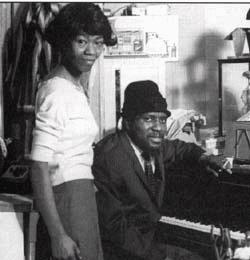
Nellie and Thelonious Monk


Nellie Monk (1921-2002)

http://www.npr.org/blogs/ablogsupreme/2009/12/the_women_who_made_thelonious_monk.html

All,

See what I said about "Genius and Recognition" in my previous post below about Monk, Baraka, and Robin Kelley? Well, that admonition goes
DOUBLE here. So thank you, Thank you, THANK YOU Mrs. Barbara Monk, Mary Lou Williams, Alberta Simmons, and Nellie Smith Monk (the one Thelonious always "crepesculed" with) for being absolutely instrumental as well as essential in the formation and growth of one of the greatest and most important artists of the 20th century...

Kofi


The Women Who Made Thelonious Monk
by Walter Ray Watson
National Public Radio--NPR

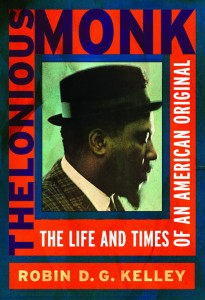
My story about Thelonious Monk biographer Robin D.G. Kelley ran on All Things Considered yesterday. But wait! There's much more to say: Kelley's new book, Thelonious Monk: The Life and Times of An American Original, takes considerable pains to acknowledge the support of women in the life of the musician.


The photo ID of Barbara Monk, Thelonious Monk's mother, shows that she was employed by the City of New York to clean public offices. (courtesy of the Thelonious Monk Estate)


First, there's his mother, Barbara Monk, who moved to New York City with Thelonious Monk Sr., and their three children: Thomas, the eldest; his sister Marion, and Thelonious Jr., the youngest child. The family moved to New York City to escape the farm life they had known in North Carolina. Thelonious Sr. eventually returned to Carolina, and Monk's mother and sister raised the family. Barbara Monk cleaned city offices to support her kids. When the youngest Monk began skipping classes during his senior year at Stuyvesant High School -- and eventually left altogether -- it was Barbara Monk who encouraged him to take that leap of faith.

A few years earlier, she had also supported Thelonious Jr.'s decision to follow a Christian evangelist, a woman whose name was never known to the family (and whose precise religious affiliation was just as hard to pin down), on a barnstorming tour of Midwestern towns for nearly two years.

As Kelley recounts in his book, Monk's travels through Kansas and other states is the most mysterious and undocumented time in Monk's life. But they were also perhaps his most fruitful years as an itinerant artist, learning how to call tunes on the spot, and how to respond to both musicians and audiences in the moment.

There was also a piano teacher early in Monk's development named Alberta Simmons. Kelley learned about Simmons' life from her daughter, Alberta Webb; Simmons, born in 1892, died long ago. Alberta Simmons was a performer, and assimilated the stride styles of Fats Waller, James P. Johnson and Eubie Blake. She played the Clef Club, speakeasies in New York City, and even went out to Flushing, Queens for gigs. But as Webb told Kelley, "Being a woman, [Simmons] got sort of sidetracked trying to raise her children. Unfortunately things did not work out in later years."

Kelley's detective work found New York census records of Alberta Simmons at five year intervals. As time progressed, Simmons reported her career as piano teacher, and, in later years, "domestic worker." But before her earnings as a teacher dried up, Thelonious Monk learned stride piano from the woman. Monk was known to visit the home of James P. Johnson, and attend "cutting sessions" by other famed stride practitioners. But early on, Alberta Simmons showed him the way.

Kelley told me that Alberta Simmons never got the chance to make a recording, so there's no sample artifact of her playing style. Her daughter, Alberta Webb, told Kelley that she unfortunately had no photographs of her mother to share either -- and Webb died before the publication of Kelley's book. It's one of Kelley's regrets, he says. (Then again, you develop a mountain of regrets when you interview 300 people, read countless lost articles and spend 14 years on a mission that no one quite believes you would complete.) On the bright side, Kelley says that it's not much of a leap to think of Monk's 1956 solo recording of "Memories of You," the Andy Razaf/Eubie Blake song, as his tribute to Alberta Simmons. According to Kelley's research, she played this tune often, as if it were her own. Here's an excerpt (from The Unique Thelonious Monk, originally issued on Riverside Records):


Then, of course, there's his wife, Nellie Monk. She can't be underestimated for her role as partner, protector, career manager and supporter of Thelonious Monk. She gave her husband the space and time to develop his musical sense of space and time. She also cleaned private homes and worked as a seamstress in the lean years: The period when his music was dismissed or ignored by critics, thus making him a hard sell to the public, to club managers and to anyone considering him for studio recordings.

Last but not least, there's the great pianist and composer Mary Lou Williams, who defended, promoted and befriended Monk. Reportedly, she first heard him as a young man in Kansas City while he was touring with that mysterious traveling evangelist. She later helped him get gigs in New York, and introduced him to a great deal of music. Kelley writes that despite Monk's Baptist roots and travels with evangelical revivals, he attended Catholic churches with Williams. Among the home recordings Kelley was exposed to by the Monk Estate were these pieces that Williams arranged and wrote out for Monk to try. Hear Monk practice "All God's Chillun Got Rhythm."

Takes One and Two:


Take Three:


Robin Kelley also sent me an unpublished excerpt he wrote about the music.

After ending his home recording of "Body and Soul" abruptly, Mr. Monk then shuffles some papers on the piano and announces, with the enthusiasm of a kid in a toy store, "Now let me see how we make out with this now. Mmmmm!" He then proceeds to tentatively work through an arrangement of "All God's Chillun Got Rhythm" -- a Gus Kahn and Bronislau Kaper composition Mr. Monk never recorded nor included in his repertoire. The initial choruses sound a lot like Mary Lou Williams' 1946 trio recording (Classics Records 1050) of the song, which I confirmed when archivist Ann Kuebler helped me locate the arrangement (titled simply "Chillun") in Ms. Williams' papers at the Institute for Jazz Studies. It is likely that Mr. Monk had a copy of her arrangement from the 1940s since they exchanged quite a bit of music during the early days of bebop. In particular, Mr. Monk takes from the arrangement Ms. Williams' rephrasing of the melody, the ascending arpeggios in the third and fourth bar of the song's A section, and the key signature: A-flat ... By the second take, he begins to incorporate more of his own unique phrases and improvised lines, including a striding left hand and dissonant clusters in the piano's upper register. Perhaps as a tribute to Mary Lou Williams, his final six bar cadence incorporates the kind of "boogie woogie" left hand figures Ms. Williams often used. By the third take, "Chillun" is entirely his own. Opening rubato, almost ballad-like, Mr. Monk throws in an unusual bass line in bars 9-12 and shifts into stride piano, over which he plays several high register phrases over and over to see what they sound like. By the time he returns to the melody, Mrs. Nellie Monk adds her singing voice and Mr. Monk closes with a tag similar to what he plays at the end of Gershwin's "Nice Work if You Can Get It."

Also, Mary Lou recorded this [arrangement] on October 7, 1946 (three days before Monk's 29th birthday). Unique are her phrasing of the melody and, most importantly, the bass line, in bars 3 and 4 of the A section; those ascending arpeggios. Notice how he echoes her phrasing throughout, especially in early takes of the song.
Here's the first 'A' section of Mary Lou's version:


Now go back and listen to Monk's versions with this information: The context makes a huge difference.

As long as Monk's legacy still rings in our ears, the women who contributed to Monk's development as a child, student, artist and man are to be honored. (And then there's the Baroness Pannonica de Koenigswarter, but that's another story in itself.) Thanks to Robin Kelley for keeping their gifts to the music alive, if not unearthing them altogether.

7:45 PM ET | 12-30-2009 | permalink

MONK, BARAKA, AND KELLEY: The Joyous Confluence of Great Music & Great Writing

Thelonious Monk

Amiri Baraka


From: The Independent Ear
Nov 17, 2009
http://www.openskyjazz.com/blog/?p=201


"THE ONLY CATS WORTH ANYTHING ARE THE CATS WHO TAKE CHANCES."

--THELONIOUS MONK

All,

LIKE ALWAYS GENIUS RECOGNIZES GENIUS--WITNESS: MONK, BARAKA, KELLEY.

HOLLA!

KOFI


HAPPY NEW TEARS EVERYBODY!!


Robin D.G. Kelley, author of the exhaustively-researched and superb new Thelonious Monk biography Thelonious Monk: The Life and Times of An American Original (Free Press, an imprint of Simon & Schuster), contributed the following piece to the recent 75th birthday commemoration for Amiri Baraka. He granted re-print permission to The Independent Ear. Read Robin’s contribution to our ongoing dialogue between African American music writers: Ain’t But a Few of Us by clicking on the month of October.


Author & USC Professor Robin D.G. Kelley


What Amiri Baraka Taught Me About Thelonious Monk
by Robin D.G. Kelley

"Monk was my main man."
— Amiri Baraka

I just spent the past fourteen years of my life researching and writing a biography of pianist/composer Thelonious Monk, and over thirty years attempting to play his music. My obsession with Monk can be traced back to many things and many people, but paramount among them is Amiri Baraka. Let me explain.

My path to "jazz" began like so many others of my generation who came of age in the late 1970s — with the funky commercial fusions of Grover Washington, Jr., Bob James, Patrice Rushen, Earl Klugh, Ronnie Laws, through Stanley Clarke and Chick Corea. But inexplicably, at the tender age of seventeen or eighteen I took a giant leap directly into the so-called "avant-garde", or the New Thing. By 1980, the New Thing wasn’t so new (and as Baraka and others have shown us, it wasn’t so new in the 1960s), but the music appealed to my rebellious attitude, my faux sense of sophistication, and to the way I heard the piano. As a young neophyte piano player and sometimes bassist, my heroes became Cecil Taylor, Eric Dolphy, Ornette Coleman, Don Cherry, Archie Shepp, late ‘Trane, the Art Ensemble of Chicago, those cats. I knew almost nothing about bebop, nor could I name anyone in Ellington’s orchestra except for Duke. I just thought free jazz was the beginning and end of all "real" music. My stepfather introduced me to Charlie Parker, Monk, Bud Powell, Dexter Gordon, but I wasn’t yet ready to fully appreciate bebop. Then in one of my many excursions to "Acres and Acres of Books" in Long Beach, California, I picked up two used paperbacks by one LeRoi Jones: Blues People and Black Music.

I dove into Black Music first. Imagine my surprise when I discovered a thoughtful piece on Monk in a book that I understood then to be a collection of essays primarily about the "New Thing." Don’t get me wrong; I dug Monk from the first listen. I had heard an LP recorded live at the Five Spot Cafe with Monk and tenor saxophonist Johnny Griffin. I wore it out, especially their rendition of Monk’s "Evidence". But Monk wasn’t part of the jazz avant-garde. He was already an old man when Ornette Coleman made his debut, or so I thought. Baraka’s Black Music corrected me, schooling me on the roots and branches of free jazz. Between his piece on "Recent Monk," his brilliant treatise, "The Changing Same (R&B and the New Black Music)," and several other pieces on white critics and the jazz avant-garde, I began to hear Monk and "free jazz" quite differently. It was Baraka who dubbed the jazz avant-garde the "New Black Music," insisting that it emerged directly out of a Black tradition, bebop, as opposed to the Third Stream experiements of Gunther Schuller, Lee Konitz, and Lennie Tristano. While Black musicians might have milked Western classical traditions for definitions and solutions to the "engineering" problems of contemporary jazz, Europe is not the source. "[J]azz and blues," he writes, "are Western musics; products of an Afro-American culture."

Of the few hundred times I listened to Monk, Johnny Griffin, drummer Roy Haynes, and bassist Ahmed Abdul-Malik tear the roof off the Five Spot, I probably heard Baraka, shouting his approval and urging them on from his table near the bandstand. It was August of 1958 and Baraka (when he was still LeRoi Jones) had been an East Village resident for the past year. He became a Five Spot regular when Coltrane was with Monk in the summer and fall of 1957. His constant presence gave him unique insights into Monk’s music and the challenges it created for the musicians who played with him. Indeed, Baraka was one of the few critics to admit that "opening night [Coltrane] was struggling with all the tunes." Baraka just didn’t come to dig the music, he studied Monk.

In fact, he was arguably the first American critic, along with Martin Williams, to really understand what Monk was doing and why a new generation of self-described avant-garde musicians was drawn to Monk’s music and his ideas. By the time Baraka entered the fray, most critics had either dismissed Monk for having no technique or formal training as a pianist, or they praised him for his eccentricity and inventiveness precisely for his lack of technique or formal training. For Baraka, the whole issue of Monk’s technique was nonsense: "I want to explain technical so as not to be confused with people who think that Thelonious Monk is ‘a fine pianist, but limited technically.’ But by technical, I mean more specifically being able to use what important ideas are contained in the residue of history or in the now-swell of living. For instance, to be able to double time Liszt piano pieces might help one become a musician, but it will not make a man aware of the fact that Monk was a greater composer than Liszt. And it is the consciousness, on whatever level, of facts, ideas, etc., like this that are the most important parts of technique."

While Baraka’s fellow Beat generation writers embraced Monk because they heard spontaneous, instinctual feeling and emotion as opposed to intellect, Baraka saw no such opposition; he was careful not to divorce consciousness and intellect from emotion. He writes, "The roots, blues and bop, are emotion. The technique, the ideas, the way of handling the emotion. And this does not leave out the consideration that certainly there is pure intellect that can come out of the emotional experience and the rawest emotions that can proceed from the ideal apprehension of any hypothesis." Like his insights about Monk’s technique, the point underscored Baraka’s general claim that bebop was roots music, no matter how deep the imperative for experimentation, because it carries deep emotions, historical and personal. The music of the Blues People.

And if Thelonious Monk was anything, he was Blues People. Born in Rocky Mount, North Carolina, the grandson of enslaved Africans, delivered by a midwife who was thirteen when Emancipation Day came, Monk was raised by parents who grew up picking cotton and survived on odd jobs and cleaning white folks’ homes. His mother brought Thelonious and his two siblings to New York in search of a better life, and while they enjoyed more opportunities the Monks settled in the poor, predominantly black neighborhood of San Juan Hill (West 63rd Street, Manhattan). Thelonious grew up listening to the blues, jazz, the rhythms of calypso and merengue, hymns and gospel music (he spent two years traveling through the Midwest with an evangelist). His mother Barbara, scrubbed floors to pay for his classical piano lessons, and Monk continued his studies under the tutelage of the great Harlem stride pianists of the day. Monk told pianist Billy Taylor "that Willie "The Lion’ and those guys that had shown him respect had… ‘empowered’ him… to do his own thing. That he could do it and that his thing is worth doing. It doesn’t sound like Tatum. It doesn’t sound like Willie ‘The Lion’. It doesn’t sound like anybody but Monk and this is what he wanted to do. He had the confidence. The way that he does those things is the way he wanted to do them."

Willie ‘The Lion’ never mentions Thelonious in his memoirs, but he described the all-night cutting sessions which sharpened Monk’s piano skills: "Sometimes we got carving battles going that would last for four or five hours. Here’s how these bashes worked: the Lion would pound the keys for a mess of choruses and then shout to the next in line, ‘Well, all right, take it from there,’ and each tickler would take his turn, trying to improve on a melody… We would embroider the melodies with our own original ideas and try to develop patterns that had more originality than those played before us. Sometimes it was just a question as to who could think up the most patterns within a given tune. It was pure improvisation." A later generation of bebop pianists would often be accused of one-handedness; their right hands flew along with melodies and improvisations, while their "weak" left hands just plunked chords. A weak left hand was one of Smith’s pet peeves among the younger bebop piano players. "Today the big problem is no one wants to work their left hand — modern jazz is full of single-handed piano players. It takes long hours of practice and concentration to perfect a good bass moving with the left hand and it seems as though the younger cats have figured they can reach their destination without paying their dues."

Teddy Wilson, though only five years older than Monk but considered a master tickler of the swing generation, had nothing but praise for Thelonious’s piano playing. "Thelonious Monk knew my playing very well, as well as that of Tatum, [Earl] Hines, and [Fats] Waller. He was exceedingly well-grounded in the piano players who preceded him, adding his own originality to a very sound foundation." Indeed, it was this very foundation that exposed him to techniques and aesthetic principles that would become essential qualities of his own music. He heard players "bend" nots on the piano, or turn the beat around (the bass note on the one and three might be reversed to two and four, either accidentally or deliberately), or create dissonant harmonies with "splattered notes" and chord clusters. He heard things in those parlor rooms and basement joints that, to modern ears, sounded avant-garde. They loved to disorient listeners, to displace the rhythm by playing in front or behind the beat, to produce surprising sounds that can throw listeners momentarily off track. Monk embraced these elements in his own playing and exaggerated them.

Finally, Baraka was one of the first critics to predict that Monk’s long awaited success in the early 1960s might negatively impact his music. Indeed, this was the point of his essay, "Recent Monk." Thelonious’s fan base had expanded considerably after he signed with Columbia Records, made a couple of international tours, and appeared on the cover of Time Magazine in 1964. But Baraka noted that Monk’s quartet, like so many successful groups, began to fall into a routine that sometimes dulled the band’s sense of adventure. Baraka warned, "once [an artist] had made it safely to the ‘top,’ [he] either stopped putting out or began to imitate himself so dreadfully that early records began to have more value than new records or in-person appearances… So Monk, someone might think taking a quick glance, has really been set up for something bad to happen to his playing." To some degree, Baraka thought this was already happening and he placed much of the blame on his sidemen. Of course, Monk hired great musicians during this period — Charlie Rouse (tenor sax), bassists Butch Warren and Larry Gales, and drummers Frankie Dunlap and Ben Riley. But the repertoire remained pretty much the same, and the fire slowly dissipated. Monk himself continued to play remarkably, but there was an element of predictability that overrode all the amazing things he was doing. "{S}ometimes," Baraka lamented, "one wishes Monk’s group wasn’t so polished and impeccable, and that he had some musicians with him who would be willing to extend themselves a little further, dig a little deeper into the music and get out there somewhere near where Monk is, and where his compositions always point to."

Baraka never gave up on Monk, and while I can’t prove it I suspect Monk’s music continues to have a strong philosophical and aesthetic influence on both his literary and political work. But more than anything, I will always be grateful to Baraka for helping me discover Monk, for revealing that Monk’s rootedness in this history, in family, in tradition explains why his music, as modern as it is, can sound like it’s a century old. It explains why he always remained a stride pianist; why his repertoire was peppered with sacred classics like "Blessed Assurance" and "We’ll Understand it Better, By and By"; and why the careful listeners can hear in Monk’s whole-tone runs, forearm clusters, unusual tempos and spaces, shouts, field hollers, the rhythm of a slow moving train, rent parties, mourners, children playing stickball and marbles, and the Good Humor or Mr. Softee truck on a summer evening.

Like most scholars and other voyeurs, we are always listening for, and looking at, art for personal tragedy rather than collective memory, collective histories. Amiri Baraka understood the fallacy of this approach. Perhaps this is why he writes in the poem "Funk Lore" (one of several associated with Monk):

That’s why we are the blues
Ourselves
That’s why we
Are the
Actual
song

It should be noted that the source of the various passages from Baraka’s writings on Monk, as well as the interview segments and book passages Mr. Kelley quotes in this appreciation of Amiri Baraka are meticulously footnoted — as they are in Kelley’s exhaustively-researched book. For the sake of webzine brevity we elected not to include Robin’s footnotes and source materials… and also to urge you to run out and purchase your copy of Thelonious Monk: The Life and Times of An American Original… and do that with a quickness!

Referencing this special book, here’s a passage on Ellington’s sense of Thelonious (chapter 10, p. 138) during a time when Monk and his music were widely misunderstood, or dismissed as some sort of hopeless eccentric by musicians, critics, and the listening public:

"During the summer of 1948, while Duke Ellington’s band was traveling by train in the southern coast of England, trumpter Ray Nance decided to pass the time away by listening to records on a little portable phonography he had picked up. "I put on one of my Thelonious Monk records. Duke was passing by in the corridor, and he stopped and asked ‘Who’s that playing?’ I told him. ‘Sounds like he’s stealing some of my stuff,’ he said. So he sat down and listened to my records, and he was very interested. He understood what Monk was doing."