Tuesday, November 30, 2010

Chris Hedges On The Paramount Necessity of Resistance in the Fight For Real Change

http://www.truth-out.org/real-hope-is-about-doing-something65501


All,

As usual the indefatigable and fearless Chris Hedges goes for the gusto--like it or not. It takes real intellectual and moral courage these daze to find a reason to stubbornly fight for what one knows is right and to relentlessly call the many responsible parties out for their betrayal even if the odds are overwhelmingly against you and so many people think you're a fool to seriously demand something better and actively stand on principle to try to bring it about. Thankfully, Hedges is such a human being in a society and culture that has passively and tragically largely given itself over to massive institutional and pseudophilosophical forces that clearly seek to manipulate, corrupt, and destroy the world in the name of power, greed, hatred, hubris, hypocrisy, lies, fear, ignorance, and arrogance. Yet Hedges continues to write, fight, and organize in the face of a contemptuous Leviathan we stupidly and insanely call and trumpet as "American Exceptionalism." Meanwhile, Hedges and a few brave souls like him absolutely refuses to kowtow to and play the infantile supplicant for the rancid nativist aristocracy who typically are butt naked Emperors genuflecting to their own delusional fantasies of grandeur. The good news in the wake of all the ugly noise and despair is that Hedges knows better and continues to ACT on that knowledge--and so do we...

Kofi


Real Hope Is About Doing Something
Monday 29 November 2010
by: Chris Hedges | Truthdig | Op-Ed


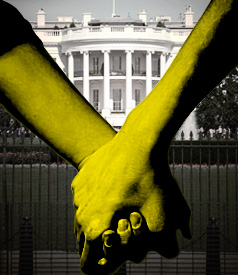
(Image: Jared Rodriguez / t r u t h o u t; Adapted: afagen, Brett Sayer)


On Dec. 16 I will join Daniel Ellsberg, Medea Benjamin, Ray McGovern and several military veteran activists outside the White House to protest the futile and endless wars in Iraq and Afghanistan. Many of us will, after our rally in Lafayette Park, attempt to chain ourselves to the fence outside the White House. It is a pretty good bet we will all spend a night in jail. Hope, from now on, will look like this.

Hope is not trusting in the ultimate goodness of Barack Obama, who, like Herod of old, sold out his people. It is not having a positive attitude or pretending that happy thoughts and false optimism will make the world better. Hope is not about chanting packaged campaign slogans or trusting in the better nature of the Democratic Party. Hope does not mean that our protests will suddenly awaken the dead consciences, the atrophied souls, of the plutocrats running Halliburton, Goldman Sachs, ExxonMobil or the government.

Hope does not mean we will halt the firing in Afghanistan of the next Hellfire missile, whose explosive blast sucks the oxygen out of the air and leaves the dead, including children, scattered like limp rag dolls on the ground. Hope does not mean we will reform Wall Street swindlers and speculators, or halt the pillaging of our economy as we print $600 billion in new money with the desperation of all collapsing states. Hope does not mean that the nation’s ministers and rabbis, who know the words of the great Hebrew prophets, will leave their houses of worship to practice the religious beliefs they preach. Most clerics like fine, abstract words about justice and full collection plates, but know little of real hope.

Hope knows that unless we physically defy government control we are complicit in the violence of the state. All who resist keep hope alive. All who succumb to fear, despair and apathy become enemies of hope. They become, in their passivity, agents of injustice. If the enemies of hope are finally victorious, the poison of violence will become not only the language of power but the language of opposition. And those who resist with nonviolence are in times like these the thin line of defense between a civil society and its disintegration.

Hope has a cost. Hope is not comfortable or easy. Hope requires personal risk. Hope does not come with the right attitude. Hope is not about peace of mind. Hope is an action. Hope is doing something. The more futile, the more useless, the more irrelevant and incomprehensible an act of rebellion is, the vaster and the more potent hope becomes. Hope never makes sense. Hope is weak, unorganized and absurd. Hope, which is always nonviolent, exposes in its powerlessness the lies, fraud and coercion employed by the state. Hope does not believe in force. Hope knows that an injustice visited on our neighbor is an injustice visited on us all. Hope posits that people are drawn to the good by the good. This is the secret of hope’s power and it is why it can never finally be defeated. Hope demands for others what we demand for ourselves. Hope does not separate us from them. Hope sees in our enemy our own face.

Hope is not for the practical and the sophisticated, the cynics and the complacent, the defeated and the fearful. Hope is what the corporate state, which saturates our airwaves with lies, seeks to obliterate. Hope is what our corporate overlords are determined to crush. Be afraid, they tell us. Surrender your liberties to us so we can make the world safe from terror. Don’t resist. Embrace the alienation of our cheerful conformity. Buy our products. Without them you are worthless. Become our brands. Do not look up from your electronic hallucinations to think. No. Above all do not think. Obey.

W.H. Auden wrote:

Faces along the bar
Cling to their average day:
The lights must never go out,
The music must always play,
All the conventions conspire
To make this fort assume
The furniture of home;
Lest we should see where we are,
Lost in a haunted wood,
Children afraid of the night
Who have never been happy or good.

The powerful do not understand hope. Hope is not part of their vocabulary. They speak in the cold, dead words of national security, global markets, electoral strategy, staying on message, image and money. The powerful protect their own. They divide the world into the damned and the blessed, the patriots and the enemy, the rich and the poor. They insist that extinguishing lives in foreign wars or in our prison complexes is a form of human progress. They cannot see that the suffering of a child in Gaza or a child in the blighted pockets of Washington, D.C., diminishes and impoverishes us all. They are deaf, dumb and blind to hope. Those addicted to power, blinded by self-exaltation, cannot decipher the words of hope any more than most of us can decipher hieroglyphics. Hope to Wall Street bankers and politicians, to the masters of war and commerce, is not practical. It is gibberish. It means nothing.

I cannot promise you fine weather or an easy time. I cannot assure you that thousands will converge on Lafayette Park in solidarity. I cannot pretend that being handcuffed is pleasant. I cannot say that anyone in Congress or the White House, anyone in the boardrooms of the corporations that cannibalize our nation, will be moved by pity to act for the common good. I cannot tell you these wars will end or the hungry will be fed. I cannot say that justice will roll down like a mighty wave and restore our nation to sanity. But I can say this: If we resist and carry out acts, no matter how small, of open defiance, hope will not be extinguished. If all we accomplish is to assure a grieving mother in Baghdad or Afghanistan, a young man or woman crippled physically and emotionally by the hammer blows of war, that he or she is not alone, our resistance will be successful. Hope cannot be sustained if it cannot be seen.

Any act of rebellion, any physical defiance of those who make war, of those who perpetuate corporate greed and are responsible for state crimes, anything that seeks to draw the good to the good, nourishes our souls and holds out the possibility that we can touch and transform the souls of others. Hope affirms that which we must affirm. And every act that imparts hope is a victory in itself.

Also from Auden:

Defenseless under the night
Our world in stupor lies;
Yet, dotted everywhere,
Ironic points of light
Flash out wherever the Just
Exchange their messages:
May I, composed like them
Of Eros and of dust,
Beleaguered by the same
Negation and despair,
Show an affirming flame.


Chris Hedges is a senior fellow at The Nation Institute. His newest book is “Death of the Liberal Class.” More information on the Dec. 16 protest can be found at http://www.stopthesewars.org

Monday, November 29, 2010

American Politics 2010: Playing Infantile Games With Our Future Instead of Addressing Social and Economic Reality

http://www.nytimes.com/2010/11/30/us/politics/30freeze.html?_r=1&emc=na

All,

This is still more bullshit political gamesmanship and time diverting antics by President Obama masquerading as a honest and forthright attempt to address the red herring issue of "deficit spending" (which is now nothing more than a demagogic code phrase used by the wildly profligate and irresponsible Republican hypocrites in Congress who under the super corporate regime of Bushwhacker 2 was responsible for the largest increase in the federal deficit in the entire history of the United States!). The reason that the issue of the deficit is fundamentally a red herring and thus largely a manufactured political crisis at this point is not that there isn't a major problem with the federal budget being seriously out of whack economically as a direct result of a decade of massive tax cuts for the rich, virtually no legal or governmental regulation at all of Wall Street and the general financial sector of the economy, and a stubbornly insistent and steadfast refusal on the part of the Bush rightwing federal government and the private corporate sector to properly invest in education, health care reform, labor protection, social and economic infrastructure, a sound and progressive energy policy, real climate control, and a genuinely strong and effective environmental protection policy. Clearly all these things and more have thus contributed to the huge growth of a clearly untenable and absolutely unsustainable budgetary mess that MUST be addressed in a serious and responsible manner by the government at some point...

So NO the reason that the issue of "deficit spending" is a political red herring is NOT that major reform and real "change" is not needed to bring the government's and the larger economy's house in order. No. The reason is that neither the Democrats nor the Republicans want to do what is really necessary to fundamentally improve and transform the economy and the general society in the progressive direction of a far more just, fair, democratic, and equitable system than what currently exists. That would require that the wealthy elites and elected political representatives of every branch of government be held directly accountable and responsible on a political, ethical, economic and ideological scale that was unprecedented in American history. You know--actual social and economic Democracy instead of the criminally corrupt Plutocracy that currently dominates and controls our political and economic system...

Meanwhile President Obama and the two major political parties keep playing an irresponsible, time wasting, very dangerous, and ultimately lethal cat-and-mouse game of brinksmanship to see who blinks first in public from the self serving standpoint of the 2012 electoral sweepstakes. What all this grandstanding (and especially among the Republicans and their demented "Tea Party" cohorts) petty vindictive tactics really means is that NOTHING important, substantive, real, necessary, or useful will emerge from either major political party to solve or seriously address any of the many major problems and crises facing the American people in general and especially the poor, working, and lower middle class who constitute the overwhelming majority of those citizens being ravaged and destroyed by the current economy and civil society...

Kofi


Obama to Freeze Pay for Most Federal Workers
By PETER BAKER
November 29, 2010
New York Times


WASHINGTON — President Obama plans to announce a two-year pay freeze for civilian federal workers on Monday in his latest move intended to demonstrate concern over sky-high deficit spending.

The president’s proposal will effectively wipe out plans for a 1.4 percent across-the-board raise in 2011 for 2.1 million civilian federal government employees, including those working at the Defense Department, but the freeze would not affect the nation’s uniformed military personnel. The president has frozen the salaries of his own top White House staff members since taking office 22 months ago.

“Clearly this is a difficult decision,” said Jeffrey Zients, deputy director of the Office of Management and Budget and the government’s chief performance officer. “Federal workers are hard-working and dedicated.” But given the deficit, Mr. Zients added, “we believe this is the first of many difficult steps ahead.”

The pay freeze will save $2 billion in the current fiscal year that ends in September 2011, $28 billion over five years and more than $60 billion over 10 years, officials said. That represents just a tiny dent in a $1.3 trillion annual deficit, but it offers a symbolic gesture toward public anger over unemployment, the anemic economic recovery and rising national debt.

Mr. Zients said the president planned to announce the plan on Monday because of an approaching legal deadline for submitting a pay plan to Congress. But by doing it now, the president also effectively gets ahead of Republicans who have been talking about making such a move once they take over the House, and assume more seats in the Senate, in January. Some Republicans have gone further, proposing to slash federal worker salaries.

The number of federal workers making more than $150,000 a year has grown 10-fold in the last five years and doubled since Mr. Obama took office, according to a USA Today study this month. Since 2000, federal pay and benefits have increased 3 percent annually above inflation, compared with 0.8 percent for private sector workers, according to data cited by the newspaper.

This is not the first time Mr. Obama has addressed government pay to make a political point. In addition to freezing the salaries of top White House staff members when he took office, he later extended that freeze to political appointees throughout the government and canceled their bonuses.

The chairmen of a fiscal commission appointed by Mr. Obama have proposed a three-year freeze for federal employees in a draft report. The commission is supposed to issue a final report by Wednesday.


Frank Rich On The Tyranny of Big Money in American Politics

http://www.nytimes.com/2010/11/28/opinion/28rich.html?src=me&ref=general

All,

The best damn political journalist writing for a major newspaper today--the always highly informative and razor sharp analyst Frank Rich--once again lays out in very precise terms exactly what has gone wrong and why, and what we need to do to fix it...

Kofi


OP-ED COLUMNIST

Still the Best Congress Money Can Buy
By FRANK RICH
November 27, 2010
New York Times


SO America’s latest crisis — until it wasn’t — was airport screeners touching our junk. As this long year lurches toward its end, we all agree that something has gone wrong in America, and we’re desperately casting about for a coherent explanation for our discontent, if not a scapegoat. Alas, the national consensus that the T.S.A. and full-body scans might be the source of all evil fizzled in less than a week. Most everyone got to Grandma’s house for Thanksgiving without genital distress.


Damon Winter/The New York Times

Frank Rich

The previous transient scapegoat was the Democrats. They were punished in yet another “wave” election — our third in a row — where voters threw Washington’s bums out. But most of the public remains bummed out nonetheless. In late October, the NBC News-Wall Street Journal poll found that only 31 percent of respondents believed that America was on the right track. When the survey asked the same question after the shellacking, the percent of optimists jumped to ... 32. Regardless of party or politics, there’s a sense a broken country can’t be fixed. Few have faith that even “wave” elections are game-changers anymore.

The larger explanations for this dysfunction are well-worn by now, from the impotence of the filibuster-bound United States Senate to the intractable polarization of an electorate divided more or less 50-50 since Bush v. Gore. Such is the bipartisanship of the funk that Jon Stewart and Glenn Beck each succeeded in bringing off well attended rallies in Washington to commiserate over the country’s political and governmental stagnation — with each rally offering its competing diagnosis.

For Stewart, the hyperpartisanship of the modern news media remains the nation’s curse. “The country’s 24-hour politico pundit panic conflict-onator did not cause our problems,” he told the throngs at his rally to “restore sanity,” but it “makes solving them that much harder.” At Beck’s rally to “restore honor,” the message seemed to be that America’s principal failing is a refusal to recognize that God “is our king.” If Stewart’s antidote was more civility, Beck’s was more prayer.

Stewart’s point is indisputable as far as it goes. Beck’s, not so much: If prayer hasn’t cured this highly prayerful nation by now, it may be because our body politic has long since developed an immunity to it. But both rallies, for all the commotion they generated, have already faded to the status of quirky historical footnotes. The reason is that neither addressed the elephant in the room — or the donkey. That would be big money — the big money that dominates our political system, regardless of who’s in power. Two years after the economic meltdown, most Americans now recognize that that money has inexorably institutionalized a caste system where everyone remains (at best) mired in economic stasis except the very wealthiest sliver.

The Great Depression ended the last comparable Gilded Age, of the 1920s, and brought about major reforms in American government and business. Not so the Great Recession. Last week, as the Fed’s new growth projections downsized hope for significant decline in the unemployment rate, the Commerce Department reported that corporate profits hit a record high. Those profits aren’t trickling down into new jobs or into higher salaries for those not in the executive suites. And the prospect of serious regulation of those at the top of the top — the financial sector — is even more of a fantasy in the new Congress than it was in its predecessor.

Wall Street is already celebrating the approach of bonus season by partying like it’s 2007. In The Times’s account of this return to conspicuous consumption, we learned of a Morgan Stanley trader, since fired for unspecified reasons, who went to costly ends to try to hire a dwarf for a Miami bachelor party prank that would require the dwarf to be handcuffed to the bachelor. If this were a metaphor — if only! — Wall Street would be the bachelor, and America the dwarf, involuntarily chained to its master’s hedonistic revels and fiscal recklessness with no prospect for escape.

As John Cassidy underscored in a definitive article titled “Who Needs Wall Street?” in The New Yorker last week, the financial sector has paid little for bringing the world to near-collapse or for receiving the taxpayers’ bailout that was denied to most small-enough-to-fail Americans. The sector still rakes in more than a fourth of American business profits, up from a seventh 25 years ago. And what is its contribution to America in exchange for this quarter-century of ever-more over-the-top rewards? “During a period in which American companies have created iPhones, Home Depot and Lipitor,” Cassidy writes, the industry reaping the highest profits and compensation is one that “doesn’t design, build or sell a tangible thing.”

It’s an industry that can buy politicians as easily as it does dwarfs, which is why government has tilted the playing field ever more in its direction for three decades. Now corporations of all kinds can buy more of Washington than before, thanks to the Supreme Court’s Citizens United decision and to the rise of outside “nonprofit groups” that can legally front for those who prefer to donate anonymously. The money laundering at the base of Tom DeLay’s conviction by a Texas jury last week — his circumventing of the state’s post-Gilded Age law forbidding corporate campaign contributions directly to candidates — is now easily and legally doable at the national level.

There are plenty of Americans who don’t endorse Stewart’s indictment of cable news; there’s even a reasonably large group that doesn’t buy Beck’s perceived shortfall in American religiosity. But seemingly everyone is aggrieved about the hijacking of the political system by anonymous special interests. The most recent Times-CBS News poll found that an extraordinary 92 percent of Americans want full disclosure of campaign contributors — far many more than, say, believe in evolution. But they will not get their wish anytime soon. “I don’t think we can put the genie back in the bottle,” said David Axelrod as the Democrats prepared to play catch-up to the G.O.P.’s 2010 mastery of outside groups and clandestine corporate corporations.

The story of recent corporate political donations — which we may never learn in its entirety — is just beginning to be told. Bloomberg News reported after Election Day that the United States Chamber of Commerce’s anti-Democratic war chest included a mind-boggling $86 million contribution from the insurance lobby to fight the health care bill. The Times has identified other big chamber donors as Prudential Financial, Goldman Sachs and Chevron. These are hardly the small businesses that the chamber’s G.O.P. allies claim to be championing.

Since the election, the Obama White House has sent signals that it will make nice to these interests. While the president returns to photo ops at factories, Timothy Geithner has already met with the chamber’s board out of camera range. In a reportorial coup before Election Day, the investigative news organization ProPublica wrote of the similarly behind-closed-doors activities of the New Democrat Coalition — “a group of 69 lawmakers whose close relationship with several hundred Washington lobbyists” makes them “one of the most successful political money machines” since DeLay’s K Street Project collapsed in 2007. During the Congressional battle over financial-services reform last May, coalition members repaired to a retreat on Maryland’s Eastern Shore to frolic with lobbyists dedicated to weakening the legislation.

Such is the ethos in his own party that Senator Jim Webb, Democrat of Virginia, complained this month that he “couldn’t even get a vote” for his proposal for a one-time windfall profits tax on Wall Street bonuses. Republicans “obviously weren’t going to vote for it,” he told Real Clear Politics, but Democrats also demurred, “saying that any vote like that was going to screw up fund-raising.”

Roughly two-thirds of the New Democrat Coalition’s House contingent won re-election on Nov. 2. Now they’ll have more Republican allies in both houses of Congress. Tea Party populists — already being betrayed by one Senate leader, Jon Kyl, on the supposed pledge against earmarks — may soon be as disillusioned as those Democrats who had hoped Barack Obama’s economic team wouldn’t look like Wall Street.

For all the McConnell-Boehner rhetorical pandering to Tea Partiers, the health care law will not be repealed by Congress — and certainly not any provisions that benefit the G.O.P. establishment’s friends in the health care industry. Over at FreedomWorks, Dick Armey’s Tea-Party-organizing group, there’s much belligerent talk of retribution against corporations seen as too friendly to Obama policies — most notably General Electric. It’s all hot air: G.E.’s political action committees gave a total of $1.6 million to politicians in both parties in 2010, and one of its former high-powered lobbyists, Dan Coats, is the newly elected Republican senator from Indiana and a probable member of the Senate Finance Committee.

America needs a rally — or, better still, a leader or two or three — to restore not just honor or sanity to its citizens but governance that’s not auctioned off to the highest bidder. When it was reported just days before our election that Iran was protecting its political interests in Afghanistan’s presidential palace by giving bags of money to Hamid Karzai’s closest aide, Americans could hardly bring themselves to be outraged. At least with Karzai’s government, unlike our own, we could know for certain whose cash was in the bag.

The Reality of Class Warfare in American Politics Today

http://www.nytimes.com/2010/11/27/opinion/27herbert.html?src=me&ref=general

All,

As Bob Herbert eloquently points out the stark reality of the social and economic tyranny of corporate capitalism in the U.S. today is by far the most important issue facing the American people, and the one both major political parties and their brazenly wealthy elites are most interested in using against us in the name of profit, exploitation, and social control...

Kofi


OP-ED COLUMNIST

Winning the Class War
By BOB HERBERT
November 26, 2010
New York Times

The class war that no one wants to talk about continues unabated.


Damon Winter/The New York Times

Bob Herbert

Even as millions of out-of-work and otherwise struggling Americans are tightening their belts for the holidays, the nation’s elite are lacing up their dancing shoes and partying like royalty as the millions and billions keep rolling in.

Recessions are for the little people, not for the corporate chiefs and the titans of Wall Street who are at the heart of the American aristocracy. They have waged economic warfare against everybody else and are winning big time.

The ranks of the poor may be swelling and families forced out of their foreclosed homes may be enduring a nightmarish holiday season, but American companies have just experienced their most profitable quarter ever. As The Times reported this week, U.S. firms earned profits at an annual rate of $1.659 trillion in the third quarter — the highest total since the government began keeping track more than six decades ago.

The corporate fat cats are becoming alarmingly rotund. Their profits have surged over the past seven quarters at a pace that is among the fastest ever seen, and they can barely contain their glee. On the same day that The Times ran its article about the third-quarter surge in profits, it ran a piece on the front page that carried the headline: “With a Swagger, Wallets Out, Wall Street Dares to Celebrate.”

Anyone who thinks there is something beneficial in this vast disconnect between the fortunes of the American elite and those of the struggling masses is just silly. It’s not even good for the elite.

There is no way to bring America’s consumer economy back to robust health if unemployment is chronically high, wages remain stagnant and the jobs that are created are poor ones. Without ordinary Americans spending their earnings from good jobs, any hope of a meaningful, long-term recovery is doomed.

Beyond that, extreme economic inequality is a recipe for social instability. Families on the wrong side of the divide find themselves under increasing pressure to just hold things together: to find the money to pay rent or the mortgage, to fend off bill collectors, to cope with illness and emergencies, and deal with the daily doses of extreme anxiety.

Societal conflicts metastasize as resentments fester and scapegoats are sought. Demagogues inevitably emerge to feast on the poisonous stew of such an environment. The rich may think that the public won’t ever turn against them. But to hold that belief, you have to ignore the turbulent history of the 1930s.

A stark example of the potential for real conflict is being played out in New York City, where the multibillionaire mayor, Michael Bloomberg, has selected a glittering example of the American aristocracy to be the city’s schools chancellor. Cathleen Black, chairwoman of Hearst Magazines, has a reputation as a crackerjack corporate executive but absolutely no background in education.

Ms. Black travels in the rarefied environs of the very rich. Her own children went to private boarding schools. She owns a penthouse on Park Avenue and a $4 million home in Southampton. She was able to loan a $47,600 Bulgari bracelet to a museum for an exhibit showing off the baubles of the city’s most successful women.

Ms. Black will be peering across an almost unbridgeable gap between her and the largely poor and working-class parents and students she will be expected to serve. Worse, Mr. Bloomberg, heralding Ms. Black as a “superstar manager,” has made it clear that because of budget shortfalls she will be focused on managing cutbacks to the school system.

So here we have the billionaire and the millionaire telling the poor and the struggling — the little people — that they will just have to make do with less. You can almost feel the bitterness rising.

Extreme inequality is already contributing mightily to political and other forms of polarization in the U.S. And it is a major force undermining the idea that as citizens we should try to face the nation’s problems, economic and otherwise, in a reasonably united fashion. When so many people are tumbling toward the bottom, the tendency is to fight among each other for increasingly scarce resources.

What’s really needed is for working Americans to form alliances and try, in a spirit of good will, to work out equitable solutions to the myriad problems facing so many ordinary individuals and families. Strong leaders are needed to develop such alliances and fight back against the forces that nearly destroyed the economy and have left working Americans in the lurch.

Aristocrats were supposed to be anathema to Americans. Now, while much of the rest of the nation is suffering, they are the only ones who can afford to smile.

Saturday, November 27, 2010

Beyond the Delusions of Hagiography and Demonization: The Necessity For A Mature Critique of President Obama


All,

As I and many others have often said the major obstacle to intellectual honesty, critical insight, and political clarity regarding what the Obama administration has and hasn't done since it came to power in the White House is that far too often the President is the passive object of the simpleminded desire of many to assess who and what he is (and what he "represents") on the basis of a servile, even fawning hagiography or an equally mindless and homicidal demonization. Thus the crucial role of seriously engaging in a genuine and substantive criticism of actual policies, programs, and positions advanced by him and his administration has been generally ignored, dismissed, or neglected in favor of either hysterically cynical complaint or smug self satisfied hubris. As a result neither ultimately immature stance has been of productive, useful, and lasting value for those of us in the U.S. citizenry who seek the advocacy and implementation of actual independent ideas, methods, and strategies that will build, fight for, and sustain a well organized national grassroots force for real social change and institutional transformation. It is because none of us who are really serious about this bedrock necessity can possibly accomplish our goals and objectives without directly addressing and dealing with the fundamental role of government and our collective role in it, that we cannot blithely or cynically afford to act as though what the government--and thus the President and his administration-- does and doesn't do is not important or "relevant." It IS important and necessary whether we like it or not and any large scale movement or mass based agenda that pretends otherwise is only wasting valuable time and deluding itself to our own peril.

Thus the paramount value of the leftist political journalist William Greider's prescient and insightful critique and analysis below is precisely that it refuses to separate our collective concerns as activists, organizers, intellectuals, and most importantly CITIZENS from the larger engagement and responsibility that we all have to make the kinds of radical democratic DEMANDS of the various individuals and institutional forces in political, economic, and social power in this country that will lead to the "change" and transformation of our lives and communities that we seek...

Kofi


Obama Without Tears
By William Greider
The Nation
November 29, 2010

Given the midterm election results, the question Barack Obama has to decide for himself is whether he really wants to be president in the fullest sense. Not a moderator for earnest policy discussions. Not the national cheerleader for hope. Not the worthy visionary describing a distant future. Those qualities are elements in any successful presidency, and Obama applies them with admirable skill and seriousness.

What's missing with this president is power—a strong grasp of the powers he possesses and the willingness to govern the country with them. During the past two years, this missing quality has been consistently obvious in his rhetoric and substantive policy positions. There is a cloying Boy Scout quality in his style of leadership—the troop leader urging boys to work together on their merit badges—and none of the pigheaded stubbornness of his "I am the decider" predecessor, nor the hard steel of Lyndon Johnson or the guile of Richard Nixon.

Obama has patience and the self-confidence not to insist that his solution is the best and only one. On many vital questions, he went so far as to not even say what his solution was. Such a governing style is too nice for real-life politics, where Boy Scouts get their heads handed to them.

Some politicians may enjoy Obama's generous spirit, but many despise him for it. Washington always takes the measure of a new president and tests him early on. Congress and the surrounding power centers, swiftly reading weakness in this president, decided they would fill the vacuum Obama left for them.

A friend and longtime warrior for liberal reforms described what unfolded in harsh but accurate terms: "First he was rolled by the bankers, then he was rolled by the generals, then he was rolled by the Blue Dogs and other Democrats who had no interest in going along with what he proposed." Obama seemed exceedingly tolerant of resisting forces and even cooperated with them. Or maybe he privately agreed with them. He never made it clear.

Perhaps because he was young and relatively inexperienced, Obama surrounded himself with savvy veterans of Washington's inside baseball. He inherited his economic advisers from Robert Rubin, his political team from former Senate leader Tom Daschle and center-right Clintonistas like Rahm Emanuel. Together with old friends from the academy, the administration was overstaffed with intellectual abstraction and short on street-smart politicians, especially any harboring liberal instincts. That pretty much ruled out the "change" many voters had expected. It produced a tone-deaf seminar of policy thinkers in which Obama assumed he was hearing all sides.

Republicans, who are masters of deceptive marketing, seized on Obama's most appealing qualities and turned them upside down. Their propaganda cast him not as soft but as a power-mad (black) leftist, destroying democracy with socialist schemes. The portrait was so ludicrous and mendacious, the president's party hardly bothered to respond. Egged on by the Republican Party and Fox News, right-wing frothers conjured sicko fantasies and extreme accusations: the president is not only a black man (bad enough for the party of the white South); he is not even American. The vindictive GOP strategy is racial McCarthyism, demonizing this honorable man as an alien threat, just as cold war Republicans depicted left-liberal Democrats as commie sympathizers.

Even Obama supporters began to ask, Where is the fight in the man? Some critics blame a lack of courage, but that neglects the extraordinary nerve Obama displayed in his rise to the White House—a young black man with an unusual name and limited experience who triumphed through his audacity. Obama's governing style is a function of his biography—a man who grew up always in the middle, both black and white. He succeeded by learning rare skills, the ability to bridge different worlds comfortably and draw people together across racial, political and intellectual divides. He learned to charm and disarm, not to smash and conquer.

For the first time in his life, those qualities seem to have failed him. Indeed, he may have been misled by his high regard for his own talents. This is really his first encounter with devastating political defeat. The question now is, What will he learn from his "shellacking"? Possibly not much, since it is always very hard to rethink and adjust in midstream. But remember, this man is an unusually observant politician with a great thirst for self-reflection. One can reasonably hope that as he absorbs the hard knocks, he will make calculated changes in how he governs.

Bluntly put, Obama needs to learn hardball. People saw this in him when he fired Gen. Stanley McChrystal, and many of us yearn to see more. If he absorbs the lesson of power, he will accept that sometimes in politics you can't split the difference or round off sharp edges. He has to push back aggressively and stand his ground, more like those ruthless opponents trying to bury him. If Congress won't act, the president will. But first he has to switch from cheerleading to honest talk. Tell people what the nation really needs, what Republicans intend to sabotage. In a political street fight, you've got to hit back.

Only Obama can decide this about himself, but others can influence the outcome by surrounding him with tough love and new circumstances created by their own direct actions. It does not help Obama to keep telling him he did great but the people misunderstood him. He did lousy, not great, and in many governing dimensions people understood his failures clearly enough. They knew he gave tons of money to bankers and demanded nothing in return. They knew he thought the economy was in recovery. They couldn't believe this intelligent man was that clueless.

Popular forces can blow away the fuzziness. They can mobilize to demonstrate visible support for the president's loftier goals and to warn him off the temptation to pursue a Clintonesque appeasement of the right. Given the fragile status of his presidency, Obama needs to know that caving in is sure to encourage enemies and drive off disheartened supporters. People should, likewise, call out the president's enemies and attack them with the harshness that's out of character for him. The racial McCarthyism of the GOP establishment is a good place to start.

People who still have great hope for Obama can help revive his presidency, but only if they toughen up themselves. Stop holding his hand (he's an adult) and start building a people's agenda that compels the president to change his. Obama won't like this at first—his own supporters talking back—but he can learn to draw strength from their courage. If people fail to step up with their own message, the president will likely fail with his.


About the Author

William Greider, a prominent political journalist and author, has been a reporter for more than 35 years for newspapers. He is the National Affairs Correspondent for The Nation magazine.

Wednesday, November 24, 2010

We Must Organize To Oppose and Defeat California Anti-Immigration Legislative Campaign Sponsored by State Tea Party

http://blogs.sacbee.com/capitolalertlatest/2010/11/calif-petition-drive-can-start.html

All,

Needless to say not only must California voters and citizens do everything in our collective power to thoroughly oppose and defeat this openly racist and repressive petition campaign and proposed legislative measure dead in its xenophobic tracks, but we all especially need to organize and unite nationally against these insidious state initiatives sponsored and backed by local and national Republican and Tea Party affiliates as well as other various independent rightwing groups who are virulently anti-Latino and Asian immigrant like the heinous California based Tea Party group described in the article below.

In the meantime: Please respond and let me know what you think of these and related issues with respect to your own local circumstances throughout the country...

Kofi


LATEST ON CALIFORNIA POLITICS AND GOVERNMENT

November 23, 2010

California petition drive cleared for Arizona-style immigration law

The California Secretary of State's office today authorized a signature drive to place an Arizona-style immigration law before California voters.

Called the "Support Federal Immigration Law Act," the proposal was submitted to state authorities in September by Michael Erickson, a Tea Party activist in in the Bay Area city of Belmont and former chair of the Sonoma County Republican Party.

Erickson, speaking at a videotaped rally on his initiative's website, said he worked with a legal team to draft a version of Arizona's Senate Bill 1070, which requires that police investigate a person's legal status if an office has reasonable suspicion of that status.

"Since we're never going to get something like this passed through the Democrat-controlled Legislature, it's going to be we the people who are going to make it happen," Erickson said at the rally.

Erickson told the Bee Tuesday that he's tried to draft his proposal -- which also makes it a state crime to hire illegal immigrants -- to avoid constitutional pitfalls. The Arizona law now faces challenges that it is unconstitutional and an overreaching of state law into federal responsibility for immigration enforcement.

Initiative supporters must gather at least 433,971 signatures of registered voters by April 21, 2011, to qualify for an election. Erickson said he'd aim to put the measure before voters during the 2012 election cycle.

The effort will rely largely on volunteers from California's Tea Party network, Erickson said.

The California proposal would make it a state crime for undocumented persons to seek work while hiding their immigration status, and a state crime for employers to "intentionally or negligently" hire an illegal immigrant.

The measure would also require all highway patrol, police, sheriff's deputies and other officers to investigate a person's immigration status if they are "reasonably suspicious" that a person who they stopped is in the country illegally.

The difference with Arizona's law, Erickson said, is that officers would have to contact federal immigration authorities and conduct such a check within a "timely manner" and could not hold a person for a long period of time.

Like the Arizona law, the proposal would also seek to allow legal residents to sue officials or agencies if they refuse to carry out this type of immigration enforcement.

Posted by Susan Ferriss

Sunday, November 21, 2010

Matt Taibbi On the Ongoing Criminality of Major U.S. Banks, Wall Street, and The Capitalist Domination of Government

http://www.pbs.org/kcet/tavissmiley/archive/201011/20101111_taibbi.html?vid=1642086966#video


All,

The always provocative, incisive, and dynamic investigative political journalist and acclaimed author Matt Taibbi of Rolling Stone magazine is easily one of the best and most informative writers in this country on the political economy of capitalism in all of its contemporary social and cultural dimensions, its extremely pernicious national/global domination of our lives, and what really needs to be done about it. The following interview with Matt appeared on the Tavis Smiley program on PBS November 12, 2010...

Kofi

Watch the full episode. See more Tavis Smiley.

Matt Taibbi is a contributing editor for Rolling Stone and the author of five books, including the best seller The Great Derangement and, his latest, Griftopia—an account of the ongoing political and financial crisis in the U.S. Taibbi previously held various editorial positions and won a National Magazine Award for commentary. He also played pro basketball in Mongolia, was one of the first Americans to play pro baseball in Russia and worked as a sports editor for the Moscow Times. The Huffington Post named Taibbi one of its 2010 Game Changers.