Thursday, September 1, 2011

The Ominous Reality of Global Capitalism in the 21st Century

(Photo: Kaba [3]; Edited: JR / t r u t h o u t [4])


http://www.truth-out.org/capitalisms-new-era/1313769455

All,

Too often lost in the dizzying and deeply disturbing global maelstrom of events of this explosive political era is a broader understanding of exactly how and why the dominant economic and ideological philosophy of capitalism is greatly responsible for the depth and severity of our current crisis. In Cooke's detailed and very informative analysis below there is an important critique of the insidious austerity policies currently being imposed throughout the world by the criminally wealthy ruling class elites who brutally insist on the rank social and economic subordination and exploitation of Labor-- and the general citizenry of various nations-- to the ravenous demands of Capital (and capitalists) run amok...And the worse is yet to come...

Kofi


Capitalism's New Era
28 August 2011

by Shamus Cooke
Truthout | News Analysis


"Karl Marx got it right, at some point capitalism can destroy itself," said Mr. Roubini, in an interview with The Wall Street Journal. "We thought markets worked. They're not working."

[Editor's Note: Mr. Roubini is an American economist and Professor of economics at New York University who became internationally famous--or infamous depending on one's particular political point of view--for successfully predicting in 2005 the imminent collapse of the U.S. housing market and the subsequent Great Recession that began in 2008 and is currently ravaging the United States economy. As a result Dr. Roubini's consistently critical and highly accurate views of the consequences of politically undisciplined economic markets in the U.S. and the Western European nations led to him being nicknamed "Dr. Doom" by the media]

The world economy is in shambles and about to get worse, according to even mainstream economists. How bad is anybody's guess. Some things, however, are certain: the recovery that politicians have been promising for years existed only in their heads. The reality of the situation is now apparent to millions of people across the globe, who, before, clung to the empty promises of economic recovery. This newfound consciousness will inevitably find expression in the political realm and, more importantly, the streets.

A key aspect of this sudden mass awareness is in response to high unemployment and the deeply unpopular measures that politicians are forcing upon working people, both byproducts of the Great Recession. Politicians are blaming "the markets" for demanding austerity measures, but "markets" are simply places where wealthy people invest their money. To guarantee a profitable return on their money these investors demand that labor laws be squashed and social programs be eliminated, all over the world.

Spain, for example, is one of many countries having austerity measures forced down their throats. Reuters reports:

"Analysts see the shaking up of the country's inflexible labor laws [laws that protect workers] and the easing of hiring and firing [so older, activist, or slower workers can be fired] as vital to restoring the country's competitiveness. The labor reforms are crucial. They will help to restore growth [profits] in the long term. Growth is the only way out of these adverse fiscal trends,' said Luigi Speranza, analyst at BNP Paribas." [May 27, 2010]

To summarize, creating new laws that enable Spanish corporations to work their workers harder will be better for profits.

Greece faces a similar austerity plan, according to The Guardian UK:

"Tax increases, spending cuts and wage reductions and a sweeping privatisation programme have led to violent protests in Greece, with many arguing that the International Monetary Fund and European Union have demanded too high a price for their financial support." [August 2, 2011]

In the United States, these policies find expression in the attack against public-sector unions and the targeting of Social Security, Medicare and Medicaid for cuts, while mass unemployment is allowed to act as a very efficient way to lower wages for all workers.

Politicians have made it clear that economic growth, especially corporate profits, will increase in response to these anti-worker policies. They are only partially right. Corporate profits in fact have been on the rise, but the austerity measures have been responsible for the depressed economies throughout Europe and the US. When workers' wages are lowered and social programs are decimated, working people and the poor are left with little money for any purchases other than the bare necessities. Without consumer demand for their products, corporations curtail operations even more. This global dynamic has been decades in the making, with the recession having finally forced the issue into the forefront.

The Reagan and Thatcher administrations were the first Western representatives during the post-World War II era of this now dominant trend, which aimed at pushing back the social programs and wages won by the labor movements. Their policies were in response to the lower corporate growth rates that began in the 1970s and continue to this day. Now, all of Europe is suffering because banks and corporations demand a more profit-friendly business environment: universal health care and education programs are in jeopardy, plus wages and other benefits are under attack.

For the wealthy and corporations this is a life-and-death struggle. The Great Recession has already bankrupted the banks and corporations who were not fit enough to survive under a crumbling market economy. The existing companies are thus forced to squeeze more work for less pay out of their workers, since labor is the most flexible cost of any business. Pushing labor costs down - and by extension cutting social programs - is thus the priority of the corporations and their paid-for politicians across the globe, since the global economy is tightly connected and they all play by the vicious rules of the market. In fact, the intensity with which the corporate elite is pursuing these policies is a reflection of their negative outlook for the global economy.

This constitutes a new era in global capitalism, one that mimics the market economy of past generations. The 2008 recession was not a temporary phenomenon, but the ushering in of a new period in which the corporate elite attempt to restructure social relations, meaning that past assumptions regarding wages and social programs must be destroyed, as a new, more profitable equilibrium is sought between the corporate elite and working people.

Implied in this nation-by-nation restructuring is a restriction of democracy, since these anti-worker policies negatively affect the vast majority of the population. The riots in London are an expression of this, as are the mass demonstrations throughout Europe as well as the Middle East. In the United States, democracy is circumvented via the so-called Super Congress, whose duty it is to cut Medicare, Medicaid and Social Security. Austerity programs throughout Europe are being implemented against the wishes of the general working populations.

Also included in this attack on working people is the corporate elite's doubled efforts to divert the working-class anger toward fake populist movements - like the Tea Party in the US - or against minorities, such as Muslims and immigrants in the US.

This will require that working people stay focused on who exactly is attacking them, while focusing on measures that can serve as alternatives to what the corporate elite are forcefully implementing.

The most immediate and important demand of working people must be taxing the rich and corporations, since social programs need to be funded and expanded and a massive jobs program with a strong green component is desperately overdue. It's not by coincidence that taxing the rich is rarely used in austerity plans; and when, on rare occasions, the rich are taxed, it's at low levels with high publicity, so the angry public will think the illusion of "shared sacrifice" is a reality.

For example, in the US, President Obama is again calling to end the Bush tax cuts for the rich (after allowing them to continue less than a year ago). It is doubtful that the Bush tax cuts will be ended, but if they were, it would be insufficient. Working people must demand that taxes on the rich be raised to at least pre-Reagan levels (70 percent), while President Eisenhower levels would be best (90 percent). Over the decades, the tax burden has shifted dramatically, causing wealth to accumulate into the bank accounts of the top 1 percent of the population, the same people who are now demanding that social programs be destroyed so that their investments are secured and their corporate profits remain high.

Since illusions of an economic recovery have now been shattered, it's up to working people to demand that their labor unions and community groups unite to tax the rich and corporations in order to finance a massive jobs program. Fortunately, the AFL-CIO is organizing actions for the first week of October to demand jobs and oppose cuts to Social Security, Medicare and Medicaid. Many within the labor movement are calling for massive demonstrations across the country for October 1. It will take these types of actions to unite working people to fight for a positive solution to the economic crisis.


[5]

This work by Truthout is licensed under a Creative Commons Attribution-Noncommercial 3.0 United States License [5].


Links:

[1] http://www.truth-out.org/print/5320
[2] http://www.truth-out.org/printmail/5320
[3] http://www.flickr.com/photos/kaba/5810323897/
[4] http://www.flickr.com/photos/truthout
[5] http://creativecommons.org/licenses/by-nc/3.0/us/
[6] http://www.truth-out.org/printmail
[7] http://www.truth-out.org/shamus-cooke/1305120314
[8] http://org2.democracyinaction.org/o/6694/p/salsa/web/common/public/signup?signup_page_KEY=2160
[9] https://members.truth-out.org/donate
[10] http://www.truth-out.org/?q=american-democracy-beyond-casino-capitalism-and-torture-state/1305143581
[11] http://www.truth-out.org/?q=dominique-strauss-kahn-and-global-capitalisms-heart-darkness/1305639498

Representative John Lewis On the Dr. King Memorial in the Nation's Capitol, Voting Rights, and the Rancid Legacy of White Supremacy

Georgia Congressman John Lewis

http://www.nytimes.com/2011/08/27/opinion/a-poll-tax-by-another-name.html?_r=1&nl=todaysheadlines&emc=thab1

All,

An eloquent and ominous statement by former SNCC chairman (1964-1966) and Georgia Congressman John Lewis of what we're really up against in the insidiously racist carnival of the so-called 21st century "postracial" era in these United Hates (same as it ever was indeed!)...The day before Dr. King was assassinated in Memphis on April 3, 1968 he said during his final speech that "we have some difficult days ahead." As usual Dr. King was as prescient and prophetic as always...

Kofi


August 26, 2011

A Poll Tax by Another Name
By JOHN LEWIS
New York Times

Washington

AS we celebrate the Martin Luther King Jr. Memorial, we reflect on the life and legacy of this great man. But recent legislation on voting reminds us that there is still work to do. Since January, a majority of state legislatures have passed or considered election-law changes that, taken together, constitute the most concerted effort to restrict the right to vote since before the Voting Rights Act of 1965.

Growing up as the son of an Alabama sharecropper, I experienced Jim Crow firsthand. It was enforced by the slander of “separate but equal,” willful blindness to acts of racially motivated violence and the threat of economic retaliation. The pernicious effect of those strategies was to institutionalize second-class citizenship and restrict political participation to the majority alone.

We have come a long way since the 1960s. When the Voting Rights Act was passed, there were only 300 elected African-American officials in the United States; today there are more than 9,000, including 43 members of Congress. The 1993 National Voter Registration Act — also known as the Motor Voter Act — made it easier to register to vote, while the 2002 Help America Vote Act responded to the irregularities of the 2000 presidential race with improved election standards.

Despite decades of progress, this year’s Republican-backed wave of voting restrictions has demonstrated that the fundamental right to vote is still subject to partisan manipulation. The most common new requirement, that citizens obtain and display unexpired government-issued photo identification before entering the voting booth, was advanced in 35 states and passed by Republican legislatures in Alabama, Minnesota, Missouri and nine other states — despite the fact that as many as 25 percent of African-Americans lack acceptable identification.

Having fought for voting rights as a student, I am especially troubled that these laws disproportionately affect young voters. Students at state universities in Wisconsin cannot vote using their current IDs (because the new law requires the cards to have signatures, which those do not). South Carolina prohibits the use of student IDs altogether. Texas also rejects student IDs, but allows voting by those who have a license to carry a concealed handgun. These schemes are clearly crafted to affect not just how we vote, but who votes.

Conservative proponents have argued for photo ID mandates by claiming that widespread voter impersonation exists in America, despite overwhelming evidence to the contrary. While defending its photo ID law before the Supreme Court, Indiana was unable to cite a single instance of actual voter impersonation at any point in its history. Likewise, in Kansas, there were far more reports of U.F.O. sightings than allegations of voter fraud in the past decade. These theories of systematic fraud are really unfounded fears being exploited to threaten the franchise.

In Georgia, Florida, Ohio and other states, legislatures have significantly reduced opportunities to cast ballots before Election Day — an option that was disproportionately used by African-American voters in 2008. In this case the justification is often fiscal: Republicans in North Carolina attempted to eliminate early voting, claiming it would save money. Fortunately, the effort failed after the State Election Board demonstrated that cuts to early voting would actually be more expensive because new election precincts and additional voting machines would be required to handle the surge of voters on Election Day.

Voters in other states weren’t so lucky. Florida has cut its early voting period by half, from 96 mandated hours over 14 days to a minimum of 48 hours over just eight days, and has severely restricted voter registration drives, prompting the venerable League of Women Voters to cease registering voters in the state altogether. Again, this affects very specific types of voters: according to the nonpartisan Brennan Center for Justice, African-Americans and Latinos were more than twice as likely as white voters to register through a voter registration drive.

These restrictions purportedly apply to all citizens equally. In reality, we know that they will disproportionately burden African Americans and other racial minorities, yet again. They are poll taxes by another name.

The King Memorial reminds us that out of a mountain of despair we may hew a stone of hope. Forty-eight years after the March on Washington, we must continue our work with hope that all citizens will have an unfettered right to vote. Second-class citizenship is not citizenship at all.

We’ve come some distance and have made great progress, but Dr. King’s dream has not been realized in full. New restraints on the right to vote do not merely slow us down. They turn us backward, setting us in the wrong direction on a course where we have already traveled too far and sacrificed too much.

John Lewis, a Democrat, is a congressman from Georgia.


Once Again Cornel West Takes the President To Task--This Time in the Name of Dr. Martin Luther King, Jr.

http://www.nytimes.com/2011/08/26/opinion/martin-luther-king-jr-would-want-a-revolution-not-a-memorial.html?_r=1&hp

All,

Cornel West really goes after President Obama in a stinging Op-Ed piece in the New York Times today. OUCH!! This reminds me of 2002 when Cornel threw a rhetorical thunderbolt at Lawrence Summers (former Clinton Treasury Secretary, current Harvard economics professor, former Harvard President and former chief economic advisor to President Obama--as well as longtime groveling political stooge for Wall Street). West called Summers the "Ariel Sharon of American higher education" (great line!) when Summers was Harvard's president and Cornel was still a professor there and Summers tried to publicly embarrass Cornel among his colleagues and students. The result: Cornel left Harvard enraged and insulted and returned to Princeton even after Summers verbally relented and begged and pleaded for West to stay...But ultimately that little contretemps was a mere academic skirmish of no truly significant or lasting consequence. And admittedly a mere editorial by itself like this one is hardly the revolution. However for real political drama and public intellectual chatter/gossip you gotta admit this is MUCH better...LOL...

Kofi


August 25, 2011

Dr. King Weeps From His Grave
By CORNEL WEST
Princeton, N.J.

THE Martin Luther King Jr. Memorial was to be dedicated on the National Mall on Sunday — exactly 56 years after the murder of Emmett Till in Mississippi and 48 years after the historic March on Washington for Jobs and Freedom. (Because of Hurricane Irene, the ceremony has been postponed.)

These events constitute major milestones in the turbulent history of race and democracy in America, and the undeniable success of the civil rights movement — culminating in the election of Barack Obama in 2008 — warrants our attention and elation. Yet the prophetic words of Rabbi Abraham Joshua Heschel still haunt us: “The whole future of America depends on the impact and influence of Dr. King.”

Rabbi Heschel spoke those words during the last years of King’s life, when 72 percent of whites and 55 percent of blacks disapproved of King’s opposition to the Vietnam War and his efforts to eradicate poverty in America. King’s dream of a more democratic America had become, in his words, “a nightmare,” owing to the persistence of “racism, poverty, militarism and materialism.” He called America a “sick society.” On the Sunday after his assassination, in 1968, he was to have preached a sermon titled “Why America May Go to Hell.”

King did not think that America ought to go to hell, but rather that it might go to hell owing to its economic injustice, cultural decay and political paralysis. He was not an American Gibbon, chronicling the decline and fall of the American empire, but a courageous and visionary Christian blues man, fighting with style and love in the face of the four catastrophes he identified.

Militarism is an imperial catastrophe that has produced a military-industrial complex and national security state and warped the country’s priorities and stature (as with the immoral drones, dropping bombs on innocent civilians). Materialism is a spiritual catastrophe, promoted by a corporate media multiplex and a culture industry that have hardened the hearts of hard-core consumers and coarsened the consciences of would-be citizens. Clever gimmicks of mass distraction yield a cheap soulcraft of addicted and self-medicated narcissists.

Racism is a moral catastrophe, most graphically seen in the prison industrial complex and targeted police surveillance in black and brown ghettos rendered invisible in public discourse. Arbitrary uses of the law — in the name of the “war” on drugs — have produced, in the legal scholar Michelle Alexander’s apt phrase, a new Jim Crow of mass incarceration. And poverty is an economic catastrophe, inseparable from the power of greedy oligarchs and avaricious plutocrats indifferent to the misery of poor children, elderly citizens and working people.

The age of Obama has fallen tragically short of fulfilling King’s prophetic legacy. Instead of articulating a radical democratic vision and fighting for homeowners, workers and poor people in the form of mortgage relief, jobs and investment in education, infrastructure and housing, the administration gave us bailouts for banks, record profits for Wall Street and giant budget cuts on the backs of the vulnerable.

As the talk show host Tavis Smiley and I have said in our national tour against poverty, the recent budget deal is only the latest phase of a 30-year, top-down, one-sided war against the poor and working people in the name of a morally bankrupt policy of deregulating markets, lowering taxes and cutting spending for those already socially neglected and economically abandoned. Our two main political parties, each beholden to big money, offer merely alternative versions of oligarchic rule.

The absence of a King-worthy narrative to reinvigorate poor and working people has enabled right-wing populists to seize the moment with credible claims about government corruption and ridiculous claims about tax cuts’ stimulating growth. This right-wing threat is a catastrophic response to King’s four catastrophes; its agenda would lead to hellish conditions for most Americans.

King weeps from his grave. He never confused substance with symbolism. He never conflated a flesh and blood sacrifice with a stone and mortar edifice. We rightly celebrate his substance and sacrifice because he loved us all so deeply. Let us not remain satisfied with symbolism because we too often fear the challenge he embraced. Our greatest writer, Herman Melville, who spent his life in love with America even as he was our most fierce critic of the myth of American exceptionalism, noted, “Truth uncompromisingly told will always have its ragged edges; hence the conclusion of such a narration is apt to be less finished than an architectural finial.”

King’s response to our crisis can be put in one word: revolution. A revolution in our priorities, a re-evaluation of our values, a reinvigoration of our public life and a fundamental transformation of our way of thinking and living that promotes a transfer of power from oligarchs and plutocrats to everyday people and ordinary citizens.

In concrete terms, this means support for progressive politicians like Senator Bernard Sanders of Vermont and Mark Ridley-Thomas, a Los Angeles County supervisor; extensive community and media organizing; civil disobedience; and life and death confrontations with the powers that be. Like King, we need to put on our cemetery clothes and be coffin-ready for the next great democratic battle.

Cornel West, a philosopher, is a professor at Princeton.


Alexander Cockburn On The Disturbing Dynamics of the National Presidential Race in 2012

President Obama

http://www.thefirstpost.co.uk/83581,news-comment,news-politics,making-a-case-for-barack-obama-just-gets-harder?print=print

"If the truth hurts/then you'll be in pain. And if the truth drives you crazy/then you'll just be insane..."
--Sister Souljah, 1992

All,

Another typically excellent and brutally honest article by the legendary investigative and political journalist Alexander Cockburn. Though the words are stinging and painful--even seemingly harsh at times--no one who is HONEST about what the President has and has not done while in office since 2008 could possibly disagree or find flaws with the fundamental TRUTH of what Cockburn says here. I've been personally saying it--and thinking it--for nearly two years now and nearly everyone I know who believed in and vigorously campaigned and voted for Obama--as I also did!--now feel the exact same way as Cockburn does in this article. Like I said before I and most of my deeply disillusioned friends will still vote for him again in 2012 only because we have NO OTHER CHOICE since clearly voting for ANY Republican--or simply sitting out the election-- would be an insane act of national political suicide. Needless to say this is an utterly pathetic position for us to be left in and it's more than understandable at this point why so many people who thought and expected Obama to have some real principles and actually stand for something (and to fight for it while in office) are enraged and bitter about the colossal MESS that we are presently in because this man has FAILED to be a leader for the desperately needed national progressive reform that he "promised" he would be during his campaign in 2008...Thus the paramount question remains: When will the masses of the American people, and most especially the Left as an effective mass organizing force, rise to fill this yawning national political and ideological vacuum?

Kofi


Making a case for Barack Obama just gets harder
by Alexander Cockburn:
AUGUST 25, 2011
The First Post


Loyalists will vote for Obama again – but only to stop some insane Republican from getting in


The White House that shook in Tuesday's earthquake has been home to its present incumbent for 32 months. Obama wasn't around to watch the furniture shake. He's up on Martha's Vineyard for the third year in a row with Michelle and their two daughters, bunkered in a $25,000-a-week holiday rental on a lush 28-acre estate in the little town of Chilmark.

He's keeping a low profile. Words like "stand-offish" roll petulantly off the tongues of the island's liberal elites. They were spoiled by Bill Clinton who spent six presidential vacations on the Vineyard. No renter he. Bill free-loaded on rich pals and party donors, mostly synonymous.

No one could ever accuse Bill of being stand-offish, though he once confided to Vernon Jordan that he preferred Jackson Hole, Wyoming, to Martha's Vineyard as a vacation spot since it was impossible to get "pussy" in the stuffy Massachusetts resort.

Obama's stand-offishness includes, I am informed by one knowledgeable Martha's Vineyard local, failure to show at an exclusive fundraiser, also at a party of his friend Henry Louis Gates, the Harvard prof whose July 2009 spat with the Cambridge police once prompted the normally hyper-prudent Obama to say the cops had acted "stupidly" – probably the most vivid off-the-cuff judgment of his entire presidency.

The presidential excuse for the Gates no-show was apparently that he and Michelle didn't "want to leave the kids alone." Alone? One of the houses on the Chilmark estate is occupied by the Secret Service; another by close aides. You'd think at least two could have been press-ganged into child-minding duties.

Like many presidents trying to have a holiday, Obama has drawn fire for lounging about on the Vineyard for 10 days while ordinary Americans battle hard times, and Hurricane Irene threatens the Atlantic seaboard.

So, as with other presidents, his press man claims 50 per cent of Obama's time is spent doing the nation's business, much of it hunkered down with his counter-terrorism advisor, John Brennan. Presumably they are reviewing intelligence reports that al-Qaeda is planning something really big to mark the tenth anniversary of the destruction of the Trade Towers on 9/11/2011.

As president, Obama is not doing well. It's not just a matter of the 53 per cent disapproval rating reported yesterday by Gallup. After two-and-a-half years, people are beginning to come to settled opinions about their president and many of these aren't flattering.

In 2008 liberals and most leftists were deeply in love with Obama and genuinely believed the promissory notes about a better America he strewed along the campaign trail and has since welshed on at a rate of well over 90 per cent.

The face-off over the debt ceiling at the start of this month was the final straw. Take a man I have known for many decades, William Broyles, former Marine, lifelong Texan Democrat, speech writer in the Carter White House, former Newsweek editor, co-creator of China Beach, Apollo 13 and Cast Away.

Ten days ago, Bill wrote a furious Newsweek column headlined 'The Oval Office Appeaser'. Bill is normally a courteous man, not one who likes to hurl mouldy cabbages from the balcony. I've never known him write more angrily.

"After each betrayal, after each terribly bad bargain, Obama comes out waving a piece of paper, a one-sided agreement to appease the Republicans—peace in our time…

"A despair grips America today, a cold fear that our best days are behind us, that we are adrift and powerless. Yes, the Republicans are to blame. But so is a president who treats core American values as bargaining chips, who won't fight for anything, who refuses to lead. It turns out hope does matter… Americans aren't inspired by well-meaning weakness. We like strong leaders, particularly in desperate times."

Obama is a very curious fellow. I don't think any writer thus far has got the measure of the man. Take the Obama White House. From the news-leak point of view he presides over the tightest ship in living memory. Leaks, corridor gossip, my-side-of-the-story confidences of policy-makers battling for the president's ear, depth charges planted by such powerful cabinet members as Hillary Clinton? None of the above. This is the White House of a man in total control, contrasting markedly with Clinton's fitful supervision of the shambolic White House of his two terms.

But Obama, where it counts, is not in control. Republicans, regarded as certifiably insane by a lot more Americans than disapprove of Barack Obama, face him down and he leaps to do their bidding, even as they kick him in the teeth for not doing more. He tugs his forelock to Wall Street, the defence industry, the oil companies, Monsanto, the agriculture industry, Israel. An appeaser, as Broyles charged. And when the dust of battle rises, he cuts and runs.

Last week the Democrats got a nasty shock when the New York Times ran a story reporting on the battle for Anthony Weiner's Brooklyn district. Weiner resigned from Congress on June 16, done in by Twittering photos of his penis to women, none of them his wife or even a constituent. The Republican challenger is apparently making a strong showing in this traditionally Democratic district. The Times quoted life-long Democrats expressing their discontent in virulent terms.

There are plenty of Obama loyalists out there. I know leftists who still forlornly try to make a case for the man and will stay true to the end. But if they vote for him next year it won't be for any positive reason, such as sent them delightedly to the polls in 2008 in search of hope. They'll gesture to Rick Perry or some other Republican challenger and fall back on the "lesser of two evils" argument.

But will this work with the sort of blue-collar union people and independents who voted for Ronald Reagan in 1980 because they thought Carter was a wimp who couldn't handle the economy?

Bill Clinton survived incompetence and scandal because enough Americans felt like somewhat disillusioned brides after two or three years of facing the Real Thing across the breakfast table. "Dump him? For who? Anyway, he's promised me he'll try to do better." He's a flake and a liar, but he's our flake and our liar.

No one feels like that about Obama. He's not a man who elicits mass affection. People whose vote he courts are genuinely confused. Does he believe in anything beyond raising a billion dollars for the 2012 campaign? Now he's on the trail again, assuring people without jobs that he'll put them back to work. It's a very tough sell.

Meanwhile Texas Governor Rick Perry, who entered the Republican race only a week ago, is surging against his opponents. Yesterday's Gallup poll has him in a commanding lead over the 'moderate' Republican Mitt Romney, with 29 per cent saying they are most likely to support Perry. Former front-runner Mitt Romney (17 per cent), Ron Paul (13 per cent), and Michele Bachmann (10 per cent) are next, with four other candidates at four per cent or less.

The conservative Perry's done this by staking out fierce positions, just as Reagan did against Carter. It doesn't matter that the opinions grate on the sensibilities of the liberal commentariat. He's not after their approval. Perry's a tough campaigner, not like Bob Dole, whom Clinton had the luck to face in 1996.

These days, apropos Obama, some lines from a Hollywood classic, Touch of Evil, float into my mind:

Welles: Come on, read my future for me.

Dietrich: You haven't got any.

Welles: Hmm? What do you mean?

Dietrich: Your future's all used up.


An Open Letter To My Sister

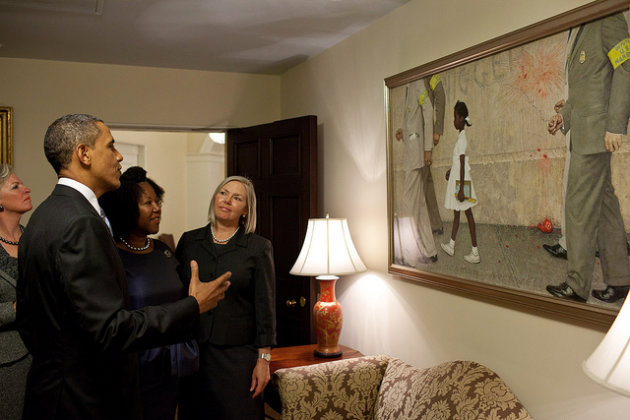
President Barack Obama with Ruby Bridges. (Official White House Photo by Pete Souza)


http://news.yahoo.com/art-sends-rare-w-h-message-race-094000977.html

Regina,

Yeah, yeah, yeah I saw this article yesterday on my own and thought about sending it out but then I thought "What's the point? Obama's only really interested in the abstract SYMBOLISM of this painting, not effectively dealing with the concrete REALITY behind it!" I'm very familiar with the famous Rockwell painting (I first saw it in LIFE magazine in the mid 1960s!). Anyway while this is a very nice and kind gesture by Ruby Bridges I really don't think Obama has any intention of acting POLITICALLY on the important issues that the painting raises in real life--otherwise Obama wouldn't be so afraid of publicly appearing with and advocating on behalf of our people generally--who I hasten to remind everyone are American citizens. I say this because of the endless bullshit and thoroughly idiotic line pushed by so many stupid and dishonest people--and the President himself--that he's "not just the President of black America but of the entire country." Of course that's obviously true--DUH!-- but when the President goes around the country to meet with various people anyone with an ounce of sense can see that he must at all times deal not only with the general reality of all Americans but also with SPECIFIC GROUPS. For example Latinos have specific particular interests in immigration reform that directly affect them and their communities as well as employment, education, healthcare, housing etc. Gays and Lesbian citizens have specific, particular interests and concerns having to do with sexual discrimination against them in the workplace and in the military and in dealing with the institution of marriage which the government is obligated to address. Various 'white' American constituencies from Jews to Irish and Italian American Catholics have specific concerns and interests as well. And what about the specific interests of Labor Unions, professionals, children, military personnel, women and issues of gender discrimination and equality, etc. etc.? In other words: As an equally discrete, individual, and specific group of citizens in the United States African Americans also have issues, concerns, and demands that MUST BE SERIOUSLY ADDRESSED AND RESOLVED. And the moronic, false, insulting NONSENSE that the President doesn't have the exact same obligation to us as a people AND as general American citizens as he does EVERY OTHER GROUP IN THE COUNTRY is just another way of this President and his administration AVOIDING the responsibility of addressing these very real, very important issues in public. Because when the government deals with racial issues in this country it is also simultaneously dealing with general issues of employment, education, healthcare, housing, consumer protection, the environment, etc. etc. because obviously issues of discrimination and structural/systemic disparities (be they rooted in racial, class, or gender bias) are integral and crucial to the welfare and development of the ENTIRE NATION.

Until such time as this President and even more importantly WE AS BLACK PEOPLE stop acting as though our needs and interests can't or shouldn't be adequately addressed in public JUST LIKE EVERYONE ELSE'S NEEDS, DESIRES, AND INTERESTS ARE BEING DEALT WITH then the emotionally powerful but still largely abstract symbolism of the art now hanging outside the Oval Office at the White House will remain ONLY SYMBOLIC and fail to properly inspire this President to deal with us OPENLY AND HONESTLY AT ALL TIMES and stop HIDING whenever we come around. After all, in the real world SYMBOLISM BY ITSELF IS NOT ENOUGH. Someone needs to ACT on the messages being conveyed by the artist in this painting and I mean NOW. Otherwise it just represents another way for the White House to avoid dealing with what the painting is actually talking about in terms of TODAY'S REALITIES...You dig?...

Kofi


Art sends rare W.H. message on race
By Josh Gerstein

August 23, 2011

Politico


President Barack Obama has taken a decidedly low-key approach to racial issues since he became America’s first black president two years ago. But in a hallway outside the Oval Office, he has placed a head-turning painting depicting one of the ugliest racial episodes in U.S. history.

Norman Rockwell’s “The Problem We All Live With,” installed in the White House last month, shows U.S. marshals escorting Ruby Bridges, a 6-year-old African-American girl, into a New Orleans elementary school in 1960 as court-ordered integration met with an angry and defiant response from the white community.

The thrust of the painting is not subtle. America’s vilest racial epithet appears in letters several inches high at the top of the canvas. To the left side, the letters “KKK” are plainly visible. The crowds, mostly women who gathered daily to taunt Bridges as she went to a largely empty school, are not shown in the picture. But the racist graffiti and a splattered tomato convey the hostile atmosphere.

Despite the historic nature of his election, Obama has rarely dwelt on racial issues. His speech Sunday dedicating a memorial to Dr. Martin Luther King Jr. near the National Mall will be an exception to the pattern, a rare public embrace of the civil rights movement.

His choice of the Rockwell painting was a more private statement. Obama has never mentioned it in a speech or public event. And while White House aides confirmed that Obama approved bringing it to the West Wing, they declined to discuss how the decision was made or why.

But in an interview with POLITICO, Bridges, now 56 and still living in New Orleans, said she began reaching out to the president last year — through Sen. Mary Landrieu (D-La.), Rep. John Lewis (D-Ga.) and Massachusetts Gov. Deval Patrick — to move the painting to the White House because she believed the image would resonate with Obama.

“It did have a lot to do with this particular president,” Bridges said. “He is a president of mixed race. So I believe he is about the same things that I am. You cannot look at a person and judge him or her by the color of their skin. … I did feel if anyone would hang the painting, it would be him.”
Last month, Bridges stopped by the White House to see the painting in its new — though temporary — home.

“I think it’s fair to say that if it hadn’t been for you guys, I might not be here, and we might not be looking at this together,” Obama told her, according to a videotape on the White House website.

Bridges says the work conveys a message of integration and “bringing people together,” but on its surface, Rockwell’s painting depicts jarring cruelty, hatred and fear.

“The N-word there — it sure stops you,” said William Kloss, an art historian and expert on the White House collections. “There’s a realistic reason for having the graffiti as a slur, [but] it’s also right in the middle of the painting. … It’s a painting that could not be hung even for a brief time in the public spaces [of the White House], I’m pretty sure of that.”

Urban League President Marc Morial, who viewed the painting during a recent visit to see the president, said Rockwell’s use of the racial slur conveys the hostility Bridges faced.

“It gives people an opportunity to see that she wasn’t walking to Sunday school and, in fact, she faced the jeers, she faced the hate,” Morial said.
“It is jarring to see it in this piece of art, but … it provides the context of the time,” said Roland Martin, an African-American radio and TV host and political commentator for CNN. “When you see that word, you see her, you see the soldiers, you realize, ‘I really get this.’”

Despite, or perhaps because of the groundbreaking nature of his presidency, Obama’s handling of issues of race has been subdued. He has hosted Black History Month events, but the civil rights page on the White House website makes little mention of racial discrimination. When eight surviving members of the 1968 Memphis sanitation workers strike came to Washington in April, Obama received them privately in the Map Room. A still photo of the meeting with Obama was posted on the White House blog.

“I don’t believe Obama’s uncomfortable talking about race. I do know it’s a politically charged issue with hypersensitivity on all sides of the equation,” said April Ryan, who is African-American and a longtime White House reporter for American Urban Radio Network. “I’ve been told by people here they don’t want to deal with a lot of ‘race’ because it overamplifies. … One thing that will always follow this president is race, so they have to, in my estimation, downplay it.”

Despite signs that at least some tea party events last fall were racially tinged, Obama has repeatedly told interviewers that he doubts race plays any significant role in the angry reactions of some Americans to his policies or in the long-festering claims that he was born outside the U.S.

Ryan said Obama and his aides also have brushed aside calls for programs targeting sharply higher unemployment rates in the African-American community.

“I can’t pass laws that say I’m just helping black folks. I’m the president of the United States,” Obama told Ryan in a December 2009 interview. “What I can do is make sure that I am passing laws that help all people, particularly those who are most vulnerable and most in need. That, in turn, is going to help lift up the African-American community.”

Ryan also noted that while Obama has never displayed any race-related artwork as provocative as the Rockwell painting, he does keep emblems of the civil rights movement near him. A small bust of King is in the Oval Office, and a copy of the Emancipation Proclamation hangs on the wall. Obama also has a pamphlet from the 1963 March on Washington sitting nearby, said Laurie Norton Moffatt, director and CEO of the Norman Rockwell Museum in Stockbridge, Mass., where “The Problem We All Live With” is displayed when it’s not on tour.

Still, at 3 feet high and nearly 5 feet wide, the painting is by far the most striking civil rights-related art in the White House. Rockwell painted the image in 1963, and it appeared on the cover of Look magazine in January 1964. It will remain about 20 feet from the Oval Office, in a well-trafficked hallway just outside the Cabinet Room, until it goes back on tour in October.

“It’s large and wide and calls a lot of attention to itself. … He pulled no punches with it, and it’s a terrific composition,” Kloss said. “I don’t think there is anything [in the White House] comparable to this.”

“If you’re a young staffer, who wasn’t alive at that time, you’re going to stop in your tracks and say: ‘Was it really like that?’” Martin said.

Some other artwork in the White House could be considered controversial but in a more subtle way, Kloss said. “There are works that would be edgy if people knew what they were about,” such as a Frederic Remington sculpture of drunk cowboys and a melancholy 1917 Childe Hassam painting of flags on Fifth Avenue in New York as America prepared to enter World War I.

In 2009, the Obamas also borrowed for the White House’s private spaces a couple of works with racial themes. One was Glenn Ligon’s “Black Like Me No. 2” — which features a repeating line from John Howard Griffin’s 1961 book on the experience of a white man who turned his skin black to study racism in the South: “All traces of the Griffin I had been were wiped from existence.”

Another Obama-era installation was William H. Johnson’s “Booker T. Washington,” which depicts the civil rights leader teaching black students.

“The president and the first lady have made an effort to tell our nation’s whole history and focus on inclusion,” Moffatt said. “They’ve not focused exclusively on the African-American heritage, but they’ve also not shied away from it,” she said, adding that there are few “narrative” works of art about the civil rights era.

Still, some civil rights leaders see his decision to put up the Rockwell painting as an empty gesture in light of his general reticence on race.

“Obama’s in campaign mode,” said Michael Meyers of the New York Civil Rights Coalition. “The Norman Rockwell painting is so historic and so old that [Obama’s] statement is safe. … Obama makes no statements about integration today, and the schools are more segregated than they’ve ever been. Where is his Education Department on that?”

Bridges said she had little time to talk with Obama during their meeting but believes he understands and to some degree personifies the message of racial tolerance that she delivers.

“Even though there were mobs outside that school every day for a whole year, the person that greeted me every morning was [my teacher], a white woman, who actually risked her life as well,” Bridges said. “This [painting] will be a great way for Obama to say to anyone who comes to his office: ‘This is what I’m about.’”

Abby Phillip contributed to this report.


Wednesday, August 24, 2011

We Must Continue to Confront the 21st Century Realities of Race and Class in the 'Age of Obama'


'Let me hear you say 'black', Maxine Waters said. | AP Photo


http://www.politico.com/news/stories/0811/61912.html


All,

YES!!! Now we're talking! I knew I could ultimately count on Representative Maxine Waters and other responsible and genuinely concerned liberal/progressive black politicians and activists to finally confront the President on the vital question of the ugly crisis of national black unemployment and the massive racist campaign against African Americans generally led by the Tea Party and the Republican right. FINALLY someone in the Democratic Party is trying to hold Obama ACCOUNTABLE for addressing crucial issues that should have been seriously addressed from Day One of the Obama Administration. IT'S ABOUT DAMN TIME!! I was beginning to think that large numbers of black folks had simply lost their minds and their common sense as well and were stumbling around in some fantasy ridden dreamlike state merely because the President is black. As millions of other progressive black, white, Latino, and Asian Americans (who BTW--we should never forget-- actually supported and VOTED FOR the President in 2008!) have been saying for nearly three years now: WE MUST ALL FIGHT FOR A TRULY PROGRESSIVE AGENDA ACROSS THE BOARD AND STAND UP AND DEFEAT OUR BRAZEN RACIST RIGHTWING ENEMIES IN THE NATIONAL POLITICAL SPHERE AS WELL AS IN OUR EVERYDAY LIVES. Time is running out and we CAN'T WAIT any longer. When the President makes his highly anticipated speech about a national jobs bill after Labor Day he had better come clean no matter what the Republicans and the Tea Party think and no matter what kind of intolerant political bullying and pathological lying they will most certainly attempt to engage in. HE AND WE MUST STAND UP AND TELL THEM AS MAXINE SAID TO "GO STRAIGHT TO HELL!" The needs, desires, and aspirations of all poor, working, and middle class American citizens who comprise the great majority of the country (and that most emphatically INCLUDES BLACK PEOPLE) must be attended to first and foremost and if the reactionary wealthy oppose us we must do everything in our massive collective power to push them aside as well. As always what we most need to know is this: WHOSE SIDE IS THE PRESIDENT ON? Only he and he alone can answer that paramount question but it had better be the RIGHT ANSWER...The stakes are far too high for anymore rhetorical bullshit coming from either the White House OR Congress...Time for us all to "get busy or get lost"...

Kofi


Waters to Obama aide: Say 'black'
By: Jennifer Epstein
August 23, 2011

Rep. Maxine Waters and other black leaders lobbed heated questions at one of President Barack Obama’s top jobs advisers Monday, pressing him to confirm the White House is focusing on creating jobs in struggling African-American communities — and to say the word “black.”

Don Graves, the executive director of the President’s Council on Jobs and Competitiveness, said at a nighttime forum at a black church in Miami that the president is “focused on every community across the country,” The Miami Herald reported.

But when he added that “certain communities have been hit harder than other communities,” Waters pushed him. “Let me hear you say ‘black,’” the California Democrat said.

As the crowd cheered, The Washington Post said in its report on the Congressional Black Caucus-sponsored event, Graves quietly said: “black, African-American, Latino — we’re going to focus on getting people back to work.”

The approach that assisting all communities helps African-Americans get jobs is “a bunch of bull,” Rep. Laura Richardson (D-Calif.) said, according to the Post. Later, she asked Graves whether he would help shuttle dozens of pieces of jobs legislation authored by CBC members to the president so he could enact them using executive authority.

“You all don’t need to go through me to get to the president,” Graves said.

But Richardson disagreed. “Let’s be honest. We have met with the president. We are asking you in the capacity of your position [at the council on] jobs, are you willing to review our bills, to work with us?”

“You may not feel like the president is listening to you, but he hears you loud and clear,” Graves said, referring to the growing frustration from African-Americans that was on view last week as Waters spoke at a much-covered CBC town hall in Detroit.

Graves said that one obstacle to job creation are “folks who are going to stand in the way and block the legislation that the Congressional Black Caucus has proposed.”

Waters interrupted him. “What people are you talking about?” she said, according to the Herald. “Say tea party. Say it!”

Graves did, though the Post described him as doing so “reluctantly.” “It was tea party Republicans,” he said.

Waters hasn’t been shy about her criticism of the tea party movement. At the event over the weekend, after being attacked by tea party-affiliated Rep. Allen West (R-Fla.) as an “overseer” of the “21st century plantation” of blacks in the Democratic Party, Waters said “the tea party can go straight to hell.”

The day after West criticized Waters and other black Democrats, his younger brother was at a job fair that Waters and other CBC members had organized in Atlanta. (West is the only Republican member of the CBC.)

But Waters wasn’t the only person on the dais Monday night who was attacking the tea party movement. Rev. Jesse Jackson, who West also described as an “overseer” said that the movement should be called the “Fort Sumter tea party that sought to maintain states’ rights and slavery,” the Herald reported.

“The tea party is a new name on an old game,” he said. “Dr. King fought a ‘tea party’ in Alabama. … He had no weapons, but he confronted the tea party.”


© 2011 POLITICO LLC


http://www.politico.com/politico44/perm/0811/sermon_on_the_green_17a363d0-4817-479e-8b75-d72de47387f8.html


Freeman to POTUS: 'Get pissed off'
By GLENN THRUSH
08/22/11

POLITICO 44


'If I could vote for him 1,000 times, I would,' Freeman said of Obama. AP Photo

When President Obama jumped on the back nine of the celebrity-clogged Vineyard Golf Club course on Sunday, he ran into none other than Morgan Freeman, Oscar winner and Obama backer.

Freeman, it turns out, was as free with advice for Obama as he was for Tim Robbins in “The Shawshank Redemption.” (POLITICO was holding outside the course in the pool van, told only that Obama was playing with his usual island foursome.)

But the deeply wired Boston Globe, invaluable for Vineyard gossip, caught up with Freeman at an event later in the day.

“What I wanted to tell him is to get pissed off, get fighting mad,” the actor told the paper. “But I know he won’t because he doesn’t think it’s politically smart.”

On Obama’s chances for reelection, Freeman added, “If I could vote for him 1,000 times, I would.”

“I think he’s been horribly sandbagged, and it makes me so angry,” he said.


Sunday, August 21, 2011

Rick Perlstein On The Historical Necessity of A Bold, Aggressive Approach to Progressive Reform vs. the Crippling Limitations of Incrementalism

http://prospect.org/cs/articles?article=a_liberal_shock_doctrine

All,

Exactly three years ago on August 18, 2008 the following very prescient and prophetic article was written and published by Rick Perlstein in American Prospect magazine. Perlstein is the 42 year old author of the profound and critically acclaimed book Nixonland: The Rise of A President and the Fracturing of America (Scribner, 2008) a 750 page masterpiece that I and many others consider to be by far the best one volume work on American politics during the 1960s ever written (and trust me I've read most of the voluminous literature on this ever fascinating and highly idiosyncratic subject). In the following piece that appeared only 10 weeks before Obama was elected President Perlstein lays out a brilliantly argued and airtight analysis of what the new President and the Democratic Party absolutely needed to do and why from the highly informative prism of modern American social, economic, and political history. That this piece so accurately and trenchantly indicated both what needed to be done and what immediate and long range consequences lay in store for us all if these suggestions were not taken seriously or were simply ignored is not only a testament to Perlstein's acute knowledge and understanding of this history but stands as a powerful and-- most importantly for us-- useful guide to what WE must do in response now that the President and his governing party have for the most part passively surrendered to the fiercely oppositional forces of the right. This article and Perlstein's book strongly reminds us that if we as citizens don't put up and support the necessary organized national fight-back that is desperately needed at this point, we will ultimately be defeated by our sworn, extremely wealthy, and highly organized enemies, either now or in the very near future...

Kofi


A Liberal Shock Doctrine

History teaches us that presidents have to move quickly to enact progressive reforms before the window of opportunity closes forever. It’s a lesson Barack Obama should take to heart.

by RICK PERLSTEIN
August 18, 2008
American Prospect

Progressive political change in American history is rarely incremental. With important exceptions, most of the reforms that have advanced our nation’s status as a modern, liberalizing social democracy were pushed through during narrow windows of progressive opportunity—which subsequently slammed shut with the work not yet complete. The post–Civil War reconstruction of the apartheid South, the Progressive Era remaking of the institutions of democratic deliberation, the New Deal, the Great Society: They were all blunt shocks. Then, before reformers knew what had happened, the seemingly sturdy reform mandate faded and Washington returned to its habits of stasis and reaction.

The Oval Office’s most effective inhabitants have always understood this. Franklin D. Roosevelt hurled down executive orders and legislative proposals like thunderbolts during his First Hundred Days, hardly slowing down for another four years before his window slammed shut; Lyndon Johnson, aided by John F. Kennedy’s martyrdom and the landslide of 1964, legislated at such a breakneck pace his aides were in awe. Both presidents understood that there are too many choke points—our minority-enabling constitutional system, our national tendency toward individualism, and our concentration of vested interests—to make change possible any other way.

That is a fact. A fact too many Democrats have trained themselves to ignore. And it sometimes feels like Barack Obama, whose first instinct when faced with ideological resistance seems to be to extend the right hand of fellowship, understands it least of all. Does he grasp that unless all the monuments of lasting, structural change in the American state—banking regulation, public-power generation, Social Security, the minimum wage, the right to join a union, federal funding of education, Medicare, desegregation, Southern voting rights—had not happened fast, they wouldn’t have happened at all?

I hope so. Because if Barack Obama is elected president with a significant popular mandate, a number of Democrats riding his coattails to the House, and enough senators to scuttle the filibuster of his legislative agenda—all of which seem entirely possible—he will inherit a historical opportunity to civilize the United States in ways not seen in a generation. To achieve the change he seeks—the monumental trio of universal health care, a sustainable energy policy, and a sane and secure internationalism—he has to completely reverse the way Democrats have habituated themselves to doing business. If they want true progress, they have to be juggernauts. American precedent gives them no other way.

***

Let Franklin Roosevelt be our guide. We take for granted now one of his signature political innovations: the idea of an executive “legislative agenda,” a specific set of White House proposals, by which the success or failure of a presidency can be judged. FDR’s was the first and most spectacular. He understood that the New Deal would pass quickly or it would not pass at all. And so, politically, he yoked Congress’ willingness to pass his program without obstruction to Congress’ willingness to address the national emergency tout court.

We’re not facing a Great Depression–level emergency now. But with an unprecedented 77 percent of respondents in an Associated Press poll saying they believe the nation is on the “wrong track,” and 9 percent telling the Gallup organization they approve of Congress’ job performance, Obama is not without leverage. Ideally, Obama’s Washington would resemble FDR’s in 1935. “The stories of that period always seemed to follow the same pattern,” Thomas Frank writes in his new book, The Wrecking Crew: How Conservatives Rule, “how the bright young man arrived in the city, fresh from law school, where he was put to work immediately on business of utmost urgency; how he went for days without sleep.”

One of those exhausted bright young men, of course, was bright-eyed Lyndon B. Johnson of the Texas Hill Country. The 1930s Washington culture in which LBJ thrived was not merely a function of the New Dealers’ scramble to redeem a national emergency. It was a function of the fact that they understood the reality of America as “the frozen republic,” as Daniel Lazare has called it. By the time Johnson got his accidental opportunity to occupy his hero FDR’s chair, progressives understood implicitly that the unique constitutional system, conceived to protect the minority interests of slaveholders, gives the upper hand to obstructers. This, and not the supposed necessity of trimming ideological sails to placate some notional conservative majority, guided their strategizing. James MacGregor Burns’ book on the subject, The Deadlock of Democracy, was not merely what every progressive in Washington was reading during the Kennedy years, it was what every progressive was living. The House Rules Committee, dominated by reactionary Southerners, kept Kennedy from passing even an increase in the minimum wage, let alone his campaign promise—the cornerstone of his legislative agenda—to extend Social Security to cover medical care for the elderly. It was, as historians G. Calvin Mackenzie and Robert Weisbrot write in their fine recent study, The Liberal Hour: Washington and the Politics of Change in the 1960s, “a lesson fully understood by the Southerners in Congress. They didn’t need to have majorities on their side, they didn’t need to have public opinion on their side, they didn’t need the president on their side. They only needed to have the rules on their side.”

Three accidents of history followed in quick succession to break the deadlock. First, in the most important turning point in history you’ve never heard of, Kennedy narrowly won a vote to dynamite the House Rules Committee’s role as a tar pit for liberal legislation by expanding its membership. Second, the Supreme Court’s first “one man, one vote” decision, Baker v. Carr (1962), outlawed Southern electoral systems, which, for instance, gave the three smallest counties in Georgia, with a total population of 69,800, as much voting strength as the largest county in the state, with a population of 556,326. And finally, Kennedy was shot. The national trauma was a blunt political opportunity from whose import Johnson did not flinch. “Let us continue,” he intoned in his first address to a joint session of Congress. Then, before this tragic but miraculous once-in-a-lifetime store of political capital drained away, he started passing the liberal legislative agenda that had been little more than a shadow during Kennedy’s lifetime.

Less than a month into his presidency, Johnson wrangled from a recalcitrant Congress a loan guarantee to help our mortal enemies, the Soviets, buy grain before he had been in office a month, convincing 38 legislators to return to Washington during their Christmas vacations to approve the loan. The Economic Opportunity Act of 1964—the “war on poverty”—passed by a nearly two-to-one margin. Johnson advocated for a tax cut that conservatives called a budget-buster, bringing Dwight D. Eisenhower out of retirement to campaign against it. But Johnson passed that, too. Then came Medicare. Then the Civil Rights Act. “I’m not going to cavil, and I’m not going to compromise,” Johnson told Sen. Richard Russell of Georgia as the landmark bill Kennedy introduced to no avail in the summer of 1963 was steamrolling its way to completion.

In 1965 Johnson passed new legislation for preschool for poor children, college prep for poor teenagers, legal services for indigent defendants, redevelopment funds for lagging economic regions, landmark immigration reform, a new Department of Housing and Urban Development, and national endowments for the humanities and art. He even added a whole new category to the liberal agenda with the passage of the Highway Beautification Act, the Water Quality Act, and the Clean Air Act. He insisted to his congressional leadership that the House’s bill for federal aid to education pass the Senate “literally without a comma changed,” aide Eric Goldman recalled. It did indeed, two weeks later, with only 18 votes in opposition.

His insistence on ramming through bills “without a comma changed” wasn’t a function of Johnson’s natural aggressiveness or ego (or at least not only that). It was, in the American legislative context, a necessary sort of pragmatism. The 36th president saw that his opportunity to move the country forward could end any day and that he must act before America lurched back into a state of fearful reaction. He was right. During the span of just a few weeks in the summer of 1965, Johnson flew to Independence, Missouri, to sign Medicare—the reform JFK had run on in 1960—and to Washington to sign the Voting Rights Act. Five days later, on Aug. 11, the Watts Riots brought down the curtain on the liberal hour. After that, he couldn’t even get Congress to approve $60 million for rodent control in the slums.

The right and Democratic centrists have taught us to think of the Great Society in terms of its failures, like the War on Poverty’s Community Action Program, which drove a wedge between Washington and local Democratic municipal administrations and supposedly empowered all manner of swindlers and “poverty pimps.” We should focus instead on Johnson’s remarkable number of broad-based accomplishments in those first 22 months. We now take for granted the notion that the elderly have a right to medical care, that the government should provide aid for education, that immigration policy should not discriminate on the basis of race, and that the government should concern itself with clean air. It would be unimaginable to see them reversed—in part because of the constitutional inertia that made them so difficult to achieve in the first place. They are the kind of things Republicans now pretend they were in favor of all along. This is the way social change works. It is the responsibility of the next progressive president to crash through a similar set of reforms for the next generation to take for granted.

***
Conservatives understand these stakes, which is why obstructionism is the rock upon which they have built their political church. Not for nothing was Jesse Helms celebrated so unequivocally by conservatives upon his death this summer: He was “Senator No.” They know that a single well-placed roadblock, whether within the news cycle or behind closed doors in the legislative process, can stop progress cold—even in the face of a Democratic Congress united with a Democratic president and a friendly judiciary. They understand that in America, Democratic (and democratic) mandates are tailor-made for sabotage and that the sabotage must come early, quick, and hard.

This was the reliable formula that brought down such progressive initiatives as Clinton’s health-care program. But it was Jimmy Carter’s attempt to fix American energy policy that really set the precedent for failed reform. It is easy to forget how progressive hopes were soaring on January 20, 1977. A Republican president had resigned in disgrace. His replacement had proven hapless and tainted. A slew of young liberal lions had been swept into office in 1974 on the wave of disgust, and Jimmy Carter was elected to give America “a government as good as its people.” Even the pundits’ affection was in his pocket.

In retrospect, of course, we remember how badly Carter mishandled the job of pushing his own legislative agenda. He couldn’t work with Congress. He alienated key Democratic constituencies. Maybe such deficiencies won’t hobble Barack Obama, who appears an infinitely more skilled politician. But despite his skill, Obama will not be available to avoid the fact that the right also learned from the early years of FDR and LBJ. They know the lessons in their bones: Strike hard and fast by any means necessary to degrade a popular new Democratic president’s capability to pass anything big right away, because once something is passed, it might never go away. Carter started out with a bang, just as FDR and LBJ would have counseled. He immediately proposed, as Sean Wilentz records in his new book, The Age of Reagan, “an enormously ambitious legislative agenda on matters ranging from national energy policy to streamlining the federal government.” He “demanded and received emergency authorization to deregulate natural gas prices,” then handed down unconditional amnesty for draft evaders and “weathered the storm and enhanced his reputation for decisiveness and independence”—shades of the bold strokes of Roosevelt’s First Hundred Days. Through April, his approval rating was 75 percent. “For the moment,” Wilentz concludes, “it looked as if the country had found the leader it had been searching for since Richard Nixon’s downfall.” And it also looked as if that something big might happen before circumstances slammed shut the window of opportunity. The energy program, an effort Carter announced as “the moral equivalent of war,” passed the House comfortably in April. But by the end of the year, the Senate eliminated it with extreme prejudice. Partly, again, it was Carter’s poor political skill. It also had plenty to do with the fact that Republicans managed to destroy Carter’s public goodwill in his first year as president.

A literary assassin played an outsize role in this project. Former Nixon operative William Safire was ensconced on The New York Times op-ed page. Sloppy record-keeping and the sort of petty favoritism endemic to provincial banking had brought Carter’s close friend and budget director Bert Lance, a former banker in Georgia, before a Senate subcommittee for minor questioning. Safire raised a series of where-there’s-smoke-there-must-be-fire insinuations. He hinted that the Teamsters Central States Pension Fund (which “the Labor Department says corruptly bankrolls Las Vegas mobsters,” Safire helpfully reminded readers) played a role, along with, of course, the Chicago Democratic Machine—and Arabs!

Safire penned eight Lance columns over the next four months, sometimes twice a week. He repeated the original charges, dropping ones others debunked, ever implying that the charges he still mentioned were the only ones he had made all along, counting on the public’s short memory to cover the fact that his original case was falling apart. Most often, his columns baited reporters: Why were they “refusing” to investigate Lance like they had hounded past Republicans? More cunningly, Safire larded the columns with less-than-subliminal linguistic references to Watergate. “Lancegate,” he implied, was exactly the same. He even declared a memo by the Manufacturers of Hanover Trust was “the ‘smoking gun.’” (Readers were counted on to vaguely recall that the “smoking gun” tape that had brought down Nixon two years earlier also involved the derailing of an FBI investigation.)

It worked, at least where it counted: in the court of political cartoons. Washington Post editorial cartoonist Herblock gave Carter a “Checkers Award,” after the infamous cocker spaniel Richard Nixon used to save his hide in a famous 1952 speech. Syndicated cartoonist Pat Oliphant went with a more straightforward depiction of Carter as Nixon: “Stonewall it. … They’re out to get us.” Lance resigned; the Justice Department handed down indictments. Even though Lance was eventually completely exonerated, the damage was done. Carter, like Obama, had run as a “different kind of Democrat”—pure, unsullied. So saboteurs like Safire had a clear challenge: “prove” that Carter was just another impure politician, if even on the shakiest of pretexts.

That, of course, is what the right will try on the next Democratic president. They will take the possibility that Obama might break through the icy seas of conservative stasis and try to render it an absurdity. There is now an army of Safires and a Republican Party full of Senator No’s. Recall William Kristol’s famous memo enjoining congressional Republicans to refuse to deal with President Clinton’s proposed health-care reforms. “The plan should not be amended,” he wrote, “it should be erased.” The right might not be at its strongest, but it certainly understands that the American system favors fell swoops, on offense as well as on defense. The system provides conservatives with opportunities for obstruction in profusion—no matter how low their approval ratings.

***
Barack Obama has not run as a policy maximalist. By and large, his big proposals have all been in that safe spot where liberals can’t quite get mad and the Beltway wise men can’t quite get scared. He has advocated for not-quite-universal health care rather than single-payer, and promised tax cuts, not massive new social outlays. But this shouldn’t worry progressives. There may be no better way to achieve an operational liberalism than to appeal to America’s rhetorical conservatism. That, after all, was how the balanced-budget-promising Franklin Roosevelt ran in 1932 and how the let-us-continue Lyndon Johnson was elected in 1964.

But when it comes time to govern, an ingrained habit of incrementalism may be a very profound problem indeed. Stopped in our tracks time and time again in attempts to assure Americans the basic social rights taken for granted by citizens of every other industrialized nation, progressives have made virtue of necessity—we have learned to think of strategic incrementalism as a positive good, even an end in itself. If, on the morning of January 20, 2009, Barack Obama should wake up to find himself president, with 60 senators and 250 representatives, plus 60 percent of the public firmly in favor of passing universal health care, would his instincts direct him to ram the legislation through as quickly as possible? No one can say for sure. This attitude is so dormant in progressive thinking that it’s hard to know whether we can revive it.

Weisbrot and Mackenzie’s The Liberal Hour is a very aptly named book: a splendid evocation of just how evanescent American moments of reform truly are. They are not unlike an action movie starring Bruce Willis, who has 60 minutes left to defuse a time bomb before everything blows up. Take immediate action, and you might just get reforms that had seemed impossible the day before but are impossible to imagine America without just one and two generations later. Take it slow, however, and you might not get anything at all.


Rick Perlstein is the author of Nixonland: The Rise of a President and the Fracturing of America (2008) and Before the Storm: Barry Goldwater and the Unmaking of the American Consensus (2001). He is a senior fellow and blogger at the Campaign for America's Future.