Friday, November 30, 2012

138 Nations in UN General Assembly Approves Palestine's Admission As An Observer State

http://www.nytimes.com/2012/11/30/world/middleeast/Palestinian-Authority-United-Nations-Israel.html?pagewanted=all


All,

Despite the fiercely reactionary and ruthless imperialist opposition of the United States and Israel to the legitimate demands of the Palestinian people for true self determination and national sovereignty the essential struggle for freedom, truth, and justice asserts itself in the global community known as the United Nations and dig this: No matter how long it takes or how many oppressive enemies and lying detractors it and the Palestinian people's inspiring fight for national independence, global recognition and genuine support encounters these fundamental facts and all they represent and embody in the quest for real freedom, equality, and justice ANYWHERE in the world (including the United States and Israel!) will continue to be courageously expressed and supported.  YES!

Kofi

P.S.  View the following previous pieces from the Panopticon Review on the ongoing Palestinian struggle and the United Nations taken from the PR archive below.  Please click on the following links:

"I wanted to say a few concluding words on Palestine, because it’s an issue that matters intensely to us. It’s clear that the fate of Palestine matters very little to the ruling class except as it may relate to incorporating Arab regimes into the anti-Iran coalition. We can see here an example of true bipartisanship at its most destructive – on condemning the Goldstone Report, on the starvation of Gaza and authorizing the Egyptian regime’s blockage of the Gaza Freedom March.

Whether the Obama administration’s early, feeble attempts to stop Israeli settlement construction and demolition of Palestinian homes were intended seriously is not clear, but it no longer matters – it is now too weakened at home to exert real pressure on Israel even if it wanted to. The policy on Palestine now is simply the Iron Fist, made worse by the cynical cover of meaningless rhetoric about “renewing the peace process.” Nothing of substance will change until Israel’s status as an imperial asset is degraded by international isolation. This is why the BDS (“boycott/divestment/sanctions”) campaign in all its diversity, internationally and here, is now so important as a focus for Palestine solidarity activism."
--David Finkel,   "One Year of Obama and the Democrats’ Debacle"  --Speech delivered to the Solidarity National Committee  (February 2011)
The Panopticon Review,  August 9, 2011

Damon Winter/The New York Times
The Palestinian Authority president, Mahmoud Abbas, center, was congratulated by Turkey’s foreign minister, Ahmet Davutoglu


U.N. Assembly, in Blow to U.S.,  Elevates Status of Palestine
By ETHAN BRONNER and CHRISTINE HAUSER
November 29, 2012 
New York Times

UNITED NATIONS — More than 130 countries voted on Thursday to upgrade Palestine to a nonmember observer state of the United Nations, a triumph for Palestinian diplomacy and a sharp rebuke to the United States and Israel.

But the vote, at least for now, did little to bring either the Palestinians or the Israelis closer to the goal they claim to seek: two states living side by side, or increased Palestinian unity. Israel and the militant group Hamas both responded critically to the day’s events, though for different reasons.

The new status will give the Palestinians more tools to challenge Israel in international legal forums for its occupation activities in the West Bank, including settlement-building, and it helped bolster the Palestinian Authority, weakened after eight days of battle between its rival Hamas and Israel.

But even as a small but determined crowd of 2,000 celebrated in central Ramallah in the West Bank, waving flags and dancing, there was an underlying sense of concerned resignation.

“I hope this is good,” said Munir Shafie, 36, an electrical engineer who was there. “But how are we going to benefit?”

Still, the General Assembly vote — 138 countries in favor, 9 opposed and 41 abstaining — showed impressive backing for the Palestinians at a difficult time. It was taken on the 65th anniversary of the vote to divide the former British mandate of Palestine into two states, one Jewish and one Arab, a vote Israel considers the international seal of approval for its birth.

The past two years of Arab uprisings have marginalized the Palestinian cause to some extent as nations that focused their political aspirations on the Palestinian struggle have turned inward. The vote on Thursday, coming so soon after the Gaza fighting, put the Palestinians again — if briefly, perhaps — at the center of international discussion.

“The question is, where do we go from here and what does it mean?” Salam Fayyad, the Palestinian prime minister, who was in New York for the vote, said in an interview. “The sooner the tough rhetoric of this can subside and the more this is viewed as a logical consequence of many years of failure to move the process forward, the better.” He said nothing would change without deep American involvement.

President Mahmoud Abbas of the Palestinian Authority, speaking to the assembly’s member nations, said, “The General Assembly is called upon today to issue a birth certificate of the reality of the state of Palestine,” and he condemned what he called Israeli racism and colonialism. His remarks seemed aimed in part at Israel and in part at Hamas. But both quickly attacked him for the parts they found offensive.

“The world watched a defamatory and venomous speech that was full of mendacious propaganda against the Israel Defense Forces and the citizens of Israel,” Prime Minister Benjamin Netanyahu of Israel responded. “Someone who wants peace does not talk in such a manner.”

While Hamas had officially backed the United Nations bid of Mr. Abbas, it quickly criticized his speech because the group does not recognize Israel.

“There are controversial issues in the points that Abbas raised, and Hamas has the right to preserve its position over them,” said Salah al-Bardaweel, a spokesman for Hamas in Gaza, on Thursday.

“We do not recognize Israel, nor the partition of Palestine, and Israel has no right in Palestine,” he added. “Getting our membership in the U.N. bodies is our natural right, but without giving up any inch of Palestine’s soil.”

Israel’s ambassador to the United Nations, Ron Prosor, spoke after Mr. Abbas and said he was concerned that the Palestinian Authority failed to recognize Israel for what it is.

“Three months ago, Israel’s prime minister stood in this very hall and extended his hand in peace to President Abbas,” Mr. Prosor said. “He reiterated that his goal was to create a solution of two states for two peoples, where a demilitarized Palestinian state will recognize Israel as a Jewish state.

“That’s right. Two states for two peoples. In fact, President Abbas, I did not hear you use the phrase ‘two states for two peoples’ this afternoon. In fact, I have never heard you say the phrase ‘two states for two peoples’ because the Palestinian leadership has never recognized that Israel is the nation-state of the Jewish people.”

The Israelis also say that the fact that Mr. Abbas is not welcome in Gaza, the Palestinian coastal enclave run by Hamas, from which he was ejected five years ago, shows that there is no viable Palestinian leadership living up to its obligations now.

As expected, the vote won backing from a number of European countries, and was a rebuff to intense American and Israeli diplomacy. France, Spain, Italy and Switzerland all voted yes. Britain and Germany abstained. Apart from Canada, no major country joined the United States and Israel in voting no. The other opponents included Palau, Panama and Micronesia.

Susan E. Rice, the American ambassador to the United Nations, was dismissive of the entire exercise. “Today’s grand pronouncements will soon fade,” she said. “And the Palestinian people will wake up tomorrow and find that little about their lives has changed, save that the prospects of a durable peace have only receded.”

A major concern for the Americans is that the Palestinians may use their new status to try to join the International Criminal Court. That prospect particularly worries the Israelis, who fear that the Palestinians may press for an investigation of their practices in the occupied territories widely viewed as violations of international law.

Saeb Erekat, the chief Palestinian negotiator, said that after the vote “life will not be the same” because “Palestine will become a country under occupation.”

“The terms of reference for any negotiations become withdrawal,” Mr. Erekat said.

Another worry is that the Palestinians may use the vote to seek membership in specialized agencies of the United Nations, a move that could have consequences for the financing of the international organizations as well as the Palestinian Authority itself. Congress cut off financing to the United Nations Educational, Scientific and Cultural Organization, known as Unesco, in 2011 after it accepted Palestine as a member. The United States is a major contributor to many of these agencies and is active on their governing boards.

In response to the Palestinian bid, a bipartisan group of senators said Thursday that they would introduce legislation that would cut off foreign aid to the authority if it tried to use the International Criminal Court against Israel, and close the Palestine Liberation Organization’s office in Washington if Palestinians refused to negotiate with Israel.

Calling the Palestinian bid “an unhealthy step that could undermine the peace process,” Senator Lindsey Graham, Republican of South Carolina, said that he and the other senators, including Charles E. Schumer, Democrat of New York, would be closely monitoring the situation.

The vote came shortly after an eight-day Israeli military assault on Gaza that Israel described as a response to stepped-up rocket fire into Israel. The operation killed scores of Palestinians and was aimed at reducing the arsenal of Hamas in Gaza, part of the territory that the United Nations resolution expects to make up a future state of Palestine.

The Palestinian Authority, based in Ramallah, was politically weakened by the Gaza fighting, with its rivals in Hamas seen by many Palestinians as more willing to stand up to Israel and fight back. That shift in sentiment is one reason that some Western countries gave for backing the United Nations resolution, to strengthen Mr. Abbas and his more moderate colleagues in their contest with Hamas.


Jennifer Steinhauer contributed reporting from Washington, Isabel Kershner from Jerusalem, and Khaled Abu Aker from Ramallah, West Bank.

Sunday, November 11, 2012

The Road We Must Travel Now

Why the American Left and Progressives Everywhere Must Critically Challenge And Create Viable Alternatives to the Conventional Politics of the White House and Congress in the Age of Obama

by Kofi Natambu


"One cannot change in one's head that which can only be changed in society."
--C.L.R. James  (1901-1989)

"The oppressed are allowed once every few years to decide which particular representatives of the oppressing class are to represent and repress them.”
--Karl Marx  (1818-1883)


Now that we have done our national civic duty and successfully stopped the truly insidious far rightwing team of Mitt Romney and Paul Ryan from entering the White House and taking over the federal government (a very important and absolutely necessary struggle that we as critically engaged citizens should make no apologies for)  we should also not delude ourselves that the mere re-election of President Barack Obama is any kind of ultimate solution to or panacea for the ongoing political, economic, and cultural crises that continue to wrack and oppress this society.  Nor should we allow ourselves the self indulgent luxury of pretending that we can fundamentally change the general direction and ideological identity of this society and culture without critically and relentlessly challenging the President and all other branches of the federal government from Congress to the Supreme Court to meet our general collective demands for deeply rooted structural and institutional transformations of our political economy in the areas of employment, education, housing, healthcare, energy policy, climate change, tax policy, corporate and Wall Street regulation, foreign policy, the political and legal protection of human and constitutional rights for women, Black and Latino American citizens, and the national LGBT community, immigration policy, national budgetary priorities, and defense spending.  

Needless to say what is now going to be required of us all--and particularly those of us from both independent  leftist organizations and Democratic Party affiliated progressive/liberal tendencies alike--is a simultaneously visionary, pragmatic, highly disciplined and well coordinated long range strategy of consistently fighting for major political and economic reforms from the organizational and tactical standpoint/viewpoints of both the "insider" liberal and "outsider" radical leftist positions that will:
1) Openly endorse and support the President when he does the right thing

 2) Heavily critique and oppose him vigorously when he doesn't--and most importantly--

 3) ALWAYS DEMAND MORE than what is being "offered" by the two major political parties at any given time.  An integral part of this broadbased strategic approach will be the corresponding insistence that our various reasons and motivations for critical intellectual engagement and grassroots mass movement will be our clear and uncompromising adherence to basic and ethically principled ideas and values.  

In pursuing this objective of seriously transforming our relationship to the government and our electorally chosen "representatives" in what is obviously an antiquated and largely dysfunctional political system we must not lose sight of what WE are doing and why.  Our fundamental task and larger obligation is to strongly `repudiate and dismiss the shallow and infantile "politics of celebrity" and its many false and manipulative guises (especially with respect to the President!) and concentrate all of our political and moral energy instead on who and what really matters--the millions of largely anonymous but absolutely essential group of poor, working, and middle class American citizens who very much need and desire large scale and fundamental changes in the very form and content of our political economy and culture in every area of contemporary life in the United States.

Finally we must NEVER conflate or confuse what we do on our own behalf as citizens in this Republic/Empire with that of ANY of our 'chosen representatives' no matter who they are or what political party they belong to.  This especially applies to our ongoing and inherently complicated relationship with President Obama who despite our general support for him electorally in the last two presidential elections we should never forget is not making many  of his most important decisions about governing according only to what WE need and want.  Which is to say the following:  Barack Hussein Obama is a bourgeois politician first, last, and always and is primarily concerned with his relative position and status vis-a-vis his professional colleagues, friends, and enemies on both sides of the aisle as well as in the corporate capitalist and financial worlds both here and abroad and thus is not fully beholden in the final analysis to our fundamental interests and desires either politically or ideologically.  What this means of course is that it is then our responsibility and obligation AT ALL TIMES to fight tenaciously in a very serious and sustained manner for what we KNOW we really need and want regardless of what the Democratic, Republican, and Tea Parties want or insist upon at any given time.  This also means that when Obama inevitably turns his back on or "betrays" us--which like any politician he surely will do as he has done in the past when he personally finds it necessary or desirable to do so--WE will have to have the guts, organized strength, independent conviction, and bedrock clarity of thought, purpose, and values to collectively stand up to him and his administration and to strongly demand of him what we should routinely demand of all our politicians and public surrogates for our interests, beliefs, and needs:  That he prioritize and fight for what we sent him and his colleagues to the White House and Congress to do on our behalf as citizens no matter what powerful countervailing forces from the elite ruling classes in either the political or economic spheres are insisting upon otherwise.

Needless to say our fundamental commitment to protecting and advancing our own collective interests, desires, and needs will require that unlike what we did far too often over the past four years we must not simply or passively give this President, his administration, and Congress a pass while we lazily sit back and take idle rhetorical potshots at the government and our other major social, economic, and cultural institutions without building and sustaining a well organized, and well coordinated NETWORK and broadbased COALITION of truly grassroots activist and public intellectual venues and organizations that are fully prepared to critically engage and challenge all our "leaders and institutions" including the President to do what's right, necessary, and important for the American people over and above the oppressive, selfish, greedy, and exploitive interests and desires of the ruling class elites who presently dominate and control our political economy and culture.  Real change and transformation on a mass scale like always is truly up to us and NOT the elites (even the ones we say we admire!).  After all, what we need to or should be pursuing on our collective behalf is not in the end about any of our various "personal" attitudes or stances toward the President or any other public figure in government or the corporate world either positively or negatively, but is wholly dependent upon how and why we make our most fundamental hopes, dreams, desires, and expectations known and manifest in concrete, real, and viable ways in the world we actually live and work in, not merely the one(s) we wish or imagine ourselves to be in.  In other words:  This really is our chance to change the direction of this society and culture and with it our lives.  Let's not blow it...
          

Wednesday, November 7, 2012

President Obama Soundly Defeats Mitt Romney And Is Re-elected To A Second Term; Five Women From the Democratic Party Are Elected To The Senate

Damon Winter/The New York Times
Americans voted to give President Obama a second chance to change Washington.

Damon Winter/The New York Times
President Obama, with his family, took the stage at McCormick Place in Chicago early Wednesday to speak at his victory party. 


All,


Once again just as they did in 2008 in soundly defeating the McCain/Palin ticket the breathtaking strategic, tactical, and highly disciplined organizational brilliance of Team Obama (especially the incredible campaign leadership of the 'Two Davids'--Axelrod and Plouffe--as well as that of their major organizing cohorts Jim Messina, and the always dynamic Stephanie Cutter) prevailed over the fiercely reactionary and billion dollar 'Super-Pac' fueled Romney and Ryan rightwing machine.  The winning combination of extraordinary political mobilization skills and creative mastery of social media linked to the historically unprecedented voter participation of Obama's vaunted national coalition of African Americans, Latinos, Women, Asian Americans and young people under 40 was a very convincing textbook example of how to effectively organize and motivate an emerging new national demographic coalition that in both stylistic and substantive terms opposes, repudiates, and categorically rejects the socially lethal doctrines of white supremacy and sexist patriarchy and misogyny that  thoroughly defines the Republican and Tea Party.

That said it is now essential that this same progressive coalition make absolutely certain and insist that the President fight and stand up to the rightwing bullies in Congress and not give in to their demagogic bluster and blackmail on every major issue facing us in the very near future.  Obama ran a GREAT campaign and seriously deserves all the kudos and hyperbolic praise he has received.  Hopefully this will remind him that to be a great leader he must have and be prepared  to  assert courage, integrity, determination, and conviction.   Only time will tell if he--and the rest of us--has what it takes to truly change the direction of this country...Stay tuned...

Kofi


Obama Wins New Term as Electoral Advantage Holds
By JEFF ZELENY and JIM RUTENBERG
November 6, 2012
New York Times
 
Barack Hussein Obama was re-elected president of the United States on Tuesday, overcoming powerful economic headwinds, a lock-step resistance to his agenda by Republicans in Congress and an unprecedented torrent of advertising as a divided nation voted to give him more time.

In defeating Mitt Romney, the president carried Colorado, Iowa, Ohio, New Hampshire, Virginia and Wisconsin, a near sweep of the battleground states, and was holding a narrow advantage in Florida. The path to victory for Mr. Romney narrowed as the night wore along, with Mr. Obama winning at least 303 electoral votes.

A cheer of jubilation sounded at the Obama campaign headquarters in Chicago when the television networks began projecting him as the winner at 11:20 p.m., even as the ballots were still being counted in many states where voters had waited in line well into the night. The victory was far narrower than his historic election four years ago, but it was no less dramatic.

“Tonight in this election, you, the American people, reminded us that while our road has been hard, while our journey has been long, we have picked ourselves up, we have fought our way back,” Mr. Obama told his supporters early Wednesday. “We know in our hearts that for the United States of America, the best is yet to come.”

Mr. Obama’s re-election extended his place in history, carrying the tenure of the nation’s first black president into a second term. His path followed a pattern that has been an arc to his political career: faltering when he seemed to be at his strongest — the period before his first debate with Mr. Romney — before he redoubled his efforts to lift himself and his supporters to victory.

The evening was not without the drama that has come to mark so many recent elections: For more than 90 minutes after the networks projected Mr. Obama as the winner, Mr. Romney held off calling him to concede. And as the president waited to declare victory in Chicago, Mr. Romney’s aides were prepared to head to the airport, suitcases packed, potentially to contest several close results.

But as it became increasingly clear that no amount of contesting would bring him victory, he called Mr. Obama to concede shortly before 1 a.m.

“I wish all of them well, but particularly the president, the first lady and their daughters,” Mr. Romney told his supporters in Boston. “This is a time of great challenges for America, and I pray that the president will be successful in guiding our nation.”

Hispanics made up an important part of Mr. Obama’s winning coalition, preliminary exit poll data showed. And before the night was through, there were already recriminations from Republican moderates who said Mr. Romney had gone too far during the primaries in his statements against those here illegally, including his promise that his get-tough policies would cause some to “self-deport.”

Mr. Obama, 51, faces governing in a deeply divided country and a partisan-rich capital, where Republicans retained their majority in the House and Democrats kept their control of the Senate. His re-election offers him a second chance that will quickly be tested, given the rapidly escalating fiscal showdown.

For Mr. Obama, the result brings a ratification of his sweeping health care act, which Mr. Romney had vowed to repeal. The law will now continue on course toward nearly full implementation in 2014, promising to change significantly the way medical services are administrated nationwide.

Confident that the economy is finally on a true path toward stability, Mr. Obama and his aides have hinted that he would seek to tackle some of the grand but unrealized promises of his first campaign, including the sort of immigration overhaul that has eluded presidents of both parties for decades.

But he will be venturing back into a Congressional environment similar to that of his first term, with the Senate under the control of Democrats and the House under the control of Republicans, whose leaders have hinted that they will be no less likely to challenge him than they were during the last four years.

The state-by-state pursuit of 270 electoral votes was being closely tracked by both campaigns, with Mr. Romney winning North Carolina and Indiana, which Mr. Obama carried four years ago. But Mr. Obama won Michigan, the state where Mr. Romney was born, and Minnesota, a pair of states that Republican groups had spent millions trying to make competitive.

Americans delivered a final judgment on a long and bitter campaign that drew so many people to the polls that several key states extended voting for hours. In Virginia and Florida, long lines stretched from polling places, with the Obama campaign sending text messages to supporters in those areas, saying: “You can still vote.”

Neither party could predict how the outcome would affect the direction of the Republican Party. Moderates were hopeful it would lead the rank and file to realize that the party’s grass-roots conservatism that Mr. Romney pledged himself to during the primaries doomed him in the general election. Tea Party adherents have indicated that they will argue that he was damaged because of his move to middle ground during the general election.

As he delivered his brief concession speech early Wednesday, Mr. Romney did not directly address the challenges facing Republicans. His advisers said that his second failed quest for the White House would be his last, with his running mate, Representative Paul D. Ryan of Wisconsin, standing as one of the leaders of the party.

“We have given our all to this campaign,” said Mr. Romney, stoic and gracious in his remarks. “I so wish that I had been able to fulfill your hopes to lead this country in a different direction.”

The results were more a matter of voters giving Mr. Obama more time than a second chance. Through most of the year slight majorities of voters had told pollsters that they believed his policies would improve the economy if they could stay in place into the future.

Mr. Obama’s campaign team built its coalition the hard way, through intensive efforts to find and motivate supporters who had lost the ardor of four years ago and, Mr. Obama’s strategists feared, might not find their way to polls if left to their own devices.

Up against real enthusiasm for Mr. Romney — or, just as important, against Mr. Obama — among Republicans and many independents, their strategy of spending vast sums of money on their get-out-the-vote operation seemed vindicated on Tuesday.

As opinion surveys that followed the first debate between Mr. Romney and Mr. Obama showed a tightening race, Mr. Obama’s team had insisted that its coalition was coming together as it hoped it would. In the end, it was not a bluff.

Even with Mr. Obama pulling off a new sweep of the highly contested battlegrounds from Nevada to New Hampshire, the result in each of the states was very narrow. The Romney campaign was taking its time early Wednesday to review the outcome and searching for any irregularities.

The top issue on the minds of voters was the economy, according to interviews, with three-quarters saying that economic conditions were not good or poor. But only 3 in 10 said things were getting worse, and 4 in 10 said the economy was improving.

Mr. Romney, who campaigned aggressively on his ability to turn around the deepest economic downturn since the Great Depression, was given a narrow edge when voters were asked which candidate was better equipped to handle the economy, the interviews found.

The electorate was split along partisan lines over a question that drove much of the campaign debate: whether it was Mr. Obama or his predecessor, George W. Bush, who bore the most responsibility for the nation’s continued economic challenges. About 4 in 10 independent voters said that Mr. Bush should be held responsible.

The president built a muscular campaign organization and used a strong financial advantage to hold off an array of forces that opposed his candidacy. The margin of his victory was smaller than in 2008 — he held an advantage of about 700,000 in the popular vote early Wednesday — but a strategic firewall in several battleground states protected his Electoral College majority.

As Mr. Romney gained steam and stature in the final weeks of the campaign, the Obama campaign put its hopes in perhaps one thing above all others: that the rebound in the auto industry after the president’s bailout package of 2009 would give him the winning edge in Ohio, a linchpin of his road to re-election.

Early interviews with voters showed that just over half of Ohio voters approved of the bailout, a result that was balanced by a less encouraging sign for the president: Some 4 in 10 said they or someone in their household had lost a job over the last four years.

He defeated Mr. Romney 52 percent to 47 percent in Hamilton County, home to Cincinnati, but only because of the number of votes he banked in the month leading up to Election Day.

Mr. Obama won despite losing some of his 2008 margins among his key constituencies, including among younger voters, blacks and Jewish voters, yet he appeared to increase his share among Hispanics and Asians. Early exit poll results showed Latinos representing about 1 in 10 voters nationwide, and voting for Mr. Obama in greater numbers than four years ago, making a difference in several states, including Colorado and Florida.

He held on to female voters, according to preliminary exit polls conducted by Edison Research, but he struggled even more among white men than he did four years ago.

Mr. Romney’s coalition included disproportionate support from whites, men, older people, high-income voters, evangelicals, those from suburban and rural counties, and those who call themselves adherents of the Tea Party — a group that had resisted him through the primaries but had fully embraced him by Election Day.

The Republican Party seemed destined for a new round of self-reflection over how it approaches Hispanics going forward, a fast-growing portion of the voting population that senior party strategists had sought to woo before a strain of intense activism against illegal immigration took hold within the Republican grass roots.

It was the first presidential election since the 2010 Supreme Court decision loosening restrictions on political spending, and the first in which both major-party candidates opted out of the campaign matching system that imposes spending limits in return for federal financing. And the overall cost of the campaign rose accordingly, with all candidates for federal office, their parties and their supportive “super PACs” spending more than $6 billion combined.

The results Tuesday were certain to be parsed for days to determine just what effect the spending had, and who would be more irate at the answer — the donors who spent millions of dollars of their own money for a certain outcome, or those who found a barrage of negative advertising to be major factors in their defeats.

While the campaign often seemed small and petty, with Mr. Romney and Mr. Obama intensely quarreling and bickering, the contest was actually rooted in big and consequential decisions, with the role of the federal government squarely at the center of the debate.

Though Mr. Obama’s health care law galvanized his most ardent opposition, and continually drew low ratings in polls as a whole, interviews with voters found that nearly half wanted to see it kept intact or expanded, a quarter wanted to see it repealed entirely and another quarter said they wanted portions of it repealed.

In Chicago, as crowds waited for Mr. Obama to deliver his speech, his supporters erupted into a roar of relief and elation. Car horns honked from the street as people chanted the president’s name.

“I feel like it’s a repudiation of everything the Republicans said in the campaign,” said Jasmyne Walker, 31, who jumped up and down on the edge of a stone planter in a downtown plaza. “Everybody said that if he lost it would be buyer’s remorse — that we were high on hope in 2008. This says we’re on the right track. I feel like this confirms that.”


Michael Cooper contributed reporting.
by Howard Fineman
11/07/2012
Huffington Post


NEW YORK -- President Barack Obama did not just win reelection tonight. His victory signaled the irreversible triumph of a new, 21st-century America: multiracial, multi-ethnic, global in outlook and moving beyond centuries of racial, sexual, marital and religious tradition.

Obama, the mixed-race son of Hawaii by way of Kansas, Indonesia, Los Angeles, New York and Chicago, won reelection in good part because he not only embodied but spoke to that New America, as did the Democratic Party he leads. His victorious coalition spoke for and about him: a good share of the white vote (about 45 percent in Ohio, for example); 70 percent or so of the Latino vote across the country, according to experts; 96 percent of the African-American vote; and large proportions of Asian Americans and Pacific Islanders.

The Republican Party, by contrast, has been reduced to a rump parliament of Caucasian traditionalism: white, married, church-going -- to oversimplify only slightly. "It's a catastrophe," said GOP strategist Steve Schmidt. "This is, this will have to be, the last time that the Republican Party tries to win this way."

The GOP chose as its standard-bearer Mitt Romney, whose own Mormon Church until recent decades discriminated officially against blacks. His campaign made little serious effort to reach out to Hispanics voters, and Romney hurt himself by taking far-right positions on immigration during the GOP primaries. He made no effort whatsoever in the black community.

Obama reached out not only racially and ethnically, but in terms of lifestyle. Analysts made fun of, and Republicans derided, his campaign's focus on discrete demographic and social slices of the electorate, including gays and lesbians. But the message was one about the future, not the American past.

U.S. Census numbers tell the story. In the first decade of the new millennium, the Asian-American population rose 43.3 percent, the African-American population 12.3 percent, the Latino community 43 percent -- and the white population just 5.7 percent.

To be sure, the president won because of his stand on the issues -- health care reform, Wall Street regulation, the auto industry bailout, among others. But his victory is something more: a sense that we are all in this together as a society, no matter who we are or how we live our lives.

I saw this new America at the heart of the Obama reelection effort, in their campaign offices. In one office in Virgina, for example, the local campaign manager was Pakistani-American, the volunteers were of every race and background, the people heading out to handle the signup drive were Hispanic, and the event they were working on was a concert by Bruce Springsteen.
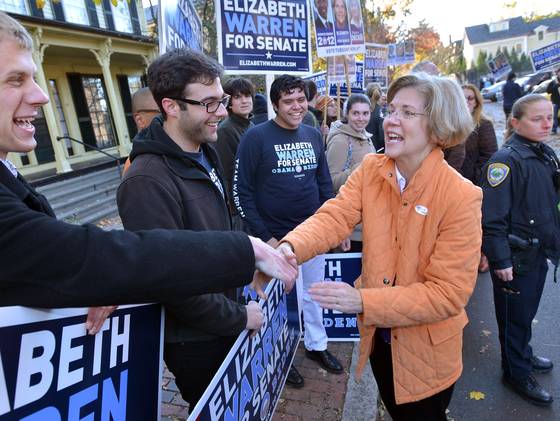
Senator-Elect Elizabeth Warren
(Photo: Josh Reynolds, AP)
Democrats keep control of U.S. Senate
by Susan Davis
USA TODAY


Democrats are going to maintain their hold on the U.S. Senate.

3:05AM EST November 7, 2012 - Democrats will maintain control of the U.S. Senate after their candidates picked up Republican-held seats in Indiana, Maine and Massachusetts, leaving the GOP no path to a takeover with the remaining competitive races that remain undecided.

Senate Majority Leader Harry Reid, D-Nev., offered a concillatory tone and called for compromise as Congress faces a daunting series of fiscal challenges in the months ahead.

"Democrats and Republicans must come together, and show that we are up to the challenge," Reid said. "This is no time for excuses. This is no time for putting things off until later. We can achieve big things when we work together."

It is the second election cycle in a row in which Republicans were favored to make gains because they were defending fewer seats, only to see their chances diminish because of missteps by their own candidates.

Sen. John Cornyn, R-Texas, chairman of the National Republican Senatorial Committee, said the party needs to take some time to process the impact of Tuesday's results.

"It's clear that with our losses in the Presidential race, and a number of key Senate races, we have a period of reflection and recalibration ahead for the Republican Party," Cornyn said. "While some will want to blame one wing of the party over the other, the reality is candidates from all corners of our GOP lost tonight. Clearly we have work to do in the weeks and months ahead."

In Indiana, Republican Richard Mourdock failed to recover from a late controversy over his remarks at a debate that pregnancy resulting from rape is "God's will" in explaining his opposition to abortion rights. Democratic Rep. Joe Donnelly was declared the winner by a narrow margin in a victory that delivered a fatal blow to lingering GOP hopes for a takeover.

Indiana Republican Senate candidate Richard Mourdock failed to recover from a late controversy over his remarks on abortion rights.(Photo: Michael Conroy, AP)

Harvard University professor and former Obama administration official Elizabeth Warren handily defeated GOP Sen. Scott Brown in one of the highest-profile races of the 2012 cycle, and the most costly in the state's history. Her victory was critical to Democrats' efforts to maintain control and hailed by liberal activists who supported her campaign.

In Maine, former Gov. Angus King sailed to victory despite the GOP's best efforts to make it a competitive race. King ran as an independent and has not said which party he intends to caucus with, but he is widely expected to sit with Democrats in the chamber. To that end, King criticized GOP strategist Karl Rove in his victory speech for directing super PAC money into Maine in an effort to defeat King. "I hope that man never comes to Maine," King said.

An early duo of Democratic re-election victories came in Ohio for Sen. Sherrod Brown and in Florida for Sen. BIll Nelson, thwarting long-shot GOP efforts for pick-ups in those states. Recent Democratic concerns about Connecticut quickly evaporated after Democratic Rep. Chris Murphy handily defeated former World Wrestling Entertainment CEO Linda McMahon, who spent nearly $100 million of her own fortune for a Senate seat in 2010 and 2012.
Sen. Sherrod Brown thwarted a long-shot GOP effort to pick up Ohio.(Photo: Tony Dejak, AP)

In Missouri, Democratic Sen. Claire McCaskill, who was targeted heavily by Republicans, pulled out a convincing win against Republican Rep. Todd Akin, whose campaign foundered after he claimed that women who were victims of rape had a biological defense against becoming pregnant.

Former Democratic Gov. Tim Kaine defeated Republican former governor and senator George Allen in the hotly contested Virginia race, maintaining the party's hold on the seat. Democratic Rep. Tammy Baldwin defeated former GOP Gov. Tommy Thompson in Wisconsin and made history: She is the first openly gay person elected to the U.S. Senate.

Republicans scored a rare victory in Nebraska, where Republican Deb Fischer defeated former Democratic Sen. Bob Kerrey, who was seeking a comeback. Fischer's victory was a GOP pick-up because the seat is currently held by retiring Democratic Sen. Ben Nelson. GOP Rep. Jeff Flake also handily won in Arizona against Democrat Richard Carmona. Texas also elected Republican Ted Cruz, a popular candidate among Tea Party activists.

In Nevada, Democratic Rep. Shelley Berkley held a narrow lead over GOP Sen. Dean Heller, another potential Democratic pick-up, but the race remained tight. Republicans were also eyeing a potential pick-up in North Dakota, where Democrat Heidi Heitkamp held a narrow lead over GOP Rep. Rick Berg in a state Republican Mitt Romney won easily.

If either Berkley or Heitkamp secures a victory, 2012 would make history for sending a new record of non-incumbent freshman women senators to the Senate. The record was set in 1996 when four new women were sent to the Senate. Four women have already won including Baldwin, Fischer, Warren and Democrat Mazie Hirono in Hawaii.

Montana was too close to call in a race pitting incumbent Democratic Sen. Jon Tester against GOP Rep. Denny Rehberg in a state Romney carried comfortably.

There were 33 Senate seats up for re-election, 23 Democrats and 10 Republicans, and most incumbents were favored to win handily. Five Republican senators and 17 Democratic senators faced no real re-election threat. With Republicans maintaining control of the U.S. House, Congress will be divided by near-identical margins next year.

All,

Elizabeth is a REAL progressive and a very strong, independent, and effective leader.  She is now also the best and most accomplished grassroots activist and public intellectual in the U.S. Senate...

Kofi


Elizabeth Warren Election Results: 
Consumer Advocate Unseats Scott Brown
11/07/2012


Elizabeth Warren defeated Sen. Scott Brown (R-Mass.) Tuesday in the race for U.S. Senate, NBC News and CBS News projected.

The Harvard Law professor and consumer advocate had narrowly been favored in recent days, as polls showed her with a slight lead over the incumbent senator.

Warren was the intellectual godmother of the Consumer Financial Protection Bureau and was its first head. She was denied a permanent appointment due to objections from congressional Republicans and from within the Treasury Department.

From the beginning, the Massachusetts Senate race attracted national attention. Brown, who opposed Obamacare, won election to the Senate in a 2010 special election at the height of the health care reform debate following the death of Sen. Ted Kennedy (D-Mass.) Warren's impassioned advocacy for economic fairness caused liberals to rally around their candidacy. Democrats were eager to reclaim the seat that Kennedy held for over four decades.

As a result, Warren became one of the top Senate fund-raisers of all time, surpassing Hillary Clinton's 2000 Senate run. Brown was also successful in fundraising, having a significant war chest from his 2010 run.

The race was neck-and-neck for most of the race, but Warren pulled away narrowly after her speech at the Democratic National Convention in Charlotte, N.C. In September.

Warren stressed that the race was about control of the Senate, and tied Brown to the national GOP. Brown distanced himself from other Senate candidates like Todd Akin of Missouri and Richard Mourdock of Indiana. In the end, Warren had an easier lift as a Democrat in a deep blue state, and Brown's moderate image only carried him so far.

Tuesday, November 6, 2012

The Politics of Race, Class, Gender and the U.S. Presidency in the Age of Obama


"There are many here among us who feel that life is but a joke, but you and I we've been through that, and that is not our fate. Let us stop talking falsely now, the hour's getting late..."

--Bob Dylan, "All Along the Watchtower," 1967
(famous cover version by Jimi Hendrix, 1968)

"It is certain, in any case, that ignorance, allied with power, is the most ferocious enemy justice can have." 
--James Baldwin


All,

I cannot emphasize enough just how crucially important and absolutely pivotal the current world-historical moment is.  If we stupidly take it all for granted and are foolish and  myopic enough to simply allow cynical resignation, solipsistic posturing, smug indifference, or braindead nihilism to consume us at this point in our collective history we will not only be brutally and soundly defeated by our ignorance, fear, alienation, and hatred(s) in collusion with our enemies but we as well as future generations will not survive the horrific consequences of that passively suicidal decision. What we should be seriously and soberly reminding ourselves at this moment of the presidential election is NOT who or what we think President Obama is or isn't at this point but far more importantly who WE are and what WE ARE PREPARED TO DO.  The raging zeitgeist is telling us all quite clearly (it's shouting at us actually) that it's "do or die" time once again in our lives whether we "like" or fully "understand" it all yet or not.  This is not the time certainly for any self serving and infantile speculations about "the future" but it is the time to take conscious hold and control of our real responsibility and obligations in the present ("nostalgia for the present" anyone?) and to ACT on the human agency that we do possess if we don't forget to exercise it.  If we fail in confronting and honestly addressing these stark economic, social, and cultural contradictions, problems, and crises on a mass scale by demanding real alternatives to the present quagmire we find ourselves in it won't matter who the next President is.  But in the meantime if we don't somehow tactically buy ourselves some admittedly very limited "free time" between now and at least 2014 (when the next midterm congressional elections take place) by keeping Romney and Ryan out of the Presidency, it will be even more difficult to fight for the major economic and political reforms that we collectively MUST immediately start fighting for when this national election is over on November 7...Meanwhile as the following article makes ominously clear an American historical replay of the "Weimar syndrome" surely awaits us all as these global crises intensify no matter what. So be prepared for real political and ideological combat no matter who's President...

Kofi
           

History's Magic Mirror: America’s Economic Crisis and the Weimar Republic of Pre-Nazi Germany 
01 November 2012
By Charles Derber and Yale Magrass,
Truthout | Op-Ed
Workers set up a digital screen for a Mitt Romney campaign event in Lancaster, Ohio, October 11, 2012. (Photo: Ty Wright / The New York Times)

Germany's economic crisis of the 1930s led to the rise of far-right populism and the Nazi Party,  fueled by the corporate and military establishment.  An American version of this "Weimar Syndrome" could emerge as the far Right closes its grip on the Republican Party.


Contrary to common wisdom, the ascendancy of the Tea Party, Christian fundamentalist, militarist, anti-feminist, anti-immigrant and other racially-coded right-wing elements in the Republican Party - that could gain preponderant influence over the nation in a Romney/Ryan Administration - is not new. It is the most recent example of the "Weimar Syndrome," where liberal and Left parties fail to solve serious economic crises, helping right-wing movements and policies - that lack major public support, but are groomed and funded by the corporate and military establishment - to take power.

These movements have sometimes created perilous right-wing systemic change. In the 1920s and early 1930s German Weimar Republic, the world witnessed the rise to power of far-right groups, supported by only a minority of the population, but aided by the conservative establishment. An American Weimar could emerge as far-right elements gain increasing dominance in the Republican Party. The corporate establishment, represented by Mitt Romney, feels dependent on their support and is willing to implement most of their agenda, despite Romney's sprouting strands of moderate rhetoric since the first debate to reach beyond the hard core.

The Weimar Syndrome involves the following elements:
1. A severe and intensifying economic crisis

2. A failure by majoritarian liberal or Left groups to resolve the crisis

3. The rise of right-wing populist groups feeling economically threatened and politically unrepresented

4. The decision of the conservative political establishment to ally with and empower these right-wing elements, as their best way to stabilize capitalism and prevent the rise of progressive movements against corporations or capitalism itself

The most dangerous Weimar right-wing populist movements in Germany were not anti-statist, a distinctively American approach, and were brutally violent. Moreover, they would never support a candidate offering conciliatory rhetoric to appeal to the unconverted. While thus different than US ultra-conservative elements in the Republican Party today, who do not pose now the same type of danger, they nonetheless offer alarming lessons for America today.

The disastrous defeat in World War I and the ensuing hyperinflation and collapse of the German economy spawned hundreds of far-right populist groups. The most famous Weimar populists were the Nazis, but in 1920s Weimar they were just one of many hyper-nationalist, militarist and "family value" fringe groups not taken seriously by either the conservative or social democratic German Establishment.

The Weimar populists were "Red State" rural and small town Germans, rooted in small business, a demographic much like the Tea Party. Their leaders expressed the insecurity and rage of these conservative traditional classes.

Rural and small town Germans felt threatened by the humiliating defeat in the Great War and Weimar's crushing economic crises. Using racist demagoguery, the Weimar populists blamed both the military defeat and the economic crisis on Jews, the leading "traitors" concentrated in Berlin and other great cities. Under Weimar, big cities had become a cauldron of new movements for unionism, socialism and Communism, feminism and artistic experimentation.

The leading German liberal and conservative parties dismissed the Weimar right-wing populists as extremists and lunatics. By the early 1930s, though, the conservative corporate establishment viewed Hitler as the only alternative to a liberal or Communist takeover as the economy collapsed. German conservative elites correctly believed he would dispose of the Communists but erroneously calculated that they could contain Hitler himself. So they put him in power despite his electoral weakness and funded his militaristic solutions for the German crisis, which they thought would also save German capitalism.

Right-wing populists in the US also emerged in the Weimar era of the 1920s, involving Christian evangelicals such as Billy Sunday, as well as the Ku Klux Klan. They expressed anti-establishment religious revivalism and racist calls for restoring the traditional order and honor of the South. In the 1930s, the American Liberty League formed a Tea Party ancestor that opposed the entire New Deal as unconstitutional statism.

From the 1960s to the 1980s, the United States underwent even greater division between a counterculture tied to a Left that saw the Vietnam War as emblematic of a flawed militaristic empire against a "silent majority" - a term coined by President Nixon to suggest a majoritarian right-wing America backed by the GOP establishment - committed to American glory, free market capitalism, traditional families, the virtues of hard work, and for some, white rights and Christian values.

By the late 1970s, the Silent Majority morphed - with aid from the Republican corporate establishment - into the populist "New Right." The New Right groups embraced unrestrained capitalism as "Christian," something which evangelical movements had seldom previously done. The American corporate elite found this version of populism - which they helped shape - palatable, especially when, like the German establishment during Weimar, it confronted a threat from the Left.

The 1970s New Right was a new generation of Christian fundamentalist populists emphasizing traditional values and free markets. In 1980, the New Right helped elect President Ronald Reagan and helped consolidate the Republican establishment's hold on power, based on the odd marriage of big corporations and Southern right-wing populism.

For all the talk about how polarized the United States is now - with polarization between a minority conservative rural populace and a progressive urban demographic - a feature of the Weimar Syndrome - it was far more so from the late 1960s through the late 1970s. Then, there was a real Left that was undermining the latitude of the American military. Many within the younger generation were rejecting the capitalist consumerist society that they were supposed to inherit. Japan and Europe were showing signs of surpassing the United States economically. Some within the corporate elite, like David Rockefeller, felt it was essential to re-establish respect for traditional authority.

A few years before the rift of the late 1970s, much of the American corporate establishment would have seen the Christian Right as a "loony fringe," but like the German elite of the early 1930s, they felt a need to find someone to return order and stability. Although many were previously suspicious of Ronald Reagan, they allowed him to become president. Hitler promised German honor would be restored and Germany would never again lose a war. Reagan made the same promise to America. The German business community thought they could contain Hitler. They were wrong. The American business community hoped they could control Reagan and it turns out they were correct. Reagan built a coalition between the corporate elite and the evangelical Right. He did not enact the programs of the fundamentalists, but he gave them lip-service as their perspective gained respectability. He re-centered the political spectrum as the real Left fell beyond the edge and liberalism, which previously had been the mainstream, became the "L-word."

Reagan dissipated the crisis that he was brought into office to resolve, but his fiscal and military policies laid the seeds for the present economic catastrophe, the structural heart of a Weimar era. He doubled the government deficit as jobs and infrastructures were exported. Despite underlying instability, reflecting the beginning of the a long American decline, there appeared to be a surface return to normalcy, prosperity and patriotism and today, even some liberals remember his tenure nostalgically.

The Tea Party and the right-wing groups in the Republican Party and House, led by Paul Ryan, are the step-children of Reagan, the New Right and the latest incarnation of right-wing populism. They pose new challenges for the corporate establishment in the GOP. How they deal with the Tea Party and Ryan Republicans will shape a possible Romney administration.

Long-term decline increases the radicalism of right-wing populists and the political volatility of the population. The corporate and GOP establishment, represented by Mr. Romney, are betting the ranch that they can again contain the new Far Right populists. But they are increasingly dependent on them, as evidenced by the pick of Ryan as Romney's running mate.

Romney insists that he, not Ryan, is the head of the Republican Party, and he is shape-shifting back to the image of moderation during his Massachusetts governorship. But a look at Romney's endorsement of the Ryan budget, his electoral-season new marriage with the southern Evangelical, militarist and racist elements in the party, and his own "severely conservative" budget and policy suggest the real Romney, in characteristic Weimar fashion, has embraced the right-wing Ryan factions and chosen to empower them.

Anti-tax guru Grover Norquist said, "We just need a president to sign this stuff.... Pick a Republican with enough working digits to handle a pen." Romney is willing. He has said would sign the Ryan budget, the document crystallizing all the Tea Party dreams of drowning the social welfare government in the bathtub.

He has spoken for a new hegemonic American militarism and proclaimed, "This century must be an American Century ... [Obama] has chosen this moment for wholesale reductions in the nation's military capacity ... This conduct is contemptible. It betrays our national interest." He has joined anti-immigrant forces by opposing the Dream Act, while attacking Obama as a "food stamp" president and thereby appealing to all the racially coded elements in the party. This is a corporate presidential candidate adopting through most of the campaign the Weimar strategy of embracing the most Rightist elements in the GOP, and only muting his "severe" conservative tone very late in the campaign to expand his base beyond true believers.

President Obama's inability to lead the country, in FDR fashion, toward a New Deal that might solve the economic crisis, opens the door to a Weimar outcome. The corporate establishment fears even the weak populist tone that Obama has embraced during this election season, and sees both the long economic crisis and an Obama victory as eroding their power and potentially subverting capitalism itself.

The obvious lesson is that in periods of severe crisis and long-term decline, all bets are off. The establishment is risking not only the Republic, but its own survival. Only the progressive popular movements - mobilized by righteous anger at the plutocratic globalizing elites disinvesting from the nation itself as they embrace far-right nationalism and populism - can ward off a potentially disastrous repeat of the 1920s Weimar march into decay and barbarism.

Copyright, Truthout. May not be reprinted without permission.


CHARLES DERBER AND YALE MAGRASS

Charles Derber, Professor of Sociology at Boston College and Yale Magrass, Chancellor Professor of Sociology at University of Massachusetts, Dartmouth, are co-authors of The Surplus American (Paradigm 2012) and Morality Wars (Paradigm 2010).


We Need More than a New President
by Saket Soni
October 2, 2012  


This article appeared in the October 22, 2012 edition of The Nation.
Supporters react to seeing President Barack Obama stake the stage during a campaign event at the University of Wisconsin-Madison, Thursday, Oct. 4, 2012, in Madison, Wis. (AP Photo/Pablo Martinez Monsivais)

In Mitt Romney’s America, 47 percent of the people live on government handouts, incapable of taking responsibility for their lives. In the real America, ordinary people are working harder than ever for less and less. Work once held a promise: it would allow workers to sustain their families, contribute to a community, and realize their full potential as human beings. In today’s economy, this promise no longer holds.

Workers know something about the economy that neither party has faced up to: work in America has changed, fundamentally and forever. First, the nature of employment has changed. Millions of people don’t work for the ultimate beneficiary of their labor, but for subcontractors or suppliers. Millions more are temporary, part-time or “self-employed.” A third of the US workforce—42.6 million workers—is now contingent. Tens of millions of workers no longer know who their real boss is.

Second, the nature of unemployment has shifted. Workers used to be employed for long periods; unemployment was short-term. Workers now face long-term unemployment interrupted by intermittent employment. Forty percent of the unemployed have been jobless for twenty-seven weeks. Unemployment is twice as high for African-Americans as for whites, and one and a half times as high for Latinos.

Third, the US workforce itself has changed. Today’s workforce isn’t just middle-aged white men: it’s women (49 percent), people of color, undocumented immigrants, young workers, baby boomers forced to delay retirement and guest workers. US companies now source workers from all over the globe, importing cheap labor for local jobs. And where there is prospective job growth, it’s overwhelmingly in low-wage sectors like service and retail.

Ana Rosa Diaz can tell you what the US workplace will look like at the end of this road. Jobless in Mexico, Ana was recruited to come to the United States as a guest worker. She peeled crawfish for a Walmart supplier in Louisiana that subjected her and her fellow workers to forced labor: they were compelled to work up to twenty-four-hour shifts with no overtime pay and were also locked in the plant to prevent breaks. When the workers spoke up, the boss threatened violence against their families.

On our current path, we all end up as guest workers: trapped in an economy of temporary, intermittent work, subcontracted, migratory, struggling with debt rather than building wealth, sourced into labor supply chains rather than climbing career ladders.

We need to use a second Obama term to create the conditions for winning a new social contract for a new economy. That means creating new forms of collective bargaining that let contingent workers and service workers bargain directly with the corporate actors that set the conditions of their jobs and their lives. It also means winning a vastly expanded role for the state in protecting all workers, including a new social safety net that addresses the rise of contingent work and long-term unemployment.

That will take more than a president; it’ll take a social movement. Because what’s really at stake isn’t the next four years—it’s the next forty.

http://www.nytimes.com/2012/10/28/opinion/sunday/the-price-of-a-black-president.html?pagewanted=all
 
All, 

Though far too many Americans and especially African Americans erroneously think or feel that this kind of incisive critical analysis of and aggressive civic engagement with the President should not be taking place because they/we fear that doing so "in public" somehow "weakens" or "undermines" Obama's image and/or political status among his many enemies and detractors, the far bigger and more important truth is that it is precisely these kind of mature critical assessments and diagnoses that not only should but MUST be made if we are to fully and maturely exercise our fundamental rights and responsibilities as citizens and human beings no matter who is in the White House or what political party is seeking to 'represent us' and our interests in any capacity in government.  Whether we support the President's bid for re-election or not it makes no sense and can only harm us in both the short and the long run if we simply attempt to petulantly censor ourselves or others who desire and need to make our demands and aspirations known to our chosen "leaders" whether they are in or out of government.  One of the biggest and most costly errors, mistakes, and inexcusable flaws of the past four years in U.S. political life--and this is especially true generally of both the national African American population and the broader multiracial, multiethnic radical/progressive American Left--is that far too often we paid a passive and even lazy deference to the President and his administration out of an "understandable" but ultimately egregious and irresponsible desire to merely protect and shield him from his many fierce enemies on the right at the expense of our own direct engagement, and as a result we too often wound up giving Obama and his adminstration a pass on his various public policy initiatives and positions (or lack thereof) when we should have been vigorously critically questioning, challenging, and even when the situation and circumstances required or called for it, actively opposing what he was doing and putting forth viable alternatives.  Given the incredible racial and philosophical siege/assault that this President has been relentlessly subjected to by the savage and psychotic Republican/Tea Party right it hasn't always been either easy or pleasant for fellow African Americans like Dr. Harris in this article or individuals like myself among others in the "national black community" (sic) to cpnfront or take on Obama in a critical or rational analytical context because we fully realize and deeply appreciate what Barack is up against and how truly difficult his task is but just as this bedrock reality doesn't mean that he as President can simply dismiss or evade his own deeper responsibilities and obligations to serve ALL of his many constituencies and support groups in a just, fair, and equitable manner, we as independent citizens and an integral part of these larger communities must also be willing and able to fully strive in a serious and disciplined manner for justice, freedom, and equality no matter who is in power, what they look like, or where they come from.  Thus I strongly applaud Dr. Harris and many other mature and serious critics of this President-- no matter what their nationality or "ethnicity" happens to be-- who while fundamentally sympathetic to and even in many cases largely supportive of him and his agenda are determined at ALL TIMES to speak truth to power and to call for, advocate, struggle for, and defend positions and critiques that may greatly diverge from or even be in direct opposition to the President and his agenda at any given time or place.  It's not only the right thing to do but it's the only way we can responsibly assert our own political and ideological agency and sense of independence and sovereignty as citizens and truly engaged members of the larger body politic...Stay tuned...

Kofi  
  
OPINION 


The Price of a Black President
Bruce Davidson/Magnum Photos
Young men joined the march from the Selma to Montgomery, Ala., organized by the Rev. Dr. Martin Luther King Jr. in March 1965.

By FREDRICK C. HARRIS
October 27, 2012
New York Times


WHEN African-Americans go to the polls next week, they are likely to support Barack Obama at a level approaching the 95 percent share of the black vote he received in 2008. As well they should, given the symbolic exceptionalism of his presidency and the modern Republican Party’s utter disregard for economic justice, civil rights and the social safety net.

But for those who had seen in President Obama’s election the culmination of four centuries of black hopes and aspirations and the realization of the Rev. Dr. Martin Luther King Jr.’s vision of a “beloved community,” the last four years must be reckoned a disappointment. Whether it ends in 2013 or 2017, the Obama presidency has already marked the decline, rather than the pinnacle, of a political vision centered on challenging racial inequality. The tragedy is that black elites — from intellectuals and civil rights leaders to politicians and clergy members — have acquiesced to this decline, seeing it as the necessary price for the pride and satisfaction of having a black family in the White House.

These are not easy words to write. Mr. Obama’s expansion of health insurance coverage was the most significant social legislation since the Great Society, his stimulus package blunted much of the devastation of the Great Recession, and the Dodd-Frank financial overhaul added major new protections for consumers. His politics would seem to vindicate the position of civil rights-era leaders like Bayard Rustin, who argued that blacks should form coalitions with other Democratic constituencies in support of universal, race-neutral policies — in opposition to activists like Malcolm X, who distrusted party politics and believed that blacks would be better positioned to advance their interests as an independent voting bloc, beholden to neither party.

But the triumph of “post-racial” Democratic politics has not been a triumph for African-Americans in the aggregate. It has failed to arrest the growing chasm of income and wealth inequality; to improve prospects for social and economic mobility; to halt the re-segregation of public schools and narrow the black-white achievement gap; and to prevent the Supreme Court from eroding the last vestiges of affirmative action. The once unimaginable successes of black diplomats like Colin L. Powell, Condoleezza Rice and Susan E. Rice and of black chief executives like Ursula M. Burns, Kenneth I. Chenault and Roger W. Ferguson Jr. cannot distract us from facts like these: 28 percent of African-Americans, and 37 percent of black children, are poor (compared with 10 percent of whites and 13 percent of white children); 13 percent of blacks are unemployed (compared with 7 percent of whites); more than 900,000 black men are in prison; blacks experienced a sharper drop in income since 2007 than any other racial group; black household wealth, which had been disproportionately concentrated in housing, has hit its lowest level in decades; blacks accounted, in 2009, for 44 percent of new H.I.V. infections.

Mr. Obama cannot, of course, be blamed for any of these facts. It’s no secret that Republican obstruction has limited his options at every turn. But it’s disturbing that so few black elites have aggressively advocated for those whom the legal scholar Derrick A. Bell called the “faces at the bottom of the well.”

The prophetic tradition of speaking truth to power, regardless of political winds or social pressures, has a long history. Ida B. Wells risked her life to publicize the atrocity of lynching; W. E. B. Du Bois linked the struggle against racial injustice to anticolonial movements around the world; Cornel West continues to warn of the “giant triplets of racism, materialism and militarism” that King identified a year before his death.

But that prophetic tradition is on the wane. Changes in black religious practice have played a role. Great preachers of social justice and liberation theology, like Gardner C. Taylor, Samuel DeWitt Proctor, John Hurst Adams, Wyatt Tee Walker and Joseph E. Lowery, have retired or passed away. Taking their place are megachurch preachers of a “gospel of prosperity” — like Creflo A. Dollar Jr., T. D. Jakes, Eddie L. Long and Frederick K. C. Price — who emphasize individual enrichment rather than collective uplift. “There’s more facing us than social justice,” Bishop Jakes has said. “There’s personal responsibility.”

Mr. Obama hasn’t embraced this new gospel, but as a candidate he did invoke the politics of respectability once associated with Booker T. Washington. He urged blacks to exhibit the “discipline and fortitude” of their forebears. He lamented that “too many fathers are M.I.A.” He chided some parents for “feeding our children junk all day long, giving them no exercise.” He distanced himself from his former pastor, the Rev. Jeremiah A. Wright Jr., whose incendiary remarks about racism’s legacy caused a maelstrom.

But as president, Mr. Obama has had little to say on concerns specific to blacks. His State of the Union address in 2011 was the first by any president since 1948 to not mention poverty or the poor. The political scientist Daniel Q. Gillion found that Mr. Obama, in his first two years in office, talked about race less than any Democratic president had since 1961. From racial profiling to mass incarceration to affirmative action, his comments have been sparse and halting.

Early in his presidency, Mr. Obama weighed in after the prominent black Harvard professor Henry Louis Gates Jr. was arrested at his home in Cambridge, Mass. The president said the police had “acted stupidly,” was criticized for rushing to judgment, and was mocked when he invited Dr. Gates and the arresting officer to chat over beers at the White House. It wasn’t until earlier this year that Mr. Obama spoke as forcefully on a civil rights matter — the fatal shooting of an unarmed black teenager, Trayvon Martin, in Florida — saying, “If I had a son, he’d look like Trayvon.”

INSTEAD of urging Mr. Obama to be more outspoken on black issues, black elites parrot campaign talking points. They dutifully praise important but minor accomplishments — the settlement of a longstanding class-action lawsuit by black farmers; increased funds for black colleges; the reduction (but not elimination) of the disparities in sentences for possession of crack and powder cocaine — while setting aside their critical acumen.

For some, criticism of Mr. Obama is disloyal. “Stick together, black people,” the radio host Tom Joyner has warned. (Another talk show host, Tavis Smiley, joined Dr. West on a “poverty tour” last year, but has been less critical of the president than Dr. West has.)

It wasn’t always so. Though Bill Clinton was wildly popular among blacks, black intellectuals fiercely debated affirmative action, mass incarceration, welfare reform and racial reconciliation during his presidency. In 2001, the Harvard law professor Charles J. Ogletree called the surge in the inmate population “shocking and regrettable” and found it “shameful” that Mr. Clinton “didn’t come out and take a more positive and symbolic approach to the issue of reparations for slavery.” But Mr. Ogletree, a mentor of Mr. Obama’s, now finds “puzzling the idea that a president who happens to be black has to focus on black issues.”

Melissa V. Harris-Perry, a political scientist at Tulane who hosts a talk show for MSNBC, warned in 2005 that African-Americans “who felt most warmly toward Clinton and most trusting of his party’s commitment to African-Americans” were in danger of underestimating “the continued economic inequality of African-Americans relative to whites.” But she has become all but an apologist for Mr. Obama. “No matter what policies he pursues, the president’s racialized embodiment stands as a symbol of triumphant black achievement,” she wrote in The Nation this month.

Black politicians, too, have held their fire. “With 14 percent unemployment if we had a white president we’d be marching around the White House,” Representative Emanuel Cleaver II of Missouri, the chairman of the Congressional Black Caucus, told The Root last month. “The president knows we are going to act in deference to him in a way we wouldn’t to someone white.”

Some of the reticence stems from fear. “If we go after the president too hard, you’re going after us,” Representative Maxine Waters, a California Democrat, told a largely black audience in Detroit last year.

But caution explains only so much. Representative John Lewis of Georgia, one of King’s last living disciples, has not used his moral stature to criticize the president’s silence about the poor. Neither have leaders of the biggest civil rights organizations, like Benjamin Todd Jealous of the N.A.A.C.P., Marc H. Morial of the National Urban League or Wade Henderson of the Leadership Conference on Civil and Human Rights, whether because of emotional allegiance or pragmatic accommodation.

The two black governors elected since Reconstruction — L. Douglas Wilder of Virginia and Deval L. Patrick of Massachusetts — have also de-emphasized race. So, too, have the new cadre of black politicians who serve largely black constituencies, like Mayor Cory A. Booker of Newark, Mayor Michael A. Nutter of Philadelphia and Representative Terri Sewell of Alabama — all of whom, like Mr. Obama, have Ivy League degrees and rarely discuss the impact of racism on contemporary black life.

Some argue that de-emphasizing race — and moving to a “colorblind” politics — is an inevitable and beneficial byproduct of societal change. But this ideal is a myth, even if it’s nice to hear. As Frederick Douglass observed, “Power concedes nothing without a demand.” The political scientist E. E. Schattschneider noted that conflict was essential to agenda-setting. Other interest groups — Tea Party activists, environmentalists, advocates for gay and lesbian rights, supporters of Israel and, most of all, rich and large corporations — grasp this insight. Have African-Americans forgotten it?

IN making this case, I have avoided speculation about Mr. Obama’s psychology and background — his biracial heritage, his transnational childhood, his community organizing, his aversion to being seen as “angry,” his canny ability to navigate multiple worlds, his talent at engaging with politics while appearing detached from it. As a social scientist I keep returning to the question: What is the best strategy for black communities to pursue their political interests as a whole?

Were Harold Cruse, the author of the unsparing 1967 book “The Crisis of the Negro Intellectual,” still alive, he would despair at the state of black intellectual life. Eddie S. Glaude Jr., a professor of religion and African-American studies at Princeton, told me: “Too many black intellectuals have given up the hard work of thinking carefully in public about the crisis facing black America. We have either become cheerleaders for President Obama or self-serving pundits.”

There are exceptions. Writing in the journal Daedalus last year, the Harvard philosopher Tommie Shelby called Mr. Obama’s approach “a pragmatic strategy for navigating hazardous racial waters” that might improve lives for poor minorities. But he added: “Judged alongside King’s transformative vision of racial equality and integration, Obama’s philosophy is morally deficient and uninspiring.”

Mr. Obama deserves the electoral support — but not the uncritical adulation — of African-Americans. If re-elected he might surprise us by explicitly emphasizing economic and racial justice and advocating “targeted universalism” — job-training and housing programs that are open to all, but are concentrated in low-income, minority communities. He would have to do this in the face of fiscal crisis and poisonous partisanship.

Amid such rancor, African-Americans might come to realize that the idea of having any politician as a role model is incompatible with accountability, the central tenet of representative democracy. By definition, role models are placed on pedestals and emulated, not criticized or held accountable.

To place policy above rhetoric is not to ask what the first black president is doing for blacks; rather, it is to ask what a Democratic president is doing for the most loyal Democratic constituency — who happen to be African-Americans, and who happen to be in dire need of help. Sadly, when it comes to the Obama presidency and black America, symbols and substance have too often been assumed to be one and the same.   


Dr. Fredrick Harris is a professor of political science and the director of the Institute for Research in African-American Studies at Columbia University, and the author of “The Price of the Ticket: Barack Obama and the Rise and Decline of Black Politics (Oxford University Press,  2012)